DNA Sequencing
December 24, 2025, 2:01 PM
Record-Breaking DNA Sequencing Technology Could Transform Newborn Care | The Scientist
In 2022, a team at Stanford University set the Guinness World Records title for the fastest DNA sequencing technique for five hours and two minutes. Now, a team from Roche, Broad Clinical Labs, and Boston Children's Hospital broke this record by sequencing a reference sample in less than four hours (three hours and 57 minutes). Testing Roche’s novel sequencing technology in a small group of NICU infants, the team delivered answers within the same work shift—from blood draw to report. Their results, published in the New England Journal of Medicine, highlight the potential of this technology to bring genetic answers to clinicians and their patients faster than ever before. Uses an SBX expansion of the DNA
DNA sequencing is the process of determining the precise order of nucleotides within a DNA molecule. It includes any method or technology that is used to determine the order of the four bases—adenine, guanine, cytosine, and thymine—in a strand of DNA. The advent of rapid DNA sequencing methods has greatly accelerated biological and medical research and discovery.
DNA sequencing may be used to determine the sequence of individual genes, larger genetic regions (i.e. clusters of genes or operons), full chromosomes or entire genomes, of any organism. DNA sequencing is also the most efficient way to sequence RNA or proteins (via their open reading frames). In fact, DNA sequencing has become a key technology in many areas of biology and other sciences such as medicine, forensics, or anthropology. See Genome Sequencing for whole Genome.
RNA was sequenced first, leading to the complete sequence of Bacteriophage MS2 in 1972, whilst the first full DAN sequence was also a bacteriophage PhiX174 which had 5386 base pairs.
The first main method of sequencing were the Maxam/Gilbert method of chemical sequencing. It used radioactive labelling and was not so popular as the Sanger method. Sanger used a Chain-Termination Method.
The classical chain-termination method requires a single-stranded DNA template, a DNA primer, a DNA polymerase, normal deoxynucleosidetriphosphates (dNTPs), and modified di-deoxynucleotidetriphosphates (ddNTPs), the latter of which terminate DNA strand elongation. These chain-terminating nucleotides lack a 3'-OH group required for the formation of a phosphodiester bond between two nucleotides, causing DNA polymerase to cease extension of DNA when a modified ddNTP is incorporated. The ddNTPs may be radioactively or fluorescently labeled for detection in automated sequencing machines.
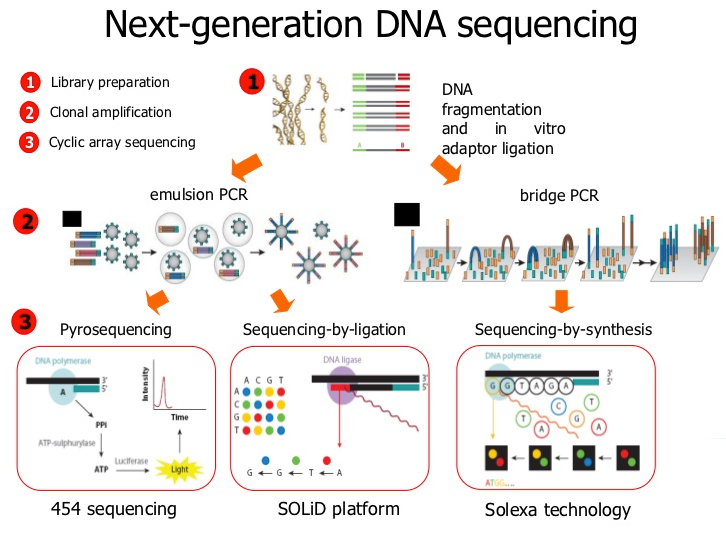
High-throughput (formerly "next-generation") sequencing applies to genome sequencing, genome resequencing, transcriptome profiling (RNA-Seq), DNA-protein interactions (ChIP-sequencing), and epigenome characterization. Resequencing is necessary, because the genome of a single individual of a species will not indicate all of the genome variations among other individuals of the same species.
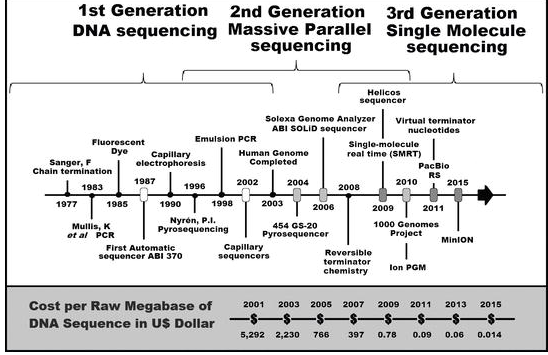
The high demand for low-cost sequencing has driven the development of high-throughput sequencing technologies that parallelize the sequencing process, producing thousands or millions of sequences concurrently. High-throughput sequencing technologies are intended to lower the cost of DNA sequencing beyond what is possible with standard dye-terminator methods. In ultra-high-throughput sequencing as many as 500,000 sequencing-by-synthesis operations may be run in parallel.
There are many newer more automated methods and I fail to comprehend most of them. But November 15, 2022, 11:43 AM see WES. The target of new sequencers is less than 1 error every 100,000 bases.
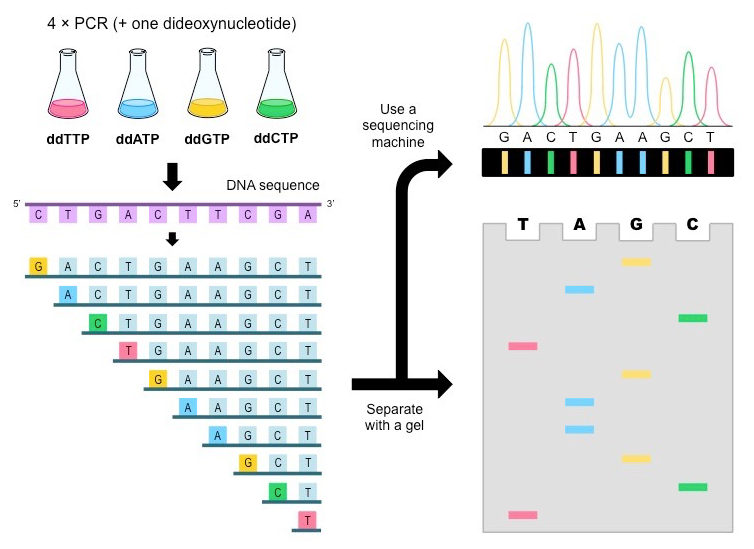

These illustrate the Sanger method.
Next Generation :

The first successful transfer of DNA Sequence over the Ethereum Blockchain. April 2018 Enterobacteria Phage phiX174 sensu lato--see article