Mount_Olympus
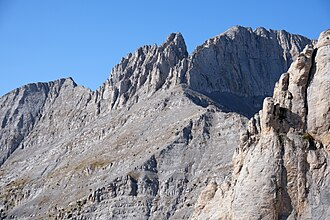
Mount Olympus (/oʊˈlɪmpəs, əˈlɪm-/,[5] Greek: Όλυμπος, romanized: Ólympos, IPA: [ˈoli(m)bos]) is an extensive massif near the Thermaic Gulf of the Aegean Sea, located on the border between Thessaly and Macedonia, between the regional units of Larissa and Pieria, about 80 km (50 mi) southwest from Thessaloniki.[6] Mount Olympus has 52 peaks and deep gorges.[7] The highest peak, Mytikas (Μύτικας Mýtikas), meaning "nose", rises to 2,917.727 metres (9,572.60 ft) and is the highest peak in Greece,[1][8][9] and one of the highest peaks in Europe in terms of topographic prominence.[10]
In Greek mythology, Olympus is the home of the Greek gods, on Mytikas peak. The mountain has exceptional biodiversity and rich flora.[11] It has been a National Park, the first in Greece, since 1938. It is also a World Biosphere Reserve.[8]
Olympus remains the most popular hiking summit in Greece, as well as one of the most popular in Europe. Organized mountain refuges and various mountaineering and climbing routes are available. The usual starting point is the town of Litochoro which lies in the eastern foothills of the mountain, some 100 km (62 mi) from Thessaloniki.
The origin of the name Όλυμπος (Olympos) is unknown.[22] One theory suggests that it is compounded of ou lyma (οὐ λύμα) and pous (πούς), meaning "pure foot", conforming to Hesiod's description of the earth as a sort of footstool for heaven up from which rise the "Blessed Gods".[23] According to Robert S.P. Beekes the word is of pre-Greek origin and he speculates that it originally meant "mountain".[22][24] The word is also probably cognate with the Mycenean Greek word 𐀄𐀬𐀠𐀊𐀍 (u-ru-pi-ja-jo) which is, most likely, a term used to describe people, or possibly an ethnic group.[25] In Homeric Greek (Odyssey 6.42), the variant Οὔλυμπος Oulumpos occurs, conceived of as the seat of the gods (and not identified with any specific peak). Homer (Iliad 5.754, Odyssey 20.103) also appears to be using οὔλυμπος as a common noun, as a synonym of οὐρανός ouranos "sky". Mount Olympus was historically also known as Mount Belus,[26] after Iliad 1.591, where the seat of the gods is referred to as βηλὸς θεσπέσiος "heavenly threshold".[a]
In Ancient Greek religion and mythology, "Olympus" was the name of the home of the Twelve Olympian gods.[28] This was conceived of as a lofty mountaintop, and in all regions settled by Greek tribes, the highest local elevation tended to be so named; among the numerous peaks called Olumpos in antiquity are mountains in Mysia, Laconia, Lycia, Cyprus, Attica, Euboea, Ionia and Lesbos, and others.[citation ^needed] Thessalian Olympus is the highest peak in any territory with Greek settlement and came to be seen as the "Pan-Hellenic" representative of the mythological seat of the gods, by at least the 5th century BC, as Herodotus (1.56) identifies Olympus as the peak in Thessaly.
In Pieria, at Olympus's northern foot, the mythological tradition had placed the nine Muses, patrons of the Fine Arts, daughters of Zeus and the Titaness Mnemosyne.[29]
In antiquity, the Olympus massif formed the border between Thessaly and Macedon. The history of the surrounding area is consequently of interest in the context of the Rise of Macedon, the Chremonidean War and the Macedonian Wars during the 4th to 2nd centuries BC. In the period of the Ottoman Empire the mountain was a hiding place and base of operations for klephts and armatoloi. It was known as Semavatevi in Turkish during the nearly 400 years of Ottoman rule.[8]
In Olympus, the second armatoliki was founded, led by Kara Michalis in 1489. The action of the klephts in Olympus led the Turks to visit their outrage on the klephts' ally-village of Milia (in the late 17th century), which they destroyed. In that period Livadi in Olympus became the seat of the armatoliki of Olympus and Western Macedonia, with their first renowned commander Panos Zidros. In the 18th century the Turks had to replace the armatoloi (who very often joined the klephts) with Muslim Albanian armatoloi who ravaged the countryside of Macedonia. However, Olympus's armatoloi, even after their capitulation to Ali Pasha, never ceased fighting on land and at sea. Among them who were active there and in nearby regions were Nikotsaras, Giorgakis Olympios and the legendary family of Lazaioi. In the early 20th century, even for some time after the liberation from the Ottoman Empire (1912), robbers were active in the region – the best known of them the notorious Giagoulas (el), while during the German invasion in 1941 the Hellenic Army fought significant battles along with units of New Zealanders and Australians. During the German Occupation (1941–1944) the mountain was one of the centers of the Greek Resistance, while a little later the Greek Civil War (1946–49) started there, in Litochoro.[30]