Carl_Jung
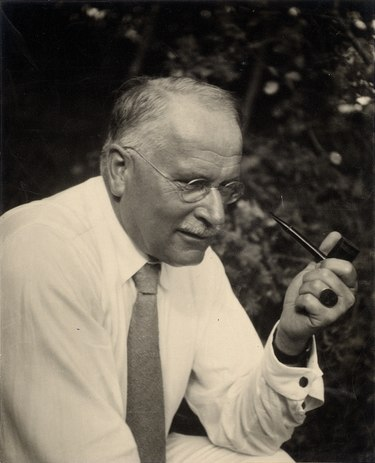
Jung, c. 1935
Carl Jung approached Gnosticism from a psychological perspective, which was followed by Gilles Quispel. According to this approach, Gnosticism is a map for the human development in which an undivided person, centered on the Self, develops out of the fragmentary personhood of young age. According to Quispel, gnosis is a third force in western culture, alongside faith and reason, which offers an experiential awareness of this Self.
Carl Gustav Jung (/jʊŋ/ YUUNG;[1][2] Swiss Standard German: [karl jʊŋ]; 26 July 1875 – 6 June 1961) was a Swiss psychiatrist, psychotherapist, and psychologist who founded the school of analytical psychology.[3][a] A prolific author of over twenty books, illustrator, and correspondent, Jung was a complex and convoluted academic, best known for his concept of archetypes. Alongside contemporaries[b] Sigmund Freud and Alfred Adler, Jung became one of the most influential psychologists of the early 20th century and has fostered not only scholarship, but also popular interest.[6]
Jung's work has been influential in the fields of psychiatry, anthropology, archaeology, literature, philosophy, psychology,[7] and religious studies. He worked as a research scientist at the Burghölzli psychiatric hospital in Zurich, under Eugen Bleuler.
- Jung established himself as an influential mind, developing a friendship with Freud, founder of psychoanalysis, conducting a lengthy correspondence paramount to their joint vision of human psychology. Jung is widely regarded as one of the most influential psychologists in history.[8][9]
Freud saw the younger Jung not only as the heir he had been seeking to take forward his "new science" of psychoanalysis but as a means to legitimize his own work: Freud and other contemporary psychoanalysts were Jews facing rising antisemitism in Europe, and Jung was raised as Christian, although he did not strictly adhere to traditional Christian doctrine, he saw religion, including Christianity, as a powerful expression of the human psyche and its search for meaning.[10] Freud secured Jung's appointment as president of Freud's newly founded International Psychoanalytical Association. Jung's research and personal vision, however, made it difficult to follow his older colleague's doctrine, and they parted ways. This division was painful for Jung and resulted in the establishment of Jung's analytical psychology, as a comprehensive system separate from psychoanalysis.
Among the central concepts of analytical psychology is individuation—the lifelong psychological process of differentiation of the self out of each individual's conscious and unconscious elements. Jung considered it to be the main task of human development. He created some of the best-known psychological concepts, including synchronicity, archetypal phenomena, the collective unconscious, the psychological complex, and extraversion and introversion.
- Jung's treatment of American businessman and politician Rowland Hazard in 1926 with his conviction that alcoholics may recover if they have a "vital spiritual (or religious) experience" played a crucial role in the chain of events that led to the formation of Alcoholics Anonymous.[11] Jung was an artist, craftsman, builder, and prolific writer. Many of his works were not published until after his death, and some remain unpublished.[12]
The Black Books and The Red Book
Main articles: The Red Book (Jung) and Black Books (Jung)

The Red Book resting on Jung's desk
In 1913, at the age of 38, Jung experienced a horrible "confrontation with the unconscious". He saw visions and heard voices. He worried at times that he was "menaced by a psychosis" or was "doing a schizophrenia". He decided that it was a valuable experience and, in private, he induced hallucinations or, in his words, a process of "active imagination".
Jung recorded everything he experienced in small journals, which Jung referred to in the singular as his Black Book,[74] considering it a "single integral whole", even though some of these original journals have a brown cover.[74] The material Jung wrote was subjected to several edits, hand-written and typed, including another, "second layer" of text, his continual psychological interpretations during the process of editing.[75][76]
Around 1915, Jung commissioned a large red leather-bound book,[77][78] and began to transcribe his notes and paint, working intermittently for sixteen years.[9]
Jung left no posthumous instructions about the final disposition of what he called the Liber Novus or Red Book. Sonu Shamdasani, a historian of psychology from London, tried for three years to persuade Jung's resistant heirs to have it published. Ulrich Hoerni, Jung's grandson who manages the Jung archives, decided to publish it when the necessary additional funds were raised through the Philemon Foundation.[9] Up to September 2008, fewer than about two dozen people had ever seen it.
In 2007, two technicians for DigitalFusion, working with New York City publishers W. W. Norton & Company, scanned the manuscript with a 10,200-pixel scanner. It was published on 7 October 2009 in German, with a "separate English translation along with Shamdasani's introduction and footnotes" at the back of the book. According to Sara Corbett, reviewing the text for The New York Times, "The book is bombastic, baroque and like so much else about Carl Jung, a willful oddity, synched with an antediluvian and mystical reality."[9]
The Rubin Museum of Art in New York City displayed Jung's Red Book leather folio, as well as some of his original "Black Book" journals, from 7 October 2009 to 15 February 2010.[79] According to them, "During the period in which he worked on this book Jung developed his principal theories of archetypes, collective unconscious, and the process of individuation." Two-thirds of the pages bear Jung's illuminations and illustrations to the text.[79]
Wartime army service
During World War I, Jung was drafted as an army doctor and soon made commandant of an internment camp for British officers and soldiers. The Swiss were neutral and obliged to intern personnel from either side of the conflict, who crossed their frontier to evade capture. Jung worked to improve the conditions of soldiers stranded in Switzerland and encouraged them to attend university courses.[80][81]
Saturday, November 08, 2025 09:45PM