Thor
Thor (from Old Norse: Þórr) is a prominent god in Germanic paganism. In Norse mythology, he is a hammer-wielding god associated with thunder, storms, strength, protection, fertility, and farmers. Besides Old Norse Þórr, the deity occurs in Old English as Thunor, in Old Frisian as Thuner, in Old Saxon as Thunar, and in Old High German as Donar, all ultimately stemming from the Proto-Germanic theonym *Þun(a)raz, meaning 'Thunder'.
Thor is a prominently mentioned god throughout the recorded history of the Germanic peoples, from the Roman occupation of regions of Germania, to the Germanic expansions of the Migration Period, to his high popularity during the Viking Age, when, in the face of the process of the Christianization of Scandinavia, emblems of his hammer, Mjölnir, were worn and Norse pagan personal names containing the name of the god bear witness to his popularity.
Narratives featuring Thor are most prominently attested in Old Norse, where Thor appears throughout Norse mythology. In stories recorded in medieval Iceland, Thor bears at least fifteen names, is the husband of the golden-haired goddess Sif and the lover of the jötunn Járnsaxa. With Sif, Thor fathered the goddess (and possible valkyrie) Þrúðr; with Járnsaxa, he fathered Magni; with a mother whose name is not recorded, he fathered Móði, and he is the stepfather of the god Ullr. Thor is the son of Odin and Jörð,[1] by way of his father Odin, he has numerous brothers, including Baldr. Thor has two servants, Þjálfi and Röskva, rides in a cart or chariot pulled by two goats, Tanngrisnir and Tanngnjóstr (whom he eats and resurrects), and is ascribed three dwellings (Bilskirnir, Þrúðheimr, and Þrúðvangr). Thor wields the hammer Mjölnir, wears the belt Megingjörð and the iron gloves Járngreipr, and owns the staff Gríðarvölr. Thor's exploits, including his relentless slaughter of his foes and fierce battles with the monstrous serpent Jörmungandr—and their foretold mutual deaths during the events of Ragnarök—are recorded throughout sources for Norse mythology.
Into the modern period, Thor continued to be acknowledged in folklore throughout Germanic-speaking Europe. Thor is frequently referred to in place names, the day of the week Thursday bears his name (modern English Thursday derives from Old English thunresdaeġ, 'Thunor's day'), and names stemming from the pagan period containing his own continue to be used today, particularly in Scandinavia. Thor has inspired numerous works of art and references to Thor appear in modern popular culture. Like other Germanic deities, veneration of Thor is revived in the modern period in Heathenry.
Name
The name Thor is derived from Norse mythology. Its medieval Germanic cognates (linguistic siblings from a common origin) are Donar (Old High German), Þunor (Old English), Thuner (Old Frisian), Thunar (Old Saxon), and Þórr (Old Norse),[2] the latter of which inspired the modern English form Thor.[3]
Etymology
Alhough Old Norse Þórr is monosyllabic, it comes from an earlier Proto-Norse two-syllable form which can be reconstructed as *Þonarr (from *Þunaraz) and/or as *Þunurr (from *Þunuraz), evidenced by the poems Hymiskviða and Þórsdrápa, and by modern Elfdalian tųosdag 'Thursday', through the common Old Norse development of the sequence -unr- to -ór-.[4]
All Germanic forms of Thor's name descend from Proto-Germanic, but its exact early form remains debated. One proposed reconstruction, *Þunuraz is suggested by Elfdalian tųosdag ('Thursday') and by a runic inscription dated to around 700 from Hallbjäns (in Sundre, Gotland), which contains the sequence þunurþurus.[5] Another possibility, *Þunaraz is attractive because it corresponds to the ancient Celtic theonym Taranus, itself arising by metathesis (switch of sounds) of an earlier *Tonaros, attested in the dative tanaro and the Gaulish river name Tanarus.[6] A third proposal, *Þunraz, is appealing in that it clearly containing the sequence -unr-, needed to account for the later Old Norse Þórr, although it no longer perfectly aligns with the Celtic *Tonaros.[7] According to John T. Koch, however, both Germanic *Þunraz and Celtic *Tonaros can still be derived from a common from *ton(a)ros ~ *tn̥ros.[8]
These Proto-Germanic forms can probably further be traced back to the common Proto-Indo-European root for 'thunder' *(s)tenh₂-, also attested in the Latin epithet Tonans (attached to Jupiter) and the Vedic stanáyati ('thunders').[9] Scholar Peter Jackson argues that those theonyms may have emerged as the result of the fossilization of an original epithet (or epiclesis, i.e. invocational name) of the Proto-Indo-European thunder-god *Perkwunos, since the Vedic weather-god Parjanya is also called stanayitnú- ('Thunderer').[10]
According to Koch, the potential correspondance between the thunder-gods Þunraz and *Tonaros is notable in the context of early Celtic–Germanic linguistic contacts, especially when added to other inherited terms with thunder attributes, such as *Meldunjaz–meldo- (from meldh- 'lightning, hammer of the thunder-god') and *Fergunja–Fercunyā (from *perkwun-iyā '[wooded] mountains').[8]
Name of the weeks
The English weekday name Thursday comes from Old English Þunresdæg, meaning 'day of Þunor', with influence from Old Norse Þórsdagr. The name is cognate with Old High German Donarestag. All of these terms derive from a Late Proto-Germanic weekday name along the lines of *Þunaresdagaz ('Day of *Þun(a)raz'), a calque of Latin Iovis dies ('Day of Jove'; compare modern Italian giovedì, French jeudi, Spanish jueves). By employing a practice known as interpretatio germanica during the Roman period, ancient Germanic peoples adopted the Latin weekly calendar and replaced the names of Roman gods with their own.[11][12]
Personal names
Beginning in the Viking Age, personal names containing the theonym Þórr are recorded with great frequency, whereas no examples are known prior to this period. Þórr-based names may have flourished during the Viking Age as a defiant response to attempts at Christianization, similar to the widespread Viking Age practice of wearing Thor's hammer pendants.[13]
Post-Roman era
"Donar" redirects here. For other uses, see Donar (disambiguation).
"Thunor" redirects here. For the genus of shrimp, see Alpheus (crustacean).
The first recorded instance of the name of the god appears upon the Nordendorf fibulae, a piece of jewelry created during the Migration Period and found in Bavaria. The item bears an Elder Futhark inscribed with the name Þonar (i.e. Donar), the southern Germanic form of Thor's name.[19]
Around the second half of the 8th century, Old English texts mention Thunor (Þunor), which likely refers to a Saxon version of the god.
In relation, Thunor is sometimes used in Old English texts to gloss Jupiter, the god may be referenced in the poem Solomon and Saturn, where the thunder strikes the devil with a "fiery axe", and the Old English expression þunorrād ("thunder ride") may refer to the god's thunderous, goat-led chariot.[20][21]
A 9th-century AD codex from Mainz, Germany, known as the Old Saxon Baptismal Vow, records the name of three Old Saxon gods, UUôden (Old Saxon "Wodan"), Saxnôte, and Thunaer, by way of their renunciation as demons in a formula to be repeated by Germanic pagans formally converting to Christianity.[22]
According to a near-contemporary account, the Christian missionary Saint Boniface felled an oak tree dedicated to "Jove" in the 8th century, the Donar's Oak in the region of Hesse, Germany.[23]
The Kentish royal legend, probably 11th-century, contains the story of a villainous reeve of Ecgberht of Kent called Thunor, who is swallowed up by the earth at a place from then on known as þunores hlæwe (Old English 'Thunor's mound').
Gabriel Turville-Petre saw this as an invented origin for the placename demonstrating loss of memory that Thunor had been a god's name.[24]
Viking age
In the 11th century, chronicler Adam of Bremen records in his Gesta Hammaburgensis Ecclesiae Pontificum that a statue of Thor, who Adam describes as "mightiest", sits in the Temple at Uppsala in the center of a triple throne (flanked by Woden and "Fricco") located in Gamla Uppsala, Sweden.
Adam details that "Thor, they reckon, rules the sky; he governs thunder and lightning, winds and storms, fine weather and fertility" and that "Thor, with his mace, looks like Jupiter".
Adam details that the people of Uppsala had appointed priests to each of the gods, and that the priests were to offer up sacrifices.
In Thor's case, he continues, these sacrifices were done when plague or famine threatened.[25] Earlier in the same work, Adam relays that in 1030 an English preacher, Wulfred, was lynched by assembled Germanic pagans for "profaning" a representation of Thor.[26]
Two objects with runic inscriptions invoking Thor date from the 11th century, one from England and one from Sweden. The first, the Canterbury Charm from Canterbury, England, calls upon Thor to heal a wound by banishing a thurs.[27] The second, the Kvinneby amulet, invokes protection by both Thor and his hammer.[28]
On four (or possibly five) runestones, an invocation to Thor appears that reads "May Thor hallow (these runes/this monument)!" The invocation appears thrice in Denmark (DR 110, DR 209, and DR 220), and a single time in Västergötland (VG 150), Sweden. A fifth appearance may possibly occur on a runestone found in Södermanland, Sweden (Sö 140), but the reading is contested.[29]
Pictorial representations of Thor's hammer appear on a total of five runestones found in Denmark (DR 26 and DR 120) and in the Swedish counties of Västergötland (VG 113) and Södermanland (Sö 86 and Sö 111).[29] It is also seen on runestone DR 48.[citation needed]
The design is believed to be a heathen response to Christian runestones, which often have a cross at the centre.
One of the stones, Sö 86, shows a face or mask above the hammer. Anders Hultgård has argued that this is the face of Thor.[30]
At least three stones depict Thor fishing for the serpent Jörmungandr: the Hørdum stone in Thy, Denmark, the Altuna Runestone in Altuna, Sweden and the Gosforth Cross in Gosforth, England. Sune Lindqvist argued in the 1930s that the image stone Ardre VIII on Gotland depicts two scenes from the story: Thor ripping the head of Hymir's ox and Thor and Hymir in the boat,[31] but this has been disputed.[32]
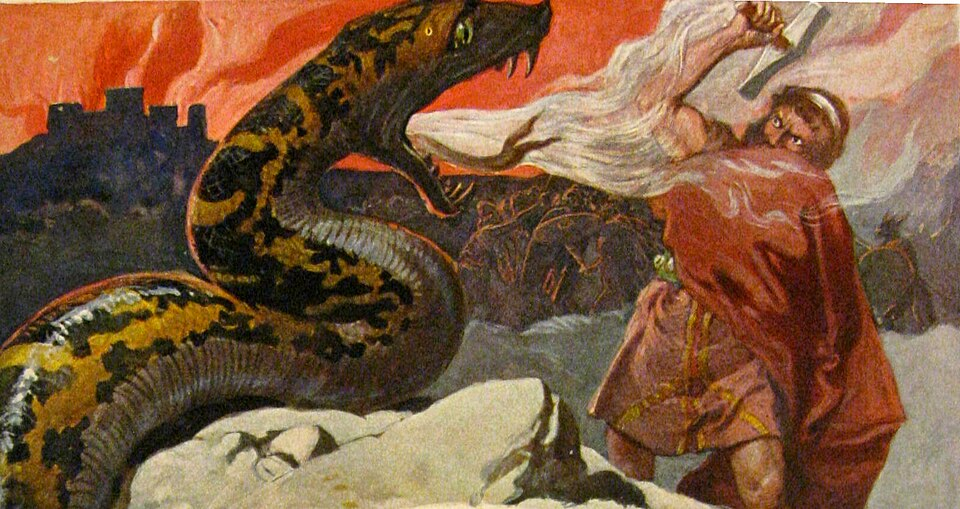
Thor and the Midgard Serpent (by Emil Doepler, 1905)
The cult of Thor was linked with men's habitation and possessions, and with the well-being of the family and community. This included the fruitfulness of the fields, and Thor, although pictured primarily as a storm god in the myths, was also concerned with the fertility and preservation of the seasonal round. In our own times, little stone axes from the distant past have been used as fertility symbols and placed by the farmer in the holes made by the drill to receive the first seed of spring. Thor's marriage with Sif of the golden hair, about which we hear little in the myths, seems to be a memory of the ancient symbol of divine marriage between sky god and earth goddess, when he comes to earth in the thunderstorm and the storm brings the rain which makes the fields fertile. In this way Thor, as well as Odin, may be seen to continue the cult of the sky god which was known in the Bronze Age.[85]
The swastika symbol has been identified as representing the hammer or lightning of Thor.[68] Scholar Hilda Ellis Davidson (1965) comments on the usage of the swastika as a symbol of Thor:
The protective sign of the hammer was worn by women, as we know from the fact that it has been found in women's graves. It seems to have been used by the warrior also, in the form of the swastika. ... Primarily it appears to have had connections with light and fire, and to have been linked with the sun-wheel. It may have been on account of Thor's association with lightning that this sign was used as an alternative to the hammer, for it is found on memorial stones in Scandinavia besides inscriptions to Thor. When we find it on the pommel of a warrior's sword and on his sword-belt, the assumption is that the warrior was placing himself under the Thunder God's protection.[69]
Swastikas appear on various Germanic objects stretching from the Migration Period to the Viking Age, such as the 3rd century Værløse Fibula (DR EM85;123) from Zealand, Denmark; the Gothic spearhead from Brest-Litovsk, Belarus; numerous Migration Period bracteates; cremation urns from early Anglo-Saxon England; the 8th century Sæbø sword from Sogn, Norway; and the 9th century Snoldelev Stone (DR 248) from Ramsø, Denmark.
Saturday, January 31, 2026 03:37PM