Germany
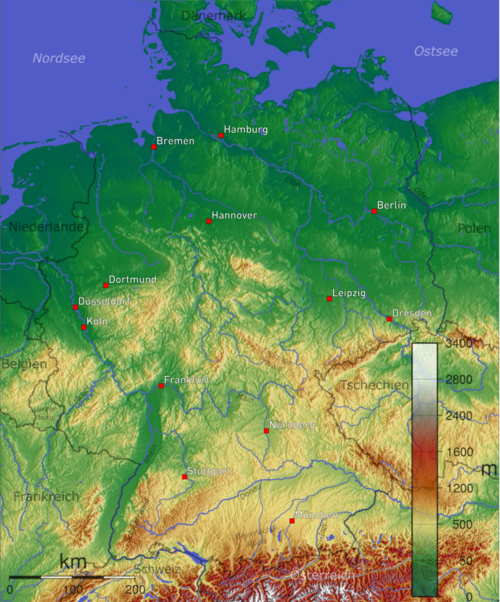
topographic map of Germany
Germany,[d] officially the Federal Republic of Germany,[e] is a country in Western and Central Europe. It lies between the Baltic Sea and the North Sea to the north with the Alps to the south. Its sixteen constituent states have a total population of over 82 million, making it the most populous member state of the European Union (EU). Germany borders Denmark to the north; Poland and the Czech Republic to the east; Austria and Switzerland to the south; and France, Luxembourg, Belgium, and the Netherlands to the west. The nation's capital and most populous city is Berlin and its main financial centre is Frankfurt; the largest urban area is the Ruhr.
Settlement in the territory of modern Germany began in the Lower Paleolithic, with various tribes inhabiting it from the Neolithic onward, chiefly the Celts, and Germanic tribes inhabiting the north. Romans named the area Germania. In 962, the Kingdom of Germany formed the bulk of the Holy Roman Empire. During the 16th century, northern German regions became the centre of the Protestant Reformation. Following the Napoleonic Wars and the dissolution of the Holy Roman Empire in 1806, the German Confederation was formed in 1815.
Unification of Germany into the modern nation-state, led by Prussia, established the German Empire in 1871. After World War I and a revolution, the Empire was replaced by the Weimar Republic. The Nazi rise to power in 1933 led to the establishment of a totalitarian dictatorship, World War II, and the Holocaust. In 1949, after the war and Allied occupation, Germany was organised into two separate polities with limited sovereignty: the Federal Republic of Germany (FRG), or West Germany, and the German Democratic Republic (GDR), or East Germany. The FRG was a founding member of the European Economic Community, while the GDR was a communist Eastern Bloc state and a founding member of the Warsaw Pact. After the fall of the communist led-government in East Germany, German reunification saw the former East German states join the FRG on 3 October 1990.
Germany is a developed country with a strong economy; it has the largest economy in Europe by nominal GDP. As a major force in several industrial, scientific and technological sectors, Germany is both the world's third-largest exporter and third-largest importer. Widely considered a great power, Germany is part of multiple international organisations and forums. It has the third-highest number of UNESCO World Heritage Sites: 55, of which 52 are cultural.
This article is about the country. For other uses, see Germany (disambiguation).
"Deutschland" redirects here. For other uses, see Deutschland (disambiguation).
Etymology
Further information: Names of Germany, Germani, and Germania
The English word Germany derives from the Latin Germania, which came into use after Julius Caesar adopted it for the peoples east of the Rhine.[11] The German term Deutschland, originally diutisciu land ('the German lands'), is derived from deutsch (cf. Dutch), which descended from Old High German* diutisc 'of the people' (from diot or diota 'people'), originally used to distinguish the language of the common people from Latin and its Romance descendants. This in turn descends from Proto-Germanic *þiudiskaz 'of the people' (see also the Latinised form Theodiscus), derived from *þeudō, descended from Proto-Indo-European *tewtéh₂-* 'people', from which the word Teutons also originates.[12]
Prehistory
Main articles: Linear Pottery culture, Unetice culture, Urnfield culture, and Celts
Ancient humans were present in Germany at least 600,000 years ago.[13] The first non-modern human fossil (the Neanderthal) was discovered in the Neander Valley.[14] Similarly dated evidence of modern humans has been found in the Swabian Jura, including 42,000-year-old flutes which are the oldest musical instruments ever found,[15] the 40,000-year-old Lion Man,[16] and the 41,000-year-old Venus of Hohle Fels.[17][18]
Germanic tribes, Roman frontier and the Frankish Empire
Main articles: Jastorf culture, Germanic peoples, Germania, Migration Period, and Frankish Realm
The Germanic peoples are thought to have emerged from the Jastorf culture during the Nordic Bronze Age or early Iron Age.[19][20] From southern Scandinavia and northern Germany, they expanded south, east, and west, coming into contact with the Celtic, Iranian, Baltic, and Slavic tribes.[21][22] Southern Germany was inhabited by Celtic-speaking peoples, who belonged to the wider La Tène culture. They were later assimilated by the Germanic conquerors.[23]
Under Augustus, the Roman Empire began to invade lands inhabited by the Germanic tribes, creating a short-lived Roman province of Germania between the Rhine and Elbe rivers. In 9 AD, three Roman legions were defeated by Arminius in the Battle of the Teutoburg Forest.[24][25] The outcome of this battle dissuaded the Romans from their ambition of conquering Germania and is thus considered one of the most important events in European history.[26] By 100 AD, when Tacitus wrote Germania, Germanic tribes had settled along the Rhine and the Danube (the Limes Germanicus), occupying most of modern Germany.[27] However, Baden-Württemberg, southern Bavaria, southern Hesse and the western Rhineland had been incorporated into Roman provinces.[28][29][30]
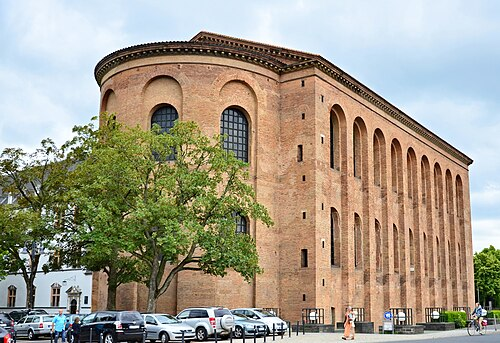
 Basilica of Constantine in Trier (Augusta Treverorum), built in the 4th century
Around 260, Germanic peoples broke into Roman-controlled lands.[31] After the invasion of the Huns in 375, and with the decline of Rome from 395, Germanic tribes moved farther southwest: the Franks established the Frankish Kingdom and pushed east to subjugate Saxony and Bavaria. Areas of modern eastern Germany were inhabited by Western Slavic tribes.[28]
In the 2005 elections, Angela Merkel became the first female chancellor. In 2009, the German government approved a €50 billion stimulus plan.[112] Among the major German political projects of the early 21st century are the advancement of European integration, the country's energy transition (Energiewende) for a sustainable energy supply, the debt brake for balanced budgets, measures to increase the fertility rate (pronatalism), and high-tech strategies for the transition of the German economy, summarised as Industry 4.0.[113] During the 2015 European migrant crisis, the country took in over a million refugees and migrants.[114]
Law
Main article: Law of Germany
Further information: Judiciary of Germany and Law enforcement in Germany
Germany has a civil law system based on Roman law with some references to Germanic law.[144] The Bundesverfassungsgericht (Federal Constitutional Court) is the German Supreme Court responsible for constitutional matters, with power of judicial review.[145] Germany's specialised supreme court system includes the Federal Court of Justice for civil and criminal cases, along with the Federal Labour Court, Federal Social Court, Federal Fiscal Court, and Federal Administrative Court for other matters.[146]
Criminal and private laws are codified on the national level in the Strafgesetzbuch and the Bürgerliches Gesetzbuch respectively. The German penal system seeks the rehabilitation of the criminal and the protection of the public.[147] With the exceptions of petty crimes, tried by a single professional judge, and of serious political crimes, all charges are adjudicated by mixed tribunals where lay judges (Schöffen) and professional judges preside together.[148][149]
In 2016, Germany's murder rate stood at a low of 1.18 murders per 100,000.[150] In 2018, the overall crime rate in the country fell to its lowest since 1992,[151] while in 2024, it was reported that violent crime reached a 15-year high, with overall crime rising as well.[152]
Same-sex marriage in Germany has been legal since 2017, and LGBT rights in the country are generally protected.[153]
In 2019, Germany was the world's seventh-largest consumer of energy.[213] All German nuclear power plants were phased out in 2023.[214] Germany meets its power demands using 40% renewable sources (2018),[215] and has been called an "early leader" in solar panels and offshore wind.[216] The German energy transition (Energiewende) is the recognised move to a sustainable economy by means of energy efficiency and renewable energy,[217][218] with the country being called "the world's first major renewable energy economy".[219] Germany has reduced its primary energy consumption by 11% between 1990 and 2015[220] and set itself goals of reducing it by 30% until 2030 and 50% by 2050.[221]
The country is committed to the Paris Agreement and several other treaties promoting biodiversity,[222] low emission standards,[223] and water management.[224] As of 2017, Germany's household recycling rate is among the highest in the world, at around 65%.[225] In 2023, Germany was the 14th highest emitting nation of greenhouse gases.[226]
According to the 2022 census, Christianity is the largest religion in Germany at 49.7% of the population; 23.1% identified as Protestant and 25.1% as Catholic.[242]