Approaching a Synthesis Problem - Exercise 112
Exercise 12.12 - Approaching a Synthesis Problem
Introduction
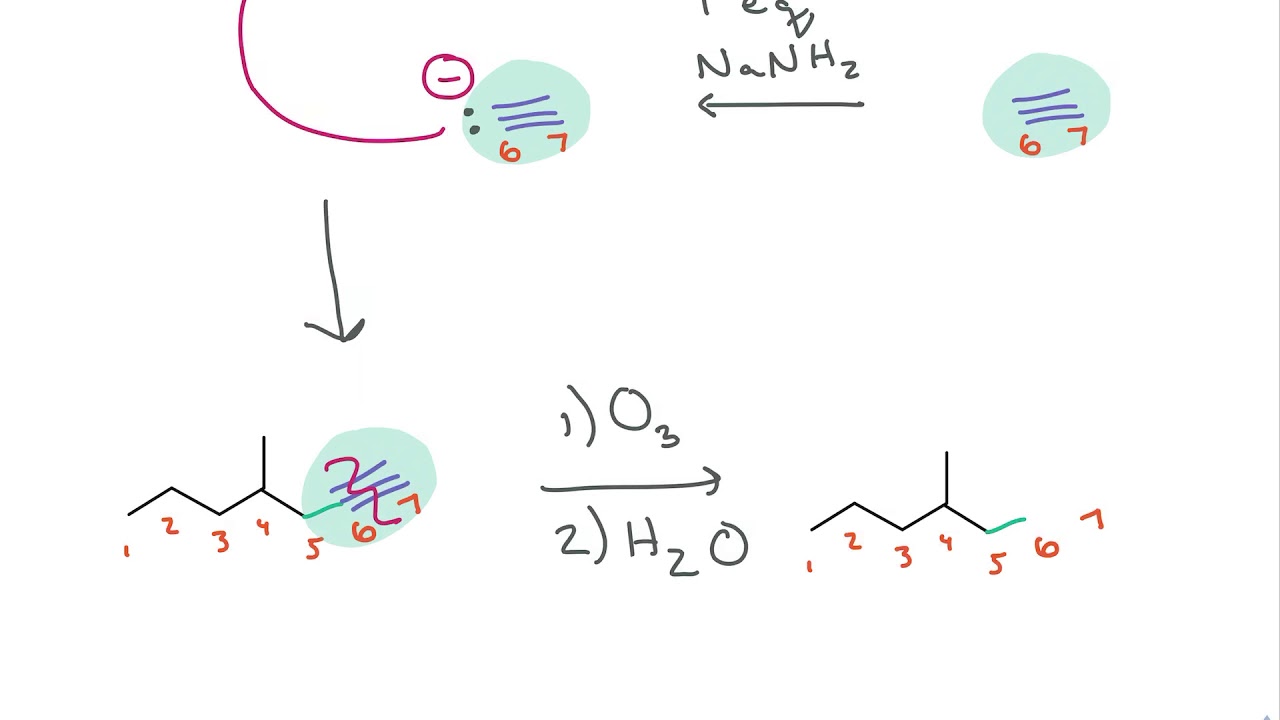
This video tackles Exercise 12.12, which involves performing a multi-step synthesis to transform a given starting molecule into a specified product. The focus is on identifying the structural changes required and applying appropriate reactions to achieve the desired transformation.
Main Points
- Identifying Structural Changes:
- Compare the starting material and the product to identify common structures and changes.
- Note the increase in the number of carbons from five in the starting material to six in the product.
- The presence of an aldehyde in the product suggests ozonolysis.
- Increasing Carbon Chain Length:
- To add carbons, use a terminal alkyne treated with sodium amide to create a nucleophile.
- Decide which molecule will be the terminal alkyne and which will be the alkyl halide based on the location of the reactive part in the product.
- Addition and Elimination Reactions:
- Add a halogen (bromine) using anti-Markovnikov addition of HBr in the presence of peroxides.
- Convert the molecule into an alkyl halide with the halogen on the desired carbon.
- Performing the SN2 Reaction:
- Create a nucleophile from a terminal alkyne using sodium amide.
- Conduct an SN2 reaction between the nucleophile and the alkyl halide to form the new carbon-carbon bond.
- Reducing the Number of Carbons:
- The product has one less carbon than the intermediate, indicating the need for ozonolysis.
- Convert the alkyne to an alkene using either hydrogen gas with Lindlar’s catalyst or dissolving metal reduction (sodium in liquid ammonia).
- Perform ozonolysis on the alkene to cleave the carbon-carbon bond and form the aldehyde.
Examples/Evidence
- Mechanistic Steps:
- Detailed steps for each reaction, including the addition of HBr, formation of the nucleophile, SN2 reaction, reduction of the alkyne to an alkene, and ozonolysis.
- Emphasis on controlling the addition and elimination steps to ensure the correct placement of functional groups.
Conclusion
This synthesis problem demonstrates the importance of planning and executing multi-step transformations in organic chemistry. Key steps include identifying structural changes, using appropriate reagents for addition and elimination reactions, and performing ozonolysis to achieve the desired product.