Hyperconjugation, Inductive Effect & Resonance Structures - YouTube
Summary of "Carbocation Stability - Hyperconjugation, Inductive Effect & Resonance Structures"
Video Title: Carbocation Stability - Hyperconjugation, Inductive Effect & Resonance Structures
Introduction
The video provides an in-depth analysis of carbocation stability, explaining the fundamental concepts of hyperconjugation, inductive effects, and resonance structures in organic chemistry.
Main Points/Arguments
- Carbocation Definition: A carbocation is a positively charged carbon atom. Tertiary carbocations are more stable than secondary, which are more stable than primary, and these are more stable than methyl carbocations.
- Stabilization Mechanisms:
- Inductive Effects: Tertiary carbocations are stabilized by three electron-donating groups (e.g., methyl groups) that stabilize the positive charge through sigma bond electron donation.
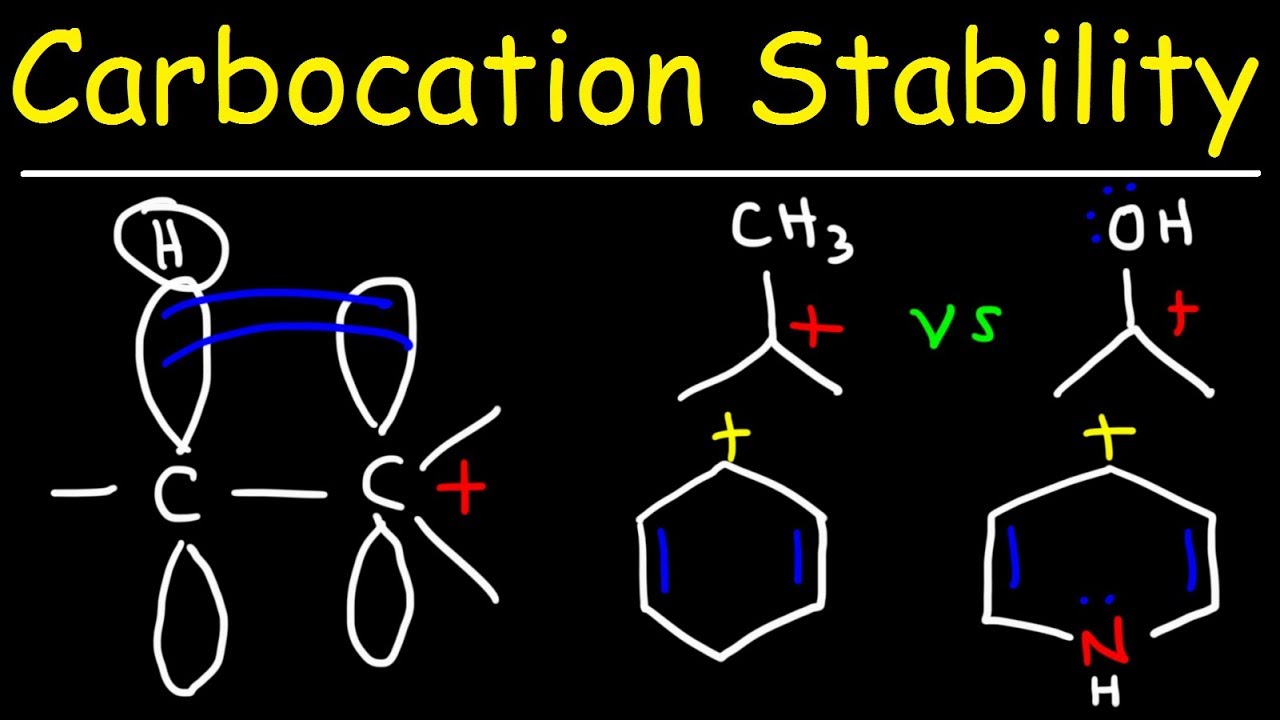
- Hyperconjugation: Involves the overlap of a sigma bond (CH bond) orbital with an empty p-orbital of the carbocation, further stabilizing the positive charge.
- Comparison of Stabilizing Groups:
- A comparison between a methyl group and a hydroxyl group (OH) reveals that while the methyl group donates electron density through inductive effects, the hydroxyl group, despite being electronegative and withdrawing electrons, can stabilize the carbocation through resonance by donating a pair of electrons.
- Resonance Effects:
- The ability to form resonance structures greatly increases carbocation stability. The video demonstrates this with various structures, highlighting that the more resonance structures possible, the more stable the carbocation.
- The most stable structure discussed was one with a nitrogen atom in the ring, providing stability through aromaticity and complete octets for all atoms.
- Electron Donating vs. Withdrawing Groups:
- Electron-donating groups like methyl stabilize positive charges, whereas electron-withdrawing groups like carbonyl destabilize them by creating an additional positive charge.
Conclusion
The video concludes by emphasizing the importance of understanding the stability of carbocations in organic reactions. The stability is influenced by various factors including the number of electron-donating groups, the ability to form resonance structures, and the presence of electron-withdrawing groups.