Henry K Beecher
Henry Dale put Beecher in touch with William Sargant
". Schmidt asserts that Britain’s exploration of ‘truth drugs’ seems to have ‘partly’ come from the United States with a visit to the UK by Henry K. Beecher, a Harvard anaesthetist and former member of the OSS (Office of Strategic Services). Beecher was tasked by his bosses to gather information on drugs and narcotics and asses their potential as weapons. This assignment was part of Operation Artichokeset up by the CIA in 1951. Another of Beecher’s objectives was to identify scientists who could be recruited for secret work back in the US. Schmidt then goes on to discuss LSD experiments with service personnel at Porton Down in the 1950s done at the behest of MI6 who were much vexed by questions of mind control, truth drugs and brain washing,. ."
What’s your poison? Secret Science: A Century of Poison Warfare and Human Experiments Ulf Schmidt Oxford: Oxford University Press found in
http://www.lobster-magazine.co.uk/free/lobster70/lob70-secret-service.pdf
Oberursel had become Camp King, the home
of the European Command Interrogation Center where, after 1948, a staff of ex-Gestapo soldiers and former Nazi doctors, including the notorious deputy Reich health leader Kurt
Blome, were employed in inhumane interrogations of Soviet defectors and double agents.
Nearby in the town of Kronberg, the CIA used Haus Waldhof, a former country estate, as a
safe house for drug testing, brutal torture, and lethal experiments on Soviet bloc expendables. In 1952, for example, the CIA’s Morse Allen—assisted by Dr. Samuel V. Thompson, a
Navy Psychiatrist, and Professor G. Richard Wendt, a University of Rochester psychologist—would use the site to test dangerous combinations of drugs such as Benzedrin and
Pentothal-Natrium on Russian captives, under the protocol that “disposal of the body is not a
problem” (Silver, 1993, pp. 199–213; Pruitt, 18 January 1993, pp. 18–19; Koch and Wech,
2003, pp. 50, 89–121, 269; Bower, 1987, pp. 254–256).
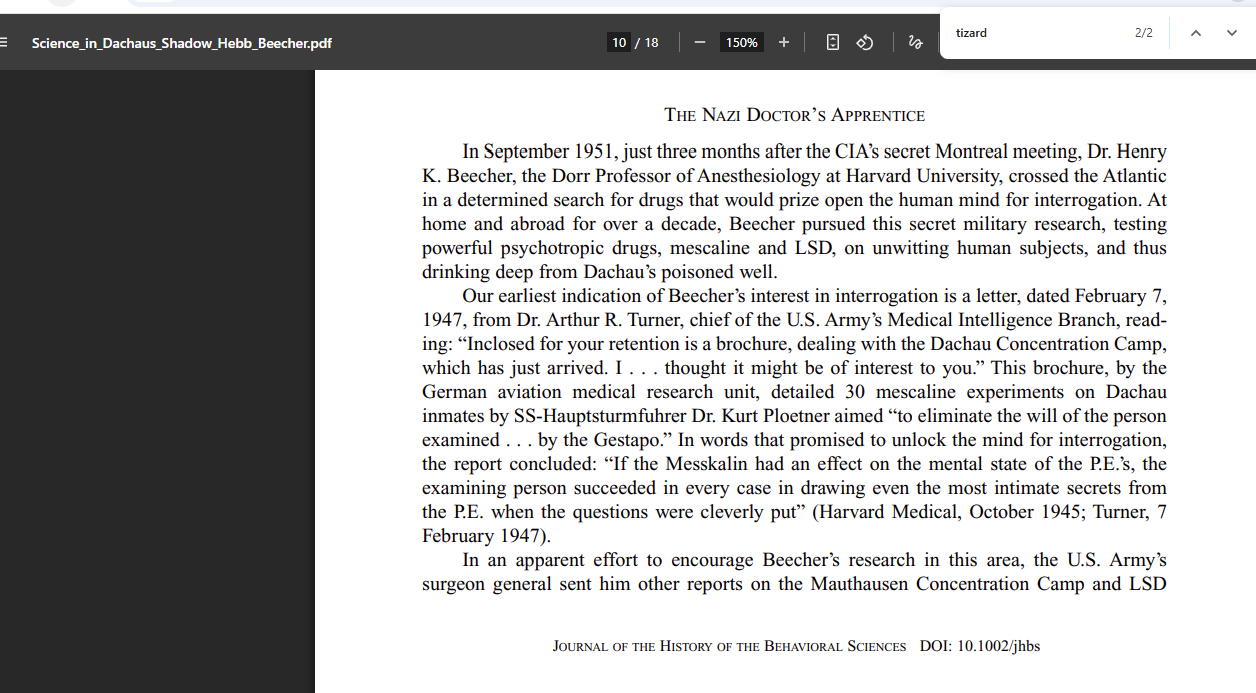
At Oberursel, Dr. Beecher discussed possible drug uses for interrogation with six staffers
including a Major Hart, head of a “brutal interrogation team” known as the “rough boys,” and
Captain Malcolm Hilty, chief interrogator. All agreed: “It would be desirable for me to return,
jhbs434_04_20271.qxp 9/10/07 4:38 PM Page 411
412 ALFRED W. McCOY
JOURNAL OF THE HISTORY OF THE BEHAVIORAL SCIENCES DOI: 10.1002/jhbs
perhaps in a year, when we know better the signs and symptoms of the newer derivatives of
mescaline and lysergic acid [LSD], to interrogate especially high level escapees from
Russian interrogation.” In the interim, they recommended he work with a Dr. Schreiber,
Camp King’s former staff doctor, whom Beecher described as “a physician and former
German general who is now on his way to the States, will be at the School of Aviation
Medicine . . . Schreiber is intelligent and helpful” (Beecher, 21 October 1951; Koch & Wech,
2003, pp. 102–103).
Who was Dr. Schreiber, this ideal partner for Professor Beecher’s secret drug research?
He was, in fact, General Walter Schreiber, former medical chief for the Wehrmacht who had
presided over “concentration camp . . . experiments on inmates that usually resulted in a slow
and agonizing death.” After Camp King commended his “high efficiency,” the Pentagon sent
him to Texas, where he joined other Nazi doctors at the School of Aviation Medicine, albeit
only until May 1952 when complaints about war crimes forced his departure for Argentina
(Bower, 1987, pp. 255–258; Koch and Wech, 2003, p. 94; “Nuremberg,” 28 August 1946;
“German,” 27 October 1948; “Accused,” 13 February 1952).
Moving on to Berlin, Dr. Beecher met with a Military Intelligence officer and “Mr. Peter
Sichel, C.I.A.” to discuss acquisition of human subjects for his plans “to interrogate as many
high-level escapees as possible as to the presence of significant signs and symptoms
[of drugs] during periods of interrogation.” When Dr. Beecher’s report on his voyage into this
intelligence netherworld reached the Pentagon in October 1951, it was, at his recommendation, stamped “TOP SECRET” and not declassified until 1977, only months after his death
(Beecher, 21 October 1951).
A year later in August 1952, Dr. Beecher, discarding Dr. Ploetner’s preference for mescaline, returned to Europe where he now focused solely, almost obsessively, on the threat and
promise of LSD 25. In the year between his visits, Beecher had joined the U.S. intelligence
community’s interrogation project with a “top secret” security clearance and a Pentagon grant
to study the “Response of Normal Men to Lysergic Acid Derivatives” (Lund, 26 May 1951;
Project Title, 31 December 1954). Just as Dr. Ploetner’s results had once heralded the promise of mescaline, so the Sandoz report, provided earlier by the Pentagon, hinted that this new
drug might open the human mind for interrogation: “LSD 25 can bring thoughts from the subconscious into the conscious, can increase associative activity and, by removing inhibitions,
can also improve the ekphoric ability.” But Sandoz had also warned that the new drug
produced “a peculiar personality disturbance similar to ‘split personality,’” and induced a
“tendency to pathological reactions (hysterical attacks, trances, epileptic fits)” (Rothlin, n.d.).
Evidently intrigued, Beecher wrote the company’s chief pharmacologist in Basel, Dr. Ernst
Rothlin, to arrange a meeting, explaining that “we have been doing some work in man with
. . . LSD 25, which was kindly furnished us by your company” (Beecher, 4 August 1952;
Beecher, 29 August 1950).
Consequently, Dr. Beecher returned from Europe warning about LSD’s effect of “severe
imbalance, hysteria” on, say, “a battleship’s crew.” In a secret report to the U.S. Army’s
surgeon general, he advised this drug should be studied “(1) as aids to obtain suppressed
information . . . (2) as threats to security when used by an enemy agent . . . (3) as tools of
biological warfare.” The latter was particularly important because “the water supply of a large
city could probably be disastrously and undetectably (until too late) contaminated.”
Determined that “the United States . . . not get behind in this field for want of an organized
plan of attack,” he now planned to intensify dosage in his Boston LSD experiments, saying:
“We need to know the effects of larger doses, of prolonged administration of small doses and
so on.” Fortunately for Beecher’s plans, a professor he had met in Europe “has promised to
jhbs434_04_20271.qxp 9/10/07 4:38 PM Page 412
SCIENCE IN DACHAU’S SHADOW 413
JOURNAL OF THE HISTORY OF THE BEHAVIORAL SCIENCES DOI: 10.1002/jhbs
send me for study the new L.A.E. (a mono ethyl amide of lysergic acid). This is said to be
more excitant to normal individuals than is L.S.D. 25” (Beecher, 4 September 1952).
Over the next two years, Dr. Beecher carried out these LSD tests using the unwitting
human subjects he now believed, through his conventional work, essential to serious pharmacological research—creating, for Beecher, a productive confluence of his covert and conventional work (Beecher, 13 February 1953). In his final report on these tests to Pentagon,
Beecher noted that after administering LSD doses—“as unknowns”—four among the nine
subjects given the stronger LAE became “mildly hostile and paranoid; another experienced
acute panic” (Project Title: Neuropsychiatry, 1954).
In his decade of secret drug testing, Dr. Beecher sacrificed his subjects to the cause of
national security. During his European travels in 1951–1952, he had sought expendable
subjects for secret interrogation experiments. Back home at Harvard, Beecher, though
aware of the drug’s painful effects from the Sandoz report, tested powerful LSD and LAE
doses that inflicted the trauma of “paranoid” reaction and “acute panic” on his unknowing
human subjects—a “psychosis in miniature” that, he said coolly, “offers interesting possibilities.” In sum, knowing in advance the serious trauma these drugs would cause, Beecher
placed his unwitting subjects at risk by giving them dangerous doses dictated by the
demands of secret research—all in violation of the Nuremberg Code. Yet he also maintained
a perfect cover, minimizing public knowledge of his military research by publishing a
single LSD study as third author—and even that was packaged innocuously as last in a
series of drug tests. Throughout, he sat on influential biomedical bodies, such as the National
Research Council, setting the U.S. research agenda (Beecher, 1959, pp. 287, 309–311;
Von Felsinger, Lasagna, & Beecher, 1957, pp. 1113–1119; Von Felsinger, Lasagna, & Beecher,
1956, pp. 414–428; Beecher, 31 May 1950; Beecher, 13 June 1955; Leake, 7 June 1955).
When controversy erupted over LSD tests at Harvard in the 1960s, Dr. Beecher played the
stern moralist, roundly condemning one of Timothy Leary’s colleagues Dr. Walter N. Pahnke,
for using the drug to ease the pain of dying. “There is an abundance of evidence,” intoned
Dr. Beecher, condemning such experiments, “that LSD can produce, has produced, lasting,
serious damage to young people” (Beecher, 1969, pp. 21–26; Lee & Shlain, 1985, pp. 74–76).
MODERN MEDICAL ETHICS
This past may have some lessons for the present debate over ethical standards within the
APA. In one of history’s supreme ironies, this secret CIA research, with its harsh treatment of
human subjects, seemed to produce its own correction, making Dr. Beecher the ultimate
victor in this silent, scientific competition. By the early 1960s, as the CIA finalized an interrogation paradigm based on behavioral methods, not drugs, and his defense contracts thus
dwindled, Beecher seems to have been freed from conflicts that may have restrained his moral
regeneration (Goliszek, 2003, pp. 179–180). In 1966, Beecher published his famous essay,
“Ethics and Clinical Research” in The New England Journal of Medicine, citing 22 instances
of medical research whose human subjects suffered “grave consequences . . . as a direct result of
experiments” and warning that these practices “will do great harm to medicine unless soon
corrected” (Beecher, 1966, pp. 1354–1360).
Initially controversial, Dr. Beecher’s 1966 article made his name synonymous with “informed consent” and ethical treatment of human subjects—a legacy commemorated today
with the annual award of the Henry K. Beecher Prize in Medical Ethics at Harvard Medical
School (Countway Medical Library, 2003, para. 1). The award’s 1993 recipient, Yale bioethics
professor Jay Katz, praised Beecher for “the moral passion that punctuated his every word”
jhbs434_04_20271.qxp 9/10/07 4:38 PM Page 413
414 ALFRED W. McCOY
JOURNAL OF THE HISTORY OF THE BEHAVIORAL SCIENCES DOI: 10.1002/jhbs
in that 1966 essay (Katz, 1993, pp. 31–39). Typical of this laudatory treatment, a 2001 article in
the Bulletin of the World Health Organization describes how Beecher drew on his “deep Christian
faith” to produce “the most influential single paper ever written about experimentation
involving human subjects” and thereby “played a significant role” in enacting strict federal
regulations (Harkness, 2001, pp. 365–366).
Apart from Beecher’s own oblique references to his lab’s ethical lapses, the literature seems
ignorant of his darker side. Even aggressive exposés of government abuses have hailed him a
“hero” of medical ethics, whereas investigations of the CIA drug scandal make but cursory references to his early LSD research (Harkness, 2001, p. 365; Rothman, 1991, pp. 2–3, 70–84, 251;
Moreno, 2000, pp. 239–242; Marks, 1979, pp. 67n, 72n; Lee & Shlain, 1985, p. 86). Today, every
academic researcher in America and Canada lives under Dr. Beecher’s long shadow, forced to
submit all research to institutional review boards that would certainly ban the experiments once
done by Hebb, Cameron, Milgram, and ironically, Beecher himself.
So what lesson might we draw from the career of Dr. Henry K. Beecher, other than the
importance of dying before your secret reports are declassified? If members of the APA feel
tainted by the work of colleagues at Guantánamo and their association’s inaction, then
Dr. Beecher provides a clear path to ethical reform. Just as he transformed himself from
Dachau disciple and CIA drug researcher into moral paragon by embracing ethical standards,
so the APA can expunge the stigma of its association with psychological torture. By using its
professional standing to endorse ethical standards for its members, and more broadly, to
define “severe mental pain” in ways that restrains future abuses, the APA can readily recover
its moral leadership.
More broadly, recent research reminds us that this Cold War past continues to shape our
political present. Just this year, a full half-century after Hebb discovered sensory deprivation
and the Cornell team documented Soviet stress positions, we have the first clinical evidence
that psychological torture is just as traumatic as its physical variant. “Ill treatment during captivity, such as psychological manipulations . . . and forced stress positions,” Dr. Metin Basoglu
reports in the Archives of General Psychiatry after interviews with 279 Bosnian victims, “does
not seem to be substantially different from physical torture in terms of the severity of mental
suffering . . . and their long-term psychological outcome” (Basoglu, Livanou, & Crnobaric,
2007, pp. 277–285).
In light of this troubled past, biographers and historians alike should be cautious
before rushing to canonize cognitive scientists who worked during the Cold War. If we do
not investigate this past and the ways that it has shaped our present, then we cannot critique
and correct. Clearly, history is too important to become mere hagiography.
https://www.uio.no/studier/emner/jus/ikrs/KRIM2950/h11/undervisningsmateriale/McCoy.pdf