Hugh Gaitskell
VISITED JIM MCGUINNESS’ PLACE OF WORK 1957
Administrative/Biographical history:
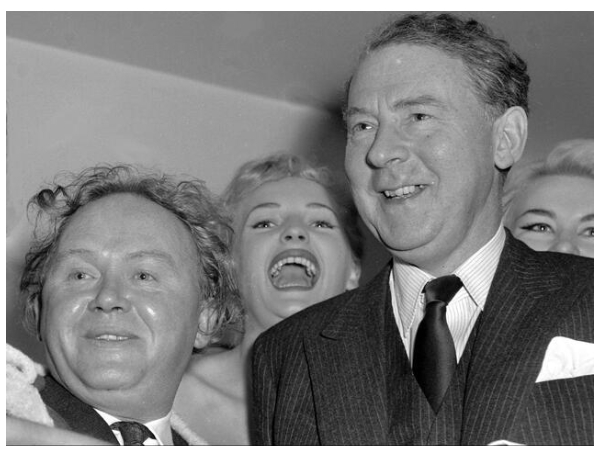
Hugh Gaitskell @ Spartacus
“George Brown was a supporter of Gaitskell in the shadow cabinet: "Hugh Gaitskell became too much the product of other people and the manoeuvring of other powerful figures and too little himself. Yet his capacity to inspire other people with his ideals was extraordinary. Had he lived he would have been a tremendous leader of young people and an enormous bulwark against the machine politicians, the bureaucrats and everything else which has tended to debase the currency of modern life."
Peter Wright, the principal scientific officer, who worked closely with Arthur Martin, who was responsible for Soviet Counter Espionage, found Golitsyn's testimony convincing and became convinced that Gaitskell was the victim of a KGB assassination. "I knew him (Gaitskell) personally and admired him greatly. I had met him and his family at the Blackwater Sailing Club, and I recall about a month before he died he told me that he was going to Russia. After he died his doctor got in touch with MI5 and asked to see somebody from the Service. Arthur Martin, as the head of Russian Counterespionage, went to see him. The doctor explained that he was disturbed by the manner of Gaitskell's death. He said that Gaitskell had died of a disease called lupus disseminata, which attacks the body's organs. He said that it was rare in temperate climates and that there was no evidence that Gaitskell had been anywhere recently where he could have contracted the disease."
Gaitskell told his doctors that he had visited the Soviet embassy just before his illness in search of a visa for his projected trip to Moscow. Though he had gone by appointment, he had been kept waiting half an hour and had been given coffee and biscuits. James Jesus Angleton the head of the CIA's Counter-Intelligence Staff, became convinced that Golitsyn was telling the truth and he ordered his staff to search the published medical literature of the fatal disease and discovered that Soviet medical researchers had published three academic papers describing how they had produced a drug that, when administered, reproduced the fatal heart and kidney symptoms suffered by Gaitskell. Chapman Pincher has argued that "the Labour leader's death was the single most important historic factor in the party's continuing swing to the left."
Bio
Educated, Winchester and New College Oxford, First Class Hons Philosophy, Politics and Economics, 1927;
Workers' Educational Association lecturer, 1927;
Assistant, Department of Political Economy, University College London, 1928;
joined 1917 Club, 1929;
founded Tots & Quots, a left-wing discussion group, 1930;
Assistant Honorary Secretary and Chairman of the Economics Section of the New Fabian Research Bureau, 1931;
awarded Rockefeller Foundation Scholarship and spent next academic year studying in Vienna, Austria, 1933;
Secretary, XYZ Club, 1934;
stood as a Labour Party candidate in Chatham, Kent, in General Election, defeated by Conservative, 1935;
adopted as prospective candidate for Leeds South, 1937;
promoted to Readership at University College London, 1937;
co-opted onto National Executive Committee, Finance and Trade Sub-committee, 1937;
joined war-time Civil Service at newly founded Ministry of Economic Warfare, 1939;
Principal Private Secretary to Hugh Dalton, Minister of Economic Warfare, 1940-1942;
Principal Assistant Secretary to Dalton at Board of Trade, 1942-1945;
elected as member for Leeds South, General Election, 1945-1963;
Parliamentary Secretary, Ministry of Fuel and Power, 1946-1947;
Minister of Fuel and Power, 1947-1950;
Minister of State for Economic Affairs, 1950;
Chancellor of Exchequer, 1950-1951;
Treasurer of Labour Party, 1954-1956;
Leader of Labour Party, 1955-1963;
Vice-Chairman, Labour Party Executive Committee, 1962.
Publications:
Chartism (Longmans & Co, London, 1929);
Money and everyday life (Labour Book Service, London, 1939);
In defence of politics (London, 1954);
The high cost of Toryism (Labour Party, London, 1955);
Recent developments in British Socialist thinking (Co-operative Union, London, 1956);
The challenge of co-existence (Methuen & Co, London, 1957);
Britain and the common market (Labour Party, London, 1962);
various articles written for publications such as
New York Times Magazine,
Reynolds News,
The Birmingham Post,
Leeds Weekly Citizen,
The Observer,
Daily Mail,
Daily Mirror,
Social Commentary and New Statesman and Nation.
http://www.aim25.ac.uk/cgi-bin/vcdf/detail?coll_id=2860&inst_id=13

 Stock Image ID: 1189685a
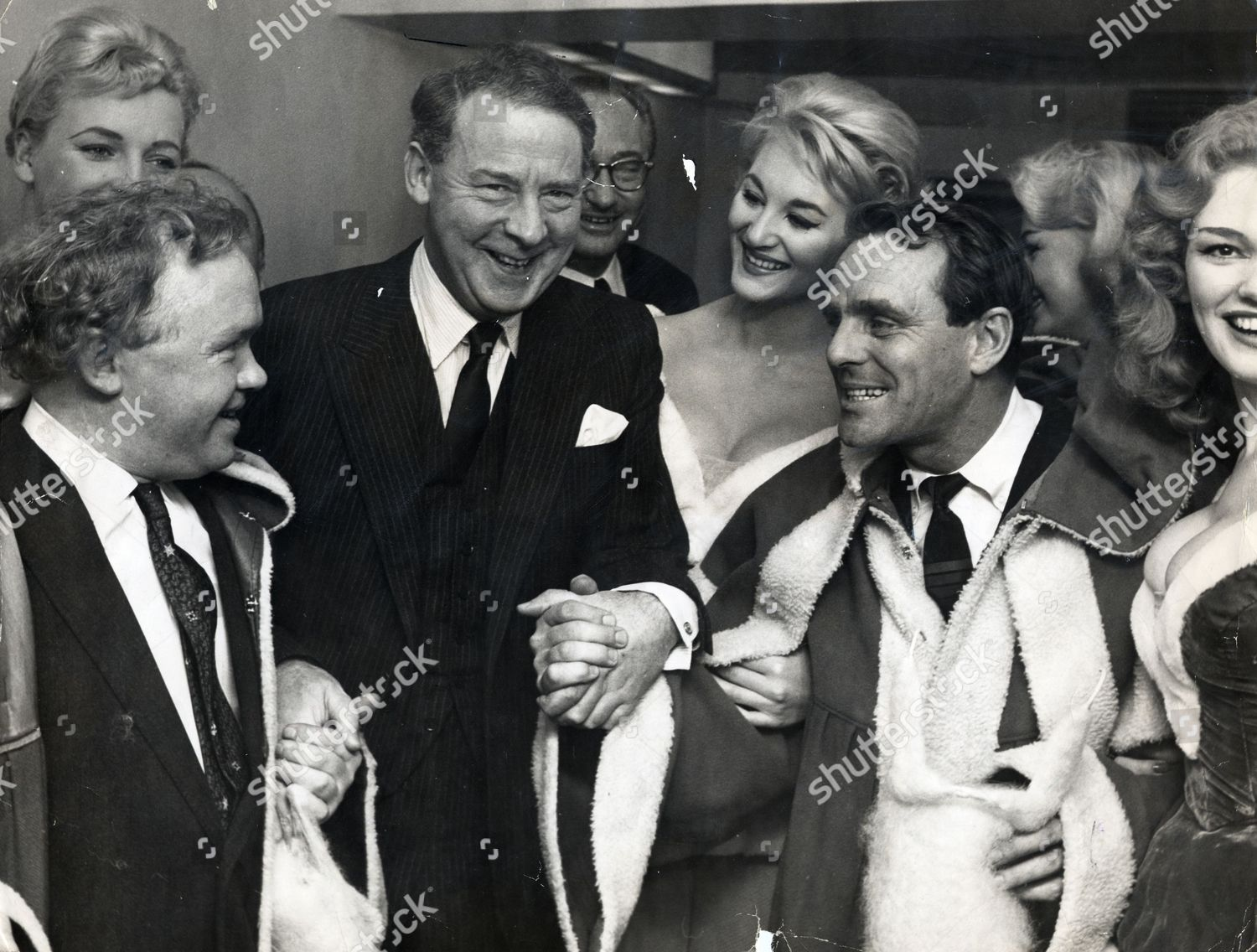
Charlie Drake (left) Hugh Gaitskell And Dickie Henderson Pictured With Showgirls At The Variety Club Luncheon At The Savoy
Charlie Drake (left) Hugh Gaitskell And Dickie Henderson Pictured With Showgirls At The Variety Club Luncheon At The Savoy
Important information
Editorial Use Only. Single use in context. Geographic restrictions may apply.
Date created: 15 December 1961