DMEA
Therapeutic Benefits, Dosage, and Safety Profile of DMAE (Dimethylaminoethanol)
DMAE (dimethylaminoethanol), also known as DMEA or deanol, represents a complex compound with diverse proposed therapeutic applications, though the scientific evidence supporting many of its purported benefits remains limited or controversial. This compound, naturally occurring in small amounts in the human brain and found in fatty fish, has garnered attention for both cognitive enhancement and cosmetic applications, yet its clinical efficacy varies significantly across different therapeutic domains.
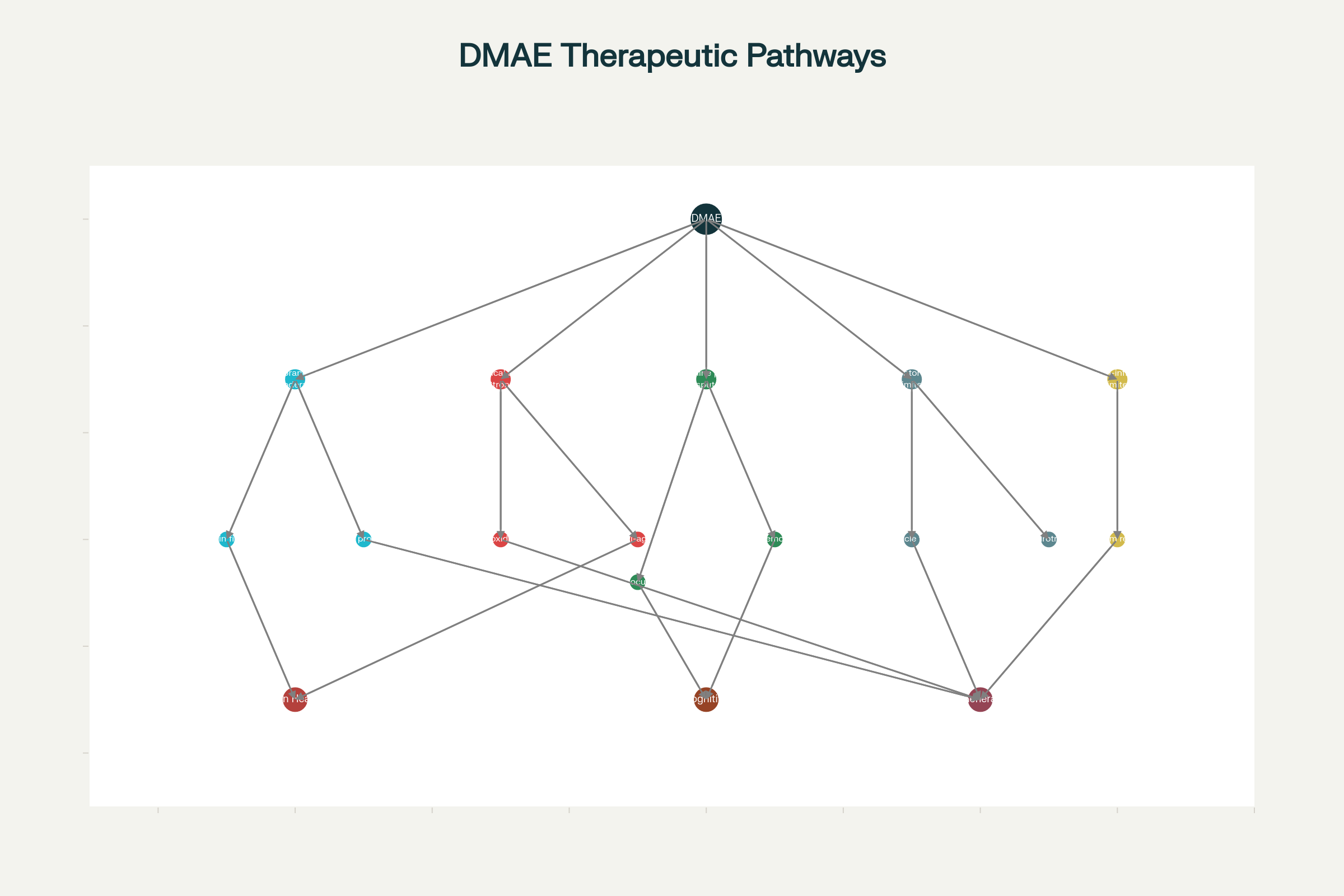
DMAE Mechanisms of Action and Therapeutic Pathways
Established Therapeutic Benefits
Dermatological Applications
The most robust scientific evidence for DMAE's therapeutic utility lies in its dermatological applications. Clinical research demonstrates that topical DMAE formulations can provide measurable benefits for skin health and appearance1. In a randomized, placebo-controlled clinical study, participants using 3% DMAE facial gel daily for 16 weeks experienced statistically significant improvements in forehead lines and periorbital fine wrinkles, with enhanced lip shape and fullness and overall skin appearance1. These effects persisted during a 2-week cessation period, suggesting lasting benefits rather than temporary effects1.
The skin-firming properties of DMAE have been confirmed through quantitative measures of cutaneous tensile strength, indicating genuine structural improvements rather than merely cosmetic changes1. Additional beneficial trends were observed in coarse wrinkles, under-eye dark circles, nasolabial folds, sagging neck skin, and neck firmness, though these did not reach statistical significance1.
Research indicates that DMAE may enhance skin health through multiple mechanisms, including increased collagen production and improved skin thickness2. Animal studies using D-galactose-induced aging models demonstrated that DMAE combined with amino acids significantly increased epidermal and dermal thickness, elevated collagen type I expression, and improved hydroxyproline content to levels approaching normal skin2.
Antioxidant Properties
DMAE exhibits substantial free radical scavenging capabilities, representing one of its most scientifically validated properties34. Electron paramagnetic resonance (EPR) spectroscopy studies reveal that DMAE efficiently neutralizes multiple types of free radicals, including hydroxyl radicals, ascorbyl radicals, and lipid radicals4. The compound demonstrates particularly strong efficacy against hydroxyl radicals, reducing their concentration by up to 87% in experimental conditions4.
This antioxidant activity may contribute to DMAE's proposed anti-aging effects, as free radical damage represents a fundamental mechanism of cellular aging3. The compound's ability to scavenge both water-soluble and lipid-soluble radicals suggests comprehensive protective effects across different cellular compartments4.
Controversial and Limited Evidence Applications
Cognitive Enhancement
The relationship between DMAE and cognitive function remains one of the most contentious areas of research. While DMAE is often marketed as a cognitive enhancer, the scientific evidence supporting these claims is inconsistent and often contradictory56. The compound was historically used as a prescription medication (Deaner) for childhood behavioral problems but was withdrawn from the market in 1983 due to insufficient evidence of efficacy57.
Despite widespread belief that DMAE increases acetylcholine production, research indicates that DMAE does not significantly elevate brain acetylcholine levels68. Studies in rats found no difference in brain acetylcholine concentrations following DMAE administration, challenging the fundamental assumption underlying its cognitive benefits6. Moreover, DMAE may actually compete with choline for brain transporters, potentially interfering with normal choline metabolism6.
Some limited evidence suggests potential benefits for attention and focus. EEG studies indicate that DMAE-containing vitamin combinations may reduce theta and alpha1 brain wave activity, patterns associated with increased vigilance and attention9. However, these studies involved combination products, making it difficult to attribute effects specifically to DMAE9.
ADHD and Childhood Behavioural Disorders
Research examining DMAE's effectiveness for ADHD yields mixed and inconclusive results51011. While some early studies suggested potential benefits for reducing hyperactivity and improving attention in children, subsequent research has failed to consistently replicate these findings10. The evidence quality remains insufficient to support DMAE as a reliable ADHD treatment5.
Neurological and Psychiatric Conditions
Clinical trials investigating DMAE for serious neurological conditions have largely produced negative results. In Alzheimer's disease, a randomized controlled trial involving 242 participants found no significant cognitive improvements compared to placebo5. Similarly, research on tardive dyskinesia, a movement disorder caused by antipsychotic medications, indicates that DMAE is no more effective than placebo and may increase the risk of adverse events1213.
Dosage Recommendations and Administration
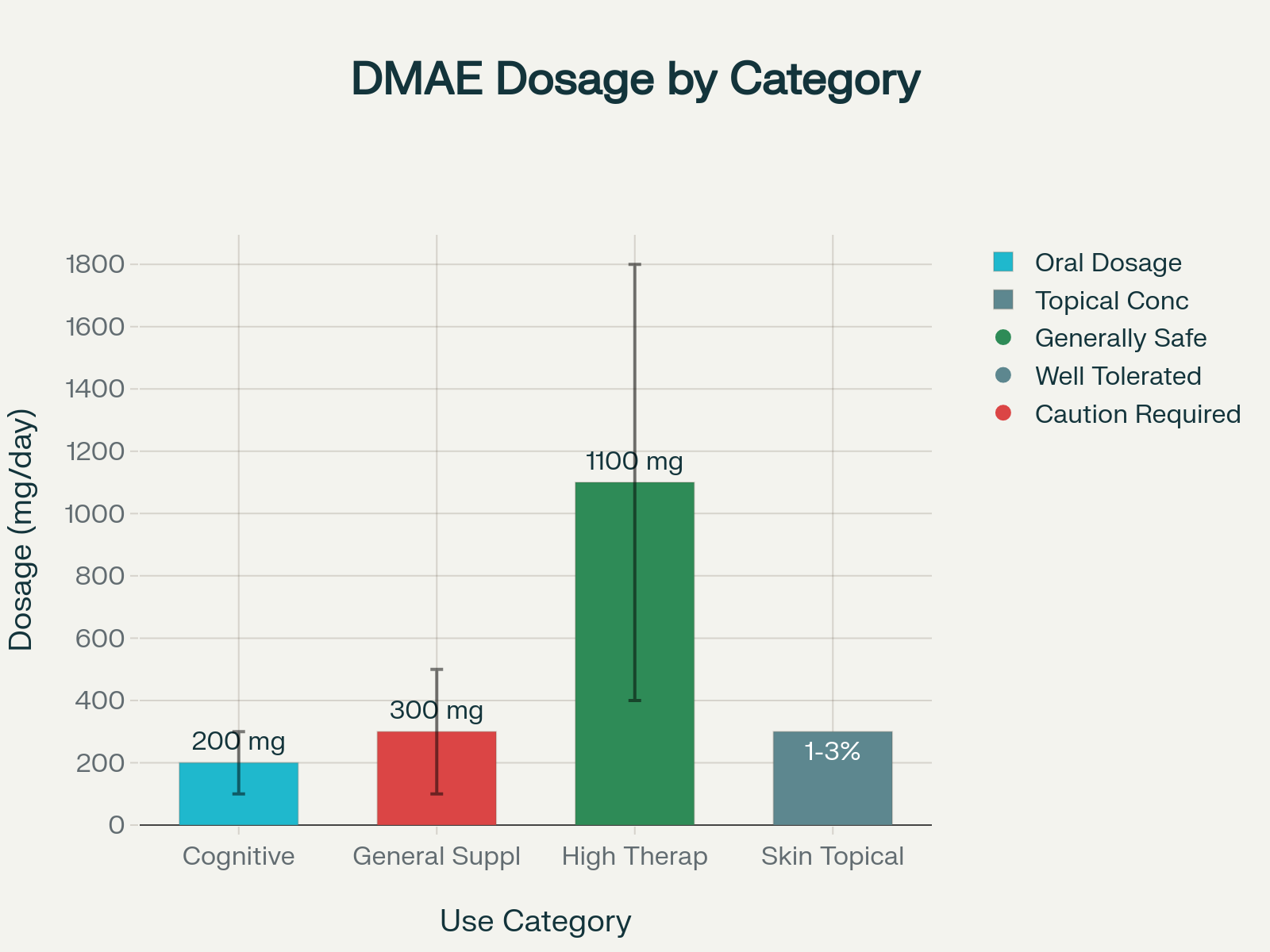
DMAE Dosage Recommendations and Safety Profile by Application
Oral Supplementation
For cognitive and general health applications, typical dosage recommendations range from 100-300 mg daily5141516. This represents the most commonly suggested range for nootropic use, though scientific validation for these doses remains limited5. Some sources recommend higher ranges of 400-1800 mg daily based on historical therapeutic use, but these doses carry increased risk of side effects1017.
Short-term or intermittent use is generally recommended rather than continuous long-term supplementation16. The optimal duration of use has not been established through clinical research, and long-term safety data remain limited14.
Topical Application
For dermatological applications, 3% DMAE concentration has demonstrated clinical efficacy and safety118. This concentration was used in the primary clinical trial demonstrating skin benefits and showed no difference in side effect incidence compared to placebo1. Lower concentrations of 1-3% are commonly available in commercial skincare products1418.
Daily application appears optimal based on clinical studies, with benefits becoming apparent after several weeks of consistent use1. The long-term safety of topical DMAE has been demonstrated for up to one year in clinical studies1.
dmae_side_effects.csv
Generated File
Side Effects and Safety Considerations
Common Adverse Effects
DMAE supplementation can produce several dose-dependent side effects51917. The most frequently reported include insomnia, headaches, muscle tension, stomach upset, and drowsiness19. Paradoxically, some users experience drowsiness while others report sleep disturbances, suggesting individual variability in response1917.
Gastrointestinal effects such as nausea and stomach upset are common, particularly at higher doses19. Taking DMAE with food may help reduce these symptoms15. Muscle-related effects, including tension and spontaneous twitching, occur in a dose-dependent manner1920.
Studies of DMAE use for tardive dyskinesia found that 25-40% of patients experienced side effects including stomach upset, drowsiness, and body odor5. These rates may be higher than those seen with lower supplemental doses5.
Serious Safety Concerns
At higher doses, DMAE can cause serious cholinergic side effects including increased nasal and oral secretions, difficulty breathing, and in severe cases, respiratory failure513. These effects result from excessive cholinergic stimulation and represent medical emergencies requiring immediate attention13.
Cardiovascular effects including increased blood pressure have been reported, though the incidence and severity are not well characterized19. Individuals with cardiovascular conditions should exercise particular caution19.
Neurological effects can include increased seizure risk, particularly in susceptible individuals513. Depression and hypomania have been documented as potential psychiatric side effects17.
Absolute Contraindications
DMAE is absolutely contraindicated during pregnancy and lactation due to lack of safety data132021. Animal studies suggest potential developmental toxicity, including skeletal abnormalities, though at doses well above typical human use22.
Epilepsy and seizure disorders represent the primary medical contraindication to DMAE use132023. Grand mal epilepsy is specifically cited as an absolute contraindication due to the risk of seizure precipitation1320.
Schizophrenia and other psychotic disorders are contraindications due to potential for symptom exacerbation1320. Similarly, bipolar disorder warrants extreme caution due to risk of triggering manic episodes20.
dmae_dosage_safety.csv
Generated File
Drug Interactions
DMAE may interact with cholinesterase inhibitors such as donepezil, galantamine, and rivastigmine, potentially enhancing their effects and increasing the risk of cholinergic toxicity192425. Anticholinergic medications may have their effects antagonized by DMAE19.
Anticoagulant medications may interact with DMAE, though the mechanism and clinical significance are not well established19. Close monitoring would be prudent if concurrent use is necessary19.
dmae_therapeutic_benefits.csv
Generated File
Mechanism of Action and Scientific Rationale
The proposed mechanisms underlying DMAE's effects remain partially understood and sometimes controversial68. Contrary to popular belief, DMAE does not appear to be directly converted to choline in the brain, challenging one of the primary theoretical foundations for its cognitive effects68.
Instead, DMAE may work through cell membrane stabilization, incorporating into phospholipid structures and potentially improving membrane integrity18. This mechanism could explain both its skin-firming effects and potential neuroprotective properties1.
The compound's antioxidant activity represents its most scientifically validated mechanism, with demonstrated ability to neutralize various free radical species34. This activity occurs through direct chemical interaction rather than enzymatic processes4.
DMAE may also modulate cholinergic receptor activity without necessarily increasing acetylcholine levels26. Recent research suggests it may influence muscarinic acetylcholine receptors and associated potassium channels, potentially explaining some neurological effects26.
Clinical Evidence Quality and Limitations
The overall quality of evidence supporting DMAE's therapeutic applications varies considerably across different uses. Dermatological applications have the strongest scientific support, with well-designed placebo-controlled trials demonstrating measurable benefits1. However, even this evidence base is relatively limited, with most data coming from a single comprehensive clinical trial1.
Cognitive and neurological applications lack robust supporting evidence56. Many studies are small, uncontrolled, or have methodological limitations that compromise their reliability5. The withdrawal of prescription DMAE products due to insufficient efficacy evidence highlights these limitations57.
Safety data, particularly for long-term use, remain incomplete148. Most safety information comes from short-term studies or case reports, limiting our understanding of chronic use risks14. The potential for serious adverse effects, particularly at higher doses, necessitates careful consideration of risk-benefit ratios13.
Conclusion and Clinical Recommendations
DMAE presents a complex therapeutic profile with established benefits in specific applications and significant limitations in others. The strongest evidence supports its use in topical dermatological applications, where 3% formulations have demonstrated measurable improvements in skin appearance and firmness with an acceptable safety profile1.
For cognitive enhancement and neurological applications, the evidence remains insufficient to support routine clinical use56. While some individuals may experience subjective benefits, the lack of robust clinical evidence and potential for adverse effects limit the therapeutic rationale for these applications5.
Safety considerations are paramount, particularly regarding contraindications and potential drug interactions1320. The compound's cholinergic effects can produce serious adverse reactions, especially at higher doses or in susceptible individuals13. Healthcare providers should carefully evaluate individual risk factors before recommending DMAE supplementation20.
Future research should focus on better defining optimal dosing regimens, elucidating mechanisms of action, and establishing long-term safety profiles68. Until more comprehensive evidence becomes available, DMAE use should be approached with appropriate caution and medical supervision, particularly for therapeutic rather than cosmetic applications513.
- https://pubmed.ncbi.nlm.nih.gov/15675889/
- https://pmc.ncbi.nlm.nih.gov/articles/PMC4123624/
- https://pubmed.ncbi.nlm.nih.gov/22300295/
- https://ri.conicet.gov.ar/bitstream/handle/11336/194780/CONICET_Digital_Nro.2959a977-95c6-4fd4-a36c-e96a8f819f37_B.pdf?sequence=2&isAllowed=y
- https://www.verywellhealth.com/dmae-what-should-i-know-about-it-89941
- https://supplements.selfdecode.com/blog/dmae/
- https://www.healthline.com/health/senior-health/dmae
- https://pmc.ncbi.nlm.nih.gov/articles/PMC7252906/
- https://pubmed.ncbi.nlm.nih.gov/12844472/
- https://www.ebsco.com/research-starters/nutrition-and-dietetics/dimethylaminoethanol-dmae-dietary-supplement
- https://www.lifeextensioneurope.co.uk/learn/ingredients/dmae/
- https://www.ebsco.com/research-starters/complementary-and-alternative-medicine/natural-treatments-tardive-dyskinesia
- https://datasheets.scbt.com/sc-238021.pdf
- https://www.getlabtest.com/news/post/dmae-supplements-benefits-usage
- https://www.lifelabsupplements.com/dmae-powder
- https://nootropicsexpert.com/dmae/
- https://www.peacehealth.org/medical-topics/id/hn-2838003
- https://agelessrx.com/is-dmae-safe/
- https://uk.burnlabpro.com/blogs/nutrition/dmae-for-weight-loss
- https://datasheets.scbt.com/sc-230249.pdf
- https://motherfigure.com/safe-skincare/dmae/
- https://ntp.niehs.nih.gov/sites/default/files/ntp/htdocs/dart/dart04_508.pdf
- https://www.pharmacompass.com/chemistry-chemical-name/dmae
- https://purebulk.com/products/dimethylaminoethanol-dmae-bitartrate
- https://wholehealthchicago.com/blog/2010/02/14/dmae-dimethylaminoethanol
- https://pmc.ncbi.nlm.nih.gov/articles/PMC6743366/
- https://mindnutrition.com/nootropics/dmae-powder
- https://www.centreofexcellence.com/uses-and-benefits-of-dmae/
- https://www.webmd.com/vitamins/ai/ingredientmono-524/deanol
- https://www.sciencedirect.com/topics/medicine-and-dentistry/dimethylethanolamine
- https://www.drionelahubbard.com/article/dmae-improves-attention-and-energy-levels-while-benefits-your-skin
- https://swolverine.com/en-gb/blogs/blog/unlocking-the-benefits-of-dmae-the-ultimate-guide-to-youthful-skin-and-enhanced-brain-function
- https://www.lifeextension.com/magazine/2004/11/aas
- https://pubmed.ncbi.nlm.nih.gov/112632/
- https://www.sciencedirect.com/science/article/pii/0028390881900010
- https://www.ncbi.nlm.nih.gov/books/NBK562906/
- https://go.drugbank.com/drugs/DB13352
- https://pubmed.ncbi.nlm.nih.gov/17940822/
- https://atamankimya.com/sayfalaralfabe.asp?LanguageID=1&id=2856&id2=9272
- https://agelessrx.com/dmae-science-research/
- https://www.droracle.ai/articles/158309/dimethylaminoethanol-dmae-for-anti-aging
- https://www.kateryanskincare.com/blogs/news/the-complete-guide-to-dmae-in-skincare
- https://pubmed.ncbi.nlm.nih.gov/29562511/
- https://pubmed.ncbi.nlm.nih.gov/29457493/
- https://pmc.ncbi.nlm.nih.gov/articles/PMC12131090/
- https://prescription-professional.nl/blogs/the-science-behind/salicylic-acid-and-dmae-a-synergistic-approach-for-acne-treatment-and-skin-firming-in-anti-aging
- https://www.explorationpub.com/Journals/en/Article/100648
- https://www.rejuvemedical.com/wp-content/uploads/2023/04/DMAE.html
- https://tree-med.com/en/dmae-v-kosmetologii.html
- https://www.droracle.ai/articles/179134/what-clinical-data-exists-for-vitamin-cvitamin-ealaferulic-aciddmae-in-anti-aging-skin-care-formulations
- https://www.alzheimers.org.uk/research/our-research/dementia-research-news/researching-new-drugs-alzheimers-disease
- https://www.mdceuticals.com/en/dmae/