Issues with Best Practice Standards and Methodologies
How Best Practice Guidelines Hold Back NHS Innovation and Perpetuate Outdated Evidence
The National Health Service faces a profound paradox: while striving to provide evidence-based care through established best practice guidelines, these very mechanisms often create barriers that delay the adoption of innovative treatments and technologies by years or even decades. This systemic issue represents a fundamental tension between the desire for clinical certainty and the need for healthcare evolution, ultimately compromising patient outcomes and the UK's competitive position in global healthcare innovation.
Research reveals that it takes an average of 17 years for new evidence to translate into routine clinical practice12, with the NHS consistently lagging behind international peers in adopting innovative technologies. This delay occurs despite the UK's scientific excellence and strong regulatory frameworks, highlighting the complex interplay between bureaucratic processes, cultural resistance, and structural barriers that characterize the NHS innovation landscape.
The Structural Architecture of Innovation Delay
Best Practice Guidelines as Innovation Barriers
The most significant limitation of clinical guidelines lies in their potential to institutionalise outdated practices3. As noted in comprehensive research on guideline limitations, "outdated recommendations may perpetuate outmoded practices and technologies"3. This occurs through several mechanisms that systematically favour established approaches over innovative alternatives.
NICE guidelines, while designed to ensure evidence-based practice, often require such extensive proof of effectiveness that promising innovations are delayed for years while additional studies are conducted45. The process creates a catch-22 situation: innovations cannot gain widespread adoption without NICE approval, but NICE approval requires evidence that can only be generated through widespread adoption. This circular dependency particularly affects small and medium enterprises (SMEs) that lack the resources to conduct extensive clinical trials required for regulatory approval67.
it also means that prescribing habits may be over 10 years out of date with the latest drugs and treatment methods. Opportunities to use better drugs or drugs of lower cost or fewer side effects are lost.
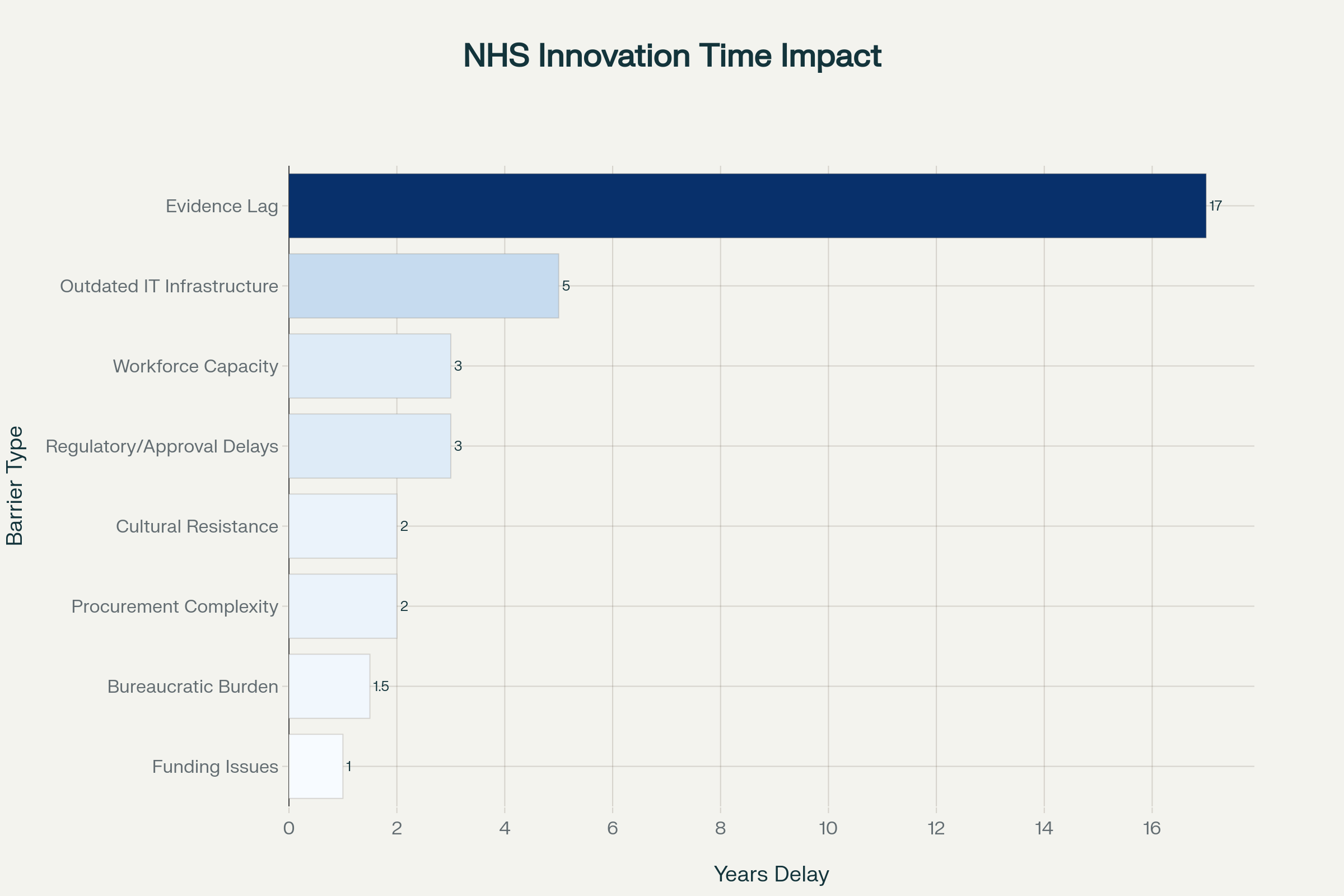
Analysis of major barriers to NHS innovation showing the time impact each barrier causes in delaying new technologies and treatments
The evidence reveals eight major barriers that collectively delay NHS innovation by an average of 4.3 years, with evidence lag representing the most severe impediment at 17 years. Outdated IT infrastructure, affecting 73% of NHS operations, creates a 5-year delay in adopting new technologies89. These barriers compound rather than operate independently, creating a formidable obstacle course for innovators seeking to improve patient care.
The Evidence Paradox
While evidence-based medicine represents the gold standard for clinical practice, the evidence requirements themselves have become barriers to innovation. Only a small subset of medical interventions has been tested in appropriate, well-designed studies3, yet guidelines often treat absence of evidence as evidence of absence, creating what researchers term the "evidence paradox."
The challenge is compounded by the fact that guideline development groups "often lack the time, resources, and skills to gather and scrutinise every last piece of evidence"3. Even when comprehensive evidence exists, subjective value judgements in weighing benefits against harms can lead to recommendations that may be inappropriate for individual patients or innovative approaches3.
NICE's own research acknowledges that guidelines have an average lifespan of six years and should be reassessed every three years10. However, the practical reality is that many guidelines remain unchanged for much longer periods, with some dating back over a decade without substantial revision. This creates a systematic bias toward established practices, regardless of emerging evidence supporting innovative alternatives.
Bureaucratic Complexity and Procurement Barriers
The SME Exclusion Crisis
The NHS procurement system has evolved into what critics describe as a "bureaucratic obstacle course" that systematically excludes small and medium enterprises11. SMEs entering the NHS procurement system face excessive duplication of compliance paperwork, with the same details required across multiple forms rather than being stored centrally for easy reference11. This administrative burden creates what one analysis termed "decuplification" – doing everything ten times over.
For example, companies not handling patient data still must justify compliance with over 200 security questions and create more than 20 new policies to meet NHS data standards11. The same insurance documents must be uploaded in four different places simply because different sections of tenders require them separately11. This bureaucratic complexity serves no meaningful purpose beyond creating barriers to entry for smaller, more innovative companies.
The financial burden on SMEs is substantial. Professional bid writing services charge fees ranging from £450 to £5,000 per day, with no guarantee of contract award11. While large corporations have dedicated in-house bid writing teams, SMEs must divert key personnel from core business operations to compile extensive submissions, creating a fundamental competitive disadvantage before the tendering process even begins11.
Regulatory Inefficiencies
The Association of British HealthTech Industries reports that regulatory inefficiencies and "unworkable" NHS tendering requirements are causing significant delays in innovation6. More than a third (35%) of companies estimate that the time from idea conception to regulatory approval takes three-to-five years, with a similar time-frame required from regulatory approval to full NHS adoption6.
Three in ten companies are not bidding on NHS tenders due to requirements singularly focused on unit price rather than total value achieved across clinical pathways6. This short-term cost focus ignores the potential for innovations to deliver long-term savings and improved outcomes across the healthcare system.
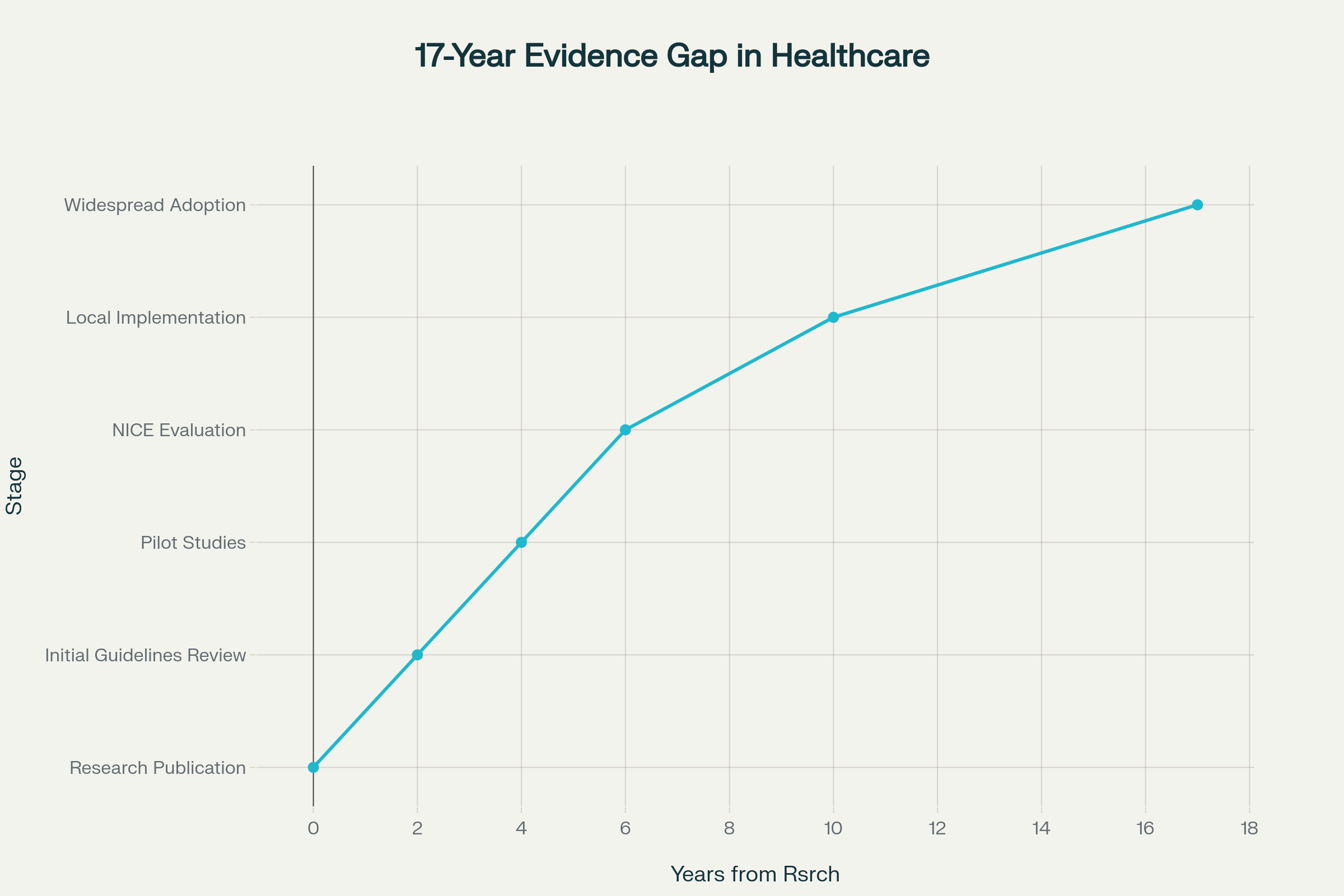
Timeline showing the 17-year journey from research publication to widespread adoption in NHS healthcare practice
The evidence-to-practice timeline reveals how systematic delays accumulate at each stage of the innovation process. From initial research publication to widespread adoption, the 17-year journey involves multiple gatekeepers and approval processes, each adding incremental delays that compound over time. Cultural resistance at the final stage represents perhaps the most intractable barrier, as it reflects deeply embedded attitudes toward change within healthcare organizations.
International Comparison: The Innovation Gap
Technology Adoption Lag
The UK's position as an innovation laggard becomes apparent when comparing adoption rates with international peers. Insulin pump therapy provides a stark example: only 7% of people with type 1 diabetes in the UK use insulin pumps, compared to 15% in Germany and Norway and approximately 40% in the United States1213. This disparity exists despite clear evidence of clinical benefits and NICE recommendations supporting wider adoption.
The Medical Technology Group found that current utilization of insulin pumps for type 1 diabetes in the UK (3.9%) is extremely low compared to other countries13. Of 68 Primary Care Trusts that provided complete data, the average pump usage rate was just 3.9%, approximately one-third of the NICE-suggested benchmark of 12%13. In some areas, uptake was remarkably low, with Medway showing only 0.25% adoption despite having nearly 2,000 eligible patients13.
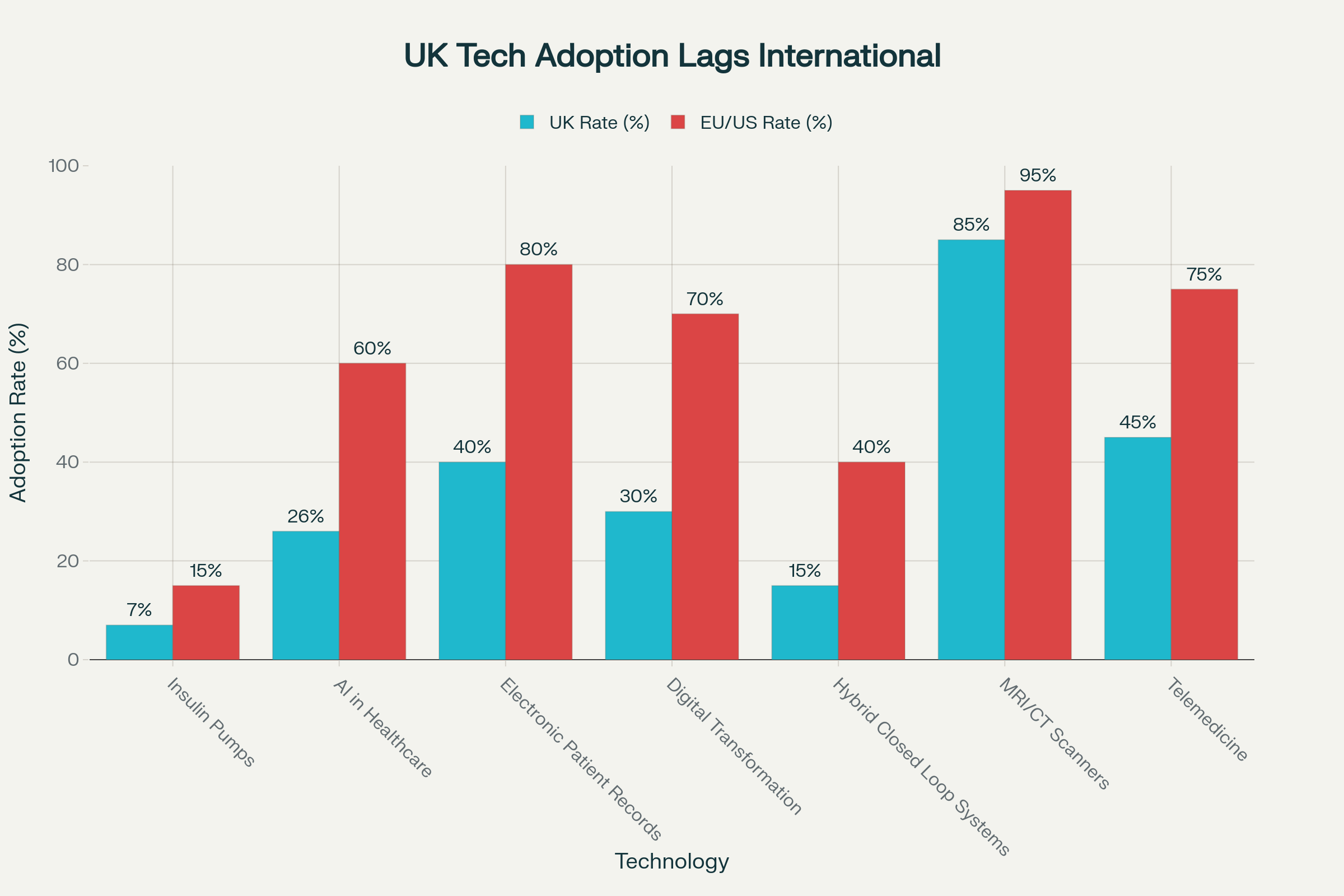
Comparison of UK healthcare technology adoption rates versus EU/US peers showing significant gaps across multiple technologies
The systematic lag in healthcare technology adoption across multiple domains demonstrates that this is not an isolated phenomenon but a systemic issue affecting the entire NHS innovation ecosystem. From artificial intelligence to electronic patient records, the UK consistently underperforms relative to international benchmarks, suggesting fundamental structural problems rather than technology-specific challenges.
Digital Transformation Delays
Digital transformation represents another area where the NHS significantly lags international peers. Despite government targets for full NHS digitalization, a 2023 report indicated that the majority of NHS Trusts still operate with hybrid paper-based and digital systems14. The rollout of Electronic Patient Records has been inconsistent and slow, with 40% NHS adoption compared to 80% internationally15.
The cost of this technological lag extends beyond efficiency concerns. More than 13.5 million hours of doctors' time is lost annually in England due to delays from inadequate or malfunctioning IT systems – equivalent to almost 8,000 full-time doctors or nearly £1 billion in lost productivity16. Some doctors report spending half an hour simply logging into computer systems, with one describing this "ridiculous waste of time" as putting "patient safety at risk"16.
Cultural and Organizational Resistance
Risk Aversion and Professional Conservatism
Healthcare professionals often exhibit reluctance to adopt unfamiliar digital systems, manifesting as "digital fatigue" and an "aversion to risk"14. This cultural barrier reflects deeper issues within NHS organizational culture that often prizes "continuity and predictability over delivering outcomes"14, inadvertently stifling innovation.
Evidence suggests that individual-level barriers include clinicians' lack of time to prioritize innovation, combined with system-level disincentives that fail to make time for innovative practices17. When services are under pressure, 43% of consultant physicians report that research activities – often the pathway through which innovations are evaluated and adopted – are among the first things to be dropped18.
Implementation Capacity Deficit
The NHS faces a fundamental mismatch between resources allocated for innovation development and those available for implementation and spread. While substantial funding supports innovation pilots and development, less than 0.1% of NHS resources are dedicated to adoption and spread activities19. This compares unfavorably with private sector companies that may allocate up to 25% of turnover to promoting their innovations19.
This resource imbalance creates what researchers term the "valley of death" for NHS innovations – promising developments that succeed in pilot studies but fail to achieve widespread adoption due to inadequate implementation support. Many innovators receive funding for active dissemination programs for only a couple of years, forcing them to revert to passive dissemination strategies before innovations achieve significant penetration19.
The Cost of Innovation Delay
Economic Impact
The financial implications of innovation delays extend far beyond direct healthcare costs. The combined impact of major barriers to NHS innovation is estimated at £2.375 billion annually, encompassing direct costs, opportunity costs, and productivity losses8. Outdated IT infrastructure alone accounts for approximately £1 billion of this burden, while evidence lag contributes an additional £500 million through delayed adoption of cost-effective interventions.
Healthcare innovations could boost the UK's economy by £278 billion, yet the NHS's inability to rapidly adopt and scale promising technologies means this potential remains largely unrealized20. The Innovation Ecosystem Programme recognizes that "pioneering businesses" often "abandon working with the NHS and went elsewhere" due to bureaucratic burden and slow timelines14.
Patient Impact
The human cost of innovation delays manifests in reduced access to potentially life-saving treatments and technologies. The Royal College of Emergency Medicine estimates that long waiting times in A&E departments are causing an additional 14,000 deaths annually – more than double all British armed forces combat deaths since the NHS was founded21. While not all of these deaths could be prevented through innovation alone, faster adoption of proven technologies and processes could significantly reduce this toll.
Cancer care provides another example where innovation delays have tangible consequences. No progress was made in diagnosing cancer at early stages (I and II) between 2013 and 202121. The UK has appreciably higher cancer mortality rates than other countries, partly attributable to slower adoption of advanced diagnostic and treatment technologies that are standard practice elsewhere.
Systemic Solutions and Reform Imperatives
Regulatory Reform
The UK government has recognized the need for regulatory reform, with the Medicines and Healthcare products Regulatory Agency outlining plans for a new Early Access service to provide time-limited, conditional access to promising technologies ahead of full regulatory approval22. This initiative aims to help bring safe and effective medical devices to patients more quickly, particularly benefiting small and medium-sized enterprises.
However, regulatory reform alone is insufficient without corresponding changes to procurement processes, funding mechanisms, and organizational culture. The Medical Technology Funding Mandate policy represents progress in addressing funding barriers for selected NICE-recommended technologies23, but its scope remains limited relative to the scale of the innovation adoption challenge.
Implementation Science
The emerging field of implementation science seeks to address the 17-year evidence-to-practice gap by developing systematic approaches to knowledge translation1. This discipline recognizes that effective implementation requires dedicated resources, skills, and organizational readiness that are often underestimated or overlooked entirely.
Implementation science research demonstrates that successful innovation adoption is not simply a matter of providing evidence or mandating change. Instead, it requires understanding and addressing the complex interplay of individual, organizational, and system-level factors that influence adoption decisions. This knowledge challenges traditional approaches that assume innovations will spread naturally if they demonstrate clear benefits.
Organizational Culture Change
Perhaps the most fundamental requirement for addressing NHS innovation barriers is cultural transformation that embeds innovation as a core organizational value rather than an optional extra. This requires leadership commitment at all levels, from frontline clinicians to executive management, supported by appropriate incentive structures and performance metrics.
Research suggests that research-active hospitals have improved outcomes for patients18, yet many NHS organizations struggle to maintain research and innovation activities under operational pressure. Protecting time and resources for innovation, even during periods of service strain, may paradoxically improve long-term organizational performance and patient outcomes.
Conclusion
The NHS faces a fundamental challenge in balancing the need for evidence-based practice with the imperative to innovate and improve. While best practice guidelines serve the important function of standardizing care and ensuring quality, they have evolved into barriers that systematically delay the adoption of beneficial innovations. The 17-year evidence-to-practice gap, combined with procurement complexity, outdated infrastructure, and cultural resistance, creates a formidable obstacle course that few innovations successfully navigate.
The cost of this systemic failure extends beyond financial metrics to encompass missed opportunities for improved patient outcomes, reduced productivity, and diminished UK competitiveness in global healthcare markets. While the challenges are substantial, they are not insurmountable. Successful reform will require coordinated action across regulatory frameworks, procurement processes, organizational culture, and implementation science.
The urgency of this challenge has never been greater. As healthcare systems worldwide grapple with aging populations, resource constraints, and complex health challenges, the ability to rapidly identify, evaluate, and adopt beneficial innovations may well determine which systems thrive and which fall behind. For the NHS, addressing innovation barriers is not merely about improving efficiency – it is about fulfilling its fundamental promise to provide the best possible care for all patients, regardless of their circumstances or location.
The path forward requires acknowledging that innovation is not a luxury to be pursued when resources permit, but an essential component of sustainable healthcare delivery. Only by systematically addressing the barriers that hold back innovation can the NHS hope to realize its potential as a world-leading healthcare system that combines the best of evidence-based practice with the benefits of continuous improvement and innovation.
- https://htn.co.uk/2024/11/19/industry-view-what-is-holding-the-nhs-back-from-innovation-and-what-is-needed-to-break-these-barriers/
- https://www.bbc.co.uk/news/articles/c4nn0vl2e78o
- https://www.nelsonadvisors.co.uk/blog/accelerating-uk-healthcare-innovation--analysis-of-the-nhs--innovator-passports--initiative
- https://mtg.org.uk/breakdown-barriers-to-innovation-in-the-nhs/
- https://digital.nhs.uk/data-and-information/information-standards/governance/latest-activity/standards-and-collections/standards-and-collections---withdrawn
- https://pmc.ncbi.nlm.nih.gov/articles/PMC6925468/
- https://www.nuffieldtrust.org.uk/sites/default/files/2017-12/1513183510_nt-innovation-briefing-scc-web-2.pdf
- https://www.sbs.nhs.uk/news/1-5bn-framework-to-upgrade-nhss-outdated-it-systems-and-get-analogue-to-digital-switch-underway-goes-live/
- https://www.kingsfund.org.uk/insight-and-analysis/blogs/siloed-unsupported-hindered-innovation-nhs-social-care
- https://www.england.nhs.uk/long-read/the-innovation-ecosystem-programme/
- https://publications.parliament.uk/pa/cm5803/cmselect/cmhealth/223/report.html
- https://www.health.org.uk/features-and-opinion/blogs/priorities-for-supporting-health-care-innovation-an-analysis-of-funding
- https://www.global-counsel.com/insights/report/unleashing-innovation-nhs-barriers-and-opportunities-adoption-and-uptake-healthcare
- https://www.healthwatch.co.uk/blog/2025-05-01/extent-and-impact-inaccurate-nhs-patient-records
- https://thehealthinnovationnetwork.co.uk/news/healthcare-innovations-could-boost-uk-economy-by-278-billion/
- https://www.nhsconfed.org/publications/scaling-innovation-within-healthcare-systems
- https://www.gov.uk/government/publications/independent-investigation-of-the-nhs-in-england/independent-investigation-of-the-national-health-service-in-england-accessible-version
- https://www.ukri.org/news/developing-regulatory-science-to-advance-healthcare/
- https://www.england.nhs.uk/improvement-hub/wp-content/uploads/sites/44/2017/11/Creating-the-Culture-for-Innovation-Practical-Guide-for-Leaders.pdf
- https://www.kingsfund.org.uk/insight-and-analysis/long-reads/nhs-crisis-evaluating-radical-alternatives
- https://impact.ref.ac.uk/CaseStudies/CaseStudy.aspx?Id=21741
- https://www.abpi.org.uk/media/yyudi2c3/abpi_connie-report_iii_v05.pdf
- https://pmc.ncbi.nlm.nih.gov/articles/PMC1114973/
- https://www.england.nhs.uk/long-read/medical-technology-medtech-funding-mandate-policy-guidance/
- https://www.ncbi.nlm.nih.gov/books/NBK549283/
- https://www.nice.org.uk/Media/Default/About/what-we-do/NICE-guidance/NICE-medical-technologies/Updated-MTEP-methods-guide.pdf
- https://www.england.nhs.uk/wp-content/uploads/2020/03/leading-the-acceleration-of-evidence-into-practice-guide.pdf
- https://www.nice.org.uk/about/what-we-do/our-programmes/nice-guidance/nice-medical-technologies-guidance
- https://www.england.nhs.uk/blog/accelerating-innovation-in-the-nhs/
- https://www.nice.org.uk/process/pmg6/chapter/updating-published-clinical-guidelines-and-correcting-errors
- https://www.nice.org.uk/Media/Default/About/what-we-do/NICE-guidance/NICE-medical-technologies/Medical-technologies-evaluation-programme-process-guide.pdf
- https://www.strategyunitwm.nhs.uk/sites/default/files/2018-12/Innovation%20&%20evaluation%20proposition%20(final)%20v1.pdf
- https://www.reddit.com/r/nhs/comments/yt9253/why_do_nhsuk_still_follow_the_old_and_outdated/
- https://www.nice.org.uk/about/what-we-do/our-programmes/nice-advice/medtech-innovation-briefings
- https://www.hee.nhs.uk/our-work/allied-health-professions/enable-workforce/allied-health-professions%E2%80%99-research-innovation-strategy-england
- https://www.nice.org.uk/media/default/About/NICE-Communities/Public-involvement/Developing-NICE-guidance/Factsheet-1-contribute-to-developing-clinical-guidelines.pdf
- https://www.gov.uk/government/news/regulatory-roadmap-points-the-way-ahead-for-new-measures-to-support-safe-access-to-medical-technology-including-ai-and-diagnostics
- https://www.libdemvoice.org/the-nhs-procurement-maze-why-smes-are-being-shut-out-of-public-sector-contracts-77068.html
- https://www.nationalhealthexecutive.com/articles/regulations-and-nhs-tendering-requirements-delaying-innovation-says-healthtech-industry
- https://nhsproviders.org/resources/a-pivotal-moment-regulation-and-oversight-survey-2024/the-perceived-burden-of-regulation
- https://www.abhi.org.uk/resource-hub/file/13666
- https://www.gov.uk/government/news/mhra-outlines-intent-to-speed-up-patient-access-to-innovative-medical-devices
- https://www.mgmt.ucl.ac.uk/sites/default/files/upload/pdfs/Taticchi_Corvaglia-Charrey_2022_FINAL.pdf
- https://www.abpi.org.uk/media/news/2022/october/nhs-patients-losing-access-to-innovative-treatments-as-uk-industry-clinical-trials-face-collapse/
- https://www.medacy.co.uk/2024/10/22/why-nhs-framework-agreements-are-a-barrier-to-innovation-and-need-urgent-reform/
- https://www.england.nhs.uk/long-read/small-and-medium-enterprises-action-plan/
- https://www.nihr.ac.uk/funding/transformative-and-disruptive-innovations-reduce-waiting-lists-and-waiting-times-april-2025/2025291
- https://www.gov.uk/government/publications/working-together-to-improve-health-and-social-care-for-all/integration-and-innovation-working-together-to-improve-health-and-social-care-for-all-html-version
- https://www.gov.uk/government/publications/a-new-approach-to-ensure-regulators-and-regulation-support-growth/new-approach-to-ensure-regulators-and-regulation-support-growth-html
- https://www.england.nhs.uk/category/innovation/
- https://healthinnovationeast.co.uk/life-sciences-sector-plan-to-grow-economy-and-transform-nhs/
- https://apply-for-innovation-funding.service.gov.uk/competition/190/overview
- https://www.health.org.uk/press-office/press-releases/uk-among-worst-performing-high-income-countries-on-waits-for-hospital
- https://www.gov.uk/government/news/unprecedented-boost-for-clinical-trials-under-10-year-health-plan
- https://pubmed.ncbi.nlm.nih.gov/37018006/
- https://assets.publishing.service.gov.uk/media/66f42ae630536cb92748271f/Lord-Darzi-Independent-Investigation-of-the-National-Health-Service-in-England-Updated-25-September.pdf
- https://www.hra.nhs.uk/about-us/news-updates/new-clinical-trials-data-shows-impact-combined-review/
- https://qualitysafety.bmj.com/content/29/5/409
- https://www.healthwatchsouthtyneside.co.uk/report-claims-nhs-is-lagging-behind-other-countries/
- https://www.rcp.ac.uk/media/xkxhrdt5/time-for-research.pdf
- https://www.bma.org.uk/news-and-opinion/millions-of-hours-of-doctors-time-lost-each-year-to-inadequate-it-systems
- https://www.seafordmedicalpractice.nhs.uk/research-active-practice/
- https://jbi.global/news/article/why-does-ebp-lag-global-healthcare-0
- https://www.kingsfund.org.uk/insight-and-analysis/reports/nhs-compare-health-care-systems-other-countries
- https://www.england.nhs.uk/blog/what-does-the-new-clinical-research-vision-mean-for-nhs-patients-and-health-professionals/
- https://www.ncbi.nlm.nih.gov/books/NBK2659/
- https://www.ombudsman.org.uk/about-us/our-casework/how-our-casework-makes-difference/case-summaries/949
- https://advanced-practice.hee.nhs.uk/research-framework-launched/
- https://www.sciencedirect.com/science/article/pii/S016517811930602X
- https://pmc.ncbi.nlm.nih.gov/articles/PMC3241518/
- https://advanced-practice.hee.nhs.uk/our-work/research/multi-professional-practice-based-research-capabilities-framework/
- https://siliconpractice.co.uk/2025/02/07/balancing-innovation-and-implementation-the-state-of-digital-transformation-in-uk-healthcare/
- https://dig.watch/updates/uk-health-sector-adopts-ai-while-legacy-tech-lags
- https://diabetesonthenet.com/wp-content/uploads/jdn17-5-175-9-1.pdf
- https://futurehealth.bmj.com/news-1/uk-healthcare-sector-falling-behind-ai-adoption
- https://www.diabetes.org.uk/sites/default/files/diabetes-storage/migration/pdf/nhs-1289383455-Insulin-pump-research-report.pdf
- https://www.frontier-economics.com/uk/en/news-and-insights/articles/article-i21056-ai-adoption-healthcare-or-health-scare/
- http://www.cypdiabetesnetwork.nhs.uk/north-east-north-cumbria/wp-content/uploads/sites/5/2024/07/NHS-England-Hybrid-closed-loop-technologies_-5-year-implementation-strategy.pdf
- https://www.kingsfund.org.uk/insight-and-analysis/long-reads/innovation-nhs
- https://assets.publishing.service.gov.uk/media/6857e0995225e4ed0bf3ceb5/dsit_technology_adoption_review_web.pdf
- https://www.england.nhs.uk/long-read/hybrid-closed-loop-technologies-5-year-implementation-strategy/
- https://www.phgfoundation.org/blog/innovation-in-the-nhs/
- https://www.health.org.uk/reports-and-analysis/analysis/tech-to-save-time-how-the-nhs-can-realise-the-benefits
- https://www.ncbi.nlm.nih.gov/books/NBK259885/
- https://www.health.org.uk/features-and-opinion/blogs/innovation-is-being-squeezed-out-of-the-nhs
- https://www.gov.uk/government/publications/barriers-and-enablers-to-advanced-technology-adoption-for-uk-businesses/barriers-and-enablers-to-advanced-technology-adoption-for-uk-businesses
- https://www.hfma.org.uk/system/files/2024-10/diabetes-hybrid-closed-loop-systems-7900.pdf
- https://www.simbo.ai/blog/exploring-the-current-state-of-ai-adoption-in-the-uk-healthcare-sector-challenges-and-opportunities-for-growth-4192120/