Weight Loss medications
Comprehensive Review of Drugs that Cause Weight Loss: Approved Medications and Non-Weight Loss Medications for Repurposing
The landscape of pharmacological weight management has evolved dramatically in recent years, with the introduction of highly effective GLP-1 receptor agonists achieving weight loss comparable to bariatric surgery. This comprehensive review examines both medications specifically approved for weight loss and those originally developed for other indications that demonstrate significant weight loss potential, offering clinicians a complete overview of pharmacological options for obesity management.
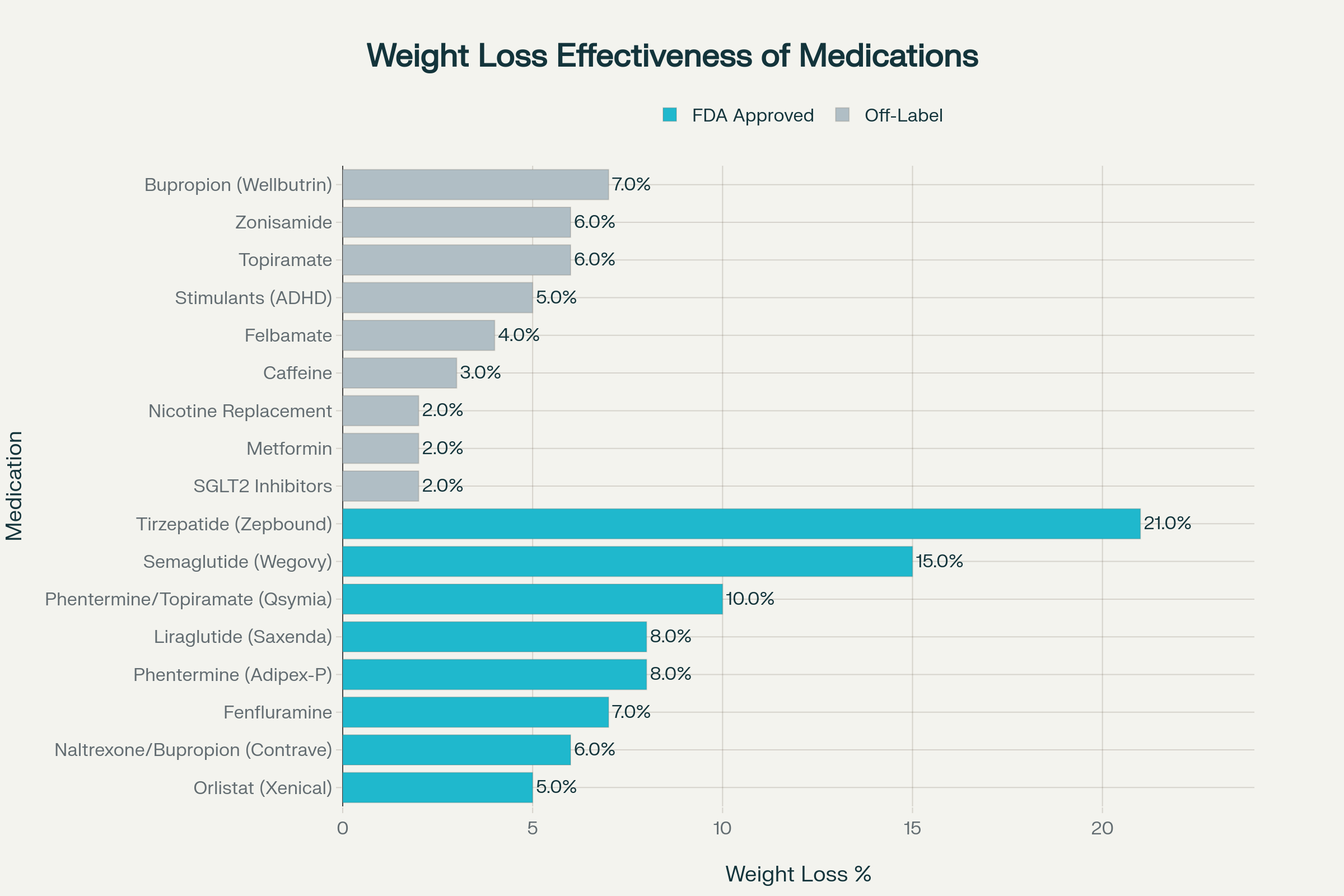
Weight loss effectiveness comparison across FDA-approved and off-label medications, showing average percentage weight loss achieved in clinical studies
FDA-Approved Weight Loss Medications
GLP-1 and Dual Receptor Agonists
The most significant advancement in obesity pharmacotherapy has come from incretin-based therapies, which represent the most effective weight loss medications currently available.
Semaglutide (Wegovy) leads this category as a GLP-1 receptor agonist approved for chronic weight management. Clinical trials demonstrate average weight loss of approximately 15% at the maximum dose of 2.4 mg weekly12. In the landmark STEP trials, 86.4% of patients achieved ≥5% weight loss, with 69.1% losing ≥10% of body weight3. The medication works through multiple mechanisms including delayed gastric emptying, central appetite suppression, and reduced food cravings.
Tirzepatide (Zepbound) represents the next generation of incretin therapy as a dual GLP-1/GIP receptor agonist. Studies show superior efficacy to semaglutide, with the highest dose (15 mg weekly) achieving 21% average weight loss in clinical trials1. Head-to-head comparisons demonstrate tirzepatide's significantly greater effectiveness, with 81.8% of patients achieving ≥5% weight loss compared to 66.5% with semaglutide2. The dual mechanism targeting both GLP-1 and GIP receptors appears to provide enhanced weight loss through complementary pathways affecting glucose homeostasis and appetite regulation.
Liraglutide (Saxenda) was the first GLP-1 receptor agonist approved for weight management, administered as a 3 mg daily injection. While less effective than newer agents, it achieves approximately 8% average weight loss and remains a valuable option for patients who may not tolerate higher-efficacy medications34.
Traditional Appetite Suppressants and Combination Therapies
Phentermine remains widely prescribed as a sympathomimetic amine that reduces appetite through norepinephrine and dopamine pathways. As monotherapy, it achieves approximately 8% weight loss, but its use is limited to short-term treatment (typically 12 weeks) due to potential cardiovascular effects and dependency concerns45.
Phentermine/Topiramate (Qsymia) combines the appetite suppressant effects of phentermine with topiramate's weight loss properties. This combination achieves approximately 10% average weight loss, with the dual mechanism providing enhanced appetite suppression while potentially reducing some adverse effects through lower individual drug doses67.
Naltrexone/Bupropion (Contrave) targets both opioid and dopamine/norepinephrine pathways to reduce food cravings and emotional eating. Clinical trials show approximately 6% average weight loss, with the combination designed to address both hedonic and homeostatic eating behaviors67.
Lipase Inhibitors
Orlistat (Xenical) uniquely works through peripheral mechanisms by inhibiting pancreatic and gastric lipases, preventing approximately 30% of dietary fat absorption. While achieving more modest weight loss (approximately 5%), it offers the advantage of not affecting central nervous system pathways and has an established long-term safety profile38. The medication's gastrointestinal side effects, while limiting tolerability, are predictable and dose-related.
Non-Weight Loss Medications with Repurposing Potential
Antidiabetic Medications
Metformin represents one of the most studied off-label weight loss agents. Originally developed for type 2 diabetes management, it achieves modest weight loss (approximately 2-3%) through multiple mechanisms including appetite reduction, improved insulin sensitivity, and gut microbiome modification91011. The Diabetes Prevention Program demonstrated sustained weight loss over 15 years, with highly adherent patients experiencing 3.5% body weight reduction1112. While not FDA-approved for weight loss, metformin is commonly prescribed off-label, particularly for patients with insulin resistance or metabolic syndrome.
SGLT2 Inhibitors (canagliflozin, empagliflozin, dapagliflozin) promote weight loss through glucosuria, causing caloric loss of 320-480 kcal/day through urinary glucose excretion. Meta-analyses demonstrate 1.5-2.5 kg average weight loss, with approximately two-thirds of weight loss attributed to fat mass reduction1314. These medications offer cardiovascular and renal benefits beyond weight loss, making them particularly valuable in patients with diabetes and obesity.
Neuropsychiatric Medications
Bupropion (Wellbutrin) demonstrates significant weight loss potential as an NDRI (norepinephrine-dopamine reuptake inhibitor). Studies show average weight loss of 7 pounds over two years compared to other antidepressants151617. Unlike most antidepressants that cause weight gain, bupropion's stimulating effects on dopamine and norepinephrine pathways reduce appetite and increase energy expenditure1819. The medication is FDA-approved as part of the naltrexone/bupropion combination for weight loss.
Topiramate achieves weight loss through multiple mechanisms including carbonic anhydrase inhibition, GABA enhancement, and glutamate receptor antagonism. Studies demonstrate 6% average weight loss, with effects appearing dose-dependent and sustained over time2021. The medication's efficacy led to its inclusion in the FDA-approved phentermine/topiramate combination. However, cognitive side effects and teratogenic potential limit its use.
Anticonvulsants
Zonisamide shows promise for weight loss through mechanisms similar to topiramate, including effects on neurotransmitter systems and metabolism. Clinical studies demonstrate approximately 6% weight loss, with concurrent improvements in glycemic control and cardiovascular risk factors222324. The medication appears particularly effective in patients with higher baseline BMI and may have additional benefits for comorbid conditions.
Fenfluramine has been reintroduced for specific epilepsy indications despite its historical association with cardiac valvulopathy. Modern formulations at lower doses show significant weight loss effects (approximately 7%) with improved safety profiles22. However, its use remains restricted to specialized epilepsy centers due to ongoing cardiovascular concerns.
Stimulant Medications
ADHD Stimulants (amphetamines, methylphenidate) cause weight loss through appetite suppression and increased energy expenditure. While not approved for weight management, these medications typically result in 5% average weight loss2526. Their use for weight loss remains controversial due to abuse potential and cardiovascular risks, though some clinicians consider them for patients with comorbid ADHD and obesity.
Phentermine beyond its approved indication demonstrates efficacy in ADHD management, suggesting overlapping mechanisms in dopaminergic pathways. Some practitioners use it off-label for patients requiring both attention enhancement and weight management2627.
Cardiovascular Medications
Cardiovascular medications generally cause weight gain rather than loss, limiting their repurposing potential. ACE inhibitors show minimal weight effects, with some studies suggesting modest weight maintenance benefits2829. Beta-blockers typically cause 2-3 pounds weight gain through metabolic slowing, though newer agents like carvedilol and nebivolol have more neutral weight effects303132.
Other Agents
Caffeine, while not a prescription medication, demonstrates thermogenic effects through adenosine receptor antagonism and sympathetic nervous system activation. Studies show 3-8% increase in energy expenditure, with potential weight loss benefits when combined with dietary interventions333435. However, tolerance development and cardiovascular stimulation limit its long-term utility.
Nicotine Replacement Therapy provides modest weight control benefits during smoking cessation, achieving approximately 2% weight reduction through metabolic effects and appetite suppression3637. While not appropriate as a primary weight loss intervention, it may help prevent post-cessation weight gain.
Emerging Therapies and Combination Approaches
Triple Receptor Agonists
Retatrutide represents the next frontier in obesity pharmacotherapy as a GLP-1/GIP/glucagon triple receptor agonist. Phase II trials demonstrate unprecedented weight loss of up to 24% at 48 weeks, surpassing all currently available medications383940. The addition of glucagon receptor activation enhances hepatic fat oxidation and energy expenditure beyond the effects of GLP-1/GIP dual agonism. Phase III trials are ongoing to confirm these remarkable efficacy signals.
Combination Therapy Strategies
Clinical experience increasingly supports combination approaches targeting multiple pathways simultaneously. Case reports demonstrate that adding semaglutide to existing regimens of phentermine, topiramate, and metformin can achieve weight loss approaching bariatric surgery outcomes (>30% total body weight loss)41. The rationale for combination therapy includes:
- Targeting different mechanisms of weight regulation
- Potentially reducing individual drug doses and side effects
- Overcoming weight loss plateaus with monotherapy
- Addressing the multifactorial nature of obesity
Established Combinations include phentermine/topiramate and naltrexone/bupropion, both FDA-approved based on superior efficacy compared to individual components642. Emerging Combinations under investigation include GLP-1 agonists with SGLT2 inhibitors, which may provide complementary weight loss through different mechanisms while offering cardiovascular and metabolic benefits43.
Safety Considerations and Contraindications
Universal Contraindications
All weight loss medications are contraindicated in pregnancy due to potential fetal risks and lack of benefit to maternal health44. Breastfeeding typically represents another contraindication, though individual risk-benefit assessments may apply.
Medication-Specific Safety Profiles
GLP-1 Receptor Agonists carry risks of pancreatitis, diabetic retinopathy progression, and theoretical thyroid C-cell tumor risk based on rodent studies4546. The most common side effects are gastrointestinal (nausea, vomiting, diarrhea), typically mild-to-moderate and transient during dose escalation.
Sympathomimetic Amines (phentermine) are contraindicated in cardiovascular disease, hyperthyroidism, glaucoma, and substance abuse history44. Blood pressure and heart rate monitoring are essential during treatment.
Topiramate-Containing Combinations require pregnancy prevention due to teratogenic risks including craniofacial abnormalities44. Kidney stone formation and cognitive effects may limit long-term use.
Drug Interactions
Weight loss medications demonstrate numerous clinically significant interactions. Semaglutide interacts with 275 medications, including insulin, sulfonylureas, and ACE inhibitors, primarily through hypoglycemia risk4748. Naltrexone/Bupropion blocks opioid effects, requiring careful perioperative management and contraindication with opioid dependence49.
Metformin interactions include potential lactic acidosis with contrast agents and alcohol, while SGLT2 inhibitors may enhance ketogenesis and interact with diuretics50.
Paediatric Considerations
Four medications are FDA-approved for adolescent weight management: semaglutide (Wegovy), liraglutide (Saxenda), orlistat, and phentermine/topiramate (Qsymia), all approved for ages 12 and older5152. The American Academy of Pediatrics now recommends considering anti-obesity medications for adolescents with obesity as part of comprehensive treatment including lifestyle interventions.
Paediatric-Specific Considerations include:
- Growth and pubertal development monitoring
- Higher sensitivity to side effects
- Limited long-term safety data
- Psychological considerations around body image
- Family involvement in treatment decisions
Preliminary data suggest efficacy in children as young as 6-11 years, though long-term effects on growing bodies remain unknown53.
Clinical Decision-Making Framework
Patient Selection Criteria
Primary Weight Loss Medications are indicated for patients with BMI ≥30 kg/m² or BMI ≥27 kg/m² with weight-related comorbidities. Treatment should be discontinued if <5% weight loss is achieved within 12 weeks at optimal dosing44.
Off-Label Repurposing considerations include:
- Comorbid conditions that may benefit from specific medications
- Patient preference regarding administration routes
- Cost and insurance coverage factors
- Individual tolerability profiles
- Previous treatment responses
Sequencing and Combination Strategies
Current practice typically begins with lifestyle interventions, progressing to monotherapy with the most appropriate agent based on individual factors. Combination therapy is reserved for patients with inadequate response to monotherapy or those requiring treatment of multiple conditions simultaneously.
Emerging Paradigms suggest earlier intervention with more effective medications, potentially including combination approaches from treatment initiation for patients with severe obesity or multiple comorbidities.
Future Directions
The obesity pharmacotherapy landscape continues evolving rapidly with multiple agents in development. Oral GLP-1 receptor agonists may improve patient acceptance and adherence. Novel mechanisms under investigation include FGF21 analogs, MC4 receptor agonists, and targeted hypothalamic approaches.
Personalized Medicine approaches may eventually guide medication selection based on genetic, metabolic, or biomarker profiles. Digital Health Integration including continuous glucose monitoring and smartphone applications may enhance medication effectiveness through real-time feedback and behavioural modification.
Conclusion
The current era represents a paradigm shift in obesity pharmacotherapy, with new medications achieving weight loss previously only possible through surgical intervention. While FDA-approved weight loss medications provide the foundation of treatment, numerous off-label options offer additional therapeutic approaches for complex cases or specific patient populations.
The expanding expanding lsit of weight loss medications, from traditional appetite suppressants to cutting-edge triple receptor agonists, provides clinicians with unprecedented options for individualized obesity treatment. Success requires careful patient selection, appropriate monitoring, and integration with comprehensive lifestyle interventions. As our understanding of obesity's complex pathophysiology continues to evolve, the future promises even more effective and targeted therapeutic approaches for this challenging chronic disease.
The key to optimal outcomes lies in matching individual patients with the most appropriate medications based on their specific clinical profile, preferences, and treatment goals, while maintaining vigilance for safety considerations and drug interactions. This comprehensive approach, combining evidence-based medicine with clinical expertise, offers hope for meaningful and sustained weight loss for patients struggling with obesity and its numerous comorbidities.
- https://www.drugs.com/medical-answers/mounjaro-wegovy-ozempic-compare-weight-loss-3570898/
- https://asoi.info/wp-content/uploads/2022/10/11-IR-Pharmacotherapy-in-Obesity-Management-FINAL.pdf
- https://jamanetwork.com/journals/jamainternalmedicine/fullarticle/2821080
- https://obesitymedicine.org/blog/weight-loss-medications/
- https://www.thelancet.com/journals/eclinm/article/PIIS2589-5370(23)00059-7/fulltext
- https://pubmed.ncbi.nlm.nih.gov/40353578/
- https://researchbriefings.files.parliament.uk/documents/CBP-10171/CBP-10171.pdf
- https://academic.oup.com/jes/article/7/3/bvac195/6982509
- https://www.nice.org.uk/news/articles/nice-describes-how-weight-loss-drug-tirzepatide-will-be-rolled-out
- https://www.niddk.nih.gov/health-information/weight-management/prescription-medications-treat-overweight-obesity
- https://www.ncbi.nlm.nih.gov/books/NBK279038/
- https://www.england.nhs.uk/ourwork/prevention/obesity/medicines-for-obesity/weight-management-injections/
- https://www.fda.gov/drugs/postmarket-drug-safety-information-patients-and-providers/fdas-concerns-unapproved-glp-1-drugs-used-weight-loss
- https://www.thelancet.com/journals/lancet/article/PIIS0140-6736(24)00351-9/abstract
- https://www.nhs.uk/conditions/obesity/treatment/
- https://www.oxfordonlinepharmacy.co.uk/blog/the-future-of-weight-loss-drugs-what-s-coming-in-2025
- https://www.racgp.org.au/afp/2017/july/pharmacotherapy-for-obesity
- https://pubmed.ncbi.nlm.nih.gov/34518444/
- https://www.forbes.com/health/weight-loss/approved-weight-loss-medication/
- https://www.sciencedirect.com/science/article/pii/S2665913124000396
- https://pubmed.ncbi.nlm.nih.gov/31524318/
- https://www.webmd.com/diabetes/metformin-cause-weight-loss
- https://pmc.ncbi.nlm.nih.gov/articles/PMC10532729/
- https://www.medicalnewstoday.com/articles/antidepressants-that-cause-weight-loss
- https://sesamecare.com/blog/metformin-for-weight-loss
- https://sesamecare.com/blog/topiramate-topamax-for-weight-loss
- https://www.health.harvard.edu/blog/managing-weight-gain-from-psychiatric-medications-202207182781
- https://www.healthline.com/health/diabetes/metformin-weight-loss
- https://academic.oup.com/endo/article/153/9/4401/2424149
- https://pmc.ncbi.nlm.nih.gov/articles/PMC5574691/
- https://pmc.ncbi.nlm.nih.gov/articles/PMC6520185/
- https://www.ncbi.nlm.nih.gov/books/NBK554530/
- https://www.psychiatrist.com/news/11-antipsychotics-and-their-impact-on-weight-gain-by-dose/
- https://www.ccjm.org/content/90/9/545
- https://go.drugbank.com/drugs/DB00273
- https://www.mind.org.uk/information-support/drugs-and-treatments/antipsychotics/side-effects/
- https://www.diabetes.org.uk/about-diabetes/looking-after-diabetes/treatments/tablets-and-medication/metformin
- https://www.droracle.ai/articles/171228/how-does-topamax-help-weight-loss
- https://psychiatryonline.org/doi/10.1176/appi.ajp.20230922
- https://www.health.harvard.edu/blog/is-metformin-a-wonder-drug-202109222605
- https://medicinainterna.net.pe/sites/default/files/SLGTP2_para_reducir_peso_en_diabeticos.pdf
- https://www.choosingtherapy.com/phentermine-vs-adderall/
- https://www.drugs.com/medical-answers/zyrtec-cause-weight-gain-3578020/
- https://pmc.ncbi.nlm.nih.gov/articles/PMC6394798/
- https://www.singlecare.com/blog/phentermine-for-adhd/
- https://www.aaaai.org/allergist-resources/ask-the-expert/answers/old-ask-the-experts/antihistamines-weight-gain
- https://pubmed.ncbi.nlm.nih.gov/34932882/
- https://medvidi.com/blog/phentermine-vs-adderall-how-do-these-two-stimulants-differ
- https://pmc.ncbi.nlm.nih.gov/articles/PMC3221329/
- https://gpnotebook.com/en-GB/pages/diabetes-and-endocrinology/sglt2-inhibitors-and-weight-loss
- https://www.singlecare.com/blog/phentermine-vs-adderall/
- https://www.theindependentpharmacy.co.uk/hay-fever/guides/cetirizine-vs-loratadine-for-hay-fever-relief
- https://cks.nice.org.uk/topics/diabetes-type-2/prescribing-information/sglt-2-inhibitors/
- https://www.reddit.com/r/Psychiatry/comments/nwyzo2/phentermine_for_adhd/
- https://obesitymedicine.org/blog/antihistamines-and-weight-gain-obesity-medicine-association/
- https://www.sciencedirect.com/science/article/pii/S2214623724000061
- https://www.verywellhealth.com/phentermine-vs-adderall-similarities-and-differences-7973968
- https://www.verywellhealth.com/do-antihistamines-cause-weight-gain-83094
- https://www.cheshireandmerseysideformulary.nhs.uk/docs/files/sglt2_comb.pdf
- https://www.mayoclinic.org/healthy-lifestyle/weight-loss/expert-answers/phentermine/faq-20057940
- https://pubmed.ncbi.nlm.nih.gov/16274385/
- https://www.mayoclinic.org/diseases-conditions/high-blood-pressure/expert-answers/beta-blockers/faq-20058385
- https://pubmed.ncbi.nlm.nih.gov/35596110/
- https://pmc.ncbi.nlm.nih.gov/articles/PMC3743454/
- https://www.formhealth.co/blog/beta-blockers-weight-gain
- https://pubmed.ncbi.nlm.nih.gov/18047602/
- https://www.ahajournals.org/doi/10.1161/HYPERTENSIONAHA.120.16667
- https://www.talkspace.com/blog/propranolol-weight-gain/
- https://www.neurology.org/doi/10.1212/CPJ.0000000000200210
- https://www.bhf.org.uk/informationsupport/heart-matters-magazine/medical/drug-cabinet/ace-inhibitors
- https://www.healthline.com/health/heart-health/heart-medications-that-cause-weight-gain
- https://www.healthline.com/health/epilepsy/seizure-medications-that-cause-weight-gain
- https://www.mayoclinic.org/diseases-conditions/high-blood-pressure/in-depth/ace-inhibitors/art-20047480
- https://pmc.ncbi.nlm.nih.gov/articles/PMC8486557/
- https://www.drugs.com/compare/lamotrigine-vs-zonisamide
- https://www.sciencedirect.com/science/article/abs/pii/S0140673603128929
- https://www.ahajournals.org/doi/10.1161/01.hyp.37.2.250
- https://www.reddit.com/r/Epilepsy/comments/1hgipiy/weight_loss_on_keppra_zonisamide_lamictal/
- https://cks.nice.org.uk/topics/hypertension/prescribing-information/angiotensin-converting-enzyme-inhibitors/
- https://www.nhs.uk/medicines/beta-blockers/
- https://pubmed.ncbi.nlm.nih.gov/2912010/
- https://pmc.ncbi.nlm.nih.gov/articles/PMC1496892/
- https://www.talkspace.com/blog/wellbutrin-weight-gain-or-loss/
- https://pmc.ncbi.nlm.nih.gov/articles/PMC6467726/
- https://pmc.ncbi.nlm.nih.gov/articles/PMC3817500/
- https://thriveworks.com/help-with/medication/does-wellbutrin-cause-weight-gain-or-loss/
- https://sealions.com/blogs/posts/tapping-into-fat-burners-how-caffeine-powers-thermogenesis
- https://www.nicorette.co.uk/during-the-quit-journey/managing-your-weight
- https://www.verywellmind.com/antidepressant-and-weight-1067613
- https://journals.physiology.org/doi/10.1152/ajpregu.00832.2005
- https://www.nhs.uk/better-health/quit-smoking/ready-to-quit-smoking/quit-with-nicotine-replacement-therapies-nrt/
- https://en.wikipedia.org/wiki/Bupropion
- https://www.frontiersin.org/journals/neuroscience/articles/10.3389/fnins.2021.621356/full
- https://www.cancer.org/cancer/risk-prevention/tobacco/guide-quitting-smoking/nicotine-replacement-therapy.html
- https://pubmed.ncbi.nlm.nih.gov/11557835/
- https://www.sciencedirect.com/science/article/pii/S0002916523432868
- https://medlineplus.gov/ency/article/007438.htm
- https://withinhealth.com/learn/articles/zyban-wellbutrin-bupropion-weight-loss-risks
- https://www.sciencedirect.com/science/article/abs/pii/S0002916523167761
- https://www.niquitin.co.uk/weight-gain-after-quitting-smoking/
- https://pmc.ncbi.nlm.nih.gov/articles/PMC12026077/
- https://pmc.ncbi.nlm.nih.gov/articles/PMC10578411/
- https://www.clinicaltrialsarena.com/features/obesity-trials-to-watch/
- https://www.nature.com/articles/s41591-024-03018-2
- https://pmc.ncbi.nlm.nih.gov/articles/PMC4780673/
- https://www.manchester.ac.uk/about/news/new-study-to-deepen-understanding-of-a-weight-loss-medication/
- https://pmc.ncbi.nlm.nih.gov/articles/PMC12190491/
- https://pmc.ncbi.nlm.nih.gov/articles/PMC11704407/
- https://www.nature.com/articles/s41366-024-01473-y
- https://www.thelancet.com/journals/landia/article/PIIS2213-8587(25)00092-0/abstract
- https://www.sciencedirect.com/science/article/pii/S0031699724000024
- https://www.sciencedirect.com/science/article/abs/pii/S0014299924007854
- https://www.nature.com/articles/s41366-025-01798-2
- https://www.nature.com/articles/s44324-025-00054-5
- https://www.mayoclinic.org/healthy-lifestyle/weight-loss/in-depth/weight-loss-drugs/art-20044832
- https://www.ccjm.org/content/84/12/951
- https://www.healthline.com/health/drugs/wegovy-interactions
- https://www.nbcnews.com/health/kids-health/teens-kids-weight-loss-drugs-obesity-fda-rcna93645
- https://www.novomedlink.com/obesity/products/treatments/wegovy/efficacy-safety/safety-profile.html
- https://pmc.ncbi.nlm.nih.gov/articles/PMC11678256/
- https://pmc.ncbi.nlm.nih.gov/articles/PMC11294794/
- https://www.gov.uk/drug-safety-update/glp-1-receptor-agonists-reminder-of-the-potential-side-effects-and-to-be-aware-of-the-potential-for-misuse
- https://www.ema.europa.eu/en/news/updated-advice-minimise-risks-interaction-between-weight-loss-medicine-mysimba-opioids
- https://www.nature.com/articles/d41586-024-02983-5
- https://pubmed.ncbi.nlm.nih.gov/25900872/
- https://www.drugs.com/drug-interactions/semaglutide.html
- https://pmc.ncbi.nlm.nih.gov/articles/PMC8082722/
- https://www.medicalnewstoday.com/articles/drugs-wegovy-interactions
- https://health.choc.org/weight-loss-medications-and-treating-teen-obesity-what-parents-should-know/
- https://www.thelancet.com/journals/eclinm/article/PIIS2589-5370(24)00599-6/fulltext
- https://well.co.uk/weight-management/weight-management-clinic/medications-advice/mounjaro-drug-interactions/
- https://www.uhs.nhs.uk/Media/UHS-website-2019/Patientinformation/Childhealth/Semaglutide-for-weight-management-in-children-3182-PIL.pdf
- https://www.fda.gov/consumers/consumer-updates/mixing-medications-and-dietary-supplements-can-endanger-your-health