Dolutegravir risks and long term consequnces
Long-Term Safety Risks of Dolutegravir: A Comprehensive Analysis of CNS Penetration, Organ Toxicity, and Mechanisms of Damage
This comprehensive analysis examines the emerging long-term safety concerns associated with dolutegravir (DTG), an integrase strand transfer inhibitor that has become a cornerstone of HIV treatment. While initially considered highly safe based on clinical trials, post-marketing surveillance and real-world evidence have revealed a complex safety profile requiring careful evaluation of the risk-benefit ratio for long-term use.
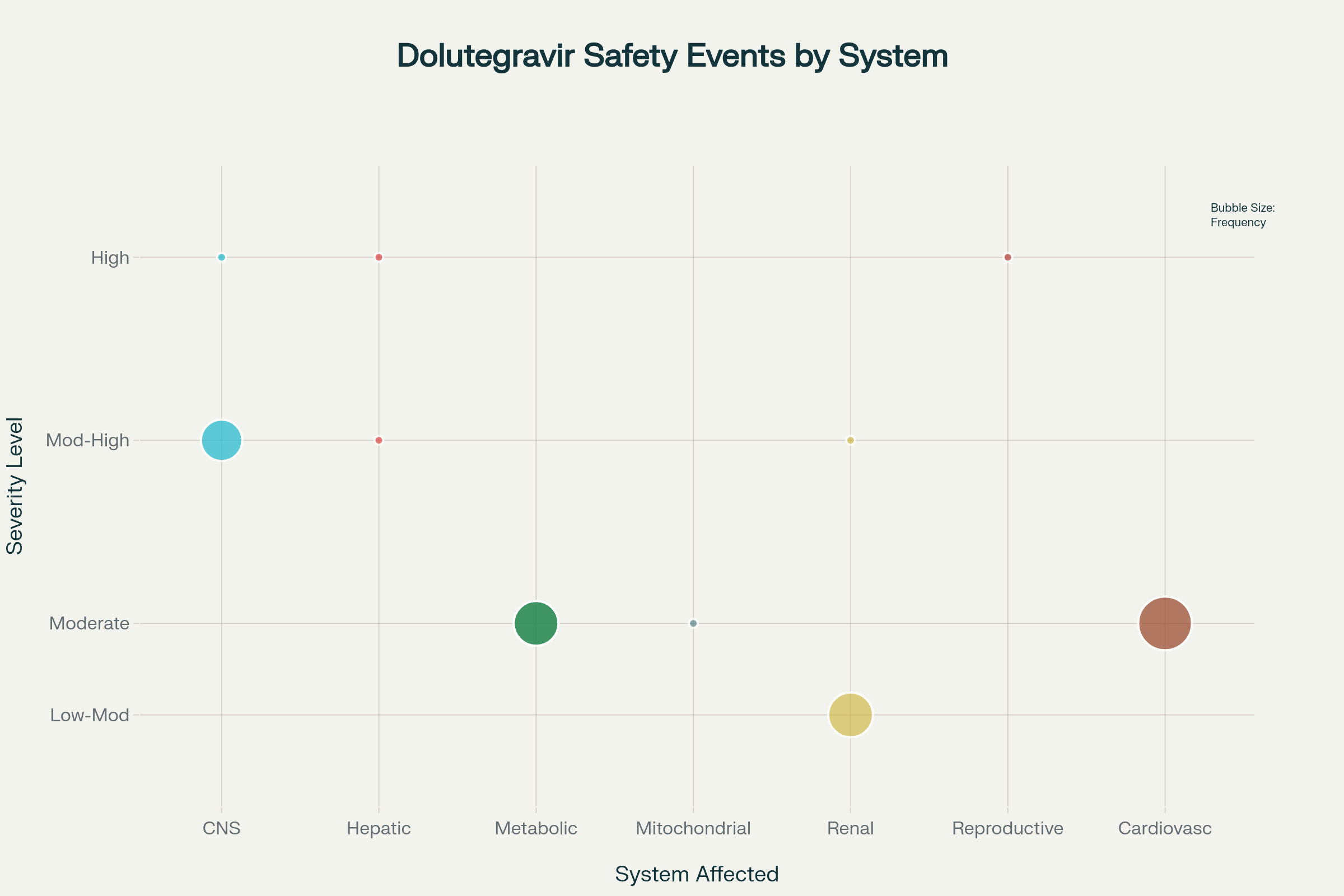
Long-term Safety Concerns and Adverse Events Associated with Dolutegravir by Organ System
Central Nervous System Effects and Blood-Brain Barrier Disruption
CNS Penetration and Neuropsychiatric Toxicity
Dolutegravir demonstrates significant central nervous system penetration with cerebrospinal fluid concentrations reaching 9.6 ng/mL (range: 3.6-22.8 ng/mL), well above the therapeutic threshold. This penetration occurs through passive diffusion across the blood-brain barrier, creating the potential for neurotoxicity. The drug achieves CSF inhibitory quotients of 48-114 times the wild-type IC₅₀, indicating substantial CNS exposure.pmc.ncbi.nlm.nih+1
Neuropsychiatric adverse events represent one of the most clinically significant long-term risks, with discontinuation rates of 3.5-15% in real-world studies compared to <2% in clinical trials. The most common manifestations include insomnia (36% of neuropsychiatric discontinuations), dizziness, headache, poor concentration, and depression. These effects appear within a median onset time of 74 days, with most occurring as an early failure pattern.pmc.ncbi.nlm.nih+1
Blood-Brain Barrier Disruption Mechanisms
Research has demonstrated that dolutegravir significantly disrupts blood-brain barrier integrity through multiple mechanisms. In vitro studies show DTG reduces expression of tight junction proteins (ZO-1, Claudin-5, JAM-2) and drug transporters (P-glycoprotein, ABCB1, ABCC1). This disruption is accompanied by increased pro-inflammatory cytokines (TNF-α, IL-1β) and nitric oxide production.pmc.ncbi.nlm.nih+1
The combination of dolutegravir with sertraline particularly exacerbates blood-brain barrier permeability, creating significant drug-drug interactions that may increase neurotoxicity risk. This interaction involves inhibition of P-glycoprotein-dependent DTG efflux, potentially leading to increased CNS concentrations and enhanced neuropsychiatric adverse events.pmc.ncbi.nlm.nih+1
Progressive Multifocal Leukoencephalopathy Risk
A particularly concerning finding from pharmacovigilance data is the association with progressive multifocal leukoencephalopathy (PML), a rare but potentially fatal CNS condition. Post-marketing surveillance identified 24 cases with a 41.7% mortality rate overall, with particularly high risk in males (55.6% mortality) and the 18-45 age group (66.7% mortality). The mechanism involves immune reconstitution inflammatory syndrome (IRIS) following cART initiation, which may exacerbate PML caused by JC virus reactivation.pmc.ncbi.nlm.nih
Hepatotoxicity and Liver-Related Risks
Drug-Induced Liver Injury
Hepatobiliary disorders represent a significant disproportionate safety signal with dolutegravir use (ROR = 2.45, 95% CI: 2.27-2.65). Drug-induced liver injury (DILI) occurs in 0.3-2% of patients, with higher rates in those coinfected with hepatitis B or C viruses. The hepatotoxicity pattern can be either hepatocellular or cholestatic, with some cases progressing to fulminant liver failure requiring transplantation.pmc.ncbi.nlm.nih+3
Several mechanisms contribute to hepatotoxicity:anncaserep
- Direct drug toxicity on liver metabolism
- Immune reconstitution syndrome in coinfected patients
- Hypersensitivity reactions
- Mitochondrial toxicity
- Immune-mediated responses
Hepatic Necrosis and Severe Outcomes
Hepatic necrosis represents a high-priority adverse event, particularly in patients aged 46-65 years, with a 27.3% mortality rate. The median onset time for hepatic adverse events is approximately 59 days for designated medical events, emphasizing the need for early biochemical monitoring. Cases typically present with elevated transaminases (AST >750 U/L, ALT >1000 U/L) and may progress to acute liver failure.pmc.ncbi.nlm.nih+2
Weight Gain and Metabolic Dysfunction
Mechanisms of Weight Gain
Dolutegravir-associated weight gain is well-documented, with patients gaining an average of 1.78 kg more than controls at 12 months. The primary mechanism involves inhibition of the melanocortin-4 receptor (MC4R), a key regulator of energy homeostasis. Women appear particularly susceptible due to higher baseline leptin levels and greater reliance on leptin-POMC-MC4R signaling for fat distribution regulation.pmc.ncbi.nlm.nih+1
Adipose Tissue Changes and Lipid Dysfunction
Laboratory studies demonstrate that dolutegravir directly affects adipose tissue, promoting:
- Greater adipocyte differentiation and lipid storage marker expressionpmc.ncbi.nlm.nih+1
- Higher lipid accumulation in exposed cellsaidsmap+1
- Lower leptin and adiponectin levels, hormones critical for metabolic regulationpmc.ncbi.nlm.nih+1
- Development of adipose tissue fibrosis through collagen upregulationpmc.ncbi.nlm.nih
- Reduced glucose uptake by adipocytesaidsmap+1
These changes result in dyslipidemia with increased total cholesterol and altered lipid profiles, though the long-term cardiovascular implications remain under investigation.thelancet+1
Mitochondrial Toxicity and Cellular Dysfunction
Mitochondrial Damage Mechanisms
Recent research has identified significant mitochondrial toxicity associated with dolutegravir-containing regimens. Studies demonstrate:pubmed.ncbi.nlm.nih+2
- Increased mitochondrial reactive oxygen species (mtROS) productionpubmed.ncbi.nlm.nih
- Fragmented mitochondrial networks compared to other integrase inhibitorspubmed.ncbi.nlm.nih
- Elevated mitochondrial mass suggesting compensatory responsespubmed.ncbi.nlm.nih
- Increased cellular apoptosis in exposed cellspubmed.ncbi.nlm.nih
The mechanisms of mitochondrial dysfunction include:elischolar.library.yale+1
- Inhibition of mitochondrial DNA polymerase gamma
- Disruption of electron transport chain complexes
- Increased oxidative stress and ROS production
- Interference with ATP synthesis
- Alteration of cholesterol biosynthesis pathwayselischolar.library.yale
Importantly, these effects are reversible upon drug discontinuation, suggesting direct rather than permanent mitochondrial damage.pubmed.ncbi.nlm.nih
Renal Effects and Creatinine Handling
Creatinine Elevation Mechanisms
Dolutegravir causes predictable increases in serum creatinine of 10-14% through inhibition of organic cation transporter 2 (OCT2). This mechanism is non-pathological and rapidly reversible, representing altered tubular secretion rather than actual nephrotoxicity. The median onset of creatinine changes occurs early in treatment and remains stable throughout therapy.pmc.ncbi.nlm.nih+2
Long-Term Renal Risks
While acute creatinine elevation is benign, renal failure has been identified as a moderate-to-high priority adverse event, particularly in patients over 65 years of age. The mechanisms may involve:pmc.ncbi.nlm.nih+1
- Cumulative toxicity from long-term exposurepmc.ncbi.nlm.nih
- Drug interactions with other nephrotoxic agents
- Age-related nephron vulnerability in elderly patientspmc.ncbi.nlm.nih
- Potential direct renal tubular effects beyond OCT2 inhibition
Cystatin C measurements may provide more accurate renal function assessment than creatinine-based estimates in patients receiving dolutegravir.dovepress
Reproductive Toxicity and Teratogenicity
Neural Tube Defects
The association between periconceptional dolutegravir exposure and neural tube defects has been extensively studied following initial reports from Botswana. Current evidence shows:gov+2
- Geographic variation in risk (0.08% in US studies vs. 0.94% initially reported from Botswana)pmc.ncbi.nlm.nih+1
- No increased risk in countries with folic acid fortificationpmc.ncbi.nlm.nih
- Similar rates to other antiretrovirals and HIV-negative populations in most studiesacademic.oup+1
Mechanisms of Potential Teratogenicity
The theoretical mechanisms for neural tube defects include:gov+1
- Folate antagonism (though not definitively established)
- Direct embryotoxicity during critical developmental periods
- Interference with folate-dependent one-carbon metabolism
- Oxidative stress affecting neural tube closure
Pregnancy loss risk appears elevated compared to HIV-negative women (adjusted RR 1.73 in private insurance, 1.41 in Medicaid), though this may relate to HIV infection rather than dolutegravir specifically.pmc.ncbi.nlm.nih
Male Fertility Effects
Limited data suggest potential impacts on male fertility. One study found that while HIV infection reduced testosterone and impaired sperm motility, dolutegravir-containing cART improved sperm motility and increased testosterone levels. However, sperm DNA fragmentation increased significantly, suggesting potential subcellular spermatogenic toxicity.pubmed.ncbi.nlm.nih
Cardiovascular and Thrombotic Risks
Hypertension and Cardiovascular Effects
Hypertension risk appears increased with dolutegravir use, with studies showing 14.2 percentage point increases in hypertension risk compared to efavirenz. However, controlled trials comparing dolutegravir to protease inhibitors show no increased hypertension risk, suggesting the effect may be comparative rather than absolute.thelancet+1
Platelet Activation and Thrombosis
Emerging laboratory evidence suggests dolutegravir may increase platelet activation, potentially affecting stroke and heart attack risk. The proposed mechanism involves enhanced calcium influx into platelets, leading to a hyperactive state that could promote inappropriate clotting. This finding requires validation in clinical studies.aidsmap
Bone Health Effects
Contrary to many antiretrovirals, dolutegravir appears to have beneficial effects on bone health. Studies demonstrate:pmc.ncbi.nlm.nih
- Significant increases in lumbar spine bone mineral density (+1.6% at 96 weeks)pmc.ncbi.nlm.nih
- Greatest benefits in patients with baseline osteopenia/osteoporosis (+2.5% increase)pmc.ncbi.nlm.nih
- Superior bone outcomes compared to tenofovir-containing regimenspmc.ncbi.nlm.nih
- Positive effects in dual therapy regimens when combined with other agentspmc.ncbi.nlm.nih
Immune System Effects and Autoimmune Disorders
Immune Reconstitution Syndrome
Immune reconstitution inflammatory syndrome (IRIS) represents a significant risk, particularly in patients with low baseline CD4 counts. IRIS manifests as:medicinenet+3
- Cytomegalovirus retinitis
- Mycobacterial infections (generalized or focal)
- Pneumocystis jirovecii pneumonia
- Central nervous system inflammatory responsespmc.ncbi.nlm.nih
Autoimmune Disorders
Autoimmune disorders including Graves' disease, autoimmune hepatitis, polymyositis, and Guillain-Barré syndrome have been reported. These conditions may occur months after treatment initiation and represent inappropriate immune activation rather than reconstitution against opportunistic pathogens.medicinenet+3
Theories on Mechanisms of Damage
Integrated Mechanistic Framework
The diverse toxicity profile of dolutegravir suggests multiple interconnected mechanisms:
- Central Nervous System: BBB disruption → increased CNS penetration → neurotoxicity through MC4R inhibition and inflammatory responses
- Metabolic: MC4R inhibition → disrupted energy homeostasis → weight gain → metabolic syndrome → cardiovascular risk
- Hepatic: Direct cellular toxicity + immune-mediated responses + mitochondrial dysfunction → hepatocellular injury
- Mitochondrial: Inhibition of mitochondrial enzymes → increased ROS → cellular dysfunction → organ-specific toxicity
- Renal: OCT2 inhibition (acute, benign) + potential cumulative effects (long-term concern)
- Immunologic: Enhanced immune activation → IRIS + autoimmune phenomena
Temporal Patterns of Toxicity
Pharmacovigilance data reveal distinct temporal patterns:pmc.ncbi.nlm.nih
- Early effects (median 59-74 days): Neuropsychiatric, hepatic, metabolic
- Intermediate effects (months): Autoimmune disorders, continued weight gain
- Late effects (years): Cumulative renal effects, cardiovascular consequences
Risk-Benefit Assessment and Long-Term Monitoring
High-Priority Populations Requiring Enhanced Monitoring
- Women of childbearing age: Teratogenicity risk, enhanced weight gain susceptibility
- Elderly patients (>65 years): Higher neuropsychiatric discontinuation, renal failure risk
- Hepatitis B/C coinfected patients: Increased hepatotoxicity risk
- Patients with psychiatric history: Higher neuropsychiatric adverse event risk
- Low baseline CD4 patients: IRIS and autoimmune disorder risk
Recommended Monitoring Strategies
Pre-treatment assessment:
- Pregnancy testing and contraception counseling
- Baseline liver function tests (especially in coinfected patients)
- Psychiatric history and current medications
- Renal function baseline (creatinine, eGFR)
Ongoing monitoring:
- Neuropsychiatric screening at each visit for first 6 months
- Liver function tests at 2-4 week intervals initially, then quarterly
- Weight and metabolic parameters (BMI, lipids, glucose) quarterly
- Blood pressure monitoring for cardiovascular risk
- Renal function monitoring, particularly in elderly patients
Conclusion
The long-term safety profile of dolutegravir reveals a complex pattern of organ-specific toxicities that extend beyond the favorable profile observed in initial clinical trials. While many effects are reversible and manageable through monitoring, certain high-priority risks—including progressive multifocal leukoencephalopathy, hepatic necrosis, and potential teratogenicity—require careful consideration in clinical decision-making.
The risk-benefit ratio remains favorable for most patients given dolutegravir's exceptional antiviral efficacy and high resistance barrier. However, the emerging safety data necessitates individualized risk assessment, enhanced pharmacovigilance, and structured monitoring protocols to ensure optimal long-term outcomes for people living with HIV.
Future research priorities should focus on validating mechanistic hypotheses, identifying predictive biomarkers for toxicity, and developing strategies to mitigate long-term risks while preserving the therapeutic benefits that have made dolutegravir a cornerstone of modern HIV treatment.