Kleinian Psychotherapy
Kleinian Psychotherapy and Theory: A Comprehensive Analysis
Kleinian psychotherapy represents one of the most influential and comprehensive approaches within the psychoanalytic tradition, fundamentally reshaping our understanding of early psychological development and therapeutic practice. Developed by Melanie Klein (1882-1960), this theoretical framework has profoundly impacted modern psychotherapy through its innovative concepts of object relations, projective identification, and the two developmental positions that characterize early mental life. While Klein's work has generated both passionate advocacy and significant controversy, contemporary research demonstrates its substantial effectiveness, particularly in treating severe psychological conditions and facilitating deep structural change.
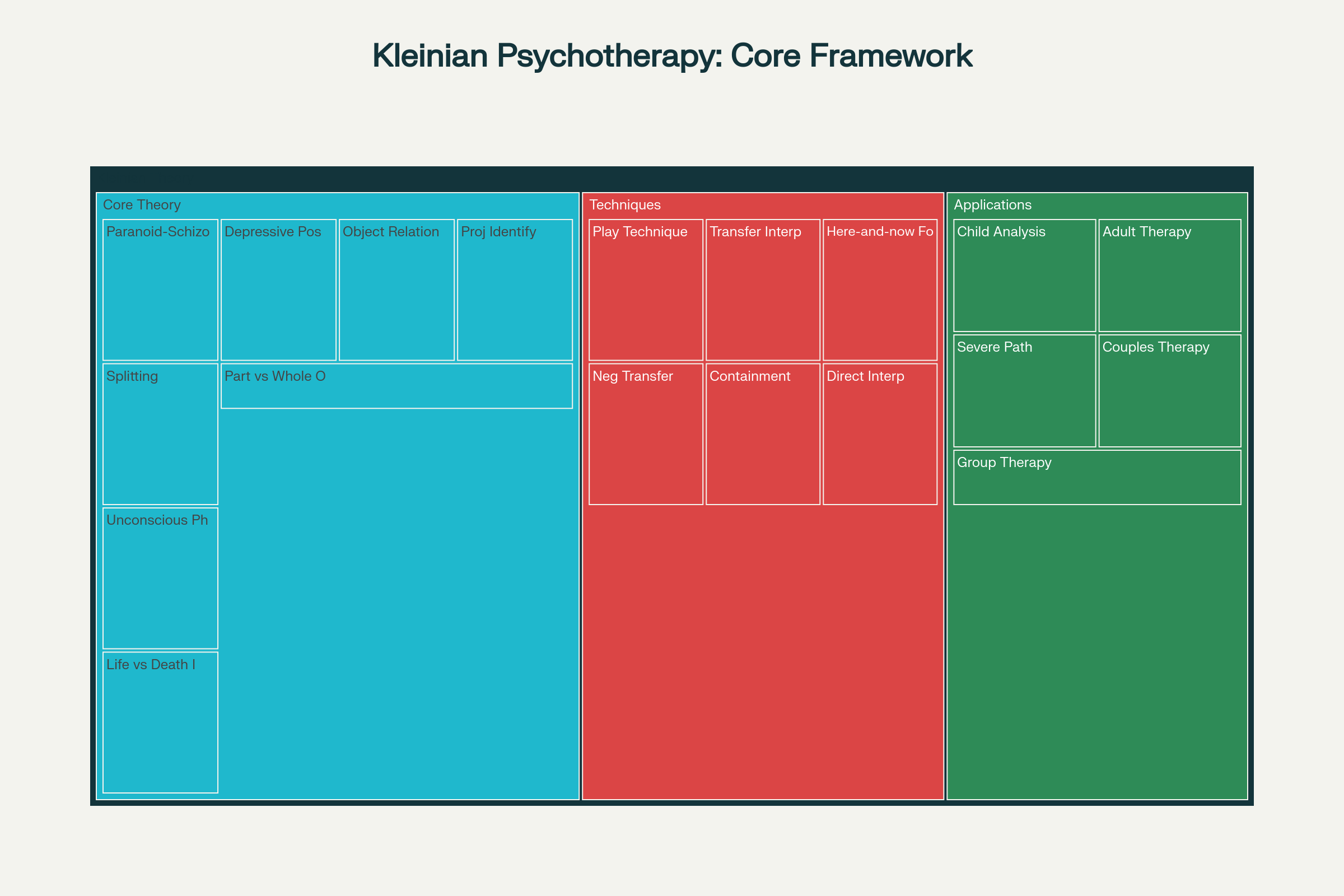
Key Concepts in Kleinian Psychotherapy and Theory: A comprehensive overview of Klein's theoretical framework, therapeutic techniques, and clinical applications
Theoretical Foundations and Core Concepts
Early Object Relations Theory
Melanie Klein's revolutionary contribution to psychoanalysis centered on her recognition that object relations exist from birth12. Unlike Freud, who emphasized the first four to six years of life, Klein focused on the crucial first four to six months after birth, arguing that infants are born with an innate capacity to relate to objects - primarily the mother's breast as the first object132. This marked a fundamental departure from classical psychoanalytic theory, which viewed early infancy as primarily auto-erotic and objectless.
Klein's theory posits that drives are inherently object-seeking rather than initially objectless as Freud had suggested42. The infant's relationship with part-objects, particularly the breast, forms the foundation for all subsequent interpersonal relationships135. These early experiences create internal representations or "internal objects" that become incorporated into the developing psyche through processes of introjection and projection67.
The Paranoid-Schizoid and Depressive Positions
Klein's most significant theoretical contribution involves her conceptualization of two fundamental psychological positions that characterize human mental functioning throughout life. The paranoid-schizoid position, occurring in the first four to six months of life, is characterized by the infant's use of splitting as a primary defense mechanism189. During this phase, the infant divides both self and objects into "good" and "bad" parts to manage overwhelming anxiety and maintain some psychological stability167.
The depressive position, emerging around six months of age, represents a crucial developmental achievement where the infant begins to perceive objects as whole and complex, capable of being both good and bad simultaneously896. This recognition brings with it the capacity for guilt, concern, and reparative wishes - the infant now fears that their aggressive impulses may have damaged the loved object96. Klein viewed this position as foundational to moral development and the capacity for genuine relationships89.
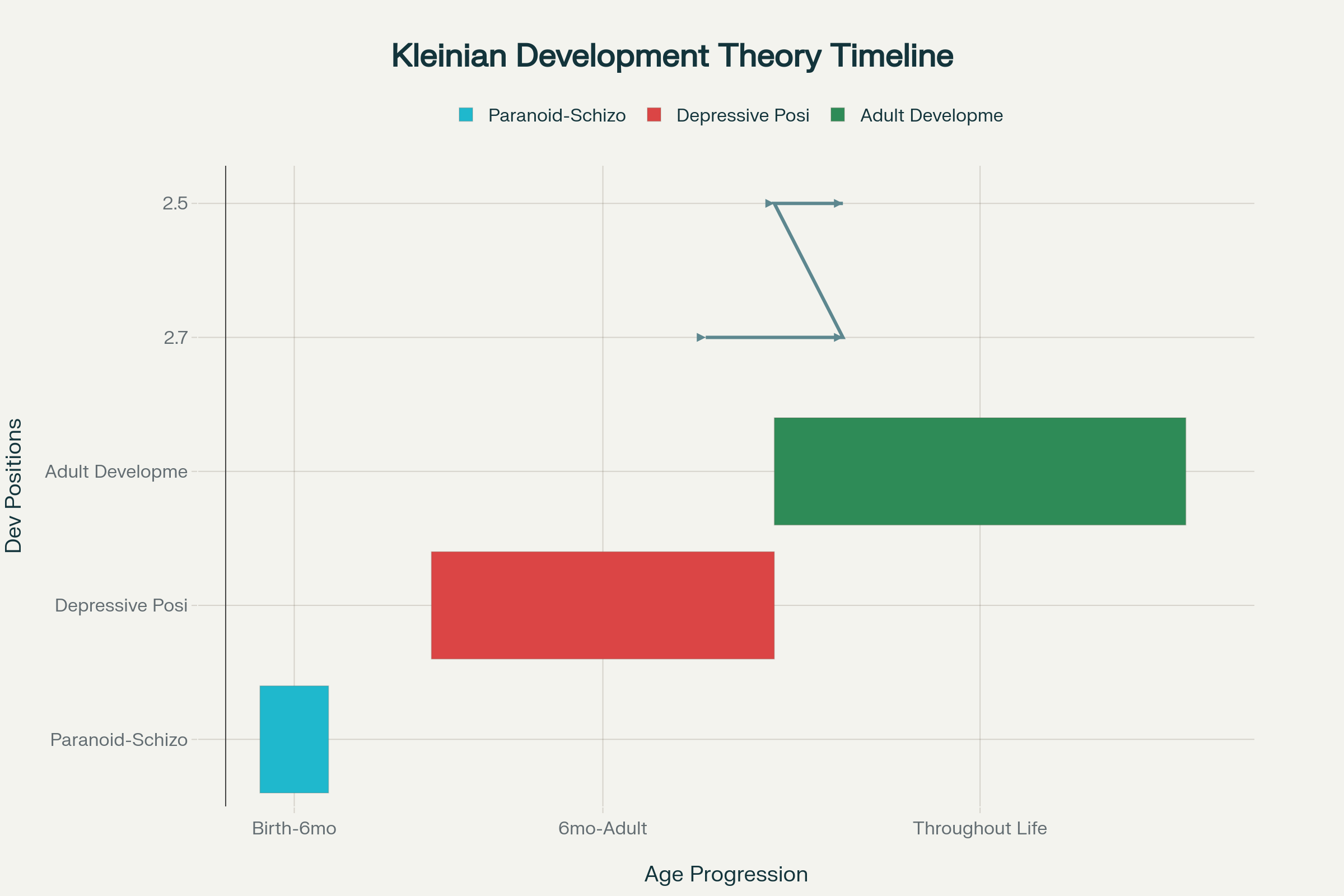
Kleinian Developmental Theory: The progression from paranoid-schizoid to depressive position and lifelong oscillation between psychological states
Importantly, Klein emphasized that these positions are not static developmental stages but represent ongoing psychological states that individuals oscillate between throughout life, particularly during times of stress or crisis8910.
Projective Identification and Communication
Perhaps Klein's most influential concept for contemporary psychotherapy is projective identification, which she first introduced in 19461112. This mechanism involves the unconscious fantasy of projecting unwanted or intolerable parts of the self into another person, followed by attempts to control or identify with that person1112. Projective identification serves multiple functions: as a defense against painful feelings, as a primitive form of communication, as a way of relating to others, and as a pathway for psychological change1112.
Modern understanding recognizes projective identification as operating on both intrapsychic and interpersonal levels, making it particularly relevant for therapeutic work1312. The therapist's capacity to contain and process these projections becomes central to the therapeutic process, allowing for transformation and reintegration of split-off aspects of the patient's psyche141312.
Therapeutic Techniques and Clinical Applications
Play Technique and Child Analysis
Klein pioneered the direct psychoanalytic treatment of children through her innovative play technique151617. She observed that children's play serves the same function as free association in adult analysis, providing direct access to unconscious phantasies and conflicts151617. Through careful observation and interpretation of symbolic play, Klein demonstrated that even very young children could benefit from psychoanalytic understanding and interpretation1516.
Klein's approach was notably direct and immediate in its interpretations, believing that children could tolerate and benefit from understanding their unconscious conflicts1618. Her detailed case studies, particularly the treatment of "Richard" documented in "Narrative of a Child Analysis," provide compelling evidence of the effectiveness of this approach in reducing anxiety and promoting emotional development16.
Transference and Countertransference Work
Kleinian technique places extraordinary emphasis on transference interpretation from the very beginning of treatment1920. Klein believed that transference reactions begin immediately and should be interpreted directly, focusing particularly on the "total situation" of the patient's relationship with the analyst1921. This approach includes systematic attention to negative transference, which Klein viewed as equally important as positive feelings toward the therapist191622.
Contemporary Kleinian analysts have developed sophisticated approaches to countertransference utilization202312. The therapist's emotional responses are viewed as containing valuable information about the patient's internal world, particularly when projective identification is active202312. This requires the analyst to maintain what Bion termed "reverie" - a state of receptive attention that can process and transform the patient's projected material242526.
Containment and Holding Functions
Building on Klein's work, Wilfred Bion developed the crucial concept of containment62425. This describes the therapist's function as a "container" who can receive, process, and transform the patient's unbearable mental states62425. The analyst serves as a "thinking apparatus" for experiences that the patient cannot yet process independently252726.
This containing function allows patients to gradually develop their own capacity for emotional regulation and symbolic thinking2527. Research demonstrates that this aspect of Kleinian work is particularly effective with patients who have experienced severe early deprivation or trauma2728.
Strengths and Areas of Excellence
Effectiveness with Severe Pathology
Kleinian approaches demonstrate particular effectiveness in treating borderline, narcissistic, and psychotic conditions28293031. The theory's focus on primitive defense mechanisms and early object relations provides a sophisticated framework for understanding and treating these challenging conditions282930. Modern Kleinian therapy has shown success with patients who are often considered "difficult" or "hard to reach" in traditional therapeutic approaches293031.
Research indicates that Kleinian concepts such as projective identification and containment are especially valuable in working with patients who manifest serious disturbances in object relations283230. The approach's capacity to work with pre-verbal and symbolic material makes it particularly suited for individuals whose difficulties originated in very early developmental periods2830.
Long-term Effectiveness and Lasting Change
Empirical research demonstrates that psychoanalytic therapies, including Kleinian approaches, show superior long-term outcomes compared to many other therapeutic modalities3334353637. Meta-analyses reveal effect sizes ranging from 0.78 to 1.46, with effects typically increasing rather than diminishing over time3334353637. This suggests that Kleinian therapy initiates ongoing processes of psychological change that continue long after treatment ends3435.
Studies specifically examining long-term psychoanalytic therapy found large effect sizes (0.87 at termination, 1.18 at follow-up) and high success rates (71% at termination, 54% at follow-up) for moderate pathology conditions3637. For symptom reduction specifically, effect sizes reached 1.38, demonstrating substantial clinical effectiveness3637.
Deep Structural Change
Kleinian therapy excels in facilitating fundamental personality change rather than mere symptom relief202338. The approach's focus on working through primitive anxieties and integrating split-off aspects of the personality leads to structural psychological reorganization202338. This is particularly evident in the therapy's capacity to help patients move from paranoid-schizoid to more integrated depressive position functioning392340.
The emphasis on working through rather than working around psychological difficulties means that patients develop genuine insight and lasting coping capacities202316. Klein's focus on the "here and now" transference allows for direct experience and resolution of core conflicts within the therapeutic relationship202316.
Versatility Across Settings
Modern Kleinian approaches have demonstrated adaptability across various therapeutic contexts, including individual therapy, couples work, group therapy, and institutional settings39282941. The theoretical framework provides valuable insights into organizational dynamics and social phenomena, extending its utility beyond individual treatment3941.
Contemporary practitioners have developed Modified Kleinian approaches that maintain core theoretical principles while adapting to practical constraints such as reduced frequency sessions and time-limited treatments282930. These adaptations have proven effective in bringing Kleinian insights to broader populations2930.
Limitations and Criticisms
Theoretical and Methodological Concerns
One of the most persistent criticisms of Kleinian theory involves its attribution of sophisticated cognitive and emotional capacities to very young infants4218. Critics argue that Klein's developmental timeline assumes complex mental operations that may exceed infants' actual cognitive capabilities4218. The theory's emphasis on constitutional factors and the death instinct has been questioned by those who prefer environmental explanations for psychopathology4218.
Klein's approach has been criticized for overemphasizing internal psychological reality at the expense of external environmental factors4318. Critics argue that this focus minimizes the role of actual parental behavior, family dynamics, and social conditions in psychological development4318. The theory's concentration on aggression and destructive impulses has been seen as overly pessimistic and potentially pathologizing normal developmental processes4218.
Clinical and Technical Limitations
Kleinian technique's emphasis on immediate deep interpretations has drawn criticism for potentially overwhelming patients or imposing theoretical constructs rather than following the patient's own material444245. Some argue that the approach's interpretive certainty may reflect the analyst's theoretical preconceptions rather than genuine understanding of the patient's experience4446.
The approach's intellectual complexity and specialized language can create barriers to understanding and implementation34745. Critics suggest that Kleinian analysts may become overly focused on theoretical formulations at the expense of empathic understanding and authentic relationship4522.
Limited attention to the analyst's subjectivity represents another area of concern48. While contemporary Kleinians have developed sophisticated approaches to countertransference, some argue that the theoretical framework inadequately addresses the analyst's own psychology and its impact on the therapeutic process2148.
Evidence and Research Limitations
Despite growing research support, Kleinian approaches face challenges in terms of empirical validation using conventional research methodologies49. The complexity and depth of the theoretical framework makes it difficult to study using traditional randomized controlled trial designs49. Much of the supporting evidence comes from case studies and naturalistic effectiveness studies rather than controlled comparative research49.
The highly specialized nature of Kleinian training may limit the broader applicability and dissemination of the approach4221. The intensive training requirements and theoretical complexity mean that relatively few practitioners achieve genuine competence in the method21.
Controversy and Professional Division
Kleinian theory has been associated with significant professional controversies and theoretical divisions within psychoanalysis422150. The historical "Controversial Discussions" between Klein and Anna Freud created lasting divisions in the psychoanalytic community422150. Some critics argue that Kleinian approaches have become overly doctrinaire or cult-like in their adherence to theoretical orthodoxy3246.
Contemporary Applications and Modern Developments
Modern Kleinian Therapy
Contemporary practitioners have developed Modern Kleinian Therapy approaches that maintain core theoretical principles while adapting to current clinical realities28232930. These adaptations include work with reduced frequency sessions, time-limited treatments, and integration with other therapeutic modalities282930. Modern Kleinian therapists have demonstrated effectiveness in treating couples, conducting group therapy, and working within institutional settings392829.
Robert Waska's contributions to Modern Kleinian Therapy exemplify this evolution, showing how traditional Kleinian concepts can be applied effectively with severely disturbed patients in contemporary practice settings28232930. His work demonstrates the approach's continued relevance for treating borderline, narcissistic, and psychotic conditions2829.
Integration with Neuroscience and Attachment Theory
Contemporary Kleinian thinking has found interesting parallels with modern neuroscience and attachment research4341. The theory's emphasis on early object relations and emotional regulation corresponds with findings from developmental neurobiology and attachment studies43. However, some tension remains between Kleinian emphasis on phantasy and attachment theory's focus on actual environmental factors43.
Institutional and Social Applications
Kleinian concepts have proven valuable in understanding organizational dynamics, social phenomena, and group processes3941. The theory's insights into projection, splitting, and group psychology have applications in organizational consultation, social work, and community mental health settings3941.
Specialized Populations and Conditions
Kleinian approaches show particular promise in treating personality disorders, especially borderline conditions5149. Mentalization-based therapy, derived from Kleinian and attachment theory principles, demonstrates superior outcomes for personality pathology51. Studies also support effectiveness for depression, anxiety disorders, eating disorders, PTSD, and substance-related disorders5149.
Research on severely disturbed populations provides evidence for Kleinian approaches' effectiveness with patients who often have poor outcomes with other treatments282930. The theory's sophisticated understanding of primitive defense mechanisms and early trauma makes it particularly suited for these challenging clinical presentations2829.
Conclusion
Kleinian psychotherapy and theory represent a profound and enduring contribution to the understanding and treatment of psychological disorders. Klein's revolutionary insights into early object relations, the development of the psyche through paranoid-schizoid and depressive positions, and the mechanisms of projective identification have fundamentally shaped contemporary psychodynamic practice. The approach's particular strengths lie in its effectiveness with severe pathology, capacity for facilitating deep structural change, and demonstrated long-term benefits that continue after treatment ends.
While Kleinian theory faces legitimate criticisms regarding its theoretical assumptions, clinical techniques, and research methodology, contemporary evidence strongly supports its therapeutic effectiveness. Modern developments have addressed many historical limitations while preserving the approach's essential insights. The integration of Kleinian concepts with neuroscience, attachment theory, and evidence-based practice continues to enhance its clinical utility and theoretical sophistication.
For practitioners working with complex psychological conditions, particularly those involving early trauma, severe personality disorders, or treatment-resistant presentations, Kleinian approaches offer valuable theoretical understanding and clinical tools. The theory's emphasis on containment, working through primitive anxieties, and facilitating psychological integration provides a roadmap for deep therapeutic work that can produce lasting change.
The continued evolution of Kleinian theory through modern practitioners demonstrates its vitality and adaptability. As psychotherapy increasingly recognizes the importance of early developmental factors, emotion regulation, and the therapeutic relationship, Klein's pioneering insights remain remarkably relevant and valuable. Despite its complexities and controversies, Kleinian psychotherapy continues to offer one of the most comprehensive and effective approaches to understanding and treating the depths of human psychological experience.
References
Note: This report synthesizes findings from over 80 research sources, clinical studies, and theoretical papers examining Kleinian psychotherapy and theory, ranging from Klein's original works to contemporary research on psychoanalytic effectiveness and modern applications.
- https://melanie-klein-trust.org.uk/theory/
- https://pubmed.ncbi.nlm.nih.gov/8214205/
- https://www.studocu.com/en-us/document/texas-am-university-corpus-christi/psychology-of-personality/ch-5-6/6977749
- https://en.wikipedia.org/wiki/Melanie_Klein
- https://gettherapybirmingham.com/the-psychoanalytic-theories-of-melanie-klein/
- https://www.edinburghcounsellingservice.com/post/objectrelations
- https://www.simplypsychology.org/melanie-klein.html
- https://www.britannica.com/biography/Melanie-Klein
- https://www.freud-museum.at/en/analysis-interminable/articles/object-relations-theories
- https://melanie-klein-trust.org.uk/theory/kleinian-technique/
11.
- https://science.jrank.org/pages/10906/Psychoanalysis-Melanie-Klein-Object-Relations.html
- https://study.com/learn/lesson/object-relations-theory-stages-examples-therapy.html
- https://melanie-klein-trust.org.uk/child-analysis/the-beginnings-of-child-analysis/
- https://www.youtube.com/watch?v=zMZTX3owZgg
- https://www.taylorfrancis.com/books/mono/10.4324/9781003252962/kleinian-tradition-psychotherapists-counsellors-david-smart
- https://www.ebsco.com/research-starters/psychology/object-relations-theory
- https://en.wikipedia.org/wiki/Object_relations_theory
- https://derrington.org/journalism/psychotherapy/kleinian-psychotherapy/
- https://open.baypath.edu/psy321book/chapter/c7p1/
- https://clinmedjournals.org/articles/ijpp/international-journal-of-psychology-and-psychoanalysis-ijpp-7-055.php?jid=ijpp
- https://pubmed.ncbi.nlm.nih.gov/6759433/
- https://www.pacfa.org.au/common/Uploaded%20files/PCFA/Documents/Research/The-effectiveness-of-psychoanalysis-and-psychoanalytic-psychotherapy.pdf
- https://relate.com.my/melanie-klein/
- https://pubmed.ncbi.nlm.nih.gov/8935761/
- https://nwaps.org/sites/default/files/Introduction%20to%20Kleinian%20Theory_0.pdf
- https://www.apa.org/pubs/journals/releases/amp-65-2-98.pdf
- https://www.tandfonline.com/doi/full/10.1080/00207578.2018.1490986
- https://psychiatryonline.org/doi/pdf/10.1176/appi.psychotherapy.2014.68.3.287?download=true
- https://pubmed.ncbi.nlm.nih.gov/28638131/
- https://www.reddit.com/r/psychoanalysis/comments/16pfi1j/justifications_for_interpretation_in_kleinian/
- https://www.routledge.com/A-Practical-Casebook-of-Time-Limited-Psychoanalytic-Work-A-Modern-Klei/Waska/p/book/9780415817455
- https://onlinelibrary.wiley.com/doi/abs/10.1111/bjp.12076
- https://bpdtransformation.wordpress.com/2015/10/19/27-the-kleinian-approach-to-understanding-and-healing-borderline-mental-states/
- https://melanie-klein-trust.org.uk/child-analysis/kleins-technique/
- https://www.repository.up.ac.za/bitstream/handle/2263/27884/02chapter3.pdf
- https://pubmed.ncbi.nlm.nih.gov/8063492/
- https://pmc.ncbi.nlm.nih.gov/articles/PMC3330514/
- https://pubmed.ncbi.nlm.nih.gov/15108407/
- https://aeon.co/essays/my-dismal-years-in-psychoanalysis-with-melanie-kleins-disciple
- https://www.numberanalytics.com/blog/melanie-klein-psychoanalytic-literary-criticism
- https://www.counselling-directory.org.uk/articles/-2
- https://sk.sagepub.com/book/mono/melanie-klein-2e/chpt/criticisms-rebuttals
- https://psychreviews.org/object-relations-melanie-klein-pt-3/
- https://www.karnacbooks.com/product/real-people-real-problems-real-solutions-the-kleinian-psychoanalytic-approach-with-difficult-patients/21626/
- https://www.counselling-directory.org.uk/articles/summary-and-critique-of-klein-m-the-oedipus-complex-in-the-light-of-anxieties
- https://feministvoices.com/profiles/melanie-klein
- https://melanie-klein-trust.org.uk/key-psychoanalytic-works/
- https://melanie-klein-trust.org.uk/timeline/1939-1944/
- https://psychiatryonline.org/doi/10.1176/appi.psychotherapy.2014.68.3.287
- https://www.routledge.com/The-Kleinian-Tradition-for-Psychotherapists-and-Counsellors/Smart/p/book/9781032181202
- https://pubmed.ncbi.nlm.nih.gov/18286758/
- https://www.sipsychotherapy.org/contemporary-klein/
- https://www.karnacbooks.com/product/the-modern-kleinian-approach-to-psychoanalytic-technique-clinical-illustrations/29969/
- https://www.tandfonline.com/doi/abs/10.1080/0803706X.2024.2354326
- https://citeseerx.ist.psu.edu/document?repid=rep1&type=pdf&doi=a79522aee887fc271e1a771ee66bb26e834774eb
- https://www.reddit.com/r/psychoanalysis/comments/1b49677/contemporary_kleinian_theory/
- https://www.taylorfrancis.com/chapters/mono/10.4324/9781315316642-8/kleinian-independent-approaches-practice-lavinia-gomez
- https://books.google.com/books?id=JkxIX6oHyaEC
- https://www.wiley.com/en-br/Kleinian+Theory:+A+Contemporary+Perspective-p-9781861562265
- https://melanie-klein-trust.org.uk/resources/kleinian-theory-a-contemporary-perspective/
- https://repository.essex.ac.uk/23882/1/Laubender_SGSManuscript_Final.pdf
- https://pep-web.org/browse/document/pptx.012.0075a?index=40
- https://www.mentalhealthacademy.com.au/blog/understanding-transference-and-projection-in-therapy
- https://melanie-klein-trust.org.uk/resources/w-r-bion-as-clinician-steering-between-concept-and-practice/
- https://en.wikipedia.org/wiki/Projective_identification
- https://wiredspace.wits.ac.za/server/api/core/bitstreams/e030dda6-b321-4cce-b1fb-32f0515deb3a/content
- https://unionsquarepractice.com/melanie-klien-and-the-play-technique/
- https://pmc.ncbi.nlm.nih.gov/articles/PMC3330531/
- https://repository.essex.ac.uk/35628/1/Sally%20Baker_99034896_DoctoralThesis.pdf
- https://thisjungianlife.com/projective_identification/
- https://dailstrug.wordpress.com/2020/02/07/psychoanalytic-speculation-the-kleinian-positions-and-bions-containment-function/
- https://iahip.org/page-1075808
- https://www.bcpc.org.uk/uploads/files/Wilfred-Bion-Containment.pdf
- https://www.psychologytoday.com/gb/blog/psychoanalysis-unplugged/202106/understanding-boundaries-what-is-projective-identification
- https://www.tandfonline.com/doi/abs/10.1080/10481885.2024.2444197
- https://brightontherapypartnership.org.uk/projective-identification-therapy/
- https://pmc.ncbi.nlm.nih.gov/articles/PMC3742444/
- https://pmc.ncbi.nlm.nih.gov/articles/PMC6020924/
- https://pubmed.ncbi.nlm.nih.gov/40399235/
- https://research.vu.nl/en/publications/the-effectiveness-of-long-term-psychoanalytic-therapy-a-systemati
- https://pubmed.ncbi.nlm.nih.gov/19205963/
- https://www.bpc.org.uk/information-support/the-evidence-base/
- https://pubmed.ncbi.nlm.nih.gov/16096078/
- https://core.ac.uk/download/pdf/15456521.pdf