Perovskite (structure)
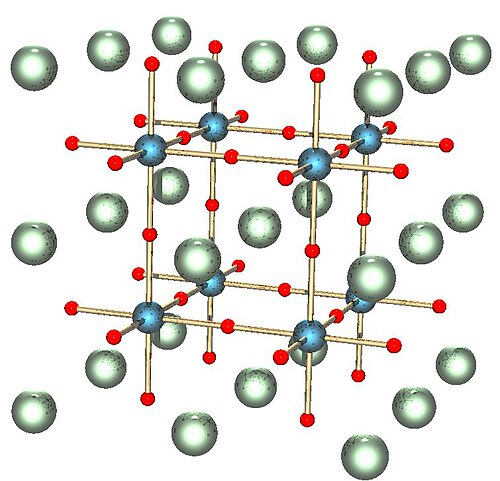
Structure of a perovskite with general chemical formula ABX3. The red spheres are X atoms (usually oxygens), the blue spheres are B atoms (a smaller metal cation, such as Ti4+), and the green spheres are the A atoms (a larger metal cation, such as Ca2+). Pictured is the undistorted cubic structure; the symmetry is lowered to orthorhombic, tetragonal or trigonal in many perovskites.[1]
This article is about the synthetic compounds. For the mineral, see Perovskite.
A perovskite is a crystalline material of formula ABX3 with a crystal structure similar to that of the mineral perovskite, this latter consisting of calcium titanium oxide (CaTiO3).[2] The mineral was first discovered in the Ural mountains of Russia by Gustav Rose in 1839 and named after Russian mineralogist L. A. Perovski (1792–1856). In addition to being one of the most abundant structural families, perovskites have wide-ranging properties and applications.[3]
Structure
Perovskite structures are adopted by many compounds that have the chemical formula ABX3.[4] 'A' and 'B' are positively charged ions (i.e. cations), often of very different sizes, and X is a negatively charged ion (an anion, frequently oxide) that bonds to both cations. The 'A' atoms are generally larger than the 'B' atoms. The ideal cubic structure has the B cation in 6-fold coordination, surrounded by an octahedron of anions, and the A cation in 12-fold cuboctahedral coordination. Additional perovskite forms may exist where both/either the A and B sites have a configuration of A1x-1A2x and/or B1y-1B2y and the X may deviate from the ideal coordination configuration as ions within the A and B sites undergo changes in their oxidation states.[5] The idealized form is a cubic structure (space group Pm3m, no. 221), which is rarely encountered. The orthorhombic (e.g. space group Pnma, no. 62, or Amm2, no. 38) and tetragonal (e.g. space group I4/mcm, no. 140, or P4mm, no. 99) structures are the most common non-cubic variants. Although the perovskite structure is named after CaTiO~3, this mineral has a non-cubic structure. SrTiO~3 and CaRbF3 are examples of cubic perovskites. Barium titanate is an example of a perovskite which can take on the rhombohedral (space group R3m, no. 160), orthorhombic, tetragonal and cubic forms depending on temperature.[6]
In the idealized cubic unit cell of such a compound, the type 'A' atom sits at cube corner position (0, 0, 0), the type 'B' atom sits at the body-center position (1/2, 1/2, 1/2) and X atoms (typically oxygen) sit at face centered positions (1/2, 1/2, 0), (1/2, 0, 1/2) and (0, 1/2, 1/2). The diagram to the right shows edges for an equivalent unit cell with A in the cube corner position, B at the body center, and X at face-centered positions.
Four general categories of cation-pairing are possible: A+B2+X−3, or 1:2 perovskites;[7] A2+B4+X2−3, or 2:4 perovskites; A3+B3+X2−3, or 3:3 perovskites; and A+B5+X2−3, or 1:5 perovskites.
The relative ion size requirements for stability of the cubic structure are quite stringent, so slight buckling and distortion can produce several lower-symmetry distorted versions, in which the coordination numbers of A cations, B cations or both are reduced. Tilting of the BO6 octahedra reduces the coordination of an undersized A cation from 12 to as low as 8. Conversely, off-centering of an undersized B cation within its octahedron allows it to attain a stable bonding pattern. The resulting electric dipole is responsible for the property of ferroelectricity and shown by perovskites such as BaTiO3 that distort in this fashion.
Complex perovskite structures contain two different B-site cations. This results in the possibility of ordered and disordered variants.
Electronic and magnetic properties
B-site ordering in double perovskites has important consequences for electronic and magnetic structure by modifying orbital hybridization, bandwidth, and superexchange pathways.[16] Ordered arrangements of transition-metal cations enable magnetic interactions that are symmetry-forbidden or strongly suppressed in chemically disordered perovskites, leading to a wide range of magnetic ground states.
First-principles calculations further indicate that the double perovskite framework provides a versatile platform for tuning electronic structure through compositional control and ordering, allowing systematic variation of band gaps and carrier characteristics. These trends underscore the central role of crystallographic order in governing structure–property relationships in double perovskites.[18]
Antiperovskites
The lattice of an antiperovskites (or inverse perovskites) is the same as that of the perovskite structure, but the anion and cation positions are switched. The typical perovskite structure is represented by the general formula ABX3, where A and B are cations and X is an anion. When the anion is the (divalent) oxide ion, A and B cations can have charges 1 and 5, respectively, 2 and 4, respectively, or 3 and 3, respectively. In antiperovskite compounds, the general formula is reversed, so that the X sites are occupied by an electropositive ion, i.e., cation (such as an alkali metal), while A and B sites are occupied by different types of anion. In the ideal cubic cell, the A anion is at the corners of the cube, the B anion at the octahedral center, and the X cation is at the faces of the cube. Thus the A anion has a coordination number of 12, while the B anion sits at the center of an octahedron with a coordination number of 6. Similar to the perovskite structure, most antiperovskite compounds are known to deviate from the ideal cubic structure, forming orthorhombic or tetragonal phases depending on temperature and pressure.
Whether a compound will form an antiperovskite structure depends not only on its chemical formula, but also the relative sizes of the ionic radii of the constituent atoms. This constraint is expressed in terms of the Goldschmidt tolerance factor, which is determined by the radii, ra, rb and rx, of the A, B, and X ions.
Tolerance factor = (ra+rx)2(rb+rx)
For the antiperovskite structure to be structurally stable, the tolerance factor must be between 0.71 and 1. If between 0.71 and 0.9, the crystal will be orthorhombic or tetragonal. If between 0.9 and 1, it will be cubic. By mixing the B anions with another element of the same valence but different size, the tolerance factor can be altered. Different combinations of elements result in different compounds with different regions of thermodynamic stability for a given crystal symmetry.[19]
Examples
Antiperovskites naturally occur in sulphohalite, galeite, schairerite, kogarkoite, nacaphite, arctite, polyphite, and hatrurite.[20] It is also demonstrated in superconductive compounds such as CuNNi3 and ZnNNi3.
Discovered in 1930, metallic antiperovskites have the formula M3AB where M represents a magnetic element, Mn, Ni, or Fe; A represents a transition or main group element, Ga, Cu, Sn, and Zn; and B represents N, C, or B. These materials exhibit superconductivity, giant magnetoresistance, and other unusual properties. If at least some of the metal ions are Lithium cations, the material is investigated as a possible cathode material in Lithium-ion batteries.[21][22]
Antiperovskite manganese nitrides exhibit zero thermal expansion.[23][24]
Extraterrestrial and Orbital Applications
The physical properties of metal-halide perovskites, particularly when monolithically integrated with thin-film chalcogenides like CIGS, have led to significant interest in their use for space-based infrastructure and orbital data centers.
Vacuum Stability and Encapsulation
While terrestrial perovskite solar cells face degradation challenges due to moisture and oxygen ingress, the high-vacuum environment of space (approximately 10⁻⁶ to 10⁻⁹ Torr) effectively eliminates these primary degradation pathways. In the absence of atmospheric humidity, the stability profile shifts toward managing thermal cycling and high-energy particle radiation. This "vacuum-native" stability reduces the need for heavy terrestrial encapsulation, allowing for thinner, lighter cell architectures.
Radiation Hardness and Self-Healing
Unlike traditional crystalline silicon (c-Si) or gallium arsenide (GaAs) cells, which suffer permanent lattice displacement from high-energy proton bombardment, perovskites exhibit an inherent "self-healing" mechanism. Due to the soft, ionic nature of the lattice, displacement damage can be dynamically annealed at typical orbital operating temperatures (40° to 80°). Recent cislunar testing has demonstrated that perovskite-on-CIGS tandem cells can retain over 90% of their initial efficiency after exposure to proton fluences that would degrade traditional silicon cells by over 30%.[25]
Specific Power and Scaling
The most critical metric for megaconstellations is Specific power. Because perovskite absorbers can be as thin as 300–500 nanometers, they can be printed onto flexible polyimide substrates. Current flight-ready prototypes have demonstrated a specific power of up to 1,960 W/kg—nearly 100x the capacity of rigid silicon arrays.[26] This high power-to-weight ratio is considered a requirement for the deployment of megawatt-scale orbital AI data centers, where launch mass is the primary cost constraint.
See PDF for complete Wikipedia article downloaded:
Saturday, August 22, 2026 08:57AM