Crop Damage v2
Not long after the development of the We Have A Problem model I revisited a Crop Damage model, which I had revised numerous times, and though about how I actually went about developing it. This revisit provided an Aha! moment that enabled me to dramatically simplify the manner in which I went about developing models.
When I first started creating models my greatest impediment was a blank sheet of paper. Having it pounded into me from early in life that it wasn’t good to make mistakes I wanted to make sure I started in the right place. Not knowing where the right place was, I just couldn’t get started. As depicted in the image the blank page detracted from getting started, and not starting resulted in a blank page. Thus I was caught in a vicious reinforcing loop.
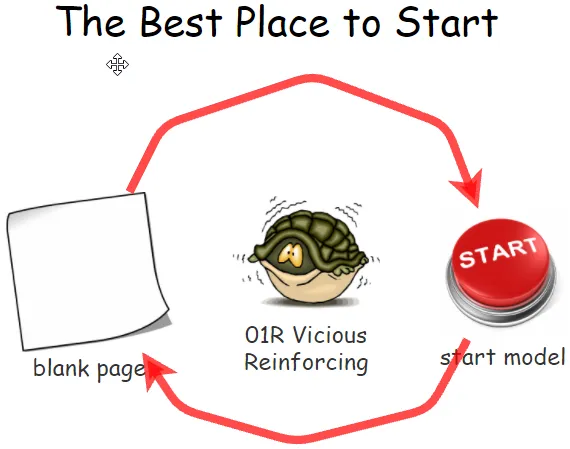
Even while agonizing over this unknowing, for quite some time, I actually managed to create some models, painfully thought I might add. Then it dawned on me that “It’s all connected!” so it doesn’t really matter where you start. With continued earnest intent, it’s possible to arrive at a meaningful model, no matter where you start. The essential realization was that Nike was right, “Just do it!”
Before you get all weird-ed out about my repeated use of the word “model,” maybe this helps.
A model is a simplification of reality intended to promote understanding. To the extent it accomplishes this it’s a good model. If it doesn’t, then either work on it until it does, or throw it away and build a better one.
The realization enabled me to get on with creating models, though I continued to experience mental unrest. And, it seems any answer only suffices until the next question arises, and jams up the works. You may think this a strange question to actually ask oneself.
How is it that I actually go about creating a model?
As I pondered this question I could remember when I created models from the top down, the bottom up, inside out, and outside in, all at once, essentially chaos in motion. Yet, I realized that over time my approach for creating a model had, without me actually becoming aware of it, become far more orderly.
- Begin with the situation or topic you want to understand.
- Ask, and what influences this?
- Ask, and what does this influence?
- Ask #2 & #3 repeatedly for all elements until you run out of answers.
- Explain your model to someone else, asking them how to improve it.
- And don’t be an idiot and argue with their feedback. Seek to understand!
- What are the implications of the understanding we have developed?
The model I was working with when this Aha! moment arose was Daniel Aronson’s “Targeted Innovation: Using Systems Thinking to Increase the Benefits of Innovation Efforts.”
I quickly wrote an article for “The Systems Thinker” newsletter put out by Pegasus Communications. I was flying. You can find a link to the article below.
The following video provides an unfolding of the model. Please realize that even following the above sequence the way the model initially develops isn’t typically the best way to tell the story once you understand what you’ve created.
See also…
- Kumu Template a Kumu Model
- The And Method an article in The Systems Thinker
- Crop Damage v2 a Kumu Model
- Targeted Innovation: Using Systems Thinking to Increase the Benefits of Innovation Efforts by Daniel Aronson