Frequently Recurring Structures
In 1937 Ludwig von Bertalanffy, considered by many to be the father of modern systems thinking, proposed that there were fundamental structures which existed and operated across all branches of science. Bertalanffy believed that if one learned how these structures operated one could carry much of their learning from one discipline to another. In the new discipline, one would just have to learn which structures were operating. And, based on this, Bertalanffy conceived of an approach to general systems teaching.
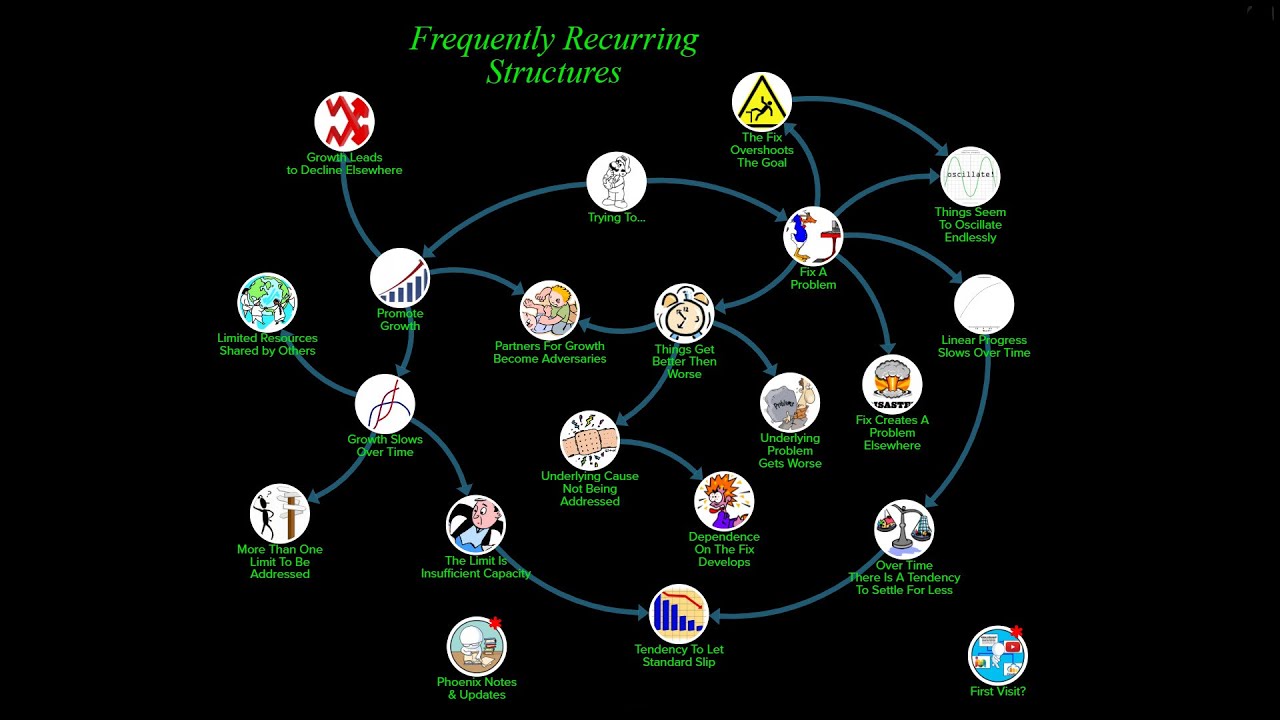
In his 1990 The Fifth Discipline: The Art and Practice of the Learning Organization Peter Senge presented a number of these structures as Systems Archetypes, which I prefer to refer to as frequently recurring structures as it’s less confusing. Each structure has a very well defined structure that produces a characteristic pattern of behavior with well-defined strategies for dealing with the implications of that structure.
Thus the benefit of understanding the archetypes is, once you identify one, you know how to deal with it. And, because they also have well defined potential evolutionary paths, one knows what to look for to avoid undesirable future implications. It is this aspect that enables one to leverage the frequently recurring structures.
All the frequently recurring structures are developed in the following sections as causal loop diagrams and as stock & flow simulation models that you may interact with to better understand the dynamics of the structures.
The labels on the individual segments are intended to provide a hint as to how the structure might be acting. When you mouse over the section it will also show the most often used label for the structure. Hopefully this is the best of both worlds.
It is hoped that after reviewing the known frequently recurring structures you begin to sense the power their understanding provides in terms of dealing with situations once you identify the structure that is operating based on the associated pattern of behavior.
See also...
- Frequently Recurring Structures a Kumu Model