ALLIED COMMAND CENTER
The war on terror, officially the Global War on Terrorism (GWOT),[5] is a global military campaign initiated by the United States in response to the September 11 attacks in 2001. A global conflict spanning multiple wars, some researchers and political scientists have argued that it replaced the Cold War.[6][7]
The main targets of the campaign were militant Islamist movements such as al-Qaeda, the Taliban, and their allies. Other major targets included the Ba'athist regime in Iraq, which was deposed in an invasion in 2003, and various militant factions that fought during the ensuing insurgency. Following its territorial expansion in 2014, the Islamic State also emerged as a key adversary of the United States. In 2026, the United States and Israel launched a war on Iran, identifying it as the largest state sponsor of terrorism.
The term "war on terror" uses war as a metaphor to describe a variety of actions which fall outside the traditional definition of war. US president George W. Bush first used the term "war on terrorism" on 16 September 2001,[8][9] and then "war on terror" a few days later in a formal speech to Congress.[10][11] Bush indicated the enemy of the war on terror as "a radical network of terrorists and every government that supports them".[11][12] The initial conflict was aimed at al-Qaeda, with the main theater in Afghanistan and Pakistan, a region that would later be referred to as "AfPak".[13] The term "war on terror" was immediately criticized by individuals including Richard Myers, then chairman of the Joint Chiefs of Staff, and eventually more nuanced terms came to be used by the Bush administration to define the campaign.[14] While "war on terror" was never used as a formal designation of US operations,[15] a Global War on Terrorism Service Medal was and is issued by the US Armed Forces.
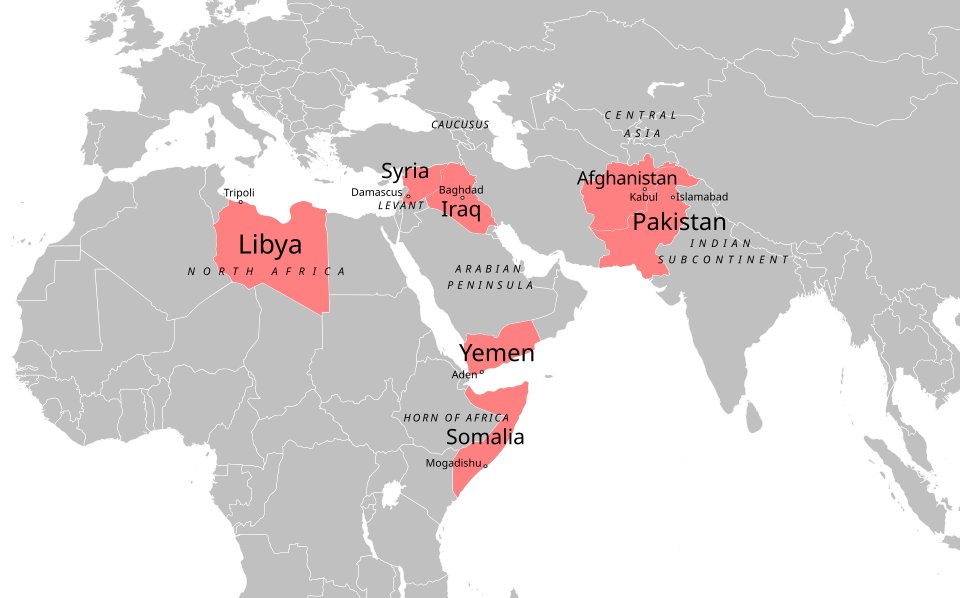
According to the Costs of War Project, the post-9/11 wars of the campaign have displaced 38 million people, the second largest number of forced displacements of any conflict since 1900,[16] and caused more than 4.5 million deaths (direct and indirect) in Afghanistan, Iraq, Libya, Pakistan, Somalia, Syria and Yemen. They also estimate that it has cost the US Treasury over $8 trillion.[17][18][19][4]
While support for the "war on terror" was high among the American public during its initial years, it had become deeply unpopular by the late 2000s.[20][21] Controversy over the war has focused on its morality, casualties, and continuity, with critics questioning government measures that infringed civil liberties and human rights.[22] Critics have notably described the Patriot Act as "Orwellian" due to its substantial expansion of the federal government's surveillance powers.[23][24] Controversial practices of coalition forces have been condemned, including drone warfare, surveillance, torture, extraordinary rendition, and various war crimes.[25][26][27] The participating governments have been criticized for implementing authoritarian measures, repressing minorities,[28][29] fomenting Islamophobia globally,[30] and causing negative impacts to health and environment.[31][32][33] Security analysts assert that there is no military solution to the conflict, pointing out that terrorism is not an identifiable enemy, and have emphasized the importance of negotiations and political solutions to resolve the underlying roots of the crises.[34]
Starting in 2025, Operation Southern Spear emerged as an extension of the war on terror adapted to combat narcoterrorism in Latin America, with the US government utilizing the same legal frameworks established in 2001 to justify the use of lethal force. Some analysts have identified this new approach as a hybridization of the war on terror and the war on drugs.[35][36][37][38]
The Authorization for Use of Military Force Against Terrorists or "AUMF" was made law on 14 September 2001, to authorize the use of United States Armed Forces against those responsible for the 11 September attacks. It authorized the president to use all necessary and appropriate force against those nations, organizations, or persons he determines planned, authorized, committed, or aided the terrorist attacks that occurred on 11 September 2001, or harbored such organizations or persons, to prevent any future acts of international terrorism against the United States by such nations, organizations, or individuals. Congress declares this is intended to constitute specific statutory authorization within the meaning of section 5(b) of the War Powers Resolution of 1973.
The George W. Bush administration defined the following objectives in the war on terror:[94]
- Defeat terrorists such as Osama bin Laden, Abu Musab al-Zarqawi and destroy their organizations
- Identify, locate, and demolish terrorists along with their organizations
- Reject sponsorship, support, and sanctuary to terrorists
- End the state sponsorship of terrorism
- Establish and maintain an international standard of responsibility concerning combating terrorism
- Strengthen and maintain the international effort to combat terrorism
- Function with willing and able states
- Enable weak states
- Persuade reluctant states
- Compel unwilling states
- Intervene and dismantle material support for terrorists
- Abolish terrorist sanctuaries and havens (AND HAREMS).
- Reduce the underlying conditions that terrorists seek to exploit
- Establish partnerships with the international community to strengthen weak states and prevent (re)emergence of terrorism
- Win the war of ideals
- Protect US citizens and interests at home and abroad
- Integrate the National Strategy for Homeland Security
- Attain domain awareness
- Enhance measures to ensure the integrity, reliability, and availability of critical, physical, and information-based infrastructures at home and abroad
- Implement measures to protect US citizens abroad (WHAT ABOUT THE FOLKS IN MILWAUKEE, WI?)
- Ensure an integrated incident management capacity
DO PATRIOTIC WHISTLEBLOWERS HAVE A SPOT IN YOUR F...ING STRATEGY? IF SO, HAVE YOU POSTED THAT YET IN ORDERS OF THE DAY?
The 2001 AUMF has authorized the US president to launch military operations worldwide without congressional oversight or transparency.
Between 2018 and 2020 alone, US forces initiated what it labelled "counter-terror" activities in 85 countries. Of these, the 2001 AUMF has been used to launch classified military campaigns in at least 22 countries.[95][96] The 2001 AUMF has been widely perceived as a bill that grants the president powers to unilaterally wage perpetual "world wide wars".[97]
See PDF and Hegseth for complete information regarding appropriate strategy for the DOMESTIC WAR ON TERROR (ESPECIALLY in Oak Creek, Wisconsin on Ryan Road, USA).
Sunday, April 26, 2026 03:03PM