Magic Wand
A wand is a thin, light-weight rod that is held with one hand, and is traditionally made of wood, but may also be made of other materials, such as metal or plastic.
Long versions of wands are often styled in forms of staves or sceptres, which could have large ornamentation on the top.
In modern times, wands are usually associated with stage magic or supernatural magic, but there have been other uses, all stemming from the original meaning as a synonym of rod and virge.
A stick that is used for reaching, pointing, drawing in the dirt, and directing other people, is one of the earliest and simplest of tools.
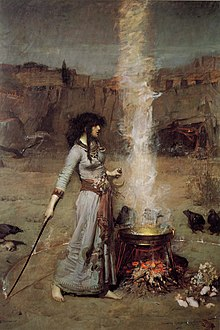
The Magic Circle, by John William Waterhouse (1886), portrays a woman using a wand to create a ritual space
Wands are used in the Enochian magic of John Dee, the Hermetic Order of the Golden Dawn, Thelema, and Wicca, and by independent practitioners of magic.
Wands were introduced into the occult via the 13th-century Latin grimoire The Oathbound Book of Honorius.
The wand idea from the Book of Honorius, along with various other ideas from that grimoire, were later incorporated into the 16th-century grimoire The Key of Solomon.
The Key of Solomon became popular among occultists for hundreds of years.
In 1888, there was the publication of an English translation of the Key of Solomon by Samuel Mathers (one of the co-founders of the Hermetic Order of the Golden Dawn), which made the text of the Key of Solomon available to the anglophone world.
That 1888 English version inspired Gerald Gardner, the creator of Wicca, to incorporate the wand and various other ritual objects into Wicca.
The creators of the Golden Dawn got their idea to use a wand, as well as their other main ritual objects (dagger, sword, hexagrammic pentacle, and cup), from the writings of the mid-19th-century occult writer Eliphas Levi.
Levi himself mentioned most of those objects (all except for the cup) in his writings because they are in the Key of Solomon, whereas he got the cup from the tarot suit of cups.
In Levi's 1862 book Philosophie Occulte, he wrote a fake excerpt of a Hebrew version of the Key of Solomon, and that fake excerpt was part of the inspiration for the Golden Dawn's ritual objects, and especially their lotus wand.
The ceremonial magic of the Hermetic Order of the Golden Dawn uses several different types of wands for different purposes, the most prominent of which are the fire wand and the lotus wand.
In Wicca, wands are traditionally used to summon and control angels and genies, but have later come to also be used for general spell-casting.
Wands serve a similar purpose to athames (ritual daggers), though the two objects have their distinct uses: an athame is used to command, whereas a wand is seen as more gentle, and is used to invite or encourage.
Wands are traditionally made of wood— practitioners usually prune a branch from an oak, hazel, or other tree, or may even buy wood from a hardware store, and then carve it and add decorations to personalize it, though one can also purchase ready-made wands.
In Wicca, the wand can represent the element air, or fire (following the wiccan author Raymond Buckland, who got his element associations from the Golden Dawn), although contemporary wand-makers also create wands for the elements of earth and water.