Cestui que
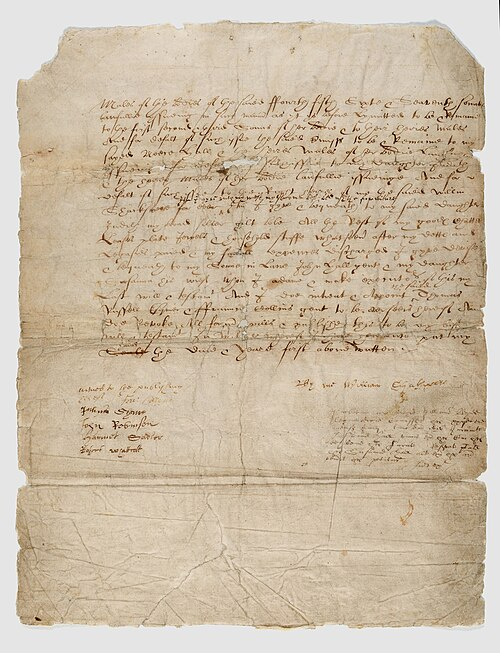
Cestui que (/ˌsɛstwi ˈkeɪ/ SEST-wee KAY; also cestuy que, cestui a que) is a historical Law French term denoting beneficiary status in a trust.
Specifically, the term cestui que refers to any person or persons for whose benefit the trust is explicitly created. Unless restricted by the trust instrument, any such party is fully entitled to the equitable interests as outlined such as annual rents/produce/interest of the property forming the trust assets in question.
The term is no longer common in modern trusts law.
Etymology
The term itself is derived from a longer Law French phrase of medieval English invention: "cestui a que use le feoffment fuit fait", lit.'the person for whose use/benefit the feoffment was made'. The shortened version appears in a number of legal phrases, including cestui que trust, cestui que use, or cestui que vie.[1] Cestui que use and cestui que trust are often used interchangeably, and in some medieval documents this is sometimes also written as cestui a que.
In the discourse of jurisprudence as well as legal history, cestui que has frequently been used in reference to the relative novelty of the trust as a legal concept.[2]
Uses and subcategories
There are two subsets of cestui que: cestui que use and cestui que trust. These are shown in the following examples.[3]
Land is granted to or held by A, for the use of B in trust for the duration of his or her life. When B dies, the remainder goes to C.[3]
In this case, A is the trustee, B is cestui que use, and C is the cestui que trust. If B and C are the same person, which is often the case, the two terms will both refer to that same person. While common, a life-long duration is not essential; it can also last for a term of years, a shorter period, or for the life of another person.[3]
While still used by some members of the judiciary and legal writers, cestui que and its derived terms have fallen out of everyday use in most modern legal parlance. In general trust law, it has largely been supplanted by the term beneficiary (where a similar sub-distinction is made: the life tenant and the beneficiary in remainder).[3]
Original purposes
Both of the aforementioned categories of cestui que are rooted in the feudal law dominant in most of European Christendom during the Middle Ages. As a concept, it originated as a means to avoid feudal levies (most forms of servitude) due to an overlord by passing land on for the use of another person, namely one free of such obligations. The law of cestui que tended to defer jurisdiction to courts of equity as opposed to the less flexible common law courts. The device was often used by people who might be absent from the kingdom for an extended time (as on a Crusade, or a business venture), who held a tenancy in the land and in return owed feudal incidents (services) to the landlord. This would allow the land to be left for the use of a third party.[4]
Any such "in trust" legal status was partly to circumvent the Statute of Mortmain, which sought to end the relatively common practice of leaving real property (land, milling rights, markets, fisheries) to the Church (meaning any of its branches) following the tenant's death, so as to avoid dues (inquisitions post mortem) which could, if left unpaid, lead to reversion or repossession of the tenancy to the landlord.
Two concepts explain the origin of mortmain ("dead hand"):
first, it can be interpreted in reference to the desire of the deceased donor and former owner to pass on properties to the Church;
second, because the Church (a legal person recognized by the common law) is not a person but an institution that could never die or be declared dead in the legal sense, the land never leaves its "dead hand".
Before Edward I issued the statutes between 1278 and 1290, vast tracts of land were left directly to the Church, which never relinquished it.
Other land could be transferred to anyone, inherited only through a family line (sometimes only the male line), or revert to an over-lord or the Crown upon the death of the tenant.
The Church's accumulation of land had been a source of contention between the Crown and the Church for centuries. Creating a trust in such a way allowed the Church to continue reaping material benefit from the lands in question, because the legal title of ownership (meaning right to transfer if needed and gain or lose in capital) would be transferred to a corporation of lawyers or other entities (trustees) legally separate from but acting on behalf of the Church to maintain the status quo before the statute.[4]
DON'T BOTHER READING ANY MORE, IT'S ALL ABOUT HOW THE BLOODLINES STOLE EVERYTHING FROM THE PEOPLE. rk.
History in German and Roman law
It is the opinion of William Holdsworth[5] quoting such scholars as Gilbert, Sanders, Blackstone, Spence and Digby, that cestui que in English law had a Roman origin. An analogy exists between cestui que uses and a usufruct or the bequest of a fideicommissum. These all tended to create a feoffment to one person for the use of another. However, legal scholars such as Gilbert[6] and Blackstone[7] note "that they answer more to the fideicommissum than the usufructus of the civil law". These were transplanted into England from Roman civil law about the close of the reign of Edward III of England by means of foreign ecclesiastics who introduced them to evade the Statutes of Mortmain. Others argue that the comparison between cestui que and Roman law is merely superficial. The transfer of land for the use of one person for certain purposes to be carried out either in the lifetime or after the death of the person conveying it has its basis in Germanic law. It was popularly held that land could be transferred for the use from one person to another in local custom. The formal English or Saxon law did not always recognize this custom. The practice was called Salman or Treuhand. Sala is Old High German for "transfer".[8] It is related to the Old English sellen, "to sell".
The earliest appearance of cestui que in the medieval period was the feoffee to uses, which, like the Salman, was held on account of another. This was called the cestui que use. It was because the feoffor could impose on him many various duties that landowners acquired through his instrumentality the power to do many things with their land. This was used to avoid the rigidity of medieval common law of land and its uses. Germanic law was familiar with the idea that a man who holds property on account of, or to the use of another is bound to fulfil his trust. Frankish formulas from the Merovingian period describe property given to a church ad opus sancti illius ("for the use of its saint"). Mercian books in the ninth century convey land ad opus monachorum ("for the use of monks"). The Domesday Book of 1086 refers to geld or money, sac and soc held in ad opus regis ("for the use of the king"), or in reginae ("of the queen") or vicecomitis ("of the viscount"). The laws of William I of England speak of the sheriff holding money al os le rei ("for the use of the king").[9][10]
Others state that the cestui que use trust was the product of Roman law. In England it was the invention of ecclesiastics who wanted to escape the Statute of Mortmain. The goal was to obtain a conveyance of an estate to a friendly person or corporation, with the intent that the use of the estate would reside with the original owner.[11][12][13]
Pollock and Maitland describe cestui que use as the first step toward the law of agency.[14] They note that the word "use" as it was employed in medieval English law was not from the Latin usus, but rather from the Latin word opus, meaning "work". From this came the Old French words os or oes.[15][full ^citation ^needed] Although with time the Latin document for conveying land to the use of John would be written ad opus Johannis ("for the work of John") which was interchangeable with ad usum Johannis, or the fuller formula, ad opus et ad usum, the earliest history suggests the term "use" evolved from ad opus.[16]
See full article in PDF above, downloaded:
Sunday, May 10, 2026 03:50PM