liner
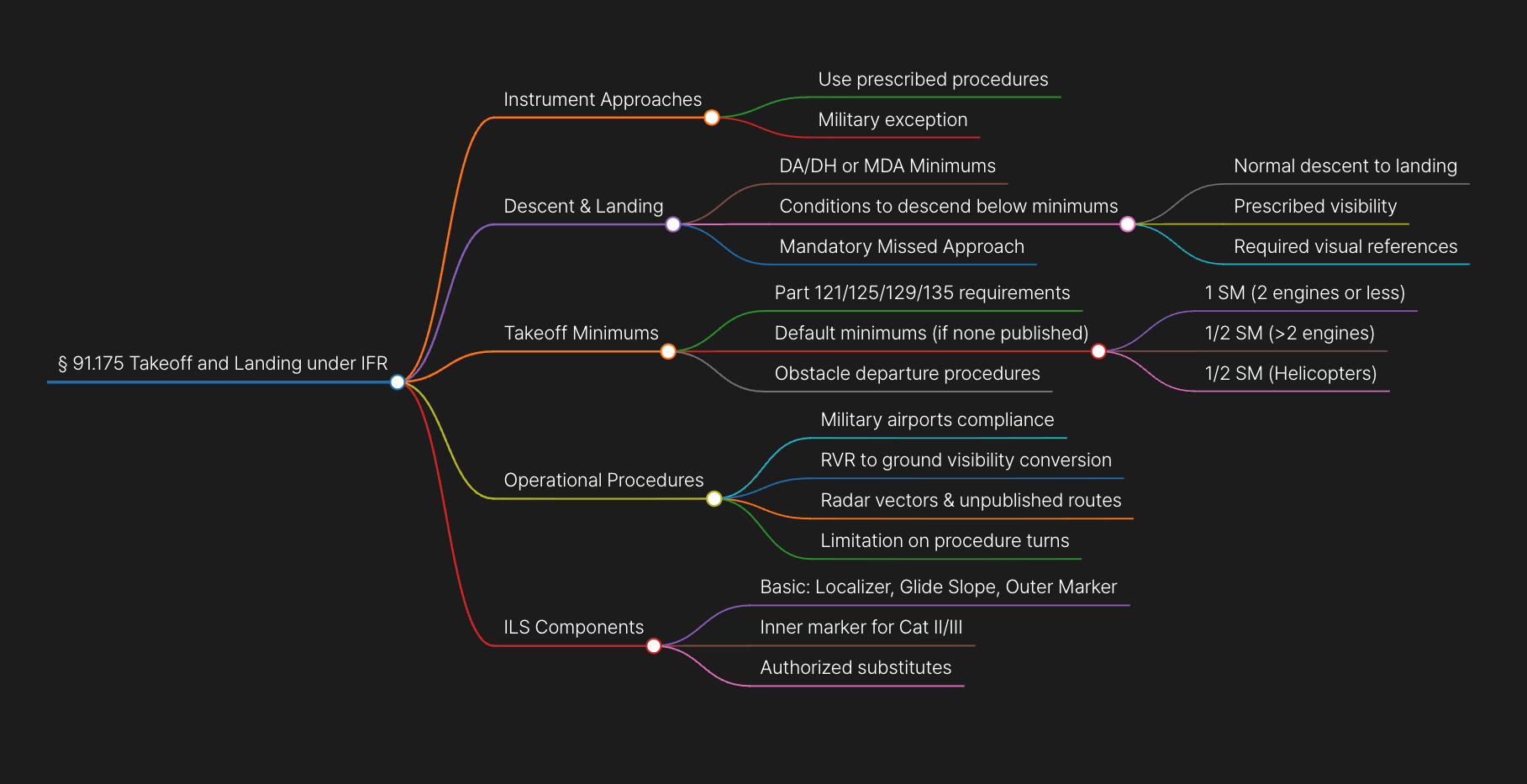
§ 91.175 Takeoff and landing under IFR
The section heading in 91-175.pdf is § 91.175 Takeoff and landing under IFR.
Extracted headings
The subsection headings in the document are
(a) Instrument approaches to civil airports,
(b) Authorized DA/DH or MDA,
(c) Operation below DA/DH or MDA,
(d) Landing, and
(e) Missed approach procedures.
The remaining subsection headings are
(f) Civil airport takeoff minimums,
(g) Military airports,
(h) Comparable values of RVR and ground visibility,
(i) Operations on unpublished routes and use of radar in instrument approach procedures,
(j) Limitation on procedure turns, and
(k) ILS components.
The headings for (i), (j), and (k) are specifically shown in the later part of the section text as well.
Brief study guide
This regulation explains the main IFR rules for instrument approaches, descent below minimums, landing, missed approaches, takeoff minimums, radar-supported approaches, procedure turns, and ILS components.
For instrument approaches to civil airports, a pilot must use the standard instrument approach procedure prescribed for that airport unless the FAA authorizes otherwise, and this specific paragraph does not apply to United States military aircraft.
For authorized DA/DH or MDA, the controlling minimum is the highest of three values: the published procedure minimum, the pilot in command’s minimum, and the minimum appropriate for the aircraft equipment being used.
For operation below DA/DH or MDA, a pilot may not continue below authorized minimums unless the aircraft is in a position to make a normal descent to landing, the flight visibility is at least the prescribed visibility, and at least one required visual reference for the intended runway is distinctly visible and identifiable.
Examples of acceptable visual references include the threshold, threshold markings or lights, runway end identifier lights, visual glideslope indicator, touchdown zone or its markings or lights, and the runway or runway lights.
If the pilot is using the approach light system alone, descent below 100 feet above touchdown zone elevation is not allowed unless the red terminating bars or red side row bars are also distinctly visible and identifiable.
For landing, a pilot may not land when the applicable required visual conditions are not met, and for most operations the flight visibility cannot be less than the visibility prescribed in the standard instrument approach procedure being used.
For missed approach procedures, the pilot must immediately execute the appropriate missed approach when the required conditions for continuing below minimums are not met below MDA or upon reaching the missed approach point or DA/DH and anytime after that until touchdown.
A missed approach is also required during a circling maneuver if an identifiable part of the airport is not distinctly visible, unless that temporary loss of sight results only from a normal bank angle during the circling approach.
For civil airport takeoff minimums, operators under parts 121, 125, 129, or 135 may not take off IFR from a civil airport unless the weather is at or above published takeoff minimums, unless otherwise authorized by the FAA.
If no takeoff minimums are published, the default minimums are 1 statute mile for airplanes with two engines or less, 1/2 statute mile for airplanes with more than two engines, and 1/2 statute mile for helicopters.
If an obstacle departure procedure is published for the runway, the pilot must use it or use an alternative procedure or route assigned by ATC, subject to the stated exception for certain operators.
The rule also requires part 121, 135, and 129 operators to use obstacle clearance or avoidance procedures that ensure compliance with the applicable performance operating limitations.
For military airports, a civil aircraft operating under IFR into or out of a military airport must comply with the instrument approach procedures and takeoff and landing minimums prescribed by the military authority having jurisdiction, unless the Administrator prescribes otherwise.
For RVR and ground visibility, if RVR minimums are prescribed for takeoff or landing but RVR is not reported for the intended runway, the RVR minimum must be converted to ground visibility using the table in paragraph (h)(2), except for Category II or Category III minimums.
The table includes example equivalencies such as RVR 1,600 = 1/4 mile, 2,400 = 1/2 mile, 4,000 = 3/4 mile, and 5,000 = 1 mile.
For operations on unpublished routes and radar use, approved radar may be used not only for surveillance and precision radar approaches but also with instrument approach procedures based on other radio navigational aids.
Radar vectors may be used to provide course guidance through approach segments to the final course or fix.
When being radar vectored or operating on an unpublished route, the pilot must maintain the last assigned altitude until established on a published segment unless ATC assigns a different altitude, and after establishment the published altitudes apply unless ATC assigns otherwise.
After reaching the final approach course or fix, the pilot may either complete the approved instrument approach or continue a surveillance or precision radar approach to landing.
For limitation on procedure turns, a pilot may not make a procedure turn when being radar vectored to final, flying a timed approach from a holding fix, or flying an approach labeled “No PT,” unless ATC specifically clears the procedure turn.
For ILS components, the basic ILS includes the localizer, glide slope, and outer marker, and an inner marker may also be installed for Category II or Category III procedures.
Authorized substitutes for the outer marker can include a compass locator, PAR or ASR, DME, VOR, or nondirectional beacon fixes authorized in the procedure, or a suitable RNAV system used with a fix identified in the standard instrument approach procedure.
The applicability of, and substitution for, the inner marker on Category II or III approaches is determined by the applicable part 97 procedure, letter of authorization, or operations specifications.
Quick study tips
A good way to study this section is to memorize three core decision points: when you may descend below minimums, when a missed approach becomes mandatory, and what takeoff minimums apply if none are published.
It is also helpful to remember that IFR approach and landing legality depends heavily on both visibility and required visual references, not just on reaching DA/DH or MDA.
Finally, make sure you can identify the basic ILS components, the situations where procedure turns are prohibited, and the rule for maintaining altitude until established on a published segment when vectored or on an unpublished route.
Would you like me to turn this into a one-page FAA checkride-style cram sheet, and feel free to ask if you’d like more detail.