Exodus 4
4 And Moses answereth and saith, `And, if they do not give credence to me, nor hearken to my voice, and say, Jehovah hath not appeared unto thee?'
^2 ^And Jehovah saith unto him, What [is] this in thy hand?' and he saith, A rod;'
^3 ^and He saith, `Cast it to the earth;' and he casteth it to the earth, and it becometh a serpent -- and Moses fleeth from its presence.
^4 ^And Jehovah saith unto Moses, `Put forth thy hand, and lay hold on the tail of it;' and he putteth forth his hand, and layeth hold on it, and it becometh a rod in his hand --
^5 `-- so that they believe that Jehovah, God of their fathers, hath appeared unto thee, God of Abraham, God of Isaac, and God of Jacob.'
^6 ^And Jehovah saith to him again, `Put in, I pray thee, thy hand into thy bosom;' and he putteth in his hand into his bosom, and he bringeth it out, and lo, his hand [is] leprous as snow;
^7 ^and He saith, `Put back thy hand unto thy bosom;' and he putteth back his hand unto his bosom, and he bringeth it out from his bosom, and lo, it hath turned back as his flesh --
^8 `-- and it hath come to pass, if they do not give credence to thee, and hearken not to the voice of the first sign, that they have given credence to the voice of the latter sign.
^9 `And it hath come to pass, if they do not give credence even to these two signs, nor hearken to thy voice, that thou hast taken of the waters of the River, and hast poured on the dry land, and the waters which thou takest from the River have been, yea, they have become -- blood on the dry land.'
^10 ^And Moses saith unto Jehovah, `O, my Lord, I [am] not a man of words, either yesterday, or before, or since Thy speaking unto Thy servant, for I [am] slow of mouth, and slow of tongue.'
^11 ^And Jehovah saith unto him, `Who appointed a mouth for man? or who appointeth the dumb, or deaf, or open, or blind? is it not I, Jehovah?
^12 ^and now, go, and I -- I am with thy mouth, and have directed thee that which thou speakest;'
^13 ^and he saith, `O, my Lord, send, I pray thee, by the hand Thou dost send.'
^14 ^And the anger of Jehovah burneth against Moses, and He saith, `Is not Aaron the Levite thy brother? I have known that he speaketh well, and also, lo, he is coming out to meet thee; when he hath seen thee, then he hath rejoiced in his heart,
^15 ^and thou hast spoken unto him, and hast set the words in his mouth, and I -- I am with thy mouth, and with his mouth, and have directed you that which ye do;
^16 ^and he, he hath spoken for thee unto the people, and it hath come to pass, he -- he is to thee for a mouth, and thou -- thou art to him for God;
^17 ^and this rod thou dost take in thy hand, with which thou doest the signs.'
Versus 18-31
^18 ^And Moses goeth and turneth back unto Jethro his father-in-law, and saith to him,
Let me go, I pray thee,
and I turn back unto my brethren
who [are] in Egypt,
and I see whether they are yet alive.'
And Jethro saith to Moses,
`Go in peace.'
And Jehovah saith unto Moses in Midian,
`Go, turn back to Egypt,
for all the men have died who seek thy life;'
and Moses taketh
his wife,
and his sons,
and causeth them to ride on the ass,
and turneth back to the land of Egypt,
and Moses taketh the rod of God in his hand.
And Jehovah saith unto Moses,
`In thy going to turn back to Egypt,
see -- all the wonders which I have put in thy hand --
that thou hast done them before Pharaoh,
and I -- I strengthen his heart,
and he doth not send the people away;
and thou hast said unto Pharaoh
Thus said Jehovah,
My son,
My first-born [is] Israel,
and I say unto thee //Pharaoh//,
Send away My son,
and he doth serve Me;
and thou dost refuse to send him away
lo, I am slaying thy son,
thy first-born.'
And it cometh to pass
in the way,
in a lodging place,
that Jehovah
meeteth him //who//,
and seeketh to put him to death;
and Zipporah
taketh a flint,
and cutteth off the foreskin of her son,
and causeth [it] to touch his feet,
and saith,
`Surely a bridegroom of blood
[art] thou to me;'
and He //YHWH// desisteth from him:
then she //Zipporah// said,
`A bridegroom of blood,'
in reference to the circumcision.
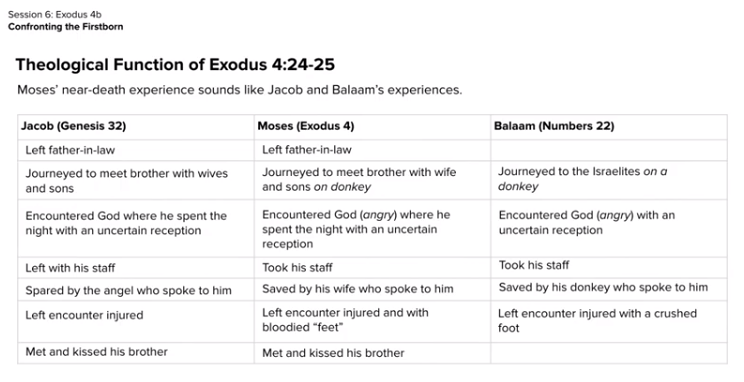
Origianl language does not say YHWH met Moses, it just says him.
Hyperlinks to story of Balaam (Numbers 22) and Jacob (Genesis 32)
Zipporah - another women stepping in to rescure/deliver Moses. Zipporah sounds like Shiphra in Hebrew. Zipporah is a foreign woman.
Forshadowing the blood of the first born stopping the Angel of the Lord from killing.
Removing the “covering of skin” hyperlink back to God making a covering of skin in the garden. Also, removing the skin uncovers the rod - a hyperlink to the rod/snake aka order/chaos. It is also a way of removing the foreign - removing the shoes - to be on holy ground.
And Jehovah saith unto Aaron,
`Go to meet Moses
into the wilderness;'
and he goeth,
and meeteth him
in the mount of God,
and kisseth him,
and Moses declareth to Aaron
all the words of Jehovah
with which He //YHWH// hath sent him //Moses//,
and all the signs
with which He //YHWH// hath charged him //Moses//.
And Moses goeth
-- Aaron also
-- and they gather all the elders of the sons of Israel,
and Aaron speaketh
all the words which Jehovah
hath spoken unto Moses,
and doth the signs before the eyes
of the people;
and the people believe
when they hear that Jehovah
hath looked after the sons of Israel,
and that He hath seen their affliction;
and they bow and do obeisance.
Notes
Heiser, Michael S.. The Unseen Realm: Recovering the Supernatural Worldview of the Bible (p. 312). Lexham Press. Kindle Edition.
In the Old Testament, Israel, the son of God (Exod 4:23), passed through the sea (Exod 14–15) and then ventured out into the wilderness on the way to Canaan to re-establish Yahweh’s kingdom.
The problem of hunger was, of course, an issue in Israel’s wanderings in the wilderness on the way to Canaan. Jesus responds by quoting Deuteronomy 8:3,
Jesus’ point was that his loyalty was to the invisible Yahweh alone; he would obey no other. The second temptation was like the first. Satan dared Jesus to jump from the top of the temple to prove he was the son of God, whom God’s angels would protect. Jesus quotes Deuteronomy 6:16, which again is in the context of obedience to Yahweh alone:
The “original rebel,” whose domain became earth/Sheol, nachash/Satan was perceived by Second Temple and New Testament theology as primary authority over all other rebels and their domains. Consequently, his lordship over the gods who ruled the nations in the Deuteronomy 32 worldview of the Old Testament was presumed. Had Jesus given in, it would have been an acknowledgment that Satan’s permission was needed to possess the nations. It wasn’t. Satan presumed power and ownership of something that, ultimately, was not his but God’s.
Sources:
Bible Project Classroom