Leviticus 5
Witness not saying something //chukim//
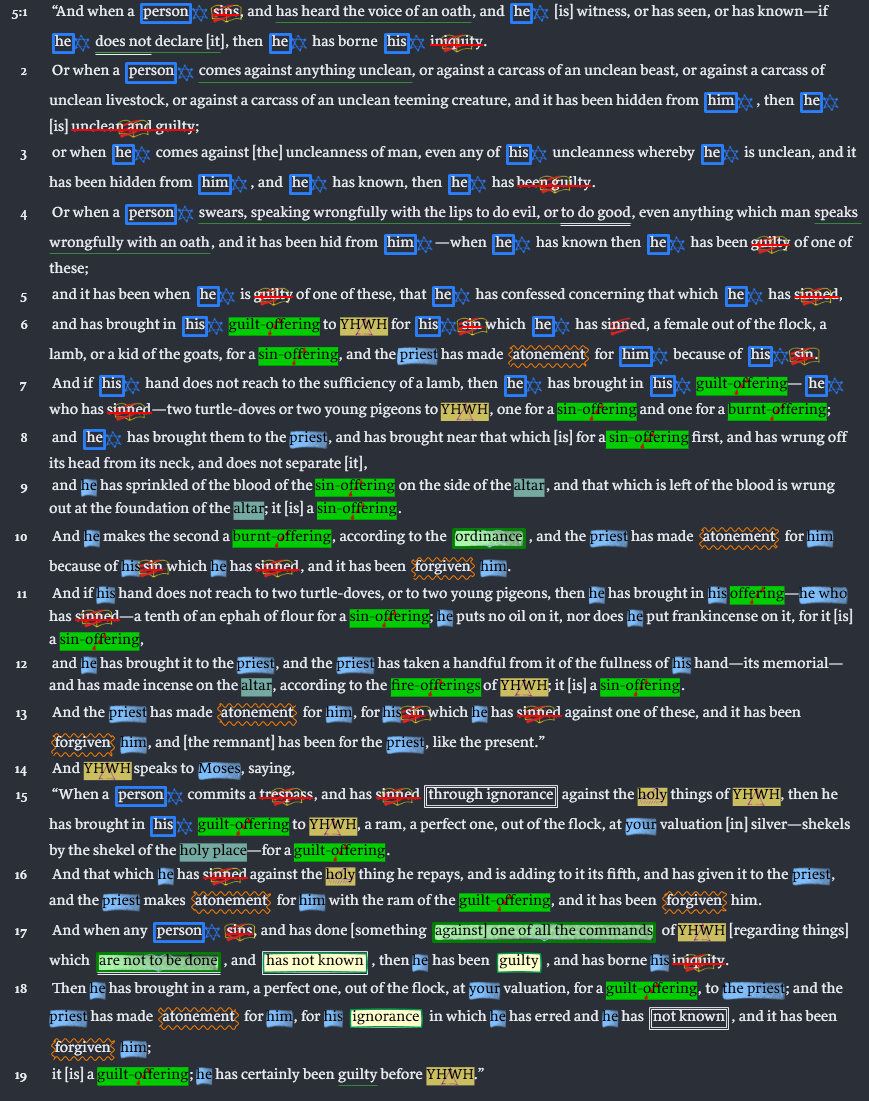
And when a person
doth sin,
and hath heard the voice of an oath,
and he [is] witness,
or hath seen,
or hath known
-- if he declare not,
then he hath borne his iniquity:
This person sees or hears something but doesn’t tell what he knows so he is guilty.
Unclean Animal or Man //chukim//
Or when a person
cometh against any thing unclean,
or against a carcase
of an unclean beast,
or against a carcase
of unclean cattle,
or against a carcase
of an unclean teeming creature,
and it hath been hidden from him,
and he unclean,
and guilty;
Or when he cometh against uncleanness of man,
even any of his uncleanness whereby he is unclean,
and it hath been hidden from him,
and he hath known,
and hath been guilty:
False Witness //mishpat//
Or when a person
sweareth,
speaking wrongfully with the lips
to do evil,
or to do good,
even anything which man speaketh
wrongfully with an oath,
and it hath been hid from him; --
when he hath known
then he hath been guilty of one of these;
If you say you are going to do something and it was good, you should do it. If it was bad, you should repent for it. Either way, if we do not do what we said we would do, we are guilty of a broken oath.
`And it hath been when he is guilty
of one of these,
that he hath confessed concerning that which he hath sinned,
and hath brought in his guilt offering
to Jehovah
for his sin which he hath sinned,
a female
out of the flock,
a lamb,
or a kid of the goats,
for a Sin-Offering,
and the priest hath made atonement for him,
because of his sin.
`And if his hand reach
not to the sufficiency of a lamb,
then he hath brought in his guilt offering
-- he who hath sinned
-- two turtle-doves or two young pigeons
to Jehovah,
one for a Sin-Offering, and one for a burnt offering;
//see Sanhedrin 98b on Isa 53; see Isa 53:10 which says that Moshiach’s self-offering will be an asham for his people, cf Isa 53:8),//
and he hath brought them in unto the priest, and hath brought near that which [is] for a sin-offering first, and hath wrung off its head from its neck, and doth not separate [it],
^9 ^and he hath sprinkled of the blood of the sin-offering on the side of the altar, and that which is left of the blood is wrung out at the foundation of the altar; it [is] a sin-offering.
^10 `And the second he maketh a burnt-offering, according to the ordinance, and the priest hath made atonement for him, because of his sin which he hath sinned, and it hath been forgiven him.
^11 `And if his hand reach not to two turtle-doves, or to two young pigeons, then he hath brought in his offering -- he who hath sinned -- a tenth of an ephah of flour for a sin-offering; he putteth no oil on it, nor doth he put on it frankincense, for it [is] a sin-offering,
^12 ^and he hath brought it in unto the priest, and the priest hath taken a handful from it -- the fulness of his hand -- its memorial -- and hath made perfume on the altar, according to the fire-offerings of Jehovah; it [is] a sin-offering.
^13 `And the priest hath made atonement for him, for his sin which he hath sinned against one of these, and it hath been forgiven him, and [the remnant] hath been to the priest, like the present.'
^14 ^And Jehovah speaketh unto Moses, saying,
Trespass //mishpat//
When a person committeth a trespass,
and hath sinned
through Bishgaga/ignorance
against the holy things
of Jehovah,
then he hath brought in his guilt-offering
to Jehovah,
a ram,
a perfect one,
out of the flock,
at thy valuation [in] silver
-- shekels by the shekel of the sanctuary
-- for a guilt-offering.
This one has a rebellious spirit - he may not be intentionally sinning, but it’s his attitude which bring him into sinning.
`And that which he hath sinned
against the holy thing
he repayeth,
and its fifth is adding to it,
and hath given it to the priest, and the priest maketh atonement for him with the ram of the guilt-offering, and it hath been forgiven him.
`And when any person sinneth,
and hath done [something against] one of all the commands
of Jehovah [regarding things]
which are not to be done,
and hath not known,
and he hath been guilty,
and hath borne his iniquity,
are not to be done - the Shall Not commands
avon = iniquity; ignorance does not absolve guilt, and the individual must bear the consequences (avon) of their action, typically requiring an asham (guilt offering) to atone for it. Avon is distinct from other terms like chatat (sin offering, often for general sin) or pesha (transgression, implying rebellion), as avon emphasizes the moral guilt and its consequences.
^18 `Then he hath brought in a ram, a perfect one, out of the flock, at thy valuation, for a guilt-offering, unto the priest; and
the priest hath made atonement for him,
for his ignorance
in which he hath erred
and he hath not known,
and it hath been forgiven him;
^19 ^it [is] a guilt-offering; he hath been certainly guilty before Jehovah.'
TLV
5 “If a soul sins—after hearing a charge of an oath, and he is a witness whether he has seen or otherwise known—if he fails to report it, then he will bear his guilt.
^2 “Or if a person touches any unclean thing—whether it is the carcass of an unclean animal or the carcass of unclean livestock or the carcass of unclean creeping things, though it is hidden from him, still he is unclean and he will be guilty.
^3 “Or if he touches some human uncleanness, whatever his filth is by which he is unclean, though it is hidden from him, when he knows of it, then he will be guilty.
^4 “Or if a person swears rashly with his lips to do evil or to do good—about anything that one might utter rashly by an oath, though it is hidden from him, when he realizes it, then he will be guilty of one of these.
^5 “So it will be, when one becomes guilty of one of these things, he should confess about what he has sinned. ^[a] ^6 ^Then he is to bring his trespass offering to Adonai for his sin that he committed: a female from the flock, a lamb or a goat, as a sin offering. So the kohen is to make atonement for him over his sin.
^7 “But if one cannot afford a lamb, then he should bring, as his trespass offering for the sin he committed, two turtledoves or two young pigeons, to Adonai. One is for a sin offering and the other for a burnt offering. ^8 ^He is to bring them to the kohen, who will present the one for the sin offering first, and twist its head from its neck but not sever it completely. ^9 ^He is to sprinkle some of the blood of the sin offering on the side of the altar, while the rest of the blood is to be drained out at the base of the altar. It is a sin offering. ^10 ^He is to make the second a burnt offering, according to the regulation. So the kohen is to make atonement for one over his sin that he committed—and he will be forgiven.
^11 “But if one cannot afford two turtledoves or two young pigeons, then he is to bring as his offering for the sin he has committed a tenth of an ephah[b] of fine flour as a sin offering. He is to put no oil on it nor put any frankincense on it, for it is a sin offering. ^12 ^He is to bring it to the kohen, then the kohen is to take his handful of it as the memorial portion and burn it up as smoke on the altar, on Adonai’s offerings by fire. It is a sin offering. ^13 ^The kohen is to make atonement for him over his sin that one has committed in any of these things—and he will be forgiven. The rest belongs to the kohen, just like the meal offering.”
^14 ^Adonai spoke to Moses, saying: ^15 “If anyone commits a faithless act and sins unwittingly against the holy things of Adonai, then he is to bring his trespass offering to Adonai: a ram without blemish from the flock, according to your value in silver shekels after the shekel of the Sanctuary, for a trespass offering. ^16 ^He is to make restitution for that which he has done wrong in regard to the holy thing, and is required to add a fifth part to it, and give it to the kohen. So the kohen will make atonement for him with the ram of the trespass offering—and he will be forgiven.
^17 “Now if anyone sins and one of Adonai’s commandments that are not to be done, though he did not know it, still he is guilty and will bear his iniquity. ^18 ^He is to bring to the kohen a ram without blemish from of the flock, according to your value, as a trespass offering. Then the kohen is to make atonement for him over the sin that he committed unknowingly—and he will be forgiven. ^19 ^It is a trespass offering. He is absolutely guilty before Adonai.”
Mitzvot of Restitution
^20 ^Then Adonai spoke to Moses saying: ^21 “Suppose anyone sins and commits a faithless act against Adonai by dealing falsely with his neighbor in a matter of a deposit or a pledge of hands, or through robbery, or has extorted from his neighbor, ^22 ^or has found what was lost and lied about it, swearing falsely—so sinning in one of any of these things that a man may do. ^23 ^Then it will be, when he has sinned and has become guilty, that he must restore what he took by robbery, or what he got by extortion, or the deposit that was committed to him, or what was lost that he found, ^24 ^or any thing about which he has sworn falsely, he is to restore it in full, and add a fifth part more to it. He must give it to the one to whom it belongs on the day of presenting his trespass offering. ^25 ^He is to bring his trespass offering to Adonai, a ram without blemish from the flock, according to your value, for a trespass offering, to the kohen. ^26 ^The kohen shall make atonement for him before Adonai, and he will be forgiven concerning whatever he may have done to become guilty.”
OJB
5 And if a nefesh sin, after he hears a public adjuration to give testimony, and he is an ed (witness), whether he hath seen or known of it; if he does not utter it, then he shall bear his avon (iniquity).
^2 ^Or if a nefesh touch anything tamei (unclean), whether it be a nivlat chayyah teme’ah (carcass of an unclean beast), or a nivlat behemah teme’ah (carcass of unclean livestock), or the nivlat sheretz tamei (carcass of unclean creeping things), and if it be hidden from him; he also shall be tamei, and guilty.
^3 ^Or if he touch the tum’at adam (uncleanness of man), whatsoever tumah it be that a man shall be made unclean therewith, and it be hid from him; when he knoweth of it, then he shall be guilty.
^4 ^Or if a nefesh swear, rashly pronouncing with his lips to do harah, or to do hatov, whatsoever it be that a man shall pronounce with a shevuah (oath), and it be hid from him; when he knoweth of it, then he shall be guilty in one of these.
^5 ^And it shall be, when he shall be guilty in one of these things, that v’hitvaddah (he shall confess) that he hath sinned in that thing;
^6 ^And he shall bring his asham (penalty, trespass offering) unto Hashem for his chattat (sin) which he hath sinned, a nekevah from the flock, a lamb or a female goat, for a chattat (sin offering); and the kohen shall make kapporah for him concerning his chattat.
^7 ^And if he be not able to afford a seh (lamb), then he shall bring for his asham (guilt offering, *see Sanhedrin 98b on Isa 53; see Isa 53:10 which says that Moshiach’s self-offering will be an asham for his people, cf Isa 53:8*), which he hath sinned, two turtledoves, or two young pigeons, unto Hashem; one for a chattat (sin offering), and the other for an olah (burnt offering).
^8 ^And he shall bring them unto the kohen, who shall offer that which is for the chattat (sin offering) first, and wring off his head from his neck, but shall not separate it;
^9 ^And he shall sprinkle of the dahm of the chattat (sin offering) upon the side of the Mizbe’ach; and the rest of the dahm shall be pressed out at the base of the Mizbe’ach; it is a chattat (sin offering).
^10 ^And he shall offer the second for an olah (burnt offering), according to the mishpat (prescribed manner); and the kohen shall make kapporah for him for his chattat (sin) which he hath sinned, and it shall be forgiven him.
^11 ^But if he be not able to afford two turtledoves, or two young pigeons, then he that sinned shall bring for his korban the tenth part of an ephah of fine flour for a chattat (sin offering); he shall put no shemen upon it, neither shall he put any incense thereon; for it is a chattat (sin offering).
^12 ^Then shall he bring it to the kohen, and the kohen shall take his handful of it, even a memorial portion thereof, and burn it on the Mizbe’ach, according to the offerings made by eish unto Hashem; it is a chattat (sin offering).
^13 ^And the kohen shall make kapporah for him as touching his chattat (sin) that he hath sinned in one of these, and it shall be forgiven him; and the remnant shall be the kohen’s, like the minchah.
^14 ^And Hashem spoke unto Moshe, saying,
^15 ^If a nefesh commit a ma’al (trespass), and sin through ignorance (unintentionally), in the holy things of Hashem; then he shall bring for his asham unto Hashem a ram tamim see [Gn 22:13 on the vicarious aspect of the substitutionary atonement and compare Isa 53:5,8] out of the flocks, with thy estimation by shekels of kesef, after the Shekel HaKodesh (the Shekel of the Sanctuary), for an asham (trespass or guilt offering).
^16 ^And he shall make restitution in regard to the holy thing in which he was remiss, and shall add the fifth part thereto, and give it unto the kohen; and the kohen shall make kapporah for him with the ram of the asham (trespass offering), and it shall be forgiven him.
^17 ^And if a nefesh sin, and commit any of these things which are forbidden to be done by the mitzvot Hashem; though he know it not, yet he is guilty, and shall bear his avon (iniquity).
^18 ^And he shall bring a ram tamim out of the flock, with thy estimation, for an asham (trespass offering) unto the kohen; and the kohen shall make kapporah for him concerning his ignorance wherein he erred and knew it not and it shall be forgiven him.
^19 ^It is an asham (trespass offering); he hath certainly trespassed against Hashem. See [Isa 53:10 on Moshiach’s asham offering for Israel—Isa 53:8].
LSV