The Camp
A Christian Walk with the Tabernacle Israelites
The Camp
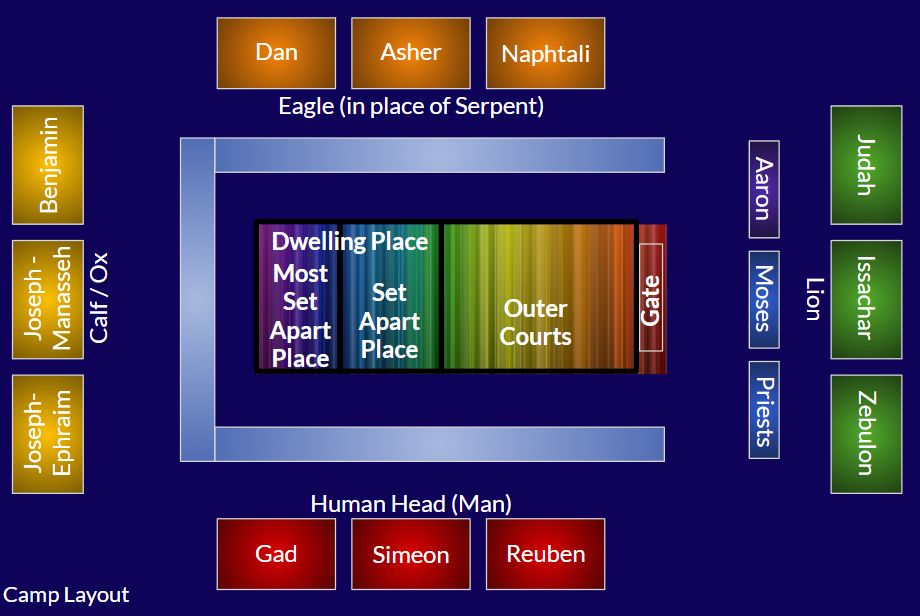
This is the general layout of the camp. The entire set up was instructed by God, where people set up, the clothes the people who served in the tabernacle wore, the pegs, and even the thread and color used in the tabernacle. On the outside were the tribes of Israel organized by each of the sons of Jacob/Israel. Then the levites, Moses, Aaron, and the Priests.
As we look at the people in the camp, we’ll kind of being walking through Numbers, and hit a few scriptures in Leviticus and Deuteronomy.
The progression outlined:
- Outer Camp (Lost/Foreigners): Exodus 3:7-10, Deuteronomy 7:6-8 (God calls people out of bondage).
- Outer Courts (Called-Out Group): Leviticus 1:1-4, Hebrews 10:19-22 (entering through offerings, fulfilled in Christ).
- Holy Place (Called-Out Body): 1 Peter 2:5, Revelation 1:6 (serving as priests, giving heart and soul).
- Most Holy Place (Called-Out Life): Hebrews 4:14-16, 1 Peter 2:9 (full dedication, mind given to God, living as His reign is near).
The Layout
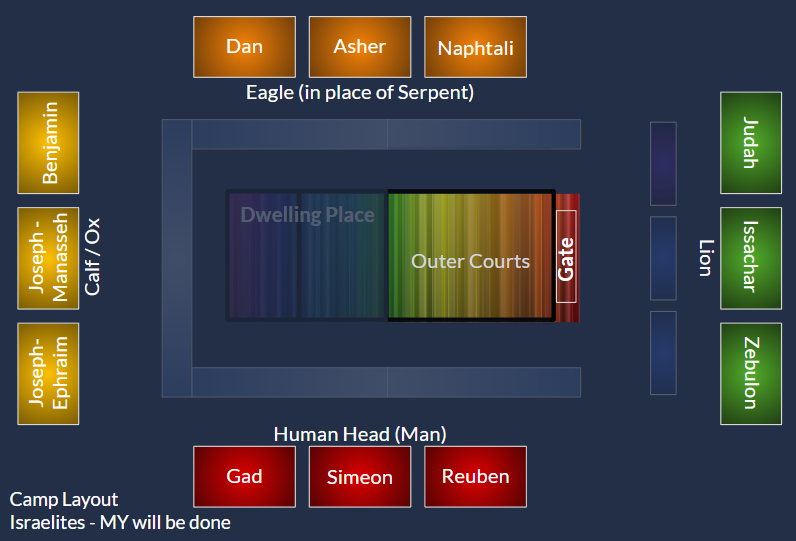
- These people were the family members of all the son’s of Jacob/Israel except Levi’s. Many time we in America say Jews or the Jewish people. But these were actually Israelites. The tribe of Judah absorbed the tribe of Benjamin and those people because known as Jews. The other tribes remained under Ephraim and were known as Israel. David would later unite them and establish Jerusalem. Over time, others identified as Jews because they followed “Jewish” laws. There is actually a long history which is impossible to shorten to just a couple of sentences. But in general, the people who were lead out of bondage from Egypt, wandered in the desert and set up the Tabernacle were Israelites because they were descendants of Israel, formerly known as Jacob.
- It is also believed there were people among them who were not Israelites by blood. Later when we look at the Witness or the Commandments, we will see there were foreigners among them.
- The colors I used are according to Jewish Rabbictical traditions. The scripture indicates each was “next to” the other. Some lay them out the way I have them here. Some lay them out in four columns of people. If that is done, the shape generally matches that of a cross.
- In Numbers, they were ordered to take a census of “all the men in Israel who are twenty years old or more and able to serve in the army” with “The total number was 603,550.” Some estimate the number of people including men, women, and children to be as many as 2 million. Six US states have less than 2 million people in them. Nebraska and New Mexico have about 2 million people. The census was taken only of these tribes. The tribe of Levi, which we will discuss later, was not included.
- According to Numbers we are given the layout of the camp: “The Israelites are to camp around the tent of meeting some distance from it, each of them under their standard and holding the banners of their family.”” We find the standard Genesis 49 when Israel/Jacob blessed his sons. Each tribe had their own banner, however, YHWH, divided them into four under:
- Judah - Lion born 4th to Leah. Jesus came out of this tribe.
- Reuben - Man born 1st to Leah
- Ephraim - Ox born to Joseph who was 11th born to Rachel
- Dan - Serpent but he chose to use an Eagle carrying a serpent because he didn’t want to use a serpent. Born 5 to Rachel’s maid
- The four banners can be found elsewhere in scriptures but we won’t go into details on that today but if you’d like you can note:
- They are the four faces of the living creatures in both Ezekiel 1 and Revelation 4-6, 15, and 19.
- Ezekiel calls them Cherubs - There are Cheribim on the Seat of Atonement in the Most Set Apart Place.
- They were beside God and surrounded Christ
The Four Banners and Spiritual Symbolism
- Genesis 49:1-28 - Jacob’s blessings to his sons, which include symbols (e.g., Judah’s lion, Reuben’s man), later reflected in the tribal banners.
- Ezekiel 1:10 - The four living creatures with faces (man, lion, ox, eagle), paralleling the banners and symbolizing God’s presence.
- Revelation 4:6-8 - The four living creatures around the throne, echoing the Tabernacle’s connection to heavenly worship.
- Another note of interest which may come up again as we look at the layout of the Tabernacle later: The Tabernacle also represents the layout of Eden. Genesis 2 indicates that a river “flowed from Eden, from where it was separated into four headwaters.”
- Also worth noting, there are 24 elders around the throne. I didn’t go into this study, but in my readings, many believe this is made up of the 12 sons of Jacob/Israel and the 12 Disciples of Christ. Take that as a minor note and if something like that interests you, have fun looking into it.
- King Saul will come from the Tribe of Benjamin.
- King David and Jesus comes for the Tribe of Judah.
- There were eventually leaders appointed from the tribes as recorded in Deuteronomy. They were set up in layers: “as commanders of thousands, of hundreds, of fifties and of tens and as tribal officials.” These leaders weren’t spiritual leaders, they were like our judges today, but in a less formal way. Basically, you would go to another family member and ask them to determine which one was right and which one was wrong. Can you even imagine that today? Moses told them to ““Hear the disputes between your people and judge fairly, whether the case is between two Israelites or between an Israelite and a foreigner residing among you. 17 Do not show partiality in judging; hear both small and great alike. Do not be afraid of anyone, for judgment belongs to God. Bring me any case too hard for you, and I will hear it.”” None of this took place inside the Tabernacle area. It all took place out in the camp area. Based on the judgement made, you might be required to bring an offering to the Taberncle.
- The people from these tribes would bring their offering to the Tent of the Appointment or Tabernacle Entrance. Their offering would be examined. But the offering was only a reflection of the person bringing it. The value and quality of the offering showed how serious the person making it was about making the offering. Sometimes, the priest would reject the offering and they would be sent away. None of these people could enter the Outer Courts without offering something of value. So although they could enter the Outer Courts, it wasn’t freely, it had to be approved by a Priest. There were only two offerings required by God. There were three additional voluntary offerings. We will look at those later.
- If I was applying this as a picture today, this group would be divided into two sets of people. Those who were just camping outside of the Tent of Meeting or Tabernacle area. And those who entered the Outer Courts. The Israelites as a whole group switched between complete dedication and going back to their old ways. They lived in the inbetween. One minute they were agreeing to be completely dedicated to God and following his ways, the next they were breaking their agreement. They were always in flux.
- In the time of Jesus, we might see these people as the Jews (in the Temple) and the Gentiles (outside the Temple). The Jews were trying to following God’s way, and the Gentiles were living their on way.
- Christianity today might call them the lost people (outside the church) and the saved people (inside the church). They might be the people who come and go between the two worlds. The people who seek out God when they are in need. But in general, their lives are designed around their fleshly desires more than God’s desires. They are all about MY will be done. In some countries and families, they don’t take stepping up to the gate so lightly, it could cost them their lives or even rejection from their family and friends. But in other countries, like in the US in general, you can step up to the gate, bring your sincere, heart felt offering at the time, and then head right back into the world and come back again when you want or need to. Cost isn’t a real consideration.