1 Peter 3
3 In like manner,
the pattern of submission and godly conduct described in 1 Peter 2:13–25, slaves to masters (2:18–25) and Christ’s example of enduring suffering and doing good, to honor God.
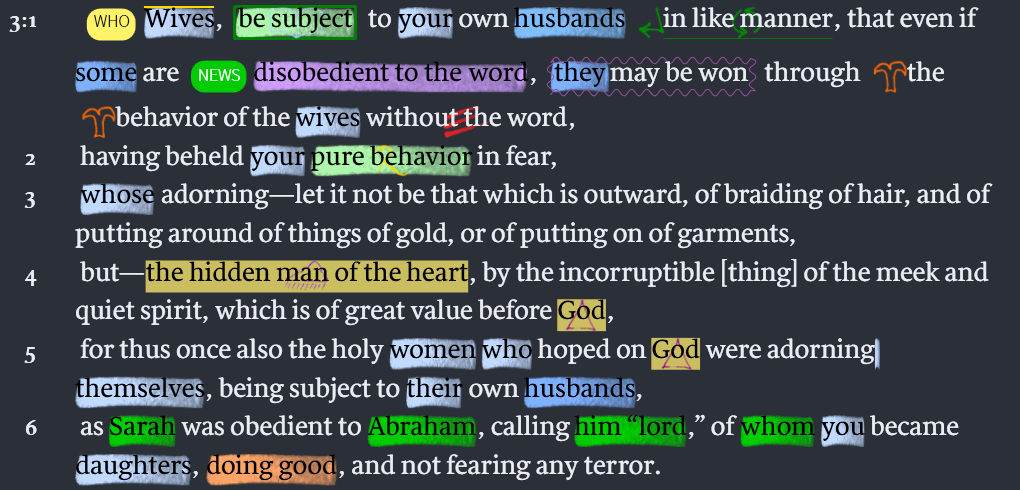
Wives
be ye subject
to your own husbands,
that even if certain are disobedient to the word,
through the conversation of the wives,
without the word, they may be won,
having beheld your pure behaviour in fear,
whose adorning --
let it not be that which is outward,
of plaiting of hair,
and of putting around of things of gold,
or of putting on of garments,
but -- the hidden //secret// man of the heart,
in the incorruptible thing
of the meek
and quiet spirit,
which is, before God, of great price,
for thus once also
the holy women
who did hope on God,
were adorning themselves,
being subject to their own husbands,
as Sarah was obedient to Abraham, //Genesis 18:12//
calling him `sir,'
of whom ye did become daughters,
doing good,
and not fearing any terror. //Proverbs 3:25//
Disobedient to the wrod ... without the word:
In 1 Peter, λόγος consistently refers to God’s word or the gospel when used with the article (τῷ λόγῳ, “the word”). The husbands are described as not believing or obeying “the word,” implying they reject the Christian message (the gospel), not just verbal speech.
1 Peter 1:23 (NIV): “For you have been born again… through the living and enduring word [λόγου, logou] of God.” Here, λόγος is the gospel that brings salvation.
1 Peter 2:8 (NIV): “They stumble because they disobey the word [τῷ λόγῳ, tō logō].” The same phrase as 3:1 (ἀπειθοῦσιν τῷ λόγῳ) refers to rejecting the message of Christ.
1 Peter 1:25 (NIV): “But the word [ῥῆμα, rhēma, but quoting Isaiah 40:8’s λόγος in the LXX] of the Lord endures forever. And this is the word [ῥῆμα] that was preached to you.” The preached gospel is equated with λόγος in the LXX context.
The phrase “without word” is paired with “διὰ τῆς… ἀναστροφῆς” (dia tēs… anastrophēs, “through the conduct of the wives”). This contrast emphasizes that the wives’ behavior (ἀναστροφή, lifestyle or conduct), not their verbal speech, will win over the husbands.
Other New Testament verses use λόγος in dual senses within close proximity (e.g., Acts 4:29, “speak your word [λόγον, logon]” as the gospel, vs. 4:31, “spoke the word [λόγον, logon]” as preaching). Context always clarifies the nuance.
in like manner
the pattern of submission and godly conduct described in 1 Peter 2:13–25, slaves to masters (2:18–25) and Christ’s example of enduring suffering and doing good, to honor God.
Husbands
dwelling with [them]//wives//,
according to knowledge,
as to a weaker vessel
-- to the wife
-- imparting honour,
as also being heirs together
of the grace of life,
that your prayers be not hindered.
All
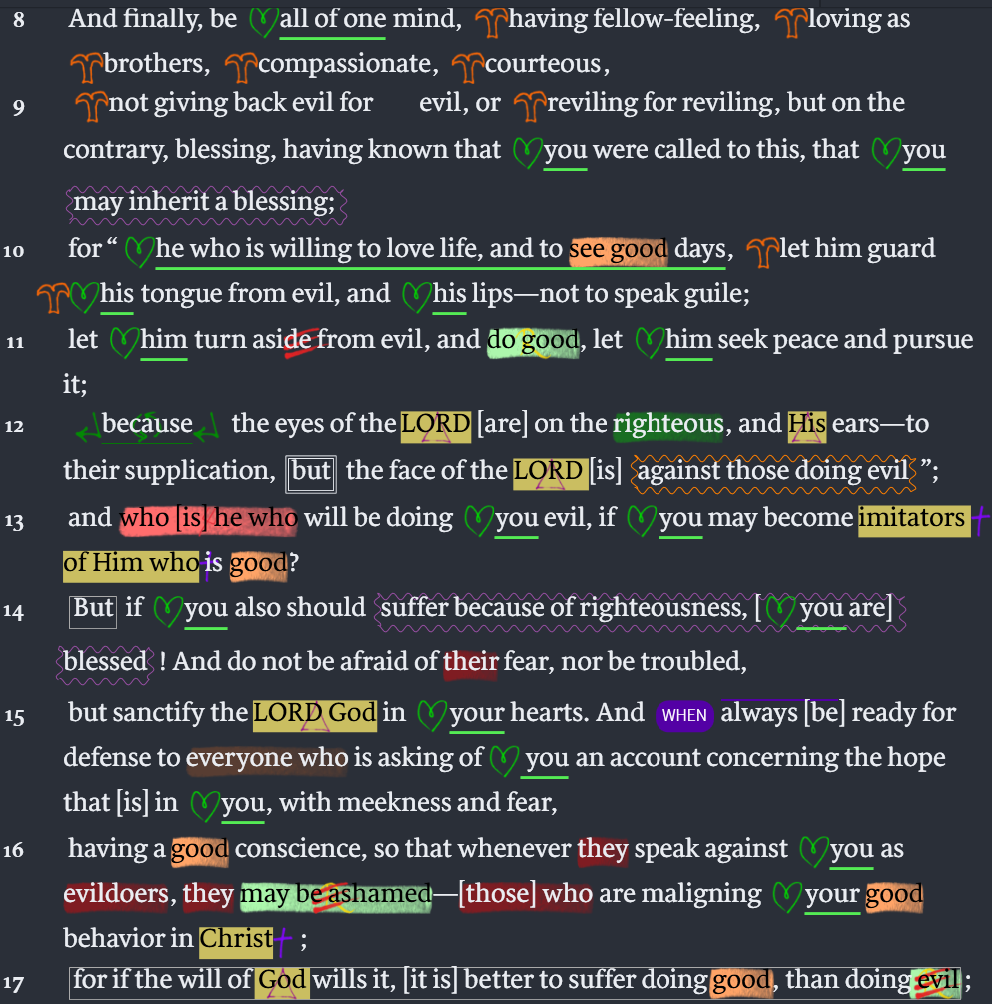
being all of one mind, //Psalm 133:1//
Do
having fellow-feeling,
loving as brethren,
compassionate,
courteous,
blessing,
having known that to this ye were called,
that a blessing ye may inherit;
he who is willing to love life,
and to see good days,
let him guard his tongue from evil, and his lips //Psalms 34:13-17//
let him turn aside from evil,
and do good,
let him seek peace and pursue it;
Do Not
not giving back evil for evil,
not railing for railing,
not to speak guile;
Righteous
because
the eyes of the Lord [are]
upon the righteous,
and His ears
-- to their supplication //tefillos//,
but if ye also should suffer
because of Righteous,
happy [are ye]!
and of their fear be not afraid, nor be troubled,
and the Lord God sanctify in your hearts.
Unrighteous
and the face of the Lord [is]
against those doing evil;' //ra//
who [is] he who will be doing you evil,
if of Him who is good ye may become imitators?
1 Peter 3:12 quotes Psalms 34:16 in the Septuagint (LXX), the Greek translation of the Hebrew Old Testament. The Septuagint uses κακά (kaka) in Psalm 34:16 (LXX 33:17) to translate the Hebrew word for “evil.”
Be Ready Always
And [be] ready always
for defence
to every one who is asking of you
an account concerning the hope that [is] in you,
with meekness and fear;
having a good conscience,
that in that in which they speak against you as evil-doers,
they may be ashamed
who are traducing your good behaviour in Christ;
for [it is] better doing good,
if the will of God will it,
to suffer,
than doing evil //ra//;
because
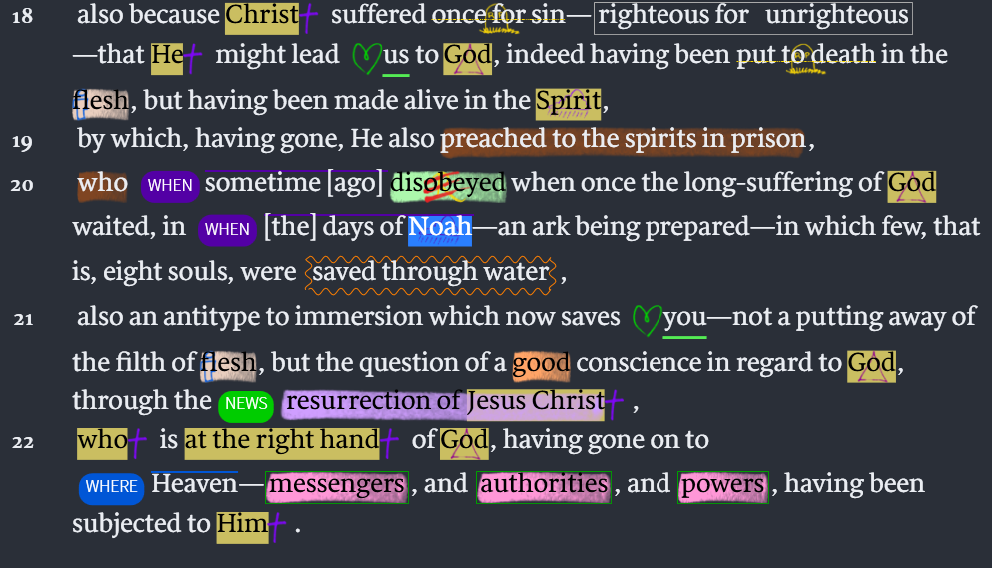
also Christ once for sin did suffer //once = ἅπαξ (hapax, denotes a singular occurrence, often with a sense of finality or uniqueness//
-- righteous for unrighteous
-- that he might lead us to God,
having been put to death indeed,
in the flesh,
and having been made alive in the spirit,
in which also to the spirits
in prison //Psalms 16: 9-10, Isaiah 53:8//
having gone he did preach,
who sometime disbelieved,
when once the long-suffering of God did wait,
in days of Noah
-- an ark being preparing
-- in which few, that is, eight souls, were saved through water;
also to which an antitype //pattern, must understand everything that comes before to interpret the current picture; anti means what everything has been built up to - the flood to baptism//
doth now save us //but a pledge//
-- baptism, //Jeremiah 17:13//
(not a putting away of the filth of flesh, //Isaiah 1:16–18//
but the question of a good conscience in regard to God,)
through the rising again of Jesus Christ,
^who is at the right hand of God,
having gone on to heaven
having been subjected to him
-- messengers,
and authorities,
and powers, .
Obeservation: ONCE for sin?
the phrase translated as “give an answer” or “defense” is tied to the word ἀπολογία (apologia), found in the clause “πρὸς ἀπολογίαν” (pros apologian), meaning “for a defense” or “to give an answer.” ἀπολογία derives from ἀπολογέομαι (apologeomai), meaning “to speak in defense” or “to give an account.” It refers to a reasoned defense, explanation, or response, often in a formal or legal context, but also broadly to answering questions about one’s beliefs or actions. Hebrew Equivalent: Primarily רִיב (riv), meaning “to contend,” “plead,” or “defend a cause,” as seen in Job 13:15, Isaiah 1:17, and Micah 7:9, aligning with the defense of faith or righteousness. Secondarily, עָנָה (‘anah), meaning “to answer” or “respond,” as in Proverbs 15:1, but less specific to defense.
The “pledge” (ἐπερώτημα) in 1 Peter 3:21 as a commitment to God in baptism mirrors the Old Testament נֶדֶר, where individuals pledge devotion or obedience to God. Baptism, like a vow, is a public act of faith and commitment, seeking God’s grace for a clear conscience. The covenantal nature of baptism (a new covenant act) aligns with נֶדֶר’s use in covenantal contexts (e.g., vows to uphold God’s law or seek His favor).
In biblical times, baptism was a public declaration of allegiance, a "boundary crossing ritual" signifying a shift from previous allegiances. Baptism was done by the person - an act of free will - no one “dunked” them. Using done at a mikvah (ritual baths).
Other relative references to Baptism and Mitkvah: Leviticus 11:36, Genesis 6:17–18, Genesis 7:17–23, Exodus 14:21–22, 29, Joshua 3:14–17, Ezekiel 36:25–27, Zechariah 13:1
explore Isaiah 8:12-13
defending faith in Psalms