BP: Exodus Overview Class
Exodus Overview Session Notes
Dr. Carmen Imes

Contents
Session 1: Exodus and the Exodus 5 Session 2: Proliferation and Oppression (Exodus 1) 7 Session 3: Delivering the Deliverer (Exodus 1-2a) 9 Session 4: Becoming Moses (Exodus 2b) 11 Session 5: Commissioning Moses (Exodus 3-4a) 12 Session 6: Confronting the Firstborn (Exodus 4b) 14 Session 7: Let Them Go! (Exodus 5-7) 17 Session 8: Signs and Wonders (Exodus 7-11) 20 Session 9: Hard Heart (Exodus 7-11) 22 Session 10: Passover Ritual (Exodus 12-13) 25 Session 11: Sea Crossing (Exodus 13b-14) 27 Session 12: Prophetic Song (Exodus 15) 29 Session 13: Liminal Space (Exodus 16-17) 31 Session 14: Burden of Leadership (Exodus 18) 33 Session 15: Commissioning the Nation (Exodus 19) 34 Session 16: Law as Mission (Exodus 20) 36 Session 17: No Other Gods (Exodus 20a) 37 Session 18: Bearing His Name (Exodus 20b) 38 Session 19: Resting in God’s Provision (Exodus 20c) 40 Session 20: “Slavery” Laws (Exodus 21-23a) 41 Session 21: Defining the “Conquest” (Exodus 23b) 44 Session 22: Covenant Ratified (Exodus 24) 45 Session 23: Tabernacle (Exodus 25-31) 46 Session 24: Priestly Garments (Exodus 28-29) 48 Session 25: Apostasy (Exodus 32) 49 Session 26: Presence (Exodus 33-34) 52 Session 27: Participation (Exodus 35-40) 53 Session 28: Glory (Exodus 40) 55
Exodus Overview 2
Prework
Read Bearing God's Name: Why Sinai Still Matters by Carmen Imes
Read Exodus Old and New by Michael Morales (optional)
Study Questions
- In Exodus 1:1-2:10, who is named, who is unnamed, and why?
- Women play significant roles in Exodus 1-2 and 4. What motivates them to act as they do? And what can that teach us about our response to injustice in the world around us?
- In Exodus 2:1-4:31, what clues does the author give us about Moses’
conflicting identities? Who is he, and how can we tell?
- In what ways does Moses’ own story in Exodus 1-4 anticipate or foreshadow Israel’s story as a nation?
- Bible readers often struggle with the idea of God hardening Pharaoh’s heart. Does God’s hardening of Pharaoh’s heart override his freedom? Consider this issue as you read 4:21- 14:18. Do you notice any patterns that might help us with this question?
- What patterns do you notice in how the plague narratives unfold? Why doesn’t God just send a single, decisive plague? What is the purpose of having so many plagues?
- What connections do you notice between the first half of Exodus and the creation account in Genesis 1?
- Why might the author have included a chapter of ritual instructions
to interrupt this exciting narrative in chapter 12?
- Trace the idea of the firstborn through the book. Who are the firstborn? What is their role in this drama? 10. What is the literary-theological significance of Miriam’s role in the song of Exodus 15?
- Read Numbers 11-12, 16-17, and 20 and then re-read Exodus 15:22-17:7. What similarities and differences did you notice? How can you account for those? Do you notice similarities and differences in God’s response? What has changed and what hasn’t?
- Read Exodus 18 and Numbers 11. Reflect on Moses’ leadership role, its challenges, and God’s provision. What do you make of the fact that Moses follows Jethro’s advice without a command from God in Exodus 18? What is problematic about Moses’ perspective in Numbers 11, and how does God respond?
- Carefully compare the Ten Commandments in Exodus 20 and Deuteronomy 5.
What differences do you notice? How can you account for these?
- As you read the laws in Exodus 20-23, make a list of ways that they put in
place protections for vulnerable members of the community.
- Many people struggle with God’s command that Israel take possession of the land of the Canaanites. Reread Exodus 23:20-33. What reasons are given for the conquest? What specifically are the Israelites asked to do?
- In Exodus 24, Moses ratifies the covenant between YHWH and Israel. In verse 8, he sprinkles blood on the people. What is the significance of that? Where else in the Torah is someone sprinkled with blood?
- Which items get the most attention in the tabernacle instructions (Exod. 25-31)? Why?
- In the golden calf incident (Exod. 32), YHWH changes his mind in response to Moses’ intercession (v. 14). What implications does this have for our understanding of prayer and the sovereignty of God?
- Compare Exodus 23:20, 32:33-33:6, and 33:12-34:11. Why did God say he would not go with them? What changed his mind? What can we learn from Moses’ interaction with God at Sinai?
- Why does Exodus 35-40 repeat so much material from Exodus 25-31? What is the theological significance? Was the tabernacle a success? Why or why not? (Give evidence from the text.)
Session 1: Exodus and the Exodus
Did the Events in Exodus Really Happen?
• Deuteronomy 26:1-9
• Joshua 24:1-28
• Isaiah 43:14-21
• Psalm 105
“As a constitutive event, the exodus is recognized as an
event of such import that the community would not be
what it is without its having occurred.”
Fretheim, Terence (2010). Exodus:
Interpretation: A Bible Commentary for Teaching
and Preaching. Westminster John Knox Press.
When Did the Exodus Happen?
A summary of Nahum Sarna’s Exodus from the Jewish Publication Society
| 15th Century | 13th Century |
|---|---|
• 1 Kings 6:1 (480 years) • But Pharaoh lived at Thebes during that time, 400 miles away, and controlled Canaan Counting back 480 years from Solomon in 960 B.C.E. (1 Kgs. 6:1), puts the exodus at 1440 B.C.E. Perhaps this number is somewhat symbolic, representing 12 generations at 40 years per generation, when in reality the number is considerably smaller. | • Pharaoh lived near Pithom and Rameses, which were built by the Hebrews (Exod. 1:11) • Egypt had lost control of Canaan • “Israel” mentioned on Pharaoh Merneptah’s Stele (c.1224-11) • But what about the 480 years? • And geography and archaeology of the conquest don’t match exactly |
Which Pharaoh?
He is unnamed in the text, but pay close attention to whose names we learn.
Note: The mention of Pithom and Rameses in 1:11 does not solve this, since a scribe could have updated the city names later.
Exodus Overview 5
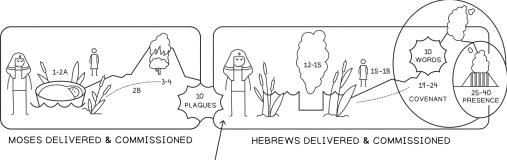
Literary Design of Exodus
1-4: The Saga of Moses
1-2: Moses Delivered from Pharaoh
3-4: Moses Commissioned by YHWH
5-40: The Saga of the Hebrews
5-18: Hebrews Delivered from Pharaoh
5-11: Ten Plagues
12-15a: Passover and Exodus
15b-18: Wilderness Journey
19-40: Hebrews Commissioned by YHWH
19-24: Covenant
25-40: Presence
Recommended Resource
The Liturgy of Creation: Understanding Calendars in Old Testament Context by Michael LeFebvre
Exodus Overview 6
Session 2: Proliferation and Oppression (Exodus 1)
Creation Echoes
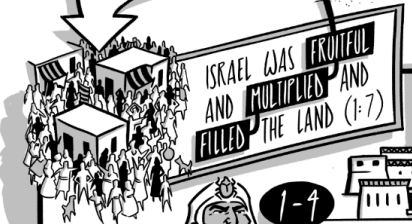
| Genesis 1:28 | Exodus 1:7 |
|---|---|
| Be fruitful [prh] and multiply [rbh], fill [mlʾ] the land [ʾrṣ] and subdue it. Rule over the fish of the sea and over birds of the heavens and over every living creature that roams upon the land. | But the children of Israel were fruitful [prh] and they swarmed [šrṣ; cf. Gen. 1:20-21; 9:7] and they increased [rbh] and became very, very [mʾd; Gen. 1:31] numerous, and the land [ʾrṣ] was filled [mlʾ] with them. |
Over whom or what were they supposed to rule? (Gen. 1:28; cf. Exod. 1:14)
Pharaoh’s Fear
• Problem: The Israelites outnumber us
• Solution: Keep them from multiplying so that they will not fight us and leave • Plan A: Harsh labor
• Plan B: Murderous midwives
• Plan C: Nile drowning
Whose names do we know in chapter 1? The Hebrew midwives are named, even though Pharaoh is not. The midwives’ courage in defying Pharaoh is remembered for all time.
Exodus Overview 7
“Come, let us ...”
Pharaoh repeats the arrogance of the brick makers in Genesis 11, whose city and tower tried to establish their own fame and avoid being “scattered” (Gen. 11:3-4). God has already demonstrated his commitment to opposing the proud. In response, God will reverse Pharaoh’s oppressive policies (cf. Exod 5:12).
Store Cities
The building of ותֹנ ְכּ ְס ִמ) miskənôt) in 1:11 mirrors the building of the ן ָכּ ְשׁ ִמ) miškān) in Exodus 25-40. These were likely warehouses with supplies for Pharaoh’s funerary cult, ensuring that Egyptians would worship him long after his death. YHWH calls the people to build a tabernacle to worship him instead.
Exodus Overview 8
Session 3: Delivering the Deliverer (Exodus 1-2a)
A Tale of Three Daughters
What do you see?
• The daughter of Levi “saw that he was good” (2:2)
• The baby’s sister “stood at a distance to see what would happen to/for him” (2:4)
• The daughter of Pharaoh “saw the basket ... saw the baby ... and felt sorry for him” (2:5-6) Cf. “God looked on the Israelites and was concerned about them” (2:25)
YHWH: “I have indeed seen the misery of my people ... and I am concerned about their suffering” (3:7) YHWH: “I have seen the way the Egyptians are oppressing them” (3:9)
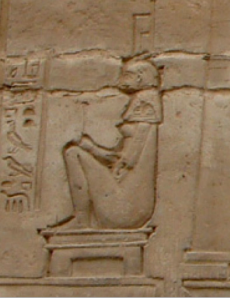
Delivery Stool or Birthing Bricks?
ʾābnayim ≈ “two stones” (Exod. 1:16)
• Birthing equipment: See Jeremiah 18:3 (potter’s wheel)
• Genitalia: This would be the only such occurrence
• Birthing stool: Possible, but Pharaoh’s instruction in v. 16 would be strange
• Ritual bricks: This seems more likely
See Josef Wegner, “Tradition and Innovation: The Middle Kingdom” for more on birthing bricks used as a stool and then rearranged for a newborn ritual.
Exodus Overview 9
Delivering the Deliverer
• Shiphrah and Puah (the midwives)
• The boy’s mother
• The boy’s sister
• The daughter of Pharaoh
• The maidservants of Pharaoh’s daughter
• Zipporah (chapter 4)
Midwife, mother, sister, daughter, wife—each woman courageously defies Pharaoh, working within her sphere of influence to resist injustice.
Pharaoh had “let the girls live” (ḥāyah; 1:16, 22), but women became his greatest threat. Their “liveliness” (ḥāyeh) was the reason they kept bearing sons (1:19).
Exodus Overview 10
Session 4: Becoming Moses (Exodus 2b)
Naming Moses (Exod. 2:10)
• “Moses” in Hebrew = “one who draws out”
• “Moses” in Egyptian = “son of _”
Who is Moses?
• How is he identified in the first two chapters?
• How does Moses’ commissioning clarify his identity?
• “I am the God of your father, God of Abraham, God of Isaac, and God of Jacob” (3:6)
Moses and the Betrothal Scene Pattern
Martin, Michael W. “Betrothal Journey Narratives.” Catholic Biblical Quarterly 70 (2008): 505–23.
Abstract: M. expands on the five-element betrothal type-scene identified by Robert Alter in the OT. He identifies seven additional typical elements that help constitute a larger betrothal journey narrative in which the betrothal type-scene is situated. The full pattern comprises the following elements: (1) a groom-to-be travels to a foreign land; (2) he meets (a) young woman/women at a well; (3) someone draws water; (4) the suitor gives a gift or performs an ingratiating service; (5) the suitor reveals his identity; (6) someone rushes with news of his arrival to the woman's family; (7) the family responds with a greeting/invitation; (8) a betrothal is arranged; (9) the suitor resides with the woman's family; (10) the suitor returns home; (11) he is received by his kin at journey's end; and (12) the suitor resides with his kin. Next, M. shows how the pattern is creatively adapted in various stories in OT, Intertestamental, and NT literature, including narratives about Isaac, Jacob, Moses, Ruth, Saul, David, the entire story of Tobit, and the encounter of Jesus and the Samaritan woman in the Fourth Gospel. Interpretation of these narratives is informed by recognition not only of their conformity to the pattern but also their innovative use of it. [Abstracted by: William J. Urbrock for Old Testament Abstracts]
Exodus Overview 11
Session 5: Commissioning Moses (Exodus 3-4a)
Horeb (3:1) vs. Sinai (19:1, 11)
| Horeb | Sinai |
|---|---|
• A wider area (Exod. 17:1-7) • Once called Mount Horeb (Exod. 33:6) • Wordplay with ḥereb, “sword” (Exod. 32:27) | • A desert? or synecdoche? (Exod. 19:1) • May be a new name for the mountain • Wordplay with səneh-bush (Exod. 3:2-3) |
These names could reflect different sources, interchangeability, or a name change over time. Exodus 3:12 coordinates the two locations.
Literary Significance of the Burning Bush
YHWH’s concern for Israel frames the burning bush (2:23-35 and 3:6-10).
• Bush = Israel
• Fire = Oppression in Egypt
• (cf. “iron furnace” in Deut. 4:20; 1 Kgs. 8:51; Jer. 11:3-4)
See Janzen, J. Gerald (2003). "And the Bush Was Not Consumed." Jewish Bible Quarterly, 31. 219-25. Theological Significance of the Burning Bush
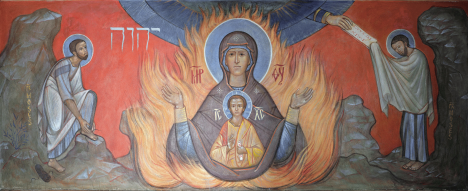
Mural by Seraphim O’Keefe for the Burning Bush Chapel of St. John of the Ladder in Greenville, South Carolina (https://orthodoxartsjournal.org/new-murals-at-st-john-of-the-ladder-greenville sc/). The Virgin Mary holds her hands in a prayer position that makes her like a chalice to receive Christ’s flesh and blood. Moses’ two encounters with God at Sinai, in which God revealed his name and his commands, frame the icon.
Exodus Overview 12
This icon reflects a centuries’ old tradition of associating the burning bush with Mary (e.g., Gregory of Nyssa). She, too, had the glory of God within her, but it did not consume her.
See Davis, Ellen F. (2001). Getting Involved with God: Rediscovering the Old Testament.
Cowley. 45-49.
The Call of Moses
“Moses! Moses!”
“Here I am.”
Moses’ response indicates his full availability and commitment to God (Cf. Abraham [Gen. 22:1, 11], Jacob [Gen. 31:11; 46:2], and Samuel [1 Sam. 3:4]).
The name of God
• God said to Moses, “I will be whoever I will be (ʾehyeh ʾăšer ʾehyeh).”
• And he said, “This is what you shall say to the Israelites, ‘I will be’ (ʾehyeh) has sent me to you.”
• And God spoke again to Moses, “This is what you shall say to the Israelites: ‘YHWH (yahweh), the God of your fathers, the God of Abraham, God of Isaac, and God of Jacob has sent me to you.’ This is my name in perpetuity, and this is how I am to be invoked from generation to generation.”
These three statements create anticipation by gradually unveiling the personal name of God. God will flesh out the meaning of his name by acting on their behalf (see Exod. 34:6-7).
See Surls, Austin (2017). "Making Sense of the Divine Name in the Book of Exodus: Etymology to Literary Onomastics." BBRSup, 17. Eisenbrauns.
Knowing YHWH’s Name: Three Possibilities
Why does Moses ask God’s name?
- No one knew YHWH’s name before this.
References to YHWH in Genesis could reflect a later perspective, but 4:1 presumes that the name will be “verifiable” (see also Gen. 4:26b).
- Moses did not know YHWH’s name.
Pharaoh’s daughter raised Moses, so this is possible.
- Moses is confirming the divine identity.
In a polytheistic context, Moses needed verification.
Moses’ Objections and YHWH’s Responses
| Who am I? (3:11) | I will be with you. |
|---|---|
| Who are you? (3:13) | I will be whoever I will be. |
| What if they don’t believe me? (4:1) | What is this in your hand? |
| I am clumsy-mouthed. (4:10) | I will be with your mouth. |
| Send someone else. (4:13) | What about Aaron, your brother? |
Exodus Overview 13
Session 6: Confronting the Firstborn (Exodus 4b) Exodus 4:18-31 is a tightly constructed literary unit with an important literary function.
Textual Unity
• Mention of the ḥtn, or relative by marriage (4:18 // 4:25-26)
• Commission of Moses // Aaron (4:19 // 18:27)
• Firstborn of YHWH // Pharaoh (4:22-23)
• Pharaoh // YHWH sought to kill Moses (4:19 // 24)
• YHWH would kill Pharaoh’s // Moses’ son (4:23-24)
• YHWH’s // Aaron’s encounter (שגפׁ (with Moses (4:24 // 4:27)
• Moses’ intention to see his brothers // Moses and Aaron’s arrival in Egypt (4:18 // 27-31)
Literary Function
• Conversation with Jethro (4:18 // 18:7) frames Israel’s deliverance story • Women deliver Moses (Exod. 1-2 // 4:24-26) frames Moses’ deliverance story Hebrew in) ׁשִ פְ רָ ה) “Shiphrah “like sounds) צִ ּפֹרָ ה) “Zipporah• “
• Circumcision anticipates Passover (4:24-26 // 12:8, 12-13)
• Both rituals protect from YHWH killing the firstborn
• In both rituals, blood is applied by “touching” (נגע ;Exod. 4:25; 12:13, 22-23)
“Once again it is a woman who, by her quick-wittedness and insight, saves Moses. [Zipporah] stands in the train of the midwives, Moses’ mother and sister, and the daughter of Pharaoh. Moses owes his very life to a series of actions by women, two of them non-Israelites. … Moses is thus revealed as one who does not himself stand without need of mediation with God.”
Fretheim, Terence (2010). Exodus: Interpretation: A Bible Commentary for
Teaching and Preaching. Westminster John Knox Press.
Exodus Overview 14
Theological Function
Moses’ near-death experience sounds like Jacob’s and like Balaam’s.
| Jacob (Gen. 32) | Moses (Exod. 4) | Balaam (Num. 22) |
|---|---|---|
• Left father-in-law • Journeyed to meet brother • With wives and sons • Encountered God • Where he spent the night • With an uncertain reception • Left with his staff • Spared by the angel • Who spoke to him • Left encounter injured • Met and kissed his brother | • Left father-in-law • Journeyed to meet brother • With wife and sons on donkey • Encountered God (angry) • Where he spent the night • With an uncertain reception • Took his staff • Saved by his wife who spoke to him • Left encounter injured and with bloodied “feet” • Met and kissed his brother | • Journeyed to the Israelites on a donkey • Encountered God (angry) • With an uncertain reception • Took his staff • Saved by his donkey who spoke to him • Left encounter injured with a crushed foot |
An Enigmatic Scene
Who is YHWH trying to kill—Moses or Gershom?
• Why would YHWH try to kill Moses right after commissioning him?
• Why is Moses entirely passive in this story?
• Why had Moses not already circumcised his son?
• Was Moses already circumcised?
• How did Zipporah know what to do?
• Whose “feet” does Zipporah touch with the foreskin? Her son’s? Moses’? YHWH’s?
• Is this a reference to actual feet or a euphemism for male genitalia?
• (cf. Deut. 28:57; Isa. 6:2; 7:20).
• Who drew back from whom after she performed the ritual?
• What does her statement mean?
Unlocking the Enigma
Zipporah’s statement: “you are a blood relative” (י ִל ה ָתּ ַא ים ִמ ָדּן־ ַת ֲח (uses the same root ḥtn that means “father-in-law” in 4:18. The basic meaning is kinship by marriage. Christopher Hays argues, “through this ritual, Zipporah claims her family’s relationship to the Divine Kinsman, YHWH” (Hays, 2017).
No matter who Zipporah circumcised, whose “feet” she touched, and to whom she spoke, her ritual action and statement resolved the uncertainty of their covenant status. YHWH announced his intention to kill the firstborn of Egypt; now Moses’ family is fully identified with the descendants of Abraham.
Exodus Overview 15
Circumcision
| What? | The incision or complete removal of the foreskin |
|---|---|
| Why? | The sign of God’s covenant with Abraham (Gen. 17:9-14) |
| When? | Other cultures practiced it at puberty or marriage; Israelites on the eighth day |
| Who? | Required for every male community member, even foreigners (Exod. 12:48) |
Circumcision was not practiced on the wilderness generation (see Josh. 5:5)! God’s people had failed to circumcise their sons on the way and died in the wilderness. Joshua rectified their oversight by acting as Zipporah had done, circumcising the “sons of Israel” with flint knives to ensure their covenant status.
Exodus Overview 16
Session 7: Let Them Go! (Exodus 5-7)
Signs
• Return to the mountain (3:12)
• Staff into snake (4:2-5)
• Diseased hand (4:6-8)
• Water to blood (4:9)
Pharaoh was often depicted with a shepherd’s staff and a snake headdress, representing a goddess of lower Egypt. Snakes were associated with royal authority.
Moses’ staff would confirm his authority to Pharaoh and initiate five plagues, part the Sea of Reeds, bring water from a rock, and decide the battle against Amalek.
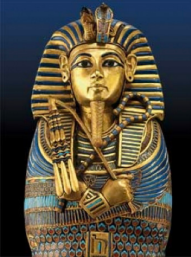
King Tutankhamun with rod/staff and flail/whip and snake headdress.
Exodus Overview 17
“With a mighty hand and an outstretched arm”
• Mighty hand (Exod. 6:1; 13:3, 9, 14,16; 14:31)
• Outstretched arm (Exod. 6:6; Deut. 4:34; 5:15; 7:19; 9:29; 11:2; 26:8; Jer. 32:21)
So the LORD brought us out of Egypt with a mighty hand and an
outstretched arm, with great terror and with signs and wonders.
Deuteronomy 26:8 NIV
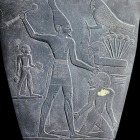
Narmer Palette, detail (2 ft. tall). Pharaoh Narmer, followed by his sandal bearer, smiting the head of a foe. The “mace-pose” was standard for over 3,000 years in Egypt. See https://www. khanacademy.org/humanities/ap-art-history/ancient-mediterranean-ap/ancient-egypt-ap/a/ palette-of-king-narmer.
Purpose of Release
“YHWH, the God of Israel, says this: ‘Send away my people,
that they may celebrate a festival in my honor in the wilderness.’”
Exodus 5:1
This is the first prophetic announcement in the Bible: “Thus says YHWH” Cf. 7:16; 8:1
Purpose of Confrontation
But Pharaoh said, “Who is YHWH that I should
listen to his voice by sending Israel away?
I do not know YHWH, and furthermore I will not
send Israel away.” “Let my people go!”
Exodus 5:2
Exodus Overview 18
Two main ways of expressing this: שלחׁ”) send away”; piel) and הלך”) let go”; hiphil)
Purpose of Confrontation
• Blood: “By this you will know that I am YHWH” (7:17)
• Frogs: “So that you may know there is no one like YHWH” (8:10)
• Flies: “So that you will know that I, YHWH, am in this land” (8:22)
• Hail: “So you may know that there is no one like me in all the earth” (9:14) • Hail: “So you may know that the earth is YHWH’s” (9:29)
• Locusts: “That you may know that I am YHWH” (10:1-2)
• Firstborn: “You will know that YHWH makes a distinction between Egypt and Israel” (11:7)
Exodus Overview 19
Session 8: Signs and Wonders (Exodus 7-11)
Literary Patterning in the Plague Narrative
Chart from Kenneth Kitchen, On the Reliability of the Old Testament, 253.
| Plague # | Forewarning | Timing | Command Where |
|---|---|---|---|
| 1 | Yes | “In morning” | Station self |
| 2 | Yes | None | Go to Pharaoh |
| 3 | None | None | None |
| 4 | Yes | “In morning” | Station self |
| 5 | Yes | None | Go to Pharaoh |
| 6 | None | None | None |
| 7 | Yes | “In morning” | Station self |
| 8 | Yes | None | Go to Pharaoh |
| 9 | None | None | None |
| 10 | Yes | None | None |
The suggestion that each plague confronts a particular Egyptian god is an argument from silence. Many of the connections are quite weak. However, the plagues were clearly an affront to the order of Egyptian society and worship, especially to the very important concept of ma’at or order/ balance/harmony that governed Egyptian society. Ma’at is the ancient Egyptian concept of truth, balance, order, harmony, law, morality, and justice.
The suggestion that the plagues were naturally occurring phenomena related to each other in a chain reaction is intriguing, but cannot account for all the plagues. Furthermore, it does not acknowledge the text’s claim that each plague miraculously started and stopped at Moses’ command.
Plagues as Un-Creation
• Chaos in place of order
• Loss of dominion over creatures
• Boundaries erased between domains
• Creation no longer “good”
Exodus Overview 20
Plagues as “Signs” of Judgment to Come
Terence E. Fretheim identifies links between the plagues and the sea crossing in which the plagues “point beyond themselves toward a disastrous future” (“The Plagues as Ecological Signs of Historical Disaster,” What Kind of God?, 226).
• Moses’ staff “swallows” Egyptians’ staffs // Egyptians “swallowed” by the sea (15:12) • Water of the Nile turns to blood // Egyptian armies killed in the sea
• Frogs “covered” the land // the sea “covered” the Egyptians
• Dead frogs piled up // dead Egyptians piled up (14:30)
• Not one fly remained (8:27) // not one Egyptian remained (14:28)
• Locusts driven into the sea // Egyptians driven into the sea
The Plagues as “Signs” of Deliverance
Fretheim also notes that the narrator tells the story in such a way that we are invited to compare YHWH’s treatment of the Egyptians and the Israelites (“The Plagues as Ecological Signs of Historical Disaster,” What Kind of God?, 234).
• “They could not drink the water” (7:24 vs. 15:23)
• “raining” hail vs. “raining” bread (9:18 vs. 16:4)
• “came up and covered the land” (10:14-15 vs. 16:13)
The Plagues as a Warning
58 If you do not carefully follow all the words of this law, which are written in this
book, and do not revere this glorious and awesome name—the LORD your God—
59 the LORD will send fearful plagues on you and your descendants, harsh and
prolonged disasters, and severe and lingering illnesses. 60 He will bring on you all
the diseases of Egypt that you dreaded, and they will cling to you.
Deuteronomy 28:58-60
Exodus Overview 21
Session 9: Hard Heart (Exodus 7-11)
Pharaoh’s “Heart”: Two Views
| Heavy Heart = Guilty | Hard Heart = Resolute |
|---|---|
| YHWH co-opts an Egyptian concept expressed in the Book of the Dead where the gods weigh a dead person’s heart on a balance against a feather. A heart heavier than the feather is guilty of injustice. YHWH finds Pharaoh guilty by his own standards. | As in Hebrew, the Egyptian concept of a “hard heart” is not cruel but resolute. YHWH inverts the positive Egyptian concept of “stoutheartedness” and shows that Pharaoh’s ideals are contrary to YHWH’s. Pharaoh fails to define good and evil on YHWH’s terms. |
Egyptian background for “heavy heart” from the Book of the Dead
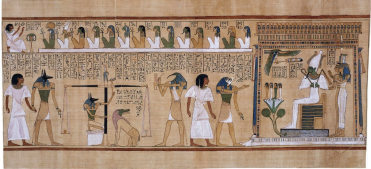
Photo: Public Domain (https://commons.wikimedia.org/w/index.php?curid=17527324).
“Judgment scene from the Book of the Dead. In the three scenes from the Book of the Dead (version from 1275 B.C.E.) the dead man (Hunefer) is taken into the judgment hall by the jackal headed Anubis. The next scene is the weighing of his heart, with Ammut awaiting the result and Thoth recording. Next, the triumphant Hunefer, having passed the test, is presented by the falcon headed Horus to Osiris, seated in his shrine with Isis and Nephthys” (British Museum).
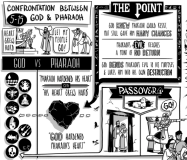
Who Is Doing What Kind of Hardening?
Exodus Overview 22
| שהׁק) qšh) ≈ hard | חזק) ḥzq) ≈ strong | כבד) kbd) ≈ heavy | |
|---|---|---|---|
| Commission | 4:21 Y > P (future) | ||
Second Commission | 7:3 Y > P (future) | ||
| Staff > Snake | 7:13 P (qal) | ||
| Nile > Blood | 7:22 P (qal); ‘he would not listen’ | 7:14 P (state; adj); ‘he refuses’ | |
| Frogs | 8:15[11] P > P | ||
| Gnats | 8:19[15] P (qal); ‘he would not listen’ | ||
| Flies | 8:32[28] P > P | ||
| Cattle | 9:7 P (state; qal); ‘he did not send away the people’ | ||
| Boils | 9:12 Y > P | ||
| Hail | 9:35 P (qal) | 9:34 P&S > P&S | |
| Locusts | 10:20 Y > P | 10:1 Y > P&S | |
| Darkness | 10:27 Y > P | ||
Death of Firstborn | 11:10 Y > P | ||
13:15 when P > P (summary) | |||
| Sea of Reeds | 14:4 Y > P (future) | ||
| Sea of Reeds | 14:8 Y > P | ||
| Sea of Reeds | 14:17 Y > E (future) |
Things To Note About Pharaoh’s Heart
• Generally speaking, causation shifts from Pharaoh to YHWH. (Exception: Hail falls in the second group of five, but Pharaoh and his servants make their hearts heavy.)
• Pharaoh never makes his own heart “strong” (= resolute), always “heavy” (= guilty).
• YHWH only makes Pharaoh’s heart “heavy” (= guilty) once. YHWH almost always makes it “strong” (= resolute).
• YHWH and Pharaoh each make his heart “hard” once.
Exodus Overview 23
Pharaoh’s Heart in the Literary Design of Exodus
| 1 | 4 | 7 |
|---|---|---|
חזק כבד | כבד | חזק כבד |
| 2 | 5 | 8 |
| חזק כבד כבד | כבד | |
| 3 | 6 | 9/10 |
| חזק חזק חזק | חזק |
Pharaoh’s Heart in the Literary Design of Exodus
• Pharaoh imposes “heavy” labor and ends up “heavy hearted.”
• Moses “strengthens” the snake, while YHWH “strengthens” Pharaoh (4:4, 21).
• YHWH sends “heavy” swarms of flies, plague, hail, and locusts in response to Pharaoh’s “heavy heart” in those episodes (lex talionis).
• Even in passages where causation of the heavy/strong heart is not explicit, the context makes clear that Pharaoh is at fault (7:14; 9:7; 7:22; 8:19[15]). The heavy heart goes with inaction, while the strong heart goes with refusal to listen.
• YHWH’s “strong arm” overcomes Pharaoh’s “strong heart” (6:1; 13:3, 9, 14, 16; 14:31). • YHWH’s “glory” (heaviness) outweighs Pharaoh’s “heavy heart” (14:4, 17, 18). • Key takeaway: the punishment fits the crime.
Does Pharaoh Lose Free Will?
“Exodus gives no sign that Pharaoh longed to submit to Yahweh as his sovereign
and was prevented from doing so; he received numerous rebukes, explanations,
and commands that imply opportunity to submit.”
Coover-Cox, Dorian (2006). “The Hardening of Pharaoh’s Heart in Its
Literary and Cultural Contexts.” Bibliotheca Sacra. 163.
Exodus Overview 24
Session 10: Passover Ritual (Exodus 12-13)
The Literary Function of the Passover
Why interrupt an epic narrative with ritual? Performative ritual allows every generation of Israelites to participate in this foundational event, making it part of their own story.
“The historical event is at one and the same time a liturgical event.”
Fretheim, Terence E. (2010). Exodus: Interpretation:
A Bible Commentary for Teaching and Preaching.
Westminster John Knox Press.
Passover
This event initiates a new calendar (Exod. 12:2). It is a new creation event, fulfilling God’s promise to Abraham in Genesis 15:13-16.
What is the Passover? Has the word “passover” been mistranslated? According to the Dictionary of Classical Hebrew, the verb פסח) pesach) can mean:
- Pass over, spare (?)
- Limp, leap
- Protect (?)
The third meaning seems most appropriate in these contexts.
• Exodus 12:23: "And YHWH will pass through [unrelated word] to strike the Egyptians and will see the blood upon the lintel and the two door posts and YHWH will פסח the doorway and will not allow the destroyer to enter your house to strike you."
• Isaiah 31:5: "Like swooping birds, thus will YHWH of hosts protect Jerusalem; he will protect and deliver,פסח and rescue."
Who can participate in the Passover? God gives restrictions in Exodus 12:43-49 along covenant lines, not based on ethnicity. Circumcision is the approved sign of covenant membership.
The Firstborn Belong to YHWH
YHWH’s claim on the firstborn of Egypt extends to the Israelites as well. Every firstborn belongs to him and must be sacrificed (in the case of animals) or redeemed (in the case of children) for 5 shekels (Num. 18:15).
Wilda Gafney argues that this law includes daughters as well as sons. Although verses 12 and 15 specify only male animals are to be sacrificed or redeemed, the language for humans is arguably generic (bekhor, adam, beney Israel). See Gafney, Wilda C. (2017). Womanist Midrash: A Reintroduction to the Women of the Torah and the Throne. Westminster John Knox Press.
Exodus Overview 25
Exodus and Liberation Theology
Exodus has been a major source of inspiration for liberation theologies of Latin America and the American South. When we read the Bible with the oppressed, we notice two things. 1) “Salvation” is not primarily spiritual or other-worldly, but sets the oppressed free from those who abuse earthly power. 2) Humans are invited to participate in the task of liberation here and now.
A few more key things to notice:
• Exodus does not liberate for the sake of freedom, but for worship of YHWH. The people go from serving Pharaoh to serving YHWH.
• The family of Abraham is the specific target of YHWH’s deliverance.
• The liberation of the Hebrews becomes the basis for the call to treat others well in biblical law.
Exodus Overview 26
Session 11: Sea Crossing (Exodus 13b-14)
What Body of Water Did the Israelites Cross?
• Hebrew: yam suph = Sea of Reeds
• Greek translation: eruthran thalassan = Red Sea
• Both “gulfs,” the Gulf of Suez and the Gulf of Aqaba, were yam suph.
• Some scholars think it became the Red Sea because each of the cardinal directions (North, South, East, and West) was associated with a color. (Black Sea is north, Red Sea is south, etc.)
• First mention of the Sea of Reeds: Exodus 10:19; 13:18; 15:4; 15:22; 23:31. (e.g. 1 Kgs. 9:26 shows that Ezion Geber is on the shore of yam suph too).
“A theory favored by some modern scholars is that the name red
is referring to the direction south, just as the Black Sea’s name
may refer to north. The basis of this theory is that some Asiatic
languages used color words to refer to the cardinal directions.”
Wikipedia (https://en.wikipedia.org/wiki/Red_Sea).
Sea of Reeds in the Literary Design of Exodus
The Hebrew name Sea of Reeds forges an important connection with the deliverance story of the infant Moses, whose mother placed him among the “reeds” in the Nile, and whose name means “one who draws out.”
Just as Moses passed through the reeds to escape death by Pharaoh’s hand, so the Israelites passed through the Sea of Reeds to escape death by Pharaoh’s hand.
Exodus Overview 27
How Many Hebrews Left Egypt?
English translations say “600,000 men” plus families (Exod. 12:37).
• Why question this?
• That would likely mean over 2 million Israelites total.
• Archaeology doesn’t support it, either in Egypt or in Canaan, at that time. • How could 12 brothers become 600,000 men in four generations? (Exod. 6:14-25)
• Other logistical problems include the size of the camp and the length of time needed to cross the Sea of Reeds.
• What are our options?
• Archaeologists are wrong.
• The numbers are rhetorical or symbolic.
• The numbers were multiplied by 10 for rhetorical reasons (Ronald Allen, “Exodus,” REBC, 65-69). This accounts for round numbers and fits with the exact number of firstborns in relation to the Levites.
• The numbers represent the population during a later period (Terence
Fretheim, Exodus: Interpretation, 144). This is a way of affirming that later
Israelites were participants in the exodus event.
• The phrase is mistranslated and should read “600 military units” plus families.
Translating Exodus 12:37
Hebrew does not use numerals but instead spells out numbers in full.
“children without men ,foot on) ʾeleph (אֶ לֶ ף hundred Six = “ּכְ ׁשֵ ׁש־מֵ אֹות אֶ לֶ ף
The word ʾeleph has four possible meanings in a Hebrew lexicon.
- Thousand
- Head of cattle
- Military unit
- Clan (tribal unit smaller than a tribe)
• Judges 6:15: “But sir, how can I deliver Israel? My ף ֶל ֶא is the weakest in Manasseh, and I am the least in my family.”
• Joshua 22:14: “And with him ten chiefs, one from each of the tribal families of Israel, every one of them the head of a family among the ף ֶל ֶא of Israel.”
Exodus Overview 28
Session 12: Prophetic Song (Exodus 15)
The Literary Function of the Song of the Sea
Like liturgy, songs make history memorable. The people are not jubilant about their escape until a body of water stands between them and slavery, and until their oppressors are brought to justice. Freedom is not enough on its own. As long as the possibility of re-enslavement remains, freedom is incomplete. The Song of the Sea celebrates justice.
The Torah’s poetry often conveys the heart of its theology.
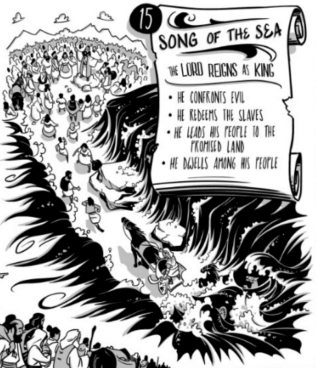
The Themes of the Song of the Sea
| Victory | YHWH struck the gods of Egypt (15:1-12; cf. Exod. 12:12-13). “Who among the gods is like you, LORD? Who is like you–majestic in holiness, awesome in glory, working wonders?” (Exod. 15:11) “He turns to stubble the army that demanded stubble.” (15:7; cf. 5:12) |
|---|---|
| Renown | YHWH’s deliverance established his reputation among the nations (15:14-16). Philistia, Edom, Moab, and Canaan tremble. |
| Creation | YHWH’s deliverance creates Israel as a new nation and dismantles Egypt. The “deeps” cover the Egyptian army (15:5; cf. Gen. 1:2). The Israelites walk through on “dry ground” (15:19; cf. Gen. 1:9-10). |
| Rest | YHWH’s deliverance would culminate in proximity to his presence in the land. YHWH will “bring them in and plant them on the mountain of your inheritance” (15:17). |
The Literary Function of Miriam the Prophet
• Miriam witnessed Moses’ rescue from death in the River of Reeds (2:4).
• Though only a child, Miriam brought women together to
participate in redemption (2:7-8).
• Miriam witnessed Israel’s rescue from death in the Sea of Reeds.
• Now a grown woman, Miriam brings together the women to
celebrate redemption (15:20-21).
Miriam’s participation links these two redemption stories and reminds us of how many times God used women to accomplish his purposes. Shiphrah, Puah, the daughter of Levi, the daughter of Pharaoh, the maidservants, Zipporah, the women who plundered Egypt, and now the women who celebrate what God accomplished.
Her song echoes the theme of the plague narratives—that you may know that I am YHWH—by announcing its fulfillment—sing to YHWH for he is highly exalted. As a previous Pharaoh had mandated that the Israelites hurl their sons into the River, now YHWH hurls Pharaoh’s warriors into the Sea.
Exodus Overview 29
Exodus Overview 30
Session 13: Liminal Space (Exodus 16-17)

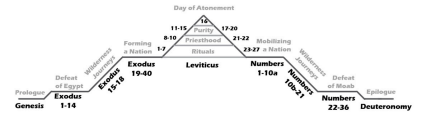
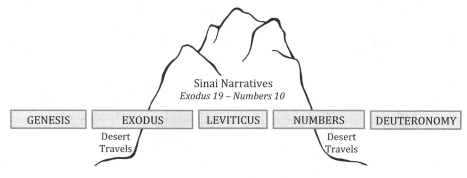 Imes, Carmen Joy (2019). Bearing God’s Name: Why Sinai Still Matters. IVP Academic. 14.
Exodus Overview 31
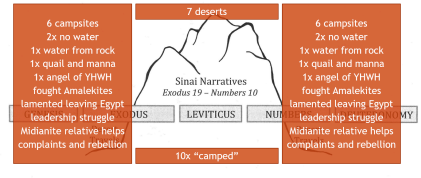
Chiasm in the Wilderness Journeys
Exodus 5-15: YHWH’s showdown with Pharaoh, king of Egypt
Exodus 14:19-20: Angel of YHWH protects Israel from Egypt’s army
Exodus 15: Song of victory over Pharaoh, king of Egypt
Exodus 15:22-25 :Springs of water provided
Exodus 16:1-17:6: Food?!; Sabbath; opposing Moses; water from rock
Exodus 17:8-16: Joshua wins battle with Amalekites
Exodus 18:1-6: Moses’ family (conflict?)
Exodus 18:13-18: Moses’ leadership burden
Exodus 18:19-27: Assisted by Midianite kin (Jethro)
Exodus 19:1-2: Arrival at Sinai
SINAI NARRATIVES (Exodus 19-Numbers 10)
Numbers 10:11-13: Departure from Sinai
Numbers 10:29-32: Assisted by Midianite kin (Hobab) Numbers 11: Moses’ leadership burden
Numbers 12: Moses’ family (conflict)
Numbers 13-14: Joshua and Caleb; battle with Amalekites/Canaanites lost Numbers 15:32-21:9: Sabbath; opposing Moses/Aaron; water from rock; food?! Numbers 21:16-18a: Springs of water provided
Numbers 21:18b-35: Song of victory over Sihon, king of Ammon
Numbers 22:21-35: Angel of YHWH protects Israel from Moab’s curses
Numbers 23-24: YHWH’s showdown with Balak, king of Moab
Boxall, Ian; Gregory, Bradley C. (2022). The New Cambridge Companion to Biblical Interpretation. Cambridge University Press.
Key Themes of the Wilderness Narratives
The people’s ingratitude and rebellion meets …
God’s gracious provision in cycles of work and rest …
Which results in a contrast between serving YHWH and serving Pharaoh.
(dabar yom b’yomo in 16:4 and 5:13, 19)
Exodus Overview 32
Session 14: Burden of Leadership (Exodus 18)
Exodus 18 in the Literary Design of Exodus
Exodus 4:18-31 and Exodus 18 frame Israel’s deliverance story.
• Moses speaks with Jethro (4:18; 18:5-12).
• Jethro offers a blessing of peace (4:18; 18:7).
• Zipporah traveled with Moses’ sons (4:20; 18:6).
• The noun ḥōtēn, which can mean father-in-law or other male in-law (4:18; 18:1, 7-8, 24, 27); Zipporah also uses the related noun ḥātan (4: 25-26) which refers more broadly to a relative by marriage.
• Aaron greets Moses with a kiss at the mountain of God (4:27); Moses greets Jethro with a kiss near the mountain of God (18:5-7).
• Aaron and the “elders of Israel” (4:29; 18:12).
Note the vague location in Exodus 18:5, reserving “Sinai” for later so that this incident can participate in wilderness framing of the Sinai narratives.
Jethro’s Testimony
“Praise be to the LORD, who rescued you from the hand of the
Egyptians and of Pharaoh, and who rescued the people from the hand
of the Egyptians. Now I know that the LORD is greater than all other
gods, for he did this to those who had treated Israel arrogantly.”
Exodus 18:10-11 NIV
Jethro’s testimony affirms the literary structure of the book: rescue of Moses + rescue of Israel = the nations know YHWH is greater than all gods.
Exodus 18 in the Literary Design of the Torah
Exodus 18 and Numbers 10-11 frame the Sinai narratives.
• Moses receives advice from a Midianite family member (Exod. 18:17-23 // Num. 10:29).
• Moses struggles under the burden of leadership (Exod. 18:13-16 // Num. 11:10-17).
• Moses appoints elders to share the burden (Exod. 18:24-26 // Num. 11:24-25).
Moses’ complaint in Numbers 11 echoes Jethro’s words from Exodus 18.
| Exodus 18:18b | Numbers 11:14 |
|---|---|
כי־כבד ממך הדבר לא־תוכל עשֹהו לבדך׃ | לא־אוכל אנכי לבדי לׂשאת את־כל־העם הזה כי כבד ממני |
| For this thing is too heavy for you You are unable to do it alone | I myself am unable alone To carry all this people For it is too heavy for me |
Exodus Overview 33
Session 15: Commissioning the Nation (Exodus 19)
Key Terms for the Sinai Narratives
• Theophany: visible manifestation of God’s presence
• Covenant: formal, permanent agreement between two parties
• Decalogue: Ten Commandments
• Stipulations: requirements of the covenant to which both parties agree
• Ratification: official ritual by which a covenant takes effect
• Tabernacle: authorized place of God’s holy presence (tent)
• Priesthood: official tabernacle service by authorized men from Levi
• Ordination: official ritual in which someone becomes a priest
• Consecrate: set apart, make holy
• Cult: entire system of worship (tabernacle, priests, sacrifices)
“You yourselves have seen what I did to Egypt, and how I carried you on
eagles’ wings and brought you to myself. Now if you obey me fully and keep
my covenant, then out of all nations you will be my treasured possession.
Although the whole earth is mine, you will be for me a kingdom of priests
and a holy nation." These are the words you are to speak to the Israelites.
Exodus 19:4-6
What Does It Mean To Be God’s Treasured Possession?
Hebrew: segullah
• Concrete uses: personal treasury of a king (1 Chron. 29:3 and Ecc. 2:8)
• Metaphorical uses: covenant partner with special responsibility to represent the sovereign (Exod. 19:5; Deut. 7:6; 14:2; 26:18; Ps. 135:4; Mal. 3:17)
• Cf. Ugaritic (sgl) and Akkadian (sikiltu) also use the word in these two ways.
Exodus Overview 34
Who Is YHWH’s Treasured Possession?
Usually, Israel is the treasured possession because of the Sinai covenant (Exod. 19:5; Deut. 7:6; 14:2; 26:18; Ps. 135:4).
But Malachi 3:17 envisions a future day in which YHWH will select a new segullah. That new acquisition prompted Greek translators to choose a slightly different phrase.
περιούσιος 》 περιποίησις
But you are a chosen people, a royal priesthood, a holy
nation, God’s special possession (περιποίησις), that you may
declare the praises of him who called you out of darkness
into his wonderful light. Once you were not a people, but
now you are the people of God; once you had not received
mercy, but now you have received mercy.
1 Peter 2:9-10
Peter applies covenant titles from Sinai to a mixed audience of Jews and Gentiles. He sees the Church as the fulfillment of Malachi 3:17—God’s acquisition of a new segullah.
Exodus Overview 35
Session 16: Law as Mission (Exodus 20)
How Should We Read the Decalogue?
• Literary Context
• Historical Context
Literary Context of the Decalogue
What has happened in the story so far, leading up to Sinai? Note: The law is not Israel’s means of salvation!
Historical Context: How Did the Israelites Feel About the “Law”?
5 See, I have taught you decrees and laws as the LORD my God
commanded me, so that you may follow them in the land you are
entering to take possession of it. 6 Observe them carefully, for this will
show your wisdom and understanding to the nations, who will hear
about all these decrees and say, “Surely this great nation is a wise and
understanding people.” 7 What other nation is so great as to have their
gods near them the way the LORD our God is near us whenever we pray
to him? 8 And what other nation is so great as to have such righteous
decrees and laws as this body of laws I am setting before you today?
Deuteronomy 4:5-8
Cf. Exodus 19:8; 24:3, 7
Historical Context: How Many Stone Tablets Were There?
• “When he finished speaking with him on Mount Sinai, he gave to Moses the _two tablets _of the [covenant] document (ותּד ֵע(, tablets of stone, inscribed by the finger of God.” (Exod. 31:18)
• “And Moses turned and he went down from the mountain, and the _two tablets o_f the [covenant] document (ותּד ֵע] (were] in his hand, tablets inscribed on both sides, inscribed on front and back.” (Exod. 32:15)
• “And he took and he set the [covenant] document (ותּד ֵע (into the ark …” (Exod. 40:20)
Historical Context: What Is the Significance of Having Two Tablets? Excerpt from the treaty between Suppiluliuma and Shattiwaza:
“A duplicate of this tablet has been deposited before the sun-goddess
of Arinna, because the sun-goddess of Arinna regulates kingship and
queenship. In Mitanni land [a duplicate] has been deposited before
Teshub, the lord of the [sanctuary] of Kahat. At regular [intervals] shall
they read it in the presence of the king of the Mitanni land and in the
presence of the sons of the Hurri country.”
Kitchen, Kenneth A; Lawrence, Paul J. N. (2012). Treaty, Law
and Covenant in the Ancient Near East. Harrassowitz.
Exodus Overview 36
Session 17: No Other Gods (Exodus 20a)
The Importance of Exodus 20:2
I am YHWH, your God, who brought you out from the land
of Egypt from the house of slaves.
Exodus 20:2
The Implied Cosmology of Exodus 20:4
Three-tiered universe with domains and residents
Do not make for yourself a statue of any figure
that is in the heavens above or that is on the earth
beneath, or that is in the waters under the earth.
Exodus 20:4
The Textual Unity of Exodus 20:2-6
I am YHWH, your God, who brought you out from the land of Egypt, from the
house of slaves. Do not have (for yourself) other gods before me. Do not make for
yourself a statue of any figure that is in the heavens above or that is on the earth
beneath, or that is in the waters under the earth. Do not bow down to them and do
not serve them because I am YHWH your God, El Qanna (Impassioned God), who
attends to (the) iniquities of the fathers upon the children even upon the third and
upon the fourth (generation) of those hating me, and acts in covenant faithfulness
to thousands who love me and obey my commands.
Exodus 20:2-6
How many commands are in this passage?
• A (motive): I am Yahweh your God (verse 2)
• B (prohibition): You are not to have any other gods (verse 3)
• C (prohibition): You are not to make a carved-image (verse 4)
• B (prohibition): You are not to bow down to or serve them (verse 5a
• A (motive): I am Yahweh your God (verse 5b-6)
Adapted from Greenstein, Edward (2011). “Rhetoric of the Ten Commandments.” The Decalogue in Jewish and Christian Tradition. T & T Clark.
The Point of the First Command
Exclusive loyalty to YHWH means that the people will serve only YHWH.
The Consequences of Idolatry
In the BibleProject video on the image of God, Tim says that the temple doesn’t have an image or idol of God in it because God has already made humans as his image. When we show allegiance to anything other than God, we not only rob God of the praise he deserves, we also diminish ourselves as those made to represent God.
Exodus Overview 37
Session 18: Bearing His Name (Exodus 20b)
You shall not lift up / carry the name of Yahweh, your God, in vain, for
Yahweh will not acquit one who lifts up / carries his name in vain.
ל ֹא תִ ּׂשָ א אֶ ת־ׁשֵ ם־יְהוָ ה אֱ ֹלהֶ יָך לַ ּׁשָ וְ א ּכִ י ל ֹא יְנַּקֶ ה יְהוָ ה אֵ ת אֲ ׁשֶ ר־יִּׂשָ א אֶ ת־ׁשְ מֹו לַ ּׁשָ וְ א
History of Interpretation of the Name Command
Most translators assume it is “elliptical.”
“You shall not lift up [. . .] the name of Yahweh [. . .] in vain”
= You shall not lift up [your hand] to the name
i.e. swear an oath
= You shall not lift up the name [on your lips]
i.e. use lightly, say, or call upon
What if the name command is not elliptical?
Historical Context of the Name Command
Official Seals Stone Inscriptions Human Branding
Inscription of a god’s name implied ownership, sovereignty, and an obligation to protect whatever was inscribed. The god's reputation was then bound up with the fate of what he or she owned.
Literary Context of the Name Command
• Covenant / election: the vassal is a “treasured possession” (segullah) of the sovereign and represents him through loyal service.
• High priest as representative: The high priest “carries” the “names” of the Israelite tribes as their representative and wears YHWH's name on his forehead.
The High Priest “Bears Names”
So Aaron shall bear the names of the sons of Israel in the breastpiece of judgment on his heart when he goes into the holy place, for a continual remembrance before Yahweh.
Exodus 28:29
You shall make a medallion of pure gold, and engrave on it, like the engraving of a signet, “Holy, belonging to Yahweh.” You shall fasten it on the turban with a blue cord; it shall be on the front of the turban.
Exodus 28:36-37
Exodus Overview 38
קדש ליהוה
Israel Bears YHWH’s Name
And YHWH has had you declare yourselves this day to be his
treasured people, just as he said to you, so you shall keep his
commands, and he shall set you high over all the nations that
he has made, for praise, for fame, and for honor, and to be a
people holy, belonging to YHWH your God, just as he said.
Deuteronomy 26:18-19
Theological Context of the Name Command
Israel bears YHWH's name and thereby represents YHWH among the nations.
The point of the second command is the proper representation of YHWH by his people (e.g., “He leads me in paths of righteousness for his name’s sake”) (Ps. 23:3).
The Covenant Formula
“I will take you as my own people, and I will be your God.” (Exod. 6:7 NIV)
• Command #1: Worship no other gods
• Command #2: Don’t misrepresent YHWH
See also Leviticus 26:12; Jeremiah 7:23; 11:4; 30:22; Ezekiel 36:28.
Exodus Overview 39
Session 19: Resting in God’s Provision (Exodus 20c)
The Sabbath Command
8 Remember the Sabbath day by keeping it holy. 9 Six days you shall labor
and do all your work, 10 but the seventh day is a sabbath to the LORD your
God. On it you shall not do any work, neither you, nor your son or daughter,
nor your male or female servant, nor your animals, nor any foreigner
residing in your towns. 11 For in six days the LORD made the heavens and
the earth, the sea, and all that is in them, but he rested on the seventh day.
Therefore the LORD blessed the Sabbath day and made it holy.
Exodus 20:8-11
What is the Sabbath for?
• A day of rest
• Stopping
Who is the Sabbath for?
• Everyone in the community
• Rich or poor
• Native born or foreigner
• Male or female
• Human or animal
• Everyone gets a rest
Why should we keep the Sabbath?
• God set this pattern at creation when he finished his work and rested.
• Note: Deuteronomy 5 offers a different rationale.
A Tale of Two Sabbaths
| Exodus 20:8-11 | Deuteronomy 5:12-15 |
|---|---|
8 Remember the Sabbath day by keeping it holy. 9 Six days you shall labor and do all your work, 10 but the seventh day is a sabbath to the LORD your God. On it you shall not do any work, neither you, nor your son or daughter, nor your male or female servant, nor your animals, nor any foreigner residing in your towns. 11 For in six days the LORD made the heavens and the earth, the sea, and all that is in them, but he rested on the seventh day. Therefore the LORD blessed the Sabbath day and made it holy. | 12 Observe the Sabbath day by keeping it holy, as the LORD your God has commanded you. 13 Six days you shall labor and do all your work,14 but the seventh day is a sabbath to the LORD your God. On it you shall not do any work, neither you, nor your son or daughter, nor your male or female servant, nor your ox, your donkey or any of your animals, nor any foreigner residing in your towns, so that your male and female servants may rest, as you do. 15 Remember that you were slaves in Egypt and that the LORD your God brought you out of there with a mighty hand and an outstretched arm. Therefore the LORD your God has commanded you to observe the Sabbath day. |
Exodus Overview 40
Session 20: “Slavery” Laws (Exodus 21-23a)
Objecting to the Old Testament
“Slavery was bad for [the Israelites] to experience
but acceptable for them to initiate and practice.”
Kirk-Duggan, Cheryl. (2016). “Let My
People Go.” Voices From the Margin (edited
by R.S. Sugirtharajah). Orbis Books.
Exodus 21:2-6: The Case of the Male ʿEbed
2 If you hire a Hebrew ʿebed, six years he shall serve but in the seventh he may
leave freely at no cost. 3 If he came alone, he shall leave alone. If he possessed
a wife, his wife may leave with him. 4 If his master gave him a wife and she bore
him sons or daughters, the woman and her offspring will belong to her master,
and he must leave alone. 5 But if the servant insists, “I love my master, my wife,
and my children. I will not go free!” 6 then his master shall bring him to God and he shall bring him to the door or to the doorframe so his master may pierce his
ear with an awl and he shall serve him permanently.
Exodus 21:2-6
Aspects of an ʿebed:
• Voluntary hired worker
• Limited term of service
• Free to leave and to marry
• Voluntary permanent service
The goal of these laws was to protect the vulnerable from exploitation by the powerful. Exodus 21:7-11: The Case of the Female ʾAmah
But if a man sells his daughter as an ʾamah, she shall not leave as the male servants leave. If she is troublesome in the eyes of her master who has claimed her for
himself, then he must let her be ransomed. He is not allowed to sell her to foreign people because he broke the agreement with her. But if he has claimed her for his son, he must treat her in accordance with daughters’ rights. If he takes another
[wife] for himself, he may not reduce her food, clothing, or marital rights. But if he does not give her these three, then she may leave without paying any money.
Exodus 21:7-11
Aspects of an ʾamah:
• Marries into the household
• Fathers always arranged marriages for their daughters
• “Bride price” is expected for the bride’s family
The goal of these laws is to guard against sexual exploitation.
Exodus Overview 41
Literary Structure of the Book of the Covenant
• A: 20:23-26 — Worship regulations
• B: 21:2-11 — Sabbath patterns for servitude
• C: 21:12-23:9 — Neighbor laws (injuries, property, justice)
• B’: 23:10-12 — Sabbath patterns for land and work
• A’: 23:13-19 — Worship regulations
Adapted from Morrow, William (2017). An Introduction to Biblical Law. William B. Eerdmans. The point: These laws are oriented toward freedom / Sabbath rather than slavery.
Attention to Genre and Context
Genre: Casuistic laws (“if … then …”) regulate non-ideal situations.
Context:
• YHWH brought them out of servitude (20:2)
• Servants and foreigners get a Sabbath rest (20:10)
• Kidnapping strictly prohibited (21:16)
• Death penalty for killing a servant (21:20-21)
• Release for permanently injured servants (21:26-27)
• Accidental death of servant is taken seriously (21:32)
• Mistreatment of foreigners prohibited (22:21)
• Taking advantage of vulnerable prohibited (22:22)
• No interest on loans to the needy (22:25)
• No denying justice to the poor (23:6)
• Unplowed (Sabbath) fields support the poor (23:10)
Exodus Overview 42
Exodus 21:20-21: The Case of the Injured Servant
If a man strikes his ʿebed or his ʾamah with a rod, and he dies under
his hand, he shall surely be avenged. However, if (after) a day or two
days he stands up, he shall not be avenged, for it/he is his silver.
Exodus 21:20-21
Note:
• Death is the penalty for killing a servant.
• Verses 18-19 are concerned with the loss of labor. The aggressor must pay the injured person for loss of work time. In the case of a hired servant, the master bears the loss of labor himself, since he is responsible for the injury. He cannot add to the debt of the servant.
• “It” refers to the fee, not the servant (Hoffner).
• There is no need to enact “eye for an eye” because the master has already borne the loss of his servant’s labor as he recovered.
A Wider Vision on Old Testament Law
“The Old Testament and later the New Testament create an imaginative world in which slavery becomes more and more untenable.”
McCaulley, Esau. (2020). Reading While Black: African American Biblical Interpretation as an Exercise in Hope. IVP Academic. 142.
“[The biblical slavery laws were] calculated to make readers uneasy about the ethics of slave-owning. These laws represent an early strategy for raising readers’ conscience about the institution of slavery and (implicitly) calling it into question. Overall, their tactics reflect an ethic of concern for the vulnerable.”
Morrow, William. (2017). An Introduction to Biblical Law. William B. Eerdmans. 98.
Exodus Overview 43
Session 21: Defining the “Conquest” (Exodus 23b)
What does YHWH’s messenger provide for the Israelites?
• Protection on their journey (v. 20)
• Guidance to the promised land (v. 20, 23)
• Ongoing instruction (v. 22)
• Leadership in battle (v. 23)
What will YHWH do for the people?
• Oppose Israel’s enemies (v. 22)
• Wipe out Israel’s enemies (v. 23)
• Throw nations into confusion (v. 27)
• Drive out the nations (v. 28-30)
• Establish Israel’s borders (v. 31)
• Give the people into Israel’s hands (v. 32)
What are the Israelites supposed to do?
• Not bow down to or worship their gods (v. 24)
• Demolish the gods and their sacred stones (v. 24)
• Worship YHWH (v. 25)
• Drive out the people from before you (v. 31)
• Make no covenant with them or their gods (v. 32)
• Not let them live in the land (v. 33)
Why can the Canaanites not live in the land?
Do not let them live in your land or they will cause you to sin against
me, because the worship of their gods will certainly be a snare to you.
Exodus 23:33
Note: This is not ethnic cleansing. The concern here is the exclusive worship of YHWH (cf. Deut. 7:1-6; 12:1-4).
Exodus Overview 44
Session 22: Covenant Ratified (Exodus 24)
Covenant Ratification Ritual
• Context of worship (v. 1-2, 9-11)
• Clear articulation of expectations (v. 3, 7)
• Verbal agreement from the people (v. 3, 7)
• Written record of expectations (v. 4)
• Stone pillars to represent all 12 tribes (v. 4)
• Ritual offerings (v. 4-5)
• Blood symbolism (v. 6, 8)
What does the sprinkled blood symbolize?
The priestly ordination ritual also applies blood to both altar and person (Lev. 8:23-24, 30). • Sprinkled blood = official entrance into the covenant
• Sprinkled blood underscores Israel’s role as a kingdom of priests
Note: Leviticus 14:1-32 reinstates an unclean person to the covenant community with sprinkled blood, but that blood is not applied to the altar.
Davis, John Steeple (19th or early 20th century). The Covenant Confirmed.
Recommended Resources
Richter, Sandra L. (2020). “Does God Really Command Women to Marry Their Rapists? A Study of Deuteronomic Law.” HebraicThought.org (https://hebraicthought.org/deuteronomic-law-women marry-rapists/).
Durgin, Celine; Johnson, Dru (2022). The Biblical World of Gender: The Daily Lives of Ancient Men and Women. Wipf & Stock.
Exodus Overview 45
Session 23: Tabernacle (Exodus 25-31)
Time in the Tabernacle Texts (Exod. 24:15-18)
15 When Moses went up on the mountain, the cloud covered it, 16 and the
glory of the LORD settled on Mount Sinai. For six days the cloud covered the
mountain, and on the seventh day the LORD called to Moses from within the
cloud. 17 To the Israelites the glory of the LORD looked like a consuming fire
on top of the mountain. 18 Then Moses entered the cloud as he went on up
the mountain. And he stayed on the mountain forty days and forty nights.
Exodus 24:15-18
Theological insight emerges from attention to the elapse of time on the mountain. Through this time of testing in the wilderness (40 days/nights ≈ 40 years), God is doing a new work of creation (six days), inviting his people into sabbath rest (seventh day) by which he lives among them again.
Creation Echoes in the Tabernacle Texts
• Culminates in consecration (Gen. 2:13; Exod. 40:9-13)
• Cherubim as guardians of sacred space (Gen. 3:24; Exod. 25:18; 26:1)
• Tree of life // lampstand with seven branches (Gen. 2:9; Exod. 25:31-37)
• Gold and onyx stones (Gen. 2:12; Exod. 26:37; 28:5-6, 9, 17-19)
• “Evening” and then “morning” (Gen. 3:5; Exod. 27:21)
• Prescribed food and proscribed food (Gen. 2:16-17; Exod. 29:31-34)
• God’s spirit, knowledge, and skill in creation (Gen. 1:2; 2:2-3, 7, 17; Exod. 31:3) • Seven-day process (Gen. 1; Exod. 29:30; Lev. 8:33)
• Clothing the “priests” (Gen. 3:21; Exod. 28:41)
Exodus Overview 46
Time in the Tabernacle Texts (Exod. 25-31)
YHWH’s instructions presented as seven speeches:
- 25:1-30:10: Tabernacle and furnishings
- 30:11-16: Atonement money
- 30:17-21: Wash basin
- 30:22-31: Anointing oil
- 30:34-38: Incense recipe
- 31:1-11: Appointing Bezalel and Oholiab
- 31:12-17: Sabbath
Narrative Space in the Tabernacle Texts
Focus on two items:
• Ark of the covenant
• Breastpiece of the high priest
Sacred Space in the Tabernacle Texts
Diagram by Danny Imes from Imes, Carmen Joy (2018). Bearing YHWH’s Name at Sinai. Eisenbrauns.
The outside curtains are white, with the east-west axis using the most elaborate fabrics. The expense and beauty of materials increases as you approach the most holy place.
Exodus Overview 47
Session 24: Priestly Garments (Exodus 28-29)
Priestly Garments
- Tunic, 2. Sash, 3. Robe, 4. Ephod, 5. Band, 6. Breastpiece, 7. Turban, 8. Medallion Drawing by Carmen Imes from Imes, Carmen Joy (2018). Bearing YHWH’s Name at Sinai. Eisenbrauns.
Function of the Priestly Garments
• Aaron and his sons are part of the cultic apparatus.
• The garments are essential to (constitutive of) their role (28:35).
• The garments imply sacred privilege and responsibility.
• Aaron alone wears colored fabrics (except for the priests’ sash).
• Aaron is an “inside-out tabernacle” with his most elaborate garments visible.1
• Aaron becomes the authorized representative of YHWH and of all 12 tribes, mediating between them (28:12, 29).
• Urim and Thummim facilitate and centralize divine decision making (28:30). • Aaron bore sanctuary-related sin as the authorized representative (28:38).
Symbolism of the Ordination Ceremony
• Involves all three defining marks of a rite of passage:
• Separation
• Liminality
• Reintegration
• Moses is the primary actor (Aaron and sons are quite passive). • Blood is an essential symbol of cleansing.
• Priests must first be cleansed before they can facilitate others’ cleansing. • Sacrifices restore the holiness of the community.
• Blessing initiates the community’s vocation as YHWH’s representatives.
- Propp, Exodus 19-40, 528.
Exodus Overview 48
Session 25: Apostasy (Exodus 32)
12th Century B.C.E. Bronze bull from Samaria; Israel Museum (Photos: C Imes)
Calf idol from Ashkelon, 16th Century B.C.E.; Israel Museum (Photos: C Imes)
What does Aaron think he’s doing?
- Making a visual representation of YHWH?
- Making a visual representation of YHWH’s transport?
- Introducing a new deity to Israel like Baal of Canaan?
Note: The point of the exodus was to demonstrate YHWH’s superiority over the gods, so this ruins everything! It breaks the first command—no other gods/idols.
Exodus Overview 49
The Theological Function of the Gold Calf Incident
“Since idolatry diminishes the glory of God, and since humans are made
in the image of God, it follows that idolatry is also detrimental to the very
essence of our humanity. … Idolatry is radical self-harm. It is also radically,
terribly ironic. In trying to be as God (in the original temptation and
rebellion), we have ended up becoming less human. … If you worship that
which is not God, you reduce the image of God in yourself. If you worship
that which is not even human, you reduce your humanity still further.”
Wright, Christopher J.H. (2020). “Here Are Your Gods”:
Faithful Discipleship in Idolatrous Times. IVP Academic.
The Theological Function of the Gold Calf Incident
Idolatry betrays a desire to domesticate the divine and approach God on our terms.
As God’s “image” (Hebrew: tselem), we are God’s concrete representatives in the world. By worshiping idols, we abdicate our God-given role. Idolatry is the inverse of our creation purpose. Rather than subduing creation, we submit to it and are subdued.
We become like what we worship (Ps. 115:1-8; 135:15-18). And Israel becomes “stiff-necked” just like the metal calf they worship (32:9; 33:5).
The Literary Function of the Gold Calf Incident
| Exodus 25-31 | Exodus 32-34 | Exodus 35-40 |
|---|---|---|
Tabernacle Instructions Given | Tabernacle Instructions Carried Out |
YHWH anticipates the need for a sacrificial system that can deal with the effects of sin in the community. Before the incident occurs, he has already given Moses the tabernacle blueprints.
Did Moses Have a Temper Tantrum? (Exod. 32:19-20)
(Image source: https:// collections.louvre.fr/en/ ark:/53355/cl010120231)
Moses’ burning anger is justified, and it mirrors God’s (32:10). Breaking the tablets demonstrated that the people had broken the covenant stipulations.
Exodus Overview 50
Contrasting the Leadership of Aaron and Moses
| Aaron | Moses |
|---|---|
• Makes no attempt to correct them • Caves in to the people’s desires • Tries to redeem the event by dedicating the festival to YHWH • Minimizes his own complicity | • Refuses YHWH’s offer of special status • Intercedes for God’s mercy for the nation • Shows concern for God’s reputation • Shares God’s anger over the incident • Brings consequences to the idolaters • Binds his life with the peoples’ (32:32) |
Moses put his own life on the line by interceding for the people and begging for God’s mercy.
Exodus Overview 51
Session 26: Presence (Exodus 33-34)
Eden Restored
The purpose of the tabernacle was the restoration of divine presence (Exod. 25:8: “Then have them make a sanctuary for me, and I will dwell among them”). However, Israel’s idolatry jeopardized this plan (Exod. 33:1-6).
The Most Important Thing (Exod. 33:12-17)
YHWH: “My presence will go and I will give you (Moses) rest.”
Moses: “If your presence doesn’t go, do not send us up from here.”
The presence of God is the mark of his favor and the sign of Israel’s distinctiveness. YHWH’s Self-Revelation (Exod. 34:6-7)
6 And he passed in front of Moses, proclaiming, “The Lord, the Lord,
the compassionate and gracious God, slow to anger, abounding in
love and faithfulness, 7 maintaining love to thousands, and forgiving
wickedness, rebellion and sin. Yet he does not leave the guilty
unpunished; he punishes the children and their children for the sin
of the parents to the third and fourth generation.”
Exodus 34:6-7
This is arguably the most important passage in the Hebrew Bible—the passage most often quoted or alluded to in all of Scripture (20+ times).
We may think of compassion and judgment as opposites, but YHWH’s character is holistic and non-contradictory.
God’s patience and justice are held in tension.
If we neglect any of these attributes, we end up with a god we’ve made in our image.
The Radiance of Moses
Being in God’s presence changed Moses—his face became radiant.
And we all, who with unveiled faces contemplate the Lord’s
glory, are being transformed into his image with ever-increasing
glory, which comes from the Lord, who is the Spirit.
2 Corinthians 3:18 NIV
“I am changed in the presence of a holy God.”
Mark Altrogge
(See BibleProject’s video Visual
Commentary: Exodus 34:6-7.)
Exodus Overview 52
Session 27: Participation (Exodus 35-40)
Literary Function of Exodus 35-40
• Fulfillment of YHWH’s instructions to Moses in chapters 25-31
• Frames the golden calf incident
• Leads up to the climax of the book, God’s presence in the community
Building a Tent for God
These chapters present three speeches from Moses to the community. 1. Sabbath reminder (35:1-3)
• Doing God’s work does not cancel the Sabbath
• God’s work must be done in God’s way
- Commands about community participation in construction (35:4-29) • “Everyone who is willing”
• Offerings were voluntary, but specific (25:1-9; 35:1-9)
• Both men and women responded (35:22-24, 29)
• Leaders contributed gemstones and ingredients for oil and incense (35:27-28) • The people gave more than enough (36:3-7)
• “All who are skilled”
• Skilled women spun yarn (35:25-26)
- Appointment of Bezalel and Oholiab to design and teach (35:30-36:7) • Spirit of God, wisdom, understanding, knowledge, skills
• Metalwork
• Engraving gemstones
• Woodworking
• Artistic crafts
• Embroidery
• Weaving
Exodus Overview 53
Obedience to God’s Instructions at Sinai
The Israelites had done all the work just as the LORD
had commanded Moses. Moses inspected the work
and saw that they had done it just as the LORD had
commanded. So Moses blessed them.
Exodus 39:42-43
Theological Function of Exodus 35-40
• Resolves the alienation from God of Genesis 3
• Marks Israel as the community where YHWH has chosen to dwell
• Ensures the success of Israel’s future, as long as they maintain proper worship and live in obedience to covenant stipulations
Exodus Overview 54
Session 28: Glory (Exodus 40)
More Creation Echoes in the Tabernacle Texts
• Moses “finished” the work (31:18; 40:33; cf. Gen. 1:31-2:1).
• Moses “saw” the work and approved (39:43; Gen 1:31).
• Moses gave a “blessing” (39:43; cf. Gen. 1:28).
• Moses “consecrated” the result (40:9; cf. Gen 2:3).
See Mann, Thomas W. (1988). The Book of the Torah: The Narrative
Integrity of the Pentateuch. Westminster John Knox Press.
What Are the Implications of God’s
Presence Among Them?
• Danger—sin is taken seriously
• Guidance on their travels
• Reassurance day and night
• Israel has a new master
Exodus as a Creation Story
The creation of a new nation:
• From disorder to order
• From oppression to love of neighbor
• From serving Pharaoh to serving YHWH
A new society shaped by:
• Sacred time (a new calendar)
• Sacred space (YHWH’s presence in their midst)
• Obedience to covenant stipulations
Exodus Overview 55