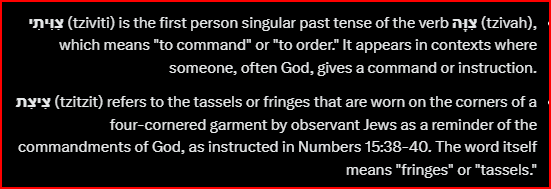
Tzitzit
https://youtu.be/1dwVI35ZHqs?t=1056
In Judaism when you do the Torah service they take the the Hem which in this case, the tassels which was a sign of status in the ancient world and they will put the tassel in the the scroll when they do the Liturgy.
When you go back to the ancient world it's more than a custom it actually represented your status who you are. It's basically you acknowledging who you are. It that this is to be true, like a signature. There are things we are not aware of when we look at the Historical things, there are many things that are legal in nature that we never consider how important they are like seals, we think are meaningless, but it represented the life of the person.
Blue represented royalty in Hebraic times. But many people today in Judaism they don't really understand why the the blue is that important according to its cultural background of the day so can you imagine psychologically how it would be for God to deal with 600,000 people that come out of Egypt. They were living there for so long and they're slaves in a slave mentality. They keep making mistakes and God says well let me tell you who I think you are - a Royal Kingdom. You're not just anybody anymore. You're not slaves anymore. You're free people, you are royal. That really brings an amazing message of a righteous God.
Read later: why-we-all-must-wear-tassels-tzitzit-2014
The word "tzitzit" may come from the Hebrew word nitzah, which means "budding flower".
Numbers 15:37-40
“And YHWH spake unto Moses, saying,
Speak unto the children of Israel, and bid them that they make them fringes in the borders of their garments throughout their generations, and that they put upon the fringe of the borders a ribband of blue:
And it shall be unto you for a fringe, that ye may look upon it, and remember all the commandments of YHWH, and do them; and that ye seek not after your own heart and your own eyes, after which ye use to go a whoring: That ye may remember, and do all my commandments, and be holy unto your God.”
Deuteronomy 22:12 says, “Thou shalt make thee fringes upon the four quarters of thy vesture, wherewith thou coverest thyself.” So we see that there was to be four of these fringes on their clothing, and these fringes were to contain a thread of blue (Num 15:38).
ציצת Tzitzit Tassels Fringes – Place of the Lamb
Let’s go back to the words “corners” or “quarters” in the Deuteronomy passage and the word “borders” in the Numbers passage. All these words are translated from the Hebrew word “kanap” (כנף). This word is most commonly translated as “wing”, and it follows that it usually refers to birds (and YHWH’s protection under His “wings”). This word, “kanap” is used in a couple of other situations though, and that’s where we start to discover some interesting things.
Most particularly, we read in Malachi 4:2, “… unto you that fear my name shall the Sun of righteousness arise with healing in his wings …”. This is universally believed to be a Messianic prophecy, and in it we are told that the Messiah will have healing in His wings (“kanap”, corners)! In the Septuagint (Greek translation of the OT), the Hebrew word, “kanap”, is translated into the Greek word “kraspedon”. It is this word that brings us into the New Testament.
In Luke 8:43-48 we read the well known story of a woman who had an issue of blood for twelve years. No doctors could heal her, but she reached out and touched the Messiah’s garment and was instantly healed. What she touched was Yeshua’s “kraspedon” – his tzitzit! Yeshua told her that her faith had made her well – and it’s very likely that it was her faith in the words of Malachi 4:2 that brought about this event.
We read of a greater number of people being healed in the same way in Matthew 14:34-36. Clearly, Messiah Yeshua wore tzitzit just as the Torah stated.
Blossoms of the Tzitzit – Place of the Lamb
The Hebrew word “tzitzit” (ציצת) has language roots that go back to a noun, “tzitz” (ציץ), and a verb, “tzutz” (צוץ). Interestingly, this combination helps to define the purpose of the tzitzit very well, as they are a physical object (noun) that should lead the wearer to an action (verb).
As we look at these two root words in Scripture, we discover that there are two verses that contain both of the words. The first of these is found in Numbers 17:8 – only two chapters after the tzitziot (plural) are first discussed. We read of a rebellion that arose against Moses and Aaron, and in this chapter, YHWH authenticates Aaron’s family as His chosen priestly line after 12 wooden rods from each of the tribes were placed in the tabernacle overnight. On the next day, only Aaron’s rod had miraculously been transformed. The latter part of verse 8 reads, “the rod of Aaron for the house of Levi was budded, and brought forth buds, and bloomed blossoms, and yielded almonds”. In this amazing incident, we find the two root words we are studying – where the rod “bloomed” (the verb צוץ) “blossoms” (the noun ציץ).
The second verse is found in Psalm 103:15, which tells us, “As for man, his days are as grass: as a flower of the field, so he flourishes”. The two root words here are, “flower” (the noun ציץ) and “flourishes” (the verb צוץ). As you see, these verses give a good idea of what these words indicate, and we see how closely interrelated they are. The object (noun) is a flower or blossom, and the active word (verb) is to do with the flourishing or blooming of those flowers. They are not words that oppose each other but, rather, fully complement each other.
Earlier in the Torah, we read a verse that gives us a conditional statement, beginning with “If you walk in my statutes, and keep My commandments, and do them …” (Lev 26:3). These words are precisely what YHWH tells us the tzitziot were to be reminders of, and after all that we’ve examined so far, the words that follow begin to truly complete the picture. Verse 4 reads, “… then I will give you rain in due season, and the land shall yield her increase, and the trees of the field shall yield their fruit.” Here is the fruit!! Can you see the direct link here back to the commandments? The tzitzit is like the visible flower that blooms from our obedience to Torah, but this definitely leads all the way to fruit. A flower doesn’t become fruit, though, without rainfall to nourish the tree and provide the sustenance it needs to develop that pollinated flower into the fruit. Does the tzitzit have it’s own water source? It doesn’t – and YHWH says that it is He alone that brings the rain. He, therefore, uses our obedience (also known as good works in Scripture) to bring about fruit in and through our lives.