Hornberg
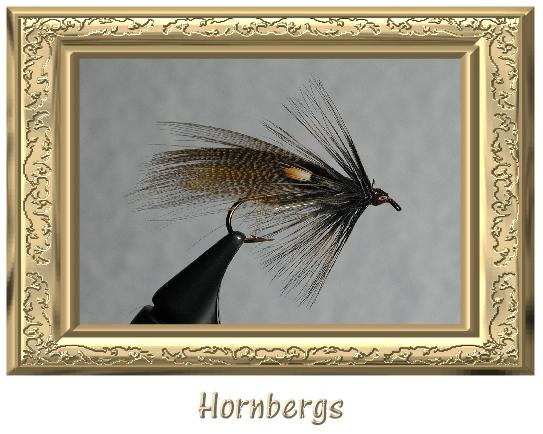
The Hornberg can be fished as a dry fly dead drift or fished as a streamer below the surface of the water. Alternately a combination approach can be employed. It can be cast out upstream and drifted until the fly swings below and dangles. Then the fly can be pulled under the surface and stripped in as a streamer. Fished as a dry fly the Hornberg is suggested to represent a caddis or stonefly. When stripped subsurface it is intended to represent a baitfish. While the above is probably the most common form of the Hornberg seen today, it really represents just the current stage in the evolution of this fly. This current version differs from the original Hornberg.
The old version differs from the current version by having wing tips that were lacquered and twisted or stroked to a point.
When tied in a small size and with the wings tented over the shank it may well represent a caddis. Frank Hornberg is said to have tied it as an imitation of lucastrine caddis, a caddis common to central Wisconsin.
While originally designed as a dry fly, the Hornberg special must have proven to be effective when fished subsurface. Now it is mainly regarded as a streamer pattern. Since its appearance in the midwest, it has gained popularity in the Northeast. There it became the Hornberg instead of the Hornberg Special and the wings tips were left unlacquered.
From <https://globalflyfisher.com/patterns-streamer-swaps-streamers/hornbergs>
| Hook | Streamer, 6-10 Mustad 38941, 9671 |
|---|---|
| Thread | Black |
| Tail | None |
| Body | Flat silver tinsel |
| Underwing | Yellow calf tail, tied so as to tilt slightly upward |
| Overwing | Flanked by 2 mallard flank feathers, half a shank past bend |
| Cheeks | Jungle cock eyes, 2nd eye showing |
| Hackle | Grizzly and brown mixed - tied as a dry fly collar |
From <https://globalflyfisher.com/patterns-streamer-swaps-streamers/hornbergs>
HORNBERG

HORNBERG
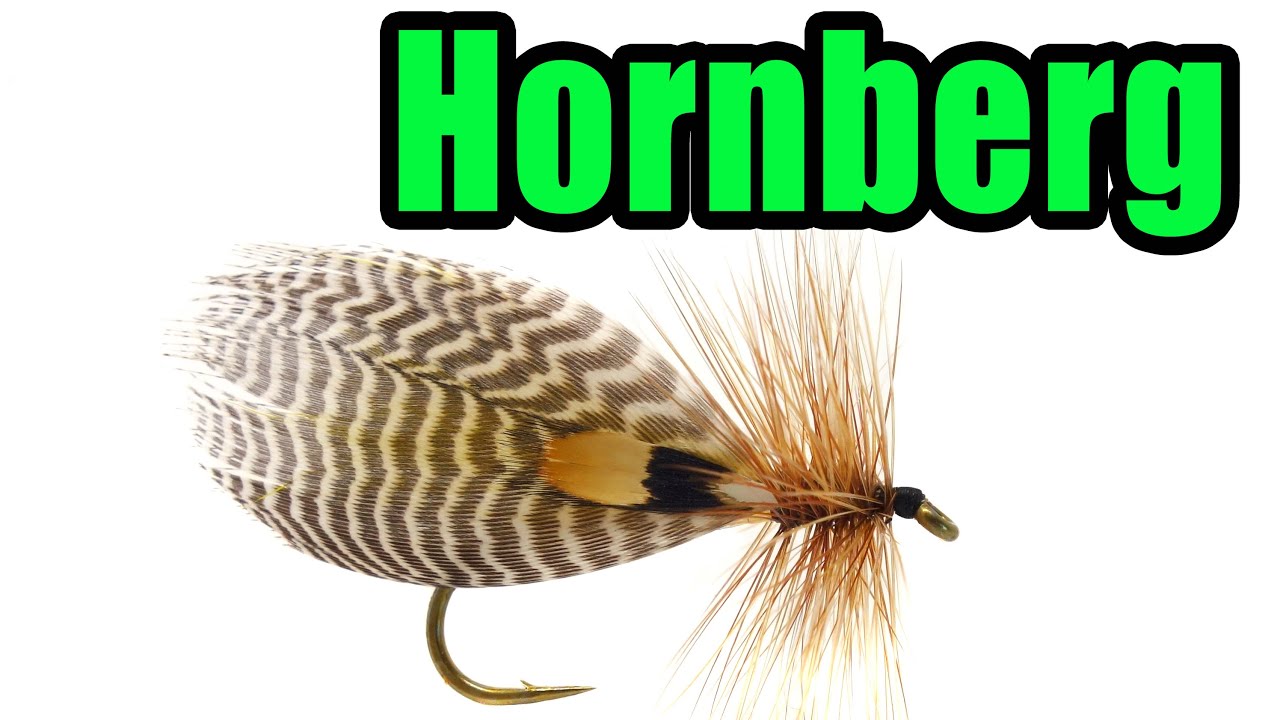
Hook: Regular dry fly hook, size 10.
Thread: Black 6/0.
Body: Flat silver tinsel.
Underwing: Yellow calftail hair.
Wings: Mallard flank feathers.
Cheek: Jungle cock.
Hackle: Grizzly.
Frank Hornberg, a game warden from Central Wisconsin, created the Hornberg in the 1920s. He called it the Hornberg Special, and designed it to imitate a caddisfly. I don’t know when the Hornberg became known as a streamer, but Col. Joseph Bates included this pattern in his book, Streamers and Bucktails: The Big Fish Flies. Okay, that was Bates’s opinion, but I use the Hornberg as a dry fly, especially when the trout are feeding on adult damselflies. I spent some time considering whether I should include this pattern in this article, but I have had such great success using this old fly that I had to share it with you. Fly Tyer contributing author Sharon E. Wright tied this version; she followed the classic pattern recipe, but you may omit the jungle cock cheeks.
From <https://www.flytyer.com/15-trout-flies-must-tie/15/>
INVENTORY:
#10 - 1
#12 - 2
SOURCE:
Imitation jungle cock eyes from https://www.jsflyfishing.com/products/imitation-jungle-cock-eyes?_pos=1&_sid=c5791f8b7&_ss=r
HX
| Joy Springs | 7/16/22 | Effective as a streamer in pool |
|---|---|---|
| Skunk River | 8/4/22 | #10 Effective for small mouth as a dead drift wet fly along bank Effective for small mouth as a streamer in pool |
| North Bear | 6/5/23 | #12 Effective at first crossing pool |