Wooley Bugger
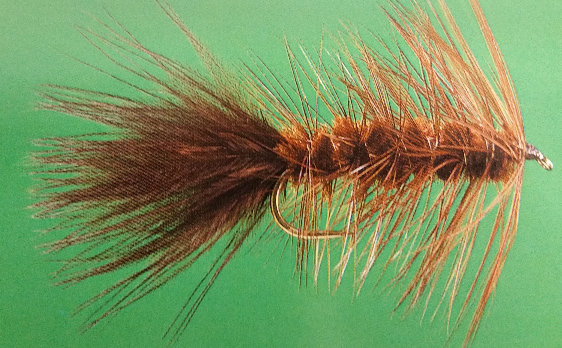
Wooly buggers will imitate bait fish and stoneflies.
This streamer pattern originated as a variation of the Woolly Worm, an Old English fly pattern which is quite like the classic palmer fly.
Wooly Buggers originally were tied in dark, drab colors like black and brown to mimic a Hellgrammite, or the dobsonfly nymph. These nymphs are roughly 1-2 inches long, have many sets of legs, and are generally found in shades of black and grey.
These large aquatic bugs are the equivalent of a four-course meal to trout and smallmouth bass.
Wooly buggers are most used when targeting fish that often feed on large insects like hellgrammites, leeches, or bait fish.
When using wooly buggers to target trout, the most common tactic is to fish this streamer on a swing. This looks like casting the fly upstream or directly across the current, allowing the streamer to sink while mending line upstream.
From <https://anchorfly.com/wooly-bugger/>
Woolly buggers are effective fished year round. In spring, be sure to use more flash and weight to get it down in streams that have high flow and low visibility. In summer, fish it slow and deep when the water warms. Fished this way, it's one of the best trout flies for summer in addition to best flies for bass.
The good, old Woolly Bugger is likely the first fly those new to fly tying craft at the vise, and I don’t know any anglers who don’t have ‘Buggers in their fly boxes. In fact, I know anglers who have entire boxes dedicated solely to the tried-and-true streamer.
But the Woolly Bugger is so much more than a streamer, and anglers who understand how to best fish this fly will have more success with it. I love fishing ‘Buggers as the point fly under an indicator, particularly if it’s got some weight to it —often, I’ll wrap the hook shank in non-lead wire, or put on a heavy, tungsten bead so I know the fly will get down. In darker colors — from brown or olive to jet black — the fly is a serviceable imitation of a stonefly nymph, and its weight will help get a trailing nymph down into the strike zone, giving you more chances to hook trout. It’s also worth letting the ‘Bugger swing out after a nymph drift, where it’s prone to drawing vicious strikes.
I’ve also used ‘Buggers under indicators in still water — a weighted Woolly Bugger, lightly jigged in several feet below an indicator where leeches or worms are present can be a deadly pattern for cruising trout or bass. No doubt about it … the ‘Bugger is among the most versatile flies out there, and anglers should fish it more often, and in more ways.
Fly Tying: Building a Better Bugger | MidCurrent
- size 8 3X long is kind of the ideal length.
- 5/32” gold bead
- .02 lead-free wire
- UTC 140 Denier in a light olive color
- Olive-colored marabou
- gold Krystal flash
- olive-colored Ultra chenille in the standard size
- grizzly-dyed olive feather
SOURCE
- Tie
- Orvis
INVENTORY
- #12 -
- 2 black
- 1 olive (O)
HX