Roll Casting
The Roll Cast and Roll Cast Pickup
by Marty McVey
In the last issue of the Flyline we discussed casting overhead, both on- and off-shoulder casting?1 With both casts, we need a good back cast to set up our forward cast. However, there are times when fishing that we may not have room behind us to execute a proper back cast. For example, we may have trees, weeds, fences, high banks or any combination thereof behind us, restricting our back cast.
In those instances, we need to make some sort of adjustment to allow us to present our fly to the fish. In many cases, we can use a roll cast. A roll cast is a fly cast that does not require a back cast. The roll cast has other uses as well -- removing slack fly line that may have resulted from poor line management during the drift, and picking up a heavy fly or sinking line in order to recast.
Roll Cast Mechanics
For the purposes of this discussion, assume a right-handed caster making a 40’ cast.
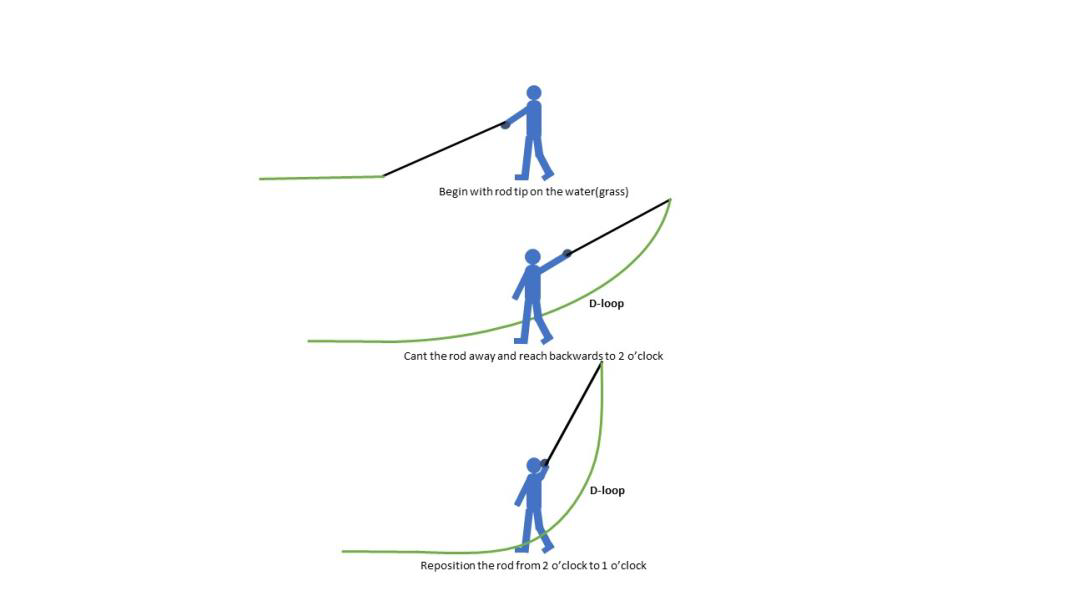
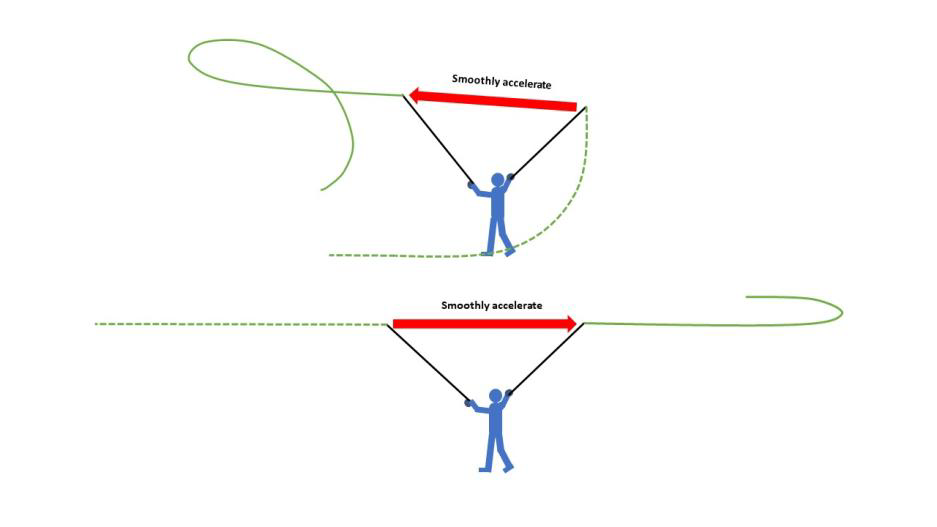
Step 1: Figure 1 illustrates the mechanics of Step 1. Whether you are on the water or using a roll cast tool on the grass, begin with the rod tip on the water. Cant your rod away from you a little to prevent the slack of the fly line from tangling with your rod tip. Then, slowly lift your rod up and back to create a D-loop on you casting side. The D-loop is the shape the rod makes with the fly line from the rod tip to the point where the fly line first touches the water. Stop the backward motion at 2 o’clock to make a nice big D-loop. Once you have created the D-loop, reposition your rod to 1:00 o’clock.
Figure 1. Setting up the D-loop for the Roll Cast.
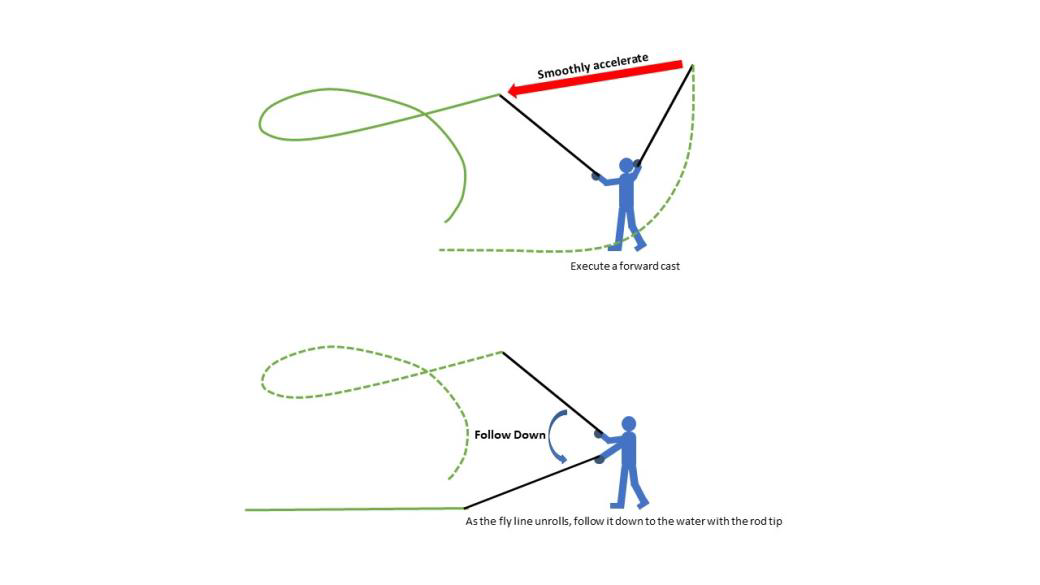
Step 2: Execute a forward cast from 1:00 o’clock to 10:30 o’clock – this is the same forward cast motion as we executed in the pickup and lay down and in our false cast. This is a slight downward trajectory which will deliver the fly towards your target on the water. The forward cast needs to be forceful, because the only fly line our cast is directly energizing is that of the D-loop. The energy we impart to the D-loop must be great enough to then propel the remainder of the line in our anchor (the anchor is the fly line on the water). As you execute the forward cast, direct your cast straight ahead or to the left. It must not be to the right of the anchor, because if you cast over the top of the anchor, the line will tangle when the loop is formed.
Step 3: As your fly line unrolls, follow it down to the water with your rod tip. Figure 2 illustrates Steps 2 and 3 of the roll cast.
Figure 2. Executing the forward cast of the Roll Cast.
Common Mistakes when Roll Casting
When we execute the roll cast, we are looking for a narrow loop, very similar to our common overhead cast. Common faults on this cast are:
- Not repositioning the rod from the 2 o’clock position to the 1 o’clock position during the D-loop formation step, and
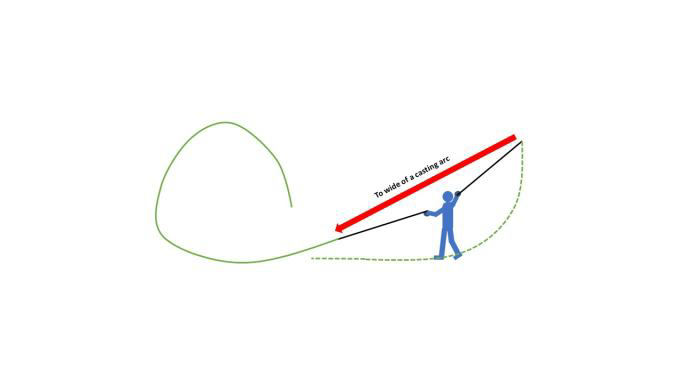
- Not stopping the forward cast at 10:30 o’clock. Many beginners don’t stop until the rod is at 9 o’clock( or sometimes not until the rod tip touches the water).
In either case, the result is a widened casting arc and a rounded rod tip path. As the loop is formed and unrolls, it will be a large round loop that causes line and leader to pile up as it unrolls(See Figure 3).
Figure 3. Too Wide of a Casting Arc and Wide Loop with a Rounded Top Leg.
Another issue beginning casters have is crossing the anchor with the forward cast. For the most efficient roll cast, our rod tip path must travel parallel to our anchor and a foot or two on the inside(the caster’s side) of the anchor(like a set of train tracks – the anchor is one track and our rod tip path is the other and they never cross). If we cast over our anchor, as the line is being picked up off of the water, it will tangle with the bottom leg of our loop, destroying the cast. Figure 4 shows the casting zone for a right handed roll cast.
Figure 4. Roll Cast Casting Zone Relative to the Anchor.
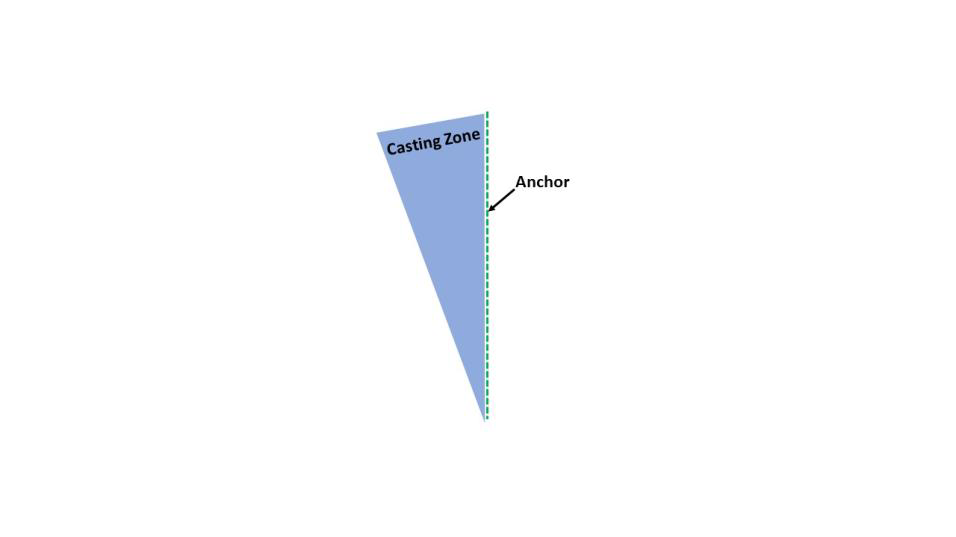
Moreover, when trying to cast to a target, our anchor needs to be lined up to our target in order to make an efficient cast to that target.
Roll Cast Pick Up
The roll cast pick up cast is an almost identical cast except we change the trajectory of our forward cast. With this cast we can make a roll cast and begin false casting before our line contacts the water. Note, this cast requires room for a back cast since we are transi-tioning into an overhead false cast. This cast is useful if you have not managed your line properly and have some slack on the water. You could simply strip all of the slack in and make a normal pick up and false cast shooting line until you can reach the target. Or, you could simply execute the Roll Cast Pick Up and pull all of the slack line out during the formation of the D-loop and begin false casting without stripping in all of the slack line.
Mechanics of the Roll Cast Pick Up Cast
Step 1: Whether you are on the water or using a roll cast tool on the grass, cant your rod away from you a little to prevent the slack of the D-loop from tangling with your rod tip. Then, slowly lift you rod up and back to create a D-loop on you casting side. Stop the back-ward motion at 2 o’clock. Once you have created the D-loop with the anchor at your feet, reposition your rod to 1:30 o’clock.
Step 2: Execute a forward cast from 1:30 o’clock to 11 o’clock. This is a slight upward trajectory which will cause the fly line to unroll forward and up rather than down to the water as in the normal roll cast. The forward cast needs to be forceful, since the only fly line our cast is directly impacting is that of the D-loop. The energy we impart to the D-loop will then propel the remainder of the line. Also, as you execute the forward cast, cast to the left of the fly line on the water (the anchor). If you cast over this fly line, the line will tan-gle.
Step 3: As the fly line, not the leader, finishes unrolling, begin a normal back cast.
Step 4: Continue to false cast until you are ready to return your fly to water/grass. As your fly line unrolls, follow it down to the water with your rod tip. Figure 5 Illustrates the Roll Cast Pick Up.
Figure 5. Roll Cast Pick Up
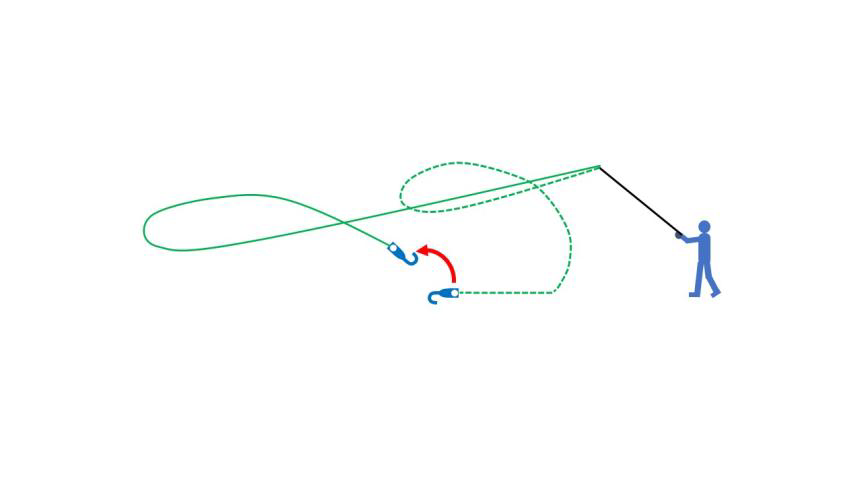
This cast is also very good at picking up our fly off of the water quietly. Ever notice sometimes when you try to pick up your dry fly, you sometimes hear a “pop” as it comes off of the water? Now exaggerate that to the loud “chug” of a large bass popper when you try to pick it off of the water. That large concave mouth of the popper the water not only makes a lot of noise but also creates quite a dis-turbance on top of the water.
With a roll cast pick up, the fly line peels these flies off of the water up and backwards, not allowing them to “pop” or “chug” like a nor-mal pick up(see figure 6)
Figure 6. Popper Picked Up by the Roll Cast Pick Up
Summary
Add these two casts to your arsenal and open up new water for yourself -- water that some anglers will not be able to fish, because there’s no room for a back cast. These casts will also make you more efficient at removing slack from your system and stealthier on the water by reducing the amount of noise you make.
Improve your casting and catch more fish.
Acknowledgments
Thank you to Bruce Richards (FFI CBOGE, CI, MCI L-2 Examiner) for reviewing this article and sharing your comments.
Bibliography
False Casting and Casting Off Shoulder, Marty McVey. The Flyline, December 2023, Hawkeye Fly Fishers Association.
Marty