Turban Head eagle
Design
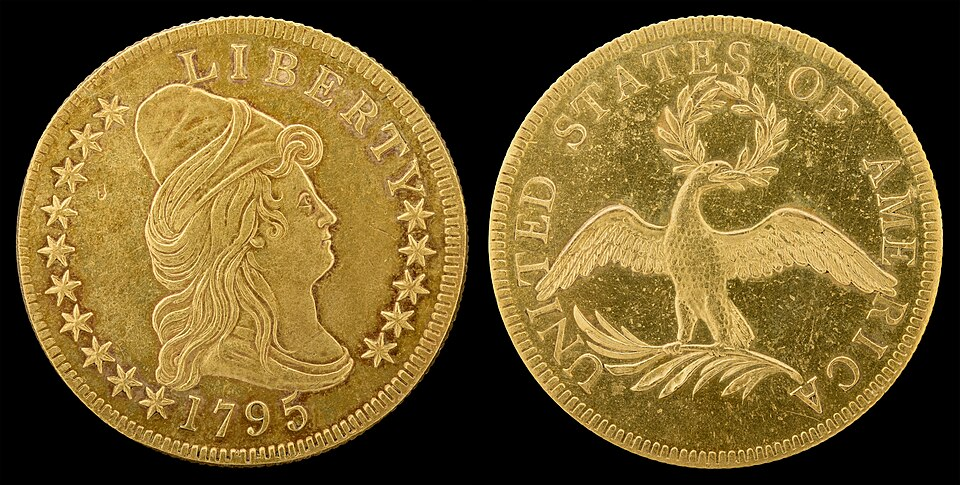
The three designs for the Turban Head eagle—the obverse and the two reverses—are all by Scot. They are identical to designs used on other silver and gold coins of the period—the Mint did not yet put denominations on gold pieces.[8] The origin of Scot's obverse is uncertain. Art historian Cornelius Vermeule suggests a similarity between Scot's portrayal of Liberty on the eagle and the portrait on the 1792 half disme (deemed by some the first Federal coinage), and speculates that the ultimate inspiration may have been Martha Washington, the President's wife.[9] He also contends that a bust should have drapery only if intended as part of a statue: "Greco-Roman classicism has been misunderstood here".[9] Numismatic historian Walter Breen believes that Scot probably "copied some unlocated contemporaneous engraving of a Roman copy of a Hellenistic goddess, altering the hair, adding drapery and an oversize soft cap".[5] Breen disputes Vermeule's contention that the cap is a pileus, the hat given to emancipated slaves as a symbol of their freedom. In support of his argument, he reproduces an 1825 letter from then Mint Director Samuel Moore, stating that the cap on the gold coins was "not the Liberty cap in form, but probably conforming to the fashionable dress of the day".[10] Numismatic author David Lange contends the headgear is a mob cap, much in fashion at the time.[11]
The reverse that appeared on the eagle from 1795 to mid-1797 depicts an eagle clutching a victory wreath, perched on a branch and surrounded by the nation's name.[4] Vermeule contends that the appearance of the bird is "difficult to describe" but that it has "a healthy individuality and an almost-rustic charm".[9] Breen suggests that the branch is from a palm tree, and that this is in tribute to deSaussure, a South Carolinian.[12] The reverse coined from 1797 featured a heraldic eagle based on the Great Seal of the United States. Breen points to what he deems a blunder on Scot's part: the bird holds arrows and an olive branch, but carries the arrows in the dexter, or dominant right claw, symbolizing a preference for war over peace.[13]
SOURCE:
DOWNLOADED:
Saturday, July 25, 2026, 5:07 PM