rich lowry
disambig, see main lowry nro
mma
May 14, 2025, edition of National Review's The McCarthy Report
RICH LOWRY: Crypto. What's the news?
ANDY MCCARTHY: So, well, the news last night, is that an obscure company, that has a Chinese subsidiary. It's a company that, trades on, NASDAQ, and it, it has a Chinese subsidiary. It last year did such booming business that it has had zero revenue.
It only has eight employees. Again, we know this because the company trades on NASDAQ. It turned out that they raised $300,000,000 from an unidentified entity that's set up in The Virgin Islands, which is notorious for, people, because its laws allow for shell companies to be easily set up. The Virgin Islands is notorious for people who want to be anonymous in conducting financial transactions. So we have somebody who we don't know who is giving $300,000,000, bought $300,000,000 of the stock of this nondescript company with the Chinese subsidiary that doesn't apparently have any business, but somehow trades on NASDAQ.
They have gotten $300,000,000 from whoever the source is, and they've announced that they're gonna buy $300,000,000 worth of Trump's meme coin that we talked about last week, the Trump coin. This is the coin that Trump announced, three days before he was being inaugurated that his company or company that he controls, was basically going to market. And the Trump entities are enriched the more that the coin is worth, and they also make money because whether people who buy the meme coin meme coin scheme is basically a pump and dump scheme. You know, people buy a meme coin is not like as I described last week, a meme coin is not like stable coin or other cryptocurrency. It doesn't even pretend to be currency.
It's basically people are buying a memento that's associated with, you know, a person, a joke, an internet influence operation, what have you. But it's a memento of something. Trump's meme coin, the image that they put out when they began to market it three days before he was inaugurated was Trump with his fist in the air going fight, fight, fight, kind of, invoking the memory of the assassination attempt, in Butler. They began selling it. It was, I think that it was selling for 18 cents a token when they first put it out.
At one point, it went up to $75 a token. And there were they marketed, like, a thousand of these tokens. So on paper, Trump was a very rich person and may actually have, have already made over a billion dollars on this based on sales of the coin and also the way they structured it every time a buyer has a transaction in in, this meme coin, the Trump people make money. They make a transaction fee on every transfer of the meme coin. So they've made about $350,000,000 on the, on the transaction fees and their holding of the coins that they have is inflated.
If the, if the price of the coins goes up and every time there's a big purchase of the coins, obviously the value goes up. So now we have this transaction where somebody is basically giving Trump three hundred million dollars. And I think the most alarming thing about the meme coin is, again, we have all these laws against government officials taking foreign money. We have the bribery law in the constitution. We have the Emoluments Clause, but we also have, you know, campaign finance laws that make it illegal for foreigners to give American campaigns or related activities like, inauguration funds, foreigners can't contribute to them.
So something like the meme coin, which Trump sets up as a private business of his and is obviously using the presidency as leverage to increase the value of it. And because crypto, a lot of the transactions can be fairly anonymous transactions, what the people who are investigating this are finding is that the money and it's now it's been billions of dollars, but the money that's pouring into these ventures is from overseas. A lot of it comes from China. A lot of it comes from Singapore.
A lot of it comes from places in the Middle East. A lot of it comes from other places in Asia. So it's a way for foreigners to pay Trump a lot of money. And some of them have been pretty open about the fact that they're not only big buyers of this meme coin. Trump is now, the other the other meme coin thing that's gone on for the last couple of weeks is they were worried that the price of meme coin, the market in meme coin, the Trump meme coin was going to collapse because after it surged at the beginning, it's gone down.
And even though a lot of people made a lot of money, most investors have lost money. The last thing I saw this week said that the losses were probably over $3,000,000,000, but a lot of people who got in early, as is typical of a pump and dump scheme, a lot of people who got in early and then sold when the, when the value surged made a lot of money. And again, the Trump's make a lot of money because whether investors win or lose, they make the transaction fee, but they don't want they don't want the thing to collapse because they're still holding about 800,000 of these coins. They only marketed 200,000, and the value of what they're holding depends on what the market is. So what they did to try to prop up the market was have a contest where the top I think it was 220 purchasers of the Trump meme coin would be invited to a big gala dinner at Trump's Virginia golf club.
LOWRY: Yeah.
MCCARTHY: And one of the big prizes, if you were at the, like, the really high rung of people who were purchases, was you're gonna get a tour of the White House. So, I mean, it couldn't be more blatant that, that they're using.
LOWRY: [INAUDIBLE]
MCCARTHY: Yeah. Right. So, they're trying to prop up the price. And in the meantime, a lot of these people have gone public because now they've had this contest and they were trying to win the contest. Right?
So, you know, the Times has a bunch of these people who they've interviewed. And they said, yeah, I bought, like, you know, a million dollars worth of the mean coin to get into the into the contest because I'm hoping to discuss, I'm hoping to meet president Trump at the gala and talk to him about, you know, conditions in Mexico and the tariffs. And I wanna talk to him about crypto policy. Of course, they're trying to buy influence. I mean, it couldn't be more obvious that that's what they're doing.
But the alarming thing here is you have all these foreign I mean, even if the even if they weren't foreign, it would be very disturbing to have somebody who was president leveraging the power of the presidency to get people to buy stuff from him, which is obviously making him much richer. Trump's net worth, according to Forbes, this week is $5,400,000,000 between, you know, what they did to stand up, this Trump media company, the Trump media and technology group that owns, Truth Social. And what they've done with this cryptocurrency stuff, Trump's net worth has doubled in the last year or so. And that's, you know, that's when, Tish James had him on the ropes and it looked for a second like he was gonna lose everything, right?
Which is probably in part why he's so adamant to strike while the iron is hot. But this is very disturbing. There's a lot of foreign money coming into these, into the family coffers.
LOWRY: Is there any precedent for this sort of action? I would they only be Joe Biden and and his his family business? Or have we ever seen anything like this?
MCCARTHY: I don't I don't think so. I mean, I think as I said in the first column I wrote about the cryptocurrency stuff, I think the analogs here would be something like the Biden family business or the Clinton Foundation.
LOWRY: Right.
MCCARTHY: You know, the Clintons set up this foundation in large part so that foreign people could pay them a lot of money and not have to worry about the campaign finance laws.
LOWRY: Pay a lot of money, and you go to the conferences, and you spend time with former president, future presidents, I believe. .
MCCARTHY: Right. Right. And, it all looks like global good. Right? Global do-gooding.
LOWRY: It's we'll just be done in office while in office.
MCCARTHY: Yes. Right. That's the difference is when you were paying into the Clinton Foundation, you were trying to buy influence with very influential buy access to very influential people. And there was always a chance that Hillary could become president again. Right?
But they weren't in office. And with Biden, as scummy as that whole thing was, they actually tried to shut it down and mainly did shut it down in 2019 because he was running for president.
LOWRY: Right.
MCCARTHY: And you could tell, by the way, that Biden, you know, implausibly, how many times did he say, I don't know anything about it. That's Hunter's stuff. I don't ask him about it. I don't know anything about it. I know nothing about it.
So even though they were making what what for them was a lot of money, and they were clearly selling Biden's political influence, they at least had enough sense to say, this has nothing to do with the presidency. I'm not cashing in on my power. You know, they were trying to erase the, to the extent that there was a a a trail of clues that that was what they were doing. They were trying to, to wipe that slate clean. With Trump, he's very much right out in the open, and he's leveraging the actual power of the presidency, which is why the money is so astronomical.
I mean, look, the Biden stuff, the the House Committee trace $27,000,000 into the Biden family coffers, that's a rounding error compared to the money that we're talking about here. Yeah. And it's not surprising that that's true because there's nothing like the power of the presidency. You cannot you can obviously understand why if people think they can turn it to their advantage, that would be something, it would be worth it to them to pay a lot of money for.
LOWRY: Get pardoned. Investigations get dropped. You know? You're you're, It's happening. Some obscure question foreign policy question settled in in your favor or your pay master's favor, etcetera.
megyn show
If recent New York Times contributor Rich Lowry's guise as a foe of the former president has been threadbare for years, he today uttered the one thing even l'orange has managed to avoid saying near a hot mic. If you want to hear Lowry blurt out "Haitian █████r migrants" (and God knows one might not want to hear his voice say anything at all) here it is on Bluesky.
He's bristling at the suggestion he said it, but if he tried to catch himself he surely did not succeed. I hear a hard happy N and a hard happy R. N for Nationalism. N for Naked. N for No he did not mispronounce migrants as "Migger." It's reasonable to assume, all the same, that it was an unintentional brainfart; here is a relevant and extremely similar example. If you watch the video closely, you can see Lowry closing his mouth to say the word, which undeniably suggests intent to form an M, not an N. On the other hand, you'll hear him say "M" several times right afterward, it sounds nothing like what he claims wasalso an M, and it isn't followed by "igger."
What you intend to say and what you do say are different things. We are responsible for the words that escape us.
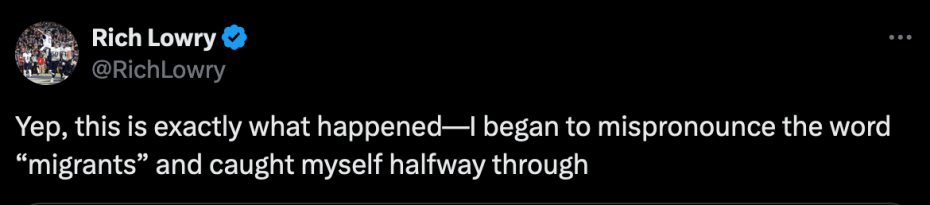
Consider a comical if mirthless hypothetical: you're a white fella who is very racist indeed, but in the heat of the moment the word you intended to say somehow comes out as "migrant." Really? I swear on Woodrow Wilson's grave that was an N. Nigh Grant? Yeah. I caught myself halfway through. But the end made it worse. Shut up!
Fairness and good faith are noble impulses, but how much grace should be offered? Besides, the equivocating and excusing mainstream of journalists and pundits are already giving him plenty at the site they will never, ever leave.
Many wingnut welfarites are more voluble racists in private and the words of power inch closer to their lips because they think 2025 is a zero sum game that they may lose. The "then suddenly" stage after a decade of "gradually" is upon their imaginations and they are readying their acts. Who would be surprised if a man who writes things like "Yes, Fight Anti-White Racism" turns out to be among them?
If you're in any doubt as to your voter registration status, if you haven't received any paperwork lately from your state on the matter, go to Vote.org and register to vote, then vote for Kamala Harris and Tim Walz.
mma 9 24
https://www.alternet.org/2022/01/tucker-carlson-and-george-soros/
an 1 22
Earlier this week, fans of thehighest-rated host in U.S. cable news were told that one of the most recognizable and demonized Jews in public life is waging a "political, social and demographic war on the West." Hungary, they were told, is this monstrous figure's "main hunting area," but all of North America and Europe are in his sights, and only through the widespread embrace of aggressive conservative nationalism can he be defeated.
In fairness, not all of that is made clear at first. For the first quarter of Fox News host Tucker Carlson's new documentary short, "Hungary vs Soros: The Fight for Civilization," it's hard to tell why it was made. Yes, over the last several years Prime Minister Viktor Orbán's proudly "illiberal" Hungary has become the centerpiece of American conservative vision-boarding. Yes, many on the U.S. right would love to emulate Hungary's pronatalist policies to encourage early marriage and large families; its crackdowns on press and academic freedom, including the defunding of university gender studies; its effective ban on Muslim immigration, and its actual bans on same-sex marriage, adoption and LGBTQ content for minors. It's no secret that Soros remains one of the right's foremost villains, blamed for everything from protests against Brett Kavanaugh's Supreme Court confirmation to Donald Trump's election loss to migrants seeking entry to America.
But all that aside, the latest "Tucker Carlson Original" looks and feels, at least at first, like old news: a tighter, better produced, chalkboard-free remake of Glenn Beck's three-hour 2010 anti-Soros series, "The Puppet Master," which was widely condemned as antisemitic and is sometimes credited for helping drive Beck's departure from Fox the following year.
Carlson's reboot, which wasn't aired on Fox News proper but its seedier online streaming service, Fox Nation, includes many of the same ingredients as the original. There's the same sort of ominous soundtrack and grayed-out coloring when Soros appears on screen, and the same fixation on Soros as a "globalist" who is allegedly erecting a new world order through his sprawling web of influence and his control of media "storylines."
There's a familiar framing, early in the film, of Soros as being amoral in some difficult-to-specify way. In Beck's version, an opening quote from Soros noted that his mother, in pre-Holocaust Hungary, had been "ashamed of being Jewish." In Carlson's, within the first minute or so we see a clip of Soros telling an interviewer he doesn't believe in God. While Carlson doesidn't repeat Beck's use of ghoulish medieval puppet props, he deploys the same metaphor, accusing Soros of using his money and NGO network "to oust democratically elected leaders and install ideologically-aligned puppets into positions of power." And, like Beck, Carlson cites as evidence Soros's support for various Eastern European "color revolutions," without acknowledging to his audience that those revolutions were almost entirely peaceful protests against communist or post-communist dictatorships.
There are some notable differences in Carlson's update. In establishing Hungary under Orbán as the last bulwark against Soros's allegedly creeping empire, Carlson turns into something of a Budapest tour guide, marveling at airport advertisements encouraging people to have more children, the city's architecture and anti-Soros street signs. ("Will George Soros attack our country again?")
He works in some combat reporter-style helicopter footage as he tours the Hungarian border fence, and lingers long on the faces of two hapless teenage-looking refugees who were caught trying to enter the country, and who Carlson darkly suggests probably aren't Syrian, as they claim. He even stops to appreciate Budapest's "mostly conservative" graffiti, like a wall spray-painted with "Fuck Liberals" (in English) and a symbol that looks a lot like the white supremacist rendering of the Celtic cross.
But the big reveal begins about a quarter of the way through, when Carlson first mentions "nationalism." Orbán was once the beneficiary of Soros's philanthropy, Carlson says, but now understands him as a threat after becoming "a Hungarian nationalist." This is likely to fly under the radar for most viewers, but that is effectively the documentary's guiding theme: Orbán is "the sort of man, the sort of political leader, who has taken these populist nationalist instincts and turned them into effective policy." Furthermore, "Soros opposes Orbán because Soros opposes nation states" and the upcoming Hungarian elections "will be the defining battle in the war between George Soros and Viktor Orbán, in the battle between globalism and nationalism."
None of that rhetoric is anything new when it comes to Orbán, who's made Hungarian national sovereignty the defining issue of his political identity. But it definitely says a lot about Carlson, and how he's helping to mainstream one of the most contentious and troubling ideologies of the contemporary right.
Last November, hundreds of right-wing academics and thinkers gathered in Orlando for the highbrow National Conservatism conference. Much of the three-day gathering focused on trying to develop a new conservative coalition along post-liberal lines. As I wrote in The New Republic earlier this month, the National Conservatives see classical liberalism — meaning old-fashioned, small-L liberalism, which prioritizes individual rights and private property, and is embraced by many staunch conservatives as well — as the root of modern society's problems.
A society ordered around unfettered personal and market freedom, they argue, makes it too difficult to raise families according to "traditional" values. A widespread commitment to multicultural pluralism, in their view, has led to an oppressive cultural imperialism where individual countries are prohibited from protecting their borders or upholding their historical cultures. They'd like to see newly empowered national governments that embrace official or public religion, use state power to coerce people into leading virtuous lives (according to their standards) and reassert the sort of proud, unapologetic nationalism that reigned before the horrors of World War II.
Besides academics and writers, the National Conservatism movement has recently been adopted by former American Enterprise Institute president Christopher DeMuth, and is influential enough that the November conference drew a number of leading Republican politicians and contenders, including sitting senators Ted Cruz, Josh Hawley and Marco Rubio, and wannabe-senator J.D. Vance.
Many of the intellectuals heading up the postliberal/National Conservatism movement are Roman Catholic "integralists," who ultimately want to see the country governed according to a conservative Catholic vision of the "common good" (with most details about what that means left strategically vague). Other leaders are avowed nationalists, seeking to reclaim the term from what they see as its unfair association with the likes of Nazi Germany. A number of them have made that case prominently in books published in the last four years, including First Things editor R.R. Reno's "Return of the Strong Gods," National Review editor Rich Lowry's "The Case for Nationalism," and National Conservatism conference organizer Yoram Hazony's "The Virtue of Nationalism."
In both of those camps within right-wing intellectual circles, Hungary has emerged as the most practical model they can aspire to: It's the sort of nationalist "Christian democracy,"as Orbán calls it, that they believe stands the best chance of replication in the U.S. (at least until there's enough support for the right-wing Catholic utopia sometimes described, jokingly or not, as the Empire of Guadalupe). As abundant media coverage has noted, the U.S. right has cheered on most of Orbán's most controversial policies. His government has assiduously courted their support, including through private institutions' offer of visiting fellowships and scholarships to numerous conservative academics and thinkers and Orbán's personal invitation to figures like American Conservative writer Rod Dreher that they consider Hungary their "intellectual home."
Those overtures have reaped undeniable benefits. Fulsome statements of support have flowed in from the likes of Dreher (who plays a starring role in the Fox Nation documentary) and Carlson, who broadcast his top-rated prime-time show from Budapest for a week last August. Orbán's reelection bid has drawn the endorsement of Donald Trump and many of his acolytes, all the way down to, just this week, the New York Young Republicans Club. In tangling with critics about the endorsement on Twitter this Thursday, the club's vice president taunted his foes by writing, "We're literally unifying the international right. …I'm not here to argue. I'm here to win.")
Orbán's regime also had a major presence at the National Conservatism conference in Orlando.There was a promotional table offering free conservative Hungarian books and magazines; a panel on "international nationalism" featuring Orbán's political director, Balázs Orbán (no relation), who enjoys a sizable American following; and a plenary address from Dreher on "What Conservatives Must Learn from Orbán's Hungary." (They must learn to unashamedly embrace "state power" in defense of conservative values and build a "conservative deep state" to ensure that entrenched right-wing policies can survive the unfortunate results of electoral defeat.)
Most of Carlson's viewers are unlikely to know much about all the ideological furniture in the background, or to care about it. But he's doing his best to bring them the Cliff Notes version, breaking the ideas discussed by Ivy-educated right-wing elites in Orlando into digestible bite-sized chunks, and delivering them, airplane-style, into mainstream conservative discourse.
One of those chunks is the rehabilitation of nationalism as a conservative virtue. Another is the idea that it's not just acceptable but commendable to use family policy as a means of engineering a country's racial makeup.
For years, Hungary had one of the lowest fertility rates in Europe. Combined with high emigration— mostly to other European Union nations — it was losing 32,000 people from its population annually. Orbán's government sought to address this by unveiling an aggressive suite of pronatalist policies in 2019, including interest-free loans to families that are forgiven with the birth of a third child, subsidies for minivans, and a lifetime exemption from income tax for mothers who have four or more kids.
Policies like these have enjoyed support from some conservative quarters for years. In 2007, the international right-wing coalition World Congress of Families called for similar measures while warning about what it called "demographic winter." This was the idea that European countries were producing too few children, leading to both "the graying of the continent" and the creation of dangerous population vacuums that would be filled with immigrants too difficult to assimilate. At the time, as I reported in The Nation, most of the racial hand-wringing was couched in euphemistic terms. But these days that subtext has become text, and sometimes the flashing headline, with the proliferation of conspiracist narratives about "white genocide" and the "Great Replacement," or Trump-era activists calling for a "white baby challenge."
In this new context, Orbán has been embraced by some on the right for framing his pronatalist policies as an intentional barricade against Muslim immigration, saying that while other countries were buoyed by immigration, Hungary didn't merely "need numbers" but rather "Hungarian children," or that Hungary didn't "want our colour, traditions and national culture to be mixed with those of others." Katalin Novák, the stylish and combative former family minister who became the face of Hungary's pronatalist campaign, warned that countries that abandon tradition will find themselves "condemned to [demographic] death." Conservatives on this side of the Atlantic swooned, with Breitbart dedicating regular coverage to Hungarian pronatalism, the National Review**cheering**that Orbánwas "redefining the possibilities for modern social conservatism," and Carlson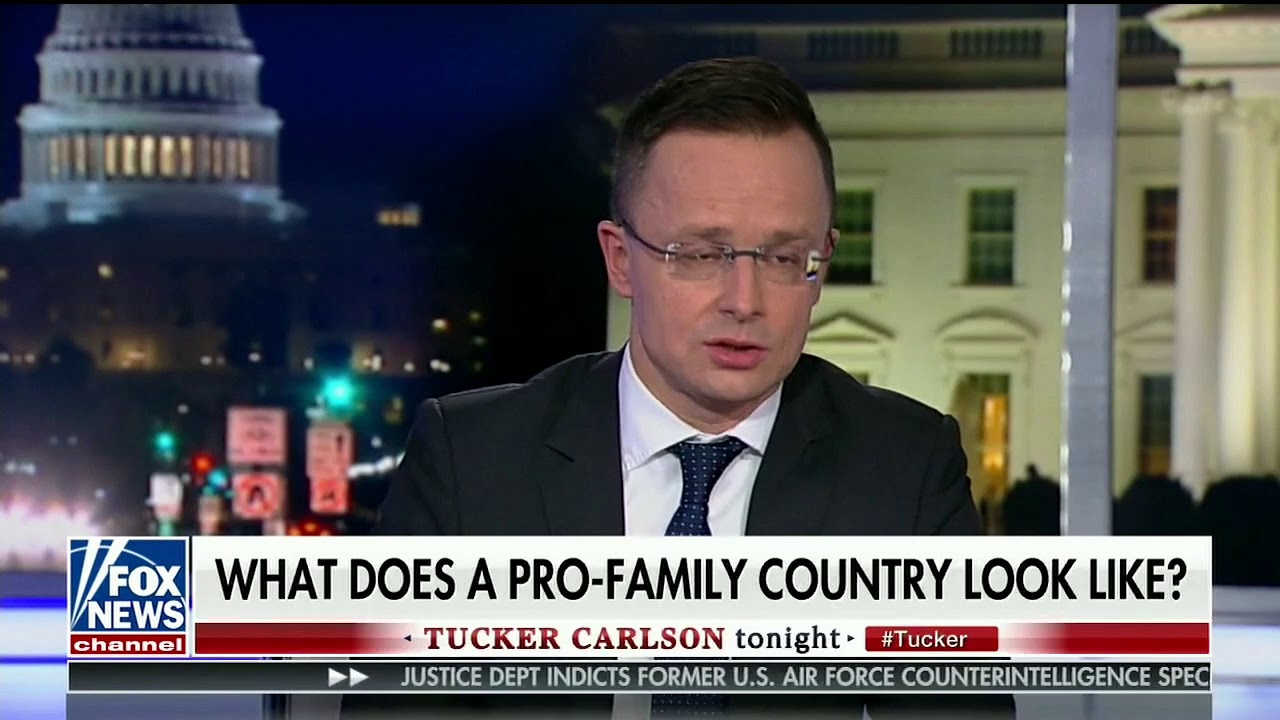 the plan as a model of family values during a 2019 interview with Hungary's foreign minister.
Orbán is not quite that blunt in Carlson's new special — the second half of which focuses on Hungary's pronatalist initiatives as part of the country's battle against Soros — but unlike other countries that choose to, in Carlson's words, "import new citizens from the rest of the world," the prime minister says Hungarians "would not like to leave this country to the migrants, we would like to leave it to our grandchildren." Carlson nods along with this, visiting a series of large Hungarian families as they beam at each other on playgrounds or buy new cars with government subsidies, before cutting to a black-and-white clip of a grim-faced Soros, saying that he's very concerned about the direction Hungary is headed. The unsubtle takeaway is that these amorphous questions of shifting populations and changing family structures is actually deliberate "demographic war," with Soros as general of the opposing army.
That's not an original idea either. It's the encapsulated narrative within or beneath the Great Replacement or white-genocide conspiracy theories, which hold that liberals — and specifically Jewish liberals — want to bring large numbers of immigrants and refugees into the U.S. or Europe to "replace" the white population there. That narrative has been the direct inspiration for numerous mass murder events, including the El Paso Walmart shooting, the mosque murders in Christchurch, New Zealand, and the assault on worshippers at Pittsburgh's Tree of Life synagogue, where the killer blamed a Jewish group for aiding refugees.
In September Carlson finally introduced the term "the great replacement" to his audience — after hinting or gesturing at it for months — calling it a "policy" to "change the racial mix of the country" through "the replacement of legacy Americans with more obedient people from far-away countries."
In the documentary released this week, Carlson illustrates this premise with a series of images intended to land more powerfully than words: a back-and-forth contrast between scenes of white people strolling amid the old-world beauty of Budapest streets or boating on the Danube, and scenes of Black and brown people, almost exclusively in situations of violent chaos, surging against fences, fighting with cops or, at their most benign, crying on the street. Toward the end of the documentary, the video cuts rapidly and repeatedly between second-long shots of white couples on park benches and footage of a crowd of shirtless Black men, shouting in a foreign language and lunging at the camera.
The next shot is meant to come as a relief: Orbán, back at the interview table, saying that he hopes his administration's work will "be enough to convince the people that it's a reasonable decision to support us, and not give the country to George Soros."
Carlson's larger point appears to be that a similar decision, one with apocalyptic or civilization-scale consequences, faces Americans as well.