James "Spider" Marks
==
fired by CNN for coi/grift?
http://www.historycommons.org/entity.jsp?entity=james_marks_1
...CNN fires one of its “independent military analysts” (see April 20, 2008 and Early 2002 and Beyond), retired Army general James “Spider” Marks, for using his position to help secure government contracts for his business. In 2004, Marks was hired as an analyst by CNN; about the same time, he took a senior management position at McNeil Technologies, where his job is to land military and intelligence contracts....
==
co- founder of Willowdale Services, LLC, a boutique private advisory firm based in northern Virginia.
---
u of phoenix
---
He was the senior intelligence officer for Joint Task Force Los Angeles during the LA Riotsand served as a strategist on the personal staff of the Chief of Staff of the Army
==
https://www.desmogblog.com/2018/03/30/tigerswan-lisa-smith-security-license-louisiana-bayou-bridge-pipeline
2x?
...The board turned down Smith’s request for a license on October 4, 2017. “Denial was based on material misrepresentations in the application and during the State Board deposition,” said Blache.
TigerSwan had two lawyers representing the firm present during Smith’s deposition. It is not currently employed by Energy Transfer Partners to do security work related to the Bayou Bridge pipeline, a 162-mile-long project which will carry to Gulf Coast refineries oil originally drilled in North Dakota. So far, that security work has been performed by the firm Hub Enterprises.
Neither Lisa Smith not TigerSwan responded to multiple requests for comment.
TigerSwan Connections in Louisiana
Even before the Louisiana board rejected TigerSwan’s application, the private security firm already appeared to be working its connections to the Bayou Bridge pipeline.
In February 2017, retired Major General James “Spider” Marks testified in support of this pipeline at a Louisiana Department of Natural Resources permit hearing and published an op-ed endorsing it in a local newspaper. In neither of these instances, however, did Marks disclose that he was chair of TigerSwan’s advisory board, not unlike the way Smith also failed to share her ties to the firm. (Marks is no longer listed on TigerSwan’s website.) [vid]
This seems to be a trend for Marks, who has a history of appearing on TV as a military pundit without disclosing his ties to military weapons companies.
TigerSwan appears determined to succeed in gaining access to perform security work in Louisiana.
As Julie Dermansky has previously reported for DeSmog: “A few days after TigerSwan’s permit was denied in Louisiana, the company filed an appeal and hired five lobbyists who work for thelobbying firm Southern Strategy Group.”
The firm is currently awaiting a hearing with the Louisiana State Board of Private Security Examiners appealing its denied application.
Louisiana Proposes Harsher Punishments for Pipeline Offenses
==
2019
https://www.desmogblog.com/2019/02/15/propaganda-pipeline-front-group-gain-grow-america-infrastructure-now
Although pipelines have been facing a number of setbacks recently, pro-pipeline groups aren’t giving up. One of those is Grow America’s Infrastructure Now (GAIN), which came to our attention because it’s recently begun sponsoring the Washington Examiner’s daily energy newsletter.
GAIN’s website simply describes the group as supporting strengthening infrastructure development and only mentions pipelines as one aspect of its focus, which also includes bridges, roads, etc. But the group’s blog, Twitter, and coverage in the mediaare pretty exclusively dedicated to pro-pipeline messaging. Hmmm, almost like it isn’t an all-around infrastructure group, and perhaps may have some ulterior motive …
Which, of course, it does. GAIN was formerly known as the Midwest Alliance for Infrastructure Now (MAIN), which Steve Horn at DeSmog reported was acting as a front group for DCI. You may remember DCI as the PR firm tied to the GOP: It’s got experiencein creating front groups on behalf of Big Tobacco, it’s known for its role spearheading the modern Tea Party movement, and it’s also worked to discredit Dakota Access pipeline protesters.
And although it seems to have changed names, GAIN is still up to the same tricks.
Back in July of 2017, Eric Hananoki at Media Matters wrote a piece exposing howCNN Commentator James “Spider” Marks was writing op-eds attacking pipeline protestors without disclosing he was on the advisory board of TigerSwan, a company that was hired to provide security for the Dakota Access pipeline. This led to numerous papers updating Marks’ pieces to reflect this. PennLive actually stated “his work will not appear on the website again” due to this failure to disclose.
What’s Marks been up to lately? Well as it turns out, in the past year, he’s been writing more pro-pipeline op-eds, in the Pittsburgh Post-Gazette, the Washington Times, and RealClearPolitics. All, of course, without mentioning his position as a Strategic Advisor at GAIN.
GAIN’s latest project is a “fact-checker” tool, designed, as the website says, to push back against the so-called “coordinated disinformation campaigns” that have been leveraged against pipelines like Dakota Access and Keystone XL.
However, GAIN seems unaware of how fact-checkers generally work: The website often just repeats a claim without offering any further evidence and then deems it true.
A recent fact-check from earlier this week has the appearance of offering more evidence, but that disappears once you dig in. The check gives a “False” rating to a claim that a pipeline would negatively impact property values, using evidence in a 2016 study by the Interstate Natural Gas Association of America (INGAA), a trade organization that advocates for the natural gas pipeline industry, which concluded that proximity to a natural gas pipeline has no impact on property value.
Beyond the inherent bias of having a natural gas pipeline advocacy group do this study,some have also pointed outthat the study compared houses next to the pipeline with houses in the same development, a few hundred feet from the pipeline, rather than with the broader market. This means the research may not be accurately portraying the influence of pipelines on property value. After all, if the pipeline depresses value for the whole neighborhood, this methodology wouldn’t notice.
Personal and local accounts suggest that’s exactly what’s happening. One property owner in the path of that Kinder Morgan pipeline — a self-described conservative who supports pipelines — says he’s been trying to sell his property and interest has dropped since the project was announced.
Meaning that unless you own the pipeline or get paid by the people who do, buying into the industry‘s propaganda will be all pain, no GAIN.
---
==
https://www.desmogblog.com/2018/03/30/tigerswan-lisa-smith-security-license-louisiana-bayou-bridge-pipeline
The private security firm TigerSwan, known for its controversial military-style tactics against Dakota Access pipeline protesters, is appealing the decision to deny its application for a license to operate in the state of Louisiana, where Energy Transfer Partners is building the Bayou Bridge pipeline. In November, several environmental groups opposed to the Bayou Bridge pipeline attempted to intervene in this case, saying their members were particularly vulnerable to TigerSwan’s security and surveillance practices should it be allowed to operate in support of that oil pipeline, but today the Louisiana State Board of Private Security Examiners denied this request.
However, during this process, it came to light that the state board denied another security license application from a TigerSwan employee who failed to disclose her employment with the firm after TigerSwan’s application was rejected.
The board's deposition of this employee, obtained via a public records request, was included in the request to intervene in TigerSwan’s case by 350 New Orleans, Atchafalaya Basinkeeper, Gulf Restoration Network, L’eau Est la Vie (“Water Is Life”) Camp, Louisiana Bucket Brigade, and Louisiana Crawfish Producers Association-West.
“Given its track record, TigerSwan should not be allowed to come into Louisiana and use their military-style tactics to hinder the right of ordinary Louisianans to exercise their First Amendment rights,” Pamela Spees, attorney with the Center for Constitutional Rights, who is representing the groups, said in a statement. “The board did the right thing in denying them a license.”
TigerSwan Employee Tries to Set up New Security Firm in Louisiana
[pix convoy]
Part of the reason the board cited for rejecting TigerSwan’s case on July 17, 2017 was “they were denied licensure twice in [North] Dakota and are pending litigation,” according to the board’s executive director Fabian Blache III.
TigerSwan is being sued by the North Dakota Private Investigation and Security Board for allegedly performing security work in the state without a license during and after the Standing Rock protests against the Dakota Access pipeline.
On September 19, 2017, the Louisiana board deposed TigerSwan employee Lisa Smith, who had applied for a license to operate her brand-new private security firm, LTSA, LLC, in Lafayette, Louisiana. While she originally said she opened the company office in August, later in the deposition Smith corrected this to say it was actually July — the same month that TigerSwan’s application was rejected. Louisiana state records indicate that LTSA, LLC was registered on August 3, 2017.
In her license application, filed August 4, Smith, a resident of North Carolina, where TigerSwan is also based, submitted a resume which did not disclose her contemporaneous employment with TigerSwan.
Instead, she listed her employer as “Metlife MSOC,” which is the security operations center where the firm had contracted her to work. In the September deposition, she confirmed that TigerSwan paid her salary but that she reported for work at Metlife.
[doc]
In Lisa Smith's deposition on September 19, 2017, she denies her company LTSA was set up in relation to TigerSwan's denied license to operate in Louisiana.
During the deposition, the board asked Smith whether or not she had ever listed TigerSwan as her employer on her LinkedIn profile. She answered that she did not remember.
However, the board supplied an email with a screenshot of a Google search result showing a cache of her LinkedIn profile, which listed her as a “Watch Officer at TigerSwan/Metlife SOC.” Her current LinkedIn profile does not list her employment with TigerSwan, and while during the deposition Smith said her Metlife contract was already expired in September, her profile continues to list “Metlife-MSOC” as her present employer.
When asked by the board about why she decided to open a security firm in Louisiana, Smith replied: “The opportunities were good.” However, she denied LTSA had any connection with TigerSwan and its failure to secure a license in the state, and further said that while she had heard of “Bayou Bridge,” she said she did not know what it was or whether she would consider applying for work related to it in the future.
Smith also denied knowing someone named Brandon Nix. According to Blache, the state board's executive director, Nix was the agent who originally applied for TigerSwan’s license in Louisiana.
“We later learned that he was the person liaising with Lisa Smith’s registers office site to secure the keys to the property leased by her company LTSA,” Blache told DeSmog via email.
[doc]
In Lisa Smith's deposition, she denied her new security company, LTSA, had any connection to her employer TigerSwan.
The board turned down Smith’s request for a license on October 4, 2017. “Denial was based on material misrepresentations in the application and during the State Board deposition,” said Blache.
TigerSwan had two lawyers representing the firm present during Smith’s deposition. It is not currently employed by Energy Transfer Partners to do security work related to the Bayou Bridge pipeline, a 162-mile-long project which will carry to Gulf Coast refineries oil originally drilled in North Dakota. So far, that security work has been performed by the firm Hub Enterprises.
Neither Lisa Smith not TigerSwan responded to multiple requests for comment.
TigerSwan Connections in Louisiana
Even before the Louisiana board rejected TigerSwan’s application, the private security firm already appeared to be working its connections to the Bayou Bridge pipeline.
In February 2017, retired Major General James “Spider” Marks testified in support of this pipeline at a Louisiana Department of Natural Resources permit hearing and published an op-ed endorsing it in a local newspaper.In neither of these instances, however, did Marks disclose that he was chair of TigerSwan’s advisory board, not unlike the way Smith also failed to share her ties to the firm. (Marks is no longer listed on TigerSwan’s website.)
[video]
This seems to be a trend for Marks, who has a history of appearing on TV as a military pundit without disclosing his ties to military weapons companies.
TigerSwan appears determined to succeed in gaining access to perform security work in Louisiana.
As Julie Dermansky has previously reported for DeSmog: “A few days after TigerSwan’s permit was denied in Louisiana, the company filed an appeal and hired five lobbyists who work for the lobbying firm Southern Strategy Group.”
The firm is currently awaiting a hearing with the Louisiana State Board of Private Security Examiners appealing its denied application.
Louisiana Proposes Harsher Punishments for Pipeline Offenses
With implications for future protests against the Bayou Bridge pipeline, this week the Louisiana State Legislature introduced House Bill 727, which proposes as a criminal offense the “unauthorized entry of and criminal damage to a critical infrastructure.”
The bill seeks to include oil and gas pipelines and their construction sites among the definition of “critical infrastructure.” For those convicted of damaging this infrastructure when a threat to human life is “foreseeable” or the action “disrupts” the infrastructure's operations, the bill stipulates a sentence of imprisonment and hard labor for between six and 20 years, up to $25,000 in fines, or both.
It also includes separate “conspiracy” charges, with similar criminal penalties, except that the maximum possible fine is $250,000. The bill both amends the Louisiana criminal code, which currently deals only with “unauthorized entry of a critical infrastructure” and creates the new crimes for damaging those facilities and conspiring to either illegally enter or damage them.
Several other states, including Wyoming, Iowa, and Ohio, have introduced similar laws in recent months which would criminalize the type of activities of past oil and gas pipeline protesters. Oklahoma already passed into law parallel legislation which has served as a template for other state proposals.
Some state lawmakers have specifically cited the Dakota Access pipeline protests as inspiration for these “critical infrastructure” bills and likened actions by pipeline protesters to “**terrorist activities.”
---
---
no link many
Bayou Bridge Pipeline Opponents Say Louisiana Governor's Office Is Surveilling Them
By Julie Dermansky • Wednesday, March 7, 2018 - 16:43
Louisiana Bucket Brigade founder Anne Rolfes at a press conference protesting Louisiana Governor John Bel Edwards' treatment of anti-pipeline activists.
Opponents of the Bayou Bridge pipeline accused Louisiana Governor John Bel Edwards of meeting with representative of the oil and gas industry while refusing to meet with activists and communities affected by the pipeline’s construction. They further allege that the administration has instead placed them under surveillance, pointing to similar treatment of Dakota Access pipeline opponents in North Dakota in 2016. Their claims are based in part on emails and other public records released by the state.
The activists brought their grievances to the Democratic governor’s home and office on March 1, holding a press conference in front of the Governor’s Mansion in Baton Rouge and then occupying the foyer to his office in the State Capitol for over an hour.
“The Bayou Bridge pipeline should be called the John Bel pipeline,” Louisiana Bucket Brigade founder and director Anne Rolfes declared at the press conference. In her view, “any accidents that will happen” related to the pipeline lead back to the Governor. He had the power to stop it, she said, but chose not to.
At the press conference, representatives from the HELP Association, 350 New Orleans, L'eau est La Vie (Water Is Life) camp, and the Center for Constitutional Rights also expressed disappointment in what they described as the state government’s cozy relationship with industry.
Louisiana Bucket Brigade read aloud emails about the Bayou Bridge pipeline from the Edwards administration and industry that were obtained by the Center for Constitutional Rights (CCR), a New York-based legal and educational nonprofit.
Pastor Harry Joseph of Mt. Triumph Baptist Church in St. James, Louisiana
Pastor Harry Joseph of the Mount Triumph Baptist Church in St. James, where the pipeline will terminate, speaking at the press conference in Baton Rouge.
Security staff at the Louisiana Bucket Brigade press conference March 1
Security next to the press conference in Baton Rouge.
The governor, who voiced his support for the pipeline early on, has not commented on a federal judge’s recent ruling halting construction of the project through the Atchafalaya Basin, an environmentally sensitive National Heritage Area.
The pipeline is a joint venture between majority stakeholder Energy Transfer Partners, the company behind the Dakota Access pipeline, and Phillips 66 Partners, LP. Pipeline construction along its route from Lake Charles, near the Texas border, to St. James, about 60 miles west of New Orleans, began in January.
CCR attorney Pamela Spees grew up in Lake Charles, Louisiana, one of the communities affected by the pipeline. She said in a press release that the emails show how “the deck is stacked against people in Louisiana who stand in opposition to the ongoing destruction and harm caused by the Oil and Gas industry. The indications of monitoring and surveillance of local advocates and small organizations by the Governor’s Office of Homeland Security and Emergency Preparedness are particularly concerning. It is astounding that the resources of so many law enforcement agencies are trained on watching these organizations and communities trying to exercise their rights to be heard.”
In addition, Spees found it “deeply troubling that not one email released by the Louisiana Department of Environmental Quality contained any discussion of or expressions of concern by people in the agency about the alarming accident history of the companies involved in the Bayou Bridge project.”
CCR is still fighting to get other public records related to the Bayou Bridge pipeline, and has appealed two cases it lost. One is against Bayou Bridge Pipeline LLC, in which the nonprofit sought records concerning the company’s use of eminent domain. And the other is against Louisiana’s St. Charles Parish Sheriff’s Office and Sheriff Greg Champagne for failing to release public records related to trips he and some of his deputies took to North Dakota to observe how law enforcement was responding to the Dakota Access pipeline protests.
“We saw a dangerous blurring of the lines between law enforcement and private corporations at Standing Rock,” Spees said. “Louisiana residents have a right to know what role local officials played in that situation and how it relates to events playing out closer to home.”
Surveillance of Opponents of the Bayou Bridge Pipeline
Dominic Renfrey, a representative with the Center for Constitutional Rights, informed me that Bayou Bridge Pipeline LLC is employing the firm Hub Enterprises to provide security for the company, based on sightings at pipeline construction sites.
Energy Transfer Partners spokesperson Alexis Daniel told me, “The safety of our employees and the communities in which we live and work is our top priority. In order to ensure that, we do have security plans in place and we do communicate with law enforcement agencies as appropriate. Beyond that, we do not discuss details of our security efforts.”
CCR’s Renfrey also said that documents released last week indicate the Governor’s Office of Homeland Security and Emergency Preparedness (GOHSEP) “might be involved in surveillance.” The GOHSEP director sent an email about the Louisiana Bucket Brigade to state regulatory and law enforcement agencies, including the Department of Environmental Quality (DEQ), the Department of Natural Resources, the Louisiana State Police, and the Louisiana National Guard. The agency also prepared a report about the L'Eau Est La Vie Camp, contrasting it to the resistance camps against the Dakota Access pipeline.
Hub Enterprises security personnel near a Bayou Bridge pipeline construction site
Hub Enterprises security personnel across the street from a Bayou Bridge pipeline construction site that activists shut down temporarily on February 26 during a direct action leading to the arrest of three protesters.
GOHSEP Communications Director Mike Steele told The Advocate that there’s nothing sinister about his agency’s role. “The agency keeps an eye on issues that may, at some point, draw big crowds requiring security, traffic control, or crowd control. Homeland security may have an ominous connotation,” he said, “but they aren’t spies.”
“It’s not surveillance. It’s letting these agencies know that these matters are ongoing,” Steele said.
There was plenty of security on hand at the March 1 press conference and impromptu visit to the governor’s office. Some of the security personnel were impossible to identify because they remained in vehicles with tinted windows.
Anne Rolfes tries to catch who is inside an apparent security vehicle
Anne Rolfes, founder of the Louisiana Bucket Brigade, trying to figure out who was in an SUV monitoring the press conference across from the Governor’s Mansion.
Security inside the foyer of the Louisiana governor's office during an anti-pipeline protest
Security inside the foyer in front of the governor’s office.
The documents so far obtained by CCR don’t indicate that any state agency hired a private security firm to surveil opponents of the pipeline. However, if one did, it wouldn’t be the first time a government agency in Louisiana hired a private firm to supplement its resources.
Last year, New Orleans Mayor Mitch Landrieu’s administration hired Trident Response Group, a private security firm based in Texas, for risk assessment, surveillance, intelligence gathering, and extra security at sites where Confederate monuments were slated for removal.
Landrieu’s administration defended the move to hire a private security firm after documents from an open records request showed the city paid over $700,000 dollars to Trident in May while the city prepared to remove the monuments. While denying that the city spied on local groups on either side of the issue, the city has not been transparent about what services Trident provided.
Take ’Em Down Nola, the group pushing for the removal of the Confederate monuments, suggested that Trident may have hacked some of its members’ emails and social media accounts and possibly infiltrated the group.
Trident shares similarities with TigerSwan, one of the private security firms employed by Energy Transfer Partners in North Dakota, and Hub Enterprises. All three companies’ websites tout staff that include former military personnel.
TigerSwan’s license application with the Louisiana State Board of Private Security was turned down last year. The denial was based on the pending litigation against the company for allegedly operating in North Dakota without a permit.
Some Bayou Bridge opponents believe the company was working in Louisiana without a license before its application was turned down.
In February 2017,James “Spider” Marks spoke in favor of the Bayou Bridge pipeline at a permit hearing. He identified himself as a retired U.S. Army major general and president of a corporate advisory firm, but did not disclose that he also sits on TigerSwan’s board of advisors.
The Louisiana Bucket Brigade says that emails from GOHSEP reveal Louisiana officials are aligned with a growing national trend of surveillance intended to intimidate citizens exercising their First Amendment rights, a finding the group considers alarming.
“Since the Standing Rock camp opposing the Dakota Access pipeline in North Dakota was disbanded last year, 56 bills that heighten the risk and criminal penalties of dissent have been introduced across 30 states,” reads a press release from the organization. “Many of these bills seek to frame protests as ‘riots’ and activists as ‘terrorists‘ or ‘jihadists,’ in attempts to criminalize protected free speech activity.”
Several states have even gone as far as introducing or passing bills that critics say would specifically criminalize pipeline protests.
“The documents reveal an unacceptable disparity in the public agencies’ treatment of pipeline and industry representatives in contrast to the communities they're obligated to serve,” Spees said. She told me that CCR will continue to seek more information from Louisiana’s public agencies because the documents already obtained suggest there is more to the story.
Energy Transfer Partners spokesperson Alexis Daniel told me, “The safety of our employees and the communities in which we live and work is our top priority. In order to ensure that, we do have security plans in place and we do communicate with law enforcement agencies as appropriate. Beyond that, we do not discuss details of our security efforts.”
I asked Governor Edwards’ office what he would say to those who feel he is willing to meet and listen to representatives of the oil and gas industry but not the Bayou Bridge pipeline’s opponents, including those directly impacted by the project. Shauna Sanford, a representative from the governor’s office, said, “We don't have a comment at this time.”
==
==
https://www.alternet.org/environment/energy-transfer-partners-company-behind-dakota-access-pipeline-strong-armed-landowners
Four Pennsylvania residents filed a federal lawsuit this week against Texas-based pipeline company Energy Transfer Partners (ETP), claiming the Fortune 500 company and its subsidiaries violated their constitutional rights by engaging in illegal surveillance and harassment against landowners and pipeline protestersand caused emotional distress and other harm.
The suit, which seeks compensatory damages, also names ETP's private security provider, North Carolina-based TigerSwan, as well as local law enforcement officers who arrested pipeline opponents on charges that ultimately were not prosecuted. It claims that energy companies like ETP are increasingly relying on de facto public-private partnerships with government to "strong-arm" opponents into silence with false arrests and malicious prosecution.
"Since May of 2015, every day of my life has been affected by the plans to build this pipeline, and the lengths that Energy Transfer Partners will go to in the pursuit of profit," said plaintiff Elise Gerhart, who lives on property that will be crossed by the pipeline. "We've been needlessly harassed by agencies and violently threatened by individuals who've been intentionally incited and mobilized."
The lawsuit centers on ETP's Mariner East 2 pipeline project that would carry fracked gas from the Marcellus and Utica shale regions of West Virginia, Ohio and western Pennsylvania to refineries near Philadelphia, with much of the product to be exported overseas for making plastics. ETP is also behind several other controversial petro pipeline projects including the Bayou Bridge pipeline in Louisiana, the Trans-Pecos in Texas and the Dakota Access in North Dakota, the target of massive demonstrations last year in which Native American protesters and their supporters faced attack dogs, rubber bullets, mace and water cannons. Pipelines are a growing concern across the South: Of the 56 interstate pipeline projects that have sought permits from federal regulators since 2013, 31 run at least partly through Southern states.
Elise Gerhart's mother, Ellen Gerhart, also a plaintiff in the lawsuit, has owned a 27-acre property in central Pennsylvania's rural Huntingdon County with her husband, Stephen, since 1983 and has cared for it according to the principles of the state's forest stewardship program, which encourages private landowners "to implement sound forest management practices." In 2015, Sunoco, which has since merged with ETP, filed a declaration of taking in county court in order to gain access to a wooded part of the property to begin clearing trees for the planned pipeline. The court granted the company's request in March 2016, establishing an easement on the property and barring the Gerharts from interfering with access. There's currently a lawsuit working its way through the state courts over whether the taking was legal; it comes at a time of growing controversy over how pipeline companies are gaining access to private lands.
At the time the court granted Sunoco/ETP access rights to the Gerhart property, the Mariner East 2 project had neither the necessary state permits for construction nor what's known as "possessory interest" in the easement, which wasn't granted by the county court until April 2017. The lawsuit claims that, without possessory interest, the company had no legal right to exclude anyone from the easement — but that's not what happened.
Arrest to silence?
In late March 2016, shortly after the court granted the easement, the Philadelphia-based environmental advocacy group Clean Air Council posted a public event to Facebook encouraging people to oppose the tree-cutting planned for the Gerhart property. On March 29, 2016, dozens of protesters arrived and set up an encampment,with some sitting in trees to block their removal.
Agents of ETP/Sunoco bearing chainsaws also arrived on the land, escorted by state police and officers from the local sheriff's department. They were eager to begin work as U.S. Fish and Wildlife Service regulations prohibit cutting trees on the Gerhart property after March 31 to protect migratory birds and an endangered bat.
Three of the plaintiffs in the lawsuit were arrested that day:
- Protester Alex Lotorto of Milford, Pennsylvania, claims he was using a walkie-talkie to let other protesters know where the tree cutters were but law enforcement officers accused him of using it to disrupt work at the site. Arrested and charged with disorderly conduct and criminal contempt, he was held on a $200,000 bond he could not afford to pay and stayed in jail for three days. Once the tree-cutting stopped on April 1, his bond was reduced to $5,000 unsecured and he was released.
- Protester Elizabeth Glunt of Altoona, Pennsylvania, entered the easement only briefly to warn tree cutters that they were getting too close to tree-sitting protesters, according to the lawsuit. She was charged with disorderly conduct and criminal contempt. Held in jail until her family raised the money to pay her $100,000 bond, Glunt was strip-searched and claims she suffered emotional distress as a result.
- The lawsuit states that Ellen Gerhart approached but did not enter the easement area to warn tree cutters that they were too close to tree sitters. She was arrested and charged with disorderly conduct and indirect criminal contempt and released on a $5,000 unsecured bond.
Just over a week later, on April 7, 2016, Ellen Gerhart was arrested again on the same charges when tree cutters returned to her property unannounced and she approached them to warn that they were violating federal wildlife regulations. Elise Gerhart was also arrested for climbing a tree and charged with disorderly conduct.
Smears of Russian ties
All of the charges against the plaintiffs were ultimately dismissed.The lawsuit says that's because the arrests weren't part of a legitimate pursuit of justice but rather an effort to "arbitrarily and maliciously send a message to the Gerhart family and their supporters to discourage their opposition to the pipeline and its construction and thereby chill their First Amendment rights."
The lawsuit also takes aim at TigerSwan, ETP's private security provider, based in the town of Apex near Raleigh, North Carolina. The company was founded in 2008 by retired U.S. Army lieutenant colonel and Delta Force operator James Reese.
According to company documents obtained by The Intercept, an investigative news outlet whose reporting is cited in the lawsuit, TigerSwan's tactics against pipeline protesters in five states — North Dakota, South Dakota, Iowa, Illinois, and Texas — included military-style counterterrorism measures such as aerial surveillance, radio eavesdropping, and infiltration of camps and activist circles.
The plaintiffs in the lawsuit say similar tactics are being deployed against Mariner pipeline opponents, who cite helicopters and drones flying low over the Gerhart property outside of the easement, and unmarked vehicles parking nearby and shining high-beam lights onto the land. TigerSwan has been operating in Pennsylvania at least since April 2017.
The suit further charges that ETP and TigerSwan have repeatedly sent an agent to the Gerhart property to attempt to infiltrate the protest encampment. While there, the lawsuit says, the agent took photos that were later posted to the Facebook page of a shadowy group called PA Progress to identify Ellen and Elise Gerhart. Other PA Progress posts called Elise Gerhart an "anarchist" and falsely accused her of sabotage. The lawsuit suggests that the page, which has since been taken down, was connected to TigerSwan.
The campaign against the protesters also deployed misleading propaganda in other ways. For example, the chair of TigerSwan's advisory board, retired Army Major General James "Spider" Marks, had an op-ed published on the news website PennLive.com in May warning that Mariner pipeline opponents would engage in violence and cause environmental damage. However, he did not identify his connection to TigerSwan and its interest in the pipeline project. The website has since added a note to the op-ed disclosing his position and stating that Marks' work will not appear there again.
The lawsuit further claims that the Gerharts were the targets of misinformation spread online, which it also connects to TigerSwan. For example, it points to posts atBlack Badger Report— a pseudonymously written website that claims to be concerned about the proliferation of "fake news" but whose front page features just six stories since June, all of them critical of pipeline protesters except forone condemning The Intercept of Communist ties—falsely accused Elise Gerhart and other protesters of being fronts for Russian government attempts to disrupt U.S. energy markets. The lawsuit ties the online attacks to TigerSwan through a web of internet connections involving TigerSwan Vice President Derek Borror.
The inaccurate posts not only caused "reputational harm," the lawsuit says, but "have incited commenters to threaten to injure or kill Elise Gerhart and her supporters,"which in turn have caused her "mental anguish and emotional distress."
The plaintiffs are asking for a jury trial. Neither ETP nor TigerSwan responded to a request for comment.
Sue Sturgis
==
==
https://www.desmogblog.com/2017/07/05/dakota-access-tigerswan-james-spider-marks-los-angeles-riots
desmog horn
Retired Major General James “Spider” Marks chairs the advisory board for TigerSwan, a private security firm hired by Energy Transfer Partners to help police protests of the Dakota Access pipeline — an approach for which Marks has shown vocal support.
DeSmog has found that Marks also headed up intelligence efforts for the task force which brought over 10,000 U.S. military troops to police the 1992 riots following the acquittal of Los Angeles Police Department members involved inbeating Rodney King. In addition, Marks, a long-time military analyst for CNN, led intelligence-gathering efforts for the U.S. military’s 2003 “shock and awe” campaign in Iraq, which was dubbed “Operation Iraqi Liberation.”
In recent months, Marks has endorsed Dakota Access and its southern leg, the Bayou Bridge pipeline. He has shown this support by writing op-edpiecespublished in various newspapers and on the website of apro-Dakota Access coalition runby a PR firm funded by Energy Transfer Partners.
“I spent a good portion of my adult life in Iraq, and I must tell you that the similarities are stark,” Marks said in November of the anti-Dakota Access encampment set up by the Standing Rock Sioux Tribe.
Marks, according to The Washington Times, traveled to Standing Rock “as an adviser to the Midwest Alliance for Infrastructure Now” (MAIN), a pro-pipeline front group run by the Republican Party public relations firm, DCI Group.
“General Marks is still an adviser to the coalition. He is given a modest stipend for his time and expertise,” DCI Group's Craig Stevens told DeSmog of Marks' relationship with MAIN. “TigerSwan is not a member of the Coalition nor does the Coalition receive any funding from them.” Stevens manages public relations efforts for MAIN and is the crisis management lead for DCI.
In February, Marks traveled to Louisiana to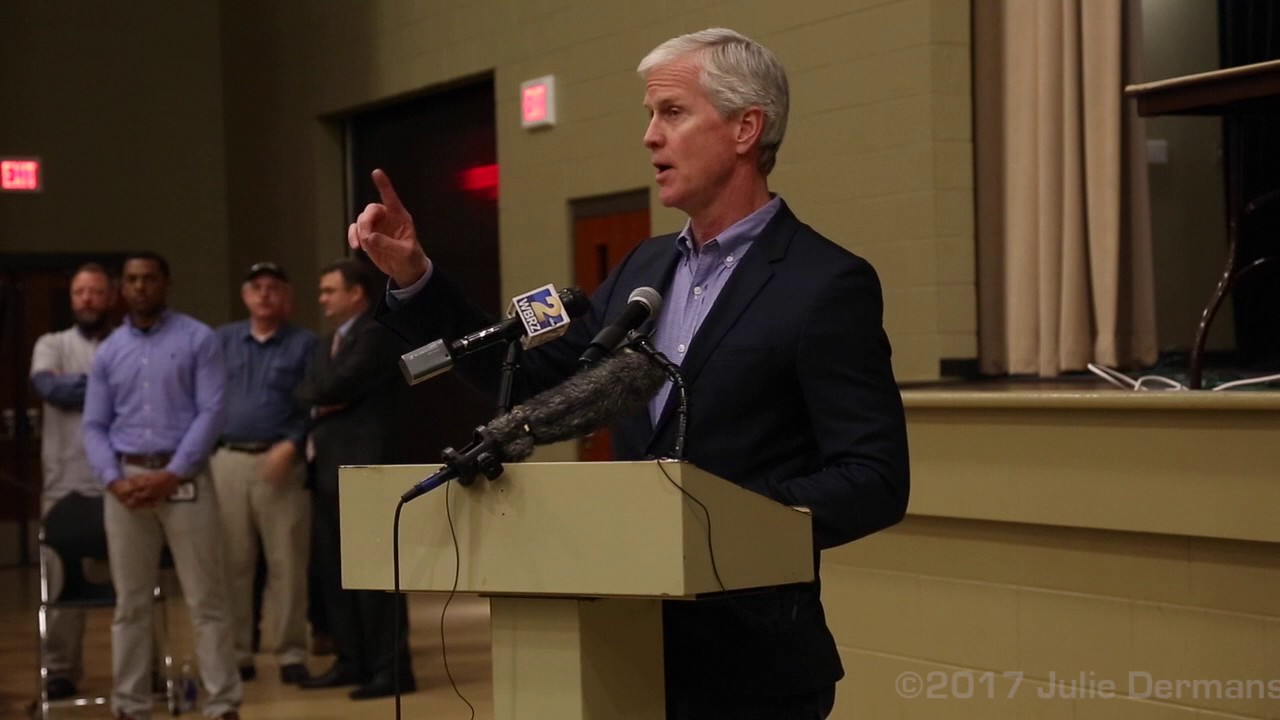 in favor of the Bayou Bridge pipeline at a Louisiana Department of Natural Resources hearing.[vid]
Neither Marks nor TigerSwan responded to requests for comment for this story. TigerSwan has recently come under fire by the North Dakota Private Investigative and Security Board for operating in the state without a permit, with the Board filing a legal complaint about the matter. Energy Transfer Partners says TigerSwan is no longer working on its behalf in North Dakota.
Pentagon Pundits
Among his numerous public appearances, writings, and television pit stops, Marks has failed to disclose his advisory board position for TigerSwan. Failure to disclose affiliations, though, is not unusual for Marks.
As a military pundit for CNN, both The New York Times and the watchdog group Public Accountability Initiative (PAI) have documented that Marks has often appeared on cable TV while not disclosing his ties to military weapons companies. The 2008 New York Times Pulitzer Prize-winning investigation — “Behind TV Analysts, Pentagon’s Hidden Hand” — covered Marks and explained thathe and over 75 others were paid by the George W. Bush administration to give seemingly independent, pro-Iraq War analyses on cable TV outlets beginning in early 2002.
The catch: The public was never informed that thesepro-war pundits were on the Pentagon’s payroll and often on the payroll of military weapons companies as well.
“To the public, these men are members of a familiar fraternity, presented tens of thousands of times on television and radio as ‘military analysts’ whose long service has equipped them to give authoritative and unfettered judgments about the most pressing issues of the post-Sept. 11 world,” wrote The Times. “Hidden behind that appearance of objectivity, though, is a Pentagon information apparatus that has used those analysts in a campaign to generate favorable news coverage of the administration’s wartime performance.”
The thousands of documents obtained for The New York Times investigation were organized and published online in a searchable format by the Center for Media and Democracy. Those memoranda, emails, and other materials offer an insightful window into the cozy relationships among the upper echelons of the U.S. media, the U.S. military, and the U.S. government. General Marks fits neatly in the intersection of these three entities.
In an email to Major General Donald Shepperd, Joy DiBenedetto, then Vice President of Network Booking and Research at CNN Worldwide, thanked Shepperd for putting her in contact with General Marks. She wrote, “you can always contact me for any CNN reason, and if I’m not the right person, I can certainly get you to the right person.”
In 2006 Marks traveled on a pro-Iraq War trip during his capacity as a Pentagon pundit. That trip was convened by the U.S. Department of Defense, and the Pentagon tried to have Marks ask CNN to foot his bill for travel expenses. Along with other retired military men-turned-analysts, Marks was part of a roundtable meeting withGeneral David Petraeus in 2007, and participated in conference calldiscussions with Defense Department officials. Marks had his media appearances reviewed by the Office of the Secretary of Defense.
In PAI's 2013 report, “Conflicts of interest in the Syria debate,” the watchdog group named 22 people serving as commentators on the issue of whether or not the U.S. should attack Syria for using chemical weapons on its own citizens. That report, paralleling The New York Times' findings on the Iraq War, found numerous cases of undocumented conflicts of interest. The group of men, which once again included Marks, landed mainstream media pundit gigs on CNN, MSNBC, and FOX and wrote op-eds for Bloomberg and The Washington Post.
PAI noted in its report that out of 111 total appearances by the pundits in October 2013 alone, only 13 had mentioned their relationships to the defense industry. Marks appears on the list identified as the former Commander of the U.S. Army Intelligence Center. The list ties him into the defense sector by noting his position at Willowdale Services, a boutique consulting firm for the energy and national security industries.
In the documents obtained by The New York Times, a picture emerges of Marks’ advocacy for military intervention in Syria long before 2013. When asked by CNN in February 2007 to speak about the failed bombing attempt on Vice President Cheney, he told the network to “bear in mind you have Syria, which is to the west of Iraq, which is a safe haven for the introduction of new ideas and an opportunity for insurgents to go across that border, and refit, regroup, and reintroduce themselves into the fight.”
And just hours later on another CNN show, Marks made similar remarks about Pakistan, telling CNN’s Brian Todd that “what is significant is the proximity of Bagram Air Base to Pakistan, which is as the crow flies only 70 miles, as you can see right here from Bagram to Pakistan. The region right here is Waziristan. This is the root of the challenge.”
Marks also serves as a source for the private security firm Stratfor (Strategic Forecasting Inc.), according to a roster leaked to and published by Wikileaks. Stratfor's past client list has included the American Petroleum Institute.
1992 LA Riots
Marks also headed up the Joint Task Force Los Angeles, assigned with cracking down on the violent 1992 riots which erupted in the aftermath of the Rodney King verdict. The task force operated under the authority of an executive order issued by then-President George H.W. Bush.
“What we saw last night and the night before in Los Angeles is not about civil rights,” then-President Bush said in a aired. “It's not about the great cause of equality that all Americans must uphold. It's not a message of protest. It's been the brutality of a mob, pure and simple. And let me assure you: I will use whatever force is necessary to restore order. What is going on in LA must and will stop.”
Law enforcement’s crackdown of the Los Angeles riots in 1992 came under criticism for its heavy-handed and militarized approach. Fast forward to 2016, when the crackdown by out-of-state cops on protests at Standing Rock, often done with military gear lobbied for by the National Sheriffs’ Association, likewise received similiarly sharp scrutiny for its militarized nature. Tigerswan provides funding to the National Sheriffs’ Association, which has, in turn, endorsed the Bayou Bridge pipeline, which will bring Dakota Access oil to the Gulf of Mexico.
In 1996 Col. William Mendel, then a senior analyst with the Foreign Military Studies Office at Fort Leavenworth, Kansas, wrote that :{Los Angeles in 1992 should be seen from a U.S. military perspective as an example of “urban warfare.”}:
“Many misunderstood the LA Riot of 1992 as predominantly a race riot. As witnessed by the California National Guard Field Commander, the riots were seen as a case study in urban warfare,” wrote Mendel. “The Guard's counter-riot operations tell of the increasingly dangerous nature of military and police operations in the urban environment.”
In the end, Mendel concluded that law enforcement and U.S. military effots during the Los Angeles riots created what he estimated was more harm than good.
“Little good came out of the events of the LA riots of 1992. Nearly everyone looked bad, except for the individual soldiers, firemen and policemen who performed selflessly throughout the difficult week of rioting,” Mendel posited. “The social and economic scars remain in central Los Angeles where Bloods and Crips gangs continue drug trafficking.”
Main image: James “Spider” Marks speaking in support of the Bayou Bridge pipeline at a Louisiana
===