Sauer D J E S Q
DISAMBIG
---
---
SEE MIZZOU AG STAFFER NETWORK
AN 2 26
The Missouri prosecutor overseeing an investigation into the 2020 vote in Fulton County, Georgia, has taken part in meetings since last fall with lawyers tasked by President Donald Trump to reinvestigate his loss to Joe Biden.
Thomas Albus, whom Trump appointed last year as U.S. attorney for Missouri’s Eastern District, has had multiple meetings set up with top administration lawyers to discuss election integrity.
At those meetings was Ed Martin, a Justice Department lawyer who until recently led a group investigating what the president has described as the department’s “weaponization” against him and his allies, according to a source familiar with the meetings who spoke on condition of anonymity for fear of retribution.
White House lawyer Kurt Olsen, who has been tasked with reinvestigating the 2020 election, also was directed to join at least one of the meetings, according to the source. Both Martin and Olsen worked on behalf of Trump to try to overturn the 2020 election results, and a federal court sanctioned Olsen for making false claims about the reliability of voting machines in Arizona.
The meetings reveal new details about the length of the preparations for, and people involved in, the January FBI raid on Fulton County, which election and legal experts told ProPublica was a significant escalation in Trump’s breaking of democratic norms.
U.S. Attorney General Pam Bondi picked Albus and has granted him special authority to handle election-related cases nationwide, even though his earlier work as a federal prosecutor didn’t involve election law or election-related cases. The meetings with Martin, Olsen and other lawyers for the Justice Department were described by the source as being about “election integrity,” a term the Trump administration has used to describe investigations into its false claims that elections are rigged.
Martin, Olsen, Albus and others declined to answer questions about the meetings and other detailed questions from ProPublica. The White House and the Justice Department also did not respond to questions.
The meetings came at a particularly crucial time.
Martin’s efforts to obtain election materials from Fulton County, a Democratic stronghold, had hit a wall. In August, he sent a letter demanding that a Fulton County judge allow him to access tens of thousands of absentee ballots for “an investigation into election integrity here at the Department of Justice,” but he had reportedly received no reply.
Martin explained to Steve Bannon on a podcast that aired around the time of the meetings that although the White House had given Olsen the official mandate to reinvestigate the 2020 election, “inside DOJ, myself and a couple of others have been working also on the same topic” — including getting the Fulton County ballots. But Martin described progress as a “challenge.”
Bannon, who served as Trump’s chief strategist in his first term, asked why Martin didn’t just “get some U.S. marshals to go down and seize” the ballots.
Martin suggested it was easier said than done, but agreed: “Look, we’ve got to get” the ballots.
Before long, Albus and Olsen were interviewing witnesses for their case. Kevin Moncla, a conservative researcher, told ProPublica that he spoke to Albus and Olsen a couple of times, both together and separately, around the turn of the year. He identified himself as Witness 7 in the affidavit that persuaded a judge to sign off on the raid, and the affidavit mentions a 263-page report he authored that activists believe may have justified the raid, ProPublica has reported. Moncla has a long history of working with Olsen, dating back to an attempt by Kari Lake, a Republican candidate for governor in Arizona, to overturn her 2022 loss.
Just a few weeks after those interviews, in late January, Albus was listed as the government attorney on the search warrant that authorized the seizure of roughly 700 boxes of election material in Georgia, far outside of Albus’ usual jurisdiction.
Former U.S. attorneys from both parties said it was rare for a federal prosecutor from one region to take on cases in other states or be granted the nationwide authority Albus has been given.
Under Trump, senior roles across the White House, DOJ and FBI have increasingly been filled by a small, interconnected group of Missouri lawyers with longstanding ties to one another.
Another top federal official in the meetings was Jesus Osete, the principal deputy assistant attorney general for civil rights. Before joining the Justice Department, Osete worked in the Missouri attorney general’s office, where he represented the state in at least five lawsuits against the Biden administration regarding vaccine mandates, immigration and other policies. Osete did not respond to requests for comment or to a detailed list of questions.
When the FBI raided Fulton County’s election center, Andrew Bailey, another lawyer from the same political circles, was in charge. Before joining the FBI as deputy director, he had used his position as Missouri’s attorney general to pursue high-profile cases against prominent Democrats and said he supported all efforts to investigate Biden, his family and his administration.
A spokesperson for the FBI declined to answer detailed questions about Bailey.
Last year, Roger Keller, a veteran federal prosecutor from Albus’ office, was brought in to help prosecute New York Attorney General Letitia James for alleged mortgage fraud in Virginia after the original career prosecutors on the case were replaced by political appointees. After a judge dismissed the case, two federal grand juries declined to indict James again, and Keller returned to Missouri.
Trump’s solicitor general, D. John Sauer, previously served as Missouri’s solicitor general under state attorneys general Josh Hawley and Eric Schmitt. He and Schmitt signed Missouri’s amicus brief supporting efforts to overturn the 2020 presidential election results. Sauer later represented Trump in his presidential-immunity case, successfully arguing before the Supreme Court that Trump was entitled to broad immunity from prosecution.
Albus’ connection to the other Missouri lawyers goes back decades. Unlike some of the others, though, he has never held elected office or had a high public profile, nor has he waged culture-war campaigns like Bailey or Martin. Instead, he spent most of his career as a federal prosecutor and as a judge in a Missouri state circuit court.
Emails show Albus exchanging brief messages with Martin in 2007, when Albus was an assistant U.S. attorney in St. Louis and Martin was chief of staff to then-Gov. Matt Blunt. The emails were part of records from the Blunt administration that became public after being released under Missouri’s Sunshine Law.
In the email exchange, Albus put in a good word for a St. Louis lawyer who was a finalist for an appellate court judgeship, and Blunt ultimately selected that candidate.
Albus served as first assistant to Schmitt from early 2019 until Albus was appointed by Gov. Mike Parson to fill a circuit court judge vacancy in early 2020. Schmitt, now a U.S. senator, praised Albus as “one of the finest prosecutors I have ever met” when endorsing his nomination for U.S. attorney in December.
Lawyers who appeared in Albus’ court rated him as well prepared, professional and attentive, according to Missouri judicial performance reviews. They said he followed the evidence, applied the law correctly and gave clear reasons for his rulings.
Albus came under more critical scrutiny after Trump named him interim U.S. attorney last summer. Much of that attention centered on a fraud case he inherited when he took office. Prosecutors alleged that developers in St. Louis falsely claimed to be using minority- and women-owned subcontractors to qualify for city tax breaks, conduct the Justice Department has historically treated as wire fraud.
One of the defendants was represented by lawyer Brad Bondi, the brother of Pam Bondi.
The developers’ lawyers argued that even if the government’s claims were true, they were legally irrelevant because the Trump administration had taken the position that tax breaks based on race or gender were unlawful. Albus accepted those arguments and dropped the case. As part of the resolution, Albus personally hand-delivered to City Hall a check of about $1 million from one of the developers’ companies as restitution. He told the St. Louis Post-Dispatch that he intervened “to make it clear” his office wanted to drop charges and hand-delivered the check “to make sure they got it.”
In a letter to Pam Bondi and Deputy Attorney General Todd Blanche, Congressional Democrats said the dismissal of the St. Louis case and other cases in which the Justice Department intervened on behalf of Brad Bondi’s clients raised “significant broader ethical concerns.” In the St. Louis case, and in a separate matter involving another Brad Bondi client whose charges were dropped, a Justice Department spokesperson said Pam Bondi’s relationship with her brother had “no bearing on the outcome.”
A spokesperson for the developers said their lawyers communicated only with the U.S. attorney’s office in St. Louis about the case and had no direct contact with Pam Bondi. He said the dismissal reflected “a recognition that this case should never have been brought in the first place.” Brad Bondi did not respond to a request for comment.
Weeks later, around the time of Albus’ meetings about election integrity, he posed with Martin in Martin’s office, flanked by a framed photo of Trump and a copy of “A Choice, Not an Echo,” the influential conservative manifesto by Phyllis Schlafly arguing that Republican voters were being manipulated by party elites and the media.
Martin posted the photo on X with the caption, “Good morning, America. How are ya’?”
---
President-elect Donald Trump tapped two Missouri members of the legal team for jobs in the new administration, naming D. John Sauer solicitor general and Will Scharf assistant to the president and White House staff secretary.
Sauer, who lives in the St. Louis suburb of Town and Country, was Missouri solicitor general from 2017 through 2022 under Josh Hawley and Eric Schmitt. In that job, he led Missouri’s unsuccessful effort alongside other GOP attorneys general to keep Trump in power by challenging the 2020 election results.
More recently, Sauer successfully represented Trump at the U.S. Supreme Court in his bid for immunity from being criminally charged for trying to overturn the 2020 election. The justices voted 6-3 along ideological lines in July to give Trump immunity from some official acts he took as president.
As solicitor general, Sauer will be responsible for litigating the federal government’s positions at the U.S. Supreme Court.
“He is a legit genius, an incredible lawyer and I’m thrilled for him and his family,” Schmitt posted on social media.
Scharf, who ran unsuccessfully against Missouri Attorney General Andrew Bailey in the GOP primary, briefly served in the administration of former Gov. Eric Greitens before moving to Washington, D.C., to work for the advocacy organization Judicial Crisis Network, focused on judicial confirmations and nominations, most notably Justice Brett Kavanaugh.
In 2020, he returned to Missouri to work as an assistant U.S. attorney in St. Louis. Alongside Sauer, Scharf was part of the team advising and defending Trump in his myriad criminal trials over the last year.
In his new job, Scharf will decide which memos, briefings and reports will go to the president and who should weigh in on issues and speeches.
“Will is a highly skilled attorney who will be a crucial part of my White House team,” Trump said in announcing Scharf’s appointment, later adding: “Will is going to make us proud as we Make America Great Again.”
---
---
AN 11 25
SAUER FLAILS?
Wednesday, November 5 was an important day for the U.S. Supreme Court, whose justices listened to oral arguments in Learning Resources v. Trump.The nine justices are examining President Donald Trump's ability to unilaterally impose, by executive order, steep new tariffs invoking a Jimmy Carter-era law: the International Emergency Economic Powers Act of 1977 (IEEPA).
The legal analyst Lisa Rubin weighed in on the hearing — and she thought that conservative Justice Amy Coney Barrett was especially tough when questioning Trump's allies.
Conservative host Joe Scarborough noted that when Solicitor General John Sauer gave evasive answers to Barrett's questions, liberal Justice Sonia Sotomayor jumped in and chastised him for it.
Scarborough told Rubin and "Morning Joe" co-host Mika Brzezinski, "I got to say, Lisa, that the most remarkable part of that hearing was when Amy Coney Barrett had the solicitor general on the line, and he kept trying to pull away — and she kept reeling him in, and he kept trying to pull away. He kept pulling away. She just — she was tenacious. And finally, Justice Sotomayor, I think, in an act of mercy, said: Just answer her question. You're not answering her question. We all know you can't answer her question. Just admit it, basically, is what Justice Sotomayor was saying."
Rubin agreed with Scarborough's analysis, emphasizing that Barrett was tenacious in her questioning of Sauer.
"Pity the person who comes on the other side of Amy Coney Barrett, who is precise, pragmatic and the mother of seven children," Rubin told Scarborough and Brzezinski. "So, if anybody is well prepared for that kind of questioning, I would venture a guess, it's Amy Coney Barrett. And you're right to say that she was completely fixated on the plain text of the statute. The argument that the (Trump) administration is relying upon is that the words 'regulate importation' somehow include the power to impose tariffs."
Rubin continued, "But of course, not only is the word tariff not present ... there is nothing in the string of verbs there, as Justice (Elena) Kagan mentioned, that gets to where John Sauer, the solicitor general, wants to see the argument go. There's nothing in all of the things that the president can do under this Emergency Powers Act that has anything to do with raising revenue, much less imposing taxes or duties. And that's where you get to the question of the larger constitutional issues about whose responsibilities really are these?"
---
AN 11 25
Wednesday's Supreme Court "showdown" over President Donald Trump's tarriffs is putting America's highest court in a major bind, Politico reports.
Trump is asking the justices to overturn lower-court decisions that declared many of his tariffs "an illegal overreach" as they found that a 1977 law, the International Emergency Economic Powers Act, did not authorize the president to impose such broad tariffs.
“Nowhere does it say tariffs, taxes, duties,” noted Elizabeth Goitein, who studies emergency powers at New York University’s Brennan Center.
This showdown, Politico says, is an "epic clash between two of the most deeply ingrained tenets of the conservative legal movement."
One of those tenets, Politico explains, "is that presidents need and are entitled to extreme deference on matters of national security and foreign policy," suggesting that "the six conservative justices may be willing to uphold Trump’s unprecedented move to bypass Congress and unilaterally impose sweeping global tariffs."
Chief Justice Roberts, however, has made a name for himself opposing "government meddling in the free market," they explain, which "could prompt the court’s conservatives to view Trump’s tariffs more skeptically than they view many of his other, non-economic policies."
Jonathan Adler, a professor at William and Mary Law School, says that the justices are going to be conflicted.
“I think that some of the justices that matter are going to feel a bit torn,” he said. “What’s interesting here is that this case requires some of the conservative justices to confront a conflict between different strands of their own jurisprudence.”
The court, Politico explains, must differentiate between whether the tariffs are just part of the president's economic policy or a "core part" of his management of national security and international relations.
“How this case comes out will depend in large part on what the frame or the lens on it is,” said Vikram Amar, a law professor at the University of California at Davis. “Is this a case about unbridled, unauthorized — at least not explicitly authorized — broad executive authority, or is this a case about presidential ability to discharge foreign affairs and national security responsibilities?”
These questions, Politico says, is "most acute" for Justice Brett Kavanaugh, who is "the high court’s most outspoken voice for the president’s need for flexibility and dexterity in response to international challenges. But he is also highly skeptical of government power in the economic realm."
"If an agency wants to exercise expansive regulatory authority over some major social or economic activity … an ambiguous grant of statutory authority is not enough,” Kavanaugh wrote in a nod to his "fealty" to the conservative theory known as the “major questions doctrine."
That doctrine says that "courts should block executive branch actions of widespread impact when their legal basis is ambiguous," Politico explains.
“Congress must clearly authorize an agency to take such a major regulatory action," Kavanaugh added.
Experts see Kavanaugh "likely to lean towards blessing the tariffs," Politico says, while "Justices Clarence Thomas, Samuel Alito and Neil Gorsuch are thought by court watchers to be even more likely to uphold the tariffs."
Roberts and Justice Amy Coney Barrett are the ones to watch, they say.
“The center of the court is going to be especially interesting to watch,” Roman Martinez, a former law clerk to Kavanaugh and Roberts, said about them during a discussion at Georgetown Law.
“I think this case will probably split the conservatives,” said Cary Coglianese, a University of Pennsylvania law school professor who specializes in administrative law and regulatory processes.
Whatever they rule, Politico writes, the conservative justices will likely emerge unscathed.
"While a ruling against the tariffs would surely infuriate Trump, it wouldn’t do much if anything to hurt the conservative justices’ standing in their legal, political and social circles," they note.
Goitein disagrees, saying, "This will be a true test of the Supreme Court in many, many ways."
---
---
FIRE
D. John Sauer, the next Solicitor General — the government’s SCOTUS lawyer in First Amendment cases — First Amendment News 448
Listen to this article
IFrame Content
by
November 20, 2024
View credit
D. John Sauer argued on behalf of former Donald Trump before the Supreme Court in Trump v. United States.
The position of Solicitor General of the United States was created by the Statutory Authorization Act of June 22, 1870. The Act states that there shall be an officer “learned in the law” to be called the Solicitor General, to assist the Attorney General in the performance of his or her duties. By that measure, and unlike some of the other Trump nominees, D. John Sauer is “learned” indeed. Since he is the one most likely to argue the government’s case in the Supreme Court in future cases, his qualifications and views on law (including First Amendment law) are important.
Credentials
Mr. Sauer graduated from Duke University with a Bachelor of Arts in philosophy and a Bachelor of Science in electrical engineering. He was then off to Oriel College at the University of Oxford on a Rhodes Scholarship for a Bachelor of Arts in theology, followed by a Master of Arts in philosophy from Notre Dame. At Harvard, he was the articles editor of the Harvard Law Review and received his Juris Doctor degree magna cum laude in 2004.
Sauer clerked for Fourth Circuit Judge J. Michael Luttig and then for Supreme Court Justice Antonin Scalia. He then served as a federal prosecutor for five years.
In January 2017, then-Missouri Attorney General Josh Hawley appointed Sauer as Solicitor General of Missouri.
Experience
As portrayed by Amy Howe over at SCOTUSblog:
In December 2020, Sauer led a group of states in filing a “friend of the court” brief supporting Texas’s unsuccessful efforts to overturn the results of the 2020 election in four battleground states won by Joe Biden. Sauer wrote that Texas’s allegations “raise important questions about election integrity and public confidence in the administration of Presidential elections,” but the justices concluded that Texas lacked a legal right, known as standing, to bring its case.
And in 2022, Sauer (along with nine other states) challenged the Biden administration’s COVID vaccine mandate for workers in federally funded healthcare facilities. The Supreme Court declined to take up his petition for review.
After stepping down as Missouri’s solicitor general, Sauer formed his own law firm, the James Otis Law Group.
[. . .]
In private practice, Sauer has continued to litigate hot-button issues. Last term he represented Louisiana in its unsuccessful effort, joined by Missouri, to limit the government’s ability to communicate with social media companies about their content moderation policies. And he currently represents state officials defending an Arizona law that bars transgender women and girls from competing in college and school sports.
Most notably, Sauer represented former President Donald Trump in the U.S. Court of Appeals for the District of Columbia Circuit regarding the issue of presidential immunity in the criminal case of United States of America v. Donald J. Trump. Thereafter, he successfully represented Mr. Trump in the Supreme Court.
On censorship and social media
[T]he federal Censorship Enterprise has succeeded in transforming online discourse throughout America by rendering entire viewpoints virtually unspeakable on social media — the “modern public square.” It also directly interferes with another cherished First Amendment freedom — the right of citizens to organize to petition the government for redress of grievances. This ongoing distortion of the most fundamental American freedom, the right to free speech, is intolerable under the First Amendment.”
— Testimony of D. John Sauer (July 20, 2023)
video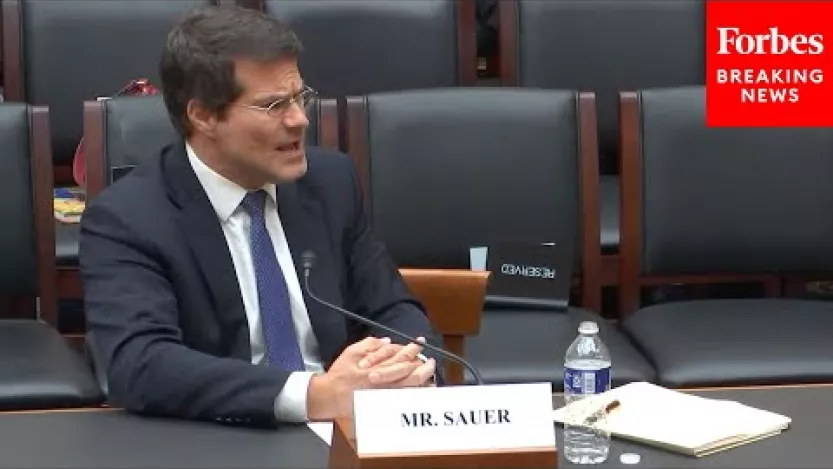
WATCH VIDEO: D. John Sauer Testifies On Censorship, Defends Former President Donald Trump
Related
- “Trump FCC chair pick stresses need to ‘restore’ First Amendment rights,” Fox News (Nov. 19)
- “Trump Names Brendan Carr, Senior GOP Leader at FCC, To Lead the Agency,” First Amendment Watch (Nov. 18)
===
an 2 25
During a confirmation hearing for nominees chosen for high-profile posts within the Department of Justice, two of President Donald Trump's appointees wouldn't rule out disobeying federal court orders.
NBC News reported Wednesday that both Aaron Reitz and Dean John Sauer (who have been nominated as assistant attorney general and solicitor general, respectively) suggested to senators that they may ignore a ruling from a federal judge that they disagree with. While neither Reitz — who is chief of staff to Sen. Ted Cruz (R-Texas) — or Sauer outright said they would ignore a ruling, both gave cagey answers and notably didn't once definitively say that they would always abide by judges' decisions.
Sauer in particular hinted that he could disregard future orders, in citing two maligned Supreme Court cases: Korematsu v. United States and Dred Scott v. Sandford. In the Korematsu decision handed down in 1944, the Supreme Court ruled that the government had the right to detain Japanese Americans in remote prison camps. In the 1857 Dred Scott case, the Court ruled that slaves did not have the same protections as citizens and lacked standing to sue in court. Both decisions have been widely regarded as some of the worst in the Supreme Court's history.
READ MORE:'Fake news': Law professor schools JD Vance after he suggests Trump ignore federal judges
"I just wonder whether some historians might think we’d be better off if it [Korematsu] hadn’t been followed," Sauer told Senate Judiciary Committee ranking member Dick Durbin (D-Ill.) during the hearing.
While Democrats and Republicans on the committee were typically divided in their support of Trump's nominees, Sen. John Neely Kennedy (R-La.) agreed with Democrats who were concerned about the possibility of DOJ officials disregarding the federal judiciary. NBC reported that Kennedy took a veiled jab at former President Joe Biden's administration in his warning to Reitz and Sauer that they shouldn't entertain the idea of disobeying federal judges. He noted that the federal bench relies on its "legitimacy" as it doesn't have an "army" at the ready to enforce its orders.
“Don’t ever, ever take the position that you’re not going to follow the order of a federal court. Ever. Now, you can disagree with it. Within the bounds of legal ethics you can criticize it. You can appeal it, or you can resign,” Kennedy said. “For four years, I have watched people in this town — not all, not, not everybody — but many try to undermine the legitimacy of the federal judiciary and it triggered each and every time my gag reflex."
Earlier this month, Vice President JD Vance opined that the Trump administration was being unfairly treated by federal judges striking down some of his executive actions, like his order attempting to repeal birthright citizenship (which is guaranteed by the Constitution) and his order freezing federal funds already appropriated by Congress from being disbursed. But the administration appears to already be flouting the latter order, as some nonprofits have said they still can't access federal grant money that had already been approved.
READ MORE:'First of many': Internet erupts after judge blocks Trump's 'blatantly unconstitutional' order
Click here to read NBC's report in full.
===
dean John Sauer (born November 13, 1974) is an American lawyer who previously served as Solicitor General of Missouri and Deputy Attorney General for Special Litigation in the U.S. state of Missouri.
Education
Sauer was born on November 13, 1974. He attended Saint Louis Priory School, a Catholic secondary day school for boys in Creve Coeur, Missouri, run by the Benedictine monks of Saint Louis Abbey. He then attended Duke University, graduating in 1997 with a double Bachelor of Arts in philosophy and Bachelor of Science in electrical engineering. He was awarded a Rhodes Scholarship to attend the University of Oxford, where he received a Bachelor of Arts in theology from Oriel College,[1] and he then earned a Master of Arts in philosophy from the University of Notre Dame.[2]
Sauer then attended Harvard Law School, where he was an articles editor of the Harvard Law Review. He graduated in 2004 with a Juris Doctor, magna cum laude.[3]
Legal career[]
After law school, Sauer was a law clerk to Judge J. Michael Luttig of the U.S. Court of Appeals for the Fourth Circuit from 2004 to 2005 and to Justice Antonin Scalia of the Supreme Court of the United States from 2005 to 2006.
Sauer worked as a litigation associate at Cooper & Kirk and then became an Assistant United States Attorney for the Eastern District of Missouri. He later reentered private practice.[4]
In 2015, Sauer defended a priest accused of sexually abusing children. Sauer helped the priest sue his accusers, including the alleged victim's mother.[5] Father Xiu Hui “Joseph” Jiang had been accused of two separate instances of sexual abuse, but prosecutors eventually dropped all charges in both cases. Sauer prevailed in the civil lawsuits related to the accusations.[6]
In January 2017, then-Missouri Attorney General Josh Hawley appointed Sauer Solicitor General of Missouri.[7]
On December 10, 2020, as Solicitor General Counsel of Record, Sauer signed the "Motion of States of Missouri, Arkansas, Louisiana, Mississippi, South Carolina, And Utah To Intervene And Proposed Bill of Complaint In Intervention" in an attempt to overturn the 2020 United States presidential election.[8] The motion sought to intervene and join the Texas Bill of Complaint (filed by Texas Attorney General Ken Paxton), to prevent the selection of presidential electors based upon the November election results in Pennsylvania, Georgia, Wisconsin, and Michigan.[9]
In January 2023, Missouri Attorney General Andrew Bailey appointed Sauer Deputy Attorney General for Special Litigation.[10][11] Sauer resigned from his post less than a month later, on January 27, 2023.[12]
In July 2023. Sauer testified before a U.S. House Subcommittee as the Louisiana Department of Justice Special Assistant Attorney General. ^[13]
Representing Donald Trump[]
On January 9, 2024, he represented former President Donald Trump in oral arguments before a panel of the U.S. Court of Appeals for the District of Columbia Circuit regarding the issue of presidential immunity in the criminal case of United States of America v. Donald J. Trump.[14]
At the hearing, in response to a hypothetical question posed by Judge Florence Y. Pan about whether a U.S. President could order SEAL Team Six to assassinate a political rival and be immune from prosecution,[15] Sauer argued that the impeachment clause in Article II, Section 4, of the Constitution[16] implies that the Senate must first impeach and convict before a president can be criminally prosecuted, and that acquittal bars prosecution.[17] Sauer stated that this type of prosecution of a former president "would authorize, for example, the indictment of President Biden in the Western District of Texas after he leaves office for mismanaging the border allegedly". ^[18]
---
no lnx
How Trump’s lawyer could steer the Supreme Court on abortion and trans rights
Joan Biskupic
By Joan Biskupic, CNN Chief Supreme Court Analyst
12 min read
Published 6:00 AM EST, Wed December 18, 2024
:
:{:{D. John Sauer testifies during a House Judiciary subcommittee hearing on Capitol Hill in Washington, DC, on July 20, 2023.}:
}:
CNN
—
President-elect Donald Trump’s choice to be the government’s top lawyer before the Supreme Court burst on the national scene about a year ago and is best known for winning Trump immunity from prosecution for election subversion.
But D. John Sauer has been an unswerving, if low-profile, foot soldier in America’s culture wars for more than a decade.
The nominee for US solicitor general has opposed abortion rights, birth-control access and same-sex marriage. He backed efforts to overturn Trump’s election defeat in 2020 and last year was one of the most prominent conservatives arguing that the Biden administration censored right-wing views about Covid-19 and vaccines.
Chief Justice of the United States John Roberts attends the State of the Union address on February 7, 2023.
Related article
Analysis: John Roberts leads the charge to uphold bans on trans care
Now, he is poised to become one of the most powerful lawyers in the country, representing the Trump administration before a conservative bench that could be even more open to the president’s agenda than the first time. Three of the nine justices were appointed by Trump during his first term.
The confluence of Sauer’s experience, his personal tie to Trump and the transformed court he will face could lead to some of the most ambitious advocacy on behalf of an administration in decades.
Sauer has already been at the lead of litigation over transgender rights, which was one of the flashpoints of the presidential race and at the center of the most closely watched case of the current term.
Within 48 hours of Trump’s November 14 selection of Sauer for the solicitor general post, Sauer appeared on a previously scheduled Federalist Society panel in Washington entitled “Sex, Gender, and the Law.” He spoke about a case he’d recently appealed to the Supreme Court on behalf of Arizona legislators who want to keep transgender girls and women from playing on female sports teams. (A federal appellate court blocked Arizona’s “Save Women’s Sports Act,” in the case brought by two transgender girls who wanted to play girls’ sports at their schools, finding that the prohibition violated the Constitution’s guarantee of equal protection.)
In the general comments he offered, Sauer emphasized that lower courts are divided over the level of constitutional coverage for transgender people alleging discrimination and that legal battles are bound to continue.
Earlier this month, the justices heard arguments on whether states may ban gender-affirming treatment for children experiencing gender dysphoria, that is, distress over an identity that does not match their sex at birth. The Biden administration had petitioned the justices to take the case after a US appellate court upheld bans in Tennessee and Kentucky.
One of the first challenges for the new US solicitor general will be to alert the justices to a new Trump position. The incoming administration may not want to withdraw the petition or otherwise slow down the court’s consideration of the case, US v. Skrmetti, since the justices appeared ready to uphold the bans.
Sauer declined a CNN interview request for this story.
The 50-year-old nominee is a Harvard Law grad and Rhodes scholar who served as a law clerk for the late Justice Antonin Scalia and eventually became Missouri state solicitor general.
He shunned the sometimes-confining world of corporate law that many lawyers of his pedigree choose. As a result, Sauer, intensely conservative and a committed Catholic, has been able to chart his own course in the law. He remained largely under the radar until the Trump representation.
After his nomination, Rebecca Hart Holder, president of Reproductive Equity Now, a Boston-based national abortion rights group, raised concerns about where Sauer would take the federal government on reproductive rights, for example, related to emergency-room services for pregnant women experiencing complications. The Biden administration has argued in recent lawsuits that the 1986 Emergency Medical Treatment and Labor Act (EMTALA) ensures emergency abortion care.
“The fact that President Trump is nominating a very well-educated conservative attorney who has made attacking abortion rights one of the cornerstones of his career is deeply troubling,” Holder told CNN, “He is an attorney who will go after not just the right to access to abortion but also, really, surveillance of people who could be seeking abortion care.”
During Sauer’s time as Missouri solicitor general, a state health director reportedly gathered information on menstrual cycles and pregnancies. The information emerged in a 2019 hearing over the state’s effort to deny Planned Parenthood a license to perform abortions.
This year, according to Missouri Ethics Commission figures, Sauer contributed $777,000 to the Missouri Right to Life political action committee and two other groups opposed to a ballot measure, known as Amendment 3, to ensure abortion rights in the state.
Among those ready to praise Sauer’s nomination was former US appellate judge Michael Luttig, who otherwise is an unrelenting critic of Trump and the Supreme Court’s decision to give him substantial immunity from prosecution.
Sketch artist William J. Hennessy Jr. sketches a scene from the senate impeachment trial of President Donald Trump in the US Capitol on Thursday, January 30, 2020.
Sauer was as a law clerk to Luttig, who sat on the Richmond-based US based appellate court, before Sauer served in the chambers of Scalia, a conservative icon who died in 2016.
“He is a man of great faith and great principle,” Luttig said of Sauer, “He has stayed close to his roots in all respects. He is devoted to his family.” Luttig has declared Trump v. United States a mistake akin to the 1857 Dred Scott decision that denied Black people citizenship. But he lays it at the feet of the justices, not Sauer.
Yet it is precisely the case that has catapulted Sauer to one of the most powerful and prestigious legal positions in any administration.
When Trump announced the solicitor general nomination on November 14, his statement referred to Sauer “winning a Historic Victory on Presidential Immunity, which was key to defeating the unconstitutional campaign of Lawfare against me and the entire MAGA Movement.”
Clerkships and anti-abortion efforts
The SG, as the position is known colloquially, decides which of the government’s legal losses in lower courts to appeal and then defends the administration before the nine justices.
Most visibly, the SG stands at a mahogany lectern, before the nine justices on their elevated bench. The men who have taken the role (and all but two SGs in history have been men) wear the traditional garb of grey morning coat and grey striped trousers.
The post is currently held by Biden appointee Elizabeth Prelogar; the first woman SG was Elena Kagan, who served for a year before President Barack Obama appointed her to the Supreme Court in 2010.
Sauer’s appointment breaks a pattern of SGs chosen from large corporate law firms or high-ranking academic positions. In his first presidential term, Trump chose Noel Francisco of the global Jones Day firm.
Related article
Supreme Court says it will review if Catholic Charities is exempt from labor taxes in a major church-state case
After his judicial clerkships, Sauer worked briefly for the small but influential conservative firm of Cooper Kirk, then spent five years as an assistant US attorney in the eastern district of Missouri. He then worked for small firms and eventually founded his own law group named after James Otis, a leading political and legal activist of the colonial era who developed foundational views of a limited government and individual property rights. Sauer was captivated in his childhood by the portrayal of Otis in the Revolutionary War classic work, “Johnny Tremain.”
In private practice, Sauer wrote briefs backing abortion restrictions and arguing against the Obamacare contraceptive mandate.
He represented 67 Catholic theologians and ethicists on the side of Hobby Lobby Stores, challenging the Affordable Care Act’s birth-control insurance regulation for employers.
“The Mandate,” Sauer wrote in the 2014 case, “imposes a substantial burden on the religious freedom of Catholic employers and other religious believers who object on religious grounds to providing insurance coverage for abortifacients, elective sterilization, and/or contraceptives, and for education and counseling designed to encourage the use of such services. … (T)he Mandate thrusts Catholic and other religious employers into a ‘perfect storm’ of moral complicity in the forbidden actions.”
The Supreme Court sided with the challengers in a 5-4 decision.
Sauer also represented members of Congress who opposed same-sex marriage, in a case that eventually led to the Supreme Court’s 2015 landmark Obergefell v. Hodges decision creating a fundamental right to gay and lesbian unions. The following year, he wrote a brief for a group of conservative scholars in support of a restrictive Texas abortion law. The Supreme Court in June 2016 struck down the regulations as an undue burden on a woman’s right to end a pregnancy, in Whole Woman’s Health v. Hellerstedt.
From 2017 to 2023, Sauer served as the Missouri state solicitor, first taking the position at the urging of then attorney general (and now US senator) Josh Hawley. He joined with other Republican-run states in briefs to the high court against federal Covid vaccine mandates for certain health care workers and against abortion rights, including in the Dobbs v. Jackson Women’s Health Organization case that led to the reversal of Roe v. Wade in 2022.
During Sauer’s tenure as state solicitor general, he defended Missouri capital cases, including one that went all the way to the Supreme Court. That case, Bucklew v. Precythe, was brought by a convicted murderer challenging the state’s lethal injection protocol. The state won in a 5-4 decision.
The square-jawed Sauer keeps his dark hair closely cropped and wears small oval shaped wire-rimmed glasses. He exudes a buttoned-down restraint but can become animated on all manner of topics.
“He’s a very well-read person with a ton of interests, from the sacred to the profane, almost literally,” said John Demers, who was a co-clerk in the Scalia chambers nearly 20 years ago and has stayed friends through the years. Demers, a vice president at Boeing, was an assistant attorney general for the National Security Division in the first Trump administration.
“He’s a practicing Catholic and we share that piece in common,” Demers said. “He can talk about theology, and he can talk to you about ‘South Park.’”
WASHINGTON, DC - DECEMBER 04: A transgender rights supporter takes part in a rally outside of the U.S. Supreme Court as the high court hears arguments in a case on transgender health rights on December 04, 2024 in Washington, DC. The Supreme Court is hearing arguments in US v. Skrmetti, a case about Tennessee's law banning gender-affirming care for minors and if it violates the Constitution’s equal protection guarantee. (Photo by Kevin Dietsch/Getty Images)
Protestors speak out as Supreme Court hears gender-affirming care case
01:20
Sauer’s argument style can be similarly animated with moments of drama.
When he appeared before a federal appellate court in 2023 for the state of Louisiana (after leaving the Missouri SG post) in a challenge to the Biden administration’s social media practices, he spoke rapidly and emphatically.
At one point, his voice intensified with a personal claim that he had been censored after talking about the case in a recorded law office presentation: “The notion that Covid censorship is over is totally unsupportable. Two weeks ago, I gave a talk about this very case … criticizing federal government censorship.” He said the video had been posted on social media but then removed. “I was censored as a lawyer for the Louisiana attorney general,” he said, offering no further explanation nor being pressed on it by the judges hearing the case.
When the social media case later went to the Supreme Court, the justices by a 6-3 vote rejected that position, put forward by two states and five social-media users. Justice Amy Coney Barrett wrote that the challengers had failed to demonstrate that they were injured by any administration actions.
Deep roots in Missouri
Sauer’s first name is Dean, but he has always gone by his middle name of John. He attended a Catholic grade school and then Saint Louis Priory, a Benedictine monk-run boys’ secondary school. He went to Duke on an academic scholarship and became captain of the varsity wrestling team. Before studying at Harvard Law School, he was a Rhodes scholar, attending Oriel College at the University of Oxford.
Sauer’s family goes back several generations in Missouri. He and his wife have five young children. Associates say he is still deciding whether to move the family to Washington, DC.
Sauer’s father, Fred, founded an investment firm and became president of Missouri Roundtable for Life, a cause to which John has contributed. (Fred Sauer ran unsuccessfully for the Republican nomination for governor in 2012.)
John Sauer also contributed heavily to the Missouri Right to Life PAC this year as the group was fighting the ballot measure to establish a right to abortion in the state’s constitution. Voters approved Amendment 3, which overturned a state ban and gave residents a right to end a pregnancy up to the point that a fetus would be viable, that is, live outside the woman.
Since Sauer’s time as a state solicitor general, he has been active in numerous red state litigation efforts.
After the 2020 presidential election, he joined with a handful of other Republican state lawyers to challenge the election results that gave Joe Biden the White House. He shepherded a brief on behalf of six states that sought to intervene in the case first filed by Texas against Pennsylvania and other swing states that favored Biden. (The Supreme Court declined to hear the case.)
Trump v. United States
Sauer came to real national prominence at the end of 2023, when he represented Trump’s defense to charges brought by Department of Justice special counsel Jack Smith, who had accused the former president of election fraud, conspiracy and other offenses that culminated in the January 6, 2021, attack on the Capitol.
He was connected to Trump by Will Scharf, who was working in Missouri with Sauer and has since been designated by Trump to be White House staff secretary.
A courtroom sketch of a White man in a suit arguing in front of the Supreme Court.
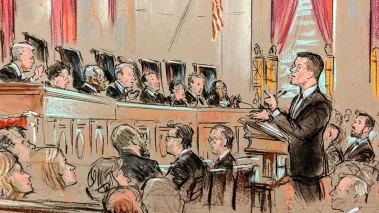
In this sketch from court, D. John Sauer argues before the US Supreme Court over whether former President Donald Trump is immune from criminal prosecution in Washington, DC, on Thursday, April 25, 2024. Bill Hennessy
Scharf recounted a call from Trump in August 2023 in an interview with the Missouri Independent, “His legal team was looking to bring on a dedicated appellate team, and the president just called me and asked me if that was something that I was interested in.” Scharf said he, Sauer, and another lawyer “pitched the campaign the way you would pitch any client, and a couple days later, they hired us. And we’ve been working for the president ever since.”
Sauer presented oral arguments before the DC Circuit and then Supreme Court on behalf of Trump. His ardent claims for presidential immunity extended famously in the lower court even to a situation when a president would order Seal Team Six to kill a political opponent.
Before the justices in arguments last April, Sauer defended Trump on constitutional principles, as well as against the specific details of the election-subversion charges.
20240729-roberts-immunity-supreme-court-ruling-gfx-final.jpg
Related article
Exclusive: The inside story of John Roberts and Trump’s immunity win at the Supreme Court
When confronted with the allegations that Trump helped create a “fraudulent slate” of presidential electors in the states, Sauer interjected: “so-called fraudulent electors.” He said referring to them as “fraudulent” amounted to “a complete mischaracterization.”
“On the face of the indictment,” he told the justices, “it appears that there was no deceit about who had emerged from the relevant state conventions, and this was being done as an alternative basis.”
He brushed aside any suggestion of wrongdoing by Trump in the states, despite that Smith’s indictment said Trump had “organized fraudulent slates of electors” to “obstruct the certification of the presidential election.” (State prosecutions related to 2020 fraudulent electors are ongoing.)
Sauer told the justices Trump “absolutely” had a right to put forward alternate Republican electors.
More broadly, Sauer asserted, “Without presidential immunity from criminal prosecution, there can be no presidency as we know it.”
It turned out the Supreme Court, where he could soon regularly appear as solicitor general, agreed.
---
ggl 10 25
[### D. John Sauer - Solicitor General, Missouri

The Federalist Society
https://fedsoc.org › bio › d-john-sauer](https://fedsoc.org/bio/d-john-sauer)
D. John Sauer has served as the Solicitor General of Missouri since 2017. Before that, he served as a federal prosecutor for five years and spent time in ...

[### D. John Sauer

The Federalist Society
https://fedsoc.org › ttd-topics › d-john-sauer](https://fedsoc.org/ttd-topics/d-john-sauer)
The Future of Class Actions after Oral Argument in Trump v. CASA · Brian T. Fitzpatrick. Many people have asked me in the days after the Supreme Court argument ...
[### Dean John Sauer - Solicitor General of the United States

Senate Committee on the Judiciary (.gov)
https://www.judiciary.senate.gov › doc › sauer_sjq](https://www.judiciary.senate.gov/imo/media/doc/sauer_sjq.pdf)
Feb 25, 2025 — The Federalist Society, Mississippi Lawyer's Chapter, Liberty Luncheon: Is Common Core. Constitutional? (Jackson, MS, Mar. 27, 2015). I gave ...
[### Hans Sauer

The Federalist Society
https://fedsoc.org › bio › hans-sauer](https://fedsoc.org/bio/hans-sauer)
Jun 3, 2013 — Hans Sauer is Deputy General Counsel for Intellectual Property for the Biotechnology Industry Organization, a major trade association ...
[### Federalist Society on X: ".@jacklgoldsmith wrote about the ...

x.com
https://x.com › FedSoc › status](https://x.com/FedSoc/status/1924465070811087076)
wrote about the significance of Solicitor General John Sauer's pledge to recognize Supreme Court precedent as binding in last week's oral argument.
[### Sources: D. John Sauer Conflicts of Interest

Public Citizen
https://www.citizen.org › sources-d-john-sauer-conflicts-...](https://www.citizen.org/sources-d-john-sauer-conflicts-of-interest/)
... lawyer pushed to limit abortion. Now he's Trump's solicitor general pick. November 19, 2024. The Federalist Society, D. John Sauer. Stay Updated on Public ...
[### Inside the Oral Argument of Trump v. CASA: Will the Court ...

The Federalist Society
https://fedsoc.org › commentary › fedsoc-blog › inside-...](https://fedsoc.org/commentary/fedsoc-blog/inside-the-oral-argument-of-trump-v-casa-will-the-court-rein-in-universal-injunctions)
Jun 3, 2025 — Representing the federal government, Solicitor General John Sauer advanced a historically grounded argument against universal injunctions. His ...
[### How Trump's lawyer could steer the Supreme Court on ...

CNN
https://www.cnn.com › 2024/12/18 › politics › john-sa...](https://www.cnn.com/2024/12/18/politics/john-sauer-trump-solicitor-general-profile)
Dec 18, 2024 — Sauer has already been at the lead of litigation over transgender rights, which was one of the flashpoints of the presidential race and at the ...
---