problem solvers caucus
see no labels
manchinema?
related?
===}:
an 9 24
Democratic election lawyer Marc Elias, publisher of Democracy Docket, has been warning that if Vice President Kamala Harris defeats former President Donald Trump in November, far-right MAGA Republicans will try everything they can to overturn the election results. And those Trump loyalists, according to Elias, are much better organized in 2024 than they were in 2020.
Not all Republicans, however, are on board with election denialism. And some U.S. House Republicans, according to Politico's Sarah Ferris, have "signed a bipartisan pledge to uphold the results of the 2024 election."
More than 30 lawmakers serving in the U.S. House of Representatives, Ferris reports, signed the pledge. Most were Democrats, but a "half dozen" were Republicans — including Rep. Don Bacon (R-Nebraska), who organized the effort with Rep. Josh Gottheimer (D-New Jersey).
READ MORE:The MAGA plot to steal 2024 election is on a 'different level than 2020': experts
Other House Republicans who signed the pledge included Rep. Brian Fitzpatrick of Pennsylvania, Rep. Lori Chavez-DeRemer of Oregon, and Reps. Mike Lawler, Nick LaLota and Anthony D'Esposito of New York State.
Bacon, in an official statement, said, "In America, we respect election results, especially once the courts and appeals work through the process. We fight hard to win during campaigns and then respect the results when the votes are counted."
Ferris notes that Trump "has continued to insist that he did not lose the election in 2020" and has been "stoking fear that he may again encourage his supporters to block certification of the election next January if he loses for a second time."
"None of the six Republicans who signed the pledge voted against certifying the 2020 election on January 6, 2021," the Politico reporter observes. "Several of them were not yet in office. A total of 139 House Republicans did vote against certifying President Joe Biden's victory.
READ MORE:['Nothing is off the table': Trump plans for 'bureaucratic bullying' of enemies if he wins
*Read Politico's full article at this link.
===
===
Problem Solvers Caucus is a bipartisan group in the United States House of Representatives that includes 58 members, equally divided between Democrats and Republicans, who seek to foster bipartisan cooperation on key policy issues. Created in January 2017, the group is currently co-chaired by Josh Gottheimer (D-NJ) and Brian Fitzpatrick (R-PA).[5]
- :{:(style="display:table-cell;padding-left:0px;padding-right:0.5em"):}::{History}:
- :{1.1:(style="display:table-cell;padding-left:0px;padding-right:0.5em"):}::{Healthcare reform}:
- :{1.2:(style="display:table-cell;padding-left:0px;padding-right:0.5em"):}::{Congressional rules reform}:
- :{1.3:(style="display:table-cell;padding-left:0px;padding-right:0.5em"):}::{COVID-19 relief}:
- :{1.4:(style="display:table-cell;padding-left:0px;padding-right:0.5em"):}::{Capitol riot and reaction}:
- :{2:(style="display:table-cell;padding-left:0px;padding-right:0.5em"):}::{List of Co-Chairs}:
- :{3:(style="display:table-cell;padding-left:0px;padding-right:0.5em"):}::{Membership}:
- :{4:(style="display:table-cell;padding-left:0px;padding-right:0.5em"):}::{Media coverage}:
- :{5:(style="display:table-cell;padding-left:0px;padding-right:0.5em"):}::{References}:
History[
[ ](https://en.wikipedia.org/wiki/File:Problem_Solvers_Caucus_-_2020-02-12.jpg)
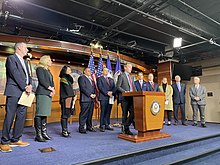
Problem Solvers Caucus hosting a press conference in 2020

The Problem Solvers Caucus developed over time as an outgrowth of informal meetings organized by the political reform group...No Labels. No Labels spent years on Capitol Hill working to get members in a room to talk with colleagues from the other party. These informal “get to know you” meetings led to more substantive cooperation across the aisle, including the introduction of nine bipartisan bills to reduce government waste and inefficiency, and the passage of the No Budget, No Pay Act of 2013 and theMedicare “doc fix” in 2015.[6][7][8]
Over time, No Labels continued to organize members into a more cohesive group and eventually branded the group the “Problem Solvers” and recruited its first two co-chairs, Rep. Reid Ribble (R-WI) and Rep. Kurt Schrader (D-OR).[9] This group of members organized by No Labels also signed a resolution (H.R. 207) calling for both parties to unify behind a National Strategic Agenda with four goals focused on: job creation, balancing the budget, securing Medicare and Social Security, and energy security.[10]
The early iteration of the Problem Solvers group was promising, but it lacked the cohesion of groups on the left and right like the Progressive Caucus and Freedom Caucus. That began to change at the outset of 115th Congress when the Problem Solvers registered as an independent member-driven Caucus.[11]
Writing in The New York Times about the Problem Solvers Caucus, then co-chairs Reed and Gottheimer said: "We all knew the partisanship in Washington had gotten out of control and felt the need to create a bipartisan group committed to getting to "yes" on important issues. We have agreed to vote together for any policy proposal that garners the support of 75 percent of the entire Problem Solvers Caucus, as well as 51 percent of both the Democrats and Republicans in the caucus."[12]
Today, the Problem Solvers Caucus is co-chaired by Rep. Josh Gottheimer (D-NJ) and Rep. Brian Fitzpatrick (R-PA), and counts 58 members evenly divided between the parties, who are working to forge bipartisan solutions to America’s toughest challenges.[5]
Healthcare reform[
During the week of August 4, 2017, the 43-member House Problem Solvers Caucus released a compromise to shore up the struggling insurance exchanges. The proposal focused on the skyrocketing cost of individual health insurance premiums. At the time, the Trump administration considered suspending cost-sharing payments that defray out-of-pocket payments like deductibles and co-payments, a move which insurers said could cause premiums to rise by 15 percent or more.[13]
The second part of the Problem Solvers plan would have provided relief to help states deal with the high cost of pre-existing and chronic conditions. The relief is provided through a dedicated stability fund that states could use to reduce premiums and limit losses for providing coverage for these high-cost patients. The third part of the plan provides relief to certain businesses from the mandate that they provide insurance to full-time employees. It also defines "full time" as a 40-hour workweek to discourage businesses from manipulating employees’ weekly hours to skirt the mandate.[12]
The plan would have also eliminated the Medical Device Tax, an excise charge of 2.3 percent, which opponents claim is passed onto consumers and reduces funds for research and development.[13]
Congressional rules reform:{:(style="margin-right:0.25em"):}:[edit:{]}:
After the 2018 Midterm elections, the Problem Solvers Caucus and House Democratic Leadership negotiated a package that reformed the rules of the House. The initiative, entitled "Break the Gridlock", gives bipartisan ideas a fair hearing on the House floor and encourages legislation through compromise.[14]
COVID-19 relief[
In September 2020, the Problem Solvers released their "March to Common Ground" COVID-19 relief package, an outline for a Congressional bi-partisan compromise that showed that members of both parties were willing to listen to each other in order to craft legislation.[15]
Capitol riot and reaction[
On May 18, 2021, the Problem Solvers Caucus endorsed bipartisan legislation to investigate the attack on the Capitol.[16] However, the next day only 18 of 28 Republican Problem Solvers voted in support of creating a bipartisan commission to lead the investigation.[17]
List of Co-Chairs:{:(style="margin-right:0.25em"):}:[edit:{]}:
| Term Start | Term End | Democratic Co-Chair | Republican Co-Chair |
|---|---|---|---|
| 2017 | 2019 | Josh Gottheimer (D-NJ) | Tom Reed (R-NY) |
| 2019 | 2021 | 2021 | 2021 |
| 2021 | present | Brian Fitzpatrick (R-PA) | Brian Fitzpatrick (R-PA) |
Membership:{:(style="margin-right:0.25em"):}:[edit:{]}:

Problem Solvers Caucus in the 117th United States Congress.
Republican Problem Solvers caucus member
This group include 58 members: 29 Democrats and 29 Republicans.[18][19]
Democrats[
- Carolyn Bourdeaux of Georgia
- Salud Carbajal of California
- Ed Case of Hawaii
- Lou Correa of California
- Jim Costa of California
- Debbie Dingell of Michigan
- Jared Golden of Maine
- Vicente González of Texas
- Josh **Gottheimer**of New Jersey
- Josh Harder of California
- Steven Horsford of Nevada
- Chrissy Houlahan of Pennsylvania
- Conor Lamb of Pennsylvania
- Susie Lee of Nevada
- Elaine Luria of Virginia
- Tom Malinowski of New Jersey
- Stephanie Murphy of Florida
- Tom O'Halleran of Arizona
- Jimmy Panetta of California
- Chris Pappas of New Hampshire
- Scott Peters of California
- Dean Phillips of Minnesota
- Bradley Schneider of Illinois
- Kurt Schrader of Oregon
- Elissa Slotkin of Michigan
- Darren Soto of Florida
- Abigail Spanberger of Virginia
- Haley Stevens of Michigan
- Tom Suozzi of New York
Republicans[
- Mark Amodei of Nevada
- Don Bacon of Nebraska
- Mike Bost of Illinois
- Ben Cline of Virginia
- John Curtis of Utah
- Brian Fitzpatrick of Pennsylvania
- Mike Gallagher of Wisconsin
- Andrew Garbarino of New York
- Tony Gonzales of Texas
- Anthony Gonzalez of Ohio
- Jenniffer Gonzalez of Puerto Rico
- Jaime Herrera Beutler of Washington
- Bill Johnson of Ohio
- Dusty Johnson of South Dakota
- David Joyce of Ohio
- JohnKatko of New York
- Young Kim of California
- Peter Meijer of Michigan
- Daniel Meuser of Pennsylvania
- Blake Moore of Utah
- Tom Reed of New York
- Tom Rice of South Carolina
- Maria Elvira Salazar of Florida
- Chris Smith of New Jersey
- Pete Stauber of Minnesota
- Bryan Steil of Wisconsin
- Van Taylor of Texas
- Fred Upton of Michigan
- David Valadao of California
Former members[
Democrats[
- Anthony Brindisi of New York (lost reelection in 2020)[20]
- Joe Cunningham of South Carolina (lost reelection in 2020)[21]
- Elizabeth Esty of Connecticut (did not seek reelection in 2018)[22]
- Kendra Horn of Oklahoma (lost reelection in 2020)[23]
- Daniel Lipinski of Illinois (lost Democratic nomination in 2020)[24]
- Ben McAdams of Utah (lost reelection in 2020)[25]
- Richard Nolan of Minnesota (did not seek reelection in 2018)[26]
- Jared Polis of Colorado (elected Governor of Colorado in 2018)[27]
- Jacky Rosen of Nevada (elected to United States Senate in 2018)[28]
- Max Rose of New York (lost reelection in 2020)[29]
- Peter Welch of Vermont (Remains in office. Previously a member, but uncertain current membership status.)[30]
- Kyrsten Sinema of Arizona (elected to United States Senate in 2018)[31]
Republicans[
- Mike Coffman of Colorado (lost reelection in 2018)[32]
- Ryan Costello of Pennsylvania (did not seek reelection in 2018)[33]
- Carlos Curbelo of Florida (lost reelection in 2018)[34]
- Charlie Dent of Pennsylvania (resigned in 2018)[35]
- John Faso of New York (lost reelection in 2018)[36]
- Will Hurd of Texas (did not seek reelection in 2020)[37]
- Lynn Jenkins of Kansas (did not seek reelection in 2018)[38]
- Tom MacArthur of New Jersey (lost reelection in 2018)[39]
- Patrick Meehan of Pennsylvania (resigned in 2018)[40]
- Illeana Ros Lehtinen of Florida (did not seek reelection in 2018)[41]
- Glenn Thompson of Pennsylvania (Remains in office. Previously a member, but uncertain current membership status.)
- Dave Trott of Michigan (did not seek reelection in 2018)[42]
- David Young of Iowa (lost reelection in 2018)[43]
- Steve Watkins of Kansas (lost Republican nomination in 2020)[44]
Media coverage[
The Problem Solvers Caucus has been finding itself in the middle of several key battles and is "proving to be a force on Capitol Hill, one that's willing to leave some bruises in its wake but also to make common cause with its natural Senate allies".[45]
Mark Pocan, a former caucus member and co-chair of the Congressional Progressive Caucus, a left-leaning organization, says he was "duped" by No Labels and the PSC, saying that rather than "breaking gridlock", it is "a fast track for special interests and lobbyists."[46]
References[
- ^ Nilsen, Ella (November 26, 2018). "Nancy Pelosi's Problem Solvers Caucus problem, explained". Vox. Retrieved August 5, 2019.
- ^ Laslo, Matt (April 20, 2019). "U.S. House Democrats say squabbles are healthy sign as they move past 100 days". WHYY-TV. NPR. Retrieved August 5, 2019.
- ^ Cannon, Carl M. (March 25, 2018). "Tiny Tent Political Parties". RealClearPolitics. Retrieved August 6, 2019.
- ^ "Centrist lawmakers band together to demand House reforms for the next speaker". The Washington Post. Retrieved August 5, 2019.
- ^ :{Jump up to::(style="user-select:none;top:-99999px;clip:rect(1px, 1px, 1px, 1px);overflow:hidden;position:absolute !important;padding:0px !important;border:0px !important;height:1px !important;width:1px !important"):}:^a b(https://en.wikipedia.org/wiki/Problem_Solvers_Caucus#cite_ref-:2_5-1) "Our Co-Chairs". Problem Solvers Caucus. Retrieved May 3, 2021.
- ^ "Members of Congress introduce bipartisan legislation as the 'Problem Solvers':{"}:. Washington Post. ISSN 0190-8286. Retrieved 2021-07-17.
- ^ Brooks, David (2016-11-29). "Opinion | The Future of the American Center". The New York Times. ISSN 0362-4331. Retrieved 2021-07-17.
- ^ Camp, Dave (2013-02-04). "H.R.325 – 113th Congress (2013–2014): No Budget, No Pay Act of 2013". www.congress.gov. Retrieved 2021-07-17.
- ^ Cusack, Bob (2014-07-16). "New congressional caucus disavows 'kindergarten-style theatrics':{"}:. TheHill. Retrieved 2021-07-17.
- ^ Reed, Tom (2015-04-21). "H.Res.207 – 114th Congress (2015–2016): Expressing the sense of the House of Representatives regarding establishing a National Strategic Agenda". www.congress.gov. Retrieved 2021-07-17.
- ^ "Reed joins Congressional Problem Solvers Caucus". observertoday.com. Retrieved 2021-07-17.
- ^ :{Jump up to::(style="user-select:none;top:-99999px;clip:rect(1px, 1px, 1px, 1px);overflow:hidden;position:absolute !important;padding:0px !important;border:0px !important;height:1px !important;width:1px !important"):}:^a b(https://en.wikipedia.org/wiki/Problem_Solvers_Caucus#cite_ref-:0_12-1) Gottheimer, Josh; Reed, Tom (2017-08-04). "Let's Stop the Bickering and Fix the Health Care System". The New York Times. ISSN 0362-4331. Retrieved 2017-08-12.
- ^ :{Jump up to::(style="user-select:none;top:-99999px;clip:rect(1px, 1px, 1px, 1px);overflow:hidden;position:absolute !important;padding:0px !important;border:0px !important;height:1px !important;width:1px !important"):}:^a b(https://en.wikipedia.org/wiki/Problem_Solvers_Caucus#cite_ref-:1_13-1) Gottheimer, Josh; Reed, Tom (2017-08-04). "Opinion | Let's Stop the Bickering and Fix the Health Care System". The New York Times. ISSN 0362-4331. Retrieved 2020-05-24.
- ^ "The Democratic House wants to reform democracy. It's not a panacea — but it's a start". Washington Post. January 3, 2019.
- ^ The Editorial Board. "Editorial: Who's ready for some bipartisanship in D.C.? We can dream". chicagotribune.com. Retrieved 2020-12-23.
- ^ https://problemsolverscaucus.house.gov/media/press-releases/problem-solvers-caucus-endorses-bipartisan-legislation-investigate-jan-6-attack
- ^ https://clerk.house.gov/Votes/2021154
- ^ "Featured Members". Problem Solvers Caucus. Retrieved 2021-03-28.
- ^ Problem Solvers Caucus Announces New Members for 117th Congress | Problem Solvers Caucus
- ^ "Problem Solvers Caucus' $1.5 trillion coronavirus aid plan gains traction in House". syracuse.com. 2020-09-15. Retrieved 2021-07-15.
- ^ "Column: How Joe Cunningham lost". Daily Game Cock. Retrieved November 18, 2020.
- ^ "Rep. Elizabeth Esty Won't Seek Re-Election in Wake of Abusive Staffer Disclosures". Roll Call. Retrieved 2020-05-24.
- ^ "Rep. Kendra Horn discusses losing the race for Oklahoma's 5th Congressional District". Koco. Retrieved November 16, 2020.
- ^ "Anti-abortion Democrat Rep. Dan Lipinski Loses Primary". US News. Retrieved March 18, 2020.
- ^ "Ben McAdams Concedes to Burgess Owens". Washntion Times. Retrieved November 16, 2020.
- ^ Eric Bradner; Terence Burlij. "Dem's retirement gives Republicans a pickup opportunity". CNN. Retrieved 2020-05-24.
- ^ Schneier, Matthew (2019-01-09). "Colorado's Got a Gay Governor. Who Cares?". The New York Times. ISSN 0362-4331. Retrieved 2020-05-24.
- ^ Dixon, Darius. "Jacky Rosen unseats Dean Heller in Nevada Senate race". POLITICO. Retrieved 2020-05-24.
- ^ "Rep. Max Rose concedes congressional race to Nicole Malliotakis after bitter campaign". New York Post. Retrieved November 12, 2020.
- ^ "Problem Solvers Caucus creates problem for Nancy Pelosi". 2018-11-24. Retrieved 2020-05-24.
- ^ Romero, Simon (2018-11-12). "Kyrsten Sinema Declared Winner in Arizona Senate Race". The New York Times. ISSN 0362-4331. Retrieved 2020-05-24.
- ^ Swanson, Ian (2018-11-06). "Coffman loses GOP seat in Colorado". TheHill. Retrieved 2020-05-24.
- ^ Pramuk, Jacob (2018-03-26). "Republican Rep. Ryan Costello will retire, making it tougher for GOP to hold House majority". CNBC. Retrieved 2020-05-24.
- ^ Harder, Amy. "Carlos Curbelo, Republican leader on climate, loses tight Florida race". Axios. Retrieved 2020-05-24.
- ^ Cheney, Kyle; Schneider, Elena. "Dent resigns, to leave Congress next month". POLITICO. Retrieved 2020-05-24.
- ^ Foderaro, Lisa W. (2018-11-07). "Antonio Delgado Upsets John Faso as 3 House Republicans Fall to N.Y. Democrats". The New York Times. ISSN 0362-4331. Retrieved 2020-05-24.
- ^ Cochrane, Emily. "Will Hurd, Only Black Republican in House, Is Retiring From Congress". New York Times. Retrieved August 1, 2019.
- ^ Marcos, Cristina (2017-01-25). "Rep. Jenkins retiring from public office in 2018". TheHill. Retrieved 2020-05-24.
- ^ Hellmann, Jessie (2018-11-14). "MacArthur loses New Jersey House race to Democratic challenger Andy Kim". TheHill. Retrieved 2020-05-24.
- ^ Levy, Marc; Fram, Alan. "U.S. Rep. Pat Meehan resigns after sexual harassment charge". mcall.com. Retrieved 2020-05-24.
- ^ "Rep. Ileana Ros-Lehtinen, 1st Cuban-American in Congress, to retire". The Denver Post. The Associated Press. 2017-04-30. Retrieved 2020-05-24.
- ^ Burke, Melissa Nann. "Insider: GOP Rep. Trott retires to avoid 'dialing for dollars':{"}:. Detroit News. Retrieved 2020-05-24.
- ^ Ta, Linh. "Republican Rep. David Young in defeat: 'Tonight the people, unfortunately, didn't choose our ideas':{"}:. Des Moines Register. Retrieved 2020-05-24.
- ^ Axelrod, Tod. "Rep. Steve Watkins loses Kansas primary after voter fraud charges". The Hill. Retrieved August 9, 2020.
- ^ "Tom Reed's 'Problem Solvers' solve a problem, making enemies and friends in the process". The Buffalo News. 2019-07-08. Retrieved 2020-05-04.
- ^ Pocan, Rep Mark (2018-12-04). ":{'No Labels' Needs A Warning Label"}:. Huffington Post. Retrieved 2018-12-05.
show <ul style="list-style-image: url(" w="w" skins="skins" vector="Vector" resources="resources" common="common" images="images" bullet-icon.svg="bullet-icon.svg" d4515="d4515" margin="margin" px="px" padding="padding" display="display" inline-block="inline-block" white-space="white-space" nowrap="nowrap" line-height="line-height" inherit="inherit"><font size="4" face="Times New Roman"></font><li class="nv-view" style="margin: 0px; display: inline; word-spacing: -0.125em;"><font size="4" face="Times New Roman"><font size="4" face="Times New Roman"><font size="4" face="Times New Roman"><font size="4" face="Times New Roman"><a href="https://en.wikipedia.org/wiki/Template:Ideological_caucuses_in_the_U.S._Congress" title="Template:Ideological caucuses in the U.S. Congress" style="text-decoration-line: none; background: none;"><abbr title="View this template" style="border: none; cursor: inherit; text-decoration: inherit; font-variant-numeric: normal; font-variant-east-asian: normal; font-variant-caps: small-caps; background: none transparent; box-shadow: none; padding: 0px;">v</abbr></a></font></font></font></font></li><li class="nv-talk" style="margin: 0px; display: inline; word-spacing: -0.125em;"><a href="https://en.wikipedia.org/wiki/Template_talk:Ideological_caucuses_in_the_U.S._Congress" title="Template talk:Ideological caucuses in the U.S. Congress" style="text-decoration-line: none; background: none;"><abbr title="Discuss this template" style="border: none; cursor: inherit; text-decoration: inherit; font-variant-numeric: normal; font-variant-east-asian: normal; font-variant-caps: small-caps; background: none transparent; box-shadow: none; padding: 0px;">t</abbr></a></li><li class="nv-edit" style="margin: 0px; display: inline; word-spacing: -0.125em;"><a class="external text" href="https://en.wikipedia.org/w/index.php?title=Template:Ideological_caucuses_in_the_U.S._Congress&action=edit" style="text-decoration-line: none; background-image: url(" w="w" resources="resources" src="src" mediawiki.skinning="mediawiki.skinning" images="images" external-ltr.svg="external-ltr.svg" background-position="background-position" right="right" center="center" background-repeat="background-repeat" no-repeat="no-repeat" padding-right="padding-right" px="px" background-size="background-size" initial="initial" important="important" background-attachment="background-attachment" background-origin="background-origin" background-clip="background-clip" background-color="background-color" padding-top="padding-top" padding-bottom="padding-bottom" padding-left="padding-left"><abbr title="Edit this template" style="border: none; cursor: inherit; text-decoration: inherit; font-variant-numeric: normal; font-variant-east-asian: normal; font-variant-caps: small-caps; background: none transparent; box-shadow: none; padding: 0px;">e</abbr></a></li></ul> Ideological caucuses in the United States Congress |