INC TRUTH BAK
4 26
new node, see Gore
MERRI OK
see attacks by CEI, fred smith, drew johnson tenn house BS
aha libtard attacks b/c global cooperation collective action gov’r regulation
cei backed by koch oil?
===
NEW UK COURT GGL 4 26
[### Dimmock v Secretary of State for Education and Skills

Wikipedia
https://en.wikipedia.org › wiki › Dimmock_v_Secretary...](https://en.wikipedia.org/wiki/Dimmock_v_Secretary_of_State_for_Education_and_Skills)
The plaintiff sought to prevent the educational use of An Inconvenient Truth on the grounds that schools are legally required to provide a balanced presentation ...Read more
[### An Inconvenient Verdict for Al Gore

ABC News
https://abcnews.com › TenWays › story](https://abcnews.com/US/TenWays/story?id=3719791&page=1)
Oct 12, 2007 — An Inconvenient Verdict for Al Gore. Win some, lose some? U.K. court cites errors in "An Inconvenient Truth." ByMARCUS BARAM. February 12 ...Read more
[### British High Court Ruling on An Inconvenient Truth

Friends of Science
https://friendsofscience.org › assets › documents › British...](https://friendsofscience.org/assets/documents/FOS%20Essay/British_High_Court_Ruling_on_An_Inconvenient_Truth.html)
The decision by the British Government to distribute Al Gore's film "An Inconvenient Truth" has been the subject of a legal action by New Party member Stewart ...Read more
[### Stuart Dimmock v. Secretary of State for Education and ...

Environmental Law Alliance Worldwide (ELAW)
https://elaw.org › resource › uk-stuart-dimmock-v-secret...](https://elaw.org/resource/uk-stuart-dimmock-v-secretary-state-education-and-skills-2007-ewhc-2288-admin-inconvenient-t)
The powerful Al Gore film “An Inconvenient Truth” will form part of a pack on climate change sent to every secondary school in England.Read more
[### Gore's climate film has scientific errors - judge

The Guardian
https://www.theguardian.com › oct › climatechange](https://www.theguardian.com/environment/2007/oct/11/climatechange)
Oct 11, 2007 — Al Gore's Oscar-winning documentary on global warming, An Inconvenient Truth, was yesterday criticised by a high court judge who highlighted what he said were ...Read more
[### Media ignore British judge's conclusion that An ...

Media Matters
https://www.mediamatters.org › new-york-times › media...](https://www.mediamatters.org/new-york-times/media-ignore-british-judges-conclusion-inconvenient-truth-substantially-founded-upon)
Media ignore British judge's conclusion that An Inconvenient Truth is “substantially founded upon scientific research and fact” ... United Kingdom High Court ...Read more
[### U.K. judge: Gore's climate film has 9 problems

NBC News
https://www.nbcnews.com › wbna21259069](https://www.nbcnews.com/id/wbna21259069)
Oct 11, 2007 — While "An Inconvenient Truth" will still be shown in English schools, the judge said teachers will have to be careful not to endorse Gore's ...Read more
main attack on sea level rise?
===
trump 1/4 inch rise in 400 yrs, more beachfront property? i heard 6 24
---
MILLOY DAILY CALLER ON ANNIV
[### STEVE MILLOY: 20 Years After 'An Inconvenient Truth'

The Daily Caller
https://dailycaller.com › 2026/02/01 › opinion-20-years...](https://dailycaller.com/2026/02/01/opinion-20-years-after-an-inconvenient-truth-steve-milloy/)
Jan. 24 marked the 20th anniversary of the release of Al Gore’s alarmist global warming movie “An Inconvenient Truth.” Gore has surfed the movie and climate alarmism to a net worth estimated at $300 million and a Nobel Peace Prize.
:{:{But the rest of us have been saddled with: (1) a hoax that has debased the field of science; (2) an energy scam that has cost the world more than $10-20 trillion dollars and threatens our national security; and (3) a political power grab that has reduced our freedoms.}:
(RELATED: Howard Lutnick Heckled By Al Gore At High-Profile Globalist Soirée)}:
Gore’s movie was junk from the get-go. I attended a meeting in early January 2006 where Gore presented the slide show that was the basis for the movie to a group of conservatives at a weekly meeting sponsored by Grover Norquist’s Americans for Tax Reform. After the presentation, I approached Gore and asked if he was interested in participating in some sort of debate about his claims. Although he said he was interested, his staff later declined.
The movie premiered weeks later at the Sundance Film Festival, and the rest is history. And here’s what that history is.
The “documentary” was initially a hit, grossing $50 million in theaters. Problematically, though, the film soon became part of many secondary school curriculums. Its credibility took a major hit in 2007 when a British court ruled that the movie could not be shown to school children with a warning label about its factual errors.
As I noted in a FOX news column at the time, the judge ruled that Gore’s claims about global warming drying up Lake Chad, causing polar bears to drown while being forced to swim farther for food; and shutting down the Gulf Stream were false and/or impossible. Based on the judge’s ruling, I estimated that “the footage that ought to be excised adds up to about 25 minutes or so out of the 98-minute film. What’s left is largely Gore personal drama and cinematic fluff that has nothing to do with the science of climate change.”
Despite the embarrassing ruling, Gore was awarded the Nobel Peace Prize that December. His acceptance speech doubled down on the movie claims and added a few more. None of his predictions came true.
His most well-known prediction was that the Arctic might be ice-free during the summer of 2014. But at its 2025 summer minimum, the Arctic still had more than 5 million square kilometers of sea ice — about the same as in 2007. His lesser known but equally erroneous predictions relate to global temperature, drought and glaciers, agriculture, wildfires, hurricanes, deforestation, and species extinction.
Al Gore inspired former-Marxist-turned-normal-person film director Martin Durkin to produce a counter to “An Inconvenient Truth” called “The Great Global Warming Swindle” that I also reviewed in a FOX News column. Though Gore dodged my debate challenge, I was able to make him “debate” by splicing together clips from Gore’s movie with opposing experts from Durkin’s film. Though now blocked for copyright claims, this  ” can still be found on YouTube.
After all these years, the one thing Gore has been partially correct about is this: At the beginning of the United Nation’s COP-27 meeting in Egypt in 2022, Gore said “We have a credibility problem, all of us: We’re talking and we’re starting to act, but we’re not doing enough.” He’s correct about his credibility problem. It’s never gone away.
*Steve Milloy is a biostatistician and lawyer. He posts on X at @JunkScience.com
*The views and opinions expressed in this commentary are those of the author and do not reflect the official position of the Daily Caller News Foundation.
---
REF 2
Hey Al Gore, We Want a Refund
by Steven Milloy
October 19, 2007, FoxNews.com
A British judge ruled on the eve of Al Gore co-winning the Nobel Peace Prize that students forced to watch “An Inconvenient Truth” must be warned of the film’s factual errors. But would there be any science at all left in Gore’s “truth” if these errors and their progeny were excised?
Minutes of non-science filler dominate the opening sequence — images of the Gore farm, Earth from space, Gore giving his slideshow and the 2000 election controversy. Gore then links Hurricane Katrina with global warming. But the judge ruled that was erroneous, so the Katrina scenes would wind up on the cutting-room floor.
Another 12 minutes of filler go by — images of Gore in his limo, more Earth photos, a Mark Twain quote, and Gore memories — until about the 16:30 minute mark, when, according to the judge, Al Gore erroneously links receding glaciers — specifically Mt. Kilimanjaro — with global warming.
The Mt. Kilimanjaro error commences an almost 10-minute stretch of problematic footage, the bulk of which contains Gore’s presentation of the crucial issue in the global warming controversy — whether increasing levels of atmospheric carbon dioxide drive global temperatures higher. As the judge ruled that the Antarctic ice core data presented in the film “do not establish what Mr. Gore asserts,” this inconvenient untruth also needs to go. [Note to readers: A video debate between Al Gore and climatologists on this point produced by me can be viewed by clicking here.]
After Gore lectures viewers on how global warming is a “moral issue” and how he came to realize this as a result of his son’s 1989 car accident, the next five or so minutes of film would seem to violate the judge’s concern about the film linking specific weather events with global warming. During this clip, Gore again spotlights Hurricane Katrina and other discrete weather events, including how 2005 was the hottest year on record (more on that later).
After still more filler footage about Winston Churchill, the 2000 election, and rising insurance claims from natural disasters, Gore spends about 35 seconds on how the drying of Lake Chad is due to global warming. The judge ruled that this claim wasn’t supported by the scientific evidence.
More filler leads to a 30-second clip about how global warming is causing polar bears to drown because they have to swim greater distances to find sea ice on which to rest. The judge ruled however, that the polar bears in question had actually drowned because of a particularly violent storm.
On the heels of that error, Gore launches into a 3-minute “explanation” of how global warming will shut down the Gulf Stream and send Europe into an ice age. The judge ruled that this was an impossibility.
Two minutes of ominous footage — casting Presidents Reagan and George H.W. Bush, and Sen. James Inhofe (R-OK) in a creepy light and expressing Gore’s frustration with getting his alarmist message out — precede a more-than-9-minute stretch that would need to be cut.
In this lengthy footage, Gore again tries to link global warming with discrete events including coral reef bleaching, the melting of Greenland, catastrophic sea level rise, Antarctic melting and more. But like Hurricane Katrina, these events also shouldn’t be linked with global warming.
Based on the judge’s ruling, the footage that ought to be excised adds up to about 25 minutes or so out of the 98-minute film. What’s left is largely Gore personal drama and cinematic fluff that has nothing to do with the science of climate change.
It should also be pointed out that Gore makes other notable factual misstatements in the film that don’t help his or his film’s credibility.
He says in the film that polio has been “cured,” implying that we can cure “global warming.” While a preventative polio vaccine does exist, there is no “cure” for polio.
Gore attempts to smear his critics by likening them to the tobacco industry. In spotlighting a magazine advertisement proclaiming that “more doctors smoke Camel than any other brand,” he states that the ad was published after the Surgeon General’s 1964 report on smoking and lung cancer. But the ad is actually from 1947 — 17 years before the report.
Gore also says in the film that 2005 is the hottest year on record. But NASA data actually show that 1934 was the hottest year on record in the U.S. — 2005 is not even in the top 10.
Perhaps worse than the film’s errors is their origin. The BBC reported that Gore knew the film presented incorrect information but took no corrective steps because he didn’t want to spotlight any uncertainties in the scientific data that may fuel opponents of global warming alarmism.
“An Inconvenient Truth” grossed about $50 million at the box office and millions more in DVD and book sales. Gore charges as much as $175,000 for an in-person presentation of his slide show that forms the basis for the film.
Considering that a key 25 percent of “An Inconvenient Truth” is not true — and perhaps intentionally so — it seems only fair that Gore offer a refund to moviegoers, DVD/book purchasers and speaking sponsors. Where are the class action lawyers when you need them?
*Steven Milloy publishes JunkScience.com and DemandDebate.com. He is a junk science expert and advocate of free enterprise and an adjunct scholar at the Competitive Enterprise Institute.
---
REF 3 MANY GRFX
https://junkscience.com/2022/11/wrong-again-al-gore-nobel-lecture-edition/
---
2017 sequel
An Inconvenient Sequel: Truth to Power (2017) - IMDb
decade after An Inconvenient Truth (2006) brought climate change to the heart of popular culture, the follow-up shows just how close we are to a real energy revolution.
- Directors
- Bonni Cohen island president
- Writer
- Al Gore
- Stars
- Al Gore
...
Featured in The Michael Knowles Show: Al Gore Saves the World... Again! (2017)
Al Gore brings out a sequel to "The Inconvenient Truth". Allie Stuckey (aka Conservative Millennial), Zo Rachel and Jacob Airey make up the Panel of Deplorables.
---
wiki 6 24
An Inconvenient Sequel: Truth to Power - Wikipedia
an Inconvenient Sequel: Truth to Power is a 2017 American concert film/documentary film, directed by Bonni Cohen and Jon Shenk, about former United States Vice President Al Gore's continuing mission to battle climate change. The sequel to An Inconvenient Truth (2006), the film addresses the progress made to tackle the problem and Gore's global efforts to persuade governmental leaders to invest in renewable energy, culminating in the landmark signing of 2016's Paris Agreement.[3] The film was released on July 28, 2017, by Paramount Pictures, and grossed over $5 million worldwide. It received a nomination for Best Documentary at the 71st British Academy Film Awards.[4]
Synopsis
The film follows the efforts made to tackle climate change and Al Gore's attempts to persuade governmental leaders to invest in renewable energy, culminating in the signing of the Paris Agreement in 2016, as well as attempting to de-bunk the de-bunkers of Gore, his film and global warming in general.
Production
When asked during a Reddit "Ask Me Anything" in 2013 whether there were plans for a follow-up film, An Inconvenient Truth director Davis Guggenheim said, "I think about it a lot – I think we need one right now."[5] In 2014, The Hollywood Reporter reported that the producers of the first film were in talks over a possible sequel.[6] "We have had conversations," co-producer Lawrence Bender said. "We've met; we've discussed. If we are going to make a movie, we want it to have an impact."[6] Co-producer Laurie David also believed a sequel was needed. "God, do we need one," David said. "Everything in that movie has come to pass. At the time we did the movie, there was Hurricane Katrina; now we have extreme weather events every other week. The update has to be incredible and shocking."[6]
In December 2016, Al Gore announced that a follow-up to An Inconvenient Truth, An Inconvenient Sequel, would open at the 2017 Sundance Film Festival. The film was screened in the Climate section, a new division, for films featuring climate and the environment. The film was theatrically released by Paramount Pictures on July 28, 2017.[7]
In June 2017, the filmmakers told TheWrap that following President Donald Trump's withdrawal from the Paris Agreement, they would re-edit the film to expand Trump's role as antagonist, before its release.[8]
Release
An Inconvenient Sequel: Truth to Power was released on July 28, 2017, by Paramount Pictures.[9] It was home released on Digital HD on October 6, 2017, and on Blu-ray and DVD on October 24, 2017.[10]
The documentary grossed $3.5 million in the United States, and $1.7 million in other territories, for a worldwide total of $5.2 million, against a production budget of $1 million.[2]
Critical response[
[ ](https://en.wikipedia.org/wiki/File:Al_Gore_Back_Stage_%2832740619885%29.jpg)Al Gore backstage at the screening of the sequel at the Sundance Film Festival in 2017.
On review aggregation website Rotten Tomatoes, the film has an approval rating of 80%, based on 159 reviews, with an average rating of 6.5/10. The website's critical consensus reads: "An Inconvenient Sequel: Truth to Power makes a plea for environmental responsibility that adds a persuasive – albeit arguably less effective – coda to its acclaimed predecessor."[11] On Metacritic, which assigns a normalized rating to reviews, the film has a score of 68 out of 100, based on 36 critics, indicating "generally favorable reviews".[12]
John DeFore of The Hollywood Reporter gave the documentary a positive review, while writing that it is not as effective as the original, saying: "it finds plenty to add, both in cementing the urgency of Gore's message and in finding cause for hope".[13] In Nature, Michael Mann wrote that "[Al Gore]'s up against arguably the most entrenched, wealthy and powerful industry the world has ever known: fossil fuels. [...] This sequel is deliciously inconvenient, and for several reasons. It is inconvenient to the vested interests who had hoped that Gore would just give up. [...] Knowing that Al Gore is still optimistic is a shot in the arm at a time of uncertainty."[14]
Skeptical Inquirer editor Kendrick Frazier writes that Truth to Power spends little time explaining what climate change is, though there are some good summaries, but more time on the effects. Gore goes to a lot of trouble not to allow the movie to be a "downer" and shows what nations and U.S. states have done to fight climate change. Frazier states that a "skilled politician can get things done in ways that scientists can only imagine", and though he would have liked to have seen less Gore talking and more scientists on camera, Frazier writes that the movie is effective.[15]
Conversely, conservative magazine National Review's film critic Kyle Smith called the film misleading, saying that it gave the false impression that recent storm activity (such as 2012's Hurricane Sandy) was more frequent than usual, falsely gave credit to both Gore and the company SolarCity for convincing India to sign the Paris Agreement, exaggerated the importance of the Paris Agreement, and neglected to mention Gore's financial ties to SolarCity.[16]
Writing for RogerEbert.com, Nick Allen also gave the film a negative review, specifying: "The documentary follow-up proves to be less about global warming than propping up a hero awkwardly desperate to captivate audiences again like he did eleven years ago. It's like the Zoolander 2 of global warming documentaries."[17]
---
==
http://www.ecowatch.com/gore-sequel-truth-to-power-2209223662.html
When An Inconvenient Truth was released more than 10 years ago, the most criticized scene of Al Gore's climate change documentary was the flooding of downtown New York City from sea level rise and storm surge.
Well, as the former vice president explains in the first official clip of An Inconvenient Sequel: Truth to Power, that prediction came true.
vid]
The new film, which premiered last week at the Sundance Film Festival in Park City, Utah, is a follow-up to the groundbreaking 2006 documentary. It follows Gore's efforts around the world to influence international climate policy and galvanize support for the climate change movement.
The overall message is more hopeful compared to its predecessor, emphasizing how solutions for climate change are already at hand.
"It has much more emphasis on the solutions," as Gore explains in the clip below. "Compared to 10 years ago, the solutions are widely available now and are in many cases cheaper than continuing to burn dirty fuel that causes the problem in the first place."
vid]
The response to the new film has been positive so far. According to The Hollywood Reporter, the screening was met by two standing ovations.
"Now we are undergoing a time of challenge, but we are going to prevail," Gore told the crowd during a Q&A after the screening. "I'm not going to give all the evidence of why I'm so confident. Always remember that the will to act is a renewable resource."
"We will win," Gore added. "No one person can stop this movement. We want this movie to recruit others."
The original Oscar-winning film sparked a major environmental movement, prompting millions around the world to start asking questions about our warming planet. While a lot of progress has been made, from advances in climate science to the renewable energy boom, there's still a lot of work to be done—especially since Donald Trump, a notorious climate denier, is now the most powerful person in the world. Incidentally, Gore unveiled the clip on the same day of the presidential inauguration.
Gore made headlines last month when he met with Trump and his daughter Ivanka to discuss climate change. When asked by an audience member what he got from the Trump talks, Gore responded, "We will know soon enough. It's not the last conversation. A lot of people started out as climate-change denialists. Whether he will change remains to be seen."
"He was receptive to some of what I had to say, and I appreciated that," Gore also told The Hollywood Reporter in a later interview. "Candidate Trump made a number of statements and wrote a bunch of tweets that caused concern, but he also has other statements that at least give rise to the possibility that he and his team will take a fresh look at the reality of what we're facing here."
An Inconvenient Sequel: Truth to Power, directed by Bonni Cohen and Jon Shenk, comes to theaters July 28. To coincide with the film's release, publishing company Rodale Books will also release a companion book of the same name.
==
---
an 8 22 almost a foot by 2100
The fossil fuel-driven climate emergency has already locked in so much ice melt in Greenland that sea levels will surge by nearly a foot in the coming decades, peer-reviewed research published Monday warns, underscoring the need to rapidly transform virtually all aspects of the global political economy.
Even if the world stopped emitting greenhouse gases today, the Greenland ice sheet is set to lose at least3.3% of its mass, or 110 trillion tons of ice, and that will cause almost a foot in global sea-level rise (SLR), says the study, published in Nature Climate Change. The authors don't specify a time frame for the melting and SLR, though they expect much of it to happen between now and 2100.
But rather than lead to despair, this projection of inevitable damage—made by scientists based at institutions in Belgium, Denmark, Finland, Norway, the Netherlands, Switzerland, and the United States—should catalyze immediate and robust climate action, experts stress. Without it, the life-threatening situation confronting humanity is destined to grow far deadlier.
Earlier this year, the National Oceanic and Atmospheric Administration predicted that sea levels along the U.S. coastline would rise by an average of 10 to 12 inches by 2050, drastically increasing the threat of flooding in dozens of highly populated cities.
By mid-century, 150 million people worldwide could be displaced from their homes just by rising sea levels, according to some estimates. The consequences of a one-foot SLR would be especially catastrophic for developing island nations, where low elevation and high poverty combine to increase vulnerability.
These countries, which have done little to cause the climate crisis now roasting the Greenland ice sheet, lack the financial resources for adaptation and face the prospect of being wiped off the map.
"Every study has bigger numbers than the last," William Colgan, a scientist at the Geological Survey of Denmark and Greenland and co-author of the new paper, told The Washington Post. "It's always faster than forecast."
As lead author Jason Box, also from the Geological Survey of Denmark and Greenland, told the newspaper, the finding that 3.3% of Greenland's ice sheet will be gone in a matter of decades regardless of what is done to halt planet-heating pollution represents "a minimum, a lower bound."
Things are all but guaranteed to get worse if humanity continues to burn fossil fuels. Should the record-breaking ice loss that occurred in 2012 become the norm, for example, the world is likely to see around two-and-a-half feet of SLR from Greenland alone, the study says.
By the same token, each fraction of a degree of warming that is avoided makes a difference.
If Greenland's ice sheet were to disintegrate completely, sea levels would rise more than 22 feet—"enough to double the frequency of storm-surge flooding in many of the world's largest coastal cities" by the end of the century, scientists have warned, so the stakes for adequate climate action are still immense even if a certain amount of melting and SLR has been deemed irreversible.
Greenland is located in the Arctic, which has been heating up for over a century and is one of the fastest-warming regions in the world. Dangerous feedback loops are of particular concern. The replacement of reflective sea ice with dark ocean water leads to greater absorption of solar energy, and the thawing of permafrost portends the release of additional carbon dioxide and methane—both leading to accelerated temperature rise that triggers further melting, defrosting, and destabilization.
In December, researchers estimated that the Arctic has been heating up four times faster than the rest of the globe over the past three decades. Another recent study found that 2021 was the 25th consecutive year in which Greenland's ice sheet lost more mass during the melting season than it gained during the winter. Rainfall is now projected to become more common in the Arctic than snowfall decades sooner than previously expected.
This context has a direct bearing on the new paper, which contains more dire predictions than other reports relying on different assumptions.
The United Nations' Intergovernmental Panel on Climate Change (IPCC), for instance, has projected that Greenland will lose roughly 1.8% of its mass and contribute up to half a foot of SLR by 2100 if humans continue spewing large amounts of greenhouse gases into the atmosphere.
"One reason that new research appears worse than other findings may just be that it is simpler," the Postexplains. "It tries to calculate how much ice Greenland must lose as it recalibrates to a warmer climate."
"In the past, scientists have tried to determine what Greenland's ongoing melting means for the global sea level through complex computer simulations," the newspaper continues. "They model the ice itself, the ocean around it, and the future climate based on different trajectories of emissions." The result, in general, has been "less alarming predictions."
As the Post reports:
The new research 'obtains numbers that are high compared to other studies,' said Sophie Nowicki, an expert on Greenland at the University at Buffalo who contributed to the IPCC report. Nowicki observed, however, that one reason the number is so high is that the study considers only the last 20 years—which have seen strong warming—as the current climate to which the ice sheet is now adjusting. Taking a 40-year period would yield a lower result, Nowicki said.
[...]
Box, for his part, argues that the models upon which the IPCC report is based are 'like a facsimile of reality,' without enough detail to reflect how Greenland is really changing. Those computer models have sparked considerable controversy recently, with one research group charging they do not adequately track Greenland's current, high levels of ice loss.
For example, the processes causing ice loss from large glaciers in Greenland "often occur hundreds of meters below the sea surface in narrow fjords, where warm water can flick at the submerged ice in complex motions," the newspaper notes. "In some cases, these processes may simply be playing out at too small a scale for the models to capture."
Pennsylvania State University professor Richard Alley, an ice sheet expert who was not involved in the study, told the Post that "the problems are deeply challenging, will not be solved by wishful thinking, and have not yet been solved by business-as-usual."
One thing that's certain, Alley added, is that higher temperatures will lead to greater amounts of SLR.
"[The] rise can be a little less than usual projections, or a little more, or a lot more, but not a lot less," he said.
===
mashey 2012 [also uk?]
p 159
Z.2007.04 -9James M. Taylor heartland
School District Rejects Gore Film
Actually, not. Although this story was presented in April 2007:777
“On January 9, 2007, the Federal Way Public School District temporarily
blocked its teachers from showing Vice President Al Gore's global warming
documentary, An Inconvenient Truth, without presenting a "credible, legitimate
opposing view." The order was passed after Frosty Hardison, a Federal Way
parent, complained about the movie's use in his daughter's class. Hardison was
quoted in the Seattle Post-Intelligencer citing Biblical predictions of the age and
end of the world, and saying neither condones Al Gore's view points being
taught within school.
[6] The Board cited its policies on the teaching of
controversial issues, neither of which provide for a moratorium.[7][8] On January
23, after two weeks of criticism in the local and national scene, the Board
backtracked and repealed the moratorium, but still insisted that opposing views
need to be considered.”
Hardison was quoted in an article 01/10/07: 778
"Condoms don't belong in school, and neither does Al Gore. He's not a
schoolteacher," said Frosty Hardison, a parent of seven who also said that he
believes the Earth is 14,000 years old. "The information that's being presented is
a very cockeyed view of what the truth is. ... The Bible says that in the end times
everything will burn up, but that perspective isn't in the DVD."
The reader might consult the articles above and decide whether Taylor’s
April story was deliberate untruth or merely incompetence. Meme-13
Z.2007.04-10 H. Sterling Burnett
State Climatologists Attacked for Global Warming Doubts779
Some “state climatologists” were not very good scientists.
Z.2007.04-11a H. Sterling Burnett
Congress, Media Distort Censorship Issue780
777 en.wikipedia.org/wiki/Federal_Way_Public_Schools 12/14/11.
778 www.seattlepi.com/local/article/Federal-Way-schools-restrict-Gore-film1224947.php
779 Some “state climatologists” were good scientists, but some were not and rather
...
Z.2008.04-19 –Heartland quarter-page ad
Is Global Warming really a crisis? Meme-13
IS YOUR CHILD BEING EDUCATED OR INDOCTRINATED?
“The British High Court has ruled that Al Gore’s An
Inconvenient Truth is partisan propaganda and contains at least
11 scientific errors. It ruled the film should not be shown in
classrooms unless accompanied by a document pointing out the
scientific errors. The Court also ruled classroom time should be
given for presenting an alternative view. Is your child being
forced to watch Al Gore’s propaganda film? If so, you should:
Call 312/377-4000 and request a free copy of Education or Indoctrination? Al
Gore in the Classroom, a collection of background readings produced by TheHeartland Institute.
Talk to your child’s teacher, and if necessary the principal, and ask them to
remove Gore from the classroom or provide her or him an alternative view.836
If your child’s teacher or principal isn’t responsive, contact Maureen Martin,
senior fellow for legal affairs for The Heartland Institute, at
martin@heartland.org, for free legal assistance.
Because schools are for learning, not politics.”
The first sentence’s emboldened words are factual untruths. The judge:837
Wrote “It is substantially founded upon scientific research and fact,”
Listed 9 ‘Errors’ not Errors. 838
“It was essential to appreciate that the hearing before me did not
relate to an analysis of the scientific questions, but to an assessment
of whether the 'errors' in question, set out in the context of a political
film, informed the argument on ss406 and 407.”
Was satisfied with the reworded guidance supplied with AIT, which
continued to be used in schools. The opposite was true of TGGWS.
839
.
However, Heartland likely increased the number of complaints to schools,
in strong parallel with people complaining about evolution.840
See Fig. W.4.1 for chronology, as child-oriented material rose in 200
===
Mann and Monnett became targets b/c of?
hockey stick existed before, but not explicitly used? 2007 mann is defending IT?
https://en.wikipedia.org/wiki/Hockey_stick_graph
https://en.wikipedia.org/wiki/Charles_Monnett
===
Reaction to Balling's views on global warming
In the December 1995 issue of Harper's Magazine, Ross Gelbspan described Balling and other global warming skeptics as "extraordinarily adept at draining the [global warming] issue of all sense of crisis."[25] Climate of Extremes was reviewed in Foreign Affairs by Richard N. Cooper, who concluded that "Even if the authors have cherry-picked their scientific papers, this book is a useful antidote to the heavy dose of hype to which the public is regularly subjected."[23]
By contrast, The Satanic Gases, another Balling-Michaels collaboration which was published in 2000, received a scathing review fromAmerican Scientist.Reviewer John Firor argued that the book "does not fulfill" its claim (on the dust jacket) that global warming predictions are "simply wrong", that Michaels and Balling criticized the Kyoto Protocol without having read it, and that they quoted a well-known scientist out of context.[26] After Balling wrote an article for TCS Daily harshly criticizing An Inconvenient Truth as scientifically inaccurate,[27] his article was itself criticized as inaccurate by Judd Legum, who said that the article used "misleading scientific arguments." Legum's critique was endorsed by geochemist Eric Steig, a contributor to RealClimate, who said that "All those points are accurate," and that "Some of them could probably have been stronger; that is, Balling is even more wrong that Legum indicates."[28]
===
https://cleantechnica.com/2018/09/14/hurricane-florence-is-part-of-what-al-gore-got-right-in-an-inconvenient-truth/
Hurricane Florence Is Part Of What Al Gore Got Right In An Inconvenient Truth
September 14th, 2018 by Michael Barnard
---
As Hurricane Florence surges ashore in the Carolinas, it’s worth casting our minds back a dozen years to An Inconvenient Truth. Al Gore and his documentary crew attempted to mobilize the world around the imminent and pressing challenge of global warming then and since. His messages included the threat of increased severity and frequency of Atlantic hurricanes, something which is looking more and more prescient over the past few years of unusual storms.
Hurricane Florence is behaving in an unprecedented way. It started further north than average and then beelined almost straight west instead of curving further north. It’s predicted to stall on the coast and drift very slowly southward. Like Hurricane Harvey over Houston in 2017, it’s going to stay roughly in one place and drop enormous volumes of rain, amounts never experienced in the history of the region.
And Hurricane Florence is just the most impactful hurricane, so far, of an unusual season. It’s rare to have Atlantic and Pacific hurricanes churning simultaneously, yet that’s what we are seeing. Hawaii was threatened by Hurricane Lane, which is also rare. There are multiple tropical depressions and smaller hurricanes being tracked. This was supposed to be a lighter-than-usual season due to El Nino, but due to climate change, lighter doesn’t mean what it used to.
In context of this, it’s worth revisiting the predictions made in Al Gore’s film and assess their quality. And it’s worth going to the source and actually looking at what was actually said, not the straw men that have been erected since 2006 by skeptics.
Hurricanes: 90%
Prediction: Could fuel worse and more Atlantic hurricanes. No specific timeframe was predicted.

Result: Worse already, but not more so far in the Atlantic. While Hurricane Florence following Irma and Harvey so closely feels significant, statistically it’s not yet possible to assert an increase in frequency.
Severity of hurricanes is another topic. Accumulated cyclonic energy (ACE) is a useful measure adopted by the USA and India. It measures the total wind energy of a cyclone and is updated every six hours to determine the total destructive energy in the system from beginning to end. This accommodates short and long durations as well as total wind speeds. While better than the current Saffir-Simpson scale, it’s still inadequate as it doesn’t measure the actual mass of air in motion which is correlated to size and storms appear to be getting larger in diameter as well. As an example, Superstorm Sandy wasn’t even a hurricane when it came ashore, but its huge size made it devastating.
The average accumulated cyclonic energy (ACE) of 1981 to 2010 was 63 to 103 units. As of September 12th, 2018, we’re already at 62 units and predictions are for an ACE total for the season above 103 units. 2017 was 225 ACE units with Irma alone having a cyclonic energy of 64.9 units by itself, the second highest hurricane on record. It’s worth pointing out that the trend line in the ACE graph of seasons from 1851 to 2017 is curving upwards. It’s not a linear advancement of energy, its an accelerating advancement of energy. Note that the graph and curve fitting are from public data and is not from a peer-reviewed report; it is indicative not definitive.
Asia, on the other hand, has seen both increased severity and frequency of typhoons making landfall over the past 40 years.
Ocean circulation: 80%
Prediction: Could shut down Gulf Stream conveyor belt bringing warm water to northern Europe. No specific timeframe predicted.
Result: Slowing, but not stopped. The scientific understanding of the Great Conveyor circulation model has been refined and is understand to be more complex. A study since has dropped tagged and trackable items into the conveyor and they have branched off in multiple unexpected directions. Once again, chaos rules in the details, which is not a reason to doubt the science over all. The documentary was accurate based on what was understood at the time but science has moved on. There is less likelihood of a significant icing for Europe with the new scientific understanding.
Conflict: 100%
Prediction: Climate change would exacerbate drought contributing to regional conflict. No specific timeframe was predicted.
Result: Syrian conflict caused in part by climate change exacerbated drought. Studies looked at the underlying causes of drought in the region and found climate change had made it worse. That drought brought grazers and growers into conflict and caused migration to cities without resources to support the influx. Economic conflict and disruption contributed to the Syrian civil war. The war led to large-scale refugee flows, with millions flowing into neighboring regions and between 500,000 and a million entering Europe, leading to the rise of right-wing, anti-immigration parties.
Arctic ice: 100%
Prediction: The Arctic could see its first sea ice–free summers in the next 50 to 70 years.
Result: Massive ice loss in summer in Arctic has been observed. This summer has seen ice breaking up in areas where it hasn’t broken up since at least the 1970s when satellite studies began, and presumably much earlier. There is a very high probability of 100% summer ice loss by 2052 according to the latest studies, well within Gore’s timeframe.
Antarctic ice: 90%
Prediction: Warming waters will be melting the Antarctic ice sheet (ice on both land and floating on ocean). No specific timeframe predicted.
Result: Mixed in the short term. Major ice sheets have broken off Antarctica. The large majority of studies show reduced Antarctic ice mass, but one major and credibly structured study shows increased ice at present albeit with predictions of future loss by authors. There is serious cause for concern due to ocean-side ice dams holding back land glaciers. There is also some good news, in that the Antarctic bedrock, compressed by the ice cap, is rebounding much faster than expected which will reduce some of the undercutting effects. However, melting due to warming is still happening much faster than rebounding, so this is only somewhat dampening the impacts.
Sea level rise: 100%
Prediction: Melting ice and expanding seawater are raising global sea levels.
Result: Melting ice and expanding seawater are raising global sea levels and it’s accelerating. At the time of the documentary, sea level rise had been linear. As of IPCC 5, the extent of Greenland ice sheets melting was only beginning to be understood. The science has improved since 2006 and 2014 and it’s commonly understood that the curve of melting will be steeper than previously understood and and the degree of melting by 2100 will be higher. What’s poorly understood is that the median of 0.6 meters in IPCC 6 was the global average and that places closer to the equator will see — once again on average — higher degrees of sea level rise due to centripetal force from rotation of the Earth, a loss of gravitational pull due to polar ice caps and thermal expansion.
Extreme temperatures: 100%
Prediction: Warming temperatures will cause more frequent and more deadly heat waves.
Result: Warming temperatures have caused more frequent and more deadly heat waves in multiple parts of the world. And it’s not just direct heat. The threshold for deadly heat waves is based on temperature and humidity. The global warming kicker is that with every degree Fahrenheit in increased heat, there’s 4% more water vapor in the air. For every degree Celsius, it’s 7%. Wet bulb temperature, the point at which humans can’t shed heat due to a combination of temperature and humidity, is being reached more and more often globally, with threats to all outside work forces. It’s very difficult to grow crops if you can only tend them after dark.
An Inconvenient Truth was an A+ paper at the time, with the worst potential impacts both supported by the understood science and not ascribed to specific timeframes. It’s held up well and even with the advances in science, it’s still an A-quality product. If Gore were to release a V2.0, it would undoubtedly correct the places where the science has advanced, but it wouldn’t require much change.
Gore made some more specific statements about possible timeframes for Arctic ice-free summers in the years after the documentary was released, but not in the documentary itself. Most of the points that ‘skeptics’ attribute to Gore are not accurate attributions, but conflated or cherry-picked. As one example, in an interview he was pressed for an answer about a scenario with 1,000 ppm CO2 in the atmosphere and pointed out the window at a nearby highway, saying it would be under water. This was plucked from the interview as if it were a prediction about current conditions and timeframes and turned into an anti-Gore, anti-warming talking point. Always check the sources.
---
References:
- Changing climate: 10 years after An Inconvenient Truth
- Hurricanes had already become worse due to global warming before 2017
- Hurricane Florence, Like Harvey & Sandy Before Her, Will Test Hurricane Wind Scale Accuracy
- The ‘extremely active’ 2017 hurricane season is finally over — here are the insane records it set
- Chaos theory does not invalidate or explain global warming
- After 10 Years, ‘An Inconvenient Truth’ Is Still Inconvenient
- An Inconvenient Truth Then and Now: What’s Changed for Our Climate Since 2006?
- Accumulated cyclone energy
- Is the ice sheet covering Antarctica shrinking or growing?
- Ice-sheet mass balance and climate change
- Greenland and Antarctic ice sheets, European Environmental Agency
===
https://climaterealityproject.org/blog/inconvenient-truth-then-and-now
...../../../Desktop/Screen%20Shot%202016-05-09%20at%201.48.15%20
SEA LEVELS ARE RISING
Sea levels have been rising for the past century – and the pace has only increased in the past decade as glaciers melt faster and water temperatures increase, causing oceans to expand. The chart below shows sea-level changes from 1993–2006 where, from June 2006 to January 2016, sea levels increased about 41.24 millimeters (1.62 inches).
You can imagine how this change would affect the half of the global population that lives in towns and cities within 60 kilometers (37 miles) of the coast, including eight of the world’s 10 largest cities. These rising sea levels puts millions of people at risk worldwide as storms intensify and more extreme flooding occurs.
==
ubc
https://theconversation.com/an-inconvenient-truth-about-an-inconvenient-truth-81799
==
https://www.sciencenews.org/article/changing-climate-10-years-after-inconvenient-truth
...2006: Melting ice and expanding seawater are raising global sea levels.
2016: Historical evidence suggests sea levels can rise more than 10 times as fast as they are now.
In the Indian Ocean, a city seems to rise out of the waves. The island of Malé, the capital of the Maldives and home to more than 150,000 people, sits just two or three meters above sea level (*SN: 2/28/09, p. 24*). The residents of Malé are a small portion of the approximately 200 million people worldwide living along coastlines within five meters of sea level. By the end of the century, as sea levels reach inland and coastal communities grow, the population at risk of rising waters may balloon to as high as 500 million.
The global average sea level currently rises about three millimeters per year, with a meter of total sea level rise expected by 2100 if carbon emissions aren’t curtailed. Some areas, such as the U.S. East Coast, are experiencing even faster sea level rise. In February, researchers reported in the Proceedings of the National Academy of Sciences that 20th century sea level rise was faster than any other century since Rome was founded(SN: 4/2/16, p. 20).
---
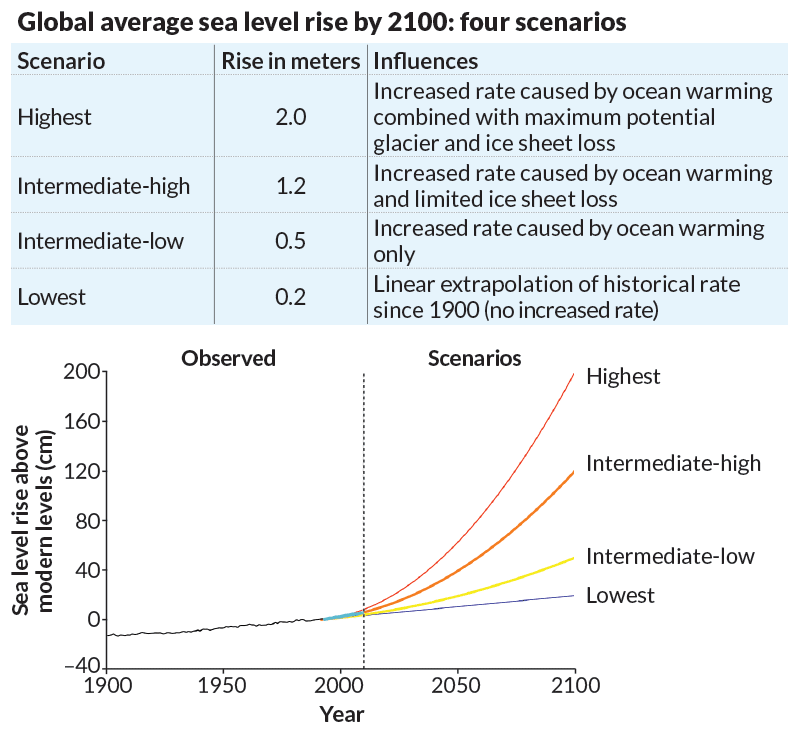
RAISING THE STAKESProjections of future sea level rise vary, but scientists warn that even a small increase in sea level can worsen flooding and change coastlines. Sea level rise primarily stems from two sources: the thermal expansion of seawater and meltwater from land-based ice.SOURCE: NOAA, GLOBAL SEA LEVEL RISE SCENARIOS FOR THE UNITED STATES NATIONAL CLIMATE ASSESSMENT 2012
---
While sea levels are rising fast, they have the ability to climb even faster. Scientists are looking further into the future and investigating just how fast sea level rise could get, especially with a hypothetical collapse of the Antarctic ice sheets. Results gleaned from past warm periods suggest that sea levels can rise much faster than suggested just a few years ago — more than 10 times the present rate.
“Sea level is probably the biggest irreversible risk of global warming,” Columbia’s Raymo says. “I expect a hell of a lot more people are going to be personally impacted by a one-meter rise in sea level than by the extinction of the grand ladybug of something or other.”
Most records of ancient climates provide only a snapshot of how high sea levels have reached at a given time, not how quickly they moved up or down. But on a 2005 expedition to Tahiti, a research team caught a break. Because coral reefs require plenty of light to thrive, they typically take root in waters shallower than 10 meters deep. As sea levels rose in the past, corals moved higher up the newly submerged coastline. Off the coast of Tahiti, the researchers sampled fossils of ancient corals from the last 150,000 years buried in layers of ocean sediment. Dating the corals using the known decay rate of radioactive uranium into other elements, the researchers created an accurate, long-term sea level record.[animated slider]
Around the end of Earth’s last glacial period, about 14,650 years ago, sea levels rose about 14 to 18 meters, the researchers reported in 2012 in Nature. What surprised those researchers is how quickly this rise happened: Sea levels rose at least 46 millimeters per year during that period. The scientists concluded that at least half of the 14 meters of sea level rise during this bout of warming originated from melting Antarctic ice.
“The scary thing, and this is why it’s kind of apocalyptic, is that once you start these things, they don’t stop,” Raymo says. “Everything we see shows that, if you look in the past, each increment of warmth seems to correlate with increasingly higher sea level.”
....
==
https://grist.org/feature/an-inconvenient-truth-oral-history/
no lnx pix
An Oral History of
An Inconvenient Truth
Al Gore got stuck on a scissor lift. Studio execs fell asleep at a screening. And everybody hated the title. The amazing true story of the most improbable — and important — film of our time.
A decade ago, climate change was a huge problem with a small audience. Unless you were among a handful of brave policymakers, concerned scientists, or loyal Grist readers, it’s fair to say the threat of a rapidly warming world took a back seat to High School Musical, MySpace, and whether or not Pluto was a planet (yes, those were all a thing in 2006).
Then, An Inconvenient Truth happened.
Somehow, a film starring a failed presidential candidate and his traveling slideshow triggered a seismic shift in public understanding of climate change. It won Oscars and helped earn Al Gore a share of the Nobel Peace Prize. It injected the issue into policy debates and dinner-table conversations alike.
Did any of this actually “save the world?” OK, you got us. Ten years after the movie’s release, climate change is still a growing threat and a polarizing issue, with record-breaking heat unable to stop skeptics from tossing snowballs on the Senate floor. But we’re also seeing corporate, political, and societal mobilization against the crisis on a scale that would have been hard to imagine 10 years ago, and there’s no question the film played a big part in getting us there.
So how did the movie-makers turn a science-heavy slideshow and unlikely leading man (sorry, Al) into a global force for change? What follows is a behind-the-scenes look at An Inconvenient Truth. As for whether there’s a happy ending, we’re afraid that’s still a bit TBD.
Interviews by Jennifer Keishin Armstrong, Amelia Urry, Eve Andrews, and Melissa Cronin
THE CAST
AL GORE
FORMER NEXT PRESIDENT OF THE UNITED STATES
DAVIS GUGGENHEIM
DIRECTOR
LAURIE DAVID
PRODUCER
LAWRENCE BENDER
PRODUCER
SCOTT Z. BURNS
PRODUCER
JEFF SKOLL
EXECUTIVE PRODUCER
LESLEY CHILCOTT
CO-PRODUCER
WITH MELISSA ETHERIDGE, LONNIE THOMPSON, AND OTHERS
- ORIGIN STORY
AL GORE: In April of 1989, I went through a personal epiphany. One of my children had a serious accident. During the darkest days, I re-examined everything that I was doing in my life, how I was spending my time, and what issues I was working on in the U.S. Senate. I had been holding hearings about the climate crisis, but during that spring of 1989, I very much deepened my emotional commitment. I started putting together a slideshow and doing research for my book, Earth in the Balance. I had previously made presentations on the subject, and I had used some visual aids with fold-up charts. But I began collecting pictures. I worked with National Geographic and some others and put together a slideshow that involved three Kodak carousels and three Kodak projectors. The slides would fade in and fade out, and the three projectors did their thing in sequence. I thought it was pretty cool.
Long before anybody talked to me about a movie, I got to the point where I could tell the slideshow was beginning to get some real traction. Probably the most important moment for me was one Saturday night on Center Hill Lake in Middle Tennessee, near where I live. A whole big gang of my rowdy friends were on the front of the houseboat drinking beer. One thing led to another, and I started giving the slideshow about midnight. I mean they’re friends, but I would say they were a tough crowd in that they were not the audience you would necessarily pick for a presentation on the climate crisis. But they had reactions that were strong, positive, very sincere, and they were moved by it. I thought to myself then, I really need to figure out a way to get this in front of more people.
“I thought that was a bad idea, if not a crazy idea. I did not see how in the world a slideshow could become a movie.”
LAURIE DAVID, producer: I was working on this issue myself, largely with the Natural Resources Defense Council. When the movie The Day After Tomorrowcame out, I was asked to moderate a panel the night before the premiere in New York City. I think the scientist Michael Oppenheimer was on the panel, Al Gore was on the panel, and a few other people. As the Hollywood person, I was the moderator. It was a really great marketing idea for this film. They had a packed house. I knew Al Gore from the elections and meeting him at people’s houses out here in Los Angeles. But I didn’t know him very well. I introduced him at the panel, and he did, like, an eight-minute version of his presentation, which I had never seen before. My jaw dropped. I had been killing myself trying to find the language to explain this issue to people in a way that they could digest. Here Al Gore had it. I was just floored.
AL GORE: She came up to me afterward and said, “This has to be made into a movie.” And I thought that was a bad idea, if not a crazy idea. I did not see how in the world a slideshow could become a movie.
DAVIS GUGGENHEIM, director: I was working at Participant Media at the time. I was the guy in charge of documentaries, and I had only been there for four months. By all accounts, including my own, I was the worst executive at Participant. I’d given my notice. It was my last week or two. And Lawrence [Bender] and Laurie came in and they said, “We’re doing this documentary about climate change with Al Gore.” I was like, “I’m not sure that’s a good idea.” A movie about climate change was very timely, but one based around a slideshow? I thought, maybe these are the wrong elements for a good film. And I think a lot of people felt that way throughout. A movie about a slideshow? With Al Gore and all the baggage that came with the 2000 election? This makes no sense.
LAURIE DAVID: At the time, everybody was mad at Al. Blamed him for giving up on the election too soon. It was not easy to get people to come hear him speak. I had to literally call people personally and beg them to come to a presentation in New York. They were like, “A slideshow with Al Gore, are you kidding me?” I worked my ass off. I put my reputation and friendships on the line, and they came. He got a standing ovation. People were floored. Then I did the same thing in Los Angeles. I got the rooms donated and invited all my Hollywood friends and producers and actors and actresses.
DAVIS GUGGENHEIM: One of Laurie’s gifts is that she is very unrelenting. She said, “You have to come to this presentation. Al Gore is going to give the presentation at the Beverly Hilton in a couple of weeks.” So I went to the presentation against my will. And Al got up, and I was like, OK, here he goes. I don’t see this.
And then there is a certain point in the middle of his slideshow where everything sorta clicks. It was towards the end, when the slideshow becomes very existential and very challenging, and you start to think about life on this planet. I think all of us just looked at each other and said, “We have to make this movie.”
LAWRENCE BENDER, producer: Imagine, we wanna make a movie about a slideshow from an ex-politician, and we want a million dollars. Who’s gonna give us that? Who in their right mind would do that?
DAVIS GUGGENHEIM: We set up another slideshow at CAA, the talent agency. I remember in the middle of it, there was an earthquake.
JEFF SKOLL, executive producer: I was front and center, right next to Tipper, when the building started to shake.
DAVIS GUGGENHEIM: All of us were like, “Oh my gosh, is this going to screw up the slideshow? Everyone’s gonna go running.” But the people who hadn’t seen the slideshow, including Jeff, I don’t think even felt the earthquake because it was so engrossing.
JEFF SKOLL: Afterward, my team at Participant came up to this small conference room at CAA. There were other people in the room, I don’t remember exactly who they were, but it was definitely Laurie and Lawrence and me, and Davis, and Al. And we had a conversation.
Two important things happened in that room: I decided to fund the whole film on the spot, and Davis agreed to leave Participant and go direct the film immediately.
AL GORE: They just convinced me that they had the skill to do things I couldn’t imagine doing. I decided: Well, they seem to know what they’re talking about, and maybe this could reach more people. Little did I know.
- THE MAKING OF …
DAVIS GUGGENHEIM: This movie was made in five and a half months. Most of my movies take a year and a half, if not two and a half. We all felt like we were on a mission from God just to make it as fast as we could. We just felt like it was urgent. The clock was ticking, and people had to see it.
LESLEY CHILCOTT, co-producer: All the logic of, take your time making the film, do it the correct way, travel to a million film festivals, get feedback, revise — that was all out the window.
DAVIS GUGGENHEIM: When people look back, they start to write a narrative in their head about why it was so successful. And in many ways, it makes no sense. It’s a huge tribute to Al and the slideshow, which he had built for 30 years. It wasn’t something he had just come up with. He had perfected it and perfected it and perfected it.
AL GORE: I’m driven by a real passionate sense of mission on this. I hope that doesn’t sound like a pretentious word. I really feel driven to communicate this as effectively as I can. I think I’m obsessed with trying to make each slide the best, most persuasive image it can be, while also keeping the full integrity of the data it represents. You just develop a sense over time of what connects with people and how you can connect even better. I guess there’s a touch of OCD somewhere. But I did become obsessed, and still am, with trying to really craft each slide to be as eye-catching and communicative as it can possibly be. And it turns out, after you get into the innards of the process, you get to the point where — this will sound ridiculous — but it makes a difference whether a transition is two-tenths of a second or three-tenths of a second. And I’ll go to 0.15 or 0.175. That is silly, but I do it anyway.
I showed Steve Jobs early versions of the slideshow several years before the movie came out. He recommended Keynote. Let me insert my own recommendation to anyone who’s putting together slideshows: It is by far and away the best such program. Of course, I’m on the board of Apple, so I’m biased. But early on Steve actually asked one of the Keynote specialists at Apple to help me learn all of the ins and outs of the program. So this guy volunteered his time, but I was so ravenous for more and more help that eventually Steve had to say, “Al, I think we’re going to have to get you a contractor.” It got to the point of: OK, we’re not going to create a new division of Apple for Al Gore’s slideshow.
DAVIS GUGGENHEIM: I would guess at that point he was giving it 50 to 100 times a year. I remember being on a plane to China with him, and he was changing the slides on his laptop from English to Mandarin. Every show, he would be changing it. But you can’t just film a slideshow. When you’re in the room with Al, you’re sort of blown away, because there’s the man in front of you. But it’s like a rock concert: You’re there and you’re blown away, but when you watch it on TV, it’s just not the same. It doesn’t sound the same, and you don’t have that personal intense feeling, like you’re in the moment.So I immediately felt that we needed to add a personal narrative and had many long discussions about how to do this.
AL GORE: I didn’t like that, either. I really did not. I just felt like: What is it about my personal story that has any relevance to this?
DAVIS GUGGENHEIM: There are stories in there about his sister dying of cancer, of his son being injured in a car accident, of him losing the 2000 election. Those are all very raw moments, and you could say, “What do those have to do with climate change? How does this fit?” I honestly didn’t have the answer to that.
LESLEY CHILCOTT: Because he was this public figure that had always been heavily edited, people didn’t know his real voice. It took us several months of following Al, I think, before we earned his trust to tell the election story, of what had happened. Initially, he didn’t want to talk about it. Why would he?
DAVIS GUGGENHEIM: I remember going to get a drink with Scott Burns, who was one of the producers. He’s great, and he’s very smart. And he was saying, why don’t you look at the movie The Last Waltz, this film by Martin Scorsese about the last concert by The Band? It intercuts between The Band performing these songs and then backstage in other places to these little vignettes. It has a wonderful structure to it.
I remember going home and looking at it and saying, “Oh, this could be.” You can just leave completely from a live moment to a non-live moment. And that’s true in An Inconvenient Truth. You go from him presenting this thing to him as a college student. You go back to the live show, and then there’s him as a senator. The Last Waltz was a breakthrough for me.
SCOTT Z. BURNS, producer: We had to tell the story of Al, because he was someone who we hadn’t heard much from since 2000. He was a guy that seemed to have vanished behind a beard, and people didn’t know what he’d been up to. And when we saw that it was something so important and so transformative — I think it made me completely reconsider him. He was no longer a victim of a really unfortunate moment in American history, but a guy who had gotten up off the canvas after a pretty severe blow and turned his attention to something so important, with so much intellect and passion and insight. I felt like it was a great comeback story that we could tell at the same time that we were telling the story of climate change.
DAVIS GUGGENHEIM: There’s this big moment in the film, this big “aha!” moment, where he shows the CO2 levels rise. So we got to the point where we made this 90-foot-wide screen. The idea was, with that big screen, how great would it be for him to walk the length of that screen. But then you’re kind of stuck, because if you do the math, you’ve got to get him 40 feet up in the air. So we had talked about a ladder, we had talked about a hoist.
Finally, we were like, well, let’s order a scissor lift. And I remember getting the scissor lift and teaching him how to go up. In the first presentation, the audience was there and it was going really well. He did it perfectly, he went up, and the reveal was great. Then it’s time to come down. And he doesn’t know how to come down.
SCOTT Z. BURNS: Al is smart enough to recognize that when you’re talking about something that serious, unless you allow for laughter, you lose the audience inside themselves. Laughter really allows a connection for community.
Al’s line in the movie, “I used to be the next president of the United States,” was such a bold move on his part, because it diffused that whole issue. It made you reconsider the entire guy before he said a word about climate change.
LONNIE THOMPSON, scientific adviser: I think his depth of understanding is much greater than what you see in the movie. He really tries to seek out the best information possible.
He would have these science breakfasts. I remember being really impressed at one stage when I was talking about these ice cores and the fact that we measure isotopes. Al Gore stopped me and said, “Lonnie, let me tell them what an isotope is.” I was always impressed with how rapidly he could pick up information.
MELISSA ETHERIDGE, musician: This was 2005, and I had just recovered from breast cancer. My life was really changed, and I was just looking for new pathways, new meaning in my music. And I got a phone call from Al Gore. Like, “Hello, Melissa, it’s Al Gore.” He started talking about what he’d been doing, this global warming slideshow. He was gonna do it in L.A., and did I want to come see it? I said, “Sure, absolutely.” And I’m thinking it’s a little slideshow, and he said, “Well, they’re filming it, and I was wondering if you wanted to write a song for it.”
Of course, there was absolutely no budget to record it, so I basically called my band in and said, “Hey, we’ve got a couple of hours, can you knock this out?”
DAVIS GUGGENHEIM: The first location shoot that we scheduled was New Orleans. Al was excited to go there because he was speaking at an insurance industry convention, because insurance adjusters were ahead of most businesses in acknowledging that climate change was happening. They were seeing the effects of hurricanes on insurance claims. We had bought our tickets, we had our crew. And I remember the shoot was on a Friday, and come Tuesday before that, there was talk of this hurricane coming. What do we do? We all felt like we should still go, but we got calls that said, “Don’t come. It’s too severe.” I don’t know if they canceled the convention or not, but we couldn’t shoot. And the flights wouldn’t leave, so we canceled our shoot. And that hurricane became Hurricane Katrina.
It became one of the key moments of the movie. It’s in our opening, where you see Mayor Ray Nagin talk about the horror that’s happening. You see the sea-level rise, you see the levees break. But it also became one of the key moments where just everyone else in the world felt, oh, this climate change thing is real. The interesting thing about climate change is it’s this threat that everyone understands, but it’s so existential. You can’t touch it. You can understand it, but then it’s not in your life every day. With Hurricane Katrina, suddenly it felt real to everybody.
- ABOUT THAT TITLE
AL GORE: I thought that was a bad idea, too. We had of course batted around a number of possible titles. It’s sort of like picking a URL. Once you start, it’s a cul-de-sac that you can’t escape from. So we’d bat them around for a while and call it quits and go back and do something productive.
LESLEY CHILCOTT: Davis and Al and I had many, many debates about it.
DAVIS GUGGENHEIM: We had a lot of really bad titles. One was The Rising. I remember Al talking about whether he should give Bruce Springsteen a call, because he had an album out called The Rising. It had a great triple-entendre, because it was like the sea-level rising and the idea of people rising. So we got excited about that for a while.
LESLEY CHILCOTT: On an intellectual level, it makes sense: The Rising! The temperature is rising, everything is rising — everything in the movie, all the graphs, go from the lower left to the upper right. And we’re like, “Technically it makes sense, but it does sound like a horror movie.”
DAVIS GUGGENHEIM: There were also some really bad ones like Too Hot to Handle. Maybe that’s not right, but it was something with “hot,” ya know? We had a lot of hot puns.
Then I was interviewing Al at his home. I think we had at least 12 interviews, and he would tell you that they were excruciating for him. I kept pushing him and pushing him and pushing him in the way that I do.
AL GORE: Boy, did he ever. I was not fully prepared for what a skillful interviewer Davis was. You don’t hear his voice in the movie at all, but he did a series of taped interviews just with audio tape, not with the camera on, and plumbed the depths of what was going on in my mind and heart when I dealt with this issue. I’m telling you, at times, he would kind of remind you of an exchange you would have with a child, where you give what you think is a pretty good answer, and then the next question is, “Yes, but why?” Then you peel back a layer, and you come up with something that’s a little deeper and more introspective. And then the response is, “Yeah, but why?” He kept on going, and pretty soon I was saying stuff that I understood myself for the first time.
DAVIS GUGGENHEIM: I generally don’t like people’s first answers to things. And especially someone as polished as him, someone who is crafting his message so carefully. Sometimes a well-crafted answer is not good for a film. It wants to be raw and in the moment, and you want to feel like it’s found as you’re making it, like he thinks of it at the time he’s saying it. So I ask, “Why is this so hard for people? I get the logic of the argument for climate change, but why is it so hard for people to grasp?” And he goes, “Because it’s an inconvenient truth, ya know?” I had never heard him say that. I don’t know if he had before. And he said it in a string of a long answer, but in the back of my head, I go, that’s the title of our movie.
I gotta tell you, it was not a popular title in our discussions. For a while, I was defending it vigorously against other titles, and people thought it was hard to say, people thought it wasn’t fun, it wasn’t sexy. Days before we went to Sundance and had to decide, there was a large group of people who did not like the title.
AL GORE: My immediate reaction was, “Nah, I don’t think so.” And again, I was flat wrong. That’s become a common phrase in popular culture, and you see it over and over in different contexts.
MELISSA ETHERIDGE: He was happy that I worked “an inconvenient truth” into the song. I didn’t know how I would do it — it’s not the most singable lyric — but I was able to do it.
- SUDDEN IMPACT
DAVIS GUGGENHEIM: Right before Sundance we took the film to a major studio. This studio had everyone there, it had the head of the studio, the head of production, the head of development — every executive who worked at the studio — because Al came. To his credit, he flew in for the meeting ’cause it was too important. We showed it for them, and several of the executives fell asleep in the screening. I remember listening to one of them snore, then waking up awkwardly when the lights came up.
I remember the executives going into another room and huddling, then coming back and the head of the studio saying to us, “We do not believe that anyone will pay to have a babysitter come so that they can go see this movie. Stop dreaming — this movie will never have a theatrical release. But we believe in what you’re doing, we like you, and as a favor to you, we will make, for free, 10,000 DVDs that you can send to science teachers.”
“I did not have one doubt that this was going to change the world.”
LAWRENCE BENDER: There were naysayers along the way — a lot of naysayers along the way.
MICHAEL FELDMAN, Gore political adviser: I immediately went to the dark side, thinking about how it could be mocked, or whether people would think it was a political move.
JEFF SKOLL: At one point, Al was doing his presentation to a group of mayors at Sundance — these were all mayors who had come to talk about climate change. But he had to do another presentation that night in Minneapolis. So I flew all of us and our crew and Davis and Lesley and Al to Sundance on a small private plane. We got there and we did the presentations and then we went to Minnesota.
The plane itself was parked in a farmer’s field and it had filled up with all these mosquitoes from the lights of the plane. Imagine you put eight people in a plane filled with mosquitoes and you shut the door and take off — it was bedlam. We were all slapping mosquitoes, making a mess of the plane. I didn’t really know Al that well at that point, but I saw a mosquito on his upper leg and without thinking, I just slapped it. Al gave me a look of shock. I said, “Oh, I’m sorry, sir.”
DAVIS GUGGENHEIM: Everything changed when we took it to Sundance. We had an afternoon slot, which is not a great slot. We were not in one of the great theaters. Then we screened the movie with an audience, and I’ll never forget when the lights came up. I think someone said there were three standing ovations. I don’t remember, but the response was unlike any movie I’ve ever been a part of. The applause didn’t stop, and the people just rushed towards Al. We pushed out this side door and went to a friend’s house where there was a small reception. I think it was maybe 50 of us. We all kind of can’t believe it.Then suddenly these calls start coming in, these offers to buy the film. And there were a lot of them.
JEFF SKOLL: Participant went to Sundance with two documentaries that year: One that we thought would go straight to PBS, and one that we thought would actually be appealing to a global audience. Well, the one documentary you know; the second one was a film called The World According to Sesame Street. We figured this is the one that would have popular appeal, and Al’s film maybe would go straight to PBS.
In the end Paramount signed up to distribute the film. Our other film, The World According to Sesame Street, went straight to PBS.
LAURIE DAVID: I did not have one doubt that this was going to change the world in some way. We had so much passion and were so convinced of it. But then you say, “How do you get the audience to come?” Don’t forget, there was no social media then. There was no Twitter, none of that. I remember going to all the environmental groups to get their base out the first weekend. Once people started seeing it, we knew word of mouth was going to be great. One of the huge successes of the film was that every morning show, every newspaper, every magazine wrote about it. And by writing about the movie, they’re writing about the issue. That was huge.
MEGAN COLLIGAN, Paramount marketing executive: We did promotional screenings. We were asking people either to pledge to see it again or to bring a friend or to encourage a friend to go. It was almost like a voter registration drive. You’re voting with your $8, and that $8 is going to be the thing that is going to spark awareness.
DIANE WEYERMANN, executive producer: It ended up doing a massive $50 million box office around the world. It’s incredibly unusual for a documentary film to reach that number of people, and climate change wasn’t really a subject that people were talking about.
LAWRENCE BENDER: Thousands of documentaries are made, only a handful get in the movie theater, only a handful break a million dollars at the box office, a small handful every year.
LESLEY CHILCOTT: We came out at exactly the right time. There are so many amazing groups that had been talking about this issue for so many years, and there was finally something that they could all point to.
JEFF SKOLL: In 2006, before the film was released, there was a poll that showed about a third of Americans felt that climate change was an important issue. And in 2007, the year after the film was released, that 33 percent went up to something like 85 percent. There was a huge jump in awareness.
DIANE WEYERMANN: I remember going to the Academy Awards that year. Al Gore on the red carpet was like pandemonium, which we didn’t necessarily expect — everybody wanting his attention, taking his picture, yelling out to him. It was really wild to see Al Gore the rock star.
MICHAEL FELDMAN: People wanted a piece of him again, in a way that was unlike when he was in office. I think in some ways, it almost took being out of office, in political no-man’s-land, to use these other levers to have an even bigger impact on this issue that he really cared about.
[youtube https://www.youtube.com/watch?v=UmzfBuXAM60&w=970&h=546%5D
AL GORE: Davis got the Academy Award, but I have visiting rights.Before they announced the award, they had asked me and Leo DiCaprio to go out on stage and make a comment about how the Oscars was greening itself. At the time, there was some speculation about me maybe running for president again in ’08. My daughter Kristin, who is a screenwriter in Hollywood, wrote this part of the script where Leo said, “Al, isn’t there something else you’d like to announce?” And I looked at him, and I said, “Well, I really wasn’t planning to, but …” Then I pulled out a prepared statement.
You know how the orchestra will start playing music when your time’s up? During the rehearsal, I told the conductor, “You come in full blast, you gotta cut me off right away.” That’s how they did it, and it was really fun.
- THE LEGACY
AL GORE: I don’t want to sound like a nutcase, but I am driven to do this. I’ve got several slideshows in the next several days. I gave several last week. I still work on it every day. I worked on it this morning. There’s so much new science that comes out almost every day now. It doesn’t really change the overall scientific story, but thankfully the solution side has changed significantly. With all of our discussion of the movie, I don’t want to lose sight of the fact that we’re still facing a threat to the future of civilization. We’re making great progress, and we’re now getting close to the point where we can imagine turning the corner and starting to get the upper hand, but we’re not there yet. I could not imagine for a moment slowing down. I ask myself every day, what else can I do to be more effective?
LAURIE DAVID: For a long time, you couldn’t see the impact of global warming. Now you see it every friggin’ day. That’s what was so powerful about that slide where you see the water rising, what it would do to cities. That was using imagination at that point. But you can see it now. You can see what’s happened with the Arctic. You can see what’s happened with glaciers. You can see the sea level rising. And of course the storms and the drought. Every other day there’s a huge, once-in-a-lifetime weather event. I think one of the most amazing things about the film is how much of it was right-on. He was right about everything.
SCOTT Z. BURNS: I was at the climate march a year and a half ago in New York City, and I was blown away that there were millions of people in the streets. I do feel that the film helped tie some shoes and get some people out there.
AL GORE: It sounds like false bravado to say I’m just getting warmed up, and I don’t want to put it that way because I’m getting older. But I feel like I’m just getting warmed up in the sense that I continue every day to try to figure out ways to communicate effectively. I think it’s beginning to have a real impact. I spoke at the United Nations on Earth Day when 175 countries came to sign the Paris agreement. The U.N.’s never seen anything like that before. I’m very excited now that we’ve got a real chance to win this. The only remaining concern is it matters a lot how quickly we win it.
MELISSA ETHERIDGE: It’s never all you want it to be, but that’s not the way change happens. Change happens slowly. We’re totally moving in that direction, and we’re not ever going back.
LAURIE DAVID: There were millions of dollars spent by corporations to confuse the public about this issue. Millions and millions and millions spent by the coal and oil industries. Where would we be if private-interest money wasn’t spent deceiving the public? How much further along would we be? I think initially we thought there would be more attacks against the film directly. But there wasn’t anything in the film that wasn’t true. They weren’t able to attack the film directly. So the money went into misinformation campaigns in the public: The science isn’t complete, not everybody agrees, there are two sides to this. This is how they confused the public. It was a targeted, organized campaign to spread misinformation on global warming.
It’s a problem that’s only going to be solved if the whole world unites. And I think the whole world did unite in Paris, finally. The drought, the wildfires … everything he talked about is happening, but it’s happening faster. That’s the only thing we maybe were a little off on, how fast everything has happened. We’re not talking about our grandkids’ future now. We’re talking about our future.
DAVIS GUGGENHEIM: When we ended up doing press for the movie after it came out, we would quote Jim Hansen, the great NASA scientist, who basically modeled the most important predictions of what climate change would do. He said we have 10 years to make significant change or we will do irreversible damage to the Earth. And we are now 10 years from when we made the movie.
[ted id=2441 width=”770?]
I’m hopeful because Al’s new slideshow, which he continues to do, is more hopeful. There’s a lot of reasons to believe. A lot of the progress is exponentially better than we had imagined. Yet I am terrified for my children. The existential acceptance of this issue is still dormant. Even amongst the people who accept that climate change is real, those people are not doing enough. There are moments where I’m up at night worrying, but the rest of the time I sort of glide through my life, pretending it’s not there. I drive an electric car, I have solar panels on my house, I vote the right way. And yet even my response is not up to where it should be.
So I feel like we can blame all the bad guys, but the truth is, all of us who believe it’s real still aren’t doing enough. Maybe the only person in the world who is, is Al Gore.
===
https://www.npr.org/templates/story/story.php?storyId=5425355
...the
COmpetitive Enterprise Institute, which gets some of its funding from such companies as ExxonMobil, has released a counterstrike to Al Gore's new documentary An Inconvenient Truth. While I haven't seen the film, from the press it's getting, it's a jeremiad against global warming.
CEI takes issue with that and has released two TV ads, that -- get this -- promote CO2. Now, a vast majority of scientists agree that man-made pollutants, especially CO2, are definitely causing an increase in the Earth's temperature. How fast and how much is open to debate, but pretty much everyone agrees, this is probably not a good thing.
CEI's ads sound like something that Saturday Night Live (which Gore recently hosted) might come up with. Their tag line about CO2, "They call it pollution. We call it life."
There are some things you just can't make up.
==
ref 404 -->
https://web.archive.org/web/20060613053824/http://streams.cei.org/
dl works but warn on file type
http://pointers.audiovideoweb.com/stcasx/ny60win16080/eresources/cei/Global_Warming_Energy-low.wmv/play.asx
We Call It Life The Competitive Enterprise Institute has produced two 60-second television spots focusing on the alleged global warming crisis and the calls by some environmental groups and politicians for reduced energy use. "Energy" WMV: Hi - Low Quicktime: Hi - Low
also https://www.youtube.com/watch?v=7sGKvDNdJNA note change of music and darkness at end
"Glaciers"
WMV: Hi - Low Quicktime: Hi - LowSpecial web-only bonus, on the occasion of the release of An Inconvenient Truth: Al Gore's Big, Fat Carbon Footprint"Al Gore: An Inconvenient Story" WMV: Hi - Low Quicktime: Hi - Low
==
https://en.wikipedia.org/wiki/An_Inconvenient_Truth
An Inconvenient Truth is a 2006 documentary film directed by Davis Guggenheim about former United States Vice President Al Gore's campaign to educate citizens about global warming via a comprehensive slide show that, by his own estimate made in the film, he has given more than a thousand times.
Premiering at the 2006 Sundance Film Festival and opening in New York City and Los Angeles on May 24, 2006, the documentary was a critical and box-office success, winning two Academy Awards for Best Documentary Feature andBest Original Song.[4] The film grossed $24 million in the U.S. and $26 million in the foreign box office, becoming the tenth highest grossing documentary film to date in the United States.[5]
The idea to document his efforts came from producer Laurie David who saw his presentation at a town-hall meeting on global warming which coincided with the opening of The Day After Tomorrow. Laurie David was so inspired by Gore's slide show that she, with producer Lawrence Bender, met with Guggenheim to adapt the presentation into a film.
Since the film's release, An Inconvenient Truth has been credited for raising international public awareness of global warming and reenergizing the environmental movement. The documentary has also been included in science curricula in schools around the world, which has spurred some controversy.[citation ^needed]
- Synopsis
- 2Background
- 3Scientific basis
- 4Reception
- 5Accolades
- 6Impact
- 7Use in education
- 8Music
- 9Sequel
- 10See also
- 11References
- 12External links
Synopsis
An Inconvenient Truth presents in film form an illustrated talk on climate by Al Gore, aimed at alerting the public to an increasing "planetary emergency" due to global warming, and shows re-enacted incidents from his life story which influenced his concerns about environmental issues. He began making these presentations in 1989 with flip chart illustrations,[6] the film version uses a Keynote presentation, which Gore refers to as "the slide show".[7]
The former vice president opens the film by greeting an audience with his well known line about his campaign in 2000: "I am Al Gore; I used to be the next President of the United States."[8] He is shown using his laptop to edit his presentation, and pondering the difficulty he has had in awakening public concern: "I've been trying to tell this story for a long time and I feel as if I've failed to get the message across."[6]
Gore then begins his slide show on Global Warming; a comprehensive presentation replete with detailed graphs, flow charts and stark visuals. Gore shows off several majestic photographs of the Earth taken from multiple space missions, Earthrise and The Blue Marble.[9] Gore notes that these photos dramatically transformed the way we see the Earth, helping spark modern environmentalism.
Following this, Gore shares anecdotes that inspired his interest in the issue, including his college education with early climate expert Roger Revelle at Harvard University, his sister's death from lung cancer and his young son's near-fatal car accident. Gore recalls a story from his grade-school years, where a fellow student asked his geography teacher about continental drift; in response, the teacher called the concept the "most ridiculous thing [he'd] ever heard." Gore ties this conclusion to the assumption that "the Earth is so big, we can't possibly have any lasting, harmful impact on the Earth's environment." For comic effect, Gore uses a clip from the Futurama episode "Crimes of the Hot" to describe the greenhouse effect. Gore refers to his loss to George W. Bush in the 2000 United States presidential election as a "hard blow" yet one which subsequently "brought into clear focus, the mission [he] had been pursuing for all these years."
:{:{The film includes segments intended to refute critics who say that global warming is unproven or that warming will be insignificant. For example, Gore discusses the possibility of the collapse of a major ice sheet in Greenland or in West Antarctica, either of which could raise global sea levels by approximately 20 feet, flooding coastal areas and producing 100 million refugees. Melt water from Greenland, because of its lower salinity, could then halt the currents that keep northern Europe warm and quickly trigger dramatic local cooling there.}:
It also contains various short animated projections of what could happen to different animals more vulnerable to global warming . Throughout the movie, Gore discusses the scientific opinion on global warming, as well as the present and future effects of global warming and stresses that global warming "is really not a political issue, so much as a moral one," describing the consequences he believes global warming will produce if the amount of human-generated greenhouse gases is not significantly reduced in the very near future. Gore also presents Antarctic ice coring data showing CO2 levels higher now than in the past 650,000 years.}:
The documentary ends with Gore arguing that if appropriate actions are taken soon, the effects of global warming can be successfully reversed by releasing less CO~2~ and planting more vegetation to consume existing CO2. Gore calls upon his viewers to learn how they can help him in these efforts. Gore concludes the film by saying:
"Each one of us is a cause of global warming, but each one of us can make choices to change that with the things we buy, the electricity we use, the cars we drive; we can make choices to bring our individual carbon emissions to zero. The solutions are in our hands, we just have to have the determination to make it happen. We have everything that we need to reduce carbon emissions, everything but political will. But in America, the will to act is a renewable resource."[10]
During the film's end credits, a diaporama pops up on screen suggesting to viewers things at home they can do to combat global warming, including "recycle", "speak up in your community", "try to buy a hybrid vehicle" and "encourage everyone you know to watch this movie."[11]
Gore's book of the same title was published concurrently with the theatrical release of the documentary. The book contains additional information, scientific analysis, and Gore's commentary on the issues presented in the documentary.[12][13] A 2007 documentary entitled An Update with Former Vice President Al Gore features Gore discussing additional information that came to light after the film was completed, such as Hurricane Katrina, coral reef depletion, glacial earthquake activity on theGreenland ice sheet, wildfires, and trapped methane gas release associated with permafrost melting.[14]
Background
See also: Environmental activism of Al Gore
Origins
Gore became interested in global warming when he took a course at Harvard University with Professor Roger Revelle, one of the first scientists to measure carbon dioxide in the atmosphere.[15] Later, when Gore was in Congress, he initiated the first congressional hearing on the subject in 1981.[16] Gore's 1992 book, Earth in the Balance, dealing with a number of environmental topics, reached the New York Times bestseller list.[17]
As Vice President during the Clinton Administration, Gore pushed for the implementation of a carbon tax to encourageenergy efficiency and diversify the choices of fuel better reflecting the true environmental costs of energy use; it was partially implemented in 1993.[18] He helped broker the 1997 Kyoto Protocol, an international treaty designed to curb greenhouse gas emissions.[19][20] The treaty was not ratified in the United States after a 95 to 0 vote in the Senate. The primary objections stemmed from the exemptions the treaty gave to China and India, whose industrial base and carbon footprint have grown rapidly, and fears that the exemptions would lead to further trade imbalances and offshoring arrangement with those countries.[21][22]
Gore also supported the funding of the controversial, and much-delayed satellite called Triana, which would have provided an image of the Earth 24 hours a day, over the internet and would have acted as a barometer measuring the process of global warming.[23] During his 2000 presidential campaign, Gore ran, in part, on a pledge to ratify the Kyoto Protocol.[24]
The slide show
...
Critical reviews
Several reviews criticized the film on scientific and political grounds. Journalist Ronald Bailey argued in the libertarian magazine Reason that although "Gore gets [the science] more right than wrong," he exaggerates the risks.[64] MIT atmospheric physicist Richard S. Lindzen was vocally critical of the film, writing in a June 26, 2006 op-ed in the Wall Street Journal that Gore was using a biased presentation to exploit the fears of the public for his own political gain.[65]
Some other reviewers were also skeptical of Gore's intent, wondering whether he was setting himself for another Presidential run. Boston Globe writer Peter Canello criticized the "gauzy biographical material that seems to have been culled from old Gore campaign commercials."[66] Phil Hall of Film Threat gave the film a negative review, saying "An Inconvenient Truth is something you rarely see in movies today: a blatant intellectual fraud."[67]
Others felt Gore didn't go far enough in depicting the threat Indigenous peoples faced with the dire consequences of climate change. "An Inconvenient Truth completely ignores the plight of Arctic indigenous peoples whose cultures and landscapes are facing profound changes produced by melting polar ice," argued environmental historian Finis Dunaway.[68]
Accolades
An Inconvenient Truth has received many different awards worldwide. The film won the 2007 Academy Awards for Best Documentary Feature[69]^ and ^Best Original Song for Melissa Etheridge's "I Need to Wake Up".[70] It is the first documentary to win 2 Oscars and the first to win a best original song Oscar.[71][72]
After winning the 2007 Academy Award for Documentary Feature,[73] the Oscar was awarded to director Guggenheim, who asked Gore to join him and other members of the crew on stage. Gore then gave a brief speech, saying:
My fellow Americans, people all over the world, we need to solve the climate crisis. It's not a political issue; it's a moral issue. We have everything we need to get started, with the possible exception of the will to act. That's a renewable resource. Let's renew it.[74]
Sight & Sound magazine conducts a poll every ten years of the world's finest film directors to find out the Ten Greatest Films of All Time. This poll has been going since 1992, and has become the most recognised poll of its kind in the world.[75] In 2012 Cyrus Frisch voted for "An Inconvenient Truth". Frisch commented: "A few years after this film was made, global industry has become more aware of its impact on nature."[76]
In addition, the film received numerous other accolades, including a special recognition from the Humanitas Prize, the first time the organization had handed out a Special Award in over 10 years,[77] the 2007 Stanley Kramer Award from The Producers Guild of America, which recognizes "work that dramatically illustrates provocative social issues"[78] and the President’s Award 2007 from the Society for Technical Communication "for demonstrating that effective and understandable technical communication, when coupled with passion and vision, has the power to educate—and change—the world."[79]
For Gore's wide-reaching efforts to draw the world’s attention to the dangers of global warming which is centerpieced in the film, Al Gore, along with the Intergovernmental Panel on Climate Change (IPCC), won the 2007 Nobel Peace Prize.[80] The related album, which featured the voices of Beau Bridges, Cynthia Nixon and Blair Underwood, also won Best Spoken Word Albumat the 51st Grammy Awards.[81]
The film won many other awards for Best Documentary:[82]
---
Scientific basis

Gore presents theKeeling curve, which shows a pattern of steadily increasing carbon dioxide in the atmosphere since 1958
The film's thesis is that global warming is real, potentially catastrophic, and human-caused. Gore presents specific data that supports the thesis, including:
- The Keeling curve, measuring CO2 from the Mauna Loa Observatory.
- The retreat of numerous glaciers is shown in before-and-after photographs.
- A study by researchers at the Physics Institute at the University of Bern and the European Project for Ice Coring in Antarctica (EPICA) presenting data from Antarctic ice cores showing carbon dioxide concentrations higher than at any time during the past 650,000 years.[34]
- Instrumental temperature record showing that the ten hottest years ever measured in this atmospheric record had all occurred in the previous fourteen years.
- A 2004 survey, by Naomi Oreskes of 928 peer-reviewed scientific articles on global climate change published between 1993 and 2003. The survey, published as an editorial in the journal Science, found that every article either supported the human-caused global warming consensus or did not comment on it.[35] Gore also presented a 2004 study by Max and Jules Boykoff showing 53% of articles that appeared in major US newspapers over a fourteen-year period gave roughly equal attention to scientists who expressed views that global warming was caused by humans as they did to global warming "skeptics" (many of them funded by carbon-based industry interests), creating a false balance.[36]
The Associated Press contacted more than 100 climate researchers and questioned them about the film's veracity. All 19 climate scientists who had seen the movie or had read the homonymous book said that Gore accurately conveyed the science, with few errors.[37]
:{:{:{William H. Schlesinger, dean of the Nicholas School of Environment and Earth Sciences at Duke University said "[Gore] got all the important material and got it right." Robert Corell, chairman of the Arctic Climate Impact Assessment was also impressed. "I sat there and I'm amazed at how thorough and accurate. After the presentation I said, 'Al, I'm absolutely blown away. There's a lot of details you could get wrong.' ... I could find no error."[37]}:
Michael Shermer, scientific author and founder of The Skeptics Society, wrote in Scientific American that Gore's slide show "shocked me out of my doubting stance."[38] Eric Steig, a climate scientist writing on RealClimate, lauded the film's science as "remarkably up to date, with reference to some of the very latest research."[39] Ted Scambos, lead scientist from the National Snow and Ice Data Center, said the film "does an excellent job of outlining the science behind global warming and the challenges society faces in the coming century because of it."[40]}:}:
:{:{One concern among scientists in the film was the connection between hurricanes and global warming, which remains contentious in the science community. Gore cited five recent scientific studies to support his view.[37]"I thought the use of imagery from Hurricane Katrina was inappropriate and unnecessary in this regard, as there are plenty of disturbing impacts associated with global warming for which there is much greater scientific consensus," said Brian Soden, professor of meteorology and oceanography at the University of Miami.[37] Gavin Schmidt, climate modeler for NASA, thought Gore appropriately addressed the issue.[41] }:
"Gore talked about 2005 and 2004 being very strong seasons, and if you weren't paying attention, you could be left with the impression that there was a direct cause and effect, but he was very careful to not say there's a direct correlation," Schmidt said.[41] "There is a difference between saying 'we are confident that they will increase' and 'we are confident that they have increased due to this effect,'" added Steig. "Never in the movie does he say: 'This particular event is caused by global warming.'"[41]}:
EPICA and Vostok ice cores display the relationship between temperature and level of CO2 for the last 650,000 years
:{:{:{Gore's use of long ice core records of CO2 and temperature (from oxygen isotope measurements) in Antarctic ice cores to illustrate the correlation between the two drew some scrutiny;}::{ Schmidt, Steig and }::{Michael E. Mann back up Gore's data. "Gore stated that the greenhouse gas levels and temperature changes over ice age signals had a complex relationship but that they 'fit'. Both of these statements are true," said Schmidt and Mann.[42] "The complexity though is actually quite fascinating ... a full understanding of why CO2 changes in precisely the pattern that it does during ice ages is elusive, but among the most plausible explanations is that increased received solar radiation in the southern hemisphere due to changes in Earth's orbital geometry warms the southern ocean, releasing CO2 into the atmosphere, which then leads to further warming through an enhanced greenhouse effect. }:
Gore's terse explanation of course does not mention such complexities, but the crux of his point–that the observed long-term relationship between CO2 and temperature in Antarctica supports our understanding of the warming impact of increased CO2 concentrations–is correct. Moreover, our knowledge of why CO2 is changing now (fossil fuel burning) is solid. We also know that CO2 is a greenhouse gas, and that the carbon cycle feedback is positive (increasing temperatures lead to increasing CO2 and CH4), implying that future changes in CO2 will be larger than we might anticipate."[42] "Gore is careful not to state what the temperature/CO2 scaling is," said Steig. "He is making a qualitative point, which is entirely accurate. The fact is that it would be difficult or impossible to explain past changes in temperature during the ice age cycles without CO2 changes. In that sense, the ice core CO2-temperature correlation remains an appropriate demonstration of the influence of CO2 on climate."[39]}:}:
....
===
https://www.desmog.com/2008/03/04/cei-letter-outlines-tv-ad-attack-campaign/
---
Tomorrow, the ultra conservative Competitive Enterprise Institute (CEI) will launch a new round of television ads attacking former Vice President Al Gore for his leadership on climate change.The right-wing Washington Times gleefully reported on CEI’s ad buyon Saturday:
Al Gore’s opulent lifestyle and his virtuous plea to save the planet from global warming don’t mesh, according to the Competitive Enterprise Institute (CEI), which announced plans yesterday for a new national advertising campaign to showcase the contrast before the American public.
In fact, Al Gore has worked diligently to reduce his own carbon impact. After a thorough renovation of his house —complete with a fight to obtain zoning permission for solar panels — Gore has one of the first 14 homes in the United States to receive the LEED gold certification for efficiency and green practices. The renovations “cut the home’s summer electrical consumption by 11 percent compared with a year ago.”
CEI’s campaign simply recycles old partisan smears. According to the Times, CEI is relying on “research released last year by the Tennessee Center for Policy Research,” a conservative group founded by Drew Johnson, who previously worked for the right-wing National Taxpayers Foundation and interned for the Exxon-funded American Enterprise Institute.
CEI is hardly a neutral player either:
– The Washington Monthly reported, “The Competitive Enterprise Institute has been a particularly aggressive advocate of the notion that global warming is a ‘theory not a fact.’” [LINK]
– CEI “adjunct analyst” Donald Boudreaux said in 2006: “the best policy regarding global warming is to neglect it– and let capitalism continue to make us healthier and wealthier.” [LINK]
– CEI has received more than $2 million from ExxonMobil since 1998. [LINK]
– CEI’s global-warming denying position is so radical that last year, ExxonMobil announced it had ceased funding CEI, in an effort to improve its corporate image. [LINK]
– CEI belongs to the State Policy Network, a “voluntary and by invitation-only” coalition of free-market think tanks that includes both the Tennessee Center for Policy Research and the Heartland Institute, which ran last week’s global warming denial conference. [LINK, LINK]
This is not the first time CEI has tried to distract attention from global warming science in order to attack Gore. Last year, it produced two ads asserting the of[
 [vid]
](https://youtu.be/Wq_Bj-av3g0). The ad campaign had the Orwellian title, “They call it pollution. We call it life.”
UPDATE: Desmog blog notes thatCEI is trying to fundraise off its Gore campaign.
https://www.desmog.com/2008/03/04/cei-letter-outlines-tv-ad-attack-campaign/
ref mar 2008
Below is a fundraising letter one of our loyal readers sent along, penned by Fred Smith, president of the Competitive Enterprise Institute.
It’s quite the vitriolic and desperate pitch for money – something the CEI is no doubt in need of after their fall from grace with oil giant ExxonMobil. This vast government, media, science conspiracy theory stuck in Smith’s head isn’t going to save any shred of credibility he and his organization might have left.
And it won’t endear him with media, who he describes in the letter as being “remarkably gullible.”
The letter also outlines the CEI‘s plans to run a national TV campaign to expose the “… hypocrisy and distortions of global warming mania.”
Wow, a national TV campaign by CEI!? Hopefully it goes as well as their last one.
Here’s the intro:
… about Al Gore’s movie, “An Inconvenient Truth”?
… about how we’re supposedly killing the planet?
… about how we Americans must drastically cut back our standard of living to avert an alleged catastrophe?
Here at the Competitive Enterprise Institute, we’re the leading group in the country telling the “real” truth about global warming.
And the hard-left environmentalists don’t like it one bit. That’s because their agenda is not based on science but on ideology – an ideology that opposes human technology and progress.
An ideology that is anti-growth, anti-capitalist, and anti-American.
Unfortunately, the global warming movement has become incredibly powerful. It has convinced many Americans that global warming is a catastrophe in the making.
More dangerously, they have recruited powerful allies in a remarkably gullible news media, which have dropped all pretense of balance and instead are committed advocates for the global warming agenda.
Have you noticed, for example, how every heat wave results in more media hysteria, while record cold waves are brushed aside as irrelevant?
And remember the dire predictions that the record 2005 hurricane season was a trend that would continue because it was fueled by global warming? Remember how it was followed by an embarrassed media in 2006, when not a single hurricane hit the U.S.?
But theradicalenvironmentalists won’t be deterred.
On the contrary, aided by Hollywood elites, pop culture icons and political opportunists like Al Gore, the global warming movement is on the brink of turning its agenda of fear into actual public policy that will do enormous harm to our prosperity and to our freedom.
That’s why I need your help today.
As President and Founder of the Competitive Enterprise Institute, a free market public policy group established in 1984. Mr. Smith is also a frequent guest on national television including such shows as CNN‘s “Crossfire,” PBS‘s “News Hour with Jim Lehrer” and “Now with Bill Moyers,” ABC‘s “20/20” and “This Week,” NPR‘s “Talk of the Nation” and “The Diane Rehm Show,” and “The G. Gordon Liddy Show,” among many others.
A prolific writer, Mr. Smith’s works have been published in leading newspapers and magazines such as the Wall Street Journal, National Review, Economic Affairs, and the Washington Times.
Letter from Smith:
My name is Fred Smith. I am founder and president of the Competitive Enterprise Institute.
My colleagues and I are doing everything we can to fight the reckless politics of the global warming movement. And to speak out about the dangers that their radical agenda poses to you, to me and to every single American.
For years now, pro-free market, pro-limited government individuals and organizations have warned of the growing threat posed by unfounded global warming hysteria.
But, as I’m sure you agree, they’ve been unable to actually stop the radical green political juggernaut we see today. That juggernaut that is now a dominant force in American politics thanks to the results of last year’s elections.
That is, until now.
At the Competitive Enterprise Institute we’re ready to do more than just TALK about the hypocrisy and distortions of global warming mania; we’re ready to DO SOMETHING about it.
That’s why we are launching a national TV ad campaign to expose Al Gore and the global warming alarmists. We have produced two hard-hitting 60-second television ads that we have already aired on a limited basis.
TV ads can be expensive, but it’s the best way to reach millions of Americans.
And remember, these ads are only the first step in a massive new public education campaign to stand up to the wild hysteria of the global warming fanatics
These ads are important because they represent a truly new strategy in combating the junk science, scare tactics and blatant propaganda of today’s radical green movement.
That strategy is to take our case directly to the people. These first two ads remind people of how biased the media are in presenting the alleged science behind global warming alarmism, and of how reducing CO2 emissions can’t be achieved without a massive loss of individual freedom and drastic reductions in the living standards of ordinary Americans;
These ads – and the new ones we hope to produce and air soon with your help –are not aimed at scholars and “policy wonks,” but at ordinary Americans.
You Can Help Us Show These Ads by Going Here Now
Let me tell you a bit about CEI. We are not a traditional “think tank.” Our work does not stop with groundbreaking research. We realize it is not enough to simply identify the flaws in the arguments of those who think massive government is the solution to every problem. Instead, we have to actively reach out – not just to other scholars and to policy makers – but to the public and the media to ensure that our ideas are heard.
This approach has made us one of the nation’s most effective and powerful forces for economic freedom, and against global warming alarmism.
We’ve been called “the best environmental think tank in the country” by The Wall Street Journal.
The Weather Channel named CEI as one of the ten most influential participants in the global warming debate in 2006. No other non-profit group made the list. Not one of the big environmental groups, with annual budgets twenty or fifty times CEI’s, was named to the list. Not the Sierra Club. Not Greenpeace. Not the Natural Resources Defense Council. Only CEI.
Two liberal U.S. Senators were so upset with our efforts that they wrote a letter which threatened one of our corporate supporters unless they cut off our funding. These two senators even mentioned CEI by name in this outrageous attempt to stifle free speech.
That just tells me we are effective.
CEI has done a tremendous amount of research on global warming alarmism. I invite you to explore our website (www.cei.org) and review the many papers we have published that challenge the so-called “proven” science behind global warming.
But research alone isn’t enough to win this fight.
That’s why we need your help today – Go Here Now
The truth is most of the papers we publish – while enormously influential in policy circles – will never be seen by the general public. And thanks to a biased news media, they will go largely unreported.
This means that we have to go beyond the usual arenas of academic debates, and reach out directly to the public.
The messages contained in our hard-hitting TV ads are the first step in our plan to do this.
IF we can raise the funds we need from concerned Americans like you, we can take those messages to a far wider audience.
I admit that this will be one tough fight. Our adversaries have been masterful at manipulating public opinion.
Because of films like Al Gore’s “An Inconvenient Truth,” the Hollywood thriller, “The Day After Tomorrow,” and countless unquestioning TV news reports and newspaper articles, more than 8 out of 10 Americans now believe that human-induced global warming caused by carbon dioxide emissions threatens our planet.
Thanks especially to Al Gore and his movie, which has been called one of the “slickest science propaganda films of all time,” ordinary people are now haunted by visions of droughts, floods, disease, famine, mass extinctions, ferocious storms and catastrophic rises in sea level.
But in reality Gore’s movie is more science fiction than science. Most of his claims are not even backed by the scientists that he claims support him. (I urge you to read our point-by-point rebuttal of Al Gore; just look for Al Gore’s Science Fiction at www.cei.org.)
In fact, a growing body of evidence demonstrates how little basis there is for claims that we face a global warming catastrophe:
Yes, there has been a slight warming trend (about 1 degree Fahrenheit) in the 20th century. This was to be expected, since the Earth was still recovering, after all, from a multi-century cold spell known as the Little Ice Age.
But it’s highly uncertain that CO2 had much to do with that slight warming. From 1940 to 1975, the global temperature fell even as CO2 emissions rose. Since 2001, global temperatures have only gone up a statistically insignificant .03 degrees Celsius.
And as for whether mankind played a role in that slight warming, two new scholarly books have just been published throwing new doubt on this claim.
[]
In “Unstoppable Global Warming Every 1,500 Years,” scientists Fred Singer and Dennis Averypresent evidence of 600 global warming and cooling periods in the last million years.
In “The Chilling Stars,” Professor Henrik Svensmark and Nigel Calder discuss how cosmic rays amplify small changes in the sun’s brightness, creating 1- to 2-degree increases in temperatures on earth.
Global warming alarmists would have you believe that, until now, the Earth has always had a stable climate. But in fact, over the millennia, the earth has warmed and cooled repeatedly. The reasons for this are unclear, but they were certainly unrelated to human activity. Yet Al Gore and the other alarmists want us to ignore this.
We won’t. Help us expose Al Gore – Go Here Now
In fact, the green lobby pretends that there is an absolute “scientific consensus” on a coming climate disaster, and they want to shut down the debate altogether. In Mr. Gore’s words, “the debate in the scientific community is over.”
Those scientists and analysts who disagree are under increasing professional and personal attack.
For example, Heidi Cullen, an “expert” for the Weather Channel, declared that meteorologists who disagree with her about global warming should not be certified to report the weather on television.
More outrageously, liberal newspaper columnist Ellen Goodman wrote, “We’re at a point where global warming is impossible to deny. Let’s just say that global warming deniers are now on a par with Holocaust deniers.”
But if global warming alarmists are so certain of their position, then why do they react so harshly when anyone challenges their views?
I believe the answer is that they’re not all that certain at all. They know full well that many of their claims can’t withstand critical review.
And they know that once their pretense of a consensus starts falling apart, their radical political agenda will collapse as well!
In short, we can win this debate.
And, in fact, we must win it.
Too much is at stake for our children’s future, our nation’s prosperity, our way of life, our freedom, to do anything less than our utmost on this issue.
We need to take the battle of global warming hysteriato the next level.
And I must ask for your most generous financial support to make this happen.
We need to run our new series of hard hitting ads, not in just a few cities, but in every media market in the United States. And we need to air them often enough and continuously enough to change public opinion.
Our initial budget for this massive undertaking is $6.5 million dollars. This budget allows us to create and air a series of ads challenging the false claims of the global warming crowd with indisputable scientific evidence.
I am convinced these ads will get results.
Our goals with this campaign are clearly ambitious. Nothing on this scale has ever been tried before. $6.5 million is a lot of money.
But it is really a very small amount when you consider the potential danger our economy faces from ill-advised, politically-motivated global warming legislation. Some have estimated that the cost to enact panic legislation to curb carbon emissions will be in the TRILLIONS of dollars.
If the alarmists get their way you could end up paying twice as much as you do now for gasoline or electricity. Great Britain is considering limiting the number of personal plane trips that a “regular” person can take to one a year.
I believe we can succeed in turning this debate around. But we are absolutely dependant on the generous financial support of Americans like you.
You can make a difference today – Go Here Now
Will you become a Friend of the Competitive Enterprise Institute by sending a tax-deductible donation of $1,000 or more today?
Your $1,000 donation can pay to run as many as 20 – or perhaps more – of our ads on television stations and cable channels around the country.
While I hope you will consider a gift at that level, please know your donation today of $100, $250 or $500 is also most welcome and urgently needed.
Rest assured, at whatever donation level you feel comfortable, your tax-deductible contribution will be much appreciated and put to immediate good use in our campaign against global warming alarmism … and for affordable energy and economic freedom around the world.
I have enclosed a donor information page detailing the benefits of giving to CEI at a number of levels.
Remember, no one does what we do. No other public policy group is duplicating the work we are doing to counter the global warming fanatics. And if we don’t succeed now in changing public opinion, we will lose this debate and America will be changed forever.
For 20 years CEI has been at the forefront of the struggle for liberty. And despite modest resources, we’ve succeeded time and time again! But we cannot succeed alone.
Time is short. Ill advised, global warming legislation is being introduced and debated right now. We have very little time to get the truth out about global warming.
Please make your most generous possible contribution
to CEI without delay – Go Here Now.
Sincerely,
Fred L. Smith, Jr.
President and Founder
P.S. Please, do not put this letter aside thinking one person can’t make a difference. Your $100, $250, $500 or hopefully $1,000 or more, tax-deductible contribution to CEI today can truly have an impact on public opinion. As a thoughtful and concerned American, your personal commitment to our crusade to tell the truth about global warming is important to our success.
Take a minute to help us fight back – Go Here
===
---