usrtk bak
11/21
merri ok
---
see also RTK, mostly on chem
==
BS attack (ctr, defend folta cassy etc)
---
Tracing Bayer’s ties to power in Trump’s Washington
From lobby firms to top officials, a look at how Bayer built access and secured favors
Stacy Malkan | February 24, 2026
The White House invokes the Defense Production Act to guarantee supplies of elemental phosphorus and glyphosate-based herbicides. Regulators reapprove dicamba, a Bayer herbicide twice blocked by federal courts, and clear the way for new pesticides containing toxic, persistent PFAS “forever” chemicals.
And the U.S. Justice Department urges the U.S. Supreme Court to erase billions of dollars of Bayer’s liability for its glyphosate-based Roundup weed killer – placing the weight of the executive branch on the side of a foreign company against thousands of Americans who say Bayer’s products caused their cancers.
Over the past year, the administration under President Donald J. Trump has delivered a string of victories to Bayer, the German agrichemical and pharmaceutical giant that merged with Monsanto in 2018 to become the world’s leading manufacturer of genetically modified seeds and pesticides.
Pesticide industry influence in Washington is not new. The Biden administration also delivered wins to Bayer, including defending pesticide deregulatory measures. But Bayer’s big wins with the Trump administration come as the company seeks sweeping legal protections from cancer lawsuits – at a time when a growing body of scientific research links glyphosate to cancer and other chronic diseases, and cancer rates are rising among young people across the U.S. Corn Belt.
These favors to Bayer clash with Trump’s promise to “Make America Healthy Again,” which many supporters understood as a pledge to confront industries linked to chronic disease. They show how a foreign corporation can procure influence at the highest levels of the U.S. government and shape policies that impact health.
Our review of Bayer’s access in Washington found 16 key administration officials with ties to Bayer’s lobbying or legal network. Bayer and its lobbyists have access to people in power at the White House, U.S. Department of Agriculture, the Environmental Protection Agency and even those in high level positions closest to Trump.
Bayer also has a formidable lobbying force in Washington, with 45 people registered to lobby for Bayer under the Lobbying Disclosure Act, and at least 13 outside lobby firms – seven of which are now among the highest-paid firms in D.C. More than 30 senior officials at lobby firms retained by Bayer have direct ties to Trump, having worked in one or both of his administrations or political campaigns.
Taken together, these relationships describe a network of aligned actors positioned across the American institutions that write the rules for pesticides, enforce those rules, and defend them in court. The implications extend beyond one company or product line: Decisions shaped by Bayer’s access to the Trump administration are affecting pesticide regulation, how chemicals are assessed, our nation’s farm policy, and the ability of Americans to seek justice in court.
Bayer’s reach into to Trump’s inner circle
The most potent Bayer connections to the Trump administration involve a group of Florida lobbyists and former lobbyists who hold power in Trump’s Washington: Chief of Staff Susie Wiles, U.S. Attorney General Pam Bondi, and Brian Ballard, who employed both Bondi and Wiles as lobbyists for years before they joined the Trump administration.
Wiles, one of Trump’s most powerful advisors in Washington, worked for Ballard Partners as a lobbyist and then partner for a decade until 2022. From 2016 to 2022, she also worked as a senior advisor to Trump’s presidential campaigns.
Ballard raised more than $50 million for Trump’s 2024 campaign, and served on the 2024 inaugural and transition finance committees; he is widely seen as one of the most influential people in D.C. in who does not hold an official government title.
Ballard’s firm Ballard Partners became the highest-earning lobbying firm in D.C. in 2025, setting a record for the most lucrative year for any lobbying firm in U.S. history. The firm registered to lobby for Bayer in December 2024. The firm also now lobbies for the American Chemistry Council, a trade group that includes Bayer among its corporate members.
Both Ballard and his partner, Daniel McFaul, who served on Trump’s 2016-2017 presidential transition team, are registered to lobby for both Bayer and the American Chemistry Council. The two organizations have paid Ballard Partners a combined half million dollars since Trump was elected the second time, according to federal lobby disclosures.
One of the ACC’s priorities this year is revising the Toxics Substances Control Act, the nation’s main toxic chemicals law. A new Republican bill seeks to narrow the scientific evidence regulators can use to assess health risks and would give chemical companies a larger role in assessing how their products are evaluated.
As Attorney General, Bondi leads the Justice Department and wields broad power over federal legal strategy and the government’s positions in court. Like Wiles, Bondi moved back and forth between her lobbyist job at Ballard Partners and roles supporting Trump. Bondi joined Ballard Partners in January 2019 to launch and chair the firm’s corporate regulatory compliance practice. She left later that year to assist with Trump’s legal defense for his first impeachment inquiry, then rejoined Ballard Partners for five years from 2020 to 2025 before taking the top job in the Justice Department.
For more Ballard Partners executives with ties to Trump see our Bayer Lobby Tracker.
Another Bayer tie to Wiles is the lobbying and public relations firm Mercury Public Affairs.Trump’s chief of staff was co-chair of Mercury from 2022 to November 2024, immediately prior to joining the White House. The firm registered to lobby for Bayer in August 2025. While at Mercury, Wiles also served as co-chair of Trump’s presidential campaign in 2023 and 2024, according to financial disclosures.
Registered lobbyists for Bayer at Mercury Public Affairs include Bryan Lanza, who was deputy communications director for Trump’s 2016 campaign and communications director for Trump’s first presidential transition team. Lanza joined Mercury in 2017 and has been a frequent guest on cable news shows as a surrogate and for Trump.
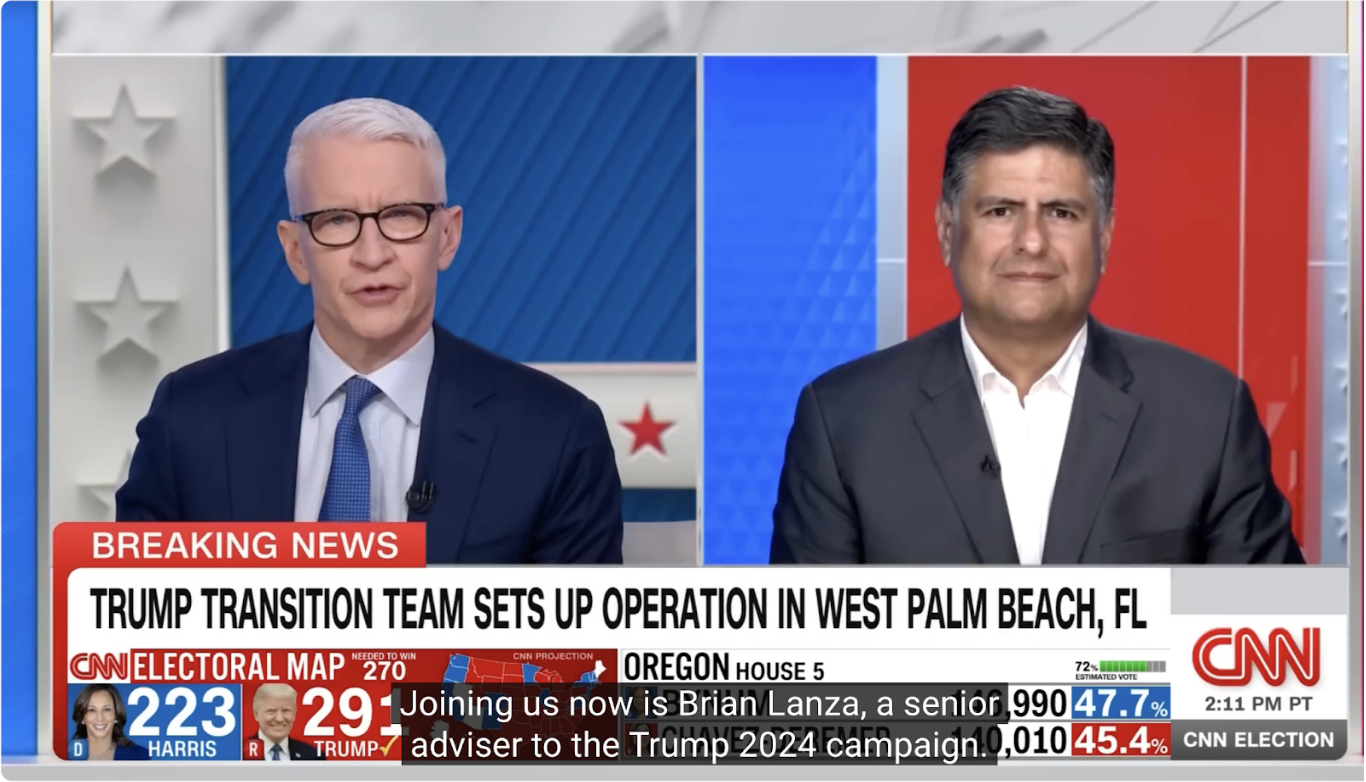 *Bryan Lanza of Mercury Public Affairs appeared on CNN as a senior advisor to the Trump campaign. He is now a registered lobbyist for Bayer.
More Bayer ties to the White House
Another key White House aide with ties to Bayer’s legal network is Ryan Baasch, Trump’s deputy assistant to the President for economic policy. In this role, Baasch helps convert Trump’s economic agenda into coordinated federal policy. From 2016-2021, Baasch was an associate at Latham & Watkins, a law firm that represented Bayer on Roundup settlement issues and represented Monsanto in a case involving dicamba. The firm also represented Monsanto and CropLife America in a glyphosate warning case.
Another aide close to Trump in 2025, Trent Morse, was a senior associate at Ballard Partners from 2020 to 2022, then moved to Mercury Public Affairs as a senior vice president. As deputy assistant to the President and deputy director of presidential personnel for eight months, Morse was part of the team responsible for recruiting, vetting and recommending candidates for political appointments throughout the executive branch. He left the White House in August for a lobbying job.
USDA officials’ ties to Bayer
The U.S. Department of Agriculture oversees farm policy, crop systems, and biotechnology approvals, shaping the subsidies, research, and planting decisions that drive demand for Bayer’s seeds and chemicals. The agency has long faced criticism over its servility to the chemical industry, and the Trump administration is no exception. Current USDA officials with ties to Bayer and its chemical industry allies include:
- Stephen Vaden, deputy secretary of agriculture, is a former associate at Jones Day(2014–2017), a firm that represented Bayer on its acquisition of Monsanto, and Squire Patton Boggs (2011-2014), which represented Bayer and Monsanto in cases involving glyphosate and PCBs.
- Richard Fordyce,undersecretary for farm production and conservation, is the former agriculture business growth director for the public relations and marketing firm Osborn Barr Paramore (2021-2025), which was Bayer’s PR agency for years. A former director of the United Soybean Board, Fordyce was administrator of the Farm Service Agency in Trump’s first term.
- Scott Hutchins,undersecretary for research, education, economics & chief scientist, spent over 30 years at Dow AgroSciences (now Corteva), most recently as global R&D director. He served in this same USDA role in the first Trump administration.
- Pat Swanson,administrator of the Risk Management Agency, was a director for the lobby groups American Soybean Association and the Iowa Soybean Association, where she advocated for Bayer’s pesticides.
- Bill Beam,administrator of the Farm Service Agency, served for nine years on the United Soybean Board, which collaborates with Bayer on research initiatives. Beam previously served as the deputy administrator for farm programs at the FSA (2018–2021).
- Peter Laudeman, senior policy advisor for trade and foreign agricultural affairs, is a former political affairs manager of Corteva Agriscience (formerly DowDuPont) from 2020-2022, and legislative assistant for the National Corn Growers Association from 2018-2020.
Bayer’s pursuit of federal preemption
Bayer’s case before the Supreme Court has high stakes for public health protections and the legal right of individuals to hold companies accountable in court.
Federal preemption – the idea that federal law can override state law in some circumstances – has long been a priority for chemical and food companies that want a single, often weaker, national standard for regulation and liability, while consumer and health groups argue that states must retain the right to set higher health and safety standards.
The issue is central to Bayer’s case before the Supreme Court: the company argues that because the EPA approved glyphosate, cancer claims tied to Roundup should be barred under state failure-to-warn laws. The federal government’s position on whether pesticide approvals preempt state laws has shifted across administrations, underscoring how much the outcome depends on who holds power, and who influences it.
In May 2025, two appellate attorneys with deep experience at the U.S. Department of Justice, Jennifer Scheller Neumann and Amelia Yowell, joined Holland & Hart LLP,a firm that provides legal and lobbying services. A month earlier, the firm had registered to lobby for Bayer.
Neumann spent 20 years at the DOJ’s Environment and Natural Resources Division, most recently as chief of the appellate section overseeing all appellate litigation involving federal environmental laws. She was a signatory on the DOJ’s 2019 amicus brief in the Ninth Circuit Court of Appeals supporting Monsanto (now Bayer). The brief argues that EPA’s approval of glyphosate preempts state failure-to-warm laws.
The Biden administration reversed that position in 2022, urging the Supreme Court to reject Bayer’s case on the premise that federal pesticide law should not preempt state failure-to-warn laws.The Trump Justice Department reversed it again in 2025 – arguing the Biden-era position was wrong and that juries shouldn’t second-guess EPA science.
Oral arguments before the Supreme Court are scheduled for April 27. A win for Bayer could turn EPA pesticide approvals into a nationwide liability shield, elevating the agency’s slow and often industry-dominated chemical assessment process into a final word on pesticide safety, at a time when peer-reviewed research continues to emerge linking pesticide exposure to cancer, neurological harm, and other chronic illnesses.
As Nathan Donley of the Center for Biological Diversity warned, such a precedent would mean that “the only thing that matters legally in determining a pesticide’s safety is what EPA claims to be true, even if those claims completely ignore the best available science.”
Slashing capacity at EPA
Bayer allies also pervade the U.S. agency charged with protecting health and the environment – in positions where they influence what chemicals and pesticides are approved and how these products are regulated. Chemical industry lobbyists now occupy the top four jobs at the EPA’s Office of Chemical Safety and Pollution Prevention (OCSPP), the division in charge of regulating chemicals and pesticides. EPA officials loosened ethics standards to allow it.
Douglas Troutman, assistant administrator at OCSPP, is the former co-CEO and chief lobbyist for the American Cleaning Institute (ACI), which represents major chemical manufacturers. Troutman worked at the lobby group for 17 years before joining the Trump administration.
Nancy Beck, principal deputy assistant administrator at OCSPP, was a senior director at the American Chemistry Council – a lobby group representing Bayer, Dow Chemical, DuPont and other chemical manufacturers – from 2012 to 2017. In Trump’s first EPA, she held advisory roles within the White House at NEC and OMB. Between Trump administrations she worked at Hunton Andrews Kurth, a law firm that offers, among other services, glyphosate litigation defense to companies facing lawsuits from cancer claims.
Lynn Ann Dekleva OCSPP’s deputy assistant administrator for new chemicals, also held this role during the first Trump administration. In between, she was a senior director at the lobby group American Chemistry Council.She is a 30-year veteran of DuPont chemical company, where she workedas a program manager and engineer.
Kyle Kunkler, OCSPP deputy assistant administrator for pesticides, is a former pesticide industry lobbyist. He was director of government affairs, with a focus on biotech and pesticides, for the American Soybean Association from 2020-2025, and prior to that spent three years managing government affairs on food and agriculture for the Biotechnology Innovation Organization lobby group. CropLife America, the main lobby group for the pesticide industry, gave him a “Rising Star” award in 2020.
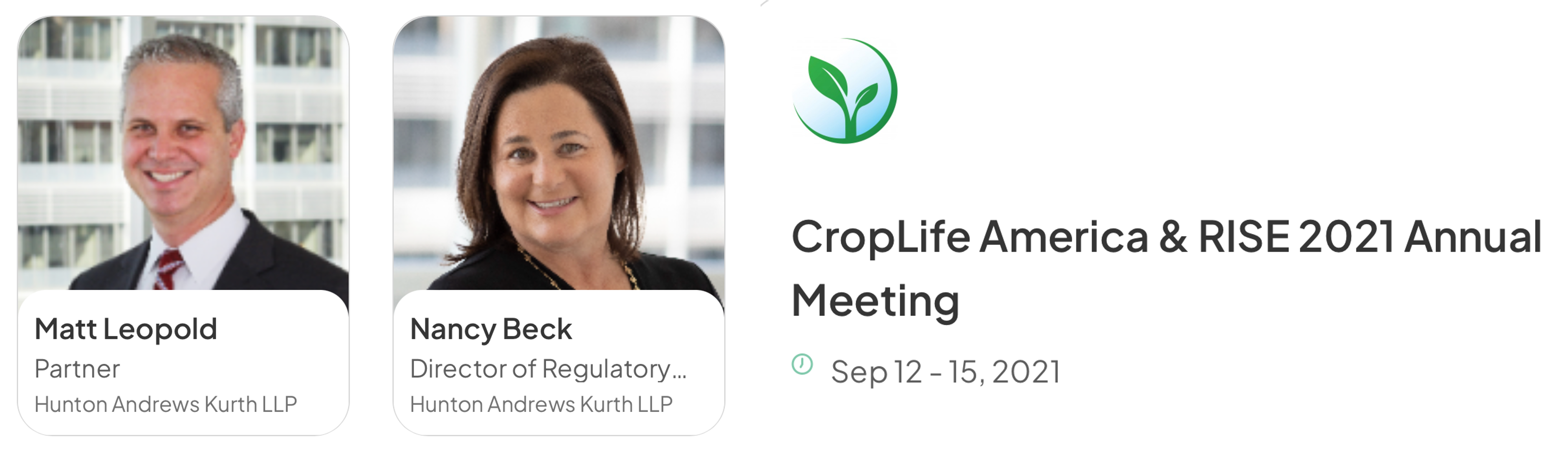 *Bayer was a gold sponsor at CropLife America 2021 where Beck was a featured speaker alongside her colleague Matt Leopold, who was EPA’s top lawyer during the first Trump administration. Hunter Andrews Kurth is a leading firm for pesticide litigation.
---
More EPA officials with ties to Bayer include:
Steven Cook, deputy assistant administrator for the Office of Land and Emergency Management, oversees Superfund sites. Bayer is associated with several Superfund sites due to its pesticide and chemical manufacturing. Cook spent over 20 years as the in-house corporate counsel for LyondellBasell, one of the world’s largest plastics and chemical companies. LyondellBasell has a 50/50 joint venture with Bayer (a propylene oxide and styrene monomer plant). LyondellBasell CEO Peter Vanacker is board chair of the American Chemistry Council.
Aaron Szabo,assistant administrator for air and radiation (appointed in July 2025) was a partner and lobbyist at CGCN Group (2018–2023), which has been registered to lobby for the American Chemistry Council during the past decade. From 2023 to 2024, he was a senior director and attorney at Faegre Drinker Biddle & Reath, where he represented chemical interests, including the ACC, before returning to the EPA in January 2025.
Alex Dominguez,deputy assistant administrator for mobile sources, was a registered lobbyist with Massie Partners, where he represented the National Corn Growers Association, a group whose members are consumers of Bayer’s seeds and pesticides. He worked in that role from 2023 to January 2025.
More Trump officials tied to Bayer
As assistant secretary of legislation at the U.S. Department of Health and Human Services, Gary Andresis a primary liaison between HHS and Congress. He was previously the senior executive vice president of public affairs at the Biotechnology Innovation Organization, the main trade group for biotech companies including Bayer. At BIO, Andres directed the lobbying strategy for the entire biotech sector, which included defending the regulatory framework for GMOs and associated agrichemicals. He previously worked at lobbying firm Dutko Worldwide which has represented Bayer.
Secretary of Transportation Sean Duffy also has ties to a Bayer lobby firm; he was senior counsel and advisory board member of BGR Group from 2019 to 2023 and was a registered lobbyist for the firm in 2020, though there is no record of him lobbying for Bayer.
13 lobby firms working for Bayer in Washington
Bayer’s direct lobbying spending is significant, but its political influence expands considerably when viewed alongside allied trade and commodity groups that together form a well-financed and coordinated lobbying network. In 2025, Bayer retained at least 13 lobby firms and at least 49 registered lobbyists registered to lobby for the company (including Bayer’s six in-house lobbyists) as of the fourth quarter, federal disclosures show.
Bayer spent at least $9.19 million on federal lobbying last year. While it is not among the highest-spending single corporations lobbying in D.C., the agribusiness sector ranked ninth with $219.9 million in lobbying expenditures in 2025 – the highest year on record for the sector. We include the sector total because Bayer’s influence is amplified by an integrated industrial agribusiness system that acts in concert – from pesticide-dependent commodity crops to factory farms and ultra-processed food production – to shape policy in its favor.
Within the sector, groups directly lobbying for favorable pesticide policies include trade groups representing pesticide manufacturers – the American Chemistry CouncilandCropLife America – and commodity groups such as the National Corn Growers Association and American Soybean Association that rely on Bayer’s products.
These four groups spent a combined $22 million on federal lobbying in 2025, with 12 more outside lobby firms and 79 more registered lobbyists in the fourth quarter.
Bayer’s lobbying activity last year was its highest in recent years, but lower than the company’s peak in 2016, 2017 and 2018, just before the Bayer/Monsanto merger and following the 2015 WHO cancer agency finding that glyphosate is a probable human carcinogen.
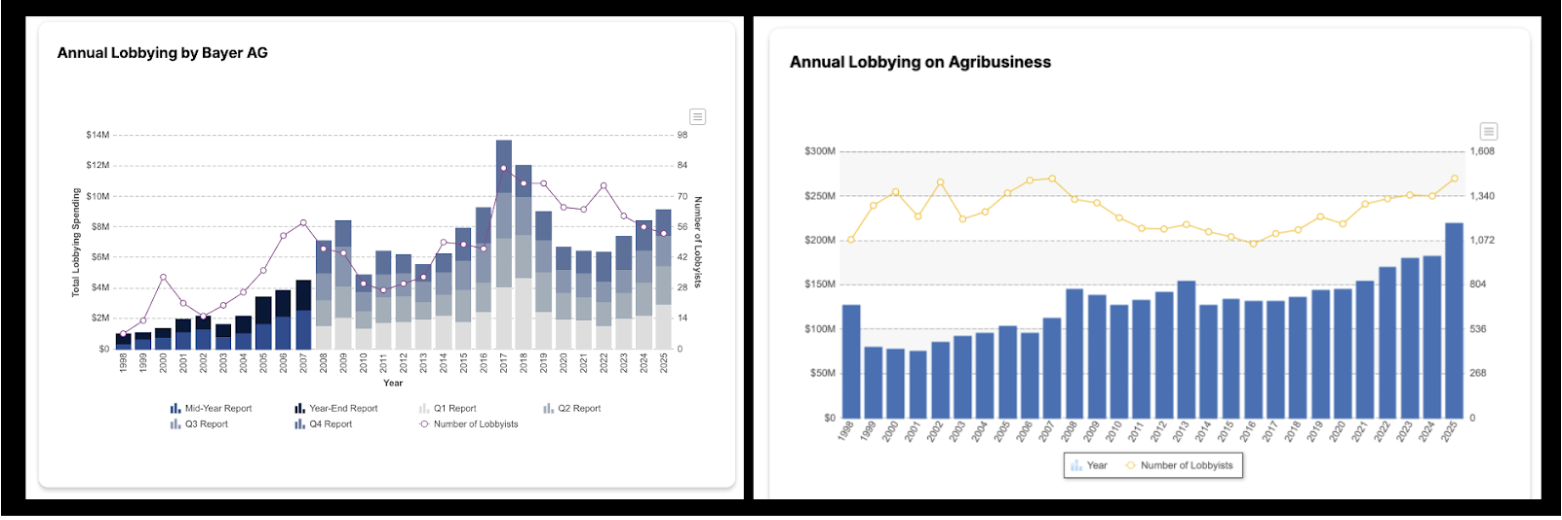 *Source: OpenSecrets
These numbers don’t reflect the whole picture of Bayer’s lobbying activities. The Lobbying Disclosure Act requires registration only after certain spending and activity thresholds are met, so public filings do not capture all of the paid influence work taking place in Washington.
They don’t reflect state-level activity, either. Pesticide related PAC spending surged in late 2024 as companies sought to limit damage awards in courts across the nation. In Iowa alone, Bayer spent a record amount last year trying to pass a state immunity bill critics called the Cancer Gag Act.
Read more about Bayer’s lobby force in our Bayer Lobby Tracker.
More lobbyists tied to Trump
Political scientists have long documented how lobbying shapes public policy by securing access to decision-makers, and helping corporations turn their priorities into laws and regulations. These dynamics help explain how companies like Bayer can translate access in Washington into concrete policy wins.
More than 30 people in leadership positions at lobby firms retained by Bayer have direct ties to Trump’s current or former administrations or presidential campaigns, our analysis shows. Many of these lobbyists are not personally registered to lobby for Bayer, but may be assisting in ways that do not trigger lobby registration, for example, advising the firm’s Bayer lobbyists.
As noted earlier, Ballard Partners – the firm that employed both Susie Wiles and Pam Bondi, and is run by one of Trump’s biggest political fundraisers – is a fundamental connection for Bayer o Trump’s orbit. In addition to Brian Ballard and Daniel McFaul, the two lobbyists at the firm who are registered to lobby for both Bayer and the American Chemistry Council, other partners at Ballard have connections to Trump:
Hunter Morgen, a D.C.-based partner in the firm, served over three years in senior positions during the first Trump administration – as special assistant to the President and senior advisor for policy and strategy in the White House working on trade and immigration issues with Peter Navarro and Stephen Miller. Prior to his White House role, Morgen was policy advisor for the State Department in the Office of Policy and Planning. He previously worked on Trump’s 2016 presidential campaign and transition team. In 2020, Trump appointed Morgen to the Presidential Council on Improving Federal Civil Architecture. Morgen – along with Brian Ballard, Daniel McFaul, Syl Lukas (a senior partner at Ballard) and Susie Wiles – were included among a list of donors invited to an October 2025 gala for Trump’s new $250 million East Wing ballroom.
 *Trump has said the new ballroom is being “paid for 100 percent by me and some friends of mine, donors,” raising concerns about conflicts of interest.
Mike Rubino, another D.C. partner at Ballard, was among the first hires on Trump’s 2016 presidential campaign where he was a senior advisor directing operations in ten states and winning nine of them, according to his bio. He joined the first Trump administration as a senior official at HHS before leaving for the private sector where he worked alongside Corey Lewandowski, who is currently a key figure at the Department of Homeland Security.
Ballard D.C. Partner William Russell was the aide responsible for Trump’s daily travel and logistics for nearly four years of the first administration. Russell also worked on Trump’s 2016 and 2024 campaigns.
Brian Hughes, a partner at Mercury Public Affairs– the other lobby firm that previously employed Susie Wiles – was NASA chief of staff from May to December 2025. He joined Mercury in January 2026. Brian Hughes was Trump’s Florida campaign manager in 2024 and communications director for Trump’s transition team. Danielle Alvarez, another partner at Mercury, held communications and advisory roles in Trump’s 2020 and 2024 campaigns.
Other Bayer lobby firm ties to Trump’s White House include:
Amy Swonger, a principal at Invariant– a firm registered to lobby for Bayer – worked in the Executive Office of the President for most of Trump’s first term, as assistant to the president and as director and deputy director of legislative affairs.
Jordan Bonfitto,a director at Invariant, was a policy advisor at the National Economic Council in Trump’s first White House, focused on the agricultural and biotech portfolios. From February to October 2025, Bonfitto was the chief of staff for marketing and regulatory programs at the USDA under Secretary Brooke Rollins. He joined Invariant in November.
Other notable Bayer lobby firm ties to Trump:
Holland & Hart, a lobby firm Bayer retained in April 2025, employs former EPA Administrator Andrew Wheeler, who held the top job at EPA for part of Trump’s first term. Wheeler is a partner at the firm and head of federal affairs. Troy Lyons, a registered lobbyist for Bayer and senior director of federal affairs at Holland & Hart, held senior roles in Trump’s first EPA working under both Wheeler and Trump’s first EPA Administrator Scott Pruitt.
At BGR Government Affairs, several senior lobbyists have ties to Trump. Managing Director David Urban was a senior advisor on Trump’s 2016, 2020, and 2024 campaigns; Practice Head and Principal William Crozer left the firm during Trump’s first term to serve as special assistant to the president and deputy director of the White House Office of Intergovernmental Affairs; and PrincipalJoseph Lai was aspecial assistant to the President for legislative affairs (2017-2019), where he led the outreach and vote-counting efforts to confirm Justices Gorsuch and Kavanaugh, as well as other major appointees.
Akin Gump Strauss Hauer & Feld, longtime lobbyists for Bayer and Monsanto, also has notable advisors and partners with ties to Trump. Geoff Verhoff, senior advisor at the firm, served on the Trump-Pence victory finance leadership committee 2017-2021 and was the vice chair of the RNC Finance Committee in those years. Partner Kelly Ann Shaw, was deputy assistant to the President for international economic affairs and the U.S. lead negotiator (Sherpa) for the G7, G20, and APEC in 2018 and 2019. Senior Advisor Anna Abramdeputy commissioner for policy, legislation and international affairs at the FDA from 2017 to 2021.
For more ties between Bayer’s lobby firms, the Trump administration and other routes of influence see our lobby tracker:
This analysis of Bayer-Trump connections reflects only what is visible in public records. Additional financial, political, or personal ties – including undisclosed funding streams, if they exist – may remain hidden. This story is a work in progress. We will update it. You can help by sending us what you may know about ties between Bayer and the Trump administration, including the federal agencies. Contact Stacy Malkan via Signal or email stacy@usrtk.org.
Updates made February 26:
- Added another USDA official (Peter Laudeman) with ties to Bayer.
- Added total number of lobbyists and lobby firms retained by four trade and commodity groups that work closely with Bayer: American Chemistry Council, CropLife America, National Corn Growers Association and American Soybean Association.
Categories: Monsanto/Bayer, Pesticides Tags: Primary Article
===
https://www.desmog.com/2022/12/09/pesticide-industry-science-denial-monsanto-glyphosate-cancer/}:
As regulators in the United States and European Union prepare to review and potentially reauthorize the controversial weedkiller glyphosate, anew report reveals the stealth tactics and narrative spin deployed by the chemical’s manufacturer to discredit inconvenient science and protect profits.
The report, published by Friends of the Earth and nonprofit investigative organizationU.S. Right to Know,uses the case study of Monsanto (now owned by Bayer) and its widely used glyphosate-based product Roundup to illustrate the pesticide industry’sdeceptive tactics and communications strategies — which mirror those of the tobacco and fossil fuel industries.
“The pesticide industry is not just following in the footsteps of Big Tobacco and Big Oil, they co-wrote the playbook,” Stacy Malkan, lead report author and co-founder of U.S. Right to Know, said.
The pesticide industry used this PR strategy, which involves tactics like distorting science and disseminating misleading messaging through third party allies, to convince regulators and the public that its products were safe and necessary, the report explains.
“This case study provides an important window into how one company worked with many partners across the pesticide and processed food industries, academia, PR firms, and various front groups to sell the world on a toxic pesticide,”said author and advocate Anna Lappé, who contributed to the report. “These disinformation tactics are critical to understand because they have been used to push the entwined myths that we need pesticides to ‘feed the world’ and that they are totally safe.”
Despite mounting scientific evidence of their harms to human health and the environment, pesticides have proliferated, withglobal usage up by about 80 percent since 1990. The most widely used pesticide in the world is Roundup, which is alleged to have caused cancers. Litigation over this cancer link is ongoing, spurred by a 2015 finding from the World Health Organization’s cancer research arm classifying the chemical as a probable human carcinogen.
[twt]
the report, released December 5, brings together internal corporate documents revealed through this litigation, as well as documents obtained through public records requests filed by U.S. Right to Know, to illuminate the extensive campaign by one of the world’s leading pesticide manufacturers — Monsanto, acquired by Bayer in 2018 — to disseminate disinformation and manipulate science regarding the health and environmental impacts of glyphosate.
These strategies have been “used by the pesticide industry for decades now and [their] impact on public health is enormous,” Nathan Donley, PhD, environmental health science director at the Center for Biological Diversity, told DeSmog via email.
Litigation concerning the health hazards of various pesticides, including glyphosate, stems from companies hijacking the regulatory process, he explained. “This can happen multiple ways, from pressuring decision makers at the EPA to producing enormous amounts of biased data that guide the actions of regulators. It’s been very effective unfortunately.”
For example, as noted in the report, under pressure from Monsanto in 1986, EPA overturned its own decision made the previous year to classify glyphosate as a possible human carcinogen. To this day, EPA maintains the position that glyphosate is not carcinogenic and does not pose human health risks if used according to its label. However, the agency is planning to conduct a new review of the chemical after a federal appeals courtstruck down EPA’s previous designation of glyphosate as benign.
The report found that over a five-year period, seven front groups with links to Monsanto spent $76 million “to push corporate disinformation, including attacks on scientists.” During that same period, six industry trade associations that appear in Monsanto PR papers spent $1.3 billion, including on lobbying and PR around glyphosate regulation.
It also argues that the pesticide industry’s current business model “would not be possible if pesticide products were subject to rigorous, independent research and if there were widespread public understanding of the harms and risks of many of these products.”
“It’s clear from this report and all the work that’s been done in this field that corporate influence in science-based decision-making is way too common,” said Genna Reed, director of policy analysis in the Center for Science and Democracy at the Union of Concerned Scientists, and lead author of a2021 study exploring ways to protect scientific integrity from the corporate “disinformation playbook.”
“This isn’t just a wonky policy problem,” Reed added. “This is a massive institutional rot that needs to be fixed to protect public health.”
Fossil Fuel and Pesticide Industry Parallels
In addition to pressuring regulators, Monsanto deployed other strategies to discredit evidence of health and environmental harms of its glyphosate-based product. The report found that Monsanto undermined or even shaped the science, attacked public health experts, bought influence at academic institutions, and used third party messengers to pollute the public discourse. These are the same strategies — and in some instances involved the same actors — that the tobacco and fossil fuel industries used to generate doubt and to deceive the public about the harmful consequences of their products.
According to the report, Monsanto covertly contributed to the scientific literature examining the health risks of glyphosate, ghostwriting papers in toxicology journals, including an influential paper published in April 2000 that concluded that glyphosate-based Roundup “does not pose a health risk to humans.” Internal company emails reveal that Monsanto employees played critical roles in data collection, drafting, editing, and relationship-building with the paper’s authors. In the wake of the 2015 glyphosate classification from the World Health Organization’s cancer research agency, Monsanto ghostwrote scientific manuscripts published in a prestigious journal as an “independent review” on the science of glyphosate. The company also orchestrated a campaign to intimidate cancer researchers and enlist Republican lawmakers to try to defund the World Health Organization’s cancer research arm.
[twt]
monsanto’s influence extended to academia.The report details how the company funded academics and universities to promote educational messaging supportive of pesticides and genetically engineered organisms (GMOs) — seed traits designed to resist toxic chemicals. Emails obtained from records requests reveal that the University of Florida, for example, “had plans for ‘educating the masses’ about GMOs and pesticides with messaging that was ‘harmonious’ with Monsanto’s,” Malkan explained.
This co-opting of academia was part of a larger pro-pesticide PR strategy. As the report explains, PR firms that helped Monsanto defend glyphosate and promote GMOs have worked with other polluting industries, including tobacco and fossil fuels. For example,FTI Consulting,which has worked extensively with the oil and gas industry, has also worked closely with Monsanto/Bayer to discredit the science on glyphosate.
Furthermore, as the report details, one industry front group that worked to attack cancer scientists and dispute the evidence linking glyphosate to cancer was the Genetic Literacy Project. Its founder Jon Entine has worked in defense of chemicals, plastics, fracking, and oil companies, and the group’s funding sources “trace back to some of the largest, most consistent funders of climate science denial.” These include foundations like Donors Trust, Scaife Foundation, and Charles Koch Foundation. Other institutions that engaged in climate denial — including Competitive Enterprise Institute,Heartland Institute,Cato Institute, andCommittee for a Constructive Tomorrow (CFACT) — also attacked scientists who raised concerns over glyphosate, according to the report.
“This is not surprising since nearly all agricultural chemicals are derived from fossil fuels,” Malkan said, adding that both industries are continuing to mislead the public in portraying their business or products as essential to climate and sustainability solutions.
“Just like Big Oil, pesticide companies are using disinformation tactics to push false solutions for the climate crisis, and stalling action on real solutions,” Malkan added. ADeSmog investigation published in November 2020 described how pesticide companies are now marketing themselves as climate-friendly.
“Pesticide companies are desperately trying to, and in many instances are successfully greenwashing the poisons they make billions of dollars selling,” Lori Ann Burd, senior attorney and environmental health program director at Center for Biological Diversity, said via email. She added that many U.S. government officials have adopted the pesticides industry’s position that their products are necessary.
“USDA, EPA and many members of Congress have largely bought in to industry rhetoric that dangerous pesticides are essential tools for feeding Americans, ignoring the reality that many countries, including Brazil, China and nations within the E.U. continue to eat despite having banned dangerous pesticides that are still widely used in the U.S.,” she explained. UN human rights experts have also pushed back against the claim that pesticides are necessary to feed the world.
Bayer did not immediately respond to a request for comment on the report.
Countering the Disinformation Playbook
The report concludes with some recommendations and steps to take to counter the pesticide industry disinformation playbook. According to this advice, which is aligned with that of other experts in fighting disinformation, exposing the tactics and strategies and enforcing strong disclosure and accountability rules are important steps to mitigate undue industry influence.
“We need to continue to shine a light on these practices and actively work on policies that can serve as firewalls,” Reed of the Union of Concerned Scientists said.
Other recommendations include challenging corporate influence in academia and holding PR firms accountable. Just as there are now campaigns to do just that for fossil fuels, the report calls for similar action and pressure for combatting pesticide industry influence and enablers.
“While the propaganda tactics of Big Oil and Big Tobacco are well-documented and their grave impacts well understood, the pesticide industry’s similar role in widespread disinformation, and its extensive scope and impact, has not been as well documented or publicly understood. We hope this report, and the chorus of recent reporting, will change that,” the report states.
===
---
https://usrtk.org/our-investigations/jon-entine-genetic-literacy-project/
no lnx pix
Posted on July 14, 2022 by Gary Ruskin
Genetic Literacy Project is an influential front group that partners with Bayer and other chemical companies to promote GMO foods and pesticides and argue for deregulation. In 2020, Bayer paid Genetic Literacy Project $100,000 for its work “to prevent legislative overreach in genetic engineering,” according to the group’s IRS form 990. Donor’s Trust, the secretive funding vehicle that funds attacks on climate science, is also a donor.
Prior to 2020, the Genetic Literacy Project claimed not to accept corporate funding, despite emails and internal corporate documents showing how the group assisted pesticide companies with their product defense efforts. We discuss the evidence here, and describe how GLP plays a leading role in efforts to attack and discredit scientists and journalists who raise concerns about chemical industry products.
Origins as Monsanto’s PR firm
Jon Entine, founder and director of Genetic Literacy Project, is also the founder and principal of ESG MediaMetrics, a public relations firm that had Monsanto as a client in 2011 when the firm registered the GeneticLiteracyProject.org domain.
Entine was also employed at that time by Statistical Assessment Services (STATS), a nonprofit group that journalists have described as a “disinformation campaign” that downplays health harms of toxic products. GLP was developed as a “cross disciplinary program with STATS,” according to web archives. In 2015, GLP moved under the umbrella of a new group, the Science Literacy Project, which inherited STATS tax ID.
STATS was a “major player in the public relations campaign to discredit concerns about bisphenol A,” according to the Milwaukee Journal Sentinel. Its parent organization, the Center for Media and Public Affairs (CMPA), was paid by tobacco giant Phillip Morris in the 1990s “to pick apart stories critical of smoking.” Entine was a director of the CMPA in 2014/2015, according to tax forms.
What is the evidence GLP secretly partnered with Monsanto for years?
The Genetic Literacy Project claims to stand for “fact-based science” even as it frequently attacks scientists and journalists who report on the health harms of toxic chemicals. Although the group claimed for years to be independent of industry, documents obtained by U.S. Right to Know and via litigation establish that Monsanto partnered with Entine and GLP on projects to promote and defend GMOs and pesticides. These collaborations were not disclosed.
A 2015 Monsanto PR plan names Genetic Literacy Project among the “industry partners” Monsanto planned to engage in its efforts to “orchestrate outcry” about the International Agency for Research on Cancer (IARC), a scientific group that found glyphosate to be a probable human carcinogen. Monsanto’s goal, according to the PR plan: “protect the reputation” of Roundup. GLP has since posted over 200 articles about IARC, several of them attacking the scientists as frauds and liars who are driven by profit and vanity.
An award-winning Le Monde investigation about the “Monsanto Papers” described Genetic Literacy Project as a “well-known propaganda website” that is “fed by PR people linked to the pesticides and biotechnology industries.” Le Monde reported that GLP played a key role in Monsanto’s efforts “to destroy the United Nations cancer agency by any means possible.”
In a 2017 court filing, plaintiffs’ attorneys suing Monsanto over glyphosate cancer concerns described Genetic Literacy Project and the American Council on Science and Health as “organizations intended to shame scientists and highlight information helpful to Monsanto and other chemical producers.”
In 2014 and 2015, Genetic Literacy Project partnered with Academics Review, a group that documents show was set up as a front group with the help of Monsanto to defend against industry critics. Genetic Literacy Project and Academics Review jointly organized the pesticide industry-funded “Biotech Literacy Project boot camps” that provided “communications skills training” to journalists and scientists to help them promote and lobby for GMOs and pesticides.
GLP led attacks against the WHO’s IARC scientists after they said glyphosate is a probable human carcinogen.
Pro-GMO papers by professors
In 2014 and 2015, Genetic Literacy Project worked with Monsanto and their PR firm to publish and promote a series of pro-GMO papers written by professors, according to documents obtained by U.S. Right to Know. Monsanto assigned and edited the papers, and set Genetic Literacy Project up to publish them. The corporation’s role was not disclosed.
Boston Globe: Harvard professor failed to disclose Monsanto connection
Bloomberg: How Monsanto Mobilized Academics to Pen Articles Supporting GMOs
The emails reveal that Monsanto executives chose Genetic Literacy Project as the “the primary outlet” to publish the professors’ papers, and to build a “merchandising plan” with the PR firm CMA to promote the papers. CMA, now renamed Look East, is directed by Charlie Arnot, who also runs the Center for Food Integrity, a nonprofit that receives funding from Monsanto, and also donates to Genetic Literacy Project.
Who paid for Entine’s book about atrazine?
Syngenta funded ACSH which published Entine’s book defending Syngenta’s pesticide.
Jon Entine is closely tied in with the American Council on Science and Health (ACSH), a corporate front group that received funding from Monsanto and other corporations but did not disclose it.
In 2011, ACSH published Entine’s book “Scared to Death,” which defends atrazine, a pesticide manufactured by Syngenta. Reporting by Tom Philpott in Mother Jones and the Center for Media and Democracy establishes that Syngenta was funding ACSH at the time, and that ACSH asked Syngenta for extra funding for a project that fits the description of Entine’s book. Syngenta was seeking third-party allies to help the company defend atrazine.
Emails show that ACSH staff asked Syngenta in 2009 for a $100,000 grant, “separate and distinct from general operating support Syngenta has been so generously providing over the years,” to produce a paper and “consumer-friendly booklet” about atrazine. In 2011, ACSH announced Entine’s new book along with a “companion friendly, abbreviated position paper,” both defending atrazine. Entine told Philpott he had “no idea” Syngenta was funding ACSH.
How does Entine attack scientists and journalists?
A key theme in Entine’s work is attacking scientists and journalists who report critically about the chemical industry, the oil industry or health problems associated with them. Some examples:
In Forbes, Entine attacked New Yorker reporter Rachel Aviv in an attempt to discredit Aviv’s reporting on internal Syngenta documents that reveal how the chemical company tried to destroy the reputation of UC Berkeley Professor Tyrone Hayes. Research by Hayes ties the herbicide atrazine to birth defects in frogs. Entine’s chief source for his attack article was Bruce Chassy, a professor who was receiving money from Monsanto and helped start a Monsanto front group to attack industry critics.
In the Huffington Post, Entine attacked Harvard Professor Naomi Oreskes, co-author of Merchants of Doubt and an expert on corporate disinformation campaigns. Entine described Oreskes as an “intellectual Rottweiler of in-your-face, environmentalism, unduly wary of modern technology.”
In the New York Post, Entine accused Columbia Journalism School Dean Steve Coll and journalist Susanne Rust of “smearing Exxon” for reporting that Exxon knew for years that climate change was real but hid the science to keep revenues flowing.
In a follow-up attack (since removed from the Huffington Post website), Entine accused Rust of ethics violations for her reporting in an award-winning series on BPA that was short-listed for a Pulitzer Prize. Entine did not disclose that her reporting identified his former employer STATS as a major player in industry’s PR efforts.
What is the funding history of GLP and Entine?
Entine’s funding history is complex and opaque, but tax documents and his own disclosures reveal a pattern of funding from anonymous sources and right-wing foundations that push deregulation and climate science denial, as well as undisclosed funding from the pesticide industry.
Inaccurate, ever-changing “transparency” note
The “financial transparency” note on the Genetic Literacy Project website is inaccurate, changes often and at times contradicts itself.
As of 2020 the group openly accepts corporate contributions. Funders in 2020 include Bayer, an agrichemical company whose products GLP promotes, and Donor’s Trust, the secretive funding vehicle that has been described as the “dark money ATM” of the right and is known for funding climate science denial and white supremacist groups.
Prior to 2020, GLP claimed it accepted no corporate funding. However, documents show the group partnered with Monsanto on promotional projects and the group’s own disclosures suggest corporate funding.
In September 2016, GLP’s “disclosure” note claimed to accept no corporate funding, but noted a $27,500 “pass through” from “Academics Review Charitable Association,” which appears not to exist. That group is apparently AcademicsReview.org, a front group that received its funding from a pesticide industry trade group although it claimed to accept no corporate funding. In 2014 and 2015, Genetic Literacy Project and Academics Review jointly organized the industry-funded Biotech Literacy Project boot camps to promote GMOs and pesticides at top universities.
In 2017 and 2018, Genetic Literacy Project claimed funding from a handful of foundations including the Templeton and Searle foundations. These groups are leading funders of climate science denial efforts. GLP also noted funding from the Center for Food Integrity, a food-industry front group that was receiving money from Monsanto and also partnering with Monsanto and Genetic Literacy Project on PR projects.
In March 2016, GLP made no financial disclosures and Entine tried to distance GLP from his former employer STATS, claiming that STATS provided accounting services only and that the groups weren’t involved with each other’s activities — a claim GLP still makes. But in 2012, GLP said it was “developed as a cross disciplinary program with STATS.”
Ties to climate science deniers
Major financial supporters of Entine’s former employer STATS and his current group Genetic Literacy Project include right-wing foundations – primarily Scaife Foundation, Searle Freedom Trust and Templeton Foundation – that are leading funders of climate science denial, according to a 2013 Drexel University study. For more information see USRTK investigation: Climate Science Denial Network Funds Toxic Chemical Propaganda.
Although the Genetic Literacy Project claims to stand up for science, the group publishes articles from writers who dismiss climate science. For example, climate science skeptic Paul Dreissen, a senior policy advisor for the Committee for a Constructive Tomorrow (CFACT), writes frequent articles for GLP denying harm from pesticides.
Center for Media and Public Affairs/George Mason University
For the fiscal year 2014/2015, according to tax records, Entine received $173,100 for his work as “director” at Center for Media and Public Affairs, a group based at George Mason University and founded by GMU Professor Robert Lichter. CMPA was paid by Phillip Morris in the 1990s to deflect concerns about tobacco, according to documents in the UCSF Tobacco Industry Library.
CMPA does not disclose its funders but has received funding from George Mason University Foundation, the leading recipient of donations affiliated with Charles Koch and Koch Industries. GMUF also received $5.3 million from Donors Trust and Donors Capital Fund between 2011-13, according to the Guardian. These funds channel money from anonymous donors including corporations to campaigns and academics who push industry interests, as Greenpeace demonstrated in an undercover investigation. Donors Trust is also a donor of Genetic Literacy Project, according to 2020 tax records.
STATS payments and loans
CMPA’s sister group, also founded by Lichter and based at GMU, was Statistical Assessment Services (STATS), a nonprofit group that played a key role in chemical industry PR efforts to defend toxic products, according to reporting in The Intercept, Milwaukee Journal Sentinel, The Atlantic and Consumer Reports.
According to IRS forms:
STATS paid Entine $140,600 in 2012/2013 and $152,500 in 2013/2014 as a “research consultant”
STATS and Center for Media and Public Affairs both listed Entine as Director in 2014/2015 with compensation of $173,100. Tax records for both groups also listed President Trevor Butterworth for $95,512 and Director Tracey Brown with no compensation. Tracey Brown is director of Sense About Science, a group that also spins science to defend chemical industry interests; Butterworth founded Sense About Science USA in 2014 and merged STATS into that group.
Science Literacy Project took over the tax ID of STATS in 2015 and listed Entine as Executive Director with compensation of $188,800.
In 2018, ESG MediaMetrics, Entine’s PR firm, reported $176,420 in income.
The Center for Media and Public Affairs has also loaned money to STATS, which “due to inadequate funding” has “not been reimbursed.” George Mason University Foundation, which does not disclose its funding, gave CMPA grants in those years. Tax records show:
CMPA loaned STATS $203,611 in 2012/2013 and $163,914 loan in 2013/2014
George Mason University Foundation granted $220,900 in 2012/2013 and $75,670 in 2013/2014 to CMPA.
What was the Biotech Literacy Project boot camp?
In 2014 and 2015, pesticide corporations spent over $300,000 on two events organized by Genetic Literacy Project and Academics Review to “train scientists and journalists to frame the debate over GMOs and the toxicity of glyphosate,” according to tax records and reporting in The Progressive. These “Biotech Literacy Project boot camps,” were held at the University of Florida in 2014 and UC Davis in 2015. The organizers falsely claimed the events were jointly funded by universities, government and industry, but the only traceable source of funding was the pesticide industry.
The boot camps provided “communication skills training” for scientists and journalists to help reframe the food safety and GMO debate, and offered “tools and support resources” to help trainees “effectively engage the media and appear as experts in legislative and local government hearings, and other policy making and related outreach opportunities.”
Boot camp faculty included representatives from the pesticide industry, food industry front groups and trade groups, and pro-GMO academics including University of Florida Professor Kevin Folta, and University of Illinois Professor Emeritus Bruce Chassy, both of whom have accepted undisclosed funding from Monsanto to promote the GMOs and pesticides that Monsanto sales rely upon. Washington Post food columnist Tamar Haspel, who also accepts money from agribusiness groups, was a faculty member at the first boot camp.
Which toxic products does Entine defend?
GLP Director Jon Entine is a former journalist who portrays himself as an objective authority on science, however, the evidence described in this fact sheet establishes that he is a longtime PR operative with deep ties to the chemical industry and undisclosed industry funding. For many years, Entine has been a prolific defender of polluting industries, writing long emotional articles based on industry arguments: that toxic chemicals and processes are safe and do not need to be regulated, and attacking scientists and journalists who raise concerns about these industries.
Defending neonicotinoids
Growing scientific evidence suggests that neonicotinoids, the most widely used class of pesticides, are a key factor in bee die-offs. The European Union has restricted neonics due to concerns about impact on bees. A February 2020 article in The Intercept by Lee Fang reported on the “sophisticated information war” pesticide companies are waging to keep the chemicals on the market in the U.S. Entine has been a key pro-industry messenger; he has argued that neonics are not key driver of bee deaths (American Enterprise Institute), that “The bee apocalypse was never real,” (American Council on Science and Health) and that neonics may actually help bee health (American Enterprise Institute and Forbes). Entine also attacked a Harvard professor’s study on bee Colony Collapse Disorder (American Enterprise Institute) and accused European politicians of trying to kill bees by restricting neonics (Forbes).
Defending phthalates
Phthalates are a class of chemicals long linked to hormone disruption, reproductive harm, fertility problems and links to childhood obesity, asthma, neurological problems and cardiovascular issues. The U.S. government began restricting the chemicals in children’s toys in 2013 due to health concerns. Entine has defended children’s products containing the chemicals. “Few chemicals on the market today have undergone as much scientific scrutiny as phthalate esters,” Entine wrote (Forbes) — but he did not mention the significant body of scientific evidence compiled over two decades that links phthalate exposures to abnormal reproductive development in baby boys. His messaging included attacks on reporters; Entine accused an NBC reporter of “shoddy journalism” for raising questions about safety (Forbes). And Entine’s PR firm, ESG MediaMetrics, worked for the Vinyl Institute, the trade association for vinyl plastic, which is a key source of exposure to phthalates. Entine did not disclose the industry connection in his Forbes articles.
Defending fracking
Entine defends hydraulic fracturing (“fracking”), the pumping of high-pressure chemical-laced water into the ground to crack shale and extract natural gas. As in his many other messaging campaigns, Entine blasts science and scientists who raise concerns, framing them as “activists,” while making sweeping and indefensible statements about “scrupulous” science conducted over many years that defend its safety. For example, Entine claimed: “From a scientific perspective, no reason exists to even suspect unknown health or environmental issues will turn up” from fracking (New York Post).
Again, attacks were a key part of the messaging. Entine accused New York Times reporters of misleading children about the potential environmental dangers of fracking (Forbes), attacked two Cornell University scientists for their study suggesting that fracking operations leak methane (Forbes), and attacked the Park Foundation, claiming that it has “almost single-handedly derailed shale-gas development in methane-rich New York State, and put its imprint on public opinion and policy decisions around the country.” (Philanthropy Roundtable)
Defending BPA
Entine writes in defense of the chemical bisphenol A (BPA), despite a large body of scientific evidence raising concerns about its endocrine disrupting potential and other health problems associated with it. Canada declared the chemical to be toxic in 2010, and the EU banned BPA in baby bottles in 2011.
Entine attacked university researchers, NGOs and journalists raising concerns about BPA (Forbes), suggested that women who can’t get pregnant should not to blame it on plastics (Forbes), and challenged scientists who linked BPA to heart disease (Forbes).
Defending Nuclear Power
Entine also defends the nuclear power industry; he has claimed that nuclear power plants are environmentally benign and that “nothing as bad as Chernobyl is likely to occur in the West.” He accused Harvard Professor Naomi Oreskes of science “denialism,” for, among other things, pointing out the economic and environmental risks of nuclear power.
Who partners with Genetic Literacy Project?
We have compiled a series of fact sheets on front groups and other third party allies the pesticide industry relies on to promote and defend its products. Several of these industry allies are also tied to Jon Entine and the Genetic Literacy Project.
The American Council on Science and Health is a corporate front group: here’s the evidence
Former AAAS president Nina Fedoroff (SLP board member) mobilized the authority of American science to back Monsanto
SLP board member Geoffrey Kabat’s ties to tobacco and chemical corporations
Former Monsanto communications director Jay Byrne is a key partner
GLP partner Academics Review was formed as a front group with the help of Monsanto
Professor Pamela Ronald gave GLP a platform at UC Davis
Read more about Entine’s Biotech Literacy Project boot camps
Read how the climate science denial network funds toxic chemical propaganda
Entine’s fellowships
Entine was an unpaid fellow at the Center for Health and Risk Communication at George Mason University (GMU) from 2011-2014.Entine is also a former senior fellow at the UC Davis World Food Center’s Institute for Food and Agricultural Literacy, which does not disclose its donors. He is a former visiting fellow at the American Enterprise Institute, a DC think tank funded in part by corporate and dark money contributions.
See also:
Greenpeace Polluter Watch: Jon Entine and “the hidden story of the Genetic Literacy Project“
USRTK: Secret documents expose Monsanto’s war on cancer scientists
Food For Thought, Hall of Shame, Our Investigations Academics Review, AcademicsReview.org, American Council on Science and Health, American Enterprise Institute, Amy Harmon, Biotechnology Literacy Project Boot Camps, Bruce Chassy, Center for Food Integrity, Center for Health and Risk Communication at GMU, Center for Media and Public Affairs, Charles Koch, Chemophobia, CMA, Donors Capital Fund, Donors Trust, Eric Sachs, ESG MediaMetrics, Genetic Literacy Project, George Mason University, George Mason University Foundation, John Templeton Foundation, Jon Entine, Keith Kloor, Kevin Folta, Koch Industries, Monsanto, Robert Lichter, Scaife Foundation, Science Literacy Project, Searle Freedom Trust, Statistical Assessment Service, Syngenta, Tamar Haspel, UC Davis World Food Center’s Institute for Food and Agricultural Literacy, University of Florida, University of Illinois, Vinyl Institute, Winkler Family Foundation
---
https://usrtk.org/tag/covid-19-origins/
:{:{}:
}:
yikes
Posted onJanuary 24, 2022 by Sainath Suryanarayanan
Early in November 2019, Wuhan Institute of Virology (WIV) Director Zhiming Yuan turned down a trip to Geneva for a World Health Organization (WHO) meeting, according to emails obtained by U.S. Right to Know.
The question is why?
Dr. Yuan’s email from November 6, 2019 came at a time when some of the first cases of Covid-19 may have begun to occur in Wuhan, China. Exactly when Covid-19 emerged is a contested issue – while some scientists argue that the earliest cases did not occur until early December, multiple intelligence, scientific and news reports suggest the first cases of Covid-19 may have emerged in Wuhan sometime between mid-late October and early November 2019.
Some scientists and news outlets have pointed to the Wuhan Institute of Virology as a possible source of the Covid-19-causing virus, SARS-CoV-2.
:{:{}:
}:
https://thebulletin.org/2021/02/who-covid-19-didnt-leak-from-a-lab-also-who-maybe-it-did/ not rule out possibility of lab leak]
Dr. Yuan’s email seems consistent with news reports that something important may have happened at the Wuhan institute in early November 2019, and perhaps for that reason he could not attend the WHO biocontainment meeting.
However, the email provides limited information, and its significance is unclear. It does not prove in any way that the Wuhan Institute of Virology was responsible for creating or releasing SARS-CoV-2.
WIV’s Dr. Yuan wrote his November 6 email in response to American biosecurity expert and WIV ally Dr. James LeDuc, wondering whether they would see each other at the following week’s WHO meeting in Geneva.
Dr. Yuan replied, “Sorry I can not go to WHO meeting at this time, and I hope to see you soon…”
When did the first Covid-19 case occur?
The Chinese government has tightly controlled and suppressed information sharing with the public and international bodies about Covid-19,its origins and onset.
There remains substantial disagreement regarding when the earliest Covid-19 cases appeared.
According to the WHO, the first confirmed Covid-19 cases in Wuhan, China occurred in December 2019, but the international agency does not by itself monitor the disease and depends on national governments for such information.
Officials in Wuhan have written that the first unexplained cases of viral pneumonia started on December 8, 2019.
Chinese doctors from Jinyintan Hospital in Wuhan, who treated some of the earliest Covid-19 patients, published a report in The Lancet medical journal that identified the date of the first known infection as December 1.
According to a paper in Science by Michael Worobey, the earliest cases occurred around December 10-11.
Media reports say the WIV has denied links between WIV and the first Covid patient (patient zero), but the Biden administration has confirmed prior State Department claims that “several researchers inside the WIV became sick in autumn 2019… with symptoms consistent with both COVID-19 and common seasonal illnesses.”
The email from Dr. Yuan was released as part of a Texas Public Information Act request to the University of Texas-Medical Branch, Galveston (UTMB), where Dr. LeDuc headed the Galveston National Laboratory until recently.
Dr. Yuan did not respond to a request for comment about this article.
Biohazards, Biohazards Blog Covid-19 origins, Galveston National Laboratory, origins of SARS-CoV-2, Wuhan Institute of Virology
0
WUHAN’S LOWER BIOSAFETY LEVEL LABS POSED GREATER RISK FOR CORONAVIRUS LAB LEAK, EXPERTS SAIDt
Posted on December 27, 2021 by Sainath Suryanarayanan
Biosafety experts, including one with longstanding ties to the Wuhan Institute of Virology (WIV), privately harbored questions about risks taken with coronavirus research at biosafety level 3 (BSL-3) labs, including those in Wuhan, according to emails obtained by U.S. Right to Know. The researchers felt that BSL-3 labs were more vulnerable to accidents, even more so than BSL-4 labs, a level used for the most potentially dangerous of pathogens.
While the WIV’s BSL-4 has been at the center of attention about biosafety practices related to the origin of Covid-19, the emails raise more questions about whether SARS-CoV-2 could have emerged from a lower biosafety level lab in Wuhan.
The emails cast doubt upon the biosafety protocols in place when the U.S. National Institutes of Health (NIH) funded EcoHealth Alliance (EHA), a U.S-based nonprofit research organization, to carry out research with the WIV and the University of North Carolina (UNC) that infected mice expressing human receptors with engineered novel bat coronaviruses. Much of that work on bat coronaviruses appears to have taken place in BSL-3 labs in Wuhan, according to grant documents submitted to the NIH; and in some cases, even lower containment BSL-2 labs in Wuhan, according to a *Journal of Virology*article, and other sources.
James Le Duc, a leading biosafety expert, and former director of the Galveston National Laboratory at the University of Texas Medical Branch (UTMB), and David Franz, a bioweapons expert and former commander of the U.S. Army Medical Research Institute of Infectious Diseases (USAMRIID), exchanged concerns about U.S. and Chinese BSL-2 and BSL-3 labs.
Le Duc has had significant contact with scientists in Wuhan over the years. He trained WIV scientists at the Galveston National Laboratory, and records show he made multiple trips toWuhan since 1986to train virologists there.
On May 15, 2021, after Franz shared a letter in *Science* in support of investigating the origins of Covid-19, including a possible lab origin, Le Duc wrote: “I’m afraid that it may be way too late to find much out but it should be attempted, including the bsl2 and bsl3 labs where I suspect the risk for accidental release is greater.”
On Jun 2, 2021, Le Duc wroteto Franz: “The focus on BSL4 is justified but the bigger problem is likely at BSL3 where many more exist and standards are varied.”
Franz wrote back to Le Duc, “I also mentioned the issue you raise about a focus on 4s, both because they tend to be taken more seriously by governments (possibly making them safer and more secure) than 2s or 3s and also that the 2s and 3s are generally more vulnerable than 4s.”
Biosafety level (BSL) designations were established in the mid-1970s. Biosafety labs are designated BSL-1 to BSL-4, with 4 as the most stringent in practices and containment of potential pathogens. In the U.S., the Centers for Disease Control and Prevention (CDC) and the NIH establish BSL designations. Pathogen Level [P] lab 1 to 4 designations are used interchangeably with BSL.
BSL-2 labs include ‘biosafety cabinets’with HEPA filtration, where experiments are performed, providing lab researchers protection from infectious agents, according to the biosafety manuals of the CDC and Boston University. Personal protective equipment (PPE), including lab coats, gloves, and eye protection as well as decontaminating procedures, are standard. BSL-3 labs have additional biosafety measures, particularly to protect against agents with respiratory transmission routes; these include full gowns or Tyvek suits, face shields, and additional “risk-based” protections such as ventilation devices, which may differ depending on the agent being used. BSL-3 labs require negative pressure and a specialized anteroom, so that agents will be contained within the lab even in the case of an accidental spill or contamination; and have more extensive HEPA filtration systems.
BSL-4 facilities have been a focus of biosafety discussions because the most deadly and dangerous pathogens, such as Ebola and Marburg viruses, are studied there. BSL-4s have more custom-designed containment and stricter requirements, including “mandatory use of positive-pressure (“space”) suits” and “dedicated nonrecirculating ventilation systems.”
In EHA-led work conducted in Wuhan, scientists infected humanized mice with engineered novel bat coronaviruses in a BSL-3 facility, according to grant documents EHA submitted to the NIH. Some collection and engineering of bat coronaviruses were done in a BSL-2, with less stringent protocols and containment, according to multiple sources including a paper in the *Journal of Virology* .
“I think we need to remember that a lot of the work, especially on coronaviruses, has been done (presumably) at BSL3…”, wrote Le Duc.
In the NIH-funded EHA grant proposal, there was ambiguity as to where the humanized mouse infections would be performed. While many biosafety details were specified in the proposal for Ralph Baric’s UNC BSL-3 animal facility – such as “rodent-sized Seal-Safe systems (192 cages) for maintaining animals in a Hepa-filtered Air in/out environment, exhausted into the BSL3 Hepa-filtered exhaust system” – few details were provided about biosafety measures for the animal work in Wuhan. EHA President Peter Daszak wrote to NIH staff in the summer of 2017, that “UNC has no oversight of the chimeric work, all of which will be conducted at the Wuhan Institute of Virology,” according to emails obtained by the White Coat Waste Project, a nonprofit watchdog group.
Confusingly, the infections of humanized mice with chimeric coronaviruses were said to be performed not only in Ralph Baric’s UNC animal BSL-3 lab, but at two locations in Wuhan – Wuhan University and the WIV. The animal BSL-3 labs at Wuhan University, were more sparsely described than those at the WIV, with general statements such as, “experimental work using humanized mice will be conducted at the Center for Animal Experiment Biosafety 3 lab of Wuhan University at the School of Medicine in Wuhan, China…Animals will be housed in a BSL-3 facility and will be under the care of a full-time veterinarian.” More detailed descriptions of the animal protocols, however, were said to be availablethrough the WIV or Wuhan University Institutional Animal Care and Use Committees (IACUC) .
Franz wrote to Le Duc: “I haven’t worried about the BSL-4 lab, but certainly the one downtown [in Wuhan].”
Earlier this year, the Global Times reported that, “Bai Chunli, president of the Chinese Academy of Sciences, said in April 2020 that China had two P4 labs in operation and 81 P3 labs in operation or approved for construction.”
Franz wrote, “There are also so many 2s and 3s that it is almost impossible to deal with them; it’s what happened with the legally binding protocol proposal to the BWC [Biological Weapons Convention] in the mid-90s.”
Le Duc wroteto Franz: “…the greatest risk is from the lower levels of biocontainment, but we don’t want to suggest that everything be moved to BSL4 either.”
U.S. Right to Know obtained the records reported on in this article through a Texas Public Information Act request to the University of Texas Medical Branch. We believe these records underscore the importance of transparency to minimize biosafety risks, prevent lab leaks and contain potential pandemic pathogens. They also highlight the need for scrutiny of current biosafety precautions.
Biohazards, Biohazards Blog biosafety concerns, Covid-19 origins, Galveston National Laboratory, James Le Duc, laboratory biosafety, origins of SARS-CoV-2
0
BIOSAFETY EXPERT CLOSE TO WUHAN INSTITUTE OF VIROLOGY URGED ASSOCIATES THERE TO ADDRESS HIS TOUGH QUESTIONS ABOUT LAB ORIGIN OF SARS-COV-2
Posted on December 2, 2021 by Shannon Murray
In early 2020, as the world was reeling from the fast spread of the Covid-19 pandemic, a leading biosafety expert with close ties to the Wuhan Institute of Virology (WIV) encouraged scientists there to launch an “investigation” into whether the new disease could have come from the institute, including answering many of his specific questions about lab activities, emails obtained by U.S. Right to Know show.
The emails show that James Le Duc, a professor and former director of Galveston National Laboratory at the University of Texas Medical Branch (UTMB), suggested scientists at the institute in China should not wait for an outside probe, but gather information and be prepared to answer questions about their work and how it may be connected to SARS-CoV-2, the coronavirus that causes Covid-19.
In a Feb. 9, 2020 email to WIV Professor Yuan Zhiming, Le Duc wrote that he thought it was important to “aggressively address these rumors and presumably false accusations quickly and provide definitive, honest information to counter misinformation.”
“If there are weaknesses in your program, now is the time to admit them and get them corrected. I trust that you will take my suggestions in the spirit of one friend trying to help another during a very difficult time,” he wrote.
Though the February 2020 email indicated he downplayed the possibility of a lab leak, only two months later, Le Duc wrote in a separate correspondence to Phillip Russell, former president of the American Society of Tropical Medicine and Hygiene, that it was “certainly possible a lab accident was the source of the epidemic and I also agree that we can’t trust the Chinese government.”
Le Duc was no stranger to the Wuhan institute; he had sponsored and trained WIV scientists at the Biosafety Level 4 (BSL-4) laboratory he ran in Galveston, andrecords show he made multiple trips to Wuhan to train virologists there since 1986.
In 2018 Le Duc co-authored an article in Science magazine with Yuan, who was then director of the WIV BSL-4 laboratory. Le Duc and Yuan referred to their “partnership” in the article, and wrote that they had “engaged in short- and long-term personnel exchanges focused on biosafety training, building operations and maintenance, and collaborative scientific investigations in biocontainment.”
BSL-3 and BSL-4 are biocontainment lab designations for handling dangerous pathogens. The higher level BSL-4 is used for working with the most dangerous high-risk agents, including Ebola and Marburg viruses.
Tough questions go unanswered
In the February 2020 email, Le Duc laid out numerous questions that he thought the WIV should address as part of an investigation into the possibility that the virus was “the result of a release from the Wuhan Institute of Virology (main campus or new BSL3/BSL4 facilities).”
Among the questions he posed:
*Where is coronavirus research conducted? What level of biocontainment?
*What are the coronaviruses in your possession that are most closely related to nCoV [novel coronaviruses] based on genetic sequences and are able to replicate in culture?
*Is there an inventory record of each isolate of each coronavirus kept? If so, are there any discrepancies between the record and actual current inventory number?
* How many people have access to the coronavirus stocks and laboratory? Senior investigators? Junior investigators? Technical support staff? Post-docs? Students? Animal handlers? Janitors and other cleaning staff? Building support personnel? Others?
* Is anyone on your team conducting gain of function studies, recombination studies or any other studies that may have resulted in the creation of the nCoV ?
*Does a serum bank exist for staff and students working on infectious agents? If yes, could a current serum and the most recent banked sera be serologically tested for antibody to nCoV in an effort to document seroconversion?
*Does the Institute have an occupational health clinic where employees and students can go to seek medical care? If so, was there any indication of unusual illness similar to that seen for nCoV among Institute staff?
*Where and when were the first Wuhan (or Hubei Province) residents infected with the nCoV first identified (hospital or clinic name/date of earliest cases)? Do staff members of the Institute reside in the district serviced by this (these) hospital/clinic (s)?
*Do staff members of the Wuhan Institute of Virology frequent the sea food/live market first associated with the nCoV outbreak? Did any staff member visit the market in the weeks prior to it being closed? If so, how many staff frequent the market? How often would they visit the market during the period of interest?
On April 13, 2020, Le Duc forwarded his email to Yuan to David Franz, former commander of the U.S. Army Medical Research Institute of Infectious Diseases, saying he had never received a response to his questions.
“As we explore trying to reengage our dialogue, some of these questions might be discussed,” he wrote to Franz.
Though the World Health Organization (WHO) has been conducting its own investigation into the origins of SARS-CoV-2, many of the questions raised by Le Duc remain unanswered. And many scientists around the world fear there may never be a full, thorough and unconflicted investigation of the origins of SARS-CoV-2.
The April 2020 exchange between Le Duc and Russell shows that Russell, a physician, vaccine scientist and retired U.S. Army major general who died in 2021, was concerned that a “coverup” of the virus origins may be underway.
Russell wrote: “That does not rule out the possibility that one of the many bat coronaviruses isolated in the Wuhan lab infected a technician who walked out the door. No need for engineering the virus. The flimsiness of the epidemiology pointing to the wet market, the absence of bats in the market, the failure to identify an intermediate animal host, the extraordinary measures taken by the Chinese government, including persecution and probable killing of two brave physicians, to cover up the outbreak, the steps taken to silence the laboratory personnel,. the change in leadership of the lab, all point to the lab as the source of the outbreak.”
“This reminds me of the efforts by Matt Messelson and many colleagues to coverup up the Sverdeslosk [Sverdlovsk] anthrax outbreak,” Russell continued. “They succeeded for many years aided and abetted by many in academia until Ken Alibek defected and the truth came out. I bought the wet market story for months but now am very skeptical of anything information coming from the Chinese government.”
U.S. Right to Know obtained the emails for this article through a Texas Public Information Act (TPIA) request on July 3, 2020. UTMB did not produce these documents until November 23, 2021, more than 16 months later. USRTK filed a second TPIA request with UTMB on September 23, 2020, but more than 14 months later UTMB still has not yet produced any documents in response.
(Edited by Carey Gillam)
Biohazards, Biohazards Blog biosafety facilities, Covid-19 origins, lab-acquired infection; biosafety; Covid-19; SARS-CoV-2; lab leak; lab accident, origins of SARS-CoV-2, risks and hazards of high-containment biosafety facilities, Wuhan Institute of Virology (WIV)
0
PUBLIC COMMENTS ON THE WHO SCIENTIFIC ADVISORY GROUP FOR THE ORIGINS OF NOVEL PATHOGENS (SAGO) MEMBERS
Posted on October 26, 2021 by Shannon Murray
The World Health Organization has proposed 26 scientists for a new group to investigate the origins of the Covid-19 pandemic, as well as future outbreaks. WHO plans to appoint members to the new Scientific Advisory Group for the Origins of Novel Pathogens (SAGO) after a two week review to gather public opinion on the proposed choices, which ends this week.
WHO’s terms of reference to strengthen public trust and transparency require that SAGO individuals “must be free of any real, potential, or apparent conflicts of interest. However several proposed panel members have clear conflicts of interest. For more this topic, see reporting in the BMJ, Covid-19: New WHO group to look into pandemic origins is dogged by alleged conflicts of interest
U.S. Right to Know has submitted comments describing conflict of interest concerns involving several proposed SAGO members. Below is the text of our public comments and you can find the PDF at this link.
From: U.S. Right to Know
Date: October 26, 2021
To: WHO Headquarters
RE: Public comments on SAGO members
Dear WHO staff:
Thank you for the opportunity to comment on the proposed Scientific Advisory Group for the Origins of Novel Pathogens (SAGO) committee members.
We represent U.S. Right to Know, a nonprofit investigative public health group based in the United States.
According to the WHO terms of reference, SAGO members “must be free of any real, potential, or apparent conflicts of interest,” and “must respect the impartiality…required of WHO.”1 The following proposed SAGO members do not meet these standards for SAGO membership:
(1) Dr. Supaporn Wacharapluesadee is a subcontractor on a 2020 multi-million-dollar NIH grant2 to EcoHealth Alliance. Her lab at Chulalongkorn University is slated to receive a $1.07 million subcontract. According to the EcoHealth Alliance, Dr. Wacharapluesadee is a longstanding collaborator for “more than 10 years.”3 Between 2014 and 2019, she was funded by a UC Davis USAID PREDICT 2 grant, in which the EcoHealth Alliance was deeply involved.4 Since 2013, Dr. Wacharapluesadee has been a co-author on multiple publications5,6,7,8 with the EcoHealth Alliance, including four with its president, Dr. Daszak.9,10,11,12
The EcoHealth Alliancehas conducted research on SARS related-CoVs with the Wuhan Institute of Virology. Anyone with personal, financial or academic ties to the EcoHealth Alliance (including grant funding, co-authorship or other research collaboration) or the Wuhan Institute of Virology, cannot be a SAGO member, because such ties could impair their judgment in an investigation of zoonotic and/or lab origins of SARS-CoV-2. Any such ties constitute an impermissible conflict of interest.
Dr. Wacharapluesadee’s association and subcontractor role with the EcoHealth Alliance plainly constitutes a conflict of interest and is disqualifying under the WHO terms of reference.
(2) Dr. Christian Drosten. Dr. Drosten signed a letter in the Lancet, orchestrated by Dr. Daszak,13 arguing that the SARS-CoV-2 lab origin hypothesis is a conspiracy theory.14 Such prejudgement is disqualifying; it is incompatible with the standard of “impartiality” in the WHO SAGO terms of reference.
Moreover, Dr. Drosten served on a bat conference advisory committee with the Ecohealth Alliance and Dr. Zhengli Shi of the Wuhan Institute of Virology.15 Dr. Drosten’s funding and continued research collaborations rest on the zoonotic potential of bat coronaviruses. For these reasons, Dr. Drosten has a personal stake in SAGO’s outcome, because it is to his personal and professional advantage to declare a zoonotic origin for SARS-CoV-2. This, too, disqualifies him from being a SAGO member.
(3) Dr. Katherin Summermatter. Dr. Summermatter has claimed that a lab leak origin of SARS-CoV-2 is a “typical conspiracy theory.”16 Such prejudgment is disqualifying.
(4) Dr. Marion Koopmans. At a scientific conference,17 Dr. Koopmans claimed that a lab origin hypothesis of SARS-CoV-2 has been debunked, along with “meteorites” and “snake origins” of SARS-CoV-2.18 She has asserted that “we found not a grain of evidence for a lab escape theory” of SARS-CoV-2.19 Such prejudgment is inconsistent with the impartiality required of SAGO members, and is disqualifying.
Erasmus University’s Viroscience department, led by Dr. Koopmans, puts the EcoHealth Alliance as first on its list of collaborators.20 The disclosure also states that the viroscience department is “closely involved” in the EcoHealth Alliance. This conflict of interest, too, is disqualifying. Dr. Koopman’s membership in the conflicted, discredited and failed Global Study of Origins of SARS-CoV-2 is also disqualifying.
The first WHO-convened Global Study of Origins of SARS-CoV-2 failed for several reasons. It was tarnished by conflicts of interest. It failed to seriously investigate the possibility of a lab origin, while advancing the dubious cold chain, frozen food hypothesis. It seemed to act as a public relations instrument of the EcoHealth Alliance and the Chinese government. Participation in this botched WHO panel must be disqualifying for SAGO membership, including for these proposed SAGO members:
:{:{(5) Dr. Vladimir Dedkov}:
(6) Dr. Elmoubasher Farag
(7) Dr. Thea Fischer
(8) Dr. Hung Nguyen-Viet
(9) Dr. John Watson
(10) Dr. Yungui Yang}:
Of the disciplines listed in the SAGO terms of reference, only Drs. Blackwell and Summermater come from the disciplines of “biosafety, biosecurity, occupational health and safety, or laboratory safety and security, ethics and social sciences.” This is unbalanced. The proposed SAGO members do not include enough experts from these fields in the terms of reference. Scientists from diverse fields of study, not merely infectious disease, should be included in SAGO for many reasons, including to offset any conflicts of interest from zoonotic origins infectious disease researchers. We urge WHO to add at least three additional members from these disciplines to SAGO.
We urge you to replace the ten above persons with the list below, who would be exemplary SAGO members. Their presence and participation would inspire public trust in the SAGO.
:{:{Dr. Filippa Lentzos}:
Dr. Richard Ebright
Dr. Jesse Bloom
Dr. Alina Chan
Dr. David Relman
Alison Young
Edward Hammond
Milton Leitenberg
Dr. Stuart Newman
Dr. Michael Antoniou
}:
:{:{Thank you for considering our comments.}:
}:
Sincerely,
Shannon Murray, PhD, Staff Scientist
Gary Ruskin, Executive Director
2https://documentcloud.org/documents/21055988-risk-zoonotic-virus-hotspots-grant-notice
3https://documentcloud.org/documents/21055988-risk-zoonotic-virus-hotspots-grant-notice, pg. 358.
4https://documentcloud.org/documents/21055988-risk-zoonotic-virus-hotspots-grant-notice, pg. 78.
5https://www.ncbi.nlm.nih.gov/pmc/articles/PMC3739538/
6https://pubmed.ncbi.nlm.nih.gov/34218820/
7https://journals.sagepub.com/doi/10.1177/2050312121989631
8https://journals.asm.org/doi/10.1128/MRA.01457-18
9https://virologyj.biomedcentral.com/articles/10.1186/s12985-015-0289-1
10https://www.ncbi.nlm.nih.gov/pmc/articles/pmid/33990224/
11https://www.pnas.org/content/118/15/e2002324118.long
12https://bmcpublichealth.biomedcentral.com/articles/10.1186/1471-2458-14-684
13https://usrtk.org/biohazards-blog/ecohealth-alliance-orchestrated-key-scientists-statement-on-natural-origin-of-sars-cov-2/
14https://www.thelancet.com/journals/lancet/article/PIIS0140-6736(20)30418-9/fulltext
15https://usrtk.org/wp-content/uploads/2021/01/CSU_records.pdf, pg. 1572.
1721 Feb 2020, KNAW-symposium, Marion Koopmans, ‘From spillover to global threat: science in action’.18https://www.youtube.com/watch?v=J24IfCS7HEs&t=832s
19https://www.youtube.com/watch?t=112&v=8KbUPh43304&feature=youtu.be
20https://www.erasmusmc.nl/en/research/departments/viroscience, see “Collaboration.”
Biohazards, Biohazards Blog Covid-19 origins, EcoHealth Alliance, investigations of coronavirus origins, laboratory biosafety, NIH, origins of SARS-CoV-2, Peter Daszak, risks and hazards of high-containment biosafety facilities, WHO, Wuhan Institute of Virology (WIV), Zhengli Shi
0
SCIENTISTS WHO AUTHORED ARTICLE DENYING LAB ENGINEERING OF SARS-COV-2 PRIVATELY ACKNOWLEDGED POSSIBLE LAB ORIGIN, EMAILS SHOW
Posted on August 11, 2021 by Shannon Murray
Four prominent U.S. virologists who published a widely cited commentary strongly rebutting the theory that SARS-CoV-2, the novel coronavirus that causes COVID-19, might have been engineered in a labprivately acknowledged that they could not “rule out the possibility” of a lab leak, according to emails obtained by U.S. Right to Know.[logic?]
The emails discuss the need for careful wording of the commentary titled “No credible evidence supporting claims of the laboratory engineering of SARS-CoV-2,”which was published in the journal Emerging Microbes & Infections (EMI) on February 26, 2020.
Published at a time when countries were grappling with the rapid spread of COVID-19, the commentary, which concluded that “SARS-CoV-2 shows no evidence of laboratory origin,” was shared widely in the scientific community. By the end of 2020, it had been downloaded 75,000 times and was the third most popular article in 2020 for academic publisher Taylor & Francis.
It and another influential statement denying a lab origin were published less than two months after the identification of SARS-CoV-2, when the importance of scientific studies to limit the spread and find treatments for COVID-19 were crucial.The communications within these emails, as well as others obtained and shared publicly by U.S. Right to Know, indicate involvement by individuals with undisclosed conflicts of interest; limited peer-review; and a lack of even-handedness and transparency regarding the consideration of lab-origin theories within the scientific community.
LAB LEAK POSSIBILITY CITED
The newly released emails contain discussions between scientists Shan-Lu Liu and Linda Saif, both with Ohio State University; Susan Weiss, of the University of Pennsylvania; and Lishan Su, who at the time was employed by the University of North Carolina. Some correspondence includes EMI editor Shan Lu, of the University of Massachusetts.
The published EMI commentary outlined multiple arguments as to why SARS-CoV-2 was not the result of laboratory engineering, arguing it was “more likely” the virus originated “in nature between a bat CoV and another coronavirus in an intermediate animal host.”
The authors stated in the article: “there is currently no credible evidence to support the claim that SARS-CoV-2 originated from a laboratory engineered CoV.” They wrote that despite “speculations, rumours and conspiracy theories that SARS-CoV-2 is of laboratory origin,” there was in fact “no evidence of laboratory origin.”
However, in a Feb. 16, 2020 email, Liu wrote to Weiss “we cannot rule out the possibility that it comes from a bat virus leaked out of a lab.”
Liu suggested changing the title of the commentary from “SARS-CoV-2: no evidence of laboratory origin” to downplay a focus on the origin issue. The title Liu suggested, according to the email, should “emphasize that the new virus is not laboratory engineered.” That suggested title – “SARS-CoV-2: no evidence for laboratory engineering” – later was finalized to contain a subtle caveat: “No credible evidence supporting claims of the laboratory engineering of SARS-CoV-2”.
The emails reveal other questionable details behind the commentary. On Feb. 11, EMI’s Lu wrote to Su and Liu about suggested changes to the commentary, “…It is better not going to too much science/tech details as it can only confuse people and provide more room for people to raise more questions.”
Emails show EMI solicited and expedited publication of the commentary and waived fees normally associated with publication. EMI’s Lu wrote to authors Liu and Su, “Yes, just a secret to you two and not share with others. When I put a super fast review and accept (basically no review), the JEO [Journal Editorial Office] of T&F, became very suspicious and wanted her boss to check and approve.”
Su replied: “Thanks for speeding it up, bro!”
“FRIGHTENING TO THINK IT MAY HAVE BEEN ENGINEERED“
An important part of the debate over the origin of SARS-CoV-2 is the existence of a furin cleavage site (FCS)at the junction between the SARS-CoV-2 spike protein domains, S1 and S2. SARS-CoV-2 belongs to a group of viruses known as betacoronaviruses lineage B. The FCS, however, does not appear in any of the other coronaviruses in this group. One argument in support of the lab origin hypothesis is that the FCS within the SARS-CoV-2 spike protein could be a result of laboratory manipulation.
The EMI commentary does not address the existence of the FCS, even though it is widely considered one of the strongest pieces of evidence of lab engineering. Evidence supports the importance of the FCS in the ability of SARS-CoV-2 to infect human cells and tissues. Engineering FCS within coronaviruses is a well-known practice in coronavirus research labs.
Email exchanges between the co-authors show that though their commentary did not address the issue, they discussed the troubling implications.
In one Feb 16 email Weiss wrote: “I don’t think it is likely that bat virus leaked into humans in the lab- is there any evidence that someone from the Wuhan lab is infected? …– lineage B Bat viruses generally do not have the furin site…I doubt very much it was engineered in[,] in the lab. Doesn’t make sense.”
Five days later, however, Weiss wrote to Liu: “I find it hard to imagine how that sequence got into the spike of a lineage b betacoronavirus- not seen in SARS or any of the bat viruses.”
Liu wrote back: “I completely agree with you, but rumor says that furin site may be engineered…”
Weiss replied: “I have been speculating- how can that site have appeared at S1/S2 border- I hate to think to was engineered- among the MHV [mouse hepatitis virus] strains, the cleavage site does not increaser [sic] pathogenicity while it does effect entry route (surface vs endosome). [S]o for me the only significance of this furin site is as a marker for where the virus came from- frightening to think it may have been engineered.”
Weiss wrote in another email: “I remain concerned about the insertion of the furin site.”
OTHER QUESTIONABLE REVELATIONS
The emails also show the commentary included the involvement of coronavirus expert Ralph Baric of the University of North Carolina (UNC) and Chinese virologist Shi Zhengli, of the Wuhan Institute of Virology (WIV).
Baric and Shi have been central figures in ongoing inquiries regarding the potentialorigins of SARS-CoV-2 and whether or not there is a connection between the virus and gain-of-function research collaborations between UNC and WIV. Such collaborations have been funded in part by the USAID-EPT-PREDICT program through an organization called EcoHealth Alliance.
The emails show the authors of the EMI commentary asked Baric and Shi to review the EMI commentary before its publication, and included some of their comments in revisions. Neither Shi nor Baric were listed as co-authors or acknowledged as contributing.
EMI’s Lu wrote to the authors, “We don’t want to appear that we are defending Ralph even though he did nothing wrong.”
Over the last year and a half, a few scientists have privately expressed concerns about signatures of lab engineering seen in the SARS-CoV-2 genome but later authored commentaries arguing against a lab origin of SARS-CoV-2.
Documents show that Kristian Andersen, a virologist with the Scripps Research Institute, emailed Anthony Fauci, director of the National Institute of Allergy and Infectious Diseases, early in 2020 expressing concerns about possible genetic engineering of the virus.
Andersen had a conference call with Fauci and other scientists in February 2020, and shortly after led the authoring of a high profile article, published as a correspondence in the journal *Nature Medicine*, specifically arguing against any possible laboratory engineering of the virus.
U.S. Right to Know obtained the emails about the EMI commentary from an Ohio Public Records Act request to Ohio State University for emails of Professor Shan-Lu Liu.
U.S. Right to Know believes transparency in science is critical for understanding the origins of SARS-CoV-2, determining control and treatment of the virus, regulating research involving dangerous pathogens, and preventing future pandemics.
(Editing by Carey Gillam)
FOR MORE INFORMATION
Ohio State University Professor Shan-Lu Liu’s emails, which U.S. Right to Know obtained through an Ohio Public Records Act request, can be found here: Shan-Lu Liu emails: Ohio State University (488 pages)
U.S. Right to Know is posting documents from our public records requests for our biohazards investigation. See:FOI documents on origins of SARS-CoV-2, hazards of gain-of-function research and biosafety labs.
Background page on U.S. Right to Know’s investigation into the origins of SARS-CoV-2.
Biohazards, Biohazards Blog bat coronavirus, Covid-19 origins, furin cleavage site, gain of function, genetic engineering, investigations of coronavirus origins, lab-acquired infection; biosafety; Covid-19; SARS-CoV-2; lab leak; lab accident, laboratory engineering, origins of SARS-CoV-2, pandemic pathogens, Ralph Baric
0
WUHAN INSTITUTE OF VIROLOGY HAS MANY UNREPORTED BAT VIRUS SAMPLES, COLLABORATING VIROLOGIST SAYS
Posted on August 10, 2021 by Sainath Suryanarayanan
The Wuhan Institute of Virology (WIV) “has many bat samples not yet worked out or results published,” according to emails of Ohio State University virologist Shan-Lu Liu, which were obtained by U.S. Right to Know.
Shan-Lu Liu has collaborated with WIV’s chief coronavirologist Zhengli Shi. For example, Liu consulted with Shi on a Feb 26, 2020 commentary in Emerging Microbes & Infections (EMI), which tried to rebut the hypothesis that the novel coronavirus SARS-CoV-2 came from a lab.
The WIV, one of the world’s foremost coronavirus research institutes, is under investigation by U.S. governmental authorities, academic virologists and independent researchers and journalists as a potential source for SARS-CoV-2’s origin in Wuhan.
In February 2020, WIV scientists reported discovering the closest known relative of SARS-CoV-2, a bat coronavirus called RaTG13. RaTG13 has become central to the hypothesis that SARS-CoV-2 emerged from wildlife. However, key questions persist about the provenance of RaTG13 and about the reliability of the WIV scientists’ claims about the closest known bat coronavirus relatives of SARS-CoV-2.
Scientists have posited that SARS-CoV-2 may be a product of WIV’s experiments on an unpublished bat coronavirus that is more closely related to SARS-CoV-2 than RaTG13. However, this cannot be verified because WIV’s authorities shut down outside access to its virus database in September 2019.
Zhengli Shi has denied speculations that her lab was working in secret on other bat viruses. In an interview with Science magazine in July 2020, Shi wrote: “We tested all bat samples that we collected, including bat anal swabs, oral swabs and fecal samples, and 2,007 samples were positive for coronavirus. We did not find any viruses whose gene sequence is more similar to SARS-CoV-2 than RaTG13.”
The statement about the WIV working on many unpublished bat viruses occurred in an email exchange on Feb 16, 2020 between Shan-Lu Liu and University of Pennsylvania coronavirologist Susan Weiss. Discussing SARS-CoV-2’s origin, Weiss asked: “Do you think it could come from a bat virus- which one or an unpublished one? RaTg13 is the closest? Is it close enough in sequence? Do you think it came through an intermediate host and sequence drifted? This is a very chilling idea”
Liu replied: “I have looked at carefully the RaTG13 sequence, and it is unlikely from it – also see attached file. But we cannot rule out the possibility of other bat viruses from the lab – The Wuhan lab has many bat samples not yet worked out or results published. There are some concerns that some of their samples may not have been handled properly and leaked out of the lab…But just a possibility.”
The Emerging Microbes and Infections commentary made no mention of the WIV’s work on unpublished bat coronaviruses.
FOR MORE INFORMATION
Ohio State University Professor Shan-Lu Liu’s emails, which U.S. Right to Know obtained through an Ohio Public Records Act request, can be found here: Shan-Lu Liu emails: Ohio State University (488 pages)
U.S. Right to Know is posting documents from our public records requests for our biohazards investigation. See:FOI documents on origins of SARS-CoV-2, hazards of gain-of-function research and biosafety labs.
Background page on U.S. Right to Know’s investigation into the origins of SARS-CoV-2.
Biohazards, Biohazards Blog Covid-19 origins, investigations of coronavirus origins, origins of SARS-CoV-2, Shan-Lu Liu, Wuhan Institute of Virology (WIV), Zhengli Shi
:{:{}:
}:
===
---
see shukla, butler, barre seid
---
usrtk no lnx pix
---
nothing on funding for UC davis
---
co-founder
http://www.biofortified.org/blog/
husband
https://www.biofortified.org/2009/03/guest-blogger-raoul-adamchak-on-corporate-transparency/
---
https://usrtk.org/tag/pamela-ronald/
CORNELL ALLIANCE FOR SCIENCE IS A PR CAMPAIGN FOR THE AGRICHEMICAL INDUSTRY
Posted on September 23, 2020 by Stacy Malkan
The Cornell Alliance for Science (CAS) is a public relations campaign funded by the Bill & Melinda Gates Foundation to train fellows around the world, especially in Africa, to promote and defend genetically engineered crops and agrichemicals in their home countries. The group based at Cornell uses its academic-sounding name and affiliation with an Ivy League Institution to try to gain credibility, but CAS has a long history of spreading inaccurate and misleading information.
The Gates Foundation has spent $22 million since 2014 funding this PR effort. This fact sheet documents inaccuracies, deceptive tactics and corporate partnerships of CAS and people affiliated with the group. The examples described here provide evidence that CAS is using Cornell’s name, reputation and authority to advance the PR and political agenda of the world’s largest chemical and seed corporations.
INDUSTRY-ALIGNED MISSION AND MESSAGING
CAS launched in 2014 with a $5.6 million Gates Foundation grant and promises to “depolarize” the debate around GMOs. The group says its mission is to “promote access” to GMO crops and foods by training “science allies” around the world to educate their communities about the benefits of agricultural biotechnology.
Pesticide industry group promotes CAS
A key part of the CAS strategy is to recruit and train Global Leadership Fellows in communications and promotional tactics, focusing on regions where there is public opposition to the biotech industry, particularly African countries that have resisted GMO crops.
The CAS mission is strikingly similar to the Council for Biotechnology Information (CBI), a pesticide-industry funded public relations initiative that has partnered with CAS. The industry group worked to build alliances across the food chain and train third-parties, particularly academics and farmers, to persuade the public to accept GMOs.
CAS messaging aligns closely with pesticide industry PR: a myopic focus on touting the possible future benefits of genetically engineered foods while downplaying, ignoring or denying risks and problems. Like industry PR efforts, CAS also focuses heavily on attacking and trying to discredit critics of agrichemical products, including scientists and journalists who raise health or environmental concerns.
WIDESPREAD CRITICISM
CAS and its writers have drawn criticism from academics, farmers, students, community groups and food sovereignty movements who say the group promotes inaccurate and misleading messaging and uses unethical tactics. See for example:
Experts in agroecology withdraw from Cornell Alliance for Science Agroecology Webinar, citing bias — Community Alliance for Global Justice (9.30.20)
Messengers of Gates’ Agenda: A Case Study of the Cornell Alliance for Science Global Leadership Fellows Program, by AGRA Watch, Community Alliance for Global Justice (8.7.20)
Students Should Continue to Question the Ethics of the Cornell Alliance for Science, by Fern Anuenue, Hawaii Alliance for Progressive Action, Cornell Daily Sun (11.19.19)
Mark Lynas slammed for exploiting African farmers’ images to promote GMOs, African Centre for Biodiversity press release (2018)
Mark Lynas’ unauthorized use of farmer’s images in misleading and unethical tactics to promote GM crops in Tanzania, report by Eugenio Tisselli, PhD, and Angelika Hilbeck, PhD. (2018)
Seeds Of Neo-Colonialism: Why The GMO Promoters Get It So Wrong About Africa, statement by the Alliance for Food Sovereignty in Africa (2018)
6 ways this Ivy League university is acting like a PR firm for junk food, GMOs and pesticides, by Sophia Johnson, Salon (2017)
New York Farmers Call for Cornell to Evict the ‘Alliance for Science,’ Bioscience Resource Project press release (2016)
The GMO Debate: One Student’s Experience of Pro-GMO Propaganda at Cornell University, by Robert Schooler, Independent Science News (2016)
Gates-funded Cornell Group Misfires in Protest of Vandana Shiva, USRTK (2016)
Why is Cornell University hosting a GMO propaganda campaign? by Stacy Malkan, The Ecologist (2016)
Gates Foundation Backed Pro-GMO Cornell Alliance for Science On the Attack, Corporate Crime Reporter (2015)
The War on Genetically Modified Food Critics, by Timothy Wise, Food Tank (2015)
EXAMPLES OF MISLEADING MESSAGING
Experts in genetic engineering, biology, agroecology and food policy have documented many examples of inaccurate claims made by Mark Lynas, a visiting fellow at Cornell who has written dozens of articles defending agrichemical products in the name of CAS; see for example his many articles promoted by the Genetic Literacy Project, a PR group that works with Monsanto. Lynas’ 2018 book argues for African countries to accept GMOs, and devotes a chapter to defending Monsanto.
Inaccurate claims about GMOs
Numerous scientists have criticized Lynas for making false statements, “unscientific, illogical and absurd” arguments, promoting dogma over data and research on GMOs, rehashing industry talking points, and making inaccurate claims about pesticides that “display a deep scientific ignorance, or an active effort to manufacture doubt.”
“The laundry list of what Mark Lynas got wrong about both GMOs and science is extensive, and has been refuted point by point by some of the world’s leading agroecologists and biologists,” wrote Eric Holt-Giménez, executive director of Food First, in April 2013 (Lynas joined Cornell as a visiting fellow later that year).
“disingenuous and untruthful”
Africa-based groups have critiqued Lynas at length. The Alliance for Food Sovereignty in Africa, a coalition of more than 40 food and farming groups across Africa, has described Lynas as a “fly-in pundit” whose “contempt for African people, custom and tradition is unmistakable.” Million Belay, director of AFSA, described Lynas as “a racist who is pushing a narrative that only industrial agriculture can save Africa.”
In a 2018 press release, the South Africa-based African Centre for Biodiversity described unethical tactics Lynas has used to promote the biotech lobby agenda in Tanzania. “There is an issue definitely about accountability and [need for] reigning the Cornell Alliance for Science in, because of the misinformation and the way that they are extremely disingenuous and untruthful,” Mariam Mayet, executive director of the African Centre for Biodiversity, said in a July 2020 webinar.
For detailed critiques of Lynas’ work, see articles at the end of this post and our Mark Lynas fact sheet.
Attacking agroecology
A recent example of inaccurate messaging is a widely panned article on the CAS website by Lynas claiming, “agro-ecology risks harming the poor.” Academics described the article as a “demagogic and non-scientific interpretation of a scientific paper,” “deeply unserious,” “pure ideology” and “an embarrassment for someone who wants to claim to be scientific,” a “really flawed analysis“ that makes “sweeping generalizations“ and “wild conclusions.” Some critics called for a retraction.
A 2019 article by CAS fellow Nassib Mugwanya provides another example of misleading content on the topic of agroecology. The article, “Why traditional agricultural practices can’t transform African agriculture,” reflects the typical messaging pattern in CAS materials: presenting GMO crops as the “pro-science” position while painting “alternative forms of agricultural development as ‘anti-science,’ groundless and harmful,” according to an analysis by the Seattle-based Community Alliance for Global Justice.
“Particularly notable in the article are strong usages of metaphors (e.g., agroecology likened to handcuffs), generalizations, omissions of information and a number of factual inaccuracies,” the group said.
Using Monsanto playbook to defend pesticides
Another example of misleading industry-aligned CAS messaging can be found in the group’s defense of glyphosate-based Roundup. The herbicides are a key component of GMO crops with 90% of corn and soy grown in the United States genetically engineered to tolerate Roundup. In 2015, after the World Health Organization’s cancer research panel said glyphosate is a probable human carcinogen, Monsanto organized allies to “orchestrate outcry” against the independent science panel to “protect the reputation” of Roundup, according to internal Monsanto documents.
Monsanto’s PR playbook: attacking cancer experts as ‘activists’
Mark Lynas used the CAS platform to amplify the Monsanto messaging, describing the cancer report as a “witch hunt” orchestrated by “anti-Monsanto activists” who “abused science” and committed “an obvious perversion of both science and natural justice” by reporting a cancer risk for glyphosate. Lynas used the same flawed arguments and industry sources as the American Council on Science and Health, a front group Monsanto paid to help spin the cancer report.
While claiming to be on the side of science, Lynas ignored ample evidence from Monsanto documents, widely reported in the press, that Monsanto interfered with scientific research, manipulated regulatory agencies and used other heavy-handed tactics to manipulate the scientific process in order to protect Roundup. In 2018, a jury found the that Monsanto “acted with malice, oppression or fraud” in covering up the cancer risk of Roundup.
LOBBYING FOR PESTICIDES AND GMOS
Although its main geographical focus is Africa, CAS also aids pesticide industry efforts to defend pesticides and discredit public health advocates in Hawaii. The Hawaiian Islands are an important testing ground for GMO crops and also an area that reports high exposures to pesticides and concerns about pesticide-related health problems, including birth defects, cancer and asthma. These problems led residents to organize a years-long fight to pass stronger regulations to reduce pesticide exposures and improve disclosure of the chemicals used on agricultural fields.
“launched vicious attacks”
As these efforts gained traction, CAS engaged in a “massive public relations disinformation campaign designed to silence community concerns” about the health risks of pesticides, according to Fern Anuenue Holland, a community organizer for Hawaii Alliance for Progressive Action. In the Cornell Daily Sun, Holland described how “paid Cornell Alliance for Science fellows — under the guise of scientific expertise — launched vicious attacks. They used social media and wrote dozens of blog posts condemning impacted community members and other leaders who had the courage to speak up.”
Holland said she and other members of her organization were subjected to “character assassinations, misrepresentations and attacks on personal and professional credibility” by CAS affiliates. “I have personally witnessed families and lifelong friendships torn apart,” she wrote.
OPPOSING THE PUBLIC’S RIGHT TO KNOW
CAS Director Sarah Evanega, PhD, has said her group is independent of industry: “We do not write for industry, and we do not advocate or promote industry-owned products. As our website clearly and fully discloses, we receive no resources from industry.” However, dozens of emails obtained by U.S. Right to Know, now posted in the UCSF chemical industry documents library, show CAS and Evanega coordinating closely with the pesticide industry and its front groups on public relations initiatives. Examples include:
CAS played a key role in trying to discredit a public records investigation by U.S. Right to Know to obtain information about the pesticide industry’s partnerships with academics. According to Monsanto documents released in 2019, Monsanto was deeply worried about the USRTK investigation and planned to try to discredit it as an attack on “scientific freedom” — the same messaging CAS used in a in a public petition opposing the investigation.
CAS partnered on the petition with Biofortified, a group that lobbied against pesticide regulations in Hawaii at the behest of a pesticide industry trade group, while claiming to be independent.
The Monsanto PR plan to counter the USRTK investigation suggested having a Monsanto executive reach out to Rob Horsch at the Gates Foundation to ask for assistance with the effort.
CAS Director Sarah Evanega was a Trustee in 2017 of the International Food Information Council, a food and chemical industry-funded PR group that defends sugar, food additives, GMOs and pesticides.
More examples of CAS partnerships with industry groups are described at the bottom of this fact sheet.
ELEVATING FRONT GROUPS, UNRELIABLE MESSENGERS
In its efforts to promote GMOs as a “science-based” solution for agriculture, Cornell Alliance for Science has lent its platform to industry front groups and even a notorious climate science skeptic.
Trevor Butterworth and Sense About Science/STATS: CAS partners with Sense About Science/STATS to offer “statistical consultation for journalists” and gave a fellowship to the group’s director Trevor Butterworth, who built his career defending products important to the chemical, fracking, junk food and drug industries. Butterworth is founding director of Sense About Science USA, which he merged with his former platform, Statistical Assessment Service (STATS).
Journalists have described STATs and Butterworth as key players in chemical and pharmaceutical industry product defense campaigns (see Stat News, Milwaukee Journal Sentinel, The Intercept and The Atlantic). Monsanto documents identify Sense About Science among the “industry partner” it counted on to defend Roundup against cancer concerns.
Climate science skeptic Owen Paterson: In 2015, CAS hosted Owen Paterson, a British Conservative Party politician and well-known climate science skeptic who slashed funding for global warming mitigation efforts during his stint as UK Environment Minister. Paterson used the Cornell stage to claim that environmental groups raising concerns about GMOs “allow millions to die.” Pesticide industry groups used similar messaging 50 years ago to try to discredit Rachel Carson for raising concerns about DDT.
Lynas and Sense About Science: Lynas of CAS is also affiliated with Sense About Science as a longtime advisory board member. In 2015, Lynas partnered with climate science skeptic Owen Paterson Paterson also Sense About Science Director Tracey Brown to launch what he called the “ecomodernism movement,” a corporate-aligned, anti-regulation strain of “environmentalism.”
INDUSTRY DEFENSE IN HAWAII
In 2016, CAS launched an affiliate group called the Hawaii Alliance for Science, which said its purpose was to “support evidence-based decision-making and agricultural innovation in the Islands.” Its messengers include:
Sarah Thompson, a former employee of Dow AgroSciences, coordinated the Hawaii Alliance for Science, which described itself as a “communications-based non-profit grassroots organization associated with the Cornell Alliance for Science.” (The website no longer appears active, but the group maintains a Facebook page.)
Social media posts from the Hawaii Alliance for Science and its coordinator Thompson have described critics of the agrichemical industry as arrogant and ignorant people, celebrated corn and soy mono-crops and defended neonicotinoid pesticides which many studies and scientists say are harming bees.
Joan Conrow, Managing Editor of CAS, writes articles on her personal website, her “Kauai Eclectic” blog and for the industry front group Genetic Literacy Project trying to discredit health professionals, community groups and politicians in Hawaii who advocate for stronger pesticide protections, and journalists who write about pesticide concerns. Conrow has accused environmental groups of tax evasion and compared a food safety group to the KKK.
Conrow has not always disclosed her Cornell affiliation. Hawaii’s Civil Beat newspaper criticized Conrow for her lack of transparency and cited her in 2016 as an example of why the paper was changing its commenting policies. Conrow “often argued the pro-GMO perspective without explicitly mentioning her occupation as a GMO sympathist,” wrote journalism professor Brett Oppegaard. “Conrow also has lost her journalistic independence (and credibility) to report fairly about GMO issues, because of the tone of her work on these issues.”
Joni Kamiya, a 2015 CAS Global Leadership Fellow argues against pesticide regulations on her website Hawaii Farmer’s Daughter, in the media and also for the industry front group Genetic Literacy Project. She is an “ambassador expert” for the agrichemical industry-funded marketing website GMO Answers. Like Conrow, Kamiya claims pesticide exposures in Hawaii aren’t a problem, and tries to discredit elected officials and “environmental extremists” who want to regulate pesticides.
STAFFERS, ADVISORS
CAS describes itself as “an initiative based at Cornell University, a non-profit institution.” The group does not disclose its budget, expenditures or staff salaries, and Cornell University does not disclose any information about CAS in its tax filings.
The website lists 20 staff members, including Director Sarah Evanega, PhD, and Managing Editor Joan Conrow (it does not list Mark Lynas or other fellows who may also receive compensation). Other notable staff members listed on the website include:
Gregory Jaffe, Associate Director of Legal Affairs of CAS, is also the Director of Biotechnology for Center for Science in the Public Interest where he draws a $143,000 salary plus benefits. CSPI opposes GMO labeling and Jaffe argues that “Americans should embrace” the current crop of genetically engineered foods.
Jayson Merkley, one of 10 members of the CAS training team, worked as a social media consultant for March Against Myths Against Modification, a project of the industry partner group Biofortified. For an example of misleading messaging involving Merkley, see 2016 post, Gates-funded Cornell group misfires in protest against Vandana Shiva.
The CAS advisory board includes academics who regularly assist the agrichemical industry with their PR efforts.
Pamela Ronald, a geneticist at UC Davis, has ties to chemical industry front groups and PR efforts that claim to be independent; she co-founded and served on the board of Biofortified, and set up the industry-tied Genetic Literacy Project and its founder Jon Entine with a platform at UC Davis. Ronald receives industry payments for speaking engagements; see $10,000 invoice to Bayer and $3,000 invoice to Monsanto.
Alison Van Eenennaam, a cooperative extension specialist at UC Davis, argues for deregulating genetically engineered animals she is developing. She is a key outside spokesperson who has worked with the agrichemical industry on various PR efforts to oppose regulations and transparency.
Cornell Professor Tony Shelton was one of several professors recruited by Monsanto to write pro-GMO papers that were published by the industry front group Genetic Literacy Project with no disclosure about Monsanto’s role. Shelton created a controversy when he asked his students to taste a pesticide, ostensibly as a stunt to promote GMOs.
GATES FOUNDATION CRITIQUES
Since 2016, the Gates Foundation has spent over $4 billion on agricultural development strategies, much of that focused on Africa. The foundation’s agricultural development strategies were led by Rob Horsch (recently retired), a Monsanto veteran of 25 years. The strategies have drawn criticism for promoting GMOs and agrichemicals in Africa over the opposition of Africa-based groups and social movements, and despite many concerns and doubts about genetically engineered crops across Africa.
Critiques of the Gates Foundation’s approach to agricultural development and funding include:
Failing Africa’s Farmers: An Impact Assessment of the Alliance for a Green Revolution in Africa, by Timothy Wise, Tufts Global Development and Environment Institute (2020)
False Promises: The Alliance for a Green Revolution in Africa, by Rosa Luxtemburg Stiftung et. al. (2020)
‘Replacing hunger with malnutrition’: Former UN official calls out African Green Revolution, by Timothy A. Wise, Institute for Agriculture and Trade Policy (2020)
Gates Foundation’s ‘failing green revolution in Africa,’ by Stacy Malkan, The Ecologist (2020)
Has Africa’s green revolution failed? Deutsche Welle (2020)
US groups invest billions in industrial ag in Africa. Experts say it’s not ending hunger or helping farmers, by Lisa Held, Civil Eats (2020)
Seeds of Neo-Colonialism: Why the GMO Promoters Get it So Wrong About Africa, statement by the Alliance for Food Sovereignty in Africa (2018)
The Gates Foundation’s Ceres 2030 Plan Pushes Agenda of Agribusiness, by Jonathan Latham, Independent Science News (2018)
Gates Foundation Hired PR Firm to Manipulate UN Over Gene Drives, by Jonathan Latham, Independent Science News (2017)
Philanthrocapitalism: The Gates Foundation’s African programmes are not charity, by Philip L Bereano, Professor Emeritus at the University of Washington, Third World Resurgence (2017)
Does the Bill and Melinda Gates Foundation help big corporations more than poor people? by Oscar Rickett, Vice (2016)
Bill Gates is on a mission to sell GMOs to Africa, but he’s not telling the whole truth, by Stacy Malkan, Alternet (2016)
Philanthropic Power and Development. Who shapes the agenda? by Jens Martens and Karolin Seitz, Global Policy Forum (2015)
Gates Foundation’s Seed Agenda in Africa ‘Another Form of Colonialism,’ Warns Protesters, by Lauren McCauley, Common Dreams (2015)
How does the Gates Foundation feed the world? funding analysis by GRAIN report (2014)
Bill Gates spends bulk of agricultural grants in rich countries, by John Vidal, the Guardian (2014)
Gated Development: Is the Gates Foundation always a force for good? Global Justice Now report (2014)
How Bill Gates is Helping KFC Take Over Africa, by Alex Park, Mother Jones (2014)
MORE CAS-INDUSTRY COLLABORATIONS
Dozens of emails obtained via FOIA by U.S. Right to Know, and now posted in the UCSF chemical industry documents library, show CAS coordinating closely with the agrichemical industry and its public relations groups to coordinate events and messaging:
CAS Director Sarah Evanega worked with Monsanto’s Cami Ryan to organize a series of workshops in 2017 to promote genetically engineered foods.
Responding to a request from a DuPont Pioneer executive, Evanega recruited University of Florida Professor Kevin Folta to speak to the University-Industry Consortium, a group that works to maintain “a competitive advantage” for its corporate and academic members. Although Folta has misled the public about his ties to industry, Evanega has promoted him as “an amazing champion for change” and “a model for scientists.”
Evanega invited CAS advisory board member Alison Van Eenennaam, a cooperative extension specialist at UC Davis, to speak at the DuPont Pioneer-funded Cornell Breeding Symposium. The emails show Evanega asking Van Eenennaam to submit comments on a government proposal to regulate GMOs, and discussing how to develop feminist materials to promote GMOs.
Evanega served on the working group of the UC Davis Institute for Food and Agricultural Literacy (IFAL), alongside Monsanto staffers and two industry front groups, Genetic Literacy Project and Academics Review. The groups co-hosted an industry-funded “boot camp” to train scientists and students to promote and defend GMOs and pesticides.
MORE CRITIQUES OF MARK LYNAS
Mark Lynas’ inaccurate, deceptive promotions for the agrichemical agenda — USRTK fact sheet (updated regularly)
Mark Lynas slammed for exploiting African farmers’ images to promote GMOs, African Centre for Biodiversity (2018)
Seeds Of Neo-Colonialism – Why The GMO Promoters Get It So Wrong About Africa — Alliance for Food Sovereignty in Africa (2018)
The Science is Still Out on GMO Safety, by David Schubert, PhD, Head, Cellular Neurobiology Laboratory & Professor at The Salk Institute for Biological Studies, San Diego Union Tribune letter (2018)
The Absurdity of Claiming All GMOs are Safe, by geneticist Belinda Martineau, PhD Biotech Salon and Letter to NYT (2015)
The War on Genetically Modified Food Critics, by Timothy A. Wise, Food Tank
Professor John Vandermeer challenges environmentalist Mark Lynas on GMOs, Food First (2014)
Science, Dogma and Mark Lynas, by Doug Gurian-Sherman, PhD, Union of Concerned Scientists (2013)
Misleading Claims Made By and About Mark Lynas, GM Watch (2013)
Of Myths and Men: Mark Lynas and the Intoxicating Power of Technocracy, by Eric Holt-Giménez, PhD, Director Food First/Institute of Food Policy and Development, Huffington Post (2013)
Scientist: Genetic Engineering is Based on Dramatically Incomplete Knowledge, Q&A with John Vendermeer (2013)
22 Pieces Of Junk Science From The Lynas Manifesto, by Brian John, PhD, Permaculture Research Institute (2013)
A Rebuttal to Mark Lynas’ GMO Reversal, by Jason Mark, Earth Island Journal (2013)
Food For Thought, GMOs, Our Investigations, Pesticides, Sweeteners ACSH, Alison Van Eenennaam, American Council on Science and Health, Anthony Shelton, BASF, Bayer, Biofortified, CBI, Center for Consumer Freedom, Center for Science in the Public Interest, Cornell Alliance for Science, Cornell College of Agriculture and Life Science, Cornell Office of International Programs, Council for Biotechnology Information, CSPI, Dow AgroSciences, DowDuPont, ecomodernism, Gates Foundation, Genetic Literacy Project, Gil Ross, Global Leadership Fellows, GMO Answers, Gregory Jaffe, Hawaii Alliance for Science, Hawaii Farmer's Daugh, Jayson Merkley, Joan Conrow, Joni Kamiya, Kauai Eclectic, Kevin Folta, March Against Myths Against Modification, Mark Lynas, Monsanto, Owen Paterson, Pamela Ronald, Rick Berman, Rob Horsch, Sarah Evanega, Sarah Thompson, Science Literacy Project, Sense About Science, STATS, Syngenta, Tracey Brown, Trevor Butterworth, University of California Davis, University of Florida
PAMELA RONALD’S TIES TO CHEMICAL INDUSTRY FRONT GROUPS
Posted on December 27, 2018 by Stacy Malkan
Updated in June 2019
Pamela Ronald, PhD, a professor of plant pathology at the University of California, Davis and author of the 2008 book “Tomorrow’s Table,” is a well-known advocate for genetically engineered foods. Less known is Dr. Ronald’s role in organizations that portray themselves as acting independently of industry, but in fact are collaborating with chemical corporations to promote and lobby for GMOs and pesticides, in arrangements that are not transparent to the public.
TIES TO KEY AGRICHEMICAL INDUSTRY FRONT GROUP
Pamela Ronald has multiple ties to a leading agrichemical industry front group, the Genetic Literacy Project, and its executive director, Jon Entine. She assisted them in many ways. For example, documents show that in 2015, Dr. Ronald appointed Entine as a senior fellow and instructor of science communications at UC Davis, and collaborated with Genetic Literacy Project to host an agrichemical industry-funded messaging event that trained participants how to promote agrichemical products.
The Genetic Literacy Project is described in an award-winning Le Monde investigation as a “well-known propaganda website” that played a key role in Monsanto’s campaign to discredit the World Health Organization cancer research agency’s report on glyphosate. In a 2015 PR document, Monsanto identified Genetic Literacy Project among the “industry partners” the company planned to engage to “orchestrate outcry” about the cancer report. GLP has since published many articles attacking the cancer scientists as “anti-chemical enviros” who lied and engaged in corruption, distortion, secrecy and fraud.
Entine has longtime ties to the chemical industry; his body of work includes defending pesticides, industrial chemicals, plastics, fracking, and the oil industry, often with attacks on scientists, journalists and academics. Entine launched the Genetic Literacy Project in 2011 when Monsanto was a client of his public relations firm. The GLP was originally associated with STATS, a nonprofit group journalists have described as a “disinformation campaign” that seeds doubt about science and is “known for its defense of the chemical industry.”
In 2015, the Genetic Literacy Project moved to a new parent organization, the Science Literacy Project. IRS tax filings for that year indicated that Dr. Ronald was a founding board member of the Science Literacy Project, but emails from August 2018 show that Dr. Ronald convinced Entine to retroactively remove her name from the tax form after it became known she was listed there (the amended tax form is now available here). Dr. Ronald wrote to Entine, “I did not serve on this board and did not give permission for my name to be listed. Please take immediate action to notify the IRS that my name was listed without consent.” Entine wrote that he had a different recollection. “I clearly recall you agreeing to be part of the board and head the initial board … You were enthusiastic and supportive in fact. There is no question in my mind that you agreed to this.” Nevertheless he agreed to try to get her name removed from the tax document.
The two discussed the tax form again in December 2018 after this fact sheet was posted. Entine wrote, “I listed you in the original 990 based on a telephone conversation in which you agreed to be on the board. When you represented to me that you disagreed, I purged the record as you requested.” In another email that day, he reminded Dr. Ronald that “in fact you were associated with ‘that organization: as we worked together, seamlessly and constructively, in making the boot camp at your university a great success.”
Science Literacy Project tax forms now list three board members: Entine; Drew Kershen, a former law professor who was also on the board of “Academics Review,” a group that claimed to be independent while receiving its funds from agrichemical companies; and Geoffrey Kabat, an epidemiologist who serves on the board of scientific advisors for the American Council on Science and Health, a group that received money from Monsanto for its work defending pesticides and GMOs.
FOUNDED, LED UC DAVIS GROUP THAT ELEVATED INDUSTRY PR EFFORTS
Dr. Ronald was the founding director of the World Food Center’s Institute for Food and Agricultural Literacy (IFAL), a group launched in 2014 at UC Davis to train faculty and students to promote genetically engineered foods, crops and pesticides. The group does not fully disclose its funding.
Documents show that Dr. Ronald gave Jon Entine and his industry front group Genetic Literacy Project a platform at UC Davis, appointing Entine as an unpaid senior fellow of IFAL and an instructor and mentor in a science communications graduate program. Entine is no longer a fellow at UC Davis. See our 2016 letter to the World Food Center inquiring about funding for Entine and IFAL and their obscure explanation about where their funding comes from.
In July 2014, Dr. Ronald indicated in an email to a colleague that Entine was an important collaborator who could give them good suggestions on who to contact to raise additional funds for the first IFAL event. In June 2015, IFAL co-hosted the “Biotech Literacy Project boot camp” with Genetic Literacy Project and the Monsanto-backed group Academics Review. Organizers claimed the event was funded by academic, government and industry sources, but non-industry sources denied funding the events and the only traceable source of money came from industry, according to reporting by Paul Thacker in The Progressive.
Tax records show that Academics Review, which received its funding from the agrichemical industry trade group, spent $162,000 for the three-day conference at UC Davis. The purpose of the boot camp, according to the agenda, was to train and support scientists, journalists and academic researchers to persuade the public and policy makers about the benefits of GMOs and pesticides.
Speakers at the UC Davis boot camp included Jay Byrne, Monsanto’s former director of corporate communications; Hank Campbell of the Monsanto-funded American Council on Science and Health; professors with undisclosed industry ties such as University of Illinois Professor Emeritus Bruce Chassy and University of Florida Professor Kevin Folta; Cami Ryan, who now works for Monsanto; David Ropeik, a risk perception consultant who has a PR firm with clients including Dow and Bayer; and other agrichemical industry allies.
Keynote speakers were Dr. Ronald, Yvette d’Entremont the Sci Babe, a “science communicator” who defends pesticides and artificial sweeteners while taking money from companies that sell those products, and Ted Nordhaus of the Breakthrough Institute. (Nordhaus was also listed as a Science Literacy Project board member on the original 2015/2016 tax form, but his name was removed along with Dr. Ronald’s in the amended form Entine filed in 2018; Nordhaus said he never served on the board.)
COOKING UP A CHIPOTLE BOYCOTT
Emails indicate that Dr. Ronald and Jon Entine collaborated on messaging to discredit critics of genetically engineered foods. In one case, Dr. Ronald proposed to organize a boycott against the Chipotle restaurant chain over its decision to offer and promote non-GMO foods.
In April 2015, Dr. Ronald emailed Entine and Alison Van Eenennaam, PhD, a former Monsanto employee and cooperative extension specialist at UC Davis, to suggest they find a student to write about farmers using more toxic pesticides to grow non-GMO corn. “I suggest we publicize this fact (once we get the details) and then organize a chipotle boycott,” Dr. Ronald wrote. Entine directed an associate to write an article for Genetic Literacy Project on the theme that “pesticide use often soars” when farmers switch to a non-GMO model to supply restaurants like Chipotle. The article, co-authored by Entine and touting his UC Davis affiliation, fails to substantiate that claim with data.
CO-FOUNDED BIOTECH SPIN GROUP BIOFORTIFIED
Dr. Ronald co-founded and served as board member (2012-2015) of Biology Fortified, Inc. (Biofortified), a group that promotes GMOs and has a partner activist group that organizes protests to confront Monsanto critics. Other leaders of Biofortified include founding board member David Tribe, a geneticist at University of Melbourne who co-founded Academics Review, the group that claimed to be independent while receiving industry funds, and collaborated with IFAL to host the Biotech Literacy Project “boot camp” at UC Davis.
Former board member Kevin Folta (2015-2018), a plant scientist at the University of Florida, was the subject of a New York Times story reporting that he misled the public about undisclosed industry collaborations. Biofortified bloggers include Steve Savage, a former DuPont employee turned industry consultant; Joe Ballanger, a consultant for Monsanto; and Andrew Kniss, who has received money from Monsanto. Documents suggest that members of Biofortified coordinated with the pesticide industry on a lobbying campaign to oppose pesticide restrictions in Hawaii.
PLAYED LEADING ROLE IN INDUSTRY-FUNDED PROPAGANDA MOVIE
Dr. Ronald featured prominently in Food Evolution, a documentary film about genetically engineered foods funded by the trade group Institute for Food Technologists. Dozens of academics have called the film propaganda, and several people interviewed for the film described a deceptive filming process and said their views were taken out of context.
https://www.foodpolitics.com/2017/06/gmo-industry-propaganda-film-food-evolution/
ADVISOR FOR CORNELL-BASED GMO PUBLIC RELATIONS CAMPAIGN
Dr. Ronald is on the advisory board of the Cornell Alliance for Science, a PR campaign based at Cornell University that promotes the GMOs and pesticides using agrichemical industry messaging. Funded primarily by the Bill & Melinda Gates Foundation, the Cornell Alliance for Science has opposed the use of Freedom of Information Act to investigate public institutions, misled the public with inaccurate information and elevated unreliable messengers; see documentation in our fact sheet.
RECEIVES MONEY FROM THE AGRICHEMICAL INDUSTRY
Documents obtained by U.S. Right to Know indicate that Dr. Ronald receives compensation from agrichemical companies to speak at events where she promotes GMOs to key audiences that companies seek to influence, such as dieticians. Emails from November 2012 provide an example of how Dr. Ronald works with companies.
Monsanto staffer Wendy Reinhardt Kapsak, a dietician who formerly worked for the food-industry spin group IFIC, invited Ronald to speak at two conferences in 2013, Food 3000 and the Academy of Nutrition and Dietetics Food and Nutrition Conference and Expo. Emails show that the two discussed fees and book purchases and agreed Dr. Ronald would speak at Food 3000, a conference organized by the PR firm Porter Novelli that Kapsak said would reach “90 high media impact food and nutrition professionals/influencers.” (Dr. Ronald invoiced $3,000 for the event). Kapsak asked to review Dr. Ronald’s slides and set up a call to discuss messaging. Also on the panel were moderator Mary Chin (a dietician who consults with Monsanto), and representatives from the Bill & Melinda Gates Foundation and Monsanto, with Kapsak giving opening remarks. Kapsak later reported that the panel got rave reviews with participants saying they would share the idea that, “We have to have biotech to help feed the world.”
Other industry-funded speaking engagements for Dr. Ronald included a 2014 speech at Monsanto for $3,500 plus 100 copies of her book which she declined to tweet about; and a 2013 speaking engagement for which she invoiced Bayer AG for $10,000.
RETRACTED PAPERS
Retraction Watch reported that, “2013 was a rough year for biologist Pamela Ronald. After discovering the protein that appears to trigger rice’s immune system to fend off a common bacterial disease – suggesting a new way to engineer disease-resistant crops – she and her team had to retract two papers in 2013 after they were unable to replicate their findings. The culprits: a mislabeled bacterial strain and a highly variable assay. However, the care and transparency she exhibited earned her a ‘doing the right thing’ nod from us at the time.”
See coverage:
“What do you do about painful retractions? Q&A with Pamela Ronald and Benjamin Swessinger,” Retraction Watch (7.24.2015)
“Can the scientific reputation of Pamala Ronald, the public face of GMOs, be salvaged?” by Jonathan Latham, Independent Science News (11.12.2013)
“Pamela Ronald does the right thing again, retracting a Science paper,” Retraction Watch (10.10.2013)
“Doing the right thing: Researchers retract quorum sensing paper after public process,” Retraction Watch (9.11.2013)
Food For Thought, GMOs, Our Investigations Academics Review, Academy of Nutrition and Dietetics, ACSH, Alison Van Eenennaam, American Council on Science and Health, Andrew Kniss, Bayer, Bill & Melinda Gates Foundation, Biofortified, Biology Fortified Inc., Biotech Literacy Project, Biotech Literacy Project boot camp, Breakthrough Institute, Bruce Chassy, Cami Ryan, Cornell Alliance for Science, Cornell University, David Ropeik, David Tribe, Dow, Drew Kershen, Dupont, Food 3000, Food Evolution, Gates Foundation, Genetic Literacy Project, Geoffrey Kabat, GMOs, Hank Campbell, IFAL, Institute for Food and Agricultural Literacy, Institute for Food Technologists, Jay Byrne, Joe Ballanger, Jon Entine, Kevin Folta, MAMMyths, Monsanto, Pamela Ronald, Porter Novelli, Science Literacy Project, Statistical Assessment Service, Steve Savage, Ted Nordhaus, The Sci Babe, Tomorrow's Table, UC Davis, University of Florida, University of Illinois, University of Melbourne, Wendy Reinhardt Kapsak, World Food Center, Yvette d’Entremont
BIOFORTIFIED AIDS CHEMICAL INDUSTRY PR & LOBBYING EFFORTS
Posted on May 31, 2018 by Stacy Malkan
Biology Fortified Inc., known as “Biofortified,” is a nonprofit organization that works closely with the agrichemical industry and its collaborators on public relations and lobbying campaigns to defend genetically engineered foods and pesticides, and attack industry critics.
Board members and bloggers are key agrichemical industry allies
Current and former board members and blog authors listed on Biofortified’s “meet our experts” page have close ties to the agrichemical industry and industry front group efforts.
Current board member David Tribe, a geneticist at University of Melbourne, co-founded Academics Review, a Monsanto front group that claimed to be independent while receiving industry funds. Internal documents describe how Academics Review was set up with the help of Monsanto to attack industry critics. Tribe has been a Biofortified board member since the group’s launch in 2012.
Biofortified co-founder and former board member Pamela Ronald, a geneticist at UC Davis, is also a former board member of the Science Literacy Project, the umbrella organization of Jon Entine’s Genetic Literacy Project, a key chemical industry front group. Ronald has received industry money to promote genetically engineered crops; see $10,000 invoice to Bayer and $3,000 invoice to Monsanto for speaking fees.
Former Biofortified board member Kevin Folta, a plant scientist at the University of Florida, aids agrichemical industry PR efforts and has also received industry funds. [Update: Biofortified announced on 8/29/2018 they cut ties with Folta over conflict of interest disclosure issues.]
Biofortified blog author Steve Savage, an agrichemical industry consultant and former DuPont employee, promoted inaccurate information about pesticide residues in organic food, according to a May 2018 column in the Washington Post
Biofortified blog author Joe Ballenger has been a Monsanto contractor.
Biofortified blog author Andrew Kniss was offered an “unrestricted gift” by Monsanto.
Following are examples of industry-aligned lobbying and public relations efforts involving Biofortified and its leaders.
“Biofortified boys” lobby squad defends pesticides
In 2013, the Hawaii Crop Improvement Association (HCIA) — a trade group representing DowDuPont, Monsanto and the Hartung Brothers — organized a lobbying trip to Kauai for industry allies to oppose a community ordinance that would have improved public disclosure of pesticide use and required pesticide buffer zones around schools, hospitals and other public areas. According to emails obtained by U.S. Right to Know, the HCIA executive director referred to four supporters who were invited on the lobby trip as the “Biofortified boys.” They were:
Karl Haro von Mogel, Biofortified science director
Steve Savage, Biofortified blog author and agrichemical industry consultant
Kevin Folta, Biofortified board member and professor at University of Florida
Jon Entine, director of Genetic Literacy Project, a Monsanto partner group
Emails show that Renee Kester, lead organizer of the HCIA lobby project, emailed the four men on July 11, 2013 (page 10) to thank them “for all of the support you have given us over here in Hawaii with regard to our recent legislative battles” and to set up a call to discuss their availability to attend an upcoming legislative hearing. Alicia Muluafiti, executive director of HCIA, then emailed the group (page 9) about the need to craft out short term and longer term strategies “using the Biofortified boys”:
More information:
New York Times, “A Florida Professor Works with the Biotech Industry: A Trip to Hawaii to Testify, Paid by Industry” (page 23) (9/5/2015)
GM Watch, “How the ‘Biofortified Boys’ defended the pesticide industry’s secrets in Hawaii” (9/27/2015)
Biofortified listed as “industry partner” in Monsanto PR doc
This internal Monsanto document identifies Biofortified as an “industry partner” in Monsanto’s public relations plan to discredit the World Health Organization’s cancer research arm, the International Agency for Research on Cancer (IARC), to protect the reputation of Roundup weedkiller. In March 2015, an IARC expert panel judged glyphosate, the key ingredient in Roundup, to be probably carcinogenic to humans.
The Monsanto PR document identified four tiers of industry partners the corporation planned to engage in its “preparedness plan” for the IARC cancer report. Biofortified is listed in “Tier 2,” along with Academics Review, AgBioChatter academics, Genetic Literacy Project and Sense About Science. These groups are are often cited as independent sources, but as the Monsanto plan and other examples suggest, they work behind the scenes with the agrichemical industry to protect corporate interests. (Update: In October 2018, Biofortified posted a statement from Monsanto saying the company does not fund or partner with them.)
Opposed transparency and state FOIA requests
Biofortified co-sponsored, along with the Cornell Alliance for Science, a March 2015 petition opposing the use of state Freedom of Information Act (FOIA) requests to investigate links between publicly funded academics and the agrichemical industry.
Emails obtained by U.S. Right to Know via state FOIA requests have since revealed numerous examples of academics working in covert ways with agrichemical companies and their PR firms to aid industry’s lobbying and messaging agenda — for example, the documents describing the origins of the front group Academics Review, and those that discussed the “Biofortified boys” lobby trip to Hawaii. Many of the emails obtained by U.S. Right to Know are now posted in the UCSF Chemical Industry Documents Library, USRTK Agrichemical Collection. The documents have generated worldwide media coverage about transparency in the food industry and the health and environmental risks of pesticides and GMOs.
Biofortified’s industry-aligned attacks on critics
A stuffy doll representing GMO corn named Frank N. Foode is the mascot of Biofortified.
Biofortified founding board member David Tribe co-founded Academics Review, a front group set up with the help of Monsanto to attack industry critics, according to documents obtained by U.S. Right to Know. In one email, Jay Byrne, a former director of corporate communications for Monsanto, discussed a target list of industry critics he was developing for Monsanto.
March Against Myths about Modification (MAMyths), a project of Biofortified, also targeted some of the groups and individuals named on Byrne’s target list – for example, the group participated in a protest against Vandana Shiva and reportedly led a failed attempt to derail an event featuring Vani Hari, the “Food Babe,” sponsored by the Center for Food Safety.
MAMyths co-founder Kavin Senapathy had several articles deleted by Forbes after the New York Times revealed that her co-author, Henry Miller, published a column in Forbes that was ghostwritten by Monsanto. Miller was also identified as a partner in Monsanto’s public relations plan to attack the IARC cancer panel.
Senapathy is co-author of a 2015 book about Hari, “The Fear Babe,” which features a forward written by former Biofortified board member Kevin Folta, in which he describes the food movement as a “well financed terrorist faction.”
Senapathy and Haro von Mogel also appear in the GMO propaganda film Food Evolution.
Related projects
GENERA Database is a list of studies to “show people how much research has been conducted on genetically engineered crops,” according to the FAQ on the Biofortified website. The list was first started by David Tribe, who also co-founded the Monsanto front group Academics Review. Early promotion for GENERA misleadingly claimed to show “more than 600 peer-reviewed reports in the scientific literature which document the general safety and nutritional wholesomeness of GM foods and feeds.” Many of those studies did not address safety issues. The inaccurate promotional language was later removed, along with about a third of the studies.
Food For Thought, GMOs, Our Investigations, Pesticides Academics Review, AgBioChatter academics, Alicia Muluafiti, Andrew Kniss, Bayer, Biofortified boys, Cornell Alliance for Science, David Tribe, DowDuPont, Dupont, Food Evolution propaganda film, Frank N. Foode, GENERA, Genetic Literacy Project, HCIA, IARC, industry partner, Jay Byrne, Joe Ballenger, Jon Entine, Karl Haro von Mogel, Kavin Senapathy, Kevin Folta, March Against Myths about Modification, Monsanto, Pamela Ronald, Renee Kester, Science Literacy Project, Sense About Science, Steve Savage, Syngenta, UC Davis, University of Florida, University of Melbourne, World Health Organization
FOOD EVOLUTION GMO FILM SERVES UP CHEMICAL INDUSTRY AGENDA
PrintEmailShareTweet
Posted on February 4, 2018 by Stacy Malkan
This post has been updated with reviews of Food Evolution:
Letter from 45 academics: “Food Evolution deserves to be called out for what it is: a piece of propaganda“
Letter from University of Minnesota research scientists: “The Food Evolution movie is agribusiness propaganda“
NYU Professor Marion Nestle: Food Evolution is a “slick piece of GMO industry propaganda” … “I have asked repeatedly to have my short interview clip removed from this film. The director refuses. He believes his film is fair and balanced. I do not.” Follow up post by Marion Nestle: “A win for GMO trolls: this blog no longer accepts comments“
Michael Pollan: “My experience and take much the same” and “This movie is funded by industry“
UC Berkeley Associate Professor Alastair Iles: “No evolution in thinking in Food Evolution“
UC Berkeley Professor Miguel Altieri: “Food Evolution is propaganda for public support of GMOs“
Doug Durian-Sherman, PhD: “Food Evolution Supports GMOs, but Not Science” Part 1 and Part 2
Vice article: “This Documentary Wants to Teach People About GMOs, But Experts Call It Propaganda“
Alternet by Stacy Malkan: “Neil deGrasse Tyson Owes Fans a More Honest Conversation About GMOs“
By Stacy Malkan, 6/19/2017
Some industry messaging efforts are so heavy-handed they end up highlighting their own PR tactics more than the message they are trying to convey. That’s the problem with Food Evolution, a new documentary by Academy Award-nominated director Scott Hamilton Kennedy and narrated by Neil deGrasse Tyson.
The film, opening in theaters June 23, claims to offer an objective look at the debate over genetically engineered foods, but with its skewed presentation of science and data, it comes off looking more like a textbook case of corporate propaganda for the agrichemical industry and its GMO crops.
That the film’s intended purpose was to serve as an industry-messaging vehicle is no secret. Food Evolution was planned in 2014 and funded by the Institute for Food Technologists, a trade group, to culminate a multi-year messaging effort.
IFT is partly funded by big food corporations, and the group’s president at the time was Janet Collins, a former DuPont and Monsanto executive who now works for CropLife America, the pesticide trade association. IFT’s President-Elect Cindy Stewart works for DuPont.
IFT chose Kennedy to direct the film, but he and producer Trace Sheehan say they had complete control over the film they describe as a fully independent investigation into the topic of GMOs including all points of view.
The film’s credibility suffers from their choice to embrace only the science and scientists who side with the chemical industry players who profit from GMOs and the chemicals used on them, while ignoring science and data that doesn’t fit that agenda.
The Monsanto Science Treatment
The clearest example of the scientific dishonesty in Food Evolution is the way the film deals with glyphosate. The weed killer chemical is at the heart of the GMO story, since 80-90% of GMO crops are genetically engineered to tolerate glyphosate.
Food Evolution reports that the increase in glyphosate use due to GMOs is not a problem, because glyphosate is safe. Two sources establish this claim in the film: a farmer says glyphosate has “very, very low toxicity; lower than coffee, lower than salt,” and Monsanto’s Robb Fraley – in response to a woman in an audience who asks him about science linking glyphosate to birth defects and cancer – tells her that’s all bad science, “it’s pseudoscience.”
All science raising concerns about glyphosate is “pseudoscience,” says Monsanto.
There is no mention of the carcinogenicity concerns that are engulfing Monsanto in an international science scandal, or the many farmers who are suing Monsanto alleging they got cancer from the company’s glyphosate-based Roundup herbicide.
There is no mention of the 2015 report by the World Health Organization’s cancer agency that classified glyphosate as a probable human carcinogen, or California’s decision to add glyphosate to the Prop 65 list of chemicals known to cause cancer, or the peer-reviewed studies that have linked various adverse health outcomes to glyphosate and Roundup.
Instead of an objective look at the evidence, Food Evolution gives viewers the full Monsanto science treatment: any science that raises concerns about the possible health risks of agrichemical products should be ignored, while studies that put those products in a favorable light is the only science worth discussing.
Double Standards in Science and Transparency
Equal treatment of interview subjects with different points of view would have helped the credibility of Food Evolution. Instead, the film paints the GMO critics it features as dishonest or out to make a buck off the organic industry, while leaving out key details about its pro-industry sources.
In one scene, the film’s main character, UC Davis professor Alison van Eenennaam, frets that appearing onstage with a Monsanto executive at a debate could sully her independent reputation. Viewers never learn that she used to work for Monsanto, or that she holds several GE patents which suggest a financial interest in the topic at hand.
Pro-industry scientist Pamela Ronald, another key science source, gets the hero treatment with no mention that two of her studies have been retracted. Yet viewers are hammered with news that a study by French scientist Gilles-Eric Séralini – which found kidney problems and tumors in rats fed GMO corn – was “retracted, retracted, retracted!”
The film leaves out the fact that the study was subsequently republished, and was retracted in the first place after a former Monsanto employee took an editorial position with the journal where it was originally published.
The “Africa Needs GMOs” Narrative
In another neatly spun narrative, Food Evolution takes viewers on an emotional journey to the developing world, and along another favorite industry messaging track: rather than focus on how genetic engineering is used in our food system now – primarily to convey herbicide tolerance – we should focus on how it might possibly be used in the future.
With plenty of airtime and dramatic tension, the film examines the problem of banana wilt, a disease killing staple crops in Africa, and leads viewers to believe that genetic engineering will save the crop, the farmers and the community.
Maybe. But the film neglects to mention that the savior GE technology is not yet available and might not even work. According to a paper in Plant Biotechnology Journal, the resistance shown in the lab is robust but may not be durable in open fields.
The film is “fundamentally dishonest.”
Meanwhile, a low-tech solution is working well and looks like it could use some investment. According to a 2012 paper in the Journal of Development and Agricultural Economics, farmer field schools, which help growers acquire hands-on knowledge of techniques to prevent banana wilt, led to lower infection rates and high crop recovery in Uganda. Results from farmer field schools “have been remarkable,” according to the UN.
The solution doesn’t warrant a mention in Food Evolution.
“It’s fundamentally dishonest of the film to tout a GE solution that may not even work, as the scientists themselves acknowledge,” said Michael Hansen, senior scientist at Consumers Union, “while failing to point out another way to control the problem that works very well, but doesn’t involve selling a product to make money.”
Did Monsanto have anything to do with Food Evolution?
Monsanto and allies were discussing plans for a documentary in late 2013, according to emails obtained by US Right to Know. The emails do not contain evidence linking those discussions to Food Evolution, but they do establish Monsanto’s desire for a film that sounds surpassingly similar to the one Kennedy created.
Monsanto’s Eric Sachs wrote in Dec. 2013 to a group of PR advisors, “there is clearly a lot of interest to pursue a documentary film. Importantly, the consensus was that Monsanto’s participation was welcome, particularly in the planning phase.”
He recommended a January 2014 planning call. Jon Entine of the Genetic Literacy Project stepped up to take the lead, and mentioned he had “gotten a personal pledge of $100,000 from a private business person if we can get” (the rest of the line is cut off). Entine also has a connection to the Institute for Food Technologists; he spoke about “anti-food activism” at IFT’s 2012 annual meeting.
Another person mentioned in the Monsanto emails, Karl Haro von Mogel – who had discussed with Sachs “the downsides of a film funded by the ‘Big 6’” and suggested “what would matter more than their money is their participation” – was interviewed in Food Evolution, and was also involved in filming one scene, which suggests some behind the scenes coordination with the filmmakers.
In reaction to the emails, Kennedy wrote on Twitter: “@foodevomovie has had ZERO $ or INPUT from #Monsanto. We are fully transparent & happy 2 have fact-based dialogue.”
He said in an interview, “that email exchange had absolutely nothing to do with our project whatsoever … we hadn’t even committed to making the film with IFT at that date in 2013.”
The people in the email exchange were not involved in filming or advising, he said, and Karl Haro von Mogel “was a subject in the film and had no involvement or influence on any creative/editorial decisions on the film at any point in the production. Also it may be useful to point out that the email conversation you reference occurred long before we ever even knew Karl or any of these people.”
Sneak Peek Behind the Scenes
Another email exchange obtained by US Right to Know offers a peek behind the scenes at the narrative development in Food Evolution. The exchange depicts Kennedy’s search for examples to feature for “us/developing world need GMO.”
“Any other ‘us/developing world need GMO’ you can give me names of aside from oranges? Shintakus lettuce?” Kennedy asked. Producer Trace Sheehan responded with a list of GMO products including drought-tolerant rice, allergy-free peanuts, carcinogen-free potatoes … “and then button with Golden Rice.”
When Kennedy pushed for “the top GMO crops currently in use, and what countries,” Mark Lynas of the Cornell Alliance for Science wrote, “Really Bt brinjal in Bangladesh is the only one that is truly GMO in and is in widespread operation.”
The film’s frame-driven reporting ignores that detail about the lack of operational GMO solutions, and doesn’t mention that the closer example, vitamin-A enhanced Golden Rice, still isn’t available despite huge investments and years of trials, because it doesn’t work as well in the field as existing rice strains.
What is propaganda?
In a scene that is supposed to convey scientific credibility, Food Evolution flashes the logo of the American Council on Science and Health at the very moment Neil deGrasse Tyson says there is a global consensus on the safety of GMOs. It’s a fitting slip. ASCH is a corporate front group closely aligned with Monsanto.
The ACSH logo scene also appears in the background in this 2-minute clip from a recent Climate One debate, as Kennedy pushed back against the suggestion that his film is propaganda.
“How do we determine what is propaganda?” Kennedy asked. “I say one of the ways we do it is (to ask), are results asked for, or results promised? I was not asked for results and I did not promise results. If you have a problem with the film, the problem lies with me.”
This review originally appeared in Huffington Post and has been reprinted in Alternet.
See also: Stacy Malkan’s follow-up article, Neil deGrasse Tyson Owes Fans a More Honest Conversation About GMOs than Food Evolution. “Interviews with several other GMO critics who appear in the film, or were asked to be in it, corroborate the picture of a strange process involving sneaky filming, selective editing, misrepresentation and lack of disclosure about the film’s funding.”
Food For Thought, GMOs Alison Van Eenennaam, American Council on Science and Health, Cindy Stewart, Cornell Alliance for Science, CropLife America, Dupont, Eric Sachs, Food Evolution, Genetic Literacy Project, GMO, Institute for Food Technologists, Janet Collins, Jon Entine, Karl Haro von Mogel, Mark Lynas, Monsanto, Neil deGrasse Tyson, Pamela Ronald, Robb Fraley, Scott Hamilton Kennedy, Trace Sheehan, UC Davis
---
https://web.archive.org/web/20190218201926/https://thebreakthrough.org/people/profile/pamela-ronald
http://thebreakthrough.org/people/profile/pamela-ronald
biofort not listed
---
biofort not listed
https://en.wikipedia.org/wiki/Pamela_Ronald
821...
---
---
https://kfolta.blogspot.com/2019/02/what-am-i-missing.html?m=1
no lnx pix of him smile in lab w/ baby plants
Monday, February 4, 2019
What Am I Missing?
I humbly ask this question. What am I missing?
Tonight I read the press release for the AAAS about the 2019 Scientific Freedom and Responsibility Award, going to two Sri Lankan physicians / researchers that apparently confirmed a deadly causal connection between a kidney disease (Chronic Kidney Disease of Unknown Origin; CKDu) and the herbicide glyphosate. Congrats, congrats!
Wow, I must have missed this. Certainly a concrete link would be big news, and if AAAS is awarding someone for this research it must have been a prominent publication. But I scan the literature almost daily and never saw this.
The names of the awardees seemed strangely familiar. Then it hit me... this was the 2014 paper where they looked at hard water consumption in Sri Lanka and then suggested a tie between CKDu, heavy metals and glyphosate. The paper presented a hypothesis. There were no data. There were no experiments. It was a decent hypothesis that could be tested.
At the time the anti-ag-chemistry world lit up in celebration. Finally they had the smoking gun. I remember this vividly-- only there was no smoke, there was no gun. It was a hypothesis to test. These folks don't actually read the papers.
This paper, presenting a hypothesis only, was sufficient to spark a ban of glyphosate in 2015, a move that drew criticism because the ban occurred in the absence of data. Later, reputable scientists would add that the ban threatened food security as farmers were stripped of a helpful agricultural tool, based on a hunch.
The Sri Lankan National Academy of Science made clear statements on the associations, stating that the "research is not conclusive" and "We are not aware of any scientific evidence form studies in Sri Lanka or abroad showing that CKDu is caused by glyphosate."
The same organization also notes no association between CKDu and cancer, which we'd expect if the herbicide was causing both diseases as some claim.
[pix]
Lethal herbicides? I'm not aware of evidence that supports this conclusion. What's up AAAS?
The researchers are obviously passionate about identifying the source of the problem in this region. An examination of their later work shows a dedicated inquiry into heavy metals and pesticides that occur in drinking water in agricultural areas, and their association with CKDu. They also look at the flip side and how access to clean water improves health outcomes. That alone is deserving of some recognition. I also think they would agree with me that the AAAS website was not accurately representing their conclusions.
Many researchers, including these authors, have examined the connections to heavy metals, particularly arsenic and cadmium (including this work that shows cadmium dose-response), which are present in high levels in CKDu endemic areas, and arise from application of fertilizers and pesticides.
Their follow up paper added a correlation to the hypothesis by actually examining heavy metals and glyphosate in the urine of a relatively small number of subjects (10 ill, 10 asymptomatic, 10 from another area). Their conclusion was, "Although we could not localize a single nephrotoxin as the culprit for SAN (Sri Lankan Agricultural Nephropathy), multiple heavy metals and glyphosate may play a role in pathogenesis."
A case-control study (self-reported health factors) by the same authors in a CKDu-endemic hospital also found statistical associations with application of several different herbicides and insecticides. There also was association with exposure to a variety of heavy metals in drinking water, especially from abandoned wells. The authors note that the majority of those answering questions were farmers who don't use personal protective equipment when spraying pesticides. I'm not surprised that they'd have higher levels in their urine. Again, the authors were correct in noting the limitations of the study.
Across all work, these authors rely on statistical associations between agricultural inputs, heavy metals, and CKDu, and a hypothetical "Compound X" that could bind heavy metals and transport them to the kidneys. They suggested that glyphosate would fit the bill and build survey data that support that association. Cool. Again, a great hypothesis to test, but we have to be careful with interpretations.
The caption says "deadly herbicide called glyphosate" -- again, what am I missing here?
This where AAAS oversteps the data, referring to the herbicide as lethal and deadly. C'mon AAAS. If this was Natural News, Green Med Info, The Food Babe, or any other kooky khemistree website then I might understand. They've been searching to vilify ag chemistries for decades.
But this is AAAS. I'm a member.I'm always in awe at the awardees for their much deserved recognition.
These authors see a problem in these agricultural regions and are searching for a cause. Certainly publishing such a hypothesis could bring lots of criticism to the researchers, as well as derision from farmers that rely on agricultural chemistry. However, I'm not sure how this situation jumps from a statistical association to hard conclusions that rewrite agricultural policy and toxicology-- especially when so many heavy metals levels are also high and associate with the disease (in the same authors' findings).
How does the Sri Lanka situation fit into the wider picture? We have to remember that Sri Lanka is not the only place that uses glyphosate and there is no reputable mention of CKDu in other populations studied. There also is the incongruence between this report and other reports on the herbicide's potential as a physiologically relevant heavy metal shuttle at levels found in drinking water. Other analyses of CKDu do not support their hypothesis.
CKDu sufferers are not reported to also be stricken with Non-Hodgkin's Lymphoma, which a jury of my peers says should be the case.
Despite all of the questions and shortcomings, we really need to object to the AAAS conclusions of "lethal" and "deadly".
Or they must have some information I don't have.
Or does the emperor wear no clothes?
The bottom line is that the associations are not clear, the experiments to demonstrate strong links are difficult to do, and the multi-factorial nature and genetic/environmental overlays will make such conclusions difficult to discern. That has been the conclusion of others as well.
This will be a very interesting discussion. I'm glad to stand corrected here. But I'm afraid that our most esteemed scientific organization just elevated a testable hypothesis to "fact" and I'll spend a lot of time over the next year explaining that the data are just not there (at least at this point) to support that conclusion.
at February 04, 2019
Email This
BlogThis!
Share to Twitter
Share to Facebook
Share to Pinterest
Newer PostOlder PostHome
Hey Goofballs, Science is Not a Popularity Contest
Allegations of Threats
Over the last week the trolls are back, and polluting social media with more anti-Folta nonsense. I won't even touch on it. Nobody ha...
no lnx
---
"It is better to light a candle than to curse the darkness" -
Sunday, May 23, 2021
Allegations of Threats
Over the last week the trolls are back, and polluting social media with more anti-Folta nonsense.
I won't even touch on it. Nobody has looked at it, nobody really cares. It gets few likes, retweets, etc., and those that do show some love to the filth are in the defamation network. It's dead.
But sadly I need to always play defense. Now that these allegations are forever placed in findable space, I must reluctantly respond. I teach students, I work with kids, I lead community initiatives, and when someone claims that I'm issuing "threats" I unfortunately have to provide my perspective.
First, Carey Gillam. She tweeted this, this week:
Carey is one of very few people on my "do not Heimlich" list. She is one person that I believe is truly evil, and takes pleasure in harming others. When I begged her to leave my family out of some online slander, she doubled down and went after someone very close to me. I appealed to her as a mother and a human being to please just stop-- but she dialed it up. She is a monster.
Over the last decade she has trashed my work, made false claims about me and my motivations, and has been generally horrible. She is paid by USRTK, the organization sponsored by industry to endlessly harass me, so she gets a paycheck to post defamation like the above. That's her job.
If she had "bizarre and oddly threatening emails" from me she would have posted them, or paraded them around the internet.
And if I would have made threats, they would have been very much deserved.
Threat Capacity
I'm not one to make threats. I'm a diplomat. We work things out. However, I am one to describe the constellation of outcomes if a given path is taken. Big difference. By talking about "here's what happens if..." is an important point for me to present to others.
I make no threats, and nothing I say could ever be remotely construed as a personal threat-- like physical harm or unfair retribution. I don't have that gear. Frankly, I wish the trolls would leave me alone, and I ignore them for the most part.
Where It Started
This week a story emerged online about how Karl Haro Von Mogel claimed that I threatened him in a 39-page psycho complaint to my University's Dean for Teaching.
Think about this. If someone were to threaten you in a non-work related context, legitimately, would you run crying to their employer?
Karl does this because he knows that there are no legitimate threats from an ethical or legal perspective, and people that know me, and know him, understand that I don't operate that way. They see what he has done to cause me personal and professional harm, along with stark personal betrayal, and understand that I probably am justified in feeling a little prickly towards him. I just ignored him until his wild complaint package surfaced.
But universities are extremely risk averse and must take all claims very seriously. That means universities can be exploited to do your dirty work, and trash the reputation of your target academic from within their institution.
At the same time my University Administration knows me better than anyone, and also knows the praise I receive for good work in teaching, service, research and outreach. They know a troll when they smell one.
The other major problem here is that the alleged threats were not communicated through a university email account or in my role as a professor at the university. I was a private citizen protecting my privacy and reputation, and discussions with Karl were personal and through non-work channels. Now von Mogel took it upon himself to drag in my employer and make his claims public, making my personal, private emails public without my knowledge or permission, or the courtesy a carbon copy. Shame.
He produced an email from me that contained this excerpt, interpreting it as a threat:
At the time, my personal property and files were being distributed to the internet, including the ever-hostile GM Watch for malicious and incorrect re-interpretation. I wanted to know how that material was getting out of my home and file cabinet, and I suspected he may be part of that pipeline. I already knew that he broke my confidentiality on some highly-sensitive work I was doing with a law firm and was meddling in my divorce by providing false statements to my ex-wife's attorney.
I simply told him, we can discuss this privately, or make it public, you pick. That's not a threat. This is me kindly offering to work it out together privately, rather than having it blow up publicly and have to explain it, like is happening here. I don't want to wreck the guy's future like he wants to wreck mine.
Keep in mind that this was several years ago. I just learned of this complaint last week (5/2021) when it went public, and if it didn't go internet-wide I would never have said anything publicly. They guy has enough problems and could still sort it out and be a good contributor.
But to accuse me of threats is something I must directly address.
He continues:
If it is false, then we can talk about it and sort it out. It was his refusal to discuss this important issue, and my need to get to the bottom of it that prompted my response. It was not "social blackmail", as proven by the fact that he did not discuss it with me and I kept quiet-- I never made it public until now, when his complaint became public.
The next "double down" on "threats" was:
[x]
This was after Karl reported me to a professional conference for violating the Code of Conduct, simply because I requested a meeting with him on how we were going to complete a project that was crowdfunded with >$13,000 of public money, where he dropped the ball and my name was attached to it. I had every right to be angry, and I wasn't. I just wanted to formulate a plan out of the mess, together.
My reputation was on the line and I wanted a resolution. I either wanted a plan forward or was going to disconnect from the work very publicly in an act of self-preservation.
Luckily he kicked me off of the project, along with lots of other people that did the analysis on my end, and did so very publicly, so I didn't have to do anything.
Is it a Threat?
The point is simple. These are not threats-- these are IF/THEN statements where I spelled out our options to completing a project or resolving a difference. I always was gracious in offering to do things the easy way first, and avoiding escalation that does nobody any good.
That statement is shown to be true with time, as I did not receive a satisfactory solution that I asked for, and still never took the situation public. I didn't want to affect his career and possibilities like he wanted to do to me. I just let it disappear.
Until now. If the 39-page complaint didn't surface, then I would not have to state my explanation of the situation. He knows about FOIA and public records requests, he used that system anonymously to gather confidential documents of mine and distribute them. He absolutely knew that he was planting a seed that would be discovered later and play a critical role in his malicious targeting.
Again
If you have questions, ask me. The situation is super unfortunate and my guess is that the other parties involved wish they had a do-over. It makes them look amazingly sad and petty. Rather than accepting an invitation in a private email (these were from my personal account, not subject to FOIA, and had nothing to do with university business) to resolve a difference with me personally, they run to conferences and my university administration and claim "threats".
And now this long-forgotten annoyance has become very public, not by me, I'm busy working and teaching science.
And I want to keep doing that. These kinds of accusations do nothing to help me teach others as they are designed to harm my reputation.
Which means I now need to work even harder at producing good media and better outreach. Good. I needed a little fire to refocus my efforts in positive ways.
I hope he finds his.
---
Dissecting the Dr. Dan Stock Video
One of the saddest parts of the pandemic is the number of trained physicians that have divorced themselves from their training and exploit t...
Global News, Rachel Parent, and a Deliberate Hit Piece
I remember going back to Chicago to visit my father just before Christmas in 2015. The previous months had been brutal, and I was finally ...
---
==
see sense about science
https://usrtk.org/food-for-thought/trevor-butterworth-spins-science-for-industry/
STATS GLP entine split?
Koch Industries / George Mason University Foundation
Charles Koch, CEO of the petrochemical conglomerate Koch Industries, gave over $100 million to 361 college campuses from 2005 to 2014, according to a Greenpeace analysis of IRS filings. The George Mason University Foundation, which received $45.5 million, was by far the largest beneficiary of this largesse.
Students at GMU raised concerns about Koch funding in a 2014 letter to the GMU president, noting that the university has been “criticized as being a subsidiary of Koch Industries.” In response to a public records request for information about Koch funding, the students “were told that all financial donations are funneled through the GMU Foundation, which does not have to respond to our FOIA request as a distinct private entity.”
The GMU Foundation funded STATS sister organization CMPA $220,990 in 2012, and $75,670 in 2013, according to tax records. In those years CMPA also helped finance STATS. In 2012, STATS reported a $203,611 loan from CMPA that “due to inadequate funding” has “not been reimbursed.” In 2013, STATS reported a loan from CMPA for $163,914.
Tax records for 2014 show no loans between the groups or donations from GMU Foundation. CMPA’s 2014 tax filingshows compensation of $97,512 for Butterworth and $173,100 for Jon Entine, a longtime public relations operative with deep ties to the chemical industry, who runs the Genetic Literacy Project, an agrichemical industry front group.
Wholly Independent?
---
---
https://www.davisenterprise.com/local-news/ucd/anti-gmo-group-sues-ucd-over-public-records-requests/
2016
a national nonprofit group is suing UC Davis to comply with requests for public records related to the university’s work on genetically modified organisms, pesticides and its relationship with the agrichemical industry.
Gary Ruskin, co-founder and co-director of U.S. Right to Know said, “We are conducting this investigation of the food and agrichemical industries in an effort to improve the food we eat and the health of all Americans.”
Since Jan. 28, 2015, U.S. Right to Know has filed 17 public-records requests with UCD, the group said in a statement, “but the university has provided a total of merely 751 pages in response to all of these requests, while similar requests at other universities have yielded thousands of pages each.”
The lawsuit was filed on Wednesday in the Yolo County Superior Court against the Regents of the University of California.
A specific issue that Ruskin is concerned with involves Jon Entine, listed on UCD’s World Food Center as a “senior fellow.”
In March of 2015, U.S. Right to Know filed a request with UC Office of the President asking for all correspondences to or from Entine to any staff of 19 organizations, including Monsanto, Bayer, DuPont and Dow.
In March of this year, Ruskin wrote a letter to UCD Chancellor Linda Katehi asking that she and the university reveal the sources of funding for Entine’s work with the Genetic Literacy Project, the UC Davis Institute for Food and Agricultural Literacy, and its parent unit, the UC Davis World Food Center.”
On April 7, Josette Lewis, associate director of the World Food Center, responded to Ruskin on behalf of Katehi saying, “The World Food Center has not accepted any industry funding to support IFAL, Mr. Entine, or the Genetic Literacy Project.”
She further stated that Entine serves in a non-compensated role as a senior fellow.
UCD has not provided an estimate of when it will fill the remainder of the PRA requests, according to U.S. Right to Know’s statement. “It originally estimated production of documents in April 2015.It has completed only one response — regarding the soda industry — but none of the 16 requests related to the agrichemical industry.”
UCD spokeswoman Dana Topousis said on Friday, “As is our normal practice, we have been working diligently on U.S. Right to Know PRA requests, in addition to responding to a higher volume of other PRA requests over the last year.”
A copy of the complaint is available at http://usrtk.org/wp-content/uploads/2016/08/UCDaviscomplaint.pdf
—Reach Tanya Perez at tperez@davisenterprise.net or 530-747-8082. Follow her on Twitter at @EnterpriseTanya
---
Using USA Today as an outlet
In February 2017, two dozen health, environmental, labor and public interest groups wrote to the editors of USA Today with concerns that the paper regularly publishes science columns authored by ACSH staff, including Campbell, without disclosing ACSH’s funding from multiple corporate interests. ACSH Vice President of Scientific Affairs Alex Berezow, who co-authored Campbell’s 2012 book, remains on the USA Today Board of Contributors buthis biothere does not disclose his leadership staff position at ACSH.
Related:
- Newsweek and :{USA Today Need Standards for Opinion Writers, by Stacy Malkan, Fairness and Accuracy in Reporting (2.2.2018)}:
- Public Interest Groups to USA Today: Dump Corporate Front Group Science Columns, letter to editors (2.23.2017)
- USA Today Fail: Trump Science Article Written By Corporate Front Group, by Stacy Malkan, Alternet (6.1.2016)
- The :{American Council on Science and Health is a Corporate Front Group, USRTK fact shee}:
---
ref 1
no lnx pix
FEBRUARY 2, 2018
Newsweek and USA Today Need Standards for Opinion Writers
STACY MALKAN
Newsweek: The Campaign for Organic Foods Is a Deceitful, Expensive Scam
Why are Newsweek and USA Today so willing to let special interests mislead their readers? Clear standards are needed for disclosing conflicts of interest.
Facts don’t matter in commentaries printed by Newsweek, so long as the writer “seems genuine.” That’s the takeaway from a troubling email exchange with Newsweek opinion editor Nicholas Wapshott in response to concerns and questions I raised about a recent commentary attacking the organic industry.
Newsweek: The Campaign for Organic Food Is a Deceitful, Expensive Scam [trump pix?]
This Newsweek article (1/19/18) doesn’t mention that its author has been exposed as putting his name on Monsanto-written articles—but it does spend several paragraphs attacking the reporter who exposed him.
The organic hit piece in Newsweek (1/19/18) carried the byline of Henry I. Miller, who lost his platform at Forbes last year after the New York Times (8/1/17) revealed that Miller had published an article in Forbes under his own name that was actually written by Monsanto.
In his recent Newsweek article, Miller spent several paragraphs attacking Danny Hakim, the New York Times reporter who revealed that ghostwriting scandal; but Miller didn’t disclose to readers either the scandal or his collaborations with Monsanto.
Yet Monsanto’s fingerprints were all over Miller’s Newsweek article, as I reported (US Right to Know, 1/23/18). Miller used pesticide industry sources to make false claims about organic farming, and attacked people who were named on a target list that had been developed by Monsanto and Jay Byrne, Monsanto’s former director of corporate communications, who was quoted in Miller’s piece with no mention of the Monsanto affiliation.
None of this appears to bother Newsweek opinion editor Nicholas Wapshott, according to an on-the-record email exchange.
Miller ‘Flatly Denies’ Facts
On January 22, I emailed Wapshott to raise concerns that Newsweek continues to publish Miller’s commentaries without disclosing his relationship with Monsanto, and asked if he was aware that:
1) The New York Times reported in August that Miller had been caught publishing an article ghostwritten by Monsanto under his own name in Forbes, in violation of Forbes’ policy. Forbes ended its relationship with Miller and deleted all his articles from the site.
2) A 2015 internal Monsanto PR plan (recently released by lawyers involved in litigation against Monsanto) lists “Engage Henry Miller” as one of its first action items.
3) A source Miller used in his Newsweek article, Jay Byrne, is a former Monsanto employee (not identified as such). According to emails I reported here, Byrne worked with Monsanto to set up a front group of “independent” academics, secretly funded by industry, who attacked the organic industry as a “marketing scam,” the same theme in Miller’s Newsweek article.
4) Miller has a long history of partnering with—and pitching his PR services to—corporations that need help convincing the public their products aren’t dangerous and don’t need to be regulated.
Wapshott responded, “Hi Stacy, I understand that you and Miller have a long history of dispute on this topic. He flatly denies your assertions. Nicholas”
Henry I. Miller: “He seems genuine.”
I wrote back to ask for clarification.
Hi Nicholas, to clarify:
Miller denies he published a column ghostwritten by Monsanto under his own name in Forbes and that Forbes has since deleted all his articles? (NYT story,Retraction Watch story)
Miller denies the Monsanto’s PR plan to address the IARC cancer rating of glyphosate lists “Engage Henry Miller” on page 2, item 3?
Miller denies that Jay Byrne, the former Monsanto employee not identified as such in his Newsweek article, was involved with setting up Academics Review as a front group? (Byrne has not denied writing theseemails.)
Miller and I have disagreed yes, we were on opposite sides of a political campaign to label GMOs, but the above facts are facts, and provable. Do you think it’s fair to your readers to continue to publish his work without disclosing his ties to Monsanto?
Wapshott responded, “I think so. I have met Miller and he seems genuine. And I find it hard to believe that his flat denial is a lie. We would need a full trial to determine the truth and those resources are, thank goodness, beyond our means.”
Jumbled Mix of Conflict Disclosures
I wrote back to Wapshott once more, pointing out that a trial is not necessary in the Miller case, since the facts have been established by reporting in the New York Times and corroborated by Forbes’ spokesperson Mia Carbonell, who told the Times:
All contributors to Forbes.com sign a contract requiring them to disclose any potential conflicts of interest and only publish content that is their own original writing. When it came to our attention that Mr. Miller violated these terms, we removed his blog from Forbes.com and ended our relationship with him.
Does Newsweek have a similar policy to require writers to disclose potential conflicts of interest and use only their own writing?
Newsweek editors have yet to respond to my query about disclosure policies. But the problem of weak, confused or non-existent conflict-of-interest disclosures is widespread in the media.
For a 2015 article in CJR (11/23/15), Paul Thacker asked 18 media organizations that cover science to describe their disclosure standards for both journalists and the sources they use in their stories, and 14 responded.
“The responses present a jumbled mix of policies,” Thacker wrote.
Some draw a bright line—preventing journalists from having financial ties to any outside sources. Others allow some expenses and speaking fees. To complicate matters further, some organizations have written rules, while others consider incidents on a case-by-case basis. Standards advocated by professional societies also seem to differ.
Tamar Haspel (Photo: Gretchen Ertl/Washington Post)
Washington Post food columnist Tamar Haspel is allowed to take money from agribusiness groups, because she’s not a “reporter.” (Photo: Gretchen Ertl/Washington Post)
Some outlets apply different standards to reporters and columnists, as I learned when I asked why Washington Post food columnist Tamar Haspel can take speaking fees from agrichemical industry groups while writing about that industry as part of her regular column beat (FAIR.org, 10/28/15). Reporters at Washington Post aren’t allowed to do that, but in the case of columnists, the editor decides.
It’s all very murky. And some outlets are clearly crossing a bright line by publishing the views of groups and people who work with corporations to promote pro-industry science views without telling readers about the corporate collaboration.
Henry Miller’s attack on organic food in Newsweek is one example. Another is USA Today’s regular publication of science columns from the American Council on Science and Health, a front group for the tobacco, chemical, fossil fuel, pharmaceutical and other industries seeking to discredit scientific information about the harm of their products.
USA Today Lends Platform to Corporate Front Group
In February 2017, two dozen health, environmental, labor and public interest groups wrote to the editors of USA Today asking the paper to stop publishing science columns by the American Council on Science and Health (ACSH), or at least provide full disclosures about who funds the group.
Leaked financial documents reveal that ACSH solicits money from corporations to defend and promote their products; for example, ACSH spins science on fracking, e-cigarettes, toxic cosmetics and agrichemical industry products, and solicits funding from those industries in exchange. Recent reporting establishes that ACSH works with Monsanto on messaging campaigns.
“USA Today should not be helping this group promote its false identity as a credible, independent source on science,” the two dozen groups wrote to the editors. “Your readers deserve accurate information about what and whom this group represents, as they reflect on the content of the columns.”
USA Today: Call junk science by its rightful name: Fake news
An ironic headline (USA Today, 7/21/18) for a piece written by a representative of a corporate front group.
Nearly a year later, USA Today is still publishing columns by ACSH staff and still failing to notify its readers about ACSH’s funding from corporations whose agenda they promote.
In an email response dated March 1, 2017, USA Today editorial page editor Bill Sternberg explained:
To the best of our knowledge, all of the columns in question were authored or co-authored by Alex Berezow, a longtime member of USA Today’s Board of Contributors. Mr. Berezow has written some 25 op-eds for us since 2011, and we consider him to be a credible voice on scientific issues. He holds a PhD in microbiology from the University of Washington, was the founding editor of RealClearScience and has contributed to a number of mainstream outlets.
Berezow is now a senior fellow at ACSH, and his “@USAToday contributor” status appears in his bio on Twitter, where he frequently attacks critics of the pesticide industry, for example in this recent vile tweet featuring a sexually graphic illustration of a nurse giving a patient a coffee enema.
Does USA Today really want to be associated with this type of science communication?
Integrity and Transparency in Science Reporting
News outlets can do better than these examples at Newsweek and USA Today, and they must do better. They can start by refusing to publish columns by corporate front groups and PR surrogates who pose as independent science thinkers.
They can implement clear and strong policies that require all columnists and journalists to disclose potential conflicts of interest for themselves and the sources they cite in their work.
At a time when the public is questioning the legitimacy of the news media, it is more important than ever for all publications to follow the highest standards of journalistic ethics and serve the public with as much truth and transparency as possible.
This article originally appeared on the website of US Right to Know (1/31/18), where Stacy Malkanis co-founder and co-director.
===
---
https://dailycaller.com/2018/07/19/how-russia-and-ngos-collude-to-damage-american-exceptionalism/
no lnx many graf
OPINION
HENRY I. MILLER AND JON ENTINE
PROFESSOR, DIRECTOR OF THE GENETIC LITERACY PROJECT
July 19, 2018
6:19 PM ET
Modern genetic engineering techniques applied to agriculture are making stunning advances. This year, after decades in (gratuitous) regulatory limbo, the U.S. Food and Drug Administration, Health Canada and Food Standards Australia New Zealand gave the green light to domestic import and consumption of Golden Rice, which has been genetically modified to produce provitamin-A.
Every year, about half a million children become blind as a result of Vitamin A deficiency (VAD) and 70 percent die within a year of losing their sight. In developing countries, 200 — 300 million children of preschool age are at risk of VAD, which increases their susceptibility to infections such as measles and diarrheal diseases.
Yet this revolutionary rice, now being grown in test plots in many countries, has still not been greenlighted for public consumption in the two countries where it would do the most good: Bangladesh and the Philippines.
How could that be? No serious concerns have ever been raised about its safety, and human feeding trials in China have shown that Golden Rice can prevent this scourge. The reason is the strident, relentless opposition from anti-biotechnology non-governmental organizations (NGOs), Greenpeace in particular, that regard any genetic engineering success as a kind of Trojan Horse that could sway public opinion.
Golden Riceis one of many humanitarian breakthroughs being developed by universities and developing countries that remain stalled, including disease-resistant bananas and cassava; climate-adaptive plants; and new corn varieties that are more efficient at photosynthesis, able to fix carbon from atmospheric CO2 and convert it into sugar. The last of these advances reportedly results in a mid-single-digit or higher percentage increase in yield, which would be an extraordinary advance, especially in less-developed countries where corn is a subsistence crop.
There’s an old saying that no good deed goes unpunished, and the anti-genetic engineering machine, largely funded by the organic and natural products industries, continues to hum along, attacking not only companies that produce breakthroughs but also academics and ordinary citizens who preach the kind of science-driven public policy that will promote more advances.
That paid advocacy is particularly vile because it has taken such a personal turn—viciously assailing not only the technology but the scientists and science communicators who advocate for a level playing field that asks only that the technology be allowed to succeed or fail on its merits in the farm and food marketplace.
These activists regularly trot out a litany of false accusations about their targets, with university professors as frequent victims. The most notorious of these “hit groups” is U.S. Right to Know, or USRTK, which pretends to be part of a grassroots movement, but is actually mostly funded by the pernicious Organic Consumers Association. OCA is not a mainstream organic trade group but a rump organization of science deniers known for their rejection of medical vaccines (They cause autism!), support for homeopathy and believing that Zika virus outbreaks are a conspiracy perpetrated by the world’s chemical companies.
USRTK has filed harassing Freedom of Information requests for emails and documents of at least a hundred public university faculty and staff members, hoping to find snippets which, when cherry-picked from hundreds of thousands of emails and taken out-of-context, might imply conflicts of interest. Their efforts to undermine scientists and public policy scholars whose work threatens organic agriculture—as genetic engineering continually widens the already-large productivity gap between conventional and organic practices–follow a familiar pattern.
In the words of University of Florida plant biologist Kevin Folta, who has been excoriated repeatedly by USRTK for supposedly being a Monsanto sock puppet, the activists “develop a narrative that suggests industry collusion or undue influence, especially with any attempt to connect the faculty member to Monsanto, a company that is the bogeyman favorite of activists.” Professor Folta’s supposedly “egregious” pay-for-play violation: His university accepted $25,000, since returned, to help cover costs on an outreach project on genetic engineering....
---
https://www.alternet.org/2019/08/documents-reveal-monsanto-surveilled-journalists-activists-even-musician-neil-young/
cf DN
Explosive new documents reveal the U.S. agribusiness giant Monsanto ran a “fusion center” to surveil and discredit journalists and activists who criticized or wrote damning reports about Monsanto, as well as legendary singer-songwriter Neil Young, who released an album in 2015 called “The Monsanto Years.” Monsanto monitored Young’s Twitter activity and even analyzed the lyrics of his album. The fusion center also surveilled journalist Carey Gillam, who has done extensive research and writing about Monsanto and its popular pesticide Roundup, which has been linked to cancer. The corporation also targeted the nonprofit research group U.S. Right to Know, which submitted Freedom of Information Act requests about the company. From Kansas City, Missouri, we speak to Carey Gillam, a veteran investigative journalist and author of “Whitewash: The Story of a Weed Killer, Cancer, and the Corruption of Science,” and from Berkeley, California, Gary Ruskin, co-founder of U.S. Right to Know
==
==
https://www.democracynow.org/2019/8/9/monsanto_fusion_center_surveillance_of_critics
GOODMAN: “Monsanto Years” by Neil Young and Promise of the Real. This is Democracy Now! I’m Amy Goodman. An explosive new report shows documents — in an explosive new report, documents reviewed by The Guardian reveal that the U.S. agribusiness giant Monsanto ran a “fusion center” to surveil and discredit journalists and activists who criticized or wrote damning reports about Monsanto, as well as legendary singer-songwriter Neil Young, who released an album in 2015 called The Monsanto Years. Monsanto monitored Young’s Twitter activity and even analyzed the lyrics of his album.
The so-called fusion center also surveilled journalist Carey Gillam. She was a Reuters reporter who was reporting extensively on Monsanto and its popular pesticide Roundup, which has been linked to cancer. Documents show Monsanto made plans to harass Gillam online, contact her editors at Reuters in the hopes of having her taken off reporting on Monsanto. The corporation also targeted the nonprofit research group U.S. Right to Know, which submitted a Freedom of Information Act request about the company.
For more, we’re joined in Kansas City, Missouri, by Carey Gillam, a veteran investigative journalist and author of Whitewash: The Story of a Weed Killer, Cancer, and the Corruption of Science. And in Berkeley, California, Gary Ruskin is with us, co-founder of U.S. Right to Know — both Monsanto targets.
Carey Gillam, let’s begin with you in Kansas City. Can you explain what happened when you released your book, Whitewash?
CAREY GILLAM: Yeah, I mean, even before Whitewash came out, we know now from the documents that Monsanto was preparing to discredit the book, to discredit me. What we see from the documents that have come out is that the company had a strategic plan, a project action plan, with 20-some different line items and a consulting company in Washington, D.C., and numerous individuals engaged in, you know, covert and secretive strategies to make it look like third parties, for instance, were writing negative book reviews about me. Independent individuals were giving talking points to discredit me and to smear the book. We know from the documents that Monsanto talked about purchasing Google blog postings, search engine optimization, so that if people searched for my name and the book, they would get a host of negative, slanderous information about me. And all of this was done to look like it didn’t come from Monsanto, to look like it was coming from independent third parties — farmers or scientists or others. And we saw that play out. I saw that play out on Amazon, on one weekend, after the book was released, when a whole host of negative book reviews, all at once, with similar talking points, sounding like they came from one person almost, just poured onto Amazon to try to take the book down.
AMY GOODMAN: Democracy Now! invited Monsanto to join us on the show. They declined our request but sent us a statement to read on the air: quote, “None of the documents cherry-picked by plaintiffs’ lawyers and their surrogates contradict the findings of the extensive body of science and conclusions of leading health regulators that glyphosate-based herbicides are safe when used as directed and that glyphosate is not carcinogenic. Instead, they show that Monsanto’s activities were intended to ensure there was a fair, accurate and science-based dialogue about the company and its products in response to significant misinformation, including steps to respond to the publication of a book written by an individual who is a frequent critic of pesticides and GMOs. We take the safety of our products and our reputation very seriously and work to ensure that everyone — from regulators to customers to other stakeholders — has accurate and balanced information to make decisions about our products.” Carey Gillam, if you could respond?
CAREY GILLAM: Sure. I mean, first of all, you know, a frequent critic of GMOs and pesticides, you know, is not really an accurate representation. I’m a journalist. I report accurate information about the risks, as well as the rewards, as well as the benefits. But my book, you know, did lay out a lot of information that Monsanto had wanted to keep hidden. It was based very heavily on documents that I obtained from EPA, USDA and FDA, as well as some internal Monsanto documents. So, you know, the book is very heavily documented and data-driven. Monsanto has not been able to come up with anything that’s inaccurate in the book.
And what Monsanto is actually saying there, you know, they want to talk about fairness and truthfulness and transparency, but what they were doing was actually trying to deceive the public by coming out and engineering all of these secretive things that would look like they were coming from outside the company. You know, if the company has complaints, if the company wants to make a statement about something, they should do it in a truthful way, so that people know it’s coming from Monsanto, and not engage in these secretive strategies.
And what I talk about with this is, it’s not so important, you know, what they were trying to do to me or what they were trying to do to a book. I’m one person. I’m one journalist. But what we know, from a larger trove of documents, is that this is par for the course. You know, this is what they do. They have engaged in smear campaigns against numerous scientists, numerous journalists around the world, and they do it through this third-party strategy so that it looks like it’s coming from a more authentic, more valid, independent source.
AMY GOODMAN: In Oakland, California, Monsanto, in May, was ordered to pay its highest damages yet in the third lawsuit over the popular weed killer Roundup. A jury has ordered Monsanto, which is owned by German pharmaceutical giant Bayer, to pay more than $2 billion in punitive damages to Alva and Alberta Pilliod, a couple who were both diagnosed with non-Hodgkin’s lymphoma cancer after using Roundup on their properties for over 30 years.
Gary Ruskin, that’s Oakland, California. You’re right now in Berkeley. You’re the founder of U.S. Right to Know. Your group was also targeted by Monsanto. Can you respond to what you have been trying to find out, what you understand from these documents, how they targeted you, and why you’re concerned so much about Roundup, why you’ve been raising issues?
GARY RUSKIN: Sure. So, in 2015, we began an investigation of the Monsanto Company and its business practices and its public relations practices. And so I filed a number of Freedom of Information Act requests and tried to understand how they do their business and how they deploy their public relations strategies, and quickly found explosive documents that became a front-page New York Times story about how Monsanto uses and deploys academics in its public relations strategies and how it pays them secretively and there are secret ties. But, essentially, Monsanto creates a choir, by which it deploys its messaging about, that its products are safe.
And so, as these stories got replicated in outlets both in the United States and across the world, apparently Monsanto became very alarmed by them. And so, we now have documents that show they had this elaborate plan, 30 pages long, 11 Monsanto staff, you know, public relations firm, trade groups, all helping out, trying to respond to our little tiny investigation. You know, I run a very small nonprofit. We only have four staff, including Carey Gillam. And yet Monsanto was so threatened by our small effort to conduct an investigation into their public relations work that they generated this elaborate plan to — they said that our investigative effort had the potential to be extremely damaging, that it would impact the entire industry. And so, not too long after that, up springs lots of really kind of — you know, lots of slime and smears about me and about Carey, that spring up all over the internet, as well. And we also found out that there is this Monsanto fusion center, an internal corporate intelligence center, that is tracking, has been tracking our work in some way. We don’t really know very much about its operations. So, that’s what we know from the documents.
AMY GOODMAN: We began this segment with a song of Neil Young from his album The Monsanto Years. Talk about what the documents show about Neil Young, how they were going after him.
GARY RUSKIN: Well, it’s very limited, what we have. We know that the Monsanto intelligence center, the fusion center, was analyzing his social media and his work talking about and singing about Monsanto. It’s pretty sparse. That’s all we know. I mean, really, the documents raise many more questions than they answer about: What exactly is the Monsanto fusion center? What does it do? What practices does it carry out? Who really works for it? You know, what tactics and strategies do we use? There’s a New York Times story about corporate intelligence centers from last year that talk about the use of military-style tactics. The word “fusion center” really comes from a Department of Homeland Security term, “fusion centers.” You know, it’s well known that some of these fusion centers are staffed by former intelligence people. So, what actually happens at the Monsanto fusion center, we don’t really know.
AMY GOODMAN: The website American Council on Science and Health, or [ACSH], has posted articles attempting to discredit our guests, Carey Gillam and Gary Ruskin. One article is titled “Dear Gary Ruskin and Anti-GMOers, Stop Being Puppets for Putin.” Internal Monsanto documents show the company funds the [ACSH]. One document says, in all caps, “You WILL NOT GET A BETTER VALUE FOR YOURDOLLAR than [ACSH].” Carey Gillam, if you could respond to this? And also, according to The Guardian, Monsanto paid Google — and you talked about this — to promote search results for “Monsanto Glyphosate Carey Gillam” that criticized your work. Explain how this works, how they can pay Google to increase the chance that when I look for your name, I’m going to see something negative.
CAREY GILLAM: Well, I cannot pretend to understand how the algorithms of Google work. But what we do know and what we have seen is that when there is information that Monsanto really wants to promote, or others in the agrochemical industry, you can see this play out on Google search engines. Sometimes it will say, you know, a Google ad off to the left of it. But there are ways to optimize this sort of search engine so that information does rise to the top. And certainly Monsanto has had the resources, the information to do that. And we know that they talk about doing that.
Now, in terms of the other payments, this ACSH group, that I’ve talked about and you mentioned, the American Council on Science and Health, this is one, what we call, front group, one group that we have been able to establish that Monsanto has helped fund, sends money to, secretly. The group is supposed to look like it’s independent and authoritative. They post op-eds all in USA Today, and they have — their people write in Forbes magazine. And what they’re doing is really — you know, they’re paid hit men for Monsanto. And we see that in these internal emails. And it’s really, you know, ingenious on the part of corporations like Monsanto, but what it does is it fools consumers. It’s designed to fool scientists, consumers, lawmakers, anyone who’s really looking for authoritative information and doesn’t understand that this is being funded by special corporate interests.
AMY GOODMAN: Gary Ruskin, you’re calling for the release of all records on this subject. You believe that these documents are just the tip of the iceberg. Are you continuing to be monitored, harassed, targeted?
GARY RUSKIN: Well, we don’t really know, except that we do know that if you search for my name or Carey’s name on the internet, you see a fantastic amount of smears and slime and things that aren’t true. And so, why is that? Where does that come from? You know, the documents that were just released do suggest that Monsanto was carrying out some kind of a campaign to discredit us and to discredit our organization and Carey’s book. And so, the documents are what we know.
AMY GOODMAN: Carey Gillam, will you be suing?
CAREY GILLAM: You know, no. I mean, I have made some inquiries and talked to some legal counsel, and we’ve talked about this. I mean, the publisher of the book would be very concerned, is very concerned, about what Monsanto has done to try to interfere with sales of the book.
AMY GOODMAN: We’re going to have to leave it there, but I thank you both very much for being with us, Carey Gillam, a veteran journalist, author of Whitewash, and Gary Ruskin of U.S. Right to Know. I’m Amy Goodman. This is Democracy Now!Thanks so much for joining us.
---
Up Next
How Monsanto Plants Stories, Suppresses Science & Silences Dissent to Sell a Cancer-Linked Chemical
==
==
Our Investigations, Pesticides American Chemistry Council, American Council on Science and Health, APCO Associates, Bruce Chassy, Charles Koch Foundation, DDT, Donors Trust, Eric Sachs, Exxon Mobile, George C. Marshall Institute, ghostwriting, Gregory Conko, Henry I. Miller, Hoover Institution, Jayson Lusk, Julie Kelly, Kavin Senapathy, Lynde and Harry Bradley Foundation, Monsanto, Sarah Scaife Foundation, Searle Freedom Trust, tobacco industry
---
https://www.ecowatch.com/monsanto-propaganda-newsweek-2528277875.html
miller
==
non-hodg lymphoma 11k cases waiting
2 bif ct loss --> settle 5 bill?$
4 key epa sci oppose current legal status, one ed imp peer jrl
kpfa 3/12 jess roland rev dr to chem gp; dessicant on wht and oats 9kids food, ~ ca bill)
Whitewash Bk USRTK Terry Gillam
40 mil lbs? to 300 m now, in rain
==
==
Coca-Cola Sees Public Health Debate as 'a Growing War,' Documents Reveal
Coca-Cola intentionally funded the Global Energy Balance Network (GEBN) as a "weapon" in a "growing war between the public health community and private industry" on the causes of obesity, according to a press release sent to EcoWatch by consumer group U.S. Right to Know.
The quotes come from documents obtained in a Freedom of Information Request filed by U.S. Right to Know that formed the basis for a study published Wednesday in the Journal of Epidemiology and Community Health. The study's authors focused on the documents because they definitively proved that Coca-Cola funded the GEBN with the intention of influencing public health debate in their favor.
"[C]onclusions about the intentions of food and beverage companies in funding scientific organisations have been prevented by limited access to industry's internal documents," the abstract said. The revealed documents therefore allowed the study's authors to draw those conclusions.
The documents further revealed that Coca-Cola intended the GEBN to appear as an "honest broker" in the national conversation on obesity, but that it's actual purpose was to "promote practices that are effective in terms of both policy and profit," the abstract said.
The GEBN was a non-profit dedicated to promoting the idea that exercise, not calorie counting, was the key to weight-loss and health. It was presided over by scientists from the University of Colorado, the University of South Carolina and West Virginia University. The group imploded after a series of events initiated when The New York Times reported in August 2015 that it was funded by Coca-Cola. Then, in November of that year, The Associated Press obtained emails showing that the soft-drink company had played a major role in shaping the group's mission and branding, even instructing it not to use blue in its logo, to avoid associations with Pepsi, CBS reported. The group disbanded a week later.
When the scandal broke, Coca-Cola CEO Muhtar Kent told the Associated Press, "[I]t has become clear to us that there was not a sufficient level of transparency with regard to the company's involvement with the Global Energy Balance Network. Clearly, we have more work to do to reflect the values of this great company in all that we do."
The newly-released documents, however, suggest that transparency was never the goal, and that the shadiness of the GEBN's funding reflected the company's values rather accurately.
Even though Coca-Cola has tried to buy scientific weight for its claims that exercise is more important for combating obesity than diet, the scientific consensus actually runs the other way, The Times reported in the article revealing the source of the GEBN's funding. According to the Harvard T.H. Chan School of Public Health, drinking sugary drinks regularly increases the risk of type 2 diabetes, gout, heart disease, and obesity.
The authors of the Journal of Epidemiology and Community Health study expressed concern that Coca-Cola is borrowing tactics from another industry attempting to sell unhealthy products.
"Coca-Cola's proposal for establishing the GEBN corroborates concerns about food and beverage corporations' involvement in scientific organisations and their similarities with Big Tobacco," the abstract said.
Just because the GEBN disbanded doesn't mean Coca-Cola has stopped trying to influence public policy. In February, U.S. Right to Know sued the Center for Disease Control (CDC) for documents about its relationship to the soft-drink giant. Former CDC chief Dr. Brenda Fitzgerald, who resigned in January after it was revealed she'd bought shares in a tobacco company, also had ties to Coca-Cola. As Georgia Public Health Commissioner she had co-run with the company an anti-obesity program called Georgia SHAPE that promotes exercise but doesn't mention diet, U.S. Right to Know reported.
...
==
usrtk
https://usrtk.org/food-for-thought/julie-kelly-cooks-up-propaganda-for-the-agrichemical-industry/
Kelly is a food writer and cooking instructor who emerged in 2015 as a fierce advocate for the agrichemical industry, with articles defending pesticides, arguing against GMO labeling and attacking the organic food industry. Her work has appeared in the National Review, The Hill, Huffington Post, the Wall Street Journal and Forbes.
Kelly has not disclosed her funding sources.
Julie Kelly’s husband, John Kelly Jr., is a lobbyist for the agribusiness giant ADM, among other corporate clients including Blackstone and CVS; and government clients including DuPage County where Julie Kelly formerly worked as a policy consultant to county board chairman Dan Cronin.
Articles Dropped from Forbes
In August 2017, Forbes deleted articles by Julie Kelly that share a byline with Henry I. Miller, a Hoover Institution fellow, following revelations that Monsanto ghostwrote an article attacking the International Agency for Research on Cancer, which Miller published under his own name in Forbes.
The New York Times reported on Aug. 1:
Documents show that Henry I. Miller asked Monsanto to draft an article for him that largely mirrored one that appeared under his name on Forbes’s website in 2015. Forbes removed the story from its website on Wednesday and said that it ended its relationship with Mr. Miller amid the revelations.
Retraction Watch further reported: Forbes “has pulled down all of Miller’s articles on its site, because he violated the terms of his contract” which calls for authors “to disclose any potential conflicts of interest and only publish content that is their own original writing.”
The emails, posted here, show how corporations work with with writers like Miller to promote industry talking points while keeping their collaborations secret. In this case, a Monsanto executive asked Miller to write a column and provided him with a “still quite rough draft” as “a good start for your magic.” The rough draft appeared a few days later, largely unchanged, under Miller’s name in this Forbes column.
Kelly and Miller have co-written at least a dozen articles together, promoting pesticides, arguing for deregulation and attacking the organic industry. Kelly articles removed from the Forbes website include, among others: “Federal Subsidies to Organic Agriculture Should be Plowed Under” (7.12.17), “Will the Trump Administration Usher in an Era of Less Cronyism and Pay-to-Play?” (11.16.16) and “How Organic Agriculture Evolved from Marketing Tool to Evil Empire” (12.2.15).
Inaccuracies
A July 12, 2017 article attacking the organic industry — removed from the web by Forbes because of the co-byline with Henry I. Miller — Kelly and Miller cited an Academics Review report attacking the organic industry as a reputable, independent source. Documents show Academics Review was set up as a front group with the help of Monsanto and with industry funding to attack the organic industry and critics of GMOs.
A Dec. 2, 2015 article in Forbes co-written by Kelly and Miller falsely claimed that University of Florida Professor Kevin Folta “turned over almost 5,000 emails” in response to pubic records requests, “only one of which showed any connection with Monsanto.” In fact, the New York Times posted 174 pages of Folta’s emails showing many interactions with Monsanto and Ketchum, the agrichemical industry’s PR firm.
Kelly has claimed, inaccurately, that genetically engineered foods lead to lower pesticide use and create huge advantages for farmers; in fact, GMOs have led to higher overall herbicide use due to herbicide-tolerant GMO crops and farmers have experienced many problems.
Manufacturing Doubt about Climate Science / Pesticide Risk
Julie Kelly’s work includes:
Casting doubt on the science of climate change in the National Review
Attacks on climate activists, for example tweeting to Bill McKibben, “You are a piece of shit.”
Calling on Congress to defund the International Agency for Research on Cancer, the World Health Organization’s cancer research arm, in The Hill.
Kelly’s frequent co-author Miller is a member of the “scientific advisory board” of the George C. Marshall Institute, which is famous for its oil and gas industry funded denials of climate change. In articles co-bylined with Miller, Kelly has:
Argued that organic farms are “an affront to the environment.”
Promoted DDT as an effective pesticide that should not have been banned, and argued that “green zealots” and “ignorant ideological activists” could ruin the food supply by pressuring EPA to ban Monsanto’s glyphosate.
Described the Trump Administration as likely to usher in an era of “greater governmental transparency and accountability, and a more level playing field” that could be a huge boon to the GMO industry.
The Hoover Institution, which promotes Kelly’s work, has a mission to “limit government intrusion into the lives of individuals.” Its top funder is the Sarah Scaife Foundation, which was identified in a 2013 Drexel University study as among “the largest and most consistent funders of organizations orchestrating climate change denial” and a foundation that promotes “ultra-free-market ideas in many realms.”
Chemical Industry Allies
USRTK has compiled a series of fact sheets about writers and PR groups the agrichemical industry relies on to manufacture doubt about science that raises concern about risky products and argue against environmental health protections.
– Why You Can’t Trust Henry I. Miller
– Why Forbes Deleted Some Kavin Senapathy Articles
– The American Council on Science and Health is Corporate Front Group
– Jon Entine of Genetic Literacy Project: The Chemical Industry’s Master Messenger
– Trevor Butterworth / Sense About Science Spins Science for Industry
– Does Science Media Centre Push Corporate Views of Science?
Follow the USRTK investigation of Big Food and its front groups: https://usrtk.org/our-investigations/
Food For Thought, Our Investigations American Council on Science and Health, Bill McKibben, climate change science denial, Henry Miller, Hoover Institute, Julie Kelly
==
==
http://www.ecowatch.com/usda-glyphosate-testing-2326808630.html
The U.S. Department of Agriculture (USDA) has quietly dropped a plan to start testing food for residues of glyphosate, the world's most widely used weed killer and key ingredient in Monsanto's branded Roundup herbicides.
The agency spent the last year coordinating with the U.S. Environmental Protection Agency (EPA) and U.S. Food and Drug Administration (FDA) in preparation to start testing samples of corn syrup for glyphosate residues on April 1, according to internal agency documents obtained through Freedom of Information Act requests. Documents show that at least since January 2016 into January of this year, the glyphosate testing plan was moving forward. But when asked about the plan this week, a USDA spokesman said no glyphosate residue testing would be done at all by USDA this year.
The USDA's plan called for the collection and testing of 315 samples of corn syrup from around the U.S. from April through August, according to the documents. Researchers were also supposed to test for the AMPA metabolite, the documents state. AMPA (aminomethylphosphonic acid) is created as glyphosate breaks down. Measuring residues that include those from AMPA is important because AMPA is not a benign byproduct but carries its own set of safety concerns, scientists believe.
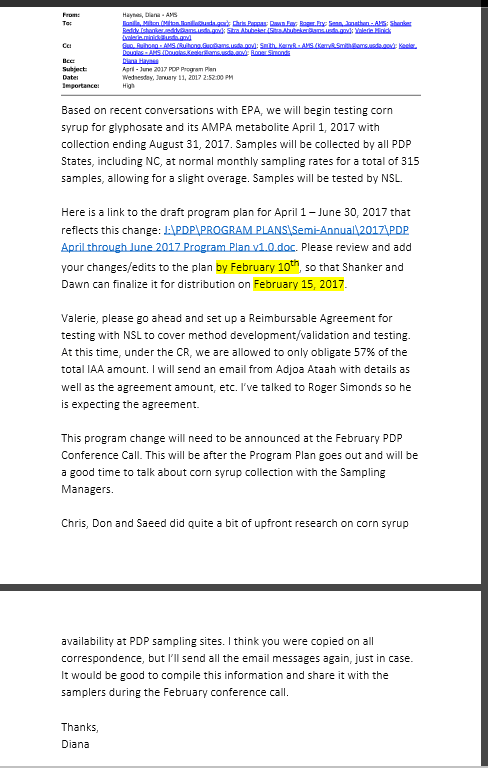
On Jan. 11, USDA's Diana Haynes, wrote to colleagues within USDA:
"Based on recent conversations with EPA, we will begin testing corn syrup for glyphosate and its AMPA metabolite April 1, 2017 with collection ending August 31, 2017. This program change will need to be announced at the February PDP Conference Call."
Haynes is director of a USDA Agricultural Marketing Service division that annually conducts the Pesticide Data Program (PDP), which tests thousands of foods for hundreds of different pesticide residues.
==
BS? punked?
http://www.corporatecrimereporter.com/news/200/gary-ruskin-and-jon-entine-tangle-over-the-gmo-corporate-connection/
4/16
Corporate Crime Reporter,
please give us a call at 202.468.8868 or write to us at:
russellmokhiber@gmail.com
or at:
Corporate Crime Reporter
1209 National Press Building
Washington, D.C. 20045
Jon Entine is senior fellow at the University of California Davis Institute for Food and Agricultural Literacy.
Entine is also a fellow at the American Enterprise Institute.
He runs the Genetic Literacy Project — which is a project of a non profit he heads called the Science Literacy Project.
Now comes Gary Ruskin of US Right to Know in Oakland, California.
Ruskin says that Entine has a long history of defending corporate interests — chemical, nuclear, pesticides, GMO and fracking.
In March 2015, Ruskin filed a Freedom of Information Act (FOIA) request with UC Davis asking for any correspondence between Entine and a string of corporate interests, including Monsanto, Syngenta, Bayer, BASF,Dow, the Biotechnology Industry Organization, and the Grocery Manufacturers Association.
UC Davis has yet to produce the documents Ruskin requested.
Ruskin’s lawyer, Jessica Krupke of Sandler Reiff in Washington, D.C., sent a letter to UC Davis calling the year long delay “unreasonable.”
“Our client has instructed us that, if your office continues to disregard the requirements of the law by failing to provide an estimate of the date of production and by unreasonably delaying the production itself, we are to pursue all available legal remedies to obtain the disclosure of public records to which our client is entitled,” Krupke wrote.
Ruskin wrote earlier this month to UC Davis Chancellor Linda Katehi asking her “reveal the sources of UC Davis funding for Jon Entine, the Genetic Literacy Project, the UC Davis Institute for Food and Agricultural Literacy, and its parent unit, the UC Davis World Food Center.”
“We are concerned that UC Davis may be acting as a financial conduit to enable corporations to direct third-party public relations attacks against targeted academics, individuals and institutions.” Ruskin wrote. “There is a significant body of evidence that Entine acts as a chemical industry public relations operative. Perhaps you are aware that he has written dozens of articles defending corporate interests, and attacking a range of targets whose work criticizes or detracts from the profit interests of the chemical and fossil fuel industries. Most recently, the Columbia Journalism School, as well as academics at Harvard and UC Berkeley, were his focus for attack. Alongside his role as senior fellow at the UC Davis Institute for Food and Agricultural Literacy, Entine is also executive director of the Genetic Literacy Project, which regularly attacks activists, journalists and scientists who raise concerns about the health and environmental risks of genetically engineered foods and pesticides.”
Entine says Ruskin is engaged in a “juvenile witch hunt.”
“The irony is that the Genetic Literacy Project receives 97% of its funding — the rest via the Internet/PayPay — from non partisan, independent foundations with no connection to the debate over GMOs, while Gary Ruskin’s US Right to Know gets $274,500 from the Organic Consumers Association, a fringe, anti-science group with huge influence in the organic community and throughout the web which benefits directly from scaring people about food and farming,” Entine told Corporate Crime Reporter in an interview last week. “So while the Science Literacy Project/GLP is 100% funded by non-partisan 501(c)(3) foundations and individuals, Ruskin is a paid arm of one of the most extremist anti-science organizations in the US whose members directly benefit from the scare he can create around independent science.”
“And here’s the Alice in Wonderland world we live in,” Entine said. “We have a dramatic new technology called genetic engineering. It’s not risk free because nothing is. Research is expensive so governments are not in a position to take the lead on it, plus they are crappy at doing that anyway. Corporations pursue research in this, costing hundreds of millions in investments.”
“Reasonable regulations in place start getting distorted by anti-technology activists even though thirty years of research has shown an almost perfect record of safety and compliance. New tighter restrictions are put in place. Smaller corporations drop out of development because it’s too expensive. Now anti-technology activists complain GE has been taken over by large corporations, which are bad, so must be opposed, because they could control food supply. Governments begin developing smaller projects such as GE eggplant and wilt resistant banana and vitamin enhanced rice, with no corporate connections. They are condemned as Trojan Horses for Big Biotech. The food researchers develop inexpensive ways to tweak individual genes to stop browning in potatoes, apples and mushrooms. They are condemned as tools of the devil. Then a small company develops a sterile mosquito which would help prevent a Zika crisis, including in the US, and the same brainiacs believe it should be stopped, because it’s part of a larger plot of corporate takeover of the world.”
When did Entine start the Genetic Literacy Project?
“In 2011,” Entine says. “But I couldn’t get money directly. I had to go through a receiving foundation. I went through the Statistical Assessment Service (STATS) and asked if they would act as the receiving foundation for the money for it. They said — if you pay us eight percent or ten percent for operational costs, I forget what it was. I said — sure. So, that’s what I did. STATS doesn’t exist anymore, by the way.”
“Now it’s the Science Literacy Project — that’s the 501(c)(3). Under that is the Genetic Literacy Project and the Genetic Expert News Service.”
Who funds the Science Literacy Project?
“Money came in last year from the Templeton Foundation, the Searle Freedom Trust, and the Winkler Family Trust.”
You have pro-GMO groups like yourself —
“I’m not a pro-GMO group,” Entine says. “How could you look at my site and even pretend to use those words? Sixty percent of what we talk about is human genetics. Why would you call that a pro-GMO group? Anyone who looks at it and comes to the conclusion that it’s a pro-GMO group can’t even add one plus one. We spent sixty percent of our resources or more on human genetic related issues. That’s been a large part of our focus and the focus of two of my books.”
“It’s a website about human genetics that does exactly what it says it does. It tries to look at human and agricultural genetics from a science point of view. It’s not a pro-GMO group. If bad things happen with GMOs — which I don’t believe exist as as concept — we write about it. We will carry articles by Gary Ruskin. It’s not like Gary Ruskin carries articles by me.”
You have posted articles by Gary Ruskin on your web site?
“We have printed articles by plenty of people who are pro-GMO on our web site. If Gary Ruskin could get an article in a major publication other than his own vanity site, we would print it. We do not print people from their vanity sites. And we do not print from NGO activist sites. If he is going to write an attack from an organic funded organization like USRTK, no I’m not going to print it. But if he has an article in Time magazine — we put up articles by Terry Gillam — who now works for Gary Ruskin — we have articles by her all the time.”
In his letter to UC Davis, Ruskin says that “there is a significant body of evidence that Entine acts as a chemical industry public relations operative.”
“There is no body of evidence,” Entine says.
Ruskin says Entine “has written dozens of articles defending corporate interests and attacking a range of targets.”
“I don’t believe that’s an accurate description of what we do. We report on the news. If a genetically modified mushroom happens to be safe and we report it — in Gary Ruskin’s eyes, that’s pro-GMO propaganda. In 98 percent of the world’s eyes, that’s science.”
You wrote a column March 1 in the New York Post that attacked the Columbia Journalism School. You argued that the school “smeared Exxon.”
“I’ll stand by the words that I wrote.”
Ruskin goes to public universities and seeks emails of people he considers to be corporate advocates and seeks their connections to corporations.
“I know exactly what Ruskin wants to do. His very first FOIA was directed at me. I know exactly what he wants to do.”
Is he going to find any evidence of UC Davis connections to corporate interests?Ruskin is saying that he is “concerned that UC Davis may be acting as a financial conduit to enable corporations to direct third-party public relations attacks against targeted academics, individuals and institutions.”
“He can say that all he wants, but there is no evidence to support it,” Entine said.
There have been other universities where he has found connections between the academics and the corporations.
“Gary Ruskin has a pathetically jaded view of what it means to have an interconnected world where corporations and universities and journalists act together. All I can say is that I don’t take any corporate money. The Genetic Literacy Project doesn’t take any corporate money. Our records are open.UC Davis got no corporate money funnelled from them to me. Ruskin has gone after me for a year and a half and done hundreds of Freedom of Information requests. And he hasn’t laid a hand on me. There is not one scintilla of evidence. It is all innuendo.”
Are you paid by UC Davis?
“No.”
What if there are corporate connections with the UC Davis Institute for Food and Agricultural Literacy and the UC Davis World Food Center. Let’s say Ruskin uncovers corporate money going to those entities.
“Corporations have a right to be involved,” Entine said. “We are talking about land grant universities, universities required by the state constitution to be involved with the organization that improves agriculture. UC Davis and Oklahoma State and Iowa and Nebraska and others would be violating state law if they were not involved in many ways, financially and others, with corporations. They are required to be involved. That’s all I’ll say about it. This is silly. This sounds like a juvenile witch hunt by someone who is obsessed with corporations. Corporations do good things and corporations do bad things. Gary Ruskin does good things and bad things.”
“There is no there there.”
Have you debated anti-GMO people in public debates?
“Yes, at a New York Times food conference last October. I debated a guy from a natural products company.”
You are willing to debate someone like Michael Hansen of Consumers Union?
“Yes. He’s an ideologue. He’s not a serious person.”
You say they are ideologues. They say you are a corporate —
“They have no evidence of that. They are creating that out of the people I support.”
“I’m a science journalist. I have no corporate ties. GLP has no corporate funding. No one has found any. There is none. They can make all these accusations they want. They can say I’m bought and sold. They don’t have the evidence. It’s not there. We stand by the science. I’ve offered space on the GLP site.”
You have never taken money from corporate funders?
“When I give a speech, I do.”
Funding of your groups?
“No.”
Give me some recent speeches you have given and how much they have paid you?
“No. I’ve been paid at modest levels. I’ve spoken at the Australian National Press Club.”
What about corporate speeches?
“I have never given a speech for a corporation.”
What about industry groups?
“I have given speeches for various industries.”
Give us one example?
“I’m not playing that game with you.”
“I’m a skeptical guy who doesn’t take anybody at face value. I’ve been involved in trying to change the world in a positive way. I see people like Gary Ruskin and Michael Hansen as dangerous people. They are on the wrong side of goodness. They will hurt people. People will look back and see them as the ultra-reactionary right of this period of time, the ones who are so ideological and paranoid about technological progress that they are willing to subvert potential innovations purely on the speculation that corporations are somehow poised to take over the world.”
==
==
entine hit on rtk:
But that video would soon look like child’s play (pun intended). A far more vicious campaign to impugn the integrity of “pro” GMO scientists was launched, led by U.S. Right to Know. This group, funded by the Organic Consumers Association, filed FOIA requests at several universities, seeking the email correspondence of these scientists in order to find any communication with biotech companies like Monsanto. You can read the full story here. The end result was the character assassination of notable public scientists like Dr. Kevin Folta, who has now suspended his informative podcast and ceased communicating with people on social media. His experience has had a chilling effect: many scientists pledged to withdraw from science communication altogether for fear of having their personal and professional lives maligned.
Earlier this month, the OCA was at it again, announcing at the COP21 event in Paris they would hold a “Monsanto Tribunal” at The Hague next year. The mock trial, designed to look authentic, will accuse Monsanto of “ecocide.” OCA president Ronnie Cummins made clear the objectives of the faux tribunal: “Monsanto….we are going to show that you are trying to poison us all. And we are going to take down your business and the whole factory-farm industrial agriculture empire that goes with it.”
Pro-Science Moms rising
It’s clear that the anti-GMO movement and their mommy foot soldiers have run the table over the last few years, commanding the public debate. This year changed that. A group of science-minded women (including many moms) met in Washington, DC in September to talk about how to advance our cause. It is an impressively diverse group: scientists, farmers, writers, activists representing a wide range of political affiliations. But our passion about promoting genetic engineering transcends any other differences. It’s a formidable group of highly-motivated women.
Science writer Kavin Senapathy, whom I met at the March Against Myths that she helped organize in Chicago last May as a counter protest to the annual Millions Against Monsanto, authored a book this year entitled The Fear Babe. The book carefully counters many of the pseudo-science claims of The Food Babe who helped save the world from pumpkin spice and yoga mat bread. We are joined by other mothers – Julie Gunlock, Amy Porterfield Levy, Jennie Splitter – who are taking on a decidedly assertive tone to push back with some great (and funny) columns. I expect more to come, and more like-minded women to join us, in 2016.
==
---
At U.S. Right to Know, we stand up for transparency – in the marketplace, politics and media – as crucial to building a better, healthier food system.
In 2015, we launched an investigation into food and agrichemical industry public relations. Our investigation, including documents received via the Freedom of Information Act (FOIA), offers a rare look behind the scenes at how the food and agrichemical industries, their front groups, PR operatives and academics work together to promote industry propaganda.
We will add to the findings below as our investigation continues.
_{Academics and Universities
}_Kevin Folta, University of Florida
- New York Times: Food Industry Enlisted Academics in GMO Labeling War
- Emails posted by The New York Times
- Mother Jones: These Emails Show Monsanto Leaning on Professors to Fight the GMO PR War
- Nature Biotechnology: Standing up for Transparency
- Global News: Documents Reveal Canadian Teenager Target of GMO Lobby
- Independent Science News: The Puppetmasters of Academia
Bruce Chassy, University of Illinois
- WBEZ: Why Didn’t an Illinois Professor Have to Disclose GMO Funding? USRTK: Following an Email Trail: How a Public University Professor Collaborated on a Corporate PR Campaign
- News Release: New Documents Uncover Monsanto’s Secret Role in Bruce Chassy’s Academics Review Website
- New York Times: Food Industry Enlisted Academics in GMO Labeling War
- Chassy emails posted by The New York Times
- Mother Jones: These Emails Show Monsanto Leaning on Professors to Fight the GMO PR War
John Entine, UC Davis, Genetic Literacy Project
- Fact Sheet: Jon Entine, the Chemical Industry’s Master Messenger
- News Release: Group Calls on Jon Entine to Reveal Funding Ties to Industry
- Bloomberg: How Monsanto Mobilized Academics to Pen Articles Supporting GMOs
Henry Miller, Hoover Institution
- Fact Sheet: Why You Can’t Trust Henry Miller
Calestous Juma, Harvard University
- Boston Globe: Harvard Professor Failed to Disclose Monsanto Connection in Paper Touting GMOs
- Harvard Crimson: Prof Failed To Disclose Connection to Company in Paper
Cornell Alliance for Science & Gates Foundation
- The Ecologist: Why is Cornell University Hosting a GMO Propaganda Campaign?
- The Ecologist: Bill Gates: Can We Have an Honest Conversation about GMOs?
Peter Phillips, University of Saskatoon
- Saskatoon Star Phoenix: Group Questions U of S Prof’s Monsanto Link
David Shaw, Mississippi State University
- New York Times: Food Industry Enlisted Academics in GMO Labeling War
- Emails posted by the New York Times
James Hill & John Peters, University of Colorado, Denver (Anschutz Health and Wellness Center)
_{Industry PR Groups
}_American Council on Science and Health
GMO Answers is a PR and Marketing Website for GMO Companies
Grocery Manufacturers Association
International Dairy Foods Association
Ketchum: The Agrichemical Industry’s PR Firm
Ketchum PR Firm Attacks Organic Food, Then Pitches Itself to Organic Companies
U.S. Farmers and Ranchers Alliance
_{Reporters and Media
}_
- USRTK: Journalists Fail to Reveal Sources Funded by Coca-Cola
- USRTK: Journalists Failed to Disclose Sources’ Funding From Monsanto
Keith Kloor
- USRTK: Journalists Mentioned in our FOIA Requests
- Polluter Watch: Keith Kloor
Tamar Haspel
- FAIR: Buckraking on the Food Beat: When Is It a Conflict of Interest?
- FAIR: Washington Post’s Food Columnist Goes to Bat for Monsanto
- USRTK: Journalists Mentioned in Our FOIA Requests
Amy Harmon
- US RTK: Journalists Mentioned in Our FOIA Requests
_{Reports
}_
- Seedy Business: What Big Food is Hiding with its Slick PR Campaign on GMOs
- Spinning Food: How Food Industry Front Groups and Covert Communications are Shaping the Story of Food
---