weaver ruby ridge
---
see mcveigh
---
---
YT
END OF DAYS
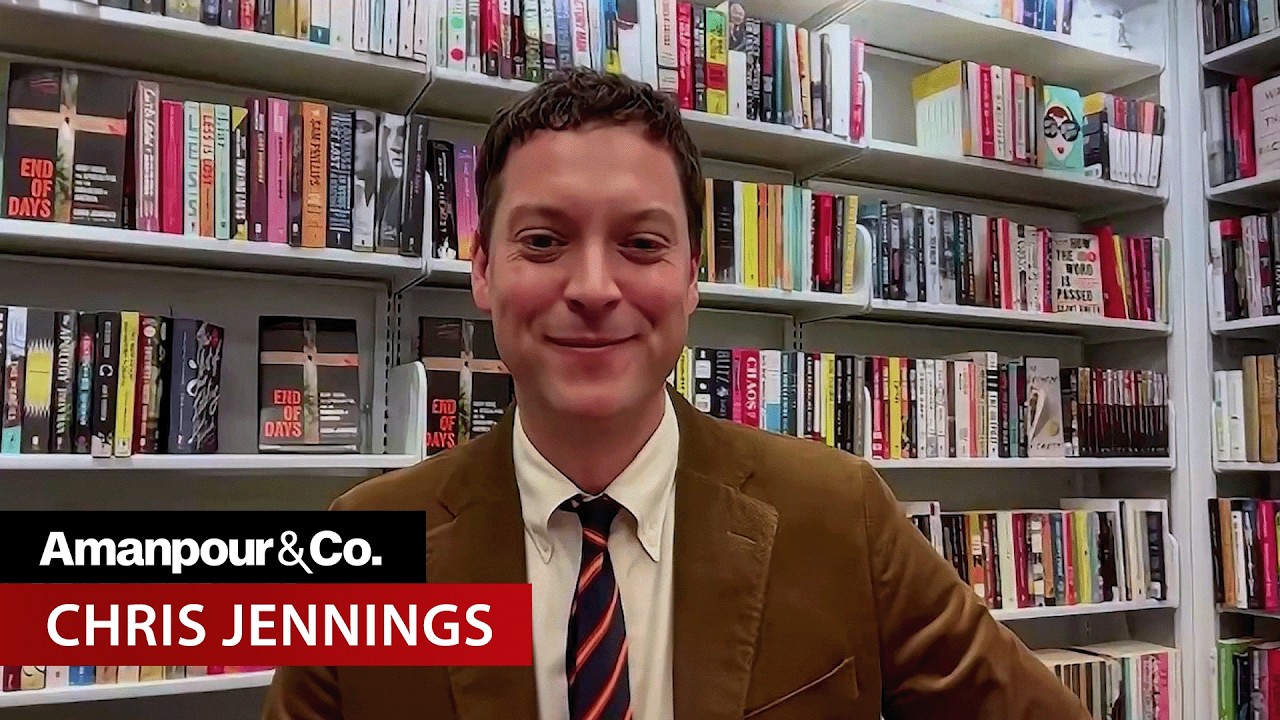
Echoes of Conspiracy from Ruby Ridge to Today | Amanpour and Company

1,357 views Feb 12, 2026 #amanpourpbs
The 1992 Ruby Ridge siege was an incident that shocked the U.S. The 11-day armed standoff in the mountains of Idaho between federal agents and the Weaver family ended in three deaths. In his new book "End of Days," Chris Jennings argues that the episode — rooted in apocalyptic, racist and anti-government ideology — helped pave the way for today's conspiracy-driven politics. Jennings joins the show to discuss the legacy of the widely televised event and what it reveals about America today. Originally aired on February 12, 2026
---
---
8 22 an the conv
in the run-up to the U.S. midterm elections, some politicians continue to ride the wave of what's known as "Christian nationalism" in ways that are increasingly vocal and direct.
GOP Rep. Marjorie Taylor Greene, a far-right Donald Trump loyalist from Georgia, told an interviewer on July 23, 2022, that the Republican Party "need[s] to be the party of nationalism. And I'm a Christian, and I say it proudly, we should be Christian nationalists."
Similarly, Rep. Lauren Boebert, a Republican from Colorado, recently said, "The church is supposed to direct the government. The government is not supposed to direct the church." Boebert called the separation of church and state "junk."
Many Christian nationalists repeat conservative activist David Barton's argument that the Founding Fathers did not intend to keep religion out of government.
As a scholar of racism and communication who has written about white nationalism during the Trump presidency, I find the amplification of Christian nationalism unsurprising. Christian nationalism is prevalent among Trump supporters, as religion scholars Andrew Whitehead and Samuel L. Perry argue in their book "Taking Back America for God."
Perry and Whitehead describe the **Christian nationalist movement as being "as ethnic and political as it is religious," noting that it relies on the assumption of white supremacy. Christian nationalism combines belief in a particular form of Christianity with nativist and populist political platforms. American Christian nationalism is a worldview based on the belief that America is superior to other countries, and that that superiority is divinely established. In this mindset, only Christians are true Americans.[real am]
Parts of the movement fit into a broader right-wing extremist history of violence, which has been on the rise over the past few decades and was particularly on display during the Capitol attack on Jan. 6, 2021.
The vast majority of Christian nationalists never engage in violence. Nonetheless, Christian nationalist thinking suggests that unless Christians control the state, the state will suppress Christianity.
From siege to militia buildup
Violence perpetrated by Christian nationalists has manifested in two primary ways in recent decades. The first is through their involvement in militia groups; the second is seen in attacks on abortion providers.
The catalyst for the growth of militia activity among contemporary Christian nationalists stems from two events: the 1992 Ruby Ridge standoff and the 1993 siege at Waco.
At Ruby Ridge, former Army Green Beret Randy Weaver engaged federal law enforcement in an 11-day standoff at his rural Idaho cabin over charges relating to the sale of sawed-off shotguns to an ATF informant investigating Aryan Nation white supremacist militia meetings.
Weaver ascribed to the Christian Identity movement, which emphasizes adherence to Old Testament laws and white supremacy.Christian Identity members believe in the application of the death penalty for adultery and LBGTQ relationships in accordance with their reading of some biblical passages.
During the standoff, Weaver's wife and teenage son were shot and killed before he surrendered to federal authorities.
In the Waco siege a year later, cult leader David Koreshand his followers entered a standoff with federal law enforcement at the group's Texas compound, once again concerning weapons charges. After a 51-day standoff, federal law enforcement laid siege to the compound. A fire took hold at the compound in disputed circumstances, leading to the deaths of 76 people, including Koresh.
The two events spurred a nationwide militia buildup. As sociologist Erin Kania argues: "Ruby Ridge and Waco confrontations drove some citizens to strengthen their belief that the government was overstepping the parameters of its authority. … Because this view is one of the founding ideologies of the American Militia Movement, it makes sense that interest and membership in the movement would sharply increase following these standoffs between government and nonconformists."
Distrust of the government blended with strains of Christian fundamentalism have brought together two groups with formerly disparate goals.
Christian nationalism and violence
Christian fundamentalists and white supremacist militia groups both figured themselves as targeted by the government in the aftermath of the standoffs at Ruby Ridge and Waco. As scholar of religion Ann Burlein argues,"Both the Christian right and right-wing white supremacist groups aspire to overcome a culture they perceive as hostile to the white middle class, families, and heterosexuality."
Significantly, in 1995, Oklahoma City bomber Timothy McVeigh and accomplice Terry Nichols cited revenge for the Waco siege as a motive for the bombing of the Alfred Murrah federal building. The terrorist act killed 168 people and injured hundreds more.
Since 1993, at least 11 people have been murdered in attacks on abortion clinics in cities across the U.S., and there have been numerous other plots.
They have involved people like the Rev. Michael Bray, who attacked multiple abortion clinics. Bray was the spokesman for Paul Hill, a Christian Identity adherent who murdered physician John Britton and his bodyguard James Barrett in 1994 outside of a Florida abortion clinic.
In yet another case, Eric Rudolph bombed the 1996 Atlanta Olympics. In his confession, he cited his opposition to abortion and anti-LGBTQ views as motivation to bomb Olympic Square.
These men cited their involvement with the Christian Identitymovement in their trials as motivation for engaging in violence.
Mainstreaming Christian nationalist ideas
The presence of Christian nationalist ideas in recent political campaigns is concerning, given its ties to violence and white supremacy.
Trump and his advisers helped to mainstream such rhetoric with events like his photo op with a Bible in Lafayette Square in Washington following the violent dispersal of protesters, and making a show of pastors laying hands on him. But that legacy continues beyond his administration.
Candidates like Doug Mastriano, the Republican gubernatorial candidate in Pennsylvania who attended the Jan. 6 Trump rally, are now using the same messages.
In some states, such as Texas and Montana, hefty funding for far-right Christian candidates has helped put Christian nationalist ideas in the mainstream.
Blending politics and religion is not necessarily a recipe for Christian nationalism, nor is Christian nationalism a recipe for political violence. At times, however, Christian nationalist ideas can serve as a prelude.
---
---
war ~ everyone ch
BTB
...The heat brought on by the crackdown forced Beam to retire his beloved inter-Klan newsletter and survival alert. The last issue contained an essay by an unknown author – probably Beam. In it, he wrote, “The second American revolution will be a revolution of individuals, a revolution without exact precedent in recorded history. Because individuals can accomplish complex acts of resistance without peril or betrayal or even detection by the most advanced snooping devices. Missions formerly assigned to groups may be undertaken by individuals equipped to fight alone.” It would not be long before a young man named Timothy McVey would prove these words prophetic.
Chapter 6: The Perfect Soldier
[Transcriber's Note: I'm leaving out Robert & guest's off-script comments except where relevant, they will appear in brackets. Occasionally, 2-3 words were changed to better adapt speech to writing. If using in academic text please reference actual recording as there are points (specifically Robert quoting from 'American Terrorist')where proper quotation became unclear & I just went with my best guess.]
The 1988 Seditious conspiracy trial held important lessons for the chief minds behind the white supremacist movement. When they leaned into their patriotism, their love of an America that was white and Christian, but America nonetheless, they could draw significant sympathy from their fellow white men and women. Swastikas and klan robes were much less useful than tearful stories of hippie protestors spitting on flags.
The 1990s saw continuous growth in both the survivalist and the american militia movement. Neither of these things was inherently white supremacist, but Beam and his colleagues had been remarkably successful at seeding their propaganda into gun shows and conventions. As a result, the early 90s brought them a whole crop of fellow travelers: men and women who did not identify as nazis and had never held clan membership, but who were also quite capable of reading the Turner Diaries and identifying with its message.
Randy Weaveris a perfect example of this new sort of recruit. He was a former green beret, a patriot who loved his country and working with his hands. He and his wife Vicky were Christian conservatives. They fell in love with the first generation of evangelical TV preachers - men like Jerry Falwell - they also read a book called "The Late Great Planet Earth" by Hal Lindseywhich focused on using the bible to predict the near future. Lindsey's book convinced Randy and Vicky that Gog, an anti-Christian empire from the book of Ezekiel was the Soviet Union. They became more and more gone into conspiracy theories and convinced themselves that a great and firey apocalypse was imminent. I'm gonna quote next from 'American Experience' by PBS. "Concerned citizens, they set out to spread the word. They weren't able to find a church that approached these matters with what they felt was the appropriate level of seriousness, so they held their own Bible studies with like minded friends and neighbors. This sparked the attention of a local reporter who came to do a story on them. The Weavers, Walter learned, did not appreciate the results. They felt betrayed, but they'd never been more sure in their beliefs: a great conflagration was coming, and they felt increasingly unsafe in Iowa. Vicky started having visions in the bathtub - god was speaking to her - and god was telling her to go west to find for her family a mountaintop. They would be safe there."
The Weavers moved to a place that would later come to be called 'Ruby Ridge' in Idaho, not far from Richard Butler's Aryan Nations compound.Randy Weaver began to visit the compound, attending several events and beginning to make friends among the neo-nazis. The exact nature of what he believed precisely is unclear and heavily debated. It /seems/ that he identified with some aspects of Christian Identity theology, and it's safe to say he was racist by normal people standards, but it's also fair to say that Randy Weaver was not really a nazi or really an ideological white supremacist. He hung around Aryan Nations because he lived in the middle of nowhere, they were the only people to hang with, and he just didn't care about their racism. He was not the kind of man who'd have joined a group like 'The Order' BUT he would come to play an important role in the next step of the white supremacist movement.
Now, the FBI wound up wiretapping several of the fascists that Randy Weaver befriended. It was quite immediately obvious to them that Mr. Weaver had no plans to overthrow the government, spark a race war, or do anything more subversive than live off the land with his family and picnic with Nazis from time to time. In fact, when other people in these wiretapped conversations would suggest committing crimes [lynchings], Randy would say something like, "We don't really go in for that stuff."
While the feds knew that Randy Weaver wasn't really dangerous they saw him as the perfect guy to approach as an informant. He wasn't a true believer, and he was VERY poor. If they could entrap him into committing a crime, they could scare him with prison time til he agreed to wear a wire and help them catch some of the big fish in the Aryan Nations community. An undercover agent approached Randy and offered him good money to illegally saw off a couple shotguns. Now, Randy was not a believer in the legitimacy of American gun control regulations, and he needed the cash, so he gladly acquiesced and was subsequently busted for it. The feds made their offer, and Randy refused them. He was arrested on federal firearms charges and taken to jail. Randy made bail though and he fled back to Ruby Ridge and holed up with his family, and a whole bunch of guns, in the hope the federales would not follow. They did.
But the attempted arrest did not go well. A US marshal was shot dead by the Weaver clan and the authorities responded with a blizzard of indiscriminate gunfire which killed Randy's 14 year old son, the family dog, and his unarmed wife, Vicky. A standoff ensued, the law came in with helicopters, armored vehicles, and the kind of militarized police that look familiar to us now but were new and terrifying back in 1992. The media descended on Ruby Ridge too, and the assault on the Weaver family was spread virally throughout the far right. The Weavers were the perfect poster family to illustrate government overreach. Footage of black helicopters floating over Ruby Ridge, andsaint-like photos of Vicky Weaver were almost tailor made to sell the idea that a new world order was coming for white christian gun-owning Americans.
Louie Beam and his fellow fascists knew a great opportunity when one came a-knockin. In 1992, while Ruby Ridge was still in the news, the leading minds of the white supremacist movement gathered in Estes Park for a summit on how, precisely, they could use this tragedy to their advantage. The Summit was convened by Pete Peters, a Christian Identity preacher from Colorado and the head of a sizeable Christian Identity church, the LaPort Church of Christ. Here's how Leonard Zeskind summarizes the proceedings in 'Blood and Politics': "For two days they met in committee, deliberated in plenary sessions, and engaged in the kind of one-on-one conversation known in the parlance of business professionals as networking. They made decisions in the name of Jesus Christ and Yahw-h, sang 'Arms for Christian Soldiers', and carried themselves in a manner of quiet resolve appropriate for their surroundings: a YMCA in a facility abutting the park. No guns were waved, and even the most heated rhetoric seemed to have the blood drained out of it." Estes Park signified a radical shift in the tactics of the white power movement. Like the 1983 Aryan Nations conference, we mostly know what was discussed at Estes park because of the things that happened after it. The nazis started reaching out to more moderate americans.
Louis Beam published an article in his magazine appropriately named 'the Seditionist' - because he'd gotten declared innocent of sedition. He called for leaderless sedition in the wake of Ruby Ridge. Big Star One, a militia with members in Texas, Oklahoma, and New Mexico carried out grenade launcher and mortar training exercises in rural Texas. The Montana militia published a guidebook on how to engage in domestic terrorism. In 1993 law enforcement across the nation found explosives caches meant to be used as attacks in various-- National Afro-American Museum in Ohio, and a black church in LA. None of this made the news in a big way because of something that happened in mid-1993. The siege of the Branch Davidian compound in Waco Texas.
The Branch Davidians were not a christian identity sect, their leader David Koresh was not affiliated with the white supremacist movement, but the ATF siege of their compound so close after Ruby Ridge was useful for Louis Beam and his congregants to propagandize around. On --1993, ATF agents attempted to serve a search warrant about sexual abuse and illegal weapons charges. People inside the compound opened fire, 4 agents and 5 Branch Davidians were killed, and the situation devolved into a bloody siege. On April 19th, the FBI, who'd taken control of the situation, launched an assault on the compound. In the ensuing melee several fires broke out and quickly swept through the structures. By the time the smoke had cleared and it was all over 53 adults and 23 children were dead.
The whole tragedy was inarguably a clusterfuck on the federal government, which of course helped groups like the fascists.
Kirk Lyons, a close friend of Louis Beam and a white supremacist militia leader himself, sent out an issue of his groups fundraising letter that featured a photo of a 14 year old girl who'd died in the Waco siege. The girl was of course, white, and the photo was captioned 'Why We Fight'. There were dozens, hundreds, and eventually thousands of pieces of similar propaganda. Gradually, day by day, and month by month, explicitly fascist and white supremacist groups began to wrap their ideological claws around the militia movement and suck in ever more patriots. British Journalist John Ronson was one of the few journalists who spent a great deal of time embedded with the fringe right during. the Michigan militia during this time had about 12,000 members which was a significant surge in the wake of Ruby Ridge and Waco. One of those members was a young desert storm veteran named Tim McVeigh.
Timothy McVeighwas born on April 23 1968. McVeigh grew up in Pendelton New York and had an early childhood that was pretty standard for the 70s and 80s. He watched 'Gumby' and 'Truth or Consequences', he played cowboys and indians or cops and robbers with other kids in the neighborhood. Tim preferred playing the good guys as he saw them, cops or cowboys, whenever possible. He was sickly and somewhat prone to accidents, hurting himself in all sorts of ways that young boys who spend a lot of time in the woods tend to do. Tim was an energetic boy and he might've been someone who'd ended up on Ritalin had he been born a decade or two later. He was constantly in trouble for minor things, but he also had a good heart, as this story from 'American Terrorist' makes clear. Tim was playing near the pond when he noticed one of the older neighborhood boys carrying a burlap sack. The sack was weighted down with rocks, curious Tim could see there was something else wriggling in the sack and he watches as the older boy pitched the sack out into the pond where it quickly sank to the bottom. "What was that?" Tim asked, running to the far shore of the pond where the neighborhood boy stood. "Those are kittens my dad had," the boy answered in a matter of fact tone, "we had to get rid of them". For Tim, who loved animals and especially kittens, the realization of what he had witnessed hit him hard. He cried about the incident for days.
[They break from script to chat, at some point Robert summarizes: "He was a sensitive kid. The story of Tim McVeigh is the story of how a young mind got enraptured with this kind of terroristic apocalyptic ideology who wouldn't have gotten caught in the first iteration of it. This is a guy who would only have been caught by the changes made to the movement's propaganda outreach after Estes Park."]
Tim fell in love with guns at an early age, his grandfather first took him shooting when he was 7, and Tim's Grandpa, Ed McVeigh, everyone said, was a stickler about firearm safety. He considered safe gun ownership to be an integral part of American citizenship. [So he likes guns, but he doesn't like killing things, he's like a target shooter and stuff] . Being small and sort of weird, Tim McVeigh was a bit of a magnet for bullies. He developed a deep hatred for bullying and a reflexive rage at the sight of anything he saw as bully behavior whether it came from an individual or an institution. Tim's parents divorced when the kids were young, his sisters chose to go live with their mother but Tim stayed with his father so that he would not have to be alone [again, sensitive kid]. After the OKC bombing, a number of pundits would try to tie his parents' divorce to his evolution as a terrorist; this would seem to be an overstatement, but he did tie his mother leaving his father to broader social trends, later stating in an interview that, "In the past 30 years because of the women's movement they've taken an influence out of the household."
When one reads about McVeigh they get the feeling that had he been born later he might've found a home within the alt-right. For one thing, he was obsessed with the Star Wars movies and identified heavily with Luke Skywalker. As the 80s rolled along and home computers started to become more common, McVeigh became one of the first generation of computer nerds. He was on the internet before basically anyone else. His handle on those early message boards was "The Wanderer". We can't know everywhere McVeigh went in the early internet, but it's unlikely to be pure coincidence that Timothy grew obsessed with survivalism and the second amendment during the years he was most involved in nascent internet culture. It's entirely possible he came across some of Louis Beam's writings during this time. We know for a fact that he fell in love with a book... 'The Turner Diaries'. He first heard about 'the Turner Diaries' from an ad in 'Soldier of Fortune' magazine. He ordered the book by mail, and fell madly in love with it. For the rest of his life he'd insist that the book's gun rights advocacy was what drew him to it, not its depiction of a genocidal worldwide race war. [and it's kinda likely he was telling the truth. again, like Randy Weaver, Tim McVeigh was a racist, but it's not his motivation.]
Post-Estes Park, the Turner Diaries remained on of the lynchpins of white supremacist recruitment in the US. Ads for it in magazines like Soldier of Fortune often posed the question "What would you do if the government comes for your guns?". None of this is to say McVeigh wasn't racist, he grew up in a place where everyone was white, at age 19 he got a job as a guard on an armored car, he later recalled his colleagues expressing casual racism towards black residents on the east side of Buffalo and eventually he adopted those beliefs and their propensity for using racial slurs. Racism was a fact of Tim's life, but again, it wasn't like the main thing for him. What was his main thing, were guns....
In Tim McVeigh, Louis Beam and his fellow fascists had found the perfect soldier, the perfect exemplar of Beam's concept of leaderless resistance. He was not a lone wolf as some foolish pretenders in journalism had named him. McVeigh was radicalized by a constellation of writers and thinkers as well as hundreds of men he had spoke with at gun shows and survivalist conventions and sitting outside the siege lines at Waco. He was radicalized by William Pierce, who wrote 'the Turner Diaries' hoping desperately that someone would do exactly what McVeigh did. McVeigh's attack prompted response from federal law enforcement, but not the one you might expect. While there were some crackdowns on militia cells and organizations, the justice department largely responded by taking a lighter hand with white supremacists and militias.
In 1996 'the Montana Freemen' wound up in a standoff with the federal government. As a group they represented a synthesis of Christian Identity and Posse Comatatus beliefs.They declared themselves independent of federal control and wound up in an 81 day standoff with law enforcement. For awhile it looked like the Freemen compound might become another Waco. But the standoff ended peacefully. Video footage of the 23 adults and 4 children surrendering showed no giant armored vehicles or military-looking police. The FBI's hostage rescue team wore sneakers and casual civilian clothing. McVeigh would go to his grave convinced that the lighter hand used on the Montana Freemen was the result of his attack on Oklahoma City... and he might have been right. According to 'American Terrorist', "Clinton R. VanZandt, the former FBI agent who'd tried without success to negotiate a peaceful end to the Waco standoff three years earlier, agreed with McVeigh, at least on that point. Retired from the FBI and working as a security consultant, VanZandt feels that the government learned a painful lesson from the OKC bombing. In VanZandt's words, 'the government realized that it must become a velvet brick, not a battering ram.' 'What an absolute classic tragedy,' VanZandt had said soon after the conflagration at Waco, 'what a total indictment of mankind's inability to communicate and relate even though we have different religious beliefs and personal philosophies.' While VanZandt condemned the OKC bombing, he felt that Waco had started a war and that McVeigh's bombing had not only been an escalation, but a turning point in the war."
My only disagreement with Mr. VanZandt is the idea that the war Mr. McVeigh wound up fighting in had started with Waco. This war had been going on much longer than that, at least as far back as the days of George Lincoln Rockwell. Timothy McVeigh may have seen himself as a patriotic american, but he fought as a soldier of the american fascist movement under generals Louis Beam and William Pierce. The failure of the federal government, and almost everyone, to see this war is one reason why things have gotten so bad in 2019 as I write this. McVeigh would be joined on down 30 years by dozens of other angry young men. Men like Eric Harris and Dylan Klebold, the infamous Columbine shooters. Most experts would agree that Harris was the motivating force behind the attacks, more or less pulling Klebold along with him. This is not often reported on, but Harris was obsessed with Adolf Hitler and Nazism. He wrote constantly about Nazi ideology, his hatred of free speech, the press, and his desire to see mentally defective people executed. Harris was also obsessed with Timothy McVeigh.
Dave Colon is a journalist who spent more than a decade studying the massacre.He found regular references to OKC and McVeigh in Harris's writings before the shooting. Colon writes, "In his journal, Eric would brag about topping McVeigh. Oklahoma City was a one-note performance, McVeigh set his timer and walked away. He didn't even see his spectacle unfold. Harris admired McVeigh, but desperately wanted to beat him, carrying out a larger attack, killing more people."
Eric Harris and DK did not succeed in their goal of topping McVeigh, but Harris may yet manage to beat McVeigh's 'High Score'. In the decades since the 1996 shooting at Columbine it has inspired at least 74 copycat attacks which have killed 89 people and injured 126 more. You can draw a direct line from George Lincoln Rockwell to William Pierce and Louis Beam, to Tim McVeigh, and then to Eric Harris. By the late 1990s, it was incredibly clear that leaderless resistance as a tactic was the best weapon in the white supremacist arsenal; but it would take the mass adoption of the internet and the era of the smartphone for Louis Beam's deadliest innovation to see its full potential.
Chapter 7: The Digital Reich
---
---
https://en.wikipedia.org/wiki/Ruby_Ridge
Ruby Ridge was the site of an 11-day siege in 1992 in Boundary County, Idaho, near Naples. It began on August 21, when deputies of the United States Marshals Service (USMS) initiated action to apprehend and arrest Randy Weaver under a bench warrant after his failure to appear on firearms charges. Given three conflicting dates for his court appearance, and suspecting a conspiracy against him, Weaver refused to surrender, and members of his immediate family, and family friend Kevin Harris, resisted as well. The Hostage Rescue Team of the Federal Bureau of Investigation (FBI HRT) became involved as the siege developed.
During the Marshals Service reconnoiter of the Weaver property, six U.S. Marshals encountered Harris and Sammy Weaver, Randy's 14-year-old son, in woods near the family cabin. A shootout took place. Deputy U.S. Marshal William Francis Degan, Sammy Weaver, and the Weavers' dog, Striker, all died as a result. In the subsequent siege of the Weaver residence, led by the FBI, Weaver's wife Vicki was killed by FBI sniper fire. All casualties occurred in the first two days of the operation. The siege and standoff were ultimately resolved by civilian negotiators. Harris surrendered and was arrested on August 30, while Weaver and his three daughters surrendered the next day.
Weaver and Harris were subsequently arraigned on a variety of federal criminal charges, including first-degree murder for the death of Degan. Harris was acquitted of all charges, and Weaver was acquitted of all charges except for the original bail condition violation for the arms charges and for having missed his original court date. He was fined $10,000 and sentenced to 18 months in prison, credited with time served plus an additional three months, and released after 16 months.[1][2]
During the federal criminal trial of Weaver and Harris, Weaver's attorney Gerry Spence made accusations of "criminal wrongdoing" against the agencies involved in the incident, in particular the FBI, the USMS, the Bureau of Alcohol, Tobacco, and Firearms (ATF), and the United States Attorney's Office (USAO) for Idaho. At the trial's end, the Department of Justice's Office of Professional Responsibility formed the Ruby Ridge Task Force (RRTF) to investigate Spence's charges. A redacted HTML version of the RRTF report, publicly released by Lexis Counsel Connect, raised questions about all the participating agencies' conduct and policies. The Justice Department later posted a more complete PDF version of the report.[3][4]
Both the Weaver family and Harris brought civil suits against the government over the firefight and siege. The Weavers won a combined out-of-court settlement in August 1995 of $3.1 million. After numerous appeals, Harris was awarded a $380,000 settlement in September 2000.
To answer public questions about Ruby Ridge, the Senate Subcommittee on Terrorism, Technology and Government Information held hearings between September 6 and October 19, 1995, and subsequently issued a report calling for reforms in federal law enforcement to prevent a repeat of the losses of life at Ruby Ridge and restore public confidence in federal law enforcement.[5] It was noted that the Ruby Ridge incident and the 1993 Waco siege involved many of the same agencies (the FBI HRT and the ATF) and some of the same personnel (the FBI HRT commander). The GAO also conducted a review of federal policies about use of deadly force, publishing it in 1995.
The Boundary County prosecutor indicted FBI HRT sniper Lon Horiuchi for manslaughter in 1997 before the statute of limitations for the charge could expire; the case, Idaho v. Horiuchi, was moved to federal court, which has jurisdiction over federal agents.[6] It was dismissed because of the supremacy clause. The United States Court of Appeals for the Ninth Circuit ruled in 2001 that Horiuchi could be tried on state charges. But a new county prosecutor, Brett Benson, had been elected in 2000 and dismissed the case, saying it was unlikely the state would be able to prove the criminal charges. His decision was controversial.[7][8]
- Geography
- 2Development
- 3Encounter near Weavers' cabin
- 4Siege and controversy
- 5Trials of Weaver and Harris
- 6Federal investigations of law enforcement
- 7Aftermath: civil suits
- 8State criminal charges
- 9Later life of the Weavers
- 10Domestic terrorism
- 11In popular culture
- 12See also
- 13Bibliography
- 14References and notes
- 15Further reading and viewing
- 16External links
Geography
Ruby Ridge is the southernmost of four ridges that extend east from the Bottleneck/Roman Nose mountain range toward the Kootenai River.[9] Caribou Ridge lies north of it,[10] and the area between them drains into the Ruby Creek. Some local maps have identified Ruby Ridge as an extension of Caribou Ridge, but press reporting on the Weaver standoff used the federally recognized name.[11] It is approximately thirty miles (50 km) south of the border with Canada (British Columbia).
Development
Randy Weaver, a former Iowa factory worker and U.S. Army Green Beret,[12] moved with his wife and four children to northern Idaho during the 1980s so they could "home-school his children and escape what he and his wife Vicki saw as a corrupted world."[13][14] In 1978, Vicki, the religious leader of the family,[15] began to have recurrent dreams of living on a mountaintop and believed that the apocalypse was imminent.[16] After the birth of their son, Samuel, the Weavers began selling their belongings[17] and learning to live without electricity.[15] They bought twenty acres (8 ha) of land on Ruby Ridge in 1983 and began building a cabin;[18] the property was in Boundary County on a hillside on Ruby Creek opposite Caribou Ridge, northwest of nearby Naples, Idaho.[11]
In 1984, Randy Weaver and his neighbor Terry Kinnison had a dispute over a $3,000 land deal. Kinnison lost the ensuing lawsuit and was ordered to pay Weaver an additional $2,100 in court costs and damages. Kinnison wrote letters to the FBI, Secret Service, and county sheriff alleging Weaver had threatened to kill Pope John Paul II, President Ronald Reagan, and Idaho Governor John V. Evans.[19]
In January 1985, the FBI and Secret Service began an investigation of allegations that Weaver had made threats against Reagan and other government and law enforcement officials.[20] On February 12, Randy and Vicki Weaver were interviewed by two FBI agents, two Secret Service agents, and the Boundary County sheriff and his chief investigator.[21] The Secret Service had been told that Weaver was a member of the white supremacist group Aryan Nations and that he had a large weapons cache at his residence. Weaver denied these allegations, and the government filed no charges.[20] On three or four occasions, the Weavers had attended Aryan Nations meetings atHayden Lake, where there was a compound for government resisters and white separatists.[22][23]
The investigation noted that Weaver associated with Frank Kumnick, who was known to associate with members of Aryan Nations. Weaver told the investigators that neither he nor Kumnick was a member of Aryan Nations and described Kumnick as "associated with The Covenant, The Sword, and the Arm of the Lord."[24]
On February 28, Randy and Vicki Weaver filed an affidavit with the county courthouse alleging that their personal enemies were plotting to provoke the FBI into attacking and killing the Weaver family.[21] On May 6, Randy and Vicki Weaver sent Reagan a letter claiming that Weaver's enemies may have sent Reagan a threatening letter under a forged signature. No evidence of such a letter surfaced, but the 1985 letter was cited by the prosecutor in 1992 as Overt Act 7 of the Weaver family conspiracy against the federal government.[25][page needed][26]
ATF involvement
The Bureau of Alcohol, Tobacco and Firearms first became aware of Weaver in July 1986, when he was introduced to a confidential ATF informant at a meeting at the World Aryan Congress.[20] The informant portrayed himself as a weapons dealer.[24] Weaver had been invited to the meeting by Frank Kumnick, the original target of the ATF investigation. It was Weaver's first time at this Congress. Over the next three years, Weaver and the informant met several times.[20] In July 1989, Weaver invited the informant to his home to discuss forming a group to fight the "Zionist Organized Government", referring to the U.S. government.[20]
In October 1989, the ATF claimed that Weaver sold the informant two sawed-off shotguns, with the overall length of the guns shorter than the limit set by federal law. In November 1989, Weaver accused the ATF informant of being a spy for the police; Weaver later wrote he had been warned by "Rico V."[27] The informant's handler, Herb Byerly, ordered him to have no further contact with Weaver. Eventually, FBI informant Rico Valentino outed the ATF informant to Aryan Nations security.[28]
In June 1990, Byerly attempted to use the sawed-off shotgun charge as leverage to get Weaver to act as an informant for his investigation into Aryan Nations.[20] Weaver refused to become "a snitch," and the ATF filed the gun charges in June 1990. It claimed that Weaver was a bank robber with criminal convictions.[29] (Those claims were false: at that time Weaver had no criminal record. The 1995 Senate investigation found: "Weaver was not a suspect in any bank robberies.")[30] A federal grand jury indicted Weaver in December 1990 for making and possessing, but not for selling, illegal weapons in October 1989.[31]
The ATF concluded it would be too dangerous for agents to arrest Weaver at his property.[20] In January 1991, ATF agents posed as broken-down motorists and arrested Weaver when he and Vicki stopped to assist.[20] Weaver was told of the charges against him, released on bail, and told that his trial would begin on February 19, 1991. On January 22, the judge in the case notified the attorney Everett Hofmeister that Hofmeister would be Weaver's attorney.[32] The same day, Weaver called the U.S. probation officer Karl Richins and told him that he had been instructed to contact Richins on that date. Richins did not have the case file at that time, so he asked Weaver to leave his contact information and said he would contact him when he received the paperwork. According to Richins, Weaver did not give him a telephone number.[32] Hofmeister sent Weaver letters on January 19, January 31, and February 5, asking Weaver to contact him to work on his defense within the federal court system.[32]
On February 5, the trial date was changed from February 19 to 20 to give participants more travel time following a federal holiday. The court clerk sent the parties a letter informing them of the date change, but the notice was not sent directly to Weaver, only to Hofmeister. On February 7, the probation officer sent Weaver a letter indicating that he had the case file and needed to talk with Weaver. This letter erroneously said that Weaver's trial date was March 20.[32][33] On February 8, Hofmeister again attempted to contact Weaver by letter informing him that the trial was to begin on February 20 and that Weaver needed to contact him immediately. Hofmeister also made several calls to individuals who knew Weaver, asking them to have Weaver call him. Hofmeister told U.S. District Court Judge Harold Lyman Ryan that he had been unable to reach Weaver before the scheduled court date.[34]
When Weaver did not appear in court on February 20, Ryan issued a bench warrant for failure to appear in court.[33][35] On February 26, Ken Keller, a reporter for the Kootenai Valley Times, telephoned the U.S. Probation Office and asked whether Weaver did not show in court on February 20 because the letter Richins sent him had an incorrect date.[36] Upon finding a copy of the letter, the Chief Probation Officer, Terrence Hummel, contacted Ryan's clerk and informed them of the incorrect date in the letter. Hummel also contacted the U.S. Marshals Service and Weaver's attorney, informing them both of the error. The judge, however, refused to withdraw the bench warrant.[36]
The U.S. Marshals Service agreed to put off executing the warrant until after March 20 in order to see whether Weaver would show up in court on that day. If he were to show up on March 20, the DOJ claimed that all indications are that the warrant would have been dropped.[36] But instead, the U.S. Attorney's Office (USAO) called a grand jury on March 14. The USAO did not inform the grand jury of Richins's letter and the grand jury issued an indictment for failure to appear.[36]
U.S. Marshals Service involvement
When the Weaver case passed from the ATF to the Marshals Service, no one informed the marshals that ATF had attempted to solicit Weaver as an informant.[37]
As the law enforcement arm of the federal court, the U.S. Marshals were responsible to arrest and bring in Weaver, now considered a fugitive.[38] Weaver simply stayed in his remote home, threatening to resist any attempt to take him by force.[39][40]
Weaver was known to have an intense distrust of government. The erroneous Richins letter is believed to have increased this feeling and may have contributed to his reluctance to appear for trial. Weaver was suspicious of what he thought were inconsistent messages from the government and his lawyer; he began to think there was a conspiracy against him.[36] Weaver came to believe that he would not receive a fair trial if he were to appear in court. His distrust grew when Hofmeister erroneously told him that if he lost the trial, he would lose his land, essentially leaving Vicki homeless, and that the government would take away his children.[41]
U.S. Marshals Service officers made a series of attempts to have Weaver surrender peacefully, but Weaver refused to leave his cabin. Weaver negotiated with U.S. Marshals Ron Evans, W. Warren Mays, and David Hunt through third parties from March 5 to October 12, 1991, when Assistant U.S. Attorney Ron Howen directed that the negotiations cease.[42] The U.S. Attorney directed that all negotiations go through Hofmeister, but Weaver refused to talk with him. Marshals began preparing plans to capture Weaver to stand trial on the weapons charges and his failure to appear at the correct trial date.[43]
Although marshals stopped the negotiations as ordered, they made other contact. On March 4, 1992, U.S. Marshals Ron Evans and Jack Cluff drove to the Weaver property and spoke with Weaver, posing as real-estate prospects.[43] At a March 27, 1992, USMS HQ meeting, Art Roderick code-named the operation "Northern Exposure".[44] Surveillance teams were dispatched and cameras set up to record activity at Weaver's residence. Marshals observed that Weaver and his family responded to vehicles and other visitors by taking up armed positions around the cabin until the visitors were recognized.[43]
Threat source profile
Beginning in February 1991, U.S. Marshals developed a Threat Source Profile on Weaver. Agents' failure to integrate new information into that profile was criticized in a 1995 report by a subcommittee of the Senate Judiciary Committee:
The Subcommittee is ... concerned that, as Marshals investigating the Weaver case learned facts that contradicted information they previously had been provided, they did not adequately integrate their updated knowledge into their overall assessment of who Randy Weaver was or what threat he might pose. If the Marshals made any attempt to assess the credibility of the various people who gave them information about Weaver, they never recorded their assessments. Thus, rather than maintaining the Threat Source Profile as a living document, the Marshals added new reports to an ever-expanding file, and their overall assessment never really changed. These problems rendered it difficult for other law enforcement officials to assess the Weaver case accurately without the benefit of first-hand briefings from persons who had continuing involvement with him.[45]
Many of the people the marshals used as third party go-betweens on the Weaver case—Bill and Judy Grider, Alan Jeppeson, and Richard Butler—were assessed by the marshals as more radical than the Weavers. When Deputy U.S. Marshal (DUSM) Dave Hunt asked Bill Grider, "Why shouldn't I just go up there ... and talk to him?", Grider replied, "Let me put it to you this way. If I was sitting on my property and somebody with a gun comes to do me harm, then I'll probably shoot him."[46]
The Subcommitte said that the profile included "a brief psychological profile completed by a person who had conducted no firsthand interviews and was so unfamiliar with the case that he referred to Weaver as 'Mr. Randall' throughout".[47] A later memo circulated within the DOJ opined that:
The assumptions of federal and some state and local law enforcement personnel about Weaver—that he was a Green Beret, that he would shoot on sight anyone who attempted to arrest him, that he had collected certain types of arms, that he had "booby-trapped" and tunneled his property—exaggerated the threat he posed.[48]
Rivera helicopter incident
Following a flyover by a hired helicopter for Geraldo Rivera's Now It Can Be Told television show on April 18, 1992, U.S. Marshal Service HQ received media reports that Weaver had shot at the helicopter.[49][50] That day in Idaho, U.S. Marshals were installing surveillance cameras overlooking the Weaver property.[51] The field report for April 18, 1992, filed by Marshal W. Warren Mays, reported seeing a helicopter near the Weaver property, but not that any shots were heard.[52] In an interview with a local paper, Weaver denied that anyone had fired at the helicopter.[52] When interviewed by the FBI, the helicopter pilot Richard Weiss said that Weaver had not fired on his helicopter. The Report of the RRTF to the OPR (1994) said, when the "indictment [of Weaver] was presented to the grand jury, the prosecution had evidence that no shots had been fired at the helicopter."[53][54]
Media reports that Weaver had fired on the Rivera helicopter became part of the justification later cited by USMS Wayne "Duke" Smith and FBI HRT Commander Richard Rogers in drawing up the Ruby Ridge Rules of Engagement on August 21–22, 1992. Also, in spite of Weiss's repeated denials that shots had been fired at his helicopter, Howen charged that, as Overt Act 32 of the Weaver's Conspiracy Against the Federal Government, Randy, Vicki, and Harris fired two shots at the Rivera helicopter.[25][page needed]
Operation "Northern Exposure" was suspended for three months due to the confirmation hearings for United States Marshals Service Director Henry E. Hudson.[55]
Encounter near Weavers' cabin
On Friday, August 21, 1992, six marshals were sent to scout the area to determine suitable places away from the cabin to apprehend and arrest Weaver.[56][57][58] The marshals, dressed in military camouflage, were equipped with night-vision goggles and M16 rifles.[13][59] Deputy U.S. Marshals (DUSMs) Art Roderick, Larry Cooper, and Bill Degan formed the reconnaissance team, while DUSMs David Hunt, Joseph Thomas, and Frank Norris formed an observation post (OP) team on the ridge north of the cabin.[60]
...
---