usda bak
819
no notes 3/16?
6 26 NO TRANSCRIPT
Jun 11, 2026 #usda #screwworm #farmers
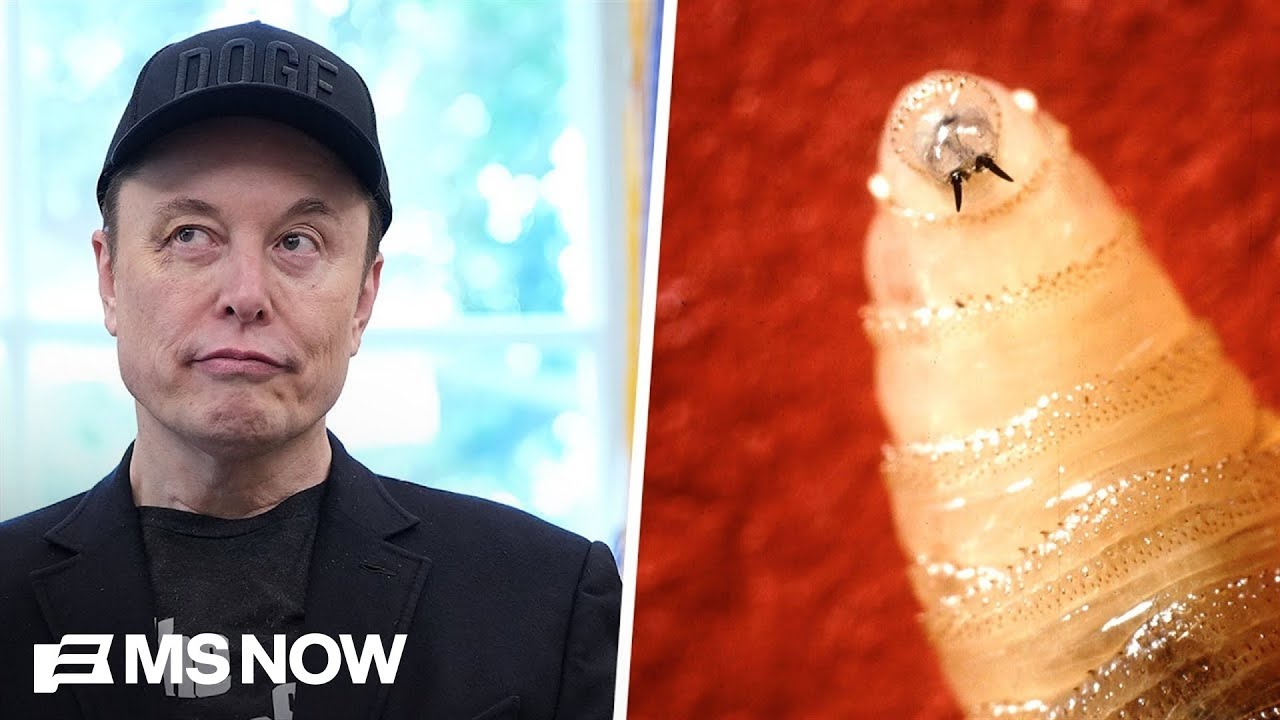
Chris Hayes: Trump and Musk took a chainsaw to the obscure government programs that kept flesh-eating screwworms away from American farms. And now that failure could hit farmers, ranchers, and your grocery bill.
NEWSMAX IDIOCY
---
NOTE USDA HAS SCREWED AA FARMERS
rww
04/09/2025
by
Religious right anti-choice activist Alveda King has been appointed Senior Advisor on Faith and Community Outreach at the Department of Agriculture.
---
https://www.alternet.org/2020/04/grotesque-deadly-failure-usda-slammed-for-allowing-millions-of-pounds-of-produce-to-rot-as-food-insecurity-surges/
==
omfg smithfield so dak covid hotspot?!
https://www.ecowatch.com/usda-removing-safeguards-on-food-2645756313.html
==
wapo
==
full txt
no lnx
Science ranks grow thin in Trump administration
Jeff Jorgenson examines young corn plants in May on a partially flooded field he farms near Shenandoah, Iowa. A USDA scientist was working on a tool to help farmers mitigate the impact of flooding and other effects from climate change when the Trump administration moved his agency to Kansas, prompting him to quit. (Nati Harnik/AP)
By
Annie Gowen,
Juliet Eilperin,
Ben Guarino and
Andrew Ba Tran
Jan. 23, 2020 at 12:45 p.m. PST
KANSAS CITY, Mo. — Dozens of government computers sit in a nondescript building here, able to connect to a data model that could help farmers manage the impact of a changing climate on their crops.
But no one in this federal agency would know how to access the model, or, if they did, what to do with the data.
That’s because the ambitious federal researcher who created it in Washington quit rather than move when the Agriculture Department relocated his agency to an office park here last fall.
He is one of hundreds of scientists across the federal government who have been forced out, sidelined or muted since President Trump took office.
The exodus has been fueled broadly by administration policies that have diminished the role of science as well as more specific steps, such as the relocation of agencies away from the nation’s capital.
While the administration has come under fire for prioritizing the concerns of industry at the expense of science in government decisions, the cumulative effects are just beginning to appear after three years of Trump in the White House.
Some farmers said the USDA staff upheaval has made it harder to access information they need.
Torrential rains last spring dashed the plans of Liz Brownlee, who runs a livestock farm with her husband, to expand her pasture in Crothersville, Ind. Then an unseasonably dry autumn brought 90-degree days that baked the farmers’ seeds.
“With all this uncertainty from climate change, I need the best data possible” to know when to plant, she said. “I’m worried I’m not going to have it.”
In the first two years of the Trump administration, more than 1,600 federal scientists left government, according to Office of Personnel Management employment data analyzed by The Washington Post. That represents a 1.5 percent drop, compared with the 8 percent increase during the same period in the Obama administration.
One-fifth of the high-level appointee positions in science are vacant — normally filled by experts who shape policy and ensure research integrity.
Of those who departed, the numbers were greatest among social scientists, soil conservationists, hydrologists and experts in the physical sciences — chemistry, geology, astronomy and physics.
At the Environmental Protection Agency, nearly 700 scientists have left in the past three years, according to The Post analysis. The EPA has hired 350 replacements.
Linda Birnbaum, who spent four decades working on toxicology and public health issues at the EPA and National Institutes of Health before retiring in October, said the loss of expertise weakens the government’s ability to make sound decisions.
“It’s going to take a long time for government science to come back. There’s little doubt about that,” said Birnbaum, who serves as an adjunct professor at Duke University and the University of North Carolina at Chapel Hill. She added that NIH has remained well- insulated because it enjoys bipartisan support in Congress.
“But when I look at colleagues in other agencies, especially any agency that has any regulatory role, they’re decimated,” she said.
Trump administration officials dismiss that notion, saying much of the criticism comes from activists outside the federal government.
Interior Secretary David Bernhardt points out that he is the first secretary to enlist a career federal scientist to serve as his scientific adviser.
“I’ve got an ideas box, I haven’t seen that,” he said in an interview, referring to complaints that science has been de-emphasized. “I do hear that from advocates and external parties. And, you know, anybody that looks at these things objectively tends to find that they’re without merit.”
Last year, the environmental group Center for Biological Diversity accused Bernhardt of pushing aside the conclusions reached by career scientists at the U.S. Fish and Wildlife Service regarding how a pesticide affected endangered species. Eight Democratic senators sought an investigation. Interior’s inspector general concluded there was “no evidence” Bernhardt abused his position.
As a presidential candidate, Donald Trump called climate change a “hoax.” Once in office, he began dismantling much of President Barack Obama’s climate plan. He has installed industry figures in regulatory roles and rolled back scores of rules and policies that he considers harmful to the fossil-fuel industry. Trump’s actions spurred scientists into the streets, joining protesters for a March for Science rally on the Mall in 2017 and again in 2018.
Many scientists who work for the U.S. government or rely on its funding say the changes brought by the Trump administration are being felt across the country.
After historic rainfall last spring swept away livestock and grain in the Midwest, crop planting was delayed by weeks. Andrew Crane-Droesch, 38, a researcher at the Agriculture Department’s Economic Research Service, started work on a data tool that could predict months in advance the impact of, say, heavy rainfall on crop prices or planted fields. He hoped that knowledge could help farmers, commodity traders and government disaster planners prepare.
But when Agriculture Secretary Sonny Perdue moved forward with his controversial plan to relocate the Economic Research Service and the National Institute of Food and Agriculture — two key research agencies — to Kansas City, Crane-Droesch headed for the exit.
He joined two-thirds of affected employees in his division who either retired or found other jobs rather than move to the greater Kansas City region. At the National Institute of Food and Agriculture, which oversees $1.7 billion in scientific funding for researchers, nearly 8 of every 10 employees have left.
Crane-Droesch, who took a health-research job in Philadelphia, said there’s no one left at the USDA who has the time or the know-how to run the model he created or to finish the project.
“All that work was for naught, and they nuked the account,” he said. “Even if they hired somebody for my portfolio — which I don’t think they did — it would take that person quite a while to get up to speed, just as it took me several years.”
The move to Kansas City has also meant dozens of reports and millions in research funding have been delayed or scuttled as the Agriculture Department scrambled to keep up with departures.
The agency has been forced to hire back 21 retired employees on temporary contracts, to stanch its losses.
But experts on bee pollination, organic farming, commodity markets and trade are gone, setting back research that has been in process for months or even years.
“They never tried to refute our work; they tried to bury it by getting rid of the people who produced the work,” Crane-Droesch said.
To restore the National Institute of Food and Agriculture and the Economic Research Service to their size under the Obama administration, the USDA would have to hire more than 400 people. One USDA official said the department has “well over 150 active recruitments in process between both agencies.”
Current and former employees interviewed said they felt the move to Kansas City was intended to diminish research areas such as trade policy, farm income and climate change; Perdue is a climate skeptic who recently described the problem as “weather patterns, frankly.”
A USDA spokesman defended the move, saying that Perdue believes the agencies can better serve “customers” — farmers, ranchers, academic institutions and agribusiness — by relocating to Kansas City, “a hub for all things agriculture in America’s heartland.”
The department estimates it will save $300 million over 15 years from employment and rent in Kansas City.
EPA pursues regulatory rollbacks, despite criticism from its scientific advisers
Some federal researchers said they left the Trump administration after concluding their work was being undermined.
Dan Costa, who worked at the EPA for 34 years before stepping down as director of its air, climate and energy research program in January 2018, said the tipping point for his retirement came when an EPA spokesman undercut a study published in the New England Journal of Medicine that the agency had funded.
The study found that long-term exposure to levels of soot and smog lower than current national standards can cause premature death among older Americans. Such a finding suggests that current standards don’t adequately protect public health, which would have implications for industries that pollute. An unidentified EPA spokesman attacked the study in an interview with the Washington Times, an act Costa called “scientifically unethical.”
Peter Van Doren, a senior fellow at the libertarian Cato Insitute, said in an interview that scientists need to remember that they don’t set policy.
“When nerds and politicians disagree, nerds lose,” he said. “Scientists think, ‘We are smart, and we ought to decide.’ But we don’t get to decide.”
Elsewhere in the government, political appointees have delayed grants for scientific work.
At Interior’s U.S. Geological Survey, Director James Reilly “felt that he needed to personally look at every grant that went out,” according to Bernhardt’s science adviser William Werkheiser, who served as Reilly’s deputy before joining the secretary’s office. The process stalled grants at the agency’s climate adaptation science centers for more than six months.
The centers fund university research to help wildlife, lands and people adjust to a changing climate.
Robin O’Malley, who retired last month as director of one climate adaptation center, said in an interview that the slowdown in hiring and grant approvals has hampered the centers.
“They haven’t said no to us at any time, they’ve just made it difficult to move forward,” he said. “You’re up a creek.”
Across the government, the administration is scaling back advisory committees that offer input to policymakers from scientists and other experts. Last year, Trump required agencies to eliminate one-third of their advisory panels, with a few exceptions.
Will McClintock, a marine scientist who has helped dozens of countries establish marine sanctuaries, used to serve on the National Oceanic and Atmospheric Administration’s Marine Protected Areas federal advisory committee.
After seeing that people were mailing in hand-drawn maps to nominate reserves, McClintock created a Google Maps-like program called SeaSketch that allows fishermen, divers and conservationists to propose sanctuary zones alongside scientists and government officials.
“I’m bringing lots and lots of expertise, for free, to our federal government,” said McClintock, a project scientist at the University of California at Santa Barbara who volunteered on the advisory panel. But before NOAA could adopt the software, his federal advisory committee was eliminated.
Some Republicans have supported the executive order to cut advisory committees. “Based on the characterization made by many of my colleagues and their friends in the media, you would think this order was a death blow to science at all the agencies,” said Rep. Ralph Norman (R-S.C.) to EPA Administrator Andrew Wheeler at a hearing in September. “In reality it just seems like a common sense, nonpartisan way to eliminate wasteful committees.”
The Office of Management and Budget declined to estimate the cost savings from cutting the committees. "The administration is always looking for ways to end redundant and out of date programs — this is an open and closed case where taxpayer resources are better used elsewhere," the office said in a statement.
It is unclear whether the USDA relocation will ultimately save taxpayers $300 million over 15 years as promised. For now, employees transferred to Kansas City are working out of an existing USDA office until permanent space is ready.
Earlier this month, the boxy building about six miles outside the city's central business district had the feeling of the first day of school. New hires waited to sign in, get security badges and learn where to park.
"We lost a lot of people, and we're trying to rebuild," said Daniel Hellerstein, an economist who researches the economic impact of soil conservation. Hellerstein was one of the retiring employees who was temporarily hired back but remains in Washington. "It's going to be difficult because the slots we need are fairly skilled, and there's a lot of competition out there for qualified people."
Much of the impact of the federal government's shrinking science capacity will not be felt for years, observers said.
"If we're gone, is the world going to be a worse place?" he mused. "I like to think so. But it's not going to be immediate."
==
==
Department of Agriculture launched an absurd pro-Trump podcast; the first guest was Fox contributor Sarah Sanders.
==
ew 819
Top Scientist Quits USDA, Says Trump Admin Tried to Bury Study Linking Climate and Nutrition
https://www.dailykos.com/stories/2019/7/1/1868871/-Climate-Change-USDA-Scientists-to-be-fired-in-2-weeks-DANGER
also trms 2x
...Why is he wanting to fire Scientists who study climate change? ( According to Rachel and other reports. www.scientificamerican.com/…
Then we have the Food and Drug inspectors who have a problem thanks to the orange dung.
USDA inspects food, and meds.
The Agriculture Department is offering employees a rare choice: accept a forced transfer to a post 1,000 miles away or be fired.
The Trump administration’s plan to move two agencies from the District to the Kansas City area includes a document with two blank boxes on it, sent to employees on June 13. Check one, it instructs: Accept the transfer by July 15 or “be separated by adverse action procedures.”
William Jolly, a research ecologist with the agency's Rocky Mountain Research Station in Missoula, Mont., was supposed to give a 30-minute presentation titled "Climate-Induced Variations in Global Severe Fire Weather Conditions" at the International Fire Congress in Orlando, Fla., next month. The event is hosted by the Association for Fire Ecology (AFE).
The travel denial follows reports last week that U.S. EPA blocked three scientists from making presentations at a conference in Rhode Island featuring climate change. Critics accused the Trump administration of stifling the dissemination of taxpayer-funded science.
...
==
==
CHINAUSDA approves shipping slaughtered chicken to China and back, says you can eat itJASON WEISBERGER
==
==
http://newsenter.org/lubbock/2018/05/05/253811-trump-selects-texas-tech-prof-for-usda-under-secretary-job.html
On his 470th day in the Oval Office, President Donald J. Trump Friday announced his intention to nominate Dr. Mindy Brashears as the U.S. Department of Agricultures (USDAs) next Under Secretary for Food Safety. It will be many more days before the Texan food safety expert takes office.
Brashears, who was an expert witness in the BPI v. ABC trial last summer is a professor of food safety and public health who is also director of the International Center for Food Industry Excellence at Texas Tech University.
Zippy Duvall, president of the American Farm Bureau Federation, also had positive things to say about Brashears appointment. “Consumers deserve to have confidence that their food is safe and that sound science is used to ensure they have access to the most wholesome products. That is why President Trump’s selection of Dr. Mindy Brashears as Under Secretary for Food Safety is welcome news to America’s farmers and ranchers. Her extensive and innovative track record of improving food safety standards is an excellent fit at USDA, where food safety remains a core part of the agency’s mission, and always a priority for farmers and ranchers,” Duvall said.
The departments top job over food safety, which Secretary of Agriculture Sonny Perdue says is at the core of USDAs mission has been vacant for the past 1,604 days. And it will remain vacant until Dr. Brashears nomination is confirmed by the U.S. Senate.
Brashears is a professor of food safety and public health and the director of the International Center for Food Industry Excellence at Texas Tech University. Brashears’ research program focuses on improving food safety standards to make an impact on public health. In a statement, USDA noted that her highly acclaimed work evaluates interventions in pre-harvest and post-harvest environments and on the emergence of antimicrobial drug resistance in animal feeding systems. These efforts have resulted in commercialization of a pre-harvest feed additive that can reduce Escherichia coli and salmonella in cattle.
Brashears selected for food safety post
USDA unconfirmed nominations ahead of hers include Stephen Alexander Vader as general counsel, Naomi C. Hart as assistant secretary for civil rights, and James E. Hubbard as Under Secretary for natural resources and environment.
Perdue Friday pressed the U.S. Senate to take up all our nominations as quickly as possible.
Food safety is at the core of USDAs mission, because it directly affects the health and well-being of millions of Americans every day. President Trump has made an excellent choice in Dr. Mindy Brashears, and I am excited to have her join the team. Dr. Brashears has spent decades finding ways to improve food safety standards through innovation, invention, and leadership on research missions across the globe. I look forward to her bringing that wealth of expertise and track record of results here to USDA.
Government-wide, the Trump Administration is currently waiting for Senate confirmation on at least 124 additional nominations. According to the Washington Post/Partnership for Public Services tracking of the top 600 executive positions requiring Senate confirmation, only half are nominated and confirmed.
U.S. Secretary of Agriculture Sonny Perdue applauded President Donald J. Trumps recent selection of Mindy Brashears to be the U.S. Department of Agricultures Under Secretary for Food Safety. After the announcement, Perdue issued the following statement:
The average time to confirm a Trump nominee is taking a historic 84 days. That means if Brashears wins confirmation, its unlikely she will take over until late summer or early fall at the earliest.
“Consumers deserve to have confidence that their food is safe and that sound science is used to ensure they have access to the most wholesome products. That is why President Trump’s selection of Dr. Mindy Brashears as Under Secretary for Food Safety is welcome news to America’s farmers and ranchers. Her extensive and innovative track record of improving food safety standards is an excellent fit at USDA, where food safety remains a core part of the agency’s mission, and always a priority for farmers and ranchers.”
Secretary Perdue Applauds President Trumps Selection for USDAs Under Secretary for Food Safety
Generally speaking, Senate Democrats cannot defeat Trump nominees, but they can and do use a bag of procedural tricks to delay them from getting to the necessary floor votes. Secret holds can be placed on a nominee by individual Senators and the minority party can demand 30 hours debate ahead of any nominees floor vote.
The following statement regarding the appointment of Dr. Mindy Brashears as Under Secretary for Food Safety at the Agriculture Department may be attributed to American Farm Bureau Federation President Zippy Duvall.
Once the White House sends over the formal nomination for Brashears to serve as Under Secretary for Food Safety to the Senate, it’s certain to be assigned to the Senate Committee on Agriculture, Nutrition & Forestry.
USDA works to increase ag exports
The appointment of Ken Barbic as USDAs assistant secretary for congressional relations was the most recent to clear the Ag committee and get a favorable floor vote. It took 103 days.
Background: Dr. Brashears is a Professor of Food Safety and Public Health and the Director of the International Center for Food Industry Excellence at Texas Tech University. Dr. Brashears’ research program focuses on improving food safety standards to make an impact on public health. Her highly acclaimed work evaluates interventions in pre- and post-harvest environments and on the emergence of antimicrobial drug resistance in animal feeding systems. These efforts have resulted in commercialization of a pre-harvest feed additive that can reduce E. coli and Salmonella in cattle. She also leads international research teams to Mexico, Central and South America to improve food safety and security and to set up sustainable agriculture systems in impoverished areas. She is past-Chair of the National Alliance for Food Safety and Security and of the USDA multi-state research group.
While Food Safety News last October alone reported that Brashears was one of two candidates for Under Secretary for Food Safety under serious consideration by the White House, she was last in the news during the June 2017 BPI-ABC trial.
“Food safety is at the core of USDA’s mission, because it directly affects the health and well-being of millions of Americans every day. President Trump has made an excellent choice in Dr. Mindy Brashears, and I am excited to have her join the team. Dr. Brashears has spent decades finding ways to improve food safety standards through innovation, invention, and leadership on research missions across the globe. I look forward to her bringing that wealth of expertise and track record of results here to USDA.
Her testimony, including a cross-examination that turned combative, likely contributed to the decision by Disney-owned ABC News to reach a settlement favorable to South Dakota-based BPI. The undisclosed settlement ended a state jury trial tasked with deciding whether ABC News had defamed BPI by repeatedly calling its lean finely textured beef product pink slime.
U.S. Secretary of Agriculture Sonny Perdue today applauded President Donald J. Trump’s selection of Dr. Mindy Brashears to be the U.S. Department of Agriculture’s (USDA) Under Secretary for Food Safety. After the announcement, Secretary Perdue issued the following statement:
Brashears testified with her smile and Texas twang at trial for BPI as one of the nations top beef safety experts. She said BPIs textured beef product was definitely meat and definitely beef and not pink slime.
Dr. Brashears is a Professor of Food Safety and Public Health and the Director of the International Center for Food Industry Excellence at Texas Tech University. Dr. Brashears research program focuses on improving food safety standards to make an impact on public health. Her highly acclaimed work evaluates interventions in pre- and post-harvest environments and on the emergence of antimicrobial drug resistance in animal feeding systems. These efforts have resulted in commercialization of a pre-harvest feed additive that can reduce E. coli and Salmonella in cattle. She also leads international research teams to Mexico, Central and South America to improve food safety and security and to set up sustainable agriculture systems in impoverished areas. She is past-Chair of the National Alliance for Food Safety and Security and of the USDA multi-state research group.
Her cross-examination by ABCs attorneys from the prominent Williams & Connolly law firm in Washington D.C. was tough and spirited, but Brashears was still left smiling. Disney financial statements later indicatedABCs legal settlement with BPI was at least $177 million.
Food safety is at the core of USDAs mission, because it directly affects the health and well-being of millions of Americans every day. President Trump has made an excellent choice in Dr. Mindy Brashears, and I am excited to have her join the team. Dr. Brashears has spent decades finding ways to improve food safety standards through innovation, invention, and leadership on research missions across the globe. I look forward to her bringing that wealth of expertise and track record of results here to USDA.
Her highly acclaimed work evaluates interventions in pre- and post-harvest environments and on the emergence of antimicrobial drug resistance in animal feeding systems. These efforts have resulted in the commercialization of a pre-harvest feed additive that can reduce E. coli and Salmonella in cattle, Secretary Perdues statement said.
(Washington, D.C., May 4, 2018) – U.S. Secretary of Agriculture Sonny Perdue today applauded President Donald J. Trumps selection of Dr. Mindy Brashears to be the U.S. Department of Agricultures (USDA) Under Secretary for Food Safety. After the announcement, Secretary Perdue issued the following statement:
In addition to her research, Brashears has led international research teams to Mexico, Central and South America to improve food safety and security and to set up sustainable agriculture systems in impoverished areas.
Dec. 13, 2013, was the last day Dr. Elizabeth Hagen served as USDAs Under Secretary for Food Safety. She was nominated in 2010 by President Obama and quickly confirmed by the U.S. Senate.
“Her work evaluates interventions in pre- and post-harvest environments and on the emergence of antimicrobial drug resistance in animal feeding systems and has resulted in the commercialization of a pre-harvest feed additive that can reduce E. coli and Salmonella in cattle,” according to the release. She is also a past chair of the National Alliance for Food Safety and Security and of the USDA multi-state research group.
A-J Media Mindy Brashears, a professor of food microbiology and food safety in Texas Techs College of Agricultural Sciences & Natural Resources, has been selected by President Donald Trump as the new under secretary for food safety in the U.S. Department of Agriculture.
Brashears appeared as an expert witness last year for Beef Products Inc., helping the Sioux City, Iowa, food company negotiate a multimillion settlement from ABC News. The company had sued ABC, alleging it had been disparaged by the news organization when it described a beef product as “pink slime.” Brashears told the jury that BPI’s lean finely textured beef is meat, is beef, is nutritious and is entirely safe to eat.
Secretary of Agriculture Sonny Perdue said in a statement issued Friday morning that food safety is at the core of the USDAs mission, because it directly affects the health and well-being of millions of Americans every day.
A rose to … the U.S. Department of Agriculture, which this week highlighted USDAs success and continuing commitment to expanding trade and increasing rural prosperity through ag exports. We encourage leaders at USDA to continue talking up ag trade. The message about the importance of trade to rural America and the nations economy cannot be understated, but it can be undermined with threats of tariffs and suspicious comments about multinational trade agreements.
“President Trump has made an excellent choice in Dr. Mindy Brashears, and I am excited to have her join the team. Dr. Brashears has spent decades finding ways to improve food safety standards through innovation, invention and leadership on research missions across the globe. I look forward to her bringing that wealth of expertise and track record of results here to USDA,” Perdue said.
According to a bio on Texas Techs website, Brashears is not only a professor in classes such as food microbiology and food safety, but she also serves as the director of the International Center for Food Industry Excellence at Tech. Her research has focused on interventions in pre- and post-harvest environments and on the emergence of antimicrobial drug resistance. Her interests are primarily in meat and poultry products, with some work on spinach. Her work has resulted in the commercialization of pre-harvest feed additives that reduce E. coli and Salmonella in cattle.
Perdue said there are still qualified people in addition to Brashears awaiting confirmation to fill key roles at USDA, and urged the Senate to take up all of the nominations as quickly as possible.
==
==
GMO Labeling: Public Interest Advocacy Group Sues Trump Over Secrecy
Last week, Center for Food Safety (CFS) sued the Trump Administration for refusing to make public documents surrounding its decision on how to label genetically engineered (GE or GMO) foods. On May 3, 2018, the U.S. Department of Agriculture (USDA) released long-awaited proposed regulations for the first-ever U.S. mandatory disclosure of foods produced using genetic engineering. Earlier this year, CFS sought the public data and documents about the rulemaking under the Freedom of Information Act (FOIA), but the administration failed to make public any information, leading to this CFS lawsuit to force that disclosure....
golden rice not certified b/c does nor work
https://kpfa.org/episode/the-ralph-nader-radio-hour-june-18-2018/
Andrew Kimbrell, returns to make the case that passing food labeling laws will spell the end of the GMO industry
ctr for food safety BE = bio-engr vs GM or GMO
==
==
Proposed GMO Food Labeling Could Leave 100 Million Americans in the Dark see GMO's 5/18.
The U.S. Department of Agriculture (USDA) on Thursday released the long-awaited proposed regulations for the mandatory disclosure of foods produced using genetic engineering (GE or GMO), which it calls "bioengineered foods."
The regulations come out of a 2016 law signed by President Obama prohibiting existing state GE labeling laws, such as Vermont's, that required on-package GE labeling, and instead created a federal "disclosure" program, which for the first time creates a nationwide standard of required GE disclosure. There now will be a 60 day public comment period. The 2016 law requires that USDA issue the final rules by July 29, 2018.
Public comments will be particularly important because the proposal presents a range of alternatives for public comments and makes few decisions, leaving considerable unknowns about its outcome. For example, instead of requiring clear, on-package labeling in the form of text or a symbol, USDA proposes to allow manufacturers to instead choose to use "QR codes," which are encoded images on a package that must be scanned and are intended to substitute for clear, on-package labeling.
Real-time access to the information behind the QR code image requires a smartphone and a reliable broadband connection, technologies often lacking in rural areas. As a result, this labeling option would discriminate against more than 100 million Americans who do not have access to this technology. Last fall, CFS forced the public disclosure of USDA's study on the efficacy of this labeling, which showed it would not provide adequate disclosure to millions of Americans.
"USDA should not allow QR codes," stated Andrew Kimbrell, executive director at Center for Food Safety (CFS). "USDA's own study found that QR codes are inherently discriminatory against one third of Americans who do not own smartphones, and even more so against rural, low income, and elderly populations or those without access to the internet. USDA should mandate on-package text or symbol labeling as the only fair and effective means of disclosure for GE foods."
When it comes to on-package text or symbols, USDA proposes to disallow the terms "genetic engineering or GMO," and use only the term "bioengineered," or "BE," despite the fact that genetic engineering and GMO have been the terms used for 30-plus years by consumers, companies and regulators. Many food companies have long used the terms genetic engineered, GE, or GMO, and thousands of products are currently labeled as such (e.g., Non-GMO).
"USDA's exclusion of the well-established terms, GE and GMO, as options will confuse and mislead consumers, and the agency must instead allow the use of those terms," added Kimbrell.
Another big question left unanswered by the proposal is whether or not "highly refined" GE foods will be covered, such as cooking oils, candies, or sodas that have ingredients derived from GE crops, but are in processed form such that in the final product, the GE content may or may not be detectable. USDA is taking comments on whether or not to include these products, with two differing alternatives including or excluding them. The proposal also seeks comments on how to deal with newer forms of genetic engineering—which often go by different names such assynthetic biology, gene-editing, or CRISPR—and whether or not to include foods produced through them.
"Excluding highly processed GE foods would mean that consumers would be wrongly left in the dark about thousands of GE products," said Bill Freese, CFS's science policy analyst. "These products, as well as those from newer forms of genetic engineering, must be subject to mandatory labeling if this rule is to be meaningful."
Other major issues on which USDA is taking comment are what threshold to use for GE content, the timing of compliance, enforcement and record-keeping requirements.
CFS has been fighting for mandatory GE food labeling for over two decades at the federal and state levels. CFS provided legal and policy support to dozens of states that introduced GE labeling legislation, including Vermont which passed its GE labeling law in May 2014. CFS also helped successfully defend the Vermont law in court.
"This is a 'Call to Action' to all Americans who have waited for decades to finally have GE foods labeled. Now is the time to tell the Trump administration to do the right thing and meaningfully label these foods," declared Kimbrell.
...
https://www.ecowatch.com/usda-nutrition-program-2559010874.html
U
SDA Focus on Nutrition Program 'Integrity' Is a Smokescreen
By Sarah Reinhardt
The U.S. Department of Agriculture has announced it will hire a new "chief integrity officer" to oversee federal nutrition programs such as the National School Lunch and Breakfast Programs, Special Supplemental Nutrition Program for Women, Infants and Children (WIC), and the Supplemental Nutrition Assistance Program (SNAP, formerly known as food stamps).
The integrity of SNAP in particular has been a popular topic among those in the Trump administration, including USDA Sec. Sonny Perdue, who argue that SNAPenables a "lifestyle of dependency" and seek major program reforms in the upcoming Farm Bill. But these arguments have been conjured from very little science and a whole lot of smoke—and have the effect of distracting the public from more pressing issues at hand.
SNAP is among the nation's most effective and efficient programs
Monitoring any government program is necessary to ensure that taxpayer dollars are being spent effectively, and the USDA does so through its quality control process and periodic reports on fraud and abuse. In fiscal year 2011, as part of the Obama administration's Campaign to Cut Waste, the USDA Office of Inspector General (OIG) conducted an extensive review of more than 15,000 stores for compliance with SNAP program rules. The results of these assessments, combined with USDA participation data, tell us the program is working as intended, and with remarkably few problems.
SNAP fraud1—broadly defined as exchanging benefits for cash or falsifying participant or retailer applications to illegally obtain or accept benefits—happens relatively infrequently, though it's difficult to measure. The USDA's most recent report on the topic estimated that it affected about 1.5 percent of all SNAP benefits received between 2012 and 2014. This represents a slight increase since the early 2000s (1.0 to 1.3 percent between 2002 and 2011), but remains substantially lower than in the 1990s, when reported rates were as high as 3.8 percent.
Compare this to some of the other federal programs contained in the Farm Bill—like crop insurance. Back in 2013, former USDA secretary Tom Vilsack voiced concerns about the integrity of crop insurance programs due to error and fraud rates that exceeded those of SNAP. As with SNAP, illegal activity is largely uncovered by way of criminal investigations. According to the Department of Justice, recent convictions and sentences connected with the federal crop insurance program have included the indictment of a Kentucky agricultural producer for insurance fraud, wire fraud, and money laundering; an Iowa farmer who received more than $450,000 in crop insurance proceeds illegally; a Louisiana farmerwho created shell farms to receive more than $5.4 million in subsidy payments; and a Kentucky crop insurance agent whose clients received nearly $170,000 in indemnity payments for false claims. And those are just the cases from the last six months. Unlike SNAP, no chief integrity officer has been assigned to monitor fraud and abuse in the program.
So yes, we should be striving for continuous improvement in the operation of all federal programs. But explaining why SNAP in particular has come under such intense scrutiny requires some historical and political context—and a good understanding of who might benefit from maintaining old narratives
The rise, fall and flatline of SNAP fraud
Though President Lyndon B. Johnson signed the Food Stamp Act into law in 1964, the program began to gain popularity in the 1970s, when participation doubled from 5 million to 10 million over the course of the decade. As participation increased, the USDA began to discover incidents of abuse, eventually revealing a widespread pattern of illegal activity that would plague the program for the next twenty years. Reported rates of fraud at this time were between 10 and 20 percent.
The widespread abuse lent itself to growing public disapproval of the food stamps program and, accompanied by racist and classist rhetoric around so-called "welfare queens," fueled substantial program reform by the Reagan administration in the early 1980s.
But what likely ushered in drastic improvements in rates of fraud and abuse was the introduction of new electronic benefit transfer (EBT) systems, which fully replaced paper food stamps in 2004. In addition to requiring a 4-digit PIN number, EBT cards create a record of each purchase, increasing the ease with which agencies can identify and document illegal use.
That brings us, more or less, to the efficient and effective program that we've seen for the last decade.
Despite how well SNAP works, politicians have continued to frame it as a program that suffers from rampant misuse and illegal activity. For those seeking drastic budget cuts and reforms, that negative narrative grants permission to discredit both the program and those who use it—and one needs to look no further than President Trump's welfare reform proposals or Speaker Paul Ryan's comment about the tailspin of "inner-city culture" to know that the legacy of the welfare queen is alive and well.
Speaking of integrity…
To get a sense of where this is all headed, keep your eyes on USDA Secretary Sonny Perdue—if you can. He's been making some quick pivots lately.
At a May 2017 House Appropriations Subcommittee on Agriculture hearing, Perdue stated that "SNAP has been a very important, effective program," and that the agency was considering no changes. "You don't try to fix something that isn't broken."
Less than a year later, the secretary has voiced his support for a number of proposed program changes, including stricter work requirements for adults without dependents. Not unlike the recent announcement aimed at nutrition program integrity, these proposals are often grounded more in political ideology than fact. USDA's own data shows that most SNAP participants who can work do work—albeit in unstable jobs—and counters the notion that participants stay on the program for long periods of time.
When the House releases its draft of the Farm Bill, which may happen as early as this week, Perdue's response (or lack thereof) could provide insight on the policy proposals he's prepared to support. More than likely, he'll continue to endorse the positions of his party—but then again, we've been surprised before.
- Fraud and abuse should be distinguished from error rates, or improper payment rates, which capture how often SNAP participants receive underpayment or overpayment of benefits. (The overwhelming majority of SNAP errors are attributed to unintentional error by recipients or administrative staff.) Program error rates have also experienced substantial declines in recent years: they reached an all-time low of 2 percent in 2013, down from 6.6 percent in 2003. And though a 2015 USDA OIG review of the quality control process found understated error rates in some states, the resulting corrective actions target state agencies—not individual SNAP participants.
==
https://www.ecowatch.com/usda-organic-eggs-2524568365.html
https://www.ecowatch.com/usda-animal-welfare-2518422850.html
USDA Gives in to Big 'Organic' Poultry, Moves to Withdraw New Animal Welfare Rules
Monday, the U.S. Department of Agriculture (USDA) formally proposed withdrawing a set of rules finalized at the end of the Obama administration that establish stronger, more enforceable animal welfare requirements for certified organic producers.
The rules, titled the Organic Livestock and Poultry Practices rule, are the product of more than a decade of collaboration and coordination among the organic community, including consumers, farmers, veterinarians, environmentalists and animal welfare groups. Unfortunately, a few large-scale egg producers fear the new rules will expose their less-than-organic practices and put pressure on USDA and Congress to stop the rule.
"The new rules are vital for protecting animal welfare, organic consumers, and the thousands of farmers that opt-in to organic certification," said Cameron Harsh, senior manager for Organic & Animal Policy at the Center for Food Safety.
The rules, which have been delayed from implementation three separate times since being finalized in January 2017, provide needed clarity on organic animal care, including prohibiting several painful alterations. In particular, the rules require all animals to have real access to the outdoors, which must include contact with soil and vegetation, and outline minimum spacing requirements for poultry. This is, in fact, what consumers already expect from the organic poultry and eggs they buy in stores. But the largest poultry producers have so far been able to consider small, cement, fenced-in areas as outdoor access and have not been required to abide by specific spacing limitations.
"The rules would hold all certified producers to the high standard of animal care that consumers expect and that the drafters of the organic law intended. If they are withdrawn, the steadily growing organic market and consumer trust in the organic seal will be at risk," added Harsh.
Center for Food Safety has submitted extensive comments in support of the rules. While the rules are not perfect, they are a substantial step toward ensuring all organic animals are provided a consistent level of care. The small but vocal opposition against the rules have misrepresented the realities of the rules in order to continue business-as-usual.
The proposal to withdraw the Organic Livestock and Poultry Practices rule is open for public comment until Jan. 17, 2018.
==
see sci supp 2
==
While Congress hasn’t accomplished much in 2017, it did manage to pass a budget resolution — and within that budget, a sum of $3 million stands out.
Congress appropriated that $3 million to fund the Agricultural Biotechnology Education and Outreach Initiative. That’s a partnership between the Food & Drug Administration (FDA) and the Department of Agriculture (USDA) “to provide consumer education on agricultural biotechnology and food and animal feed ingredients derived from biotechnology.”
What they’re really talking about is a promotional campaign for genetically modified organisms, or GMOs.
There are two major flaws with this plan.
First, the FDA is tasked with building a campaign around the “safety and benefits of crop biotechnology.” But what about the risks, concerns, and unknowns?
Leaving those out means using government agencies and taxpayer funds for corporate propaganda. It benefits companies like Monsanto, Dow, Dupont, Syngenta, and Bayer, which collectively earn billions of dollars from these technologies, but does little to inform consumers.
Second, the initiative will push forward “science-based” education. The question is: Whose science are they using?
There’s very little independent or government research on GMOs and their corresponding pesticides. The lack of unbiased and comprehensive science on biotechnology is a result of corporations controlling who can do research on biotech products.
Much of the existing research is either industry-funded or straight out of biotechnology companies’ own labs. The existing regulatory framework relies on voluntary reporting and doesn’t require independent verification to prove the safety of new products before they land on dinner plates across the country.
If the government’s going to educate consumers on biotechnology, it must first do its own unbiased studies on the long-term environmental and health impacts of existing GMOs and pesticides. It also needs a much more rigorous — and mandatory — regulatory process.
The government must tell consumers the full truth, presenting balanced and unbiased information on the benefits, risks, and concerns around biotechnology. The FDA must openly address consumer concerns about long-term environmental impacts, corporate influence on government research, and corporate control of our industrialized food system.
We’re at a turning point in history where we can reverse the harm that we’ve done to our communities, farmland, and environment.
Industrialized, chemical-intensive agriculture designed to work around biotechnology is a failed system. It’s increasing herbicide use, exacerbating pesticide resistance, polluting our waterways, soil, and air, and promoting highly processed food and confined animal production.
==
https://www.propublica.org/article/a-wide-open-door-for-pesticide-lobbyists-at-agriculture-department
At a private meeting in September, congressional aides asked Rebeckah Adcock, a top official at the Department of Agriculture, to reveal the identities of the people serving on the deregulation team she leads at the agency.
Teams like Adcock’s, created under an executive order by President Trump, had been taking heat from Democratic lawmakers over their secrecy. What little was publicly known suggested that some of the groups’ members had deep ties to the industries being regulated.
Adcock, a former pesticide industry executive, brushed off the request, according to House aides familiar with the exchange, who asked for anonymity because they were not authorized to comment publicly. Making the names public, they recalled her saying, would trigger a deluge of lobbyists.
In fact, interviews and visitor logs at the Agriculture Department showed that Adcock had already been meeting with lobbyists, including those from her former employer, the pesticide industry’s main trade group, CropLife America, and its members. CropLife pushes the agenda of pesticide makers in Washington, including easing rules related to safety standards and clean water.
Adcock, who left the trade group in April, maintained contact with her former industry allies despite a signed ethics agreement promising to avoid for one year issues involving CropLife as well as matters that she had lobbied about in the two years before joining the government.
In one meeting, Adcock discussed issues banned by the ethics agreement with an executive who had been her lobbying partner weeks earlier at CropLife, according to the accounts of participants and the visitor logs, obtained through a public records request by The New York Times and ProPublica.
Tim Murtaugh, a spokesman for the USDA who also spoke on behalf of Adcock, said she had not violated her ethics agreement by meeting with her former industry allies. He also denied that Adcock had discussed issues related to her previous lobbying at the meeting, or that she had suggested that her deregulation team would be swamped by lobbyists if names of its members were released.
“The career ethics officers at USDA agree that this is not a violation of the ethics agreement that Rebeckah Adcock signed,” said Murtaugh, citing a 2009 memo by the Office of Government Ethics.
Others dispute that interpretation of the memo; the ethics office declined to say whether the memo applied to the meeting, citing its policy not to discuss individual cases.
Help Us Investigate
Help Us Identify the Officials Helping Trump Roll Back Regulations
In February, President Trump ordered federal agencies to form task forces charged with finding regulations to weaken or eliminate. While the names of appointees to executive-agency task forces are typically made public, some agencies are refusing to reveal who is on their panels
Adcock is scheduled to appear Tuesday before subcommittees of the House Committee on Oversight and Government Reform, which is tracking Trump’s deregulation effort. In announcing the hearing, the committee, led by Republicans, applauded the deregulation teams for making an “unprecedented reduction in the federal regulatory footprint.”
Republican members of the committee declined to comment about Adcock’s activities. Representative Elijah E. Cummings, the top Democrat on the committee, said that if Adcock had violated her ethics agreement, it contributed “to a troubling pattern of President Trump’s failure to ‘drain the swamp.”
In February, Trump ordered major federal agencies to set up the deregulation teams, to fulfill a campaign promise to cut red tape for businesses. Corporations and industry groups quickly hired lawyers, lobbyists and economists to help them influence the process with billions of dollars at stake. The regulations under review cover a range of subjects, including the cleanliness of drinking water and the safety of highways.
The Trump administration has declined to make public the names of many members of the teams. It has also generally not provided records related to the teams’ calendars and correspondence.
A joint investigation published in July by The Times and ProPublica found that the teams included former employees of industry-financed organizations that oppose environmental regulations; lawyers who have represented companies in cases against federal regulators; and staff members of so-called political dark-money groups. Some are reviewing rules that their previous employers sought to weaken or kill, and at least two may be positioned to profit personally if certain regulations are undone. In all, the two news organizations have identified 112 current and former team members, including 41 with potential conflicts.
At the meeting on Capitol Hill in September, Adcock lamented the scrutiny that her team was under, a House aide familiar with the exchange said. Adcock cited, in particular, public records requests for calendars and emails.
The Times and ProPublica asked for those records this year and have received only a few. Most other federal agencies have been similarly unresponsive. The visitor logs that have been obtained are often handwritten sign-in sheets. They appear to show only a fraction of meetings, and many are illegible. It is not known from the logs, for example, if Adcock or her team had met with environmental or science groups in addition to the industry representatives.
In response to questions from reporters about possible conflicts of interest, agency officials across the government have said the deregulation teams are abiding by strict ethical standards, including rules that bar them from working on issues directly affecting recent employers.
Records received through a Freedom of Information Act request show that Adcock entered such an agreement on April 26, pledging that she would “not participate personally and substantially in any particular matter involving specific parties in which I know CropLife America is a party or represents a party” for a year.
The two knew each other well. From 2010 to early this year, Adcock and Bray lobbied together for CropLife, which represents Syngenta and Monsanto, among other pesticide makers.But in May, Kellie Bray, a lobbyist for CropLife, arrived for a meeting with Adcock, according to the visitor logs.
Disclosure records show that during those years the two advocated for the industry’s agenda at agencies, including the USDA and the Environmental Protection Agency, and in Congress. They pushed CropLife’s interests on bills and regulations relating to the impact of pesticides on water and human health.
Adcock’s departure from CropLife left the trade association short a seasoned lobbyist, but gave it a valuable contact in the top ranks of the USDA
Bray said in an interview that in May, Adcock had met with her and the Southern Crop Production Association, a CropLife affiliate. Bray said she had sat in on the meeting but hadn’t talked.
“I facilitated the introduction,” she said. “That is all.”
After the meeting, the Southern Crop Production Association, which represents pesticide manufacturers, formulators and distributors across the South, said on its website that “Rebeckah has an exceptional understanding regarding the many issues facing agriculture due, in large part, to her previous position with CLA,” using the acronym for CropLife America.
Among the topics discussed, according to the trade group’s website, were the tests that pesticides must undergo to prove they are safe and rules governing their use near water sources. The trade group did not respond to requests for comment. Bray confirmed that the group had discussed regulations about the use of pesticides near water.
Discussing policy related to the impact of pesticides on water is deemed off limits under Adcock’s ethics agreement. Murtaugh, the USDA spokesman, said Adcock disputed that she had discussed any off-limits subject.
“If any participant declared concern regarding any issue precluded by Adcock’s agreement, she politely and firmly instructed them it was not a matter she could discuss or assist with,” he said.
He also said Adcock had instructed Bray not to participate in the meeting and did not recall her being in the room.
Murtaugh said a provision in the memorandum from the Office of Government Ethics allowed an appointee like Adcock to attend meetings with a former employer or client so long as five or more other stakeholders participated. In the May meeting, he said, four of the Southern Crop Production Association representatives were affiliated with individual companies: Syngenta, Albaugh, Triangle Chemical and Crop Production Services.
However, three of those companies are also members of the CropLife trade group, Adcock’s former employer. And they were attending in their capacity as the executive committee of the Southern Crop Production Association, according to the association’s website, not as individual company executives.
Walter M. Shaub Jr., who headed the Office of Government Ethics under President Barack Obama and during the early months of the Trump administration, said the provision cited by the USDA did not apply to the ethics regulation in Adcock’s agreement. Even if it did apply, he said, the meeting lacked a necessary diversity because the participants were all affiliated with one trade group. He also said it was irrelevant that Bray hadn’t spoken.
“If she brought them there, signed into the sign-in log, attended the meeting that she may or may not have set up, it definitely counts as a meeting with her,” said Shaub, who has been critical of the Trump administration.
Before Adcock worked at CropLife, she served as a lobbyist for the farming industry at the American Farm Bureau Federation. Among its donors is Farm Credit, a lending institution. In July, Adcock met with a delegation from Farm Credit, according to a participant.
One of the executives who attended — Jeremy Brown, president of Broadview Agriculture, a Texas cotton producer — said in an interview that he knew Adcock from the Farm Bureau. For those who did not know her, Adcock explained her past lobbying on behalf of the farming industry, and she asked for recommendations on regulatory changes, he said.
“Any time you have people already familiar with the industry, it helps,” Brown said. “They can hopefully get their feet on the ground and get the work in.”
He said he had pushed Adcock to get cottonseed reclassified as an oil seed crop so cotton producers could be eligible again for certain government subsidies if revenue dropped. He also discussed what he termed overreach on clean-water rules.
“She was taking notes, being really receptive,” Brown said.
Another highlight, he said, was the access the group enjoyed. Never before had he attended a meeting in the private gathering room just outside the office of the secretaryof agriculture.
“I’ve been to the USDA a couple other times,” Brown said, “and this was the first time I’ve been able to go to what they call the Cage.”
Update: The Agriculture Department provided the House Committee on Oversight and Government Reform with a full list of its deregulation team appointees Tuesday following publication of this story, said Jennifer Werner, a spokeswoman for committee Democrats, citing her Republican counterparts.
Filed under:
==
https://www.vanityfair.com/news/2017/11/usda-food-stamps-school-lunch-trump-administration
micael lewis moneyball
INSIDE TRUMP’S CRUEL CAMPAIGN AGAINST THE U.S.D.A.’S SCIENTISTS
The folks at the Department of Agriculture laid on a friendly welcome for the Trump transition team, but they soon discovered that most of his appointees were stunningly unqualified. With key U.S.D.A. programs—from food stamps to meat inspection, to grants and loans for rural development, to school lunches—under siege, the agency’s greatest problem is that even the people it helps most don’t know what it does.
...
More than a month after the election, the Trump transition team finally appeared. But it wasn’t a team: it was just one guy, named Brian Klippenstein. He came from his job running an organization called Protect the Harvest. Protect the Harvest was founded by a Trump supporter, an Indiana oilman and rancher named Forrest Lucas. Its stated purpose was “to protect your right to hunt, fish, farm, eat meat, and own animals.” In practice it mainly demonized organizations, like the Humane Society, that sought to prevent people who owned animals from doing terrible things to them. They worried, apparently, that if people were forced to be kind to animals they might one day cease to eat them. “This is a weird group,” says Rachael Bale, who writes often about animal welfare for National Geographic....
e first time we spoke wasn’t long after Trump had nominated her replacement. His name was Sam Clovis. He had a doctorate in public administration from the University of Alabama but no experience in science. He’d come to prominence in 2010 as a Rush Limbaugh-style right-wing talk-radio host in Sioux City, Iowa. As Iowa chairman of Rick Perry’s 2016 presidential campaign, he’d ripped Trump loudly and righteously for having “no foundation in Christ.” Then he’d quit Perry’s campaign to become co-chairman of the Trump campaign, declining to address rumors he’d done it for the money. (“I’m not going to talk about how much money I’m getting paid,” he told the Des Moines Register. “It’s just not going to happen.”) His appointment as the U.S.D.A.’s chief scientist felt like a practical joke to those who had worked there: this was the place that, back in the early 1940s, had taken Alexander Fleming’s findings and effectively invented penicillin. It had triggered the antibiotics revolution. It had coped with endless blights and outbreaks. The consequences of the science it funded—or did not fund—was mind-boggling. The person Clovis was replacing had taught at universities, worked in the White House, and, along the way, been inducted into the National Academy of Sciences. (On Wednesday, Clovis withdrew himself from consideration after his name was publicly tied to a former Trump campaign adviser who pleaded guilty to lying to the F.B.I. about his connections with Russian associates.)
“They are going to politicize the science,” said Woteki. “My biggest concern is the misuse of science to support policies.”
In recent years, much of the department’s research has dealt with the effects of climate change. The head of science directs nearly $3 billion in grants each year. Woteki directed the science that leads to nutritional standards for schoolchildren. She set research priorities. Hers had been food security; domestic and global nutrition; safety of the food supply; and figuring out how best to convert plants into fuel. “All of that has to be done in the face of a changing climate,” said Woteki. “It’s all climate change.” It might sound silly that the U.S.D.A. funds a project that seeks to improve the ability of sheep to graze at high altitudes—until you realize that this may one day be the only place sheep will be able to graze. “We’re going to become even more reliant on the efficiencies that come from the investment in science,” she said. One-quarter of the arable land in the world is already degraded, either by overfarming or overgrazing. “Changing temperatures and changing rainfall patterns will force changes in the way crops are grown and livestock are raised,” she said. “The changing climate brings new risks of food-borne disease. Even the pathogens are influenced by temperature and humidity.”
If the Trump administration were to pollute the scientific inquiry at the U.S.D.A. with politics, scientific inquiry would effectively cease. “These high-level discussions really worry me,” she says. Research grants will go not to the most promising ideas but to the closest allies. “There is already good science that isn’t being funded,” she said. “That will get worse.” Junk science will be used to muddy issues like childhood nutrition. Maybe sodium isn’t as bad for kids as people say! There’s no such thing as too much sugar! The science will suddenly be “unclear.” There will no longer be truth and falsehood. There will just be stories, with two sides to them.
http://www.motherjones.com/politics/2016/12/trump-usda-klippenstein-heitkamp/
...
Choosing a centrist Democrat like Heitkamp would be quite a departure from earlier versions of Trump’s USDA short list, which included wild cards like Texas Agriculture Commissioner Sid Miller, who unapologetically shares fake news stories on his office’s Facebook page and once tried to bill taxpayers for a trip to take a medical procedure called a Jesus shot. Charles Herbster has also appeared as a prime candidate for USDA chief—he’s a man who currently runs a a multilevel marketing operation(a highly controversial business model that relies on a network of individual “distributors” to sell products) and who financesand helps lead a Big Ag federal super-PAC also funded by Monsanto, DuPont, Archer Daniels Midland, and other agribusiness giants.
Indeed, a day before the Politico piece hailing Heitkamp as the likely pick, Trump veered in a quite different direction, announcing a new member of the team overseeing the transition of the USDA: Brian Klippenstein, executive director of a group called Protect the Harvest. The brainchild of Forrest Lucas—a right-wing oil magnate and cattle rancher who has himself emerged as a contender to serve as Trump’s secretary of the interior—Protect the Harvest seems to exist mainly to troll the Humane Society of the United States.
On its website, Protect the Harvest warns that HSUS seeks to “put an end to animal ownership.” This is nonsense—the Humane Society is by no means coming for your furry friend. Its website features “tools you need to help the pets in your home and beyond.” I asked Paul Shapiro, vice president of policy at HSUS, whether his group opposes the keeping of pets. “That would certainly be news to the vast numbers of our staff who bring their dogs to work here,” he replied.
Protect the Harvest’s real beef with HSUS appears to be that the group promotes legislation that curtails some of the harsher aspects of factory-scale animal farming. The two groups recently clashed over a Massachusetts ballot measure this fall to ban tight cages in egg and pork production. Lucas personally donated nearly $200,0000 to defeat the measure, and Klippenstein actively campaigned against it. The measure passed with overwhelming support on November 8.
Protect the Harvest’s zeal to fight regulation of animal farming extends even to “puppy mills“—large facilities that churn out dogs like factory farms churn out pigs. Back in 2010, the year before Protect the Harvest was founded, Lucas vigorously opposed a Missouri ballot measure to “require large-scale dog breeding operations to provide each dog under their care with sufficient food, clean water, housing and space; necessary veterinary care; regular exercise and adequate rest between breeding cycles,” and to “prohibit any breeder from having more than 50 breeding dogs for the purpose of selling their puppies as pets.” In 2014, Protect the Harvest opposed an Illinois bill banning the retail sale of puppy-mill dogs.
Klippenstein isn’t the only member of Trump’s USDA transition team. Recall that back in November, Trump picked a lobbyist whose clients include Little Ceasar’s Pizza, the soda and snack industries, and the Illinois Soybean Association to lead the agency’s transition. He soon abruptly quitafter Trump announced a ban on registered lobbyists serving in the transition.
But then, a few days later, Trump tapped Joel Leftwich, Republican staff director for the Senate Agriculture Committee, to help lead the USDA transition. Leftwich took the Senate job in 2015—after having spent the previous three years as the director of government affairs for Pepsi. In 2010—just before another stint on the Senate ag committee staff—Leftwich had worked as a lobbyist for seed and chemical giant DuPont. In other words, Team Trump pushed out a current lobbyist for Big Soda and Big Ag—only to replace him with a guy who basically lives in the revolving door between government and agribusiness, and whose latest turn as a lobbyist ended way back in 2015.
So basically, we’ve got a two-time industry lobbyist and an anti-animal-welfare zealot teaming up to choose the next USDA chief.
What that means for the prospect of Heitkamp taking the USDA reins is unclear. She narrowly won her North Dakota Senate seat in 2012, and Trump won the state in 2016 with 63 percent of the vote. As a Democrat, she faces a hard fight for reelection in 2018, which may be why she agreed to meet with Trump on December 2, in what was widely read as a job interview. If she exits the Senate now, North Dakota would have to hold a special election to replace her, and the winner would almost certainly be a Republican. On Monday, Sen. Harry Reid (D-Nev,), the soon-to-retire former Democratic leader of the Senate, sought to throw water on the Heitkamp-to-USDA rumor, telling CNN that “I would doubt very seriously” that she’d agree to join the Trump administration. Whether he has knowledge of Heitkamp’s intentions, or is just hoping to keep a Senate seat in the party fold, is unclear.
...
==
guardian.com/environment/2017/aug/07/usda-climate-change-language-censorship-emails
no link doc
Staff at the US Department of Agriculture (USDA) have been told to avoid using the term climate change in their work, with the officials instructed to reference “weather extremes” instead.
A series of emails obtained by the Guardian between staff at the Natural Resources Conservation Service (NRCS), a USDA unit that oversees farmers’ land conservation, show that the incoming Trump administration has had a stark impact on the language used by some federal employees around climate change.
A missive from Bianca Moebius-Clune, director of soil health, lists terms that should be avoided by staff and those that should replace them. “Climate change” is in the “avoid” category, to be replaced by “weather extremes”. Instead of “climate change adaption”, staff are asked to use “resilience to weather extremes”.
The primary cause of human-driven climate change is also targeted, with the term “reduce greenhouse gases” blacklisted in favor of “build soil organic matter, increase nutrient use efficiency”. Meanwhile, “sequester carbon” is ruled out and replaced by “build soil organic matter”.
Firefighters battle a wildfire in California.
Facebook Twitter Pinterest
Firefighters battle a wildfire in California. Photograph: Noah Berger/AP
In her email to staff, dated 16 February this year, Moebius-Clune said the new language was given to her staff and suggests it be passed on. She writes that “we won’t change the modeling, just how we talk about it – there are a lot of benefits to putting carbon back in the sail [sic], climate mitigation is just one of them”, and that a colleague from USDA’s public affairs team gave advice to “tamp down on discretionary messaging right now”.
In contrast to these newly contentious climate terms, Moebius-Clune wrote that references to economic growth, emerging business opportunities in the rural US, agro-tourism and “improved aesthetics” should be “tolerated if not appreciated by all”.
Trump is deleting climate change, one site at a time
Read more
In a separate email to senior employees on 24 January, just days after Trump’s inauguration, Jimmy Bramblett, deputy chief for programs at the NRCS, said: “It has become clear one of the previous administration’s priority is not consistent with that of the incoming administration. Namely, that priority is climate change. Please visit with your staff and make them aware of this shift in perspective within the executive branch.”
Bramblett added that “prudence” should be used when discussing greenhouse gases and said the agency’s work on air quality regarding these gases could be discontinued.
Other emails show the often agonized discussions between staff unsure of what is forbidden. On 16 February, a staffer named Tim Hafner write to Bramblett: “I would like to know correct terms I should use instead of climate changes and anything to do with carbon ... I want to ensure to incorporate correct terminology that the agency has approved to use.”
On 5 April, Suzanne Baker, a New York-based NRCS employee, emailed a query as to whether staff are “allowed to publish work from outside the USDA that use ‘climate change’”. A colleague advises that the issue be determined in a phone call.
Some staff weren’t enamored with the new regime, with one employee stating on an email on 5 July that “we would prefer to keep the language as is” and stressing the need to maintain the “scientific integrity of the work”.
In a statement, USDA said that on 23 January it had issued “interim operating procedures outlining procedures to ensure the new policy team has an opportunity to review policy-related statements, legislation, budgets and regulations prior to issuance”.
The statement added: “This guidance, similar to procedures issued by previous administrations, was misinterpreted by some to cover data and scientific publications. This was never the case and USDA interim procedures will allow complete, objective information for the new policy staff reviewing policy decisions.”
Kaveh Sadeghzadeh of the Natural Resources Conservation Service added that his organisation “has not received direction from USDA or the administration to modify its communications on climate change or any other topic”.
[Trump's planned EPA cuts will hit America's most vulnerable]
Trump has repeatedly questioned the veracity of climate change research, infamously suggesting that it is part of an elaborate Chinese hoax. The president has started the process of withdrawing the US from the Paris climate agreement, has instructed the Environmental Protection Agency (EPA) to scrap or amend various regulations aimed at cutting greenhouse gases, and has moved to open up more public land and waters to fossil fuel activity.
The nomenclature of the federal government has also shifted as these new priorities have taken hold. Mentions of the dangers of climate change have been removed from the websites of the White House and the Department of the Interior, while the EPA scrapped its entire online climate section in April pending a review that will be “updating language to reflect the approach of new leadership”.
The series of emails. Some parts were redacted before the emails were released. The Guardian has further redacted phone numbers, and highlighted key passages.
“These records reveal Trump’s active censorship of science in the name of his political agenda,” said Meg Townsend, open government attorney at the Center for Biological Diversity.
“To think that federal agency staff who report about the air, water and soil that sustains the health of our nation must conform their reporting with the Trump administration’s anti-science rhetoric is appalling and dangerous for America and the greater global community.”
The Center for Biological Diversity is currently suing several government agencies, including the EPA and state department, to force them to release information on the “censoring” of climate change verbiage.
While some of the changes to government websites may have occurred anyway, the emails from within the USDA are the clearest indication yet that staff have been instructed to steer clear of acknowledging climate change or its myriad consequences.
US agriculture is a major source of heat-trapping gases, with 15% of the country’s emissions deriving from farming practices. A USDA plan to address the “far reaching” impacts of climate change is still online.
However, Sam Clovis, Trump’s nomination to be the USDA’s chief scientist, has labeled climate research “junk science”.
Last week it was revealed that Clovis, who is not a scientist, once ran a blog where he called progressives “race traders and race ‘traitors’” and likened Barack Obama to a “communist”.
==
https://agriculture.house.gov/uploadedfiles/bramblett_testimony.pdf
12k watershed dams, vol chesapeake bay pgm
==
legit soil ppt 11/15
Bianca Moebius-Clune, director of soil health
http://www.firt.org/sites/default/files/TFI%20FIRT%20FOTC%20-%20Bringing%20Science%2C%20Production%2C%20and%20Conservation%20Together%20-%2011%20November%202015.pdf
cornell
https://soilhealth.cals.cornell.edu/about/cornell-soil-health-team/ donors look ok
==
==
http://www.ecowatch.com/usda-glyphosate-testing-2326808630.html
The U.S. Department of Agriculture (USDA) has quietly dropped a plan to start testing food for residues of glyphosate, the world's most widely used weed killer and key ingredient in Monsanto's branded Roundup herbicides.
The agency spent the last year coordinating with the U.S. Environmental Protection Agency (EPA) and U.S. Food and Drug Administration (FDA) in preparation to start testing samples of corn syrup for glyphosate residues on April 1, according to internal agency documents obtained through Freedom of Information Act requests. Documents show that at least since January 2016 into January of this year, the glyphosate testing plan was moving forward. But when asked about the plan this week, a USDA spokesman said no glyphosate residue testing would be done at all by USDA this year.
The USDA's plan called for the collection and testing of 315 samples of corn syrup from around the U.S. from April through August, according to the documents. Researchers were also supposed to test for the AMPA metabolite, the documents state. AMPA (aminomethylphosphonic acid) is created as glyphosate breaks down. Measuring residues that include those from AMPA is important because AMPA is not a benign byproduct but carries its own set of safety concerns, scientists believe.
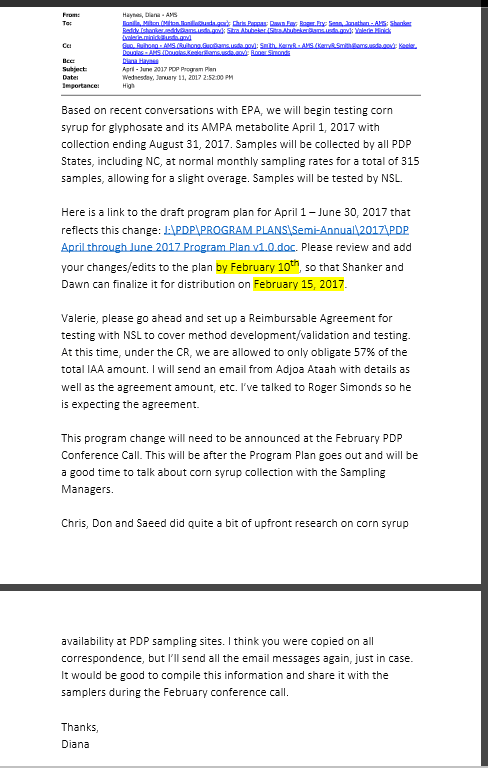
On Jan. 11, USDA's Diana Haynes, wrote to colleagues within USDA:
"Based on recent conversations with EPA, we will begin testing corn syrup for glyphosate and its AMPA metabolite April 1, 2017 with collection ending August 31, 2017. This program change will need to be announced at the February PDP Conference Call."
Haynes is director of a USDA Agricultural Marketing Service division that annually conducts the Pesticide Data Program (PDP), which tests thousands of foods for hundreds of different pesticide residues.
==
https://www.nytimes.com/2017/03/08/us/politics/sonny-perdue-georgia.html
==
https://www.washingtonpost.com/politics/trump-picks-sonny-perdue-for-agriculture-secretary/2017/01/18/
==
http://www.politico.com/tipsheets/morning-agriculture/2016/12/trumps-usda-landing-team-looks-like-its-klip-and-zip-217913
TRUMP’S USDA LANDING TEAM LOOKS LIKE IT’S ‘KLIP’ AND ZIP: USDA, the federal department that most directly serves rural America — one of the key voting blocs that propelled President-elect Donald Trump to victory — has had little contact with his landing team — the transition team’s crack crew responsible for collaborating with agency staff to ensure a smooth handoff from the Obama administration, reports Pro Ag’s Helena Bottemiller Evich. Inauguration Day is little more than a month out and yet it’s questionable whether the Trump transition has even fielded a landing team — as in a group of transition officials working together — at the federal government’s sixth-largest department, which has more than 100,000 employees.
As of Monday, one Trump transition volunteer, Brian Klippenstein, began showing up at USDA. Klippenstein, known to many as “Klip,” is executive director of Protect the Harvest, a group that advocates for safeguarding animal agriculture and was founded by oil executive Forrest Lucas (who was considered for Interior secretary early in the transition’s search process).
Before Klippenstein arrived at USDA this week, the sole person named to the landing effort was Joel Leftwich, the Senate Agriculture Committee’s Republican staff director. But Leftwich has been in limbo for weeks, as questions swirled about how involved in the transition he should be, particularly since Senate Ag will be tasked with confirming many key USDA appointments in the coming months, multiple sources told POLITICO. As a result, Leftwich hasn’t been showing up at USDA regularly, and it isn’t clear how much of a role he is playing in the transition effort. The Senate Agriculture Committee deferred questions to Trump transition officials, who did not respond to requests for comment.
At four other large federal agencies, however, the Trump transition has dispatched landing teams consisting of more than a handful of people.
==
huge # trumpistas:
| Agriculture | Joe Alexander | Special Assistant | GS-15 | 1/20/17 |
|---|---|---|---|---|
| Agriculture | David Blair | Confidential Assistant | GS-12 | 1/20/17 |
| Agriculture | Turner Bridgforth | Deputy White House Liaison | GS-12 | 1/20/17 |
| Agriculture | Nicholas Brusky | Confidential Assistant | GS-12 | 1/20/17 |
| Agriculture | Samuel Clovis | Senior White House Advisor | SES | 1/20/17 |
| Agriculture | Carly Couture | Confidential Assistant | GS-12 | 1/20/17 |
| Agriculture | Charles Crowe* | Staff Assistant | 2/13/17 | |
| Agriculture | Jody Cummins | Confidential Assistant | GS-11 | 1/20/17 |
| Agriculture | Brian Dansel | Special Assistant | GS-14 | 1/20/17 |
| Agriculture | Brock Densel | Confidential Assistant | GS-12 | 1/20/17 |
| Agriculture | George Dunlop | Special Assistant | GS-15 | 1/20/17 |
| Agriculture | Jacob French | Staff Assistant | GS-09 | 1/20/17 |
| Agriculture | Joseph Gilson | Confidential Assistant | GS-11 | 1/22/17 |
| Agriculture | Heidi Green | Senior Advisor | SES | 1/30/17 |
| Agriculture | Donald Gutman | Senior Advisor to OCFO | SES | 1/20/17 |
| Agriculture | Austin Harris | Staff Assistant | GS-09 | 1/20/17 |
| Agriculture | Bethany Hudson | Confidential Assistant | GS-11 | 1/20/17 |
| Agriculture | Kevin Jayne | Confidential Assistant | GS-13 | 1/20/17 |
| Agriculture | Dino LaVerghetta | Special Assistant | GS-15 | 1/22/17 |
| Agriculture | Russell Laird | Special Assistant | GS-15 | 1/30/17 |
| Agriculture | David Matthews | Confidential Assistant | GS-11 | 1/20/17 |
| Agriculture | Auria McAlicher* | Special Assistant | 2/1/17 | |
| Agriculture | Brenton McNeely* | White House Liaison | 2/6/17 | |
| Agriculture | Thomas Midanek | White House Liaison | GS-15 | 1/20/17 |
| Agriculture | Ella Mizrahi | Staff Assistant | GS-04 | 1/30/17 |
| Agriculture | Christopher OHagan | Confidential Assistant | GS-12 | 1/20/17 |
| Agriculture | Tim Page | Confidential Assistant | GS-12 | 1/22/17 |
| Agriculture | Cameron Quinn | Special Assistant | GS-15 | 1/30/17 |
| Agriculture | Elias Rella | Staff Assistant | GS-07 | 1/20/17 |
| Agriculture | James Renne | Special Assistant | GS-15 | 1/30/17 |
| Agriculture | Michawn Rich | Special Assistant | GS-15 | 1/30/17 |
| Agriculture | William Russell | Confidential Assistant | GS-13 | 1/25/17 |
| Agriculture | Campbell Shuford | Confidential Assistant | GS-11 | 1/20/17 |
| Agriculture | Joel Small | Staff Assistant | GS-07 | 1/20/17 |
| Agriculture | Stephen Vaden | Senior Advisor to OGC | SES | 1/22/17 |
| Agriculture | Thayer Verschoor | Special Assistant | GS-14 | 1/30/17 |
| Agriculture | Nicholas Westcott | Confidential Assistant | GS-11 | 1/30/17 |
| Agriculture | Joshua Whitehouse | Confidential Assistant | GS-13 | 1/20/17 |
| Agriculture | Robyn Whitney | Staff Assistant | GS-09 | 1/20/17 |
| Agriculture | Larry Young | Senior Advisor to the Secretary | Senior Advisor to the Secretary | Senior Advisor to the Secretary |
==
re shirley sherrod james o keefe
Number of Black Farmers in U.S. Is Growing, Thanks in Part to the New Policies at the USDA
By Sylvia A. Harvey, Yes! Magazine
By partnering with local farmers, the Department of Agriculture has begun to tackle its racist past. READ MORE»
==
rev dr
As it moves ahead with its $130 billion merger with fellow chemical giant Dow, DuPont has made quite a hire. To lead the company's "public policy and government affairs strategies," DuPont has tapped Krysta Harden, who just ended a six-plus-year stint at the US Department of Agriculture, where she served as chief of staff to Secretary Tom Vilsack and, most recently, as deputy secretary, the department's No. 2 position.
Krysta HardenDuPont
Harden's move from the USDA to DuPont is not her first whirl through the revolving door separating industries from the government watchdogs that regulate them. According to her USDA bio, she started her career on Capitol Hill, where she worked as staff director for the House subcommittee on peanuts and tobacco and as chief of staff and press secretary for former Rep. Charles Hatcher (D-Ga.), who was defeated in 1992. From there, she moved to Gordley Associates, which handles "legislative initiatives" for the American Soybean Association. The soybean-industry lobbying stint lasted until 2004. After a stretch as CEO of the National Association of Conservation Districts, Harden moved to the USDA in 2009, where she started as assistant secretary for congressional relations before working up to the No. 2 spot under chief Vilsack.
Harden is joining DuPont before the deal with Dow is fully consummated, but when it is the combined company plans to split into three independent parts, one of which will likely emerge as the globe's biggest agrichemical/seed company, bigger even than rivals Monsanto and Syngenta.
==