Omidyar Group
big gap format
==
https://www.omidyar.com/investees
roy steiner SYSTEMS
Director of Learning @OmidyarNetwork. Deputy Director @GatesFoundation Scientist by way of @MIT @Cornell. Strategist @McKinsey & CEO internet startup in Africa.
https://medium.com/@roysteiner1919
https://medium.com/@roysteiner1919
==
Roy Steiner in Positive Returns
Sep 14, 2017 · 4 min read
Systems Thinking: Trust Your Gut
For this week’s Friday Learning Note we are excited to have our first ever guest post from Rob Ricigliano, Systems and Complexity Coach for The Omidyar Group!
https://www.linkedin.com/in/robert-ricigliano-abb675b
https://medium.com/positive-returns/systems-thinking-trust-your-gut-715db4a7750?source
...
my blog post, Why Good Intentions Aren’t Enough, I talked about how the world we live in is inherently complex, with linkages that are often difficult to see and understand. This is why it’s important for leaders to incorporate a systems view when developing strategies.
There are many anecdotal stories as to why systems thinking is important for leaders, including this fun cautionary talk about cats in Borneo
Leaders who strive to make progress towards social change while applying systems thinking are part of a new culture of system leadership. These leaders can be individuals or organizations who are committed to creating the conditions for others to rise up and better the world.
During lunch with Wendy Kopp, a powerful leader who founded Teach for America, we got to talking about what we’d read recently, and she shared that she gained great insights from “:{The Dawn of System Leadership” and had read it six times.
If you haven’t yet read the piece by Peter Senge, Hal Hamilton, and John Kania, }:it’s a worthwhile article to read and revisit periodically for insight into what it takes to be a systems leader in a complex world.
Specifically, thethree leadership capabilities they outline resonate deeply with the work we do at Omidyar Network.
1. The first is the ability to see the larger system. This is the reason we are building the capacity to do system mapping and other system practices into our strategy work.
2. The second capability involves fostering reflection and more generative conversations. With the goal of creating more effective “learning infrastructure,” we have embedded into our business cycles key activities such as portfolio reviews and after action reviews that create a space for teams to engage in systematic reflection.
3. The third capability centers on shifting the collective focus from reactive problem solving to co-creating the future. Perhaps the best example of this has been our work in fostering and co-creating with others the impact investing movement that is developing new ways to direct significant capital to investments that create social good....
5 min overview sys
==
bunch of tools, incl po workbook
https://oecd-opsi.org/toolkits/systems-practice-workbook/
kumu
fail? https://docs.kumu.io/content/Workbook-012617.pdf
https://docs.kumu.io/content/Workbook-012617.pdf
rpg
https://oecd-opsi.org/toolkits/game-of-life-2050/
Game of Life 2050draws on scenarios for a sustainable European society in 2050. It is an interactive board game in which players consider four scenarios that describe the radical changes needed to be living within key environmental boundaries by 2050.
The game takes a minimum of 2 hours to run (ideally 4 hours) and involves 5-7 actors (each played by one person or in pairs) and one Games Master.
Play consists of three ‘rounds’ in which actors are given a set of circumstances that have unfolded at 10, 20 and 30 years into the timeline, and must decide from a range of options how they will respond.
Game materials and guidebook are both available for download.
https://ssir.org/articles/entry/systems_thinking_a_view_from_the_trenches
Srik Gopal, Donata Secondo, & Robin KaneMay 2, 2017
In recent years, systems thinking—a discipline that helps us understand interdependent structures of dynamic systems—has emerged as a powerful force for change in the philanthropic world. Borne out of the realization that significant and sustainable social change requires more than discrete interventions, systems thinking has become de rigueur for any foundation looking to create impact at scale. A 2016 publication on systems grantmaking by Grantmakers for Effective Organizations, as well as recent pieces by FSG, Bridgespan, and New Profit have captured this spirit, and sought to provide guidance and direction for foundations navigating this new world.
But what does systems thinking and change look like in the trenches?
The Democracy Fund, which spun off from Omidyar Network as an independent entity in 2014, provides one example. The Democracy Fund’s mission is to help ensure that the US political system can withstand new challenges and deliver on its promise to the American people. Given the complexity of this goal, we knew from the beginning that to produce the greatest impact, we needed to create strong, systems-oriented strategies that aligned with the work of others.
We “drank the Kool-Aid” on systems thinking and chose to pursue a fairly intensive approach to strategy development for three different initiatives. The core approach was causal loop mapping—a structured process of identifying different forces and dynamics in the system. This was followed by a set of activities to identify leverage opportunities (ways we could intervene) in the map, and a strategy development process that built on those opportunities. For instance, based on a causal loop map of Congressional functioning (see below), we identified leverage opportunities around improving the capacity of those who work in Congress (members and staff) and the ways Congress engages with constituents. (See more on our approach and complete maps on two of our initiatives here).
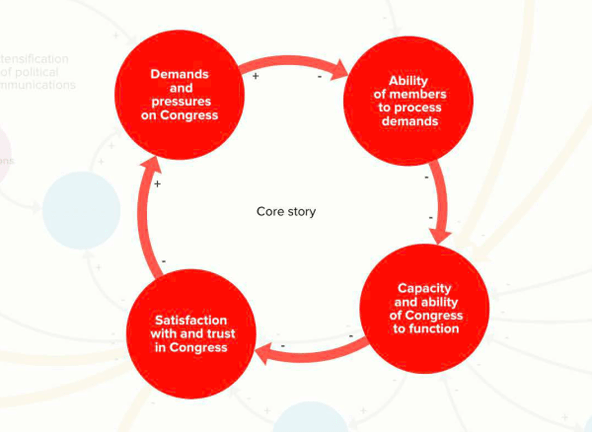
A causal loop from Democracy Fund’s Congress and Public Trust map depicts the vicious cycle of higher demand, lower capacity, and lower satisfaction. (Image courtesy of Democracy Fund)
Evaluating the process
We conducted a two-year process evaluation of these efforts and found that, overall, systems mapping and thinking provided meaningful benefits. Internally, it led to deeper insights, helped develop stronger theories of change, and created a shared language. Externally, it helped develop partnerships and led to a greater understanding of our thought process by grantees. However, systems mapping and the systems-based strategy process we used for our first three initiatives was also time-consuming, complicated, and resource-intensive.
At the start, we believed a systems-based strategy process would:
- Result in more robust strategies than may have emerged from a more traditional planning process
- Help us reach out to and cultivate a set of influential partners
- Help position the Democracy Fund as an innovative thought leader, convener, and funder
- Foster the development of the Democracy Fund as a learning organization
The following chart highlights what worked well and what could work better, based on these four intended outcomes:

Lessons
Here are four lessons based on our findings that may help others pursuing systems-based strategy:
1. Customize the process to the needs of stakeholders.
Though systems thinking can serve a variety of ends—including supporting sense-making and analysis, building new strategies, or communicating with and aligning stakeholders—any given application of the process might prioritize these objectives differently. Hence, it is important to customize the process, and adjust the pacing and sequencing accordingly. A “beginner” group, for instance, may need more orienting to the basic concepts and ideas of systems thinking, where as an “advanced” group could begin deploying tools right away. Organizational maturity is part of that. For new organizations like ours—with a start-up environment, new staff, and lack of infrastructure—the process can take significantly longer.
2. Employ an “ecosystem of tools” that serve different purposes.
Each tool in the “systems thinking toolbox” serves a different purpose; organizations must therefore deploy them with discernment and intentionality. In our case, causal-loop mapping ended up being the primary way we made sense of each system and our role in it. But although the maps helped us identify where we might focus an intervention for greater impact, they did not show us how to engage with the system nor help us identify the value we brought to the space. Other instruments, such as actor mapping, trend analysis, and landscape assessment can and should complement causal loop maps to create a more robust inquiry and stronger strategies.
3. Apply a developmental mindset to the process.
A hallmark of a process like this is that, although there is a sequence of logical steps, there is no expectation that previous steps will be “finished” before moving forward. In fact, downstream activities actually help revisit and clarify upstream ones. In our case, with the Congress map, identifying where to intervene (for example, on Congressional capacity) helped us revisit and explicate the portion of the map that dealt with capacity-related factors. Taking “two steps forward, and one step back” at times can feel frustrating. But acknowledging this dynamic on the front end can actually help alleviate the pressure to get each step in the process “perfect” and ultimately lead to stronger, more thoughtful articulations of a systemic strategy.
4. Recognize that systems thinking is organizational change.
The least acknowledged part of a systems thinking journey like the one we took is that it takes a toll on organizational culture. It can be challenging for staff—especially at an organization that has never gone through the process before—to think and act in a different way. To succeed, organizations need clear, strong leadership committed to shepherding the process and fostering the supportive environment that encourages best thinking. For us, this meant needing to keep an eye on the human experience—helping adult learners nurture curiosity, facilitating difficult conversations among stakeholders, and holding space for staff to work through differences.
Next steps
As we look back at the past couple of years of our evolution as an independent foundation, it is apparent that we have come a long way in our journey as a systems-fluent organization. Betsy Wright Hawkings, who leads our Governance program, carries a copy of the Congress systems map to meetings she has with policymakers on Capitol Hill, and reports of rapt attention to, and enthusiastic agreement about, many of the underlying political dynamics. Tom Glaisyer, who leads our work on media and journalism, has started supporting workshops on systems thinking and adaptive learning for grantee organizations in the journalism space.
In the wake of the 2016 elections, we have begun to build systems-based strategies in three areas: trust in journalism, freedom of the press, and trust in elections. Over the next few months, we will be putting these lessons to instrumental use—implementing a customized approach and using an ecosystem of tools, in a developmental way, while being mindful of our own organizational dynamics. We recognize, however, that our journey continues, and we are eager to continue to learn from our experiences and those of others in the field.
Srik Gopal (@srik) is the vice president of strategy, impact, and learning at the Democracy Fund, where he leads the organization’s efforts to be highly impactful in its mission to improve American democracy. He was previously a managing director at social impact consulting firm FSG.
Donata Secondo is the manager of learning and strategy at the Democracy Fund. She supports the organization in developing impactful, systems-based strategies and fostering an active learning culture.
Robin Kane, principal of RK Evaluation & Strategies, is a DC-based consultant with more than 25 years of experience in program planning, evaluation, policy advocacy, and strategic communications. She led the evaluation of the Democracy Fund’s systems and strategies process.
Tags
Nonprofit Management, Partnerships, Strategic Philanthropy, Strategic Planning, Systems Change
##
https://www.omidyar.com/blog/why-good-intentions-aren%E2%80%99t-enough
Why Good Intentions Aren’t Enough
May 11, 2017
Even when our goal is to create positive change, we sometimes spend a lot of resources to accomplish little or even make things worse.
The world we live in is inherently complex, with linkages that are often difficult to see and understand. This is why it is important to incorporate a systems view when developing a strategy.
In David Stroh’s book, “Systems Thinking for Social Change,” he shares the story of a program that tried to address homelessness in the United States by building more housing units. Only, it didn’t solve the problem. After significant investment, homelessness had not gotten better in the area, it had actually increased!
Homelessness is a systemic problem with many causes that are complex and interconnected. In situations like this, simple solutions that don’t take a systems view into account often result in unintended negative consequences instead of durable change.
At Omidyar Network we use a systems thinking practice as we seek to understand and influence the complex systems in which we work — systems ranging from financial services in the developing world to early childhood education in the US.
The Omidyar Group’s System and Complexity Team explains why we use a systems practice: https://vimeo.com/174541762
Democracy Fund, another organization within The Omidyar Group, also strives to incorporate systems thinking into their work. In this article, Democracy Fund President Joe Goldman explains how systems mapping can be used as a tool to understand complex problems and open us up to creative solutions. He explains that “a systems map is different than a network map that describes how different individuals or organizations are connected to one another. Instead, a systems map describes the dynamic patterns (or feedback loops) that occur in a system, whether they are vicious or virtuous cycles of behavior and reaction.”
In a previous Friday Learning Note, I shared Omidyar Network’s “Learning for Impact Cycle” which begins with strategy development. As a former management consultant I have seen my share of strategies that all too often assume the world is mechanistic and fail to appreciate interconnections that ultimately determine success. Good strategy that is system informed requires different mindsets from those we have used in the past.
In the video above, The Omidyar Group’s Systems and Complexity Teamshares four key mindsets needed to better engage with systems:
- Seek health, not “mission accomplished.”
- See patterns,not just problems.
- :{Unlock change. Don’t impose it.[find untapped]
}:
- Plan to adapt. Don’t stay the course.
Having good intentions is an important first step. At Omidyar Network we have a vision that guides us toward societal health and well being. To complement this intention, it’s important for us to learn and analyze how we can best take action to solve complex problems — and that usually requires systems thinking. As a result we have struggled with the theoretical nature of our work, and labored to translate it into a methodology that is more practical.
For those interested in gaining a deeper understanding of what we have learned so far, I highly recommend signing up for the next +Acumen course, “Systems Practice: A Practical Approach to Move from Impossible to Impact.”
9/19
https://www.plusacumen.org/courses/systems-practice
#AlwaysLearning
Roy
https://medium.com/positive-returns/learning-for-impact-cycle-b93e53f4a5e4
no lx Graf
Learning for Impact Cycle
Friday Learning Notes

Roy Steiner
Apr 27, 2017

At Omidyar Network, we operate in complex systems that are constantly evolving, and we’re making early bets on innovations. Developing learning and feedback cycles enables us to do our work better and to deliver more impact.
In our first Friday Learning Note we introduced the metaphor of cultivating an award-winning orchard as the approach we’re taking in building a learning organization. Next we are going to share how we define our Learning for Impact Cycle.

Building an effective learning cycle has nothing to do with the cycles illustrated above but everything to do with the cycle illustrated below.

The Learning for Impact Cycle has four elements:
1. Smarter Strategies — Good impact assessment depends on good strategy.

We do this by working to understand and listen to the system. A good strategy begins with trying to develop a deep understanding of the system we are engaging with, listening to the people being impacted, and clarifying the change we intend to contribute.
This involves incorporating a systems view (often with system mapping).
By identifying leverage points where you think you can make a difference in the existing system, you can develop a theory of change.
The theory of change is used to construct a results framework that identifies metrics (including an “uber metric”) for system change and the interim results leading to this change. These metrics can be monitored and reviewed regularly.
Smart strategies can be further developed by clarifying learning questions — these clearly articulate learning goals and incorporate input from a wide variety of external sources, ensuring the voices of the people we intend to serve are truly heard.
- Hypothesis-Driven Investing — Every investment is like an experiment that tests our understanding of the system and how to affect it.

Once strategies have been identified we develop compelling hypotheses about how an investment will create impact.
Integral to this step is ensuring the right metrics and data are collected that can influence decision making.
- Systematic Reflection — Reality is almost always different from what you can expect or predict. By exploring the difference between our hypothesis and what happened, we learn most effectively.

Reflection allows us to adjust and broaden our understanding of the systems we are trying to change.
- Derived Insights — Once we have reflected on our own activities, it’s critical to complement our insights with input from others. These insights then feed back into updating our strategies and the cycle repeats itself.
How could integrating a learning cycle enhance your work?
We believe that evaluation must be in the service of learning and, in turn, learning must be in service of increasing impact (not just for learning’s sake).
In my role as Omidyar Network’s senior director of learning and impact, I lead our team in supporting activities that ensure this cycle gets embedded into our processes and culture — that this becomes part of our DNA and includes everyone at our firm.
I encourage you to incorporate learning cycles into your own life. A good place to start is asking these questions:
1. How can you build your learning capacities?
2. What feedback, information, and knowledge would help you make better decisions?
3. What are the most important feedback loops for you in your organization?
Feel free to share your thoughts or questions in the comments section.
#AlwaysLearning
Roy
--
see course below
download syll
- Course:We strongly encourage (but do not require) that you form a team of 2-8 people to take the course with. It works best to find friends or coworkers who can meet in person. Need to find team members? You can post to the discussion forums a month before the course starts.
- Platform: NovoEd (+Acumen developed the course. We host this course on the NovoEd platform.)
- Timing: This course will be open for 11 weeks. You can work through the materials at your own pace during the time the course is open. There are no required times for you to log in. There will be suggested deadlines for you to complete each assignment. The final deadline is the final day of the course.
Course Syllabus
Section 1: What is Systems Practice?
Section 2: Set A Guiding Star and Near Star for Your System
Section 3: Explore Forces in Your System
Section 4: Build Loops and Discover the Deep Structure
Section 6: Find Opportunities for Leverage
Section 7: Build a Systems Strategy
| Scholarly articles for **omidyar system theory thinking** |
|---|
A positive **theory**of social entrepreneurship - Santos - Cited by 1014 … it happen: Beyond **theories**of the firm to **theories**of … - Sarasvathy - Cited by 301 Creating a culture of collaboration: The International … - Schuman - Cited by 72 |
Web results
Why Good Intentions Aren't Enough | Omidyar Network
https://www.omidyar.com/blog/why-good-intentions-aren’t-enough
May 11, 2017 - In David Stroh's book, “Systems Thinking for Social Change,” he shares ... As a result we have struggled with the theoretical nature of our work, ...
[PDF]
The Omidyar Group's Systems Practice workbook - Kumu help
https://docs.kumu.io/content/Workbook-012617.pdf
Not all challenges need a systems practice approach, so it's important to take a step back to consider the complexity of your challenge, think about the problem ...
Missing: theory | Must include: theory
Systems Practice | +Acumen
https://www.plusacumen.org/courses/systems-practice
Learn to use a systems thinking approach to move from “impossible” to impact. ... 2019; Time: 5 hours/week; Duration: 11 weeks; Partner: The Omidyar Group.
Missing: theory | Must include: theory
Systems Practice Workbook - Observatory of Public Sector Innovation ...
https://oecd-opsi.org/toolkits/systems-practice-workbook/
This workbook aims to fill the gap between the promise of a systems ... Omidyar Group ... Thinking Big: How to Use Theory of Change for Systems Change.
Systems Thinking: A View from the Trenches
https://ssir.org/articles/entry/systems_thinking_a_view_from_the_trenches
May 2, 2017 - Four lessons from one foundation's effort to put systems thinking into practice. ... The Democracy Fund, which spun off from Omidyar Network as an ... Internally, it led to deeper insights, helped develop stronger theories of ...