ufw v cedar point nursery
merri ok
---
badish code on main
bak no lnx 3 23
takings
union cement trucks?
===
1 23 no sign of aclu?
===
ufw
The Supreme Court’s ruling in Cedar Point v. ALRB makes a racist and broken farm labor system even more unequal. Farm workers are the hardest working people in America. This decision denies them the right to use their lunch breaks to freely discuss whether they want to have a union. The Supreme Court has failed to balance a farmer’s property rights with a farm worker’s human rights.
---
wapo w links
On June 23, the Supreme Court dealt a blow to organized labor. In Cedar Point Nursery v. Hassid, the court ruled that a California regulation that enabled labor organizers to meet with workers on large farms violated farm owners’ property rights. The case was brought by the owners of Cedar Point Nursery, a strawberry grower, and Fowler Packing Co., a grower and shipper of grapes and citrus. The farm owners argued that the California regulation requiring they allow labor organizers to enter their properties amounted to an unconstitutional taking of their property without just compensation, and the Supreme Court agreed. Here are four things to know about the Cedar Point Nurserydecision.
1.Cedar Point Nurseryeliminates a signature achievement of César Chávez’s United Farm Workers movement
The case deals with the constitutionality of a nearly 50-year-old California regulation enacted in the wake of César Chávez’s farmworkers’ movement, pitting the rights of property owners against the rights of workers. In the 1960s, César Chávez, Dolores Huerta and the United Farm Workers organized to combat the grueling and exploitative practices of large farm owners. The union led boycotts and strikes that prompted the state of California to pass the Agricultural Labor Relations Act of 1975.
As part of the act, California created an Agricultural Labor Relations Board. One of the board’s most significant regulations — and the one eliminated by Cedar Point Nursery— requires employers to allow labor organizers access to their property. Under the regulation, employers are required to allow union organizers to enter their property for four months each year for three nonconsecutive hours outside of the workday (one hour before the start of work, one hour during lunch break, and one hour after work). The Agricultural Labor Relations Board argued that the regulation was necessary to enable unions to organize seasonal farmworkers, who live in dispersed areas and are only present on employer property for a few weeks at a time.
Without the regulation, unions lose much of their ability to help farmworkers organize to fight employer exploitation. Farmworkers in the United States are vulnerable to some of the most egregious human rights abuses in the country, including sexual violence and harassment, child labor, wage theft, illness and death. Unions are some of the most effective tools farmworkers have for fighting abusive labor practices. But with Cedar Point Nursery, the court’s conservative majority has dealt what could be a mortal blow to their ability to organize and combat abuses by finding that employers have a “right to exclude” labor organizers from their property.
2. The court’s ruling is narrow, but it has potentially broad implications
The Fifth Amendment says the government cannot “take” private property for public use without just compensation. In Cedar Point Nursery, the Supreme Court ruled that this clause protects a “right to exclude” groups from private property. The majority was careful to carve out exemptions to its ruling. For example, the majority opinion notes that the ruling does not prohibit government health and safety inspectors from entering private property to grant benefits such as permits and licenses and does not prohibit law enforcement from entering property while in pursuit of a crime.
The result is a narrow ruling that, nevertheless, is based in logic that could later be applied to a host of government regulations of businesses.
3. The ruling could compromise anti-discrimination and fair housing laws
Legal academics like Niko Bowie of Harvard Law School point out that the Supreme Court’s reasoning could compromise anti-discrimination laws, fair housing laws and health and safety regulations of businesses. Bowie shows how White segregationists in the 1960s used the same legal reasoning the Supreme Court does in Cedar Point Nursery.
In the Supreme Court case Heart of Atlanta Motel v. United States, segregationists used the takings clause to challenge the 1964 Civil Rights Act, which prohibits businesses from discriminating on the basis of race. Segregationists contended that laws requiring them to serve Blacks amounted to a taking of their property without just compensation because these laws violated their “right to exclude.”
Justices disagreed, responding that the takings clause only applies to complete seizures of land. As other legal analysts have noted, the Roberts Court seems to contradict this Supreme Court precedent in Cedar Point Nursery, finding that even temporary intrusions on property violate the “right to exclude.”
The Supreme Court just took a case that could kill Roe v. Wade -- or let it die slowly
4. The Roberts Court’s rulings on labor echo the infamous Lochner-era decisions
Cedar Point Nursery is not the first antilabor decision to emerge from the Roberts Court. In Janus v. American Federation of State, County and Municipal Employees, the court overruled 40 years of precedent to hold that public sector unions cannot require employees to pay union dues. And in Epic Systems Corp v. Lewis, the court found that companies can use arbitration clauses in employment contracts to bar workers from suing them collectively.
Some scholars have noted that the court’s new line of reasoning is reminiscent of opinions from the early 1900s. This time period was characterized by antilabor decisions and is commonly referred to as the Lochnerera, after the infamous Supreme Court case Lochner v. New York, which struck down a New York statute that had established maximum work hours for bakers.
During the Lochnerera, the judiciary often issued hostile labor decisions like Adair v. United States, which enabled employers to blacklist members of unions, and Loewe v. Lawlor, which allowed the government to use the Sherman Antitrust Act to suppress labor boycotts. In fact, pro-labor legislation faced such a degree of animosity that labor leaders turned to state constitutions to circumvent the federal courts.
Cedar Point Nursery is consistent with these recent antilabor opinions and a sign that the court is returning to an era characterized by judicial opinions that curtailed workers’ rights.
{Erin Mayo Adam(@erinadam0*)* is an assistant professor of political science at Hunter College, City University of New York; director of the LGBTQ Policy Center at the Roosevelt House; and the author of “Queer Alliances: How Power Shapes Political Movement Formation” (Stanford University Press, 2020)*}:
---
https://slate.com/news-and-politics/2021/06/supreme-court-union-busting-cedar-point-nursery.html
no lnx
JURISPRUDENCE
The Supreme Court’s Latest Union-Busting Decision Goes Far Beyond California Farmworkers
BY MARK JOSEPH STERN
JUNE 23, 2021
In the 1960s, the United Farm Workers began demanding better pay and working conditions for California’s agricultural workers, who were subject to egregious exploitation and abuse. Led by César Chávez and Dolores Huerta, the union’s campaign culminated in the passage of the California Agricultural Labor Relations Act. Among other guarantees, this landmark law granted union organizers limited, temporary access to agricultural workplaces to speak with laborers. Businesses challenged the act as a violation of their property rights, but in 1976, the U.S. Supreme Court dismissed the case “for want of a substantial federal question.”
The Supreme Court of 2021—stacked, as it is, with six conservative Republican-appointed justices—sees things differently. On Wednesday, the court’s conservative supermajority held that California’s law violates the Fifth Amendment, which bars the taking of private property for public use “without just compensation.” Remarkably, the majority held that the law constitutes a “per se taking”—not a mere regulation, but an “appropriation” of property that flouts the owners’ “right to exclude.” The court’s 6–3 decision in Cedar Point Nursery v. Hassid is thus acrushing blow to organized labor, which often relies on workplace access to safeguard workers’ rights. It also undermines the broader legal framework that permits the government to impose all manner of regulations on private property, including workplace safety laws and nondiscrimination requirements. With Cedar Point, the Supreme Court has handed business owners a loaded gun to aim at every regulation they oppose.
Before we get to the devastating impact of Wednesday’s decision, some background: The Supreme Court has identified two types of “takings” under the Fifth Amendment, and deemed one much worse than the other. This distinction matters a great deal in Cedar Point. First, there are “per se” takings, which involve a major intrusion of private property. Historically, only the most burdensome laws—those that deprive property of “all economically beneficial or productive use” or constitute a “permanent physical occupation”—qualify as per se taking. In those situations, a property owner can automatically demand compensation or, if denied payment, block the law. Second, there are “regulatory takings,” which involve more minor restrictions on property, like zoning ordinances. It’s much harder to fight a regulatory taking in court, and even if you win, the government may have more flexibility in providing compensation.
The consequences of Roberts’ maximalist decision will be swift and severe.
For many years, Justice Antonin Scalia agitated to expand the definition of per se takings in a crusade to curb the government’s regulatory authority. He never quite succeeded—but in Cedar Point, Chief Justice John Roberts finished the job for him. Roberts’ opinion for the court deemed California’s union access law a per se taking that requires just compensation for agribusiness owners. How could that be? After all, union organizers are not on the property every day, but rather for three hours a day, 120 days a year; they do not constitute a “permanent physical occupation.” Nor do these organizers halt “all economically beneficial or productive use” of the land; most employees keep working, harvesting the produce that makes their bosses wealthy.
To get around this problem, Roberts changed the law (under the guise of applying precedent): He declared that a law that temporarily limits a property owner’s “right to exclude” qualifies as a per se taking of private property, compelling the government to pay the property owner. Any time a regulation allows third parties to “physically invade” property—even for a brief time—it “takes” that property under the Fifth Amendment, the chief justice concluded. As a result, the state must either compensate property owners or else cease its activities.
As Justice Stephen Breyer noted in dissent, this holding does not fit with Supreme Court precedent. Yes, the court has held that a temporary “physical appropriation” of property is a per se taking. But, Breyer wrote, California’s law “does not appropriate anything. It does not take from the owners a right to invade (whatever that might mean). It does not give the union organizations the right to exclude anyone. It does not give the government the right to exclude anyone.” Instead, the law merely “limits the landowners’ right to exclude certain others.” Until Wednesday, such regulations had not been deemed a per se taking. Now they will be.
The consequences of Roberts’ maximalist decision will be swift and severe. Most obviously, it will hobble unions’ ability to help California’s agricultural workers, who toil in dangerous conditions, facing the persistent threat of illness and death, for rock-bottom wages. Agribusinesses are notorious for exploiting these laborers, many of whom are immigrants who speak limited English.California’s union access rule arose out of necessity: Many farmworkers are migrants who continually move around the state in pursuit of seasonal work and lack permanent housing. They are, in short, inaccessible outside the workplace. If unions cannot speak to them at their job, they may not be able to speak to them at all.
Roberts did not explain how California could remedy the constitutional violation identified in Cedar Point, but it’s notable that the plaintiffs did not even ask for “just compensation.” Instead, they asked for an injunction excluding union organizers from their property. In theory, the state could fix the problem by compensating agribusinesses for unions’ “invasion” of their property. But how much would that cost? At oral arguments, Justice Amy Coney Barrett floated $50 per “taking”—a charge that would quickly balloon as every California agribusiness demanded payment each time a union organizer stepped on their property. And the plaintiffs suggested that businesses are owed much more. Are state lawmakers willing to cover that bill? Or will California require the unions to pay the cost? If so, might unions simply forgo farm access rather than pay out huge sums to every agribusiness they try to organize?
But the broader implications extend into nearly every corner of commercial activity in the U.S. In dissent, Breyer pointed to “the large numbers of ordinary regulations” that permit an “invasion of” private property. The government can enter a business to examine food products and inspect private schools, for example. Its agents can enter all manner of businesses to ensure compliance with run-of-the-mill health and safety laws. And it can force businesses to serve certain customers by passing civil rights measures. Are these per se takings?
To avoid answering this question, Roberts invented exceptions to Cedar Point’s new rule, including “a business generally open to the public.” As Harvard Law professor Niko Bowie wrote on Wednesday, however, the chief justice’s improvised exceptions won’t actually prevent businesses from refashioning typical regulations as a “taking.” Nondiscrimination laws “take” a club’s right to exclude women, religious minorities, and other disfavored groups. Environmental regulations “take” a landowner’s right to exclude inspectors. Fair housing laws “take” a landlord’s right to exclude Black renters.If guaranteed access to private property (including commercial businesses) is a per se “taking,” then, as Bowie put it, the government will have to start paying for what it regulates.
None of this is required by the original public meaning of the Constitution. Not even close. The Fifth Amendment’s framers understood the takings clause to apply only to direct appropriation of physical property. They carried on a long tradition, rooted in English common law and colonial practice, of authorizing entry onto private property for public purposes. The “right to exclude” that Roberts conjured in Cedar Point is not a constitutional principle but a policy judgment thinly veiled in legalese. It is the product of the conservative legal movement’s relentless demands for deregulation by judicial fiat—for a return to the era when federal courts struck down health, safety, and economic policies on the basis of their own political preferences.
The most optimistic spin on Cedar Point is that the Supreme Court will limit its reasoning to the context of unions. That, after all, is what the court did in 2018’s Janus v. AFSCME, hobbling public sector unions by creating a constitutional rule that applies to nobody else. The conservative justices’ evident hostility toward organized labor may not extend to the myriad regulations jeopardized by Cedar Point; the decision may be a ticket good for one ride only. That’s cold comfort to thousands of low-income workers who will now be subjected to even more abuse on the job. But if the court takes Cedar Point to its logical conclusion, we are entering a new era of black-robed rulers overriding lifesaving regulations put in place by representatives of the people.
===
new
pac leg no lnx
Supreme Court affirms property rights for California fruit growers
Cedar Point Nursery v. Hassid
Won: U.S. Supreme Court affirms right to exclude trespassers from your property
In the early morning hours in fall 2015—during Northern California’s frenetic harvest season—Cedar Point Nursery was at full staff. Five hundred employees were hard at work in trim sheds, tending to the strawberry plants that would soon ship to growers throughout the country.
They were suddenly shocked when a crowd burst through the doors and made their way through the building, barking through bullhorns that the workers needed to join the UFW. Some workers were so scared and intimidated that they left the property, but most stayed on the job, uninterested in union membership.
Union organizers invade Cedar Point’s property and disrupt business operations. Footage captured by employees.
Similarly, for three straight days, UFW organizers tried to storm Fresno-based Fowler Packing Company, one of the nation’s largest growers of table grapes and citrus. Its 2,500 employees and their families already enjoy workplace perks typically promised by labor unions: safe and immaculate facilities, free health care with an on-site health clinic, and free meals any time of the day at an on-site cafeteria.
Mike Fahner, owner of Cedar Point Nursery, similarly treats his employees well, with many of them staying for twenty years or longer. Seasonal workers keep coming back to Cedar Point year after year. With little demand from his staff in joining the union, he consulted with the police and an attorney to stop the harassment of his business and was stunned to discover that the union’s property invasion was legally authorized under California law.
A state regulation requires all of California’s agricultural employers to allow such trespassing by union organizers. The California Agricultural Labor Relations Board created its so-called Union Access Regulation in 1975 so union officials can spend up to three hours a day, 120 days a year trying to recruit new union members—on their employers’ turf. Mike wondered how anyone could manage a business with the possibility of such severe disruptions hanging over them.
The regulation is a hold-over from the days when farm workers had little access to media or other means of communications and often lived on their employers’ property during busy times of the season. These days, seasonal workers stay at nearby hotels. And most workers have access to hundreds of Spanish-speaking radio stations and other media outlets, cell phones and smartphones, and the internet. Nevertheless, the board insists its regulation is still necessary to reach these employees.
Unions, however, have no special right to invade private property and disrupt commercial operations, and property owners have a fundamental right to exclude trespassers. Government can’t make a regulation violating that right even if it limits the hours when it applies.
Represented by PLF free of charge, the owners of Cedar Point Nursery and Fowler Packing Company asked the U.S. Supreme Court to invalidate California’s unlawful union access regulation.
WHAT’S AT STAKE?
The Constitution forbids government from requiring you to allow unwanted strangers onto your property. And union activists are no exception. California’s regulation that allows them to do so violates property owners’ fundamental right to exclude trespassers.
CASE TIMELINE
September 01, 2021
Final Stipulated Judgment After Remand
United States Supreme Court
June 23, 2021
Opinion
United States Supreme Court
March 05, 2021
Reply Brief for Petitioners
United States Supreme Court
January 07, 2021
Center for Constitutional Jurisprudence Amicus Brief on the Merits in Support of Petitioners
United States Supreme Court
January 07, 2021
States’ Amicus Brief on the Merits in Support of Petitioners
United States Supreme Court
LOAD MORE
FOR MEDIA INQUIRES:
Kate Pomeroy
MEDIA DIRECTOR
Attorneys
Joshua P. Thompson - Director of Equality and Opportunity Litigation
DIRECTOR OF EQUALITY AND OPPORTUNITY LITIGATION
Chris Kieser - Attorney
ATTORNEY
Damien M. Schiff - Senior Attorney
SENIOR ATTORNEY
---
CASE TIMELINE
September 01, 2021
Final Stipulated Judgment After Remand
United States Supreme Court
June 23, 2021
Opinion
United States Supreme Court
March 05, 2021
Reply Brief for Petitioners
United States Supreme Court
January 07, 2021
Center for Constitutional Jurisprudence Amicus Brief on the Merits in Support of Petitioners
United States Supreme Court
January 07, 2021
States’ Amicus Brief on the Merits in Support of Petitioners
United States Supreme Court
January 07, 2021
The Buckeye Institute’s Amicus Brief on the Merits in Support of Petitioners
United States Supreme Court
January 07, 2021
The Liberty Justice Center's Amicus Brief on the Merits in Support of Petitioners
United States Supreme Court
January 07, 2021
US Chamber of Commerce’s Amicus Brief on the Merits in Support of Petitioners
United States Supreme Court
January 07, 2021
USA AC Merits Brief ISO of Reversal
United States Supreme Court
January 06, 2021
Americans for Prosperity Foundation’s Amicus Brief on the Merits in Support of Petitioners
United States Supreme Court
January 06, 2021
California Farm Bureau Federation’s Amicus Brief on the Merits in Support of Petitioners
United States Supreme Court
January 06, 2021
Mountain States Legal Foundation’s Amicus Brief on the Merits in Support of Petitioners
United States Supreme Court
January 06, 2021
New England Legal Foundation’s Amicus Brief on the Merits in Support of Petitioners
United States Supreme Court
January 06, 2021
Western Growers Association, et al.’s Amicus Brief on the Merits in Support of Petitioners
United States Supreme Court
December 31, 2020
PLF Opening Merits Brief
United States Supreme Court
December 31, 2020
The Cato Institute AC Merits Brief on the Merits in Support of Petitioners
United States Supreme Court
December 30, 2020
Pelican Institute AC Merits Brief on the Merits in Support of Petitioners
United States Supreme Court
September 02, 2020
American Farm Bureau Federation Amicus Brief on the Merits in Support of Petitioners
United States Supreme Court
September 02, 2020
Cato Institute Amicus Brief on the Merits in Support of Petitioners
United States Supreme Court
September 02, 2020
Institute for Justice's Amicus Brief on the Merits in Support of Petitioners
United States Supreme Court
September 02, 2020
Mountain State Legal Foundation Amicus Brief on the Merits in Support of Petitioners
United States Supreme Court
August 31, 2020
Pelican Institute's Amicus Brief on the Merits in Support of Petitioners
United States Supreme Court
August 27, 2020
California Farm Bureau Federation Amicus Brief on the Merits in Support of Petitioners
United States Supreme Court
July 29, 2020
Cedar-Point-Nursery-v.-Shiroma-Petition-for-a-Writ-of-Certiorari
Question Presented
California law forces agricultural businesses to allow labor organizers onto their property three times a day for 120 days each year. The regulation provides no mechanism for compensation. A divided panel below held that, although the regulation takes an uncompensated easement, it does not effect a per se physical taking of private property because it does not allow “24 hours a day, 365 days a year” occupation. As an eight-judge dissent from denial of rehearing en banc noted, the panel “decision not only contradicts Supreme Court precedent but also causes a conflict split.” The question presented is whether the uncompensated appropriation of an easement that is limited in time effects a per se physical taking under the Fifth Amendment.
Petitioners are: Cedar Point Nursery and Fowler Packing Company, Inc. Respondents are: Victoria Hassid, in her official capacity as Chair of the Agricultural Labor Relations Board; Santiago Avila-Gomez, in his official capacity as Executive Secretary of the Agricultural Labor Relations Board; and Isadore Hall III, in his official capacity as Board Member of the Agricultural Labor Relations Board. Pursuant to Rule 35(3), Chair Hassid is substituted for former Chair Genevieve Shiroma, who was a Respondent below. Corporate Disclosure Statement Cedar Point Nursery and Fowler Packing Company, Inc., have no parent corporations and no publicly held company owns 10% or more of the stock of either business.
...
The En Banc Vote ......................................... 10 C. Basic Legal Framework .................................. 11 1. Easements in Gross ...................................... 11 2. Takings Background ..................................... 12 Reasons for Granting the Petition ........................... 13 I. Certiorari Should Be Granted to Resolve a Conflict Between the Courts of Appeals ......... 13 II. Certiorari Should Be Granted Because the Decision Below Undermines This Court’s Precedents and Sows Confusion in Takings Law ................................................ 17 A. The Ninth Circuit’s Refusal to Treat the Access Regulation as a Per Se Physical Taking Contradicts and Confuses This Court’s Precedents ................ 19 B.
The Ninth Circuit’s Decision Disregarded This Court’s Traditional Respect for the Right to Exclude ........................................... 25 III.
Certiorari Should Be Granted Because This Case Presents a Clean Vehicle to Address an Issue of Nationwide Importance ................ 27
Conclusion ................................................................. 31
...
p 13
Loretto v. Teleprompter Manhattan CATV Corp., 458 U.S. 419, 426 (1982).
One of these serious invasions of property rights is a physical taking, “where government requires an owner to suffer a permanent physical invasion of her property—however minor.” Lingle v. Chevron U.S.A., 544 U.S. 528, 538 (2005). Categorical treatment is also appropriate where a regulatory use restriction “completely deprive[s] an owner of ‘all economically beneficial us[e]’ of her property.” Id. at 538 (quoting Lucas v. S.C. Coastal Council, 505 U.S. 1003, 1019 (1992)).
This case involves the first category—physical invasions— which, unlike regulatory use restrictions, are not subject to Penn Central’s multifactor test. Instead, physical takings—however small—require compensation. This petition directly presents the question of whether the appropriation of an easement, permanent in duration but limited in time, effects a per se physical taking. Reasons for Granting the Petition I. Certiorari Should Be Granted to Resolve a Conflict Between the Courts of Appeals The panel opinion below created a clear circuit split. The Ninth Circuit’s opinion conflicts directly with the Federal Circuit’s decision in Hendler v. United States, 952 F.2d 1364 (Fed Cir. 1991), on the dispositive issue of whether a continual, but timelimited easement qualifies as a “permanent” physical ...
Cases like Knick will continue to test the boundaries of the government’s obligation to compensate property owners for a taking of the right to exclude. Granting this petition would forestall the inevitable confusion among the lower courts and give this Court the opportunity to state a clear rule. II. Certiorari Should Be Granted Because the Decision Below Undermines This Court’s Precedents and Sows Confusion in Takings Law Apart from opening a circuit split, the decision below threatens to undermine this Court’s physical takings precedents. At the core of the Takings Clause is the requirement that the government pay just compensation when it physically takes possession of
...
A. The Ninth Circuit’s Refusal to Treat the Access Regulation as a Per Se Physical Taking Contradicts and Confuses This Court’s Precedents
The panel erred by limiting the physical takings doctrine to only those appropriated easements that permit access to private property all day, every day. Perhaps most fundamentally, the panel decision treats the appropriation of time-limited easements as mere regulatory use restrictions. But see Nollan, 483 U.S. at 831 (“To say that the appropriation of a public easement across a landowner’s premises does not constitute the taking of a property interest but rather . . . ‘a mere restriction on its use,’ is to use words in a manner that deprives them of all their ordinary
...
B. The Ninth Circuit’s Decision Disregarded This Court’s Traditional Respect for the Right to Exclude
The Ninth Circuit’s failure to apply the physical takings doctrine in this case represents a significant departure from this Court’s traditional respect for the fundamental right to exclude trespassers from private property. Far from being merely one “strand” of property rights subject to regulation, the denial of the right to exclude is the quintessential element that triggers application of the physical takings doctrine. The Court in Kaiser Aetna declared the right to exclude “a fundamental element of the property right” that “the Government cannot take without compensation.” 444 U.S. at 179–80. Nollan likewise relied on the primacy of the right to exclude to conclude that California could not appropriate a public beach access easement without compensation. 483 U.S. at 831. “[A]s to property reserved by its owner for private use,” the Nollan Court declared, “the right to exclude [others is] ‘one of the most essential sticks in the bundle of rights that are commonly characterized as property.’” Id. (quoting Loretto, 458 U.S. at 433). By rejecting per se treatment because “the sole property right affected by the regulation is the right to exclude,” Pet. App. A-18, the Ninth Circuit’s decision significantly discounted this Court’s precedents. There is no support for the Ninth Circuit’s demotion of such a fundamental aspect of property ownership.8
...
---
United States Supreme Court
June 29, 2016
Decision Memorandum
February 10, 2016
Complaint
February 10, 2016
Motion for Preliminary Injunction
COLLAPSE
---
RELATED CASES
Beachfront
Government reneges on building permit, unlawfully strips property rights
MIKE BORDELON AND BREEZY SHORES, LLC V. BALDWIN COUNTY
California man protect his houseboat and his rights
California man fights government overreach to protect his houseboat and his rights
DANIEL KNIGHT V. RICHARDSON BAY REGIONAL AUTHORITY
Row homes along the Royal Street in the French Quarter
Fighting for timely just compensation for government-damaged property
ARIYAN INC. V. SEWERAGE & WATER BOARD OF NEW ORLEANS
Serene Virginia farm nestled amidst rolling hills and lush green fields
Hunters’ ‘right to retrieve’ tramples property owners’ right to exclude trespassers
MEDEIROS V. VIRGINIA DEPARTMENT OF WILDLIFE RESOURCES
Relaxing massage experience with a cozy massage table
Local government wields unannounced, warrantless search power over private businesses and home practitioners
VONDRA V. CITY OF BILLINGS
Constitutional Rights of public workers
California law keeps workers ignorant of their constitutional rights
JACKSON V. NAPOLITANO
contractor
Bulldozing unfair, illegal union-rigged construction scheme
MINNESOTA ASSOC. BUILDERS AND CONTRACTORS V. MINNEAPOLIS PUBLIC SCHOOL DISTRICT
:{:{---}:
new
prn newswire BS
NEWS PROVIDED BY
Fowler Packing Company, Inc.; Gerawan Farming, Inc.
05 Apr, 2016, 01:43 ET
SHARE THIS ARTICLE
- - - - - -
---
:{:{FRESNO, Calif., April 5, 2016 /PRNewswire/}:
-- Fowler Packing Company, Inc. and Gerawan Farming, Inc. announce that on Friday, April 1, 2016, seven leading California grower associations asked the U.S. District Court for the Eastern District of California to strike down provisions of newly-enacted legislation (AB 1513) that excludes Fowler Packing Company, Inc. and Gerawan Farming, Inc. from protections intended to benefit all farmers and their workers.}:
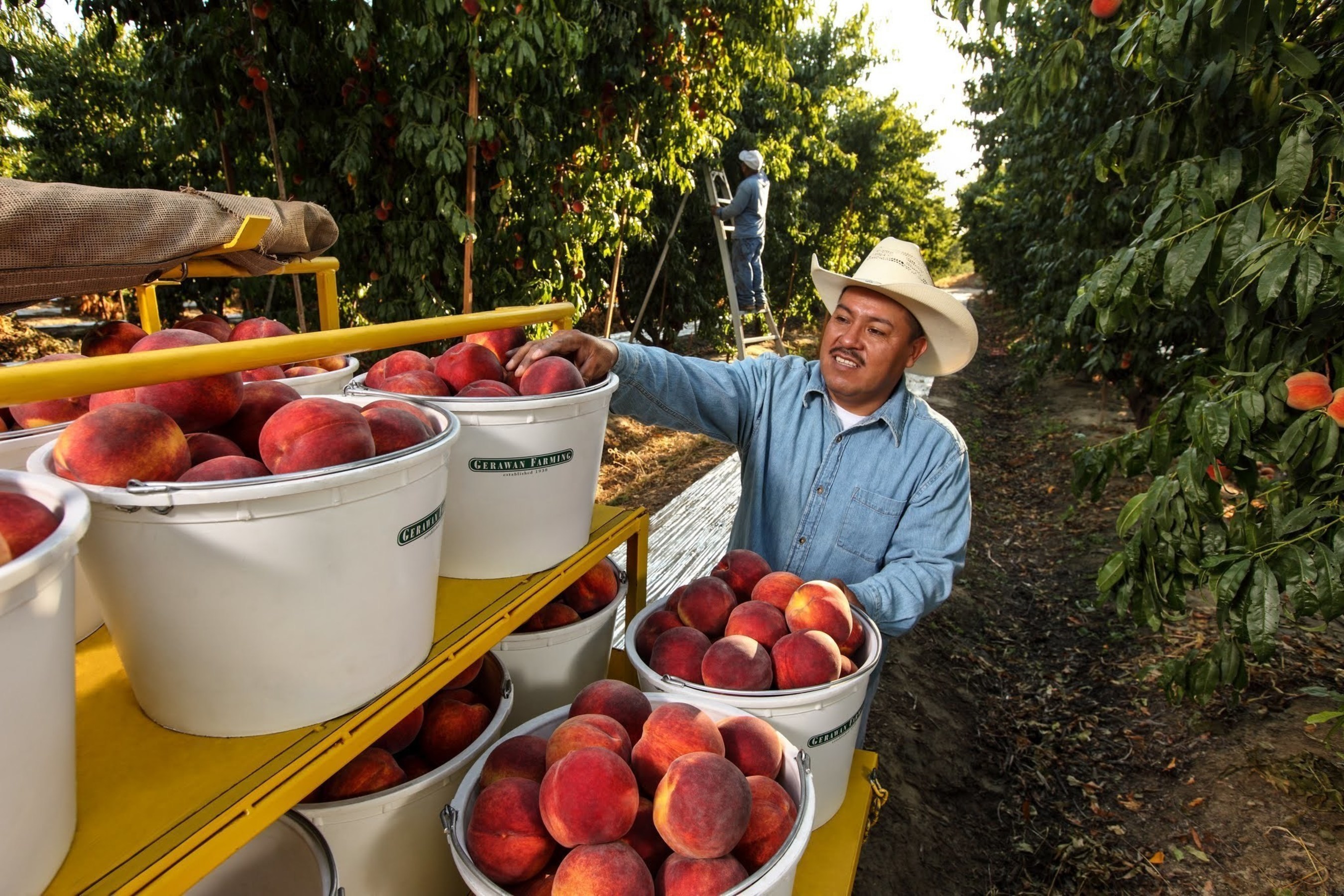
Peach harvest at Gerawan Farming (Fresno, California)

Fruit packing at Fowler Packing (Fresno, California)
AB 1513 provides to an entire class of California employers – but not Fowler and Gerawan – an affirmative defense to potentially ruinous class action litigation involving "non-productive time" wage and hour claims. But it also provides a means to resolve these cases so as to provide larger and more timely back pay recoveries for workers than could be expected through litigation. Fowler and Gerawan were "carved out" of this statute at the behest of the United Farm Workers (UFW) with the effect, if not the intent, of punishing Fowler and Gerawan.
In an amicus brief filed on Friday by the Pacific Legal Foundation (PLF), these seven grower organizations argue that AB 1513's "carve outs" constitute legislative punishment and violate the U.S. Constitution's Bill of Attainder Clause.
The "friend of the court" brief was filed Western Growers, California Fresh Fruit Association, the National Hmong-American Farmers, the African-American Farmers of California, California Farm Bureau Federation, the Fresno County Farm Bureau, and the Nisei Farmers League.
Tom Nassif, president and CEO of Western Growers, stated that "it is unseemly and shameful that the legislature allowed the UFW to demand provisions that carve out two farm employers from a law that was otherwise thoughtfully crafted to get money to thousands of farm workers quickly and without subjecting employers to predatory class action lawsuits." Barry Bedwell, president of California Fresh Fruit Association, echoed these concerns: "In fact and in practice, these employers are exemplary in their relationships and interactions with employees, and they and their workers deserve the same opportunities this legislation affords to others."
"We appreciate that this state-wide coalition of growers recognizes the injustice of AB 1513 and stands with us to oppose this law," said Dennis Parnagian, president of Fowler Packing.
In brief filed on April 4, Fowler and Gerawan argued that AB 1513 also violates the Equal Protection Clause of the U.S. Constitution. "When the Legislature justified throwing Fowler and Gerawan under the bus to avoid 'blowing up' a 'grand compromise,' it passed a law that was designed to punish these companies and their workers," said their counsel, David A. Schwarz of Irell & Manella LLP.
"We appreciate in particular that three minority farmers' rights organizations have lent their voice to this challenge," said Dan Gerawan, co-owner of Gerawan Farming. "Their members understand from first-hand experience the importance of the U.S. Constitution's promise of 'equal protection under the laws.'"
The amici are represented by Damien Schiff and Wencong Fa of Sacramento, California-based PLF, the oldest and most successful public interest legal organization dedicated to the defense of individual rights, property rights, and limited government.
The case is Fowler Packing Company, Inc., et al. v. David M. Lanier, et al., Case No. 1:16-cv-00106-AWI-SMS (E.D. Cal.).
Attached:
- Amicus Brief of Pacific Legal Foundation
- Fowler and Gerawan's Opposition to Defendants' Motion to Dismiss
Photo - http://photos.prnewswire.com/prnh/20160405/351684
Photo - http://photos.prnewswire.com/prnh/20160405/351685
SOURCE Fowler Packing Company, Inc.; Gerawan Farming, Inc.
---
https://www.facebook.com/AAFCalifornia/
no info seems semi legit, tho grifters post on it?
fresno
---
new
cthouse news service in cahoots
ELIZABETH WARMERDAM / January 26, 2016
 FRESNO, Calif. (CN) - Two California farm businesses were intentionally excluded from benefits of a state law to punish them for their labor disputes with the United Farm Workers, the growers claim in Federal Court.
Gerawan Farming and Fowler Packing Co. sued the state on Friday, claiming that exemptions in Assembly Bill 1513violate their rights to equal protection. The United Farm Workers is not a party to the case.
David Schwarz, attorney for Gerawan and Fowler, told Courthouse News the intent of the legislation "was to carve out and punish two growers targeted by the UFW."
"The effect is to deprive their employees of the benefits promised to other farmworkers in this state. All of this was done at the behest of a politically influential union as the price of their support of this bill," Schwarz said.
AB 1513 was signed into law on Oct. 10, 2015, and took effect on Jan. 1. The bill essentially rewrote the rules governing payment of piece-rate compensation in California.
It requires employees to be paid for rest and recovery periods and other nonproductive time at or above specified minimum hourly rates, separately from any piece-rate compensation.
The law, written by Assemblyman Das Williams, D-Santa Barbara, is intended to ensure that employees who get paid by the mile driven, by the piece produced, or by the fruit piece picked have paid meal and rest periods.
The law includes a safe harbor provision for employers who could face liability for not properly paying their piece-rate workers for recovery and rest periods in the past. Employers have a grace period in which to pay back wages to workers for nonproductive time. In return, they will be protected from lawsuits for past failure to pay, potentially sparing them from far higher penalties.
Although most growers can take advantage of the safe harbor provision, Gerawan and Fowler say they were intentionally carved out of the legislation.
"The ostensible purpose of AB 1513 was to insure that workers were 'made whole' promptly and to cause the resolution of pending wage and hour class actions by minimizing the risk of crippling penalty judgments caused by these litigations. As enacted, AB 1513 deliberately excluded Fowler and Gerawan," the complaint states.
The two Fresno County growers say they are defending themselves in class actions based on nonproductive time wage and hour claims, but are not allowed to apply for the law's so-called "Penalty Relief Plan," like other growers in the state.
"In essence, the Legislature created an amnesty program for an entire class of California employers facing wage and hour class action suits, except for Fowler and Gerawan," the complaint states.
The targeting was not accidental, the growers say, as several carve-out dates in the legislation single out Gerawan and Fowler.
For example, the safe harbor does not apply to any nonproductive wage and hour claim that was asserted in court before March 1, 2014 - which excludes Gerawan, because it was sued by the UFW about three weeks before that cutoff date.
The legislation "was reverse-engineered via a last minute legislative 'gut and amend' designed to punish Fowler and Gerawan. The targeting was in response to demands by the United Farm Workers of America that these growers be excluded from AB 1513's 'safe harbor' provisions as the price for the UFW's non-opposition to this legislation," according to the complaint.
The UFW has been in a longstanding feud with Gerawan over unionization and has had a series of labor disputes with Fowler Packing. An attorney for the union is among the attorneys listed on class action lawsuitsfiled against both growers.
"While the UFW now publicly claims credit for the passage of AB 1513, it does not mention its role in carving out Fowler and Gerawan - and their employees - from the legislation, or the reasons behind its demand that these two growers be singled out for special punishment," the growers say.
They claim that Assemblyman Williams acknowledged that excluding them from the bill's protection "was part of a 'pact' to keep the UFW from opposing the measure."
Purposefully targeting them for punishment also puts their employees at a disadvantage by stripping them of the benefits of the law, the growers say.
"Unlike workers who might obtain prompt payment of back wages by employers who opt for the protections afforded under AB 1513's amnesty program, the workers represented by UFW's general counsel in these class actions obtain no protection as a result of this 'pact' between the UFW and the Legislature," the complaint states.
Assemblyman Jim Patterson, R-Fresno, said that AB 1513 "was passed under the cover of darkness and in the final hours of session without any discussion and we all know why. It was rammed through to hide the fact that Fowler Packing, Gerawan Farming and other companies were unfairly targeted by the UFW and their cronies in the Legislature."
Patterson said the bill "shredded the constitutional guarantee of equal protection under law and was passed by the legislators who swore to protect that sacred right. It is another example of the consequences of dictatorial, one-party rule."
Gerawan and Fowler declaratory judgment that the provisions exempting them from the benefits of the law are unconstitutional, and a permanent injunction against enforcement.
Assemblyman Williams did not immediately respond to a request for comment Monday. Nor did the UFW or the state's labor agencies.
---
new}:
12 2015
IRS scandal in the headlines for several years revealed the Internal Revenue Service developed a scheme to prosecute conservatives who publicly oppose President Obama’s policies.
California Gov. Jerry Brown and his legislative Democrats have just accomplished a similar scheme with the passage of a bill targeting two large agriculture businesses, which dared to challenge the illegal stranglehold on Brown’s appointed Agriculture Labor Relations Board by the waning United Farm Workers labor union.

Fowler Packing Company
Family owned and operated Fowler Packing Company and Gerawan Farming are targets of Assembly Bill 1513, which unfairly carves-out the two employers who have long been targeted for UFW unionizing efforts, from the limited safe harbor provisions in the recently passed and signed bill.
Both large employers and growers, Fowler Packing grows peaches, nectarines, plums and mandarins, and Gerawan grows nectarines, peaches and grapes.
Wag the Dog
Gov. Brown signed a bill into law October 10 rewriting the definition of labor rules governing piece-rate compensation in California. But, unsurprisingly, the bill extracts a very high price from employers to benefit unions and, unfairly carves-out the two employers that are targets of UFW unionizing efforts.
“The process from the beginning stunk to high heaven,” said Assemblyman Jim Patterson, R-Fresno. “This does lay open the dirty politics that can be put together with the ALRB, UFW and politicians.”
“This is what a Banana Republic looks like,” Patterson said. “If they can do it to Fowler Packing and Gerawan Farming, they can do it to anybody.”
“This Machiavellian, utterly dishonest and punitive carve out could not have happened had this not been the end of legislative session,” Patterson explained. “What is missing is a criminal complaint in this case. This is and was a criminal conspiracy. Perhaps as time goes by, a court case will be so glaring, law enforcement will look at the potential,” Patterson said.
AB 1513, authored by Assemblyman Das Williams, D-Santa Barbara, never was heard in a legislative committee; it was a gut and amend bill done at the very end of the legislative session, in order to avoid public legislative committee hearings. “If ever there was a piece of legislation that should put some members of the Legislature in prison, this is it,” Patterson said. “If you peel open this rats nest, you will see the conspiracy: Huge campaign contributions… huge amounts of money flowing to lawmakers who voted for it… all willing to vote for excising out the Parnagians (of Fowler), and Gerawan,” Patterson said. “And quite frankly, the governor knew it when he signed it,” Patterson added. “This is more evidence of what one-party dictatorship looks like: fear, conspiracy, the use of law making against one’s political enemies.”
“It’s shameful,” Patterson said. “Many have crossed the line.”
Icing on the UFW Cake
Anyone who doesn’t know of this unholy liaison between the ALRB and the UFW might think the United Farm Workers labor union has an angel in the governor’s office, because nothing other than divine intervention – or criminal conspiracy – could explain the wanton gifts the labor union has received from California Gov. Jerry Brown by way of the Legislature.
AB 1513 creates the new California Labor Code section 226.2, setting forth requirements for payment of a separate hourly rate for “non-productive” time, i.e., rest and recovery breaks documented by piece-rate employees. The new law, which applies to all employees compensated on a piece-rate basis, becomes effective January 1, 2016.

Gerawan Farming
Piece-rate work is paid for according to the number of units or products completed or produced. Piece rate plans may be determined by one individual’s work, or can also include a group of employees who share compensation based upon group completion of required tasks or products.
The bill, born out of two class action lawsuits, Gonzalez v. Downtown LA Motors and Bluford v. Safeway, allows employers to come into compliance with non-productive time pay requirements in exchange for liability protection from related wage claims. However, AB 1513 discriminated against specific companies where an active non-productive time wage lawsuit was filed as of March 1, 2014, and/or for which an active suit alleges the adding of “ghost” employees to reduce wages.
Prior to AB 1513 being introduced, Downtown LA Motors and Safeway, involved in class action lawsuits for non-productive time payment, entered into a negotiation with California labor organizations to develop safe harbor protections to limit their exposure for non-productive time payment while offering a formula for paying back pay.
Illegal Carve-Out
Never before has legislation specifically targeted two businesses the way AB 1513 does. AB 1513 illegally carves out Gerawan Farming, and Fowler Packing from the safe harbor protections. The exclusion of Gerawan and Fowler was based on a specific carve out was the direct result of labor permitting the involvement of the UFW in the negotiations. All other employers may take advantage of the safe-harbor liability protection from penalties from unpaid wages.
Never before has any legislation excised out private businesses for exclusion of legal protections.
Gov. Ignores Farm Workers

Assemblyman Jim Patterson
While Gov. Jerry Brown has ignored thousands of California farm workers who don’t want to be unionized by the UFW, he recently authorized gifting the financially floundering UFW labor union $3 million each year for the next five years toward their Obamacare health plan.
There are nearly one million farm and agricultural workers in California, yet the United Farm Workers labor union represents less than 4,000 of them. Still, Jerry Brown continues to help the UFW limp along, assisting the union to terrorize well-run, law-abiding, decent farming businesses with countless lawsuits, and harassing them with unreasonable and illegal demands.
Assemblyman Patterson said the creation of AB 1513 was conspiratorial because a “group of individuals got together, and then put together a bill they knew was unconstitutional, because the labor union demanded if they did not, no one would get protections.”
“And a lot of other interests in the state – who, if this happened to them, would have righteous indignation – rolled over, said nothing, and got the benefit of the bill,” Patterson said. “The fundamental operation of Sacramento, and one-party rule, is fear. This is the reason this bill looks the way it does – political fear.”
He added, “The only way for justice is that this Constitutional conspiracy is brought out in a court of law.”
Tags: Agricultural Labor Relations Board, ALRB, Assembly Bill 1513, Assemblyman Das Williams, Assemblyman Jim Patterson, Bluford v. Safeway, California, California Labor Code section 226.2, California Legislature, Democrats, Fowler Packing Company, Gerawan Farming, Gonzalez v. Downtown LA Motors, Government, Jerry Brown, jobs, Katy Grimes, labor unions, Legislature, Parnagian, regulations, Republicans, Sacramento, safe harbor provisions, UFW, Unions, United Farm Workers labor union
BS katy grimes
this is the second part in a series; Part l is here.
California businesses are being targeted for retribution through a bill passed by the Legislature and signed into law by Gov. Brown October 10, rewriting the definition of the labor rules governing piece-rate compensation in California.
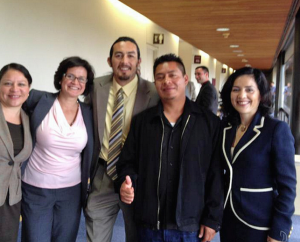
ALRB attorney Jessica Arciniega, ALRB Regional Director Alegria de la Cruz, and ALRB General Counsel Sylvia Torres-Guillén, UFW attorney Mario Martinez and a UFW organizer
Assembly Bill 1513 unfairly singles out two of the largest fruit growers in the San Joaquin Valley, for discriminatory treatment, based on demands that these two companies be excluded from protection under the bill’s affirmative defense. Both companies are targets of United Farm Workers unionizing efforts.
It is however, a violation of the U.S. Constitution to single out members of a group so as to inflict punishment on them without a judicial trial (United States v. Lovett).
Fowler Packing Company and Gerawan Farming are the victims of an injustice done at the behest of the UFW. Both companies have been sued by attorney Mario Martinez — the same attorney who is the General Counsel of the UFW — the union which had undo influence over this legislation.
The UFW is dwindling in numbers, down to about 3,300 members from a high of 50,000, and desperately needs members – voluntary or not.
The Legislation
AB 1513, by Assemblyman Das Williams, D-Santa Barbara, a gut-and-amend bill, originated as a legislative solution to a legislatively created labor issue, throwing many large businesses into class-action lawsuits over piece-rate pay, and nonproductive work time pay.
The bill creates an affirmative defense and a limited “safe harbor” for employers who agree to pay current and former employees back payment for unpaid and/or underpaid rest and recovery periods known as “nonproductive” time. The legislation specifies that the “safe harbor” would protect employers from any claim or cause of action.
And, going way beyond the class-action lawsuit, which precipitated this bill, it also requires employers who use piece-rate compensation to pay workers separately for rest and recovery periods and for “non-productive” time, at least the minimum wage.
The other legally sketchy area of the bill was a provision added late in the gut-and-amend process, at the insistence of the United Farm Workers labor union, which targets the two companies as retribution. The provision prevents the companies from accessing the safe harbor protection from class action litigation due to unproven allegations in an unrelated wage and hour case, and as retribution for employees’ efforts to oust the UFW.
Fowler and Gerawan
Targeted for unionization by the UFW, Fowler Packing Company in Fresno, is a family farming business established in 1950 by Sam Parnagian. Sam’s sons and adult grandchildren now run the business. “Fowler Packing is one of the largest shippers in the fresh produce business, handling over 7 million boxes of stone fruit and table grapes, and 15 million boxes of citrus per year,” the company website reports. Fowler has 400 full-time workers and 2500 seasonal workers, most of whom are employed at least 10 to 12 months a year, and farms about 10,000 acres – which is why they’ve been a target for unionization by the UFW.
“They should be the largest union in California, if they are that great,” Dennis Parnagian said in an interview. Parnagian said Fowler employees have very good working conditions, and are treated like family. Parnagian’s company provides meals for every Fowler employee twice each day, with a fully staffed kitchen and diner on premises, among other perks.
Farm employees from Gerawan Farming have been trying to get the UFW out of their workplace since October 2012. Desperate for new members, the UFW reappeared out of the blue after doing nothing since 1990 when they won an election to unionize Gerawan’s employees, but never negotiated a collective bargaining agreement. In 2012, they reappeared to impose a contract on Gerawan Farming and its 3,000-5,000 employees.
This incited the workers, who describe their working conditions as optimum. Gerawan farming pays the industry’s high wages and benefits, including retirement, vacation pay, and even the tuition for the workers’ children at the local Catholic St. La Salle School.
“Once a contract is imposed on our workers, it will double or even triple the size of the UFW’s current membership,” Dan Gerawan explained in 2013; he’s the president of Gerawan Farming, a family-owned and operated business located in in Reedley since 1938. “So, more than half of the UFW’s membership will never have been given the opportunity to express whether they even want the UFW to represent them.” Gerawan Farming is the nation’s largest grower of peaches, plums, and nectarines, and among the leaders in table grapes, and packs under the Prima label.
Legislative Technicality
AB 1513 contains provisions that unfairly exclude participation by these specific agricultural employers. Safe-harbor exclusions, as expressly inserted by use of the March 1, 2014 date in late-added amendments, sacrifices Gerawan to continued legal exposure in exchange for legal protections afforded to others. Another amendment added a provision excluding any company for which an active claim is open alleging the adding of “ghost” employees to reduce or eliminate employee wages from use of payment calculation formulas and exposure protections afforded by AB 1513. This amendment was aimed directly at Fowler Packing.
Ghost Workers
Parnagian explained that when Fowler is working many crews at a time, a crew boss is assigned to each. The crew is paid as a whole by the number of bins they pick. In February 2014, Fowler received a tip through the company’s anonymous tip hotline, that a crew boss had added “ghost workers” who don’t exist. Fowler immediately dispatched its Human Resources and Quality Control employees into the field to investigate. Within the week they found the crew boss, who admitted to adding the ghost workers, who then pocketed their checks himself. Parnagian said the crew boss claimed he’d only been at his scheme for three weeks. He was however, terminated on the spot.
Parnagian said the company then calculated four months back to the previous October (rather than just three weeks) to recalculate the employees’ checks, and immediately paid the differences, and some extra to the workers in the crew.
Fowler Packaging sent a letter out to all employees telling them what happened, and assured them the cheating crew chief was gone, and that the employees were made whole with their pay.
As a former 20-year Human Resources Director, this is a textbook case of how to do everything right when it is discovered a supervisor is dishonest.
AB 1513 was created to protect employers who made good faith efforts to comply with the state’s reporting requirements and wage and hour laws, yet the legislation was amended to penalize Fowler, even after the company did everything required by law to remedy the ghost worker situation.
However, Fowler is being penalized to this day by the UFW, using language in AB 1513, according Parnagian, and to several sources close to the case.
The UFW’s attorney, Mario Martinez, capitalized on the ghost worker situation when it heard about it, and convinced a Fowler employee he could get her more money, by claiming this is part of the corporate culture at Fowler. Attorney Martinez filed a lawsuit on behalf of the employee against Fowler, and then added the amendment into AB 1513, specifically targeting Fowler Packaging.
Martinez filed a class action lawsuit against Gerawan in February 2014 on behalf of two Gerawan workers, claiming they were not paid minimum wage, and denied breaks and meals periods.
Also in February 2014, Gerawan worker and defacto leader of the workers fighting the UFW, Silvia Lopez, sued the gubernatorial appointees and regional staff of the ALRB alleging civil rights violations, and their refusal to count the Gerawan farmworkers’ decertification votes violated her 1st and 14th Amendment rights.
Perhaps even more important to remember is Martinez, the UFW’s general counsel, is also the plaintiff’s attorney in the two class action lawsuits against Gerawan and Fowler. So he is suing Gerawan and Fowler on behalf of workers, while in parallel representing the UFW in ALRB matters against Gerawan.
Given the battles Gerawan Farming has done since 2012 with the UFW, culminating with the employees’ election to likely decertify the union, none of this is surprising.
Assemblyman Jim Patterson, R-Fresno, called AB 1513 a “criminal conspiracy,” and is calling for a legal remedy: “The only way for justice is if this conspiracy is brought out into the open in a court of law.”
Tags: Agricultural Labor Relations Board, ALRB, Assembly Bill 1513, Assemblyman Das Williams, Assemblyman Jim Patterson, Bluford v. Safeway, California, California Labor Code section 226.2, California Legislature, Democrats, Fowler Packing Company, Gerawan Farming, Gonzalez v. Downtown LA Motors, Government, Jerry Brown, jobs, Katy Grimes, labor unions, Legislature, Parnagian, regulations, Republicans, Sacramento, safe harbor provisions, UFW, Unions, United Farm Workers labor union
This entry was posted on Tuesday, December 8th, 2015 at 8:55 pm and is filed under Blog Posts.
Unconstitutional Legislation Singles Out Political Enemies of UFW | FlashReport-
---
reason mag
A federal appeals court last week took the highly unusual step of finding a U.S. constitutional cause of action in a challenge to a California state law—the latest wrinkle in a long-running and bitter dispute between a farmworkers' union and two large Central Valley fruit growers.
The California legislature approved a law last year that was designed to protect the state's businesses after two court decisions left them open to unforeseen liabilities regarding the minimum wage. The measure, Assembly Bill 1513, passed by solid majorities, was a sign of concern about broad economic harm if companies who had acted in good faith were forced to pay various fines for some commonly accepted payment practices.
This legislative overhaul of the state's wage-and-hour law waived all penalties if, by this Thursday, the companies paid their piece-rate workers back wages for any unpaid rest periods. The legislation would have been largely noncontroversial, except that it included carve-outs for two Fresno-based fruit growers—Fowler Packing Co. and Gerawan Farming. In other words, the law apparently applied to every California business, except for these particular companies, both of which had run afoul of a union.
According to A.B. 1513's language, the bill does not apply to "Claims for paid rest or recovery periods or pay for other nonproductive time that were made in any case filed prior to April 1, 2015, when the case contained by that date an allegation that the employer has intentionally stolen, diminished, or otherwise deprived employees of wages through the use of fictitious worker names or names of workers that were not actually working." That portion exempts the two companies because of an allegation made in a lawsuit.
These two firms allege that they were exempted from the benefits of the new law because the UFW had threatened to otherwise oppose the legislation, according to a *Sacramento Bee* report. The measure, by the way, was pushed through at the end of the legislative session as a "gut-and-amend" deal—language was stripped out of an existing bill and replaced at the last minute with new language. Such bills circumvent requirements for a full set of hearings and legislative vetting.
The district court dismissed the companies' complaint. But in the recent ruling, the 9th U.S. Circuit Court of Appeals partially reversed that decision and sent it back for further review.
Although the written opinion is still forthcoming, this is a significant ruling that focuses attention on the concept of equal protection, which was the main allegation made in the lawsuit. As their complaint argued, a key section of the law "not only arbitrarily excludes and punishes one employer based solely on an unproven allegation. It arbitrarily includes and protects employers, alleged to have used ghost workers, so long as they were sued after April 1, 2015. … (T)he ghost worker allegation carve-out is simply a mechanism to subject Fowler to disparate and punitive legislative treatment based solely on an allegation of wrongdoing."
The appeals court, however, rejected the farms' claim that the law had violated "bill of attainder" provisions in the U.S. Constitution. That refers to an act by any legislature that inflicts punishment without the protections of due process or judicial review—i.e., "trial by legislature." The plaintiffs had argued that the California Legislature exempted those companies based on some union allegations and was a form of punishment against them, in that it singled out Fowler and Gerawan, and did so without any legitimate, nonpunitive purpose.
"By denying those employers the protection that every other employer enjoys, the Legislature essentially adjudged them to be guilty of egregious conduct. But the Constitution does not give legislatures the power to determine guilt, it grants that authority to courts," explained the Pacific Legal Foundation's Wencong Fa in a column in the *San Francisco Daily Journal*. The foundation had filed an amicus brief on behalf of the companies and several farm organizations, including the California Farm Bureau and Western Grower.
The Fowler and Gerawan labor disputes have been a long-running California saga. The UFW has had a variety of disputes with Fowler. In the Gerawan situation, the company says the UFW had re-emerged at the farm after a long hiatus, claiming to be the rightful representative of the farmworkers there. The state Agricultural Labor Relations Board had refused to even count the ballots in a union de-certification election there—and imposed a seemingly unwanted contract on workers there. It's become a national news story and litigation continues.
A.B. 1513 was supported even by some agricultural organizations because of the advantages it provides to the industry in general. There's little disagreement it was the result of tough negotiations—a point the Brown administration has made in support for the law. But that doesn't mean Fowler and Gerawan don't make a valid argument. The new law could be of overall benefit to most California agricultural companies while still unfairly singling out two companies involved in disputes with one of the groups involved in those negotiations.
The official Assembly bill analysis puts the issue in perspective: "Supporters argue that this bill is a fair compromise for both employers and workers, addressing a situation where there was a significant development in case law. … Opponents argue that these arbitrary provisions set forth a troubling precedent that represents political targeting that sacrifices some companies to continued legal exposure in exchange for legal protections afforded to others."
Fowler and Gerawan asked the state to suspend enforcement of this week's deadline pending the outcome of the case as the federal courts take the rare step of reviewing a constitutional challenge to piece of state legislation.
Steven Greenhut is Western region director for the R Street Institute. This article was first published in Calwatchdog.comhttp://calwatchdog.com/2016/12/13/court-oks-constitutional-challenge-new-state-law-affecting-farm-industry/
---
wiki 3 23 https://en.wikipedia.org/wiki/Cedar_Point_Nursery_v._Hassid
cedar Point Nursery v. Hassid, 594 U.S. _ (2021), was a United States Supreme Court case involving eminent domain and labor relations. In its decision, the Court held that a regulation made pursuant to the California Agricultural Labor Relations Act that required agricultural employers to allow labor organizers to regularly access their property for the purposes of union recruitment constituted a per se taking under the Fifth Amendment. Consequently, the regulation may not be enforced unless “just compensation” is provided to the employers.
Background
In 1975, California's legislature passed the California Agricultural Labor Relations Act to help unions gain access to agriculture workers in the state, which at that time tended to be migratory with the seasons and difficult to contact otherwise. The Act allowed union members, with prior notice to the state's Agricultural Labor Relations Board but without consent of the property owner, to come onto agricultural properties up to three times a day, one hour at a time, up to 120 days during a year, to perform unionization activities.[1]
The dispute arose out of a 2015 effort by agricultural union organizers to persuade workers at a Dorris, California strawberry nursery and at a Central Valley fruit packing operation to join a collective bargaining organization. The visit to the northern California farm was conducted under the 1975 Act. The nursery owner sued for a declaratory judgment and an injunction barring future visits by labor organizers, arguing that the regulation results in a physical taking of property and an unreasonable seizure under the U.S. Constitution.
Both the U.S. District Court for the Northern District of California and the U.S. Court of Appeals for the Ninth Circuit[2] rejected the request for an injunction and the nursery's and fruit packer's arguments that state authorization of union organizer visits under the state regulation is a taking of property or an unreasonable seizure. The 2-1 opinion by the appeals court was written by Judge Richard Paez and joined by Judge William A. Fletcher. Judge Edward Leavy dissented. Judge Sandra Segal Ikuta wrote a dissent from the denial of rehearing en banc that was joined by 7 other judges.
The California Supreme Court had previously rejected constitutional attacks on the regulation in 1976.
Supreme Court[
Certiorari was granted in the case on November 13, 2020.[3]
Amicus curiae briefs were filed by multiple organizations, including Pelican Institute for Public Policy, Cato Institute, Americans for Prosperity Foundation, New England Legal Foundation,California Farm Bureau Federation,Western Growers Association, California Fresh Fruit Association, Mountain States Legal Foundation, Institute for Justice, Chamber of Commerce of the United States, and Buckeye Institute for the petitioner.
A coalition of states led by Oklahoma also filed an amicus brief on the petitioners' side.
Amici for the respondent included National Employment Law Project, United Food & Commercial Workers Western States Council, Teamsters Joint Council 7, Constitutional Accountability Center, AFL–CIO, Service Employees International Union, United Farm Workers of America, California Rural Legal Assistance, Inc., and International Lawyers Assisting Workers Network. A coalition of states led by Virginia also filed an amicus brief supporting the respondent. Several U.S. senators and a group of local governments also filed amicus briefs in support of the petitioner.
The United States filed an amicus brief in support of petitioners on January 7, 2021, 13 days before the end of the Trump administration. On February 12, 2021, acting solicitor general Elizabeth Prelogar notified the Supreme Court that the Biden administration had changed the government's position and urged affirmance of the lower court decision.[4]
The basic issue before the justices was whether the union organizer visits to the petitioners' facilities is aphysical taking of property and therefore automatically subject to an injunction or mandatory compensation under the 1982 case of Loretto v. Teleprompter Manhattan CATV Corp. or, instead, whether the petitioners' claim should be evaluated under the various factors outlined in the 1978 case of Penn Central Transportation Co. v. New York City.[5]
The Supreme Court heard oral arguments on March 22, 2021. Cedar Point Nursery and Fowler Packing Co. were represented by the Pacific Legal Foundation.
The Court issued its decision on June 23, 2021. In a 6–3 decision, the Court reversed the Ninth Circuit decision and remanded the case back for further review. The majority opinion was written by Chief Justice John Roberts and joined by Justices Clarence Thomas, Samuel Alito, Neil Gorsuch, Brett Kavanaugh, and Amy Coney Barrett. Kavanaugh also wrote a concurring opinion. Roberts wrote "The access regulation amounts to simple appropriation of private property" and that "access regulation grants labor organizations a right to invade the growers' property. It therefore constitutes a per se physical taking" without compensation.[1] Roberts stated that this would not affect functions like government inspectors as those are beneficial to both employees and the public.[1]
Justice Stephen Breyer wrote the dissenting opinion, joined by Justices Sonia Sotomayor and Elena Kagan. Breyer wrote that the access granted to union organizers was only temporary and not permanent and thus should not be considered a taking, since the agricultural worked are not "forever denied" use of the property, and thus the law was "not functionally equivalent to the classic taking in which government directly appropriates private property or ousts the owner from his domain".[1] Breyer also expressed concern that the majority opinion may be used broadly by landowner to block access from inspectors such as those "to verify proper preservation of wetlands or the habitat enjoyed by an endangered species, or for that matter, the safety of inspected meat".[1]
References...
===
Cedar Point Nursery, an Oregon corporation,operates a nursery in Dorris, California, that raises strawberry plants for producers. It employs approximately 100 full-time workers and more than 400 seasonal workers at that location.On October 29, 2015, organizers from the United Farm Workers union ("the UFW") entered the nursery, without providing prior written notice of intent to take access as required by the regulation.The UFW allegedly disrupted the workers, and some workers left their work stations to join the protest, while a majority of workers did not.
Sometime later, the UFW served Cedar Point with written notice of intent to take access. Cedar Point filed a charge against the UFW with the Board, alleging that the UFW had violated the access regulation by failing to provide the required written notice before taking access. The UFW likewise filed a countercharge, alleging that Cedar Point had committed an unfair labor practice.
Cedar Point then sued the Board in federal district court alleging that the access regulation, as applied to them, amounted to a taking without compensation, in violation of the Fifth Amendment, and an illegal seizure, in violation of the Fourth Amendment. The district court granted the Board’s motion to dismiss for failure to state a claim, and Cedar Point appealed. Reviewing the district court’s order granting the motion to dismiss de novo, the U.S. Court of Appeals for the Ninth Circuit concluded that the access regulation does not violate either provision, and it affirmed the lower court.
Questions
Does the California regulation granting labor organizations a “right to take access” to an agricultural employer’s property to solicit support for unionization constitute a per se physical taking under the Fifth Amendment?
Conclusions
The California regulation granting labor organizations a “right to take access” to an agricultural employer’s propertyto solicit support for unionization constitutes a per se physical taking. Chief Justice John Roberts authored the 6-3 majority opinion of the Court.
The Takings Clause of the Fifth Amendment of the U.S. Constitution, which applies to the states via the Fourteenth Amendment, prohibits the government from taking private property for public use “without just compensation.” There are two types of takings: physical appropriations of land and imposition of regulations that restrict the landowner’s ability to use the land. Physical takings must be compensated.
Use restrictions are evaluated using a flexible test developed in Penn Central Transportation Co. v. New York City, 438 U.S. 104 (1978), which balances factors such as the “economic impact of the regulation, its interference with reasonable investment-backed expectations, and the character of the government action.”
In this case, the California regulation granting labor organizations a “right to take access” to an agricultural employer’s property is aphysical taking. The regulation does not restrict the growers’ use of their own property, but instead appropriates the owners’ right to exclude third parties from their land, “one of the most treasured rights” of property ownership. By granting access to third-party union organizers, even for a limited time, the regulation confers a right to physically invade the growers’ property and thus constitutes a physical taking.
Justice Brett Kavanaugh authored a concurring opiniondescribing another way the Court could have arrived at the same conclusion, using a different precedent.
Justice Stephen Breyer authored a dissenting opinion, in which Justices Sonia Sotomayor and Elena Kagan joined. Justice Breyer argued that the regulation does not physically appropriate growers’ property; rather, it temporarily regulates their right to exclude others and as such should be subject to the “flexible” Penn Central rule.
===
https://www.linkedin.com/pulse/ufw-aclu-join-battle-farm-worker-rights-1973-daniel-c-lavery/...
The ACLU of Southern California announced they were initiating a funded Farmworker project in late 1973. They became interested in assisting the strikers at a time when Teamsters, police, and growers threatened the workers’ civil liberties. Jerry introduced me to Ramona Ripston, the ACLU director, regarding this position. I interviewed with her and a professor of constitutional law at UCLA. He asked about my background, knowledge of constitutional issues, and First Amendment picketing and leafleting cases the ACLU had handled in the past. The next day Ramona said, “We have selected you for director of the project.”
...a l wirin
Wirin, General Counsel, Emeritus of the ACLU of Southern California, spent over forty years in defense of the Bill of Rights. He represented Stokely Carmichael and the Ku Klux Klan; and he designed the tax-payer’s suit permitting citizens to sue government officials to block illegal expenditure of tax funds. He successfully challenged California loyalty oaths, the state abortion law, and attacked the evacuation of 115,000 Japanese Americans from the West Coast at the beginning of World War II. I felt I had arrived at one of the pinnacles of civil rights expertise. I was so motivated, I worked sixteen hour days away from my new family. I had stepped into a dream job. The meetings at the ACLU with attorneys discussing their cases allowed me invaluable experience, since they litigated major challenges to violations of civil rights.
After the UFW grape contracts expired in April 1973, The International Brotherhood of Teamster (IBT) Union met with the growers and claimed to represent the workers. The UFW asserted they had procured fraudulent signatures by the purported workers. The AFL-CIO came out in support of the UFW strike and provided $1.6 million in strike benefits. A turbulent period of labor strife in the fields had just started.
[cops teamster goons, jerry cohen atty
http://www.danielclavery.com (author website)
https://www.facebook.com/danielclavery (Facebook)
https://www.linkedin.com/danielclavery.com (Linkedin)
https://twitter.com/Danielclavery
pol op BS lacy? jarvis
fox tv biz?
for over 20 years the California Political Review has been one of the most influential and respected publications for California political discourse. Founded by the late John Kurzweil, CPR has been one of the state’s leading outlets for thoughtful, innovative political news and commentary.
Our content is meant to be hard-hitting, solution-oriented and aims to hold legislators throughout the Golden State to higher standards and good governance principles to rebuild a vibrant economy, protect individual liberties and make California as business friendly as possible.
The California Political Review is a website advancing innovative thinking on CA public policy issues. Bill Saracino, who has been with CPR since its inception in 1990 is a contributing editor. James V. Lacy, author of the book “Taxifornia,” first published by Post Hill Press in January, 2014, is the publisher of the California Political Review.
In 2014, we welcomed Stephen Frank as Senior Contributing Editor and are proud to incorporate Steve’s “California Political News and Views” as a special section of California Political Review.
"ambush’ of Valley ag firms by UFW front-and-center with U.S. Supreme Court this month
March 19, 2021 By Stephen Frank 2 Comments
The case in front of the Supreme Court is simple. Should goons, posing as union organizers be allowed to trespass, harass workers and threaten farm owners. In the old Soviet Union, this would be allowed. In the United States can goons stop your business from operating and bully workers into paying them protection money, while calling it “dues”?
“The issue at hand in Cedar Point Nursery v. Hassid, which will be heard by the nine jurists on March 22, revolves around the state’s “access rule,” which allows union organizers to visit worksites for three hours per day up to 120 days a year to discuss unionization.
Fowler Packing alleges that United Farm Workers organizers “tried to storm” the business for three straight days in 2015.
That came around the time when the UFW allegedly “stormed” Cedar Point Nursery, a starter strawberry plant grower located along Highway 97 near the Oregon Border, and disrupted operations.
Nonprofit Pacific Legal Foundation heard about the event in Northern California and connected with Cedar Point owner Mike Fahner and Fowler Packing to seek legal action to challenge the access rule.
If the goons/unions win this case, private property has ended and a Brownshirt regime, outside of government has been created. This is as important a case as the Court has ever heard.
Ambush’ of Valley ag firms by UFW front-and-center with U.S. Supreme Court this month
Daniel Gligich, The Sun, 3/10/21
A legal battle between California agriculture businesses – including Fresno County-based Fowler Packing Company – and the State of California over union rights will soon be taking center stage in front of the United State Supreme Court.
The issue at hand in Cedar Point Nursery v. Hassid, which will be heard by the nine jurists on March 22, revolves around the state’s “access rule,” which allows union organizers to visit worksites for three hours per day up to 120 days a year to discuss unionization.
Fowler Packing alleges that United Farm Workers organizers “tried to storm” the business for three straight days in 2015.
That came around the time when the UFW allegedly “stormed” Cedar Point Nursery, a starter strawberry plant grower located along Highway 97 near the Oregon Border, and disrupted operations.
Nonprofit Pacific Legal Foundation heard about the event in Northern California and connected with Cedar Point owner Mike Fahner and Fowler Packing to seek legal action to challenge the access rule.
PLF attorney Joshua Thompson said the UFW attempted to intimidate the employees at both businesses.
“We certainly allege in the complaint that the purpose here isn’t to hand out leaflets and inform rights,” Thompson said. “Not only do they have the right to contact these workers in a myriad of ways, but they do in fact do so. The aim of the access regulation isn’t to set up a table and inform, it’s to intimidate. And that’s exactly what they tried to do to both of our clients, both Cedar Point Nursery and Fowler Packing Company”
Thompson also argued that the access rule is outdated.
“One of the purported justifications for the access regulation is that you can’t otherwise access workers outside of being able to come onto the private property of the business,”Thompson said. “But in Mike’s case, for example, the union not only had that authority, but they did in fact follow the workers to nearby Klamath Falls, [Oregon], where their hotels were and continued to try to persuade them to strike and to join the union. But, of course, that didn’t happen, the workers decided that wasn’t in their best interest.”
Fahner pointed to social media as a game changer for communication compared to when the California Agricultural Labor Relations Board created the rule in 1975.
“I’d just like to get the message to everyone that we’re not against unions,” Fahner said. “Unions have their place. I’m sure they do. This law in today’s world is no longer necessary. With social media, you can communicate with people around the world effectively without having to have access to a person’s private property and place of business. Was there a day in time that this could be perceived as necessary? Maybe… The effectiveness of social media and getting the message out eliminates this right to access need.”
Cedar Point employee Victor Garcia called the UFW’s actions an “ambush” and said the event could have turned violent.
“To this day it gives me chills because it changed my life in a way,” Garcia said. “There’s people that say, ‘We need protection.’ That protection, I needed it when I was young when I was a kid, when I was in Mexico. I felt like it was an ambush. It wasn’t a protest. There’s a difference between a protest and an ambush, and that’s how I felt.”
The PLF produced a video that includes footage from the day the UFW visited Cedar Point:
Fresno attorney Howard Sagaser of Sagaser Watkins & Wieland PC is an attorney set to argue the case before the U.S. Supreme Court later this month.
Share this:
Filed Under: Stephen Frank's California Political News And Views
About Stephen Frank
Stephen Frank is the publisher and editor of California Political News and Views. He speaks all over California and appears as a guest on several radio shows each week. He has also served as a guest host on radio talk shows. He is a fulltime political consultant.
===
https://www.jdsupra.com/legalnews/supreme-court-decision-in-cedar-point-4375087/#:~:text=In%20Cedar%20Point%20Nursery%2C%20the,automatically%20counts%20as%20a%20taking.
Supreme Court Decision in Cedar Point Nursery v. Hassid May Provide Businesses New Opportunity to Challenge Regulations
On June 23, 2021, the Supreme Court decided Cedar Point Nursery v. Hassid, a case involving a California regulation that requires employers to allow union organizers to enter their property to solicit members. In a 6-3 ruling along ideological lines, the Court stood with property owners and held these unwanted intrusions constituted a “taking” under the Takings Clause of the Fifth Amendment. Chief Justice John Roberts explained in his majority opinion that allowing unions to freely come onto privately held land was a violation of property owners’ constitutional rights, even if unions “only” had fleeting access to the land. But this seemingly sweeping ruling declines to extend this logic to things like regulatory inspections overseen by state workers. This should serve as a powerful reminder that a conservative court is not a panacea to bureaucratic overreach, and regulatory reform must come through legislative and executive processes. This advisory breaks down the Court’s opinion and explores how the ruling might provide grounds for challenging other regulations.
Majority Opinion
The central issue in Cedar Point Nursery was the constitutionality of a California “access regulation” that requires farm owners to allow labor union organizers to access their property in order to “solicit support for unionization.” The regulation provides that union organizers can access an employer’s property for up to three hours a day and 120 days per year. The farmers claimed the regulation amounted to the government taking their property without compensation, which is a violation of the Fifth Amendment.
The Fifth Amendment prohibits property from being “taken for public use, without just compensation.” A typical example of a taking occurs when the government uses its power of eminent domain to seize someone’s land for the purpose of building an airport or widening a road. The Fifth Amendment requires the government to pay for that land. Government regulations can also count as takings. For example, in one famous case, the Supreme Court ruled that a New York regulation requiring a landlord to install TV cables on her apartment building was a taking, since the regulation caused a “permanent physical occupation” of her property.
In Cedar Point Nursery, the Supreme Court ruled that the California access regulation is a taking because it forces farmers to give union organizers physical access to their property. The Court explained that any regulation that physically “invades” a person’s property automatically counts as a taking. The Court also stressed that “the right to exclude is ‘universally held to be a fundamental element of the property right’” in land. Since the access regulation limits the farmers’ “right to exclude” and forces them to give union organizers physical access, it takes away enough of the farmers’ property rights to require compensation under the Fifth Amendment.
How Much Should The Government Pay?
One question that Cedar Point Nursery leaves open is what courts should do if they determine that a regulation is a taking. Since the Fifth Amendment requires the government to compensate an owner for a taking, courts usually direct the government to pay the value of the land the government took. When a taking is temporary, compensation usually equals the rental value of the property while it was taken. But in cases like Cedar Point Nursery, where the government limited the farmers’ property rights without taking their property altogether, proving the appropriate amount of compensation is difficult.Justice Amy Coney Barrett suggested that the compensation could total as little as $50 for a union site visit. But the majority did not address this issue, leaving it to lower courts to apply different approaches.
New Path To Challenging Regulations?
The Court’s holding that some temporary physical invasions are per se takings could make it easier for businesses to challenge other regulations that give the government or others access to private property. Indeed, one commentator called the Cedar Point Nursery ruling “a crushing blow to organized labor, which often relies on workplace access to safeguard workers’ rights.” In reality, the case is less about the right to bar unions from one’s property than about the taking of one’s property without the “just compensation” demanded by the Fifth Amendment. That right to compensation could be extended to other regulations. Examples include the Occupational and Safety Health Act (“OSHA”), which requires employers to give a government inspector and employee representative (often designated by a union) access to their premises. See 29 C.F.R. § 1903.3 (2021). However, the Court’s ruling identified some important caveats that could complicate efforts to challenge OSHA and other regulations.
First, the Court said that a regulation will not rise to the level of a taking unless an owner’s property is accessed multiple times. Unlike the access regulation, where union organizers entered the farmers’ property year after year, one or two instances of property access will not suffice. Second, the Court clarified that the government may always access private property in exceptional circumstances, such as “in the event of public or private necessity.”
Finally, the government may require an owner to allow access to his land in exchange for some benefit, like a building permit. The Court explained that as long as the government’s access to the property has a reasonable connection to the benefit offered, the access is not a taking. Indeed, Chief Justice Roberts seems to have no problem with this course of action. He wrote: “[T]he government may require property owners to cede a right of access as a condition of receiving certain benefits, without causing a taking . . . . [G]overnment health and safety inspection regimes will generally not constitute takings.” This comports with longstanding precedent upholding the government’s broad discretion to place reasonable restrictions on a business’s activity. Litigants who hope to use the Cedar Point Nursery decision to challenge other regulations will need to explain why none of these three exceptions applies.
Businesses may have an opening to challenge certain regulations following the Cedar Point Nursery decision. Still, the exceptions in the Supreme Court’s ruling will likely limit its impact, as will the challenge of proving how much compensation the government owes.
Summer associate Micah Allred assisted in the preparation of this advisory.
===
raga pacific legal? takings? david bacon kpfa
https://calmatters.org/california-divide/2021/06/supreme-court-california-farmworker-unions-property-rights/
no lnx
Supreme Court limits California union recruiting in favor of property rights
BY KATE CIMINI JUNE 23, 2021UPDATEDJUNE 24, 2021
Crew workers carry picking ladders over unsold citrus in a field near Rocky Hill Drive and Spruce Road in Exeter on Monday, June 14, 2021. Ron Holman / Visalia Times-Delta]
IN SUMMARY
Commercial growers celebrated the Supreme Court’s decision in Cedar Point Nursery v Hassid, but farmworker unions say this will make it harder for them to access workers and advocate for their rights.
In a blow to labor, the U.S. Supreme Court invalidated a decades-old California rule inspired by César Chávez that allowed union organizers to meet with farmworkers at their place of work. Commercial growers applauded the conservative court’s ruling to uphold property rights while union representatives vowed not to be deterred.
Two agricultural producers filed suit after organizers with the United Farm Workers sought to access their property to speak with farmworkers. The plaintiffs in Cedar Point Nursery v Hassid, Cedar Point Nursery and Fowler Packing Company, argued the California regulation requiring them to provide access up to three hours a day, 120 days a year was unconstitutional and unnecessary.
Dorris-based Cedar Point Nursery grows strawberry plants for commercial growers near the Oregon border; Fowler Packing Company in Fresno ships grapes and citrus.
Today’s 6-3 ruling fell along ideological lines, with the U.S. Supreme Court’s conservative majority agreeing with the growers. They held that the access regulations allowed “physical invasion” of the land without compensation.
While growers celebrated the decision, labor activists say it will now be harder to access workers and advocate for their rights. As the decision was announced they vowed it won’t stop them from growing their ranks.
Win for property rights, loss for farmworker unions
Monterey County Farm Bureau Executive Director Norm Groot, who runs the private nonprofit association of farmers and ranchers on California’s Central Coast, characterized the court’s decision as a big win for ag, landowners and farm operations.
Groot said the decision championed property rights while prioritizing private farm operation security and food safety.
“It’s good for food safety that you don’t have visitors making incursions into fields to talk to employees while they’re on break, at lunch or working,” he said.
The Western Growers’ Association, a private organization that advocates for produce farmers in California, Arizona, Colorado and New Mexico, also applauded the decision, calling it a “simple property rights case” and union organizers “trespassers.”
Not all California farmers are impacted by the decision.
John D’Arrigo, CEO of D’Arrigo Brothers in Salinas, said the Supreme Court decision wouldn’t change the way he works with the United Farm Workers (UFW). The company sells produce under the brand name Andy Boy.
His workers have been unionized through the organization for about 40 years. The contracts explicitly allow union reps access to the property and the farmworkers.
“We haven’t really had a problem at all because we’re used to it,” D’Arrigo said. “We’ve got a system, everybody understands the rules, and, quite frankly, we’ve been getting along famously with the UFW for many years, now.
“If you don’t have a contract and aren’t used to (organizers accessing your property), I could see it upsetting people. But for us, it’s a way of life,” he said.
Labor organizers absorbed the blow and said that the decision wouldn’t stop them from working with farmworkers.
UFW Vice President Lauro Barajas was disappointed to hear the Supreme Court had ruled against labor, but not frustrated.
“There’s always something that inspires or pushes us to continue our work,” he said. “The frustration is like giving up, and we can’t give up.”
Barajas said the Supreme Court decision favored growers, who he said historically have had all the power in the employer-worker relationship. The recent ruling, he said, gives growers even more power.
“It’s not good news, but normally we don’t live with good news,” Barajas said.
Union rule stems back to farm labor movement
Agricultural employees working on farms have been excluded from federal labor law since 1935.
Following efforts by Chávez and other farm labor leaders, California created the 1975 California Agricultural Labor Relations Act. Among other things, the regulation allowed organizers to access farmer property a maximum of three hours a day, 120 days a year, in order to speak with their employees and drum up support for unionization.
Businesses are supposed to be notified before organizers arrive, and organizers are then allowed to come during nonwork times such as lunch and before and after work. It is rare that organizers use the regulation –– California said organizers took advantage of it just five times in the 2019-2020 budget year and 24 times the prior year.
Cedar Point Nursery and Fowler Packing Company challenged the regulation as unconstitutional and outdated, given that unions can now reach workers in many ways, including smartphones and radio.
The UFW told the justices that the regulation is more necessary now than ever. The union said farmworkers are increasingly indigenous workers from Mexico and the only effective way to communicate with them is in-person, at their job sites, as many don’t have cell phones and speak only indigenous languages.
“A lot of these workers are living in labor camps owned by the employer, are transported to and from their worksites and these folks are isolated,” UFW Director of Strategic Campaigns Elizabeth Strater said. “They never leave their employers’ property. In some instances, they are isolated by design.”
Implications of Supreme Court ruling for property rights
The access regulation is unique to California. But unions and others had argued that ruling for the businesses could threaten regulations that allow the government to access private property to conduct workplace health and safety inspections, among other things.
Calling the farm labor system racist and unequal, Strater said she found it ironic “that Supreme Court justices who pride themselves on supporting local and state rules over federal rules have decided that farmworkers should lose under both.
“The Supreme Court has failed to balance a farmer’s property rights with a farmworker’s human rights,” she said.
During March court arguments heard by telephone, the Associated Press reported Justice Brett Kavanaugh said the court had decades ago considered how to balance the rights of unions and property owners. The court concluded that there could be “no access unless you can show that there are no alternative means of communication that exists,” he said.
The ruling is the latest hit to unions by the court under Roberts.
In 2018, the court’s conservative majority overturned a 41-year-old pro-union decision that allowed states to require that public employees pay some fees to unions that represent them, even if the workers choose not to join.
Still, it’s unclear how much will change as a result of the court’s ruling.
Michael Droke, a senior partner at law firm Dorsey & Whitney in its Food and Agriculture group, advises California agriculture corporations and co-ops. He suggested agricultural employers review policies and practices regarding on-farm access, and clearly mark their property, in order to ensure they can establish property lines for purposes of union access.
“Unions are still allowed to contact employers off the grower’s premises,” he said. “It is often easy to see where the grower’s employees are located, because employee cars are parked at the side of the field. However, bussing workers to the job site may create wage and hour risk under generally-applicable California law.”
For the record, this story has been updated to correct Norm Groot’s title with the Monterey County Farm Bureau.
This article is part of the California Divide, a collaboration among newsrooms examining income inequality and economic survival in California.
===
it's not just the threat of heat stress that is escalating. Our new research shows that rising temperatures due to climate change are making some pesticides up to 100 times as toxic. Current laws leave farmworkers at grave risk of injury and death—but we can help change that.
Urge your US representative to cosponsor the Asunción Valdivia Heat Illness and Fatality Prevention Act
==
https://www.utne.com/politics/cesar-chavez-united-farm-workers-union-ze0z1301zwar
Successes and Failures of Cesar Chavez and the United Farm Workers Union
Learn about the successes and failures of Cesar Chavez, the United Farm Workers Union and the grape boycott.
===
===
mofo fedsoc amicus?]
https://fedsoc.org/commentary/fedsoc-blog/california-regulation-ruled-an-uncompensated-taking-in-cedar-point-nursery-v-hassid
On June 23, 2021, the United States Supreme Court issued an important decision for property rights. In Cedar Point Nursery v. Hassid, the Court held that a California regulation allowing union organizers to access agricultural growers’ private property up to three hours per day, 120 days a year, is a per se physical taking requiring just compensation under the Fifth and Fourteenth Amendments. Writing for a 6-3 majority, Chief Justice John Roberts stated “[t]he Founders recognized that the protection of private property is indispensable to the promotion of individual freedom.” Thus, when government authorizes the physical invasion of private property, the government has taken private property and must pay for what it takes.
In Cedar Point Nursery, a group of property owners challenged California’s access regulation as the uncompensated taking of an easement, and a physical appropriation of their property. The government defended its regulation by arguing that the regulation was not a per se physical taking and was instead a regulatory taking that should be analyzed under the multi-factor balancing test established in Penn Central v. New York. The Ninth Circuit Court of Appeals agreed with California, holding that the regulation was not a taking because it did not give union organizers the right to “unpredictably traverse their property 24 hours a day, 365 days a year.”
The Supreme Court reversed, stating that “a physical appropriation is a taking whether it is permanent or temporary.” The Court recognized its longstanding distinction between regulations that “appropriate” private property versus regulate the use of property. And the Court held that California’s regulation appropriates rather than regulates by granting union organizers “the right to invade the growers’ property and therefore constitutes a per se physical taking.”
The Court emphasized the deep roots of its categorical rule. Physical takings “are as old as the Republic” and “impose[ ] a clear and categorical obligation to provide the owner with just compensation.” And in this case, the Court recognized that the property right appropriated—the right to exclude—is “universally held to be a fundamental element of the property right.” Given the importance of that right, the Court was emphatic that California’s regulations here amounted to a per se taking.
By contrast, the dissent argued the regulation was just that, a regulation, not a physical appropriation of property. Writing for three dissenting justices, Justice Stephen Breyer distinguished the majority’s analysis by relying on a distinction between “permanent” physical invasions of property and “temporary” physical invasions. The dissent argued the latter are regulations, not per se takings, thus a “regulatory-balancing” approach, not an “absolute per se” rule, was warranted. And the dissent criticized the majority’s approach, warning it will produce more uncertainty for the lower courts than applying the Penn Central balancing test.
The majority rejected the dissent’s critique. As a matter of text, history, precedent, and common sense, the Court held that a physical invasion is a per se appropriation of property, not a use regulation. And it rejected the notion that a temporary physical invasion is distinct from a permanent physical invasion. “There is no reason the law should analyze an abrogation of the right to exclude in one manner if it extends for 365 days, but in an entirely different manner if it lasts for 364,” wrote the Chief Justice. The majority refused to accept the dissent’s position that “the right to exclude is an empty formality, subject to modification at the government’s pleasure.” In the Chief’s words, the right to exclude “cannot be balanced away.”
The majority concluded by clarifying its decision. First, trespasses are distinct from takings, and “are properly assessed as individual torts rather than appropriations of a property right.” Second, some physical invasions may not be takings if they are “consistent with longstanding background restrictions on property rights,” such as abating nuisances. Third, government can require property owners to cede a right of access in exchange for certain benefits. But the physical invasion authorized by California law fell under none of these recognized exceptions.
Ultimately, the majority’s holding was simple; physical appropriations of land are governed by a “per se rule: The government must pay for what it takes.” Although the dissent worries that the majority’s categorical rule will prove unworkable in the modern world, the majority responded that “the complexities of modern society . . . only reinforce the importance of safeguarding the basic property rights that help preserve individual liberty.” In their Cedar Point decision, the Court reaffirmed what John Adams recognized two centuries ago: “Property must be secured, or liberty cannot exist.”
For more information and analysis of the decision in Cedar Point Nursery v. Hassid check out the Courthouse Steps Decision Teleforum here.
=
Delano grape strike
Date September 8, 1965
Location Delano, California
Goals Minimum wage
Methods Strikes, boycotting, Demonstrations
Resulted in Collective bargaining agreement
Parties to the civil conflict
United Farm Workers;
Agricultural Workers
Lead figures
Philip Vera Cruz,
Larry Itliong,
Lupe Martinez,
Cesar Chavez,
Dolores Huerta and Richard Chavez
Number
2,000
Casualties
Deaths:
Injuries:
Arrests: 250 Deaths: 14
Injuries: 300
The Delano grape strike was a labor strike by the Agricultural Workers Organizing Committee and the United Farm Workers against grape growers in California. The strike began on September 8, 1965, and lasted more than five years. Due largely to a consumer boycott of non-union grapes, the strike ended with a significant victory for the United Farm Workers as well as its first contract with the growers.
The strike began when the Agricultural Workers Organizing Committee, mostly Filipino farm workers in Delano, California, led by Philip Vera Cruz, Larry Itliong, Benjamin Gines and Pete Velasco, walked off the farms of area table-grape growers, demanding wages equal to the federal minimum wage.[1][2][3] One week after the strike began, the predominantly Mexican-American National Farmworkers Association, led by Cesar Chavez, Dolores Huerta and Richard Chavez,[4] joined the strike, and eventually the two groups merged, forming the United Farm Workers of America in August 1966.[3] The strike rapidly spread to more than 2,000 workers.
Through its grassroots efforts—using consumer boycotts, marches, community organizing and nonviolent resistance—the movement gained national attention for the plight of some of the nation's lowest-paid workers.[2][3] By July 1970, the UFW had succeeded in reaching a collective bargaining agreement with the table-grape growers, affecting in excess of 10,000 farm workers.[1][2][3]
1 Background
2 Geography
3 References
4 External links
Background
...
==
https://en.wikipedia.org/wiki/California_Agricultural_Labor_Relations_Act_of_1975
The California Agricultural Labor Relations Act (CALRA), also referred to as the Alatorre-Zenovich-Dunlap-Berman Agricultural Labor Relations Act of 1975,[1] is a landmark[2] statute in US labor law enacted by the state of California which became law on June 4, 1975,[3] and which establishes collective bargaining for farmworkers in that state.[4]
The goal of the Act is to "ensure peace in the agricultural fields by guaranteeing justice for all agricultural workers and stability in labor relations."[5] The Act, part of the California Labor Code, explicitly encourages and protects "the right of agricultural employees to full freedom of association, self-organization, and designation of representatives of their own choosing, to negotiate the terms and conditions of their employment, and to be free from the interference, restraint, or coercion of employers of labor, or their agents, in the designation of such representatives or in self-organization or in other concerted activities for the purpose of collective bargaining or other mutual aid or protection."[6]
The Act established rules and authorized regulations similar to those of National Labor Relations Act, a federal law which formally protected the collective bargaining rights of most American workers except farm and domestic workers.[7] The California Agricultural Labor Relations Board (ALRB) administers the Act. The ALRB has two functions: To conduct, oversee, and certify representation elections, and to investigate unfair labor practice (ULP) charges and pursue remedies.[4] Administrative law judges and agency staff adjudicate most cases, with the five-member Board serving as a final arbiter.[4]
1 Background
2 Impetus for legal action
2.1 The Salad Bowl strike
2.2 Worsening violence of the jurisdictional dispute
2.3 The Modesto march and the push for legislation
3 Legislative history of CALRA
3.1 Previous legislative efforts
3.2 Passage
4 Structure of the Act
5 Implementation
6 Impact of the law
7 Efforts at revision
8 See also
9 References
9.1 Further reading
10 External links
Background
Collective bargaining rights for most hourly workers in the United States were first given legal protection in 1933 by Section 7a of the National Industrial Recovery Act (NIRA). Although NIRA did not specifically exempt agricultural laborers from the protection of the Act, the Roosevelt administration—eager to win over farm-state members of Congress—argued that farmworkers were excluded.[2][8] When the National Labor Relations Act (NLRA) was enacted in 1935, it, too, specifically exempted agricultural workers due to pressure from the "farm bloc" in Congress.[7][8][9] Although a number of attempts were made in the 1920s, 1930s and 1940s to organize farm laborers, these efforts were unsuccessful.[10]
In August 1966, the National Farm Workers Association and Agricultural Workers Organizing Committee, two unrecognized and relatively minor labor unions claiming to represent farm workers in California, merged to form the United Farm Workers Organizing Committee (the predecessor organization to the United Farm Workers).[11] Adopting the philosophy of pacifism in the face of often violent reaction to its organizing efforts and engaging in strikes, hunger strikes, boycotts and secondary boycotts (including the particularly successful Delano grape strike), marches, rallies, and cutting-edge public relations campaigns, the United Farm Workers (UFW) began organizing large numbers of agricultural laborers into unions.[11] In some cases, the UFW even won recognition and negotiated contracts.[4][11]
Impetus for legal action
The Salad Bowl strike
Main article: Salad Bowl strike
A series of violent strikes and inter-union jurisdictional battles set the political stage for passage of the California Agricultural Labor Relations Act. By 1969, the UFW was on the verge of winning the four-year-old Delano grape strike.[11] But as the Delano grape strike seemed to be ending, an attempt by the International Brotherhood of Teamsters to organize farm laborers in the Salinas Valley in California led to the costly "Salad Bowl strike."[12] Six thousand drivers and packing workers represented by the Teamsters struck on July 17, 1970, winning a contract on July 23 under which growers gave the Teamsters, not the UFW, access to farms and the right to organize workers into unions.[13][14][15] Secret talks between the UFW and the Teamsters led to an agreement to return jurisdiction over the field workers to the farm union,[13][16] but the agreement collapsed on August 23 and 7,000 UFW workers struck the Salinas Valley growers.[17] Violence, sporadic at first but increasingly widespread, began to occur in the fields.[18] On December 4, federal marshals arrested and jailed Chávez.[19] Two days later, an anti-union mob nearly rioted when former Olympic gold medal-winning decathlete Rafer Johnson and Ethel Kennedy, widow of slain Senator Robert F. Kennedy visited Chávez in jail.[11]The two unions signed a new jurisdictional agreement reaffirming the UFW's right to organize field workers,[20]
Worsening violence of the jurisdictional dispute
The Teamsters resumed their dispute with the UFW in December 1972, which led to further extensive disruptions in the state agricultural industry, mass picketing, mass arrests, and extensive violence.[4][21][22] Many growers signed contracts with the Teamsters on April 15, and thousands of UFW members began picketing in the fields.[23] Mass arrests jailed more than 1,700 UFW members by late July (some county jails had three times the number of detainees they were legally capable of holding),[24] and UFW members accused law enforcement officers of beating detainees.[25] Soon organizing battles between the two unions became violent. "Flying squads" of Teamsters began attacking UFW supporters in broad daylight in the Coachella Valley.[11][26] The violence worsened when the dispute moved into the Delano vineyards. Seventy farm workers were attacked on July 31, a UFW picketer was shot on August 3, five firebombs were thrown at UFW picket lines on August 9, two UFW members were shot on August 11, and a UFW picketer was shot to death on August 16.[27] Finally, a tentative agreement was reached on September 27, 1973; the Teamsters again agreed to leave jurisdiction over farm field workers to the UFW.[28][29]
The new agreement did not last long. On November 7, just 41 days later, the Teamsters union said it would not repudiate the contracts it had signed.[30] But the UFW now had too few resources and membership to do much about it.[4][21][31] The UFW deployed its best strategic weapon, the boycott, and kept up the push for a national boycott of grapes, wine and lettuce.[32] The Teamsters reiterated their pledge to uphold their contracts in November.[33]
By late 1974, many observers concluded that the UFW was no longer a viable force. It called a few small strikes, defied court injunctions to stop picketing, and continued pushing its national boycotts. [34] But in July, it was forced to end picketing at some grape fields near Delano.[35] The Teamsters were in no better position to win organizing battles. It had opened a major organizing drive in March 1974 [36] and established a regional farm workers' local in June,[37] but the effort was in chaos by November.[38] Newspaper columnists, however, began wondering in June whether the UFW had any capacity to fight, and by February 1975 had concluded the union had no future.[39]
The Modesto march and the push for legislation[edit]
The ongoing fight between the Teamsters and UFW and its effect on UFW's organizational viability led César Chávez to seriously consider legal reform as a solution to his union's problems.[11][40] Chávez had rejected legislative solutions in the past by arguing that a truly successful union movement must be built from the ground up rather than rely on top-down activity.[11][40] But Chávez began to reconsider this stand in light of the attacks by the Teamsters. Additionally, the time seemed right for a legislative program: Jerry Brown, long an avid supporter of the UFW, had been elected Governor of California in November 1974.[11] Brown had even hired LeRoy Chatfield, a former high-level UFW staffer, as one of his key aides.[11][40]
Once in office, however, Brown's support for the UFW cooled.[11][40] The UFW knew it had to make a strong political showing in order to push Brown and the California State Legislature to act.[11][40][41]
The UFW considered more mass picketing, more rallies, and more boycotts, but the union was worried that it had lost the support of farm workers and the public and that such events would point out the weakness of the union rather than its strength.[11] Instead, the UFW settled on a 110-mile (180 km) march by a small group of UFW leaders from San Francisco to the E & J Gallo Winery in Modesto.[11] The organizers envisioned a small but dramatic march that would not require large numbers of participants. Just a few hundred marchers left San Francisco on February 22, 1975.[40][41][42] But more than 15,000 people joined them en route by the time they reached Modesto on March 1.[40][41][43]
The spontaneous, spectacular success of the Modesto march garnered significant media attention, and proved that the UFW still had the support of farm workers.[11][40][41]
Legislative history of CALRA
The dramatic success of the Modesto march energized the farm labor movement in California. Governor Brown quickly began pushing for labor law reform. Grower resistance never emerged, as many employers were reluctant to continue the fight against the UFW. "The grape boycott scared the heck out of the farmers, all of us," said one major grower, and employers did not want another UFW boycott.[11][21][40][41][44]
Previous legislative efforts[
Several previous efforts to enact legislation protecting collective bargaining rights for farm workers had emerged in California between 1969 and 1975, but all had failed. César Chávez had briefly supported labor law reform in California in April 1969,[45] and Conservative Republican State Senator George Murphy had sponsored a bill backed by Republicans and growers the same year to guarantee the right to organize, imposed secret-ballot elections, and restricted right to strike and to engage in boycotts.[46] But the Murphy bill, as well as a less restrictive bill in the State Assembly, died.[47] Murphy introduced an even more restrictive bill in 1970, but that too failed.[48]
The first positive sign for labor law reform came in 1971. An association of major growers agreed to support legislation which provided for recognition of farm worker unions in January 1971.[49] The State Senate narrowly approved a bill opposed by the UFW, but the Assembly killed the measure.[50] Based on the support for the growers in the State Senate, the growers backed a ballot measure, Proposition 22, which would have guaranteed the right to organize but placed heavy restrictions on the right to strike, boycott, and picket.[51] Then-California Attorney General Jerry Brown sued to have Proposition 22 removed from the ballot amid allegations of signature fraud on the approving petition, violation of child labor laws (children as young as six years old were alleged to have been paid to collect signatures), and bribery.[52] The measure went down to defeat.[53]
The next legislative push came in 1973. The American Farm Bureau Federation, the nation's largest association of farmers and a representative of many California growers, proposed amending the federal National Labor Relations Act to permit agricultural workers to organize.[54] The change led California Governor Ronald Reagan to introduce a bill in the California state legislature that would permit agricultural field workers to unionize under secret ballot elections as well as ban secondary boycotts.[55] But the state Assembly did not pass the bill.[56] However, California's then-Secretary of State, Jerry Brown—declaring that a "bloody civil war" existed in the Central Valley—came out in favor of a legislative solution in August 1973.[57] Brown, a longtime labor attorney who had met César Chávez in 1968 and long supported the UFW and helped introduce UFW leaders to Hollywood stars, directors, and studio heads in order to help the union win critical support in the entertainment industry.[11]
Brown's public support and his impending run for governor (which was widely anticipated) led Chávez to make a stronger push for labor law reform in 1974. Chávez and John F. Henning, Executive Secretary-Treasurer of the California Labor Federation (the state body of the AFL-CIO, wrote the bill and first-term Chicano Assemblyman Richard Alatorre (D-Los Angeles) introduced the bill.[11][40][58] But Governor Ronald Reagan led opposition which killed the bill.[59]
Passage
Jerry Brown's election as governor significantly improved the chances of passing a bill in 1975.[60] Two of the 26 paragraphs of Brown's inaugural address were devoted to the need for farm labor legislation, Assembly Speaker Leo T. McCarthy voiced his support for the legislation.[61]
The bill which would eventually become CALRA was introduced in both chambers of the state legislature on April 10, 1975.[62] Top UFW staff member Dolores Huerta acted as the farm worker union's chief lobbyist.[63]With McCarthy, some growers, and the UFW behind the bill, a key State Senate committee approved the bill on May 7.[64] Key labor unions (including the Teamsters), arguing that card check rather than secret ballot elections should be the bill's preferred method of resolving unionization disputes, opposed the bill.[65] Nonetheless, a key State Assembly committee approved it on May 12, despite attempts by some Teamster members to intimidate legislators into opposing the bill.[66] The opposition was countered by the UFW, which held rallies to support the bill, and agreement was reached on May 19 on a compromise bill.[67]
By that time, however, the deadline for passing a bill out of its chamber of origination had passed, and Governor Brown was forced to call a special session of the legislature to pass the farm labor bill.[68] A Senate committee approved the bill on May 21, the full Senate passed the bill on May 26, two Assembly committees reported the bill on May 27, and the Assembly passed the bill and set it to Governor Brown for his signature on May 29.[69] Just 50 calendar days were needed to pass the bill. Governor Brown signed the legislation into law on June 4, 1975.[3]
...
==
omg grover
https://www.atr.org/tags/california-agricultural-labor-relations-act
9/14 karthch sp
today the Center for Worker Freedom (CWF) launched the first in a series of billboards in Sacramento designed to bring attention to Fresno farm workers who are being forced into a union against their will.
Workers at Fresno-based Gerawan Farming voted last November in a decertification election to rid their workplace of the United Farm Workers (UFW). Union bosses at the UFW are trying to take three percent of the workers’ hard-earned pay, despite the fact that the union has negotiated no wages or working conditions for the workers in over twenty years.
But the California Agricultural Labor Relations Board (ALRB) is refusing to count the votes from last fall’s decertification election in an outrageous violation of the Gerawan workers’ constitutional freedoms of speech and assembly.
Writing for Forbes on Labor Day, CWF Executive Director Matt Patterson notes that the California Governor has a unique responsibility - and opportunity - in the Gerawan situation:
For Governor Jerry Brown, who can make the ALRB count the votes, there is an opportunity to restore faith in our democracy to those who have come here seeking its protections.
The CWF digital boards are located on the West side of I-5, just South of Richards Blvd (facing South) and on US 50 half a mile West of Howe Ave (facing East) in Sacramento. They will rotate a variety of messages through September designed to alert Governor Jerry Brown to the plight of the Gerawan workers, while urging him to help them get their votes counted.
The first message (pictured below) shows Silvia Lopez, a Gerawan farm worker, with tape over her mouth labeled “ALRB” and reads: “Freedom of Speech Includes Fresno Farm Workers.”
...
omfg
no lnx
https://www.supremecourt.gov/docket/docketfiles/html/public/20-107.html
No. 20-107
Title: Cedar Point Nursery, et al., Petitioners
v.
Victoria Hassid, et al.
Docketed: August 3, 2020
Lower Ct: United States Court of Appeals for the Ninth Circuit
Case Numbers: (16-16321)
Decision Date: May 8, 2019
Rehearing Denied: April 29, 2020
Questions Presented
DATE PROCEEDINGS AND ORDERS
Jul 29 2020 Petition for a writ of certiorari filed. (Response due September 2, 2020)
PetitionAppendixCertificate of Word CountProof of Service
Aug 06 2020 Blanket Consent filed by Petitioners, Cedar Point Nursery, et al.
Blanket Consent
Aug 18 2020 Motion to extend the time to file a response from September 2, 2020 to October 2, 2020, submitted to The Clerk.
Main Document
Aug 19 2020 Motion to extend the time to file a response is granted and the time is extended to and including October 2, 2020.
Aug 27 2020 Brief amicus curiae of California Farm Bureau Federation filed.
Certificate of Word CountMain DocumentProof of Service
Aug 31 2020 Brief amicus curiae of Pelican Institute for Public Policy filed.
Sep 02 2020 Brief amici curiae of State of Oklahoma, et al. filed.
Sep 02 2020 Brief amici curiae of The Cato Institute filed.
Sep 02 2020 Brief amicus curiae of American Farm Bureau Federation filed.
nt
Sep 02 2020 Brief amicus curiae of Institute for Justice filed.koch etc bogus
Sep 02 2020 Brief amicus curiae of Mountain States Legal Foundation filed.
Sep 02 2020 Brief amicus curiae of Southeastern Legal Foundation filed.
Oct 02 2020 Brief of respondents Victoria Hassid, et al. in opposition filed.
Main DocumentProof of ServiceCertificate of Word Count
Oct 15 2020 Reply of petitioners Cedar Point Nursery, et al. filed.
Main DocumentProof of ServiceCertificate of Word Count
Oct 21 2020 DISTRIBUTED for Conference of 11/6/2020.
Nov 09 2020 DISTRIBUTED for Conference of 11/13/2020.
Nov 13 2020 Petition GRANTED.
Nov 24 2020 Motion to dispense with printing the joint appendix filed by petitioners Cedar Point Nursery, et al.
Main Document
Dec 02 2020 Blanket Consent filed by Petitioner, Cedar Point Nursery, et al.
Blanket Consent
Dec 07 2020 Motion to dispense with printing the joint appendix filed by petitioners GRANTED.
Dec 28 2020 Motion for an extension of time filed.
Main Document
Dec 28 2020 Motion to extend the time to file the joint appendix and petitioners' brief on the merits granted and the time is extended to and including December 31, 2020.
Dec 30 2020 Brief amicus curiae of Pelican Institute for Public Policy filed.
Certificate of Word CountProof of ServiceMain Document
Dec 31 2020 Brief of petitioners Cedar Point Nursery, et al. filed.
Main DocumentCertificate of Word CountProof of Service
Dec 31 2020 Brief amici curiae of The Cato Institute, et al. filed.
Main DocumentCertificate of Word CountProof of Service
Jan 05 2021 Brief amicus curiae of Americans for Prosperity Foundation filed.
Main DocumentCertificate of Word CountProof of Service
Jan 06 2021 Amicus brief of New England Legal Foundation not accepted for filing. (January 06, 2021)
Jan 06 2021 Brief amicus curiae of New England Legal Foundation filed.
Main DocumentProof of ServiceCertificate of Word Count
Jan 06 2021 Brief amicus curiae of California Farm Bureau Federation filed.
Main DocumentCertificate of Word CountProof of Service
Jan 06 2021 Brief amici curiae of Western Growers Association; California Fresh Fruit Association; Grower-Shipper Association of Santa Barbara and San Luis Obispo Counties; and Ventura County Agricultural Association filed.
Main DocumentProof of ServiceCertificate of Word Count
Jan 06 2021 Amicus brief of Mountain States Legal Foundation not accepted for filing. (February 04, 2021 - Corrected brief filed.)
Jan 06 2021 Brief amicus curiae of Mountain States Legal Foundation filed.
Main Document
Jan 07 2021 Brief amicus curiae of Institute for Justice filed.
Main DocumentCertificate of Word CountProof of Service
Jan 07 2021 Brief amicus curiae of Chamber of Commerce of the United States of America filed.
Main DocumentCertificate of Word CountProof of Service
Jan 07 2021 Brief amicus curiae of United States filed.
Proof of ServiceMain Document
Jan 07 2021 Brief amicus curiae of The Buckeye Institute filed.
Main DocumentCertificate of Word CountProof of Service
Jan 07 2021 Brief amici curiae of National Association of Counties, et al. in support of neither party filed.
Main DocumentCertificate of Word CountProof of Service
Jan 07 2021 Brief amici curiae of State of Oklahoma, et al. filed.
Main DocumentCertificate of Word CountProof of Service
Jan 07 2021 Brief amicus curiae of American Farm Bureau Federation filed.
Main DocumentCertificate of Word CountProof of Service
Jan 07 2021 Brief amicus curiae of Center for Constitutional Jurisprudence filed.
Main DocumentCertificate of Word CountProof of Service
Jan 07 2021 Brief amicus curiae of Liberty Justice Center filed.
Main DocumentCertificate of Word CountProof of Service
Jan 21 2021 Motion for an extension of time filed by responents.
Main Document
Jan 22 2021 Motion to extend the time to file respondents' brief on the merits is granted and the time is extended to and including February 5, 2021.
Feb 01 2021 SET FOR ARGUMENT on Monday, March 22, 2021.
Feb 04 2021 Record requested from the U.S.C.A. 9th Circuit.
Feb 04 2021 Record from the U.S.C.A. 9th Circuit is electronic and located on Pacer.
Feb 05 2021 Brief of respondents Victoria Hassid, et al. filed.
Main DocumentProof of ServiceCertificate of Word Count
Feb 10 2021 Brief amici curiae of National Employment Law Project, et al. filed.
Main DocumentCertificate of Word CountProof of Service
Feb 11 2021 Brief amici curiae of United Food and Commercial Workers Western States Council and Teamsters Joint Council 7 filed.
Certificate of Word CountProof of ServiceMain Document
Feb 11 2021 Amicus brief of Property Law Professors not accepted for filing. (February 19, 2021)
Feb 11 2021 Brief amici curiae of Property Law Professors filed.
Main DocumentCertificate of Word CountProof of Service
Feb 11 2021 Amicus brief of United Food and Commercial Workers Western States Council and Teamsters Joint Council 7 not accepted for filing. (March 10, 2021)
Feb 12 2021 Letter from the Acting Solicitor General notifying the Court of the United States' change in position from that presented in its amicus curiae brief filed on January 7, 2021 filed. (Distributed)
Main Document
Feb 12 2021 Brief amicus curiae of Constitutional Accountability Center filed.
Main DocumentCertificate of Word CountProof of Service
Feb 12 2021 Brief amicus curiae of American Federation of Labor and Congress of Industrial Organizations filed.
Main DocumentCertificate of Word CountProof of Service
Feb 12 2021 Brief amici curiae of Legal Historians filed.
Main DocumentCertificate of Word CountProof of Service
Feb 12 2021 Brief amicus curiae of Service Employees International Union filed.
Main DocumentCertificate of Word CountProof of Service
Feb 12 2021 Brief amicus curiae of United Farm Workers of America filed.
Main DocumentCertificate of Word CountProof of Service
Feb 12 2021 Brief amici curiae of California Rural Legal Assistance, Inc., et al. filed.
Main DocumentCertificate of Word CountProof of Service
Feb 12 2021 Brief amicus curiae of Senators Sheldon Whitehouse, Jeff Merkley, Richard Blumenthal, Cory Booker, and Alex Padilla filed. (Corrected brief to be filed)
Feb 12 2021 Brief amici curiae of Senators Sheldon Whitehouse, et al. filed (Feb. 22, 2021).
Main DocumentProof of ServiceCertificate of Word Count
Feb 12 2021 Brief amici curiae of International Lawyers Assisting Workers Network (ILAW), et al. filed.
Main DocumentProof of ServiceCertificate of Word Count
Feb 12 2021 Brief amici curiae of Commonwealth of Virginia, et al. filed.
Main DocumentCertificate of Word CountProof of Service
Feb 12 2021 Brief amici curiae of Local Governments filed.
Main DocumentCertificate of Word CountProof of Service
Feb 22 2021 CIRCULATED.
Mar 05 2021 Reply of petitioners Cedar Point Nursery, et al. filed. (Distributed)
Main DocumentCertificate of Word CountProof of Service
Mar 22 2021 Argued. For petitioners: Joshua P. Thompson, Sacramento, Cal. For respondents: Michael J. Mongan, Solicitor General, San Francisco, Cal.
Jun 23 2021 Judgment REVERSED and case REMANDED. Roberts, C. J., delivered the opinion of the Court, in which Thomas, Alito, Gorsuch, Kavanaugh, and Barrett, JJ., joined. Kavanaugh, J., filed a concurring opinion. Breyer, J., filed a dissenting opinion, in which Sotomayor and Kagan, JJ., joined.
NAME ADDRESS PHONE
Attorneys for Petitioners
Joshua Paul Thompson
Counsel of Record Pacific Legal Foundation
930 G Street
Sacramento, CA 95814
jthompson@pacificlegal.org 9164197111
Party name: Cedar Point Nursery, et al.
Wencong Fa Pacific Legal Foundation
930 G Street
Sacramento, CA 95814
wfa@pacificlegal.org (916) 419-7111
Party name: Cedar Point Nursery, et al.
Attorneys for Respondents
Joshua Patashnik
Counsel of Record California Department of Justice
455 Golden Gate Ave., Suite 11000
San Francisco, CA 94102
josh.patashnik@doj.ca.gov 415-510-3896
Party name: Victoria Hassid, et al.
Other
Sarah Elizabeth Roy Harbison
Counsel of Record Pelican Instititue for Public Policy
400 Poydras St., Suite 900
New Orleans, LA 70130
sarah@pelicaninstitute.org 5049528016
Party name: Pelican Institute for Public Policy
Elizabeth B. Prelogar
Counsel of Record Acting Solicitor General
United States Department of Justice 950 Pennsylvania Avenue, NW
Washington, DC 20530-0001
SupremeCtBriefs@USDOJ.gov 202-514-2217
Party name: United States
Paul J. Beard II
Counsel of Record FisherBroyles LLP
4470 W. Sunset Blvd.
Suite 93165
Los Angeles, CA 90027
paul.beard@fisherbroyles.com 818-216-3988
Party name: American Farm Bureau Federation
Michael M. Berger
Counsel of Record MANATT, PHELPS & PHILLIPS, LLP
2049 Century Park East
Suite 1700
Los Angeles, CA 90067
mmberger@manatt.com (310) 312-4185
Party name: Western Growers Association; California Fresh Fruit Association; Grower-Shipper Association of Santa Barbara and San Luis Obispo Counties; and Ventura County Agricultural Association
Carl Gale Borden
Counsel of Record 2600 River Plaza Dr
Sacramento, CA 95833
cborden@cfbf.com 9165615659
Party name: California Farm Bureau Federation
Anthony Thomas Caso
Counsel of Record Center for Constitutional Jurisprudence
One University Drive
Orange, CA 92866
caso@chapman.edu 877-855-3330
Party name: Center for Constitutional Jurisprudence
Bryan Gregg Cleveland
Counsel of Record Oklahoma Attorney General's Office
313 NE 21st Street
Oklahoma City, OK 73105
bryan.cleveland@oag.ok.gov (405) 521-3921
Party name: State of Oklahoma, et al.
Cynthia Fleming Crawford
Counsel of Record Americans for Prosperity Foundation
1310 N. Courthouse Road
7th Floor
Arlington, VA 22201
ccrawford@afphq.org 5713292227
Party name: Americans for Prosperity Foundation
Leon Dayan
Counsel of Record Bredhoff & Kaiser, PLLC
805 15th Street NW
Suite 1000
Washington, DC 20005
ldayan@bredhoff.com 202-842-2600
Party name: Service Employees International Union
John D. Echeverria
Counsel of Record Vermont Law School
164 Chelsea Street
P.O Box 96
South Royalton, VT 05068
jecheverria@vermontlaw.edu 8028311386
Party name: Property Law Professors
Matthew James Ginsburg
Counsel of Record American Fed. of Labor and Congress of Industrial
815 16th St., N.W.
Washington, DC 20006
mginsburg@aflcio.org 202-637-5397
Party name: American Federation of Labor and Congress of Industrial Organizations
Brianne Jenna Gorod
Counsel of Record Constitutional Accountability Center
1200 18th Street, NW
Suite 501
Washington, DC 20036
brianne@theusconstitution.org 202 296 6889
Party name: Constitutional Accountability Center
Toby Jay Heytens
Counsel of Record Office of the Attorney General
202 North Ninth Street
Richmond, VA 23219
SolicitorGeneral@oag.state.va.us (804) 786-7240
Party name: Commonwealth of Virginia, et al.
Steffen Nathanael Johnson
Counsel of Record Wilson Sonsini Goodrich & Rosati
1700 K Street, NW, Fifth Floor
Washington, DC 20006
sjohnson@wsgr.com (202) 973-8888
Party name: Chamber of Commerce of the United States of America
Matthew Littleton
Counsel of Record Donahue, Goldberg, Weaver & Littleton
1008 Pennsylvania Ave SE
Washington, DC 20003
matt@donahuegoldberg.com 2026836895
Party name: National Association of Counties, National League of Cities, U.S. Conference of Mayors, International City/County Management Association, International Municipal Lawyers Association, Government Finance Officers Association
Katharine Minkel Mapes
Counsel of Record Spiegel & McDiarmid LLP
1875 Eye Street, NW
Suite 700
Washington, DC 20006
Katharine.mapes@spiegelmcd.com 202-879-4000
Party name: Legal Historians
Mario Martinez
Counsel of Record Martinez Aguilasocho & Lynch, A Professional Law Corporation
P.O. Box 1998
Bakersfield, CA 93303
mmartinez@farmworkerlaw.com 661-859-1174
Party name: United Farm Workers of America
Thomas Ryan McCarthy
Counsel of Record Consovoy McCarthy PLLC
1600 Wilson Boulevard
Suite 700
Arlington, VA 22209
tom@consovoymccarthy.com 7032439423
Party name: The Buckeye Institute
Veronica Melendez Lopez
Counsel of Record California Rural Legal Assistance Foundation
2210 K Street, Suite 201
Sacramento, CA 95816
vmelendez@crlaf.org (916) 446-7904
Party name: California Rural Legal Assistance, Inc., California Rural Legal Assistance Foundation, Farmworker Justice, and California Catholic Conference
Jonathan B. Miller
Counsel of Record Public Rights Project
4096 Piedmont Avenue, #149
Oakland, CA 94612
jon@publicrightsproject.org 6468316113
Party name: Local Governments
Jeanne Ellen Mirer
Counsel of Record 1 Whitehall Street, 16th Floor
New York, NY 10004
jmirer@mmsjlaw.com 2122312235
Party name: International Lawyers Assisting Workers Network (ILAW), International Commission For Labor Rights (ICLR), Global Labor Justice-International Labor Rights Forum (GLJ-ILR) and Cornell Labor Law Clinic
John Pagliaro
Counsel of Record The New England Legal Foundation
150 Lincoln Street
Boston, MA 02111
johnpagliaro@nelfonline.org 617-695-3660
Party name: New England Legal Foundation
Jeffrey Hallett Redfern
Counsel of Record Institute for Justice
901 North Glebe Road, Suite 900
Arlington, VA 22203
jredfern@ij.org 6123081084
Party name: Institute for Justice
Glenn Ellis Rothner
Counsel of Record Rothner, Segall and Greenstone
510 South Marengo Avenue
Pasadena, CA 91101
grothner@rsglabor.com (626) 796-7555
Party name: Senators Sheldon Whitehouse, Jeff Merkley, Richard Blumenthal, Cory Booker, and Alex Padilla
Catherine Kiley Ruckelshaus
Counsel of Record National Employment Law Project
90 Broad Street
Suite 1100
New York, NY 10004
cruckelshaus@nelp.org 6466938221
Party name: National Employment Law Project, et al.
Jeffrey Michael Schwab
Counsel of Record Liberty Justice Center
208 South LaSalle Street, Suite 1690
Chicago, IL 60604
jschwab@libertyjusticecenter.org 312-637-2280
Party name: Liberty Justice Center
Ilya Shapiro
Counsel of Record Cato Institute
1000 Massachusetts Ave., NW
Washington, DC 20001
ishapiro@cato.org 2028420200
Party name: The Cato Institute
Robert H. Thomas
Counsel of Record Damon Key Leong Kupchak Hastert
1003 Bishop Street
1600 Pauahi Tower
Honolulu, HI 96813-0000
rht@hawaiilawyer.com 808-531-8031
Party name: Southeastern Legal Foundation
Henry M. Willis
Counsel of Record Schwartz, Steinsapir, Dohrmann & Sommers
6300 Wilshire Blvd.
Suite 2000
Los Angeles, CA 90048
hmw@ssdslaw.com 3236554700
Party name: United Food and Commercial Workers Western States Council and Teamsters Joint Council 7
Cristen Alice Wohlgemuth
Counsel of Record Mountain States Legal Foundation
2596 S. Lewis Way
Lakewood, CO 80227
cristen@mslegal.org 3032922021
Party name: Mountain States Legal Foundation
===
links
DATE PROCEEDINGS AND ORDERS
Jul 29 2020 Petition for a writ of certiorari filed. (Response due September 2, 2020)
PetitionAppendixCertificate of Word CountProof of Service
Aug 06 2020 Blanket Consent filed by Petitioners, Cedar Point Nursery, et al.
Blanket Consent
Aug 18 2020 Motion to extend the time to file a response from September 2, 2020 to October 2, 2020, submitted to The Clerk.
Main Document
Aug 19 2020 Motion to extend the time to file a response is granted and the time is extended to and including October 2, 2020.
Aug 27 2020 Brief amicus curiae of California Farm Bureau Federation filed.
Certificate of Word CountMain DocumentProof of Service
Aug 31 2020 Brief amicus curiae of Pelican Institute for Public Policy filed.
Main DocumentProof of ServiceCertificate of Word Count
Sep 02 2020 Brief amici curiae of State of Oklahoma, et al. filed.
Main DocumentProof of ServiceCertificate of Word Count
Sep 02 2020 Brief amici curiae of The Cato Institute filed.
Main DocumentProof of ServiceCertificate of Word Count
Sep 02 2020 Brief amicus curiae of American Farm Bureau Federation filed.
Main DocumentProof of ServiceCertificate of Word Count
Sep 02 2020 Brief amicus curiae of Institute for Justice filed.
Main DocumentProof of ServiceCertificate of Word Count
Sep 02 2020 Brief amicus curiae of Mountain States Legal Foundation filed.
Main DocumentCertificate of Word CountProof of Service
Sep 02 2020 Brief amicus curiae of Southeastern Legal Foundation filed.
Main DocumentCertificate of Word CountProof of Service
Oct 02 2020 Brief of respondents Victoria Hassid, et al. in opposition filed.
Main DocumentProof of ServiceCertificate of Word Count
Oct 15 2020 Reply of petitioners Cedar Point Nursery, et al. filed.
Main DocumentProof of ServiceCertificate of Word Count
Oct 21 2020 DISTRIBUTED for Conference of 11/6/2020.
Nov 09 2020 DISTRIBUTED for Conference of 11/13/2020.
Nov 13 2020 Petition GRANTED.
Nov 24 2020 Motion to dispense with printing the joint appendix filed by petitioners Cedar Point Nursery, et al.
Main Document
Dec 02 2020 Blanket Consent filed by Petitioner, Cedar Point Nursery, et al.
Blanket Consent
Dec 07 2020 Motion to dispense with printing the joint appendix filed by petitioners GRANTED.
Dec 28 2020 Motion for an extension of time filed.
Main Document
Dec 28 2020 Motion to extend the time to file the joint appendix and petitioners' brief on the merits granted and the time is extended to and including December 31, 2020.
Dec 30 2020 Brief amicus curiae of Pelican Institute for Public Policy filed.
Certificate of Word CountProof of ServiceMain Document
Dec 31 2020 Brief of petitioners Cedar Point Nursery, et al. filed.
Main DocumentCertificate of Word CountProof of Service
Dec 31 2020 Brief amici curiae of The Cato Institute, et al. filed.
Main DocumentCertificate of Word CountProof of Service
Jan 05 2021 Brief amicus curiae of Americans for Prosperity Foundation filed.
Main DocumentCertificate of Word CountProof of Service
Jan 06 2021 Amicus brief of New England Legal Foundation not accepted for filing. (January 06, 2021)
Jan 06 2021 Brief amicus curiae of New England Legal Foundation filed.
Main DocumentProof of ServiceCertificate of Word Count
Jan 06 2021 Brief amicus curiae of California Farm Bureau Federation filed.
Main DocumentCertificate of Word CountProof of Service
Jan 06 2021 Brief amici curiae of Western Growers Association; California Fresh Fruit Association; Grower-Shipper Association of Santa Barbara and San Luis Obispo Counties; and Ventura County Agricultural Association filed.
Main DocumentProof of ServiceCertificate of Word Count
Jan 06 2021 Amicus brief of Mountain States Legal Foundation not accepted for filing. (February 04, 2021 - Corrected brief filed.)
Jan 06 2021 Brief amicus curiae of Mountain States Legal Foundation filed.
Main Document
Jan 07 2021 Brief amicus curiae of Institute for Justice filed.
Main DocumentCertificate of Word CountProof of Service
Jan 07 2021 Brief amicus curiae of Chamber of Commerce of the United States of America filed.
Main DocumentCertificate of Word CountProof of Service
Jan 07 2021 Brief amicus curiae of United States filed.
Proof of ServiceMain Document
Jan 07 2021 Brief amicus curiae of The Buckeye Institute filed.
Main DocumentCertificate of Word CountProof of Service
Jan 07 2021 Brief amici curiae of National Association of Counties, et al. in support of neither party filed.
Main DocumentCertificate of Word CountProof of Service
Jan 07 2021 Brief amici curiae of State of Oklahoma, et al. filed.
Main DocumentCertificate of Word CountProof of Service
Jan 07 2021 Brief amicus curiae of American Farm Bureau Federation filed.
Main DocumentCertificate of Word CountProof of Service
Jan 07 2021 Brief amicus curiae of Center for Constitutional Jurisprudence filed.
Main DocumentCertificate of Word CountProof of Service
Jan 07 2021 Brief amicus curiae of Liberty Justice Center filed.
Main DocumentCertificate of Word CountProof of Service
Jan 21 2021 Motion for an extension of time filed by responents.
Main Document
Jan 22 2021 Motion to extend the time to file respondents' brief on the merits is granted and the time is extended to and including February 5, 2021.
Feb 01 2021 SET FOR ARGUMENT on Monday, March 22, 2021.
Feb 04 2021 Record requested from the U.S.C.A. 9th Circuit.
Feb 04 2021 Record from the U.S.C.A. 9th Circuit is electronic and located on Pacer.
Feb 05 2021 Brief of respondents Victoria Hassid, et al. filed.
Main DocumentProof of ServiceCertificate of Word Count
Feb 10 2021 Brief amici curiae of National Employment Law Project, et al. filed.
Main DocumentCertificate of Word CountProof of Service
Feb 11 2021 Brief amici curiae of United Food and Commercial Workers Western States Council and Teamsters Joint Council 7 filed.
Certificate of Word CountProof of ServiceMain Document
Feb 11 2021 Amicus brief of Property Law Professors not accepted for filing. (February 19, 2021)
Feb 11 2021 Brief amici curiae of Property Law Professors filed.
Main DocumentCertificate of Word CountProof of Service
Feb 11 2021 Amicus brief of United Food and Commercial Workers Western States Council and Teamsters Joint Council 7 not accepted for filing. (March 10, 2021)
Feb 12 2021 Letter from the Acting Solicitor General notifying the Court of the United States' change in position from that presented in its amicus curiae brief filed on January 7, 2021 filed. (Distributed)
Main Document
Feb 12 2021 Brief amicus curiae of Constitutional Accountability Center filed.
Main DocumentCertificate of Word CountProof of Service
Feb 12 2021 Brief amicus curiae of American Federation of Labor and Congress of Industrial Organizations filed.
Main DocumentCertificate of Word CountProof of Service
Feb 12 2021 Brief amici curiae of Legal Historians filed.
Main DocumentCertificate of Word CountProof of Service
Feb 12 2021 Brief amicus curiae of Service Employees International Union filed.
Main DocumentCertificate of Word CountProof of Service
Feb 12 2021 Brief amicus curiae of United Farm Workers of America filed.
Main DocumentCertificate of Word CountProof of Service
Feb 12 2021 Brief amici curiae of California Rural Legal Assistance, Inc., et al. filed.
Main DocumentCertificate of Word CountProof of Service
Feb 12 2021 Brief amicus curiae of Senators Sheldon Whitehouse, Jeff Merkley, Richard Blumenthal, Cory Booker, and Alex Padilla filed. (Corrected brief to be filed)
Feb 12 2021 Brief amici curiae of Senators Sheldon Whitehouse, et al. filed (Feb. 22, 2021).
Main DocumentProof of ServiceCertificate of Word Count
Feb 12 2021 Brief amici curiae of International Lawyers Assisting Workers Network (ILAW), et al. filed.
Main DocumentProof of ServiceCertificate of Word Count
Feb 12 2021 Brief amici curiae of Commonwealth of Virginia, et al. filed.
Main DocumentCertificate of Word CountProof of Service
Feb 12 2021 Brief amici curiae of Local Governments filed.
Main DocumentCertificate of Word CountProof of Service
Feb 22 2021 CIRCULATED.
Mar 05 2021 Reply of petitioners Cedar Point Nursery, et al. filed. (Distributed)
Main DocumentCertificate of Word CountProof of Service
Mar 22 2021 Argued. For petitioners: Joshua P. Thompson, Sacramento, Cal. For respondents: Michael J. Mongan, Solicitor General, San Francisco, Cal.
Jun 23 2021 Judgment REVERSED and case REMANDED. Roberts, C. J., delivered the opinion of the Court, in which Thomas, Alito, Gorsuch, Kavanaugh, and Barrett, JJ., joined. Kavanaugh, J., filed a concurring opinion. Breyer, J., filed a dissenting opinion, in which Sotomayor and Kagan, JJ., joined.
NAME ADDRESS PHONE
Attorneys for Petitioners
Joshua Paul Thompson
Counsel of Record Pacific Legal Foundation
930 G Street
Sacramento, CA 95814
jthompson@pacificlegal.org 9164197111
Party name: Cedar Point Nursery, et al.
Wencong Fa Pacific Legal Foundation
930 G Street
Sacramento, CA 95814
wfa@pacificlegal.org (916) 419-7111
Party name: Cedar Point Nursery, et al.
Attorneys for Respondents
Joshua Patashnik
Counsel of Record California Department of Justice
455 Golden Gate Ave., Suite 11000
San Francisco, CA 94102
josh.patashnik@doj.ca.gov 415-510-3896
Party name: Victoria Hassid, et al.
Other
Sarah Elizabeth Roy Harbison
Counsel of Record Pelican Instititue for Public Policy
400 Poydras St., Suite 900
New Orleans, LA 70130
sarah@pelicaninstitute.org 5049528016
Party name: Pelican Institute for Public Policy
Elizabeth B. Prelogar
Counsel of Record Acting Solicitor General
United States Department of Justice 950 Pennsylvania Avenue, NW
Washington, DC 20530-0001
SupremeCtBriefs@USDOJ.gov 202-514-2217
Party name: United States
Paul J. Beard II
Counsel of Record FisherBroyles LLP
4470 W. Sunset Blvd.
Suite 93165
Los Angeles, CA 90027
paul.beard@fisherbroyles.com 818-216-3988
Party name: American Farm Bureau Federation
Michael M. Berger
Counsel of Record MANATT, PHELPS & PHILLIPS, LLP
2049 Century Park East
Suite 1700
Los Angeles, CA 90067
mmberger@manatt.com (310) 312-4185
Party name: Western Growers Association; California Fresh Fruit Association; Grower-Shipper Association of Santa Barbara and San Luis Obispo Counties; and Ventura County Agricultural Association
Carl Gale Borden
Counsel of Record 2600 River Plaza Dr
Sacramento, CA 95833
cborden@cfbf.com 9165615659
Party name: California Farm Bureau Federation
Anthony Thomas Caso
Counsel of Record Center for Constitutional Jurisprudence
One University Drive
Orange, CA 92866
caso@chapman.edu 877-855-3330
Party name: Center for Constitutional Jurisprudence
Bryan Gregg Cleveland
Counsel of Record Oklahoma Attorney General's Office
313 NE 21st Street
Oklahoma City, OK 73105
bryan.cleveland@oag.ok.gov (405) 521-3921
Party name: State of Oklahoma, et al.
Cynthia Fleming Crawford
Counsel of Record Americans for Prosperity Foundation
1310 N. Courthouse Road
7th Floor
Arlington, VA 22201
ccrawford@afphq.org 5713292227
Party name: Americans for Prosperity Foundation
Leon Dayan
Counsel of Record Bredhoff & Kaiser, PLLC
805 15th Street NW
Suite 1000
Washington, DC 20005
ldayan@bredhoff.com 202-842-2600
Party name: Service Employees International Union
John D. Echeverria
Counsel of Record Vermont Law School
164 Chelsea Street
P.O Box 96
South Royalton, VT 05068
jecheverria@vermontlaw.edu 8028311386
Party name: Property Law Professors
Matthew James Ginsburg
Counsel of Record American Fed. of Labor and Congress of Industrial
815 16th St., N.W.
Washington, DC 20006
mginsburg@aflcio.org 202-637-5397
Party name: American Federation of Labor and Congress of Industrial Organizations
Brianne Jenna Gorod
Counsel of Record Constitutional Accountability Center
1200 18th Street, NW
Suite 501
Washington, DC 20036
brianne@theusconstitution.org 202 296 6889
Party name: Constitutional Accountability Center
Toby Jay Heytens
Counsel of Record Office of the Attorney General
202 North Ninth Street
Richmond, VA 23219
SolicitorGeneral@oag.state.va.us (804) 786-7240
Party name: Commonwealth of Virginia, et al.
Steffen Nathanael Johnson
Counsel of Record Wilson Sonsini Goodrich & Rosati
1700 K Street, NW, Fifth Floor
Washington, DC 20006
sjohnson@wsgr.com (202) 973-8888
Party name: Chamber of Commerce of the United States of America
Matthew Littleton
Counsel of Record Donahue, Goldberg, Weaver & Littleton
1008 Pennsylvania Ave SE
Washington, DC 20003
matt@donahuegoldberg.com 2026836895
Party name: National Association of Counties, National League of Cities, U.S. Conference of Mayors, International City/County Management Association, International Municipal Lawyers Association, Government Finance Officers Association
Katharine Minkel Mapes
Counsel of Record Spiegel & McDiarmid LLP
1875 Eye Street, NW
Suite 700
Washington, DC 20006
Katharine.mapes@spiegelmcd.com 202-879-4000
Party name: Legal Historians
Mario Martinez
Counsel of Record Martinez Aguilasocho & Lynch, A Professional Law Corporation
P.O. Box 1998
Bakersfield, CA 93303
mmartinez@farmworkerlaw.com 661-859-1174
Party name: United Farm Workers of America
Thomas Ryan McCarthy
Counsel of Record Consovoy McCarthy PLLC
1600 Wilson Boulevard
Suite 700
Arlington, VA 22209
tom@consovoymccarthy.com 7032439423
Party name: The Buckeye Institute
Veronica Melendez Lopez
Counsel of Record California Rural Legal Assistance Foundation
2210 K Street, Suite 201
Sacramento, CA 95816
vmelendez@crlaf.org (916) 446-7904
Party name: California Rural Legal Assistance, Inc., California Rural Legal Assistance Foundation, Farmworker Justice, and California Catholic Conference
Jonathan B. Miller
Counsel of Record Public Rights Project
4096 Piedmont Avenue, #149
Oakland, CA 94612
jon@publicrightsproject.org 6468316113
Party name: Local Governments
Jeanne Ellen Mirer
Counsel of Record 1 Whitehall Street, 16th Floor
New York, NY 10004
jmirer@mmsjlaw.com 2122312235
Party name: International Lawyers Assisting Workers Network (ILAW), International Commission For Labor Rights (ICLR), Global Labor Justice-International Labor Rights Forum (GLJ-ILR) and Cornell Labor Law Clinic
John Pagliaro
Counsel of Record The New England Legal Foundation
150 Lincoln Street
Boston, MA 02111
johnpagliaro@nelfonline.org 617-695-3660
Party name: New England Legal Foundation
Jeffrey Hallett Redfern
Counsel of Record Institute for Justice
901 North Glebe Road, Suite 900
Arlington, VA 22203
jredfern@ij.org 6123081084
Party name: Institute for Justice
Glenn Ellis Rothner
Counsel of Record Rothner, Segall and Greenstone
510 South Marengo Avenue
Pasadena, CA 91101
grothner@rsglabor.com (626) 796-7555
Party name: Senators Sheldon Whitehouse, Jeff Merkley, Richard Blumenthal, Cory Booker, and Alex Padilla
Catherine Kiley Ruckelshaus
Counsel of Record National Employment Law Project
90 Broad Street
Suite 1100
New York, NY 10004
cruckelshaus@nelp.org 6466938221
Party name: National Employment Law Project, et al.
Jeffrey Michael Schwab
Counsel of Record Liberty Justice Center
208 South LaSalle Street, Suite 1690
Chicago, IL 60604
jschwab@libertyjusticecenter.org 312-637-2280
Party name: Liberty Justice Center
Ilya Shapiro
Counsel of Record Cato Institute
1000 Massachusetts Ave., NW
Washington, DC 20001
ishapiro@cato.org 2028420200
Party name: The Cato Institute
Robert H. Thomas
Counsel of Record Damon Key Leong Kupchak Hastert
1003 Bishop Street
1600 Pauahi Tower
Honolulu, HI 96813-0000
rht@hawaiilawyer.com 808-531-8031
Party name: Southeastern Legal Foundation
Henry M. Willis
Counsel of Record Schwartz, Steinsapir, Dohrmann & Sommers
6300 Wilshire Blvd.
Suite 2000
Los Angeles, CA 90048
hmw@ssdslaw.com 3236554700
Party name: United Food and Commercial Workers Western States Council and Teamsters Joint Council 7
Cristen Alice Wohlgemuth
Counsel of Record Mountain States Legal Foundation
2596 S. Lewis Way
Lakewood, CO 80227
cristen@mslegal.org 3032922021
Party name: Mountain States Legal Foundation