Conservative Right Bak
capt 5 25
conservativert525 note name tweak
220 belated redumbdent, GOP has been proxy; also free mkt capitaLISM?
this is an experiment, collecting labels, but can also be big picture long view
merri ok
see LIE POWER ANY MEANS
see mcconn 3 central to --> trump
SEE GOP GOP5gop 7 indict 2024
see thom critique reagan revo KIRK TREASON
see 2 santas BS
SEE FAIL 3 COVID
see libtard supply side econ
see deregulation
---
---
no lnx
Republicans and the biggest political con of the last century
Thom Hartmann May 24, 2025
Neal deGrasse Tyson makes a very relevant point this week:
“If a foreign adversary snuck into our Federal budget and cut science research and education the way we’re cutting it ourselves — strategically undermining America’s long-term health, wealth, and security — we would likely consider it an act of war.”
Donald Trump’s administration just said you can’t get the Covid vaccine unless you’re over 65 or sick, setting up America for more death and disease. As Noah Berlatsky notes in his great Substack newsletter:
“This is the latest effort by Trump to try to kick start a major US pandemic and degrade the health and welfare of the country. Trump as also rolled back food testing, including testing for bacteria in infant formula. He’s made major cuts at the FAA, leading to fears for airline safety—and a number of dramatic airline safety failures already may be related to the destruction of capacity. Cuts at the NOAA may diminish the ability to warn about dangerous weather events. The Republican proposals for Medicaid cuts are likely to lead to tens of thousands of deaths. And of course Trump’s senseless tariffs are increasing inflation, destroying jobs, and could still easily end us in a recession.“
But why? What the hell is going on here?
Almost two-thirds of us Americans can’t afford the basic necessities of life, according to a new report from the Ludwig Institute for Shared Economic Prosperity (LISEP) reported by CBS News. They point out that if unemployment numbers included the underemployed and those stuck in “poverty-wage jobs,” it would be around 24%, not the 4.2% recently reported, leading to an acknowledgement of a widespread misery that’s largely hidden by the way we currently calculate unemployment.
Income for the bottom 60% of Americans, for example, actually declined by 4% in the years 2001 to 2023 while costs — particularly for healthcare, housing, food, and education (college tuition, for example, is up 122% since 2001) — have exploded.
Before the pandemic, half of all homes on the market were affordable to a family earning $75,000 a year; today it’s only one out of five houses that such a family could afford to purchase.
The initial result of this post-Reagan Revolution economy was to kneecap the middle class and working class; now Republicans are using the same strategy they employed to destroy our middle class to dismantle our nation’s government and its core functions to leave us vulnerable to the predation of foreign nations, vulture capitalists, and the morbidly rich.
And nobody’s sure why.
The history of how we got here is shocking. And the place it’s taking us — gutting government functions while handing our role in the world over to China and Russia — is downright scandalous.
At first, it was simply a political strategy to claim the mantle of Santa Claus from the Democrats by “gifting” America with tax breaks. Then it became a program to force Dems to kill off their own social programs by driving up the national debt. And now it’s being used to disassemble the American government itself, abandoning what’s left of the middle class while handing America’s dominant role in the world to China and Russia.
You could call it treason, except that it’s become so normalized and institutionalized that most Americans wouldn’t even understand the reason for the label.
Republican policy weirdness that brought us to this moment began around the national debt in 1981.
The U.S. was significantly in debt following our Revolutionary War, the Civil War, World War I, and World War II. Following the philosophy that a large national debt should only exist during a time of national emergency, in each case, after the end of each war, we began a serious effort to pay down that debt.
Andrew Jackson finished paying off the entire debt from the Revolutionary War in the 1830s. We’d largely paid off the debt from the Civil War by the end of the 19th century, and, as the Treasury Department notes on its debt history site, our “government ended the century with its finances in very good order.”
We paid the national debt for WWI down to a mere $17 billion by the time the Republican Great Depression hit, but between the cost of the New Deal and World War II, we entered the post-WWII era in 1946 with a debt equal to 106% of GDP, a ratio we hit again in 2015.
Republicans and Democrats quickly united around the idea of paying off our national debt in the post-war years, driving it down to a mere $800 billion ($0.8 trillion) between 1945 and 1981 when Reagan came into office.
And then, following Jude Wanniski’s “Two Santas” plan, the GOP embarked on an experiment that had never been intentionally tried in the U.S. or any other developed country in world history: drive up the national debt as high as possible with massive tax breaks for the very richest among us.
Reagan did this for two reasons:
— First, deficit spending with trillions in borrowed money (he ran the debt up to $2.4 trillion in a mere 8 years) stimulates the economy, so people thought Reagan had produced good times. (Give me a $2 trillion credit card, and I’ll show you what it looks like to live large, too!)
— Second, the rising debt gave Republicans the perfect excuse to follow Wanniski’s advice to force the Democrats to “shoot their Santa [of programs like Social Security and Medicaid] in the face.” Whenever a Republican is in the White House, Wanniski argued, Republicans should run up the debt as hard and fast as possible, so when a Democrat is in the White House they can squeal about “the debt our children will inherit! Oh, the humanity!”
The GOP has stuck to this strategy for 44 years now, running up $36 trillion in debt (and our entire Gross Domestic Product was a mere $27.7 trillion last year) and now, finally, we’ve reached the point where this unsustainable debt is not only costing us a trillion dollars a year in debt service (interest payments) but has led to a downgrade of our nation’s credit score.
At first, the main effect of the Two Santas strategy was merely to make the morbidly rich among us fabulously richer, while extracting much of that wealth from the homes, retirement plans, and savings of the middle class. It was, quite simply, a planned and successful transfer of roughly $50 trillion into the money bins of the rich, almost all of it coming out of the hides and lives of the rest of us.
When Reagan came into office in 1981, about two-thirds of Americans were solidly middle class with a single paycheck being able to buy a home, a car, raise a family, put the kids through school, and provide for a decent retirement.
Today, that same standard of living requires a bit more than two full-time jobs, and only about 47% of us are in the middle class (with two wage earners instead of just one in 1981).
“‘The middle class has been declining — we just haven't recognized it fully,’ LISEP Chairman Gene Ludwig told CBS MoneyWatch. ‘It’s really dangerous because it’s the kind of thing that leads to social unrest, and it’s not fair. The American dream is not that it’s given to you — it’s that if you work hard, you have a chance to get ahead and achieve the things in life that you want to achieve. It’s not living in a tent, not having to steal.”
But now Trump, Musk, Vance, and congressional Republicans — having first crushed the American middle class — are doing everything they can to destroy America’s preeminent position in the world along with our social safety net.
— Instead of investing in education and science, they’re making it harder for students to get an education.
— Instead of promoting democracy around the world, they’re embracing murderous dictators while broadcasting rightwing neofascist propaganda on Voice of America.
— Instead of lifting up Americans by helping our veterans and providing food, healthcare, and shelter to the poor and disabled, they’re gutting the VA and the social safety net.
As a result, today nearly half of American children (45% or 34 million kids) rely on food and medical programs that are now targeted by “Christian” Mike Johnson’s House Republicans in their Big Brutal Bill providing trillions in tax breaks to billionaires. The proposed cuts to SNAP (food stamps) and Medicaid, for example, would be the largest in the history of the U.S.
Reagan’s Two Santas strategy has done serious harm to America, collapsing the economic futures of two entire generations.
And now they’re going after our government itself.
But, why? Nobody’s sure.
— Did Vladimir Putin, Xi Jinping, or both tell Trump and/or Elon Musk to destroy America?
— Are our country’s billionaires so psychopathically greedy that they’re willing to sell us all out for another few billion dollars in tax breaks?
— Do Trump’s allies believe that if they can impoverish Americans we’ll be more willing to go along with their authoritarian agenda the way Germans did after being immiserated by the Republican Great Depression of the 1930s?
— Are they following the “Dark Enlightenment” philosophers of Silicon Valley who argue that democracy is outdated and “we need to get over our dictator phobia” and let the tech giants run the country?
Nobody knows for sure. Nobody can really explain it.
Republicans are aren’t even pretending anymore; they’re not even bothering to proclaim BS like “trickle down” or the “need to support the job creators.“
Most distressing, there’s virtually no discussion of any of this in the mainstream press.
— The Two Santas strategy is easily documented, but never mentioned.
— The explosion of our national debt is all over economists’ websites, but when the American media mentions it, it’s always in the context of Democrats needing to “reduce spending” rather than the fact that virtually 100% of our debt today was put there exclusively by Reagan, Bush, and Trump tax cuts and Bush’s two illegal wars.
— Nobody, it seems, is speculating about why Trump and Musk would want to kill off USAID or kneecap the FAA and the National Weather Service. Qui bono (who benefits?) other than Putin and Xi? The savings are a drop in the billionaire’s bucket; there must be a larger agenda than just funding tax cuts for billionaires.
— And, they’re now holding their votes in the middle of the night; I think we all know what they are hiding and the credulous press is letting pass.
I don’t know why Republicans have been so enthusiastic about first destroying the American middle class and now our government itself, but the consequences have driven the explosion of rightwing anger, racism, and misogyny that’s been sweeping the nation since Trump’s appearance on the scene in 2015.
And now they’re threatening our position in the world, as well as possibly leading us all into a third world war.
Why do you think this is happening?
NOW READ: 'Trump's tactics are in fact communist': Former Tea Party congressman busts MAGA for what it is
---
---
an 5 25
Never Trump (https://www.alternet.org/2020/11/trump) conservatives often attack President Donald Trump and the far-right MAGA movement as a toxic departure from the conservatism of the past and a betrayal of what President Ronald Reagan and Arizona Senators Barry Goldwater and John McCain represented. And they will applaud National Review founder William F. Buckley for distancing himself from the far-right conspiracy theorists of the John Birch Society.
But in an opinion column published on May 14 (https://www.nytimes.com/2025/05/14/opinion/trump-due-process-habeas-corpus.html), liberal New York Times opinion writer Jamelle Bouie argues that Trumpism didn't really start with Donald Trump and his MAGA movement — and that the right's dark side was there all along.
Bouie takes a close look at the second Trump Administration, stressing that its policies aren't new ideas for the American right.
READ MORE:Revealed: Republican tax gifts to the rich would explode deficit they always complain about (https://www.alternet.org/trump-tax-cuts-2672016682/)
:{:{"Of the endless torrent of illegal, unconstitutional — and anti-constitutional — actions flowing from the Trump Administration," Bouie observes, "there are three that stand out for their contempt for the rule of law. There is the president’s ongoing assault on the right to due process, seen in his administration's refusal to facilitate the return of Kilmar Ábrego García, the Maryland man who was arrested in Baltimore in March and removed to a prison in El Salvador…. The second incident is the suggestion, by the White House Deputy Chief of Staff Stephen Miller, that the president might suspend habeas corpus to keep federal courts from releasing the (Trump) Administration's detainees — thus blocking its efforts to remove, among others, some lawful residents from the country….}:
The last, and by comparison relatively minor, instance of constitutional subversion by this administration is the president's plan to accept a $400 million luxury aircraft to temporarily replace Air Force One, provided to the United States by the royal family of Qatar."}:
IFrame Content (https://imasdk.googleapis.com/js/core/bridge3.695.1_en.html#fid=goog_535791585)
IFrame Content (https://imasdk.googleapis.com/js/core/bridge3.695.1_en.html#fid=goog_535791586)
IFrame Content (https://imasdk.googleapis.com/js/core/bridge3.695.1_en.html#fid=goog_535791587)
But no matter how many dangerous lines Trump crosses, Bouie argues, much of the American right refuses to stand up to him.
"The Republican Party is, with only a few quibbles and some occasionally timid disagreement, united in support of Donald Trump," Bouie warns. "Conservative intellectuals have spent the last decade spinning endless excuses for the president and his allies. They treat his tyrannical aspirations as little more than a curiosity, or even a justified response to some imagined revolutionary movement of the political and cultural left. }:}:
Both the MAGA cheerleaders of the Claremont Institute and the Trump rationalizers in the nation’s premier publications agree: Nothing Trump has done, or wants to do, is beyond the pale…. This attitude, while shocking in its moral and ethical decadence, is not all that surprising. As the writer and editor Jacob Heilbrunn shows in 'America Last: The Right's Century-Long Romance with Foreign Dictators,' the conservative movement has always had a soft spot for despots of various stripes."}:
Bouie continues, "The political and intellectual antecedents of the Trump movement, stretching all the way back to the early 20th Century, have often had nothing but praise for those despotic rulers who extinguished the freedom of the many for the liberty of the few, from Gen. Francisco Franco in Spain and Gen. Augusto Pinochet in Chile to, at this moment, Vladimir Putin in Russia and Viktor Orban in Hungary…. There is no 'Trumpified' conservative movement. There never was. There is only the conservative movement that was, we can see now, waiting for its Donald Trump."
READ MORE:'This is a bribe': Trump buried for saying Qatar jet would save American taxpayers' money (https://www.alternet.org/trump-qatar-jet-taxpayers/)
*Jamelle Bouie's full New York Times column is available at this link (https://www.nytimes.com/2025/05/14/opinion/trump-due-process-habeas-corpus.html) (subscription required).
---
an 5 25
More than 100 days into his return to the White House, the conclusion is stark: Donald Trump (https://www.alternet.org/2020/11/trump) is no longer the same president he was during his first term. His familiar nationalist and populist rhetoric (https://www.jstor.org/stable/j.ctv1rr6dh8) is now openly paired with an authoritarian turn (https://www.npr.org/2025/04/22/nx-s1-5340753/trump-democracy-authoritarianism-competive-survey-political-scientist) – one without precedent in US history. He has adopted a neo-imperial view of the economy (https://theconversation.com/us-v-them-trumps-tariffs-and-his-economic-vision-of-dominance-254096), treating the global order as a zero-sum contest of winners and losers. In this worldview, cooperation gives way to domination: what matters is power and the accumulation of wealth.
Having withstood two impeachment procedures, numerous lawsuits and at least one assassination attempt, Trump now governs with what can appear to be unchecked authority. To his followers, he has become a hero, a martyr – almost a messianic figure (https://www.theguardian.com/commentisfree/article/2024/jul/18/to-his-supporters-trump-is-a-martyred-messiah-resurrected-after-crucifixion). He no longer sees democracy as a framework to be honoured, but as a tool to legitimize his hold on power. His decisive electoral victory now serves as a mandate (https://nymag.com/intelligencer/article/trump-mandate-break-law.html) to cast aside institutional limits.
Three key features define his style of governance: a radical centralization of executive power (https://www.nytimes.com/2025/04/30/us/politics/trump-100-days-president-power-law.html) grounded in the theory of the “unitary executive” (https://en.wikipedia.org/wiki/Unitary_executive_theory); the politicization of the Department of Justice, used as a weapon (https://theconversation.com/how-trump-is-weaponising-the-department-of-justice-and-the-dark-tactic-hes-using-to-get-away-with-it-250760) against rivals; and the manipulation of federal authority to target cultural, media and educational institutions (https://www.theguardian.com/us-news/ng-interactive/2025/mar/22/trump-administration-authoritarianism). His playbook is chaos (https://www.axios.com/2025/04/23/trump-white-house-chaos-everywhere): unsettle opponents, dominate the media narrative and blur the boundaries of democratic norms. Impulsive and reactionary, Trump often governs in response to Fox News segments or trending posts on Truth Social. Instability has become a strategic tool.
But Trump is not a historical anomaly. While his 2016 victory may have seemed unlikely, his re-election reflects a deeper, long-term transformation rooted in the post-Cold War era.
From an external to an internal enemy
The collapse of the USSR – a structuring external enemy – redirected political confrontation toward the designation of an internal enemy (https://read.dukeupress.edu/books/book/3107/chapter/6662948/Losing-the-Good-LifePost-Cold-War-Malaise-and-the). The culture war has become the dominant ideological battleground, driven by two closely linked forces. On one side, a religious radicalization led by nationalist Christian movements – such as the New Apostolic Reformation (https://theconversation.com/the-courage-tour-is-attempting-to-get-christians-to-vote-for-trump-and-focused-on-defeating-demons-241335) – seeks to roll back social progress and promote the vision of an outright theocracy (https://www.theatlantic.com/magazine/archive/2025/02/new-apostolic-reformation-christian-movement-trump/681092/). On the other, growing racial anxiety (https://www.cambridge.org/core/books/white-identity-politics/5C330931FF4CF246FCA043AB14F5C626) is fueled by fears of white demographic decline and resistance to civil rights gains.
The commentator Pat Buchanan (https://www.politico.com/magazine/story/2016/09/donald-trump-pat-buchanan-republican-america-first-nativist-214221/) saw it coming as early as the 1990s.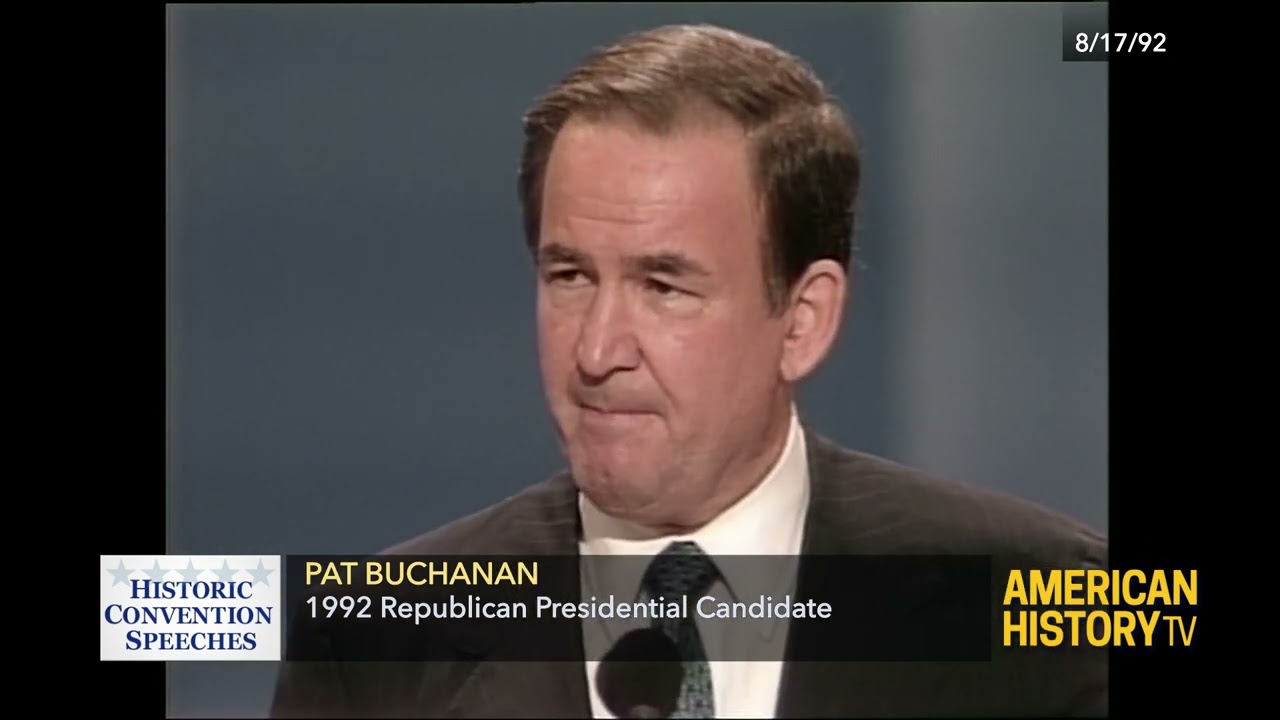 (https://youtu.be/y1rQKnTWEDQ), he warned: “There is a cultural war going on for the soul of America… as critical as the Cold War itself.” Too radical for his time, Buchanan championed a white, Christian, conservative US hostile to cosmopolitan elites. Though marginalized then, his ideas laid the groundwork for what would become Trumpism.
Newt Gingrich (https://time.com/5863457/how-newt-gingrich-laid-the-groundwork-for-trumps-republican-party/), who served as Speaker of the House from 1995 to 1999, played a pivotal role in reshaping both the Republican party and US politics (https://history.princeton.edu/about/publications/burning-down-house-newt-gingrich-fall-speaker-and-rise-new-republican-party). A Republican group he chaired famously distributed a pamphlet to Republican candidates titled “Language: A Key Mechanism of Control” (https://uh.edu/%7Eenglin/rephandout.html?ref=forwardky.com), advising them to use uplifting language to describe themselves, and inflammatory terms like “corrupt”, “immoral” and “traitor” to describe their opponents. This aggressive rhetoric redefined political rivals as enemies to be defeated – helping pave the way for a right-wing politics in which winning trumps democratic norms.
At the same time, the rise of a new conservative media ecosystem intensified polarization. The launch of Fox News in 1996, the growth of right-wing talk radio shows like Rush Limbaugh’s (https://www.nytimes.com/2021/02/17/us/politics/limbaugh-death.html) and the later explosion of social media gave the US right powerful tools (https://www.mediamatters.org/google/right-dominates-online-media-ecosystem-seeping-sports-comedy-and-other-supposedly) to shape and radicalize public opinion. Today, algorithm-driven information bubbles trap citizens (https://www.vox.com/recode/21534345/polarization-election-social-media-filter-bubble) in alternate realities, where misinformation and outrage drown out reasoned debate. This has deepened polarization (https://www.simonandschuster.com/books/Why-Were-Polarized/Ezra-Klein/9781476700366) and fractured society as a whole.
Channeling anger
This ideological and media realignment has unfolded alongside a broader crisis: the unraveling of the post-Cold War neoliberal consensus. Promises of shared prosperity have been replaced by deindustrialization, deepening inequality and widespread resentment. Successive traumas – from 9/11 and the 2008 financial crash to the Covid-19 pandemic – and foreign wars without real victories have eroded public trust in the establishment (https://journals.openedition.org/sociologie/7726).
Trump channels this anger (https://theconversation.com/how-donald-trumps-populist-narrative-led-directly-to-the-assault-on-the-us-capitol-153277). He offers a vision of a restored and idealized America, a rollback of recent social gains, and a reassertion of national identity grounded in religion and race. His populism is not a coherent ideology but an emotional response – born of perceived injustice, humiliation and loss.
Trump is more than a symptom of America’s democratic crisis: he is its most vivid manifestation. He embodies the legacy of the 1990s – a foundational decade of identity grievance, culture wars and media deregulation. Viewed as a political outsider (https://www.tandfonline.com/doi/abs/10.1080/15456870.2019.1610763), he has never been judged as a traditional politician, but rather embraced, by some, as the archetypal “self-made man” (https://theconversation.com/a-new-book-reveals-much-of-trumps-success-is-based-on-a-myth-he-is-a-self-made-billionaire-240648) – a successful businessman and reality TV celebrity.
His rhetoric (https://muse.jhu.edu/pub/174/monograph/book/76805) – transgressive, provocative and often cruel – gives voice to what had been repressed. The humiliation of opponents becomes part of the performance. For his supporters, it’s exhilarating (https://www.theatlantic.com/ideas/archive/2018/10/the-cruelty-is-the-point/572104/). It breaks taboos, flouts political correctness and feeds the fantasy of reclaiming a lost America.
And he’s no longer alone. With the vocal support of economic and tech elites like Elon Musk (https://www.newyorker.com/culture/infinite-scroll/techno-fascism-comes-to-america-elon-musk) – now a central figure in the radicalized right on X – Trumpism has entered a new phase. Together, they’ve outlined a new kind of authoritarian, cultural and digital power, where influence matters more than institutions.
The US re-elected not just a man, but a style, an era and a worldview built on dominance, disruption and disdain for rules. Still, history is unwritten: intoxicated by hubris and undermined by incompetence, Trumpism may yet crash into the wall of reality (https://www.theatlantic.com/politics/archive/2025/01/trump-cant-escape-laws-political-gravity/681474/) – with consequences far beyond America’s borders.
Jérôme Viala-Gaudefroy (https://theconversation.com/profiles/jerome-viala-gaudefroy-440831), Spécialiste de la politique américaine, Sciences Po (https://theconversation.com/institutions/sciences-po-2196)
This article is republished from The Conversation (https://theconversation.com/) under a Creative Commons license. Read the original article (https://theconversation.com/culture-wars-political-polarization-and-deepening-inequality-the-roots-of-trumpism-255778).
---
---
NO LNX
Behind the 60-year Republican plot to destroy American democracy
Activist Phyllis Schafly wearing a "Stop ERA" badge, demonstrating with other women against the Equal Rights Amendment in front of the White House, Washington, D.C..
Thom Hartmann April 27, 2025
In a Daily Take here on Hartmann Report, I mentioned Russell Kirk and the origins of today’s hard right GOP. A few people replied with, “Who’s that?” and similar questions; others were incredulous that Republicans actually believed the middle class created by FDR’s New Deal was a bad thing. So, here’s the backstory to what I mentioned.
I was thirteen years old in 1964 when my dad, a Republican activist, gave me a copy of John Stormer’s book “None Dare Call It Treason.” The Goldwater campaign had sent it to him, and its claim that the State Department was filled with communists intent on handing America over to the USSR had his friends buzzing.
Ironically, Stormer’s book and the movement it ignited within the GOP is largely responsible for that party today standing on the precipice of fully endorsing fascism as an alternative to democracy in the US.
And it was started by morbidly rich men (it was all men back then) who wanted to use the threat of a “communist menace” to gut the union movement to increase their own corporate profits and CEO pay.
The founding premise of the modern conservative movement tracks back a generation before Stormer’s book to a Republican thought leader named Russell Kirk. He laid it out in his 1951 book The Conservative Mind: From Burke to Eliot, as I detail in The Hidden History of American Oligarchy.
Kirk argued that the middle class was becoming a threat to America; without clearly defined classes and power structures — essentially without the morbidly rich in complete control of everything — he worried that society would devolve into chaos.
The opening chapter of his book was about Edmund Burke, the Irish conservative who wrote, in 1790, that hairdressers and candlemakers should not be allowed to run for political office or even to vote:
“The occupation of a hairdresser or of a working tallow-chandler cannot be a matter of honor to any person — to say nothing of a number of other more servile employments. Such descriptions of men ought not to suffer oppression from the state; but the state suffers oppression if such as they, either individually or collectively, are permitted to rule. In this you think you are combating prejudice, but you are at war with nature...”
Kirk and his followers essentially predicted in 1951 that if today’s “hairdressers and working tallow-chandlers” — college students, women, working-class people, and people of color — ever got even close to social and political power at the same level as wealthy white men, there would essentially be a communist revolution in the US, handing us over to Stalin and his Politburo.
(Keep in mind, this was when racial segregation was legal and brutally enforced, the voting age was 21, campuses were almost entirely all-male, both abortion and birth control were illegal in most states, and women couldn’t open checking accounts or get credit cards without a husband’s, brother’s, or father’s signature.)
Throughout the 1950s, Kirk and his warnings of the dangers of an activist middle-class developed a small following; the most prominent of his proponents were William F. Buckley Jr. and Barry Goldwater. Most Republicans, though, considered him a crackpot.
But when the birth-control pill was legalized in 1961 and the Vietnam War heated up a few years later, those marginalized groups Kirk had warned his wealthy white male followers about began to rise up in protest.
Kids were burning draft cards, women were burning bras, and Martin Luther King Jr. was leading a movement for racial justice that the white power structure blamed for American cities burning. Gay liberation was also having a moment.
Meanwhile, the Arab Oil Embargoes of the 1970s had lit the flame of inflation, and unionized workers were striking all over America for wage increases to keep up with the rising cost of living.
Wealthy white conservatives freaked out as the morbidly rich promoted the idea that America was experiencing a “moral decline” that could only be fixed by ending the union movement and other “liberal” causes that shared the union movements’ populist goals.
They became convinced that they were seeing Kirk’s prophecy play out in real time on their television screens every night: the “communists” — those uppity racial minorities, women who’d forgotten their “rightful place in society,” students who objected to Vietnam, unionized workers, and gender minorities — were on the verge of “taking over” America.
These five movements all hitting America at the same time got the attention of conservatives and Republicans who had previously ignored or even ridiculed Kirk back in the 1950s. Suddenly, America’s most powerful and well-known conservative commentators (like William F. Buckley Jr.) were telling Republicans that Russell Kirk was, indeed, a prophet.
They’d finally found a politically acceptable “hook” to destroy the wealth of working-class people and transfer trillions into their own money bins: fear of communism and a prophesied social decay caused by an activist middle class.
The Republican/Conservative “solution” to the “crisis” these five movements represented was put into place in 1981 when Ronald Reagan was sworn into office: the explicit goal of the morbidly rich white men funding the so-called Reagan Revolution was to take the middle class down a peg to end the protests of the ’60s and ’70s, restore “social stability,” and increase corporate profitability.
Their plan was to declare war on labor unions so wages could slide back down again, end free college across the nation so students would live in fear rather than be willing to protest, and increase the penalties Nixon had already put on drugs so they could use those laws against their scapegoats, particularly the hippy antiwar protesters and Black people demanding an end to police killings. They also wanted to outlaw abortion, to put women “back in their place.”
Thus, Reagan massively cut taxes on rich people and raised taxes on working-class people 11 times. For example, he put income taxes on Social Security and unemployment payments, and put in a mechanism to track and tax tips income, all of which had previously been tax-free but were exclusively needed and used by middle-class people.
He ended the tax deductibility of credit-card, car-loan, and student-debt interest, overwhelmingly claimed by working-class people. At the same time, he cut the top tax bracket for millionaires and billionaires from 74% to 25%. (There were only a handful of billionaires in America then, in large part because of previous tax policies; today’s democracy-destroying explosion of billionaires followed Reagan’s, Bush’s, and Trump’s massive tax cuts on the rich.)
Reagan declared war on labor unions, crushed PATCO in less than a week, and over the next decade the result of his war on labor was that union membership went from about a third of the American workforce when he came into office to around 10% at the end of the Reagan/Bush presidencies. It’s just now beginning to recover from its low of 6% of the private workforce.
He and Bush also husbanded the moribund 1947 General Agreement on Tariffs and Trades (GATT, which let Clinton help create the WTO) and negotiated NAFTA, which Clinton signed and thus opened a floodgate for American companies to move manufacturing overseas, leaving American workers underemployed while radically cutting corporate labor costs and union membership.
And, sure enough, Reagan’s War on Labor cut average inflation-adjusted minimum and median wages by more, over a couple of decades, than anybody had seen since the Republican Great Depression of the 1920s and ’30s.
The billionaire’s investment in taking the middle-class down a peg was paying off by orders of magnitude.
Had Reagan not destroyed the nation’s unions, the median American income today would be well over $100,000 a year, minimum-wage households would have a family income of $86,000, and a single wage-earner would still be able to buy a house, a car, send the kids to college, and have a decent retirement (as my dad did, working a union job for 35 years in a tool-and-die shop).
Instead, CEOs today keep all that money for themselves and their investors.
And Reagan’s War on Colleges jacked up the cost of education so high that an entire generation is today saddled with more than $1.5 trillion in student debt: as predicted, many aren’t willing to jeopardize it all by “acting up” on campuses.
The key to selling this campaign of impoverishment to the American people to help out the billionaire class was the idea that the US shouldn’t protect the rights of workers, subsidize education, grant women equal rights, or enforce Civil Rights laws because, conservatives said, all of those things were aspects of “socialism.” And if America embraced socialism, we may as well be ruled by the Soviet Union.
As Reagan told us in his first inaugural, government “socialist” programs were not the solution to our problems, but instead were the problem itself.
He ridiculed the formerly-noble idea of service to one’s country and joked that there were really no good people left in government because if they were smart or competent they’d be working in the private sector for a lot more money.
He even told us that the nine most frightening words in the English language were, “I’m from the government, and I’m here to help.”
Following Lewis Powell’s 1971 memo, throughout the 1970s and 1980s Republican billionaires built a massive infrastructure of think tanks and media outlets to promote and amplify Reagan’s message that government supports of any sort for poor or working-class people were simply gateway drugs to socialism and, inevitably, communism.
It so completely swept America that by the 1990s even President Bill Clinton was saying things like, “The era of big government is over,” and “This is the end of welfare as we know it.” Limbaugh, Hannity and other right-wing radio talkers were getting millions a year in subsidies from billionaire-funded groups like the Heritage Foundation. Billionaire-owned Fox “News” today carries on the tradition.
It had been a pretty good scam for the billionaires who owned the GOP and wanted, back in the 1950s, to stop the union movement that was forcing them to share their profits with their workers.
First, they terrified Americans about communism and socialism, then convinced about half of us that those things came straight out of “liberal” social and economic movements.
Unions, feminism, acceptance of the queer community, civil rights, minimum wage increases, and even regulation of corporate behavior would, they told us, all lead to Soviet-style tyranny.
So, to save America from herself, Reagan gutted the American middle class, transferring over $50 trillion in wealth from working class people into the money bins of the morbidly rich.
By 2016, Americans were starting to figure out that they’d been screwed — and that Hillary Clinton’s husband had been in on it by continuing Reagan’s policies and doubling-down on free trade — and were loudly demanding change.
Into this maelstrom walked Donald Trump, proclaiming himself the savior of the country. In the GOP primary he pointed out how corrupt his opponents were, particularly Jeb Bush and Marco Rubio, and destroyed them, one after the other.
For the general election in 2016, he changed his tune and ran on what was traditionally a Democratic platform, saying he was going to bring jobs home, end so-called “free trade” policies [TPP], raise taxes on the rich so much that “my friends won’t talk to me anymore,” and make sure every American had free or low-cost healthcare and access to an affordable college education.
They were all lies — something Trump had become adept at during his business career — but they worked and sucked in disaffected workers who knew they’d been screwed but weren’t sure who did it to them or why.
So here we are.
We have an open fascist and apparent friend of authoritarian Russia as president after being convicted by a jury of his peers on 34 felony charges, having previously been adjudicated as responsible for sexual abuse (the judge called it “rape”) and fraud.
He’s putting into place people and policies that could turn America into an authoritarian nation like Russia or Hungary, and apparently wants to re-align the United States away from NATO and the EU and toward Russia, China, Iran, and North Korea.
We are literally facing the authoritarian future that John Stormer was warning us about back in 1964. Only instead of “communists” in the State Department, it’s a billionaire president with the avowed goal of ending union rights and locking up or using the Army with live ammunition against those who protest his policies.
And it all tracks back to wealthy conservatives funding a project in the 1960s to scare Americans about socialism and communism so they could stop the union-fueled growth of wages that were cutting into their profits.
Perhaps none dare call it treason. But I do.
NOW READ: The man-babies of MAGA never grew up because they never had to
---
---
an 3 25
No one in the GOP has done more to push the U.S. Supreme Court to the far right than Sen. Mitch McConnell (R-Kentucky), who recently announced that he won't be seeking an eighth term in 2026. After blocking former President Barack Obama's High Court nominee, Merrick Garland, in 2016, the then-Senate majority leader aggressively pushed all three of President Donald Trump's SCOTUS picks: Brett Kavanaugh, Neil Gorsuch and Amy Coney Barrett.
In 2022, Justices Kavanaugh, Gorsuch and Barrett were part of the 5-4 majority ruling that overturned Roe v. Wade after 49 years in Dobbs v. Jackson Women's Health Center. Yet Trump (https://www.alternet.org/2020/11/trump) deeply resents McConnell, and vice versa — even though McConnell gave Trump a lukewarm endorsement in the 2024 election.
In a biting opinion column published by The Hill (https://thehill.com/opinion/columnists/juan-williams/5179109-mitch-mcconnell-made-our-country-worse/) on March 10, journalist Juan Williams argues that McConnell, now 83, has done a lot to bring the United States to the "perilous moment" it faces during Trump's second term — despite all the bad blood between him and Trump.
:{:{READ MORE:'Investors are starting to play defense' as business class fears 'growing chaos' from Trumponomics (https://www.alternet.org/t-2671299659/?utm_source=push_notifications)}:
"The bad news for McConnell is that despite his decades towering over Washington as a top GOP leader, he is now eclipsed by President Trump's takeover of his party," Williams says (https://thehill.com/opinion/columnists/juan-williams/5179109-mitch-mcconnell-made-our-country-worse/). "Trump has called McConnell 'a dour, sullen, and unsmiling political hack' and warned that Republicans would lose if they remained aligned with him. And Trump issued a racially pointed insult to McConnell's wife. McConnell didn’t fire back."
Williams continues (https://thehill.com/opinion/columnists/juan-williams/5179109-mitch-mcconnell-made-our-country-worse/), "The only public shot McConnell ever took at Trump came after the January 6, 2021 riot at the Capitol, saying he was 'morally responsible.' Yet, when it came time to act, he voted to acquit Trump. The weak explanation: 'We have a criminal justice system in this country.' According to the New York Times, at the same time, McConnell told advisers in private: 'The Democrats are going to take care of the son of a b for us."
Williams notes that (https://thehill.com/opinion/columnists/juan-williams/5179109-mitch-mcconnell-made-our-country-worse/) McConnell "tried to regain some dignity by defying Trump with votes against Trump's nominations of Pete Hegseth for defense secretary, Tulsi Gabbard for director of national intelligence and Robert F. Kennedy Jr. for Health and Human Services secretary." But he considers such votes "too little too late."
"Despite a few good votes on bad nominees," Williams writes (https://thehill.com/opinion/columnists/juan-williams/5179109-mitch-mcconnell-made-our-country-worse/), "the history books will still highlight McConnell's power plays over the years to polarize the Senate with his hard-right ideological agenda. McConnell can't erase the procedural tricks to block President Obama's judicial appointments, thwarting voters who elected a Democratic president and a Democratic Senate majority to nominate and confirm judges."
:{:{READ MORE:Acting Trump official spread false rumors about 'low-IQ' Marco Rubio (https://www.alternet.org/marco-rubio-darren-beattie-cnn/)}:
According to Willliams (https://thehill.com/opinion/columnists/juan-williams/5179109-mitch-mcconnell-made-our-country-worse/), the fact that many Republicans "hate" McConnell "because Trump told them to" doesn't erase his history.
"For the history books," Williams writes (https://thehill.com/opinion/columnists/juan-williams/5179109-mitch-mcconnell-made-our-country-worse/), "he will be the main player paving the way for Trump…. McConnell will go down in history not as a statesman, but as the man who brought us to this perilous moment. That's not trashing you, senator. It's simply stating a fact."
---
---
AN 3 25
Trump's bootlicker brigade: How fake patriots are destroying America
WASHINGTON, DC - MARCH 04: U.S. Secretary of State Marco Rubio kisses Rep. Marjorie Taylor Greene (R-GA) as he arrives for President Donald Trump's address to a joint session of Congress at the U.S. Capitol on March 04, 2025 in Washington, DC.
Win McNamee/Pool via REUTERS
Thom Hartmann March 10, 2025
Former Democratic Senator Joe Manchin accused Congressman Al Green and other Democrats of “disrespect” and — absurdly— “inhumanity” for standing up and pointing out Donald Trump’s over-100 lies in his State of the Union address.
This is the same on-the-take Senator Joe Manchin who refused to break a filibuster and thus blocked legislation that would have reversed Citizens United and established an absolute right to vote in America.
The same sellout-coal-baron Senator Joe Manchin who opened the door for Elon Musk to buy the election for Donald Trump and Republicans to throw around 4 million mostly-Democratic voters off voting rolls or refuse to count their votes.
Now that the big money is on the Republican side, thanks in large part to cross-my-palm-with-cash Senator Joe Manchin stabbing America in the back, the elderly yacht-dweller seems to have joined the MAGA Republicans, at least in spirit.
You know who I’m talking about: those guys who claim to represent the “real” America.
We saw them jumping up over and over again at Trump’s State of the Union Address, chanting “USA, USA, USA” when Texas Congressman Al Green tried to point out that Trump was lying to everybody.
They show up at school board and city council meetings sometimes literally wrapped in the American flag while carrying semiautomatic weapons in one hand and bibles in the other, screaming obscenities and threats at public officials.
They demand that children be exposed to measles in school and refused to vaccinate their kids, then support Republicans who are planning to destroy the Medicaid program that provides healthcare to more than 70 million Americans.
They say they love our country, but they and the world’s richest man are actively gutting our government in a way that is openly delighting Vladimir Putin and Xi Jinping.
They forbid teachers from teaching sex education, make it illegal for teachers to mention birth control, and when girls become pregnant make it a crime to get an abortion.
They strip out of our schools’ curriculum the history of Black people being beaten at the Edmund Pettis Bridge 60 years ago today, are banning books nationwide, and are waging war against queer people for simply wanting to be who they are.
They say they love our military, but are firing thousands of workers in the Veterans Administration.
They claim to be champions for the elderly, but are actively working on a plan to privatize Social Security while they gut the Social Security administration itself.
They insist that global warming is a hoax and fight like hell to keep hundreds of billions in taxpayer subsidies flowing to the fossil fuel oligarchs, threatening violence at even a discussion of a carbon tax, electric cars, or LED light bulbs.
They celebrate an attack on our US Capitol as well as several state capitols, trying to kill Michigan Governor Gretchen Whitmer, Vice President Mike Pence, and Speaker of the House Nancy Pelosi.
They complain about the “American carnage” of our century-old infrastructure, but threaten a new civil war if politicians raise taxes on the well-off and the morbidly rich to fix it.
They assert a belief in “fiscal responsibility,” but are preparing to borrow another $5 trillion to give to their billionaire donors as tax cuts and corporate subsidies.
They demand prayer in schools and “one nation, under god” at public events, yet totally disregard Jesus’ teaching that prayer be done so quietly and privately that it’s in one’s “closet.”
Their preachers openly violate US tax law, forcing us all to pay for their public utilities like police, fire, and public roads, while defying Jesus’ teachings about separating church and state (not to mention the similar sentiments of this nation’s Founders).
They attack colleges and academics and support over a trillion dollars in student debt (which happens nowhere else on Earth) and are actively deconstructing our Department of Education while demanding tariffs against countries that technologically outpace us because they have better-educated workforces.
They claim to be “Christians” yet oppose government-supported food stamps and housing support in open defiance of Jesus’ teaching in Matthew 25:31-46 that the only way to get to heaven is to feed the hungry and care for the homeless.
They claim to believe in democracy yet push laws making it harder to vote but easier for goons to show up at polling places in militia garb to intimidate those who want to vote.
They say they’re on the side of working people but hate unions (except police unions).
They claim to be America’s best patriots.
They’re wrong, and tragically deluded.
In fact, they’re the boot-licking brigade for morbidly rich rightwing billionaires who don’t want their polluting businesses regulated or their taxes raised.
They’re gullible patsies of hustlers claiming religion inspires them while fleecing their congregations to buy a new private jet and a new mansion in Hawaii.
They’re sexually insecure men being played as marks by the NRA and the weapons industry, who tell them that by strapping AR15 prosthetic penises across their backs they seem masculine.
They’re grown-up elementary school bullies who turned to violence as children to conceal their inability to keep up in the classroom and now do the same when they don’t understand basic science.
They’re white chumps who’re convinced they’re genetically superior to everybody else and are terribly confused when they see really smart nonwhite people on TV or in politics.
They’re useful idiots of foreign autocrats and oligarchs who send millions of trolls and fake news across social media daily because a functioning American democracy is a threat to their own wealth, power, and appearance of legitimacy.
They’re dupes for billionaire media families and their TV and radio hosts who’re laughing all the way to the bank as they crank the outrage machine harder and harder to keep their suckers glued to the dial.
Genuine patriots work to heal a country, to bring out its best, to strengthen its social and political fabric and make a better nation and world for future generations.
These people are not patriots: they’ve been screwed for 44 years by Reaganomics, told it’s raining while that “trickle down” is just America’s oligarchs pissing on them, and they’re looking for someone to blame.
Trump and rightwing media have told them for years that their troubles are caused by people of color, scientists, unions, “liberals” and the “coastal elites” — and they’re believing it.
It would be tragic if these boot-lickers weren’t so wed to hate, bigotry, and violence; instead they’re a genuine threat to law-abiding Americans and the survival of our democratic republic.
NOW READ: Here's Trump's next target — according to the tyrant's playbook
---
---
an 4 24
rural white voters have, in many cases, far more political power than suburban or urban voters, and they’re using that outsized power to push our nation toward disaster. While they’re only 20 percent of the country, for example, because of gerrymandering they control fully 42 percent of seats in the House of Representatives.
The authors of new book, White Rural Rage: The Threat to American Democracy (https://www.amazon.com/White-Rural-Rage-American-Democracy/dp/0593729145/ref=thomhartmann) point out that rural whites are measurably more bigoted and xenophobic than suburban or urban voters, 13 points more likely to hate on queer people, 15 points more likely to support Trump’s Muslim ban.
They’re also far more likely to agree that setting democracy aside for a strongman like Trump or another Putin wannabee will “fix the mess and drain the swamp.” And fully 74% of the members of Congress who voted to overturn the 2020 election represented rural districts.
The majority of rural white voters disagree with the statement (or have no opinion) that “diversity makes America stronger.” And while only 22 percent of city dwellers believe Trump won the 2020 election and Biden and Democrats “stole” it, a mind-boggling 47 percent of rural whites are certain Biden is illegitimately occupying the White House.
READ:Revealed: What government officials privately shared about Trump not disclosing finances (https://www.rawstory.com/raw-investigates/donald-trump-office-government-ethics/?utm_source=breaking)
The astonishing paradox, though, is how Republican politicians regularly crap on their own voters in rural America. Instead of offering help or solutions to rural problems, the GOP and conservative media instead feed them a steady diet of xenophobic and racist fear and hate.
And they eat it up! The racist buffoons among them are one and a half times more likely to be QAnon followers than people who live in cities or suburbs.
Democrats created — and Republicans opposed — virtually all the programs that are keeping rural America from sinking even farther into poverty and despair. Social Security, unemployment insurance, SS Disability, Medicare, Medicaid, over 60 farm subsidy programs that funnel billions in taxpayer dollars into rural communities, food stamps, the Women and Infant Children (WIC) program, anti-addiction programs, etc.
The only real accomplishment of the Trump presidency was passing a massive $2 trillion dollar tax cut for the morbidly rich that had virtually no effect on rural voters. Nonetheless, 71 percent of rural voters cast a ballot for Trump in 2020.
There are still 11 mostly rural states where hospitals are closing and people are dying younger than necessary because Republicans in those states have refused to expand Medicaid.
Republicans in Congress fought against legislation to expand rural broadband access. They constantly try to cut or gut rural health and nutrition programs, and fought against expanding Obamacare in a way that would help rural people.
gerry SUPERMAJORITY
Most of the Red State Republican politicians in America know their seats will never be in danger, so they take millions from special interest groups to write loopholes into the tax code, vote for larger fossil fuel subsidies, and vote against efforts to lower prescription drug prices or do anything about global warming.
They get rich while the people who put them into office struggle to get by. Ted Cruz escapes to Cancun with the $600,000+ in cash he just got for his podcast, laughing at Texas voters all the way. JD Vance, a multimillionaire Wall Street (https://ohiodems.org/the-lever-j-d-vances-wall-street-tax-dodge/) guy, lives in an elite townhouse and travels by first class while people in Ohio watch Republican politicians gut their public schools and try to outlaw abortion and birth control.
Republican members of Congress representing rural states went all the way to the Supreme Court to successfully block President Biden’s first attempt at reducing student debt while rural students carry (http://www.wipsociology.org/2021/09/09/geographic-disparities-in-student-debt-by-rural-suburban-and-urban-background/) 60% more student debt than urban students by age 25.
One of the most chilling quotes from the book is about how rural voters are willing to both abandon democracy and embrace a violent rightwing coup:
“[R]ural Americans are more likely to believe that ‘it may be necessary at some point soon for citizens to take up arms against the government.’ Indeed, more than one out of four rural residents agree that Trump should be returned to office by force if necessary.”
White rural voters are more likely than any other demographic group — Blacks, Hispanics, Asians, Native Americans — to be willing to overturn our democracy, and the people who represent them are in the majority of legislators who voted to overturn the 2020 election the day after the January 6th attack on our capitol.
If, say, Black people held that view, rightwing media would be trumpeting it every day from coast to coast. But because it’s rural white people, the so-called “heartland Americans,” it gets largely ignored by American media.
After all, most mainstream outlets treat rural people as if they’re an exotic species who must be listened to: going to rural diners to interview people is so common it’s become a cliché. In the past month I’ve seen dozens of such interviews played on MSNBC and CNN, but not once have I seen those same reporters go into a city and ask why people are voting for Biden.
The Biden administration has done more for rural America than any president since Lyndon Johnson rolled out Medicare, Medicaid, and food stamps. Biden’s American Rescue Plan provided (https://www.whitehouse.gov/briefing-room/statements-releases/2022/03/01/fact-sheet-the-biden-administrations-historic-investments-to-create-opportunity-and-build-wealth-in-rural-america/) specific tax breaks and credits targeted at rural poverty, subsidized mortgage payments, and provided rent assistance to tens of thousands of rural residents:
— Rural Americans are nine times more likely (https://www.whitehouse.gov/briefing-room/statements-releases/2022/03/01/fact-sheet-the-biden-administrations-historic-investments-to-create-opportunity-and-build-wealth-in-rural-america/) to lack access to affordable child care, so Biden’s program allocated $39 billion for subsidies for child care providers, with the money disproportionately going to rural communities. There was also (https://www.whitehouse.gov/briefing-room/statements-releases/2022/03/01/fact-sheet-the-biden-administrations-historic-investments-to-create-opportunity-and-build-wealth-in-rural-america/) $350 billion specifically allocated for small towns in rural areas to help them run basic government functions and upgrade their infrastructure. He even put up (https://www.whitehouse.gov/briefing-room/statements-releases/2022/03/01/fact-sheet-the-biden-administrations-historic-investments-to-create-opportunity-and-build-wealth-in-rural-america/) $198 million in funding for rural colleges and universities.
— Biden and Democrats delivered (https://www.whitehouse.gov/briefing-room/statements-releases/2022/03/01/fact-sheet-the-biden-administrations-historic-investments-to-create-opportunity-and-build-wealth-in-rural-america/) a 15% increase in SNAP (food stamp) benefits that have a huge impact in rural areas, reaching “2.9 million people in rural areas, including 800,000 children, reducing rural poverty by 11 percent and rural child poverty by 20 percent.” Biden’s USDA, over Republican objections, also put a billion dollars into rural food banks.
— Biden and Democrats “invested (https://www.whitehouse.gov/briefing-room/statements-releases/2022/03/01/fact-sheet-the-biden-administrations-historic-investments-to-create-opportunity-and-build-wealth-in-rural-america/) a historic $3 billion in the Department of Commerce’s (DOC) Economic Development Administration (EDA) to build local [rural] economies that are resilient to future economic shocks, including a $300 million Coal Communities Commitment.”
— Biden and Democrats — over GOP objections — expanded (https://www.whitehouse.gov/briefing-room/statements-releases/2022/03/01/fact-sheet-the-biden-administrations-historic-investments-to-create-opportunity-and-build-wealth-in-rural-america/) hunting and fishing opportunities on 2.1 million acres of public lands, the largest such expansion in U.S. history, and provided $1.5 billion in annual funding for wildlife and habitat conservation efforts. Another $2 billion went (https://www.pbs.org/newshour/politics/watch-biden-touts-new-economic-opportunity-in-rural-america-during-minnesota-visit) “for funding communities in the Rural Partners Network to spur job creation and build infrastructure.”
— They put $5 billion (https://www.whitehouse.gov/briefing-room/statements-releases/2022/03/01/fact-sheet-the-biden-administrations-historic-investments-to-create-opportunity-and-build-wealth-in-rural-america/) in “investments to help rural areas update infrastructure, boost high-speed internet access, and aid agricultural producers and small businesses in implementing climate-focused practices” and “$1.7 billion in funding to assist farmers, ranchers and foresters in adopting techniques to adapt to the changing climate, such as cover crops, nutrient management, and carbon storage.”
And that’s just the beginning: for a full list of the ways the Biden administration, over the objection of Republicans in Congress, has helped rural people click here (https://www.whitehouse.gov/briefing-room/statements-releases/2022/03/01/fact-sheet-the-biden-administrations-historic-investments-to-create-opportunity-and-build-wealth-in-rural-america/).
Not one single Republican in either the House or the Senate voted for any of the things listed above: in fact, almost all voted against these helps to rural America.
Instead of concerning themselves with the well-being of rural people, they’re trying to block clean air standards that prevent rural communities from being poisoned, block clean water standards in rivers that supply water to rural communities, cut taxes on billionaires, and increase subsidies to the fossil fuel and banking industries.
All while taking huge campaign contributions, private jet rides, taxpayer funded junkets overseas, and the promise of million-dollar-a-year jobs when they leave Congress if only they vote the right way.
Because Republican politicians are more interested in feathering their own nests than helping out the people they were elected to represent, rural Red states are massively subsidized by urban Blue states just to keep their heads above water. As the Associated Press recently reported (https://apnews.com/article/north-america-business-local-taxes-ap-top-news-politics-2f83c72de1bd440d92cdbc0d3b6bc08c?utm_source=pocket_reader):
“Mississippi received $2.13 for every tax dollar the state sent to Washington in 2015, according to the Rockefeller study. West Virginia received $2.07, Kentucky got $1.90 and South Carolina got $1.71.
“Meanwhile, New Jersey received 74 cents in federal spending for every tax dollar the state sent to Washington. New York received 81 cents, Connecticut received 82 cents and Massachusetts received 83 cents.”
It’s undeniably true (and documented with each hotlink below) that Republican-controlled “Red” states, almost across the board, have higher rates of:
— Spousal abuse (https://www.ruralhealthinfo.org/topics/violence-and-abuse)
— Teen pregnancy (https://www.motherjones.com/kevin-drum/2012/02/teen-pregnancy-higher-red-states-blue-states/)
— Sexually transmitted diseases (https://www.politico.com/blogs/on-congress/2009/01/stds-higher-in-red-states-015729)
— Abortion (https://www.motherjones.com/kevin-drum/2012/02/teen-pregnancy-higher-red-states-blue-states/) (at least before Dobbs; now it would be “forced births”)
— Bankruptcies and poverty (https://www.usnews.com/news/best-states/slideshows/us-states-with-the-highest-poverty-rates)
— Homicide (https://smartpolitics.lib.umn.edu/2009/09/16/red-states-have-higher-crime-r/) and suicide
— Infant mortality (https://www.dailykos.com/stories/2020/11/10/1994653/-Decades-of-Republican-Mismanagement-Have-Left-Red-States-Mired-in-the-Past-at-the-Bottom)
— Maternal mortality (https://www.dailykos.com/stories/2020/11/10/1994653/-Decades-of-Republican-Mismanagement-Have-Left-Red-States-Mired-in-the-Past-at-the-Bottom)
— Forcible rape — Robbery (https://smartpolitics.lib.umn.edu/2009/09/16/red-states-have-higher-crime-r/) and aggravated assault
— Dropouts from (https://appliedsentience.com/2020/07/30/economics-are-red-or-blue-states-better/) high school
— Divorc (https://www.jstor.org/stable/10.1086/674703)e
— Contaminated (https://www.cnbc.com/id/48944108) air and water
— Opiate addiction (https://www.dailykos.com/stories/2020/11/10/1994653/-Decades-of-Republican-Mismanagement-Have-Left-Red-States-Mired-in-the-Past-at-the-Bottom) and deaths
— Unskilled (https://www.dailykos.com/stories/2020/11/10/1994653/-Decades-of-Republican-Mismanagement-Have-Left-Red-States-Mired-in-the-Past-at-the-Bottom) workers
— Parasitic infections (https://www.pbs.org/wgbh/nova/article/how-a-worm-gave-the-south-a-bad-name/)
— Income and wealth inequality (https://www.businessinsider.com/inequality-in-red-vs-blue-states-2015-7?op=1)
— Covid deaths (https://politicalwire.com/2021/11/29/red-states-see-highest-rates-of-covid-deaths/) and unvaccinated (https://khn.org/morning-breakout/covid-deaths-skew-higher-than-ever-in-red-states/) people
— Federal subsidies (https://www.businessinsider.com/red-states-are-welfare-queens-2011-8) to states (“Red State Welfare”)
— People on welfare (https://www.nytimes.com/2012/02/17/opinion/krugman-moochers-against-welfare.html)
— Child poverty — Homelessness (https://appliedsentience.com/2020/07/30/economics-are-red-or-blue-states-better/)
— Spousal murder (https://www.huffpost.com/entry/murder-women-report_n_55f85315e4b0c2077efc3713)
— Unemployment (https://appliedsentience.com/2020/07/30/economics-are-red-or-blue-states-better/)
— Deaths from (https://www.latimes.com/business/la-xpm-2012-nov-20-la-fi-hy-red-states-traffic-deaths-20121120-story.html) auto accidents
— People living on disability (https://www.dailykos.com/stories/2020/11/10/1994653/-Decades-of-Republican-Mismanagement-Have-Left-Red-States-Mired-in-the-Past-at-the-Bottom)
— Gun deaths (https://www.forbes.com/sites/ariannajohnson/2023/04/28/red-states-have-higher-gun-death-rates-than-blue-states-heres-why/)
So, why do Red state voters tolerate being conned and ripped off by their own elected representatives? Are they just stupid?
One theory is that “they hate the same people we hate.” And, indeed, for a significant and measurable cohort of rural white voters, racial fear and hatred is a primary motivating factor in their embrace of the GOP, although that’s only, according to this new book, about 20% of rural people.
Others vote Republican because the party has been so effective at branding itself with county fairs, NASCAR, country music, and the overall rural lifestyle including a faux paean to rugged individuality and independence.
Having over 1500 radio stations daily broadcasting a rightwing Republican message to literally every nook and cranny of rural America is another large factor. As is the dominance of Australian billionaire Lachlan Murdoch’s Fox “News.”
Will rural voters ever wake up to how badly they’re being screwed now and have been screwed by Republicans ever since Reagan started the whole neoliberal austerity and free trade (https://www.amazon.com/Hidden-History-Neoliberalism-Reaganism-Greatness/dp/1523002328/ref=thomhartmann) movement that shipped over 60,000 factories and 20 million jobs overseas?
Or is the GOP’s cynical manipulation of religion, gender, and race enough to keep them voting to hurt themselves and further enrich Republican fat-cats?
So far, all indications seem like that’s the case and will stay that way for at least the next election cycle.
While the media struggles with trying to “understand” the rural white voter every election cycle, instead they should be running stories on how the very real problems and crises of rural America are daily made worse by Republicans in Congress and at the helm of their Red States.
How to break through?
Democrats need to get smart and start using the “negative partisanship” strategies Rachel Bitecofer recommends in her new book Hit 'Em Where It Hurts: How to Save Democracy by Beating Republicans at Their Own Game (https://www.amazon.com/Hit-Where-Hurts-Democracy-Republicans/dp/0593727142/ref=thomhartmann). They can do this by pointing out, with ad buys and media appearances, just how bad Red state Republicans politicians have been for rural people and their communities.
And they need to do it soon. As the authors of White Rural Rage point out:
“By 2040, 70% of Americans will reside in the 15 most populous states and choose 30 of the 100 US senators. Concentrated in smaller and more rural states, the remaining 30% of the population will elect 70 senators. No matter how distorted these population ratios become, each state is guaranteed its two senators — past, present, and forever.”
Our mainstream media have made it clear, for over 40 years, that they won’t expose the damage Republicans are doing to rural areas because their TV programs will fail if Republican politicians boycott them.
So, the job falls to us and the Democrats. Can we do it? I believe so; we just need to get started.
NOW READ:GOP Senators back away from MTG's 'ridiculous' speaker threat (https://www.rawstory.com/raw-investigates/marjorie-taylor-greene-mike-johnson/?utm_source=breaking)
---
---
alternet-3 24 NO LNX
How the GOP plans to drag America back to the 19th century
Thom Hartmann
March 22, 2024
“Moscow Mike” Johnson and his Republicans in the House are determined to continue to shorten the lifespans of Americans by forcing brutal Red State policies on the entire nation. It’s literally killing people, but they frankly don’t care so long as they can keep taxes on their billionaire owners low.
And now Republicans are officially saying they want to cut Social Security and gut Medicare.
Ronald Reagan is long gone, but a recent report shows how his policies and his party live on and are still hurting us: they’re responsible for millions of lost years of Americans’ lives. The study calls them “missing Americans.”
It wasn’t always this way.
In the 1930s, after FDR rolled out programs to aid the homeless and unemployed across the country, America enjoyed a longer life expectancy — and more healthy years within that life expectancy — than any other wealthy nation in the world.
While some of that was due to the public health crisis echoing across Europe in the wake of World War I, it was largely because FDR’s Democrats in charge of the country were building schools and hospitals like there was no tomorrow.
Republican President Eisenhower followed in that tradition through the 1950s, and in the 1960s LBJ rolled out Medicare and Medicaid. As a result, we continued to have the world’s best lifespans and quality-of-life.
Then came Reagan’s austerity and neoliberalism campaigns in 1981 and America began to become unraveled.
That study, published by the National Academy of Sciences in the journal PNAS Nexus, looked at “excess deaths” (they also called them “missing Americans”) in our country versus others around the world.
The researchers from Boston University School of Public Health, the University of Pennsylvania, and the Harvard Medical School and TH Chan School of Public Health found:
“The United States had lower mortality rates than peer countries in the 1930s–1950s and similar mortality in the 1960s and 1970s. Beginning in the 1980s, however, the United States began experiencing a steady increase in the number of missing Americans, reaching 622,534 in 2019 alone.”
Those excess deaths, it turns out, are almost all entirely the result of Republican policies, both at the federal and state level.
The researchers found:
“Stagnant minimum wages and losses of collective bargaining protections have contributed to widening economic inequality. A scant safety net for working-age adults and the absence of universal healthcare have privatized risk, tying health more closely to personal wealth and employment.
“Additionally, lax regulation of opioids, firearms, environmental pollutants, unhealthy foods, and workplace safety has contributed to elevated US mortality, particularly among lower-educated and lower-income people.”
And it’s worse in Red states:
“Increasingly divergent policies at the state level have resulted in widening health gaps across US states. In those geographic areas of the United States where excess mortality has increased the most, voters have turned towards policy-makers who have further undermined population health, e.g. through refusal to expand Medicaid or to implement firearm regulations.”
While not coming right out and saying that people live longer in Blue states than Red states, that’s largely what the study found. And it’s not a small effect:
“In 2021, there were 26.4 million years of life lost due to excess US mortality relative to peer nations…”
While President Eisenhower ran for re-election in 1956 by bragging about how on his watch millions more Americans had gotten good union jobs or signed up for Social Security, by 1981, when Reagan took office, the 1978 efforts of five corrupt Republicans on the Supreme Court to legalize political bribery were beginning to seriously take hold.
That’s when everything changed. Since 1981, millions of Americans have died unnecessarily because of neoliberal austerity policies: their lives were sacrificed on the altars of increased corporate profits and lower taxes for billionaires.
— Reagan told us that the “union bosses” were just out for themselves and the best thing American workers could do was to rely on their employers’ good will. He also claimed that the minimum wage actually hurt low-wage workers because, he said, it “prevented” employers from hiring more people.
Both were lies, as history has vividly shown, and both contributed to our epidemic of early and unnecessary deaths, as Red state minimum wages are still as low as $7.25/hour and Red “Right to Work for Less” states make it nearly impossible to unionize.
“Stagnant minimum wages and losses of collective bargaining protections have contributed to widening economic inequality” that leads to early deaths, reported the researchers.
— The Republican backlash to Obamacare extending Medicaid to everybody in the country wasn’t limited to their lawsuit before the Supreme Court that ended up letting Red states opt out of coverage, or to the Astroturf “Tea Party” movement funded by rightwing billionaires.
— To this day, more than a decade later, there are still about a dozen Red states that have taken the five Republican justices up on their offer and refuse to expand the program. Those Republican-controlled states have also thrown hundreds of bureaucratic roadblocks to people getting any kind of state services, from food stamps to unemployment insurance to housing assistance.
“A scant safety net for working-age adults and the absence of universal healthcare have privatized risk, tying health more closely to personal wealth and employment” that leads to early deaths, reported the researchers.
— A collaborative research project between the University of Texas and the University of Toronto published in The Journal of the American Medical Association found that the Red state preference for deregulation and a lack of oversight:
“…explained 9.2% of an enrollee’s odds of receiving prolonged opioids… The correlation between a county’s Republican presidential vote and the adjusted rate of … prolonged opioid use was 0.42 (P<.001). In the 693 counties with adjusted rates of opioid prescription significantly higher than the mean county rate, the mean Republican presidential vote was 59.96%, vs 38.67% in the 638 counties with significantly lower rates.”
— Cancer alley is alive and well in Texas and Louisiana thanks to Republican governments’ in those states refusal to enforce environmental regulations that would keep carcinogens out of the air and water.
— A child living in Mississippi is ten times more likely to die from gunshot than a child in Massachusetts because Republicans in Mississippi refuse to adopt rational, constitutional gun control regulations like Massachusetts has had for decades.
— Obesity and the diabetes, heart disease, and strokes associated with it are vastly more prevalent and thus more deadly in Red states than Blue states because so many more people are living in poverty in Red states and must eat junk food because it is cheaper than healthy food.
— Twenty-nine states, encompassing virtually all the nation’s Red states, have no state-level workplace safety agencies; those only exist in 21 mostly Blue states. As a result, Red Wyoming has 10.4 workplace deaths per 100,000 workers while Blue Rhode Island only has 1.0 deaths per 100,000 workers.
“Additionally, lax regulation of opioids, firearms, environmental pollutants, unhealthy foods, and workplace safety has contributed to elevated US mortality, particularly among lower-educated and lower-income people” wrote the researchers about unnecessary/early deaths in America.
When The Washington Post looked into the differences between Red and Blue states, what they found was shocking.
For example, noted the authors:
“Ohio sticks out — for all the wrong reasons. Roughly 1 in 5 Ohioans will die before they turn 65, according to Montez’s analysis using the state’s 2019 death rates. The state, whose legislature has been increasingly dominated by Republicans, has plummeted nationally when it comes to life expectancy rates, moving from middle of the pack to the bottom fifth of states during the last 50 years, The Post found. Ohioans have a similar life expectancy to residents of Slovakia and Ecuador, relatively poor countries.”
While it would be easy and glib to say that Republican politicians want the citizens of their states to die young, the simple truth is that they don’t care: their priority, instead, is the profitability of the companies in their states and keeping the taxes on their oligarchs low.
Author Mark Jacob noted on Xitter:
“Voting for Republicans is like eating poison.”
In fact, eating poison is a choice. Most people trapped in Red states, though, don’t have the means or ability to move to a Blue state because they’ve been denied a good education, are saddled with medical debt, and/or haven’t made enough at their work to afford the transition.
Blue states, for their part, are fighting back on behalf of their citizens. As Bernie’s poverty advisor Nikhil Goyal wrote for The New York Times a few months ago:
“Fourteen [Blue] states have adopted a state-level child tax credit, with many featuring a fully refundable provision so that families with little to no income can benefit. This year, New Mexico has expanded free preschool seats and made child care free for families earning up to four times the federal poverty rate — roughly $120,000 for a family of four.
“In the upcoming fiscal year, Minnesota will pour more than $250 million of additional funding into early childhood education to reduce the costs of child care and create thousands of new preschool slots. This includes $10 million to supplement funding of the federal Head Start program, which serves children up to the age of 5 and should be bolstered by states.
“Today, nine [Blue] states have universal free school breakfast and lunch on the books. Just last month, the governor of Illinois, J.B. Pritzker, established a $20 million initiative that will help fund grocery stores in food deserts.”
But every action draws a reaction, as Isaac Newton was quick to point out. Republicans are now trying to do to Blue states — to all of America — the same damage they’ve done to Red states over the past 40 years.
In the sixteen months since Republicans took control of the US House of Representatives, child poverty in America has doubled. This is because Republicans in the House refused to renew programs Democrats put in place providing health care, food assistance, housing support, the child tax credit, and subsidized child care: all have now expired.
In the past eleven months, since Republicans in Congress refused to act, 3.2 million children lost access to healthcare, 70,000 childcare and preschool programs have closed, and the child tax credit has expired. So have the Supplemental Nutrition Assistance Program’s emergency allotments. As of last November, 10,046,000 Americans have been kicked off Medicaid, nearly all in Red states.
And it’s all intentional.
Republicans will proudly tell you it’s necessary to keep taxes low for their morbidly rich donors, and to prevent poor people from becoming “lazy.” Speaker “Moscow Mark” Johnson will tell you that it’s the Christian way, just like trashing queer people and forcing 10-year-old rape victims to carry their pregnancies to term.
Welcome to the 2024 GOP and their plans to “deconstruct the administrative state” so they can drag America back to the 19th century.
Mark Jacob was right about the poison part. But instead of Republican voters eating it, their politicians are determined to force it down the throats of all of us, our children, and our grandchildren.
---
an 1 24 no lnx
The 56-year-long crisis of treasonous & illegitimate GOP presidents is happening again
Thom Hartmann
January 27, 2024
Once again, America and the world are watching with horror as a Republican candidate for president — just to win an election — manipulates world affairs in a way that will cause widespread death and destruction while damaging the interests and reputation of America.
There’s a long tradition of Republicans running for president committing what can best called treason, or at least criminal manipulation of international affairs, to advantage themselves and hurt incumbent Democratic presidents.
Yesterday, Mitch McConnell let the proverbial cat out of the bag. A bipartisan group of senators had been working on a bill to provide funding to Ukraine and Israel, with money for the southern border, and when it looked like they were going to produce something that would actually pass the House and Senate, Donald Trump inserted himself, telling the Republicans they should kill the bill.
Trump apparently wants to run on chaos at the border, and solving the problem as this legislation is intended to do would take that issue away from him. But he’s also explicitly opposed to any further US aid to Ukraine. This is a treasonous twofer, putting Trump’s election above the interests of the United States and world peace.
Trump, of course, knows that if it weren’t for Putin’s intervention in the 2016 election, he never would have been president. And he desperately needs a repeat to hold onto his fortune and stay out of jail: he’s in a far greater bind now than when he first ran for president as a hustle to get GE to pay him more for his TV show.
His 2016 Campaign Manager Paul Manafort, after all, admitted that during that election he was handing secret internal campaign polling and strategy information off to Russian intelligence, so they could successfully use it to micro-target vulnerable voters via Facebook, an effort that reached 26 million targeted Americans in 6 swing states.
Now, Trump wants Putin’s help again for 2024. He knows that Putin can do things from overseas, including using deepfakes and posing as Americans to spread explicit lies on social media, that would send people to prison for election interference if done here in the US.
Putin’s number one goal, of course, is to seize control of Ukraine while destabilizing western democracies. So, Trump, wanting Putin’s help, is now trying to deliver Ukraine to Putin by killing US aid.
This pattern of Republican presidential candidates criminally intervening in foreign policy just to win elections started in 1968 and has been a feature — not a bug — of every Republican president who succeeded in taking the White House since: it’s time to seriously discuss the five-decade-long problem we have with treasonous and illegitimate GOP presidents.
It started in 1968, when President Lyndon Johnson was desperately trying to end the Vietnam war. It had turned into both a personal and political nightmare for him, and his vice president, Hubert Humphrey, who was running for President in the election that year against a “reinvented” Richard Nixon.
Johnson spent most of late 1967 and early 1968 working back-channels to North and South Vietnam, and by the summer of 1968 had a tentative agreement from both for what promised to be a lasting peace deal they’d both sign that that fall.
But Richard Nixon knew that if he could block that peace deal, it would kill VP Hubert Humphrey’s chances of winning the 1968 election. So, Nixon sent envoys from his campaign to talk to South Vietnamese leaders to encourage them not to attend upcoming peace talks in Paris.
Nixon promised South Vietnam’s corrupt politicians that he’d give them a personally richer deal when he was President than LBJ could give them then.
The FBI had been wiretapping South Vietnam’s US agents and told LBJ about Nixon’s effort to prolong the Vietnam War. Thus, just three days before the 1968 election, President Johnson phoned the Republican Senate leader, Everett Dirksen, (you can listen to the entire conversation here):
President Johnson: Some of our folks, including some of the old China lobby, are going to the Vietnamese embassy and saying please notify the [South Vietnamese] president that if he’ll hold out ’til November 2nd they could get a better deal. Now, I’m reading their hand. I don’t want to get this in the campaign. And they oughtn’t to be doin’ this, Everett. This is treason.
Sen. Dirksen: I know.
Those tapes were only released by the LBJ library in the past decade, and that’s Richard Nixon who Lyndon Johnson was accusing of treason.
At that point, for President Johnson, it was no longer about getting Humphrey elected. By then Nixon’s plan had already worked and Humphrey was being wiped out in the polls because the war was ongoing.
Instead, Johnson was desperately trying to salvage the peace talks to stop the death and carnage as soon as possible. He literally couldn’t sleep.
In a phone call to Nixon himself just before the election, LBJ begged him to stop sabotaging the peace process, noting that he was almost certainly going to win the election and inherit the war anyway. Instead, Nixon publicly said LBJ’s efforts were “in shambles.”
But South Vietnam had taken Nixon’s deal and boycotted the peace talks, the war continued, and Nixon won the White House thanks to it.
An additional twenty-two thousand American soldiers, and an additional million-plus Vietnamese died because of Nixon’s 1968 treason, and he left it to Jerry Ford to end the war and evacuate American soldiers.
Nixon was never held to account for that treason, and when the LBJ library released the tapes and documentation long after his and LBJ’s deaths it was barely noticed by the American press.
Gerald Ford, who succeeded Nixon, was never elected to the White House (he was appointed to replace VP Spiro Agnew, after Agnew was indicted for decades of taking bribes), and thus would never have been President had it not been for Richard Nixon’s treason. He pardoned Nixon.
Next up was Ronald Reagan.
During the Carter/Reagan election battle of 1980, then-President Carter had reached a deal with newly-elected Iranian President Abdolhassan Bani-Sadr to release the fifty-two hostages held by students at the American Embassy in Tehran.
Bani-Sadr was a moderate and, as he explained in an editorial for The Christian Science Monitor, successfully ran for President of Iran that summer on the popular position of releasing the hostages:
“I openly opposed the hostage-taking throughout the election campaign…. I won the election with over 76 percent of the vote…. Other candidates also were openly against hostage-taking, and overall, 96 percent of votes in that election were given to candidates who were against it [hostage-taking].”
Carter was confident that with Bani-Sadr’s help, he could end the embarrassing hostage crisis that had been a thorn in his political side ever since it began in November of 1979.
But behind Carter’s back, the Reagan campaign worked out a deal with the leader of Iran’s radical faction — Supreme Leader Ayatollah Khomeini — to keep the hostages in captivity until after the 1980 Presidential election. Khomeini needed spare parts for American weapons systems the Shah had purchased for Iran, and Reagan was happy to promise them.
This is the story that was finally confirmed just last year with The New York Times’ reporting that we now know how the deal was conveyed to the Ayatollah and by whom, including the lieutenant governor of Texas.
This was the second modern-day act of treason by a Republican wanting to become president.
The Reagan campaign’s secret negotiations with Khomeini — the so-called “Iran/Contra October Surprise” — sabotaged President Carter’s and Iranian President Bani-Sadr’s attempts to free the hostages.
As President Bani-Sadr told The Christian Science Monitor in March of 2013:
“After arriving in France [in 1981], I told a BBC reporter that I had left Iran to expose the symbiotic relationship between Khomeinism and Reaganism.
“Ayatollah Khomeini and Ronald Reagan had organized a clandestine negotiation, later known as the ‘October Surprise,’ which prevented the attempts by myself and then-US President Jimmy Carter to free the hostages before the 1980 US presidential election took place. The fact that they were not released tipped the results of the election in favor of Reagan.”
And Reagan’s treason — just like Nixon’s treason — worked perfectly.
The Iran hostage crisis continued and torpedoed Jimmy Carter’s re-election hopes. And the same day Reagan took the oath of office — to the minute, as Reagan put his hand on the bible, by way of Iran’s acknowledging the deal — the American hostages in Iran were released.
Keeping his side of the deal, Reagan began selling the Iranians weapons and spare parts in 1981, and continued until he was busted for it in 1986, producing the so-called “Iran/Contra” scandal.
But, like Nixon, Reagan was never held to account for the criminal and treasonous actions that brought him to office. Which is one reason Bush Jr. and Trump believed they could get away with anything.
After Reagan — Bush senior was elected — but like Jerry Ford — Bush was really only President because he served as Vice President under Reagan. And, of course, the naked racism of his Willie Horton ads helped boost him into office.
The criminal investigation into Iran/Contra came to a head with independent prosecutor Lawrence Walsh subpoenaing President George HW Bush after having already obtained convictions for Weinberger, Ollie North and others.
And Walsh was now looking into actual criminal activity by Bush himself in support of the Iran/Contra October Surprise.
Bush’s attorney general, Bill Barr, suggested he pardon them all to kill the investigation and protect himself, which Bush did.
The screaming headline across the New York Times front page on December 25, 1992, said it all: “BUSH PARDONS 6 IN IRAN AFFAIR, AVERTING A WEINBERGER TRIAL; PROSECUTOR ASSAILS ‘COVER-UP’”
And if the October Surprise hadn’t hoodwinked voters in 1980, you can bet Bush senior would never have been elected in 1988. That’s four illegitimate Republican presidents.
Which brings us to George W. Bush, the man who was given the White House by five right-wing justices on the Supreme Court.
In the Bush v. Gore Supreme Court decision in 2000 that stopped the Florida recount — and thus handed George W. Bush the presidency — Justice Antonin Scalia wrote in his opinion:
“The counting of votes … does in my view threaten irreparable harm to petitioner [George W. Bush], and to the country, by casting a cloud upon what he [Bush] claims to be the legitimacy of his election.”
Apparently, denying the presidency to Al Gore, the guy who actually won the most votes in Florida and won the popular vote nationwide by over a half-million, did not constitute “irreparable harm” to Scalia or the media.
And apparently it wasn’t important that Scalia’s son worked for a law firm that was defending George W. Bush before the high court (with no Scalia recusal).
Just like it wasn’t important to mention that Justice Clarence Thomas’s wife worked on the Bush transition team — before the Supreme Court shut down the recount in Florida — and was busily accepting resumes from people who would serve in the Bush White House if her husband stopped the recount in Florida…which he did. (No Thomas recusal, either.)
More than a year after the election a consortium of newspapers including The Washington Post, The New York Times, and USA Today did their own recount of the vote in Florida — manually counting every vote in a process that took almost a year — and concluded that Al Gore did indeed win the presidency in 2000.
As the November 12th, 2001 article in The New York Times read:
“If all the ballots had been reviewed under any of seven single standards and combined with the results of an examination of overvotes, Mr. Gore would have won.”
That little bit of info was slipped into the seventeenth paragraph of the Times story so that it would attract as little attention as possible because the 9/11 attacks had happened just weeks earlier and journalists feared that burdening Americans with the plain truth that George W. Bush actually lost the election would further hurt a nation already in crisis.
To compound the crime, Bush could only have gotten as close to Gore in the election as he did because his brother, Florida Governor Jeb Bush, had ordered his Secretary of State, Kathrine Harris, to purge at least 57,000 mostly-Black voters from the state’s voter rolls just before the election. Thousands of African Americans showed up to vote and were turned away from the polls in that election in Florida that Bush “won” by fewer than 600 votes.
The simple reality is that Al Gore won Florida in 2000, won the national popular vote by a half-million, and five Republicans on the Supreme Court denied him the presidency.
Florida Governor and George W. Bush’s brother Jeb had his Secretary of State, Kathryn Harris, throw thousands of African Americans off the voting rolls just before the election but then — when the votes had come in and it was clear former Vice President Al Gore had still won — she invented a brand new category of ballots for the 2000 election: “Spoiled.”
As The New York Times reported a year after the 2000 election when the consortium of newspapers they were part of finally recounted all the ballots:
“While 35,176 voters wrote in Bush’s name after punching the hole for him, 80,775 wrote in Gore’s name while punching the hole for Gore. [Florida Secretary of State] Katherine Harris decided that these were ‘spoiled’ ballots because they were both punched and written upon and ordered that none of them should be counted.
“Many were from African American districts, where older and often broken machines were distributed, causing voters to write onto their ballots so their intent would be unambiguous.”
George W. Bush “won” the election by 537 votes in Florida, because the statewide recount — which would have revealed Harris’s crime and counted the “spoiled” ballots, handing the election to Gore (who’d won the popular vote by over a half-million nationwide) — was stopped when George HW Bush appointee Clarence Thomas became the deciding vote on the Supreme Court to block the recount order from the Florida Supreme Court.
Harris’ decision to not count the 45,599 more votes for Gore than Bush was completely arbitrary: there was no legal category and no legal precedent, outside of the old Confederate states simply refusing to count the votes of Black people, to justify it.
The intent of the voters was unambiguous. And the 5 Republicans on the Supreme Court jumped in to block the recount ordered by the Florida Supreme Court (in violation of the 10th Amendment) just in time to prevent those “spoiled” votes from being counted, cementing Bush’s illegitimate presidency.
So, for the third time in 4 decades, Republicans took the White House under illegitimate electoral circumstances. Even President Carter was shocked by the brazenness of that one. And Jeb Bush and the GOP were never held to account for that crime against democracy.
To get re-elected in 2004, Bush used an old trick: become a “wartime president.” In 1999, when George W. Bush decided he was going to run for president in the 2000 election, his parents hired Mickey Herskowitz to write the first draft of Bush’s autobiography, A Charge To Keep.
Although Bush had gone AWOL for about a year during the Vietnam war and was thus apparently no fan of combat, he’d concluded (from watching his father’s “little 3-day war” with Iraq) that being a “wartime president” was the most consistently surefire way to get reelected and have a two-term presidency.
“I'll tell you, he was thinking about invading Iraq in 1999,” Herskowitz told reporter Russ Baker in 2004.
“One of the things [Bush] said to me,” Herskowitz said, “is: ‘One of the keys to being seen as a great leader is to be seen as a commander-in-chief. My father had all this political capital built up when he drove the Iraqis out of (Kuwait) and he wasted it.
“[Bush] said, ‘If I have a chance to invade Iraq, if I had that much capital, I'm not going to waste it. I’m going to get everything passed I want to get passed and I'm going to have a successful presidency.’”
Bush lying us into that war was an act of treason against America that cost 900,000 Iraqi lives, over 7,000 American lives (on the battlefield: veterans are still committing suicide daily), and over $8 trillion added to the national debt.
But it did what it was supposed to do: it got Bush re-elected in 2004.
Which brings us to this year’s election.
In 2016, Trump ally Kris Kobach and Republican Secretaries of State across the nation used Interstate Crosscheck to purge millions of legitimate voters — most people of color — from the voting rolls just in time for the Clinton/Trump election.
Meanwhile, Russian oligarchs and the Russian state, and possibly pro-Trump groups or nations in the Middle East, are alleged to have funded a widespread program to flood social media with pro-Trump, anti-Clinton messages from accounts posing as Americans, as documented by Robert Mueller’s investigation.
It was so blatant that it provoked the U.S. Intelligence Community’s assessment of their similar actions during the 2020 election (done while Trump was still president but released in March, 2021) pretty much declaring Trump a “Russian asset.”
It was a repeat, in many ways (albeit unsuccessful this time) of the Russian efforts in 2016. Then, as mentioned, Republican campaign data on the 2016 election, including which states needed a little help via phony influencers on Facebook and other social media, was not only given to Konstantin Kilimnik by Paul Manafort, but Kilimnik transferred it to Russian intelligence.
And now Trump is trying to exacerbate a crisis on our southern border and screw Ukraine in a way that will lead to mass causalities and disrupt the international order — all to give Putin what he wants — the same way Nixon used Vietnam, Reagan used Iran, and Bush used Iraq, just to win a damn election.
While we can’t rewrite history, at least we can try to prevent it from being repeated. Call your members of Congress — your representative and both your senators — and let them know if you agree that Ukraine aid and resolving the issue at the southern border shouldn’t be held hostage to Trump’s need for Putin’s help and approval.
The number for the congressional switchboard is: 202-224-3121.
It’s way past time that America ceased to be the dog wagged by the tail of corrupt Republicans who want to be president.
---
---
an 8 23 $
no lnx
For the next time some idiot tries to tell you the GOP is 'The Party of Business'
Nikki Haley is ‘whitewashing’ her record on Putin while hypocritically attacking Democrats: conservative
Thom Hartmann
August 30, 2023
As predictably as the sun rises and sets, every Sunday sees a commentator or politician on one of the Sunday political talk shows say — without being challenged — words to the effect that the Republican Party understands and supports business better than Democrats. This weekend, as I recall, it was CNN‘s turn.
All my life, in fact, I’ve been told by the media that the GOP is the “party of business.”
It may have once been true when I was a very young child, but today it’s a lie — and has been so in a huge way since the neoliberal Reagan Revolution.
Between 1933 and 2020 there were 14 American presidents, 7 Democratic and 7 Republican.
:{:{}:
}:
The economy during this time grew at an average rate of 4.6% under the Democratic presidents, but only an anemic 2.4% under Republican presidents. For example, the economy has grown three times faster under Biden than under Trump.
Ten of the past 11 recessions began under Republican presidents,although lifelong Republican and Trump Fed appointee Jerome Powell seems hell-bent on producing one for Joe Biden, just in time for the 2024 election.
Republican presidents have exploded the national debt, while the only balanced budgets out of the past 60 years have been presented by Democratic presidents Carter, Clinton, and Obama.
Bill Clinton left George W. Bush a $128 billion surplus (after 4 consecutive years of budget surpluses): Bush immediately squandered it with a massive tax cut for billionaires and two criminal wars.
Just last year, President Biden decreased federal spending by $550 billion and reduced the deficit by $1.4 trillion — the largest one-year deficit drop in American history — all while creating five times more jobs in 2 years than the last three Republican presidents combined.
If not for the Reagan, Bush, and Trump tax cuts for billionaires and the two wars George W. Bush lied us into, our national debt would today be zero instead of over $30 trillion.
The core of American business and thus the livelihood of American communities before Reagan was small- and medium-sized companies.
We enforced anti-trust lawsso aggressively that when Buster Brown and Kinney shoe companies wanted to merge in the 1960s the Supreme Court blocked the merger because the combined company would control about 5 percent of the US shoe market.Nike alone today controls around 20 percent of that market.
Small- and medium-sized companies built America and brought us the American middle class, the first and largest middle class in the world. But in 1983, when Reagan ordered the DOJ, FTC, and SEC to stop enforcing anti-trust laws dating back to the Sherman Act of 1890, giant corporations began a relentless campaign to destroy locally-owned companies.
Strip malls and small-town downtowns that were once mostly home to local retailers are now dominated by giant monopolistic national chains. Big Box stores, spreading across the country unconstrained since Reagan, have been wiping out small towns and rural communities.
One study found, as Reuters reported:
“[T]he closer a store was to the Walmart location, the greater the likelihood it would close. Persky and his colleagues found that for every mile closer to the Walmart, 6 percent more stores closed. Close in around the store's location, between 35 and 60 percent of stores closed.”
For most American businesses and the communities they serve, Republican governance has been a disaster since the Reagan 1980s.
In the 1950s, Republican President Dwight Eisenhower championed building tens of thousands of new public schools all across America, an effort supported by the business community because an educated workforce is a productive workforce.
From the early days of the Industrial Revolution, Americans were proud that we had one of the best-educated workforces in the world, and that itself was a huge boost to business.
In 2010, though, when fossil fuel billionaires bankrolled the Tea Party and were looking for an issue to beat up on Democrats in the 2010 and 2012 elections, they seized on the national standards for education program conceived and legislatively initiated by both Republicans and Democrats called “Common Core.”
Although it had been endorsed by the US Chamber of Commerce and GOP presidential front-runner Jeb Bush (among others) and was in place in 45 states, word went out that it was an effort to “indoctrinate” American students.
:{:{}:
}:
The story ran day after day on Fox “News” and rightwing hate radio. Hysteria followed, and Red state after Red state outlawed these new high standards for high-school graduation. Republican grandstanding for political gain actually dumbed down America.
The 2020 version of this was Critical Race Theory, another equally bogus attack on public education. Between this, “Don’t Say Gay,” and banning thousands of books, the Republican war on public education has blossomed into full flower.
Now, Republican states are trying to shut down their public schools altogether via state-wide voucher programs, replacing Eisenhower’s AAA+ education system with state-funded religious and rightwing for-profit schools that refuse to teach actual science, civics, or American history.
Arizona was the first to go statewide with vouchers, and Republican legislators in Texas, Florida, Kansas, and a dozen other GOP-run states are considering the same.It’s quite simply an all-out effort to destroy public education and subsidize religious schools and private all-white academies for upper-middle-class people who can take advantage of a voucher that only covers part of the cost of tuition.
The only option left for the very poorest people will be the few remaining public schools, essentially turning them into ghettos.
Republican President Dwight Eisenhower ran for re-election in the 1956 election by bragging that he’d expanded Social Security across America, and his 1952 election was mostly powered by his enthusiastic endorsement of unionization.
:{:{}:
}:
At a speech before the American Federation of Labor (AFL) in 1952, Eisenhower noted that the first national legalization of unions in America was signed by Republican President Calvin Coolidge, the 1926 Railway Labor Act.
:{:{}:
}:
“Only a handful of unreconstructed reactionaries harbor the ugly thought of breaking unions,” he told the union group now known as the AFL-CIO, the nation’s largest. “Only a fool would try to deprive working men and women of the right to join the union of their choice.”
:{:{}:
}:
Similarly, in September of 1970 President Richard Nixon hosted labor leaders from across America, praising the movement. As The New York Times noted on September 8, 1970:
“When the ‘great issue’ has been whether to support the President and to meet the nation’s responsibilities ‘for defending and protecting the forces of freedom in the world,’ he said, ‘American labor has never been found wanting. It has always been the first in war and in peace.’”
As a result of combined Democratic and Republican support of unions, by Reagan’s election in 1980 about two-thirds of all American workers had a union job or it’s equivalent,with great pay, benefits, and retirement plans, because a third of workers were union members and that set the pay and benefits floor for the non-union employers to compete for another third of workers.
But, following Nixon putting Lewis Powell on the Supreme Court in 1971, the GOP began to adopt the positions in thePowell Memo, which included gutting labor unions so the morbidly rich could become even richer.
Their rationale was that workers having a say in the workplace had “destabilized” America, a point first made in 1951 by Russell Kirkin his book The Conservative Mind that I detailed two years ago here.
President Reagan, however, declared war on organized labor with his attack on the PATCO union. Ever since, the GOP has been fighting efforts to expand unionization.
Combined with Reagan’s massive tax cuts for billionaires and giant corporations, this loss of union representation has led to a$50 trillion transfer of wealthfrom the homes and retirement accounts of working-class people straight into the money bins of the morbidly rich.
Instead of two-thirds of Americans having a middle-class lifestyle like in 1980, today that number is down to around 45 percent of us. As a result, both poverty and homelessness have exploded across the land. And poor and homeless people can’t afford to support a strong economy — and thus American business — the way a prosperous middle class can.
Dwight Eisenhower created the Small Business Administration to “aid, counsel, assist, and protect insofar as is possible the interests of small-business concerns.”
He signed a massive expansion of Social Security to take the pension/retirement onus off small- and medium-sized employers, increased the minimum wage so a prospering working class could purchase the products of American manufacturers, and built low-income housing across the nation to end the homeless “hobo” problem left over from the Republican Great Depression.
Eisenhower created from scratch the Department of Health, Education and Welfare to build a healthy and well-educated workforce, while Richard Nixon signed the Environmental Protection Agency into law to save the lives of American workers being killed by toxic pesticides and other chemicals (the agency’s creation was provoked by Rachel Carson’s book Silent Spring).
Today’s GOP opposes all of these programs and agencies. They only support the largest American companies and the richest citizens.
When Trump was president, he rolled back regulation of toxic pesticides known to cause brain damage to children, and one of his first official acts in office was to end the prohibition of coal mines dumping their toxic waste and tailings into America’s rivers, polluting downstream water supplies with cancer-causing chemicals.
Arguably, the best policy possible for American businesses of all sizes is the Medicare For All program promoted for decades by progressive Democrats.
Back in 2004, Toyota announced they’d be opening a new factory in North America. Three southern US states offered them billions in tax advantages and free land, with the Republican governor of Alabama openly bragging about how cheaply his citizens would work for the company.
But in the end, in 2005, Toyota announced they’d be building the factory in Ontario, Canada because US healthcare costs are nearly twice those of Canada, which has had a successful Medicare For All system in place for more than a half-century (as I lay out in The Hidden History of American Healthcare: Why Sickness Bankrupts You and Makes Others Insanely Rich).
Since then, as Republicans (and a few bought-off Democrats) continue to fight any effort to establish a national healthcare or health insurance system, the company has built two more North American factories in Canada.
If it wasn’t for Republican obstruction, they would’ve been built here and the jobs would be here.
The simple reality is that Republicans have no coherent plans for the American economy beyond more tax cuts for their morbidly rich donors and more deregulation of the very largest and most polluting corporations.
:{:{}:
}:
To compensate for this deficiency, they push hate against queer people, public school teachers, women, and dark-skinned immigrants. DeSantis has gone so far as to attack Disney, Florida’s largest employer and source of tax revenues, because they had the temerity to respect their gay, lesbian, and trans employees and customers.
Republicans have banned hundreds of books from public schools and libraries, saturated our towns and cities with weapons of war, banned women’s access to reproductive healthcare, and packed our courts with judges who’d be comfortable with the American Nazi movement, the Federalist Society, and the John Birch Society.
Not only are these policies and positions bad for America, they’re also destructive of most American businesses.
So, the next time some idiot tries to tell you that the GOP is “the party of business,” let them know the real facts.
The only businesses Republicans actually support are gun sellers, megachurches, corrupt defense contractors, and giant monopolies. And none of those are good for average Americans, locally-owned businesses, or the US economy.
---
---
an 8 23 $
no lnx
Dear Republicans: We tried it your way and it doesn't work
House Minority Leader Kevin McCarthy with RNC Chair Ronna Romney McDaniel and Rep. Tom Emmer in November 2022 (Wikimedia Commons)
Thom Hartmann
August 29, 2023
The 1970s were a pivotal decade, and not just because it saw the end of the Vietnam War, the resignation of Nixon, and the death of both the psychedelic hippie movement and the very political (and sometimes violent) SDS. Most consequentially, the 1970s were when the modern-day Republican Party was birthed.
Prior to that, the nation had hummed along for 40 years on a top income tax bracket of 91% and a corporate income tax that topped out around 50%. Business leaders ran their companies, which were growing faster than anytime in the history of America, and avoided participating in politics.
Democrat Franklin Roosevelt and Republican Dwight Eisenhower renewed America with modern, state-of-the-art public labs, schools, and public hospitals across the nation; nearly free college, trade school, and research support; healthy small and family businesses; unions protecting a third of America’s workers so two-thirds had a living wage and benefits; and an interstate highway system, rail system, and network of new airports that transformed the nation’s commerce.
When we handed America over to Ronald Reagan in 1981 it was a brand, gleaming new country with a prosperous and thriving middle class.
The seeds of today’s American crisis were planted just ten years earlier, in 1971, when Lewis Powell, then a lawyer for the tobacco industry, wrote his infamous “Powell Memo.” It became a blueprint for the morbidly rich and big corporations to take over the weakened remnants of Nixon’s Republican Party and then America.
They then moved on to infiltrate our universities, seize our media, pack our courts, integrate themselves into a large religious movement to add millions of votes, and turn upside down our tax, labor, and gun laws.
That effort burst onto the American scene with the 1980 election of Ronald Reagan.
By 1982 America was agog at the “new ideas” this newly-invented GOP was putting forward. They included radical tax cuts, pollution deregulation, destroying unions, and slashing the support services the New Deal and Great Society once offered people (because, Republicans said, feeding, educating, or providing healthcare to people made them dependent).
Their sales pitch was effective, and we’ve now had 42 years of the so-called Reagan Revolution.
It’s time to simply say out loud that it hasn’t worked:
Republicans told us if we just cut the top tax rate on the morbidly rich from the 74% it was at in 1980 down to 27% it would “trickle down” benefits to everybody else as, they said, the “job creators” would be unleashed on our economy.
Instead of a more general prosperity, we’ve now ended up with the greatest wealth and income inequality in the world, as over $50 trillion was transferred over 40 years from the bottom 90% to the top 1%, where it remains to this day. The middle class has gone from over 60% of us to fewer than half of us.
Republicans told us if we just deregulated guns and let anybody buy and carry as many as they wanted wherever they wanted it would clean up our crime problem and put the fear of God into our politicians.
“An armed society is a polite society” was the bumper sticker back during Reagan’s time, the NRA relentlessly promoting the lie that the Founders and Framers put the 2nd Amendment into the Constitution so “patriots” could kill politicians. Five Republicans on the Supreme Court even got into the act by twisting the law and lying about history to make guns more widely available.
Instead of a “polite” society or politicians who listened better to their constituents, we ended up with school shootings and a daily rate of gun carnage unmatched anywhere else in the developed world.
Republicans told us that if we just ended sex education in our schools and outlawed abortion, we’d return to “the good old days” when, they argued, every child was wanted and every marriage was happy.
Instead of helping young Americans, we’ve ended up with epidemics of sexually transmitted diseases, unwanted pregnancies, and — now that abortion is illegal in state after state — a return to deadly back-alley abortions.
Republicans told us that if we just killed off Civics and History classes in our schools, we’d “liberate” our young people to focus instead on science and math.
Instead, we’ve raised two generations of Americans that can’t even name the three branches of government, much less understand the meaning of the Constitution’s reference to the “General Welfare.”
Republicans told us that if we cut state and federal aid to higher education — which in 1980 paid for about 80% of a student’s tuition — so that students would have what they told us was “skin in the game,” we’d see students take their studies more seriously and produce a new generation of engineers and scientists to prepare us for the 21st century.
Instead of happy students when, we cut that 80% government support down to around 20% (with the 80% now covered by student’s tuition), our nation is groaning under a $2 trillion dollar student debt burden, preventing young people from buying homes, starting businesses, or beginning families. While students are underwater, banksters who donate to Republican politicians are making billions in profits every single week of the year from these bizarrely non-negotiable loans.
Republicans told us that if we just stopped enforcing the anti-monopoly and anti-trust laws that had protected small businesses for nearly 100 years, there would be an explosion of innovation and opportunity as companies got bigger and better.
Instead, we’ve seen every industry in America become so consolidated that competition is dead, price gouging and profiteering reign, and it’s impossible to start or find small family-owned businesses anymore in downtowns, malls, and the suburbs. It’s all giant chains, many now owed by hedge funds or private equity. Few family or local businesses can compete against such giants.
Republicans told us that if we just changed the laws to let corporations pay their senior executives with stock (in addition to cash) they’d be “more invested” in the fate and future of the company and business would generally become healthier.
Instead, nearly every time a corporation initiates a stock buyback program, millions and often billions of dollars flow directly into the pockets of the main shareholders and executives — while workers, the company, and society suffer the loss.
Republicans told us that if we just let a handful of individual companies and billionaires buy most of our media, a thousand flowers would grow and we’d have the most diverse media landscape in the world. At first, as the internet was opening in the 90s, they even giddily claimed it was happening.
Now a small group of often-rightwing companies own our major media/internet companies, radio and TV stations, as well as local newspapers across the country. In such a landscape, progressive voices, as you can imagine, are generally absent.
Republicans told us we should hand all our healthcare decisions not to our doctors but to bureaucratic insurance industry middlemen who would decide which of our doctor’s suggestions they’d approve and which they’d reject. They said this will “lower costs and increase choice.”
In all of the entire developed world — all the OECD countries on 4 continents — there are only 500,000 medical bankruptcies a year. Every single one of them is here in America.
Republicans told us if we just got rid of our unions, then our bosses and the companies that employ them would give us better pay, more benefits, and real job security.
As everybody can see, they lied. And are working as hard as they can to prevent America from returning to the levels of unionization we had before Reagan’s Great Republican Experiment.
Republicans told us if we went with the trade agreement the GHW Bush administration had negotiated — NAFTA — and then signed off on the WTO, that we’d see an explosion of jobs.
There was an explosion; lots of them, in fact, as over 60,000 American factories were torn down or left vacant because their products were moved to China or elsewhere. Over 10 million good-paying jobs went overseas along with those 60,000 factories.
Republicans told us global warming was a hoax:they’re still telling us that, in fact. And therefore, they say, we shouldn’t do anything to interfere with the profits of their friends in the American fossil fuel industry and the Middle East.
The hoax, it turns out, was the lie that there was no global warming — a lie that the industry spent hundreds of millions over decades to pull off. They succeeded in delaying action on global warming by at least three decades and maybe as many as five. That lie produced trillions in profits and brought us the climate crisis that is today killing millions and threatens all life on Earth.
And then, of course, there’s the biggest GOP lie of them all: “Money is the same thing as Free Speech.”
Five Republicans on the Supreme Court told us that if we threw out around 1000 anti-corruption and anti-bribery laws at both the state and federal level so politicians and political PACs could take unaccountable billions, even from foreign powers, it would “strengthen and diversify” the range of voices heard in America.
It’s diversified it, for sure. We’re now regularly hearing from racists and open Nazis, many of them elected Republican officials, who would have been driven out of decent society before the Reagan Revolution. American political discourse hasn’t been this filled with conflict and violence since the Civil War, and much of it can be traced straight back to the power and influence of dark money unleashed by five Republicans on the Supreme Court.
The bottom line is that we — as a nation, voluntarily or involuntarily — have now had the full Republican experience.
And now that we know what it is, we’re no longer listening to the Republican politicians who are continuing to try to sell us this bullshit.
We don’t want to hear Republicans sermonizing about deficits (that they themselves caused).
Or welfare (that they damaged and then exploited).
Or even whatever they’re calling “faith” these days, be it the death penalty, forcing raped women to give birth at the barrel of a gun, or burning books.
We’re over it, Republicans. A new America is being birthed from the ashes of the Reagan Revolution and you can’t stop it much longer.
---
---
https://www.alternet.org/america-third-world/
thom no lnx
Have you noticed America is looking like a third world nation?
SEATTLE, WA - NOVEMBER 3: A homeless encampment known as Nickelsville, located on steep, muddy hillside next to Interstate 5 and 90, is viewed on November 3, 2015, in Seattle, Washington. Seattle, located in King County, is the largest city in the Pacific Northwest, and is experiencing an economic boom as a result of its European and Asian global business connections. (Photo by George Rose/Getty Images)
Thom Hartmann and Raw Story March 15, 2023
Louise and I got home Saturday from a week with extended family in Central America. On the drive from our rented vacation condo by the Pacific Ocean back to the airport, we passed miles of slums or barrio bajos. Some homes were made from scavenged cinderblock and brick, but most were scrap wood and cardboard with tarps as roofs. Along the rudimentary streets ran ditches filled with raw sewage, and electricity was hijacked from streetlights.
Back in the 1980s, when I was doing international relief work for the German-based Salem organization, I spent months in such places in Uganda, Peru, Kenya, Colombia, Mexico, southern Sudan, Ecuador, Peru, Thailand, India, Sri Lanka, and several other “Third World” countries. At that time, four decades ago, the “slums” in America looked like high-quality housing compared to those countries, with most having electricity, running water, and reliable sewer systems.
But no longer: America has an entirely new type of slum we haven’t seen here since the 1930s, the product of 42 years of the Reagan Revolution. We call them “tent cities,” along with their more upscale neighbors: roadsides lined with old RVs and cars in which desperate or hopeless people live.
Instead of referring to their denizens as slum-dwellers, we call them the “homeless,” and their numbers have grown so large in the past decade of our neoliberal experiment that they signal an undeniable national housing crisis.
America, in other words, is more and more resembling a Third World nation.
But why?
Homelessness and slums like these aren’t an accident or act of G-d; they’re the result of intentional policy decisions made by politicians. They reflect the confluence of multiple choices we’ve made as a nation over the past four decades, choices that were sold to us by the morbidly rich with the promise that their increases in wealth would “trickle down” to the rest of us even as they cut services and raised the retirement age to 67.
Historically, the wealth or poverty of a nation has first reflected its natural resource base. Countries with lots of stuff under or growing above the ground that can be exported or used as energy end up with lots of money and, broadly, a healthy society.
A nation sitting on billions of barrels of oil will generally have a wealthier populace (Saudi Arabia, UAE) than one living on scrub brush and desert (South Sudan).
The exception to this is the application of human labor and ingenuity to whatever natural resources may be available. Japan, for example, is a relatively resource-poor nation but has maximized arable land through terraced rice farming and used manufacturing — importing raw materials and exporting finished goods — to create wealth that’s turned it into a First World nation.
America is both resource rich (from arable land to minerals and fuels) and was once the manufacturing floor of the world, producing extraordinary wealth across the land. By the 1950s we were the first large nation in the world to have a middle class made up of more than half its population, largely because of our manufacturing base, supplemented by our resource sectors.
:{:{}:
}:
But then Reagan brought America some new ideas, rejecting classical economics — from Adam Smith in 1776 to John Maynard Keynes in the 1930s — and embraced a new system called neoliberalism by its founders, as I lay out in The Hidden History of Neoliberalism: How Reaganism Gutted America.
The theory was that if we just abandoned government regulation and taxation of large companies and the morbidly rich, it would free them up to turbocharge our national prosperity. The newly created wealth, Reagan Republicans told us, would be shared by all.
Of course, that’s not how it worked out.
Instead, neoliberalism has reduced our middle class from almost two-thirds of us in 1980 to fewer than 45 percent of us today; thrown two generations into massive student and healthcare debt; produced a handful of morbidly rich individuals and families; and created a housing crises that rivals the Hoovervilles of the Republican Great Depression.
Reagan promised American workers if they’d go along with his war on organized labor that wages and benefits would go up because companies would no longer be “burdened” with having to work things out with “union bosses.” This new “right to work for less” would, he said, make us all richer.
:{:{}:
}:
Instead, cutting union membership from a third of our workers down to around 6 percent of the private workforce has caused wages to stagnate so badly that the standard of living a single full-time worker could provide his family in 1980 now requires at least two full-time workers. While “household income” (the number Republicans love to cite) has risen slightly in the past 42 years, individual income relative to living expenses has collapsed.
Reagan promised us that if we’d stop enforcing anti-trust laws (as he did in 1983) and let giant companies become ever bigger, the increased efficiencies and economies of scale would translate into a widespread prosperity.
Instead, giant monopolistic and oligopolistic corporations have used their increased efficiency to run small- and medium-sized competitors out of business, reducing our urban downtowns and rural cities to ghost towns. The pharaonic wealth produced by these giant corporations is tightly held by their largest investors and senior executives.
Reagan promised us that if we’d just cut the “tax burden” on the wealthiest Americans and our largest and most profitable corporations it would provoke morbidly rich “job creators” to use that extra cash to hire millions more Americans and give everybody a raise.
:{:{}:
}:
Instead, billionaires are buying half-billion-dollar super-yachts, private jets, and shooting themselves and their rich buddies into outer space while paying an average 3 percent income tax.
:{:{}:
}:
Reagan promised us if we’d just follow Milton Friedman’s advice (when he was secretly being paid off by the real estate lobby) and end rent controls, cut home mortgage subsidies like those through the FHA and VA, and throw our housing markets open to unrestrained speculation and both corporate and foreign ownership, every American could live the American Dream.
:{:{}:
}:
Instead, foreign investors and massive hedge funds run by Wall Street billionaires are buying up America’s housing stock and turning it into rental properties, both exploding the price of houses and rents. The clear and measurable result is an epidemic of homelessness and the tent cities I mentioned at the start of this article.
:{:{}:
}:
Reagan promised us if we’d just end the “oppressive regulations” designed to keep our food supply safe, our drugs affordable, clean up our air and water, and protect our children from death by firearms the “magic of the free market” would instead provide all those things in spades.
:{:{}:
}:
Instead, our food supply is filled with chemicals, microplastics, and heavily processed faux foods that have produced two generations of obesity and related metabolic disorders in children along with an explosion of cancer, birth defects, and other once-rare diseases.
Reagan promised us if we’d just stop funding public schools and stop teaching civics and instead direct that money to private for-profit or church-run voucher and charter schools it would grow the levels of literacy, civic engagement, and healthy political dialogue.
:{:{}:
}:
Instead, about half of all American adults cannot read a book written at an eighth-grade level, according to the U.S. Department of Education and the National Institute of Literacy. Only 39 percent of Americans can name all three branches of government, leaving our nation vulnerable to racist white nationalists and fascists wanting to transform the democratic experiment our Founders began with this American republic.
Reagan promised us, as he and George HW Bush were negotiating the GATT/WTO and NAFTA, that if we’d just abandon 191 years of protectionist tariffs and trade policy so American companies could move their manufacturing overseas, we’d see an eruption of high-paying white-collar jobs in technology without having to get grease under our fingernails.
:{:{}:
}:
Instead, over 60,000 factories left this nation, moving at least 16 million good-paying and previously unionized manufacturing jobs to mostly China. When I lived and studied in Beijing in late 1986, the country was impoverished. Today, China’s manufacturing sector — built over the past 30+ years by American “free trade” policy with American inventions and technology — is double the manufacturing capacity of the US.
Reagan promised us if we’d just deregulate our mediaand abandon local ownership requirements for newspapers, radio stations, and TV outlets that we’d end up with a flourishing, diverse, and edifying media sector. He kicked it off by ending enforcement of the Fairness Doctrine in 1987 and Bill Clinton carried it forward with the Telecommunications Act of 1996.
Instead, a small handful of billionaires and rightwing companies own virtually every consequential radio and TV station in the country; most of our local newspapers are bankrupt; more than half of the ones left are owned by a couple of New York-based hedge funds; and hate, lies, and disinformation have proven more effective at driving profits than honest information or concern for the public good so they’ve become an unscrupulous business model on the right.
Reagan promised us if we’d stop blindly trusting our government to do the right thing, a healthy skepticism would make our country’s bureaucracies more efficient. After all, he claimed, there are no truly competent people working in government because, if they were really talented, they’d be out making more money in private industry.
Instead of getting a more efficient government we ended up with an entire political party made up of fascist-tolerant hacks, sellouts, and opportunists anxious to dance to the tune of any billionaire willing to fund their way of life. They now populate the majority of the Supreme Court, the federal court system, control the House of Representatives, and run about half of our states.
Reagan promised us if we’d just drop all those silly regulations on gun ownership and throw the doors open to weapons of war in civilian hands, the result would be “an armed society is a polite society.”
:{:{}:
}:
Instead, bullets are the number one killer of our children and the GOP’s answer to “the crisis of our youth” is to ban drag shows.
Reagan promised us if we’d just kill off the “welfare” programs of the New Deal and Great Society, then Americans would no longer be infuriated when a “strapping young buck” was using food stamps to “buy a T-Bone steak,” while “you were waiting in line to buy hamburger.”
:{:{}:
}:
Instead, as the social safety net collapsed, poverty became more deeply entrenched andhunger among America’s children has increased since the 1980s.
Years ago, I was up late one night in an Asian city watching financial news on a hotel TV. A young American host was interviewing a very wealthy German businessman at a conference in Singapore.
Amidst questions about the business climate and the conference, the host asked the German businessman what tax rate he was “suffering under” in his home country. As I recall, the businessman said, “A bit over 60 percent, when everything is included.”
“How can you handle that?” asked the host, incredulous.
The German shrugged his shoulders and moved the conversation to another topic.
A few minutes later, the American reporter, still all wound up by the tax question, again asked the businessman how he could possibly live in a country with such a high tax rate on very wealthy and successful people. Again, the German deferred and changed the subject.
The reporter went for a third try. “Why don’t you lead a revolt against those high taxes?” he asked, his tone implying the businessman was badly in need of some good old American rebellion-making.
The German businessman paused for a long moment and then leaned forward, putting his elbows on his knees, his clasped hands in front of him pointing at the reporter as if in prayer.
He stared at the young man for another long moment and then, in the tone of voice an adult uses to correct a spoiled child, said simply, “I don’t want to be a rich man in a poor country.”
There are a few wealthy Americans who understand this. Like the Patriotic Millionaires group, they embrace an opportunity to help our country, often via Democratic politicians.
But the billionaires who fund the Republican Party and own right-wing media think it’s perfectly fine to rip the moral and political guts out of their own nation, condemn its future to severe weather, and turn its people against each other if it helps them fill their money bins.
:{:{}:
}:
They’ve funded and facilitated movements like the Tea Party and rightwing paramilitaries, media outlets like Fox “News” and Breitbart, and organizations like the Federalist Society, the Heritage Foundation, and ALEC.
They throw piles of money at Republican politicians, so long as they never stray far from the “deregulate, cut, denigrate” line about American government. They sponsor climate denial, anti-abortion, and pro-death penalty legislation to get enough political power toincrease their own profits through buying deregulation.
And, increasingly, Americans of all stripes are realizing this truth.
I’ve lived seven decades in this country, and have literally traveled pretty much everywhere, from hitchhiking from Michigan to San Francisco and back in 1967 to raising a family and living in five different states, to traveling for business to almost every other state.
But it wasn’t until America got seriously whacked, the endpoint of 40 years of austerity politics and Reaganomics combined with the stress of the century’s worst pandemic, that it became absolutely unavoidable.
I’ve never in all that time — and I’ll bet this is true of you, too, regardless of how old you are — seen tent cities growing across our land like the last five years.
Homelessnessthat can be directly and scientifically tracked back to one primary cause, which was one of the programs of the Reagan Revolution. That was the explosion in the cost of housing driven by parasitic speculators and Wall Street billionaires following widespread Republican deregulation of housing, particularly at state and local levels.
Reagan’s housing policies, which opened the door to slumlords like Jared Kushner, got the interest and involvement of the speculators from the beginning. They really jumped into the real estate market, though, at its bottom in 2008, and now in some parts of the country as many as half of all houses that are offered for sale get sold to speculators or foreign buyers.
As they drive up home prices and raise their rental rates, cities see eruptions of homelessness.
The Reagan Revolution, as we are confronted with daily,broke our nation.
It set the stage for a cynical George W. Bush to tell his biographer in 1999 that if he was elected president in 2000 he’d start a war in Iraq that would last long enough to get him re-elected in 2004, unlike his father, whose war with Iraq didn’t last long enough. Bush Jr. was our first president to act like a Third World politician, right down to the torture, wiretapping, and secret prisons.
America is now haunted by the daily dozens of suicides among veterans of those two unnecessary, expensive, and illegal wars Bush lied us into.
:{:{}:
}:
The Reagan Revolution also set the stage for the Trump administration.
Like Reagan, who tried to destroy the EPA by putting Anne Gorsuch in charge of it (she eventually had to resign in disgrace; her revenge is that her son now sits on the Supreme Court) Trumpgot rid of more than half its scientific staff.
:{:{}:
}:
He then tried to take over the military, the courts, and the Department of Justice including the FBI. Just like a classic Third World strongman dictator.
:{:{}:
}:
And that, of course, was just the beginning of Trump’s corruption of our government, his infiltration of fascists and white supremacists into our systems who, in far too many cases, are still in place and sabotaging things.
Trump’s holdovers appear to have dissuaded the FBI and DOJ from investigating and prosecuting Trump and the insider senior officials around him for more than two years, until shamed into a quick handoff to Jack Smith by a Congressional committee.
Even Mike Pence went along with the coup until the last minute, when he finally realized it couldn’t work and then pretended he was outraged. Sort of. Years later. Without giving testimony under oath. Like a Third World political opportunist.
The Reagan Revolution and the corruption it brought to Washington, DC and state capitols across the land — think Kari Lake, Ron DeSantis, Greg Abbott, Scott Walker, or Kristi Noem — changed the very nature of America.
The question for today is whether, how, and at what cost we can right our nation and repair Reagan’s, Bush’s and Trump’s damage.
==
was there a pivot point? actor? factor? "hard right turn"
[[ who broke am?
https://www.alternet.org/2022/08/how-radicals-and-extremists-are-poisoning-the-republican-brand-columnists/
Back in the early 1970s, President Richard Nixon famously complained that Republican candidates felt pressured to go arch-conservative in GOP primaries only to turn around and run as fast as they could to the center during the general election. Nixon was considered arch-conservative in his day, yet he hated conservative purity tests.
Looking back on Nixon’s comments in 2022, the ironic part is that Nixon and so many of the fellow conservatives he debated in GOP primaries during the 1960s and 1970s would be slammed as RINOs (Republicans In Name Only) by the MAGA Republicans of today.
Back in 1970 or 1975, Republicans didn’t fear they would be run out of the party if they criticized the far-right John Birch Society (https://www.washingtonpost.com/history/2021/01/15/john-birch-society-qanon-reagan-republicans-goldwater/); William F. Buckley, in fact, was adamant about keeping the Bircher conspiracy theorists out of the pages of his National Review. But the Republican primaries of 2022 are full of MAGA candidates who insist that Senate Minority Leader Mitch McConnell and Rep. Liz Cheney of Wyoming aren't aligned with the Republican party.
READ MORE: [Meghan McCain melts down after Kari Lake and other GOP extremists win in Arizona elections (https://www.alternet.org/2022/08/meghan-mccain/)
Extremism within the GOP is the focus of two opinion columns published by the Washington Post in early August: one byDana Milbank (https://www.washingtonpost.com/opinions/2022/08/04/dana-milbank-republican-destructionists-book-excerpt/) and the other by conservative Henry Olsen (https://www.washingtonpost.com/opinions/2022/08/03/gop-is-blowing-its-chance-make-midterms-referendum-democrats/). Milbank’s column is actually an excerpt from his new book, “The Destructionists: The Twenty-Five Year Crack-Up of the Republican Party,” (https://www.amazon.com/Destructionists-Twenty-Five-Crack-Up-Republican-Party-ebook/dp/B09LH2W6ZP?crid=A1LPW21HVZI4&keywords=The+Destructionists:+The+Twenty-Five+Year+Crack-Up+of+the+Republican+Party&qid=1659617075&sprefix=the+destructionists+the+twenty-five+year+crack-up+of+the+republican+party,aps,173&sr=8-4&linkCode=sl1&tag=thewaspos09-20&linkId=6b4a389dea118bdf3b02bc2c44d789d5&language=en_US&ref_=as_li_ss_tl)which has an August 9 release date on Amazon. Many Never Trump conservatives and Blue Dog Democrats believe that the GOP took a very dark turn when Donald Trump ran for president in 2016, but as Milbank sees it, the GOP was overrun with extremists long before that.
Milbank argues that the GOP took a much nastier turn in 1994, when the combative Newt Gingrich replaced Bob Michel as GOP leader in the U.S. House of Representatives.
“Bob Michel, the unfailingly genial leader of the House Republican minority for the previous 14 years, had ushered Ronald Reagan’s agenda through the House,” Milbank recalls. “But he was being forced into retirement by a rising bomb thrower who threatened to oust Michel as GOP leader if he didn’t quit…. Newt Gingrich had almost nothing in common with the man he shoved aside. Michel was a portrait of civility and decency, a World War II combat veteran who knew that his political opponents were not his enemies and that politics was the art of compromise. Gingrich, by contrast, rose to prominence by forcing the resignation of a Democratic speaker of the House on what began as mostly false allegations, by smearing another Democratic speaker with personal innuendo, and by routinely thwarting Michel’s attempts to negotiate with Democrats…. The rise of Gingrich and his shock troops set the nation on a course toward the ruinous politics of today.”
Milbank continues, “Much has been made of the ensuing polarization in our politics, and it’s true that moderates are a vanishing breed. But the problem isn’t primarily polarization. The problem is that one of our two major political parties has ceased good-faith participation in the democratic process.Of course, there are instances of violence, disinformation, racism and corruption among Democrats and the political left, but the scale isn’t at all comparable.Only one party fomented a bloody insurrection and even after that voted in large numbers — 139 House Republicans, a two-thirds majority — to overturn the will of the voters in the 2020 election.”
READ MORE: [How Trump made Arizona’s gubernatorial race a vendetta against Doug Ducey (https://www.alternet.org/2022/07/how-trump-has-made-arizonas-gubernatorial-race-a-vendetta-against-doug-ducey/)
According to Milbank, other factors that “sped” the GOP’s “turn toward nihilism” included “the ascent of conservative talk radio, followed by the triumph of Fox News, followed by the advent of social media.”
“Combined, they created a media environment that allows Republican politicians and their voters to seal themselves in an echo chamber of ‘alternative facts,’”Milbank explains. “Globally, south-to-north migration has ignited nationalist movements around the world and created a new era of autocrats. The disappearance of the Greatest Generation, tempered by war, brought to power a new generation of culture warriors…. It is crucial to understand that Donald Trump didn’t create this noxious environment. He isn’t some hideous, orange Venus emerging from the half-shell. Rather, he is a brilliant opportunist; he saw the direction the Republican Party was taking and the appetites it was stoking.”
Meanwhile, Olsen, in his August 3 column, makes it clear that he would much rather see conservatives running the federal government than liberals. But he fears that the GOP’s “radicals” are undermining the party’s chances of enjoying a “potentially momentous midterm win” in 2022.....
---
an 8 22
...Cruz’s anti-tax rhetoric should be familiar. The Republicans (as well as some Democrats) have stood against every proposed tax hike for over 20 years. The last Republican president to sign a tax increase into law was George HW Bush. Since 1994, the GOP has treated the federal government’s constitutional authority to tax as if it were theft – as if taxes were morally wrong as well as politically illegitimate.
READ MORE: Preventing election theft is 'like playing whack-a-mole': journalist (https://www.alternet.org/2022/08/preventing-theft-whack-a-mole/)]
Anti-tax rhetoric used to cover up for racist white people, especially in the south, refusing to pay for programs benefitting Black people. But over time, it evolved to become something more sinister.
The GOP’s rhetoric became pro-sedition.
Mainstream sedition
That comes naturally to Cruz.
Like many others, Cruz was in contact with Donald Trump’s attorney, Rudy Giuliani, before the former president’s bid to take over the US government. Trump pressured Republican senators to vote against accepting Joe Biden’s victory. Cruz readily complied. He voted that night to overturn the election. He later voted to acquit Trump.
The present is a product of the past, though.
And Ted Cruz is a product of Newt Gingrich.
In a review of The Destructionists,a new book about the history of the Republicans, by Post columnist Dana Milbank, Christopher Buckley summed up the record of the former House speaker:
It was Newt who pushed the Ur-rightwing nutjob conspiracy that Clinton aide Vince Foster was murdered. That big little lie metastasized a quarter-century later into 'Stop the Steal.'
It was Newt who defended right-wing militias after Timothy McVeigh murdered 168 people in Oklahoma City.
And it was Newt who, while leading a hot steaming mess of a personal life, fiercely agitated to oust Bill Clinton for playing hide-the-cigar with a 20-something intern.
Gingrich brought sedition into the Republican Party.
From that point until today, taxes from the Republican point of view were no longer constructive investments in nation-building. They were wrong. They were robbery. They were politically illegitimate.
They were the basis for a revolt.
Mainstreaming militias
Not a democratic revolt.
Gingrich escalated the Republicans’ militant rhetoric by including “the new, decidedly insurrectionist interpretation of the Second Amendment,” wrote James R. Skillen last year, “namely that the founders had written the amendment precisely so that individual citizens would have guns to use against government tyrants.”
With that, Gingrich established the party’s paramilitary wing.
It was paranoid. It was armed. It was violent.
It was perfect. Skillen wrote:
While Gingrich,[Texas Congressman] Dick Armey, and other leaders did claim that the time for insurrection had come, they expanded the GOP coalition to include militias, whose members were literally preparing for war with the federal government.
The militias remained at the party’s margins only because mainstream Republicans did not yet share their dark conspiracy theories, including the belief that communists had taken control of the federal government or that the military was preparing internment camps for American citizens.
Burning a country
Donald Trump was elected in a backlash against the country’s first Black president. That backlash didn’t come from nowhere. Its funding, its organization and its rhetoric were all firmly planted.
Gingrich had brought sedition into the Republican Party. He had wrapped insurrection in the flag and the US Constitution. He had made respectable the starving of the government of revenue, as if it were just another valid point of view. He had demanded freedom!
He had made it possible for Ted Cruz to look us in the face and say 87,000 IRS agents are going to descend “like a swarm of locusts.”
By 2010, the GOP was ready to foment, as Buckley said, “a racial backlash against Barack Obama, turning ‘itself into the party of white grievance. All that was left for Trump to do was to light a match.’”
But it didn’t just burn a Black president.
It burned a country.
READ MORE: [How GOP extremism may boost Democrats' midterms prospects (https://www.alternet.org/2022/08/gop-extremism-democrats-midterm-prospects/)
===]]
---
7 22
neo-con is // neo-libtard [Gt Recession] Bush 43; BOTH MUY MACHO, REDUCTIONISTIC?
aha GULF WAR 2 POSTER CHILD FOR CASCADE OF FAILS:
JRNLISM FAIL
set off refugee surge --> brexit [CAMBRIDGE anal ] , alt rt, authoritarian [eu la penn] ; wolfie neo-cons wanted it for decades , cooked the intel, hunted the whistleblowers Plame
SEE WMD BS YELLOWCAKE CHENEY
de-Bathification --? al queda, CNP fail ministry of oil
origin of xian nat'l trumpism?recall his BS about ppl dancing in streets in NJ? birther obama other foreigner secret muslim
televangelist grifters said it was god angry at our sin (loss of white xian am?]
pvtization blackwater halliburton? tigerswan
---
---
proto-Occupy? [KA also discounts importance of Koch TP?
https://www.kurtandersen.com/evil-geniuses
https://www.nytimes.com/2020/08/11/books/review/evil-genuises-by-kurt-andersen-an-excerpt.html
https://www.theatlantic.com/ideas/archive/2020/08/i-was-useful-idiot-capitalism/615031/
laffer w/ hart and later dems cans
...
Although very few people I knew voted for Reagan, affluent college-educated people, liberals and otherwise, tended not to disagree ferociously about politics in the 1980s and ’90s, and certainly not about economics. In retrospect, the rough consensus about economics looks like the beginning of an unspoken decades-long class solidarity among the bourgeoisie. Affluent college-educated people, Democrats as well as Republicans, began using the phrase socially liberal but fiscally conservative to describe their politics, which meant low taxes for higher-net-worth individuals (another new term) in return for tolerance of . . . whatever, as long as it didn’t involve big new social programs that affluent people would have to pay for. It was a libertarianism lite that kept everything nice and clubbable and it did at least have the virtue of ideological consistency.
When Gary Hart ran a second time for president, in 1988, one of his tax-policy advisers was Arthur Laffer, Reagan’s inventor of supply-side economics. When Jerry Brown ran for the 1992 Democratic nomination, he too sought Laffer’s help, to devise some kind of tax scheme “that was clear and easy to articulate,” and Laffer himself says he voted for Bill Clinton. (He’s now a Trump adviser.) The Democratic Leadership Council, co-founded by Clinton in 1985, became a think-tankish anchor for Democrats who didn’t disagree with Republicans that pretty much the only acceptable new solutions to any social problem were market based.* (https://www.theatlantic.com/ideas/archive/2020/08/i-was-useful-idiot-capitalism/615031/#Correx)
For the remainder of the century, no candidate from the Democratic left became a plausible finalist for the nomination. In 1992, when Clinton won the nomination, his only serious competitors were two fellow New Democrats, Brown and Tsongas. Democrats had settled into their role as America’s economically centrist party. There was no organized, viable national economic left in the vicinity of serious power. The collapse of the Soviet Union and Communism at the beginning of the 1990s was very good news, but it had the unfortunate effect of making almost any left critique of America’s new hypercapitalism seem not just quixotic but also kind of corny and quaint.
Not everybody in the 1990s was sanguine about the emerging future, or as oblivious as I still was to the multi-faceted unfairness that had been built into the economy, or as complacent as I was about the millions of Americans losing out in the go-go globalizing digitizing frenzy. Around this time, a middle-aged law-school professor and bankruptcy expert, until recently a registered Republican who’d been affiliated in the late 1970s with the conservatives’ hugely influential new Law and Economics movement, began to see the light. Elizabeth Warren has said that she realized only in the ’90s that “starting in the ’80s, the cops were taken off the beat” in financial services. “I was with the GOP for a while,” she has said, “because I really thought that it was a party that was principled in its conservative approach to economics and to markets. I feel like the GOP just left that. They moved to a party that said,No, it’s not about a level playing field. And they really stood up for the big financial institutions when the big financial institutions are just hammering middle-class American families.”
I’m betting that at the end of 1999, Warren didn’t feel complete solidarity with all the thousands of demonstrators in Seattle outside the biannual World Trade Organization meeting. Their grievances were various—from AFL-CIO folks pissed off about U.S. companies manufacturing more and more things overseas to anarchists smashing store windows and otherwise acting out their hatred for the System. I know I rolled my eyes at the Gen-X kids in Seattle chaining themselves together and getting off on tear gas; at their lack of a feasible agenda or nuance or even coherence; and at the belief of so many of them in a shadowy, multi-tentacled conspiracy of the omnipotent elite to tyrannize the little people and subvert democracy. It took me a few more years to realize that their caricature of the new economic paradigm was closer to right than wrong. What that new paradigm ultimately brought us, of course, is Donald Trump....
The obeisance of the rich right and their consiglieri to Trump for the past four years has exposed more nakedly than ever their compact—everything about money, anything for money—and the events of 2020 pushed that along to an even more hideous crescendo. In early spring, when COVID-19 had killed only dozens of Americans, Stuart Stevens, a strategist for the four previous Republican presidential nominees, wrote that “those of us in the Republican Party built this moment,” because “the failures of the government’s response to the coronavirus crisis can be traced directly to some of the toxic fantasies now dear to the Republican Party … Government is bad. Establishment experts are overrated or just plain wrong. Science is suspect.”
Norm Ornstein: I’ve witnessed the decline of the Republican Party (https://www.theatlantic.com/ideas/archive/2020/08/decline-gop/614983/)
Entirely apart from this administration’s unique incompetence and Orwellian denial of facts, while its handling of the pandemic may wind up as a political failure for them, every piece of the crises’ exacerbation came directly out of the right’s playbook of the past four decades. Stevens could have also listed Believe in our perfect mythical yesteryear, Short-term profits are everything, Inequality’s not so bad, Liberty equals selfishness, and Entitled to our own facts.
---
---
https://www.alternet.org/2022/06/economy-tanks-thank-ronald-reagan/
yesterday the Fed started something it hasn't done for quite a while. It started dumping bonds.
The Fed has been goosing the economy steadily since the Bush Crash of 2008, buying US and corporate bonds with money it creates out of thin air (only the Fed can "print money" like this by simply willing the dollars into existence).
By purchasing and holding those bonds over the past 14 years, the Fed has created and then flushed into our economy $8 trillion (https://www.federalreserve.gov/monetarypolicy/bst_recenttrends.htm) in liquid cash. This is how the Fed stimulates an economy in crisis: pouring newly-created money into the system.
As a result, our economy has been running on high-octane sugar-high stimulus (free money from the Fed, as you can see above) ever since 2008.
Several trillion of that came in the last year of the Trump presidency. While Republicans scream about spending for social needs that might also stimulate the economy, they and Trump were quite happy to see that money from the Fed.
But now the Fed and it's Trump-appointed Republican Chairman, Jerome Powell, are backing off.
Yesterday the Fed started selling those bonds, reversing the process after 14 years and now sucking money out. Instead of stimulating the economy, they're trying to slow it down in the hope that will cool off inflation.
When they receive the money back from those sales they'll simply drop it into the same Schrödinger's Cat-box from which it came: it'll vanish into the icy, dark depths of fiscal interstellar space, never to be seen again. What the Fed creates, the Fed can dissolve.
This month the Fed expects (https://www.bloomberg.com/news/articles/2022-06-01/fed-starts-experiment-of-letting-8-9-trillion-portfolio-shrink) to "retire" $47.5 billion from its balance sheet — retire that amount from our economy — rising to $90 billion a month by the end of the summer.
While these aren't huge sums in the grand scheme of things, the very fact that the Fed has gone from pumping created-from-nothing money into the economy to pulling that money back out is a Very Big Deal.
Add that to its plan to continue increasing interest rates, which also slows the economy, and we're looking at a potential Category 5 event.
Thus, the Financial Times was the bearer of the predictable bad tidings yesterday. Just from that day's FT's (digital) front page's "Live News Updates" column (https://www.ft.com/content/83c57fca-e476-4486-9679-f4f9a09c0e44), these were some of the headlines:
Ford forecasts car industry consolidation as capital becomes constrained
Treasuries and US stocks slip as investors gird for monetary policy tightening
Bank of Canada prepared to 'act more forcefully' after latest rate rise
European stocks enter June on a muted note after turbulent month
German retail sales fell 5.4% in April
UK house price growth slows in May
China's manufacturing sector activity shrinks for third consecutive month
Government bonds sell off as eurozone inflation hits record high
JPMorgan chief says 'hurricane' is bearing down on economy
In that last article, JPMorgan CEO Jamie Dimon, who a week ago had predicted "storm clouds" on the economic horizon, became far more blunt yesterday.
'I said they're storm clouds, they're big storm clouds here,' Dimon said (https://www.ft.com/content/83c57fca-e476-4486-9679-f4f9a09c0e44), adding, 'It's a hurricane.'
Elaborating that the war in Ukraine and Europe's disconnection from Russian fossil fuel markets could drive oil as high as $175 a barrel, Dimon worried (https://www.ft.com/content/83c57fca-e476-4486-9679-f4f9a09c0e44) out loud:
That hurricane is right out there down the road coming our way. We just don't know if it's a minor one or Superstorm Sandy . . . And you better brace yourself.
So, how did we get here?
Between the Republican Great Depression of 1929-1937 and Reagan's inauguration in 1981, the United States experienced a few recessions, but nothing as severe as Republican President Herbert Hoover oversaw back on Black Tuesday (https://education.nationalgeographic.org/resource/black-tuesday), October 29, 1929.
Hoover's crash was set up by the election of 1920, when Republican Warren Harding convinced Americans to abandon the trust-busting, high tax, progressive policies of Presidents Teddy Roosevelt, William Howard Taft, and Woodrow Wilson in favor of that generation's version of neoliberalism or what we today call Reaganomics.
Harding referred to it as "Horse and Sparrow Economics" — it was the early 20th century version of what Reagan later reinvented as "trickle-down economics."
If the horses (rich people and big business) were fed more oats (through deregulation and tax cuts), more of those oats would pass undigested into the horse manure that then littered the streets of American. The sparrows (working class Americans) could then pick the extra oats out of the manure.
In 1920, Warren Harding won the presidency on a campaign of "more industry in government, less government in industry" — privatize and deregulate — and "a return to normality," his promise to drop the top tax bracket from its then-91 percent rate down to 25 percent.
Harding kept both promises, putting the nation into a sugar-high spin called the Roaring '20s, where the rich got fabulously rich and working-class people were being beaten and murdered by industrialists when they tried to unionize. Harding, Coolidge, and Hoover (the three Republican presidents from 1920 to 1932) all cheered on the assaults, using phrases like "the right to work" to describe a union-free nation.
In the end, the result of the "horses and sparrows (https://www.salon.com/2019/01/05/the-gops-most-successful-scam-is-about-to-reboot-itself_partner/)" economics advocated by Harding was the Republican Great Depression (yes, they called it that until after World War II).
FDR's response to Hoover's Depression was to raise the top income tax bracket back up to 91% and impose stiff regulations on banks and Wall Street, creating the Securities and Exchange Commission (SEC) and putting Joe Kennedy in charge of it.
Gloria Swanson, who knew Kennedy well and intensely disliked him (he'd robbed and exploited her), told me over one of our many dinners in her New York apartment that FDR knew, "It takes a crook to catch a crook." And FDR was going after the crooks.
High taxes on the morbidly rich and aggressive government enforcement of banking and securities rules prevented another large-scale crash for a half century until Reagan came along and repeated Harding's mistakes in the 1980s.
After Reagan finally dropped the top tax rate from the 74% he inherited when he came into office to 28% there was a one-day 22% stock market crash — Black Monday (https://www.npr.org/sections/itsallpolitics/2011/08/09/139237597/reagans-leadership-too-was-questioned-after-1987-market-drop) on October 27, 1987 — that rivaled 1929's Black Tuesday for the first time.
When Reagan deregulated the Savings & Loan industry the banksters stole so much money they crashed S&Ls across America, the first serious bank panic since the Republican Great Depression.
We're still living in Reagan's neoliberal deregulated economy. It brought us two financial crises while he was President, the dot-com bubble-bust of 1999/2000, the Bush Crash of 2008, and arguably the trillion-dollar-heist (https://www.nbcnews.com/politics/justice-department/biggest-fraud-generation-looting-covid-relief-program-known-ppp-n1279664) of 2020 when Trump passed out money to his fat-cat buddies without controls (we're still trying to figure out where all that money went).
Now, if Dimon is right, hang onto your hat for another "event."
The core tenet of both Harding's and Reagan's versions of neoliberalism is that the economy is essentially a force of nature. It's why Harding did away with regulations on stock speculation and why Reagan deregulated everything he could as fast as he could.
The economy "operates according to its own rules," they'd tell you, and anything government does to interfere with it will simply produce a bad outcome.
In actual fact, the opposite is true.
Players in the top reaches of finance, banking, and speculation are much like players in boxing or football: they're engaged in a competitive high-stakes game defined by very specific rules, and when they know they can get away with breaking those rules, they'll often do it.
The difference is that instead of winning or throwing a football game or boxing match, when bankers and speculators violate the rules they can take down the entire economy.
The financial speculators, of course are rarely injured in the process. We bailed out the banksters and speculators in the 1980s, 1999/2000, 2008, and 2020 to the tune of trillions of dollars. Senior executives and shareholders took home hundreds of billions of those dollars, looting the system they themselves had crashed.
Since 2008, most of that money was created out of thin air by the Fed. Now the Fed wants it back, but the banksters and speculators have already stashed it in their offshore tax havens. As a result, working class Americans and small- and medium-sized businesses will largely foot the bill.
Dimon and the purveyors of doom may be wrong about a crisis at this particular moment, but the system is still shaky and fraud is rife across banking, brokerage and finance, as Elizabeth Warren (https://wallstreetonparade.com/2013/04/elizabeth-warren's-foreclosure-settlement-bombshell-banks-determined-the-number-of-victims-of-their-own-foreclosure-frauds/) and Katie Porter (https://www.esquire.com/news-politics/a27126044/katie-porter-jamie-dimon-big-banks-pay/) continually remind us.
As I lay out in The Hidden History of Neoliberalism: How Reaganism Gutted America (https://www.amazon.com/Hidden-History-Neoliberalism-Reaganism-Greatness/dp/1523002328/ref=thomhartmann), it's probably going to take another 1929-type event to shake Americans up enough to reject Reagan's vision of a deregulated economy and put the nation back on the course of the stable and steady Keynesian growth that FDR gave us from 1933 to 1981.
Now, in addition to an economy held together with the baling-wire of Fed stimulus (that's coming to an end), both the US and the world are facing a wild spectrum of assaults that could have huge economic impacts.
And Republicans are committed to doing everything they can to cripple our economy, refusing to pass much of Biden's economic agenda, in their belief that a Crash will help them in the 2022 and 2024 elections.
Between the worldwide food and oil crises the Russian invasion of Ukraine are provoking, billions in climate change damage and millions of climate change refugees, Republican intransigence, and the Fed's claiming back that $8 trillion they gave our banksters and speculators, a real crisis may be at our doorstep sooner than any of us would like.
Brace yourself.
---
---
see FASCISM
david n:
The primary impetus has been the change under which conservatism became a discrete movement intent on seizing the reins of power. In the process, the means—that is, the obtaining of power—became the end. And once the movement became centered around obtaining power, by any means necessary, then ideology became fungible according to the needs of its drive to acquire power, just as it was with fascism. This virtually guaranteed it would become a travesty of its original purpose. The nature of today’s “conservative movement” is no more apparent than in how distinctly un-conservative its actual conduct has been: busting budgets, falling asleep at the wheel of national security, engaging wars recklessly and without adequate planning.
Two things occurred to the conservative movement in this drive for power:
It increasingly viewed liberals not merely as competitors but as unacceptable partners in the liberal-conservative power-sharing agreement that has been in place since at least the New Deal and the rise of modern consumer society. Ultimately, this view metastacizes into seeing liberals as objects to be eliminated.
It became increasingly willing to countenance ideological and practical bridges with certain factions of the extremist right. This ranged from anti-abortion and religious-right extremists to the neo-Confederates who dominate Republican politics in the South to factions of the Patriot/militia movement.
The combination of these two forces exerted a powerful rightward pull on the movement, to the point where extremist ideas and agendas have increasingly been adopted by the mainstream right, flowing into aneliminationist hatred of liberalism. In the process, their own rhetoric has come to sound like that on the far right. A lot of the dabbling in far-right memes has been gratuitous, intended to “push the envelope” for talk-radioaudiences in constant need of fresh outrageousness. [AMPL...
---
---
https://www.alternet.org/2021/12/ronald-reagan-era-neoliberal/
Do we stand on the edge of a grand new progressive era, with good wages for all, racial and gender equality and justice, and a reduction of the political power of reactionary forces in America? Or will the next president gleefully overthrow American democracy, shutter the free press, and imprison those who object?
When Mussolini put Antonio Gramsci, the founder of Italy’s Communist Party, in prison in 1927, Gramsci wrote from his prison cell (https://ia600503.us.archive.org/BookReader/BookReaderImages.php?zip=/17/items/AntonioGramsciSelectionsFromThePrisonNotebooks/Antonio-Gramsci-Selections-from-the-Prison-Notebooks_jp2.zip&file=Antonio-Gramsci-Selections-from-the-Prison-Notebooks_jp2/Antonio-Gramsci-Selections-from-the-Prison-Notebooks_0370.jp2&id=AntonioGramsciSelectionsFromThePrisonNotebooks&scale=4&rotate=0) that, “[T]he old is dying and the new cannot be born; in this interregnum a great variety of morbid symptoms appear.”
Two forces in American politics are similarly on a collision course today: neoliberalism and progressivism. In the friction zone between the two, the “morbid symptom” of Trump’s white-power neofascism is claiming territory and has largely seized the power structures of the GOP.
Whether American history goes in cycles, as Strauss and Howe posit in The Fourth Turning (https://www.powells.com/book/fourth-turning-an-american-prophecy-9780767900461), or merely “rhymes” as in the apocryphal quote from Twain, we can identify periods when a particular political and economic philosophy holds court — and the periods when that philosophies or regimes begin to collapse.
The Fourth Turning posits roughly 80-year cycles in American history, each ending with an economic crash and a war, then each rebooting into a new progressive era: the Depression of the early 1770s and the American Revolution, the Panic of 1856 and the Civil War, the 1930s Republican Great Depression and World War II.
It’s been about 80 years since the end of that war, indicating, if this theory is right, that a crash and war may be around the corner.
Another way of looking at the cycles of American history is through the lens of “regimes,” as articulated by Stephen Skowronek in his 1993 book The Politics Presidents Make (https://www.powells.com/book/politics-presidents-make-leadership-from-john-adams-to-bill-clinton-9780674689374) and recently revived in The New York Times by Professor Corey Robin (https://www.nytimes.com/2021/12/09/opinion/joe-biden-political-time.html).
“The Jeffersonian regime lasted from 1800 to 1828,” Robin writes, “the Jacksonian regime, from 1828 to 1860; the Republican regime, from 1860 to 1932; the New Deal order, from 1932 to 1980.”
The Reagan order is thus now almost certainly in its calcification stage, becoming brittle, more fragile, and less vigorous as inevitably happens with every turn of regimes.
In my opinion, the progressive movement — for example the unionization effort where Kellogg’s fired their workers and irate young people crashed their job-application server — is the ascendant group that will soon take power and hold the country for another turn of history.
Unless, of course, Trump’s neofascists succeed in closing off that option by utterly destroying our system of government.
Evidence abounds that the Reagan era or regime is rapidly disintegrating; that the Trump neofascist movement isn’t strong or broad-based enough to replace it (although they can cause considerable violence and distress); and, like in the 1930s and 1960s, that a young progressive movement is rapidly acquiring and consolidating political power.
If I’m right and that’s what’s happening, it’s almost certainly because Americans are realizing that Reagan’s neoliberalism regime (which was carried on by the following five presidents) was largely a scam designed to disempower the working class while enriching the already well-off.
All its vaunted rhetoric about “fiscal responsibility” and “conservative values” was just a smokescreen to hide naked theft, racism and misogyny.
In overthrowing FDR’s New Deal politics and economics, Reagan’s era:
Destroyed most of the American labor movement
Shifted trillions in both income and wealth from the middle class to the top 1 percent
Consolidated business and the wealth it creates into the hands of monopolies in every sector of our economy
Moved over 60,000 factories and tens of millions of good-paying jobs to low-wage countries
All while fattening the money bins of the morbidly rich with the Reagan, Bush and Trump tax cuts.
Reagan, of course, had what he thought was a good rationale: he was holding back a growing tide of social change that intimidated wealthy older white men like himself and, he believed (https://www.amazon.com/Dutch-Memoir-Ronald-Edmund-Morris/dp/0394555082/), threatened “The American Way.”
It started back in 1951, when Russell Kirk (https://www.amazon.com/Conservative-Mind-Burke-Eliot/dp/0895261715/) electrified a small coterie of conservatives like William F. Buckley and Barry Goldwater with his prediction that the middle class was growing too rich, and the inevitable result would be massive and widespread social upheaval in this country.
This little band of conservatives predicted that if the middle class continued to gain income and wealth faster than the top 1% (which was the case in 1951), soon “the rabble” of working class people would be so wealthy that they’d feel safe challenge the institutions and social norms of America.
Racial minorities would demand parity with white people, these conservatives warned us, women would disobey their husbands and leap into competition in the nation’s workplaces, and young people would openly defy their elders.
The result, they predicted, would be social chaos and out of that chaos would come a new and perhaps even communist — certainly more socialist — America, unrecognizable to the John Wayne-loving white men of America.
Few in America took Kirk’s warnings seriously at the time, as I laid out in detail in The Hidden History of American Oligarchy (https://www.amazon.com/Hidden-History-American-Oligarchy-Reclaiming/dp/1523091584/). Buckley was sidelined to public broadcasting and Goldwater lost the 1964 election in an historic landslide.
But then came Jane Fonda, Tim Leary and the Beatles:
By 1968 the birth control pill was in widespread use and the women’s movement was well underway.
Martin Luther King was leading marches across America even as cities kept erupting in violence in response to white police beating and murdering unarmed Black people (which triggered literally every single one of the “race riots” of the ’60s and ’70s).
And young people were smoking pot, exploring spirituality, joining SDS, and refusing to go to Vietnam.
Suddenly, every conservative in America was reading Russell Kirk, as right-wing foundations and billionaires were rushing to fund “conservative think tanks“ and groups to influence the media and the courts.
Richard Nixon rode the white fear of this change into office that year and set the stage for the 1971 Powell Memo and the rise of Reagan ten years later. Reagan then brought to a screeching halt much of the forward motion of those three movements, along with the gay rights movement, by stripping working-class people of wealth and political power while demonizing gays around AIDS.
But nothing stays the same. Circumstances change, failures are exposed, new generations acquire power as old generations pass away. If there’s a constant to politics it is this: every new cycle is eventually rejected and replaced as time moves forward.
When Mussolini used state violence to imprison the progressive workers’ movement that was then sweeping both America and Europe, Gramsci wondered out loud (https://ia600503.us.archive.org/BookReader/BookReaderImages.php?zip=/17/items/AntonioGramsciSelectionsFromThePrisonNotebooks/Antonio-Gramsci-Selections-from-the-Prison-Notebooks_jp2.zip&file=Antonio-Gramsci-Selections-from-the-Prison-Notebooks_jp2/Antonio-Gramsci-Selections-from-the-Prison-Notebooks_0370.jp2&id=AntonioGramsciSelectionsFromThePrisonNotebooks&scale=4&rotate=0): “Will the interregnum, the crisis whose historically normal solution is blocked in this way, necessarily be resolved in favor of a restoration of the old?” Or, will this “lead in the long run to widespread skepticism and a new ‘arrangement’”?
After all, Gramsci noted (https://ia600503.us.archive.org/BookReader/BookReaderImages.php?zip=/17/items/AntonioGramsciSelectionsFromThePrisonNotebooks/Antonio-Gramsci-Selections-from-the-Prison-Notebooks_jp2.zip&file=Antonio-Gramsci-Selections-from-the-Prison-Notebooks_jp2/Antonio-Gramsci-Selections-from-the-Prison-Notebooks_0370.jp2&id=AntonioGramsciSelectionsFromThePrisonNotebooks&scale=4&rotate=0), that “new arrangement” would require “a reduction of the highest superstructures” of politics and society, “in other words, the possibility and necessity of creating a new culture.”
And, indeed, it appears that’s just what’s happening today in America.
Starbucks just got their first unionized American store in their 50 years of existence. Kellogg’s is engaging in extreme union-busting, firing and replacing striking workers, while Amazon is facing a renewed effort to unionize their warehouses.
Much like with Mussolini’s state violence, the only reason there’s not been a widespread and successful wave of unionization efforts in America is because multiple Supreme Court decisions since the 1960s have eroded union rights in this country so severely, tilting state power against workers.
While last-gasp-reactionary states like Texas are fighting to put women back into the bedroom and kitchen, progressive states like California are preparing for a post-Roe America by expanding and institutionalizing women’s rights to healthcare, contraception and abortion.
Progressive states like Oregon have decriminalized all drugs and provide terminally ill people with a “right to die with dignity,” while reactionary Red states are doubling down on their death penalties and Nixon-era anti-drug laws.
Bifurcation, a splitting apart, appears to be the current state of America, but significant social change always happens just as “opposite” forces like these battle for the approval of the larger culture and its media, to soon be followed by its voters.
Corey Robin points out in The New York Times (https://www.nytimes.com/2021/12/09/opinion/joe-biden-political-time.html) how “regimes grow brittle” and, much like the way the Reagan regime replaced FDR’s New Deal regime, we may be at the end of our generation’s 40-year neoliberal experiment (my phrase, not his).
For this to actually happen, though, is going to take not just a cultural shift but an actual change in the political and legal structures Reagan’s neoliberalism and its reactionary predecessors erected.
It will require, as Robin notes, ending the filibuster, overcoming the resistance of a small handful of sold-out Democrats in Congress (from Sinema/Manchin in the Senate to the “corporate problem solvers” in the House), expanding voting rights while ending partisan gerrymanders, and returning to an explicit right to unionize. I’d add overturning Citizens United and breaking up corporate monopolies to Robin’s list.
All of these are within our grasp and, for the first time in over 50 years, are supported by the administration in power and the Democratic Party overall.
The question is whether the forces arrayed against such change, from corporate media (and social media) to packed courts to cranky billionaires, can be overcome.
In a brilliant little (63 page) book (The Old is Dying and the New Cannot Be Born (https://www.amazon.com/Old-Dying-New-Cannot-Born/dp/1788732723/)) whose title came from Gramsci’s famous quote, Nancy Fraser argues that progressive populism is today on the verge of replacing neoliberalism in its several forms.
She makes a strong argument, although notes candidly that it will take all of us, particularly requiring a widespread mobilization of the young people who will face the worst outcomes, from the ravages of climate change to the rise of neofascist bullies, if we fail.
We stand on the verge of major social and political change.
The GOP has embraced the oligarchic strong-man police-state values that reigned in the South between 1830 and 1865.
The Democratic Party is returning to its progressive and populist roots more rapidly than anybody would have thought possible just five years ago.
As the old cliché goes, we face a moment of great danger, but also one of great opportunity.
---
---
amanda m
https://www.alternet.org/2021/07/gop/
After months of sliding downwards, COVID-19 transmission rates are now beginning to creep back up.The reasons for the backslide given in the media are often biological — lots of talk about how the delta variant is more contagious, for instance — but this surge was much more political. From the moment that President Joe Biden stepped into the White House, Republican leaders have understood that he will be blamed if the pandemic isn't brought under control. And so they've set out to sabotage his efforts by encouraging their followers to risk their own health and reject getting vaccines in an effort to get the COVID-19 numbers up.
The GOP's pro-virus campaign has been wildly successful.
While 86% of Democrats have been vaccinated, only 45% of Republicans have gotten a shot (https://www.salon.com/2021/07/06/biden-didnt-fall-short-of-july-4-vaccination-goal--he-was-sabotaged-by-republican-trolls/). Nearly all of the currently unvaccinated Republicans flat-out refuse to do it ever. So COVID-19 is quickly becoming a regional disease (https://www.washingtonpost.com/politics/2021/07/06/third-white-conservatives-refuse-get-vaccine-refusal-shown-both-polling-real-world/), with hotspots concentrated in deeply Republican areas of the country. And while the delta variant is more contagious, the main reason it's spreading is because of low vaccination rates, as 99.7% of new cases have been among the unvaccinated (https://www.cbsnews.com/news/new-covid-19-cases-united-states-almost-all-among-people-unvaccinated/).
I've been (https://www.salon.com/2021/03/12/republicans-are-trying-to-sabotage-bidens-covid-recovery-plan-to-own-the-libs-we-must-ditch-them/) writing about (https://www.salon.com/2021/03/16/trump-cant-save-vaccine-hesitant-republicans-fox-news-has-turned-the-gop-into-a-death-cult/) this Republican scheming (https://www.salon.com/2021/04/15/why-republicans-are-rejecting-the-covid-vaccine-gop-wants-to-drag-out-lockdowns-to-hurt-biden/) to use the bodies (https://www.salon.com/2021/05/03/the-us-never-had-a-shot-at-herd-immunity/) of their own people (https://www.salon.com/2021/06/07/there-is-no-solution-to-the-gops-vaccine-refusal/) as disease vectors for months (https://www.salon.com/2021/07/06/biden-didnt-fall-short-of-july-4-vaccination-goal--he-was-sabotaged-by-republican-trolls/), but only in recent days has the mainstream media started to wake up to this grim reality.
 (https://youtu.be/A4_uFX2uvEY), Erin Burnett played a supercut featuring Republican leaders like Rep. Lauren Boebert of Colorado screeching "don't come knocking on my door with your Fauci ouchie" and Sen. Ron Johnson of Wisconsin falsely suggeting the shot kills people. On the same day, another CNN anchor, Chris Cuomo, got angry with Republican Rep. Michael Burgess of Texas (https://www.mediaite.com/tv/chris-cuomo-clashes-with-michael-burgess/) for being "OK with this kind of jackassery that has absolutely led to a deficiency among Republican people in this country taking the vaccine." There's been a lot of attention paid to Republicans shutting down vaccine outreach to young people (https://www.salon.com/2021/07/14/republican-outrage-campaign-causes-tennessee-to-end-all-vaccine-outreach-to-youth-report/) in Tennessee. The Washington Post released a video (https://www.washingtonpost.com/politics/2021/07/14/under-trump-republicans-touted-coronavirus-vaccines-now-under-biden-theyre-questioning-them/) showing that Republicans who supported the vaccine while Donald Trump was in office immediately switched to dissing the shot the second the president was a Democrat: [vid]
why did it take so long for the mainstream media to admit that Republican leaders are intentionally encouraging infection? As has happened repeatedly in the past, it comes back to a reluctance to accept that Republicans really are as bad as they seem. It was just plain easier to imagine that those who said that Republicans were pro-virus are merely #resistance hysterics until the numbers made the truth undeniable.
But that Republicans really are terrible enough to spread disease for political gain is unsurprising to those who have been paying attention to the sexual health wars. For decades, Republicans have done everything they can to discourage preventive sexual health care, including cutting off access to birth control and condoms and lying about the usefulness of various methods. The claim was that this was all justified to promote "abstinence," but the result, time and again, was just more disease and unwanted child-bearing.
Megan Carpentier at Dame Magazine took a deep dive on Wednesday (https://www.damemagazine.com/2021/07/14/the-pro-life-partys-long-fight-against-vaccines/) on the Republican war on a vaccine for HPV, a sexually transmitted virus that causes many kinds of cancer, most notably cervical cancer. Pressuring parents to forgo this vaccine for their kids has been wildly successful at keeping preventable cancer rates high, Carpentier writes, as "the American Cancer Society predicts (https://www.cancer.org/cancer/cervical-cancer/about/key-statistics.html) that 14,480 people will be diagnosed with invasive cervical cancer in 2021" and "more than 4,000 people will die from cervical cancer this year."
Republicans happily promote policies to kill these people because they think it serves their political interests. Spinning their followers up about the supposed evils of women's sexual freedom has been the bread and butter of right-wing politics for decades: These women's lives are being sacrificed for conservative propaganda.
It's the same story with all other sexually transmitted infections, especially HIV, which conservatives have long exploited to stigmatize LGBTQ people. And the same story with unwanted pregnancy and childbirth, which is useful to conservatives who want to demagogue about how girls today are a bunch of sluts and feminism is the reason. They need people to get sick and get pregnant against their will, so, with great deliberation, Republicans embraced policies and rhetoric designed to get people to forgo simple prevention measures. They slash funding for sexual health care every chance they get, often redirecting it to groups that will lie to people about the efficacy of contraception (https://www.salon.com/2017/08/29/surprise-crisis-pregnancy-centers-totally-fail-at-replacing-planned-parenthood/). In public schools, health classes across the country have long been forced to distribute anti-contraception propaganda (https://www.salon.com/2017/06/12/abstinence-only-rebranded-failed-right-wing-sex-ed-policy-returns-as-sexual-risk-avoidance/). When the Affordable Care Act included copay-free coverage for contraception — a measure that, as predicted, reduced unintended pregnancy and abortion rates (https://www.usnews.com/news/health-news/articles/2020-11-10/obamacares-birth-control-coverage-may-have-reduced-unplanned-pregnancies) — Republicans lost their minds with rage. And they will lie and lie and lie about the supposed dangers of contraception and other preventive care.
Trump's vice president, Mike Pence, was deeply invested in the spread-disease-and-despair agenda, back when the targets were mostly women and LGBTQ people. In 2002, as a congressman from Indiana, Pence gave an interview where he falsely claimed (https://www.thecut.com/2016/07/mike-pence-condoms-very-poor-protection-against-stds.html) that "condoms are a very, very poor protection against sexually transmitted diseases." Later, when Pence was governor of Indiana, he gutted the HIV prevention systems in the state (https://www.salon.com/2020/02/27/trump-picks-pence-to-be-coronavirus-czar-despite-botched-response-to-hiv-outbreak-in-indiana/). When this predictably led to a surge in HIV transmissions, Pence fought against every effort to curb the infection rate (https://www.salon.com/2020/02/28/coronavirus-chief-mike-pence-brags-about-response-to-hiv-outbreak-but-experts-say-he-made-it-worse/), ensuring that the virus spread for months before he reluctantly did anything about it.
Republicans justify this anti-prevention stance by claiming they promote sexual abstinence. The goal itself is unworthy — the government should not be in the business of pushing anti-sex religious dogma on the public — but, as Pence's experience in Indiana shows, it doesn't even work. All anti-prevention policies do is lead people to have unprotected sex. Abstinence-only programs in high schools are linked with higher teen pregnancy rates (https://www.ncbi.nlm.nih.gov/pmc/articles/PMC3194801/). Cutting contraception funding doesn't lead to women forgoing sex (https://www.nbcnews.com/health/health-care/contraception-fell-medicaid-births-went-when-texas-defunded-planned-parenthood-n510736), but it does lead to a surge in unintended childbirth. And, as Carpentier's piece shows, replacing life-saving prevention tools like condoms and HPV vaccines with a "just say no" lecture leads to people dying (https://www.scientificamerican.com/article/u-s-anti-aids-abstinence-efforts-in-africa-fail-to-prevent-hiv/).
Republicans know this. They have seen the studies. They, like Pence, watched over and over as undermining prevention measures just leads to more disease and unwanted pregnancy. They just keep doing it anyway. After a certain point, it becomes hard to deny that they simply don't care if people are suffering. On the contrary, sexually transmitted diseases and unwanted pregnancies serve the GOP agenda, because all that misery can be exploited for propaganda about the supposed evils of modernity, feminism, and gay rights. Republicans have a long history of hurting people's health to serve a larger political agenda. So of course they were well-prepared to exploit the COVID-19 pandemic and encourage disease transmission for political gain. Anyone who watched Republican responses to sexually transmitted infections and unplanned pregnancy knows this playbook well. The only thing that's changed now is that they're doing it to their own people.
FROM YOUR SITE ARTICLES
GOP chair tweets proof that Biden was right about Trump's COVID ... › (https://www.alternet.org/2021/03/trump-biden-2651057713/)
New polling reveals GOP governors' disastrous handling of COVID ... › (https://www.alternet.org/2020/07/new-polling-reveals-gop-governors-disastrous-handling-of-covid-19-is-coming-back-to-bite-them/)
Trump-loving former GOP official who hated face masks dies from ... › (https://www.alternet.org/2020/09/trump-loving-former-gop-official-who-hated-face-masks-dies-from-19/)
RELATED ARTICLES AROUND THE WEB
Kristi Noem criticizes GOP governors who enacted Covid-19 ... › (https://www.cnn.com/2021/07/11/politics/kristi-noem-cpac-south-dakota-governor-covid-mandate/index.html)
Opinion | Republicans refusing to get vaccinated are owning no one ... › (https://www.washingtonpost.com/opinions/2021/07/12/gop-death-cult-attitude-toward-coronavirus-vaccines-isnt-just-lethal-its-stupid/)
Some G.O.P. Leaders Speak Out in Favor of Covid Vaccines - The ... › (https://www.nytimes.com/2021/07/14/us/politics/gop-covid-vaccine.html)
---
---
521 edit bd
Journalist John Harwood had a piece (https://www.cnn.com/2021/05/23/politics/republicans-extremists-worse-than-2012/index.html) in CNN Sunday reflecting on an essay published in 2012 that accurately predicted the coming of today's GOP. "Let's just say it: the Republicans are the problem (https://www.washingtonpost.com/opinions/lets-just-say-it-the-republicans-are-the-problem/2012/04/27/gIQAxCVUlT_story.html)" was written by Thomas Mann, who was at the time with the Brookings Institution, along with Norm Ornstein, who is still with the American Enterprise Institute. The Republicans, they said, had become "ideologically extreme, scornful of compromise, unmoved by conventional understanding of facts, evidence and science, dismissive of the legitimacy of its political opposition." Sound familiar?
I have been teaching a class for a few years, on and off, at Yale and Wesleyan on how to understand American politics. I assign Mann and Ornstein's essay every time. But I didn't know some important context Harwood provides, meaning that the essay landed with a thud nine years ago, even among what are now called anti-GOP conservatives.
Hardwood calls on Charlie Dent to comment. He's a former Republican moderate from Pennsylvania, who is now a talking head for CNN. He told Harwood that, "I thought they overstated things." He added: "I don't like where we're heading, but don't think it's inevitable that we get to that terrible place." William Kristol pooh-poohed Mann and Ornstein's essay, too. He told Harwood of his feelings at the time. "People like me were thinking, 'Yeah, there are some kooky people around, but c'mon.'" That was before Donald Trump's ascent and the consequent demise of his magazine, The Weekly Standard. (Kristol later joined other anti-GOP conservatives to found The Bulwark.)
Harwood's piece is good. I encourage you to read it. But I want to make the case for a more prescient essay. It was published in 2004 in the aftermath of the invasion of Iraq by The Chronicle Review, an obscure monthly supplement to The Chronicle of Higher Education,itself obscure. I assign it alongside Mann and Ornstein's essay. But if theirs had little impact, Alan Wolfe's had none at all. (No one in the United States Congress or the Washington press corps is being asked how they feel about it now.) With all due respect to Mann and Ornstein, I think Wolfe's is more important, because it gives a name to "where we're heading," a name that even John Harwood seems to avoid.
Alan Wolfe is a political scientist and sociologist at Boston College. He is or was the director of its Boisi Center for Religion and American Public Life. In 2004, he was searching for ways to explain Republican behavior after the terrorist attacks of September 11, 2001, and the launch of wars in Iraq and Afghanistan. He was, in other words, doing what Harwood did, but instead of looking to pundits like Mann and Ornstein, Wolfe looked way, way back to scholars like himself, this time to Carl Schmitt, who was briefly the leading exponent of fascist political thought. Fascism is "where we're heading" now, but Wolfe saw the first stirrings of it over 17 years ago.
Using Schmitt's The Concept of the Political as a lens through which to see the politics of the early 2000s, Wolfe wrote that "the most important lesson Schmitt teaches is that the differences between liberals and conservatives are not just over the policies they advocate but also over the meaning of politics itself." Wolfe goes on to explain that:
Liberals think of politics as a means; conservatives as an end. Politics, for liberals, stops at the water's edge; for conservatives, politics never stops. Liberals think of conservatives as potential future allies; conservatives treat liberals as unworthy of recognition.Liberals believe policies ought to be judged against an independent ideal such as human welfare or the greatest good for the greatest number; conservatives evaluate policies by whether they advance their conservative causes.
Liberals instinctively want to dampen passions; conservatives are bent on inflaming them. Liberals think there is a third way between liberalism and conservatism; conservatives believe that anyone who is not a conservative is a liberal. Liberals want to put boundaries on the political by claiming that individuals have certain rights that no government can take away; conservatives argue that in cases of emergency … the reach and capacity of the state cannot be challenged.1 (https://stoehr.substack.com/p/carl-schmitt-leading-exponent-of#footnote-1)
I think Alan Wolfe used the word "conservative" for a couple of reasons. One, because he didn't feeling like being charitable that day. Two, more likely, because "fascist" was not available to him in 2004.I like to think if he were to rewrite this essay, he'd make room for conservatives like Norm Ornstein, or Liz Cheney for that matter, in order to establish the boundaries of acceptable behavior in a liberal democracy in which some things really are above politics, such as the political legitimacy of a rival faction.
"Fascist," however, continues to get side-eye from mainstream commentators like John Harwood, I think because it so easily evokes images of gas chambers. But as Wolfe makes clear, it doesn't take genocide to make a fascist. What it takes a particular and particularly coherent worldview in which everyone outside one's group is the enemy. As Harwood said, Mann and Ornstein were right. Their diagnosis of the GOP is undeniable. But Alan Wolfe was more right. What's more, he gave us a vocabulary.
We should use it.
FROM YOUR SITE ARTICLES
John Stoehr - Alternet.org › (https://www.alternet.org/author/johnstoehr)
What Did Hannah Arendt Really Mean by 'the Banality of Evil ... › (https://www.alternet.org/2018/05/what-did-hannah-arendt-really-mean-banality-evil/)
How Chuck Todd and the anti-moral press launder GOP ... › (https://www.alternet.org/2021/03/chuck-todd-nbc/)
RELATED ARTICLES AROUND THE WEB
Why Conservatives Won't Govern : Democracy Journal › (https://democracyjournal.org/magazine/19/why-conservatives-wont-govern/)
Why Conservatives Can't Govern | Washington Monthly › (https://washingtonmonthly.com/2006/07/01/why-conservatives-cant-govern/)
With God on Their Side: How Evangelicals Entered American ... › (https://www.nytimes.com/2017/03/28/books/review/evangelicals-struggle-to-shape-america-frances-fitzgerald.html)
---
---
https://www.alternet.org/2021/04/intellectual-conservatives-seem-to-be-redefining-conservatism-for-make-believe-republicans/
sprigman
If you're like most people, you haven't followed the twists and turns of conservative intellectual efforts to gin up a new account of American conservatism distinguishing it from Trumpism. But if the past is any guide, don't worry. You're not missing much.
Conservatism since Reagan has been about interests, not ideas. The Reagan coalition united economic conservatives focused on "smaller government"—i.e., lower taxes and regulations—and religious conservatives intent on preserving traditional morality, which boiled down mostly to sex they don't like. The economic conservatives were the dominant partner. When the Reagan-era conservative movement deployed ideas, it was usually as a fig leaf to cover the nakedness of the dominant partner's interest.
The conservative movement that lasted from the late-1970s until 2016 looks positively egg-headed compared to today's Trumpist party. Trump's intuitive genius was to understand the standard account of the Republican coalition was incomplete. A big slice of the "smaller government" crowd, Trump understood, wasn't motivated by economicinterest at all. Rather, for a lot of exurban and rural Republicans, small government was not about reducing taxes but a way of starving the government of resources that benefit people they didn't like—namely, people who aren't white.
No amount of conservative intellectualizing is going to put a fig leaf over that. And so if conservative intellectuals are going to have any relevance, they will have to reshape American conservatism rather than simply providing ideas that cover for it.
So far the effort to do that has yielded very little. Even before Trump, the so-called "Reformicons," a circle of conservative intellectuals centered around National Review's Ramesh Ponnuru and National Affairs's Yuval Levin, argued that conservative economic policies should be reoriented away from the Reagan-era catechism and toward support of the working class—in particular, toward a set of policies aiming to strengthen the economic position of ordinary families and to restore social mobility.
Trump's ascent initially made the Reformicons look prophetic. But "reform conservatism" sputtered out in part because it was, well, still conservative. It was still burdened by the conservative reflex to devolve responsibility for reforms to state and local governments and to private charities—none of which were remotely up to the task. More to the point, the Reformicons weren't meeting the GOP's working-class voters where they were. They were trying to marry traditional conservatism to class-consciousness. But the GOP's working-class voters were far more focused on race.
Next came "Common Good Conservatism," even less likely to appeal to Trump's GOP. The main text is Notre Dame political philosopher Patrick Deneen's Why Liberalism Failed, a 2017 polemic arguing that virtually all of our society's pathologies can be laid at the feet of liberalism's identification of individual autonomy as the principal good.
Deneen's book has had more influence than it deserves. His idée fixe is too simple—he reduces liberalism to a sort of soft libertarianism. Deneen's response is essentially rehashed Reformiconism, but without the engagement with practical politics that made the Reformicons' ideas minimally credible. Deneen argues for more localism, more communitarianism, but he does little to explain practically what kind of political movement would be needed to get us there or how it could be put together.
The surest sign "Common Good Conservatism" is going nowhere is its hijacking by a band of well-credentialed kooks operating under the banner of Catholic "integralism."Advocated most loudly by Harvard Law professor and recent Catholic convert Adrian Vermeule, integralism understands the "common good" as equivalent to (less liberal) pre-Vatican II Catholic doctrine (as Vermeule and his collaborators misunderstand it).
To give you a sense of Vermeule's program, here's his argument for (https://mirrorofjustice.blogs.com/mirrorofjustice/2019/07/a-principle-of-immigration-priority-.html) prioritizing immigration for "confirmed Catholics" ("confirmed" meaning Catholics who have completed the sacrament of confirmation in their early teens, thereby signaling to Vermeule that they are "real" Catholics rather than merely baptized non-believers):
The principle is to give lexical priority to confirmed Catholics, all of whom will jump immediately to the head of the queue. Yes, some will convert in order to gain admission; this is a feature, not a bug. This principle will disproportionately favor immigrants from Africa, Asia, and Latin America. (Note here that the priority is for actual Catholics, not for applicants from "historically Catholic countries"; relatively few Western Europeans will pass through the eye of the needle, and the Irish will be almost totally excluded). It will disproportionately favor the poor, and will draw no distinction between those seeking asylum based on a fear of persecution, and those fleeing "mere" economic hardship. It will in effect require opening the southern border of the United States, although immigration from Canada will rightly become a rare and difficult event, at least if we do not count a small subset of Quebecois.1 (https://stoehr.substack.com/#footnote-1)
It's difficult for me, as a Catholic who grew up worshipping in a working- and middle-class parish (unlike Vermeule, who was raised Episcopalian in Cambridge, Mass., by well-off academics) to explain how absurd integralism is as an account of Catholicism as it exists in America. The mass of American Catholics would have no truck with Vermeule's ideas—indeed, they are far more likely to view them as confirming the worst prejudices that non-Catholics hold about Catholics and their supposed authoritarian bent (see, e.g., the speech Senator John Kennedy was forced (https://www.npr.org/templates/story/story.php?storyId=16920600) to give to dispel the fear that as president he would be taking orders from the Pope).
Integralism as a political program, is, if possible, more preposterous. Vermeule said opposition to his immigration proposal "almost necessarily defends some alternative principle of immigration priority that allocates fewer spots to non-whites and to the poor, and is thus a troubling indicator of racism and classism infesting whoever voices that opposition." Um, yeah. And that's exactly the reef on which integralism, if it didn't already have about a thousand other disabling features, would ground. There is no constituency in the GOP for a race-neutral immigration policy. It's the opposite.
So what's the future of conservative ideas? It's hard to count intellectuals out entirely; the movement will continue to maintain the "ideas infrastructure" (which doesn't cost much) if, for nothing else, to support useful apparatchiks. That said, if intellectuals continue to produce ideas that would only work if we replaced the current conservative base with some better set of voters, the auguries aren't good. It may be at some point that it's the conservative intellectuals who get replaced—that is, we may see the current bunch pushed aside by new entrants who attempt to prettify white racial authoritarianism. Those ideas would be terrible. But at least they'd be relevant.
---
HNN
https://www.alternet.org/2021/01/conservative-movement/
One of the challenges in trying to understand what has happened to a conservative movement that has clearly become detached from reality, is that for decades we've heard that someconservatives needed to be taken seriously as intellectuals. These chosen conservatives are often anointed as "serious" due their academic pedigree (usually Ivy Leaguers). But the equating of impressive degrees with intellectual seriousness has an especially bad track record for conservatives. Time and again when it comes to the integrity, honest analysis, and basic grasp of facts that are the basic standards of any "serious" scholar, they have failed.
Let's make a list of today's conservatives who currently get the "serious" designation by virtue of their elite education and for not being Louis Gohmert. In light of last week's conspiracy-driven, right-wing attack on Congress, Senators Josh Hawley and Ted Cruz stand out for their unrelenting intellectual dishonesty. Both Hawley (Yale, JD) and Cruz (Princeton BA, Harvard JD) took to the floor of the Senate just hours after right-wing collaborators had vandalized the Capitol and threatened their colleagues out of an unmoored conviction that the 2020 election had been stolen. Multiple recounts, election certifications, and dozens of court cases later, these two Ivy Leaguers shamelessly continued to raise "concerns" about the election's basic fairness. Yet, when Hawley lost his book contract on the dangers of "big tech" with Simon & Schuster over the weekend, the Washington Post's Fred Hiatt expressed a hesitant reservation (https://www.washingtonpost.com/opinions/trump-hawley-free-speech-cancel-culture/2021/01/09/075e7e24-5290-11eb-83e3-322644d82356_story.html) at a publisher deciding it didn't like the author instead of the manuscript.
Up until that point, Simon & Schuster "obviously believed" that Hawley's manuscript had "merit" and Hiatt assumes that it would have made "a useful contribution to public debate on a vital subject." Especially after Hawley's surreally dark turn last Wednesday night, why should we assume that a "useful contribution" was forthcoming from him on any debate? Hawley had led investigations into Google and Facebook, to be sure. But certainly part of the answer is that Hawley was seen a "serious" conservative. Ana Marie Cox's recent Washington Post article on Ted Cruz meanwhile stands out for her refreshing willingness to suggest that perhaps, just perhaps, Cruz, despite his reputation for smarts, is "devastatingly average (https://www.washingtonpost.com/outlook/2021/01/11/ted-cruz-know-better/)." Mimi Swartz has also started to peel the protective cover of seriousness back. Cruz used "his pseudo-intellectualism and his Ivy League pedigree as a cudgel." And now, she adds, "Any decent soul might ask: If you are so smart, how come you are using that fancy education to subvert the Constitution you've purported to love? Shouldn't you have known better?" Assuming that an Ivy League degree translates into conservatives knowing better has been the problem all along. Swartz adds correctly (https://www.nytimes.com/2021/01/11/opinion/ted-cruz-capitol-attack.html) that Cruz "did know better; he just didn't care." And because he was tabbed as a "serious" conservative, he didn't have to.
Senator Tom Cotton (Harvard BA, JD) stood out last Wednesday by not joining his fellow Ivy Leaguers in their objections on the Senate floor; but he'd already shown his flair for dangerous hyperbole and distortion last summer when the New York Times ran the Senator's opinion piece (https://www.nytimes.com/2020/06/03/opinion/tom-cotton-protests-military.html) calling for the troops to march on Black Lives Matter protestors. Cotton cherry-picked the most extreme examples of unrest to malign the overwhelmingly peaceful protests happening on the streets. As any scholar will tell you, cherry-picking the evidence is both lazy and untrustworthy. Not a good look for someone posing as a "serious" conservative.
And one could go on. What really connects these elite-educated Senators is precisely their lack of seriousness intellectually. It's not new, however. Going back to the 1960s, alarmed that the conservative movement was falling into the grips of the delusional John Birch Society, William F. Buckley (Yale, BA) was anointed as that generation's "serious" conservative. While Buckley was public intellectual rather than an office-holder, his political influence was considerable and timely for the conservative movement. In particular, Buckley disavowed the Birchers, whose view of the world was rife with conspiracy theories and seething anti-communism. Some Birchers were convinced that Dwight Eisenhower himself was a communist plant, so the bar was pretty low here for a "serious" conservative to clear. The soft bigotry of low expectations, I guess. But Buckley also wrote in 1957 that the white South was right (https://adamgomez.files.wordpress.com/2012/03/whythesouthmustprevail-1957.pdf) to oppose the civil rights movement because, he wrote, "for the time being, it is the advanced race." This was, he continued, "a fact . . . that cannot be hidden by ever-so-busy egalitarians and anthropologists." While over his long career Buckley did continue to reexamine the state of conservatism – indeed he had grave reservations about the war in Iraq – his entry intothe ranks of "serious" conservatism was by virtue of his patrician background and elite education. Once in, like the "serious" conservatives of today, he had permission to be either wildly wrong or occasionally right.
in between Buckley's heyday and the current crop of Ivy League-right wingers, we had the era of William Bennett and Newt Gingrich in the 1980s and 1990s. Bennett (Williams College BA, University of Texas PhD, Harvard JD) harrumphed his way to becoming the nation's high school principal, or officially, the Secretary of Education, under Ronald Reagan. In the early 1990s he published The Book of Virtues: A Treasure of Great Moral Stories (https://catalog.simonandschuster.com/TitleDetails/TitleDetails.aspx?cid=1324&isbn=9780684835778&FilterByName=Category&FilterBy=21&FilterVal=Education&ob=0&pn=1&ed=&showcart=N&camefrom=&find=&a=). It started with a quote from Plato's Republic, and invoked Aristotle in the first paragraph, so you knew it was serious. The book included lessons on the importance of saying "please" and a Laura Richards poem, "In which we which learn to sit still." That this was heralded as an "important" book can only be attributed to the fact that Bennett had earned his stripes as a "serious" conservative. Newsweekpractically sighed with gratitude: "Maybe this is just what the country needs."
And then there was Newt Gingrich (PhD, Tulane). After having been denied tenure at West Georgia College, Gingrich eventually won a seat in the House of Representatives in 1978. He injected into the increasingly conservative Republican Party the slashing political style we all recognize now. Democrats were not simply the opponent, they were "radical" and "traitors." Pundits and columnists of the 1990s raised their collective eyebrow over Gingrich's style even as they soberly reminded their readers that Gingrich had a doctorate and had been a college professor. A 1995 New York Times profile (https://www.nytimes.com/1995/04/11/us/gingrich-takes-presidents-not-predecessors-as-model.html) noted that he compared himself to, "Washington, Lincoln, Roosevelt, Eisenhower, Churchill, and De Gaulle." But it also noted that while Gingrich "came to congress in 1979 as a 35 year-old history professor," he often used "hyperbole, absolutes and distortion to make his points, and he can be careless with facts and numbers." While perhaps these are just tools of the trade in politics, they make one unserious as a scholar. But Professor Gingrich has dined out for years now on his farcical reputation as a "serious" conservative. (https://www.nytimes.com/1995/04/11/us/gingrich-takes-presidents-not-predecessors-as-model.html%20While)
Like Gingrich, today's elite-educated conservative politicians continue to get a pass when it comes to the basic ethical standards of real scholars, especially the moral obligation to be true to the evidence and facts. Ironically, toward the end of that long day of sedition last week, this principle was articulated poignantly by another conservative, one known more for his religion and wealth than his academic credentials. Mitt Romney (Harvard, JD/MBA), looking exhausted and shaken, pleaded with (https://www.romney.senate.gov/romney-condemns-insurrection-us-capitol) his fellow Republican senators, "The best way we can show respect for the voters who are upset is by telling them the truth." Sadly, Hawley, Cruz, Cotton, et al., will likely continue to spread lies to keep their conservative base shored up. Their seriousness lies in the danger of their politics, but they themselves are not "serious" conservatives.
---
https://www.alternet.org/2021/01/trump-nixon/
an 121 salon
Americans were shocked to watch as American stormtroopers assaulted the U. S. capitol building (https://www.salon.com/2021/01/08/republican-lawmakers-caught-helping-pro-trump-mobs-at-us-capitol-oregon-capitol/), smashing windows, roaming through the building and the floors of both Senate and House, including sitting in the seat of the Senate's presiding officer, leaving incendiary devices nearby, etc.).
This was more than a whiff of fascism. This is what fascism looks like.
So, we have to ask: beyond the lying, insurrection-instigating, so-called President, how did we get here?
The story actually goes a long way back.
First, the more obvious Republican side of the story:
Although his administration did eventually oversee some environmental protections, President Richard Nixon gained the White House via a law and order campaign in 1968 (https://www.salon.com/2020/09/12/trumps-law-and-order-campaign-relies-on-an-american-tradition-of-racist-and-anti-immigrant-politics_partner/), appealing to the so-called "silent majority" who were frightened, if not alienated, by the images of antiwar protesters, inner-city "rioters," and counterculture "freaks" during the 1960s.
The mass media, of course, fed this dynamic by refusing to take seriously the actual claims of Black, antiwar, and feminist activists; instead, making sure the public saw the most inflammatory examples of their behaviors and appearances. That's a story I have documented elsewhere.
Nixon's election and his "Southern Strategy" set in stone the future of the Republican party, although it remained for Ronald Reagan to seal the deal (https://www.salon.com/2019/10/04/we-have-to-undo-the-attack-on-the-middle-class-that-started-with-reagan-if-we-want-democracy-back_partner/). Reagan's rhetoric about basic "decency" and "family values," fed the grievances of those who felt left out of, or alienated by, the '60s. But crucially, Reagan's actual policies focused on eliminating ways the government addresses public needs, instead cutting taxes on the wealthy, rebuilding a huge military complex and aggressive foreign policy, and deregulating the economy.
However, the people drawn to so-called conservative rhetoric — whether religious traditionalists, rural folks or members of the white working class — were not the actual winners under Reagan. Instead, they lost more and more ground economically. They basically got symbolic gratification. Their attention was instead diverted to the Democrats, liberals and "Eastern elites" who "caused" their problems.
That's the path that leads directly to Trump and his True Believers.
What, then, of the Democratic Party?
That, too, is a long story. In the midst of the Reagan years, smarting from Nixon's humiliating victory in 1972 and Reagan's in 1984, Democratic centrists — names like Dick Gephardt, Sam Nunn, Bill Clinton [TONY COELHO]— took steps to move the party away from its more liberal wing and into the corporate-dependent center. In its more liberal moments the Democratic Party typically expressed hopeful rhetoric about defending the rights of minorities, women and LGBTQ people, defending the environment, etc. The reality consistently fell far short of the rhetoric.
So, in our two-party system, Republicans have been all about give-aways to the rich while manipulating the emotions of less well-off white Americans. Democrats have essentially ignored the latter populations, becoming increasingly dependent on corporate money while also manipulating the aspirations of marginalized communities.
Neither party speaks a word against a capitalist system that feeds inequality, threatens the planet's ability to sustain life, and generates a foreign policy marked by militarism and war. The "problem" is always the "other party."
In their more liberal moments, Democrats embrace what is often called "identity politics" — race, gender, and sexuality in particular. This rhetorical embrace is used by Republicans to feed the emotional attachment of their rank and file supporters. Democrats gain support when Republican rhetoric becomes outrageous. Clearly, the political center, with all its sanctimonious rhetoric, is reinforced when something like the Capitol assault occurs.
Yet the country remains stuck in this see-saw battle that goes nowhere. Beholden to corporate wealth, neither party dares to confront class inequality. Yet, unlike identity concerns about discrimination, hate speech, and oppression — all serious problems — class analysis reveals the systemic forces that lie behind these and keep both parties' rank-and-file in their place at the margins of American politics.
Ultimately, the only way out of this will occur when enough people becomeaware, not only of the seriousness of the hazards facing us, but of the need to come together in a well-mobilized mass movement addressing systemic concerns.We already see where we're heading if we don't do this.
FROM YOUR SITE ARTICLES
Nixon's authoritarianism led us to Trump — and we must finally ... › (https://www.alternet.org/2020/10/nixons-authoritarian-strain/)
Watergate reporter argues the Trump tapes are 'even graver' than ... › (https://www.alternet.org/2020/09/watergate-reporter-argues-the-trump-tapes-are-even-graver-than-the-nixon-tapes/)
Watergate congresswoman who voted to impeach Nixon lays out a ... › (https://www.alternet.org/2020/12/trump-nixon/)
RELATED ARTICLES AROUND THE WEB
Trump and Nixon were pen pals in the '80s. Here are their letters ... › (https://www.politico.com/news/2020/09/23/donald-trump-richard-nixon-pen-pals-420567)
Trump should resign like Nixon, Colin Powell says on TODAY › (https://www.today.com/news/trump-should-resign-nixon-colin-powell-says-today-t205335)
Watergate's Bernstein: Trump's Tape 'Far Worse' Than Richard Nixon's › (https://people.com/politics/watergate-journalist-says-leaked-trump-tape-is-far-worse-than-nixon-scandal-the-ultimate-smoking-gun/)
---
==
https://www.alternet.org/2020/12/conservatism/
common dr
What is a conservative? We've seen a lot of them in 2020, refusing to respect the needs of society.
The Heritage Foundation says (https://www.heritage.org/conservatism/commentary/what-conservatism): "Foremost among \conservatism's] transcendent values is the individual's use of his God-given free will, whence derives his right to be free from the restrictions of arbitrary force." Stanford University adds (https://plato.stanford.edu/entries/conservatism/): "For conservatives, individuals and local communities are better assessors of their own needs and problems than distant bureaucrats."A 2003 study for the American Psychological Association stated (http://www.sulloway.org/PoliticalConservatism%282003%29.pdf): "The core ideology of conservatism stresses resistance to change and justification of inequality." There are many other forms and definitions of conservatism (https://en.m.wikipedia.org/wiki/Conservatism) as political, economic, and social philosophies. The usage here may best be understood as the evolving (https://www.opendemocracy.net/en/can-europe-make-it/the-new-right-is-not-a-reaction-to-neoliberalism-but-its-offspring/) [marriage (https://link.springer.com/chapter/10.1007/978-4-431-55181-2_5) of individualism and neoliberalism (privatization, deregulation, low taxes, austerity) since the 1970s.
Conservatism has made 'social' a dirty word. Here are some of the details of fifty years of damage inflicted on America.
The Disastrous Effect of Placing Individuals Over Society
The anti-government, "all about freedom" individuality of conservatives has failed terribly in a time of national emergency. How did the misdirected mindset get its start? With Friedrich Hayek and Milton Friedman, who are commonly referenced with connection to neoliberalism (https://en.wikipedia.org/wiki/Neoliberalism):{. Friedman is the author of some remarkable quotes (https://www.goodreads.com/quotes/69390-when-unions-get-higher-wages-for-their-members-by-restricting): "The free market system distributes the fruits of economic progress among all people." And, according to guk :{The Guardian}:: "There is evidence that a democratic society, once established, destroys a free economy."
}:
Then came Ronald Reagan and Margaret Thatcher. The former UK Prime Minister said (https://www.margaretthatcher.org/document/106689) about society: "There is no such thing! There are individual men and women and there are families."Reagan, whose campaign slogan was, familiarly, "Let's make America great again," famously stated that "Government is not the solution to our problem; government IS the problem."
So now, at a time when we need to work together as a society rather than as a crowd of individuals, we've been betrayed by conservatism. As historian Neil J. Young puts it (https://theweek.com/articles/952636/reagans-shows-roots-americas-individualism-problem), "Now, 40 years later amid a global pandemic, that unbridled individualism has shown its deadly dimensions in Trump and the Republicans' lack of response to COVID-19...it's evident in the millions of Americans who—in refusing to wear masks, practice social distance, and momentarily deny their self-gratification—have selfishly exploited the language of 'individual responsibility' as license for their own recklessness."
Just as frightening is the recent conservative Supreme Court church-gathering decision (https://www.usatoday.com/story/news/politics/2020/11/26/religious-freedom-supreme-court-blocks-covid-limits-n-y-churches/3767379001/) that "placed religious freedom before pandemic precautions."
Deregulation and Subsidies: Corporations Running Rampant
The euphemistically-named Citizens United (http://www.citizensunited.org/what-we-do.aspx)(CU) is an example of the deceptive measures used by conservatives. CU refers to an initiative that "seeks to reassert the traditional American values of limited government, freedom of enterprise, strong families, and national sovereignty and security." But it helps corporations, not citizens, by allowing unlimited funding for corporate-friendly candidates.
Conservatives argue for less government intervention—except when it comes to subsidies. Leading the pack of favor-seeking lobbyist (https://www.opensecrets.org/federal-lobbying/industries) groups is the pharmaceutical industry. Few companies have benefited more than Pfizer, whose former CEO Ian Read once complained (http://fortune.com/2015/11/25/pfizer-allergan-ian-read/) that U.S. taxes had his company fighting "with one hand tied behind our back." In 2019 (https://www.sec.gov/ix?doc=/Archives/edgar/data/78003/000007800320000014/pfe-exhibit13x12312019.htm) Pfizer made nearly half of its $17.7 billion in profits in the U.S., yet the company claimed $1.8 billion in federal and state tax refunds. And it takes from America in another way. In recent years Pfizer has increased (https://welch.house.gov/sites/welch.house.gov/files/Pfizer%20Price%20Gouger%20Tax%20Dodger%20Report%20FINAL.pdf) the prices (https://americansfortaxfairness.org/issue/pfizer-myth-not-lowered-prices/) of dozens of prescription drugs at over ten times the rate of inflation.
Now Pfizer is basking in the glow of media coverage for the so-called "Pfizer Vaccine." The company deserves credit for its all-out efforts to distribute the medication to millions of people. But the vaccine was created (https://www.cnn.com/2020/11/10/europe/biontech-pfizer-vaccine-team-couple-intl/index.html) by the Turkish/German founders of BioNTech, Ugur Sahin and Ozlem Tureci, who guided the development of the messenger RNA process that triggers an immune reaction against Covid. The groundwork for the relatively rapid production of the vaccine was laid in place (https://www.tampabay.com/news/health/2020/12/07/how-did-we-get-a-coronavirus-vaccine-so-fast-years-of-research/) at the National Institutes of Health and the University of Pennsylvania by research on the prior SARS and MERS outbreaks. More expertise (https://www.hhs.gov/coronavirus/explaining-operation-warp-speed/index.html) came from the taxpayer-funded Department of Health and Human Services (HHS) and Centers for Disease Control (CDC). According to Dr. Anthony Fauci, "The speed is a reflection of years of work that went before." Indeed, a successful vaccine is the product of long-term social cooperation, not individualism.
Inequality: Going Viral
:{:{Thanks to the insidious conservative-minded (https://www.latimes.com/business/story/2019-08-19/column-trickle-down-is-a-lie) 50-year-old "trickle-down" philosophy—which astoundingly continues to be preached by many of the super-rich—inequality has stretched our nation nearly to the breaking point (https://www.commondreams.org/views/2020/11/30/inequality-gone-viral-obscene-numbers).}:
At one end (https://www.commondreams.org/views/2020/11/30/inequality-gone-viral-obscene-numbers), the 25 million adults who make up the richest 10% of America increased their wealth in this pandemic year by an average of $200,000 each.
At the other end: it is estimated (https://www.seattletimes.com/nation-world/nation/millions-in-u-s-heading-into-the-holidays-unemployed-and-over-5000-behind-on-rent/) by Moody's Analytics that nearly 12 million American renters will owe an average of $5,850 in back rent and utilities by the beginning of 2021. Little of America's surging income and wealth (https://aspe.hhs.gov/system/files/pdf/154286/50YearTrends.pdf) since the 1970s has gone to the poorest 50%.}:
Some Hope?
Philosopher and political economist John Stuart Mill (https://www.goodreads.com/quotes/1486818-conservatives-are-not-necessarily-stupid-but-most-stupid-people-are) once said, "Conservatives are not necessarily stupid, but most stupid people are conservatives."
As Mill made clear, smart people have also gravitated to the conservative side. Among them were the aforementioned anti-government crusaders Friedrich Hayek and Milton Friedman, who expressed support (https://www.bnnbloomberg.ca/why-legendary-economists-liked-universal-basic-income-1.1216387) for a Universal Basic Income. In fact, the UBI concept has been promoted by both political parties over the years. But it will take the will and fortitude of Congress to make it a reality. And Congress is overflowing with John Stuart Mill's conservatives.
FROM YOUR SITE ARTICLES
Republicans know Trump is destroying conservatism. This GOP ... › (https://www.alternet.org/2020/08/republicans-know-trump-is-a-disaster-this-gop-operative-just-explained-why-they-stick-by-him-anyway/)
Jerry Falwell Jr. just unmasked conservatism — and we should ... › (https://www.alternet.org/2020/03/jerry-falwell-jr-just-unmasked-conservatism-and-we-should-seriously-thank-him-for-it/)
The right-wing love affair with Ayn Rand ties conservatism to one of ... › (https://www.alternet.org/2019/08/the-right-wing-love-affair-with-ayn-rand-ties-conservatism-to-one-of-the-most-disturbing-sociopathic-killers/)
RELATED ARTICLES AROUND THE WEB
A resilient ideology - Conservatism works best when it compromises ... › (https://www.economist.com/books-and-arts/2020/10/31/conservatism-works-best-when-it-compromises)
Opinion | Trump's Goodbye to Principled Conservatism - The New ... › (https://www.nytimes.com/2020/10/30/opinion/donald-trump-conservatism.html)
Opinion | Hatred of liberals is all that's left of conservatism - The ... › (https://www.washingtonpost.com/opinions/2020/12/11/hatred-liberals-is-all-thats-left-conservatism/)
---
https://www.alternet.org/2020/12/trump-supporters-2649431913/
Do Republican voters really believe that Joe Biden stole the election from Donald Trump? Do they sincerely see Trump's efforts to overturn the election as the legitimate actions of a wronged man trying to defend democracy? When they declare "stop the steal," are they truly unaware that they are the ones trying to steal this election from the rightful winners?
Or are millions of Americans arguing in bad faith, merely claiming to believe Trump is the true winner? Is this all just a disingenuous song-and-dance, meant to put a morally justifiable gloss on what is actually widespread support among Trump voters for a coup? The answer to this question of "delusion or bad faith?" matters quite a bit, as Trump continues to prosecute his futile campaign to steal the 2020 election.
Polls show that a hefty majority of Republican voters — 68%, according to Reuters/Ipsos (https://www.reuters.com/article/us-usa-election-poll/half-of-republicans-say-biden-won-because-of-a-rigged-election-reuters-ipsos-poll-idUSKBN27Y1AJ) — say they believe the 2020 election was "rigged" in Biden's favor. Since the election, more than $200 million has flowed into Trump's coffers (https://news.yahoo.com/trump-raised-over-200-million-212323493.html) from Republican donors responding to emails promising to "stop the steal." Are these donors innocent lambs who sincerely believe that Trump is a good man done wrong? Or are they people who areactively seeking to finance a coup, employing the flimsiest of excuses?
Well, as the author of a book called "Troll Nation (https://bookshop.org/a/2464/9781510737457)," it's clear where I stand: By and large, Republican voters who claim that Biden stole the election are arguing from bad faith, not delusion.
This distinction is important because it shows that the intentions of Republican voters (and too many of their elected leaders) are sinister, and need to be taken seriously as an overt assault on democracy. Understanding modern politics means understanding one crucial reality about the current landscape: Conservatives don't hold beliefs, they only have rationalizations.
Many of their long-standing beliefs don't hold up to modern moral standards or rational scrutiny. Rather than give up those beliefs, however, Republicans have developed a series of disingenuous gambits, conspiracy theories and trolling tactics to derail conversations, sow confusion and otherwise distract those who would challenge their indefensible ideology.
Of course, it's morally indefensible to come right out and say you care more about keeping your gas guzzler than protecting the planet. So, instead, conservatives claim to be "skeptical" of climate science, wasting their interlocutor's time by forcing them to prove, over and over and over and over again, that climate change is real. Similarly, open contempt for women's rights is hard to argue, so instead, conservatives will claim concern for "fetal life" to justify support for forced childbirth — even though none of their other policy preferences point to concern about the wellbeing of children, much less fetuses.
Poll numbers showing that Republican voters "believe" that Trump lost the election are more of the same.
Conservatives know better than to openly argue that Democratic votes shouldn't be counted. So instead they concoct this elaborate conspiracy theory, painting themselves as the victims of voter fraud in order to justify an illegal effort to steal the election. The current situation is similar to the last time there was a widespread conspiracy theory aimed at delegitimizing a duly elected Democratic president. During Barack Obama's presidency, polling showed that large numbers of Republicans, often a majority, expressed "skepticism" that Obama was a natural-born citizen and therefore legally eligible to be president. As is the case now, Trump was a ringleader in pushing this "birther" conspiracy theory (https://www.nytimes.com/2016/09/17/us/politics/donald-trump-obama-birther.html), helping to mainstream claims that Obama's presidency was illegitimate.
But did Republican voters really believe that Obama was born in Kenya? Or was it just a cover story for their real but unspeakable racist opposition to a Black man being president?
A 2014 study by Stanford researchers suggests strongly (https://journalistsresource.org/studies/politics/ads-public-opinion/misunderstanding-birtherism-flawed-survey-wording-research-analysis/) that for most birthers the conspiracy theory was bad faith and not a sincere error. The researchers compared different polls and found that how the poll questions were worded made a huge difference in conservative adherence to birtherism. When pollsters reminded respondents that only "natural-born" citizens can become president, nearly 60% of Republican voters readily denied Obama's citizenship. But when polls framed it as a test of knowledge of facts, by asking respondents where Obama was born, only 31% of conservatives espoused birther beliefs. These findings suggest that most conservatives weren't confused about where Obama was born. The conspiracy theory was just a way to express racist beliefs about the inherent illegitimacy of Black leaders by asking "questions" about Obama's birth certificate.
Trump knows how to tickle this racist impulse in his followers and, unsurprisingly, his claims that Biden "stole" the election follow the same formula. Trump and his main henchman, Rudy Giuliani, have specifically accused Philadelphia, Detroit, Milwaukee and Atlanta — all cities where Black Americans are either a majority or a plurality of residents — of having "dumps" of illegal ballots.
The appeal of this conspiracy theory to racists isn't subtle. It's a way to deny the legitimacy of Black voters without coming right out and saying it. This isn't just a conspiracy theory about Trump's fragile ego. It speaks directly to long-standing right-wing fury at minority voting rights. Historian Jeffrey Herf notes another historical precedent at play, comparing Trump's conspiracy theory to the ones that rose up in Germany between the first and second world wars in a recent Washington Post (https://www.washingtonpost.com/outlook/2020/11/23/trumps-refusal-acknowledge-defeat-mirrors-lie-that-fueled-nazi-rise/) op-ed:
[Trump's] efforts to deny the reality of defeat and threaten democracy recall the most famous comparable episode in modern European history — the claims by the German military and diplomatic establishment that Germany had not been defeated militarily in World War I. Instead, they argued, Germany had been "stabbed in the back" by liberals, socialists, communists and Jews who somehow snatched defeat from the jaws of victory.
In reality, Herf points out, the war was "lost because of the superiority of the Allied military" and German hubris leading to bad battlefield decisions. But claiming to believe otherwise gave conservative Germans a chance to save face and, perhaps more important, an excuse to bash other Germans — mostly leftists and Jews — who they didn't want to acknowledge as equal citizens. Was it bad faith or misapprehension? As I note in a recent newsletter (https://mailchi.mp/salon.com/standing-room-only-melanias-war-on-christmas-and-the-right-wing-war-on-truth?e=912ad27ec2), Jean-Paul Sartre felt strongly it was the former at the time, and argued the "bad faith" case in his famous 1946 essay on anti-Semitism.
So why does it matter?
As Greg Sargent writes at the Washington Post (https://www.washingtonpost.com/opinions/2020/12/08/trumps-desperate-antics-expose-big-hole-our-discussion-democracy/), "What Republican voters think, or say they think, about who really won matters less than the fact that, as a consequence, they actively want their elected representatives to subvert our democracy and keep Trump in power illegitimately."
Unfortunately, the belief that these folks are sincere in their claims that the election was "stolen" puts a glow of innocence on their actions. This leads many observers underestimate the seriousness of a situation where a large percentage of Americans are actively supporting a coup. It also focuses attention away from what needs to be done to fight back. The "delusion" model of understanding Republican behavior suggests that education is the solution. That was thoroughly disproven in the Obama years, when even the release of his long-form birth certificate did little to discourage GOP voters from denying his legitimacy (https://www.nbcnews.com/politics/2016-election/poll-persistent-partisan-divide-over-birther-question-n627446).
Instead, it's important to see those who support Trump's coup for who they are: People who have been radicalized, through racism hateful propaganda and a sense of perpetual grievance, against democracy. They aren't going to change their minds because of new facts, because the underlying belief — which is that they deserve to be in power, no matter what — is the problem here. It's a rising American authoritarianism, and we underestimate it at our peril.
FROM YOUR SITE ARTICLES
Trump supporters are slowly coming to grips with his miserable defeat › (https://www.alternet.org/2020/11/trump-defeat-2649023449/)
Caravan of Trump supporters blocks people from voting in Southern ... › (https://www.alternet.org/2020/11/caravan-of-trump-supporters-blocks-people-from-voting-in-southern-california/)
Watch: Trump supporters surround Michigan secretary of state's ... › (https://www.alternet.org/2020/12/stop-the-steal/)
RELATED ARTICLES AROUND THE WEB
Tucker Carlson is facing backlash from conservatives - CNN › (https://www.cnn.com/2020/11/21/media/tucker-carlson-fox-news-traitor/index.html)
Opinion | 'Reach Out to Trump Supporters,' They Said. I Tried. - The ... › (https://www.nytimes.com/2020/11/19/opinion/trump-supporters.html)
See Trump supporters protest outside Michigan official's house ... › (https://www.cnn.com/videos/politics/2020/12/07/threats-to-state-officials-2020-election-brian-todd-tsr-dnt-vpx.cnn)
---
---
https://www.alternet.org/2020/11/conservatism/
HNN
On the Sunday after the November 3rd presidential election, Utah Senator Mitt Romney, the 2012 Republican presidential candidate, congratulated President-elect Joe Biden but insisted that the overall election was an endorsement of conservative principles. He pointed to the gains Republicans made in the House, though they are still in the minority, and the failure of the Democrats to capture control of the Senate, at least so far. Romney found further evidence in the Democrats' inability to flip GOP-controlled statehouses.
Romney, however, is mistaken in his basic assertion. First of all, Biden won by more than 5 million popular votes, nearly 4 percent more than Trump's total. The president-elect obtained the highest number of popular votes in the nation's history. Biden's margin of victory, contrary to Romney's claim, is not a mandate for conservatism. Rather, at the very least, the election was a referendum on President Trump's leadership, which of course Trump used to promote conservative ideas concerning tax cuts for the wealthy and the relaxation of business and environmental regulations.
No presidential election outcome reflects any single issue and it remains for the experts to crunch the numbers and analyze the ingredients that secured the Biden-Harris victory. Yet we already have sufficient evidence that the majority of the American people favor progressive positions on many issues. Surveys by Gallup, Pew, and other reliable organizations consistently show that a significant majority of Americans favor "Medicare for All," tighter gun safety restrictions, and the freedom of women to have abortions in most situations. A number of states, including Florida, have voted for the $15 minimum wage. Last but not least, polls show that a majority of Americans believe that racial discrimination continues to exist and should be addressed. These are progressive not conservative principles, and are sustained by the Biden-Harris victory.
Nevertheless, Romney is correct in one sense. In the United States what I call "systemic conservatism" continues to prevail. I draw this phrase from our reawakened realization of "systemic racism," and the two are related. By systemic conservatism I mean the institutional barriers created by the founding fathers to limit popular democracy. One obvious example is the Electoral College.Presidential candidates have to win a majority of electoral rather than popular votes. Had it been otherwise we would not have a President George W. Bush or Donald J. Trump. The Electoral College consists of the number of votes each state has in the U.S. House and Senate (except for the non-state of Washington D.C., which has three electors). The choice of an Electoral College to decide the presidency resulted from efforts of small state and slave state delegates at the Constitutional Convention to ensure their ongoing power. Most troubling, under the three-fifths compromise slave states increased their electoral votes. They did so by securing the constitutional right to count 60 percent of their enslaved people for purposes of representation in Congress and the Electoral College.
In addition, the Senate created rules to frustrate a majority of its members. Until the 1960s, southern senators used the filibuster rule, which allowed unlimited debate in the absence of a supermajority vote, to frustrate attempts to pass civil rights legislation. Republican Majority Leader Mitch McConnell has used this rule to thwart progressive legislation for the past ten years. Even if the Democrats wind up gaining two seats in Georgia, resulting in a Senate tie, they will need sixty votes to enact legislation unless the filibuster rule is changed. And if they manage to do so, a conservative majority on the Supreme Court can still overturn that legislation.
The federal system has often blocked the effects of progressive policies initiated at the national level, The post-Reconstruction Jim Crow era that lasted into the 1960s saw the southern states eviscerate the Fourteenth and Fifteenth Amendments in a variety of ways. Even when the Supreme Court struck down racial segregation in schools in 1954, southern states adopted so-called freedom of choice plans to sidestep the court's ruling for another two decades. President Franklin D. Roosevelt's New Deal legislation was instrumental in combating the Great Depression, but it had to be administered through the states. This gave states, particularly in the South, the opportunity to reinforce racial segregation within these programs and also ensure that agricultural subsidies benefitted plantation owners to the detriment of their tenant farmers and sharecroppers, a disproportionate percentage of whom were African American.
Progressive change does happen within our political system but it faces serious obstacles. The abolition of slavery and the extension of citizenship and voting rights to African Americans required a Civil War. It took the Great Depression to achieve Social Security, minimum wages, and anti-child labor laws. The Civil Rights Movement was necessary to re-enfranchise African Americans and people of color as was the Women's Suffrage Movement that extended the vote decades earlier mainly to white women. Democratic Party victories following the 2008 Great Recession provided for a short time the majorities needed to move incrementally toward universal health insurance.
There is also ample precedent within the federal system of states serving as laboratories for progressive policies, as was the case in Wisconsin during the early twentieth century. Under the leadership of Governor Robert M. LaFollette, Wisconsin joined government officials together with academic advisers to create a reform agenda that was copied throughout the nationIn the early 2000s, Massachusetts under the leadership of Governor Mitt Romney created a system of statewide health insurance that became the model of President Barack Obama's Affordable Care Act. However, in 2020, with most state legislatures in the hands of Republican majorities, the prospects for reform measures bubbling up from the bottom to the top of the political mainstream are dim.
Just as President-elect Biden will have to confront systemic racism he will also have to deal with systemic conservatism. It does not look like he will have the necessary legislative majority to achieve his programs. At best, incremental rather than sweeping change is more likely.
FROM YOUR SITE ARTICLES
The right-wing love affair with Ayn Rand ties conservatism to one of ... › (https://www.alternet.org/2019/08/the-right-wing-love-affair-with-ayn-rand-ties-conservatism-to-one-of-the-most-disturbing-sociopathic-killers/)
Author reveals how the 'hard right' — and the conflict within ... › (https://www.alternet.org/2020/10/author-reveals-how-the-hard-right-and-the-conflict-within-conservatism-led-to-the-trump-calamity/)
Jerry Falwell Jr. just unmasked conservatism — and we should ... › (https://www.alternet.org/2020/03/jerry-falwell-jr-just-unmasked-conservatism-and-we-should-seriously-thank-him-for-it/)
RELATED ARTICLES AROUND THE WEB
Opinion | Trump's Goodbye to Principled Conservatism - The New ... › (https://www.nytimes.com/2020/10/30/opinion/donald-trump-conservatism.html)
A resilient ideology - Conservatism works best when it compromises ... › (https://www.economist.com/books-and-arts/2020/10/31/conservatism-works-best-when-it-compromises)
---
https://www.alternet.org/2020/10/political-scientist-dismantles-the-folk-theory-of-democracy/
cdv
...With either outcome, dangerous myths about American political culture will remain unchallenged, left as assumed truths and conventional wisdom created by throwing uncomfortable facts down the memory hole.
These myths are numerous, but perhaps begin and end with American exceptionalism, the delusional idea that the United States is fundamentally different from all other nations, and not subject to the laws and patterns of history. Beneath that overarching belief, we find these dogmas: America's democratic institutions, norms and values are strong and permanent; the free press serves as a resolute guardian of the country's democracy; the American people are fundamentally decent and American society is healthy; Americans will always reject authoritarianism and fascism, along with large-scale political violence and terrorism are rejected; white supremacy, nativism, misogyny and other antisocial values are largely things of the past; our multiracial democracy, whatever its flaws, is a settled fact.
It is these myths that helped to create the disaster of American fascism in the form of Donald Trump and his movement. Even if Trumpism in its present form is defeated, these uninterrogated myths almost guarantee that American fascism will spring forth again.
These myths are tied together by an assumption on the part of American political elites and other influentials that the American people are reasonable, rational, politically engaged and at least somewhat ideologically consistent. There is no basis in logic or fact for any of those assumptions.
...
Among people who think and write about politics for a living, there is a kind of assumption that truth and reason, especially in American democracy, are the driving forces of people's behavior. These years with Donald Trump have stripped away some of those assumptions.
In 2016, I predicted that Trump would win the election. I argued that the average American voters is not rational or sophisticated. There was an incredulous response to my conclusion. In these four years of Trump, it took a long time for prominent people to state plainly that he is an authoritarian if not a fascist. Even as the facts reveal that to be true, there is deep anger at the truth and a profound denial among many in the commentariat and among the American people more generally. Why the anger? It almost seems like a type of narcissistic injury.
I believe that we all have, in some way or another, an attachment to what my co-author Christopher Achen and I describe as the "folk theory of democracy." That framework and narrative is a reassuring and comforting way of thinking about politics in this country. If we study the relationship between the political views that people espouse and then who they should vote for, there was this assumption that political views are causing political behavior, when in fact our research shows that it is probably more the reverse. [huh?] Other variables are also involved in political decision-making as well, which are outside of many traditional rationalizations and explanations.
I was surprised by Donald Trump's election, not because I expect voters to be ideological, but because I viewed the identities that he was appealing to as being too narrowly focused. I was also surprised by the extent of loyalty among everyday Republicans, for whom white identity may be an inclination to their behavior and decision-making but is not a part of their identity on a day-to-day basis. Sheer partisanship motivated many people to vote for Trump who otherwise might have been put off by him and what he stands for.
Why does Donald Trump have such a stable and deep level of unwavering support among Republicans? It endures to this late date, no matter what he does.
Partisanship is an identity in and of itself, one that has become increasingly important in the last 10 or 20 years in American politics. One reason that partisanship has become more important is that is it more strongly correlated with many other identities, of which race is an important one, but certainly not the only one.
In some new research, I examined attachment to democratic values. I included prompts such as "The president should take the law into their own hands," "The results of elections can't be trusted," "Patriots may have to resort to force to save the American way of life" and other such items. We were surprised by how much agreement with those items there was among Republicans.
In trying to understand the data, I applied an index for "ethnic antagonism." This consists of questions about immigrants having too much access to government resources, the political influence of black people, "discrimination" against whites and questions of a similar theme. Ethnic antagonism was by far the most powerful predictor of these anti-democratic attitudes.
The cutting edge of the strong emotions and enthusiasm in the Republican Party for Trump, although not all Republicans exhibit high levels of "ethnic antagonism," is basically grounded in a kind of ethnic panic that some people have about the possibility that "their way of life" or "their America" may be swamped by demographic changes.
"White working-class" voters are still being obsessed over by the mainstream news media and too many Democratic political strategists. What do we know empirically about the white working class and its political behavior?
I think the first thing to figure out is what people mean by white working class. "Working class" is usually understood to be "people without college degrees," which is the majority of white voters. They did disproportionately switch to Trump in 2016, but those numbers were pretty small. It is easy to exaggerate the numbers and to imagine that these people who made an important difference at the margins are representative of Trump's supporters more generally. That is not the case. Donald Trump's supporters were generally more upscale, for example, than Hillary Clinton's supporters.
The typical Republican is someone who did not go to college but did pretty well in life despite that fact. He or she attributes that success to hard work and expects other people to be able to do the same thing. I believe that most such voters were already Republicans before 2016. But the people who switched to Trump in 2016 were disproportionately that person. Education has a role in Trump's rise in another way as well. Donald Trump's behavior is unappealing to those people who went to college and internalized a particular set of norms and values about American political culture.
The New York Times kept running these long pieces where they would explain to the readers how Donald Trump was violating some cultural and political norm, with the assumption that if readers understood that fact then the public would turn against Trump. For many people in the United States, those norms are not very salient. Their allegiance to what we understood to be "democratic norms" is pretty shallow. People who respected Donald Trump for "saying it like it is" and not being restrained by "political correctness" are disproportionately people who were less educated, although not less affluent.
What are some of your largest frustrations in terms of how supposed "political experts" in the news media analyze the country's politics?
Many professional political observers in the news media and elsewhere want to interpret politics in terms of ideology. They also want to interpret politics in the country by focusing on the most intense people on each side, as though they are representative of the public as a whole. One of the main arguments about Trump's voters and racism is that he appealed to a fragment of the American public that had been underserved by racism and related values, even as compared to Republican politicians, before he came along. There is evidence in support of that conclusion.
Prior to Trump there was a concerted effort among Republican elites to try to appeal to racism, but not in overt terms. They tried to appeal to anti-immigration sentiment, but not in a way that would cut off their chances to build support among immigrant communities.
One of the other common narratives is that Trump's election is a function of some huge upswing in racism. But if you track these measures of racial resentment over time, the big shift in the last decade has been that the public as a whole has become less racist and racially resentful. But this is largely because Democrats have increasingly learned what they are supposed to say in response to questions from pollsters and other researchers about race and racial inequality. Republicans have not.
There are more major shifts in American politics in terms of media coverage than there are in reality. Every time there is some major announcement about shifts in attitudes, one should be skeptical. However, public attitudes and values do sometimes change fairly rapidly. In terms of race and politics, my intuition would be that what has changed in the Age of Trump is mostly a verbal attachment to one position or another, rather than people's deep-seated feelings about race.
How ideological is the average American? And how does ideology relate to the folk theory of democracy?
The folk theory of democracy is a belief that America is a representative democracy, and that we the voters decide on who the political leaders are and basically give them a mandate to pursue some set of policies. If these elected officials do not live up to expectations, then they are voted out and replaced by someone else.
There are some elements of that story which are true. But most Americans do not have a very well-developed or sophisticated political ideology. Their views about politics are shallower, more contingent on circumstances and more subject to self-contradiction than people who spend their careers thinking about politics would likely be able to to imagine.
Now, this does not mean that the average American is without meaningful attitudes about politics and related topics. They are not a blank slate. But the average American thinks about American politics sporadically, when they are forced to or when there is something happening in terms of political life that they cannot easily ignore. In all, journalists and scholars of politics think about politics much more than the average person.
What do we know about how the average American factors in calamities and disasters such as the coronavirus pandemic in terms of their voting behavior?...
---
https://www.alternet.org/2020/10/author-reveals-how-the-hard-right-and-the-conflict-within-conservatism-led-to-the-trump-calamity
...Your book traces the history of conservatism across two centuries, divided into four periods, in the U.K., France, Germany and the U.S. The first you describe as "frontal resistance to liberal modernity," from 1830 to 1880, with chapters titled "A Right Without Authority," dealing with politics and "Turning Reason Against Liberalism," dealing with ideas. How do these two relate to one another?
The first is the political movement as I described it, of old elites, established powers, who suddenly find themselves under challenge from new contestants. You saw it in the United States with Whigs and Democrats, you saw that in Britain with Tories and Liberals, you saw it in Germany and France. The intellectual counterpart of that struggle was, on one side, people like Burke and Maistre, who said, as it were, "Tradition, belief, unreason, these will be the flags with which we will go forward into the future."
On the other hand, there were conservatives who I mention in the chapter you just described who said, "Not at all. We have to use reason, we have to use the lessons of the Enlightenment in a conservative and orderly cause." These were people like James Madison, an American example, and Friedrich Gentz (https://www.britannica.com/biography/Friedrich-Gentz), a German. You have here this opening conflict within conservative thought between the traditionalists and the romantics, on the one hand, and the rationalists on the other.
You write: "In the 1830s, the right's primary choice was either to resist or to compromise with liberal modernity. By the 1880s, it faced the further question of how far to accept democratic modernity." How did these two choices differ, in terms of what was at stake? What options existed, and how did the right respond?
Good question! Liberalism and democracy need to be distinguished. Liberalism, as it were, lays out the feast. Democracy draws up the guest list. Liberalism promises people — it doesn't always deliver, but it promises people a number of good things: protections from arbitrary power, social progress, civil rights. It promises many freedoms. Democracy is quite different. Democracy promises those things to everybody, whoever they are. And there's a big difference. You can have a club of very equal people, where there's no ranking, where everybody respects everybody else. But the club itself can be extremely exclusive. It sounds almost banal to stress the difference, but that is vital to understanding liberal democracy. Historically, by the end of the 19th century, both conservatives and liberals were facing a demand that the liberal promises of modern life be extended to every last person. When you think about this, that promise wasn't even delivered on paper until the middle of the 20th century, and in many respects is still not delivered successfully to everybody.
So, the second period you describe as "adaptation, compromise and catastrophe," that's from 1880 to 1945. In what sense was there adaptation and compromise? What are some illustrative examples?
If you take the period as a whole, and look at the main conservative parties in Europe and the United States over that period, all of them, broadly speaking, accepted a degree of the welfare state, accepted a degree of big government. They accepted the New Deal in the United States, and in Europe they accepted the welfare state. They accepted, in other words, a very tempered capitalism in which government played a large role in propping up capitalism when it got into trouble and propping up people when they got into trouble, with social safety nets and so on. That broad consensus, hard-fought and very spotty, was by and large the consensus that mainstream conservatives accepted by the middle of the 20th century. That was so with Eisenhower, with Nixon and even to a limited degree with Reagan.
So what do you mean by "catastrophe"?
In any story of the political right, one can't escape the disaster of the rise of fascism and Nazism. I'm not suggesting that conservatism was directly to blame for these things. That would be wrong. But the conservative classes found themselves in 1945, for a variety of reasons, at a zero point from which they had to reinvent themselves.
That leads right into the third period you describe as "political command and intellectual recovery," from the end of World War II to 1980. How did conservatism recover during that period?
In the 1945 to 1980 period on the right, in a funny way, politics stopped driving intellectuals and intellectuals came to drive politics. It's a fascinating period, intellectually, for the right in the United States. There were a number of intriguing thinkers. They were ignored at the time, but they were working away quietly for what became the Reagan revolution, both in terms of economic policy and, to a larger extent, in terms of social and ethical questions. They were broadly derided or ignored, but they came into their own in the 1980s, and they've been in the saddle ever since.
How did that compare with what was happening elsewhere?
There was a similar revival elsewhere, but it was slower, and it wasn't so well paid for. In the United States, there were many big philanthropic donors, right-wing think tanks that supported particular intellectuals like Richard Weaver (https://newcriterion.com/issues/2006/9/the-consequences-of-richard-weaver) or Friedrich Hayek (https://mises.org/profile/friedrich-hayek). It was a big, very well executed campaign of intellectual renewal. It was less organized in Europe, but it existed there as well.
The fourth period you describe as "the contest for supremacy between liberal conservatism and the hard right," starting in 1980. Say a bit more about these two terms, both what they mean generally, and specifically in this time period.
It's difficult when writing about politics, for one has to be given at least five seconds to get the canoe into the water. All these labels are very slippery, particularly the labels "liberal conservatism" — that sounds like a contradiction in terms — and the term "hard right," which many conservatives particularly dislike because they feel it's a slander or a slur. But let's say "liberal conservatism," with all those provisos, is a good label for the kind of conservatism I was describing earlier, the kind of mainstream conservatism running from Eisenhower to Nixon and even to a certain extent some of the Reagan years.
That's an OK label for the kind of mainstream conservatism that I was describing, by and large, in government. However much they turned up the gas on the campaign trail, Eisenhower, Nixon and even Reagan were within a recognizable band. It was particularly liberal in economic matters, for the free market, very business-friendly, but also liberal to an extent in the social and ethical sense. Nixon wasn't a great moral or ethical campaigner. Reagan, I don't think, believed it himself personally. He threw bones to the moral right, but it wasn't his thing.
So that's liberal conservatism. It has a counterpart in Europe. The hard right, I think, is a different thing. It's what liberal conservatives are in retreat from. If you look at the present Republican Party, I would call that a hard-right party.
What is the hard right? Well, it combines two elements. It's a strange combination, on the one hand, of ultra-marketeers, who would let business do what it chooses and will do what business wants, but on the other hand of politicians speaking loudly for the forgotten man, for disaffected voters in the name of the people. The hard right is curiously for global free markets and at the same time one-nation populist. You see this odd combination across Europe and in the United States. Although there are local differences, that's the hard right.
Conservatives get quite upset when you say, "You conservatives have a fight on your hand between the liberal strain of conservatism and the hard right." Why? Because, particularly in Europe, in France and Germany, the hard right is associated with old neofascist parties but it is by no means any longer limited to those. Indeed, it's gone way beyond them. The National Rally, as it's now called in France, and the Alternative for Germany have both the elements I've mentioned: rowdy popular elements and a free-market elite element. One of the leaders of the German hard right worked, I think, for Goldman Sachs. That gives you an idea of the hard right as an elite and popular combination.
You see the same in the United States with the Republican Party. Partly because of his outsized personality, people have over-focused on Trump as if somehow he invented the hard right. He didn't at all. The hard right invented him. You could say the same thing about Boris Johnson, the Brexiteer in Britain. He didn't invent Brexit or UKIP [the anti-EU U.K. Independence Party] or the new Tory party. It chose him.
Here in America, Trump is presented as a figure who came out of nowhere. You show that he's part of a hard right that's been growing for decades, before gaining ground with his election and Brexit happening close together. How specifically would you explain him as a part of the hard right? What characteristics does he share that would make him a part of it? If you'd like, perhaps say something about how today's hard right echoes characteristics that have been there in the past.
In a way, he's a kind of gifted improviser. I don't think he has or has ever had a lot of aims or principles. In that, he rather resembles Boris Johnson in our country — gifted campaigners with a fantastic sort of canny popular touch. If you look for a consistency of aim or opinion, it's very hard to find. If you wanted a word for Trump, I think it would be opportunist. He saw a moment to move into politics, and he succeeded very well. But, the party he took over had been moving to the hard right for a long time without him.
One of the figures to whom the American hard right at the moment owes an enormous amount is Pat Buchanan. He was writing the kind of lines that Trump delivers back in the 1970s. If "Trump" were a movie, Trump would be the star, but Pat Buchanan would get the screenwriting credit.
To answer the other part of your question, the hard right does have historical precedent. There has always been in conservatism, as it has adapted, as it has become more liberal and mainstream, as it has appealed to more and more democratic voters — democratic with a small D — there's always been a resistant fringe of those who say, "We're compromising too much."
There's a quick caution needed here in that when talking about the hard right, it's very easy to be misheard and have people say, "Ah! Fawcett's out of his mind, the hard right isn't fascist." I'm not saying for a moment that the hard right is fascist. There are many, many ways in which a conservative can become less liberal or less democratic without becoming fascist. Fascism in the 1920s and '30s was something specific. It came out of a particular historical context in Europe, after a disastrous war in which Germany was defeated. History doesn't repeat in that way. Fascism is not the right parallel.
Nor indeed is populism quite the right label for the hard right. Populism in the American context meant something quite specific, it was a movement flanking progressivism at the end of the 19th century. It had wide working-class and farm support. Populism as it's kicked around nowadays is a very loose idea. In fact, populism in connection with the hard right is an elite phenomenon. The hard right is not the people fighting the elite. The hard right in the United States and Europe is one elite, namely the hard right, a very conservative elite, fighting another, a more liberal elite. Hence the subtitle of my book: "The Fight for a Tradition."
...
[quite long]
---
https://www.alternet.org/2020/10/william-barrs-bogus-voter-fraud-claims-are-part-of-a-long-history-of-republican-voter-suppression-reporter
alex h
With one national poll after another showing President Donald Trump losing to former Vice President Joe Biden in November, the president and Attorney General William Barr continue to obsess over "voter fraud." They baselessly claim the crime is promoted by mail-in voting, despite its history as a reliable practice. Journalist Pema Levy pointed out that Barr's actions are part of a long a seedy history in an article published in Mother Jones (https://www.motherjones.com/politics/2020/10/bill-barr-is-using-an-old-voter-suppression-tactic-dont-fall-for-it/) this week, describing them as thinly veiled attempts at voter suppression.
"A pattern has emerged in recent years that's easy to spot," Levy explains. "Right before an election, Republican officials in battleground states announce voter fraud investigations. The goal is obvious: suppressing turnout. But what's new this year is that this underhanded tactic is being employed by the president and the Justice Department."
Levy cites Georgia Gov. Brian Kemp as an example of a Republican who has used bogus voter fraud claims to suppress turnout, recalling that only two days before the 2018 midterms, Kemp — who was Georgia's secretary of state before becoming governor — "came out with an explosive announcement: he was investigating the state Democratic Party for attempting to hack into the state's voter registration system."
"At the time, Kemp was both the state's top election official and the Republican nominee for governor in a dead-heat race against Democrat Stacey Abrams," Levy notes. "Kemp had a history of bogus voter fraud allegations against his political opponents, and many recognized the brazen tactic this time. Election law expert Rick Hasen called it 'perhaps the most outrageous example of election administration partisanship in the modern era' and 'banana republic stuff.'"
But in May 2020, Levy adds, Georgia's Republican attorney general "confirmed what was suspected all along: there was no evidence of any crime." Republicans, Levy stresses, "have a long history of making false allegations of voter fraud, only to see their accusations fall apart once scrutinized. But airing such charges right before an election threatens to destabilize and delegitimize it."
This year, according to Levy, one is seeing "an increase in fraud allegations from the Justice Department itself — and it appears to be part of Barr's ongoing effort to transform the (DOJ) into an arm of the Trump campaign, ready to engage in a longstanding GOP voter suppression tactic."
Barr, Levy warns, is showing that he is ready to "possibly aid the Trump campaign's legal efforts to get ballots tossed during the vote-counting process."
When the U.S. Senate confirmed Barr as U.S. attorney general in 2019, Levy recalls, he was hailed as "by-the-book institutionalist" — only to show how much of a Trump loyalist he was when he "misrepresented" the findings of former Special Counsel Robert Mueller's Russia investigation and "interfered" in the DOJ's investigation of long-time Trump ally Roger Stone. And during this year's presidential election, Levy predicts, Barr will to do whatever he can to help Trump win reelection.
"Since Barr has torched his credibility," Levy writes, "any allegations of fraud emanating from the Justice Department in the coming weeks should be viewed skeptically. Barr is using an old playbook. You've been warned."
---
---
https://www.alternet.org/2020/09/scholar-explains-how-the-conservative-movement-transmits-sanitized-versions-of-white-supremacist-ideology/
paul r salon
As the longest sustained period of racial justice protests in American history segues into the heat of election season, dark shadows have appeared, from the vigilante killing of protesters (https://www.salon.com/2020/08/26/two-killed-in-kenosha-protest-over-jacob-blake-shooting-as-armed-militia-descends-to-defend-stores/) in Kenosha, Wisconsin — and widespread conservative defenses (https://www.salon.com/2020/09/01/trump-and-his-allies-are-redefining-right-wing-violence-as-self-defense--thats-dangerous/) of the teenage accused murderer — to ludicrous charges against protesters, including "terrorism," (https://theintercept.com/2020/08/27/black-lives-matter-protesters-terrorism-felony-charges/) to the Trump administration's crackdown on federal antiracism training (https://www.salon.com/2020/09/10/the-trump-regime-defends-racism-for-once-theyre-being-honest/), calling it "anti-American," and Attorney General Bill Barr's call for protesters to be charged with sedition (https://www.salon.com/2020/09/17/right-wing-talk-about-sedition-and-the-insurrection-act-has-one-purpose-stealing-the-election/).
So much for the notions that Donald Trump has no ideology, or, for that matter, that getting rid of him will make America great again. In July of 2016, I wrote about why such views were myopic (https://www.salon.com/2016/07/16/donald_trumps_weaponized_platform_a_project_three_decades_in_the_making/): "Trump advances core paleoconservative positions," researcher Bruce Wilson told me, including "rebuilding infrastructure, protective tariffs, securing borders and stopping immigration, neutralizing designated internal enemies and isolationism."
Trump's record as president has been surprisingly consistent for such an erratic figure, with his purely rhetorical support for infrastructure as the most notable exception. And therein lies a key to the current moment:With infrastructure removed from the equation — the most broadly popular position Trump's ever embraced — the remaining white nationalism stands out in stark relief, highlighted in the frenzied push toward violent confrontation around the election, and beyond.
Dr. James Scaminaci III has just published a report about the long historical genesis of this recent push for Political Research Associates, "Battle With Bullets: Advancing a Vision of Civil War (https://www.politicalresearch.org/2020/08/31/battle-bullet-advancing-vision-civil-war)." Scaminaci has a PhD in sociology from Stanford and has worked as a civilian intelligence analyst with expertise on the former Soviet Union, the former Yugoslavia, and organized crime. So the spread of social chaos, internecine violence and associated enabling ideologies is a subject he's familiar with.
Scaminaci traces the roots of culture-war and race-war narratives as far back as the Haitian revolution of the early 19th century. He observes that Steve Bannon nurtured those carefully at Breitbart News and they have played a key role in radicalizing Trump's base over the past five years, to the point where some of his supporters are visibly preparing themselves for violence. Some parts of this story have been relatively well covered, but Scaminaci provides a much more integrated and historically extensive account of how we reached our present state. I reached out to him recently for an interview by email to discuss some of his key insights and how they provide us with a much clearer picture of the forces pushing America toward civil war. The following has been lightly edited for clarity and length.
In your article, you write: "Over the last several years, a narrative around the threat of civil war — and more specifically, a racial civil war — has been growing on the Right." You observe that this comes in different versions and has deep historical roots, dating back to the colonial era. Before getting into the details, why is it important to recognize this history and learn about it?
I wanted to convey that what we are seeing now on the right wing has a long history, a history that is either overlooked or ignored. Jill Lepore (https://bookshop.org/a/2464/9781631496417) and other scholars looking at the right have noted that modern day "patriots" cast themselves as lineal descendants of the founding fathers and the American Revolution — that they are revolutionaries against the existing "tyrannical" federal government. But that history is drenched in violence and blood against Black and indigenous peoples. That context cannot be omitted. And the idea that whites are under existential threat from Black folks also needs to be put into historical context.
Second, the right-wing idea that the federal government is "tyrannical" is largely the product of white supremacist politicians, both Republican and Democratic, and intellectuals like William F. Buckley. This was the idea that post-World War II federal support for civil rights was federal overreach, was unconstitutional, and that it upset allegedly harmonious race relations in the South and eventually in the North.
According to white supremacists, the existential threat to white people in the Jim Crow South came from Black folks, whether children or adults, even touching anything that could be shared with whites. A schoolbook touched by a Black child became a Black textbook. Blacks and whites could not share drinking fountains or sit in the same seats on a bus.
What I wanted to portray in "Battle With Bullets" is that whites have long viewed any expression of nonviolent Black agency as an existential threat to themselves that required whites to resort to a brutal, genocidal racial civil war. One can understand the palpable fear of a slave revolt before 1861. But white supremacists have claimed that registering to vote, voting, moving into a white neighborhood after a history of redlining, moving into managerial or foreman positions in the workplace, or being cast as heroes or superheroes are existential threats.
You write that "The most dangerous versions of that [civil war] narrative come from leaders with paramilitary forces, while other appeals seem intended to generate a heightened sense of crisis." Can you give an example of each and then help us understand how the two are related?
Roger Stone is a political operative who has graduated from ratfucking political operations into calling for a civil war or violence or martial law. He is an ideological chaos agent. He can help set the narrative mood for the right wing. As Chip Berlet (https://www.politicalresearch.org/bio/chip-berlet) has written, elites know how to write the score for scripted violence. Somehow, the gunmen always know who to kill. In a similar category are the numerous Christian right leaders who broadcast the same civil war message to their Christian nationalist supporters and followers. I also quoted \Dallas megachurch pastor] [Robert Jeffress (https://www.dallasnews.com/opinion/commentary/2019/10/01/what-robert-jeffress-meant-when-he-said-removing-trump-would-cause-civil-war-like-fracture/) in the article.
David Neiwert (https://www.theguardian.com/world/2019/jan/27/american-exceptionalism-has-to-die-david-neiwert-on-the-rise-of-the-far-right) owns the beat on tracking the transmission of fringe ideas to the conservative mainstream. Even a decade before Trump, the ideological lines were blurring.
In 2008,Michael Savage, a right-wing radio host, said, "\T]he white person is being erased from America's future. ... There is a racial element to the immigration invasion." Then Fox News commentator Bill O'Reilly claimed, "So now, it's becoming a race war."The [Center for American Progress (https://doscentavos.net/2008/05/07/cap-hate-radios-bigotry-against-hispanics/) went on to note that O'Reilly claimed that immigration reformers "hate America ... because it's run primarily by white, Christian men" and were seeking "to change the complexion...of America."
That is no different from Jean Raspail's theme in "The Camp of the Saints (https://www.splcenter.org/hatewatch/2019/11/12/miller-pushed-racist-camp-saints-beloved-far-right)" or the narrative at The Social Contract, a white nationalist journal (http://www.thesocialcontract.com/artman2/publish/tsc0804/article_756.shtml) which published Raspail's novel. Or Glenn Beck on Fox News in February 2009, airing his racial civil war scenario (https://www.commondreams.org/views/2009/02/22/fox-news-war-games-coming-civil-war) within one month of the first Black president taking office. Or a variety of Christian Right leaders during the Obama years calling for or suggesting a racial civil war is coming, includingTony Perkins (https://www.rightwingwatch.org/post/perkins-if-scotus-legalizes-gay-marriage-it-could-lead-to-revolution/), Larry Klayman (http://www.rightwingwatch.org/content/klayman-revolution-black-muslim-obama) and Rick Joyner (http://www.rightwingwatch.org/content/joyner-get-ready-second-american-revolution).
In 2006, the Southern Poverty Law Center noted the "symbiotic dance (https://www.splcenter.org/fighting-hate/intelligence-report/2006/rising-anti-immigrant-sentiments-draw-extremist-elements-issue)" between white supremacist groups and John Tanton's hardline anti-immigration movement (https://www.splcenter.org/fighting-hate/extremist-files/individual/john-tanton), as well as the sharing of conspiracy narratives (https://www.splcenter.org/fighting-hate/intelligence-report/1998/small-number-patriot-groups-still-cause-big-problems) between white supremacists and the "patriot" militia movement.
The conservative movement, both the political and religious wings, transmit sanitized versions of white supremacist ideology. The latter is premised on preparing for, if not instigating, a racial civil war in America.
John Jackson, a scholar who covers "scientific" racism, in a recent article titled, "Going Full Nazi (https://altrightorigins.com/2017/09/20/going-full-nazi/#more-6413),"asked the question: "\W]hat is the point of drawing a line between the 'mainstream' and the 'alt' right? Perhaps there is no useful distinction to be made." The angry white guys with guns are dangerous because they have weapons of war. But the dividing line between them and the "[Fourth Generation Warfare (https://www.salon.com/2016/07/05/how_4th_generation_warfare_helps_to_explain_the_rise_of_donald_trump/)" chaos agents creating a crisis of legitimacy is increasingly blurred.
You write that this rhetoric is rooted in a narrative adapted from the1973 French novel you just mentioned, "The Camp of the Saints." Can you explain its basic narrative?
The novel has seven key ideas that its critics and proponents have noted. One, mass migration is an invasion. Two, immigrants and refugees are invaders. Three, the invaders will eventually destroy Western culture and replace Western populations. Four, the West's political elites do not have the moral strength to defend the West. Five, the invaders must be physically removed and/or violently repelled. Six, there is a difference between the "real country" and "real citizens" and the "legal country" and "legal citizens." Seven, multiracial, multiethnic or multi-confessional societies are not only unstable but undesirable, and lead to the "balkanization" of societies — a view also imported from Serbian genocidal propaganda into the American and global right.
The main variations within this "Camp of the Saints" worldview are whether the political elites lack moral strength to resist the invasions ("Great Replacement"), enact immoral policies which weaken Western societies to invasion ("demographic winter") or actively collaborate with the governments of the invading migrants to facilitate the invasion (as in John Tanton's network). The other variation distinguishes the neo-Nazis from all the other segments: whether or not the Jews are responsible for the destruction of their societies ("white genocide").
You note that for both France and the United States, the historical roots of this narrative go back to the Haitian Revolution of 1791-1804 (https://www.blackpast.org/global-african-history/haitian-revolution-1791-1804/). In the U.S. this has produced the "white genocide theory" and in France the "great replacement" theory. What distinguishes them and what draws them together?
The "white genocide" theory is premised on the fear of a Black slave revolt against the white slave-owning society. The "great replacement" theory is based on the fear of massive nonwhite immigration coupled with lower white birth rates leading to a "replacement" of the white population with a nonwhite population, and the transformation of the culture.
White supremacists use the more palatable, more sanitized "great replacement" theory interchangeably and conflate them. But they have different causal mechanisms.
On the other hand, the neo-Nazis and other proponents of the "white genocide" narrative consider any action by Black people to improve themselves, to gain access to privileged white spheres of social action or to more equitably redistribute power and status as an existential threat. "Great replacement" proponents do not share this outlook. Nor do "great replacement" proponents, in general, blame Jews for what they consider to be massive immigration.
You write, "It would be a mistake to see these various 'White Replacement' narratives as isolated from mainstream conservative thought in Europe or America." How has their influence spread through terrorist acts?
In the right-wing information sphere, ideas swirl around, mix, recombine and mutate over time to fit changing circumstances. Raspail's "Camp of the Saints" is foundational to this narrative or worldview. Raspail directly influenced the emergence and popularity of the "great replacement" theory, which is the catchall theory cited by white terrorists.
But Bat Ye'or's conception of the problem (https://oxford.universitypressscholarship.com/view/10.1093/oso/9780190877583.001.0001/oso-9780190877583-chapter-11) — that European elites conspire with Arab elites to produce both subservience to Islam and the "great replacement" — directly influenced the Norwegian terrorist Anders Breivik (https://www.salon.com/2012/04/19/breivik_product_of_the_internet/), who was motivated to provoke a decades-long civil war to stop the formation of what Ye'or called "Eurabia." Breivik, as well as the "great replacement" narrative, have inspired numerous white terrorist acts around the globe.
Returning to the American context, How did Steve Bannon and Breitbart spread their influence?
Bannon's principal contribution was to use Breitbart News to mix white supremacist ideology into the Republican Party and the Christian Right, and to heavily promote Raspail's "Camp of the Saints." In 2015 and 2016, Breitbart was the largest driver of ideological influence on the right.
How has this spread through the Trump administration?
The "Camp of the Saints" worldview largely shapes Stephen Miller's approach to immigration issues. Raspail's bottom line was that "the barbarians had to be repelled" either by violence or cruelty or both. Trump's immigration policy has been cruel (https://www.washingtonpost.com/opinions/2019/04/09/trump-cruelty-is-point-its-actually-worse-than-that/), and as Adam Serwer noted, "cruelty is the point (https://www.theatlantic.com/ideas/archive/2018/10/the-cruelty-is-the-point/572104/)."
You also call attention to the Christian right's specific variant called "demographic winter," and argue that this has played a central role in evangelical support for Trump and his wall. What should people know about that?
The term "demographic winter" appears to have come from Don Feder, communications director of the World Congress of Families (https://www.splcenter.org/fighting-hate/extremist-files/group/world-congress-families) \a far-right, anti-LGBT Christian group]. He is the most prominent WCF official linked to the Tanton (https://www.thesocialcontract.com/artman2/publish/tsc0402/article_309.shtml) [anti-immigration network (https://www.thesocialcontract.com/artman2/publish/tsc0804/article_760.shtml) and was apparently influenced by Bat Ye'or's "Eurabia" ideas, which circulate widely in conservative and right-wing Jewish circles.
In November 2005, Feder's view of Muslims in France reflected the worldview of Raspail and other "Eurabia" writers. Feder blamed the French riots of that year on "demographic winter (http://209.157.64.200/focus/f-news/1531895/posts)," "lax immigration policies" and "brain-dead multiculturalism." Where "demographic winter" differs from Raspail, the "great replacement" and the Eurabia narratives is that liberal elite support for women's reproductive freedom and gay marriage are the principal culprits, in addition to massive Muslim immigration.
What resonates with conservative Christians and Christian nationalists is the idea that Christian (Western) civilization is under threat from nonwhite immigration, Christians are being persecuted in the West and around the world, and only a strong, authoritarian leader building a wall can save them (https://www.washingtonpost.com/opinions/2019/01/02/walls-around-trump-are-crumbling-evangelicals-may-be-his-last-resort/).
Survey data supports my contention that white evangelical Protestants have a "Camp of the Saints" worldview: Seventy-eight percent favor strict limits on "legal immigration," 76% favor "building a [border] wall," 69% support a "temporary" Muslim ban and, 54% favor "preventing refugees from coming into the United States," according to October 2019 PRRI data.
The last section of your article deals with the emergence of the "Boogaloo boys"during the pandemic and the Black Lives Matter protests. How can we better understand them in terms of the longer history you've laid out? What lessons need to be learned?
The first lesson to be learned is that Donald Trump and local elected (https://www.theguardian.com/world/2019/apr/20/matt-shea-rightwing-messages-chat-records) Republican (https://www.dailykos.com/stories/2019/4/23/1852607/-Rep-Matt-Shea-defends-his-ties-to-far-right-extremists-by-linking-to-white-nationalist-website) officials (https://www.theguardian.com/us-news/2019/may/01/republican-matt-shea-rightwing-rally-guns), especially the so-called "constitutional sheriffs," have a much closer relationship to the armed wing of the Christian right. Bruce Wilson (https://4thgenwar.wordpress.com/2016/10/26/a-short-history-of-public-trump-campaign-ties-to-the-cspoa/) and David Neiwert (https://www.dailykos.com/stories/2020/9/8/1975970/-Trump-caravan-in-Oregon-deliberately-blurs-lines-between-mainstream-GOP-and-extremist-right) have been tracking that (https://twitter.com/brucewilson/status/1122460753875935232).
The second lesson is that Trump is openly orchestrating armed demonstrations of force against Democratic Party governors and mayors.
The third lesson is that it is very easy to take off your camouflage fatigues and put on a Hawaiian shirt and pretend you just got concerned — but not before you spent around $2,000 on a rifle, tactical gear and ammunition. Journalists should stop being so credulous.
The last lesson is that claims that the "patriot" militia support Black Lives Matter protests are preposterous. The BLM protests are not simply about wrongful deaths at the hands of law enforcement — something a majority of whites can see and empathize with.
BLM is calling for reckoning, a "Third Reconstruction" of America — politically, economically and culturally — in the context of a deliberate confrontation with that racist, violent history. Even at the intellectual level of the "Never Trumpers," those potentially most sympathetic to BLM, there is a blindness or an inability to confront that larger American history and the smaller Republican Party history regarding racism. To think that "angry white men with guns" have thought it through is absurd.
What's the most important question I haven't asked? And what's the answer?
I do not know the answer to the question: "Why do scholars and journalists not consider the religious basis of America's long-term crisis of legitimacy in terms of politics and science?" But I would suggest that scholars and journalists have glommed on to the least important of Richard Hofstadter's (https://www.theatlantic.com/magazine/archive/1998/11/richard-hofstadters-tradition/377296/) explanations, "The Paranoid Style in American Politics (https://bookshop.org/a/2464/9780307388445)," and ignored his more trenchant analysis in "Anti-Intellectualism in American Life (https://bookshop.org/a/2464/9780394703176)," which focuses on the epistemological disruption caused by fundamentalist Protestantism. They also ignore Marty Lipset's and Earl Raab's use of the concept of monism in describing the right wing in "The Politics of Unreason (https://books.google.com/books/about/The_Politics_of_Unreason.html?id=wQS4AAAACAAJ)." Those old guys were on to something.
---
==
https://www.alternet.org/2020/09/the-u-s-is-a-mess-and-trumps-core-supporters-could-make-it-much-worse/
the United States is in a mess.
COVID-19 is raging out of control (https://www.nytimes.com/interactive/2020/us/coronavirus-us-cases.html) in many areas of the country. Black Lives Matter protests are disrupting cities (https://www.theguardian.com/world/2020/sep/05/nearly-all-black-lives-matter-protests-are-peaceful-despite-trump-narrative-report-finds), in some cases themselves disrupted by counter-protesters. Debates over gun control (https://www.bbc.com/news/world-us-canada-51180452) continue across the country, tornadoes, hurricanes and wildfires (https://www.ncdc.noaa.gov/billions/events) seem to increase in numbers and size each year.
Could matters get worse? Yes, they could, in large measure due to Donald Trump’s core supporters. who are these people and why is it possible, indeed likely, that they will make the situation worse?
The 20 per cent or so (https://verdict.justia.com/2018/02/16/trumps-base-broadly-speaking)of Americans who follow Trump no matter what, as opposed to the other 20 plus per cent who vote for him as a Republican or because they believe he’ll cut their taxes, are largely the forgotten, the ignored, the disrespected.
In the early 20th century, those in the southern and western United States resented the federal government, largely controlled by politicians from the northeastern reaches of the country.
The West was underpopulated and felt ignored; the South was angry over the loss of the Civil War, the harsh terms of Reconstruction and the end of slavery, which had fuelled the southern economy.
The West, especially California and Texas, is now an economic powerhouse, and no longer feels ignored. In the South, however, there is still a degree of resentment that southern views are not reflected in national policies. Trump has been trying to amplify this resentment with his defence of statues of Confederate heroes and of keeping the names of Confederate officers on military bases (https://globalnews.ca/news/7215618/trump-republican-confederate-bases/).
Evangelical Christians
Trump’s followers are a diverse alliance. Southerners who feel ignored are just one faction within a broad alliance of citizens who feel that the national government does not serve them. One other easily identifiable group are evangelical Christians.
Non-Americans tend not to realize the scope of evangelical Christianity in the United States and are often puzzled by the many references to God in speeches by politicians, especially federal politicians.
These are references to the idea that Americans are God’s chosen people. This is, however, not a homogeneous group, despite media generalizations. Not all are anti-abortion and anti-gay, but many have a sense that America is sliding backwards morally.
That explains why a segment of the movement supports a president who is almost certainly a serial adulterer (https://www.washingtonpost.com/nation/2020/08/22/trump-must-pay-stormy-daniels-legal-fees/) — his speeches and his actions correspond with their concerns.
Trump was the first president to attend the annual March for Life (https://www.nbcnews.com/politics/donald-trump/trump-becomes-first-sitting-president-attend-march-life-rally-n1122246) this past January, and supporters also welcomed his appointment of social conservatives to the Supreme Court (https://www.nbcnews.com/politics/2020-election/trump-releases-new-list-supreme-court-prospects-ahead-2020-election-n1239682), bringing it closer, they believe, to overturning Roe vs. Wade, which legalized abortion.
Xenophobes, the economically disadvantaged
Another segment of hard-core supporters feel strongly that America is under attack by foreigners, including Central Americans crossing the southern border. They also falsely believe the Chinese sent COVID-19 (https://www.businessinsider.com/trump-official-navarro-accuses-china-of-plot-to-seed-coronavirus-2020-5) to kill Americans.
Sixty years ago, these supporters would have been in the “my country right or wrong (https://www.factsandopinions.com/galleries/opinion-columns/tom-regan/my-country-right-or-wrong-the-real-american-patriotism/)” camp supporting American involvement in the Vietnam War. They believe they are supporting traditional American values, free enterprise, hard work and white society against destructive change.
For these supporters, Trump promised the wall along the southern border to keep out “rapists (https://www.cnn.com/2018/04/06/politics/trump-mexico-rapists/index.html),” talks often about “the Chinese virus (https://thehill.com/changing-america/respect/diversity-inclusion/489464-trumps-use-of-the-term-chinese-virus-for)” and says kind things about counter-protesters, even excusing the actions of the young man, Kyle Rittenhouse (https://www.washingtonpost.com/opinions/2020/09/02/kyle-rittenhouse-trump-defense/), accused of killing two people at a Black Lives Matter demonstration in Wisconsin.
A sizeable segment of Trump supporters, and the ones who often get the most attention, are the economically abandoned. When Trump was elected, some in the media were quick to dismiss his supporters as lacking education, and therefore unable to grasp that Trump lied, embellished the truth and stoked bigotry.
That’s unfair on several levels.
For one, as corporations move their manufacturing offshore and the U.S. economy relies more on high-tech jobs, the less educated have lost their jobs, whether in the coal mines of West Virginia or the industrial areas of the Midwest.
Understandably, they’re attracted to a president who slapped tariffs on foreign countries, including China (https://www.china-briefing.com/news/the-us-china-trade-war-a-timeline/) and Canada (https://www.conahec.org/news/trump-imposes-steel-and-aluminum-tariffs-eu-canada-and-mexico), in the hopes manufacturing jobs will return to America.
Not surprisingly, people who believe they’ve watched the American dream of “work hard and you will succeed” vanish have lost patience with politicians on Capitol Hill who seem only to care about power. And so they’ve turned to a populist, someone who seems to understand. A lot of them don’t care about Trump’s lies; they only care that he talks about their problems.
And not all of those suffering economically are manufacturing or industrial workers service with poor education. There are middle-income earners who have been hurt by the flight of industry, which resulted in regional downturns in the economy.
The news industry
Fifty years ago, a sizeable portion of the American population would tune in every evening to the nightly news on one of three networks and listen to a trusted anchor deliver the news. Now many choose either CNN or Fox, throwbacks in many ways to newspapers of the 19th century that supported one political party and framed the news to favour that party.
Not surprisingly, this approach reinforces existing views of what is going on in the United States. The traditional networks have lost the large audiences of earlier years (https://www.pewresearch.org/fact-tank/2018/01/05/fewer-americans-rely-on-tv-news-what-type-they-watch-varies-by-who-they-are/) andlocal news in most markets has become infotainment.
Many people, even those who didn’t bother watching news in past, now get a quick fix from the internet, the source of much of the “fake news” that Trump claims the mainstream media circulate, but really originates in the minds of internet fraudsters (https://www.washingtonpost.com/technology/2020/09/01/facebook-disinformation-takedown/).
How many times, for example, have we heard that COVID-19 is a Chinese biological weapon (https://www.reddit.com/r/BlueJackets/comments/fjv7b1/we_now_must_accept_that_covid_is_a_chinese_plot/), sent to destroy the American population?
Can we blame lack of education for Trump support when even well-educated individuals have their views of the world reinforced by what they see on the internet or on a cable news channel?
Throw in a number of militant supporters of small government and lower taxes, and you have the hard-core Trump supporters.
Violence a real possibility
Many who identify with these different groups may fall into more than one category; for instance, evangelical Christians who are angry about the de-industrialization of America.
Why are Trump supporters likely to make the situation worse this election?
The answer should be obvious. When a group feels that something critical has been denied them for a long time, its members will protest. If the protest still does not bring about change, some or all will resort to violence to try to force change.
Among the staunch Trump supporters are those who will merely vote for him, those who will demonstrate for him — something Trump encourages (https://abcnews.go.com/Politics/back-trump-comments-perceived-encouraging-violence/story?id=48415766) — and those who willuse violence in order to ensure the re-election of the man they see as their only potential saviour. Violence is a real possibility as the campaign progresses.
Should Trump lose to Joe Biden, the new president must quickly show sympathy towards the economic issues embodied in the pro-Trump movement and empathy towards the more contentious goals of Trump’s supporters, or it is almost certain the violence will escalate.
Ron Stagg (https://theconversation.com/profiles/ron-stagg-497801), Professor of History, Ryerson University (https://theconversation.com/institutions/ryerson-university-1607)
---
https://www.alternet.org/2020/07/bill-moyers-explains-how-the-south-won-the-civil-war/
no lnx
Written by Bill Moyers July 31, 2020
Welcome to Moyers on Democracy. If you want to understand this moment in American politics, here’s a suggestion for you: It’s the must-read book of the year — HOW THE SOUTH WON THE CIVIL WAR, by the historian Heather Cox Richardson. Yes, the Civil War brought an end to the slave order of the South and the rule of the plantation oligarchs who embodied white supremacy. But the Northern victory was short-lived. Slave states soon stripped Black people of their hard-won rights, white supremacy not only rose again to rule the South but spread West across the Mississippi to create new hierarchies of inequality. That’s the story Heather Cox Richardson tells in HOW THE SOUTH WON THE CIVIL WAR, with echoes resounding every day in the current wild and fierce campaign for the presidency. Here to talk with her about America’s ongoing battle between oligarchy and democracy is Bill Moyers.
BILL MOYERS: Will you take us on that long but vivid arc of how we got from Abraham Lincoln, describing the end of the Civil War as “a new birth of freedom,” to Donald Trump describing America as “a land of carnage, a nightmare.” From Lincoln to Donald Trump in 2016, what happened?
HEATHER COX RICHARDSON: If you think about the Civil War as a war between two different ideologies, two different concepts of what America is supposed to be, is it supposed to be a place where a few wealthy men direct the labor and the lives of the people below them, the women and people of color below them, the way the Confederacy argued? Is that America? Or is America what Lincoln and his ilk in the Republican Party in the North defined the democracy as during the Civil War? Is it a place where all men are equal before the law and should have equal access to resources? And of course, I use the word man there, but that’s because that’s the language that Lincoln used. But the principle is expandable of course. It looked by 1865 as if that latter ideology, that of the Republicans and that of the idea of equality had triumphed. And certainly, the Republicans and Northerners who had fought for the United States government in that war believed that they had redefined America to mean equality before the law. They really believed that was the case. And that they had defeated what they called the “slave power,” the oligarchs who had gone ahead and taken over the system in the 1850s. After the Civil War, Easterners moved West across the Mississippi in really large numbers after 1865.
BILL MOYERS: White Southerners went too, of course, and you argue they saw the West as the final frontier ruled by elites, just as elites, with violence and intimidation, had ruled in the old South.
HEATHER COX RICHARDSON: And in that West, they discover a land that is already susceptible to the idea of racial and gendered hierarchies, because it has its own history of them. And it’s a place out there where the new American system happens to be a really fertile ground for the Confederate ideology to rise again. And that’s exactly what happens with the extractive industries in the West that encouraged the heavily capitalized cattle markets, for example, or mining industries, or later oil, or even agribusiness. You have in the West a development of an economy and, later on, a society that looks very much like the pre-Civil War South.
And over the course of the late 19th century, that becomes part of the American mythology, with the idea that you have the cowboy in the West who really stands against what Southerners and Northern Democrats believe is happening in Eastern society, that a newly active government is using its powers to protect African Americans and this is a redistribution of wealth from taxpayers to populations that are simply looking for a government handout. That’s language that rises in 1871, and that is still obviously important in our political discourse.
But in contrast to that, in the West, you get the rise of the image of the American cowboy, which is really our image of Reconstruction. In a weird way, people think of Reconstruction, obviously, they think of formerly enslaved people. But the image that has obtained in our textbooks and in our popular culture is the American cowboy, who is beginning to dominate American popular culture by 1866. And that cowboy — a single man, because women are in the cowboy image only as wives and mothers, or as women above the saloons in their striped stockings serving liquor and other things — is amale image of single white men. Although, again, historically a third of cowboys were people of color. It’s a single white man working hard on their own, who don’t want anything from the government. Again, historically inaccurate. The government puts more energy into the American plains than it does any other region of the country. But–
BILL MOYERS: And also on land that had been taken from Mexico after the Mexican-American War, and on land that had been stolen from the Native Americans after genocide. I mean, it’s this whole notion of, “I’m free to roam the land and become a self-made hero,” which was the cowboys’ image to those of us growing up in the ’30s and ’40s, was really a bastard idea.
HEATHER COX RICHARDSON: And part of that bastard idea, though, was so interesting. Because it is, in part, the Indian Wars of the Civil War and immediate post-war years that helped to both create the image of the cowboy, but also reinforce the idea that a few white men belong above subordinate groups like the Indigenous people, like Mexicans or Mexican Americans. Like Chinese Americans, like Fiji islanders, about whom they care very much in the late 19th century. And that racial hierarchy and gendered hierarchy really gets tied into the image of the American cowboy. And popularized with this backlash against activism in the East, trying to help African Americans adjust to the new free labor economy.
But that image becomes enormously important after 1880. Because in 1880, the South goes solidly Democratic. And, of course, in retrospect, we now know it’s going to stay Democratic for a very, very long time, indeed. But they don’t know that at the time. But what Republicans do note is that they must pick up Western votes if they’re going to continue to dominate the White House and the Senate. After 1888, when we get the installment of Benjamin Harrison in the White House, he loses the popular vote by about 100,000 votes. But he’s installed thanks to the Electoral College. The Republicans under Harrison between 1889 and 1890, they let in six new states in 12 months. That was the largest acquisition of new states in American history since the original 13 and it’s never been matched again. They let in North Dakota, South Dakota, Montana, Washington, and then Idaho and Wyoming to go ahead and make sure that they would continue to control the Senate, and the Electoral College.
And they’re not hiding this. They actually go onto their media which is their equivalent of the Fox News channel at the time and say, by letting in these states, we’re going to hold onto the Senate for all time and we’re going to make sure we hold onto the White House for all time. But what that does is it begins to shift the idea of that human freedom. All of a sudden, the Republican Party, which has tried to continue to argue that it is standing in favor of equality, although that’s negotiable. After 1888 and the admission of those new states, the Republican Party’s got to start adopting that racially charged language in order to get the West on board. And that begins the change in American history that leads to a later union between the West and the South around this idea that really white men ought to be in charge. It’s not just a Southern thing. It’s a Western thing as well. And they make up a voting bloc in Congress that manages to change a lot of the legislation of the 20th century.
BILL MOYERS: You write about how the massacre of Native Americans at Wounded Knee in 1890, in South Dakota, was an atrocity brought on by politics. And that it played into the use of politics to reimpose inequality, and the use of force for malicious purposes.
HEATHER COX RICHARDSON: It did. What happens is that with the admission of these new states in 1889 and 1890, the Republicans believe that they are going to do very well in the midterm election of 1890. And the big thing on the table in America in 1890 is the tariff – high walls around the American economy that protect businesses inside America, they protect them to the degree that because they face no foreign competition, different groups can collude with each other to raise prices. So in 1860, the Republicans insist that an economic downturn that’s been happening is only because those tariffs aren’t high enough. What happens in the election of 1890 is the Republicans think they’re going to win and they lose dramatically. It turns out when these ballots are counted, a Republican Senate or a Democratic Senate hangs on the seat of South Dakota, on one Senate seat. And that Senate seat has pretty clearly been corrupted. There’s a huge fight, then, in the legislature of who actually won. So there the situation sits.
BILL MOYERS: Sits there, for sure, with President Benjamin Harris needing to shore up his support in the Dakotas. So, he sends corrupt cronies out to replace experienced Indian agents and dispatches one-third of the federal Army as well.
HEATHER COX RICHARDSON: And with that movement of the Army into South Dakota in the largest mobilization of the US Army since the Civil War, Lakota are trying to negotiate with the Army that increasingly wants to bring them into the reservation, to the agencies to make sure that they’re under control. And over the course of the next few months, that situation escalates until a Lakota leader, Sitting Bull, is killed in December of 1890. And then in terror after that, a group of Miniconjou Lakota move across the state. They actually find the Army, the Army doesn’t find them. And in the process of corralling them and disarming them later on that month, the soldiers start to fire. And about 250 Lakota are massacred. So, it was a massacre that was really directly attributable to whether or not the Republican Party could control the US Senate in order to protect its tariffs that promoted big business, and protected a few oligarchs.
BILL MOYERS: When Americans moved to the wide-open spaces of the West after the Civil War, they kept alive the same vision of the world that had inspired Confederates. What was their argument?
HEATHER COX RICHARDSON: They certainly were not arguing at the time for a renewal of hostilities. But they did believe that America was one in which a few good hard-working white men should dominate women and people of color. And I think that’s written all over the West, although we don’t like to see that because we love our cowboys. But inherent in Western society, Western politics, Western economy and the Western society after the Civil War was the idea that a few wealthy men should control the industries. Or at least, did control the extractive industries of mining and cattle, and agribusiness and oil. And they should also control politics. And that the legal system should defend their interests while the workers should work for the people in charge. You know, these wealthy cattlemen, for example, were somehow the salt of the earth, hardworking little guys. That image was really in contrast to what was going on, which was the creation of a society that looked, in many ways, like the society of the pre-Civil War South. And by the late 19th and early 20th century, the rise of industrialists in the North who took a lot of their power and their ideological power from the cowboy imagery and from the support that they received in the American West. And to some degree, from Southern leaders as well.
BILL MOYERS: So, the pre-Civil War South was an oligarchy.
HEATHER COX RICHARDSON: Yes. I was very careful with that word. Because there are obviously a lot of words we could use for a system in which a few people take over. But the way that I was using it was with the idea that an oligarchy was a small group, usually of men in that case, who controlled the money in society and therefore came to control the political system, and also the social system.
BILL MOYERS: In order to use government policies to shore up white supremacy and prevent racial equality, right?
HEATHER RICHARDSON: And I think the echoes from that to the present are pretty clear, when you have again a small group of Americans now who define themselves that way, I think. One of the things that I found interesting is with the rise of this small elite group of large planters in the 1850s, the ways in which they came to monopolize popular culture and popular literature so that they simply didn’t say, “Well, we’re hard workers and we’ve been lucky.”But they came to believe that they deserved what they had gotten. And that they were somehow better than everybody else. And you can see that through the pulpits, ministers starting to talk about how blessed they were to have these men in their congregations. You can see it through literature, the rise of novels that talk about people who own large numbers of other people as somehow paternalistic patriarchs. And you can see it through the construction of the other, the people who are enslaved, as being somehow almost sub-human. And that’s a very deliberate construction in the 1850s. And I would argue, you can see something very similar in America in the 2000 aughts.
BILL MOYERS: In what sense?
HEATHER COX RICHARDSON: The emphasis in popular culture on how the people who were at the top really belong there. That they somehow are the best people. That they know more than the rest of us. That if you have a billion dollars, you must somehow be really much more special than those of us who don’t have a billion dollars. And I think that really shows in the way that President Trump talks about the people around him. He would appoint only the best people, who by definition, knew more than the experts did. And you look at the position that Jared Kushner has in this administration. I mean, he’s a young man with really very little training in anything and he’s supposed to be solving the Middle East crisis and handling coronavirus?And I don’t even know what his portfolio looks like at this point. But I think that’s a reflection that looks very much like that of elite Southerners in the 1850s when they simply thought by virtue of who they were, they could make things work better than anybody else could.
BILL MOYERS: And you write that as this Old South ideology moved West it influenced popular culture, especially in upholding white supremacy. There were Western movies like the classic STAGECOACH, remember? A Confederate soldier joins with the US Cavalry to defeat the “savage” Apache. And novels such as LITTLE HOUSE ON THE PRAIRIE and GONE WITH THE WIND celebrating the union of Western and Confederate ideology.
HEATHER COX RICHARDSON: Yes. And isn’t it fascinating—if you think about, again, Laura Ingalls Wilder’s a great example. People tend to dismiss her because they see it as a children’s book. And yet, it’s been enormously influential, enormously influential. And she writes about a world in which Pa takes care of the women folk and dominates the native populations around him. And certainly there are passages in that book that are extraordinarily racist, not only toward Indigenous people, but toward African Americans as well. It’s gotten her in trouble lately. But the theme throughout that book is of individualism. Pa is doing it on his own. Pa is not doing it on his own. The reality of her life was that Pa was managing to keep the family together based on the fact his daughters and his wife worked because Pa could never manage to make ends meet. And they’re living in places that are habitable for white settlers like themselves only because of the protection of the US government. And, you know, even scenes like when– when Mary goes to college.
And remember, they scrimp and save for years for Mary to go to college. And the implication in that book is that they are sending Mary to college. No. They’re raising money for her train fare and her clothing. Her room and board is being paid for by the state of South Dakota. South Dakota actually, weirdly enough, had the highest rate of literacy in the country in that era. But you don’t see that in those books. Because again, you have this wedding, if you will, of individualism to racism and this concept of women being taken care of by their men. It’s a very popular trope in American history. But it doesn’t reflect reality.
BILL MOYERS: So, when a group of slave holders embraced the idea that they and they alone should control America’s economic and political system, the Americans fought back, won the Civil War, and rededicated the country to equality. But when it happened a second time, when very rich men of property mobilized to take over America again, they largely succeeded by convincing voters that equality for people of color and women and minorities destroyed the liberty of white men. That’s almost the drum beat in the background of American politics today.
HEATHER COX RICHARDSON: One of the things about that ideology that a few wealthy men should rule, it’s not new to America. It’s been around for a very long time. And what’s really radical is the idea that in fact, all of us should have the right to self-government. And the fact that we’re still fighting about it in America today suggests to me that those two fundamentally different concepts of the role of the American government at least are still absolutely the question of what America really is about. For all the frightening things that are happening in America right now, it’s also exciting to get to redefend the concept of human self-determination, which is really what we’ve been doing all along on this continent.
BILL MOYERS: But as you write, the ideology of the Old South and its new Western allies found a powerful reactionary force to reimagine it. Let’s go to the very opening scene of your book. It’s July, 1964. The Cow Palace outside San Francisco, packed with cheering Republicans who’ve just nominated Senator Barry Goldwater of Arizona as their candidate for the presidency. They came roaring to their feet when he declares, quote–
BARRY GOLDWATER: I would remind you that extremism in the defense of liberty is no vice. And let me remind you also that moderation in the pursuit of justice in no virtue.
BILL MOYERS: 56 years later, that scene still plays out in my head. Explain why you chose that moment to begin a story that spans America from the Civil War to now.
HEATHER COX RICHARDSON: Barry Goldwater at that point was known sort of as a cowboy character. And that moment when the state of South Carolina, the state that was responsible for taking the Confederacy out of the Union. When those delegates stand up, they were the ones to put Barry Goldwater over the top, as their delegate yelled when he announced the delegation’s votes, it’s that moment when you recognize that there is a new force in American politics. And it’s the force of reaction against the liberal consensus that was widely shared by Democrats and Republicans both, that in fact, the government should be of the people, by the people and for the people. And that’s the moment when you had that reactionary voice saying, “No, that’s not what America should look like.” And it’s that theory that in fact a few people should run the system and make decisions for the rest of us that has taken over America since ’64.It came across as a racial argument. But of course, his skin was in the game for the end of business regulation.
BILL MOYERS: Regulation, right.
HEATHER COX RICHARDSON: That’s what he really cared about. It’s interesting the degree to which they harnessed the tradition of American racism and sexism as well, to their project of destroying business regulation.
BILL MOYERS: Goldwater’s big bone was government, but that was all mixed up with opposing Civil Rights and keeping segregation, discrimination. This fear of government that Goldwater was stoking at that moment was the same fear that Southern demagogues had stoked to keep Blacks in their place, it was government that was at stake here. It was what you can do with government.
HEATHER COX RICHARDSON: Well, and I think you just hit the nail on the head there with the idea that all of this is about the proper use of government. Is the idea of the United States government to protect property, so that people can accumulate more and more of it, and thereby get the power and the education and the connections to go ahead and direct society in a way that’s good for all us, which is their theory. Or is the role of government, in fact, to protect equality before the law, and to make sure that all men, in fact, and all, you know, all people are created equal and have equal access to resources and to opportunity? And those two questions are really the central questions of America.
BILL MOYERS: Ronald Reagan gave the conservative movement its present-day mantr
RONALD REAGAN: The nine most terrifying words in the English language are, “I’m from the government and I’m here to help.”
BILL MOYERS: Now just imagine using that mantra today when the pandemic is rampant. And somebody knocks on your door and says, “My name is Fauci, and I’m here to help you.” And they say, “But you’re from the government. We don’t want you.”
HEATHER COX RICHARDSON: I love the way you put it earlier when you said, “This is all a question of what the government should do.” Coming out of World War II, we had a real resurgence of the idea that the government really had a responsibility to promote equality before the law, and to guarantee equal access to resources. And that was a principle that was shared across America, I think, from Republicans and Democrats both. I mean, obviously you saw it with Franklin Delano Roosevelt in the New Deal. But you also saw it with Truman, of course. And then you also saw it Eisenhower and Eisenhower’s Middle Way. And the idea was that this American democracy stood against the fascism that had drawn us into World War II. And that FDR was so articulate about fighting back against.
You know, when he talks about Italy again and again, FDR talks about how, you know, American democracy’s messy, for sure, but look, Mussolini was supposed to make the trains run on time and instead, his people are dying and they’re starving to death. And we, us messy members of a democracy, are the ones feeding them. And he says this again and again. And coming out of that war, I think Americans really stood for that. But even before that, there’s certainly a group of reactionaries who look at the New Deal and at the Middle Way and they say, “We don’t believe that the government should interfere in our businesses. We should have the liberty, the freedom to run our businesses as we see fit.” And they, in fact, really believe that the New Deal is going to be erased. They really thought it was a temporary measure, and that Americans would turn against that. But, of course, Americans loved the New Deal. It had gotten us out of out of the Depression and it had won World War II. So they didn’t have any intention of walking away from that.
BILL MOYERS: But Goldwater and Reagan were riding away from it. And both, as you know, loved casting themselves as cowboys, white hats and all. They wrapped themselves in the mythology of the cowboy as hero; a lone white man carving a new world for white people from a hostile environment. So how did we get from Barry Goldwater in 1964, Richard Nixon, a Californian in 1968, invoking the Southern strategy of stirring up the resentments and fears and hatreds of white Southerners. And Ronald Reagan who opened his campaign in 1980 in Neshoba County, Mississippi, just a few miles from where three Civil Rights volunteers had been murdered. And then George W. Bush buying a Stetson and a Texas ranch to prove he was a Westerner. Finally, to Donald Trump, the rich guy from Queens, not a part of the Southern culture or complex, who used the same racial fears, the same threats and promises that had been used in ’64, ’68, and ’80.
HEATHER COX RICHARDSON: Well, finally by 1951, you have that famous book by William F. Buckley Jr. called GOD AND MAN AT YALE in which he says, “Listen, we got a problem. If we keep on trying to argue against the New Deal on the merits, we keep losing. So, we should stop trying to argue it on the merits. Because when we talked about what was best for most people, people voted for the New Deal.” So, he suggests that we needed to start from a baseline, saying that the government should only protect what he calls “free enterprise.” That is, there shouldn’t be regulation. And it should protect Christianity. You could wiggle around the edges. But you needed to have those two things. Well, that doesn’t really get much traction. And, of course, William F. Buckley Jr. is the son of an oil man. And he is bankrolled by some pretty serious money there. It’s a vision of a very few wealthy men. And it really doesn’t get traction until after the Brown vs. Board of Education decision of 1954, when a unanimous Supreme Court, where this chief justice is a Republican and a former governor of California–
BILL MOYERS: You’re talking about Earl Warren.
HEATHER COX RICHARDSON: Yes. He says the government needs to stand behind the desegregation of public schools. And with that, a door is open to resurrect the idea of the Reconstruction years. That any kind of government action in trying to level the playing field for African Americans in American society is a redistribution of wealth. And in 1955, we get the formation of NATIONAL REVIEW, of course, with the hiring of James Kirkpatrick, who’s a Southern editor. Who hammers again and again and again on the idea that in fact, if you let government be an active government, to go ahead and intervene in things like regulating the economy, or in this case, promoting desegregation, what you are going to get is an attack on liberty, by which they mean tax dollars, your, in coded words, “White tax dollars” are going to go to African Americans. Who, in their eyes, had not earned that sort of entree into public schools. Which is gonna cost tax dollars among other things there were– needed to be troops to have that happen.
Well, that idea, that somehow an activist government, a New Deal government, an Eisenhower government was a redistribution of wealth from hard working white people to first African Americans, and then that group of other is going to be expanded to eventually include, in the 1970s, feminist women. But that argument is really established in the 1950s. And the people who adhere to it initially are not traditional Republicans. And they’re certainly not Democrats. They self-identify as a group called movement conservatives. And they are not true conservatives. They are radical extremists. And they know it. They, a few group of capital C conservatives, are going to stand against capital L liberals. By which they mean virtually everybody else in America, Republicans and Democrats both. Because they make no distinction between the liberal consensus of FDR and Eisenhower and Chinese communism. To them, those are the same kind of redistributions of wealth. So that movement conservative argument that gets its roots in the 1950s and then is picked up by Nixon– I think he gets backed into a full-hearted embrace of movement conservatism because of the problems he’s facing in 1970, with the Vietnam War and Kent State.
But by Reagan, you have Reagan fully defending that vision.And you remember, Reagan’s initial ideas of cutting taxes were not popular. And it was not clear that that was actually going to happen. He has to put George H. W. Bush into his administration as vice president. And he had called that system “voodoo economics.” But it’s really after he’s shot that he manages to get the popular momentum in Congress to pass his first tax cut. And then he tries to cement the ability to hold those tax cuts through including Evangelicals into the political system on the Republican side, beginning really dramatically in 1986. But, also, by packing the court. So, you can see from there on, this vision snowballing.
And then in the 1990s, of course, you get Newt Gingrich becoming the Speaker of the House, and really deliberately purging the Republican Party of traditional Republicans, those he calls, RINOs, or Republicans in Name Only. By the time you get toTrump, that language is there. That whole set up is there. But Trump himself is an interesting character. Because if you remember, he was the most moderate of the Republican candidates when he was running. So he had the racism and the sexism down. But a lot of people who might have liked or might even have not liked the racism and the sexism loved the idea he was gonna make taxes fairer. He was gonna create a better health care system. He was gonna make wealthier people pay more. He was gonna promote infrastructure. All those things that went by the board. He’s put movement conservatism on steroids. And his platform in 2016 was stunning. It was William F. Buckley Jr.’s wish list, or Goldwater’s wish list. And a narrative that, by the way, has taken off, and been extraordinarily strong since the rise of Reagan.
He was elected in 1980. And you have that cowboy individualism gone wild with the STAR WARS series, which is the movie of 1977. That imagery, that one guy is going to do it on his own without the help of the government is a lovely image. It’s a mythological image. It’s one that Americans love, but it’s not reality. In fact, that image has enabled oligarchs like those really taking the reins of power under Ronald Reagan, to skew our laws in such a way that wealth has moved upward, opportunity has been taken away from the vast majority of us. The lives of most Americans, a majority of Americans, has gotten significantly worse, not better. And now under Donald Trump with the coronavirus, but also with the extraordinary dis-junction in the economy.
Now, of course, we’re looking at the recession because of the coronavirus. But even before that, with the booming stock market, and the reality that most Americans didn’t have $400 in the bank to meet an emergency. I think people are really coming to realize there is this extraordinary gap between that image and reality. And beginning more to want to root their politics in reality, both to fight the coronavirus and to fight the economic recession. But also to give credit to the essential workers of color, and to the women who are keeping this country running. I thought it was really interesting that one of the tropes from American individualism is, of course, that moms are home, right? Taking care of the kids. Over the weekend in Portland, moms went out and made a wall, a wall of moms to stand between the protesters and the federal troops.
BILL MOYERS: You say that the movement of women into politics rejects the construction of a society in which a few elite white men control the destinies of the rest of the country. And you find hope in that. But I wrote after your last sentence, “Yes, but white oligarchs and their mercenaries still have the power.”
HEATHER COX RICHARDSON: Yes, they do. And I often don’t sleep at night. But people ask me what gets me up every morning, and why do I continue to be optimistic. And I am because I believe in American democracy. I believe in the concept of human self-determination with almost a religious faith. And if I lose that faith, I feel like I will have broken that faith not only with the people around me today, but with all those people who came before us, and fought in wars, and who gave up their time and their money and their energy and did everything that they could to make sure that American democracy would survive. So, we’re in a very frightening time. But there are a lot of us, I think, who believe in this great American experiment, and will give it our all to make sure it doesn’t end on our watch....
ANNOUNCER: Thanks for listening to Moyers on Democracy. Read an excerpt from HOW THE SOUTH WON THE CIVIL WAR, a must-read book for understanding how we got to this moment. And, be sure to check out Bill’s podcast with Heather Cox Richardson, exploring how her daily LETTERS FROM AN AMERICAN found a large and loyal following on Facebook and our website. You’ll find all this and more at Billmoyers.com.
---
==
https://www.alternet.org/2020/03/managing-fear-republicans-now-have-to-strategically-decide-which-threats-to-maximize-and-to-minimize/
no lnx
Managing fear: Republicans now have to strategically decide which threats to maximize and to minimize
Written by Jonathan Zimmerman / The Washington Monthly March 16, 2020
In the recent movie Bombshell, a Fox News producer played by Kate McKinnon tells a younger colleague how the network decides what to cover. “The world is a bad place,” she quips. “Ask yourself, what would scare my grandmother or piss off my grandfather? And that’s a Fox story.”
That calculus has also been the engine of Republican politics in the age of Donald Trump, who has raised fear mongering to unprecedented heights. The country was under siege fromimmigration, terrorism, and crime, Trump asserted. Only he could make it safe—and great—again. As Democrats correctly noted, Trump has been exaggerating dangers to stoke voters’ prejudices and anxieties.
But coronavirus has scrambled politics in America, just as it has upended everything else. Until he declared a national emergency on Friday, Trump and his GOP media defenders were downplayingthe crisis.And Democrats became the party of fear, warning that Americans should be afraid—very afraid—and that the GOP was in a state of denial.
In a Quinnipiac University poll released last week, roughly 60 percent of surveyed Republicans said they were not especially concerned that the coronavirus would disrupt their lives. Two-thirds of Democrats, meanwhile,said they were somewhat or very concerned about disruption from the virus. Most remarkably, Democrats were twice as likely as Republicans to say they were afraid that they or someone they knew could catch Covid-19.
In large part, that’s because of the tone set by Trump. Last month, he said that the virus “dies with the hotter weather” and that it “will go away in April.” He also said that the total number of coronavirus cases stood at 15 and would soon be “close to zero.” Fox News host Sean Hannity quickly echoed the same sentiment, and continually hinted on his broadcast that the entire crisis might be a hoax.Rush Limbaugh likened coronavirus to a common cold.
These claims also earned a sharp rebuke from a handful of conservative media figures, including Fox’s Tucker Carlson. “People you trust, people you probably voted for, have spent weeks minimizing what is clearly a very serious problem,” Carlson told viewers last week, in a clear reference to Trump. “People you know will get sick. Some may die. This is real.”
Carlson was calling Republicans back to their customary sweet spot, as the party of fear. According to numerous research studies, Americans who perceive more danger in the world are more likely to vote Republican, while people who are more optimistic and hopeful typically pull the lever for Democrats.
That was never more obvious than in 2016, when Trump rooted his campaign firmly in fear. And it worked. Two-thirds of Trump supporters feared being a victim of terrorism, as opposed to half of all Americans. And 83 percent of people supporting Trump agreed that the American way of life needed to be protected from “foreign influence,” compared to 55 percent overall.
Never mind that foreign influence—in the form of Russian interference—helped Trump win the election. The larger moral was clear: to motivate voters, as the Fox News producer in Bombshell noted, Republicans and the conservative movement should harp on things that will scare your grandmother.
Well, coronavirus is one of those things—or, at least, it should be. The people most at risk during this crisis are the elderly, of course, who make up a big swath of the Fox News viewership. The viral infection is tailor-made for both Fox and the GOP, if they can wean themselves from their lockstep loyalty to Donald Trump.
Last week, Fox announced that most of its employees would work from home to prevent the spread of coronavirus. It also removed Fox Business anchor Trish Regan from her prime-time slot after she dismissed the crisis as “another attempt to impeach the president.”
But the president himself remains casual about coronavirus, as his behavior at Friday’s press conference made evident. Even while declaring a national emergency, Trump shook hands—something health experts have strenuously warned against—with all but one of the CEOs he invited to the White House. And despite having stood next to a Brazilian press aide who was diagnosed with coronavirus, Trump said he would not self-quarantine because has has “no symptoms whatsoever.” Of course, asymptomatic carriers of the virus can spread it to others.
In the face of Trump’s ignorance and nonchalant attitude,Democrats need to keep emphasizing the perils of the virus. Ever since Franklin D. Roosevelt proclaimed that “the only thing we have to fear is fear itself,” we’ve been reluctant to engage fear as a political tool. Simply put, we’re afraid to make people afraid.
But sometimes, you have to do precisely that to move them in the proper direction. No matter our partisan affiliations, we should all be afraid of the coronavirus. Although most Americans who contract the virus will recover, they also threaten to infect those in greatest danger: old people and those with pre-existing health conditions. And if a huge number of people contract coronavirus in a very short span of time, they could overrun our hospitals and other medical facilities and compromise the care of those who need it most. Lives are truly at stake: if the virus itself doesn’t kill people, an inadequate response to it might.
The only thing we have to fear right now is complacency, not fear. And we need leaders—in both parties-—who aren’t afraid to say that.
==
https://www.alternet.org/2020/02/how-conservatism-could-kill-us-all/
no lnx
How ‘conservatism’ could kill us all
Written by Joe Conason February 28, 2020
Nothing confirms the human need for strong, honest and competent government like a looming pandemic. The possibility that thousands, or even millions, could die from a randomly transmitted virus reminds us of our species’ vulnerability — and why society cannot exist without institutions that can protect us from such staggering existential threats.
Only government can impose quarantines and precautions when necessary. Only government can trace contacts, control transportation and monitor communities. Only government can ensure that drugs, medical devices and care will be adequately distributed — and that sufficient resources will be directed toward production of a vaccine as soon as possible, without regard to profit.
At a moment like this, it suddenly becomes clear that every problem — indeed, the most pressing problems — cannot and will not be solved by “the private sector.” If that seems blazingly obvious, please inform the Republicans who constantly tell us they want to “shrink government down to the size where we can drown it in the bathtub.” Facing a potential catastrophe, those old jeers from the right sound utterly mindless.
But that is precisely the outlook that has undermined our social defenses against a global pandemic, despite many warnings over the years from experts and academics that it was coming. President Donald Trump personifies the impulse to ignore the peril while insisting on prejudice, rather than science. It is exactly the same posture that he and his enablers take toward climate change. When he put on a stunning display of ignorance at a press conference meant to reassure us about the coronavirus, it was because he is capable of nothing more.
Trump alone isn’t responsible for the attitudes that undermine our response to the pandemic danger, of course. What passes for conservatism now is more akin to nihilism, promoting attacks on government and spending no matter what essential purpose they may serve. (Only the military, that mammoth of unconscionable waste, is exempt from right-wing dogma.) In the service of tax cuts for the ultra-rich, no vital program can be assured of adequate funding.
So the Trump budget actually aims to reduce funding for the Centers for Disease Control and Prevention — an idiotic proposal released just before the arrival of the coronavirus. The timing was perfect. And in fact, Trump and his minions have repeatedly vandalized the nation’s bulwarks against pandemic disease.
Exactly two years ago, the money budgeted by former President Barack Obama’s administration to deal with the Ebola outbreak in 2014 began to run out, and the Trump White House allowed that to occur, even though it meant reducing efforts to prevent a pandemic in most of the countries where we should be keeping watch.
The aim of that program was to stop any disease outbreak at the source, rather than allow it to leap oceans into the U.S. homeland. Among the 39 hotspot countries that saw this program eliminated were Congo, Pakistan, Rwanda — and China. Remember that the next time you hear a Republican politician barking about “wasteful” foreign aid. The simple truth is that a minimal investment in global health could have provided substantial insurance against the kind of menace we now confront.
The politicians who hate government also tend to be remarkably incapable of executing the most important government functions.Obviously, this is true of Trump and his gang, who have left an extraordinary number of posts vacant simply because they don’t understand why it is necessary to fill them. In other instances, their empty-headed disregard for the purposes of government has led to the abolition of indispensable agencies and offices — notably, the National Security Council global health security division.
For the past three years, Trump and the Republicans have busied themselves with attacks on our government’s intelligence capabilities, our health systems, even the health coverage that would enable Americans to cope with an epidemic like coronavirus might become. They railed against “the deep state”; they sabotaged fundamental services; they behaved as if society needs no sentinels or guard posts; and now they pretend to be able to protect us.
If America escapes tragedy this time, it must be taken as a warning: Never entrust the future to these numbskulls again.
To find out more about Joe Conason and read features by other Creators Syndicate writers and cartoonists, visit the Creators Syndicate website at www.creators.com.
COPYRIGHT 2020 CREATORS.COM
---