Robert Maxwell
---
WHITEHOUSE 3 26
...Epstein’s career began in the mid 1970’s at the prestigious Dalton School in New York City where, despite dropping out of college, twenty-one-year-old Jeffrey Epstein was given a position teaching high school mathematics to the children of some of New York’s wealthiest families. Perhaps of note, the outgoing headmaster at the time of Epstein’s hire was Donald Barr – father of future Attorney General Bill Barr and a former intelligence officer during World War II. The elder Barr was known for making unconventional hires at Dalton.
After a couple of years, Epstein was able to leverage the elite connections he made at Dalton to a job at Wall Street investment bank Bear Stearns, where he rose quickly through the company. After getting caught fabricating his resume, using the company credit card on expensive gifts for his girlfriend, and ultimately, providing privileged stock information to a girlfriend, among other unscrupulous behaviors, he called it quits and started his own financial firm. Those early scams were just the start.
Shortly thereafter, Epstein fell in with a wealthy man named Douglas Leese, a British defense contractor with connections in the arms industry and the British government. During this period, Epstein would tell people he was a “bounty hunter” who tracked down hidden money. According to Steven Hoffenberg, a former business mentor of Epstein’s who went to prison for a massive Ponzi scheme that he later said Epstein designed,. Ghislaine Maxwell, who became Epstein’s girlfriend and sex trafficking accomplice after her father’s death, was Robert’s favorite daughter and he involved her deeply in his work.
An opportunist in pursuit of wealth, the Czechoslovak-born Robert Maxwell had complex, shifting ties to British, Soviet, and Israeli intelligence. Initially bankrolled by MI-6, he accepted secret payments from the KGB through his Soviet-friendly publishing company and was the rare individual who traversed both sides of the Iron Curtain. In 1992, the British newspaper The Sunday Express wrote that a secret document signed by the head of the KGB months before Maxwell’s death at sea showed that he was a political and intelligence asset for the Soviet Union. The newspaper claimed that the document indicated Soviet leadership had instructed the KGB to protect Maxwell’s reputation and business activities. Maxwell’s UK Foreign Office file, released more than a decade after his death, described him as a “a thoroughly bad character and almost certainly financed by Russia.”
Journalist Vicky Ward wrote the following in Rolling Stone in 2021:
“Hoffenberg told me that Epstein had said he’d worked on several projects with Robert Maxwell, including solving Maxwell’s ‘debt’ issues. (Maxwell died in 1991, under very strange circumstances, apparently having fallen off his yacht, the Lady Ghislaine, in the middle of the night and it was discovered in the aftermath that he’d stolen 100s of millions of dollars from the pensions of his employees.)
“Epstein had also told Hoffenberg that via Maxwell and Leese he was involved in something that Hoffenberg described as ‘national security issues,’ which he says involved ‘blackmail, influence trading, trading information at a level that is very serious and dangerous.’
“Four separate sources told me — on the record — that Epstein’s dealings in the arms world in the 1980s had led him to work for multiple governments, including the Israelis.” End quote.
Epstein’s strategies for making money and working intelligence contacts seem to have some similarities to Robert Maxwell’s. For the record, Epstein – a profligate liar – once told Ward that he never met Robert Maxwell or Leese.
Also at some point in the 1980’s, Epstein struck up a friendship with a fellow brash New York businessman by the name of Donald Trump.
---
an 3 26
Sen. Sheldon Whitehouse (D-R.I.) walked through all of the details that connect trafficker Jeffrey Epstein and Russian intelligence. Those connections also link President Donald Trump.
According to Whitehouse, the pathway goes through Ghislaine Maxwell's father, which the senator read from his MI6 file that Robert Maxwell was "a thoroughly bad character and almost certainly financed by Russia."
Whitehouse walked through all of the relationships that Epstein had with international assets, including Israeli and U.S. intelligence. Recently released files prompted Polish Prime Minister Donald Tusk to announce they would do a wide-ranging investigation into Epstein's possible links to Russian intelligence.
One of those was Epstein's relationship with Oleg Deripaska, who also had a close relationship with Trump's campaign chairman Paul Manafort.
The Senator walked through a number of documents and emails in the Epstein files showing that Russian girls were part of his recruitment for the men that he sought to manipulate.
Whitehouse cited one communication from French model scout Jean-Luc Brunel to Epstein saying he found "a teacher" to help Epstein with his Russian. "She is 2 times 8 years old and not blond," he said.
JPMorgan Chase & Co. identified more than $1 billion in suspicious transactions that it flagged to the U.S. government. The big bank identified about 4,700 transactions, saying that "they were potentially related to reports of human trafficking involving Mr. Epstein," reported The New York Times.
It also mentioned Epstein’s wire transfers to Russian banks, even referencing “his relationships with two U.S. presidents.”
Epstein also maintained connections with Saudi Arabia's Crown Prince Mohammed bin Salman (MBS), a close friend of Trump and his son-in-law Jared Kushner.
"After Epstein's arrest in 2019, officials also discovered that he held an expired Austrian passport from the 1980s with his picture and a false name, which listed his residence as Saudi Arabia," CBS News and the New York Times reported.
Whitehouse cited one ex-girlfriend who recalled Epstein telling her, "I collect people. I own people. I can damage people."
Virginia Giuffre wrote in her book that Epstein had a "huge library of videotapes and a room in his home where monitors displayed in real time surveillance footage from his properties."
"He explicitly talked about using me and what I'd been forced to do with certain men as a form of blackmail so these men would owe him favors," she wrote.
She also recalled one instance in which he walked through his mansion and pointed out where all of the pinhole-sized cameras were. Epstein boasted that they recorded everything.
Florida police found two small cameras in clocks in his Palm Beach home, Whitehouse said.
He also said that former prosecutor Alex Acosta was quoted as saying that Epstein "belonged to intelligence" and that the decision to let him off easy in 2008 was made "above his pay grade."
Epstein's mentor, Steven Hoffenberg, told The National Enquirerin an account published three years after his death, "Wherever Epstein was entertaining, he and Ghislaine were taping." The report was released in the summer of 2025, alleging that more than two dozen people connected to Epstein have died under mysterious circumstances.
The Enquirer said that Epstein was running a honey-trap, taping videos of sleazy VIPs with underage girls for blackmailing them.
The same assessment came from an intelligence source who spoke to the Daily Mail, saying the operation was "the world's largest honeytrap operation" run for the KGB. Epstein would "procure" young women for his associates and then film their interactions.
He added that Epstein was a liar and a criminal who would exaggerate his own power and influence.
"The Epstein files need to be viewed through that lens," said Whitehouse.
There are still many unanswered questions, he said, but there are many very powerful men who were "very mixed up with Epstein at various times, and Epstein was very mixed up with Russia."
He closed by blasting the Justice Department and its ongoing efforts to conceal connections between these powerful men and Epstein.
---
---
an tc 2 26
For obvious reasons, the secretive world of intelligence agencies and the people who revolve in its orbit remains opaque. So much so, that some of those people may not even be aware of any involvement in the secret world.
The Epstein papers have thrown up speculation about whether the late financier and sex offender might have performed services for one or another of the big intelligence agencies. And in the wake of that speculation, it has been noted that the father of Epstein’s one-time girlfriend, Ghislaine Maxwell, was the late Robert Maxwell, well-known as a larger than life publisher and newspaper proprietor in the UK from the 1950s to the early 90s. He, too, was the subject of much speculation that he might have been involved in intelligence work.
Epstein is now better known for his sex trafficking network and Maxwell for stealing from his employees’ pension funds. But their examples point to how intelligence, high finance and influence work.
Generally speaking there are three main classes of people involved in state intelligence gathering. “Officers” are full-time employees of state intelligence agencies such as MI6. They run their groups of “agents”, who are not formally employed by the state but who deliberately and knowingly gather intelligence and perform tasks for intelligence officers. And there are what is known as “intelligencers” (or sometimes assets) who may not even know they are providing information to a spy agency.
The currency of human intelligence is access, knowledge and often the ability to compromise officials and influential people.
We often think that intelligence agencies and their agent runners seek to directly recruit people with the access and motivation to pass on state secrets. While this is undeniably the case – and the examples of the American Aldrich Ames and the Briton Melita Norwood provide good evidence of this – intelligence agencies are equally interested in recruiting what’s known as “access agents”.
Access agents
The value of an access agent is not the secrets they have access to, but the social and professional access they provide to people who do. People in high-end society, scientific research, banking, politics and culture make excellent targets for access agents. And from an agency’s point of view, the best thing is that these agents are deniable and under the radar.
Intelligence officers and their operatives require funding, mobility and a credible back story (known as a legend). Businessmen like Robert Maxwell and Jeffrey Epstein had plenty of all three, making them excellent candidates to theoretically serve the needs of intelligence agencies.
But rather than indulging in speculation about Epstein and Maxwell, which is unlikely ever to be conclusively confirmed or denied, it’s more instructive to look at what we know about access agents. They are often business people, sometimes academics or journalists with a reason to travel and the opportunity to meet people in influential circles in the course of their legitimate business.
It’s worth remembering that Kim Philby, the most notorious of the Cambridge spy ring, cut his teeth as a reporter in Spain during the civil war, before embarking on a career as an MI6 officer (and Soviet double agent). Australian journalist, Richard Hughes – who appeared lightly disguised in novels by Ian Fleming and John le Carre – was believed by many to be an agent for British intelligence, working in southeast Asia during the upheavals of the 1960s and 1970s.
Perhaps the most famous businessman-agent was Cyril Bertram Mills who combined being the director of the Bertram Mills Circus with a four-decade career spanning the years before and after the second world war with British intelligence. Travelling widely in Europe, ostensibly to seek out circus acts, he provided his spymasters with evidence of German rearmament in the 1930s. He also recruited Garbo, one of the most successful double agents, who was instrumental in convincing Germany that the D-Day landings would be in Calais, not Normandy.
An access agent is trained “to be the friend the informant doesn’t have”. They can provide what their contact needs and cannot get hold of: whether that’s useful inside information of some kind, an introduction to someone important, a sexual partner or finance for one of their ventures.
MI5 is quite open about this on its website: “Agents operate by exploiting trusted relationships and positions to obtain sensitive information. They may also look for vulnerabilities among those handling secrets.
Secrets and lies
Determining truth in intelligence is complicated. Very rarely do we see a single piece of incontrovertible evidence that proves someone’s intelligence status or the ethics or efficacy of their actions. But then as we know, all of this is shrouded in secrecy and supposition.
In Maxwell’s case, historical scholarship and TV documentaries have provided unverified hints. In Epstein’s we have indicators such as the claim by former US attorney, Alexander Acosta that he was told Epstein "belonged to intelligence”, when he negotiated his plea deal. But it’s unlikely we’ll ever know the truth about either.
Robert Dover, Professor of Intelligence and National Security & Dean of Faculty, *University of Hull
This article is republished from The Conversation under a Creative Commons license. Read the original article.
---
---
ggl 11 25
AI Overview
Robert Maxwell was an agent for the KGB, and possibly other intelligence agencies, working with them from the late 1940s to the 1980s
. His motivations included financial gain and access to information, but he also betrayed the Soviets by under-reporting profits from publishing Soviet works and potentially worked with other intelligence agencies like British intelligence (MI6) and Israeli intelligence (Mossad). His loyalty was to himself, and he was known for his complex and often deceptive dealings with various countries and organizations.
- KGB Connection: Maxwell had regular contact with Soviet leaders and the KGB, for whom he was paid to publish and translate works, making millions in the process.
- Financial Deception: He reportedly duped the Soviets about the actual number of books printed, keeping more profit for himself.
- Double Agent: He also served as an informant for MI6, presenting himself as a decorated war hero to gain access to intelligence, and later used his publishing business to try and get funding from them. He also worked with Mossad, handling their intelligence operations in some countries, even while helping himself to their profits.
- Complex Motivations: Maxwell's complex web of allegiances was driven by a desire for power, influence, and wealth, with his actions often based on self-interest rather than political ideology.
- Controversy: Accusations of fraud and mismanagement dogged his career, and his death in 1991 remains a topic of speculation, with theories suggesting foul play involving the KGB, Mossad, or others.
---
---
11 25 not talk hagio
Ian Robert Maxwell (born Ján Ludvík Hyman Binyamin Hoch; 10 June 1923 – 5 November 1991) was a British media proprietor and politician.[1][2]
Of Jewish descent, he escaped the Nazi occupation of his native Czechoslovakia and joined the Czechoslovak Army in exile during World War II. He was decorated after active service in the British Army. In subsequent years he worked in publishing, building up Pergamon Press to a major academic publisher. After six years as a Labour Member of Parliament (MP) during the 1960s, Maxwell again put all his energy into business, successively buying the British Printing Corporation, Mirror Group Newspapers and Macmillan Inc., among other publishing companies.
Maxwell led a flamboyant lifestyle, living in Headington Hill Hall in Oxford, from which he often flew in his helicopter, or sailing on his luxury yacht, the Lady Ghislaine, named after his daughter, the socialite and latterly convicted sex trafficker Ghislaine Maxwell. Maxwell was litigious and often embroiled in controversy. In 1989, he had to sell successful businesses, including Pergamon Press, to cover some of his debts. In 1991, his body was discovered floating in the Atlantic Ocean, having apparently fallen overboard from his yacht. He was buried on Jerusalem's Mount of Olives in what has been described as a state funeral, attended by much of the Israeli political establishment, including the President, Prime Minister, and six serving and former heads of intelligence.
Maxwell's death triggered the collapse of his publishing empire as banks called in loans. His sons briefly attempted to keep the business together, but failed as the news emerged that the elder Maxwell had embezzled hundreds of millions of pounds from his own companies' pension funds. The Maxwell companies applied for bankruptcy protection in 1992. After Maxwell's death, large discrepancies in his companies' finances were revealed, including his fraudulent misappropriation of the Mirror Group pension fund.[3]
Early life
Robert Maxwell was born Ján Ludvík Hyman Binyamin Hoch in the small town of Slatinské Doly on the border with Romania, in the region of Carpathian Ruthenia in Czechoslovakia (now Solotvyno, Ukraine) on 10 June 1923.[4][5][6] Like the rest of the then-newly formed Czechoslovakia, the area of Maxwell's birth and upbringing had been part of Austria-Hungary until early November 1918. The area was eventually annexed by Hungary in 1939.
Maxwell was born into a poor Yiddish-speaking Orthodox Jewish family and had six siblings. His authorised biography claims that he was also a distant relative of Elie Wiesel,[7] but The Dispatch could find nothing to substantiate such a claim.[8] Most of Maxwells' relatives died in Auschwitz after Hungary was occupied in 1944 by Nazi Germany, but years earlier he had escaped to France.[4] In May 1940, he joined the Czechoslovak Army in exile in Marseille.[9]
After the fall of France and the British retreat to Britain, Maxwell (using the name "Ivan du Maurier",[10] or "Leslie du Maurier",[11] the surname taken from the name of a popular cigarette brand) took part in a protest against the leadership of the Czechoslovak Army, and with 500 other soldiers he was transferred to the Pioneer Corps and later to the North Staffordshire Regiment in 1943. He was then involved in action across Europe, from the Normandy beaches to Berlin, and achieved the rank of sergeant.[4] Maxwell gained a commission in 1945 and was promoted to the rank of captain.
In January 1945, Maxwell's heroism in "storming a German machine-gun nest" won him the Military Cross (MC), presented by Field Marshal Sir Bernard Law Montgomery.[12] Attached to the Foreign Office, he worked in Berlin during the next two years in the press section.[6] Maxwell naturalised as a British subject on 19 June 1946[13] and changed his name to Ian Robert Maxwell by deed of change of name on 30 June 1948.[14]
In 1945, Maxwell married Elisabeth "Betty" Meynard, a French Protestant, and the couple had nine children over the next sixteen years: Michael, Philip, Ann, Christine, Isabel, Karine, Ian, Kevin, and Ghislaine.[15] In a 1995 interview, Elisabeth talked of how they were recreating Maxwell's childhood family who did not survive the Holocaust.[16] Five of his children—Christine, Isabel, Ian, Kevin and Ghislaine—were later employed within his companies. Karine died of leukaemia at age three, while Michael was severely injured in a car crash in 1961, at age 15, when his driver fell asleep at the wheel and crashed headlong into another vehicle. Michael never regained consciousness and died seven years later.[17]
After the war, Maxwell used contacts in the Allied-occupation authorities to go into business, becoming the British and US distributor for Springer Verlag, a publisher of scientific books. In 1951, he bought three-quarters of Butterworth-Springer, a minor publisher; the remaining quarter was held by the experienced scientific editor Paul Rosbaud.[18]: 135 They changed the name of the company to Pergamon Press and rapidly built it into a major academic publishing house. After a disagreement with Maxwell, Rosbaud left in 1956.[18]: 168 [19][20]
In the 1964 general election, representing the Labour Party, Maxwell was elected as Member of Parliament (MP) for Buckingham and re-elected in 1966. He gave an interview to The Times in 1968 in which he said the House of Commons provided him with a problem. "I can't get on with men", he commented. "I tried having male assistants at first. But it didn't work. They tend to be too independent. Men like to have individuality. Women can become an extension of the boss."[21] Maxwell lost his seat in 1970 to Conservative challenger William Benyon. He contested Buckingham again in both 1974 general elections, but without success.
At the beginning of 1969, it emerged that Maxwell's attempt to buy the tabloid newspaper News of the World had failed.[22] The Carr family, which owned the newspaper, was incensed at the thought of a Czechoslovak immigrant with socialist views gaining ownership. The board voted against Maxwell's bid without any dissent. The News of the World's editor, Stafford Somerfield, opposed Maxwell's bid in an October 1968 front-page opinion piece in which he referred to Maxwell's Czechoslovak origins and used his birth name.[23] He wrote, "This is a British paper, run by British people ... as British as roast beef and Yorkshire pudding ... Let us keep it that way".[24] The paper was later purchased by the Australian tycoon Rupert Murdoch, who later that year acquired The Sun, which had also previously interested Maxwell.[25]
Pergamon lost and regained
In 1969, Saul Steinberg, head of "Leasco Data Processing Corporation", was interested in a strategic acquisition of Pergamon Press. Steinberg claimed that during negotiations, Maxwell falsely stated that a subsidiary responsible for publishing encyclopedias was extremely profitable.[26][27] At the same time, Pergamon had been forced to reduce its profit forecasts for 1969 from £2.5 million to £2.05 million during the period of negotiations, and dealing in Pergamon shares was suspended on the London stock markets.[27]
Maxwell subsequently lost control of Pergamon and was expelled from the board in October 1969, along with three other directors in sympathy with him, by the majority owners of the company's shares.[28] Steinberg purchased Pergamon. An inquiry by the Department of Trade and Industry (DTI) under the Takeover Code of the time was conducted by Rondle Owen Charles Stable and Sir Ronald Leach in mid-1971.[6][29] The inquiry resulted in a report that concluded: "We regret having to conclude that, notwithstanding Mr Maxwell's acknowledged abilities and energy, he is not in our opinion a person who can be relied on to exercise proper stewardship of a publicly quoted company."[29][30] It was found that Maxwell had contrived to inflate Pergamon's share price through transactions between his private family companies.[26]
At the same time, the United States Congress was investigating Leasco's takeover practices. Judge Thayne Forbes in September 1971 was critical of the inquiry: "They had moved from an inquisitorial role to accusatory one and virtually committed the business murder of Mr. Maxwell." He further continued that the trial judge would probably find that the inspectors had acted "contrary to the rules of natural justice".[31] Pergamon performed poorly under Steinberg; Maxwell reacquired the company in 1974 after borrowing funds.[32]
Maxwell established the Maxwell Foundation in Liechtenstein in 1970. He acquired the British Printing Corporation (BPC) in 1981 and changed its name first to the British Printing and Communication Corporation (BPCC) and then to the Maxwell Communication Corporation (MCC). The company was later sold in a management buyout and is now known as Polestar.
Later business activities
In July 1984, Maxwell acquired Mirror Group Newspapers, the publisher of six British newspapers, including the Daily Mirror, from Reed International plc.[33] for £113 million.[34] This led to a media war between Maxwell and Murdoch, the proprietor of the News of the World and The Sun. Mirror Group Newspapers (formerly Trinity Mirror, now part of Reach plc), published the Daily Mirror, a pro-Labour tabloid; Sunday Mirror; Sunday People; Scottish Sunday Mail and Scottish Daily Record. At a press conference to publicise his acquisition, Maxwell said his editors would be "free to produce the news without interference".[33] Meanwhile, at a meeting of Maxwell's new employees, Mirror journalist Joe Haines asserted that he was able to prove that their boss was "a crook and a liar".[35][36] Haines quickly came under Maxwell's influence and later wrote his authorised biography.[35]
In June 1985, Maxwell announced a takeover of Clive Sinclair's ailing home computer company, Sinclair Research, through Hollis Brothers, a Pergamon subsidiary.[37] The deal was aborted in August 1985.[38] In 1987, Maxwell purchased part of IPC Media to create Fleetway Publications. The same year, he launched the London Daily News in February after a delay caused by production problems, but the paper closed in July after sustaining significant losses contemporary estimates put at £25 million.[39] Originally intending it to be a rival of the Evening Standard, Maxwell eventually decided to make it the first 24-hour paper as well.[40]
In May 1987, Maxwell's BPCC made an unsolicited bid to acquire US publishing conglomerate Harcourt Brace Jovanovich (HBJ).[41] HBJ defended itself from the hostile takeover attempt by going deeply into debt to make large cash payments to shareholders.[42] The strain of the debt was a factor in HBJ's 1989 sale of its theme park holdings to Anheuser-Busch.[43] These theme park assets included the SeaWorld chain, which the company had purchased in 1976.[44]
By 1988, Maxwell's various companies owned, in addition to the Mirror titles and Pergamon Press, Nimbus Records, Maxwell Directories, Prentice Hall Information Services and the Berlitz language schools. He also owned a half-share of MTV in Europe and other European television interests, Maxwell Cable TV and Maxwell Entertainment.[32] Maxwell purchased Macmillan Inc, the American firm, for $2.6 billion in 1988. That same year, he launched an ambitious new project, a transnational newspaper called The European. In 1991, Maxwell was forced to sell Pergamon and Maxwell Directories to Elsevier for £440 million to cover his debts;[32] he used some of this money to buy an ailing tabloid, the New York Daily News. The same year Maxwell sold forty-nine per cent of Mirror Group's stock to the public.[6]
Maxwell's links with Eastern European totalitarian regimes resulted in several biographies[45] of those countries' leaders, with interviews conducted by Maxwell, for which he received much derision.[6] At the beginning of an interview with Romania's Nicolae Ceaușescu, then the country's communist leader, he asked, "How do you account for your enormous popularity with the Romanian people?"[46]
 Global Economic Panel April 1989 in Amsterdam: Wisse Dekker, minister Hans van den Broek, Henry Kissinger and Robert Maxwell
 For the last 32 years of his life, Maxwell lived at Headington Hill Hall, which he rented from Oxford City Council and described as "the best council house" in the country.[47] It is now part of Oxford Brookes University.
Maxwell was also the chairman of Oxford United, saving them from bankruptcy and attempting to merge them with Reading in 1983 to form a club he wished to call "Thames Valley Royals". He took Oxford into the top flight of English football in 1985, and the team won the League Cup a year later. Maxwell used the club's old grounds, close to his office at Headington Hill Hall, to land his helicopter—fans would chant, "He's fat, he's round, he's never on the ground".[48][49] Maxwell also bought into Derby County in 1987. He attempted to buy Manchester United in 1984 but refused owner Martin Edwards's asking price.
Pergamon Press, a Soviet-friendly firm, published numerous Soviet science books in the West.[50][51][52][53] A bugged version of the intelligence spy software PROMIS was sold in the mid-1980s for Soviet government use, with Maxwell as a conduit.[54]
Maxwell was known to be litigious against those who would speak or write against him. The satirical magazine Private Eye lampooned him as "Cap'n Bob" and the "bouncing Czech",[55] the latter nickname having originally been devised by Prime Minister Harold Wilson[56] (under whom Maxwell was an MP). Maxwell took out several libel actions against Private Eye, one resulting in the magazine losing an estimated £225,000 and Maxwell using his commercial power to hit back with a one-off spoof magazine called Not Private Eye.[57]
Israeli support
1948 war
A hint of Maxwell's service to Israel was provided by John Loftus and Mark Aarons, who described Maxwell's contacts with Czechoslovak communist leaders in 1948 as crucial to the Czechoslovak decision to arm Israel in the 1948 Arab–Israeli War. Czechoslovak military assistance was both unique and crucial for Israel in the conflict. According to Loftus and Aarons, it was Maxwell's covert help in smuggling aircraft parts into Israel that led to the country having air supremacy during the war.[58]
Distribution of PROMIS software to facilitate Israeli spying
Maxwell is alleged to have distributed a bugged version of a software, PROMIS, to a plethora of national governments and global financial institutions that enabled mass spying by the government of Israel.[59]
Maxwell was allegedly able to sell the bugged Israeli version of the PROMIS software to Sandia National Laboratories and Los Alamos National Laboratory, two of the most important nuclear research and national security facilities in the United States.[59] Maxwell allegedly employed John Tower, Chairman of the United States Senate Committee on Armed Services, to facilitate the sales of the bugged Israeli version of the PROMIS software to Sandia and Los Alamos.[59]
Mossad allegations; Vanunu case
The British Foreign Office suspected Maxwell of being a secret agent of a foreign government, possibly a double agent or a triple agent, and "a thoroughly bad character and almost certainly financed by Russia". He had known links to the British Secret Intelligence Service (MI6), to the Soviet KGB, and to the Israeli intelligence service Mossad.[60]
Shortly before Maxwell's death, Ari Ben-Menashe, a former employee of Israel's Military Intelligence Directorate, approached a number of news organisations in Britain and the US with the allegation that Maxwell and the Daily Mirror's foreign editor, Nicholas Davies, were both long-time agents for Mossad. Ben-Menashe also claimed that, in 1986, Maxwell informed the Israeli Embassy in London that Mordechai Vanunu revealed information about Israel's nuclear capability to The Sunday Times, then to the Daily Mirror. Vanunu was subsequently kidnapped by Mossad and smuggled to Israel, convicted of treason and imprisoned for eighteen years.[61]
Journalist Seymour Hersh of The New Yorker repeated some of the allegations during a press conference in London held to publicise The Samson Option, Hersh's book about Israel's nuclear weapons.[62] On 21 October 1991, Labour MP George Galloway and Conservative MP Rupert Allason (also known as espionage author Nigel West) agreed to raise the issue in the House of Commons under parliamentary privilege protection,[b] which in turn allowed British newspapers to report events without fear of libel suits. Maxwell called the claims "ludicrous, a total invention" and fired Davies.[63] The Washington Post reported that sources in Britain and Israel disputed Hersh's claims.[64] A year later, in Galloway's libel settlement against Mirror Group Newspapers, Galloway's counsel announced that the MP accepted that the group's staff had not been involved in Vanunu's abduction. Galloway referred to Maxwell as "one of the worst criminals of the century".[65]
Death
On 4 November 1991, Maxwell had an argumentative phone call with his son Kevin over a meeting scheduled with the Bank of England on Maxwell's default on £50 million in loans. Maxwell missed the meeting, instead travelling on his yacht, the Lady Ghislaine, to the Canary Islands, Spain.[12] On 5 November, Maxwell was last in contact with the crew of Lady Ghislaine at 4:25 a.m. local time, but was found to be missing later in the morning.[63] It has been speculated that Maxwell was urinating into the ocean nude at the time, as he often did.[12] He was presumed to have fallen overboard from the vessel, which was cruising off the Canary Islands, south-west of Spain.[63][66] Maxwell's naked body was recovered from the Atlantic Ocean and taken to Las Palmas.[61] Besides a "graze to his left shoulder", there were no noticeable wounds on Maxwell's body.[12]
The official ruling at an inquest held in December 1991 was death by a heart attack combined with accidental drowning,[67] although three pathologists had been unable to agree on the cause of his death at the inquest;[61] he had been found to suffer from serious heart and lung conditions.[68] Murder was ruled out by the judge and, in effect, so was suicide.[67] His son discounted the possibility of suicide, saying, "I think it is highly unlikely that he would have taken his own life, it wasn't in his makeup or his mentality."[12] Maxwell was afforded a lavish funeral in Israel, attended by Israeli Prime Minister Yitzhak Shamir, Israeli President Chaim Herzog, at least six serving and former heads of Israeli intelligence[69] and many dignitaries and politicians, both government and opposition, and was buried on the Mount of Olives in Jerusalem.[70][71] Herzog delivered the eulogy, and the Kaddish was recited by his friend and longtime attorney Samuel Pisar.[72]
British Prime Minister John Major said Maxwell had given him "valuable insights" into the situation in the Soviet Union during the attempted coup of 1991. He was a "great character", Major added.[73] Neil Kinnock, then Labour Party leader, spoke of him as a man with "a zest for life" who "attracted controversy, envy and loyalty in great measure throughout his rumbustious life." A production crew conducting research for Maxwell, a 2007 biographical film by the BBC, uncovered tapes stored in a suitcase owned by his former head of security, John Pole. Apparently, later in his life Maxwell had become increasingly paranoid about his own employees and had the offices of those he suspected of disloyalty bugged so he could hear their conversations. ^[74]
Aftermath of Maxwell's death
Maxwell's death triggered instability for his publishing empire, with banks frantically calling in their massive loans. Despite the efforts of his sons Kevin and Ian, the Maxwell companies soon collapsed. It emerged that, without adequate prior authorisation, Maxwell had used hundreds of millions of pounds from his companies' pension funds to shore up the shares of the Mirror Group to save his companies from bankruptcy.[75] Eventually, the pension funds were replenished with money from investment banks Lehman Brothers, Coopers & Lybrand, and Goldman Sachs, as well as the British government.[76]
This replenishment was limited and also supported by a surplus in the printers' fund, which was taken by the government in part payment of £100 million required to support the workers' state pensions. The rest of the £100 million was waived. Maxwell's theft of pension funds was therefore partly repaid from public funds. The result was that in general, pensioners received about half of their company pension entitlement.[citation ^needed][77] The Maxwell companies filed for bankruptcy protection in 1992. Kevin Maxwell was declared bankrupt with debts of £400 million. In 1995, Kevin, Ian and two other former directors went on trial for conspiracy to defraud, but were unanimously acquitted by a 12-person jury the following year.[78]
Family
[ ](https://en.wikipedia.org/wiki/File:Ghislaine_Maxwell_%28cropped%29.jpg)Ghislaine Maxwell
In November 1994, Maxwell's widow Elisabeth published her memoirs, A Mind of My Own: My Life with Robert Maxwell,[79] which sheds light on her life with him, when the publishing magnate was ranked as one of the richest people in the world.[80] Having earned her degree from Oxford University in 1981, Elisabeth devoted much of her later life to continued research on the Holocaust and worked as a proponent of Jewish-Christian dialogue. She died on 7 August 2013.[81]
In July 2020, Maxwell's youngest child, his daughter Ghislaine Maxwell, was arrested and charged in New Hampshire with six federal crimes, involving minors' trade, travel, and seduction to engage in criminal sexual activity, and conspiracy to entice children to engage in illegal sex acts, linked to a sex trafficking ring with her close friend and partner Jeffrey Epstein (who had already died in jail the previous year). She was convicted on 29 December 2021, and sentenced to 20 years in prison on 28 June 2022.[82]
In popular culture
- In the 1992 final series of the British sitcom The New Statesman, a recurring joke is Alan B'Stard's knowledge that Maxwell faked his death and is still alive. In the fifth episode, B'Stard visits war-torn Herzegovina, ostensibly to negotiate a peace treaty, but his plan all along has been to smuggle Maxwell out of the country to a luxury hideaway, in return for a handsome slice of the Mirror Group funds. It transpires, however, that Maxwell has already spent the money, and the episode ends with a vengeful B'Stard giving him "an amazing déjà-vu experience" by pushing him over the side of his yacht, where he presumably dies.
- The Fourth Estate, a 1996 novel by Jeffrey Archer, is based on the lives of Robert Maxwell and Rupert Murdoch.[83]
- Maxwell, in addition to Ted Turner and Rupert Murdoch, was used as inspiration for the villainous media baron Elliot Carver in the 1997 James Bond film Tomorrow Never Dies, as well as its novelisation and video game adaptation.[84][85] At the film's conclusion, M orders a story spun disguising Carver's demise at Bond's hands, saying that Carver is believed to have committed suicide by jumping off his yacht in the South China Sea.
- A one-person show about Maxwell's life, Lies Have Been Told, written by Rod Beacham, was performed by Phillip York at London's Trafalgar Studios in 2006.[86]
- Max, a 2006 novel by Juval Aviv, is based on Aviv's investigation into the death of Robert Maxwell.[87]
- A BBC drama, Maxwell, covering his life shortly before his death, starring David Suchet and Patricia Hodge, was aired on 4 May 2007.[88] Suchet won the International Emmy Award for Best Actor for his performance as Maxwell.[89]
- Maxwell pressured Soviet leader Mikhail Gorbachev to cancel the contract between Elorg and Nintendo concerning the rights to the game Tetris, as he believed that his software company Mirrorsoft already owned the rights.[90] In the 2023 film Tetris, which deals with the legal battles surrounding the game, Maxwell is portrayed by Roger Allam.
- Succession creator Jesse Armstrong has stated that Maxwell's biography Maxwell: The Final Verdict was an influence in creating the series.[91]
See also
- *Daily News* (Perth, Western Australia) §1980–1990
- List of people who disappeared mysteriously at sea
- Maxwellisation – English and Scots civil law practice
- Scottish Daily News – Scottish newspaper published in 1975
Notes
...
---
---
guk
the murky life and death of Robert Maxwell – and how it shaped his daughter Ghislaine
This article is more than 6 years old
Was it murder? Suicide? Or just an accident? Almost 30 years before Jeffrey Epstein’s demise, Ghislaine Maxwell was caught up in another shocking and scandal-ridden mystery
:{Thu 22 Aug 2019
At one time, everyone knew where to find Ghislaine Maxwell. The former aide-de-camp of the disgraced, now deceased, billionaire Jeffrey Epstein was a fixture in Manhattan’s most fashionable salons. With an impressive list of contacts, including Prince Andrew and Chelsea Clinton, she was a regular at fundraisers, book launches and society weddings.
The last place anyone would have expected to see her was a Los Angeles shopping mall, where the 57-year-old was photographed in a burger joint last week, just days after Epstein’s suicide in a New York jail, where he was being held on charges of sex trafficking underage girls.
Amid some speculation as to whether the photograph may have been staged, and with mystery still surrounding her whereabouts, one thing is undeniable: for the second time, Ghislaine’s life has been turned upside down by the death of a controversial and powerful man.
It is almost 30 years since her father, the press baron Robert Maxwell, fell to his death from his £15m yacht, Lady Ghislaine, off the Canary Islands, aged 68. Even now there is talk of suicide, or murder – perhaps by Mossad, the Israeli intelligence service.
“He was a man who could not face the ignominy of jail, of being shown to be a liar and a thief. And he very much knew that was coming,” says Roy Greenslade, a former editor of one of Maxwell’s newspapers, the Daily Mirror. “So I am a suicide theorist. I believe Maxwell threw himself off.”
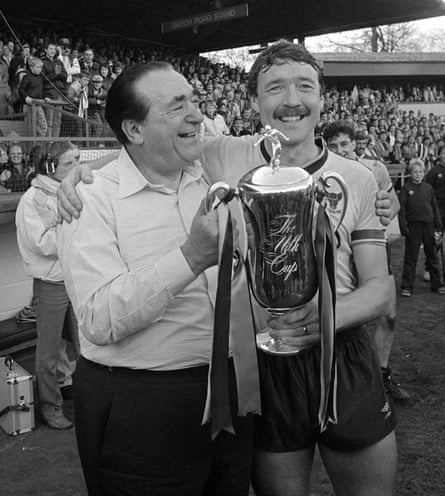
‘He was an enormous figure in British national life’ ... Maxwell, then the chairman of Oxford United, and Malcolm Shotton celebrate the club winning the 1986 Milk Cup. Photograph: PA
But Ken Lennox, then the Mirror’s senior photographer, who saw the publisher’s naked corpse shortly after it was pulled from the sea, is convinced: it was an accident.
“He used to get up at night and pee over the stern of the ship. Everybody knew this. And he weighed about 22 stone [140kg] at this time. The railings were wire. So I think he lost his balance, because he was very top-heavy,” Lennox says. “He was Teflon man. I don’t think he committed suicide.”
Bombastic, bullying and with a deep, booming voice, Maxwell was an enormous figure in British national life. Apart from Mirror Group Newspapers and the New York Daily News, his many businesses included Oxford United and Derby County football clubs. He rose from impoverishment as a Czechoslovakian refugee to become a decorated war hero, a businessman, a Labour MP and then a media mogul, amassing private jets, helicopters and Rolls-Royces en route.
His death on 5 November 1991 shocked the country. Shock turned to anger within weeks when a £460m hole was discovered in the pension funds of his companies. A borrower of unimaginable scale, he had illegally raided the funds to prop up his empire, which was on the brink of collapse. Headlines such as The Man Who Saved the Mirror were swiftly replaced by Maxwell: The Robber.
Lennox found himself at the heart of this drama when he was dispatched to help Maxwell’s widow, Betty, as she flew by private jet to the Canary Islands. On take-off, her husband was still missing. Mid-flight, Lennox recalls, he was summoned to the cockpit by the co-pilot. A body had been found in the Atlantic by a fisherman. The Spanish were unsure it was Maxwell. Would Lennox agree to look first to spare his widow unnecessary distress in case it was not her husband?
They landed at an airbase and Lennox was ushered into a room. “And there was Maxwell. Completely naked, lying on top of the air-sea rescue officers’ mess table with a sheet underneath him. And, I know it sounds crazy, but he looked good. His hair still slicked back, his complexion; he looked as if he was still alive.” Apart from a graze to his left shoulder, Maxwell’s body was unmarked, Lennox says.
‘The rumours started immediately’ ... the Daily Mirror announces Maxwell’s death in 1991. Photograph: Michael Stephens/PA
He signed an affidavit that it was, indeed, the publisher. “Then they asked me to come over and stand by Maxwell. There he was, laid out horizontally in front of me. I held up the affidavit and they took a photograph of me, with Robert underneath. So, somewhere in the Spanish archives, there is a photograph of me with Maxwell’s corpse.”
The rumours started immediately. An inquest that later recorded death by heart attack and accidental drowning (although three pathologists disagreed on the exact cause of death) has failed to quell them.
“People were phoning me up with all the conspiracy theories. ‘Do you think Maxwell was knocked off? Did you see any puncture marks behind his ears?’ But he was unmarked, apart from that graze on his shoulder,” says Lennox.
Betty, completely controlled, would later formally identify her husband. Shortly afterwards, Ghislaine flew in. “She was really, really upset. You could tell, this was ‘Daddy’s girl’. She was inconsolable; she could hardly speak. When she saw her mother, her knees just buckled,” Lennox recalls. “She was really devastated. If you look through the Maxwell files, he would take her to events: Elton John’s birthday, football matches. She was always there, clinging on to him. She called him “My Daddy” all the time.”
The fallout from Maxwell’s death left his family’s reputation in tatters. It also landed two of his sons, Ian and Kevin, in the dock, where they successfully defended themselves in 1996 against fraud charges arising from their roles in his companies.
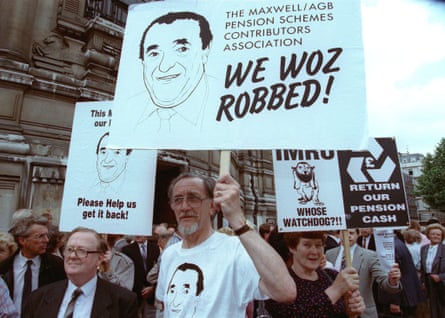
‘Shock turned to anger within weeks’ ... Mirror Group pensioners march on Whitehall to demand the government fill the multimillion-pound hole in their pensions. Photograph: Dylan Martinez/Reuters
Kevin became Britain’s biggest bankrupt, to the tune of more than £400m, in the wake of the pensions scandal. His then wife, Pandora, mother to their seven children, claimed a colourful cameo on the day of Kevin’s arrest. On hearing an early-morning knock at the door and presuming it to be journalists, she flung open a bedroom window and yelled: “Piss off or I’ll call the police.” “We are the police,” came the reply. “That was priceless,” says Lennox, who was among the journalists tipped off to witness the arrest.
“The trial of Robert Maxwell – or the trials of Robert Maxwell, had he come back and faced the music – would have been a piece of amazing theatre. Way up there with Bernie Madoff,” says Greenslade, the author of Maxwell: The Rise and Fall of Robert Maxwell and His Empire.
Ian and Kevin, like all the Maxwell children, were regularly bullied by a father who thought nothing of humiliating them in public (although Ghislaine, apparently, didn’t get it quite as bad). “I felt this was a proxy trial for Maxwell,” says Greenslade, who attended every day of the brothers’ eight-month trial and was pleased when they were acquitted.
For Oxford-educated Ghislaine, the youngest of his nine children, Maxwell’s money had provided status and a ticket to the elite. She was dispatched to New York initially as a meeter-and-greeter, to pave her father’s way when he bought the Daily News. After his death, she made it her home. She soon became part of Epstein’s inner circle and remained there for more than a decade. The two were reportedly briefly an item; they remained close.
She is said to have facilitated Epstein’s social contacts, flying with him on his private jet and organising dinners for influential people at his homes. One acquaintance described her as “half ex-girlfriend, half employee, half best friend and fixer”. Epstein described her, in a 2003 Vanity Fair profile, as his “best friend”.
‘Like all the Maxwell children, they were regularly bullied by their father’ ... Ian (left) and Kevin Maxwell arrive at court during their 1996 fraud trial. They were acquitted. Photograph: Reuters
After he pleaded guilty in 2008 to soliciting prostitution and served 13 months, it appears she moved on, although she remained on New York’s social circuit. She founded the non-profit TerraMar Project for the conservation of oceans in 2012, but it shut down abruptly last month. It is not clear how she supports herself.
She has never been accused of wrongdoing by the authorities. Allegations by Epstein’s accusers that she helped procure girls for the financier have been denied repeatedly.
Maxwell, one of seven children of Jewish parents, was born Ján Ludvík Hoch in the Czechoslovakian mountain village of Slatinské Doly, now part of Ukraine and known as Solotvyno. He claimed not to have had a pair of shoes until he was seven.
He escaped Nazi occupation by fleeing to France as a teenager, but lost his parents, four siblings and most of his extended family in the Holocaust. After joining the Czechoslovak army in exile, he was evacuated to Britain and joined the British army under the name Ivan du Maurier, apparently after a cigarette brand. He fought in Normandy, met his wife – a student at the Sorbonne – and won the Military Cross for heroism on the Dutch-German border; the decoration was pinned to his chest by Field Marshal Montgomery.
Throughout his life, he was a good friend to Israel, investing heavily in publishing, pharmaceutical and computer firms in the country. He met accusations he was an Israeli spy with furious denials and legal threats. Such speculation was fanned again after his death, when he was accorded almost a state funeral in Israel, attended by the prime minister, Yitzhak Shamir, and the president, Chaim Herzog, and buried in Jerusalem on the Mount of Olives. Conspiracy theorists have claimed that Mossad killed him because Israel refused him a loan and he threatened to retaliate.
Lennox was on the private jet that took Betty and her husband’s body to Israel. The crew struggled to load the oversized casket into the small plane, eventually having to prop it up at a 45-degree angle, in clear view of the passengers, he recalls. At one point, looking back, Betty remarked: “Ken, what do you think? Is Robert standing on his head or his feet back there?” “And I said: ‘Well, Betty, he’s always landed on his feet.’ And she just roared with laughter.”

‘He described her as his “best friend”’... Jeffrey Epstein and Ghislaine Maxwell at a party in New York in 2005. Photograph: Patrick McMullan/Getty Images
Maxwell certainly survived many scrapes. In 1971, a Department of Trade and Industry inquiry investigating a takeover bid at his publishing company Pergamon Press concluded that Maxwell was “not in our opinion a person who can be relied on to exercise proper stewardship of a publicly quoted company”. It would have been a damaging setback for many, but not for the man that Private Eye nicknamed “the bouncing Czech”.
After the war, having changed his name once more, Ian Robert Maxwell set about recreating the family he had lost. Of his and Betty’s nine children, their first-born, Michael, died aged 23, after several years in a coma following a car crash, and a daughter, Karine, died of leukaemia aged three. With the exception of Ghislaine, the surviving children lead lives away from the cameras. Ian, 62, and Kevin, 60, have reportedly set up an organisation similar to the Prince’s Trust in Greece.
Growing up, their home was the Oxford mansion Headington Hill Hall, leased from Oxford city council, which Maxwell described as “the best council house in the country”. But Sunday family lunches were rarely happy affairs. He was said to ritually humiliate his children by turn, week in, week out.
Pandora, who reportedly refers to her former father-in-law as the “fat fraudster”, has spoken of the corporal punishment meted out to Kevin as a child. Greenslade witnessed Maxwell’s public admonishments of Ian. In her autobiography, Betty, who died aged 92 in 2013, described Maxwell as bullying, unfaithful and frequently absent. But she insisted he was “not the degenerate monster” many said he was.
To understand Maxwell, says Julia Langdon, the political editor of the Mirror under him for five years, “you have to think of him as a multipersonality. He was the City magnate, the bully, the aspirant politician, the Jewish daddy.” Langdon travelled the world with him and found him fascinating. “He was very bombastic, very prone to flattery, very vain. My first reaction when he died was that I could not think of anyone less likely to commit suicide. I think he fell.”
Greenslade also dismisses the murder theory. Having interviewed the captain and crew of the Lady Ghislaine in depth, he has concluded that no one could have got aboard on that fateful night.
He does not have fond memories of his time with Maxwell, from 1989 to early 1991. Their first meeting, before he was hired, was at a dinner at a London casino. “He behaved atrociously, sweeping all the cutlery and crockery from the table, saying it was badly laid out.” He would sack people while Greenslade was away, play mind games, bully his staff. He used to urinate off the top of the Mirror building and was known to leave the door open when using his office toilet.
Staff often witnessed him trying to impress important visitors by picking up the phone and growling: “Get me the White House. Get me No 10.” The switchboard would ring back three minutes later and he would turn his back, pretending he was involved in a conversation. Once, Greenslade recalls, at a charity performance, Maxwell went on stage to lecture a prima ballerina on how to do a movement. “That was the nature of the beast. What you have here is a kind of sociopathic, possibly borderline psychopathic, character.”
He adds: “Here was a man, totally found out, not able to escape and not able to bluster. And he would have been in the dock. But he might have taken some very interesting people down with him. In that respect, it’s shades of Epstein.”
---
https://gregolear.substack.com/p/deconstructing-the-epstein-myth-what}:}:
...SK
Well, was looking at all of the criminals around Donald, and I had a head start with a piece of information that I had gotten in 2005—before there was even an imagination that this man would run for president. I think to the layman’s understanding, if you knew who Trump was, which people did, that he was political in any way, just maybe he had been and we learned that he had been.
In 2005, Trump had this new reality show with Mark Burnett. And so I had a circle of people that I knew. I’m a writer, screenwriter. So I knew folks in that circle with that man.
GO
Okay. Meaning Burnett.
SK
Yes, Burnett. And I had learned that Donald was in a tremendous amount of debt to some Russians. And it was threatening this new thing—this idea of him as this self-made, you know, billionaire, whatever, whatever the thing was, a successful businessman, because it was all about to crumble. And there’s been a tremendous amount of reporting since I learned that. Verifying all of that. So I had that information at the time, back in the day.
And so when he came down that escalator, I knew, I was like, “Oh no, that’s the guy that’s in debt to a bunch of Russian gangsters!” And so I started trying to figure out who those Russians may be. And then in doing that, I came across Jeffrey Epstein.
GO
Okay, interesting. So Trump to the Russians to Epstein.
## Tinker, Tailor, Mobster, Trump
March 31, 2020
SK
Yeah, well, organized crime—specifically Russian organized crime. And then trying to understand Donald and Fred, Fred’s empire, his father’s empire, which was built with the Genovese crime family. And then the building of Trump Tower in Manhattan that moved in—they had different territory as Fred would call it, as Donald has said on the record—that Manhattan wasn’t. According to his father, “That’s not our territory,” because it wasn’t, it was Gambino territory. For Donald Trump specifically to be able to build in Manhattan, develop in Manhattan, Fred arranged for, and Roy Cohn arranged for, the two crime families, the Gambinos and the Genovese to form what became known as a concrete cartel—all the five families were in there. And this was the bid-rigging over concrete contacts to develop in Manhattan. And it was called “the Donald Trump deal.” And so that was in the middle of it, for those U.S. crime families and the racket they were running, which is this very racket that Giuliani used to prosecute the five families. So…
GO
Four of the five families.
SK
Four of the five families. Castellanos was a holdout and then was killed, shot dead in the street. So that’s the history.
There’s way more than that. During that time, before the Russian mafia had really taken over New York—which it did; it rolled in in the late 80s, some of it even back to the 70s, but very specifically in the 80s and the 90s and just sort of rolled up a lot of the territories as their own. And they did it by laundering money through Donald’s casinos. There was a lot of ways that they did all of that. There was a very prominent Russian gangster named Ivankov, who had actually an office in Trump Tower in Manhattan, but he was ultimately caught, tipped off and caught by Andy McCabe’s team.
Like when you start learning about these characters, of what they were doing back in the day, both on the law enforcement side pursuing Russian organized crime and from the Russian organized crime side—the bosses and the key figures there were all in business in some fashion with Donald Trump.
Then in the mid early 2000s to like 2005, 2006, right around when I was hearing this stuff about him, what was happening was the Russians were wanting to keep using Trump to go internationally. So the properties: Trump Panama developing and Trump Toronto developing and Trump Georgia developing and all of these foreign developments, which we were watching. If you watch “The Apprentice,” it unfolds on “The Apprentice” as well. This sort of expansion of the Trump thing where he was just licensing his name to be put on these things, because he was really over-leveraged.
Like the one in Georgia, the country Georgia—the Trump Tower there, all they did was just stick a shovel in the ground, and a whole bunch of money was laundered. There’s Trump Baku, which, you know, there was quite a bit of reporting how that was probably a front for the Iranian Revolutionary Guard. Again, Iran and their corruption very closely tied in with Russian organized crime as well.
GO
Right. Adam Davidson in the New Yorker.
SK
So that’s the background. That’s why the Trump/Russia thing is not a hoax. Donald is the hoax. You know, he did. And there’s so much reporting and Trump, the company, Allen Weisselberg, all those people, they affirm this, they said, “Yeah, yeah, we took that money.” The problem with it is some of it was illegal, but a lot of it’s not illegal, right?
He couldn’t get a casino license in Australia, infamously. They would not give him a casino license because of his ties to organized crime, both U.S. organized crime and Russian organized crime.
GO
So a major Five Eyes power decided that Trump couldn’t have a casino license because of his ties to organized crime—and specifically Russian organized crime. Let’s just underline that because it seems important. Australia is, as they say, a real country, you know—that is one of our strongest allies.
SK
Right. Right.
So how you get to Jeffrey is, there was a time in the 80s where Donald was really having issues, and he was sort of over-leveraging himself. He was building in Atlantic City. He was doing these things and couldn’t get them funded. He always had a problem getting the money because legitimate banks would stop lending to him, which was the crisis he was facing in the early 2000s, mid-2000s. There was Deutsche Bank, but even Deutsche Bank was turning him down, so he had to go for this Russian money. You could get Russian money, you could get Chinese money, and the Chinese money hadn’t quite showed up yet. But the gangsters will invest in you. So the banks were difficult.
Now part of the stuff that made it hard to get finding from U.S. banks is because of what happened with him in the 80s with Bear Stearns. So there’s a guy that ran Bear Stearns.
(This is all the reporting done by Wayne Barrett. And I recommend everybody go read Wayne Barrett’s work on Donald and Fred Trump and that sort of “Trump Inc.” He did extraordinary work on that. He also did great work on Giuliani and showing what sort of a criminal and a fraud Giuliani was. And it still is, I guess.)
So Ace Greenberg ran Bear Stearns. Bear Stearns is the company that infamously went down in 2008 with all the credit-default swaps, all that kind of stuff that just crashed—you know, the Big Shorttype of thing.
But before that, they were a real player—Bear and Lehman and these other entities. Goldman Sachs. And so Donald had a very close relationship with Ace Greenberg. Ace Greenberg is the man whose daughter was Jeffrey Epstein’s student when Jeffrey Epstein was at the Dalton School. And Epstein did whatever he did at the Dalton School to leverage his just being a math teacher and tutor at this private school into working directly for Ace Greenberg.
So he went into the financial industry at Bear Stearns. And he didn’t come in as a low-level person and work his way up. He came in at a very senior level, and it caused a great sort of upset at Bear Stearns. Who is this guy? Where is he coming from? And why is Ace giving him this plum spot?
And he was handling private wealth management. And his big client that he had, that Ace gave him, was Edgar Bronfman, who’s Sam Bronfman’s son. Sam Bronfman, he established Seagrams, and he was Meyer Lansky and Lucky Luciano’s business partner during the bootlegging days. And Edgar Bronfman has a lot of ties to Russia as well, quite frankly. And it’s his daughters that were part of that NXIVM thing. That’s how people recognize that name, Bronfman.
GO
He’s Canadian though, right? Sam Bronfman?
SK
Yes, he was Canadian. So that was part of the bootlegging thing. Yeah.
But that was Jeffrey’s client, and he got into difficulties and troubles there at Bear Stearns with that particular client managing, you know, and he basically had to be fired. And Ace really resisted firing Jeffrey. And what I uncovered and discovered was that he didn’t fire him. He just moved him into Offshores. Jeffrey went into establishing offshore accounts and offshore money, sort of tax havens for Bear Stearns clients.
If you go into the Offshore Leaks database—which is where I found Jeffrey’s offshore accounts, some of them—you can see there are old Bear Stearns officers. In fact, Ace Greenberg’s partner at Bear Stearns is still connected and linked into those offshore accounts. So Epstein was very much doing that business, and he was doing that business for Bear Stearns right at the time that Bear Stearns was doing these wild, risky, money-backing things for Donald, for Donald developing his casino.
:{:{So thatis where I found him. And I’m like, “Who’s this Jeffrey Epstein, and what is this?” And then I started looking into Jeffrey Epstein, and I’m like, “My God, everybody’s some kind of sex-trafficking criminal.” He’s not the only one that was tied in with Donald’s business or his financial backing in some way that also was convicted for sex trafficking.}:
There’s another guy named Tevfik Arif, who was a big partner with Donald, who had that yacht with all the underage prostitutes and the trafficking that went on there. There’s a yacht, I think off of Turkey where they were finally caught, he was finally caught. So there’s the folks in Panama: his business partners in Panama were nailed for sex trafficking, international sex trafficking. And the people in Canada: there’s ties in there for his business partners in Trump Toronto and Canada, who were also Russian. The main partner there was the son-in-law of Semion Mogilevich’s business partner and consigliere—Semion Mogilevich being a great big Russian gangster.}:
And then there’s all the Craig Unger reporting on Mogilevich, that Donald was in fact laundering Mogilevich’s money himself. And that’s the man who originally compromised him. So that’s the money. It’s full of sex traffickers and it’s full of Russian gangsters.
GO
So let’s underline again Semion Mogilevich. That’s an important connection because Semion Mogilevich, if I remember correctly, was at one point directly working with Robert Maxwell. That was in one of those books, right?
SK
Correct. In Maxwell’s biography, Mogilevich is named several times. I believe the source for that was Ari Ben-Manashe, a former Israeli intelligence officer who also worked for the Kremlin. But that Robert Maxwell biography—this is Ghislaine Maxwell’s father—outlines Robert Maxwell as a Mossad and a KGB spy. That means that he was an intelligence officer. It looks like he also did—there’s quite an FBI file on him. He probably worked with U.S. intelligence at times, and it looks like he definitely worked for the Queen. He was very close with, very close with the Queen. He touched the Queen. There’s video of him, footage of him touching her, like walking alongside her and touching her like.
GO
He was friends with the Queen. Yeah.
SK
That’s very rare and weird and very strange.
GO
It’s very strange. Robert Maxwell also, when he died in 1991, in November of 1991, by falling off a yacht off the coast of the Canary Islands—as happens, I guess, all the time, so no foul play at all, none suspected; it’s weird how that thread keeps going up—but remember, he had defrauded the pensions of the company, the publishing company that he bought. So he was about to collapse before he died, like his entire...
SK
That’s right.
GO
…financial empire was a house of cards, and it was all bullshit. So that’s an important thing to keep in mind.
SK
That’s right. And he knew Donald. Donald knew him directly. There’s a lot of images and photographs. They were on the yacht, the Lady Ghislaine, that he named after his daughter. So yeah.
GO
They were on the yacht, in Page Six. With Ivana, which is interesting because Robert Maxwell is born Jan Hoch and is from Czechia. And Ivana Trump is also Czech. So I envision a scenario where the two of them are on the yacht talking in Czech, and Trump is just standing there like an idiot.
SK
I’m sure, yeah. Junior, I believe, is fluent in Czech. People underestimate Don Jr.
GO
Yeah, and Baron is fluent in Slovenian, yes.
SK
But you know, another character that was in that world with them, with Robert Maxwell—and it’s important because his money shows up in Jeffrey Epstein’s next big financial scam after the Bear Stearns moving him—is a man named Adnan Khashoggi, who is Jamal Khashoggi’s uncle. And there’s not a lot of Khashoggis, actually, by the way.
Donald knew the Khashoggis very, very, very well. Ivana called Adnan her best friend quite often. When Donald bought the one and only yacht he’s ever bought, he bought Khashoggi’s yacht. So he bought Khashoggi’s, yeah.
And Khashoggi was a known intelligence officer for Saudi Arabia, but he was at one point the wealthiest man in the world.
GO
He was an arms dealer, right? Wasn’t he an arms dealer?
SK
He was a big arms dealer. Yeah.
GO
I remember that, even in the moment, people knew who he was. Like, he wasn’t some hidden figure. I remember reading about him in the 80s. I didn’t know what these people were at the time. But I knew their names.
SK
Paul Manafort was also in this mix, Tom Barrack was in this mix. There were a lot of folks that we saw show up in Trump 1.0 as President, helping with his campaign, that were swirling around in this—what I call the underworld. But it’s where crime syndicates and intelligence services are just, you know, intertwined.
And that’s what MAGA is aware of when it comes to Jeffrey Epstein. They can kind of feel that there’s something odd there. There are intelligence services there.
Now, it’s important to point out that before Robert Maxwell died—there are several people who are credible witnesses and know what they’re talking about that have identified that Robert Maxwell was taking Jeffrey Epstein around and sort of introducing him as his protégé. So this myth—this lie—that Ghislaine and Jeffrey told that he showed up after Ghislaine’s dad died, that she moved to New York and that’s where she met Jeffrey? No, no, no, no, no, no, no. They knew each other before her father died or was killed or whatever happened off the side of that yacht. So that’s kind of key.
And then Jeffrey went from there to creating one of the biggest Ponzi schemes, the biggest Ponzi scheme ever before Bernie Madoff. He almost kind of invented it. That was called Towers Financial. And I talked a lot with Steve Hoffenberg; you talked with him as well. He was a tricky character. He’s passed away now, but he went to prison for quite a long time, and he got out of prison right at the beginning of Trump’s first term. The first person to call him when he was out of prison actually was Roger Stone, he told me.
But Hoffenberg was mortified with what Jeffrey had done with the victims. That reporting had kind of just come out when he was just out of prison. And he did contact the victims, and he did want to kind of make good. Because the money from Towers Financial was never fully recovered, Hoffenberg didn’t understand why he went to prison and Jeffrey got off.
I talked to Hoffenberg a bit. I’m like, “Well, what are some of the ways that someone gets out of being prosecuted for a big crime financial crime like this?” And it looks like Jeffrey very much cooperated with prosecutors. Now, there were a lot of criminals that were part of Towers; that was a big money laundering vehicle. Quite a lot of the money from Iran-Contra, Steve Hoffenberg suspected, was pushed—that Jeffrey got his hands on—it was pushed through Towers.
That is money that Robert Maxwell was in charge of that also disappeared around the time of his pension scandal. And so there was a lot of pressure on Robert Maxwell right before his death. It wasn’t just that his empire was crumbling. There was a lot about to be exposed of the kind of places he’d had his hands in, money that disappeared that he should never have been anywhere near it. And it exposed nation-states, intelligence services, doing what maybe they shouldn’t have been doing.
So that’s the world. It’s like a private intelligence rogue operatives. Private arms dealers like Adnan Khashoggi or the guy that Nicolas Cage played in that movie, Lord of War—like those guys, that world.
There’s also: you don’t have to just deal in arms or traffic in arms. You can traffic in kompromat, right? You can traffic in other things that would have value to intelligence services of both our nation and other nations. And it does very much look like that Robert Maxwell was in that business. It looks like Ghislaine took the mantle, and Jeffrey took the mantle from him and developed their own little operation. So all of the pieces are there for Epstein to have that connection.
And Towers Financial, I think, is also a great big piece that doesn’t get talked about enough, in terms of, What kind of deal did this guy cut with those prosecutors, that he got out of facing prison? And his business partner went in for 20 years, 18 years or whatever.
And knowing the kind of money, the kind of players that Epstein ran with, just with that one fraud and scheme alone—those are very valuable names, and a lot of money that he could have turned over to prosecutors to cut himself a deal. That could very well be the key to Alex Acosta’s phrase about Jeffrey, when he says he was told Epstein “belonged to Intelligence.” Because he would have some really big names in Towers, and really powerful players that maybe were on a sanction list, quite frankly.
GO
So just to review quickly, Towers Financial ran from 1988-1993. He’s now worked, Jeffrey has, as a math teacher at Dalton (where he got fired), at Bear Stearns in some weird capacity (where he got sort of fired). And then he went to work, if I remember correctly, Hoffenberg said Epstein went to work for Douglas Leese, who was another person in that world.
SK
Leese, yes—who was an arms dealer for the Queen. Right.
GO
And he, Leese, according to Hoffenberg, recommended Epstein to Hoffenberg by saying, “He’s smart and he has no moral compass.” So Hoffenberg knew he was going to do this Ponzi scheme, and he needed like a guy to help him with it. And that’s why he hired him. Like, specifically.
SK
And that would have been while Robert Maxwell was still alive or just sort of on his way out to the next world. Yeah. Right. All right around that time.
GO
Right. Again; so now, we’re all the way into the early 90s, and so far it’s money and offshores and arms deals and Russian mobsters and shady characters, but we haven’t even—we haven’t gotten to the sex trafficking part yet, right?
SK
Yeah, as far as we know, it wasn’t happening then. And that’s just—we only know what’s in those court documents, with what the prosecutors brought to light. And a lot of it’s still redacted. But yeah, then he’s setting up, and he’s got Les Wexner, you know, somehow come folding him in.
GO
Les Wexner being the guy that owns Victoria’s Secret and these other big retail chains. And that was the time when Jeffrey was walking around saying he was a model scout for Victoria’s Secret, you know, as a pickup line that he was using.
SK
That’s correct. There is a journalist in the Ohio area, Bob Fitrakis, who’s really good, a great muckraker, and he did a lot of work on Wexner and Wexner’s ties to organized crime. And Wexner as a potential…what’s called a non-official cover, a NOC, for our own intelligence services. Wexner has an airfield there in Ohio, a private airstrip, and there were planes coming in and out of there that Fitrakis believed and tracked to our own intelligence services.
GO
Right, and Wexner’s the guy that owns the lovely, huge mansion on the Upper East Side of New York, on East 73rd, where he’s like, “Why don’t you just live in my mansion? You know? Why don’t you Kato Kaelin this? And you just move in. I don’t need it, it’s fine, it’s good.”
SK
Right. Yeah. To Epstein, yeah, Wexner handed over the most valuable piece of property, the most valuable private residence in Manhattan to Jeffrey—just gave it to him.
GO
Which is, I think, I would say odd, unusual, strange, whatever word you want to use. Weird.
SK
It’s odd.
The other odd thing, and we talked about this this past week a lot, but we kept talking about it at the time, too. We do know that that all of these homes, New York, down in Palm Beach, out in New Mexico, the island and the plane, that these properties that either Jeffrey owned or had access to or were his in some way or form, all had surveillance technology wired throughout them. That’s in the underlying evidence in the court cases against him. So we’re not just speculating about this. It’s in the evidence. And you have to understand that we’re talking about properties that he was using for the—you know, for the abuse, while he abusing these minors and raping the minors.
---
Wikipedia, the free encyclopedia
:{:{The 'Brokers of Death' arms case (officially United States v. Samuel Evans et al[1][2]) was a US criminal case in the 1980s relating to the attempted shipment of $2.5bn worth of US-made arms to Iran. The Los Angeles Times in 1986 described the case as "the largest arms conspiracy prosecution ever brought by the Justice Department".[3]}:
The case (with indictments in May 1986, following a four-month investigation) was dropped in January 1989 after the prosecution said it could not prove the defendants did not believe their dealings were officially sanctioned. The planned deals were being arranged at the same time as the White House was secretly seeking to arrange arms sales to Iran, in what became known as the Iran-Contra affair; some evidence indicated that defendants were aware of these efforts.[4]}:
Overview
:{:{In December 1985, the case began when Iranian banker Cyrus Hashemi approached US Customs with a deal. Hashemi, described by Assistant Treasury Secretary John M. Walker, Jr. as a "major figure in international arms trafficking", had been indicted in July 1984 over arms dealing with Iran, and sought leniency in exchange for cooperation.[5] The US agreed to drop the charges against Hashemi in exchange for his cooperation.[3]}:
Hashemi said he had been approached in late 1985 by Samuel Evans, an advisor to Saudi arms dealer Adnan Khashoggi, leading to US Customs setting up a sting operation. The four-month investigation, costing over $100,000, led to arrests in April 1986 in New York and Bermuda, with the involvement of Special Agent Joseph F. King.[5] Evans was recorded by US Customs saying that he had received assurances of "full and complete cooperation" from Israeli officials, and was expecting to discuss the matter with Israeli Defense Minister Yitzhak Rabin on his next trip.[5]}:
In April 1986, 17 suspects were indicted in the case, accused of planning to use false end-user certificates to bypass the US arms embargo against Iran. Three suspects were named as retired Israeli general Avraham Bar-Am, William Northrop, and Samuel Evans. The deal was said to involve over 100 aircraft, as well as tanks and missiles.[6] Tanks were promised by Bar-Am, who said they were Soviet tanks captured from the Syrian Army in 1973.[5] Indictments were issued on 5 May 1986.[7] According to Victor Ostrovsky's The Other Side of Deception, a contact at Mossad asked Ostrovsky to call Bar-Am on 8 April 1986 and tell him that the deal had been approved. Ostrovsky said he made the call, knowing that Bar-Am was walking into a trap - his contact had told him that Bar-Am's contact had been "turned" by the FBI.[8]
Evans' lawyer later told the court that Evans had first been introduced to Hashemi by Roy Furmark, a close friend of Central Intelligence Agency Director William Casey, in January 1985.[9] Furmark was alleged to have repeatedly assured Evans that according to Casey the US approved of supplying arms to Iran.[9] Northrop sought Casey's telephone logs, claiming to have spoken with Casey on a monthly basis since 1981 and that Casey knew of and approved of the deals.[3] Testifying to Congress, Casey stated Furmark told him in October 1986 about the possible diversion of funds from arms sales to Iran.[10] One of the defendants met with US Ambassador Maxwell M. Rabb in Rome, and was recorded telling Hashemi that he was waiting for Rabb to confirm official approval (Rabb later admitted the meeting but denied discussing the arms deal).[3] An arms dealer with a diplomatic passport, John Delaroque, not indicted, assured Hashemi on 7 February 1986 that the matter had gone as far as the Vice President.[11][12]
:{:{In November 1986 Iran-Contra affair revelations forced the Justice Department to launch a review of the case.[13] After a Supreme Court decision in an unrelated case narrowed mail and wire fraud prosecutions, 46 of the 55 charges were dropped in mid-1988.[14][15]}:
The case against the 12 defendants was finally dropped in January 1989, with prosecutor Rudy Giuliani conceding that the prosecution was unable to prove that the defendants did not believe the planned deals "were officially sanctioned or that approval of the United States for such sales could be obtained".[7] The planned deals were being arranged at the same time as the White House was secretly seeking to arrange arms sales to Iran (including suspending enforcement of the Arms Export Control Act in January 1986[16]), in what became known as the Iran-Contra affair; some evidence indicated that defendants were aware of these efforts. Some defendants were close associates of Adnan Khashoggi, who became a middle-man in arms sales to Iran which were officially approved and carried out.[4]}:
Books
- Hermann Moll and Michael Leapman (1988), Broker of Death: An Insider's Story of the Iran Arms Deals Macmillan, ISBN 978-0333459423
References
---
ggl 11 25 arms
[### ARMS SALES - Early Day Motions - UK Parliament

UK Parliament
https://edm.parliament.uk › early-day-motion › arms-sales](https://edm.parliament.uk/early-day-motion/2136/arms-sales)
... Robert Maxwell, have maintained a close relationship with the Israeli Intelligence Service, Mossad, and specifically, that in 1983 the Foreign Editor of the ...
[### The murky life and death of Robert Maxwell

The Guardian
https://www.theguardian.com › us-news › aug › the-mu...](https://www.theguardian.com/us-news/2019/aug/22/the-murky-life-and-death-of-robert-maxwell-and-how-it-shaped-his-daughter-ghislaine)
Aug 22, 2019 — It is almost 30 years since her father, the press baron Robert Maxwell, fell to his death from his £15m yacht, Lady Ghislaine, off the Canary ...
Missing: sales | Show results with: sales
[### Brokers of Death arms case

Wikipedia
https://en.wikipedia.org › wiki › Brokers_of_Death_ar...](https://en.wikipedia.org/wiki/Brokers_of_Death_arms_case)
a US criminal case in the 1980s relating to the attempted shipment of $2.5bn worth of US-made arms to Iran.
[### CIA SHIPPED ARMS FROM BRAZIL, INDIA

CIA (.gov)
https://www.cia.gov › readingroom › docs](https://www.cia.gov/readingroom/docs/CIA-RDP90B01390R000100090033-4.pdf)
Robert Maxwell, a former First National senior executive, acknowledged that the bank handled the. Associated Traders account with the clear understanding ...
4 pages
Missing: sales | Show results with: sales
[### THE SINKING OF CAPTAIN BOB | Vanity Fair | March 1992 Vanity Fair
https://archive.vanityfair.com › article › share](https://archive.vanityfair.com/article/share/772fa3a5-0e89-4442-9c1f-3e0dbe42f349)
Did the same furies that drove Holocaust refugee Robert Maxwell to build a high-stakes media empire play a role in his demise?
[### Robert Maxwell, 68: From Refugee to the Ruthless Builder ...

The New York Times
https://www.nytimes.com › 1991/11/06 › world › rober...](https://www.nytimes.com/1991/11/06/world/robert-maxwell-68-from-refugee-to-the-ruthless-builder-of-a-publishing-empire.html)
Nov 6, 1991 — ... selling arms in partnership with an Israeli intelligence operative. Mr. Davies denied the charge last month, but later, confronted with ...
[### The rise and fall of Robert Maxwell

The Times of Israel
https://www.timesofisrael.com › from-wooden-shack-to...](https://www.timesofisrael.com/from-wooden-shack-to-global-media-magnate-the-rise-and-fall-of-robert-maxwell/)
Feb 23, 2021 — From wooden shack to global media magnate: The rise and fall of Robert Maxwell. His death 30 years ago remains a mystery, but a new book by ...
Missing: arms | Show results with: arms
[### Robert Maxwell

Jewish Virtual Library
https://www.jewishvirtuallibrary.org › maxwell-robert](https://www.jewishvirtuallibrary.org/maxwell-robert)
At this time he also engaged in commercial activities and following his demobilization in 1947 he entered business, specializing in import and export between ...
Missing: sales | Show results with: sales
---
ggl 11 25
robert Maxwell

Wikipedia
https://en.wikipedia.org › wiki › Robert_Maxwell](https://en.wikipedia.org/wiki/Robert_Maxwell)
Ian Robert Maxwell was a British media proprietor and politician. Robert Maxwell. MC. Maxwell at the Global Economic Panel in Amsterdam (1989).
[### Maxwell - the 'red' the feds failed to nail | World news

The Guardian
https://www.theguardian.com › freedomofinformation](https://www.theguardian.com/world/2000/oct/14/freedomofinformation.uk)
Oct 13, 2000 — He was secretly paid by the KGB to publish 50,000 copies of a series of fawning biographies of communist leaders, although he duped them about ...
[### Robert Maxwell, the KGB and MI6 | House of Maxwell | BBC ...

YouTube · BBC Select
80.1K+ views · 3 years ago](https://www.youtube.com/watch?v=RzFsHWlfsj0)
2:40
Robert Maxwell had connections with MI6 for years, whilst also maintaining links with the KGB as well. This clip from House of Maxwell, ...
[### Who Is Ghislaine Maxwell's Father, Alleged Spy For Israel ...

NDTV
https://www.ndtv.com › World News](https://www.ndtv.com/world-news/who-is-ghislaine-maxwells-father-robert-maxwell-alleged-spy-for-israel-uk-and-russia-8938577)
Jul 24, 2025 — Multiple sources report that UK Foreign Office suspected Maxwell as a double or triple agent, with ties to MI6, the Soviet KGB, and Israeli ...
[### THE SINKING OF CAPTAIN BOB | Vanity Fair | March 1992 Vanity Fair
https://archive.vanityfair.com › article › share](https://archive.vanityfair.com/article/share/772fa3a5-0e89-4442-9c1f-3e0dbe42f349)
Journalists wrote that he was a spy for the K.G.B. or Mossad or Czech intelligence—or all three. Others charged that Maxwell's emergence late in life as a born- ...
[### Robert Maxwell was a Czech born businessman and ...

Reddit · r/wikipedia
80+ comments · 3 months ago](https://www.reddit.com/r/wikipedia/comments/1m9oci1/robert_maxwell_was_a_czech_born_businessman_and/)
Robert Maxwell was a Czech born businessman and newspaper publisher in the UK. In 1991 he died after fallimg off his yacht, The Lady Ghislane.
Why was Ghislaine *Maxwell's* dad (a British citizen ...
178 posts
Jul 16, 2025
*Robert Maxwell* & the *KGB* | Espionage History ...
10 posts
Dec 21, 2019
More results from www.reddit.com
[### Who was Robert Maxwell? Ghislaine Maxwell's father, who ...

Hindustan Times
https://www.hindustantimes.com › World news › us news](https://www.hindustantimes.com/world-news/us-news/who-was-robert-maxwell-ghislaine-maxwells-father-who-had-alleged-ties-with-kgb-and-mossad-101753349262783.html)
Jul 24, 2025 — Whispers within the UK Foreign Office linked Maxwell to MI6, the Soviet KGB, and Israel's Mossad, working as a triple agent. He was said to have ...
[### The Assassination of Robert Maxwell: Israel's Superspy martindillon.net
https://www.martindillon.net › the_assassination_of_robe...](https://www.martindillon.net/the_assassination_of_robert_maxwell__israel_s_superspy_26176.htm)
Robert Maxwell was a Mossad spy. He asked them for £400 million. They refused and feared he would expose them. So three assassins killed him with a nerve agent.
[### The Maxwells: Scandal, conspiracy and more than a few ...

The Times of Israel
https://www.timesofisrael.com › the-maxwells-scandal-c...](https://www.timesofisrael.com/the-maxwells-scandal-conspiracy-and-more-than-a-few-days-in-court/)
Jul 4, 2020 — Ghislaine Maxwell comes from a family dominated by her father, Robert, whose mysterious drowning at sea left behind conspiracy theories, financial scandal and ...
[### Robert Maxwell, Israel's Superspy - Kansas City

BiblioCommons
https://kclibrary.bibliocommons.com › record](https://kclibrary.bibliocommons.com/v2/record/S120C257904)
In 1991, British media tycoon Robert Maxwell died in mysterious circumstances off his yacht in the Canary Islands. The official cause of death was drowning.
7.4/10(7)
Missing: kgb | Show results with: kgb
---