wicked problem
---
:{uber1:
old https://webbrain.com/brainpage/brain/6950F840-FB80-FCB0-D505-8AB1FA685F08#-4536}:
---
climate: https://thewire.in/environment/climate-change-wicked-problem
in1973, Horst Rittel and Melvin Weber, two members of the faculty of design and planning at the University of California, Berkeley, described ‘planning’ as a “wicked problem”. They argued that science could solve only well-defined problems with clear solutions, implying ‘wicked’ wasn’t a statement of morality as much as an adjective for a problem that resisted definition. In effect, wicked problems will have to be solved not once but many times, and they won’t ever fully go away.
Examples of such problems include social and policy issues, like crime, healthcare and education. Rittel and Weber specify ten properties that makes a wicked problem wicked. It’s worth revisiting this list in the context of the world’s climate crisis if only to show that while natural scientists and economists dominate the conversations we have about climate change, social scientists and their concerns are barely visible or heard.
1. There is no one definition of climate change.
Despite the seemingly exponential growth of the climate change literature, even the Intergovernmental Panel on Climate Change doesn’t provide one fixed definition of climate change. The phenomenon refers to how much Earth’s surface has warmed since the first industrial revolution. This figure ranges from 0.8º C to 1.2º C depending on the dataset used for analysis (and whether we’re including the Arctic region).
More generally, climate change refers to the additional change in climate variability as a result of human activities. Scientists have been checking if humans are responsible for any changes in our planet’s physical, chemical and biological systems in the atmosphere, ocean and on land. This is usually in the form of quantifying changes in the likelihood of occurrence of a given change. The activities of detection and attribution both carry some uncertainties, thanks especially to the use of models.
2. You can’t know when you’ve solved a problem under the climate change umbrella.
Decision-makers work with targets, not solutions, to avert dangerous anthropogenic interference (DAI). The UN-mandated targets to avoid DAI include keeping the world’s surface from warming by more than 2º C and 1.5º C on average. However, scientists and activists have criticised these goals as being, not scientific, and have noted that they will mostly likely be exceeded. At the COP25 international climate summit currently underway in Madrid, countries aren’t going to discuss how long it’s okay to keep the planet’s surface warmer than these thresholds either.
The other target is derived from studies that show the temperature rising linearly with cumulative carbon dioxide emitted since the first industrial revolution (i.e. as an equation of the form T = k × C, where ‘k’ is a constant). Scientists use this relationship to estimate how much more greenhouse gases we can emit before we blow past the temperature targets – a quantity that varies from 100 billion tonnes to more than 500 billion tonnes (of carbon), depending on the model used. These allowances don’t include greenhouse gases that are not carbon dioxide nor feedback mechanisms that can accelerate warming.
As a result, there’s no stopping rule for climate change. As we emit more carbon, we have to actively capture and sequester it to constantly stay within the temperature targets.
3. Solutions to the climate crisis are not true or false, or good or bad.
In the 1990s, the best way to deal with climate change was for countries to abide by the terms of the Kyoto Protocol. In the 2020s, the world will replace the Kyoto Protocol (in this context) with the Paris Agreement. Countries are also yet to agree on the latter’s hairier details, such as losses that developing countries incur due to the climate breakdown brought about by the developed countries’ historical emissions. The social cost of carbon and the return on investments in adaptation and mitigation are both value judgements that depend on individual countries as well as the distinct culture of each country.
4. Solutions to climate change generate unexpected consequences over time, making it difficult to measure their effectiveness.
Temperature and carbon budget are global mean quantities and have no direct correlation to local warming. And even if we achieve our temperature and/or carbon budget targets at the global scale, we’ll continue to experience local manifestations of uneven warming, such as uneven rainfall, food insecurity, sea-level rise, etc. Effectively, we don’t have an ultimate test of whether we’ve tamed the climate change problem.
5. Every solution we deploy will have irreversible consequences.
We won’t be able to get back the money we spend and undo the physical infrastructure we setup to meet our adaptation and mitigation goals. We’ll just have to do the best we can each time.
6. Ordinary problems come with a limited set of potential solutions. Climate change doesn’t.
Broadly speaking, climate change does seem to offer a long list of Earth-system components that we can target, like the Arctic ice, glaciers, sea level, biodiversity, etc., by way of solutions. However, the portfolio of solutions can never be complete because the cascading impact and feedback loops in the system guarantee that what is a solution for one sector may be a trigger for new problems in another.
For example, some policymakers consider the bio-energy, carbon capture and sequestration technology (a.k.a. BECCS) to be a viable mitigation strategy. But to deploy it, we’ll have to clear large tracts of land, fertilise them, even out their impact on food security, and ensure they achieve sufficient carbon sequestration potential. These actions are sure to create more layers of problems to deal with.
7. Climate change has no precedent, so experience won’t help you deal with it.
We can understand the processes that drive climate change as problems of natural science but their impact as well as our attempts to negotiate adaptation and mitigation strategies are often socioeconomic and political problems. Climate change is the only problem in human history to have affected every aspect of Earth’s physical, biological and cultural systems, and it’s happening now.
8. While ordinary problems are self-contained, climate change is mixed up with other problems, and doesn’t have one root cause.
The climate breakdown is clearly a symptom of our most basic evolutionary trait: that all heterotrophic life-forms consume energy and pollute the environment. Of these life-forms, humans – through their lifestyles – have evolved to consume energy and pollute their environment at unsustainable levels. And the behavioural change required to move away from these lifestyles seems to be beyond human ability, at least in the short-term.
9. Climate change involves many stakeholders, nearly all of whom have different ideas of the problem and its ideal solutions.
The climate crisis has more stakeholders than any other global or local problem humans have faced, including terrorism and globalisation. And unlike the hole in the ozone layer, which adversely affected all species of life on the planet, climate change can and will produce winners and losers. For example, if Siberia warms to a certain degree, it could become the world’s new bread-basket.
More generally, global heating produces winners where higher temperature and ecological changes favour greater access to and extraction of natural resources without significantly affecting the quality of life.
At the moment, representatives from the governments of 197 countries are currently engaged in negotiations at the UN’s COP25 climate summit in Madrid – and they don’t appear to be willing to assume any binding responsibilities, policies or regulations to deal with climate change. In fact, nearly all countries have determined their respective individual contributions (or nationally determined contributions, NDCs) and none of them are enough to meet temperature targets by all estimates.
India’s own NDC, one of the more acceptable ones of the lot, can still only keep Earth’s surface from warming by 2º C, and not 1.5º C as the Paris Agreement requires. When experts around the world set out to verify where we stand vis-à-vis the Paris Agreement in 2023, we should prepare to receive bad news, that our governments have done little beyond protect themselves, and worse news, that our world is headed for an unprecedented disaster.
10. Problem-solvers are liable for the consequences of any actions they take because the actions will have a large impact.
Climate-change negotiations at the global stage have already created a two-tiered system in which global agreements are to be implemented at the country level. And country-level ratification hasn’t been a straightforward thing. Major obstacles include political accountability for potential impedance to economic growth resulting from attempts to protect the global commons, such as the atmosphere, oceans and glaciers.
* * *
So even as the climate-science enterprise continues to produce remarkable new insights, it’s time we recognised climate change as a wicked socioeconomic problem that we can resolve, but not solve, with the help of the expertise of scientists as well as social scientists.
Raghu Murtugudde is a professor of atmospheric and oceanic science and Earth system science at the University of Maryland. He is currently a visiting professor at IIT
---
https://core.ac.uk/download/pdf/73975147.pdf
Cornell Law Review
Volume 94
Issue 5 July 2009 Article 8
Super Wicked Problems and Climate Change:
Restraining the Present to Liberate the Future
Richard J. Lazarus
Climate change may soon have its "lawmaking moment" in the United
States. The inherent problem with such lawmaking moments, however, is
just that: they are moments. What Congress and the President do with much
fanfare can quickly and quietly slip away in the ensuing years. This is
famously so for environmental law. Subsequent legislative amendments,
limited budgets, appropriations riders, interpretive agency rulings,
massive delays in rulemaking, and simple nonenforcement are more than capable of
converting a seemingly uncompromising legal mandate into nothing more
than a symbolic aspirational statement.
Climate change legislation is especially
vulnerable to being unraveled over time for a variety of reasons, but
especially because of the extent to which it imposes costs on the short term for
the realization of benefits many decades and sometimes centuries later. To be
successful over the long term, climate change legislation will need to include
institutional design features that insulate programmatic implementation to a...
significant extent from powerful political and economic interests propelled by
short-term concerns.
Such design features should include a variety of
asymmetric precommitment strategies, which deliberately make it hard
(never impossible) to change the law in response to some kinds of concerns while
simultaneously providing avenues for change in response to other longer term
concerns that are in harmony with the law's central purpose-to achieve and
maintain greenhouse gas emissions reductions over time. The traditional
objection to lawmaking precommitment strategies-that the present should
not be allowed to bind future lawmakers-also has little force in the climate
change context, where the purpose of such strategies is not to protect the present
at the expense of the future, but the precise opposite: to protect the future
at the expense of the present.
---
https://www.alternet.org/2021/01/deprogram-trump
aha: it's a wicked problem? meme virus has defense mechanism built in?! lack of evidence is evidence
no lnx vid
Global politics expert explains why it’s so hard to ‘deprogram’ Trumpian conspiracy theorists
Supporters of Donald Trump near the U.S. Capitol Building on January 6, 2021, Tyler Merbler
Alex Henderson January 26, 2021
The word "deprogramming" is typically used in connection with extremist religious cults such as the Unification Church, the Tony & Susan Alamo Christian Foundation or Jim Jones' the People's Temple, but cults can be political as well — for example, the QAnon movement. Political science expert Brian Klaas, in a Washington Post op-ed published on January 25, lays out some reasons why it is so difficult to "deprogram" Americans who have embraced far-right political cults and outlandish conspiracy theories.
"For the past four years, the United States was governed by a conspiracy theorist in chief," explains Klaas, who teaches global politics at University College London. "Whether by retweeting QAnon accounts from the Oval Office or painting himself as the victim of shadowy 'deep state' plots at rallies, President Donald Trump injected the toxin of baseless conspiratorial thinking straight into America's political bloodstream. On January 6, America saw how far that venom had spread as a ragtag group of militias, racist extremists and flag-waving disciples of Trumpism stormed the Capitol."
The January 6 "insurrectionists," Klaas adds, had certain things in common: they were "unified by their support for Trump" and were also "conspiracy theorists."
"There is no doubt: the United States has a serious problem with pathological political delusions," Klaas warns. "So, do we have any hope of deprogramming the millions of Americans who are devoted to dangerous lunacy? Don't hold your breath….. Once people have gone far enough down the rabbit hole of conspiratorial thinking, it can be nearly impossible to get them back out."
Klaas goes on to list some reasons why it is so difficult to "deprogram" conspiracy theorists. According to Klaas, "First, conspiracy theorists are far more likely to have a Manichaean worldview, meaning they interpret everything as a battle between good and evil….. Second, those who seek to debunk conspiracy theories are precisely the people that true believers distrust [WICKED PROBLEM?]…. Third, these organized mass delusions are designed to resist debunking."
There's a joke among critics of far-right conspiracy theorist and radio host Alex Jones that goes something like this: what did the Alex Jones listener say when told that there is no New World Order? The listener said, "Yeah, that's what the New World Order wants you to think." It's a joke, but it speaks to one of the important points Klaas makes in his op-ed — that when someone pushes back against conspiracy theorists, they sometimes respond by digging in even more.
A variety of media outlets, from CNN and MSNBC to Mother Jones and The Nation, have been relentless when it comes to debunking the far-right conspiracy theories that came from the Trump Administration and its sycophants. But Klaas notes that "if someone believes the media is controlled by sinister but unseen puppet masters, fact- checks from CNN will never convince them they're wrong."[// CLIMATE SCI, IF EXPERTS SAYS IT IT IS WRONG]
"For the past four years," Klaas notes, "those who have worked hardest to dispel QAnon believers of their fantasies are the very people that 'Anons' trust least: anti-Trump academics like me, news outlets such as the Post and politicians who they believe to be co-opted by the 'deep state.' Political scientists Brendan Nyhan and Jason Reifler have documented the risks of a backfire effect, in which correcting misperceptions actually ends up entrenching them. In the world of conspiratorial thinking, the harder the pushback, the greater the proof that a coverup is afoot."
According to Klaas, the "rise of social media" has made it much easier for far-right conspiracy theorists to live in a bubble.
"Bowling alone has been replaced by tweeting together — a cardboard cutout for real social interaction, but one that has a seductive allure to millions of people," Klaas warns. "Many of the fanatics who stormed the Capitol were neither poor nor social misfits, but rather, had found a digital community to augment or replace their offline one. We can no longer pretend that conspiracy theorists are beneath our attention. They've shown they have tremendous capacity to inflict damage on society."
Klaas discussed his Post op-ed during a January 26 appearance on MSNBC's "Morning Joe." Watch the video below:
'Coalition Of Reality' Needed To Combat Conspiracy Theories, Says Writer | Morning Joe | MSNBC
www.youtube.com
---
aha rich ppl benefit from hurricanes, shipping oil corps benefit from polar ice melt:
---
https://www.alternet.org/news-amp-politics/heres-how-hurricanes-contribute-racial-inequality
Hurricane Lane, which is bearing down on Hawaii, is a reminder of the devastation hurricane season can bring.
Only one year ago Hurricane Harvey ravaged Houston, followed closely by Irma and Maria, which left a trail of destruction across Florida and Puerto Rico. Despite the private and government aid provided after these disasters, thousands continue to struggle even today.
However, not everyone is struggling. In fact, some actually benefit economically from these extreme weather events.
In a new study, which I co-authored with my colleague James Elliott, we found that populations that are privileged in terms of education, race or homeownership gain wealth in the aftermath of natural disasters, exacerbating already wide economic inequities.
Not only that, how the government delivers aid is partly to blame.
Disasters on the rise
Natural disasters from hurricanes to wildfires are on the rise, both in terms of frequency and severity.
And they take a heavy toll. Last year alone, the United States suffered US$260 billion in direct damages from natural disasters. While that’s a devastating figure, it fails to encompass the full extent of the impact – such as a loss in income or uncovered expenses such as medical bills – that can last for months and even years after cleanup begins.
Previous research has shown the aftermath of disasters is more devastating for less privileged residents as they are more likely to lose their job, have to relocate and pay**higher rents due to reduced housing availability.
In our recent paper in the journal Social Problems, we found that the effects are even more profound, with whites, the highly educated and homeowners actually improving their relative financial situation after a disaster, while blacks, those with less education and renters are worse off compared with their peers.
Whites make gains while others lose
We combined nationally representative data from the Panel Study of Income Dynamics on nearly 3,500 families with government figures on natural hazard damages, Federal Emergency Management Aid and local population demographics in every U.S. county.
We then explored how extreme natural disasters influenced changes in family wealth from 1999 to 2013. Throughout our analysis, we controlled for race, education, age, homeownership, family status, residential mobility as well as neighborhood and county demographics with the aim of comparing households that were similar. We also only compared families who started out with similar wealth in 1999.
Overall, we found a surprisingly strong correlation between the scale of damage a county experienced and an increase in average wealth. That is, people who lived in counties that suffered extreme disasters tended to accumulate more wealth over the period than those who lived in mostly unaffected parts of the country. And the more damage a county experienced, the more pronounced the relative gains in wealth.
Greater wealth, however, was not experienced by everyone. Using a statistical technique called interactions, we were able to see how these changes affected different segments of the population depending on race, education and homeownership.
First, we considered the effects of race and found that whites who lived in counties that experienced extreme natural disasters accumulated $100,000 more wealth than their peers with similar characteristics who did not.
For people of color, on the other hand, this effect was reversed. Specifically, black residents living in disaster-prone counties lost $46,000 in wealth compared with their counterparts elsewhere. And Latino residents in affected counties lost $101,000 relative to similar peers.
In other words, while whites benefited financially by living in areas hit by hurricanes and other disasters, people of color were clobbered.
We then examined the impact of education, holding other factors constant. We found that higher levels of education were also associated with a tendency to benefit from natural disasters, while those with less experienced devastating losses.
Finally we focused on homeownership. Similarly, our results showed that those who owned emerged a lot better off than those who rented.
Our findings suggest that natural disasters are worsening wealth inequality, especially along racial lines. For example, in Monmouth, New Jersey – a New York City suburb that experienced the most natural disaster damage in the U.S. from 1999 to 2013 – $111,000 of the increase in the white-black wealth gap during the period can be attributed to the impact of the disasters.
This map visualizes these rising inequalities across the largest metropolitan areas.
FEMA aid plays a role
This evidence is depressing in its own right. Yet, what is arguably even more disturbing is Federal Emergency Management Aid is further exacerbating these inequalities.
FEMA aid is distributed to mitigate the negative repercussions of hazards. In the best of worlds this federal assistance would reduce inequality – or at least curtail its expansion. What we found is quite the opposite.
Unlike what you might think, FEMA aid is not distributed solely based on damage or need. In fact, when we compared the amount of natural disaster damage in counties across the U.S. from 1999 to 2013 with how much aid FEMA allocated to them, the correlation is weak. This suggests factors other than need, such as politics, are primarily driving FEMA aid decisions.
However, statistically, this means we can isolate the effect of FEMA aid from natural hazards. When we did this, we found that FEMA aid also exacerbated inequalities. In New York County, for example, which received nearly $8 billion in FEMA aid from 1999 to 2013, we found that $105,000 of the increase in the white-black wealth gap is attributable to FEMA aid.
In short, much like natural disasters themselves, FEMA aid is exasperating wealth inequality.
Lingering questions...
---
https://www.interaction-design.org/literature/article/wicked-problems-5-steps-to-help-you-tackle-wicked-problems-by-combining-systems-thinking-with-agile-methodology
Learn five steps to tackle wicked problems by combining systems thinking with agile methodology. Many successful organizations like Boeing, Walmart, Chrysler and Hewlett-Packard (HP) have adopted agile methodology and have been achieving success and innovation through this collaborative method. By becoming more agile, the team at Chrysler had innovated their steering wheel, outpacing Ford and GM. By incorporating customer input into their design process, Boeing produced a new airline fleet in record time. New problems require innovative thinking, and innovative ideas arise from new perspectives.
10 Characteristics of Wicked Problems
So what defines a wicked problem? Horst Rittel (1930-1990), a design theorist and university professor, first coined the term “wicked problem” in ‘Dilemmas in a General Theory of Planning’ (1973). In the paper, Rittel details ten characteristics that describe a wicked problem:
- There is no definitive formula for a wicked problem.
- Wicked problems have no stopping rule, as in there’s no way to know your solution is final.
- Solutions to wicked problems are not true-or-false, they can only be good-or-bad.
- There is no immediate test of a solution to a wicked problem.
- Every solution to a wicked problem is a "one-shot operation"; because there is no opportunity to learn by trial-and-error, every attempt counts significantly.
- Wicked problems do not have a set number of potential solutions.
- Every wicked problem is essentially unique.
- Every wicked problem can be considered to be a symptom of another problem.
- There is always more than one explanation for a wicked problem because the explanations vary greatly depending on the individual perspective.
- The planner/designer has no right to be wrong and must be fully responsible for their actions.
Walmart’s Wicked Problems Led to Disaster
Walmart, a North American multinational retail corporation, faces its fair share of wicked problems. As a large, global company struggling to speed up growth, you can see that this company’s major challengeexhibits many characteristics of a wicked problem.
Firstly,there is no immediate test of a solution (4th characteristic) for a wicked problem as these solutions often generate unexpected consequences. In the mid-2000s, Walmart attempted to shift their brand to appeal to higher-income customers. In 2005, they started re-branding themselves by launching a high-fashion campaign in Vogue, a high fashion and lifestyle magazine. They also presented fashion shows in New York and opened an office in Manhattan’s Fashion District. Shifting their unique brand would prove to be a “one-shot operation” as it has not been done before, making it difficult to measure effectiveness and control risk. There is no way to test a one-shot solution at full capacity on such a large scale. The result was that, by 2008, massive layoffs shut two divisions at its headquarters in Arkansas. Walmart’s move to high fashion proved to be a disaster.
Second,the root of a problem is often considered to be another problem(8th characteristic), a never-ending cycle! For example, the low-cost practice of the company, originally advantageous, is vulnerable to China’s decisions on its health and safety policies for their workers. It is also susceptible to changing labor laws and economic growth in China.
Finally, explanations for a wicked problem varies greatly depending on individual perspectives(9thcharacteristic). In a large company like Walmart, there is bound to be many stakeholders with differing perspectives and priorities. Stakeholders include everyone from employees, trade unions, shareholders, investors, suppliers, partners to even the government. Walmart’s wicked problems are surely tangled and complex.
How Could Walmart Tackle their Wicked Problems by Combining Systems Thinking with Agile Methodology
Between 2015 and 2016, Walmart’s stocks tumble 30 percent as they go on to close 269 stores. This is an example where a company could benefit from employing both systems thinking and agile methodology. By seeing their wicked problems as systems and breaking them down into digestible nodes (chunks of information – that can for example be objects, people or concepts) and its relationships (system thinking), they can more easily share each other’s ideas with stakeholders and team members. Conceptualizing the problem in such a tangible manner allows those involved to iterate more quickly based on a variety of concrete feedback. Let’s take a closer look at how this method evolved.
Wicked Problems and Design Thinking
The design theorist and academic, Richard Buchanan, connected design thinking to the innovation necessary to begin tackling wicked problems. Originally used in the context of social planning, the term ‘wicked problems’ had been popularized in the paper, ‘Wicked Problems in Design Thinking’ (1992) by Buchanan. Various thought leaders following Buchanan continued on to suggest we utilize systems thinking when faced with complex design problems, but what does that look like in practice for a designer tackling a wicked problem and how can we integrate it with collaborative, agile methodology?
How to Tackle a Wicked Problem using Systems Thinking and Agile Methodology
Design thinkers of the past had already begun the discussion on how to work with wicked problems by utilizing systems design, but why not take it a step further? We know systems thinking helps us understand the components and relationships of a problem. We also know that agile methodology helps with improving solutions through collaboration. Together, the two ways of thinking can be combined to lead us to a better solution at each iteration as they both evolve with the wicked problem.
Agile methodology is an iterative approach to product development. An agile, collaborative environment breeds the ability to be efficient and effectively meet the stakeholders’ changing requirements. On the other hand, systems thinking is the process of understanding how components of a system influence each other as well as influence other systems.
-
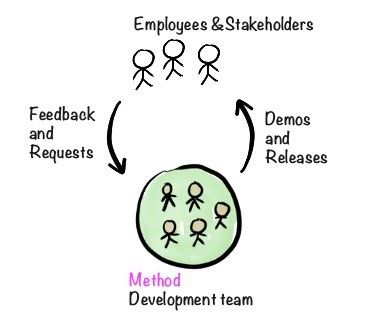
Author/Copyright holder: Yuval Yeret. Copyright terms and licence: CC BY-SA 4.0
Agile Methodology. Every iteration incorporates feedback from the previous release.
Rodale Inc. Reclaimed Lost Revenue and Customer Satisfaction by Using a Collaborative Exercise in Systems Thinking
Rodale Inc., the large publishing company with flagship products like Men’s Health and Runner’s World, had greatly benefitted from a collaborative exercise in systems thinking. As a result, the company reclaimed its lost revenue of 50 million dollars and moved from a D in customer satisfaction rating to an A.
Tom Wujec of Autodesk Inc., and a keynote speaker in the field of business visualization had suggested that organizations break down wicked problems into nodes (chunks of information) and links (the connections and relationships between the nodes), hence utilizing systems thinking when faced with a wicked problem. In his TED Talk, ‘Tom Wujec: Got a Wicked Problem? First, Tell Me How You Make Toast’, Wujec describes a perfect example of how an organization was able to tackle a wicked problem through systems thinking. Besides systems thinking, the “collaborative visualization” Wujec advocates for appears to have the agile elements of feedback and iteration to it. As the team gets together and combines each other’s thoughts and ideas, the bridge between the existing solution and the next iteration is built from gathering feedback from the users and all the stakeholders involved.
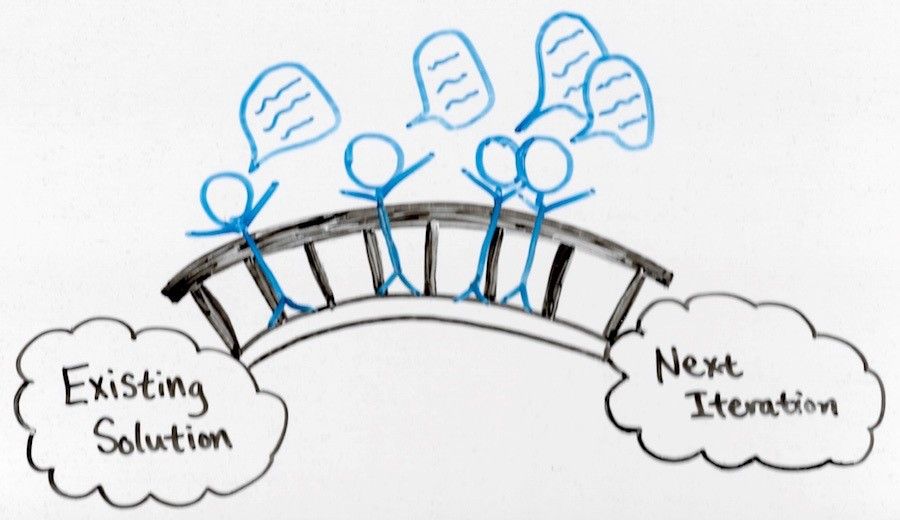
Feedback from your users and stakeholders are crucial when you’re trying to get from your existing design to the next iteration of it.
5 Steps: How You Can Apply Systems Thinking and Agile Methodology in Your Work
Anyone who’s been faced with wicked problems have experienced frustration from not knowing where or how to begin when it comes to issues that are difficult and nearly impossible to solve. Next time, you’ll have 5 handy steps and methods to use and share with your team when tackling wicked problems in design.
- Break down information into nodes (chunks of information – that can for example be objects, people or concepts) and links (the connections and relationships between the nodes) hence utilizing systems thinking when faced with a wicked problem. Doing so makes our private mental models (our representations of the external reality) visible to the outside world. Jay Wright Forrester, a pioneer in computer engineering and systems science believes that system thinking is:
"The image of the world around us, which we carry in our head, is just a model. Nobody in his head imagines all the world, government or country. He has only selected concepts, and relationships between them, and uses those to represent the real system.”...Author/Copyright holder: Tom Wujec. Copyright terms and license: CC BY 3.0...Nodes represent the objects/people/concepts while links show the connection and relationship between the nodes. In this illustration, nodes are circled in red and links are the red lines drawn between the circles. All four illustrations are systems models that participants created from Tom Wujec’s workshops on collaborative visualization and systems thinking.
Visualize the information. Sketching and placing information into a physical space helps both you and your team take in and understand the systems at hand as well as the relationships within and between them.}:
Be collaborative and include stakeholders in the process. Sharing your mental model helps other people build on your ideas and vice versa. Creating physical drawings and grouping notes to produce different systems models allows the team to synthesize several points of view.}
>
Release solutions quickly to gather continuous feedback. Feedback of success helps with solving problems we don’t have one right answer for. The more feedback you gather from your users and stakeholders, the more guidance there is to get to the next step.
:{ With each iteration, you and your team have the chance to utilize feedback and determine what changes are needed to further improve the solution for your wicked problem.
The Take Away
We as UX designers have the responsibility to come up with the best solution possible even when the problem itself is indeterminate and the best solution does not yet exist. Knowing that systems thinking and agile methodology can help us begin on tackling any wicked problem, we should utilize these practices and share them with others so that we can, together, get to the next iteration of the design. Remember the 5 Step process: Break down information into nodes (chunks of information: objects, people or concepts) and links (the connections and relationships between the nodes). Visualize the information. Be collaborative and include stakeholders in the process. Release solutions quickly and gather continuous feedback. Iterate.
Where To Learn More
:{:{:{:{:{:{:{For more information about Horst Rittel please see:}:
Horst W.J. Rittel: Dilemmas in a General Theory of Planning}:}:}:}:}:}:
:{:{:{:{:{:{:{For more information about Richard Buchanan please see:}:
Richard Buchanan: Wicked Problems in Design Thinking}:}:}:}:}:}:
For more from Tom Wujec’s TED Talk on how to practice systems thinking and collaborative visualization, please see:
make toast
Reference
Hero Image: Author/Copyright holder: Un-School MX. Copyright terms and license: CC BY-NC-SA 2.0
:{:{:{:{:{:{:{:{:{:{:{}:
}:}:}:}:}:}:}:
:{:{}:
:{:{}:
Topics in this article:
Wicked Problems Systems Thinking Design Thinking Iterative DevelopmentAgile Development
==
https://edge.org/response-detail/11091
:{:{:{}:
}:}:
Jay Rosen
Associate Professor of Journalism, New York University
Wicked Problems
There is a problem that anyone who has lived in New York City must wonder about: you can't get a cab from 4 to 5 pm. The reason for this is not a mystery: at a moment of peak demand, taxi drivers tend to change shifts. Too many cabs are headed to garages in Queens because when a taxi is operated by two drivers 24 hours a day, a fair division of shifts is to switch over at 5 pm. Now this is a problem for the city's Taxi and Limousine Commission, it may even be a hard one to solve, but it is not a wicked problem. For one thing, it's easy to describe, as I just showed you. That right there boots it from the category.
Among some social scientists, there is this term of art: wicked problems. We would be vastly better off if we understood what wicked problems are, and learned to distinguish between them and regular (or "tame") problems.
Wicked problems have these features: It is hard to say what the problem is, to define it clearly or to tell where it stops and starts. There is no "right" way to view the problem, no definitive formulation. The way it's framed will change what the solution appears to be. Someone can always say that the problem is just a symptom of another problem and that someone will not be wrong. There are many stakeholders, all with their own frames, which they tend to see as exclusively correct. Ask what the problem is and you will get a different answer from each. The problem is inter-connected to a lot of other problems; pulling them apart is almost impossible.
It gets worse. Every wicked problem is unique,so in a sense there is no prior art and solving one won't help you with the others. No one has "the right to be wrong," meaning enough legitimacy and stakeholder support to try stuff that will almost certainly fail, at first. Instead failure is savaged, and the trier is deemed unsuitable for another try. The problem keeps changing on us. It is never definitely resolved. Instead, we just run out of patience, or time, or money. It's not possible to understand the problem first, then solve it. Rather, attempts to solve it reveal further dimensions of the problem. (Which is the secret of success for people who are "good" at wicked problems.)
Know any problems like that? Sure you do. Probably the best example in our time is climate change. What could be more inter-connected than it? Someone can always say that climate change is just a symptom of another problem--our entire way of life, perhaps — and he or she would not be wrong. We've certainly never solved anything like it before. Stakeholders: everyone on the planet, every nation, every company.
When General Motors was about go bankrupt and throw tends of thousands of people out of work that was a big, honking problem, which rightly landed on the president's desk, but it was not a wicked one. Barack Obama's advisors could present him with a limited range of options; if he decided to take the political risk and save General Motors from collapse he could be reasonably certain that the recommended actions would work. If they didn't, he could try more drastic measures.
But health care reform wasn't like that at all. In the United States, rising health care costs are a classic case of a wicked problem. No "right" way to view it. Every solution comes with its own contestable frame. Multiple stakeholders who don't define the problem the same way. If the uninsured go down but costs go up, is that progress? We don't even know.
Wicked!
Still, we would be better off if we knew when we were dealing with a wicked problem, as opposed to the regular kind. If we could designate some problems as wicked we might realize that "normal" approaches to problem-solving don't work. We can't define the problem, evaluate possible solutions, pick the best one, hire the experts and implement. No matter how much we may want to follow a routine like that, it won't succeed. Institutions may require it, habit may favor it, the boss may order it, but wicked problems don't care.
Presidential debates that divided wicked from tame problems would be very different debates. Better, I think. Journalists who covered wicked problems differently than they covered normal problems would be smarter journalists. Institutions that knew when how to distinguish wicked problems from the other kind would eventually learn the limits of command and control.
Wicked problems demand people who are creative, pragmatic, flexible and collaborative. They never invest too much in their ideas because they know they are going to have to alter them. They know there's no right place to start so they simply start somewhere and see what happens. They accept the fact that they're more likely to understand the problem after its "solved" than before. They don't expect to get a good solution; they keep working until they've found something that's good enough. They're never convinced that they know enough to solve the problem, so they are constantly testing their ideas on different stakeholders.
Know any people like that? Maybe we can get them interested in health care...
==
}:}:}: