Morrison & Foerster
Morrison & Foerster is a major law firm
"With more than a thousand lawyers in nineteen offices around the world, Morrison & Foerster offers clients comprehensive, global legal services in business and litigation. The firm is distinguished by its unsurpassed expertise in finance, life sciences, and technology, legendary litigation skills, and an unrivaled reach across the Pacific Rim, particularly in Japan and China. We have one compelling mission: to deliver success for our clients." [1]
Morrison & Foerster is a member of the Professional Services Council.
Contact
LittleSis Blog [1] / By Kevin Connor [2]

Eye Opening Chart: The JP Morgan $13-Billion Settlement in Perspective
*October 24, 2013
It is quickly [3] becoming [4] clear [5] that JPMorgan’s tentative $13 billion settlement with the Department of Justice is not the massive, overly-punitive sanction that some press reports have made it out to be. The weaknesses in the deal may be explained in part by the fact that in arranging the settlement, JPMorgan was negotiating through the revolving door.
We have the names of the key players involved, thanks to the New York Times [6]: attorney general Eric Holder, associate attorney general Tony West, and deputy attorney general James Cole at the Justice Department, and JPMorgan CEO Jamie Dimon, general counsel Stephen Cutler, and outside counsel H. Rodgin Cohen on the other side of the negotiating table.
Stephen Cutler [7], JPMorgan’s general counsel, is the former director of the SEC’s enforcement division, a job which gave him experience and contacts that likely serve him well as he fends off legal challenges to the bank. His new position, of course, is much more financially lucrative: he earned over $5 million from JPMorgan in stock awards alone in 2012 (this excludes all cash compensation).
On the other side of the negotiating table (if there are two sides), Holder, Cole, and West are all former white collar defense attorneys. Holder [8] was a partner at Covington & Burling, where his clients included Bank of America and UBS. Cole [9] was a partner at Bryan Cave, where he was appointed as an independent consultant overseeing AIG’s disclosure and compliance practices (and appears to have failed spectacularly in this task).
And lastly, West [10] was a partner at Morrison & Foerster, where his clients in 2008 included none other than Washington Mutual. WaMu, of course, was acquired by JPMorgan Chase in 2008, and its mortgage lending practices are one major reason JPMorgan has such significant legal exposure. West’s disclosure form [11] lists WaMu as a client in 2008, but does not shed light on the nature of the services that he provided.
 [12]
The DOJ negotiating team.
JPMorgan has been a client of each firm in recent years, though it is unclear if Holder, West, or Cole personally worked on matters for the bank while at their respective firms.*
This white collar defense work pays pretty well, if not at Cutler’s levels. According to financial disclosure forms, Holder received $3.32 million in partnership income from Covington in 2008, before being appointed AG the next year. Cole received $900,000 in 2010 from Bryan Cave, before joining the Justice Department. West received a relatively paltry $318,000 in partnership income from Morrison & Foerster in 2008.
Expect them to be making a lot more in a couple years, if they choose to return to the private sector. While their government salaries are much lower than their private sector compensation, their government service – and their involvement in deals like this one, sitting across the table from Jamie Dimon and negotiating a “tough” deal – has significantly bolstered their value in the marketplace.
Unfortunately, democracy is footing the bill.
*Coincidentally, when JPMorgan settled a $400 million suit with FERC over charges that its commodities unit had been manipulating energy markets earlier this year, it tapped lawyers at Holder’s old firm, Covington & Burling, and West’s old firm, Morrison & Foerster. But the fact that the lawyers at each firm were former FERC officials may go further in explaining why the bank did not suffer greater penalties in that case.
Update (10/23/2013 5:15pm): Tony West, the former WaMu attorney, was the DOJ official who negotiated the details of the settlement with Cutler, after Dimon and Holder got off the phone, according to the NYT [6]:
On a final call that Friday night — Mr. Cutler, Mr. West, Mr. Holder and Mr. Dimon all joined the call — the C.E.O. asked, “What will it take to get this done?”
Mr. Holder informed him that the government would not accept less than $13 billion. And with that, they had a tentative deal.
Mr. Holder and Mr. Dimon left Mr. Cutler and Mr. West to hash out the nuances.
Cole was not reported to be on that phone call, though he was in the room [13] when Dimon and his team met with Holder and his team in Washington in late September.
*See more stories tagged with:
jp morgan [14],
eric holder [15],
jamie dimon [16],
Source URL: http://www.alternet.org/economy/eye-opening-chart-jp-morgan-13-billion-settlement-perspective
Links:
[1] http://blog.littlesis.org/
[2] http://www.alternet.org/authors/kevin-connor-0
[3] http://www.nakedcapitalism.com/2013/10/the-ridiculous-jamie-dimon-as-victim-meme-on-the-pending-jp-morgan-mortgage-settlement.html
[4] http://www.latimes.com/business/hiltzik/la-fi-mh-attack-on-jpmorgan-20131021,0,6842276.story
[5] http://www.newyorker.com/online/blogs/johncassidy/2013/10/whats-wrong-with-fining-jpmorgan-chase-13-billion.html
[6] http://dealbook.nytimes.com/2013/10/20/u-s-deal-with-jpmorgan-spurred-by-a-phone-call/?_r=0
[7] http://littlesis.org/person/1213/Stephen_M_Cutler
[8] http://littlesis.org/person/28664/Eric_H_Holder_Jr
[9] http://littlesis.org/person/37784/James_M_Cole
[10] http://littlesis.org/person/35081/Tony_West
[11] http://blog.littlesis.org/wp-content/uploads/2013/10/02481-Derek-A-West-NewEntrant278.pdf
[12] http://blog.littlesis.org/wp-content/uploads/2013/10/jpmmap1.png
[13] http://dealbook.nytimes.com/2013/09/26/jpmorgan-urged-to-pay-more-in-mortgage-deal/
[14] http://www.alternet.org/tags/jp-morgan
[15] http://www.alternet.org/tags/eric-holder-0
[16] http://www.alternet.org/tags/jamie-dimon-0
[17] http://www.alternet.org/tags/department-justice
[18] http://www.alternet.org/%2Bnew_src%2B
OpenAI #15: More on OpenAI’s Paranoid Lawfare Against Advocates of SB 53 — LessWrong
...
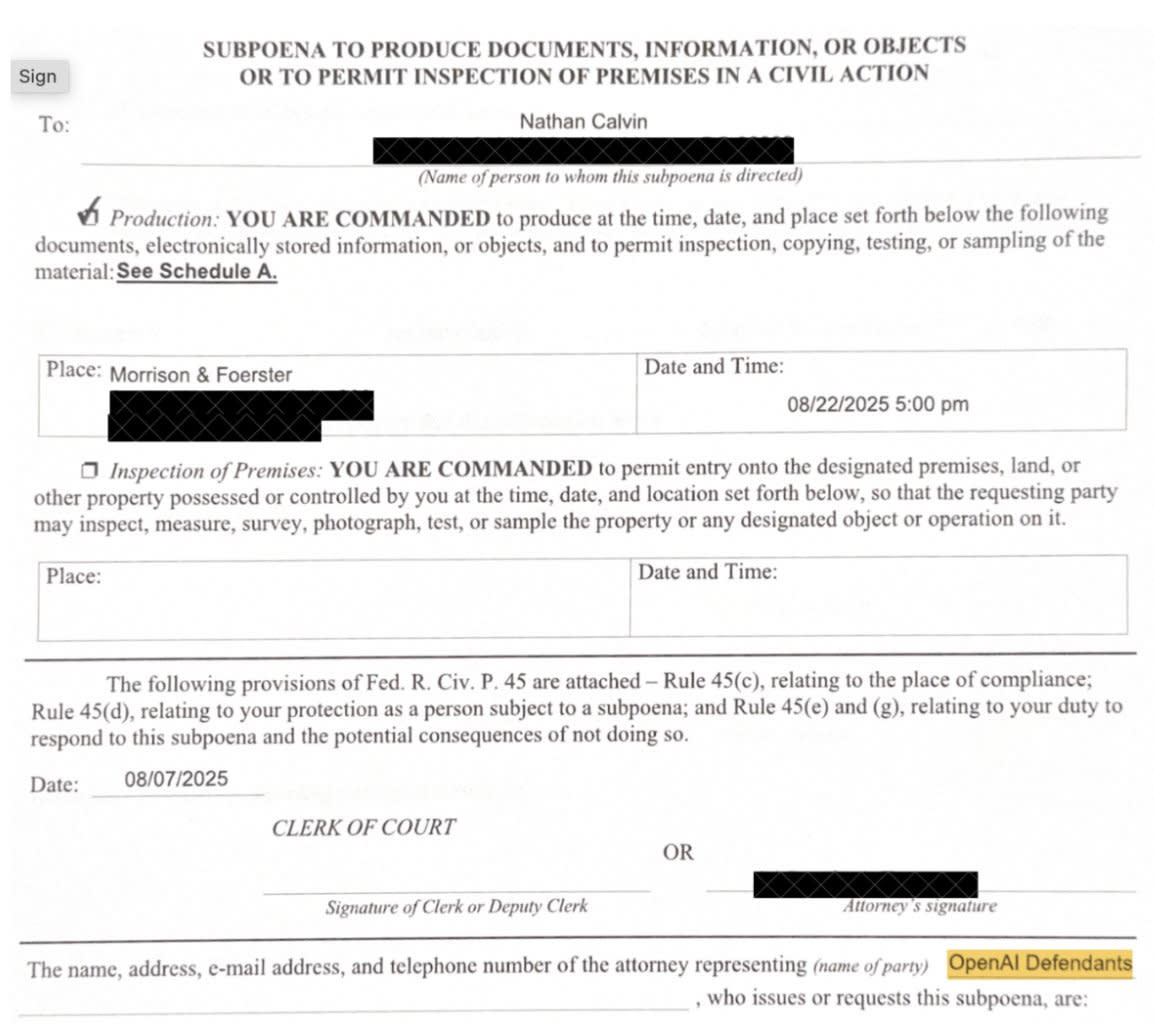
Emily Shugerman (SF Standard): Nathan Calvin, who joined Encode in 2024, two years after graduating from Stanford Law School, was being subpoenaed by OpenAI. “I was just thinking, ‘Wow, they’re really doing this,’” he said. “‘This is really happening.’”
The subpoena was filed as part of the ongoing lawsuits between Elon Musk and OpenAI CEO Sam Altman, in which Encode had filed an amicus brief supporting some of Musk’s arguments. It asked for any documents relating to Musk’s involvement in the founding of Encode, as well as any communications between Musk, Encode, and Meta CEO Mark Zuckerberg, whom Musk reportedly tried to involve in his OpenAI takeover bid in February.
Calvin said the answer to these questions was easy: The requested documents didn’t exist.
Now that SB 53 has passed, Nathan Calvin is now free to share the full story.
It turns out it was substantially worse than previously believed.
And then, in response, OpenAI CSO Jason Kwon doubled down on it.
What OpenAI Tried To Do To Nathan Calvin
Nathan Calvin: One Tuesday night, as my wife and I sat down for dinner, a sheriff’s deputy knocked on the door to serve me a subpoena from OpenAI.
I held back on talking about it because I didn’t want to distract from SB 53, but Newsom just signed the bill so… here’s what happened:
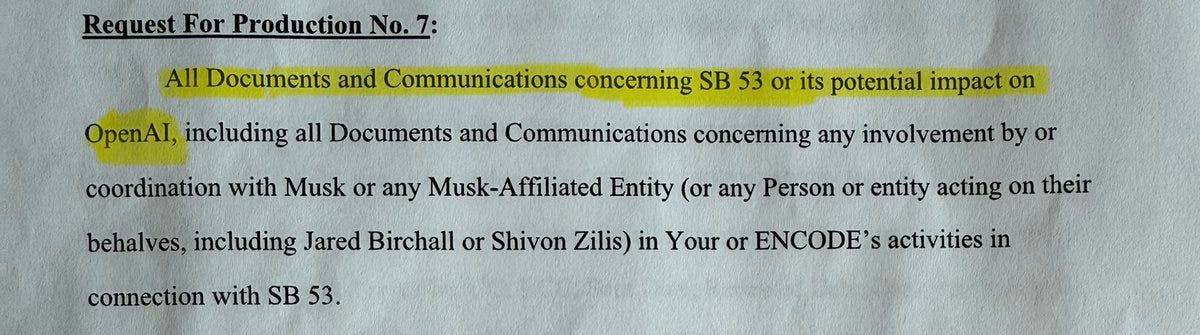
You might recall a story in the SF Standard that talked about OpenAI retaliating against critics. Among other things, OpenAI asked for all my private communications on SB 53 – a bill that creates new transparency rules and whistleblower protections at large AI companies.
Why did OpenAI subpoena me? Encode has criticized OpenAI’s restructuring and worked on AI regulations, including SB 53.
I believe OpenAI used the pretext of their lawsuit against Elon Musk to intimidate their critics and imply that Elon is behind all of them.
There’s a big problem with that idea: Elon isn’t involved with Encode. Elon wasn’t behind SB 53. He doesn’t fund us, and we’ve never spoken to him.
OpenAI went beyond just subpoenaing Encode about Elon. OpenAI could (and did!) send a subpoena to Encode’s corporate address asking about our funders or communications with Elon (which don’t exist).
If OpenAI had stopped there, maybe you could argue it was in good faith.
But they didn’t stop there.
They also sent a sheriff’s deputy to my home and asked for me to turn over private texts and emails with CA legislators, college students, and former OAI employees.
This is not normal. OpenAI used an unrelated lawsuit to intimidate advocates of a bill trying to regulate them. While the bill was still being debated.
OpenAI had no legal right to ask for this information. So we submitted an objection explaining why we would not be providing our private communications. (They never replied.)