Susan Collins Bak
poster for? climate bills
no merri
sen intel comm silent on collusion vs rubio?
dem target since brett k vote, plus flip the senate 2020
she did some move gesture around impeachment? often looked at as one of 4 who are vulnerable or who have conscience mitt
caved on impeach witnesses
8/20 i have been neglecting? avoid spite/anec wishful, but clearly rt is all-in on def of her sen seat
SUPPORT HAALAND // MURKOWSKI
'Put country first': Ex-RNC chair slams Susan Collins’ 'noncommittal non-endorsement' of Trump - Alternet.org (https://www.alternet.org/michael-steele-trump-2667153483/)
---}:
an 1 24
gop # get worse with time?!
46 GOP senators sign SCOTUS brief downplaying Trump’s role in January 6 insurrection
President Donald J. Trump, joined by Senate Majority Leader Mitch McConnell and Senator Roy Blunt, R-MO., speaks with reporters prior to attending a Senate Republican lunch Tuesday, March 26, 2019, at the U.S. Capitol in Washington, D.C. (Official White House Photo by Joyce N. Boghosian)
Carl Gibson
January 18, 2024
All but three members of the Senate Republican Caucus have signed an amicus brief to the Supreme Court of the United States (SCOTUS) urging the Court to strike down the Colorado Supreme Court's disqualification of former President Donald Trump from the state's GOP primary ballot.
The brief — which was also signed by 130 House Republicans — argued that Trump's disqualification "tramples the prerogatives of members of Congress," which they say include "the enforcement and (if necessary) removal of Section 3 [of the 14th Amendment]’s 'disability' on holding office."
"Congress—not any state court—plays a vital role in regard to [the insurrection clause]," the brief read. "It is Congress that must pass implementing legislation authorizing enforcement of Section 3."
"[T]his Court should conclude that Section 3 determinations fall within the 'political question' doctrine because they are so clearly committed by constitutional text to another political branch, i.e., Congress," the amicus brief continued. "Under current law, Congress has implemented Section 3 only in the narrow context of requiring a criminal conviction for 'rebellion or insurrection,' and provided that those found guilty 'shall be incapable of holding any office under the United States.'"
While the question of whether a presidential candidate can only be disqualified under Section 3 of the 14th Amendment will ultimately be decided by SCOTUS, the actual text of the insurrection clause doesn't explicitly say enforcement only comes after Congress votes. Rather, the clause — which prevents anyone who has "engaged in insurrection or rebellion" against the US or who has "given aid or comfort to the enemies thereof" from holding any "civilian or military" office — only states that disqualification can be reversed by a two-thirds vote from both the House and Senate. Even if all signees of the brief voted to exempt Trump from the insurrection clause, it would still fall well short of the two-thirds threshold laid out in the US Constitution.
Notably, the brief also minimizes the former president's role in the January 6, 2021 US Capitol riot, with the brief falsely asserting that Trump "quickly" asked for peace and encouraged "disbandment" of the riot even though he watched events unfold over the course of several hours before telling his supporters to go home. The brief even quoted George Orwell's dystopian novel 1984 to describe the actions of "enterprising state officials" trying to disqualify Trump as an example of the statement "peace means war."
The only GOP senators to not co-sign the brief were Sens. Bill Cassidy (R-Louisiana), Susan Collins (Maine) and Lisa Murkowski. Notably, Senate Minority Leader Mitch McConnell (R-Kentucky) co-signed the brief despite condemning Trump's actions on January 6.
thom
Thus, we can track many of the worst aspects of America’s political dysfunction to these three corrupt Supreme Court decisions, as I detail in The Hidden History of the Supreme Court and the Betrayal of America (https://substack.com/redirect/df0c18f9-4267-4d34-9f36-752e08b52e51?j=eyJ1IjoiN3ltancifQ.i0HJl3aVWG8sHp566T-pebMssFGKcgvxVOFLuZyEDpw) and The Hidden History of American Oligarchy (https://substack.com/redirect/2d578569-01a1-4fb3-a17c-dbb9f7faa19f?j=eyJ1IjoiN3ltancifQ.i0HJl3aVWG8sHp566T-pebMssFGKcgvxVOFLuZyEDpw).
Prior to the Court’sCitizens Uniteddecision, for example, there was a bipartisan consensus in Congress that climate change was caused by burning fossil fuels and that we should do something about it, as Senator Sheldon Whitehouse so eloquently documents (https://substack.com/redirect/bc91b6a8-650b-4a5a-9dfc-ab0015f2634e?j=eyJ1IjoiN3ltancifQ.i0HJl3aVWG8sHp566T-pebMssFGKcgvxVOFLuZyEDpw).
John McCain campaigned for president on a platform of doing something about climate change: he was the lead cosponsor of the Climate Stewardship Act, which had multiple other Republican cosponsors. At the time, he said (https://substack.com/redirect/bc91b6a8-650b-4a5a-9dfc-ab0015f2634e?j=eyJ1IjoiN3ltancifQ.i0HJl3aVWG8sHp566T-pebMssFGKcgvxVOFLuZyEDpw):
“While we cannot say with 100 percent confidence what will happen in the future, we do know the emission of greenhouse gases is not healthy for the environment. As many of the top scientists through the world have stated, the sooner we start to reduce these emissions, the better off we will be in the future.”
The Clean Air Planning Act was supported by Republican Senators Lamar Alexander, Lindsay Graham, and Susan Collins. Republican Senator Olympia Snow was the lead cosponsor of the Global Warming Reduction Act of 2007. Multiple Republicans supported the Low Carbon Economy Act and the Clean Air/Climate Change Act.}:
In 2009, Republicans supported the Raise Wages, Cut Carbon Act and the Waxman-Markey carbon cap-and-trade proposal. Maine Republican Susan Collins was the lead cosponsor of the Carbon Limits and Energy for America’s Renewal Act, a bill that would have imposed a fee on burning fossil fuels. At the time, she said:
“In the United States alone, emissions of the primary greenhouse gas carbon dioxide have risen more than 20 percent since 1990. Clearly climate change is a daunting environmental challenge…”
And then, in 2010, everything changed.
Clarence Thomas, actively groomed for decades by fossil fuel and other billionaires, became the deciding vote in Citizens United, legalizing not only his own corruption but that of every Republican in Congress.
Once the fossil fuel industry could pour unlimited money into either supporting — or, perhaps more importantly, destroying — the candidacy of any Republican politician, every Republican in the House and Senate began to say, “What climate change?”
As Senator Whitehouse said on the floor of the Senate:
“I believe we lost the ability to address climate change in a bipartisan way because of the evils of the Supreme Court’s Citizens United decision. Our present failure to address climate change is a symptom of things gone awry in our democracy due to Citizens United. That decision did not enhance speech in our democracy; it has allowed bullying, wealthy special interests to suppress real debate.”
When Poppy Bush was president, the world confronted a crisis with acid rain destroying monuments and buildings; Democrats and Republicans came together and put into law a sulfur dioxide cap-and-trade “free market solution” that largely solved the problem.
Why can’t we do the same with a cap-and-trade system for carbon pollution from fossil fuels like the European Union, Australia, New Zealand, and South Korea have already done? Citizens United.
Similarly, why can’t America get our gun crisis under control? We’re the only country in the world where schoolchildren are subjected to the monthly terror of active shooter drills.
Bullets are the leading cause of death among our nation’s children. But no Republican will take on the issue because they know the firearms industry and its front groups will destroy them with a waterfall of money for their inevitable opponent in the next election. Citizens United.
Our public schools are crumbling as the charter and private school industries pour millions into politicians’ coffers. Instead of fixing our schools and raising our educational standards, the private school industry has gotten Republican governors in several states to offer vouchers to every student in the state.
thom ref
kickass
How Citizens United Altered the Climate Debate (https://www.whitehouse.senate.gov/news/speeches/how-citizens-united-altered-the-climate-debate)
07.25.14
HOW CITIZENS UNITED ALTERED THE CLIMATE DEBATE
As delivered on the Senate floor
Thank you, Madam President, this is my seventy-fifth “Time to Wake Up” speech,something of a minor benchmark, I suppose. I come here urging my colleagues to wake up to the threat of climate change. I do this every week that we are in session, hoping that someday spark will hit tinder. But even as the evidence of climate change deepens, the dialogue here in Washington remains one-sided.
Climate change was once a bipartisan concern. In recent years, something changed. I think I know what changed, and I will get to that. But first, let’s reminisce about the bipartisanship.
If we take a look back, in this body we have Republican colleagues who once openly acknowledged the existence of carbon-driven climate change, and, and who called for real legislative action to cut carbon emissions. Imagine that. It wasn’t that long ago.
We have a former Republican presidential nominee,amongst us, who campaigned for the presidency on addressing climate change.
We have Republicans who have spoken favorably about charging a fee on carbon, including an original Republican cosponsor of a bipartisan Senate carbon fee bill.
We have a Republican colleague who cosponsored carbon fee legislation in the House, and another who voted for the Waxman-Markey “cap and trade” bill when he was in the House.
For years,for years there was a steady, healthy heartbeat of Republican support for major U.S. legislation to address carbon pollution. Let me be specific.
In 2003, Senator John McCain was the lead cosponsor of Democrat Joe Lieberman’s Climate Stewardship Act, which would have created a market-based emissions cap and trading program to reduce carbon dioxide and other heat-trapping pollutants from the biggest U.S. sources.
Here is what Senator McCain said at the time: I’ll quote him, “While we cannot say with 100 percent confidence what will happen in the future, we do know the emission of greenhouse gases is not healthy for the environment. As many of the top scientists through the world have stated, the sooner we start to reduce these emissions, the better off we will be in the future.”
His Climate Stewardship Act actually got a vote. Imagine that!
And when it did not prevail, Senator McCain reintroduced the measure himself in the following Congress. Republican Senators Olympia Snowe of Maine and Lincoln Chafee of Rhode Island—my predecessor—were among that bill’s cosponsors.
Other Republicans got behind other cap-and-trade proposals: Senator Tom Carper’s “Clean Air Planning Act”, at one time or another, counted Senator Lamar Alexander of Tennessee, Senator Lyndsey Graham of South Carolina and Senator Susan Collins of Maine among its supporters.
In 2007, Republican Senator Olympia Snowe was a lead cosponsor of then-Senator Kerry’s “Global Warming Reduction Act.” Senators Murkowski and Stevens from Alaska, and Senator Specter of Pennsylvania, then a Republican, were original cosponsors of the Bingaman “Low Carbon Economy Act.” And that same year, Senator Alexander introduced the “Clean Air/Climate Change Act.” Each of these bills sought to reduce carbon emissions through a cap-and-trade mechanism. Said Senator Alexander, and I’ll quote him, “It is also time to acknowledge that climate change is real, human activity is a big part of the problem, and it is up to us to act.”- 2007
That bipartisan heartbeat remained strong in 2009. Senator Mark Kirk of Illinois, while he served in the House of Representatives, was one of eight Republicans to vote for the Waxman-Markey cap-and-trade proposal.
In that same year, 2009, Senator Jeff Flake of Arizona, then representing Arizona in the House, was an original cosponsor of the “Raise Wages, Cut Carbon Act,” to reduce payroll taxes for employers and employees in exchange for equal revenue from a carbon tax. On the House Floor, then-Representative Flake argued the virtues of this approach. Here’s what he said:
If we want to be honest about helping the environment, then just impose a carbon tax and make it revenue neutral, give commensurate tax relief on the other side. Myself and another Republican colleague have introduced that legislation to do just that. Let’s have an honest debate about whether or not we want to help the environment by actually having something that is revenue neutral where you tax consumption as opposed to income.
Was a good idea then, and it is still a good idea now. Those words were echoed that year in the Senate by Senator Collins, a lead cosponsor of the “Carbon Limits and Energy for America’s Renewal Act,” Senator Cantwell’s carbon fee bill. “In the United States alone,” said Senator Collins, “emissions of the primary greenhouse gas carbon dioxide have risen more than 20 percent since 1990. Clearly climate change is a daunting environmental challenge,she said, but we must develop solutions that do not impose a heavy burden on our economy, particularly during these difficult economic times.”
2009, Think of it—there was once, not too long ago, clear and forceful acknowledgement, from leading Republican voices, of the real danger posed by climate change, and of Congress’s responsibility to act.
[Heartbeat Graph]
So what happened? Why did this heartbeat of Republican climate action suddenly flatline?
Madam President, I believe we lost the ability to address climate change in a bipartisan way because of the evils of the Supreme Court’s Citizens Uniteddecision. Our present failure to address climate change is a symptom of things gone awry in our democracy due to Citizens United.That decision did not enhance speech in our democracy; it has allowed bullying, wealthy special interests to suppress real debate.
I’ve spoken before on the Senate Floor about the Supreme Court’s Citizens United decision—one of the most disgraceful decisions by any Supreme Court; destined ultimately, I believe, to follow cases like Lochner v. New Yorkonto the ash heap of judicial infamy.
But we’re stuck with it for now.
In a nutshell, the Citizens United decision says this: corporations are people; money is speech; so there can be no limit to corporate money influencing American elections. If that doesn’t seem right, it’s because it’s not.
Phony and improper fact-finding by the five conservative activists on the Supreme Court concluded that corporate spending could not ever corrupt elections, just couldn’t do it.By some magic, it’s pure. That’s a bad enough finding on its face, but they also didn’t get that limitless, untraceable political money doesn’t have to be spent to damage our democracy. Unlimited corporate spending in politics can corrupt, not just through floods of anonymous attack advertisements; it can corrupt, secretly and more dangerously, through the mere threat of that spending, through private threats and promises. The presiding officer was the Attorney General of her state, and she well knows how much mischief can be done in backrooms by threats and promises, that’s what Attorney Generals see when they go out and investigate.
And as we’re evaluating the effect of Citizens United on our climate change debate, let’s remember one thing; a lot of this special interest money has been spent against Republicans. I’ve had Republican friends tell me, “what are you complaining about?” They’re spending more against us, than against you. There have been times when that has been true. When the Koch Brothers’ polluter money can come in and bombard you in a small primary election, that’s pretty scary. And when the paid-for right-wing attack machine can be cranked up against you in your Republican primary, that’s pretty scary, too. And what the polluters can do with political spending, they can threaten or promise to do, in ways that the public will never see or know—but the candidate will know. The candidate will know, for sure.
So, I wrote a “friend of the Court” brief to the Supreme Court with Senator McCain to highlight for the justices some of the failings and pitfalls of their shameful Citizens United decision. “The dominating influence of super PACs,” we wrote, “makes it all the easier for those seeking legislative favors and results to discreetly threaten such expenditures if Members of Congress do not accede to their demands.” I think we were right.
So how does this bear on climate change?
All that bipartisan activity I talked about preceded Citizens United. After that, polluter attacks funded by Citizens United money, and the threat of those polluter attacks,perhaps promises not to make those attacks, if you behave cast a dark shadow over Republicans who might work with Democrats on curbing carbon pollution. Tens, perhaps even hundreds of millions of dark-money dollars are being spent by polluters and their front organizations, and God only knows what private threats and promises have been made.
The timing is telling. Before Citizens United, there was an active heartbeat of Republican activity on climate change. Since then, the evidence has only become stronger. But after Citizens United uncorked all that big, dark money, and allowed it to cast its bullying shadow of intimidation over our democracy, Republicans—other than those few who parrot the polluter party line that climate change is just a big old hoax— they have all walked back from any major climate legislation.
We have Senators here who represent historic native villages, now washing into the sea and needing relocation because of climate change and sea-level rise. We have Senators who represent great American coastal cities, now overwashed by high tides because of climate change. We have Senators representing states swept by drought and wildfire. We have Senators whose home-state forests—by the hundreds of square miles—are being killed by the marauding pine beetle. We have Senators whose home states’ glaciers are disappearing before their very eyes. We have Senators whose states are having to raise offshore bridges and highways before rising seas. We have Senators whose emblematic home state species are dying off, like the New Hampshire moose, for instance swarmed by ticks, by the tens of thousands that snows no longer kill.
Yet almost none will work on a major climate bill. It’s not safe to, ever since Citizens United allowed the bullying, polluting special interests to bombard our elections, and threaten and promise to bombard our elections, with their attack ads.
Well, despite all the dark money, despite the threats and intimidation, I still believe this can be a courageous time. We simply need conscientious Republicans and Democrats to work together, in good faith, on a common platform of facts and common sense, to protect the American people and the American economy from the looming effects of climate change in our atmosphere, on our lands, in our oceans. We simply need to shed the shackles of corrupting influence and rise to our duty.
In courageous times, Americans have done far more than that. It’s not asking much to ask this generation to stand up to a pack polluters, just because they have big checkbooks. In previous generations, Americans have put at risk their very lives, fortunes and sacred honor—to serve the higher interests of this great republic. We know it can be done, because it’s been done.
We do not have to be the generation that failed at our duty. We are headed down a road to infamy now, but it doesn’t have to be that way. We can leave a legacy that will echo down the corridors of history, so that those who follow us will be proud of our efforts. But sitting here, doing nothing, yielding to the special-interest bullies and their Citizens United money, pretending the problem isn’t real, that won’t accomplish that.
As I have said before seventy-four times, and as I say tonight for the seventy-fifth time, it is time for us to wake up.
I yield the floor. I thank the presiding officer.
622 an
no lnx twt
For decades, Sen. Susan Collins’ admirers in New England praised her as a shining example of a moderate GOP conservative who was staunchly pro-choice. Collins insisted that opposition to Roe v. Wade was a deal breaker for her, but in 2018, the Maine Republican helped pave the way for Roe’s demise when she voted to confirm Justice Brett Kavanaugh to the U.S. Supreme Court.
Kavanaugh, Collins assured abortion rights supporters in 2018, considered Roe “settled law” and embraced the doctrine of stare decisis — a legal concept that means respect for precedent. But according to a leaked 5-4 majority draft opinion written by Justice Samuel Alito, Kavanaugh is among the justices who favors overturning Roe. Collins was deceived by Kavanaugh — deception that, journalists Asawin Suebsaeng and Adam Rawnsley report in an article published by Rolling Stone on June 2, was encouraged by members of the Trump Administration.
“Turns out, Collins wasn’t just wrong about Kavanaugh,” Suebsaeng and Rawnsley explain. “She was deliberately manipulated by Trump Administration officials — and a future Supreme Court justice — who viewed her as an easy mark.Two former senior Trump White House officials tell Rolling Stone that the pro-choice Collins wasn’t even considered a serious threat to the devoutly conservative Kavanaugh.”
Suebsaeng and Rawnsley continue, “Instead, the team predicted she’d need only a vague assurance that the nominee would uphold the half-century-old ruling defending abortion rights. And they were right.”
The High Court justices who have reportedly decided to overturn Roe range from Kavanaugh and Alito to Amy Coney Barrett, Neil Gorsuch and Clarence Thomas. The four dissenters are Sonia Sotomayor, Elena Kagan, Chief Justice John Roberts and Stephen Breyer (who is retiring and will be replaced by President Joe Biden’s nominee, Judge Ketanji Brown Jackson, later this year).
Collins voted to confirm Gorsuch in 2017, and she voted to confirm Alito in 2006. The Maine senator also voted to confirm Barack Obama nominees Sotomayor and Kagan.
After meeting with Alito in 2005, Collins told reporters, “He assured me that he has tremendous respect for precedent and that his approach is to not overturn cases due to a disagreement with how they were originally decided.”
A former Trump Administration official, interviewed on condition of anonymity, told Rolling Stone, “The thinking from Trump.… and everybody else who worked to make this happen was that, as long as his nominees didn’t say anything stupid (on abortion) and let the Susan Collins-es of the world think what they needed to think and hear what they needed to hear, then it would get done.”
According to Suebsaeng and Rawnsley, some Trump Administration officials who “worked on the Kavanaugh confirmation privately mocked Collins and her public posturing over Roe,” using “crass language” that included describing the Maine senator as a “cheap date.”
“Back in 2018,” Suebsaeng and Rawnsley report, “ the Trump team and Senate GOP offices would regularly send guidance to outside organizations and top activists who were fervently supporting Kavanaugh…. When it came to Collins, the guidance from Team Trump was, consistently, that she not be approached, according to two sources who were close to the White House. One of the reasons, a former top Trump aide says, is because the White House and Kavanaugh allies believed that a pressure campaign from the right would backfire, and that Collins would get to a ‘yes’ on her own — assuming she got just the right verbal responses she wanted.”
Suebsaeng and Rawnsley add, “The Trump team’s apparent manipulation of Collins was part of a broader effort to smuggle, in broad daylight, anti-Roe justices onto the Supreme Court — an effort that was only somewhat complicated by Trump’s past statements on ending Roe and his nominees’ long anti-abortion records.”
In 2018, according to Rolling Stones’ sources, “Trump aides and Kavanaugh allies” held mock Senate confirmation hearings — and Kavanaugh practiced giving evasive answers to questions about Roe.
“Whenever the topic of abortion came up in his prep sessions,” Suebsaeng and Rawnsley report, “Kavanaugh knew what do say: effectively, nothing. Typically, he would give lengthy, detailed monologues on dissents, opinions, and precedents, and then, as was his standard, refuse to divulge how he thought he’d rule if the opportunity to overturn Roe ever came up.”
An anonymous source told Rolling Stone, “That’s how (Kavanaugh) operated. It was his way of telling you, ‘I know a lot about this — but I’m not going to tell you how I’d rule’.… His idea was that saying it was long-standing precedent didn’t mean it couldn’t get overturned at some point.… (Kavanaugh) gets the need to demonstrate knowledge about the law, but not to tip your hand about your opinions about a specific case or issue.”
https://www.alternet.org/2022/05/sneaky-way-right-protest-imperiled/
// gov of va and MD
The right to peaceably assemble and protest is dearly held in the American imagination dating back to the Boston Tea Party.
While the response to peaceful protests by non-white people and women was not always embraced at the time, the narratives of suffrage parades and Civil Rights marches have been embraced in American history as the “right” way to protest free of violence or incitement.
Despite the near-universal praise for peaceful protests of the past, when activists take these historical lessons to heart and protest current injustices, those in power must be reminded anew each time that peaceful protest is vital to American history and a thriving democracy.
And so we are once again left to educate Supreme Court justices and senators on the Bill of Rights and assure them that people holding signs outside their homes are not a threat, but simply exercising one of our most treasured freedoms – the freedom to tell a powerful person they’ve royally screwed up.
This past week protests erupted outside Justices Kavanaugh, Roberts and Alito’s homes to protest the likely overturning of Roe v. Wade after Justice Alito’s draft opinion (https://www.alternet.org/2022/05/were-deeply-screwed-abortion-ruling/) was leaked for Dobbs v. Jackson Women’s Health.
The protests outside the Justices' homes, and the terrifying sidewalk chalk (https://www.vanityfair.com/news/2022/05/susan-collins-abortion-chalk-police) incident outside of Senator Collins’ home, have been peaceful. Yet many are clutching their pearls (https://www.washingtonpost.com/opinions/2022/05/09/stop-protesting-outside-supreme-court-justice-houses/) at the idea that someone could face protests at their private home.
It’s not clear why these protests are so offensive to people or why the private home of people questioning a constitutional right to privacy should be off limits.
Some have claimed these protests aren’t fair to their neighbors but the protests in front of Justice Kavanaugh’s home were organized by a neighbor (https://www.washingtonpost.com/dc-md-va/2022/05/07/wooten-holway-protest-justice-kavanaugh-neighbor/) and protestors felt pretty supported by Justice Alito’s neighbors with some even offering wine and cheese (https://jezebel.com/justice-alitos-neighbors-give-wine-and-cheese-to-report-1848905062) to a reporter covering them.
When asked about these protests, Senator Schumer (https://www.nydailynews.com/news/politics/new-york-elections-government/ny-sen-schumer-peaceful-protests-supreme-court-judges-20220510-53hcuruj4rgojjqanq35ylppui-story.html) shrugged them off and said such peaceful protests are “the American way.” He would know since he faces protests at his home in Brooklyn multiple times a week (without calling the police as far as I know).
The right of “freedom of assembly” is held in the First Amendment of the Bill of Rights, which protects freedom of speech and the right to peaceably assemble and petition the government for a redress of grievances.
The Supreme Court has also repeatedly protected this right in the face of government intrusion.
In De Jong v. Oregon (https://www.mtsu.edu/first-amendment/article/55/de-jonge-v-oregon) in 1937, the Supreme Court said the state could not interfere in De Jong’s right to organize a protest against police brutality. This case was particularly important in that it emphasized a difference between “advocacy” and “incitement” in that advocacy for communist ideas did not necessarily incite violence to overthrow the government.
It struck down Oregon’s “criminal syndicalism” law, which outlawed which prohibited advocacy of “any unlawful acts or methods as a means of accomplishing or effecting industrial or political change or revolution.”
In Edwards v. South Carolina (https://www.mtsu.edu/first-amendment/article/56/edwards-v-south-carolina) in 1963, the Supreme Court overturned the convictions of students for supposedly “disturbing the peace” when they were protesting segregation. The majority opinion wrote that the students were exercising their First Amendment rights in the “most pristine form.”
Freedom of assembly clearly has limits with one built right into the language of the First Amendment in that the assembly must be “peaceable.”
Violent action, like speech that incites violence, is not protected.
While this is a reasonable limit, it also provides an unfortunate method of delegitimizing protest – those in power can claim protests are inciting violence or lawlessness.
In Justice Clark’s lone dissent in Edwards v. South Carolina, he employed the threat of violence to justify the police’s actions in arresting the peaceful protestors. Clark claimed the protestors were not engaging in a “passive demonstration” and that the police were preventing a possible riot.
The fear of possible violence supported laws passed (https://scholarship.law.duke.edu/cgi/viewcontent.cgi?article=2739&context=faculty_scholarship) after the Nat Turner rebellion in 1831 to prohibit the assembly of free Black people all over the south.
The majority of these assemblies were peaceful and often devoted to schooling or religious worship. But the threat of another rebellion was enough to justify outlawing this basic constitutionally protected freedom. Theodore Dwight Weld said these laws were indicative of “‘the right of peaceably assembling’ violently wrested” in 1836.
At the same time in the north, abolitionists, including free Black people and white women, were taking advantage of this constitutional right to hold meetings, conventions and give speeches.
While these abolitionist tactics set the stage for the suffrage movement and the Civil Rights movement, many at the time criticized an assembly of a mixed gender and interracial group.
The behavior of the abolitionists were criticized while mobs disrupted their meetings and speeches. At an 1835 meeting (https://www.libertarianism.org/columns/abolitionism-violence-how-william-lloyd-garrison-was-almost-killed-mob-0) of the Boston Female Anti-Slavery Society, the mayor burst in with his constables to demand the women go home rather than control the mob of people disrupting the meeting.
Racial justice protests in recent years have been delegitimized with claims of violence and looting even though data shows that 93 percent (https://acleddata.com/2020/09/03/demonstrations-political-violence-in-america-new-data-for-summer-2020/) of such protests were completely peaceful.
While there have been no reports of violence as a result of abortion protests this week, even though Susan Collins called the police about sidewalk chalk, the Senate has still decided to pass a bill (https://www.cnn.com/2022/05/09/politics/supreme-court-justices-security-senate-vote/index.html) to increase security for Supreme Court justices.
While not a big deal on its face (who cares if they have security), the need for the bill implies a threat of violence that there is no evidence for.
Once again completely peaceful protests are being maligned with the mere possibility of future violence which would delegitimize their constitutional protection.
The governors of Maryland and Virginia are trying to stop the protests by demanding (https://www.washingtonpost.com/dc-md-va/2022/05/12/protests-youngkin-hogan-justices-abortion/) that the Department of Justice enforce a federal law that prohibits demonstrations intended to influence judges on decisions.
This is a particularly obnoxious attempt to stop the protests considering justices are clearly influenced by politics and conservative justices regularly give speeches (https://www.washingtonpost.com/politics/2022/02/04/gorsuch-federalist-society-republicans/) at political gatherings. Clarence Thomas (https://www.npr.org/2022/03/30/1089595933/legal-ethics-experts-agree-justice-thomas-must-recuse-in-insurrection-cases) won't even recuse himself from January 6 cases despite his wife’s involvement.
It’s ridiculous to think any of these justices would be swayed by public opinion and enforcing this law to stop the current protests could set a dangerous precedent that limits constitutional rights if protesting anything related to a Supreme Court case.
The real history of protesting in the United States is that those in power are always threatened and seek to find ways to suppress protests, but the public imagination forgets those actions and fondly remembers successful protests as deeply American. Senators and justices concerned with their legacy might want to reread how much our history books love a good protest.
ref no lnx salon?
LEVIN REPORT
TERRIFIED SUSAN COLLINS CALLS COPS AFTER CHALK VIGILANTES POLITELY ASK HER TO PROTECT WOMEN’S RIGHTS
Yes, according to the Maine lawmaker, she was the victim of a drive-by chalking.
BY BESS LEVIN
MAY 10, 2022
WASHINGTON, DC - OCTOBER 05: U.S. Sen. Susan Collins (R-ME) speaks to reporters after a floor speech to announce that she will vote for the nomination of Supreme Court Judge Brett Kavanaugh to the U.S. Supreme Court, at the U.S. Capitol, October 5, 2018 in Washington, DC. The Senate voted 51-49 in a procedural vote to advance the nomination of Judge Brett Kavanaugh to the U.S. Supreme Court. (Photo by Alex Wong/Getty Images)ALEX WONG
Chalk. If it’s been a while since you held a piece of it or watched someone else use some in action, a quick reminder that this soft, porous, sedimentary carbonate rock is popularly used in classrooms, by small children, or outside of coffee shops to lure in customers with promises of cold brew and freshly baked goods. They come in a variety of colors and one of the reasons they are very popular is probably due to the ease with which their markings can be erased, with nothing more than water. Unlike permanent forms of ink, they are almost exclusively used in a non-threatening manner. Yet according to Senator Susan Collins, her life recently flashed before her eyes because of this substance and the manner in which it was wielded.
Maine’s Bangor Daily News reports that the Republican lawmaker called the police over the weekend after “an unknown person or persons wrote a pro-abortion-rights message in chalk on the sidewalk” outside her home. At this time, you might be wondering how literally anything written in chalk would necessitate a call to the cops. Was the message particularly threatening? Did it say something about Collins’s family and what might befall them if she didn’t do exactly what the writer or writers requested? Erm, not exactly.
Yes, the actual message in question—written mostly in pink chalk—simply reads, “Susie, please…Mainers want WHPA —–> vote yes, clean up your mess.” WHPA refers to the Women’s Health Protection Act, which would codify the right to an abortion and which Collins has already said she won’t vote for. According to the Bangor Daily News, the police responded to Collins’s home at 9:20 p.m. Saturday; as should’ve been clear already, a spokesperson for the force noted that “The message was not overtly threatening.” The local Department of Public Works reportedly washed the message away, and it was not visible by Monday afternoon. “We are grateful to the Bangor police officers and the City public works employee who responded to the defacement of public property in front of our home,” Collins saidin a statement that she should have been embarrassed to release.
Not-at-all-menacing chalkings aside—the perps wrote, “please,” for fuck’s sake—it’s possible that Collins is on edge because deep down inside, she knows she’s helped to screw over millions of pregnant people, having voted to confirm both Brett Kavanaugh and Neil Gorsuch, despite Donald Trump publicly declaring that he would exclusively nominate Supreme Court justices who would help overturn Roe v. Wade. In the case of Kavanaugh, Collins insisted that Justice Beer Bong had told her he believed the landmark ruling was “settled law.” Which made Collins look pretty stupid last week, after the court’s draft opinion leaked, indicating that both Kavanaugh and Gorsuch intend to help obliterate reproductive rights.
But apparently she didn’t feel bad enough about it to actually do anything useful, stating that not only would she vote against the Women’s Health Protection Act, she wouldn’t support ending the filibuster in order to give Democrats the votes needed to pass it immediately. (While Collins and Lisa Murkowski are sponsoring their own bill called the Reproductive Choice Act, it is much more narrow than the the Women’s Health Protection Act, and Democrats say it contains loopholes that would allow states like Mississippi to ban abortion after 15 weeks. Which is…not very helpful.)
Over the weekend, protesters assembled outside of the homes of Kavanaugh and chief justice John Roberts, and despite the gatherings reportedly remaining peaceful and nonviolent, conservatives were up in arms over the supposed lack of civility, and the idea that people would protest outside the men’s homes.Incidentally, those claiming the demonstrations were beyond the pale curiously left out the fact that antiabortion activists have protested the legal medical procedure with arson, bombings, and murder.
https://www.alternet.org/2022/05/susan-collins-2657310527/
pro life
won't rule out voting for trump 2024
https://www.alternet.org/2022/01/susan-collins/
at 1st silent then 6-2 soto ~
Supreme Court's latest salvo exposes the trick John Roberts has played on the country (https://www.alternet.org/2021/09/supreme-court-abortion/)
Amanda Marcotte (https://www.alternet.org/author/amanda-marcotte) Salon (https://www.alternet.org/author/salon)
September 01, 2021
At the stroke of midnight on Wednesday, the Supreme Court suddenly overturned Roe v. Wade (https://www.washingtonpost.com/politics/courts_law/texas-six-week-abortion-ban/2021/09/01/e53cf372-0a6b-11ec-a6dd-296ba7fb2dce_story.html).
The move was quiet and it very well may be temporary (they could still issue a short decision any minute...
https://www.alternet.org/2021/05/susan-collins-investigation/
MIC $ committee?
Tuesday, Axios reported on a newly public search warrant from the FBI revealing an investigation into a "massive scheme" to illegally funnel money to Maine Republican Sen. Susan Collins' 2020 re-election campaign.
Federal investigators suspect defense contractor Navatek and its former CEO Martin Kao illegally directed $150,000 to a Collins super PAC through a shell company.They also believe Kao reimbursed family members for donating to Collins, an illegal way to circumvent campaign donation limits.Kao has previously been indicted for fraudulently receiving COVID relief funds, Axios reported.
"According to the FBI, Kao and his wife set up a sham LLC called the Society for Young Women Scientists and Engineers. Navatek then wrote the LLC a $150,000 check, investigators say, which was passed on to the super PAC," Axios (https://www.axios.com/susan-collins-reelection-investigation-finance-scheme-11280676-b9f6-480d-a47f-c33f3f7ab4ca.html?utm_source=twitter&utm_medium=social&utm_campaign=editorial&utm_content=politics-susancollins) reported. "Government contractors are barred from donating to federal political committees, and investigators suspect the donations were attempts to evade that prohibition."
It continued: "Investigators say bank records also show that Kao illegally reimbursed family members who donated to Collins' campaign, and that Navatek reimbursed some of Kao's colleagues for their contributions."
The documents do not indicate that either Collins or her campaign were aware of the scheme, and a spokesperson for the senator told Axios they "had absolutely no knowledge of anything alleged in the warrant." However, the search warrant does report that a member of the senator's staff suggested to Kao that he could have direct his family members to donate to Collins after he had reached the legal limit. And Collins has previously assisted the company Navatek, the document explains, by getting it an $8 million contract with the federal government.
FROM YOUR SITE ARTICLES
Another Gaetz top aide abruptly quits — congressman hid ... › (https://www.alternet.org/2021/04/matt-gaetz-2652214861/)
Conservative columnist blasts Susan Collins for playing into Trump's ... › (https://www.alternet.org/2020/01/conservative-columnist-blasts-susan-collins-for-playing-into-trumps-hands-on-impeachment/)
National security expert: DOJ IG report vindicated reason for FBI's ... › (https://www.alternet.org/2019/12/national-security-expert-doj-ig-report-vindicated-reason-for-fbis-2016-trump-campaign-investigation-but-sloppy-use-of-fisa-warrants-must-be-audited/)
RELATED ARTICLES AROUND THE WEB
Collins, McCaskill Release Committee Report of Bipartisan Drug ... › (https://www.collins.senate.gov/newsroom/collins-mccaskill-release-committee-report-bipartisan-drug-pricing-investigation)
Senator Collins' Statement on Legislation to Protect the Special ... › (https://www.collins.senate.gov/newsroom/senator-collins%E2%80%99-statement-legislation-protect-special-counsel%E2%80%99s-investigation)
NEW: Ethics Complaint Alleges “Blatant Corruption” As Records ... › (https://www.mainedems.org/media/new-ethics-complaint-alleges-blatant-corruption-records-reveal-senator-collins-used-her)
principled stand or hail mary to save seat?
https://www.alternet.org/2020/09/murkowski-joins-collins-in-opposing-trump-scotus-vote-before-the-election/
==
==
https://www.alternet.org/2020/09/the-tide-has-turned-susan-collins-trails-rival-sara-gideon-by-12-points-in-new-quinnipiac-poll/
https://www.alternet.org/2020/09/susan-collins-plight-gets-worse-with-new-corruption-allegation-and-a-possible-ethics-probe/
==
https://www.inthepublicinterest.org/the-billionaire-behind-efforts-to-kill-the-usps/
https://www.inthepublicinterest.org/wp-content/uploads/ITPI_USPSPrivatization_July2020.pdf (https://www.inthepublicinterest.org/wp-content/uploads/ITPI_USPSPrivatization_July2020.pdf)
COVID-19 pandemic has pushed the already-struggling U.S. Postal Service to the brink of financial collapse. But the most trusted and popular institution in America hasn’t been struggling by accident. Since the 1970s, a concerted effort to popularize the fringe idea of privatizing the Postal Service has been advanced for nearly five decades with the support of one man: the billionaire and libertarian ideologue, Charles Koch, chairman and chief executive officer of Koch Industries. This brief traces Koch’s connections, influence, and ideological push to weaken and ultimately privatize one of America’s most essential public services—and, along with it, the jobs of hundreds of thousands of public servants. [Timeline]...
[bkgd]
...These are just a few components of Koch’s political empire, which also deploys front groups. Although Koch has used his PR team to try to distance himself from Trump, the reality is that the Koch network’s 2016 spending in swing states and Senate races helped buoy Trump in his bid for the White House. Koch’s efforts also helped ensure that Sen. Mitch McConnell (R-KY), a key Koch ally, remained the Republican leader of the Senate. From this position, he’s helped Koch reshape the U.S. Supreme Court and the federal judiciary, stop a carbon tax, and thwart efforts to mitigate climate change and regulate industry in myriad ways. AFP’s latest attack on the Postal Service is part of Koch’s ongoing efforts to weaken the funding and capacity of our government. Koch’s network spent millions to win what Koch himself touted as a “once-in-a-generation opportunity” to cut taxes, the 2017 Tax Cuts and Jobs Act, which AFP helped push through and which further enriched Koch and his friends. Koch has also given millions to political campaigns, PACs, and other groups. For those who’ve been keeping score at home: To Koch, even though the Postal Service is vital to more than 300 million of his fellow Americans, helping the agency survive with $25 billion in aid should not be allowed.
But tax cuts to benefit himself and his billionaire friends—which cost America more than $2.3 trillion—was a top priority for his political machine. AFP is not alone among Koch groups in trying to destroy the Postal Service. Other major Koch-funded groups, such as the Heritage Foundation, the Cato Institute, and the Mercatus Center at George Mason University have also supported privatization. Even the Koch-funded American Legislative Exchange Council (ALEC), which focuses on state legislation, has tried to weaken the Postal Service. For years it has pushed a bill to require that ballots from military service members be carried not by the Postal Service but by for-profit shipping companies, and it is funded by two of the biggest: FedEx and UPS. It has also long pushed for the future health care benefits of retired state government workers to be slashed or prefunded, like the Postal Service. It has pushed no bills to require private companies to do the same....
the agency would be in a much stronger financial position had Congress not passed the Postal Accountability and Enhancement Act (PAEA) in 2006, which “requires the Postal Service, which receives no taxpayer subsidies, to prefund its retirees’ health benefits up to the year 2056,” on a 50-year basis. (John Oliver’s Last Week Tonight did an in-depth show on this manufactured crisis earlier this year.) According to the Institute for Policy Studies (IPS) in 2019: “If the costs of this retiree health care mandate were removed from the USPS financial statements, the Post Office would have reported operating profits in each of the last six years.” “[N]o other entity, private or public, has to make” such provision for future health benefits of current and future retirees so far in advance. Private companies also can change their health benefits without an act of Congress, unlike the Postal Service. “Current reserves of $47.5 billion could be used to pay expected pay-as-you-go retiree health care costs 10-15 years into the future,” IPS noted. The 2006 law also bars the Postal Service from obtaining other revenue by providing “nonpostal services,” such as offering banking services or opening cafes at post offices. And it also limits the ability of the Postal Service to raise rates beyond the rate of inflation. Who championed the bill that imposed this unprecedented financial burden on the Postal Service? Another Koch man, James C. Miller III...
no lnx many
The Real Backstory of Undermining the Postal Service
In 2006, Miller was advising Koch’s newly renamed Americans for Prosperity when he became
the Chairman of the Board of Governors of the Postal Service. That’s the year Congress enacted
the PAEA. Former Congressman Tom Davis (R-VA) said the idea to add the pre-funding
requirement came not from Congress but from the White House, supposedly to get a good
score on the cost of the bill from the Congressional Budget Office.
Miller and others celebrated with President George W. Bush when he signed the measure into
law, standing with Senator Susan Collins (R-ME) and other lawmakers looking over his shoulder.
In 2005,the year before the PAEA was passed, the Postal Service reported nearly $1 billion in
profit. Two years later—after the PAEA required it to transfer a $17.1 billion surplus into the new
50-year fund plus $5 billion per year—the agency was in the red.
Meanwhile, two of its rivals,
FedEx and UPS, which charge customers exponentially more for even small packages, had
comparable revenue but profited without the heavy burden of the PAEA.
And this was on top of the fact that when the GOP took over the Senate during President Bush’s
first term Congress “shifted the costs of postal employees’ military service-related pension costs
from the U.S. Treasury to the USPS—a $27 billion obligation.” In the span of three years, 2003-
2006, the GOP saddled the Postal Service with tens of billions of debt.
How could this happen? The PAEA’s massive debt load-up was passed by Congress without a
recorded vote by name. It was not billed as that but was sold as a way to help the Postal Service
“modernize” mail processing.
Who was at the helm of the ship? Senator Susan Collins.
inthepublicinterest.org | The Billionaire Behind Efforts to Kill the U.S. Postal Service 8]
Collins chaired the Senate Committee on Governmental Affairs, which approved the “reform”
bill in 2006.She also chaired the hearing and committee that approved Miller’s nomination to
the Postal Service’s Board of Governors in 2003.It was Collins who moved Miller’s nomination
forward even though she knew he had expressly called for the privatization of the very agency
he would be governing. Here is their exchange at the hearing:
:{
}:
“Chairman Collins: Mr. Miller, many years ago you expressed the view that perhaps the
private express statutes of the Postal Service, the monopoly, should be repealed. You also
spoke in favor of deregulating some of the Postal Service and allowing private companies to
compete in delivery of mail. Is that still your view?
:{
}:
Mr. Miller: If I have the same information, the same studies, same data, same analysis
that I looked at before, that would exactly be my view. I think anytime you take on a new
responsibility you owe it to yourself or whomever appointed you to that or are responsible for
putting you there, to give it your best shot, to take a new look at things. I will take a new look
at things and I will give you my best judgment.”
:{
}:
In 2006, the year Collins helped Miller (then the Chair of the Board of Governors) pass the PAEA,
one of her five largest donors was one of the five biggest shipping firms, UPS.
Miller used his Senate-confirmed post to help drive the Postal Service toward his dream of
privatization. As leader of the Board of Governors, Miller was responsible for fiscal oversight
of the Postal Service. He had to know that an agency with a net income of nearly $1 billion
the year before would not be able to absorb a new $5 billion expense per year without going
bankrupt—even if some members of Congress did not understand that or read through to
page A-2 of Miller’s “Strategic Transformation Plan,” where revenues were listed.
That plan only mentioned the word “privatization” once, and that was in a footnote to say that
very few stakeholders wanted either privatization or the closing of post offices. However, the
pre-cursor to Miller’s proposal to weigh down the Postal Service with extraordinary debt was
that getting future health liabilities fully funded would make the agency more attractive to
private investors. This plan was not masked in the initial “transformation” proposal issued by
President George W. Bush’s appointee for Postmaster General, John E. “Jack” Potter.
Who is Jack Potter?
==
https://www.alternet.org/2020/08/susan-collins-ed-me-and-said-i-threatened-her-heres-the-truth
==
https://www.alternet.org/2020/08/susan-collins-deceptive-ad-scam/
no lnx
Collins’ deceptive ad scam
Gage Skidmore
AD REMOVED FOR SUBSCRIBED USER
Written by Roger Sollenberger / Salon August 1, 2020
20
Sen. Susan Collins of Maine, a Republican facing a tough re-election race, has run numerous ads over the last three months featuring testimonials from more than 20 people who were presented as ordinary Mainers — but in fact had close ties to the state’s Republican Party or to Collins herself. While such deception is not obviously illegal, it’s intentionally misleading and suggests that Collins has had trouble attracting supporters outside a tight circle of Maine Republicans.
This wasn’t the first time that Collins’ 2020 campaign has committed an unforced video error. Last summer her campaign drew sardonic criticism after posting several minutes of B-roll of the senator meeting with Mainers in factories, a classroom, a kitchen and so on. The video was mocked as a transparent gift of content for outside groups, which could amount to a campaign finance violation.
This year, however, the campaign might catch flak for a July 30 campaign ad that features lobsterman and small business owner Wayne Parry accusing Sara Gideon, speaker of the Maine House and Collins’ Democratic opponent, of “not being honest” about her criticism of the Paycheck Protection Program.
The ad informs the viewer that Parry is a lobsterman from the town of Arundel,but does not mention that Parry also served as a Republican State House representative from 2010 to 2018, and is on the ballot as a candidate again in 2020.
Back in May, the Collins campaign put out a paid social media testimonial from a GOP selectman named Ryan Lorrain, without disclosing his party affiliation. Lorrain had written a letter to the Lewiston Sun Journal in October 2018 praising Collins’ “stand against the media and the political left” during Supreme Court Justice Brett Kavanaugh’s confirmation hearing.
“What she did took courage that few people in politics have shown,” Lorrain wrote. “I encourage others in the public eye to look to her example for handling controversy in a professional and accurate way.”
The campaign ran a paid social media testimonial in May from former Maine GOP chair Mark Ellis. In 2010, Ellis worked as political director on the gubernatorial campaign of Steve Abbott, who now serves as Collins’ chief of staff.
Another Collins-funded social media testimonial that month came from Bill and Jamie Logan, whose daughter, Jessie, once worked in Collins’ Senate office in Bangor. Their personal connection to the candidate was not disclosed.
In July, former Maine House member and state Republican Party executive director Julie O’Brien gave a Facebook testimonial for Collins’ campaign. In 2017, her son, Cameron, was hired as a legislative aide in Collins’ Washington office.
Collins’ campaign posted in April a testimonial from Ashley Luszczki, who is currently listed as policy director on the official website for the Republican president of the Maine Senate. Luszczki’s bio says she previously worked as the finance executive for the Maine Republican Party.
In May the campaign ran a testimonial from the husband of former Maine State Sen. Amy Volk, and another from Zach Woods, a Republican selectman from Levant.
The campaign featured K.C. Hughes in a July testimonial, without disclosing that Hughes was an unsuccessful Republican candidate for a Maine House seat in 2019. In May, another Republican candidate for a State House seat, Merle Parise, vouched for Collins in a video posted to the campaign’s Facebook page. In April, Collins’ Facebook featured a video endorsement from Gordon Page of Owls Head — who is currently running to represent District 12 in the Maine State Senate — as well as video testimony from serving State Sen. Stacey Guerin of Glenburn, who is also on the ballot in November.
Collins ran three testimonials from young Mainers in June 2020 without disclosing their connections to her Senate office or the Maine GOP.
Meredith Coolidge of Yarmouth gave a testimonial after working as a summer intern in the senator’s Washington office. Zach Mills of Gorham spoke for Collins’ campaign after working as a summer intern in her Portland office. And TJ Rogers of Brewer contributed a spot after working as a regional field director for the Maine Republican Party.
Yet another former Collins staffer, Chris Philbrook, appeared in a recent digital ad. Philbrook’s LinkedIn says he served as national finance director for Collins’ 2008 Senate campaign.
The testimonials have also featured a number of controversial Maine Republicans, some of whom have voiced conspiracy theories about the coronavirus pandemic.
In July, Collins’ Facebook page featured a testimonial from former GOP State House member Kathleen Chase, who has recently dismissed the science behind COVID-19 safety guidelines. That same month, Chase shared a Facebook post calling on Americans to “fight back” against public health guidelines such as wearing masks and practicing social distancing, which the post claimed were put in place so the government could “rule over” citizens.
In June, Collins published a video testimonial from former Republican State House candidate Thomas White, who has made caustic comments about abortion rights and Brett Kavanaugh.
White said that Dr. Christine Blasey Ford, Kavanaugh’s principal accuser, was an “emotionally unstable woman.” He also called the #MeToo movement the “weaponization of victimhood” and compared it to the Salem witch trials. The Maine Beacon reported that in July 2018, White “shared a graphic criticizing women who have abortions for ‘escaping the consequences of your choices by taking all choices away from another human being.'”
Another Collins testimonial this June featured Cumberland Town Council member Mike Edes. In 2014, Edes ran as the Democratic candidate for Cumberland sheriff, and was accused of illegally coordinating with a political action committee funded by a wealthy Portland real estate developer and Republican donor. No investigation was opened.
Former Maine Sen. Andre Cushing, who resigned from the State Senate in 2018 amid multiple ethics scandals, appeared in a Collins social media testimonial this May. Cushing had been accused of misusing business funds and campaign funds, and was ordered to pay a $9,000 fine to the Maine Ethics Commission for 11 campaign finance reports filed late in the two years between 2014 and 2016. The civil case is currently pending.
In May, Collins’ Facebook posted a video testimonial from Dick Pickett of Dixfield, without disclosing that Pickett has represented Maine’s 116th State House district as a Republican since 2014. The next month, Pickett published an op-ed in the Maine Examiner calling Democratic Gov. Janet Mills’ economic shutdown orders “dictatorial.”
Collins also featured a testimonial that month from Maine GOP Secretary Barbara Harvey, whose role in the Republican Party was not disclosed. Harvey published two separate op-eds on the same day in September 2018 defending Collins’ vote to confirm Kavanaugh, extolling the nominee’s “exemplary judiciary temperament” as something “the founding fathers would have taken great pride in.”
And last but not least, the Collins campaign posted in May a testimonial from former Republican Maine State House member Brian Hobart. In June, Hobart posted a Facebook message telling Black Lives Matter protesters to “quit bitching.”
“Stay in your own lane. Quit bitching. Mind your own business. Be thankful for what you have. Don’t keep looking for the truth because you couldn’t handle the truth if you found it,” Hobart wrote.
https://www.alternet.org/2020/07/is-the-conservative-federalist-society-rewarding-susan-collins-for-her-kavanaugh-vote/
Federalist Society, the conservative legal group that pushed Supreme Court Justice Brett Kavanaugh’s appointment (https://www.salon.com/2018/09/22/grooming-brett-kavanaugh/), has been the biggest contributor to the re-election campaign of Sen. Susan Collins, the embattled Maine Republican, since she voted to confirm him, federal filings show.
Donors associated with the Federalist Society, which has supported numerous other right-wing federal judges appointed by President Trump, have contributed more than $300,000 to Collins’ campaign and related political action committees over the last 18 months. That’s more than executives and employees at General Dynamics, the second-largest contributor to Collins, have contributed during her entire Senate career.
Those campaign contributions poured in after the Federalist Society and its affiliates waged a multi-million-dollar campaign to ensure Kavanaugh’s nomination shortly after receiving a secretive $17 million anonymous donation, according to the Center for Responsive Politics (https://www.opensecrets.org/news/2019/05/dark-money-group-funded-by-17million-mystery-donor-before-kavanaugh/). The effort prevailed, barely, after Collins cast a pivotal vote in Kavanaugh’s 50-48 confirmation.
That vote led to a massive crowdfunding campaign (https://www.salon.com/2020/04/17/susan-collins-top-democratic-rival-outraised-her-by-nearly-300-in-the-first-quarter/) that raised more than $4 million in advance for Collins’ eventual Democratic challenger. Collins decried the effort as a “quid pro quo” (https://www.newsmax.com/newsfront/susan-collins-brett-kavanaugh-supreme-court/2018/09/10/id/881082/) that was the “equivalent of an attempt to bribe me to vote against Judge Kavanaugh."
senate Majority Leader Mitch McConnell, R-Ky., vowed after the Kavanaugh vote that “Collins will be well-funded.” (https://www.foxnews.com/transcript/senator-mitch-mcconnell-mob-was-not-able-to-intimidate-the-senate) as well after her vote. According to the Portland Press Herald (https://www.pressherald.com/2020/07/03/gideon-reports-8-million-fundraising-haul-more-than-double-amount-raised-by-collins/), “huge sums” of out-of-state money poured into the 2020 Senate race between Collins and Gideon.
The Daily Beast previously reported that major donors to the Federalist Society had contributed more than $200,000 to Collins’ re-election effort (https://www.salon.com/2020/07/05/major-donors-to-pro-life-federalist-society-plow-money-into-susan-collins-senate-campaign-report/). Many of them had never donated to Collins before.
Federal filings reviewed by Salon show that the total contributions from Federalist Society executives and supporters now exceed $300,000. The group’s executives and backers have donated at least $210,650 to the Collins for Senator campaign committee (https://www.fec.gov/data/receipts/?committee_id=C00314575&two_year_transaction_period=2020&data_type=processed), $49,400 to Collins’ leadership PAC (https://www.fec.gov/data/receipts/?committee_id=C00391797&two_year_transaction_period=2020&data_type=processed) and another $41,800 to the Collins Victory Committee (https://www.fec.gov/data/receipts/?committee_id=C00692897&two_year_transaction_period=2020&data_type=processed).
Since the end of 2018, Federalist Society contributions dwarf those Collins has received from employees at the defense contractor General Dynamics, which had been her biggest financial backer, over the past 25 years. Employees at the company, whose Bath Iron Works is the fourth-largest private employer (https://www.maine.gov/labor/cwri/publications/pdf/MaineTop50Employers.pdf) in Maine, have contributed at least $201,838 to Collins and related PACs going back to 1995 (https://www.opensecrets.org/members-of-congress/contributors?cid=N00000491&cycle=CAREER), according to data from the Center for Responsive Politics.
A spokesman for Collins accused Salon of “political bias” in response to questions about the donations.
“The Maine Senate race is currently the most expensive in the country, and our campaign continues to be significantly outspent by far-left special interest groups that are spending money on what independent fact-checkers have repeatedly found to be ‘mostly false’ (https://www.factcheck.org/2020/07/cherry-picking-collins-prescription-drug-votes/) and misleading (https://www.washingtonpost.com/politics/2020/06/15/democratic-ad-misleadingly-attacks-susan-collins-paycheck-protection-program/) ads,” said Collins spokesman Kevin Kelley. “Senator Collins’ eventual challenger will also receive $4.1 million in CrowdPAC money — the outcome of an attempt to bribe her into voting against Justice Kavanaugh’s nomination. Senator Collins cannot be bribed and she made up her mind based on the merits of the nomination. It’s entirely laughable that the same people who tried to buy Senator Collins’ vote for more than $4 million would now suggest that she sold her vote for far less.”
Collins’ new backers linked to the Federalist Society include Steven Calabresi (https://mainebeacon.com/conservative-legal-activists-help-fill-collins-campaign-coffers/), who has been the chairman of the group’s board of directors since 1986, and conservative activist Cleta Mitchell, a Federalist Society member who made her first donation to Collins on the day Kavanaugh was confirmed (https://docquery.fec.gov/cgi-bin/fecimg/?201901309144203740).
Leaders of the Federalist Society and the Judicial Crisis Network, another dark-money group closely aligned with the Federalist Society (https://www.abajournal.com/news/article/honcho-worked-with-separate-nonprofits-to-help-raise-250m-for-conservative-judges-and-causes), have contributed more than $50,000 to Collins’ re-election effort since the vote.
Leonard Leo, the Federalist Society’s executive vice president, and his wife each contributed the maximum $5,600 (https://www.salon.com/2020/07/05/major-donors-to-pro-life-federalist-society-plow-money-into-susan-collins-senate-campaign-report/) to Collins’ campaign committee last year. Leo also held a fundraiser for Collins at his $4 million summer mansion, which he purchased the same month Kavanaugh was confirmed (https://www.salon.com/2020/07/05/major-donors-to-pro-life-federalist-society-plow-money-into-susan-collins-senate-campaign-report/). That fundraiser appears to have triggered a wave of donations from the group’s backers.
Collins was greeted by protesters at the event. “Coming for your bribe?” (https://mainebeacon.com/collins-attends-fundraiser-at-4m-mansion-of-nations-leading-anti-choice-judicial-activist/) one sign said.
Collins sounded “exasperated” when questioned over the donations, according to Bloomberg reporter Steven Dennis (https://twitter.com/StevenTDennis/status/1164154760343236608).
“So I went to a 20-person fundraiser,” she said. “It’s just ridiculous, absolutely ridiculous.”
The attendees included C. Boyden Gray (https://mainebeacon.com/collins-attends-fundraiser-at-4m-mansion-of-nations-leading-anti-choice-judicial-activist/), a Federalist Society board member. Gray previously donated $3,600 to Collins during her 2014 campaign but this time contributed $10,600 to the Dirigo PAC, Collins’ leadership PAC.
A week after the fundraiser, Neil Corkery (https://www.opensecrets.org/donor-lookup/results?name=neil+corkery&order=desc&sort=D), an executive at the Judicial Crisis Network, donated $10,200 to Collins’ re-election bid.
That same month, Reginald Brown, who sits on the Federalist Society’s board of visitors (https://fedsoc.org/board-of-visitors), contributed $2,800 to Collins’ campaign (https://docquery.fec.gov/cgi-bin/fecimg/?201910159164600491).
Diana Davis Spencer, who also sits on the board of visitors, made her first contribution to Collins with three donations totaling $5,600 (https://www.opensecrets.org/donor-lookup/results?name=diana+davis+spencer) within a month of Kavanaugh’s confirmation.
Ted Olson, another member of the board of visitors, donated $2,000 (https://www.opensecrets.org/donor-lookup/results?name=theodore+olson&order=desc&sort=D) to Collins since Kavanaugh’s confirmation, though he also donated to her campaign in 2007 and 2014.
Daniel Casey, president of the Judicial Crisis Network, also contributed the maximum $5,600 (https://www.opensecrets.org/donor-lookup/results?name=daniel+casey&order=desc&sort=D) to Collins’ campaign, his first-ever donation to the senator. The group also launched a six-figure ad campaign (https://www.salon.com/2018/10/12/susan-collins-reaps-the-rewards-for-supporting-brett-kavanaugh/) to thank Collins for supporting Kavanaugh.
The Federalist Society’s donors have contributed more than $250,000 to Collins-related PACs. Some of the backers are so-called Madison Club Platinum supporters, who donate $100,000 or more (https://fedsoc-cms-public.s3.amazonaws.com/update/pdf/MvqGg29Q81NilIcwowGDQLsgpEPHGmkvUxyjlAys.pdf) annually to the Federalist Society. These members contributed $78,500 to her re-election effort. None of the contributions came from Maine residents and many of the donors had never previously given money to Collins or her associated PACs.
These include Home Depot co-founder Bernard Marcus (https://www.opensecrets.org/donor-lookup/results?name=bernard+marcus&order=desc&sort=D) andhis wife (https://www.opensecrets.org/donor-lookup/results?name=billi+marcus&order=desc&sort=D), who contributed $20,800 to the Dirigo PAC last year, more than 10 times the amount the couple had donated to Collins in 2014.
Thomas Smith, the managing partner of Prescott Investments, donated $20,000 (https://www.opensecrets.org/donor-lookup/results?name=thomas+smith&order=desc&sort=D) to the Collins campaign, the Dirigo PAC and the Collins Victory Committee in 2019.
Roger Hertog (https://www.opensecrets.org/donor-lookup/results?name=roger+hertog&order=desc&sort=D), the former president of Alliance Capital Management, and his wife (https://www.opensecrets.org/donor-lookup/results?name=susan+hertog&order=desc&sort=D) contributed $15,300 to Collins’ campaign committee and the Collins Victory Committee in 2019.
Ravenel Curry (https://www.opensecrets.org/donor-lookup/results?name=ravenel+curry&order=desc&sort=D), the founder of Eagle Capital Management, made two donations totaling $5,600 in 2019. David (https://www.opensecrets.org/donor-lookup/results?name=david+humphreys&order=desc&sort=D) and Debra Humphreys (https://www.opensecrets.org/donor-lookup/results?name=debra+humphreys&order=desc&sort=D), whose EL Craig Foundation (https://projects.propublica.org/nonprofits/display_990/446015127/06_2019_prefixes_39-45%2F446015127_201812_990PF_2019061816422025) is a major backer of the Federalist Society, also donated the maximum $11,200 to her campaign. Rex Sinquefield (https://www.opensecrets.org/donor-lookup/results?name=Rex+Sinquefield&order=desc&sort=D), the co-founder of the libertarian-leaning think tank the Show-Me Institute, also donated the maximum $5,600 in 2019.
Several Federalist Society Madison Club Gold donors, who contribute between $50,000 and $99,999 annually (https://fedsoc-cms-public.s3.amazonaws.com/update/pdf/MvqGg29Q81NilIcwowGDQLsgpEPHGmkvUxyjlAys.pdf), donated another $20,100 to Collins after her vote.
Energy tycoon Philip Anschutz (https://www.opensecrets.org/donor-lookup/results?name=Philip+Anschutz&order=desc&sort=D), whose foundation is a major Federalist Society backer, donated a total of $11,200 to Collins’ campaign and the Collins Victory Committee. Attorney Anthony De Nicola (https://www.opensecrets.org/donor-lookup/results?name=anthony+de+nicola&order=desc&sort=D) donated $5,600 to Collins in 2019. Michael Boskin, the president of the Koret Foundation, a major funder of the Federalist Society, donated another $2,800 (https://docquery.fec.gov/cgi-bin/fecimg/?201907159151154872). None of the three had ever donated to Collins in the past. Mary Elizabeth Weiss, the wife of hedge fund manager Richard Weiss, donated an additional $500 (https://www.opensecrets.org/donor-lookup/results?name=mary+elizabeth+weiss&order=desc&sort=D).
A few Federalist Society Madison Club Silver donors, who contribute between $25,000 and $49,999 annually, donated another $53,600 to Collins’ re-election effort.
Billionaire hedge fund manager Clifford Asness (https://www.opensecrets.org/donor-lookup/results?name=clifford+asness&order=desc&sort=D) and his wife (https://www.opensecrets.org/donor-lookup/results?name=laurel+asness&order=desc&sort=D) donated a total of $26,800 to Collins’ campaign committee, the Dirigo PAC and the Collins Victory Committee. Federalist Society donor Randy Kendrick (https://www.opensecrets.org/donor-lookup/results?name=randy+kendrick&order=desc&sort=D) and her husband (https://www.opensecrets.org/donor-lookup/results?name=earl+g+kendrick&order=desc&sort=D) donated $26,800 to Collins’ re-election effort.
Other major Federalist Society donors that donated to Collins since the vote include San Francisco Giants co-owner Charles Johnson (https://www.opensecrets.org/donor-lookup/results?name=charles+johnson&order=desc&sort=D) and his wife Ann (https://www.opensecrets.org/donor-lookup/results?name=ann+johnson&order=desc&sort=D) ($21,200), construction mogul James Stephenson (https://www.opensecrets.org/donor-lookup/results?name=james+stephenson&order=desc&sort=D) and his wife Donna Yancey Stephenson (https://www.opensecrets.org/donor-lookup/results?name=donna+stephenson&order=desc&sort=D) ($21,200), health care tech CEO Nersi Nazari (https://www.opensecrets.org/donor-lookup/results?name=nersi+nazari&order=desc&sort=D) ($5,600), real estate investor Boyd Smith (https://www.opensecrets.org/donor-lookup/results?name=boyd+smith&order=desc&sort=D) ($5,600), former Bush-era diplomat Frank Baxter (https://www.opensecrets.org/donor-lookup/results?name=frank+baxter&order=desc&sort=D) ($2,000), Anne Colquitt (https://www.opensecrets.org/donor-lookup/results?name=anne+colquitt&order=desc&sort=D), the daughter of former Tennessee Gov. Bill Haslam, and her husband David (https://www.opensecrets.org/donor-lookup/results?name=david+colquitt&order=desc&sort=D) ($11,200), attorney Robert Giuffra Jr. (https://www.opensecrets.org/donor-lookup/results?name=robert+giuffra&order=desc&sort=D) ($2,800), real estate investor Richard Weekly (https://www.opensecrets.org/donor-lookup/results?name=richard+weekly&order=desc&sort=D) ($2,700), attorney Francis Menton (https://www.opensecrets.org/donor-lookup/results?name=francis+menton) ($250), attorney Donald Toumey (https://www.opensecrets.org/donor-lookup/results?name=donald+toumey) ($2,800), attorney Adam Paris (https://www.opensecrets.org/donor-lookup/results?name=adam+paris) ($2,800), attorney David Thompson (https://www.opensecrets.org/donor-lookup/results?name=david+thompson&order=desc&sort=D) ($2,800), attorney Kannon Shanmugam (https://www.opensecrets.org/donor-lookup/results?name=Kannon+Shanmugam) ($2,800), attorney Gordon Todd (https://www.opensecrets.org/donor-lookup/results?name=gordon+todd) ($2,400), attorney Michael Carvin (https://www.opensecrets.org/donor-lookup/results?name=michael+carvin) ($2,000), attorney Jay Stephens (https://www.opensecrets.org/donor-lookup/results?name=jay+stephens) ($2,000), attorney Alfred Putnam Jr. (https://www.opensecrets.org/donor-lookup/results?name=alfred+putnam) ($2,000), attorney Hill Wellford (https://www.opensecrets.org/donor-lookup/results?name=hill+wellford) ($1,000) and attorney Stewart Baker (https://www.opensecrets.org/donor-lookup/results?name=stewart+baker) ($500).
Beyond Kavanaugh, the Federalist Society has been the driving force behind Trump’s federal judicial appointments. Leo has been called “Trump’s judge whisperer.” (https://slate.com/news-and-politics/2019/05/leonard-leo-federalist-society-new-deal-trump-judges.html) Despite Collins’ claim to be pro-choice, she has voted to confirm dozens of anti-abortion judges (https://www.salon.com/2019/06/06/pro-choice-susan-collins-has-voted-to-confirm-32-anti-abortion-trump-judges/) since Trump took office and has voted to confirm more than 100 judges (https://mainebeacon.com/collins-has-voted-to-put-more-than-100-trump-judges-on-the-bench/) nominated by the president.
Collins’ campaign rejected the idea that the senator was “bribed” for her vote and said it was hypocritical to criticize her given the crowdfunding campaign against her. But Amelia Penniman, a spokeswoman for the Democratic super PAC American Bridge, argued that Collins’ recent finance reports include a “who’s who of the conservative judicial activists who brought us Brett Kavanaugh and have stacked the court with Trump’s anti-choice judicial picks.”
“This isn’t a coincidence, they’re supporting her because they know Collins is a reliable vote for their extreme nominees,” she told the Maine Beacon (https://mainebeacon.com/conservative-legal-activists-help-fill-collins-campaign-coffers/). “The further she leans into her relationship with conservative DC power players like Leonard Leo, the more she puts Mainers on the back burner.”
While Collins’ support for Kavanaugh and conservative judges may have resulted in a surge of Federalist Society cash, it has not been nearly enough to keep up with leading Democratic challenger Sara Gideon, the speaker of the Maine House of Representatives.
Gideon raised $8 million last quarter (https://www.salon.com/2020/07/06/susan-collins-trails-democratic-challenger-after-approval-rating-plummets-by-31-points-under-trump/), compared to just over $3 million for Collins. Gideon has now raised $23 million to Collins’ $16.3 million, and that’s not counting the crowdfunding campaign.
Collins is one of the most vulnerable Republicans heading into the 2020 election. Gideon has held a slight lead in every poll (https://www.salon.com/2020/07/06/susan-collins-trails-democratic-challenger-after-approval-rating-plummets-by-31-points-under-trump/) released this year as Collins’ support among women voters has evaporated (https://www.salon.com/2020/02/20/gops-susan-collins-faces-tough-re-election-fight-as-support-plummets-following-vote-to-acquit-trump/). Collins, who won her last race in 2014 by 37 points, has seen her approval rating plummet from 67% when Trump took office to just 36% this month (https://www.salon.com/2020/07/06/susan-collins-trails-democratic-challenger-after-approval-rating-plummets-by-31-points-under-trump/). She is now rated as the most unpopular senator (https://www.salon.com/2020/01/17/maine-republican-susan-collins-is-now-the-most-unpopular-member-of-the-us-senate/) in the country.
“Susan Collins sold out Mainers when she voted to give an accused rapist a lifetime appointment to the Supreme Court, and his backers have since rewarded her in turn,” Zach Hudson, a spokesman for American Bridge 21st Century, said in a statement to Salon. “But all the money in the world from right-wing special interests cannot change the simple fact that Susan Collins lost the trust of Maine voters which is why she’s now America’s most unpopular senator. Collins’ vote for Brett Kavanaugh may have bought her millions in special interest cash, but in November it will cost her her Senate seat. We hope she thinks it was worth it.”
==
accord to AN going down flailing, but with $?
https://www.alternet.org/2020/07/major-donors-to-pro-life-federalist-society-are-plowing-money-into-susan-collins-senate-campaign-report/
Sen. Susan Collins, R-Maine, (https://www.salon.com/2020/06/18/susan-collins-husband-bought-and-sold-stock-in-pharma-companies-found-liable-for-opioid-crisis/) may have risked her political career on a pivotal vote to confirm Supreme Court Justice Brett Kavanaugh (https://www.salon.com/2020/06/30/susan-collins-still-into-brett-kavanaugh-defends-his-precedent-shattering-anti-choice-vote/). While recent polls (https://www.salon.com/2020/05/28/aligned-with-radical-president-susan-collins-trails-likely-democratic-challenger-by-nine-points_partner/) show the move has cost Collins critical support, especially among women voters, the vote has benefited her in another regard.
Since Collins cast her vote in 2018, she has raised (https://www.salon.com/2020/05/05/mitch-mcconnell-pouring-dark-money-into-maine-to-boost-susan-collins/) about $200,000 from major donors to the Federalist Society, many of whom had never given to Collins before, according to The Daily Beast (https://thedailybeast.com/susan-collins-cast-the-crucial-vote-for-brett-kavanaugh-his-biggest-backers-returned-the-favor?ref=scroll).
Collins, who for years appealed to women voters (https://www.salon.com/2020/05/08/maine-women-turn-on-susan-collins-her-right-and-our-right-arent-the-same-thing-anymore/) by stylizing herself as that rarest of all political birds — a pro-choice Republican — received the contributions to her campaign (https://www.salon.com/2020/06/10/susan-collins-loses-endorsement-of-top-gun-control-group-as-poll-shows-her-losing-by-9-points/) and two affiliated political action committees from 39 donors connected to the vehemently pro-life Federalist Society, including its former executive vice president Leonard Leo.
Leo, along with Senate Majority Leader Mitch McConnell (https://www.salon.com/2020/05/28/george-conway-group-blisters-mitch-mcconnell-he-violated-and-abased-the-solemn-oaths-he-took/), is one of the main drivers (https://www.salon.com/2018/10/10/trump-mcconnell-and-kavanaugh-have-changed-the-game-there-will-be-no-more-business-as-usual/) behind the GOP’s historic streak of stacking federal courts (https://www.salon.com/2020/04/22/mcconnell-rushes-to-confirm-judicial-nominees-as-trump-flounders-in-polls-leave-no-vacancy-behind/) over the course of Trump’s term with conservative judges who oppose women’s reproductive rights (https://www.salon.com/2018/10/10/trump-mcconnell-and-kavanaugh-have-changed-the-game-there-will-be-no-more-business-as-usual/).
though Leo had never given money directly to Collins before, he and his wife, Sally each made a maximum $5,600 contribution to Collins’ campaign last year.
Leo’s value to the Federalist Society lies in his ability to connect and woo individuals. In an interview (https://www.vox.com/future-perfect/2019/6/3/18632438/federalist-society-leonard-leo-brett-kavanaugh) with Vox, Amanda Hollis-Brusky, a political scientist at Pomona College who wrote a book about the Federalist Society (https://smile.amazon.com/Ideas-Consequences-Conservative-Counterrevolution-Development/dp/0199385521?ots=1&sa-no-redirect=1), said that Leo runs two massive annual events for the Society: the National Lawyers Convention, “which is like a ball for the who’s who in the conservative legal movement,” as well as an annual law student convention, which connects students with academics and, yes, judges.
“Where the funding has made the most difference is in the kinds of events that you see in the law schools,” she said. “Students tell me and faculty tell me, no matter what side of the political spectrum they come from, they’ll always attend the Federal Society events, because they have the best food and the best alcohol.”
Collins attended a fundraiser (https://www.salon.com/2019/08/13/susan-collins-slammed-for-attending-federalist-society-fundraiser_partner/) Leo threw for her last August at his $4 million summer mansion in her home state of Maine. Leo purchased the home the same month in which Kavanuagh was confirmed (https://www.centralmaine.com/2019/08/18/why-did-trumps-judge-whisperer-buy-a-house-on-the-maine-coast/).
That event seems to have connected the pro-choice Republican to a number of new Federalist Society backers (https://mainebeacon.com/collins-exasperated-by-backlash-to-federalist-society-fundraiser/), a notion Collins scoffed at to Bloomberg reporter Steven Dennis (https://twitter.com/StevenTDennis/status/1164154760343236608).
“So I went to a 20-person fundraiser,” Collins said. “It’s just ridiculous, absolutely ridiculous.”
The senator suggested that such criticism was hypocritical, because her opponents were using her vote to confirm Kavanaugh to raise money for her general election opponent, a line which she has tossed out before when denouncing the crowdfunding campaign (https://www.salon.com/2018/10/12/susan-collins-reaps-the-rewards-for-supporting-brett-kavanaugh/).
Other Society-connected first-time donors included Daniel Casey — president of the Judicial Crisis Network, which threw millions behind nominations of Kavanaugh and Neil Gorsuch — and Philip Anschutz,the Colorado billionaire philanthropist who owns conservative publications The Weekly Standard and the Washington Examiner and whose foundation has supported the Federalist Society. Both gave Collins $5600, the maximum for the election cycle, according to The Beast.
Following Collins’ 2018 vote, Casey’s Judicial Crisis Network reportedly announced a six-figure TV and digital ad campaign (https://www.salon.com/2018/10/12/susan-collins-reaps-the-rewards-for-supporting-brett-kavanaugh/) in Maine thanking her for supporting Kavanaugh.
“Thank you Susan Collins for thoughtfully reviewing Judge Kavanaugh’s judicial record and weighing the evidence, and for being a reasonable voice during this incredibly divisive time,” Carrie Severino, the group’s chief counsel and policy director, wrote. “You put Maine and our country first – thank you.”
Many Society donors who had previously given to Collins reportedly ramped up their spending.
Bernard Marcus, co-founder of Home Depot, and wife Billi Wilma reportedly gave a combined total of $20,800 to Collins’ campaign and an affiliated PAC. Marcus is a Platinum member of the Federalist Society’s Madison Club, an echelon reserved for members who give $100,000 or more. The conservative power couple donated $3,000 total to Collins’ two previous campaigns.
C. Boyden Gray,Society board member and former counsel to President George H.W. Bush, ran incendiary ads (https://www.nytimes.com/2003/07/24/us/judicial-nominee-advances-amid-dispute-over-religion.html) pressuring Collins and other Senators to confirm conservative nominee William Pryor, Jr. Collins was one of two Republican senators to vote Pryor down — among her earliest pro-choice bona fides. Gray reportedly gave Collins $3,600 in 2014, but contributed nearly $8,000 to since her Kavanaugh vote.
But it was also Collins’ pivotal vote Kavanaugh — combined with her votes on Obamacare and impeachment (https://www.salon.com/2020/02/13/susan-collins-flees-from-reporter-when-asked-if-she-still-believes-trump-learned-a-very-big-lesson/) — which appears to have spurred progressive activists to raise more than $4 million (https://www.crowdpac.com/campaigns/387413/fund-susan-collins-future-opponent) to unseat her. This took place before her chief Democratic opponent, Maine Speaker of the House Sara Gideon, declared her candidacy.
Though Collins has raised $10.3 million over the same period of time, Gideon has significantly outpaced her, hauling in $14.8 million.
“Bribery doesn’t work on Senator Collins,” Kevin Kelley, a Collins campaign spokesperson, claimed to The Beast. “She made up her mind based on the merits of [Kavanaugh’s] nomination. It’s laughable that the same people who tried to buy Senator Collins’ vote for more than $4 million now appear to be suggesting that she sold her vote for far less.”
https://www.alternet.org/2020/05/this-is-the-60-minutes-interview-with-dr-bright-that-sent-trump-flying-into-a-rage/
Trump went off on an extensive Twitterstorm Sunday night, demanding whistleblower laws be changed after a whistleblower complaint was filed by Dr. Rick Bright. Trump specifically told Sen. Susan Collins (R-ME) that she needed to look into it.
Collins is up for reelection in November, in one of the tightest races of her career in a state that rates the president’s approval extremely low.In his interview with CBS’s Norah O’Donnell, Dr. Bright reiterated much of what he testified to Congress, saying that he tried to warn the White House that no drugs could be promoted until they were tested and proven to work on the coronavirus. Trump demanded that hydroxychloroquine be used as the drug to help treat the virus. However, it was later found to cause irregular heartbeats and other heart problems in patients. It’s for that reason that doctors recommended only using it while under close supervision at a hospital.
Still, Trump and Fox News continued to push the drug.
Dr. Bright also told O’Donnell that he and others were sounding the alarm early on in the COVID-19 crisis, only to be ignored.[vid]
==
https://www.alternet.org/2020/05/mitch-mcconnell-is-pouring-dark-money-into-maine-to-save-susan-collins-from-electoral-disaster
A dark-money group aligned with Senate Majority Leader Mitch McConnell (https://cd.politicopro.com/member/51216), is dropping more than half a million dollars on an advertisement shielding Sen. Susan Collins of Maine, an embattled Republican incumbent, from criticism of her response to the coronavirus outbreak.
The group, One Nation, is a political nonprofit that doesn’t have to disclose its donors. It also shares offices and staff (https://www.desmoinesregister.com/story/news/politics/2019/08/27/joni-ernst-medicare-for-all-karl-rove-millions-spending-fundraising-transparency-campaign-senate/2088998001/) with the Senate Leadership Fund, a McConnell super PAC.The 30-second (https://youtu.be/yPIuBr_aG4s&feature=youtu.be) will run across Maine on radio, TV and the web.
The ad responds to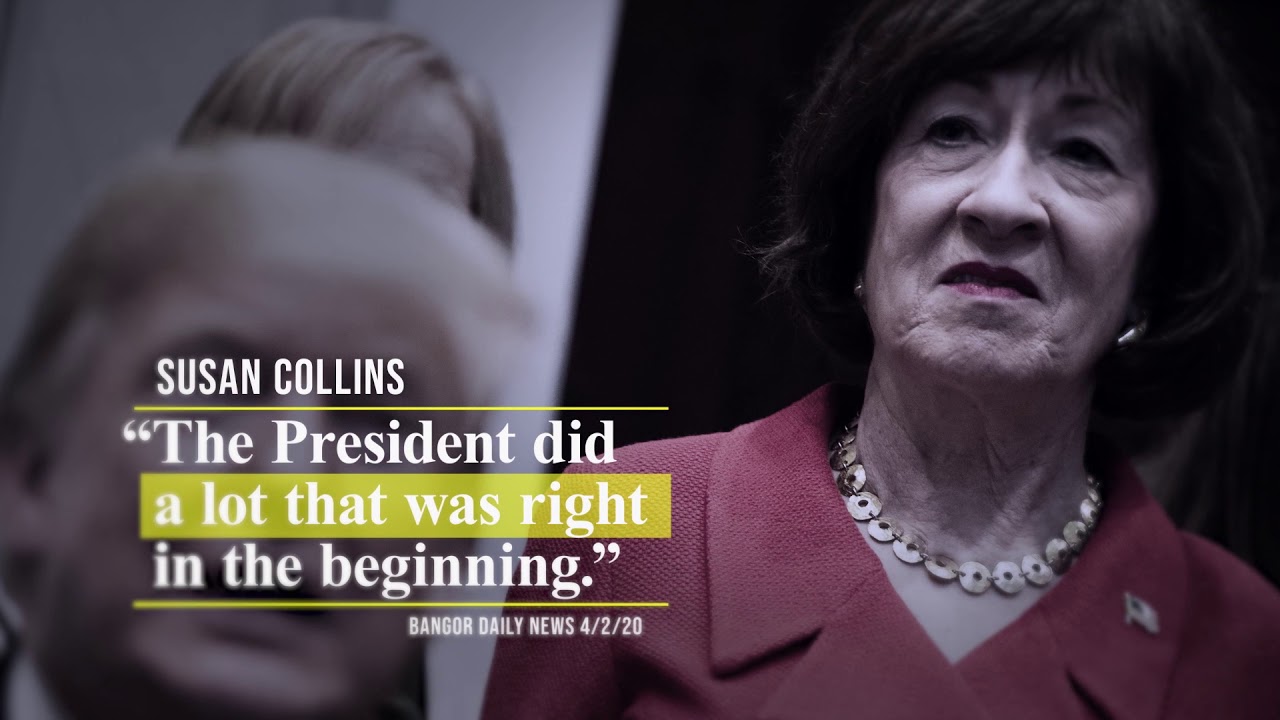 (https://youtu.be/iDLTO08Zxd8), called “Scrounging,” that criticizes Collins for neglecting to secure enough protective gear and other equipment for the state’s beleaguered frontline health care workers.
“Susan Collins defends the president,” the narrator of that ad says, over a graphic that quotes Collins claiming, “The president did a lot that was right in the beginning."
That ad was paid for by a competing Democratic dark-money organization, Majority Forward, linked to Senate Minority Leader Chuck Schumer’s Senate Majority super PAC, which sees Collins as particularly vulnerable in 2020.
The One Nation ad comes to Collins’ defense, claiming she has been “working to get that help, but dark money groups are spreading false information about those efforts.”
The 2020 race between Collins and Democrat Sara Gideon, current speaker of the Maine House of Representatives, is one of a handful of Senate races that will determine whether the GOP, which currently holds a 53-47 majority, will maintain control of the upper chamber, and keep McConnell in the majority leader’s office.
One Nation and the Senate Leadership Fund have raised a combined $190 million to protect the most vulnerable Republican seats: Those held by Martha McSally in Arizona, Cory Gardner in Colorado, Thom Tillis in North Carolina, Joni Ernst in Iowa and David Perdue in Georgia.
One Nation is also affiliated with Karl Rove, top political strategist to former President George W. Bush, and financially backs organizations that promote conservative positions on abortion and gun rights.
One Nation dropped more than $58 million (https://www.opensecrets.org/news/2019/11/dark-money-group-one-nation-2018/) on Republican Senate candidates in the 2018 midterms, and the group has already spent more than $1 million to boost Collins this year, including a $400,000 ad that ran in early January (https://www.onenationamerica.org/one-nation-launches-advocacy-effort-to-lower-cost-of-insulin-for-diabetes/) and touted her work to knock down the cost of insulin.
Collins voted against the Affordable Care Act (https://american-ledger.com/health-care/susan-collins-who-voted-over-20-times-to-gut-the-aca-wants-credit-for-saving-it/), as well as legislation to close the Medicare Part D coverage gap.
“Our investors understand the Senate is the ultimate firewall against socialism, and we are gearing up for a massive fight next year,” said Steven Law, a McConnell associate who chairs the group, in a 2019 statement.
“The Supreme Court, Green New Deal, Medicare for None — it’s all going to be on the line,” he added.
It was Collins’ pivotal vote to confirm Supreme Court Justice Brett Kavanaugh — combined with her ACA votes and her transparently cynical (https://www.salon.com/2020/02/13/susan-collins-flees-from-reporter-when-asked-if-she-still-believes-trump-learned-a-very-big-lesson/) waffling on Trump — that earned her a challenge from Gideon, one of the state’s most prominent elected Democrats.
Last summer Collins drew sardonic criticism (https://mainebeacon.com/activists-use-collins-own-footage-against-her/) when her campaign posted several minutes of B-roll of the senator meeting with Mainers in factories, a classroom, a kitchen and so on. The video was mocked as a transparent gift of content for outside groups to pull from.
FEC rules bar candidates from coordinating with outside groups. The B-roll trick, however, has proven to be a popular (https://www.huffpost.com/entry/mark-udall-ad_n_5086681) end-around.
Last September a Republican super PAC ran an ad that used a lengthy clip from that B-roll, leading the Maine Democratic Party to complain to the FEC (https://www.mainedems.org/media/new-complaint-super-pac-ad-breaks-fec-law-boost-senator-collins-nearly-300k-illegal-kind) that it was an illegal in-kind contribution, “almost entirely comprised of footage that the campaign created.”
Though Maine’s politics can be peculiar (https://www.newyorker.com/news/news-desk/trump-l-l-bean-and-the-peculiar-politics-of-maine) (and Donald Trump won one of its four electoral votes in 2016) it has drifted toward Democrats in recent years. Collins, a nominally pro-choice, middle-of-the-road Republican was a good fit for Maine for decades, but now appears increasingly vulnerable. In January she nabbed the title of “most unpopular senator” (https://www.salon.com/2020/01/17/maine-republican-susan-collins-is-now-the-most-unpopular-member-of-the-us-senate/) — previously held, of course, by Mitch McConnell.
Watch the full ad from One Nation below via (https://youtu.be/yPIuBr_aG4s&feature=emb_logo):
==
420 an covid speech fail?
http://click1.e.alternet.org/tpcjcdpspgwkwcrrkbhppkprrbkrsvmtjgpwhldvzjmm_fyjsdyrywdjrnnynsgh.html?a=&b=4270&c=21989&d=2 (http://click1.e.alternet.org/tpcjcdpspgwkwcrrkbhppkprrbkrsvmtjgpwhldvzjmm_fyjsdyrywdjrnnynsgh.html?a=&b=4270&c=21989&d=2)
==
https://www.alternet.org/2020/03/reporters-reveal-forgotten-detail-of-how-sen-susan-collins-sabotaged-pandemic-preparedness-funds/
==
https://www.alternet.org/2020/02/susan-collins-celebrates-the-return-of-divisive-paul-lepage-to-maine-politics/
an 220
no lnx
For Republicans in Trump’s cover-up, it was all about the money
Susan Collins image via MSNBC.
Written by Joan McCarter / Daily Kos February 18, 2020
In the latest Daily Kos/Civiqs poll, fully 60% of Americans disapprove of how the U.S. Senate conducted Donald Trump’s impeachment trial. The behavior of Senate Republicans following that trial probably won’t get many cheers, either. The three most closely watched Republicans during the trial, those who pretended to be open-minded and committed to doing their jobs, have all popped up in the last few days with slathering praise for the Trump administration which let loose all the money once the trial was done. It turns out the issue wasn’t the threat of heads on pikes at all. It was all about the bribes.
Retiring Sen. Lamar Alexander tweeted to thank Agriculture Secretary Sonny Perdue and Trump for the investment of “$9 million in Tennessee to provide and improve high-speed broadband infrastructure projects for 3,744 rural households, 31 businesses and 41 farms.”
Sen. Lisa Murkowski had Transportation Secretary and Moscow Mitch spouse Elaine Chao to thank for “a $20M Port Infrastructure Development Program grant to the Port of Alaska to help offset the 1st phase costs of the Port’s desperately-needed modernization program, enabling safe, cost-effective, & reliable Port operations.” That’s a whole 1% of the estimated cost for the port. Was it worth a vote to keep the worst president ever to sit in the Oval Office?
You know, of course, who else is getting in on the action:
Sen. Susan Collins
@SenatorCollins
Great news! 19 Housing Authorities in Maine have been awarded more than $9.5 million to preserve & modernize affordable housing units that serve individuals with disabilities & low-income individuals and families.https://www.collins.senate.gov/newsroom/senator-collins-announces-more-9500000-maine-housing-authorities …
==
National laughingstock Susan Collins ‘wishes’ witnesses were called (https://www.alternet.org/2020/02/national-laughingstock-susan-collins-wishes-witnesses-were-called/)
Joan McCarter (https://www.alternet.org/author/joan-mccarter/) / Daily Kos (https://www.alternet.org/author/daily-kos/)February 8, 2020
Congratulations, Sen. Susan Collins! You’ve become a national figure! Unfortunately for you, it’s as a laughingstock. First she appeared in a Saturday Night Live skit and then in a Stephen…
==
Collins’ ‘bipartisan’ reelection campaign tanked with Trump’s ‘100%’ endorsement (https://www.alternet.org/2019/12/collins-bipartisan-reelection-campaign-tanked-with-trumps-100-endorsement/)
Joan McCarter (https://www.alternet.org/author/joan-mccarter/) / Daily Kos (https://www.alternet.org/author/daily-kos/)
no lnx
1119 an
Susan Collins loses endorsement of conservation group as she fights to retain her seat
Written by Joan McCarter / Daily Kos November 15, 2019
Just two years ago, the League of Conservation Voters declared that Sen. Susan Collins, Republican from Maine, “is an extremely important ally in the fight to protect the environment and public health. […] Her leadership is more important now than ever, and we are grateful that she continues to stand up to big polluters by supporting climate action and protections for the air we breathe, the water we drink and the lands we cherish.”
What a difference two years, two new Supreme Court justices, and countless Senate votes backing Donald Trump make. This time around, the LCV is endorsing Democratic candidate Sara Gideon, one of a handful of challengers to Collins. “From her time as a town councilor to her tenure as Speaker of the Maine House of Representatives, Speaker Gideon has been a leader fighting the climate crisis, promoting clean energy, & banning offshore drilling in Maine,” LCV tweeted in its announcement.
In its endorsements, the LCV says that it seeks to “elect environmental champions who will address the climate crisis and advance a more equitable clean energy future.” Beyond that, though, “LCV Action Fund understands the critical importance of a representative democracy and is committed to endorsing candidates that are reflective of the diverse communities and identities across the country.”
Sorry, Susan Collins. That’s just not you anymore. Gideon has also nabbed the endorsement of women’s rights groups NARAL Pro-Choice America and EMILY’s List. That means Planned Parenthood Action Fund is sitting on the fence by itself in not announcing an endorsement yet in Maine.
Planned Parenthood needs to follow the example of LCV’s principled decision to drop Collins. Just two years ago it gave her the 2017 Barry Goldwater Award for “her incredible work this year in fighting to protect women’s access to reproductive health care.” Voting for Neil Gorsuch’s and especially Brett Kavanaugh’s nominations to the Supreme Court nullified all of that.
https://www.alternet.org/2019/09/moscow-mitch-spares-no-expense-to-bolster-collins-campaign-wsj
...t so cozy: Moscow Mitch McConnell making sure that Sen. Susan Collins knows just how much she owes him, and in The Wall Street Journal, no less. The Journal’s story literally says (https://www.wsj.com/articles/pence-advised-against-releasing-rough-transcript-of-ukraine-call-11569576603?shareToken=st295e80b5edd74f04979183aba667540b), “MITCH MCCONNELL SPARES NO EXPENSE to bolster the candidacy of Maine Sen. Susan Collins,” then goes on to explain just how committed he and his former staff are to getting her reelected.
:{
}:
That includes a breakfast fundraiser this week hosted by two of his former aides, now lobbyists with one of the big K Street firms. “One of the lobbyists, Brendan Dunn, was a top McConnell tax adviser and, like Collins, was crucial to the Republican tax law passing the Senate in 2017.” Ah, yes, that critical vote of hers on the tax law that’s put soooo much money into corporate America’s pockets. The vote she gave away when McConnell promised her he’d bring a bill to the floor to protect people with pre-existing health conditions. Which (checks notes) never happened.
But that’s not all. “McConnell himself will be the special guest at an Oct. 21 fundraiser for Collins, according to another invitation viewed by the Journal.” No word on what those tickets are going to cost. Beyond the shreds of Collins’ principles and independence, that is.
==
==
https://www.alternet.org/2019/08/susan-collins-slammed-by-pro-choice-groups-for-attending-federalist-society-fundraiser-in-home-of-anti-abortion-zealot/
fedsoc fundraiser?! ~ abortion AN
==
https://www.alternet.org/2019/07/republican-susan-collins-complains-she-might-not-seek-reelection-because-her-popularity-in-maine-is-crumbling/
==
https://www.alternet.org/2019/07/susan-collins-is-in-deep-water/
==
Susan Collins says she opposes the DOJ’s effort to overturn Obamacare. Her votes are the reason it’s happening (https://www.alternet.org/2019/03/susan-collins-says-she-opposes-the-dojs-obamacare-lawsuit-her-votes-are-the-reason-its-happening/)
==
officially dead?
Here's Why Susan Collins' Kavanaugh Vote Was the Republican Party's Final Surrender to Trump (https://rawstory.us2.list-manage.com/track/click?u=80b42ecc21f29763320aceb90&id=580502455e&e=4da1f92934)
By Heather Digby Parton, Salon
Idolized by both sides, Maine’s “moderate” Republican reveals herself to be just a partisan flunky after all. READ MORE» (https://rawstory.us2.list-manage.com/track/click?u=80b42ecc21f29763320aceb90&id=300f376069&e=4da1f92934)
==
https://www.alternet.org/news-amp-politics/downfall-reasonable-republican-why-susan-collins-senate-career-was-probably-just
...
brett k
...Angrily pointing the finger at any Senate Republicans who might be considering a vote against Kavanaugh, Graham declared, “To my Republican colleagues: if you vote ‘no,’ you’re legitimizing the most despicable thing I’ve seen in my time in politics.” A vote against Kavanaugh, Graham insisted, would be a vote in favor of mob rule, character assassination and the railroading of a decent and honorable man. And even though Graham didn’t mention them by name, it was painfully obvious that Collins, Alaska’s Lisa Murkowski and Arizona’s Jeff Flake were the ones he was trying to bully, coerce and strong-arm into voting for Kavanaugh.
In Flake’s case, such tactics were clearly effective. Although Flake has often been critical of President Donald Trump and tried to appear fair-minded and even-handed when Ford went public with her accusations, he announced, the morning of September 28, that he was a “yes” vote on Kavanaugh (https://www.latimes.com/politics/la-na-pol-congress-kavanaugh-vote-20180928-story.html). And Collins as well will most likely cave into pressure from Graham, Trump and Senate Majority Leader Mitch McConnell and vote for Kavanaugh just as she voted for Trump’s first Supreme Court nominee, Justice Neil Gorsuch, in 2017—only this time, Collins will be voting for someone who has been accused of sexual abuse by three different women (https://www.telegraph.co.uk/news/2018/09/27/three-women-accusing-brett-kavanaugh-sexual-misconduct/): Ford, Deborah Ramirez and attorney Michael Avenatti’s client Julie Swetnick.
Collins is damned if she does and damned if she doesn’t. If Collins were to show integrity and courage and vote against Kavanaugh—like the courage she showed when she helped to save Obamacare (https://www.newyorker.com/news/john-cassidy/how-susan-collins-helped-save-obamacare) in 2017—she would become persona non grata in the GOP. A “no” vote on Kavanaugh would likely result in an aggressive, forceful GOP primary challenge in Maine should she seek reelection in 2020.
But on the other hand, anti-Kavanaugh activists in Maine have been making it abundantly clear that if she votes “yes” for Kavanaugh, they would do everything possible to bury her in the November 2020 general election. And they’re dead serious about it: in Maine, various activist groups (including the Maine People’s Alliance and Mainers for Accountable Leadership) have been crowdfunding a hypothetical Collins opponent (https://www.crowdpac.com/campaigns/387413/either-sen-collins-votes-no-on-kavanaugh-or-we-fund-her-future-opponent) for 2020 and declaring that if Collins votes for Kavanaugh, all of that money would go to the opponent. As of Friday morning, September 28, the activists had crowdfunded more than $1.6 million—and that number would no doubt increase considerably with a “yes” vote on Kavanaugh.
Maine is not a deep red state like Alabama, Mississippi, Nebraska or Utah. It’s a New England state that was won by President Barack Obama in 2008 and 2012 and by Hillary Clinton in 2016, and Collins has been elected in Maine not as a far-right Tea Party extremist, but as a Rockefeller Republican. Many registered Democrats in Maine have crossed party lines and voted for her.
Collins has been indignant over the crowdfunding efforts, claiming that the activists in Maine are trying to bribe an elected official (https://www.vox.com/policy-and-politics/2018/9/12/17850180/susan-collins-crowdpac-kavanaugh-bribe-newsmax)—which is ludicrous. Legal scholars have asserted that crowdfunding a hypothetical Democratic future opponent might be a hardball pressure tactic, but it hardly constitutes a bribe in the legal sense. And “hypothetical” is the operative word because chances are that Collins won’t even seek reelection two years from now.
Christine Blasey Ford didn’t set out to become a feminist icon, but that is what she has, in effect, become—especially in light of all the hateful rhetoric, harassment and death threats (https://www.businessinsider.com/christine-blasey-ford-testimony-threats-brett-kavanaugh-sexual-assault-2018-9) she has been subjected to. Feminists are declaring, in essence, “I am Christine Blasey Ford,” and if Collins votes for Kavanaugh, it will be perceived as a vote against survivors of sexual abuse.
Political controversies that are hot one week can easily calm down the next week. But Kavanaugh’s appointment would be a lifetime appointment, and he could still be sitting on the High Court in 2050—with the stink of sexual abuse allegations hanging over his head.
Although Collins is receiving pressure from the center and the left, it is ultimately the pressure from the far right that is damning her career in the Senate. The GOP of the 1970s and 1980s offered more wiggle room for a Rockefeller Republican like Collins, and Republicans in the Senate and the House of Representatives were not being hounded incessantly by demands for ideological purity. But President Ronald Reagan’s belief that a politician who votes with him 80% of the time is an 80% ally rather than a 20% enemy is hardly the 2018 philosophy of President Trump, Mitch McConnell or Lindsey Graham.
For Sen. Susan Collins, the line has been drawn in the sand. She has a choice between either doing the right thing and being branded as a traitor within the GOP or bowing down to pressure from Trump, Graham and McConnell, voting for Kavanaugh and being branded as someone who made an alleged sexual predator a lifetime member of the U.S. Supreme Court.
Either way, the U.S. Senate career of Susan Collins ended on Thursday, September 27, 2018—and her chances of seeking reelection two years from now have gone from slim to none.
https://insideclimatenews.org/news/27062018/hfcs-global-warming-climate-pollution-lawsuit-trump-epa-regulations-kigali-amendment
Eleven states and the District of Columbia sued the Trump administration on Wednesday, demanding enforcement of regulations on super-polluting greenhouse gases in air conditioners and refrigerators.
A similar lawsuit was filed by environmentalists on Tuesday. Both challenge an attempt by Environmental Protection Agency Administrator Scott Pruitt (https://insideclimatenews.org/tags/scott-pruitt) to roll back federal regulations on the class of chemicals known as hydrofluorocarbons, or HFCs.
The HFC lawsuits are the latest in a string of legal challenges to the Trump administration's far-reaching agenda of rolling back (http://columbiaclimatelaw.com/resources/climate-deregulation-tracker/all-updates/) environmental regulations, especially those relating to climate change (https://insideclimatenews.org/topic/climate-change). Instead of launching a new formal rulemaking procedure to rescind or replace the HFCs rule, Pruitt announced in April (http://columbiaclimatelaw.com/climate-deregulation-tracker/epa-publishes-notice-announcing-it-will-not-enforce-2015-hfc-alternatives-rule/)that the agency would no longer enforce the Obama-era rule, which a federal court had partially struck down in a case brought by two foreign HFCs manufacturers.
The court had struck down (https://insideclimatenews.org/news/09082017/hfcs-greenhouse-gas-court-ruling-refrigeration-coolant-epa-authority-regulate-kigali) only part of the HFCs rule, leaving some elements in place, yet Pruitt's move essentially eliminated the rule entirely. By using "guidance" to do that rather than going through the formal rulemaking process, Pruitt violated administrative law, the NRDC's Lissa Lynch wrote (https://www.nrdc.org/experts/lissa-lynch/nrdc-sues-epa-revoking-court-approved-limits-hfcs) in a blog post explaining her group's lawsuit over the move.
"Throwing out these commonsense restrictions on this potent pollutant is contrary to the law and science, and it is disruptive to the manufacturers that have invested in alternatives," Massachusetts Attorney General Maura Healey said in announcing the states' lawsuit. "We are suing to protect the health of our residents and the planet."
An EPA spokesperson, asked about the lawsuits, said the agency does not comment on pending litigation.
Thousands of Times More Potent Than CO2
HFCs have become the world's fastest growing greenhouse gases as use of refrigeration and cooling spreads in a warming and more populous world. In the short term, they are thousands of times more potent as global warming gases than carbon dioxide, and while they don't last as long in the atmosphere, the short-lived climate pollutants (https://insideclimatenews.org/tags/short-lived-climate-pollutants) have a rapid global impact (https://insideclimatenews.org/news/19032018/global-warming-arctic-air-pollution-short-lived-climate-pollutants-methane-black-carbon-hfcs-slcp).
The Obama administration finalized a rule in 2015 to phase out the chemicals. By then, U.S. manufacturers were already producing less damaging alternatives, and many companies supported (https://obamawhitehouse.archives.gov/the-press-office/2014/09/16/fact-sheet-obama-administration-partners-private-sector-new-commitments-) the phase-down.
An analysis (http://www.nature.com/nclimate/journal/v6/n12/full/nclimate3125.html) by Lawrence Berkeley National Laboratory estimated the rule would have provided about 4 percent of the cuts in greenhouse gas emissions the U.S. needed to meet its obligations under the Paris climate agreement.
What About the Kigali Amendment?
Another move to phase out HFCs has been developing at theinternational level, and the Trump administration at one point indicated it supported (https://insideclimatenews.org/news/27112017/global-warming-hfcs-trump-refrigerator-air-conditioning-montreal-protocol-slcp-climate-change) it.
In 2016, nations agreed to an update to the Montreal Protocol called the Kigali Amendment (https://insideclimatenews.org/news/27112017/global-warming-hfcs-trump-refrigerator-air-conditioning-montreal-protocol-slcp-climate-change) that requires all countries to slash production and consumption of HFCs by at least 80 percent over the next 30 years. It has the backing of a wide array of U.S. businesses (https://www.documentcloud.org/documents/4515099-CEOSeniorExecutiveLetterKigali-61318.html), many of which manufacture safer alternatives to HFCs. But the Trump administration has yet to send it to the Senate for ratification.
Thirteen Republican senators, led by John Kennedy of Louisiana and Susan Collins of Maine, have urged (http://thehill.com/policy/energy-environment/391689-gop-senators-push-trump-to-submit-pollution-treaty-amendment-for) the White House to move forward with the treaty, saying the amendment would help domestic companies by leveling the playing field worldwide and giving them long-term certainty on what chemicals to use going forward.
In the meantime, Pruitt's deregulatory moves, if they survive court challenges, would undercut U.S. progress toward meeting the Kigali goals.
Connections to an Ethics Scandal
HFCs have come up in the ethics allegations swirling around Pruitt, as well, the Washington Post reported (https://www.washingtonpost.com/news/energy-environment/wp/2018/06/24/lobbyist-tied-to-pruitts-condo-rental-pushed-for-epa-to-hire-family-friend-emails-show/)this week. Emails obtained by the Sierra Club under the Freedom of Information Act show that J. Steven Hart, a lobbyist whose wife rented Pruitt a condo on Capitol Hill last year, had contacted Pruitt's chief of staff in 2017 seeking to discuss the HFCs rule and issues it might cause for companies. The agency has maintained that Hart did not lobby the agency on environmental issues. The matter is under investigation by both the EPA's inspector general and the House oversight committee.
The attorneys general who sued over HFCs represent New York, California, Delaware, Illinois, Minnesota, New Jersey, Oregon, Vermont, Washington and the District of Columbia, and they were joined by the Pennsylvania Department of Environmental Protection. Earlier this year, California (https://insideclimatenews.org/news/30032018/california-hfc-ban-short-lived-climate-pollutants-global-warming-refrigerators-air-conditioners)regulators adopted their own state prohibition on HFCs in new air-conditioning and refrigeration.
"The Trump EPA is seeking to gut critical climate protection rules through the backdoor—once again endangering New Yorkers while thumbing their nose at the law," New York Attorney General Barbara Underwood said.
PUBLISHED UNDER:
REGULATION (https://insideclimatenews.org/topics/regulation)
SHORT-LIVED CLIMATE POLLUTANTS (https://insideclimatenews.org/tags/short-lived-climate-pollutants)
SCOTT PRUITT (https://insideclimatenews.org/tags/scott-pruitt)
EPA (https://insideclimatenews.org/topic/epa)
==
kigali amend to montreal protocol
kennedy murkowski collins...
13 Republican senators are urging (https://www.documentcloud.org/documents/4501544-Senate-Letter-on-Kigali-6-4-18.html) President Trump to back a policy achieved under former President Obama that they say would create American manufacturing jobs. It would also cut greenhouse gas emissions, but that went unmentioned.
Why it matters: In a letter (https://www.documentcloud.org/documents/4501544-Senate-Letter-on-Kigali-6-4-18.html), dated last week and obtained by Axios on Monday, the senators don’t mention "Obama" or "climate change." It's one of the starkest signs of how the Republican Party is willing to support efforts cutting emissions as long as they don’t mention one of these two hyper-polarizing topics.
==
==
Sen. Susan Collins of Maine, who has the strongest environmental voting record among Senate Republicans, was the only GOP senator who voted against confirmation of Environmental Protection Agency Administrator Scott Pruitt and against the sole assistant administrator approved so far: William Wehrum, a former fossil fuel and chemical industry lawyer who now runs the agency's air office [but wd not commit on hartnet white?]
==
Dourson is also facing problems in another red state struggling with chemical contamination: North Carolina. While both Republican senators from the state voted for Pruitt and Wehrum, neither (https://bnanews.bna.com/environment-and-energy/north-carolina-senators-decline-to-back-epa-nominee-dourson) has committed to Dourson. The state is home to Camp Lejeune, the military base where TCE and other carcinogenic chemicals seeped into drinking water, leading to a cluster of cancer cases (https://www.nytimes.com/2015/02/17/health/cancer-can-be-tough-case-to-prove.html). As retired Marine Jerry Ensminger pointed out (http://www.newsobserver.com/opinion/op-ed/article181973661.html) in the Raleigh News and Observer, Dourson’s evaluation of TCE, which was paid for by the American Chemistry Council, calculated a safety level that was less protective than the one set by the EPA. Ensminger, whose daughter died of leukemia at Camp Lejeune, has called on his senators to oppose Dourson, whom he calls a “walking, talking example of conflict of interest.”
North Carolina is also ground zero (https://theintercept.com/2017/06/17/new-teflon-toxin-found-in-north-carolina-drinking-water/) for GenX (https://theintercept.com/2016/03/03/new-teflon-toxin-causes-cancer-in-lab-animals/), the latest in a family of chemicals known as PFAS to be found in drinking water. DuPont and its spinoff, Chemours, have dumped at least 1 million pounds of PFAS into North Carolina’s Cape Fear River since 1980. GenX and other PFAS are unregulated, which is limiting the state’s ability to clean it up.
While he has stayed mum about whether he will vote for Dourson, North Carolina Sen. Richard Burr wrote to Pruitt on October 31, asking him to consider evaluating GenX and the entire class of chemicals to which it belongs, a step that could lead to regulation. Some (https://insideepa.com/daily-news/hedging-toxics-nominee-burr-urges-pruitt-address-pfc-concerns) have suggested that Burr’s support for Dourson may be contingent on whether the EPA promises to help address his state’s water contamination problem. Burr’s office did not respond to inquiries for this story.
In addition to these possible defectors, Maine Sen. Susan Collins is also expected to break with the Republican ranks to oppose Dourson. Collins was the only Republican senator to vote against both Pruitt and Wehrum.
“Susan has been heroic in so many ways,” said Delaware’s Sen. Tom Carper, who has been leading the charge against Dourson in the Senate.
Because Dourson has worked on behalf of industry to defend dozens of chemicals that have contaminated the water and air of Republicans, as well as Democrats, Carper hopes that some of Collins’s colleagues will join her this time.
https://www.washingtonpost.com/news/energy-environment/wp/2017/05/10/senates-poised-to-repeal-a-final-obama-era-rule-as-soon-as-wednesday/
no link many
Senate unexpectedly rejects bid to repeal a key Obama-era environmental regulation
By Chelsea Harvey and Juliet Eilperin May 10 at 12:10 PM
Oil pumps and natural gas burn off in Watford City, N.D. Methane emissions will likely be the next big environmental issue to face North Dakota’s booming oil industry according to a top official at the state’s Department of Health. (AP/Charles Rex Arbogast)
This story has been updated.
The U.S. Senate narrowly voted down a resolution on Wednesday to repeal an Obama-era rule restricting methane emissions from drilling on public lands — with three Republicans joining every Democrat to preserve the rule.
The 51 to 49 vote marked the first time since Trump’s election that Republicans have failed in their attempt to use the Congressional Review Act to overturn Obama-era rules.
Thirteen earlier resolutions, based on the 1996 law that allows Congress to overturn rules within 60 days of their adoption, all succeeded. But the deadline for repealing such regulations through the Congressional Review Act is on Thursday.
The methane emissions rule, issued by the Interior Department’s Bureau of Land Management in November, addresses a potent greenhouse gas that is accelerating climate change.
[Earth could break through a major climate threshold in the next 15 years, scientists warn]
The rule would force oil and gas companies to capture methane that had been previously burned off or “flared” at drilling sites.
The previous administration estimated the rule would prevent roughly 180,000 tons a year of methane from escaping into the atmosphere and would boost federal revenue because firms pay only royalties on the federal resources they capture and contain.
Sen. John McCain (R-Ariz.) unexpectedly voted no against a motion to proceed with consideration of the resolution, along with GOP Sens. Susan Collins (Maine) and Lindsey Graham (S.C.). Two Democrats who had considered backing the rule’s elimination — Heidi Heitkamp of North Dakota and Joe Manchin of West Virginia — voted against the motion as well.
In a floor speech after the vote, Sen. Tom Udall (D-N.M.), said “the very first victory” lawmakers have had in beating back a Congressional Review Act bill this year came from a combination of Democratic unity and a few Republicans’ willingness to buck their leadership. “Thank you so much for coming forward and seeing the common sense nature of this issue,” Udall said, referring to Collins, Graham and McCain.
Jamie Williams, president of The Wilderness Society, praised the lawmakers who supported the rule. “In recent months, thousands of Americans asked the Senate to stand up for clean air and against the oil lobby, and their efforts were successful today,” he said.
Republicans and industry officials said they would now switch their focus to getting the Interior Department to rewrite the rule.
Barry Russell, president of the Independent Petroleum Association of America, said his group “looks forward to working with the Interior Department on a targeted, meaningful solution that will achieve the common goal of ensuring the American taxpayers receive a fair and equitable return in the form of royalties while developing a workable regulation, instead of this one-size-fits-all approach.”
[EPA dismisses half of key board’s scientific advisers; Interior suspends more than 200 advisory panels]
And Senate Environment and Public Works Committee Chairman John Barrasso (R-Wyo.) said in a statement that Interior should withdraw the regulation outright. “If left in place, this regulation will only discourage energy production, job creation, and economic opportunity across the West.”
Before this year, Congress had only nullified one rule, a regulation on ergonomics Bill Clinton enacted during his final year in office. In less than four months Republicans have wiped away rules covering everything from limits on the dumping of waste from surface mining operations to enlarging states’ power to offer retirement accounts to private-sector workers.
But the move to strike a rule requiring companies to limit the practice of flaring, or leaking, methane from oil and gas operations on federal and tribal land had given some Republicans–who control 52 seats in the Senate–pause.
Senate Press Gallery ? @SenatePress
#senate vote on HJ Res 36, the CRA on the methane rule was NOT agreed to 49-51. Collins, Graham and McCain joined all Dems/IND against.
7:27 AM - 10 May 2017
236 236 Retweets 516 516 likes
:{
}:
Many Republicans and fossil fuel producers criticized the regulation after it was finalized last year, and a resolution to repeal it passed quickly in the House of Representatives at the end of January. But despite Trump’s support, the repeal measure had been sitting in the Senate for months. It had to pass by Thursday to be eligibleto be signed into law.
:{
}:
Democrats, as well as environmental and public health groups, ran a months-long campaign to persuade Heitkamp and Manchin not to disclose their position publicly while arguing to centrist Republicans that abolishing the rule would cost taxpayers money as well as harm the environment.
[Trump undertakes the most ambitious regulatory rollback since Reagan]
:{
}:
Sen. Rob Portman (R-Ohio) also remained on the fence until Monday, when he announced in a statement that he would vote to overturn the BLM regulation. Two other wavering Republicans, Cory Gardner (Colo.) and Dean Heller (Nev.), ultimately joined Portman in voting to proceed with the bill’s consideration.
“Unfortunately, the previous administration’s methane rule was not a balanced approach,” Portman said. “As written, it would have hurt our economy and cost jobs in Ohio by forcing small independent operators to close existing wells and slowing responsible energy production on federal lands. There’s a better way.”
He added that he believes the Interior Department should still work to reduce venting and flaring on public lands. Last week, Portman wrote to Interior Secretary Ryan Zinke, calling for a commitment that the department would continue to work to reduce methane waste if the Obama rule were reversed. On May 4, Zinke responded, affirming that “the Department is committed to reducing methane waste, and under my leadership, we will take important steps to accomplish this goal.”
Environmentalists urged Portman to reconsider. In a statement on Tuesday, Environmental Defense Action Fund Executive Director Fred Krupp said Zinke’s assurances were “unfounded” and argued that the strategies for reducing methane waste outlined in his letter would have little impact.
A coalition of industry groups have argued they are taking steps to reduce fugitive methane emissions, because they recognize capturing them can yield additional profits. The American Petroleum Institute noted that the Environmental Protection Agency data, released in March, shows about an 8 percent drop in methane emissions from petroleum production since 2014, largely because of improved gas venting and flaring techniques.
The legislative window for Congressional Review Act resolutions to be considered ends on Thursday, though a handful of conservative analysts believe that agencies’ failure to submit a 2-page report on previous rules to Congress could open the door to reconsideration of dozens of much older rules.
Curtis Copeland, a regulatory expert who specialized in American government at the Congressional Research Service, said in an email that regardless of how many rules this Congress ultimately overturns, “The CRA can no longer be described as ‘obscure’ or ‘little known.’ It now has to be viewed as a substantive tool of congressional oversight regarding an outgoing President’s rules, and it is likely be used again in the future.”
==
New head of the Senate Environment and Public Works Committee? Oklahoma’s James Inhofe, author of The Greatest Hoax: How The Global Warming Conspiracy Threatens Your Future.
Gardner defeated staunch environmental ally Mark Udall in a campaign that included millions from Koch Industries and other fossil fuel interests.
“Everything in Colorado has shifted farther to the right toward the oil and gas industry and the climate-change denial funded by millions of dollars from the Koch Brothers,” said Colorado environmental activist Gary Wockner (http://ecowatch.com/author/gwockner/). “Most notably, Democratic U.S. Senator Mark Udall was swept out of office by Tea Partier Cory Gardner who is a 100 percent voting member of the most anti-environmental U.S. House of Representatives in history and declined to answer climate change questions during the race.”
Iowa’s Joni Ernst, probably the most conservative candidate elected last night, has punted on whether she believes climate change is manmade and boasts of driving an electric car. But she has vowed to work to abolish the EPA and repeal the Clean Water Act saying it was one of the most damaging laws for business. That’s another measure that once had overwhelming bipartisan support and has been a huge success in cleaning up America’s waterways. She replaced the retiring Tom Harkin, a strong pro-environmental vote.
But Beinecke pointed out, “Several senators won by running clean—including Jeanne Shaheen in New Hampshire, Susan Collins in Maine and Senator-elect Gary Peters in Michigan. All are climate champions. Peters took on the Koch brothers and promised Michigan voters he would fight in Congress to protect the Great Lakes from climate change.”
“The election may have changed the political dynamics in Washington, but it doesn’t change the science,” said Mindy Lubber, president of sustainable business group Ceres (http://www.ceres.org/). “The reality of global warming and the need for urgent action remain an imperative. Business leaders understand this truth. Smart companies are making wise choices about their energy purchases and future operational planning in a carbon-constrained world.”
Another voice for business was Rhone Resch, president and CEO of the Solar Energy Industries Association (http://www.seia.org/) (SEIA), who urged political leaders not to leave solar behind. “It’s critically important for our leaders in Washington, as well as our state capitals, to put aside their differences and work together to find real solutions that will grow our economy and put more people to work,” he said.
“As one of the fastest-growing industries in America, solar is a shining example of how stable, consistent and reliable public policies are paying huge dividends for our economy and environment. As pundits analyze the results of Tuesday’s elections, here is one important mandate to remember: Polls consistently show that 9 out of 10 Americans want to see an expanded use of solar energy nationwide.”
Michael Brune, executive director of the Sierra Club (http://www.sierraclub.org/), was also undeterred. “Despite the climate movement’s significant investments and an unprecedented get out the vote program, strong voices for climate action were defeated and candidates paid for by corporate interests and bolstered by sinister voter suppression tactics won the day,” he said.
“But don’t be fooled. This election marked a pivotal change in how candidates confront the climate crisis. Even the most anti-environmental candidates were compelled to greenwash their voting records and change their tune on climate denial. The climate on climate is changing. A Congress elected by corporate polluters may think it can force a polluter agenda on this country. But public support is solidly behind action to tackle the climate crisis. There is a growing movement of climate and clean energy voters that will be standing up to polluters and their political allies every step of the way.”
YOU MIGHT ALSO LIKE
Top 20 ‘Dirty Denier$’ Who Accept Big Bucks from Big Polluters (http://ecowatch.com/2014/09/03/climate-change-deniers-candidates/2/)
Climate Denial Machine Fueled By Big Oil and Koch Brothers Impacts Congressional Races (http://ecowatch.com/2014/07/29/climate-denial-koch-brothers/)
Why Fossil Fuels Are Dirty Politics as Well as Dirty Energy (http://ecowatch.com/2014/11/03/carl-pope-fossil-fuels-dirty-politics/)
==
9/14
Republican Senator Susan Collins just killed our only chance this year to overturn Citizens United in the Senate.
On Thursday, the U.S. Senate voted on the "Democracy for All" amendment to the U.S. Constitution, which would repeal the awful Citizens United and McCutcheon decisions. This all-important amendment would have limited the influence of millionaires and billionaires on our politics and made it clear that money is not speech.
It failed. It didn't pass because Senator Susan Collins from Maine and her fellow Republicans killed it. Susan Collins is proving once again she's not the moderate independent leader she claims. She chose to side with Mitch McConnell, Tea Party Republicans and billionaires like the Koch brothers over her constituents, as she's done so many times before.
America deserves a Senator who will stand up for our democracy. That's why DFA has endorsed Shenna Bellows, the progressive champion who is taking on Susan Collins in this year's Maine Senate race.
We can repeal Citizens United and get big money out of politics -- but we have to replace Republicans like Susan Collins with more Elizabeth Warren Democrats like Shenna Bellows. Will you help Shenna Bellows defeat Susan Collins by donating $3 to her campaign today? (https://secure.actblue.com/contribute/page/dfamaine/?refcode=CSB091314AW.5290.w)
Citizens United and similar cases relied on a flawed Supreme Court decision from 1976, Buckley v. Valeo, that argued campaign donations are the same thing as free speech. So to repeal Citizens United and Buckley v. Valeo and make it clear that campaign donations can and should be regulated, we have to amend the constitution. Sixteen states, more than 550 cities and towns, and millions of Americans -- including DFA members -- have signed on in support of that amendment.
Republican Susan Collins helped kill that amendment on Thursday. It's not surprising -- even though Collins talks like a moderate, she consistently sides with the Washington Republican extremists and Wall Street billionaires over the middle class. If we can hold the Senate with progressive champions like Shenna Bellows and unseat Republicans like Susan Collins in Maine -- we have a much better chance of passing the amendment next year.
DFA has endorsed Shenna Bellows for Senate because she knows that money isn't speech, and she'll fight to make sure that all Maine families, not just Washington insiders and Wall Street billionaires, get a real say in our democracy. She can win, but only if we can mobilize enough voters on the ground to defeat Collins' big money.
==
6/14
WASHINGTON -- A leading environmental group endorsed Sen. Susan Collins (R-Maine) on Monday over her progressive Democratic opponent, Shenna Bellows.
In a press release, the League of Conservation Voters praised Collins' commitment to environmental issues.
“Senator Susan Collins is committed to finding bipartisan solutions that will safeguard our environment and combat climate change while promoting clean energy, which will create good paying jobs and reduce our reliance on dirty fossil fuels,” said LCV Action Fund President Gene Karpinski in the release. “She is always fighting for the people of Maine by supporting common sense policies that promote the state’s outdoor heritage and help protect our air, water and public health.”
Collins has stood out (http://www.huffingtonpost.com/2014/06/27/susan-collins-environment_n_5527169.html) from her Republican colleagues when it comes to environmental issues. She has long championed cuts in carbon emissions, and last year was the only Republican to vote against an amendment that would have prevented the Environmental Protection Agency from setting carbon rules.
But Bellows, who was previously executive director of the American Civil Liberties Union in Maine, has made environmental issues a central part of her campaign. In a statement released Monday, she chided LCV for propping up a "Washington Republican" and ignoring Collins' mixed record. Collins scored the highest of any GOP senator on the LCV's National Environmental Scorecard (http://scorecard.lcv.org/), which ranks lawmakers on their voting record with regard to environmental legislation, but her score of 67 percent amounts only to a D.
hmmn
Collins voted to shut down the government over Obamacare. Twice. She voted against raising the minimum wage and the Paycheck Fairness Act but supports building the Keystone XL Pipeline and spying on Americans without a warrant.
Sen. Collins likes to pretend that she's an old-school moderate, but one look at her actual voting record tells a different story.When the stakes are high, the dirty secret is, Susan Collins votes with the Tea Party every single time.
Here’s the thing: This November, we can defeat Senator Collins -- and help save the Senate from GOP control.
Enter Shenna Bellows, the former director of the American Civil Liberties Union of Maine, who is running to unseat Collins this November. Shenna has deep Maine roots and a long history of fighting for justice, and she's been proud to fight alongside progressives like Elizabeth Warren on issues of economic security.
==
Maine Sen. Susan Collins
There must be something in the water in Maine because the state's other Republican senator, Susan Collins, is also pretty hip to climate change and the environment at large. Collins beat Snowe by 9 percentage points with aperfect 100 percent score by the League of Conservation Voters (who endorsed her last year) and, in 2007, voted for a bill that would require the government to take global warming into account when planning projects. She's voted to preserve Corporate Average Fuel Economy, or CAFE, standards, to keep renewable and solar power funding, and to elevate the EPA to a Cabinet-level department.
Collins worked with Sen. Joe Lieberman to introduce the Collins-Lieberman Energy Independence, Clean Air and Climate Security Act which would have set new standards for transportation and energy and reduced emissions to 1990 levels by 2020. The League of Conservation Voters had great things to say when they endorsed Collins in 2008 and told Grist (http://www.grist.org/article/maine-dish/), "She has demonstrated great leadership, particularly on global warming. We think that she's going to play a critical role in 2009 in helping us get the 60 votes we're going to need to move something in the Senate."
survived flank?
Recently, I wrote to you about the crazy “Keeping Politics Out of Federal Contracting Act” (KPOFCA), which would keep secret political spending by federal contractors like Northrop Grumman and Academi (formerly Blackwater) in the dark.
Now Congressional Republicans are fighting transparency on another front. On a party-line vote, the House GOP stuck language in a must-pass appropriations bill that, unless the Senate takes it out, will block significant new transparency requirements for political ads.
Don’t let corporate cronies block political spending transparency.
Urge your senators to remove the House GOP’s dark money language and to oppose KPOFCA (S. 1100). (http://salsa.democracyinaction.org/dia/track.jsp?v=2&c=TtkNXO6irKlmh1saA7zbjE%2BRC7wfgmy3)
What are the transparency requirements that corporations are so afraid of?
Well, the Federal Communications Commission (FCC) recently created a new rule that requires TV stations to make the information they collect about political ad spending available on the Internet.
This is information the TV stations are already collecting, and the data is already public. However, right now it’s only accessible by physically going to a TV station and requesting the files.
The new rule is just a modernizing update to how things work in the 21st Century. If the data is truly public, it should be posted online.
The House GOP’s anti-disclosure language in the appropriations bill specifically strips the FCC’s funding to implement the rule.
Tell your senators to support the FCC rule and to oppose secret political spending by federal contractors. (http://salsa.democracyinaction.org/dia/track.jsp?v=2&c=S%2BjcUSJu6Qdl133qNBbEG0%2BRC7wfgmy3)
KPOFCA, meanwhile, has already passed out of the Senate Homeland Security Committee.
Backed by Sen. Susan Collins (R-Maine), whose top campaign contributor is General Dynamics (a military contractor that makes fighter jets) and Sen. Joe Lieberman (I-Conn.) whose top contributor is Northrop Grumman (another military contractor), KPOFCA would prevent the government from requiring federal contractors to disclose money they’re spending to influence elections.
Iraq War
Collins voted for the Authorization for Use of Military Force Against Iraq Resolution of 2002 (http://www.sourcewatch.org/index.php/Authorization_for_Use_of_Military_Force_Against_Iraq_Resolution_of_2002) that started the Iraq War.[1]
For more information see the chart of U.S. Senate votes on the Iraq War (http://www.sourcewatch.org/index.php/U.S._Senate_votes_on_the_Iraq_War).
Statements and action on the Iraq war
Statements made by Susan Collins:
March 27, 2007: If Bush's strategy in Iraq does not show "significant results" by fall, "then Congress should consider all options including a redefinition of our mission and a gradual but significant withdrawal of our troops next year." [1 (http://news.yahoo.com/s/ap/20070328/ap_on_go_pr_wh/us_iraq)
Resolution opposing the troop "surge"
On February 5, 2007, Collins was one of two Republican Senators who crossed party lines and voted to open debate on a bill opposing President Bush's troop "surge" in Iraq. The measure failed 49-47. Later on February 17, 2007, Collins was one of seven Republicans to cross party lines and vote in favor of cloture on another non-binding resolution opposing the troop "surge." That measure failed 56-34.
Main article: Congressional actions regarding President Bush’s 2007 proposed troop “surge” in Iraq (http://www.sourcewatch.org/index.php/Congressional_actions_regarding_President_Bush%E2%80%99s_2007_proposed_troop_%E2%80%9Csurge%E2%80%9D_in_Iraq)
Environmental record
For more information on environmental legislation, see the Energy and Environment Policy Portal (http://www.sourcewatch.org/index.php/Portal:Energy_and_Environment_Policy_%28U.S.%29)
Ethics reform
In 2006, Collins introduced a bill to establish an independent congressional oversight committee, the Office of Public Integrity. On March 2, 2006, however, the bill was defeated in a Homeland Security and Governmental Affairs Committee vote of 11-5. Later that month when the Lobbying Accountability and Transparency Act of 2006 was under consideration on the floor of the Senate, Sen. Collins introduced her Office of Public Integrity bill as an amendment to the overall reform package. Her amendment failed 30-67.
Main article: Prospects for Ethics Reform in the 110th Congress (http://www.sourcewatch.org/index.php/Prospects_for_Ethics_Reform_in_the_110th_Congress)
Senate filibusters and the Gang of 14 (http://www.sourcewatch.org/index.php?title=Gang_of_14&action=edit&redlink=1)
On May 23, 2005, Collins was one of fourteen senators (http://en.wikipedia.org/wiki/Gang_of_14) from both parties that struck a deal over the Democrats' use of the judicial filibuster (http://www.sourcewatch.org/index.php/Filibuster), thus blocking the Republican leadership's attempt to implement the so-called "nuclear option (http://www.sourcewatch.org/index.php/Nuclear_option)". Under the agreement, the Democrats would retain the power to filibuster a Bush judicial nominee only in an "extraordinary circumstance", and the three most conservative Bush appellate court nominees (Janice Rogers Brown (http://www.sourcewatch.org/index.php/Janice_Rogers_Brown), Priscilla Owen (http://www.sourcewatch.org/index.php/Priscilla_Owen) and William H. Pryor, Jr. (http://www.sourcewatch.org/index.php/William_H.Pryor,Jr.)) would receive a vote by the full Senate.
Executive power
In July 2006 Collins gave her support to a bill by Sen. Arlen Specter (http://www.sourcewatch.org/index.php/Arlen_Specter) (R-Pa.) that would allow Congress to file a lawsuit to get presidential signing statements (http://www.sourcewatch.org/index.php/Presidential_signing_statements) declared unconstitutional. [2 (http://public.cq.com/public/20060726-specter.html)
For further details see the Congresspedia article on presidential signing statements (http://www.sourcewatch.org/index.php/Presidential_signing_statements).
Sam Pattern link
In the past Sam Patten (http://www.sourcewatch.org/index.php/Sam_Patten) has served as a legislative assistant to U.S. Senator Susan Collins advising her on foreign policy and defense issues. [3 (http://www.marshcopsey.com/ourteam/#)
Term limits
Sen. Collins reneged on her pledge to only serve for at most 12 years, or 2 only terms, in the Senate. During a campaign appearance in 1996, she answered "Yes" to a question about whether she would pledge to only serve 12 years in the Senate. In 2002, Collins stated in a letter to a constituent her continued pledge to serve only 12 years in the Senate, "I intend to serve only two terms as I indicated in the Sanford forum six years ago." On October 12, 2006 Collins stated that she was breaking her pledge and would seek another six year term in the Senate. Collins justified her new position stating that her viewpoint on seniority has changed, "At the time, I thought that 12 years, that two terms, would be enough. This was at the height of what I would call the frenzy over term limits."
Main article: term limits (http://www.sourcewatch.org/index.php/Term_limits)
Bio
Background
Collins was born December 7, 1952 in Caribou, Maine. She is a Phi Beta Kappa graduate of St. Lawrence University. She worked for Senator William Cohen (http://en.wikipedia.org/wiki/William_Cohen) from 1975 until 1987, when she became chair of the Maine commission on financial regulation. She served in this position until 1992, when she briefly served as New England regional director of the National Small Business Administration (http://www.sourcewatch.org/index.php?title=Small_Business_Administration&action=edit&redlink=1). She then moved to Massachusetts and served as its Deputy Treasurer in 1993, but then moved back to Maine. She was the Republican candidate in the Maine gubernatorial election of 1994, but both she and the Democratic (http://www.sourcewatch.org/index.php/United_States_Democratic_Party) candidate, former Governor Joe Brennan (http://en.wikipedia.org/wiki/Joseph_Brennan_%28politician%29), were defeated by the Independent candidate, Angus King (http://en.wikipedia.org/wiki/Angus_King).
Senate Career
When Senator William Cohen announced his retirement, Collins announced her Senate candidacy, and after a difficult three-way primary she defeated Democrat Joe Brennan in the 1996 general election. She was reelected in 2002 over State Senator Chellie Pingree (http://en.wikipedia.org/wiki/Chellie_Pingree) (D) 58% - 42%.
In the U.S. Senate, Collins played a role during the Senate's impeachment trial of President Bill Clinton (http://www.sourcewatch.org/index.php/Bill_Clinton), when she and fellow Maine Senator Olympia Snowe (http://www.sourcewatch.org/index.php/Olympia_Snowe) sponsored a motion that would have allowed the Senate to vote separately on the charges and the remedy. When the motion failed, both Snowe and Collins subsequently voted to acquit, believing that while Clinton had broken the law by committing perjury, the charges did not amount to grounds for removal from office.
Labeled as a moderate or liberal Republican, Collins often breaks with her party. She voted against the ban on partial-birth abortions, the restrictions on travel to Cuba, harsher punishments for drug users, and she opposed amending the U.S. Constitution to prohibit same-sex marriages. On taxation and trade she has taken a more moderate line, voting against some trade agreements, most recently CAFTA. In 2001 she was one of only four Republicans to vote to limit the reduction in the top tax rate and to increase the amount of tax relief for those at the bottom of the income scale. In 2003 she was the only Republican to vote in favor of spending a portion of the tax cut reserved for upper-income payers on the building of hospitals in rural areas. She has voted against drilling in Arctic National Wildlife Refuge (http://www.sourcewatch.org/index.php/Arctic_National_Wildlife_Refuge) and in favor of increasing the average mile-per-gallon requirement for vehicles. In September of 2005, Collins cosponsored a resolution with Sen. Patrick Leahy (http://www.sourcewatch.org/index.php/Patrick_Leahy) (D-VT), which disapproved a new rule put in place by the Administrator of the Environmental Protection Agency that delisted coal and some other energy sources from the Clean Air Act (http://www.sourcewatch.org/index.php/Clean_Air_Act). The resolution failed by a vote of 47-51.
2008 election
Collins has confirmed she is running for reelection in the 2008 congressional elections.[2]
Money in politics
This section contains links to – and feeds from – money in politics databases. cid=N00000491&cycle=2006
Links to more campaign contribution information for Susan Collins
from the Center for Responsive Politics' OpenSecrets.org (http://www.opensecrets.org) site.
Fundraising profile:
2006 election cycle (http://www.opensecrets.org/politicians/summary.asp?cycle=2006&cid=N00000491)
Career totals (http://www.opensecrets.org/politicians/allsummary.asp?cid=N00000491)
Top contributors by organization/corporation:
2006 election cycle (http://www.opensecrets.org/politicians/contrib.asp?cycle=2006&cid=N00000491)
Career totals (http://www.opensecrets.org/politicians/allcontrib.asp?cid=N00000491)
Top contributors by industry:
2006 election cycle (http://www.opensecrets.org/politicians/indus.asp?cycle=2006&cid=N00000491)
Career totals (http://www.opensecrets.org/politicians/allindus.asp?cid=N00000491)
Revolving door profile for Susan Collins (http://www.opensecrets.org/revolving/search_result.asp?mem=Collins%2C+Susan+M) from the Center for Responsive Politics' OpenSecrets.org (http://www.OpenSecrets.org) website.
2006 privately funded travel profile for Susan Collins (http://www.opensecrets.org/politicians/travel.asp?CID=N00000491) from the Center for Responsive Politics' OpenSecrets.org (http://www.OpenSecrets.org) website.
Personal finance profile for Susan Collins (http://www.opensecrets.org/pfds/candlook.php?CID=N00000491) from the Center for Responsive Politics' OpenSecrets.org (http://www.OpenSecrets.org) website.
Committees and Affiliations
Board of Governors for the Partnership for Public Service (http://www.sourcewatch.org/index.php/Partnership_for_Public_Service).
Member of the Aspen Strategy Group (http://www.sourcewatch.org/index.php/Aspen_Strategy_Group)
Honorary Board, Republicans for Environmental Protection (http://www.sourcewatch.org/index.php/Republicans_for_Environmental_Protection) ^[3]
Committees
Senate Committee on Homeland Security and Governmental Affairs (http://www.sourcewatch.org/index.php/Senate_Committee_on_Homeland_Security_and_Governmental_Affairs) - Ranking Member
Senate Special Committee on Aging (http://www.sourcewatch.org/index.php/Senate_Special_Committee_on_Aging)
Senate Committee on Armed Services (http://www.sourcewatch.org/index.php/Senate_Committee_on_Armed_Services)
Subcommittee on Emerging Threats and Capabilities
Subcommittee on Personnel
Subcommittee on Seapower
Committee assignments in the 109th Congress (2005-2006)
Senate Special Committee on Aging (http://www.sourcewatch.org/index.php/Senate_Special_Committee_on_Aging)
Senate Committee on Armed Services (http://www.sourcewatch.org/index.php/Senate_Committee_on_Armed_Services)
Subcommittee on Personnel
Subcommittee on Seapower
Subcommittee on Emerging Threats and Capabilities
Senate Committee on Homeland Security & Governmental Affairs (http://www.sourcewatch.org/index.php/Senate_Committee_on_Homeland_Security_%26_Governmental_Affairs), Chair
Coalitions and Caucuses
The Republican Main Street Partnership (http://www.sourcewatch.org/index.php/Republican_Main_Street_Partnership)
The Republican Majority For Choice (http://www.sourcewatch.org/index.php?title=The_Republican_Majority_For_Choice&action=edit&redlink=1)
Republicans For Choice (http://www.sourcewatch.org/index.php?title=Republicans_For_Choice&action=edit&redlink=1)
The Wish List (http://www.sourcewatch.org/index.php?title=The_Wish_List&action=edit&redlink=1)
Republicans For Environmental Protection (http://www.sourcewatch.org/index.php/Republicans_For_Environmental_Protection)
Its My Party Too (http://www.sourcewatch.org/index.php?title=Its_My_Party_Too&action=edit&redlink=1).
More Background Data
Background information on Susan Collins from Project Vote Smart (http://www.vote-smart.org/bio.php?can_id=BC032786)
Interest group scorecard ratings for Susan Collins from Project Vote Smart (http://www.vote-smart.org/issue_rating_category.php?can_id=BC032786)
Voting record for Susan Collins from the Washington Post database (http://projects.washingtonpost.com/congress/members/c001035)
Information on Susan Collins from Congress Merge (http://www.congressmerge.com/onlinedb/cgi-bin/newmemberbio.cgi?lang=&member=MEJR&site=congressmerge)
Wikipedia (http://www.sourcewatch.org/index.php/Wikipedia) also has an article on Susan Collins (http://en.wikipedia.org/wiki/Susan_Collins). This article may use content from the Wikipedia article under the terms of the GFDL (http://en.wikipedia.org/wiki/GFDL).
Contact
wiki
Susan Margaret Collins (born December 7, 1952) is an American politician who currently serves as the senior United States Senator (http://en.wikipedia.org/wiki/United_States_Senator) from Maine (http://en.wikipedia.org/wiki/Maine). A member of the Republican Party (http://en.wikipedia.org/wiki/Republican_Party_%28United_States%29), Collins has served in the Senate since 1997, and has served as the ranking member of the Senate Special Committee on Aging (http://en.wikipedia.org/wiki/United_States_Senate_Special_Committee_on_Aging) in and previously as the Chair of the Senate Committee Homeland Security (http://en.wikipedia.org/wiki/United_States_Senate_Committee_on_Homeland_Security_and_Governmental_Affairs) from 2003 to 2007.
Born in Caribou, Maine (http://en.wikipedia.org/wiki/Caribou,Maine), Collins in the graduate of St. Lawrence University (http://en.wikipedia.org/wiki/St.Lawrence_University). Beginning her career as a staff assistant for Senator William Cohen (http://en.wikipedia.org/wiki/William_Cohen) in 1975, Collins later became the staff director of the Oversight of Government Management Subcommittee (http://en.wikipedia.org/wiki/United_States_Senate_Homeland_Security_Subcommittee_on_the_Efficiency_and_Effectiveness_of_Federal_Programs_and_the_Federal_Workforce) of the Senate Committee Homeland Security (http://en.wikipedia.org/wiki/United_States_Senate_Committee_on_Homeland_Security_and_Governmental_Affairs) in 1981. She was then appointed as the Commissioner of the Maine Department of Professional and Financial Regulation byGovernor (http://en.wikipedia.org/wiki/Governor_of_Maine) John R. McKernan, Jr. (http://en.wikipedia.org/wiki/John_R.McKernan,Jr.) in 1987. In 1992 she was appointed by President George H.W. Bush (http://en.wikipedia.org/wiki/George_H.W.Bush) as the director of the Small Business Administration (http://en.wikipedia.org/wiki/Small_Business_Administration)'s regional office in Boston (http://en.wikipedia.org/wiki/Boston). Staying in Massachusetts, Collins became that state's Deputy State Treasurer (http://en.wikipedia.org/wiki/Treasurer_and_Receiver-General_of_Massachusetts) in 1993. After moving back to Maine in 1994, Collins became the republican nominee for Governor in the 1994 general election (http://en.wikipedia.org/wiki/Maine_gubernatorial_election,1994). Becoming the first woman to become the nominee of a major party for Governor of Maine, Collins finished third in an four way race with 23% of the vote. After her bid for Governor, in 1994, Collins became the founding director of the Center for Family Business at Husson University (http://en.wikipedia.org/wiki/Husson_University).
Collins was first elected to the Senate in 1996. She has since been reelected to two more terms in the senate, in 2002 and 2008.
Contents
hide (http://en.wikipedia.org/wiki/Susan_Collins#)]
1 Early life (http://en.wikipedia.org/wiki/Susan_Collins#Early_life)
2 Early political career (http://en.wikipedia.org/wiki/Susan_Collins#Early_political_career)
3 Senate career (http://en.wikipedia.org/wiki/Susan_Collins#Senate_career)
3.1 Voting record (http://en.wikipedia.org/wiki/Susan_Collins#Voting_record)
3.2 Committee appointments (http://en.wikipedia.org/wiki/Susan_Collins#Committee_appointments)
4 Awards and Honors (http://en.wikipedia.org/wiki/Susan_Collins#Awards_and_Honors)
5 Electoral history (http://en.wikipedia.org/wiki/Susan_Collins#Electoral_history)
6 References (http://en.wikipedia.org/wiki/Susan_Collins#References)
7 External links (http://en.wikipedia.org/wiki/Susan_Collins#External_links)
Early lifeedit source (http://en.wikipedia.org/w/index.php?title=Susan_Collins&action=edit§ion=1&editintro=Template:BLP_editintro) | [editbeta (http://en.wikipedia.org/w/index.php?title=Susan_Collins&veaction=edit§ion=1&editintro=Template:BLP_editintro)]
One of six children, Susan Collins was born in Caribou (http://en.wikipedia.org/wiki/Caribou,Maine), Maine (http://en.wikipedia.org/wiki/Maine), where her family has operated a lumber business since 1844.[1] Her parents, Patricia R. (née McGuigan) and Donald F. Collins, each served as mayor of Caribou; her father also served in both houses of the Maine Legislature (http://en.wikipedia.org/wiki/Maine_Legislature).[2][3][4] Her mother was born in Barranca-Bermeja, Colombia (http://en.wikipedia.org/wiki/Colombia), to American parents.[4] Her uncle, Samuel W. Collins, Jr. (http://en.wikipedia.org/wiki/Samuel_Collins,Jr.), sat on theMaine Supreme Judicial Court (http://en.wikipedia.org/wiki/Maine_Supreme_Judicial_Court) from 1988 to 1994.[5] Collins attended Caribou High School (http://en.wikipedia.org/wiki/Caribou_High_School), where she was president of the student council (http://en.wikipedia.org/wiki/Student_council).[6] During her senior year of high school in 1971, Collins was chosen to participate in the U.S. Senate Youth Program (http://en.wikipedia.org/wiki/United_States_Senate_Youth_Program), through which she visited Washington, D.C. (http://en.wikipedia.org/wiki/Washington,D.C.), for the first time and engaged in a two-hour conversation with U.S. Senator (http://en.wikipedia.org/wiki/United_States_Senate) Margaret Chase Smith (http://en.wikipedia.org/wiki/Margaret_Chase_Smith) (R (http://en.wikipedia.org/wiki/Republican_Party%28United_States%29)-ME (http://en.wikipedia.org/wiki/Maine)).[6] Collins is the first program delegate elected to the Senate and currently holds the seat once held by Smith.
After graduating from Caribou High School, she continued her education at St. Lawrence University (http://en.wikipedia.org/wiki/St.Lawrence_University) in Canton (http://en.wikipedia.org/wiki/Canton%28village%29,_New_York), New York (http://en.wikipedia.org/wiki/New_York).[7] Like her father before her, she was elected to the Phi Beta Kappa (http://en.wikipedia.org/wiki/Phi_Beta_Kappa_Society) national academic honor society.[1] She graduated from St. Lawrence magna cum laude (http://en.wikipedia.org/wiki/Latin_honors) with a bachelor's degree in government in 1975.[1]
Early political careeredit source (http://en.wikipedia.org/w/index.php?title=Susan_Collins&action=edit§ion=2&editintro=Template:BLP_editintro) | [editbeta (http://en.wikipedia.org/w/index.php?title=Susan_Collins&veaction=edit§ion=2&editintro=Template:BLP_editintro)]
Following graduation, Collins worked as a legislative assistant to U.S. Representative (http://en.wikipedia.org/wiki/United_States_House_of_Representatives), and later U.S. Senator, William Cohen (http://en.wikipedia.org/wiki/William_Cohen) (R-ME) from 1975 to 1987.[7]She was also staff director of the Oversight of Government Management Subcommittee (http://en.wikipedia.org/wiki/United_States_Senate_Homeland_Security_Subcommittee_on_Oversight_of_Government_Management,_the_Federal_Workforce_and_the_District_of_Columbia) on the United States Senate Committee on Homeland Security and Governmental Affairs (http://en.wikipedia.org/wiki/United_States_Senate_Committee_on_Homeland_Security_and_Governmental_Affairs) (1981–1987).[7]
In 1987, Collins returned to Maine and joined the cabinet of Governor (http://en.wikipedia.org/wiki/Governor_of_Maine) John R. McKernan, Jr. (http://en.wikipedia.org/wiki/John_R.McKernan,Jr.), as Commissioner of the Department of Professional and Financial Regulation.[1] She was appointed the New England (http://en.wikipedia.org/wiki/New_England) regional director for the Small Business Administration (http://en.wikipedia.org/wiki/Small_Business_Administration) by President (http://en.wikipedia.org/wiki/President_of_the_United_States) George H. W. Bush (http://en.wikipedia.org/wiki/George_H.W.Bush) in 1992.[2] After briefly serving in this post until the 1992 election (http://en.wikipedia.org/wiki/United_States_presidential_election,1992) of Democrat (http://en.wikipedia.org/wiki/Democratic_Party%28United_States%29) Bill Clinton (http://en.wikipedia.org/wiki/Bill_Clinton), she moved to Massachusetts (http://en.wikipedia.org/wiki/Massachusetts) and became Deputy State Treasurer of Massachusetts (http://en.wikipedia.org/wiki/Treasurer_and_Receiver-General_of_Massachusetts) under Joe Malone (http://en.wikipedia.org/wiki/Joe_Malone_%28politician%29) in 1993.[7]
Returning to Maine, Collins won an eight-way Republican primary (http://en.wikipedia.org/wiki/Primary_election) in the 1994 gubernatorial election (http://en.wikipedia.org/wiki/Maine_gubernatorial_election,1994), becoming the first woman to be nominated by a major party for Governor of Maine (http://en.wikipedia.org/wiki/Governor_of_Maine).[2] During the campaign, she received little support from Republican leaders and was criticized by conservative groups for her more liberal views on social issues. She lost the general election, receiving 23% of the vote and placing third behind Democrat Joseph E. Brennan (http://en.wikipedia.org/wiki/Joseph_E.Brennan) and the winner, Independent (http://en.wikipedia.org/wiki/Independent_%28politician%29) candidate Angus King (http://en.wikipedia.org/wiki/Angus_King).[8]
In December 1994, Collins became the founding executive director of the Center for Family Business (http://depts.husson.edu/cfb/) at Husson College (http://en.wikipedia.org/wiki/Husson_University) in Bangor (http://en.wikipedia.org/wiki/Bangor,Maine).[1] She served in this post until 1996, when she announced her candidacy for the seat in the U.S. Senate being vacated by her former boss, William Cohen, who retired to become U.S. Secretary of Defense (http://en.wikipedia.org/wiki/United_States_Secretary_of_Defense) under President Clinton. With Cohen's public endorsement, she won a difficult four-way primary and faced Joe Brennan, her Democratic opponent from the 1994 gubernatorial election, in the general election. She eventually defeated Brennan by a margin of 49% to 44%. She was reelected in 2002 (http://en.wikipedia.org/wiki/United_States_Senate_election_in_Maine,2002) over State Senator Chellie Pingree (http://en.wikipedia.org/wiki/Chellie_Pingree) (D), 58%-42%, and again in 2008 (http://en.wikipedia.org/wiki/United_States_Senate_election_in_Maine,_2008) over Rep. Tom Allen (http://en.wikipedia.org/wiki/Tom_Allen) (D), 61.5%-38.5%. In both elections, she carried every county in Maine.
Senate careeredit source (http://en.wikipedia.org/w/index.php?title=Susan_Collins&action=edit§ion=3&editintro=Template:BLP_editintro) | [editbeta (http://en.wikipedia.org/w/index.php?title=Susan_Collins&veaction=edit§ion=3&editintro=Template:BLP_editintro)]
Voting recordedit source (http://en.wikipedia.org/w/index.php?title=Susan_Collins&action=edit§ion=4&editintro=Template:BLP_editintro) | [editbeta (http://en.wikipedia.org/w/index.php?title=Susan_Collins&veaction=edit§ion=4&editintro=Template:BLP_editintro)]Described as one of "the last survivors of a once common species of moderate (http://en.wikipedia.org/wiki/Moderate) Northeastern Republican,"[5]Collins is considered a bipartisan (http://en.wikipedia.org/wiki/Bipartisanship) and centrist member of the Republican Party, and an influential player in the U.S. Senate.[9][10][11][12] She is a member of several moderate organizations (http://en.wikipedia.org/wiki/Factions_in_the_Republican_Party%28United_States%29) within the Republican Party, including the Republican Main Street Partnership (http://en.wikipedia.org/wiki/Republican_Main_Street_Partnership), Republican Majority For Choice (http://en.wikipedia.org/wiki/Republican_Majority_For_Choice), Republicans for Choice (http://en.wikipedia.org/wiki/Republicans_for_Choice),The Wish List (http://en.wikipedia.org/wiki/The_Wish_List%28political_organization%29), Republicans for Environmental Protection (http://en.wikipedia.org/wiki/Republicans_for_Environmental_Protection), and the Republican Leadership Council (http://en.wikipedia.org/wiki/Republican_Leadership_Council). Her voting record was at one time center-left (http://en.wikipedia.org/wiki/Centre-left) which has caused some Republicans to label her as a "Republican in Name Only (http://en.wikipedia.org/wiki/Republican_in_Name_Only)" (RINO). Although she shares a centrist ideology with Maine's former Senator, Olympia Snowe (http://en.wikipedia.org/wiki/Olympia_Snowe), Collins is considered a "half-turn more conservative" than Snowe.[5] Collins has consistently been endorsed by theHuman Rights Campaign (http://en.wikipedia.org/wiki/Human_Rights_Campaign), a major LGBT rights organization; she was one of six Republicans running in 2008 to be endorsed by the HRC.[13] Shesupported John McCain (http://en.wikipedia.org/wiki/John_McCain)in the 2008 election for President of the United States.[14]
Collins voted with the majority in favor of the Iraq War Resolution (http://en.wikipedia.org/wiki/Iraq_War_Resolution) authorizing President George W. Bush to go to war against Iraq, on October 10, 2002.[15]In the 1990s, Collins played an important role during the U.S. Senate's impeachment trial (http://en.wikipedia.org/wiki/Clinton_impeachment) of Bill Clinton (http://en.wikipedia.org/wiki/Bill_Clinton) when she and fellow Maine Senator Olympia Snowe (http://en.wikipedia.org/wiki/Olympia_Snowe) sponsored a motion that would have allowed the Senate to vote separately on the charges and the remedy. When the motion failed, both Snowe and Collins subsequently voted to acquit, believing that while Clinton had broken the law by committing perjury (http://en.wikipedia.org/wiki/Perjury), the charges did not amount to grounds for removal from office.
On October 21, 2003, with Senate Democrats, Collins was one of the three Republican Senators to oppose the Partial-Birth Abortion Ban Act (http://en.wikipedia.org/wiki/Partial-Birth_Abortion_Ban_Act). She did however join the majority of Republicans in voting for Laci and Conner's Law (http://en.wikipedia.org/wiki/Unborn_Victims_of_Violence_Act) to increase penalties for killing the unborn while committing a violent crime against the mother.
On May 23, 2005, Collins was one of fourteen senators (http://en.wikipedia.org/wiki/Gang_of_14) to forge a compromise on the Democrats' use of the judicial filibuster (http://en.wikipedia.org/wiki/Filibuster), thus allowing the Republican leadership to end debate without having to exercise the so-called "nuclear option (http://en.wikipedia.org/wiki/Nuclear_option)". Under the agreement the minority party would retain the power to filibuster a Presidential judicial nominee only in an "extraordinary circumstance", and three Bush appellate court (http://en.wikipedia.org/wiki/Appellate_court)nominees (Janice Rogers Brown (http://en.wikipedia.org/wiki/Janice_Rogers_Brown), Priscilla Owen (http://en.wikipedia.org/wiki/Priscilla_Owen), and William Pryor (http://en.wikipedia.org/wiki/William_H.Pryor,Jr.)) would receive a vote by the full Senate, while two others, Henry Saad (http://en.wikipedia.org/wiki/Henry_Saad) and William Myers (http://en.wikipedia.org/wiki/William_Myers_%28lawyer%29), were expressly denied such protection. Saad and Myers both eventually withdrew their names from consideration.
Collins voted against the restrictions on travel to Cuba, harsher punishments for drug users, and amending the U.S. Constitution to prohibit same-sex marriages. She has also joined the moderates in the Republican Party and a vast majority of Democrats in supporting campaign finance reform laws. In 2003 she was the only Republican to vote for limiting a tax cut in order to help rural hospitals.
Collins has voted against some free-trade agreements including the Dominican Republic – Central America Free Trade Agreement (http://en.wikipedia.org/wiki/Dominican_Republic_%E2%80%93_Central_America_Free_Trade_Agreement). In 1999 she was one of only four Republicans (along with her colleague Olympia Snowe) to vote for a Wellstone amendment to the Trade and Development Act of 2000 which would have conditioned trade benefits for Caribbean countries on "compliance with internationally recognized labor rights." This vote, joined only by Republicans Jim Jeffords (http://en.wikipedia.org/wiki/Jim_Jeffords) and Arlen Specter (http://en.wikipedia.org/wiki/Arlen_Specter), put her to the political left of many Democratic senators including 2008 presidential contenders John Edwards (http://en.wikipedia.org/wiki/John_Edwards),Christopher Dodd (http://en.wikipedia.org/wiki/Christopher_Dodd), and Joseph Biden (http://en.wikipedia.org/wiki/Joseph_Biden).
Collins coauthored, along with Senator Joe Lieberman (http://en.wikipedia.org/wiki/Joe_Lieberman), the Collins-Lieberman Intelligence Reform and Terrorism Prevention Act of 2004. This law implemented many of the recommendations of the 9-11 Commission, modernizing and improving America's intelligence systems.
In October 2006, President George W. Bush (http://en.wikipedia.org/wiki/George_W.Bush) signed into law major port security legislation coauthored by Collins and Washington (http://en.wikipedia.org/wiki/Washington%28U.S._state%29) Senator Patty Murray (http://en.wikipedia.org/wiki/Patty_Murray). The new law includes major provisions to significantly strengthen security at U.S. ports.
Collins voted in favor of and for the extension of the Bush tax cuts (http://en.wikipedia.org/wiki/Jobs_and_Growth_Tax_Relief_Reconciliation_Act_of_2003).[16][17][18] She offered an amendment to the original bill that allowed for tax credits to school teachers who purchase classroom materials.[19]
Collins voted for the confirmation of two U.S. Supreme Court (http://en.wikipedia.org/wiki/Supreme_Court_of_the_United_States) Justice nominees, Samuel Alito (http://en.wikipedia.org/wiki/Samuel_Alito) andJohn G. Roberts (http://en.wikipedia.org/wiki/John_G._Roberts).[20][21] In July 2009, Collins announced her intention to vote for the confirmation of President Barack Obama's first U.S. Supreme Court nominee, U.S. Court of Appeals Judge Sonia Sotomayor (http://en.wikipedia.org/wiki/Sonia_Sotomayor), breaking from the opposition led by several conservative Republican senators.
On September 19, 2007, she voted against a motion to invoke cloture (http://en.wikipedia.org/wiki/Cloture) on Senator Arlen Specter (http://en.wikipedia.org/wiki/Arlen_Specter)'s amendment proposing to restore habeas corpus (http://en.wikipedia.org/wiki/Habeas_corpus) for those detained by the United States.[22]
Collins, joining the Senate majority, voted in favor of the Protect America Act (http://en.wikipedia.org/wiki/Protect_America_Act), an amendment to the Foreign Intelligence Surveillance Act of 1978 (http://en.wikipedia.org/wiki/Foreign_Intelligence_Surveillance_Act_of_1978). Additionally, she voted to deny congressional oversight of Central Intelligence Agency (http://en.wikipedia.org/wiki/Central_Intelligence_Agency) spying programs.[23]
Siding with the majority, Collins voted for the Military Commissions Act of 2006 (http://en.wikipedia.org/wiki/Military_Commissions_Act_of_2006) that stripped the right to a writ of habeas corpus (http://en.wikipedia.org/wiki/Habeas_corpus) and access to a lawyer for prisoners held of charges of terrorism by the U.S. government.[24] She voted against an amendment to the bill that would have allowed defendants the right to habeas corpus.[25]
In 2004, along a mainly party-line vote, Collins voted against an amendment to prohibit "profiteering and fraud relating to military action, relief, and reconstruction." [26] She later sponsored the Accountability in Government Contracting Act of 2007 (http://en.wikipedia.org/w/index.php?title=Accountability_in_Government_Contracting_Act_of_2007&action=edit&redlink=1), approved unanimously by the Senate, which would create more competition between military contractors.[27]
Agreeing with the majority in both parties, Collins voted in favor of the Kyl-Lieberman Amendment (http://en.wikipedia.org/w/index.php?title=Kyl-Lieberman_Amendment&action=edit&redlink=1),[28] which gave President Bush and the executive branch (http://en.wikipedia.org/wiki/Executive_branch)the authorization for military force against Iran (http://en.wikipedia.org/wiki/Iran).[29]
As ranking member of the Homeland Security and Governmental Affairs Committee, Collins and committee chairman Senator Joe Lieberman (http://en.wikipedia.org/wiki/Joe_Lieberman) voiced concerns about budget, outside contractors, privacy and civil liberties relating to the National Cyber Security Center (http://en.wikipedia.org/wiki/National_Cyber_Security_Center), the Comprehensive National Cybersecurity Initiative (http://en.wikipedia.org/wiki/Comprehensive_National_Cybersecurity_Initiative) and United States Department of Homeland Security (http://en.wikipedia.org/wiki/United_States_Department_of_Homeland_Security) plans to enhance Einstein (http://en.wikipedia.org/wiki/Einstein_%28US-CERT_program%29), the program which protects federal networks.[30]Citing improved security and the benefits of information sharing, as of mid-2008, Collins was satisfied with the response the committee received from Secretary Michael Chertoff (http://en.wikipedia.org/wiki/Michael_Chertoff).[31]
In September 2008, Collins joined the Gang of 20 (http://en.wikipedia.org/wiki/Gang_of_20), a bipartisan group seeking a comprehensive energy reform bill. The group is pushing for a bill that would encourage state-by-state decisions on offshore drilling and authorize billions of dollars for conservation and alternative energy.[32]
Ultimately, Collins was one of just three Republican lawmakers to vote for the American Recovery and Reinvestment Act,[33] earning heated criticism from the right for crossing party lines on the bill.[34] In mid-December 2009, Collins was again one of three Republican senators to back a $1.1 trillion appropriations bill for the fiscal year beginning in 2010, joining Thad Cochran (http://en.wikipedia.org/wiki/Thad_Cochran) of Mississippi (http://en.wikipedia.org/wiki/Mississippi) and Kit Bond (http://en.wikipedia.org/wiki/Kit_Bond) of Missouri (http://en.wikipedia.org/wiki/Missouri) in compensating for three Democratic "nay" votes to pass the bill over a threatened GOP filibuster.[35]
On January 29, 2009, Collins voted in favor of the Children's Health Insurance Program (http://en.wikipedia.org/wiki/SCHIP) Reauthorization Act (H.R. 2).[36]
Collins opposed President Barack Obama's health reform legislation; she voted against the Patient Protection and Affordable Care Act (http://en.wikipedia.org/wiki/Patient_Protection_and_Affordable_Care_Act) in December 2009,[37] and she voted against the Health Care and Education Reconciliation Act of 2010 (http://en.wikipedia.org/wiki/Health_Care_and_Education_Reconciliation_Act_of_2010).[38]
The Cantwell-Collins bill (S. 2877),[39] also called the Carbon Limits and Energy for America's Renewal (CLEAR) Act (http://en.wikipedia.org/wiki/Carbon_Limits_and_Energy_for_America%27s_Renewal%28CLEAR%29_Act),[40] directs the Secretary of the Treasury (http://en.wikipedia.org/wiki/Secretary_of_the_Treasury) to establish a program to regulate the entry of fossil carbon (http://en.wikipedia.org/wiki/Carbon_cycle) (fossil fuel (http://en.wikipedia.org/wiki/Fossil_fuel)) into commerce in the United States, to promote renewable energy (http://en.wikipedia.org/wiki/Renewable_energy) jobs and economic growth.[41][42] The bill is bipartisan (http://en.wikipedia.org/wiki/Bipartisan) with Maria Cantwell (http://en.wikipedia.org/wiki/Maria_Cantwell), a Democrat (http://en.wikipedia.org/wiki/Democratic_Party%28United_States%29) from Washington (http://en.wikipedia.org/wiki/Washington_state).
On December 18, 2010, Collins voted in favor of the Don't Ask, Don't Tell Repeal Act of 2010 (http://en.wikipedia.org/wiki/Don%27t_Ask,_Don%27t_Tell_Repeal_Act_of_2010) and was the primary Republican sponsor of the repeal effort.[43][44][45][46][47][48]
During the routine calling of names on the Senate floor on July 12, 2012, Senator Collins cast her 5,000th consecutive roll-call vote, marking a streak that put her in third place behind Sen. Charles E. Grassley (http://en.wikipedia.org/wiki/Charles_E._Grassley) (R-Iowa) in second place and Sen. William Proxmire (http://en.wikipedia.org/wiki/William_Proxmire) (D-Wis), who holds the number-one spot.[49]
While Government Accountability Office (http://en.wikipedia.org/wiki/Government_Accountability_Office) was in danger of missing their October deadline for the Patient Protection and Affordable Care Act (http://en.wikipedia.org/wiki/Patient_Protection_and_Affordable_Care_Act). Senator Collins scrutinized the law’s threshold for calculating full-time work at 30 hours is pushing businesses to cut hours and stop growing, stating that instead employers should be allowed to calculate full-time employees based on a 40-hour workweek instead.[50]
Committee appointmentsedit source (http://en.wikipedia.org/w/index.php?title=Susan_Collins&action=edit§ion=5&editintro=Template:BLP_editintro) | [editbeta (http://en.wikipedia.org/w/index.php?title=Susan_Collins&veaction=edit§ion=5&editintro=Template:BLP_editintro)]
United States Senate Committee on (http://en.wikipedia.org/wiki/United_States_Senate_Committee_on_Appropriations)Appropriations (http://en.wikipedia.org/wiki/United_States_Senate_Committee_on_Appropriations)
Subcommittee on Agriculture, Rural Development, Food and Drug Administration, and Related Agencies (http://en.wikipedia.org/wiki/United_States_Senate_Appropriations_Subcommittee_on_Agriculture,Rural_Development,Food_and_Drug_Administration,_and_Related_Agencies)
Subcommittee on Financial Services and General Government (http://en.wikipedia.org/wiki/United_States_Senate_Appropriations_Subcommittee_on_Financial_Services_and_General_Government)
Subcommittee on Interior, Environment, and Related Agencies (http://en.wikipedia.org/wiki/United_States_Senate_Appropriations_Subcommittee_on_Interior,Environment,and_Related_Agencies)
Subcommittee on Military Construction, Veterans Affairs, and Related Agencies (http://en.wikipedia.org/wiki/United_States_Senate_Appropriations_Subcommittee_on_Military_Construction,Veterans_Affairs,and_Related_Agencies)
Subcommittee on Transportation, Housing and Urban Development, and Related Agencies (http://en.wikipedia.org/wiki/United_States_Senate_Appropriations_Subcommittee_on_Transportation,Housing_and_Urban_Development,and_Related_Agencies) (Ranking Member)
Committee on Armed Services (http://en.wikipedia.org/wiki/United_States_Senate_Committee_on_Armed_Services)
Subcommittee on Emerging Threats and Capabilities (http://en.wikipedia.org/wiki/United_States_Senate_Armed_Services_Subcommittee_on_Emerging_Threats_and_Capabilities)
Subcommittee on Personnel (http://en.wikipedia.org/wiki/United_States_Senate_Armed_Services_Subcommittee_on_Personnel)
Subcommittee on SeaPower (http://en.wikipedia.org/wiki/United_States_Senate_Armed_Services_Subcommittee_on_SeaPower)
Committee on Homeland Security and Governmental Affairs (http://en.wikipedia.org/wiki/United_States_Senate_Committee_on_Homeland_Security_and_Governmental_Affairs)
Special Committee on Aging (http://en.wikipedia.org/wiki/United_States_Senate_Special_Committee_on_Aging) (Ranking Member)
Awards and Honorsedit source (http://en.wikipedia.org/w/index.php?title=Susan_Collins&action=edit§ion=6&editintro=Template:BLP_editintro) | [editbeta (http://en.wikipedia.org/w/index.php?title=Susan_Collins&veaction=edit§ion=6&editintro=Template:BLP_editintro)]
Sen. Collins was awarded the U.S. Chamber of Commerce (http://en.wikipedia.org/wiki/U.S._Chamber_of_Commerce)'s 2013 Spirit of Enterprise Award, for her support of the Chamber's positions in the Senate. ^[51]
Electoral history