Wounded Knee
---
SEE UBER TheBrain
Custer 7th cav
2 books iLL?
MIKE ROGERS HSE ARMED SERV
---
-=-=
‘Final decision’ made on military medals awarded to Wounded Knee soldiers
WASHINGTON, D.C. (KTTC) – Defense Secretary Pete Hegseth has announced the soldiers who fought at Wounded Knee will keep their military awards, but the decision isn’t sitting well with some U.S. lawmakers.
The Medal of Honor was awarded to 19 members of the 7th Calvary Regiment following the 1890 events on South Dakota’s Pine Ridge Indian Reservation near Wounded Knee Creek.
While sometimes described as a battle, historic records show the Army was in the midst of a campaign to repress the tribes in the area. An estimated 250 Native Americans, including women and children, of the Lakota Sioux Tribe were killed as the soldiers attempted to disarm Native American fighters who had already surrendered at their camp.
The soldiers’ awards cite a range of actions, including bravery, efforts to rescue fellow troops and actions to “dislodge Sioux Indians” who were concealed in a ravine.
The event became a celebrated part of the regiment’s history, with its coat of arms still featuring the head of a Native American chief to “commemorate Indian campaigns.”
Fast-forward to 1990, Congress apologized to the descendants of those killed at Wounded Knee but did not revoke the medals.
Jump to 2024, when an order was issued by Hegseth’s predecessor, Lloyd Austin, to review the awards after a congressional recommendation.
Native American groups, advocates, state lawmakers from South Dakota and a number of Congress members have called for officials to revoke the medals, which represent the military’s highest honor.
“Under my direction, we’re making it clear, without hesitation, that the soldiers who fought in the Battle of Wounded Knee in 1890 will keep their medals, and we’re making it clear that they deserve those medals,” Hegseth said in a video posted on the social platform X.
“This decision is now final, and their place in our nation’s history is no longer up for debate,” he continued. “We salute their memory, we honor their service, and we will never forget what they did.”
“This was the wrong decision,” said Minnesota DFL Senator Tina Smith. “There was no honor in what happened that day. This is a stain on our history. Revoking their Medals of Honor would help tell the true story of what happened.”
A Defense Department official told The Associated Press that it’s unclear whether the report Hegseth cited in his recent social media video will be made public.
-==
Congress Members Propose Rescinding Medals of Honor for Wounded Knee
In November 2019 Senators Elizabeth Warren (D-Mass.) and Jeff Merkley (D-Ore.) introduced the Remove the Stain Act, which seeks to strip the Medal of Honor from 20 soldiers who received the award for their actions in battle at Wounded Knee, South Dakota, on Dec. 29, 1890. Warren called it “a step toward righting wrongs against native peoples.”
Wounded Knee was the final controversial battle between the United States and Plains Indians during an intermittent war that had persisted more than three decades after the Civil War.
The legislation points to the scale of slaughter in the battle turned massacre, where upward of 250 Sioux—two-thirds of whom were women and children—were killed by U.S. troops commanded by Colonel James W. Forsyth of the 7th U.S. Cavalry. Twenty-five soldiers were killed and 39 wounded (six mortally) in the engagement. A look at the citations supporting the 20 MOHs awarded at Wounded Knee reveal rather lax standards of the era, unlike the far more stringent requirements adopted since the end of World War I.
The citations include:
Musician John E. Clancy: The President of the United States of America, in the name of Congress, takes pleasure in presenting the Medal of Honor to Musician John E. Clancy, United States Army, for extraordinary heroism on 29 December 1890, while serving with Company E, 1st U.S. Artillery, in action at Wounded Knee Creek, South Dakota. Musician Clancy twice voluntarily rescued wounded comrades under fire of the enemy.
Clancy was court-martialed eight times during his career. Twice between the fight at Wounded Knee and the receipt of his medal. Clancy was later dishonorably discharged in 1894.
Private Mathew Hamilton: Bravery in action.
That is all Pvt. Hamilton’s citation reads, as do a majority of others. According to the Nebraska Historical Society, Pvt. Hamilton’s citation stemmed from “conspicuous bravery in rounding up and bringing to the skirmish line a stampeded pack mule.” Company G was not even in the direct line of fire, and it appears that “Hamilton was awarded the Medal of Honor for riding away from the fighting.”
First Sergeant Jacob Trautman: The President of the United States of America, in the name of Congress, takes pleasure in presenting the Medal of Honor to First Sergeant Jacob Trautman, United States Army, for extraordinary heroism on 29 December 1890, while serving with Company I, 7th U.S. Cavalry, in action at Wounded Knee Creek, South Dakota. First Sergeant Trautman killed a hostile Indian at close quarters, and, although entitled to retirement from service, remained to the close of the campaign.
Trautman appears to have partly received the award for reenlisting.
Twenty of the nearly 500 7th Cavalry troopers who fought at Wounded Knee were awarded the Medal of Honor. To put that into context, consider the Battle of Antietam, the bloodiest single-day battle in U.S. history, which yielded the same number of Medal of Honor recipients. On D-Day some 73,000 Americans stormed the shores of Normandy, France; just 12 were awarded the medal. And during the past 18 years of the Global War on Terrorism? Twenty-three medal recipients.
That said, Doug Sterner, author and owner of the website Home of Heroes—a comprehensive database of U.S. military valor awards—cautions against judging the brief citations from Wounded Knee, stating that many similar citations from the Civil War on through the Spanish-American War similarly lack a wealth of detail. Such abbreviated citations, he says, can belie true valor in action. Sterner argues that heroism under fire is still, in fact, heroism under fire; the nature of the circumstances does not take away the valor of the individuals, regardless of how many Americans have come to perceive Wounded Knee.
Sterner is also critical of the idea that civilians, not the military, might decide who should or should not receive the Medal of Honor. While military reviews of the award have gone on throughout the 20th century, a reevaluation by Congress could be unprecedented.
In 1990 Congress issued a formal apology for actions taken at Wounded Knee, professing “deep regret on behalf of the United States to the descendants of the victims and survivors and their respective tribal communities.” However, no reparations were made.
In 1997 and again in 2001, the National Congress of American Indians passed resolutions requesting the U.S. government strip those awarded for their actions at Wounded Knee. The Remove the Stain Act once again seeks to overturn the medals awarded for that controversial action.
For the full list of Medal of Honor recipients:
Claire. I’m the News & Social Editor at HistoryNet and a World War II researcher with an unparalleled affinity for Sir Winston Churchill, Spitfires, and Michigan football. I have a Master's degree in military history from King's College, London and my cornucopia of interests include: World War II, World War II, and World War II.
---
-=-=
-=-=
THE HILL https://thehill.com/policy/defense/5523339-hegseth-wounded-knee-soldiers-medal-of-honor/
Defense Secretary Pete Hegseth announced Thursday evening that soldiers who participated in the 1890 Battle of Wounded Knee will keep their Medals of Honor.
“Under my direction, we’re making it clear, without hesitation, that the soldiers who fought in the Battle of Wounded Knee in 1890 will keep their medals, and we’re making it clear that they deserve those medals,” Hegseth said in a video posted on the social platform X.
“This decision is now final, and their place in our nation’s history is no longer up for debate,” he continued. “We salute their memory, we honor their service, and we will never forget what they did.”
In late July 2024, then-Pentagon chief Lloyd Austin ordered a five-person board to review the honors given to troops at Wounded Knee, where Native American women and children were killed by U.S. soldiers.
The Biden administration said the board would look at each recipient’s service and record individually to make sure “no soldier was recognized for conduct that did not merit recognition under the standards applicable at the time.”
“Now, upon deliberation, that panel concluded that these brave soldiers should, in fact, rightfully, keep their medals from actions in 1890. The report was concluded in October of 2024,” Hegseth continued. “Yet despite this clear recommendation, former Secretary Lloyd Austin, for whatever reason — I think we know he was more interested in being politically correct than historically correct — chose not to make a final decision.”
He added that such “careless inaction has allowed for their distinguished recognition to remain in limbo until now.”
The Wounded Knee massacre took place in late 1890, as U.S. soldiers were battling Native Americans across the country. The Army’s 7th Cavalry Regiment was enforcing a ban on the Ghost Dance, a Native American spiritual practice, when U.S. troops detained a group of Lakota tribe members near Wounded Knee Creek in South Dakota.
After trying to recover weapons from those arrested, a firearm went off, and U.S. troops opened fire, killing at least 250 Lakota men, women and children. About 25 U.S. soldiers were also killed, likely due to friendly fire.
Earlier this year, Hegseth ordered that a Confederate memorial at Arlington National Cemetery, which was previously taken down, be restored and refurbished.
-=-=
surv wk bk
Robert m Utley 1963 last days of sioux nation SJSU 6TH FLR E99 D1 U9
not IA index https://openlibrary.org/books/OL5877716M/The_last_days_of_the_Sioux_Nation. wk p 200 ucsc scu
Jerome greene American carnage wounded knee 1890 SF PUBL LIBR LINK PLUS 21197207222497
---
ap
“The actions at Wounded Knee were not acts of bravery and valor deserving of the Medal of Honor,” Standing Rock Sioux Tribal Chairwoman Janet Alkire said. “There is nothing Hegseth can do to rewrite the truth of that day.”
Sen. Elizabeth Warren vowed to keeping pushing for the medals to be revoked through legislation.
“We cannot be a country that celebrates and rewards horrifying acts of violence,” Warren said. “Secretary Hegseth is valorizing people who committed a massacre.”
all
Native American communities that had long wanted the removal of military honors for the soldiers involved in the 1890 Wounded Knee Massacre had their hopes dashed by Defense Secretary Pete Hegseth, in his effort to root out what he calls a “woke culture” in the armed forces.
“The era of politically correct, overly sensitive, ‘don’t-hurt-anyone’s-feelings’ leadership ends right now at every level,” Hegseth said Tuesday to hundreds of military officials at a ceremony. The defense secretary announced new directives for troops that include “gender-neutral” or “male-level” standards for physical fitness and painted a picture of a military that has been hamstrung by “woke” policies.
Hegseth had announced last week in a video on social media that Wounded Knee soldiers will keep their Medals of Honor, part of a wider Trump administration move that Indigenous leaders and historians on Tuesday called part of a culture war against racial and ethnic minorities and women’s rights.
In full tribal regalia, Dewey Beard, left, and James Pipe-on-Head, survivors of the Wounded Knee massacre of 1890 in South Dakota, arrived in Washington on March 4, 1938, to testify in behalf of a bill to pay survivors of the event in which hundreds of Lakota people were killed by U.S. soldiers. They are greeted by John Collier, center, Commissioner of Indian Affairs. (AP Photo, File)
In 1890, an estimated 250 men, women and children were killed by U.S. soldiers on the Pine Ridge Reservation in South Dakota, many as they fled the violence and well after orders to cease fire. Some estimates put the number of dead over 300, more than half women and children.
Related Stories
Pete Hegseth faces deepening scrutiny from Congress over boat strikes
What to know as lawmakers disclose vivid new details of US boat strikes
2 National Guard members shot in an ambush attack just blocks from the White House
“The actions at Wounded Knee were not acts of bravery and valor deserving of the Medal of Honor,” Standing Rock Sioux Tribal Chairwoman Janet Alkire said. “There is nothing Hegseth can do to rewrite the truth of that day.”
Sen. Elizabeth Warren vowed to keeping pushing for the medals to be revoked through legislation.
“We cannot be a country that celebrates and rewards horrifying acts of violence,” Warren said. “Secretary Hegseth is valorizing people who committed a massacre.”
Massacre left scars over generations
Oglala Lakota Chief American Horse survived the killing and testified to the Commissioner of Indian Affairs in 1891 that pregnant women and women holding infants were fatally shot as they fled.
“After most all of them had been killed, a cry was made that all those who were not killed or wounded should come forth and they would be safe,” he testified. “Little boys who were not wounded came out of their places of refuge, and as soon as they came in sight a number of soldiers surrounded them and butchered them there,” he said, according to a transcript of his testimony that has been published several times in recent decades.
Arriving a few days later, Army Gen. Nelson A. Miles was shocked by the carnage, noting the large number of women and children killed.
“I have never heard of a more brutal, cold-blooded massacre than that at Wounded Knee,” he wrote the following year to a fellow officer.
The Wounded Knee Memorial for victims of the 1890 Wounded Knee Massacre stands on Feb. 7, 2012, on the Pine Ridge Reservation in Wounded Knee, S.D. (Rapid City Journal via AP, File)
Several soldiers involved in the massacre later wrote or testified about that day, including some who admitted to firing on women and children after the order to cease fire. One soldier said he “expected a court-martial” for his actions but found himself instead being praised.
As news of the killing spread across the country, there was both horror and a sense that the troops had dealt a final blow to Indigenous resistance, said David Treuer, an Ojibwe professor of English at the University of Southern California and the author of “The Heartbeat of Wounded Knee,” a book that aims to tell American history from an Indigenous perspective.
For Native Americans nationwide, even those not directly connected to the Lakota people caught up in the Wounded Knee killings, the massacre is a deeply traumatic historical event.
“It was the final punctuation mark on the conquest of the West,” Treuer said. “What also died on the plains at that moment were not just women and children but any vestige of American goodness and moral power.”
Decades of advocacy in Congress to rescind medals
In a social media post Thursday, Hegseth referred to the events at Wounded Knee as a “battle,” but most historians disagree.
“Hegseth’s proclamation on this reflects the way that this administration thinks of history — as something that one person can somehow determine through a magical proclamation,” said Philip Deloria, a Harvard history professor and member of the Dakota Nation. “We will always be around to unsettle this celebratory, sanitized version of a dishonorable, bloody massacre,” he said.
The Sacred Heart Catholic Church is seen, March 27, 1973, at the site of the Wounded Knee massacre, on the Pine Ridge Reservation in Wounded Knee, S.D. (AP Photo, File)
In 1990, Congress passed a resolution that called Wounded Knee a massacre and expressed “deep regret to the Sioux people and in particular to the descendants of the victims and survivors for this terrible tragedy.”
In 2024, then-Defense Secretary Lloyd Austin ordered a review of the medals by a panel of two appointees from Interior and three from the Department of Defense. The report was completed last October and, according to Hegseth, it found that the medals should not be rescinded.
Hegseth accused Austin of not making a final decision because he was “more interested in being politically correct than historically correct.”
Austin has not responded to a request for comment.
“This is one of America’s darkest days and the medals must be revoked,” Cheyenne River Sioux Tribal Chairman Ryman LeBeau said. “They tarnish America’s Medals of Honor. There is no honor in murder.”
OJ Semans, a Rosebud Sioux organizer, has been working for several years on a bill to preserve the site of the massacre to secure the legislation. He said disappointed but not surprised by Hegseth’s announcement.
“It’s heartbreaking knowing the actual truth out there is being buried again for political gain,” he said.
Brewer reports for the AP’s Race and Ethnicity team, focusing on Indigenous communities and tribal nations. He is a citizen of the Cherokee Nation and is based in Oklahoma.
===}:
---
Wounded Knee: Party Politics and the Road to an American Massacre
Basic Books (2011)
---
ucsc
https://ucsc.primo.exlibrisgroup.com/discovery/search?query=sub,equals,Wounded%20Knee%20Massacre,%20S.D.,%201890%20--%20Personal%20narratives,AND&tab=Everything&search_scope=MyInst_and_CI&vid=01CDL_SCR_INST:USCS&mode=advanced&offset=0}:
---
1938 sd rep case bill died 1940
---
FOR IMMEDIATE RELEASE
DECEMBER 22, 2025
CHEYENNE RIVER SIOUX TRIBE OGLALA SIOUX TRIBE WOUNDED KNEE SACRED SITE AND MEMORIAL ACT SIGNED BY PRESIDENT
Anpétu Wašté Mitákuyapi!
Tribal leaders from both the Cheyenne River Sioux Tribe and Oglala Sioux Tribe worked alongside the South Dakota congressional delegation Representative Dusty Johnson, Senator Mike Rounds, and Senator John Thune to get through congress to secure federal protection of approximately 40 acres of the Wounded Knee Massacre site as a sacred memorial.
On Friday December 19th the President signed the bill into law at the White House. This new law recognizes the land is sacred and is not held in trust in the name of the United States. The sacred land is now in restricted fee status in the name of the Cheyenne River Sioux Tribe and the Oglala Sioux Tribe for our future generations.
Chairman LeBeau shared his sentiments “Today, we stand to acknowledge the atrocities committed against the Lakota people to continue to heal, to protect, to educate, and most importantly, to ensure that we never forget the Wounded Knee Massacre of 1890. We are grateful for the passage of the Wounded Knee
Memorial and Sacred Site Act which protects our sacred lands for generations to come. The enactment of this legislation reflects the United States commitment in honoring its treaty and trust responsibilities to Tribal Nations.”
Tribes and the Delegation are working on a program ceremony at the Wounded Knee site more information
is forthcoming.
rev
..d children" (p. 444). David W. Grua's Surviving
Wounded Knee takes up the story where Brown left
off. Grua carefully documents the vastly conflicting
stories told by Colonel James W. Forsyth and the
Seventh Cavalry troops and those related by Lakota
survivors such as Joseph Horn Cloud and his broth
ers Dewey Beard and Daniel White Lance. Surviv
ing Wounded Kneels most important contribution is
showing the process by which a small group of dis
possessed people memorialized their loved ones and
documented their losses despite almost fifty years of
official denial by most military sources.
Ten years after Forsyth and his supporters in
July 1893 dedicated a memorial to Seventh Cav
alry members, native participants dedicated their
own monument protesting the Chief Big Foot Mas
sacre, as the Lakota referred to Wounded Knee, in
front of a crowd of five thousand. Grua goes on to
describe how Lakotas repeatedly petitioned the U.S.
government and other parties for redress. In 1909, a
group sought compensation for losses of property
connected to Wounded Knee. These claims were
evaluated by agent James McLaughlin and denied.
In 1912, survivors and heirs filed with the U.
...
Claims and sent copies of the claims to the com
missioner of Indian Affairs. These efforts, too, ended
in failure. In 1917 and 1920, Horn Cloud, and then
after Horn Cloud's death, his brothers, renewed
their claims, lobbied Indian Commission officials
in Washington, D.C., and recruited the support of
General Nelson Miles, but again they did not receive
the redress they were seeking. The Lakotas finally got
a bill introduced in their favor in the 1930s. Congress
man Theodore Werner of South Dakota and then
his replacement, Francis Cash, with the support of
commissioner of Indian Affairs John Collier, pushed
:{hard for official reparations.
In 1938, Beard and}:
fellow survivor James Pipe on Head testified before
Congress. At the same hearings, the War Department
still defended the actions of the military as a justi
fied attack even after almost fifty years of protests by
Lakota representatives. Although there was wide sup
port for reparations in 1940, the bill could not pass a
Congress preoccupied by World War II. Another bill
failed in 1976. Finally, in 1990, a resolution passed that
expressed the deep regret of the U.S. government but
still offered no compensation to the survivor
---
Openly celebrating a massacre of Native Americans is very fitting for this administration and the state of America today,” Native American attorney Brett Chapman wrote.
tom morello machine
...
“Under my direction, we’re making it clear, without hesitation, that the soldiers who fought in the Battle of Wounded Knee in 1890 will keep their medals,” he said. “And we’re making it clear that they deserve those medals.”
“This decision is now final — and their place in our nation’s history is no longer up for debate.
“We salute their memory. We honor their service. And we will never forget what they did.”
Native American leaders: Nothing about Wounded Knee is final
Hegseth’s remarks prompted quick response from several Native American leaders.
The Defense Department’s decision to maintain the Medals of Honor awarded to the U.S. soldiers at Wounded Knee disregards the historical record “of the brutal, unprovoked and wrongful massacre of the Lakota” by the United States 7th Cavalry,according to a statement released by the National Congress of American Indians.
The National Congress of American Indians is the oldest, largest and most representative American Indian and Alaska Native organization in the country, according to its website.
Wounded Knee, the group’s statement added, was not a “battle.”
“It was the intentional mass killing of more than 350 unarmed Lakota men, women, and children seeking safety from invading U.S. soldiers at Wounded Knee Creek.”
The events surrounding Wounded Knee, the statement added, are an atrocity that have been long recognized by historians, Tribal Nations and via the U.S. Senate’s 1990 “expression of regret” in the Concurrent Resolution 153.
Preserving the medals “champions the atrocious massacre” and compounds harm to Wounded Knee descendants — and all Native people, according to the group.
Added Janet Alkire, the chairwoman of the Standing Rock Sioux Tribe and a U.S. Air Force veteran: “The actions at Wounded Knee were not acts of bravery and valor deserving of the Medal of Honor. There is nothing Hegseth can do to rewrite the truth of that day.”
The group is demanding the Defense Department release the report used to make “this ahistorical decision,” reverse its course and meet with them and the leaders of the Great Plains Tribal Chairman’s Association.
Standing Rock Sioux Tribe. Chairwoman Janet Alkire. P.O. Box D. Ft. Yates, SD 58538-0522. Phone (701) 854-8500. Fax (701) 854-8595 janet.alkire@standingrock.org.Read more
Meanwhile, Sen. Elizabeth Warren, D-Mass., is vowing to keep pushing for the medals to be revoked through legislation, The Associated Press reported.
“We cannot be a country that celebrates and rewards horrifying acts of violence,” Warren said. “Secretary Hegseth is valorizing people who committed a massacre.”
see wounded knee medals
Austin Orders Review of Wounded Knee Medals
July 24, 2024 | By Joseph Clark, DOD News |
Secretary of Defense Lloyd J. Austin III has directed the Defense Department to review the Medals of Honor awarded to approximately 20 soldiers for their actions during the December 1890 engagement at Wounded Knee Creek, South Dakota, to ensure no awardees were recognized for conduct inconsistent with the nation's highest military honor.
DOD's Office of the Undersecretary of Defense for Personnel and Readiness will convene a special review panel to conduct an individualized assessment based on standards in effect during that period.
The scope of the panel's review is limited to examining each Medal of Honor awardee' s individual actions during the engagement at Wounded Knee Creek. However, "The [special review panel] may consider the context of the overall engagement as appropriate, including as necessary to understand each [Wounded Knee Creek Medal of Honor] recipient's individual actions," Austin wrote in a memorandum directing the review, which was released today.
Austin signed the memorandum last week following department consultation with the White House and Department of the Interior.
"It's never too late to do what's right," a senior defense official said in an interview this week. "And that's what is intended by the review that the secretary directed, which is to ensure that we go back and review each of these medals in a rigorous and individualized manner to understand the actions of the individual in the context of the overall engagement."
The official noted that the review is warranted based on a range of factors, including a congressional recommendation to review the awards included in the fiscal year 2022 National Defense Authorization Act.
The panel will provide Austin with a recommendation to either retain or rescind each Medal of Honor awarded for actions related to the Wounded Knee engagement, which resulted in the death and injury of approximately 350 to 375 Native American men, women and children, according to a 1990 Senate resolution.
That resolution, which marked the 100th anniversary of Wounded Knee, referred to the engagement as a massacre and expressed "deep regret on behalf of the United States to the descendants of the victims and survivors and their respective tribal communities."
The panel will include at least five experts, including two from the Department of the Interior. It will provide a written report of findings and recommendations by mid-October. Austin will then provide his recommendations to the president.
The secretary of the Army will provide historical records for the review no later than July 26. The Army will include everything associated with the award recommendations for each soldier, the personnel file for each awardee, copies of any Army reports into the actions at Wounded Knee Creek and any other known historical documents salient to the engagement.
The secretary of the Army will provide support to the panel throughout the review, including document retrieval and answering requests for information about the events at Wounded Knee Creek.
Defense officials noted that the department regularly reviews awards for upgrades. The Executive Branch has also conducted reviews to determine whether previous awards should be rescinded, including one in 1916 that led to 911 Medals of Honor being revoked.
The officials noted that the standards for awarding the Medal of Honor have evolved over time, and the review would be held in accordance with the standards in place at the time, as well as the context surrounding the actions at Wounded Knee.
The panel will also consider other relevant laws and regulations, such as those relating to fundamental protections for noncombatants.
"This is not a retrospective review," one official said. "We're applying the standards at the time. And that's critical because we want to make sure that as these are reviewed and as a recommendation is made to the secretary and then to the president that we have applied the standards appropriately, while ensuring that we look at the context."
External stakeholders interested in submitting historical documents for consideration by the panel have until September 15th to submit. All submissions should be sent via e-mail to: osd.pentagon.ousd-p-r.mbx.wounded-knee-moh-review@mail.mil.
WOUNDED-KNEE-MOH-REVIEW-SD-MEMO-SIGNED list
---
voa pre trump
December 29, 2024
Wounded Knee anniversary renews push to revoke US Medals of Honor
The memorial to the victims at the site of the 1890 Wounded Knee Massacre on the Pine Ridge Reservation in South Dakota.
WASHINGTON —
Each year, the Sitanka Wokiksuye, or Chief Big Foot Memorial Ride, remembers the 1890 Wounded Knee massacre with a 14-day journey on horseback from the Cheyenne River Reservation to the site of that violence on South Dakota’s Pine Ridge Reservation.
By the late 1880s, the Native American Lakota tribe was confined to reservations, their traditional ways of life forbidden, and the buffalo, critical to their survival, were decimated. Left to survive on inadequate U.S. government rations, the Lakota and many other tribes found hope in the Ghost Dance, a messianic movement that promised a return to their former way of life.
Undated studio portrait of Si Tanka, "Spotted Elk," whom the U.S. Army dubbed "Big Foot" for the oversized shoes he wore.
The U.S. Army interpreted the dance as a call to arms and sent the 7th Cavalry to suppress the dancing and arrest Hunkpapa Lakota leader Sitting Bull, who the U.S. government believed was orchestrating rebellion.
Sitting Bull was shot dead, and his half-brother, Hunkpapa Lakota leader Sitanka, dubbed Big Foot, led his followers to consult with the Oglala leadership on the Pine Ridge Reservation.
The Army intercepted them and forced them to camp at Wounded Knee village; the next day, while confiscating weapons, a shot rang out, triggering the Army to open fire. By the end of the day, Big Foot and about 300 Lakota, including unarmed women, and children, lay dead. The event was celebrated as a victory for the U.S. Army, and the government awarded Medals of Honor to 20 cavalry soldiers for their actions.
This year, the Big Foot riders and their supporters hoped that President Joe Biden might revoke those medals.
FILE - O.J. Semans, Sicangu Lakota, right, Miniconjou Lakota elder Marcella LeBeau, whose ancestor died at Wounded Knee, look on during a news conference June 25, 2019, in Washington. Then-members of Congress Paul Cook, left, and Deb Haaland are seen in the background.
Oliver “O.J.” Semans has spent years lobbying U.S. administrations to “take back honor wrongly bestowed.” The Sicangu Lakota voting rights advocate from the Rosebud Reservation in South Dakota lost many ancestors in that violence and said, “If Biden’s going to do anything, the best day would be December 29th” as that is the anniversary of the massacre.
Massachusetts Senator Elizabeth Warren introduced the Remove the Stain Act in 2019, calling on the Army to revoke those Medals of Honor. Despite some bipartisan support and backing from Native leaders and advocacy groups, the bill did not advance.
Administrative action
This July, Defense Secretary Lloyd Austin ordered a review of medals of honor given for what he called the “engagement” at Wounded Knee to assess whether awardees violated the laws and military ethics of the era.
"It's never too late to do what's right," said an unnamed senior defense official quoted in the Pentagon press release that announced the decision. "And that's what is intended by the review that the secretary directed, which is to ensure that we go back and review each of these medals in a rigorous and individualized manner to understand the actions of the individual in the context of the overall engagement."
Defense Secretary Lloyd Austin speaks at a Pentagon press briefing at the Pentagon, Feb. 1, 2024.
Austin directed a review panel of five members – three from the Department of Defense and two from the Interior Department -- to gather all relevant historical records and assess the actions of those soldiers based not on today’s standards but by those at the time.
"This is not a retrospective review," said another unnamed DoD official in the same Pentagon press release. "We're applying the standards at the time. And that's critical because we want to make sure that as these are reviewed and as a recommendation is made to the secretary and then to the president that we have applied the standards appropriately, while ensuring that we look at the context.”
The U.S. Army’s 1863 General Orders No. 100, also known as the “Lieber Code,” banned using excessive force, killing noncombatants, attacking during a ceasefire, and looting.
The Army held two sets of hearings on the matter in early 1891, interviewing officers and witnesses that included newspaper reporters, a surgeon and a Catholic priest.
“The Army was on the cusp of being a modern professional force, and so they at least made an effort to investigate allegations of crimes at Wounded Knee,” said Dwight S. Mears, author of “The Medal of Honor: The Evolution of America's Highest Military Decoration.”
In the end, the Army excused the cavalry’s actions as accidental and unintentional, and the U.S. Secretary of War recommended commendations.
“There was no political will to prosecute anybody, but they did collect a lot of evidence,” Mears said, “and if you sift through that with a critical eye, you can find a whole bunch of places where officers misrepresented themselves, which is a crime under oath.”
Three months after the massacre, the first Medal of Honor for Wounded Knee was awarded to an officer who, according to the medal citation “killed a hostile Indian at close quarters, and although entitled to retirement from service, remained to the close of the campaign.”
1862-1896 Version of the Medal of Honor.
An award without guidelines
The U.S. Medal of Honor was created in 1863 to recognize acts of bravery, gallantry, and other distinguished actions in battle.
"But the Army didn't publish any standards for awarding it until 1889, so the commanding general of the Army just gave the medal out however he saw fit,” Mears explains.
In 1916, Congress directed the Army to review more than 2,600 medals and determine whether any had been issued “for any cause other than distinguished conduct by an officer or enlisted man in action involving actual conflict with an enemy.”
After an eight-month review, the Army struck more than 900 medals from the record. All of the Wounded Knee medals remained in place.
The Department of Defense seal is seen on the podium in the Press Briefing room at the Pentagon on Tuesday, Oct. 29, 2024 in Washington. (AP Photo/Kevin Wolf)
This year’s Wounded Knee review panel was given until October 15 to present its findings. By mid-November, Cheyenne River Sioux President Ryman LeBeau reportedthat the panel had voted three-to-two in favor of maintaining all medals awarded.
Semans believes that review was flawed from the start.
“Military historians weren’t used, and it was done over such a short period of time that evidence really couldn’t be put together,” he said.
Senator Warren and South Dakota Senator Mike Rounds asked the Interior and Defense departments to extend the review’s deadline to give stakeholders — including tribes, survivor descendants and historians a chance to weigh in.
"The devil is in the details,” Mears said. “If you don't know what actually happened at Wounded Knee, you might assume that every member of the 7th Cavalry, you know, just stood up and executed Lakota. And that is not what the record supports.”
To date, neither the Pentagon nor the White House has made any statement about the review panel’s findings.
“We have no additional updates to share at this time,” a Defense Department official told VOA.
---
We appreciate the urgency to conduct this review in an expeditious manner and to make recommendations by October 15, 2024. We also hope this collaborative process includes DoD and DoI providing easy, mutual access to the records each agency receives.
rounds eliz ltr
Phone701-854-8500
**Info**info@standingrock.org
sep 19th 2025
burgum
...that commission includes North Dakota’s governor, the leaders of North Dakota’s tribes and three at-large members, two of whom must be Native American. The office also has an executive director and three other full-time staff members.
Standing Rock Council Member Cyril Archambault is the tribe’s North Dakota legislative liaison. He’s in frequent contact with commission members on legislation. The commission meets quarterly, holds at least two training sessions for tribes each year and holds spot events as needed.
South Dakota has similar entities, including the committee that met Friday and the Department of Tribal Relations, but Archambault said the comparison ends there.
“I don’t see much commitment from South Dakota. I’ll just be honest,” he said.
Nola Taken Alive, another Standing Rock council member in attendance Friday, noted that her tribe has a healthy relationship with North Dakota Gov. Kelly Armstrong.
South Dakota Gov. Larry Rhoden has met with Standing Rock leaders, which Taken Alive said signaled potential improvement in relations.
His predecessor, current U.S. Homeland Security Secretary Kristi Noem, had a strained relationship with tribes. Taken Alive attributed what she described as “friction” between Noem and tribes to “blatant disrespect, at times” from Noem. She pointed to comments Noem made last year about drug cartels allegedly operating on reservations. All nine tribal governments voted to ban Noem from their lands last year, for those comments and for saying Native American children “don’t have any hope.”
“With Governor Armstrong, he’s always reaching out,” Taken Alive said of North Dakota’s leader. “That’s a healthy relationship.”
---
WASHINGTON, D.C. — The National Congress of American Indians (NCAI) is profoundly troubled by the United States Department of Defense (DoD) decision to maintain the Medals of Honor awarded to U.S. soldiers for their actions at the Wounded Knee Massacre on December 29, 1890. This choice disregards the historical record of the brutal, unprovoked, and wrongful massacre of the Lakota by the United States 7th Cavalry and the moral imperative to confront injustice with honesty and courage.
Wounded Knee was not a “battle.” It was the intentional mass killing of more than 350 unarmed Lakota men, women, and children seeking safety from invading U.S. soldiers at Wounded Knee Creek. Contrary to U.S. Secretary of Defense Pete Hegseth’s assertion that the awarding of these medals “in our nation’s history is no longer up for debate,” this act is an atrocity whose horror has been long recognized by historians, Tribal Nations, and even acknowledged by the U.S. Senate in 1990 via Concurrent Resolution 153’s expression of regret. Preserving these medals champions this atrocious massacre and compounds the harm to the victims’ descendants and to all Native peoples.
“Honoring those involved in the Wounded Knee Massacre with the United States’ highest military award is incompatible with the values the Medal of Honor is meant to represent,” said Larry Wright Jr., NCAI Executive Director. “Celebrating war crimes is not patriotic. This decision undermines truth-telling, reconciliation, and the healing that Indian Country and the United States still need.”
Such despicable violence should not have been lauded in the first place. In an effort to right the wrongs of the past, in 2024, the Department of Defense initiated a formal review of these medals; this week’s announcement asserts the medals will remain, despite decades of advocacy from Tribal Nations, historians, and members of Congress to rescind them. NCAI stands with the Lakota Nations, all Tribal communities, and all active Native service members and Native veterans—who serve this country honorably and at higher rates than any other population—who have sought to correct the historical record and align our highest honors with our highest ideals.
NCAI stands with and uplifts the words of Tribal leaders whose communities carry the trauma and structural burdens these acts imposed upon them.
“Secretary Hegseth’s decision is another act of violence against our Lakota people,” said Chairwoman Janet Alkire, Standing Rock Sioux Tribe. “The Wounded Knee Massacre was an unprovoked attack on men, women, children and elders who had been rounded up by the military. As Indian people, we know what bravery and sacrifice means. We serve in the military at greater rates than any other group in the United States. I served in the Air Force with men and women who were brave and served with honor. The actions at Wounded Knee were not acts of bravery and valor deserving of the Medal of Honor. There is nothing Hegseth can do to rewrite the truth of that day.”
“The Wounded Knee Massacre was one of the darkest days in U.S. history,” added Chairman Ryman LeBeau, Cheyenne River Sioux Tribe. “The U.S. Cavalry stopped our people out on the high plains, surrounded them with guns and cannons, disarmed them, opened fire, and murdered them. Women and children were chased down and shot in the back. This is one of America’s darkest days and the medals must be revoked. They tarnish America’s Medals of Honor. There is no honor in murder. Secretary Pete Hegseth made this decision on his own concurrence with no contact or request for consultation to the Tribes.”
We demand that DoD immediately release the report used to make this ahistorical decision, to reverse course, and to immediately meet with NCAI and the leaders of the Great Plains Tribal Chairman's Association. Further, NCAI calls on Congress to honestly and accurately preserve American history through passing the “Remove the Stain Act” so that the nation’s highest honor fulfills its namesake by reflecting courage, not cowardice and cruelty.
*About the National Congress of American Indians:
*Founded in 1944, the National Congress of American Indians is the oldest, largest, and most representative American Indian and Alaska Native organization in the country. NCAI advocates on behalf of tribal governments and communities, promoting strong tribal-federal government-to-government policies and a better understanding among the general public regarding American Indian and Alaska Native governments, people, and rights.
---
Wounded Knee: The Last Massacre | lhistoire.fr
...In the fall of 1889, the Lakota and Cheyenne dispatched delegates to Nevada to visit Wovoka and learn the details of his teachings. The following spring, the Lakota held their first ‘Ghost Dance’ ceremony on Pine Ridge, one of the six reservations in North and South Dakota across which the various Lakota bands were now scattered.
To reservation authorities, charged with ‘civilizing’ the Lakota, Wovoka’s religion represented an unwelcome development. The desire to reverse Native Americans’ colonial position that animated Wovoka’s religion appeared to them to risk setting off a violent ‘Indian outbreak’ among a people who had been living at peace since 1881, when Sitting Bull (Tatanka Iyotake) and his followers surrendered to the U.S. All through 1890, large groups of Lakota gathered for multi-day ceremonies during which participants danced, chanted, and entered trance-like states in which they encountered long-dead relatives. ‘Indians are dancing in the snow and are wild and crazy,’ reported Daniel Royer, the new agent at Pine Ridge Reservation. ‘We need protection and we need it now.’[3]
Although few observers could overlook the obvious desire of the ‘Ghost Dancers’ for a world free from U.S. colonialism, non-Indians such as Royer nonetheless misunderstood many of the movement’s essential elements. For all his messianic fervor, Wovoka advocated a spiritual rather than military resistance. His teachings were avowedly pacific; Wovoka told his followers ‘You must not fight. Do no harm to anyone.’[4]Furthermore, although Wovoka’s teachings highlighted Native Americans’ nostalgia for a lost Indian world, the ‘Ghost Dance’ was as much a syncretic blend of native and Christian beliefs as it was a return to traditional religious practice. Among the Lakota, tribe members believed that Wovoka was the reincarnation of Jesus Christ. Having tried to help whites and been crucified for his efforts, the Son of God, according to the new Lakota cosmology, had now decided to eliminate whites from the face of the earth and restore Indians to their once-dominant position. Such a turn of events was believed likely by as early as the spring of 1891, lending the Lakota’s ceremonies in 1890 a particular urgency.
With the potential new millennium drawing nigh, relations between the Lakota and reservation officials grew increasingly tense. In November 1890, the U.S. Army dispatched the 7th Cavalry Regiment (George Armstrong Custer’s old unit) along with several other brigades to break up the ‘Ghost Dance’ ceremonies in the largest deployment of the military since the end of the Civil War.[5]
Upon the army’s arrival, some three thousand of Wovoka’s followers among the Lakota fled into the Bad Lands in the northwest portion of Pine Ridge Reservation, where the rugged terrain protected them from military assault. Instead of trying to approach Wovoka’s followers in this inaccessible locale, federal authorities opted instead to arrest those leaders of the movement that were easier to locate. Prominent among these was Sitting Bull, at whose camp the first ‘Ghost Dance’ on Standing Rock reservation had taken place. At daybreak on December 15, 1890, a detachment of forty-three Indian police surrounded Sitting Bull’s house and seized the sleeping leader. As he was being led away, a scuffle broke out between the police and some of Sitting Bull’s followers. In the melee, two of the police shot Sitting Bull in the head and chest. Sitting Bull’s teenage son and six of his followers were also killed, along with six Indian police. Despite reservation officials concerns about Wovoka’s teachings, these casualties from Sitting Bull’s arrest were, in fact, the first deaths connected to the ‘Ghost Dance.’
Less than two weeks after Sitting Bull’s death, army scouts located a Lakota chief named Big Foot (Si Tanka) and his followers near a site on Pine Ridge Reservation called Wounded Knee Creek. Although he was on his way to surrender at Pine Ridge agency, Big Foot had been a participant in earlier ‘Ghost Dance’ ceremonies and had accepted several of Sitting Bull’s followers when they fled to his camp after Sitting Bull’s death. Federal authorities thus worried that Big Foot was trying to link up with the other hold outs in the Bad Lands. Forces under Colonel James W. Forsyth quickly surrounded Big Foot’s encampment, which contained some 350 men, women, and children. Big Foot, ill with pneumonia and in an obviously inferior military position, agreed to surrender. ‘We would have done so before,’ he explained, ‘but we could not find you and could not find any soldiers to surrender to.’[6]
Forsyth’s orders were to disarm Big Foot and his followers. Shortly after daybreak on December 29, 1890, he dispatched soldiers to search the camp on Wounded Knee for weapons. To the army, the planned removal of Lakota weapons was a peace measure, designed to eliminate the tribe’s capacity to launch the violent outbreak that federal authorities so feared. To those in Big Foot’s camp, however, disarming appeared to leave them vulnerable to the violence that had already claimed the life of Sitting Bull just a few days earlier. Furthermore, it did not seem essential to peace: in previous negotiations, the army had allowed the Lakota to keep their rifles so that the men could continue to hunt.
For all the Lakotas’ obvious displeasure at the disarmament order, neither group was prepared for a fight. Forsyth had arranged his troops around the Indian encampment on Wounded Knee in a hollow square that hindered the fire of the supporting units, particularly the four Hotchkiss cannons located on a nearby rise. For their part, the Lakota were not only outnumbered, outarmed, and flying a white flag of truce; they risked placing their families in danger if they launched any violent resistance. Nevertheless, as Forsyth’s men began to gather rifles and pistols from the reluctant Lakota, a struggle erupted, then a shot (sources still dispute the source). Almost immediately, nervous Lakota and soldiers began to fire upon one another at close range.
Because of the intimate character of the disarmament process, the two groups were so close together that once the fighting started most had little time to reload; instead the conflict devolved into bitter hand-to-hand combat. After the soldiers closest to the Indian camp had either fallen or retreated, however, the supporting troopers were able to target the camp to deadly effect. Particularly devastating were the four Hotchkiss cannon. Few Lakota had ever encountered this weapon before, which could fire almost one round per second. Troopers aimed the cannon’s exploding shells at any group of Lakotas that presented themselves, regardless of the presence of women or children.
In the face of this ferocious assault, the Lakota managed to resist for close to an hour. Soldiers shot Big Foot to death near his tent early on as he tried to surrender; they then shot his daughter when she rushed forward to aid her fallen father. As Big Foot’s followers fled, troopers chased them down, too, and killed them. Later burial parties found bodies scattered far and wide—including a woman and three children shot to death three miles from the original council site—rendering a precise count of casualties elusive. The gravediggers who collected the frozen Lakota corpses for burial three days later (a grim task for which they were paid two dollars per body) tallied 146 casualties, which they buried in an over-sized trench.[7] But the actual number of dead may have been as high as almost 300 out of the 350 or so in Big Foot’s original party. The army suffered 25 dead and 39 wounded; many of the U.S. casualties may have been ‘friendly fire’ victims, killed by the volleys from outlying troops.[8]
Wounded Knee has had a contentious history in the years since 1890. Most accounts from the time depicted the incident as a dramatic military victory over savage Indians. The New York Times,for example, in an article entitled ‘Big Foot’s treachery precipitates a battle,’ commended the 7th Cavalry for ‘once more show[ing] themselves to be heroes.’ Frank Leslie’s Illustrated Newspaperenthused a few weeks later that ‘[i]n the annals of American history there cannot be found a battle so fierce, bloody, and decisive as the fight at Wounded Knee Creek. . . . With the greatest coolness, fortitude, and bravery the sturdy Seventh sent home their leaden messengers of death into the ranks of Big Foot’s followers.’[9]Ultimately, the military would honor thirty-two men for their actions at Wounded Knee, including twenty to whom it awarded the Congressional Medal of Honor, the country’s highest citation for valor.[10]
Following the lead of the U.S. Army and contemporary newspapers, many historians initially concluded that Wounded Knee was best understood as a ‘memorable Indian campaign’ or as ‘the last real war with the Sioux.’[11]In recent decades, however, scholars have increasingly come to question the appropriateness of describing Wounded Knee as a military encounter. For many present-day historians, Wounded Knee has come to represent something quite different from a battle: a particularly egregious episode of reservation mismanagement; a ‘regrettable, tragic accident’ caused by mutual misunderstanding; an example of the violence unleashed by the capitalist consolidation of the American West; an emblem of the unrelentingly hostile approach Europeans have taken towards the indigenous inhabitants of the Americas; an act of genocide.[12]
:{:{From the beginning, American Indians have been active participants in these debates over Wounded Knee’s meaning. One of the first witnesses to the event was a young Dakota doctor named Charles Eastman, who treated many of the Lakota survivors and wrote a scathing assessment of the incident in his book, *From Deep Woods to Civilization.}:
Whatever discontent the Lakota manifested in the ‘Ghost Dance,’ the movement, Eastman charged, was nonviolent and a logical response to the injustices of a corrupt reservation system. ‘[T]here was no ‘Indian outbreak’ in 1890-1,’ he wrote. ‘[S]uch trouble as we had may justly be charged to the dishonest politicians, who through unfit appointees first robbed the Indians, then bullied them, and finally in a panic called for troops to suppress them.’[13]Another Lakota, Black Elk, who witnessed the event as a young man, offered one of the best-known accounts of the incident in Black Elk Speaks:}:
We followed down along the dry gulch, and what we saw was terrible. Dead and wounded women and children and little babies were scattered all along there where they had been trying to run away. The soldiers had followed along the gulch, as they ran, and murdered them in there. Sometimes they were in heaps because they had huddled together, and some were scattered all along. Sometimes bunches of them had been killed and torn to pieces where the wagon guns hit them. I saw a little baby trying to suck its mother, but she was bloody and dead. . . . When I look back from this high hill of my old age, I can still see the butchered women and children lying heaped and scattered all along the crooked gulch as plain as when I saw them with eyes still young. And I can see that something else died there in the bloody mud, and was buried in the blizzard. A people’s dream died there. It was a beautiful dream.*[14]
Because of the painful emotions that the incident still arouses, Wounded Knee remains a site freighted with historical significance for many Native Americans. In 1903, Lakota leaders on Pine Ridge erected a monument that read ‘[m]any innocent women and children who knew no wrong died here’ over the trench into which the gravediggers had piled their corpses.[15]In 1973, members of the radical American Indian Movement (AIM) occupied the massacre site for seventy-one days, declaring it part of a newly-declared independent Oglala Sioux Nation. AIM’s actions triggered a siege by federal marshals and the Federal Bureau of Investigation in which two AIM members were killed.
Although popular memory treats the Wounded Knee Massacre of 1890 as the end of the Ghost Dance, the truth is far more complicated. Wovoka lived until 1932, continuing his teachings until his death. Variations of the Ghost Dance persisted in various Native communities well into the twentieth century, including (surreptitiously) on Pine Ridge itself. The deprivations that sparked the Ghost Dance remain in place, too. According to the 2010 census, forty-four percent of individuals on Pine Ridge live below the poverty level, one of the highest rates in the U.S. Eighty-percent of Pine Ridge’s residents are unemployed, and the death rate from diabetes on the reservation is three times higher than among the general U.S. population.[16]In place of the armed confrontations with the U.S. cavalry of the nineteenth century, the Lakota today are exposed to a pitiless structural violence—one that, no less than the Hotchkiss cannons before, destroys their lives and undermines their culture.
Karl Jacoby}:
\Karl Jacoby is a teacher at Columbia University (New York), and has published Shadows at dawn. A Borderlands Massacre and the Violence of History (Penguin, 2008), translated as Des ombres à l’aube. Un massacre d’Apaches et la violence de l’histoire(Anacharsis, 2013, Award of the Rendez-vous de l’histoire de Blois) and The Strange Career of William Ellis: The Texas Slave Who Became a Mexican Millionaire(W. W. Norton & Company, 2016).
---
ref ...In the early 1980s, White Plume's uncle told him that because the Army had not allowed survivors and family members to perform grieving ceremonies at Wounded Knee, the spirits of the victims had not been able to leave the "Land of the Breathing."
To remedy this, in 1986, White Plume, his brother Percy and 17 other Lakota, calling themselves the Si Tanka Wokiksuye Okolakiciye — "Spotted Elk Remembrance Group" — embarked on the first annual Big Foot Memorial Ride from Standing Rock to Pine Ridge.
ref 4 dirvote com ltr
Four Directions Letter to Trump Feb. 2019.pdf - Google Drive
---
war horse
wounded Knee Massacre ‘Tarnishes’ Integrity of Medal of Honor
August 25, 2022| Gabriel Pietrorazio
When Rep. Kaiali’i Kahele, a lieutenant colonel in the Hawaii Air National Guard, thinks about the men, women, and children massacred by the U.S. Army more than a century ago at Wounded Knee, it brings home memories of other wrongs.
In 1893, U.S. Marines helped stage a coup d’etat with American sugar planters against Queen Lili’uokalani, the Hawaiian monarch. Their actions in overthrowing her kingdom eventually led the cluster of islands to become the last state, through annexation, to join the United States.
“No redress has ever happened,” Kahele says, though Congress eventually apologized.
So when Native American veterans came to Kahele, who is on the House Armed Services Committee, with a mission to save the honor of Indigenous peoples, as well as of the Medal of Honor, he committed to their cause.
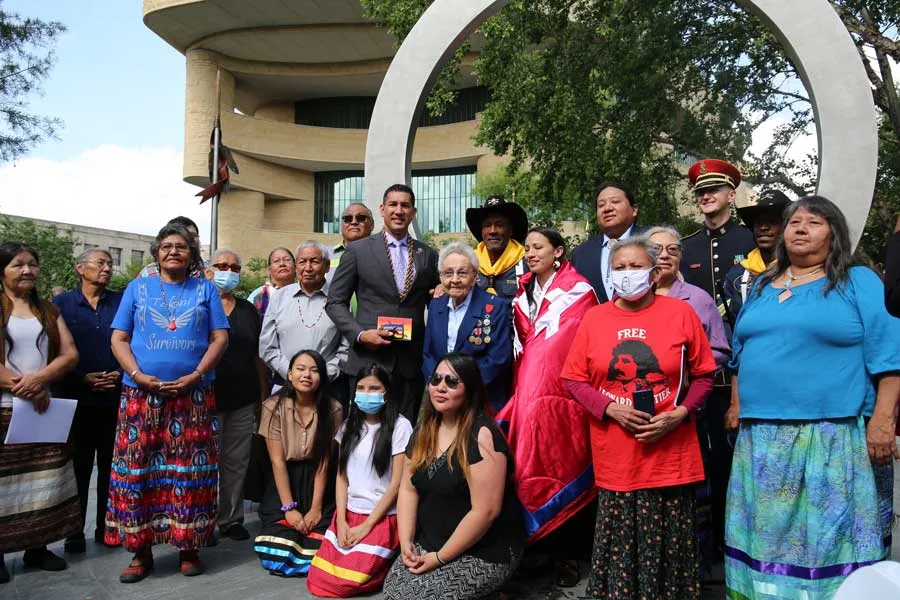
Rep. Kai Kahele, D-Hawaii, stands with Wounded Knee descendants in front of the National Native American Veterans Memorial outside the Smithsonian National Museum of the American Indian in Washington. Photo courtesy of Rep. Kai Kahele.
“As a Native Hawaiian, as a combat veteran, I’m a very proud member of our United States military,” he says. “And the Medal of Honor is our nation’s highest military honor that honors heroism and bravery. … But what happened at Wounded Knee and the massacre of hundreds of unarmed Native Americans tarnishes the integrity of the Medal of Honor and stains the reputation of those who do live up to the standard of the Medal of Honor.”
Kahele—and a coalition of veterans, descendants, and lawmakers—hopes to rescind the 20 Medals of Honor awarded after the attack.
That push began in 2019, when Donald Trump mocked Sen. Elizabeth Warren, saying the Democratic senator from Massachusetts should have filmed her 2019 New Year’s Eve announcement to establish a presidential exploratory committee while standing in front of a backdrop of “Bighorn or Wounded Knee, instead of her kitchen, with her husband dressed in full Indian garb.”
“I mean, when the president of the United States doesn’t even know about Wounded Knee and can use it as a racist joke,” says Oliver “O.J.” Semans Sr., an enrolled member of the Rosebud Sioux Tribe and a former U.S. Navy firefighter, “that means we have a long ways to go in order to teach America what actually happened at Wounded Knee, so that’s when we started the campaign.”
Semans wrote a letter to Trump less than a month after the president’s remarks but said it wasn’t meant to “explain the wrong done in invoking this horror”—since his senators had already done so.
READ MORE Advocates Activated by Marines United Are Gathering Strength
“It should never be used as a punchline,” South Dakota Republican Sen. Mike Rounds tweeted. Sen. John Thune, a member of the Senate Republican leadership, said Wounded Knee is “not something to be joked about.”
But Semans hoped to explain why the words were so hurtful and to make a formal request to fix a past wrong. He began with a history lesson:
“The ‘Battle at Wounded Knee’ on December 29, 1890 was no battle,” Semans wroteto Trump. “It was a massacre. … The 7th Cavalry, which was obligated by treaty to protect my ancestors, instead hunted my ancestors, surrounded them, and gunned hundreds of them down. This included terrified women and children who fled—defenseless—through the snow, forever stained by their blood.”
Medals of Honor were given for killing Lakota women and children. Calling upon Trump to “right a much graver wrong” was the first step in correcting his harmful and hurtful rhetoric, Semans says. But his letter went unanswered.
The unanswered letter feels heavy as Semans remembers the stories of his ancestors who had died by military hands even as they gave up their weapons. He thinks about the Medals of Honor awarded for the killing of children—as a way to change the narrative about an event so horrific that, even as the final campaign during the American Indian Wars, U.S. leaders worried about public perception and lingering legacy.
And as Veterans Affairs warns U.S. veterans that the images from the war in Ukraine could trigger memories and depression, Semans thinks about the intergenerational trauma of his people as they watch others die fighting to protect their lands. He and the band of Indigenous peoples he’s brought together to fight to restore the honor of those killed a century ago, as well as the medal established three decades before the massacre, say those horrified by the present should also be horrified by the past.
‘We Don’t Know How Many Children Ran Away’
Violet Catches, a third-generation Oglala Sioux descendant, remembers being told a days-long blizzard suddenly swept over the grassy prairies as her blood relative, Leon Holy, ran away with a group of other children from the gun-bearing soldiers.
NAT GEO https://www.nationalgeographic.com/history/article/what-really-happened-at-wounded-knee-the-site-of-a-historic-massacre
It was Dec. 29, 1890, in southwestern South Dakota, and members of the Lakota Sioux peoples had been forced from their reservation. They sought refuge in the Badlands, an inhospitable area known for its few sources of water, its slippery clay rocks, and the buttes and canyons that make travel difficult. There had been a drought that year, and crops had failed. The U.S. government sent a federal agent, who was supposed to ensure the tribal members had enough food and clothing. But Congress had cut the budget for the program after the Sioux Agreement in 1889. Until the U.S. government expanded west, the Lakota had been largely nomadic, hunting big game. U.S. officials wanted them to become farmers, on bad land, and to stay in one place. That area grew smaller as the federal government claimed more resources.
As those resources dwindled, along with rations from the government, and as the drought left the Lakotas with little food, President Benjamin Harrison feared the Native Americans would attack white settlers. The Lakota had rebelled against integration—religion, clothing, language—by performing the “Ghost Dance,” which terrified the local U.S. agent. Harrison sent in troops from Fort Robinson, Nebraska, to stop the ritual from spreading across Indian Country.
Sitting Bull, who had led the Lakotas to victory at Little Bighorn, was one of the most-wanted Native Americans at that time because, while he didn’t practice the dance himself, he ensured others were able to do so. The U.S. agent sent in Indian police to arrest him, but Sitting Bull, with 12 others, was killed.
Some people fled to Pine Ridge. Others went back to the Badlands. On Dec. 28, 1890, the 7th Cavalry—previously led by Gen. George Armstrong Custer, who died with his men at Little Bighorn—went into Wounded Knee Creek. The Lakotas of the Miniconjou band said they would surrender peacefully. The next day, Col. James Forsyth had his soldiers gather the Native Americans in a council circle, telling them the soldiers would confiscate their weapons.
The Lakota men did not give up all of their weapons. Forsyth ordered a search, but they began to perform the Ghost Dance. Accounts over what happened next differ, but one retelling of that history says the rifle of Black Coyote, a young and deaf Lakota man, misfired after most of the group’s weapons had been turned in, though it’s unclear who fired first. Ultimately, the 7th Cavalry opened fire on a group of largely unarmed men, women, and children.
Dozens of people were killed immediately, and when Lakota women and children tried to flee to a nearby ravine, the soldiers shot and killed them. The 7th Cavalry killed between 250 and 300 Indigenous people, and almost half of them were women and children.
Lakota Chief Spotted Elk, better known as Big Foot of the Miniconjou band, froze to the ground after dying at Wounded Knee Creek in South Dakota. Photo courtesy of the National Archives.
^As Catches’ ancestor fled, frozen bodies littered the makeshift battlefield stretching for miles, often called the “killing field” among Lakotas. The cold, stiff corpse of Spotted Elk, nicknamed Chief Big Foot of the Miniconjou band, was frozen to the ground. The Army dug mass graves, and soldiers stripped down some of their bodies to steal “ghost shirts” as souvenirs.
“And we don’t know how many other children ran from Wounded Knee together, unsupervised, and all of this because somebody wanted land,” Catches tells The War Horse. “Russia wants Ukraine for the land and the resources. We became displaced for the very same reason; we’re still displaced.”
‘They Didn’t Hold Themselves Accountable’
Manny Iron Hawk sends thoughts, prayers, and even a bit of his broken heart around the globe from the Cheyenne River Indian Reservation in South Dakota to the Ukrainians 5,000 miles away.
“I hope maybe we can somehow send a message to them, to the people of Ukraine, that we have similar histories,” the enrolled member of Cheyenne River Sioux Tribe tells The War Horse, “that we’ve gone through some very hard times, massacres, and whatnot.”
As co-chair of HAWK 1890, which stands for Heartbeat at Wounded Knee 1890—a Native-led grassroots group of living descendants—Iron Hawk watches the modern-day struggle for Ukrainian sovereignty. A fourth-generation direct descendant of Ghost Horse, who died at Wounded Knee with his son, Iron Hawk says history is repeating itself with “a lot of children getting killed over there,” along with older Ukrainians, some of whom “are not fleeing fast enough.”
“They’re Indigenous, they’re tied to the land, so they want to stay there and fight—if it costs them their lives,” Iron Hawk says of the Ukrainians. “They believe in something that comes from our heart.”
Even with spotty cellular and Wi-Fi service scattered across the splintered South Dakota reservations, seeing human rights violations unfold on their televisions and mobile screens in real time reminds residents of their own bloodied history.
“They’re willing to kill indiscriminately in order to create shock and awe,” Wendell Yellow Bull, an enrolled member of the Oglala Sioux Tribe, tells The War Horse. “What they did, they did here. And the political was to justify why they did the atrocities.”
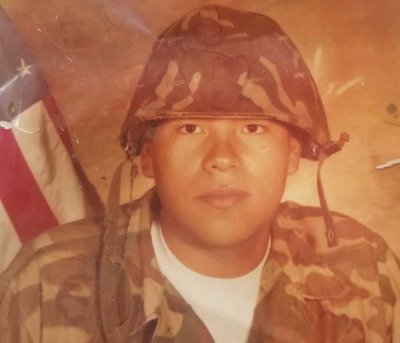
Wendell Yellow Bull, a lifelong resident of the Pine Ridge Indian Reservation, became a lance corporal while serving in the 4th Marines’ 2nd Battalion, better known as the “Magnificent Bastards,” in the years after the Vietnam War. Photo courtesy of Wendell Yellow Bull.
Joseph Horn Cloud was a Wounded Knee survivor and Yellow Bull’s great-grandfather. Yellow Bull never lived anywhere but Pine Ridge Indian Reservation—except when he joined the Armed Forces.
In 1979, after his first attempt to pass the GED test at age 17, he enlisted in the U.S. Marine Corps, earning the rank of lance corporal. He was sent to Okinawa, Japan, with the 2nd Battalion, 4th Marines, better known as the “Magnificent Bastards.” He trained infantry units assigned to rescue prisoners of war long after the Vietnam War ended. But today, his perspective has changed: He sees himself as an intruder venturing into Asia with the “Stars and Stripes” stitched onto his uniform sleeve.
The Oglala Lakota county commissioner says if Americans demand that Russia be punished for its military misconduct and allegations of war crimes in Ukraine, the United States should correct its own record.
“They didn’t hold themselves accountable because they declared it a battle,” Yellow Bull says, “They wanted the land. … They wanted revenge.”
Dwight Mears, a retired U.S. Army major and former history professor at West Point, says an investigation “did, in fact, uncover war crimes” in the days and months after the mass shooting in South Dakota. But the findings fell on deaf ears and were ignored by those highest in the chain of command.
One case stands out among the rest: Three miles away from the battlefield, the bodies of a Lakota woman and three children—two girls and a boy—of the Big Foot band were discovered behind a bush.
Major Peter Dumont Vroom, the inspector general, investigated Wounded Knee for Secretary of War Redfield Proctor, according to Mears. Vroom sought to find out if civilians died unnecessarily.
The soldiers appear to have coordinated their stories: “Most of them just blamed the Natives and said that this was treachery and they were the ones that killed their own civilians,” Mears said.
Major J. Ford Kent, 4th Infantry assistant inspector general, blamed the Lakotas for the civilian casualties.
“I am of opinion that, under the circumstances, all care was taken after the Indians made their first break to preserve the lives of non-combatants,” he wrote in a sworn statement, “and that the fact that several women and children were killed and wounded could be ascribed only to the fault of the Indians themselves, and force of unavoidable and unfortunate circumstances.”
But not all of the Army believed him, including Gen. Nelson Appleton Miles, who requested the investigation.
“I have never heard of a more brutal, cold-blooded massacre than that at Wounded Knee,” he wrote in a personal letter. “About two hundred women and children were killed and wounded; women with little children upon their backs, and small children powder-burned by the men who killed them being so near as to burn the flesh and clothing with the powder of their guns, and nursing babes with five bullet holes through them.”
First Sgt. Herman Gunther of the 7th Cavalry’s Troop D remembered chasing the fleeing Natives, and “hunting for the rest” through the ravine after the bloodshed stopped.
A woman and three children crouched in the low shrubbery. Before the troops began to shoot at their unconfirmed targets, soldiers and their commanding officers allegedly shouted out, “Hau Kola … Hau Kola …”—a Lakota term meaning “hello friend.”
No one answered, which isn’t surprising considering so many had just been killed, Mears says. So the soldiers fired. The girls were young, between the ages of six and eight. The oldest girl fell in front of her mother, who was shot beneath her right shoulder blade. The youngest daughter collapsed from a shot to her back and clung to her mother’s skirt.
The boy, who was as young as 10, was shot in the left side of his head.
Blacksmith Maurice Carey, an enlistee who had joined Troop D three weeks before the massacre, executed the boy, who was apparently still alive after the initial volley, while the rest of the soldiers wandered through the valley in search of more runaways.
Retired U.S. Army Brig. Gen. Edward Settle Godfrey’s letter to the Army War College, written 40 years after the Wounded Knee investigation concluded, shows he saw Carey take hold of the boy’s head and lift him up, only to see his eyes suddenly flicker open. His unexpected movements frightened the new recruit, who shot the boy through the head in “self defense,” out of fear for his own life, Carey later told Godfrey. But no weapons were found near any of the bodies.
While several soldiers said the bush was too thick for them to identify the unarmed Lakota woman and children, the report found that the shrubbery had no leaves left on its branches, according to Mears’ research.
“It does not appear that this killing had any connection with the fight at Wounded Knee,” War Secretary Proctor wrote, absolving the U.S. Army from any responsibility for the civilian murders.
War Department officials “worried that it was going to taint the ability to whitewash Wounded Knee and say that it had been thoroughly investigated” following the Army’s internal inquiry of the woman and her children’s deaths—one that was “pretty thorough by that day’s standards,” Mears says, “not so much by present day”—so they said it was unrelated to Wounded Knee.
Neither Forsyth, a West Point graduate, nor any of his men were prosecuted after the inquiry concluded. Although the secretary of war said the soldiers committed crimes, Proctor’s verdict allowed the Army colonel to regain control of his command following a brief leave of absence during the investigation.
‘Awarding Medals Changed the Narrative’
Soldiers who fired indiscriminately and aimed at children, as well as mostly unarmed Lakota men, were recommended for the Medal of Honor. Ultimately, 20 soldiers who participated in the massacre at Wounded Knee received the Medal of Honor. To put that in perspective, 25 Medals of Honor have been awarded in the 21 years since the 9/11 terror attacks.
After Wounded Knee, 2nd Lt. Harry Hawthorne received a medal for his gallantry, his coolness, his discretion, and the way he handled his guns, Jerry Green writes for the Nebraska State Historical Society. John Clancy, who was court-martialed eight times while he served in the Army and ultimately was dishonorably discharged, received his medal for rescuing wounded soldiers.
After Wounded Knee, the Army added to the requirements for the medal: One could not receive it if they had been court-martialed since the action.
Other soldiers received medals for “gallantry,” or “bravery.” One such soldier fatally shot himself in the head two years after Wounded Knee.
Yet another soldier received a medal for “conspicuous bravery in rounding up and bringing to the skirmish line a stampeded pack mule,” Green writes. Another soldier earned his medal for “voluntarily leaving his work as a cook.”
Medals predating the Army’s modernization, including those issued at Wounded Knee, were given without any guiding statutory regulations. Many of the Wounded Knee recipients would have failed to meet the service threshold requirements set by new modern statutes that dictated Medal of Honor eligibility, Mears says.
“Awarding medals was an excellent way to change the narrative,” Mears says, adding that the Army’s 7th Cavalry sought to “shore up their legacy.”
pix]
Retired U.S. Army Maj. Dwight Mears has always been fascinated by service awards as an academically trained historian who once taught at West Point Military Academy. He has helped the families of roughly 200 veterans apply for and earn military honors, most of which were posthumous distinctions, since the 1990s. Photo courtesy of the Department of Defense.
Twelve years after Wounded Knee, the 1916 Medal of Honor Review Board revoked 911 medals after they assessed all 2,625 medals given since the award’s founding in 1862. It’s the only time Army medals were rescinded, authorized by an act of Congress.
The Wounded Knee soldiers all kept their medals.
Mears has worked to gather academics to individually assess each Medal of Honor awarded for Wounded Knee. He has identified at least 13 cases that seem to be “facially revocable,” meaning the actions that led to the medals were questionable. But he needs more buy-in from his peers in academia.
Mears, who wrote The Medal of Honor: The Evolution of America’s Highest Military Decoration, says the Wounded Knee awards weren’t earned.
“Just about everyone with a Ph.D. after their name basically agrees that the Army should not have awarded those medals, even under their criteria that existed at that time, that it was unwise, and that probably some of those officials knew it—if not the people themselves,” Mears says.
“They were intentionally trying to push a false version of history, and so you’re not rewriting history by undoing that,” he adds. “You’re correcting history to base it on facts, and that’s like Wounded Knee because the status quo is untenable.”
‘Act Swiftly to Revoke These Undue Honors’
In early November, Sens. Warren and Jeff Merkley, D-Ore., led efforts to send a letter with Kahele and 15 other U.S. senators to the president, asking him to “act swiftly to revoke these undue honors” to “right this historical wrong and begin to heal the lasting wounds of many Native American descendants today.”
“This was something I felt, as an Indigenous, Native Hawaiian, that it was my responsibility to act as a voice for not only my ancestors, but the ancestors of all Indigenous peoples of this country who have, for over 100 years, been silenced on this issue—like those that were silenced at Wounded Knee,” Kahele says.
Although federal lawmakers argue the president has the authority to revoke honors when deemed appropriate, the process to rescind military decorations is a fairly modern and even unprecedented one, Mears says.
Reps. Ed Case, D-Hawaii; Deb Haaland, D-N.M., and Kai Kahele, D-Hawaii, celebrate the 100th anniversary of the Hawaiian Homes Commission Act in 2020. Photo courtesy of Rep. Kai Kahele.
Since there’s no statute barring any sitting president from revocating military awards, including the Medal of Honor, Mears says “it’s a safe bet” Biden has the authority to revoke the medals.
However, Defense Department policy guidelines outline reasons for revocation. In most cases, evidence must prove fraud, material error, or the misrepresentation of facts relating to the conduct of service, Mears says.
“The Department of Defense sometimes struggles with how to address and provide redress to things that have been done to our Native communities in the past,” Kahele says. “Native Hawaiians are no different.”
‘It’s Very Personal to Us’
After sending the letter in 2019, Semans and his wife Barbara began bringing at least 100 direct descendants of the 131-year-old massacre together across three reservations through Four Directions, a South Dakota-based nonpartisan organization leading Native voting rights initiatives nationwide.
Like their ancestors, the living descendants are resilient and equally patient. It took a century for Hill lawmakers to acknowledge Wounded Knee as a “terrible tragedy” in a resolution the 101st Congress passed in 1990.
In 2001, the Cheyenne River Sioux Tribal Council called upon the United States to revoke the Medals of Honor after passing a resolution demanding the Army “renounce the issuance of said medals” and proclaim that the military honors are “null and void” given “the atrocities committed” upon unarmed noncombatants.
At the National Congress of American Indians annual session 18 years later, held in Albuquerque, New Mexico, they adopted a resolution in support of the Remove the Stain Act by calling upon Congress and the president to “exercise a sense of humanity.” The 2019 resolution says commending the Army’s 7th Cavalry with military praise “dishonors the Medals of Honor and is a message of hostility and genocide by the United States against the Great Sioux Nation and our precious relatives who were massacred at Wounded Knee.”
“I think as military service members, it’s very personal to us,” Kahele says. “And it’s something that even if it happened 100-plus years ago, it needs to be addressed.”
Though the Democrats control Congress, and President Joe Biden issued an official campaign promise to rescind Medals of Honor issued at Wounded Knee, the highest military decorations still remain intact for U.S. soldiers who participated in a massacre.
The Remove the Stain Act legislation has appeared, spanning across two congressional sessions. All attempts to enact the measure into law have failed thus far. However, Four Directions helped coordinate two presidential forums, centering Native communities and issues at the forefront of conversations during the latest race for the White House.
During one such session, Bret Healy, a non-Native ally who serves as COO of Four Directions, says Biden “without reservation” made a written commitment to revoke the medals.
“He didn’t have any caveats in his answer,” ^Healy says. Four Directions released the official campaign memo to The War Horse.
“We have a lot of work ahead of us, but I know we’re up to the task,” Biden said in the document, dated Jan. 15, 2020.
As a presidential candidate, Biden said the nation’s highest military decoration being bestowed to honor a massacre is “abhorrent to those very ideals and lessens what the award represents in integrity and personal sacrifice for all others who have received it.”
Vice President Kamala Harris also backed the Remove the Stain Act, ,a retired Army nurse and elder of the Cheyenne River Sioux Tribe who served as a nurse at the Battle of the Bulge in World War II, that “history has to reflect fact” during a Four Directions presidential forum in 2019.
Semans hoped the 102-year-old Lakota community leader would see their dreams become reality. But LeBeau died in November, a few weeks after federal lawmakers renewed their efforts by pressing the Biden administration to act.
“The Biden-Harris administration considers the Wounded Knee Massacre a stain on our nation’s history and we continue to review this issue,” an assistant press secretary for the White House’s National Security Council told The War Horse in an email.
‘It’s Gaining National Prominence’
But the fight for change continues to be a struggle, even as the nation sees bases renamed and statues of Confederate generals removed. The veterans’ efforts were stalled from the outset, Semans says, when they “lost [their] lineup.” Key lawmakers left Congress after that session in 2019, most notably Deb Haaland, a former Democratic congresswoman from New Mexico. She joined the Biden administration as secretary of the interior department, becoming the first Indigenous Cabinet member in U.S. history.
So Four Directions approached Kahele.
“The Wounded Knee Massacre, to me, is a part of a larger series of military encounters and atrocities between Native Americans and the U.S. military,” Kahele says. “It’s something that we have to address as a nation, and that was my intent by getting the Wounded Knee amendment into the [National Defense Authorization Act].”
Last year, Congress inserted an amendment into the 2022 NDAA, adopting language from the reintroduced Remove the Stain Act. The original bill, which was initially introduced on the Battle of Little Bighorn’s anniversary in June 2019, would rescind the Wounded Knee Medals of Honor.
Although the Kahele Amendment passed in the House last September, it had been scrubbed from the $770 billion defense budget during the Senate conferencing period by early December.
“I’ll be pushing again this year in the upcoming NDAA to get that amendment in and send it back to the conference committee, and push for it to stand—the final version of the bill,” Kahele says.
He reintroduced the Remove the Stain Act, amending the House’s 2023 National Defense Authorization Act upon its passage in July.
pix
Lt. Sydney A. Cloman, who accompanied the burial party and drew the official map of the scene, sits on horseback among the scattered, frozen bodies of Lakota Sioux, including Chief Big Foot, throughout the Pine Ridge Indian Reservation. Photo courtesy of Denver Public Library Special Collections.
The Senate and House Armed Services conference chairs sought to “encourage the Secretary of Defense to review these medals,” as well as to provide a briefing, in a directive outlined through the joint explanatory statement accompanying the 2022 NDAA. It stated that the medals were “awarded at the prerogative of the President of the United States, not the Congress.”
It’s still unclear if Defense Secretary Lloyd Austin is assessing the status of the medals even after Congress advised him to do so more than six months ago. Two Defense Department spokespeople ^were unable to answer whether Austin had tasked his agency to review the medals since the department “does not discuss internal, deliberative processes.”
But Mears says the decision for revocation should be bipartisan: “If you want to make this ironclad as possible, the best way to do it would be to pass a bill … a bipartisan bill, optimally authorizing a review that would seek both scholarly and DOD input.”
Kahele sees no reason for more debate, and says allowing Biden to revoke the awards is “the quickest, easiest way.”
“We don’t need to conduct an investigation into Wounded Knee,” Kahele says, echoing the sentiments of the direct descendants. “Our military and nation committed atrocities there. These medals need to be and should be, and I believe will be, revoked.”
Rep. Dusty Johnson, a two-term Republican representing South Dakota’s at-large congressional district, agrees with the Hawaiian congressman. “I do not believe Congress has, or should have, the authority to unilaterally rescind or award military honors, regardless of the circumstances,” Johnson writes in an internal letter sent to Biden, dated June 24, 2021, obtained by The War Horse.
The South Dakota House Republican cites the Article XXVI Sec. 175 of the Regulations for the Army published in 1889, a statute that reads: “Medals of honor will be awarded, by the President, to officers or enlisted men who have distinguished themselves in action.”
“I request that you review these and other regulations and statutes to determine whether you, as Commander in Chief, have both the sole authority to issue Medals of Honor as well as rescind Medals of Honor,” Johnson wrote.
Several members of Congress in both chambers, including Sen. Tina Smith, D-Minn.; Warren; and Rep. Sharice Davids, D-Kan., agreed; they told The War Horse in individually written statements.
Tribal leaders also agreed. Kevin Killer, president of the Oglala Sioux Tribe, served as a Democratic lawmaker in the South Dakota House of Representatives for a decade, representing a district that encompassed the Pine Ridge Indian Reservation.
Lt. Edward W. Casey’s Cheyenne Army Scouts ride on horseback, returning from the Pine Ridge Indian Reservation during a blizzard. Photo courtesy of the National Archives.
The South Dakota State Senate unanimously adopted a resolution in February 2021 calling on the federal government to investigate and rescind the Medals of Honor. A cultural shift has transformed the state legislature since he held office, Killer says.
“I think with Wounded Knee coming to light, it’s been a lot better trying to get people to understand that history,” Killer tells The War Horse.
“But I think in the past 10 years, it’s been growing, growing—gaining national prominence,” Killer says. “I think that national awareness wasn’t there 10 years ago.”
Scott Herman, president of the Rosebud Sioux Tribe, asked that federal lawmakers venture westward to visit their reservations, meet the descendants, and see the memorial sites dedicated to their slain ancestors, he tells The War Horse.
Marlis Afraid of the Hawk, an enrolled member of the Oglala Sioux Tribe, and the rest of her family have been fighting three lifetimes for justice. Her grandfather, Richard Afraid of the Hawk, who survived the massacre at the age of 13, testified before Congress seeking reparations and the removal of medals in 1934. Her father, David Afraid of the Hawk, also fought for the change.
The Lakota great-grandmother says she hopes her children and grandchildren will one day reap the benefits of her family’s struggle—even if she doesn’t live to see it herself.
“I’m just hoping that everything will work out, you know, for all the descendants, and especially for my grandkids and my great-grandkids,” Afraid of Hawk says. “I don’t let them forget that because, you know, like I said, every time we get together with all my grandkids, I tell them: Be proud of where you come from.”
On the Pine Ridge Indian Reservation, memories inherited from atrocities committed more than a century ago still trouble Iron Hawk, he says, speaking of intergenerational trauma. He wants to break that cycle for the sake of his children.
“I heard the stories of my mother when she reads her grandma’s stories, and they also cry, you know, so somehow that transferred to me,” Iron Hawk says. “I didn’t want that for my children. It’s going to have to stop—healing has to begin right now.”

Gabriel Pietrorazio
Gabriel Pietrorazio is a national-award-winning journalist who covers Indigenous affairs, food and agriculture, and politics, as well as crime and justice. He earned a master’s degree from the Philip Merrill College of Journalism at the University of Maryland, College Park, in 2021.
---
ref 1 wayback
the Medal of Honor
The Evolution of America's Highest Military Decoration
Dwight S. Mears
The Medal of Honor may be America’s highest military decoration, but all Medals of Honor are not created equal. The medal has in fact consisted of several distinct decorations at various times and has involved a number of competing statutes and policies that rewarded different types of heroism. In this book, the first comprehensive look at the medal’s historical, legal, and policy underpinnings, Dwight S. Mears charts the complex evolution of these developments and differences over time.
The Medal of Honor has had different qualification thresholds at different times, and indeed three separate versions—one for the army and two for the navy—existed contemporaneously between World Wars I and II. Mears traces these versions back to the medal’s inception during the Civil War and continues through the ongoing wars in Iraq and Afghanistan—along the way describing representative medal actions for all major conflicts and services as well as legislative and policy changes contemporary to each period. He gives particular attention to retroactive army awards for the Civil War; World War I legislation that modernized and expanded the army’s statutory award authorization; the navy’s grappling with both a combat and noncombat Medal of Honor through much of the twentieth century; the Vietnam-era act that ended noncombat awards and largely standardized the Medal of Honor among all services; and the perceived decline of Medals of Honor awarded in the ongoing Global War on Terror.
“If you are interested in a Medal of Honor book deeper than a series of citations, you will enjoy this outstanding text.”
—Army History
“Mears book constitutes a major advancement in academic understandings of the Medal of Honour and the US awards system generally. An interesting read and, in terms of an administrative history, is unlikely to be surpassed in the near future.”
—War in History
See all reviews...
Mears also explores the tradition of awards via legislative bills of relief; extralegislative awards; administrative routes to awards through Boards of Correction of Military Records; restoration of awards previously revoked by the army in 1917; judicial review of military actions in federal court; and legislative actions intended to atone for historical discrimination against ethnic minorities. Unprecedented in scope and depth, his work is sure to be the definitive resource on America’s highest military honor.
About the Author
Dwight S. Mears holds a PhD from the University of North Carolina at Chapel Hill, taught history at the US Military Academy from 2010—2014, and retired from the US Army as a major in 2014. He recently received his law degree from Lewis & Clark Law School.
REF 2 NAT GEO
NO LNX PIX
What really happened at Wounded Knee, the site of a historic massacre
In 1890, U.S. soldiers killed hundreds of Lakota men, women, and children in an attempt to suppress a religious movement—and were awarded medals of honor for their acts of violence.
By Erin Blakemore
November 19, 2021
In January 1891, a group of U.S. Army soldiers marched past their general for a final review. Though their setting was a windswept, seemingly empty South Dakota valley, it was a festive occasion. Company after company paraded past, observed only by their general and small clusters of the people they had recently subdued.
Just a few weeks before, 500 of these marching men had massacred at least 300 Lakota men, women, and children. Twenty of the soldiers would soon receive the Medal of Honor, the U.S. military’s highest and most prestigious commendation, for their actions at Wounded Knee.
More than a century later, legislators and activists are calling on President Joe Biden to revoke the medals awarded to the soldiers who participated in the killings. Once touted as a victory against an intractable enemy, Wounded Knee is remembered today as an outright massacre.
(Subscriber exclusive: In the shadow of Wounded Knee.)
After the massacre at Wounded Knee, a burial party came to collect the corpses. But they had to wait three days for a blizzard to pass–and most of the bodies were frozen when they arrived.
Photograph by DeAgostini, Getty Images
The origins of the Ghost Dance
The massacre at Wounded Knee was a reaction to a religious movement that gave fleeting hope to Plains Indians whose lives had been upended by white settlement. The Ghost Dance movement swept through Native American tribes in the American West beginning in the 1870s. It was based on a series of teachings by Paiute medicine men, who prophesied that an upcoming upheaval would lead to the eradication of white men from the Earth and the resurgence of Native Americans.
The movement quickly took on special significance for the Lakota people of North and South Dakota. Over the course of a few decades they had lost over 58 million acres of their land, and were forced to share what was left among multiple tribes and bands. By 1889, they had been split into five separate reservations in North and South Dakota. (Reckoning with a century of trauma at U.S. boarding schools for Native American children.)
The movement’s adherents thought that songs and ceremonies could hasten the coming disaster, bring back their dead, and ensure the restoration of their lands. Lakota believers wore special shirts thought to repel bullets, while some experienced a hypnotic state brought on by the repetitive songs and shuffling, circular mass dances shared by followers.
'We need protection.'
But the Ghost Dancers’ hopes were met with fear from white settlers, who worried the rituals would incite violence against them. Federal Indian agent Daniel F. Royer—jokingly nicknamed “Young Man Afraid of Indians” by the Lakota he had been hired to monitor—was one of them. In December 1890, Royer sent a desperate telegraph from Pine Ridge Reservation in the Badlands region of South Dakota to his bosses at the Bureau of Indian Affairs in Washington, D.C.
“Indians are dancing in the snow and are wild and crazy,” he wrote. “We need protection, and we need it now.”
About this map
American authorities on other Lakota reservations were also worried about the Ghost Dance’s most prominent adherent, Chief Sitting Bull. In 1876, he had led the offensive against the U.S. Army and Lieutenant Colonel George Armstrong Custer at the Battle of the Little Bighorn, popularly known as “Custer’s Last Stand,” in which Custer and all of his soldiers were killed.
Though technically a prisoner of war being held at the Standing Rock Agency in South Dakota, Sitting Bull had been given special permission to travel the country as a performer, most famously with Buffalo Bill Cody’s Wild West show in 1885. But by the time Royer telegraphed his bosses in 1890, Sitting Bull was back at Standing Rock and had indicated he would permit Ghost Dancers to gather in his camp.
The war against the Ghost Dance
Convinced the movement posed a threat to whites, the U.S. Army banned Ghost Dance ceremonies on all reservations in December 1890 and began amassing troops across the region. The federal government had initially planned to have Buffalo Bill Cody try to convince Sitting Bull to make the dancers stand down. But Cody was intercepted enroute by Army officials and ordered to turn back. The U.S. Army now planned to arrest Sitting Bull instead.
On December 15, 1890, about 40 Native American policemen employed by the Indian Agency converged on Sitting Bull and attempted to take him into custody. When he resisted, a skirmish broke out and Bull Head, the police lieutenant, shot and killed Sitting Bull. Some of Sitting Bull’s band fled in the night and headed to join the slain chief’s half-brother, Chief Spotted Elk, at another reservation.
Convinced federal troops would kill more chiefs, Spotted Elk and his allies headed south to Pine Ridge in search of protection. But their pace was slowed by the weather and illnesses. On December 28, they encountered Army troops, who told them to head to Wounded Knee Creek. That night, as the Lakota made camp at Wounded Knee, about 500 soldiers surrounded the 300 or so men, women, and children.
Carnage at Wounded Knee Creek
Wounded Knee became a rallying cry for Native Americans. In 1973, activists occupied the South Dakota valley, leading to a standoff with federal authorities. Here, members of the Oglala Sioux tribe march to the cemetery where their ancestors were buried...Read More
Photograph via Associated Press
Russell Means, a leader of the American Indian Movement, stands beside a poster that advertises a Wounded Knee memorial event, which included a three-day march.
Photograph by Bettmann, Getty Images
The next morning, Colonel James W. Forsyth ordered the Lakota to lay down their weapons and told them they would be taken to a new camp. The Lakota assumed this meant they would be moved away from Lakota territory altogether. Some began to sing Ghost Dance songs.
The troops surrounding the Lakota had been taught that the Ghost Dance and its ceremonies were preludes to war. When one of the dancers took dirt from the ground and flung it in the air, the soldiers interpreted it as a signal of some kind and began firing.
The result was carnage. Though they fought back, the Lakota were at a numerical disadvantage and were outgunned, especially by the early machine guns used by some of the troops.
By the time the shooting stopped a few hours later, bodies were everywhere. Most, including babies and women, had been shot at close range. Some of the Lakota dead were found up to three miles away from the camp where the few who fled had been chased down.
The U.S. Army recovered its own dead, but left the Lakota victims to freeze during the three-day blizzard that followed. Before flinging the frozen bodies into a mass grave, many soldiers stripped the Lakota naked, saving their ghost shirts as souvenirs.
Twenty-five Army soldiers were killed during the fighting, many due to friendly fire. Though no reliable record of Lakota victims remains, contemporary historians estimate at least 300 were killed.
Cheyenne and Arapahoe people reenact the Ghost Dance, which was typically performed around a flagpole, at the 1898 Indian Congress in Omaha, Nebraska. At the time, it was the largest gathering of Native American tribes of its kind.
Photograph by Adolph F. Muhr, Library of Congress
Battle or massacre?
As soon as word of the incident got out, people began to tussle over how to define what had happened at Wounded Knee. Forsyth was relieved of his command after the massacre. His conduct was investigated, but he defended his actions and was quickly reinstated. American newspapers that had breathlessly followed the amassing of troops in the Dakotas portrayed it as a necessary battle; local white settlers celebrated it as a victory over a warlike people.
“We had better, in order to protect our civilization…wipe these untamed and untamable creatures from the earth,” wrote South Dakota newspaperman L. Frank Baum, the future author of The Wonderful Wizard of Oz, in response to the news.
Meanwhile, Native Americans, Lakota and otherwise, interpreted it as a sign that the U.S. government would stop at nothing to eradicate them. “I did not know then how much was ended,” wrote Black Elk, a Lakota medicine man who survived the massacre. “The nation’s hoop is broken and scattered. There is no center any longer, and the sacred tree is dead.”
It would be the last large skirmish in a century of armed conflict between Native Americans and American troops.
Should the Medals of Honor be revoked?
In 1891, the Army issued 20 Medals of Honor to soldiers who had participated in the atrocity.
Over the years, public opinion about the incident shifted as historians dug into the events surrounding the incident. Bury My Heart at Wounded Knee, Dee Brown’s 1970 history of how white Americans’ actions along the frontier devastated Native Americans, sold millions of copies and turned Wounded Knee into a household name. And as part of the broader fight for Native American sovereignty, participants in the American Indian Movement called attention to the massacre, including during a 1973 takeover of Wounded Knee in which two activists were shot. (Learn more about the Red Power movement's fight for sovereignty.)
Wounded Knee became a rallying cry for activists as they pointed out how centuries of land theft, broken treaties, and forced assimilation affected Native Americans. In 1990 Congress formally apologized for the slaughter.
Calls to rescind the medals have grown louder. In January 2021, the South Dakota State Senate passed a bill that called on the U.S. Congress to open an official inquiry into the medals, and a group of U.S. lawmakers attempted to revive an earlier proposal to revoke the medals. Now, with that bill languishing in committee, they are calling on Biden to do it himself.
“You have the authority to revoke these medals immediately,” wrote the lawmakers, including Massachusetts Senator Elizabeth Warren and Kansas Congresswoman Sharice L. Davids, in a letter to the president on November 2, 2021. “It is well past time to remove this stain from our nation’s history.”
---
38 pp
https://digitalcommons.law.ou.edu/cgi/viewcontent.cgi?article=1781&context=ailr}:}:
...state of insurrection
:{:{On December 29, 1890, the U.S. Seventh Cavalry and supporting elements killed an estimated 250 Lakota Sioux during an effort to disarm the Natives.8 Many of the Native casualties were women and young children.9 The Army lost at least thirty soldiers who were either killed or mortally wounded.10 The incident was precipitated by a federal Indian Affairs agent’s misperception that a religious revival ceremony known as the “Ghost Dance” was actually a call for insurrection.11}:
In turn, this convinced the Secretary of the Interior, the Commissioner of Indian Affairs, and, ultimately, President Benjamin Harrison that the Lakota were in a state of insurrection.12 Harrison directed that the U.S. Army take “steps . . . to prevent any outbreak.”13 When the Seventh Cavalry attempted to disarm the Lakota, a shot rang out, touching off “bitter, close quarters fighting,”14 which lasted for about twenty minutes.15 The fighting then shifted ...hotchkiss guns]}:
:{:{locations where Natives were seeking shelter.16 Major General Nelson Miles, commander of the Division of the Missouri, which included the forces at Wounded Knee, quickly relieved the commander of the Seventh Cavalry, Colonel James W. Forsyth and directed an inquiry into the incident over allegations of both friendly fire and noncombatant casualties.17 Miles wrote to his superiors expressing his “strongest disapproval” over the killing of noncombatants18 and reporting “200 dead and wounded noncombatants being found and scattered over a territory in extent a hundred miles north and south, and 30 miles east and west [of Wounded Knee].”19}:
Privately, Miles wrote that “I have never heard of a more brutal, cold-blooded massacre than that at Wounded Knee,”20 although he tempered his opinion in the official reports.21 The investigation directed by Miles exonerated Colonel Forsyth and his unit22 but nevertheless gathered detailed records of the events that allows for a review of the legality of the use of force at Wounded Knee. Soldiers’ actions at Wounded Knee were subject to Army regulations and general orders on the laws of war, specifically General Orders No. 100, known as the “Lieber Code.”23 During the Civil War, violations of the Lieber Code resulted in an estimated 3,500 prosecutions by military...}:
:{:{a place, so that the non-combatants, and especially the women and children, may be removed before the bombardment commences.”26 It also outlined an early version of the principle of distinction, which emphasized “the distinction between the private individual belonging to a hostile country and the hostile country itself,” and stressed that “the unarmed citizen is to be spared in person, property, and honor as much as the exigencies of war will admit.”27 The Army’s first investigation of Wounded Knee in February 1891 was conducted by several inspectors general who were Army officers not assigned to the Seventh Cavalry.}:
The officers were directed to, among other requirements, “ascertain whether any non-combatants were unnecessarily injured or destroyed.”28 In other words, the officers were to determine if the Army’s general orders on limiting noncombatant deaths had been violated. The inspectors general found clear evidence, including a soldier’s testimony,29 that noncombatants were killed at Wounded Knee by soldiers of the Seventh Cavalry.30 The Secretary of War agreed that these deaths were criminal in nature but, to make them less controversial, ruled that they had “[no] connection with the fight at Wounded Knee,” which was demonstrably untrue and contradicted the Army’s own investigation.31 A follow-up investigation in March 1891 confirmed that noncombatants were killed while fleeing from Wounded Knee, but it excused the deaths on}:
...
:{:{SPECIAL FEATURE 183}:
the basis that they were not “deliberate or intentional.”32 Therefore, the Army’s commanding general concluded that “no further action is required,”33 and the Secretary of War reported to President Benjamin Harrison that the campaign against the Lakota Sioux “was conducted in a manner deserving commendation.”34 As a result, there were no prosecutions or other tangible consequences for the soldiers under investigation. Among other contradictions, this outcome overlooked the fact that an officer had falsified testimony under oath during the inquiry by omitting that he had witnessed the intentional execution of a ten-year-old child who was fleeing from Wounded Knee.35 II.
Dueling Public Memory
The Department of War’s award of twenty Medals of Honor for actions that occurred at the Wounded Knee Massacre was part of the government’s effort to influence the public memory of the event. According to one historian, awarding the medals “reinforced the emerging national consensus calling the ‘Battle of Wounded Knee’ ‘civilization’s’ final triumph over ‘savagery’ in North America.”36 As both commemorative physical devices and symbols of distinguished conduct, the medals implicitly reinforced the Army’s original narrative that Wounded Knee was predominately a consequence of “‘[t]reachery’ . . . practiced by the Indians, whether by a preconcerted plan, or by the actions of the Indian who fired the first shot.}:
...
:{:{forcefully because they were confined to reservations and did not possess the same tools to shape the narrative as did the government.42 A Lakota group erected a memorial obelisk at Wounded Knee, and others engaged in writing campaigns to contest the Army’s justifications for the behavior of its soldiers.43 These efforts included recharacterizing Wounded Knee as a “massacre,” which was an intentional inversion of the Army’s labeling of Wounded Knee as a legitimate battle.44 Over the years, the Lakota also made several attempts to secure reparations for Wounded Knee by requesting legislation from Congress, but all these bills failed.45 }:
The Army submitted testimony on the bills seeking reparations for Wounded Knee, which downplayed any criminal actions or impropriety, even those previously documented in the investigations immediately following the incident. The Acting Secretary of War wrote in 1936 that “the military forces were completely vindicated from any blame in the affair at Wounded Knee Creek,” even while paradoxically citing evidence of the killing of noncombatants in the same testimony.46 In 1938, the Army’s Office of the Chief of Staff testified to Congress that in the case of noncombatants found dead three or four miles from Wounded Knee, “there is no definite evidence that they were killed by troops,”47 even though the Army’s own investigators had concluded that they were killed by soldiers}:
...
:{:{and recorded sworn statements to this effect.48 In 1975, the Acting Secretary of the Army testified to Congress that “it is reasonable to assume that a number of women and children were shot [at Wounded Knee],” and also admitted that “it is apparent that individual excesses [by the soldiers] occurred.”49 However, the Acting Secretary claimed this outcome was defensible because soldiers were “return[ing] the fire” they had received from Natives, had no “premeditated intention . . . to injure the innocent,” and were “inexperienced, untested troops who were carried away in the heat of battle.”50 Further, he noted that there was “not an iota of evidence that any orders were issued . . . that there was to be any indiscriminate killing.”51}:
Of course, this argument ignored the fact that premeditation or unlawful orders were not required to violate the Army’s directives on the use of force against noncombatants.52 In 1990, Congress passed a concurrent resolution on the centennial of Wounded Knee, expressing “its deep regret” on behalf of the United States over the incident, which it called “a terrible tragedy . . . resulting in the tragic death and injury of approximately 350-375 Indian men, women and children.”53 The resolution suggested designating Wounded Knee a national monument “in order to properly preserve and maintain the terrain.”54 The resolution was merely symbolic and produced no tangible changes. Wounded Knee was not designated as a national monument.55 There were no changes to military awards given to soldiers at Wounded Knee nor was}:
...
the award to circumstances of gallantry in combat. Thus, while there was some nuance in the regulations for both the Medal of Honor and the Certificate of Merit, the statutory basis for both awards was distinguished conduct. At least thirteen soldiers were also merely mentioned favorably in general orders for actions that occurred at Wounded Knee.77 This type of secondary recognition was more common for officers, since they were ineligible for the Certificate of Merit due to its restriction to “private soldiers.”78
As with the Certificate of Merit’s eventual conversion into the Distinguished Service Cross, after other military decorations were authorized by Congress in 1918, some of these medals were also made retroactively eligible to soldiers who had previously been mentioned in orders at Wounded Knee or elsewhere. Retroactive eligibility for medals authorized during World War I was permitted by both statute and regulation in cases where qualifying actions were performed before April 6, 1917, the soldier was still in the Army as of July 9, 1918, and heroism was already a part of “official records,” which was seen to waive any applicable statute of limitations.79 Under these strict requirements, at least one soldier at Wounded Knee eventually earned a Distinguished Service Cross for a mention in orders,80 and another received a Silver Star Medal upgraded from the same.81 The Distinguishe
...
awarded Medals of Honor, Certificates of Merit, or other awards were guilty of misconduct. Since the Remove the Stain Bill effectively converted the presumption of regularity into a presumption of impropriety, arbitrary and inequitable revocations may result. Another issue with the Remove the Stain Bill was the failure to verify that the twenty targeted medals actually were awarded for conduct at Wounded Knee. The Army identifies Private Marvin C. Hillock as one of the soldiers who earned the Medal of Honor at Wounded Knee, making his award one of those potentially impacted by Remove the Stain.
However, Hillock’s citation only listed Wounded Knee due to a clerical error, meaning that it was actually awarded for a separate engagement.119 The Army issued the correct location and date in general orders published in 1891,120 but the Army’s later listing of Medals of Honor copied the incorrect date and location.121 Summarily revoking that medal without review of Hillock’s individual case would be demonstrably inequitable since the revocation would be entirely based on a known factual error. The Remove the Stain Bill also failed to provide for DoD review of Wounded Knee medals prior to revocation. This most certainly was unacceptable to the Office of the Secretary of Defense (OSD), specifically the Office of the Deputy Assistant Secretary of Defense for Military Personnel Policy, which controls the policy governing revocation of military awards...
introduced no facts that were unknown at the time of the Wounded Knee Massacre.152 Senior Army leadership certainly avoided prosecuting or otherwise disincentivizing unlawful conduct at Wounded Knee, but they must have been aware of such misconduct at the time of award approval. As a result, while this conduct and the failure to police it was undeniably reprehensible, it does not reflect new material facts and thus does not fall under the substantial new evidence exception. Ultimately, while retroactive revocation of Medals of Honor is sanctioned by DoD regulations under some circumstances, military award policy will not permit revocation of all Wounded Knee medals in the absence of evidence of fraud, material error, or impropriety in specific cases.
This regulatory incompatibility makes it unlikely that the President will act unilaterally on the matter. Indeed, in 2022, the White House issued a statement that “[t]he Biden-Harris administration considers the Wounded Knee Massacre a stain on our nation’s history” but took no action other than committing to further review.153 Finally, revocation under executive authority is also inadvisable because it may set off a cycle of political reprisal that would politicize the award system and would leave any action open to reversal by a successor.
...
reports that avoidable noncombatant deaths had occurred at Wounded Knee and not condoned such misconduct. Among many possible actions, the Army might have determined that, if a given soldier violated the Lieber Code at Wounded Knee, then their conduct was not overall “distinguished” as required by regulations and statutes governing the Medal of Honor and the Certificate of Merit.180 Indeed, similar condemnation had previously occurred after the Sand Creek Massacre of 1864, where U.S. volunteers under military authority had slaughtered friendly Cheyenne and Arapaho women and children without provocation.181
In that case, the War Department concluded that the soldiers’ conduct was “wholly unauthorized and criminal” and declined to award any medals.182 Medals of Honor and Certificates of Merit were awarded to several artillerymen who may have unnecessarily killed noncombatants at Wounded Knee.183 One of these soldiers, Corporal Paul H. Weinert, received the Medal of Honor for his “gallantry and enterprise in action against hostile Sioux Indians.”184 Weinert later attested that he continued firing his M1875 Hotchkiss mountain gun into the ravine full of commingled combatants and noncombatants even after being directed by an officer “to come back” and that he “expected a court-martial” for disobedience.185 Weinert stated that he resolved to “make [the Natives] pay” and continued firing into the ravine until “everything was quiet at the
other end of the line.”186 A historical review panel may conclude that Weinert’s actions were unjustified under the criterion of military necessity required by the Lieber Code187 because he continued firing at noncombatants even after there was no longer any apparent military advantage to be gained by doing so. This standard might be the basis to conclude that Weinert’s actions at Wounded Knee were not overall distinguished as required by statute at that time. Weinert apparently violated the Army’s general orders on the use of force and therefore was arguably undeserving of the Medal of Honor.
Similarly, Second Lieutenant Harry L. Hawthorne was an artilleryman and platoon leader attached to the battery present at Wounded Knee.188 He earned a Medal of Honor in part for the “effect with which he handled and served his [artillery] guns in action against hostile Sioux Indians.”189 Hawthorne took offense to an editorial criticizing the firing of the M1875 Hotchkiss mountain guns “long after resistance had ceased [at Wounded Knee].”190 In his rebuttal, he admitted that the mountain guns continued firing at Natives—who he repeatedly referred to as “savages”—well after “cease firing” had sounded, but he claimed that this was necessary because “resistance had not ceased.”191 Hawthorne also acknowledged that the
...
were not overall distinguished as required by statutes governing the Medal of Honor. The case of another Medal of Honor recipient, First Lieutenant John C. Gresham, might have a different outcome under this category of analysis considering the officer’s adherence to Army directives. Gresham received his medal for having “voluntarily led a party into a ravine to dislodge Sioux Indians concealed therein” during which time he was wounded.194 Gresham’s award recommendation noted that he “worked carefully, patiently and coolly, up the ravine, searching among the dead and wounded, brought out Nineteen women and children, [and] disarmed some wounded men.”195
This account suggests that he accomplished his duty while balancing military necessity with the Army’s general orders regarding the use of force. He preserved numerous noncombatant lives and chose to disarm some combatants rather than kill them. Gresham easily could have denied quarter to both combatants and noncombatants in the same manner of several of his comrades and likely would have suffered no consequences. Other testimony corroborates this account and several others thus demonstrating that several officers halted firing to save groups of noncombatants in the same ravine. In fact, one of these efforts reportedly entailed a half-hour of negotiation.196 Such testimony suggests that the soldiers, or at least their commissioned officers, were aware of the general
...
Wounded Knee. The two soldiers took an abandoned ambulance wagon and “assisted in carrying an officer, who lay wounded on the skirmish line, off the field” while under “a sharp fire.”198 Thus, both members, apparently voluntarily, placed their own lives at risk, since the action was performed under fire. Further, the men were not traditional combatants, since it appears that they played only a medical role at Wounded Knee. If this account is accurate, revoking their Certificates of Merit (equivalent to Distinguished Service Crosses) would be highly inequitable since the soldiers committed no apparent impropriety and went well beyond the requirements of their normal duties.
Their actions arguably met both the statutory and regulatory requirements of “distinguished” conduct and “extraordinary acts of gallantry . . . in the presence of the enemy.”199 The sole Distinguished Service Cross resulting from a mention in orders at Wounded Knee might also survive this analysis. Captain John Van R. Hoff, an assistant surgeon at Wounded Knee, was mentioned in orders for his “conspicuous bravery and coolness under fire in caring for the wounded,”200 which was later upgraded to the Distinguished Service Cross in 1925.201 Since Hoff received the Distinguished Service Cross due to his original mention in orders meeting the criteria for this medal, his eligibility was on this basis rather than the criteria of the Certificate of Merit that entitled other Wounded Knee soldiers to the Distinguished Service Cross
...
p33
One of the Medals of Honor for actions at Wounded Knee was awarded in part for extending an enlistment. First Sergeant Jacob Trautman received the medal for having “killed a hostile Indian at close quarters” and also for “remain[ing] to the close of the campaign” despite being “entitled to retirement from service.”211 While the 1916 review board did not rescind Trautman’s medal, it apparently did not consider the available evidence underlying the award. Instead, the board relied on recorders who summarized the cases under review rather than looking at primary sources—a methodology adopted to save time due to the large number of medals to be reviewed.212 As a result, the review board’s summary of Trautman’s file merely repeated his citation, which did not clearly convey that an enlistment extension was material to his recommendation or award of the medal.213 In hindsight, a more thorough methodology employed by the board might have resulted in revocation under the 1916 statute. After all, preserving Trautman’s medal contradicted the rationale used to rescind other medals under the same review board. Another soldier at Wounded Knee, Private Matthew H. Hamilton, received the Medal of Honor for “rounding up and bringing to the skirmish line a stampeded pack mule.”214 It appears that the 1916 review board considered only the award citation, which was “bravery in action.”215 Thus,
...
since they were “subject to the sovereignty of the United States” and were “entitled, as repentant wards, to the protection of the government.”221 If this assimilation to an enemy state did not occur, then the Judge Advocate General opined that “acts of violence committed against [Native Americans] as if they were enemies, are not acts of legitimate warfare but crimes.”222
A federal Indian Affairs agent’s misperception that a ceremony known as the “Ghost Dance” was actually a call for insurrection led to the events at Wounded Knee.223 The government’s belief that the Natives were hostile was clearly mistaken, a fact later acknowledged by the Army’s commanding general, Major General John Schofield.224 When soldiers of the Seventh Cavalry arrested Chief Big Foot (or Spotted Elk) and his band of Lakota immediately prior to Wounded Knee, the surrender was peaceful.225 As a result, the Lakota had already submitted to military authority when Wounded Knee occurred; therefore, the Lakota were not then hostile to the United States.226 When violence unexpectedly erupted, many Natives who had been disarmed then rearmed themselves and fought in self-defense.227 This extraordinary combination of events might be the basis to conclude that Wounded Knee was not truly “in action” or “in the presence of the enemy” for the purposes of both assimilation to foreign war as well as the existing Medal of Honor or Certificate of Merit statutes and
...
It is also possible that some of the medals awarded for action at Wounded Knee did not occur under active fire, which may be a basis to conclude that they were unlawful or against regulations even if Wounded Knee was considered “in action” for the purposes of military awards. This approach may apply to the case of Second Lieutenant Guy H. Preston of the Ninth Cavalry, whose mention in orders was later upgraded to the Silver Star Medal after this decoration was authorized in 1918.229 Preston was cited in orders “[f]or courage and endurance in carrying . . . an important dispatch during the action against hostile Sioux Indians at Wounded Knee
---
ref 2
Peter Dumont Vroom, Jr.
Brigadier General, U.S. Army
Peter Dumont Vroom, Jr. was born on 18 April 1842 in Trenton, NJ, the son of New Jersey Governor Peter Dumont Vroom.
Vroom served as 1st Lieutenant, Adjutant in the 1st New Jersey Volunteer Infantry on 12 August 1862. He was wounded in action at Crampton's Pass, VA, on 14 September 1862. He was promoted to Major of the 2nd New Jersey Volunteer Cavalry on 28 August 1863. He was then brevetted Lieutenant Colonel for gallant and meritorious service during the war on 13 March 1865. He was discharged at Natchez, MS, Circular 39 War Department, Washington, DC, on 2 August 1865 and mustered out on 24 October 1865.
Vroom then accepted a commission as 2nd Lieutenant in the 3rd U.S. Cavalry on 9 April 1867 and remained in service until 12 April 1903. He retired with the rank of Brigadier General, Inspector General of the Army.
Death and Burial
Brigadier General Peter Dumont Vroom, Jr. died on 19 March 1926 in Trenton, NJ. He is buried at Arlington National Cemetery in Arlington, VA.
---
ref 3
redfield Proctor was born in 1831 in Proctorsville, Vermont. He earned a B.A. in 1851 and a master’s in 1854, both from Dartmouth College, and a law degree from the Albany Law School in 1859 -- the same year he was admitted to both the Vermont and New York state bars.
Though Proctor began a law practice in Boston, he returned to Vermont upon the outbreak of the Civil War and joined the Third Vermont Regiment as a lieutenant. He was ultimately promoted to colonel in command of the Fifteenth Vermont Volunteers but contracted tuberculosis along the way. Though Proctor was sent home, he returned to the field of battle and fought for the remainder of the conflict as a sick man.
When the war ended, Proctor returned to Vermont and the practice of law. In 1866, he entered politics as a Republican, serving as city selectman, state legislator and senator, and then as lieutenant governor from 1876 to 1878. He ran for governor of Vermont in 1878 and served one two-year term before returning to his law practice in 1881.
Proctor backed Benjamin Harrison in the presidential election of 1888. When Harrison was elected, he rewarded Proctor by giving him the war portfolio. Proctor served as secretary of war from 1889 to 1891, resigning his cabinet post to become a member of the U.S. Senate. Redfield Proctor served in the Senate until his death in 1908.
| Cosponsor | Date Cosponsored |
|---|---|
| Sen. Merkley, Jeff [D-OR]* | 04/12/2021 |
| Sen. Leahy, Patrick J. [D-VT]* | 04/12/2021 |
| Sen. Smith, Tina [D-MN]* | 04/12/2021 |
| Sen. Wyden, Ron [D-OR]* | 04/12/2021 |
| Sen. Padilla, Alex [D-CA]* | 04/12/2021 |
| Sen. Sanders, Bernard [I-VT]* | 04/12/2021 |
| Sen. Feinstein, Dianne [D-CA] | 06/24/2021 |
| Sen. Blumenthal, Richard [D-CT] | 08/09/2021 |
---
3609
IN THE HOUSE OF REPRESENTATIVES MAY 23, 2025 Ms. TOKUDA (for herself, Mr. HUFFMAN, Ms. MCCOLLUM, Mr. KHANNA, Ms. DAVIDS of Kansas, Mr. QUIGLEY, and Ms. STANSBURY) introduced the following bill; which was referred to the Committee on Armed Services
---
---
calvary-soldiers-who-massacred-hundreds-at-wounded-knee-get-to-keep-their-medals-of-honor
by levi Rickert September 26, 2025
Department of War Pete Hegseth used social media on Thursday night to announce that U.S. 7th Cavalry soldiers who massacred hundreds of innocent Lakota during the 1890 Wounded Knee Massacre will retain their Medals of Honor. The Medal of Honor, which is the highest award of valor presented to military service members, was given to 20 soldiers.
These medals were given despite the fact that the incident involved the killing of at least 250–300 Lakota people, the majority of whom were women, children, and elders.
“Under my direction, we’re making it clear, without hesitation, that the soldiers who fought in the Battle of Wounded Knee in 1890 will keep their medals, and we’re making it clear that they deserve those medals,” Hegseth said in a video posted on the social platform X.
In July 2024, then-Defense Secretary Lloyd Austin had established a five-member panel to reassess the commendations awarded to troops for their actions at Wounded Knee.
The Biden administration stated that the panel would evaluate each medal recipient’s service and records individually to ensure that “no soldier was recognized for conduct that did not merit recognition under the standards applicable at the time.”
Hegseth did not release the findings of the panel during Thursday’s social media announcement.
“We are not surprised, but disheartened that Secretary Hegseth has decided to follow former Defense Secretary Austin’s footsteps and follow recommendations by what I believe to be a panel that was established to ensure a specific outcome,” O.J. Semans, Sr. (Rosebud Sioux), co-founder and co-executive director of Four Directions, Inc., told Native News Online on Thursday evening.
The violence began when the U.S. Cavalry attempted to confiscate weapons from those taken into custody; a shot was fired, prompting troops to open fire and kill at least 250 Lakota men, women, and children. Around 25 U.S. soldiers also died, likely as a result of friendly fire.
For several years, Native organizations have urged Congress to pass the Remove the Stain Act that would rescind the Medal of Honor to those awarded for their violent deeds at Wounded Knee.
In May 20205,*Remove the Stain Act of 2025* was reintroducedby Senators Elizabeth Warren (D–MA) and Jeff Merkley (D–OR), along with Representative Jill Tokuda (D–HI),
"We cannot be a country that celebrates and rewards horrifying acts of violence against Native people," Sen. Warren said when the legislation was reintroduced. "Congress must recognize how shameful this massacre was and take an important step toward justice for the Lakota people."
“We must acknowledge our history and take concrete steps to right historic wrongs from America’s darkest chapters,” said Sen. Merkley. "Moving forward together as a nation demands we remember, reflect on, and work to rectify the abhorrent massacre of hundreds of innocent Lakota men, women, and children at Wounded Knee. This horrific injustice is not deserving of our nation’s highest award for military valor, and our long-overdue bill helps finally set the record straight by revoking these medals.”
Semans still hopes Congress will pass the legislation.
“We will continue to work with Congress to ensure Americans know the truth,” Semans said.
Earlier in the year, Hegseth also directed the restoration and refurbishment of a Confederate memorial at Arlington National Cemetery that had previously been removed.
---
https://www.alternet.org/2020/07/bill-moyers-explains-how-the-south-won-the-civil-war/
no lnx
Written by Bill Moyers July 31, 2020
Welcome to Moyers on Democracy. If you want to understand this moment in American politics, here’s a suggestion for you: It’s the must-read book of the year — HOW THE SOUTH WON THE CIVIL WAR, by the historian Heather Cox Richardson. Yes, the Civil War brought an end to the slave order of the South and the rule of the plantation oligarchs who embodied white supremacy. But the Northern victory was short-lived. Slave states soon stripped Black people of their hard-won rights, white supremacy not only rose again to rule the South but spread West across the Mississippi to create new hierarchies of inequality. That’s the story Heather Cox Richardson tells in HOW THE SOUTH WON THE CIVIL WAR, with echoes resounding every day in the current wild and fierce campaign for the presidency. Here to talk with her about America’s ongoing battle between oligarchy and democracy is Bill Moyers.
BILL MOYERS: Will you take us on that long but vivid arc of how we got from Abraham Lincoln, describing the end of the Civil War as “a new birth of freedom,” to Donald Trump describing America as “a land of carnage, a nightmare.” From Lincoln to Donald Trump in 2016, what happened?
HEATHER COX RICHARDSON: If you think about the Civil War as a war between two different ideologies, two different concepts of what America is supposed to be, is it supposed to be a place where a few wealthy men direct the labor and the lives of the people below them, the women and people of color below them, the way the Confederacy argued? Is that America? Or is America what Lincoln and his ilk in the Republican Party in the North defined the democracy as during the Civil War? Is it a place where all men are equal before the law and should have equal access to resources? And of course, I use the word man there, but that’s because that’s the language that Lincoln used. But the principle is expandable of course. It looked by 1865 as if that latter ideology, that of the Republicans and that of the idea of equality had triumphed. And certainly, the Republicans and Northerners who had fought for the United States government in that war believed that they had redefined America to mean equality before the law. They really believed that was the case. And that they had defeated what they called the “slave power,” the oligarchs who had gone ahead and taken over the system in the 1850s. After the Civil War, Easterners moved West across the Mississippi in really large numbers after 1865.
BILL MOYERS: White Southerners went too, of course, and you argue they saw the West as the final frontier ruled by elites, just as elites, with violence and intimidation, had ruled in the old South.
HEATHER COX RICHARDSON: And in that West, they discover a land that is already susceptible to the idea of racial and gendered hierarchies, because it has its own history of them. And it’s a place out there where the new American system happens to be a really fertile ground for the Confederate ideology to rise again. And that’s exactly what happens with the extractive industries in the West that encouraged the heavily capitalized cattle markets, for example, or mining industries, or later oil, or even agribusiness. You have in the West a development of an economy and, later on, a society that looks very much like the pre-Civil War South.
And over the course of the late 19th century, that becomes part of the American mythology, with the idea that you have the cowboy in the West who really stands against what Southerners and Northern Democrats believe is happening in Eastern society, that a newly active government is using its powers to protect African Americans and this is a redistribution of wealth from taxpayers to populations that are simply looking for a government handout. That’s language that rises in 1871, and that is still obviously important in our political discourse.
But in contrast to that, in the West, you get the rise of the image of the American cowboy, which is really our image of Reconstruction. In a weird way, people think of Reconstruction, obviously, they think of formerly enslaved people. But the image that has obtained in our textbooks and in our popular culture is the American cowboy, who is beginning to dominate American popular culture by 1866. And that cowboy — a single man, because women are in the cowboy image only as wives and mothers, or as women above the saloons in their striped stockings serving liquor and other things — is amale image of single white men. Although, again, historically a third of cowboys were people of color. It’s a single white man working hard on their own, who don’t want anything from the government. Again, historically inaccurate. The government puts more energy into the American plains than it does any other region of the country. But–
BILL MOYERS: And also on land that had been taken from Mexico after the Mexican-American War, and on land that had been stolen from the Native Americans after genocide. I mean, it’s this whole notion of, “I’m free to roam the land and become a self-made hero,” which was the cowboys’ image to those of us growing up in the ’30s and ’40s, was really a bastard idea.
HEATHER COX RICHARDSON: And part of that bastard idea, though, was so interesting. Because it is, in part, the Indian Wars of the Civil War and immediate post-war years that helped to both create the image of the cowboy, but also reinforce the idea that a few white men belong above subordinate groups like the Indigenous people, like Mexicans or Mexican Americans. Like Chinese Americans, like Fiji islanders, about whom they care very much in the late 19th century. And that racial hierarchy and gendered hierarchy really gets tied into the image of the American cowboy. And popularized with this backlash against activism in the East, trying to help African Americans adjust to the new free labor economy.
But that image becomes enormously important after 1880. Because in 1880, the South goes solidly Democratic. And, of course, in retrospect, we now know it’s going to stay Democratic for a very, very long time, indeed. But they don’t know that at the time. But what Republicans do note is that they must pick up Western votes if they’re going to continue to dominate the White House and the Senate. After 1888, when we get the installment of Benjamin Harrison in the White House, he loses the popular vote by about 100,000 votes. But he’s installed thanks to the Electoral College. The Republicans under Harrison between 1889 and 1890, they let in six new states in 12 months. That was the largest acquisition of new states in American history since the original 13 and it’s never been matched again. They let in North Dakota, South Dakota, Montana, Washington, and then Idaho and Wyoming to go ahead and make sure that they would continue to control the Senate, and the Electoral College.
And they’re not hiding this. They actually go onto their media which is their equivalent of the Fox News channel at the time and say, by letting in these states, we’re going to hold onto the Senate for all time and we’re going to make sure we hold onto the White House for all time. But what that does is it begins to shift the idea of that human freedom. All of a sudden, the Republican Party, which has tried to continue to argue that it is standing in favor of equality, although that’s negotiable. After 1888 and the admission of those new states, the Republican Party’s got to start adopting that racially charged language in order to get the West on board. And that begins the change in American history that leads to a later union between the West and the South around this idea that really white men ought to be in charge. It’s not just a Southern thing. It’s a Western thing as well. And they make up a voting bloc in Congress that manages to change a lot of the legislation of the 20th century.
BILL MOYERS: You write about how the massacre of Native Americans at Wounded Knee in 1890, in South Dakota, was an atrocity brought on by politics. And that it played into the use of politics to reimpose inequality, and the use of force for malicious purposes.
HEATHER COX RICHARDSON: It did. What happens is that with the admission of these new states in 1889 and 1890, the Republicans believe that they are going to do very well in the midterm election of 1890. And the big thing on the table in America in 1890 is the tariff – high walls around the American economy that protect businesses inside America, they protect them to the degree that because they face no foreign competition, different groups can collude with each other to raise prices. So in 1860, the Republicans insist that an economic downturn that’s been happening is only because those tariffs aren’t high enough. What happens in the election of 1890 is the Republicans think they’re going to win and they lose dramatically. It turns out when these ballots are counted, a Republican Senate or a Democratic Senate hangs on the seat of South Dakota, on one Senate seat. And that Senate seat has pretty clearly been corrupted. There’s a huge fight, then, in the legislature of who actually won. So there the situation sits.
BILL MOYERS: Sits there, for sure, with President Benjamin Harris needing to shore up his support in the Dakotas. So, he sends corrupt cronies out to replace experienced Indian agents and dispatches one-third of the federal Army as well.
HEATHER COX RICHARDSON: And with that movement of the Army into South Dakota in the largest mobilization of the US Army since the Civil War, Lakota are trying to negotiate with the Army that increasingly wants to bring them into the reservation, to the agencies to make sure that they’re under control. And over the course of the next few months, that situation escalates until a Lakota leader, Sitting Bull, is killed in December of 1890. And then in terror after that, a group of Miniconjou Lakota move across the state. They actually find the Army, the Army doesn’t find them. And in the process of corralling them and disarming them later on that month, the soldiers start to fire. And about 250 Lakota are massacred. So, it was a massacre that was really directly attributable to whether or not the Republican Party could control the US Senate in order to protect its tariffs that promoted big business, and protected a few oligarchs....
Massacre At Wounded Knee, 1890
On the morning of December 29, 1890, the Sioux chief Big Foot and some 350 of his followers camped on the banks of Wounded Knee creek. Surrounding their camp was a force of U.S. troops charged with the responsibility of arresting Big Foot and disarming his warriors. The scene was tense. Trouble had been brewing for months.
The hope of the Ghost Dance |
The once proud Sioux found their free-roaming life destroyed, the buffalo gone, themselves confined to reservations dependent on Indian Agents for their existence. In a desperate attempt to return to the days of their glory, many sought salvation in a new mysticism preached by a Paiute shaman called Wovoka. Emissaries from 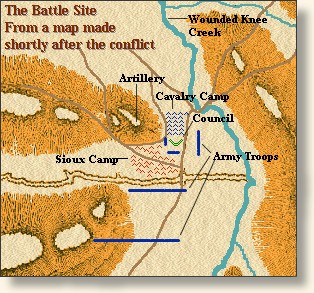 the Sioux in South Dakota traveled to Nevada to hear his words. Wovoka called himself the Messiah and prophesied that the dead would soon join the living in a world in which the Indians could live in the old way surrounded by plentiful game. A tidal wave of new soil would cover the earth, bury the whites, and restore the prairie. To hasten the event, the Indians were to dance the Ghost Dance. Many dancers wore brightly colored shirts emblazoned with images of eagles and buffaloes.
These "Ghost Shirts" they believed would protect them from the bluecoats' bullets. During the fall of 1890, the Ghost Dance spread through the Sioux villages of the Dakota reservations, revitalizing the Indians and bringing fear to the whites. A desperate Indian Agent at Pine Ridge wired his superiors in Washington, "Indians are dancing in the snow and are wild and crazy....We need protection and we need it now. The leaders should be arrested and confined at some military post until the matter is quieted, and this should be done now." The order went out to arrest Chief Sitting Bull at the Standing Rock Reservation. Sitting Bull was killed in the attempt on December 15. Chief Big Foot was next on the list.
When he heard of Sitting Bull's death, Big Foot led his people south to seek protection at the Pine Ridge Reservation. The army intercepted the band on December 28 and brought them to the edge of the Wounded Knee to camp. The next morning the chief, racked with pneumonia and dying, sat among his warriors and powwowed with the army officers. Suddenly the sound of a shot pierced the early morning gloom. Within seconds the charged atmosphere erupted as Indian braves scurried to retrieve their discarded rifles and troopers fired volley after volley into the Sioux camp. From the heights above, the army's Hotchkiss guns raked the Indian teepees with grapeshot. Clouds of gun smoke filled the air as men, women and children scrambled for their lives. Many ran for a ravine next to the camp only to be cut down in a withering cross fire.
When the smoke cleared and the shooting stopped, approximately 300 Sioux were dead, Big Foot among them. Twenty-five soldiers lost their lives. As the remaining troopers began the grim task of removing the dead, a blizzard swept in from the North. A few days later they returned to complete the job. Scattered fighting continued, but the massacre at Wounded Knee effectively squelched the Ghost Dance movement and ended the Indian Wars.
Eyewitness to a Massacre
Philip Wells was a mixed-blood Sioux who served as an interpreter for the Army. He later recounted what he saw that Monday morning:
"I was interpreting for General Forsyth (Forsyth was actually a colonel) just before the battle of Wounded Knee, December 29, 1890. The captured Indians had been ordered to give up their arms, but Big Foot replied that his people had no arms. Forsyth said to me, 'Tell Big Foot he says the Indians have no arms, yet yesterday they were well armed when they surrendered. He is deceiving me. Tell him he need have no fear in giving up his arms, as I wish to treat him kindly.' Big Foot replied, 'They have no guns, except such as you have found.' Forsyth declared, 'You are lying to me in return for my kindness.'
During this time a medicine man, gaudily dressed and fantastically painted, executed the maneuvers of the ghost dance, raising and throwing dust into the air. He exclaimed 'Ha! Ha!' as he did so, meaning he was about to do something terrible, and said, 'I have lived long enough,' meaning he would fight until he died. Turning to the young warriors who were squatted together, he said 'Do not fear, but let your hearts be strong. Many soldiers are about us and have many bullets, but I am assured their bullets cannot penetrate us. The prairie is large, and their bullets will fly over the prairies and will not come toward us. If they do come toward us, they will float away like dust in the air.' I turned to Major Whitside and said, 'That man is making mischief,' and repeated what he had said. Whitside replied, 'Go direct to Colonel Forsyth and tell him about it,' which I did.
 | ||
|---|---|---|
Artist Frederdick Remington recreated the opening moments of the massacre based on soldiers' recollections |
Forsyth and I went to the circle of warriors where he told me to tell the medicine man to sit down and keep quiet, but he paid no attention to the order. Forsyth repeated the order. Big Foot's brother-in-law answered, 'He will sit down when he gets around the circle.' When the medicine man came to the end of the circle, he squatted down. A cavalry sergeant exclaimed, 'There goes an Indian with a gun under his blanket!' Forsyth ordered him to take the gun from the Indian, which he did. Whitside then said to me, 'Tell the Indians it is necessary that they be searched one at a time.' The young warriors paid no attention to what I told them.
I heard someone on my left exclaim, 'Look out! Look out!' I saw five or six young warriors cast off their blankets and pull guns out from under them and brandish them in the air. One of the warriors shot into the soldiers, who were ordered to fire into the Indians. I looked in the direction of the medicine man. He or some other medicine man approached to within three or four feet of me with a long cheese knife, ground to a sharp point and raised to stab me. He stabbed me during the melee and nearly cut off my nose. I held him off until I could swing my rifle to hit him, which I did. I shot and killed him in self-defense.
Troop 'K' was drawn up between the tents of the women and children and the main body of the Indians, who had been summoned to deliver their arms. The Indians began firing into 'Troop K' to gain the canyon of Wounded Knee creek. In doing so they exposed their women and children to their own fire. Captain Wallace was killed at this time while standing in front of his troops. A bullet, striking him in the forehead, plowed away the top of his head. I started to pull off my nose, which was hung by the skin, but Lieutenant Guy Preston shouted, 'My God Man! Don't do that! That can be saved.' He then led me away from the scene of the trouble."
References:
Brown, Dee, Bury My Heart at Wounded Knee (1971); Jensen, Richard, et. al, Eyewitness at Wounded Knee (1991); Utley, Robert M., The Last Days of the Sioux Nation (1963); Wells, Philip, "Ninety-six Years among the Indians of the Northwest", North Dakota History, 15, no. 2 (1948).
---
“Wholesale Murder”: What People Saw at the Wounded Knee Massacre
...
As a somewhat gimpy lawman turned storekeeper, George Bartlett might have escaped recruitment for such distasteful duty, but he chose to be there nonetheless. At one point he folded his arms, resting them on the handle of his spade, and gazed at each distorted frozen face. He recognized many of the dead—some longtime friends, others familiar patrons of his nearby trading post. Watching the mass burial was painful enough. But five days earlier, from a distance, Bartlett had witnessed something even more troubling—the killing at Wounded Knee, a tragic event that has been termed both a battle and a massacre and at the very least was a largely one-sided brutal fight. By that time Bartlett had already lived an adventurous life, and more exploits lay in store.
:{Born in New Haven, Conn., on Aug. 25 1858,George Edward Bartlett moved with his parents to Sioux City, Iowa, in 1873. A year later the teenager struck out on his own, moving to the Yankton Agency in south-central Dakota Territory, where he worked at a reservation trading post. In 1876 he joined a prospecting party bound for the Black Hills. When the claims the men staked proved unsuccessful, they returned to Yankton. But in March 1877 young Bartlett ventured back into to the Black Hills with other aspiring miners.
Though he again failed to hit pay dirt, he managed to land a stint as a rider with the mail delivery service between Rapid City and Fort Pierre, 170 miles to the east. Bartlett’s 60-mile round-trip route took him from Cheyenne River Station (near present-day Wasta) east to Deadmans Creek. He rode at night to avoid Indians. Caught out in a blizzard one night, he holed up in a hollowed-out cottonwood stump for three days with only a single jackrabbit for food. When the weather finally cleared, he recovered his horse and completed his route. It was during his time as a rider Bartlett first fractured his right knee, a recurring injury that would plague him for life.}:
He next turned to market hunting for deer, elk and bison. Working with a team of skinners, Bartlett used a .45–90 Sharps rifle to kill buffalo for their hides. He came to know the country and local Indians well, sometimes working as a scout and interpreter for the Army.
Some of the Sioux at the Pine Ridge Agency playfully referred to him in English as ‘Wounded Knee,’ after the creek that coursed 50 yards behind the store
Bartlett was still only 21 in 1879 when Deadwood-based U.S. Marshal John B. Raymond appointed him a deputy marshal. In that capacity the young lawman traveled all around the Black Hills and into the wilds of eastern Montana and Wyoming territories. His job sometimes required gunplay, most notably on a frigid Valentine’s Day 1884, his fifth year behind a badge.
Authorities had received word that local outlaw George Axelby and gang were planning to ambush a deputy then transporting cohort Jesse Pruden from Miles City, Montana Territory, to the Dakotas for trial. Bartlett joined a five-man posse to thwart their plans. The lawmen tracked the gang to the Stoneville Saloon, just over the Montana Territory line some 65 miles northwest of Deadwood. Bartlett and the others arrived late on February 13 in the midst of a snowstorm and spent the night bunked in Lew Stone’s ranch house, across a gully from the saloon. As the gang prepared to light out the next morning, the posse sprang the trap.
In the initial heavy exchange of fire, three deputies were wounded, one mortally. Creased in the skull by a bullet, outlaw Jack Campbell fell from his horse, gouging the saddle with his spurs as he fell. Axelby took a bullet to the thigh and had his horse shot out from under him, while a third outlaw was shot in the elbow and also lost his mount. As the rest of the gang dug spurs and galloped off, the wounded trio scurried into the underbrush and promptly vanished. The posse caught up to Campbell the next day. According to a wry newspaper report, in attempting to steal a horse, “He found one that was loaded, and it went off and riddled him with bullets.” Axelby was never heard from again.
In newspaper interviews a quarter-century later Bartlett claimed to have been shot in the kneecap during the Valentine’s Day fight—certainly a more romantic explanation for his lifelong limp. He also claimed to have received “sympathetic ministrations” from the legendary Calamity Jane.
Whatever the truth, though hindered by his injured knee, Bartlett continued to carry out his duties admirably and without complaint. Ever ambitious, he’d even taken on a second job, operating one of five Indian trading posts on the Pine Ridge Agency along the southern Dakota border. Barrett was fluent in several Sioux dialects and was comfortable among the Indians. He understood and respected their culture and listened to their troubles. The Sioux responded in kind and accepted, even admired, the storekeeper. They called him Huste, which means “lame” in Lakota, and painted a placard bearing his new name to hang over the store’s front door. Some playfully referred to him in English as “Wounded Knee,” after the creek that coursed 50 yards behind the store. For the next seven years Bartlett and the Sioux enjoyed a mostly harmonious relationship, with friendship at its foundation.
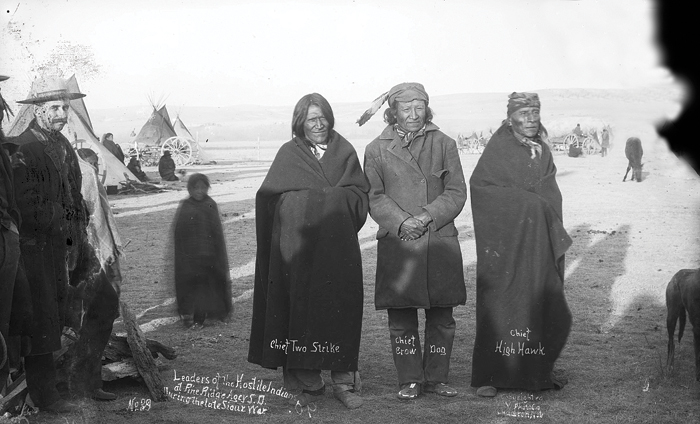 In happier times Pine Ridge trading store operator Bartlett poses with three of the agency’s Sioux chiefs. (Denver Public Library)
By 1890 there were no “wild” Indians in South Dakota. Subdued and restricted to reservations under federal administration, the Sioux adhered to the government regulations and boundaries, subsisted on government rations and shot the allotted government beeves in place of the nearly exterminated buffalo. But their level of compliance varied from settlement to settlement, and increasing numbers of disaffected Lakotas were placing their confidence in a quasi-religious movement known as the Ghost Dance.
As preached by its Paiute founder Wovoka, faithful practice of the dance would remove encroaching whites from the land, resurrect the Indians’ dead ancestors, restore the traditional ways of tribal life and restore the all-sustaining bison. Though Wovoka preached passive resistance, more bellicose followers spread word the ceremonial Ghost Dance shirts would deflect the bullets of the bluecoats. By November 1890 Black Hills settlers and Indian agents alike viewed the escalating movement as an incitement to war and called for the military to suppress the Ghost Dance, restore order and prevent an uprising. President Benjamin Harrison authorized troops on Nov. 13, 1890, and four days later Maj. Gen. Nelson A. Miles placed Brig. Gen. John R. Brooke in command of forces in the field at the Pine Ridge and Rosebud agencies.
Brooke, who established his headquarters at Pine Ridge on November 19, recognized the value of a knowledgeable, experienced man like Bartlett and without delay named him captain of the Indian Police. As he was tasked primarily with restricting white encroachment on agency lands, the Indians did not view him as a threat. Brooke also appealed to Bartlett to mediate a solution to the Ghost Dance problem before armed force became necessary. The lawman approached the Indians not as a badge wearer with a gun but as a friend who might reason with them. But there was only so much one man could do at a time of such mass discord on the reservations. By early December the number of Ghost Dance adherents at Pine Ridge had escalated alarmingly, their practice of its rituals becoming increasingly frenzied. By Christmas things had come to a head.
As December 29 dawned, Barrett stared out of the window of his store on Wounded Knee Creek. The rising sun gradually illuminated the cluster of Sioux tepees to the southwest. Also visible were the bivouacking soldiers who’d cordoned off Chief Big Foot’s village on three sides. These were troopers of the grudge-holding 7th U.S. Cavalry, Lt. Col. George A. Custer’s old command. Several of the officers and enlisted men present had ridden with him to the Little Bighorn in June 1876. Commanded by Colonel James W. Forsyth, the force comprised eight companies of 800 men. The Hotchkiss battery was dug in atop the hill 300 yards to the northwest. Its four rapid-fire guns, already ranged in and directed at likely escape points, stood ready to sling their 1.65-inch explosive projectiles. The night before many men of the 7th had reportedly been drinking.
Bartlett never revealed what his thoughts were at the time, but he must have suspected things would not end well for the Indians
Bartlett never revealed what his thoughts were at the time, but he must have suspected things would not end well for the Indians. At some point he left the store window, mounted a horse and rode to a hilltop three-quarters of a mile distant, presumably for a better view.
:{Forsyth had demanded the Sioux surrender their weapons, but a search of the Indian village turned up only a scattering of archaic guns. The critical moment came when the increasingly frustrated colonel ordered soldiers to bodily search the gathered warriors and confiscate any remaining weapons. By some accounts medicine man Yellow Bird then tossed a handful of dirt in the air to signal the Indians to open fire.
Bartlett upheld another eyewitness who said an Indian rifle discharged accidentally as a soldier wrested it from its protesting owner’s hands. At least four Sioux warriors have been identified as the “trigger man.” Barrett didn’t mention a name, only that “a single shot was fired,” answered in turn by a fusillade from the troopers and the subsequent muddled and deadly fight. When the dust and smoke settled, 25 soldiers lay dead and 39 wounded, six mortally—many thought to be victims of friendly fire. Upward of 200 Indians were killed and wounded, including women and children. Though the soldiers’ actions would be condemned in some circles, 20 would receive the Medal of Honor.}:
It was Captain Bartlett who dashed overland to Pine Ridge to deliver the distressing news to General Brooke. “Impossible! Impossible!” Brooke exclaimed in disbelief. Bartlett also informed agency physician Dr. Charles Eastman, who was of Santee Sioux, English and French ancestry. The doctor rushed to help the wounded. “Wholesale murder” is how he described the horrific scene. “Dead Injuns laid [sic] around pretty thick. The worst of it was so many women and kids killed.”
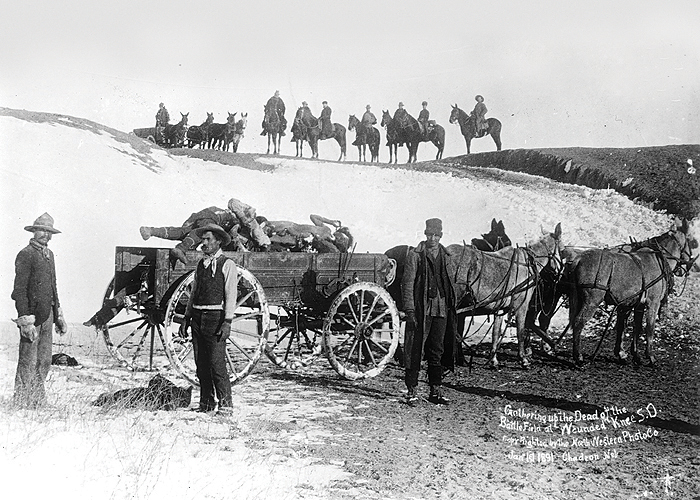 In the days following the clash Bartlett joined a civilian crew helping to gather Sioux bodies for mass burial. (Denver Public Library)
:{:{On December 30, the day after the deadly confrontation, Bartlett told a reporter from Great Falls, Montana Territory, about two wounded boys found miles from the village—one shot through both eyes, the other through a hip. Both died within days. Presumably tormented by such dreadful images, Bartlett said nothing more publicly about what he’d witnessed until Nov. 30, 1903. That’s when he spoke with Eli S. Ricker, a Nebraska journalist who recorded many firsthand accounts from the Indian wars on ruled tablets (“Ricker Tablets”), published posthumously under the title Voices of the American West. }:
By the time of their interview, Bartlett’s memories had faded, or he’d repressed them. “I can’t remember all those things,” he admitted to Ricker. “There was so much happened about that time.” When pressed about the Indians’ attempts to escape, Bartlett spoke in broad terms: “Oh, they run in every direction, and the soldiers followed them and killed them while they run, and some of them sat down on the ground and did not try to do anything.” He did allow himself to recall five fleeing women being overtaken by two soldiers. Resigned to their fate, the squaws sat down, covered their faces with their shawls and were summarily executed. “You saw that?” Ricker asked. “Yes,” came the clipped answer.}:
From his hilltop vantage Bartlett also witnessed firsthand the destructive power of the Hotchkiss guns. When the firing broke out, one warrior had hidden in a soldier’s Sibley tent. Unwisely showing himself at its open flap, he received a direct hit to the torso. “There were chunks taken out of his body,” Bartlett recalled, “as though they were pulled out.” A wagonload of Sioux women was rolling toward the refuge of the captain’s store when struck by another Hotchkiss projectile that “burned the wagon half up.” All were killed, Bartlett told Ricker.
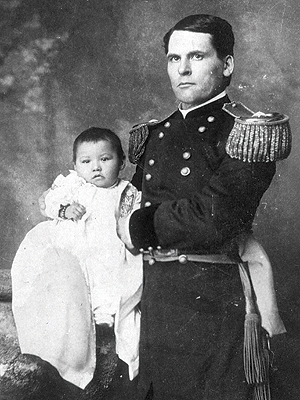 Nebraska National Guard Brig. Gen. Leonard Colby poses for a formal portrait with his adopted Sioux daughter Zintkala Nuni (Lost Bird), who was found on the battlefield amid a pile of dead Indian women. (Denver Public Library)
On New Year’s Day 1891 Bartlett joined a party of civilians on the field to collect bodies and search for survivors. Around midday as the men approached a blanket-shrouded tangle of seven dead Indian women, the captain thought he heard the whimper of an infant. He instructed the others to keep silent. On hearing another cry, the men pried apart several of the frozen corpses and discovered an unharmed months-old baby girl wrapped in a shawl. Bartlett turned her over to a Sioux couple he knew. At some point after her rescue the girl was given the wistful name Zintkala Nuni, Lakota for Lost Bird. On January 19 Nebraska National Guard Brig. Gen. Leonard Colby and wife Clara adopted the child in what some viewed as a public relation’s move, even as a stepping stone to political office. That June, coincidentally or not, President Harrison appointed Colby assistant attorney general of the United States. Over the following decades Bartlett kept in touch with Lost Bird, who died during an influenza outbreak on Valentine’s Day 1920.
In the aftermath of the Wounded Knee tragedy, 1st Infantry Captain William Dougherty was appointed acting agent for Pine Ridge, charged with “removing intruders from the reservation.” Among his first orders of business was to send Bartlett a rather terse dispatch: “Your presence at this agency being deemed detrimental to the interests of the Indians and of the government, you are hereby notified and required to depart from the Indian reservation forthwith.” Exactly why Dougherty did this is uncertain, but Bartlett immediately resigned his deputy marshal’s commission of a dozen years. Some years earlier he’d started a horse ranch just across the Nebraska line as a side venture, and he is thought to have retired to it. Not for long.
The entertainment business beckoned in 1893, a promoter hiring Bartlett to shepherd a band of Pine Ridge Indians to the 1893 World’s Columbian Exposition in Chicago. While there he and his wards signed on with a minor traveling Wild West show, the captain himself putting on a shooting exhibition. Other opportunities followed. On the road with Adam Forepaugh’s Circus in 1896, Bartlett added a Deadwood stagecoach to his performance and became a popular attraction. Newspaper reporters, intrigued by his shooting skills and real-life adventures with a gun in the Old West, often grilled him to satisfy their Eastern audience’s appetite for hair-raising, bloody adventures. For the most part Bartlett obliged their requests for rehashes of the shootout at the Stoneville Saloon and the occasional question about his memories of Wounded Knee.
:{In 1897 he hit the road with a traveling theatrical troupe, appearing that January in the melodrama “The Great Train Robbery” at Heuck’s Opera House in Cincinnati, Ohio. Between performances he took questions from The Cincinnati Times-Star.
The reporter in particular sought validation of accounts that women and children were killed at Wounded Knee. Speaking hesitantly, Bartlett confirmed that in the ferment of the initial fight soldiers regarded all Indians as hostile and shot them indiscriminately. The troopers then chased down fleeing survivors. In the wake of the killings, he added, many soldiers were heard to remark that accounts with the Sioux for the Custer massacre had been “partly squared.” Bartlett later sat down with a writer from The West Coast magazine, who paraphrased him as saying, “The ‘battle’ was a deliberately planned, ferocious slaughter of Sioux men, women and children.”}:
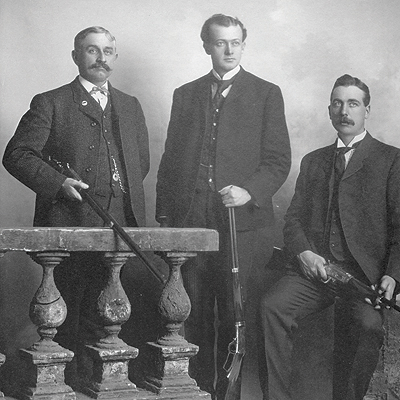 In his latter years Bartlett (at left) toured with fellow representatives of the Peters Cartridge Co., putting on shooting demonstrations as the company’s celebrity representative. (Courtesy of Rick Regnier)
When Bartlett made a 1898 stop in his hometown of New Haven, Conn., a Marlin Firearms Co. executive offered him a position as its traveling representative. He accepted and was soon wooing crowds at trap shoots up and down the East Coast. In 1899 he broke off his arrangement with Marlin to tour with Pauline Cooke and May Clinton, traveling sharpshooters who billed themselves as Misses Cooke and Clinton. Bartlett and the Misses were a hit and planned to tour Europe, opening in Copenhagen in April 1901. When that trip fell through, George and May made other plans and got married. That spring the Peters Cartridge Co. of Cincinnati persuaded Bartlett to represent their firm in the same fancy shooting capacity he’d enjoyed with Marlin. By then he was a polished showman with a national following. Exhibition shooters customarily crowned themselves with the honorific of “Captain.” In following tradition, Bartlett took on a dual captaincy of sorts.
For a decade the captain toured the country for Peters, plinking nuts, coins, rocks, washers and other thrown objects out of the air with a rimfire rifle. His trademark stunt, reducing a thrown brick to dust with a high-powered Remington rifle, was always a crowd-pleaser. His routine was among the first captured by motion pictures.
On Aug. 19, 1911, after an unspecified illness, 52-year-old Bartlett died at his home in Los Angles. He left behind a notable collection of Indian artifacts, as well as the Colt six-shooter, gun belt, knife and scabbard he’d “inherited” from Jack Campbell after the Stoneville shootout. (Years earlier Bartlett had sold Campbell’s saddle, which still bore the marks from the unfortunate outlaw’s spurs.) Author E.A. Brininstool recalled that shortly before Bartlett’s death, his old friend gave him the “old gun belt, knife, knife scabbard and pistol holster.” The Colt had vanished into memory, much like the outlaw and the man who brought him to justice. WW
{Jim Foral writes from Lincoln, Neb.
For further reading he suggestsVoices of the American West: The Settler and Soldier Interviews of Eli S. Ricker, edited by Richard E. Jensen;
Trail to Wounded Knee: The Last Stand of the Plains Indian, 1860–1890, by Herman J. Viola;
Voices of Wounded Knee, by William S.E. Coleman;
American Carnage: Wounded Knee, 1890, by Jerome A. Greene; and
Eyewitness at Wounded Knee*, by Richard E. Jensen, R. Eli Paul and John E. Carter.
---
DUCK 12 25
Library of Congress
https://www.loc.gov › item › 72184999
Pine Ridge, 1890; an eye witness account of the events surrounding the ...
Book/Printed Material Pine Ridge, 1890; an eye witness account of the events surrounding the fighting at Wounded Knee. View 292 images in sequence.

HistoryNet
https://www.historynet.com › eyewitness-wounded-knee
"Wholesale Murder": What People Saw at the Wounded Knee Massacre
Lawman George Bartlett operated a trading post on Wounded Knee Creek, was present during the 1890 clash and went on to become a sharpshooting showman.

History Nebraska
https://history.nebraska.gov › back-in-print-eyewitness-at-wounded-knee
Back in Print - "Eyewitness at Wounded Knee" - History Nebraska
Eyewitness at Wounded Knee was originally published in 1991, was unavailable for a time, and is now back in print. New technology has allowed for the digital remastering of the scores of photographs, with more than 130 pictures appearing in the book. In the late 1800s, the world of the Native Americans was disintegrating.
PBS
https://www.pbs.org › kenburns › the-west › lakota-accounts-of-the-massacre-at-wounded-knee
Lakota Accounts of the Massacre at Wounded Knee - PBS
Lakota Accounts of the Massacre at Wounded Knee From the Report of the Commissioner of Indian Affairs for 1891, volume 1, pages 179-181.

Wikipedia
https://en.wikipedia.org › wiki › Wounded_Knee_Massacre
Wounded Knee Massacre - Wikipedia
The Wounded Knee Massacre, also known as the Battle of Wounded Knee, involved nearly three hundred Lakota people killed by soldiers of the United States Army. [5] More than 250 and up to 300 Lakota people were killed and 51 wounded (4 men and 47 women and children, some of whom died later). [3] Twenty-five U.S. soldiers were killed and 39 were wounded (six of the wounded later died). [6 ...
World History Encyclopedia
https://www.worldhistory.org › article › 2368 › eastmans-account-and-media-coverage-of-the-wounded
Eastman's Account and Media Coverage of the Wounded Knee Massacre
Feb 8, 2024Of the many first-person accounts of the aftermath of the Wounded Knee Massacre, the report by Sioux author and physician Charles A. Eastman (also known as Ohiyesa, l. 1858-1939) is among the best-known...

Nebraska Press
https://www.nebraskapress.unl.edu › bison-books › 9780803236097 › eyewitness-at-wounded-knee
Eyewitness at Wounded Knee - Nebraska Press
The tragedy at Wounded Knee has often been written about, but the existing photographs have received little attention until now. Eyewitness at Wounded Knee brings together and assesses for the first time some 150 photographs that were made before and immediately after the massacre.
The New York Times Web Archive
1891: A Heart-Rending Account of the Massacre at Wounded Knee
Feb 12, 2016After the massacre at Wounded Knee Creek on the Pine Ridge reservation in South Dakota in 1890. Library of Congress On Dec. 29, 1890, American soldiers killed men, women and children on the Pine Ridge reservation in South Dakota.
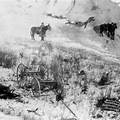
- :{[
serc.carleton.edu
https://serc.carleton.edu › resources › 17931.html
Lakota Accounts of the Massacre at Wounded Knee - SERC
This website provides the personal accounts, in direct quotation, of the Lakota Sioux involved in the massacre at Wounded Knee. The document provides excerpts from the verbatim stenographic report of the council held by delegations of Sioux with the Commissioner of Indian Affairs in Washington on February 11, 1891. Eyewitness accounts are provided by Turning Hawk, Captain Sword, Spotted Horse ...
---