CURRYBAK
CURRY126
PRIMARY ON CWG RED TEAM BS TRUMP TERM 2 1 26}:
had not heard of her, but interesting she's on poptech hit list:
recent pattern of elderly science heretics: dyson, lovelock etc, she tends to show up as commenter?
HACKADEMIC EMERITUS
HACK SQUAD RED TEAM KILL CO-OPT NCA
PIELKE
BREAKTHRU
LAMAR SMITH
BAK 1 26
==
OMFG
REF GRNWIRE
https://www.eenews.net/articles/its-the-gold-standard-of-us-climate-research-contrarians-could-write-the-next-one/
It’s the gold standard of US climate research. Contrarians could write the next one.
By Scott Waldman | 12/22/2025
Researchers who have downplayed the threat of global warming have been asked to author the next National Climate Assessment.
The Trump administration has invited a small group of climate contrarians to help write the next installment of the National Climate Assessment, the nation’s preeminent report on global warming, says one of the researchers involved.
The move would advance efforts by the White House to inject widely disputed ideas about climate change into the federal government’s official appraisal of global warming. And it would almost certainly provoke a response from the hundreds of mainstream climate scientists who have worked for years on the National Climate Assessment.
Judith Curry, a former climatologist at the Georgia Institute of Technology, is one of the climate contrarians in line for the new assignment. Earlier this year, Curry joined with four like-minded researchers to produce a separate report for Energy Secretary Chris Wright that downplayed the threat of global warming and called into question the basic tenets of climate science.
Now Curry says that same team — known as the Climate Working Group — has been asked to write the next installment of the National Climate Assessment, or NCA, a congressionally mandated report that comes out every few years and outlines the many ways that global warming is expected to impact the United States and its people.
“The Climate Working Group has been contacted about the NCA,” said Curry, who added that she was open to the idea. “Personally, I would work with whoever’s in charge to get a reasonable outline and get reasonable authors.”
Curry said she expected all five members of the Climate Working Group to work on the National Climate Assessment.
Three of the other authors did not respond to requests for comment from POLITICO’s E&E News. The fourth, Canadian economist Ross McKitrick, said late Sunday that he had not yet been contacted about working on the assessment but declined to comment as to whether he would participate in the next version.
Curry also said that the Trump administration was looking to revive the U.S. Global Change Research Program, the initiative in charge of producing the National Climate Assessment. Earlier this year, the Trump administration dismantled the program and dismissed hundreds of scientists who were already at work on the sixth version of the National Climate Assessment.
Curry said the new effort is starting to take shape. She said the Trump administration already has interviewed candidates for the U.S. Global Change Research Program, and she expected the administration would name a new program chief as soon as next month.
“I think in January, we should have a director of the USGCRP in place,” she said.
The White House did not respond to requests for comment from E&E News. Nor did the Energy Department nor the Office of Management and Budget.
But there’s at least one other sign the Trump administration is looking to write a new version of the National Climate Assessment.
Ryan Maue, who served as chief scientist at the National Oceanic and Atmospheric Administration during the first Trump administration, said last week on the social media site X that he was working on the new climate report.
He described it as a “volunteer effort” and said it would be “mostly completed before end of 2025.”
Maue did not respond to requests for comment from E&E News. But he wrote on X that he was enlisting artificial intelligence to help with the latest National Climate Assessment. He cited the Gemini 3 Pro program as well as Grok, an AI chatbot developed by xAI, the artificial intelligence company led by tech tycoon Elon Musk.
Grok in the past has downplayed the danger of global warming when compared with other AI programs.
The Trump administration’s push to revive the National Climate Assessment and resurrect the U.S. Global Change Research Program adds a new twist to the complicated history of the long-running research effort.
The program was created by Congress in 1990 and signed into law by Republican President George H.W. Bush. Its most visible product is the National Climate Assessment, which comes out roughly every four years and is used to help shape environmental rules, legislation and infrastructure projects.
Five installments of the National Climate Assessment have been published since 2000. The reports explore more than just climate change — they also examine land productivity, water resources, fisheries, ecosystems and the atmosphere.
But earlier this year, the Trump administration fired the federal employees who work for the research program — and it was effectively shuttered. The administration also deleted interactive webpages for the first five versions of the National Climate Assessment and then buried the documents on government websites.
The moves prompted a sharp outcry from the scientific community in part because the National Climate Assessment has earned a reputation for top-notch research. The document includes hundreds of peer-reviewed studies to inform its conclusions, and it relies on the work of hundreds of scientists to write its contents and review its findings.
In contrast, the Energy Department report written by Curry and her colleagues involved a much smaller group of researchers.
Her four co-authors were: McKitrick; Steven Koonin, a former chief scientist for BP who also served as an undersecretary at the Energy Department during the Obama administration; as well as John Christy and Roy Spencer, atmospheric scientists at the University of Alabama, Huntsville.
One climate scientist said the size of that group was indicative of how far the team members’ views fall outside the scientific consensus.
“Serious experts agree and action (on climate change) is needed as soon as possible,” said Katharine Hayhoe, a climate scientist at Texas Tech University who has served as a lead author on multiple versions of the National Climate Assessment.
If the Trump administration wants “people who are not going to tell them those truths,” she added, “those are the only people they have.”
The Energy Department report written by Curry and the rest of the Climate Working Group has been roundly criticized by climate scientists for its reliance on cherry-picked data and its omission of research that disproved its claims.
Scientists whose work was cited in the report said their research was distorted and manipulated. Dozens of scientists produced a 450-page report challenging its claims, and the National Academies offered its own rebuttal of the report as well.
Hayhoe said it’s critical the United States and its leaders get a clear-eyed view of climate change and its impacts.
“This is a matter of safety, security, well being, resilience and preparation for a better future for everyone,” she said. “Regardless of where they live and regardless of how they vote.”
Related Articles
Climatewire
DOE reframes climate consensus as a debate
by Scott Waldman, Benjamin Storrow | 07/31/2025 06:30 AM EDT
Climatewire
How Chris Wright recruited a team to upend climate science
by Benjamin Storrow | 08/11/2025 06:15 AM EDT
Climatewire
Trump team readies more attacks on mainstream climate science
by Scott Waldman | 08/18/2025 06:21 AM EDT
Climatewire
EPA attacks climate science. Here are the facts.
by Chelsea Harvey, Scott Waldman | 07/30/2025 06:20 AM EDT
EXPERIENCE E&E NEWS FIRSTHAND
NO LNX
---
---
TRUMP ZELDIN WRIGHT BS COVER
mma
The Trump administration's “critical review” of climate science is authored by some of Fox News’ favorite climate deniers
Special ProgramsClimate & Energy (https://www.mediamatters.org/climate-energy)
Written by Allison Fisher (https://www.mediamatters.org/author/allison-fisher)
Published 08/14/25
On July 23, the Department of Energy released a so-called “critical review” of climate science to serve as a basis for the Environmental Protection Agency to stop regulating climate pollution. The New York Times reported (https://www.nytimes.com/2025/07/31/climate/trump-climate-skeptics-science-report.html):
Sea level rise is not accelerating. More carbon dioxide in the atmosphere will be good for plant growth. The computer models used to predict global warming tend to exaggerate future temperature increases.
These arguments, routinely made by people who reject the scientific consensus on climate change, were included in an unusual report released by the Energy Department on Tuesday. The report, which is meant to support the Trump administration’s sweeping efforts to roll back climate regulations, contends that the mainstream scientific view on climate change is too dire and overlooks the positive effects of a warming planet.
The conclusions in the DOE report have been widely criticized (https://www.nytimes.com/2025/07/31/climate/trump-climate-skeptics-science-report.html) by climate scientists. From The Washington Post (https://www.washingtonpost.com/climate-environment/2025/07/31/endangerment-repeal-climate-science-report/):
Scientists argue that the new report, composed in less than two months by five authors known to have skeptical views on climate science, would not pass any peer review process. “If almost any other group of scientists had been chosen, the report would have been dramatically different,” Andrew Dessler, a climate scientist at Texas A&M University, said in a statement.
“There is a history of some of the authors of this document cherry-picking dates to show that there is no change, but they’re not providing the evidence to support that,” said Kristie Ebi, a professor of global health at the Center for Health and the Global Environment at the University of Washington.
To author its new report, the Department of Energy tapped climate contrarians, including several who have been on the payroll of the fossil fuel industry and whose discredited and debunked arguments have been promoted by right-wing media to manufacture doubt about the science that compels climate action. In fact, four of the five authors of the report — Judith Curry, John Cristy, Steven Koonin, and Roy Spencer — have appeared on Fox News during key moments to dismiss climate science and deny the link between our warming planet and extreme weather.
Climate deniers behind the Trump administration’s new climate report have appeared on Fox News to dismiss climate science during key moments
Judith Curry
Judith Curry, former chair of the School of Earth and Atmospheric Sciences at Georgia Tech, consulted (https://www.desmog.com/judith-curry/) for oil and gas companies during her time in academia. She resigned from Georgia Tech in 2017 citing climate “craziness” and has been called out (https://climatefeedback.org/scientists-reactions-us-house-science-committee-hearing-climate-science/) by other scientists for promoting debunked (https://skepticalscience.com/Judith_Curry_arg.htm) climate denial (https://www.desmog.com/2023/05/15/judith-curry-denier-montana-climate-trial/) arguments.
As climate-fueled Hurricane Idalia barreled toward Florida in August 2023, Curry appeared on Jesse Watters Primetime (https://www.mediamatters.org/jesse-watters/jesse-watters-hosts-oil-industry-funded-scientist-buttress-his-climate-denial-and) to argue that scientists have “seriously mischaracterized” the threat of climate change. She claimed that the “dominant factor” in climate change is “far and away” the “natural climate variability” of the Earth. (Earlier that same month, Curry published an op-ed (https://nypost.com/2023/08/09/climate-scientist-admits-the-overwhelming-consensus-is-manufactured/)in the New York Post, another Murdoch property, where she falsely claimed that the “overwhelming scientific consensus” on climate change is “manufactured” and suggested that scientists are incentivized by “fame and fortune” to push the idea that climate change is caused by human activity.)
John Christy
John Christy is “an atmospheric scientist who doubts the extent to which human activity has caused global warming,” according to The New York Times (https://www.nytimes.com/2025/07/31/climate/trump-climate-skeptics-science-report.html). (In reality (https://news.cornell.edu/stories/2021/10/more-999-studies-agree-humans-caused-climate-change), “more than 99.9% of peer-reviewed scientific papers agree that climate change is mainly caused by humans.”) He has regularly downplayed the link between climate change and extreme weather and has also pushed the false (https://www.climate.gov/news-features/understanding-climate/climate-change-atmospheric-carbon-dioxide) narrative (https://www.desmog.com/John-Christy/) — central to the Trump DOE climate report — that “CO2 is not the problem” because “carbon dioxide makes things grow. The world used to have five times as much carbon dioxide as it does now. Plants love this stuff. It creates more food.”
During a deadly global heat wave in July 2022, Christy appeared on The Ingraham Angle (https://www.mediamatters.org/laura-ingraham/laura-ingraham-pushes-explicit-denial-settled-climate-science-science-not-settled) to falsely claim (https://science.nasa.gov/climate-change/extreme-weather/) that extreme heat and other disasters are not “increasing in intensity or frequency.” He also repeated the common climate denial (https://www.mediamatters.org/project-2025/project-2025-architect-kevin-roberts-touted-decrease-weather-related-deaths-decrease) argument that “deaths from weather disasters and so on has gone down about 95% in the last hundred years.” But Reuters (https://www.reuters.com/fact-check/drop-climate-related-disaster-deaths-not-evidence-against-climate-emergency-2023-09-19/) points out that the decrease in deaths since 1920 is largely due to “better forecasting and preparedness,” even while “the number, intensity, and cost of climatic and meteorological hazards have all increased over the last hundred years.”
Steven Koonin
Physicist Steve Koonin, a former scientist for the oil and gas giant BP (https://www.desmog.com/2023/11/10/former-bp-scientist-steve-koonin-claims-climate-journalists-are-spreading-hysteria/) who wrote a book chock-full of errors about climate change (https://www.mediamatters.org/climate-deniers/right-wing-media-are-having-field-day-physicist-steve-koonins-new-book-climate), appeared on the August 10, 2021, edition (https://www.mediamatters.org/media/3962941) of Fox Business’ Kudlow to downplay the release of the U.N. Intergovernmental Panel on Climate Change’s sixth climate assessment (https://www.mediamatters.org/fox-news/right-wing-media-have-been-uncharacteristically-quiet-ipcc-report). Koonin stated that “it is kind of absurd to think that another one degree over a century is going to create catastrophe.” But this would put the planet at over 2 degrees Celsius of warming, which climate scientists have long urged policymakers to prevent (https://www.weforum.org/agenda/2021/07/2c-global-warming-difference-explained/) because it will be catastrophic for large parts of the globe (https://climate.nasa.gov/news/2865/a-degree-of-concern-why-global-temperatures-matter/).
Koonin also appeared on the August 10, 2021, edition (https://www.mediamatters.org/bret-baier/foxs-special-report-bret-baier-airs-feeble-attempt-dismiss-starkest-climate-change) of Special Report with Bret Baier to dismiss the connection between extreme weather and climate change, claiming that natural disasters were “on the face of it, weather. If they were climate, we would see trends over several decades in those phenomena, and we don't.”
In fact, climate scientists have been able to estimate how much climate change affects any given extreme weather (https://www.climate.gov/news-features/understanding-climate/extreme-event-attribution-climate-versus-weather-blame-game) event for years. Notably, researchers found that the heat wave that sent temperatures in the Pacific Northwest into triple digits just two months before the release of the 2021 report would have been “virtually impossible” (https://www.reuters.com/business/environment/heat-wave-pacific-northwest-could-soon-repeat-due-climate-change-research-2021-07-07/) without global warming.
Roy Spencer
Roy Spencer is a research scientist at the University of Alabama in Huntsville, an adviser to the Heartland Institute, and a former visiting fellow at the Heritage Foundation who was known as Rush Limbaugh's “official climatologist (https://www.cbsnews.com/news/20-years-of-rush-limbaugh/).” Politico (https://www.eenews.net/articles/meet-the-4-influencers-shaping-chris-wrights-worldview/) reported that even while he has written that “climate change is big business” driven by a “marching army of climate scientists whose careers now depend on a steady stream of funding from governments” (a frequent claim (https://skepticalscience.com/climate-scientists-in-it-for-the-money.htm) among climate deniers), Spencer himself “has worked with organizations that have received funding from an interlinked network of fossil fuel companies — a multitrillion-dollar global industry — as well as wealthy foundations with billions of dollars in holdings that support groups opposing climate and energy regulations.”
After Hurricane Irma devastated parts of the U.S. in 2017, Fox & Friends (https://www.mediamatters.org/fox-friends/fox-friends-hosts-rush-limbaughs-official-climatologist-cast-doubt-climate-science-wake) hosted Spencer to undermine the science linking more intense storms to a warming planet. Spencer claimed: “As you go through time, there has been no increase in the number of major land-falling hurricanes in Florida, and there's been no increase in their intensity.” While climate scientists predict (https://yaleclimateconnections.org/2019/07/how-climate-change-is-making-hurricanes-more-dangerous/) that “storm frequency will either decrease or remain unchanged” due to climate change and studies consistently show “no discernible trend in the global number of tropical cyclones,” data has confirmed that warmer temperatures have increased their intensity — including stronger wind speeds and greater precipitation.
Energy Secretary Chris Wright has appeared on Fox and CNN to defend the report and its authors
On August 5, CNN anchor Kaitlan Collins summarized (https://www.mediamatters.org/media/4032260) the Trump DOE report’s conclusions “that more carbon dioxide in the air is good for plant growth, that [rising] sea levels are not accelerating,” and asked Secretary of Energy Chris Wright how the authors were selected. Wright responded:
“I've been in the climate debate and discussion for over 20 years, so I know certainly a lot of people in that world and I just made a list of who I think are the true, honest scientists,” Wright responded. “They follow the data and the facts where they lead them. They don't have a political agenda or a desired policy or a desired thing. They're just honest scientists. There's plenty of those. But I made a list of about a dozen of them that I thought were very senior and very well-respected. I called the top five and everyone said yes.”
Collins noted that “some people have criticized the report saying the information was cherry-picked by people who had already predetermined what they wanted to say in this report.” Notably, “some people” includes climate scientists whose work is cited in the report.
Wright also claimed that “the report references the Intergovernmental Panel on Climate Change reports over 100 times,” but it is worth noting that the well-known climate contrarians behind the Trump administration’s “critical review” contradict the findings of the hundreds of scientists who spent eight years (https://www.wri.org/insights/2023-ipcc-ar6-synthesis-report-climate-change-findings) developing the IPCC report.
On the August 7 edition of Morning with Maria (https://www.mediamatters.org/media/4032356), host Maria Bartiromo asked Wright to respond to The New York Times’ “pushback” from the article headlined “Energy Department attacks climate science in contentious report.”
“What a crazy headline, but I guess that’s par for the course for The New York Times — in fact we are doing the exact opposite,” Wright responded. “We are exposing the American people and the broader scientific community to what is actually in the Intergovernmental Panel on Climate Change reports, not the hyperbolic summaries for policymakers or media headlines that claim all sorts of crazy stuff. This is what we actually know.”
“How often do you hear that the planet is getting greener because there’s more carbon dioxide in the air that contributes to increased crop productivity and greener wilderness?” he continued. “How often do you hear that deaths from extreme weather have been falling like stone for a century? And that insured losses from extreme weather events have been on a multidecadal decline — those are just facts.”
All of these climate denial arguments have been debunked for years. Increasing CO2 is far more harmful to plants (https://skepticalscience.com/co2-plant-food.htm) and farmers (https://www.scientificamerican.com/article/climate-change-is-hitting-farmers-hard/) than any short-term benefit. Extreme weather deaths are falling because of better forecasting (https://www.reuters.com/fact-check/drop-climate-related-disaster-deaths-not-evidence-against-climate-emergency-2023-09-19/) even while weather events are more intense due to our warming planet. And we are currently facing an insurance crisis (https://www.cnbc.com/2025/08/08/climate-insurers-are-worried-the-world-could-soon-become-uninsurable-.html?fbclid=IwQ0xDSwMHen1jbGNrAwd6J2V4dG4DYWVtAjExAAEeqVl15IkSd1y52P9xZW6QhlG4McoUy3T38zECfciRvxBBncbBKAfC4tXHY7c_aem_nY50uLo3RLSslAWDlhq_oQ) because of climate-fueled events making some locations economically unviable and dangerously uninhabitable. But these stark realities were abandoned in the Trump administration’s climate report in favor of debunked arguments that support the fossil fuel industry’s campaign against climate action.
---
---
REF
E AND E POL
Meet the scientists Trump could tap to undermine climate regulations
:{:{By Scott Waldman (https://www.eenews.net/meet-the-team/scott-waldman/), Zack Colman | 03/19/2025 :}:
Some downplay the threat of global warming. Others question the efficacy of climate policy. All could be of interest to the new administration.
EPA Administrator Lee Zeldin has made it his mission to destroy what he calls the “holy grail (https://www.politico.com/news/2025/03/12/epa-launches-attack-on-holy-grail-of-climate-science-and-dozens-of-enviro-rules-00226731)” of U.S. climate policy.
But President Donald Trump’s EPA chief can’t do it alone. To smash the holy grail, Zeldin needs help from a rare kind of scientist — the kind who believes climate change isn’t that bad or might even be good for humanity.
Those scientists aren’t easy to find. The overwhelming scientific consensus is that the burning of fossil fuels is heating up Earth, and the planet’s rapid change is putting people at risk for a wide range of calamities — from more extreme storms to rising sea levels to more intense heat waves.
Those threats underpin what’s known as the “endangerment finding (https://www.epa.gov/sites/default/files/2021-05/documents/federal_register-epa-hq-oar-2009-0171-dec.15-09.pdf)” — Zeldin’s holy grail. The 2009 declaration by EPA made clear that greenhouse gases like carbon dioxide are the root cause of climate change, and that EPA has the authority to regulate them under the Clean Air Act because they can harm human health.
The endangerment finding has empowered EPA to establish landmark climate regulations, including limits on the emissions produced by cars or power plants. Rolling back these regulations — and the endangerment finding itself — would require an attack on the climate science that serves as their foundation.
Enter the climate naysayers.
The Trump administration is looking to recruit scientists who could cast doubt on climate science or climate policy, or who view global warming as either a small inconvenience or a boon to humankind.
Once selected, these scientists could add their perspective (https://subscriber.politicopro.com/article/eenews/2025/03/10/white-house-likely-to-expand-assault-on-climate-science-00214124) to a bedrock climate report that comes out every few years, known as the National Climate Assessment. Their contributions to the report, in turn, could be cited as evidence in future efforts to undermine the endangerment finding — all of which would make it easier to quash climate regulations.
The scientists even could help author a second endangerment finding. A Trump-era endangerment finding might, for example, selectively highlight areas of doubt in climate science or tout the perceived benefits of global warming.
To do that, a Trump-approved body of climate findings would center around future scenarios based on lower carbon scenarios than the world is currently experiencing.
It also could emphasize less severe climate trajectories than those envisioned in the original finding, said Roger Pielke Jr., a nonresident fellow at the American Enterprise Institute, a conservative think tank.
“Being able to tease out signals of human-caused climate change in extreme weather — which everybody cares about — are going to be much more challenging with a lower emissions trajectory than a higher one,” said Pielke Jr., who is not involved in any of the efforts and has questioned how scientists can link human-driven warming to specific extreme weather events.
There is a relatively small pool of researchers who could — or would be willing to — engage in such an effort because it would misrepresent decades of climate science by the world’s top science agencies.
“It’s a very small group of people. It’s the same people who have been there for the last 20 years,” said Andrew Dessler, a climate scientist at Texas A&M University. “It’s this endlessly recycled group of people who have been making the same arguments that are unable to convince anybody in the scientific community.”
The White House has not announced its plan yet nor the researchers who might be involved, and it did not respond to a request for comment.
In a statement, an EPA spokesperson said that as “part of this reconsideration process, EPA will leverage the expertise of the White House Budget Office, including the Office of Information and Regulatory Affairs, White House Office of Science and Technology Policy, National Oceanic and Atmospheric Administration, and other relevant agencies.”
Here are some of the scientists who have spent years downplaying climate risks or criticizing climate regulations, and could be tapped by the Trump administration to help Zeldin destroy the “holy grail” of U.S. climate policy.
David Legates
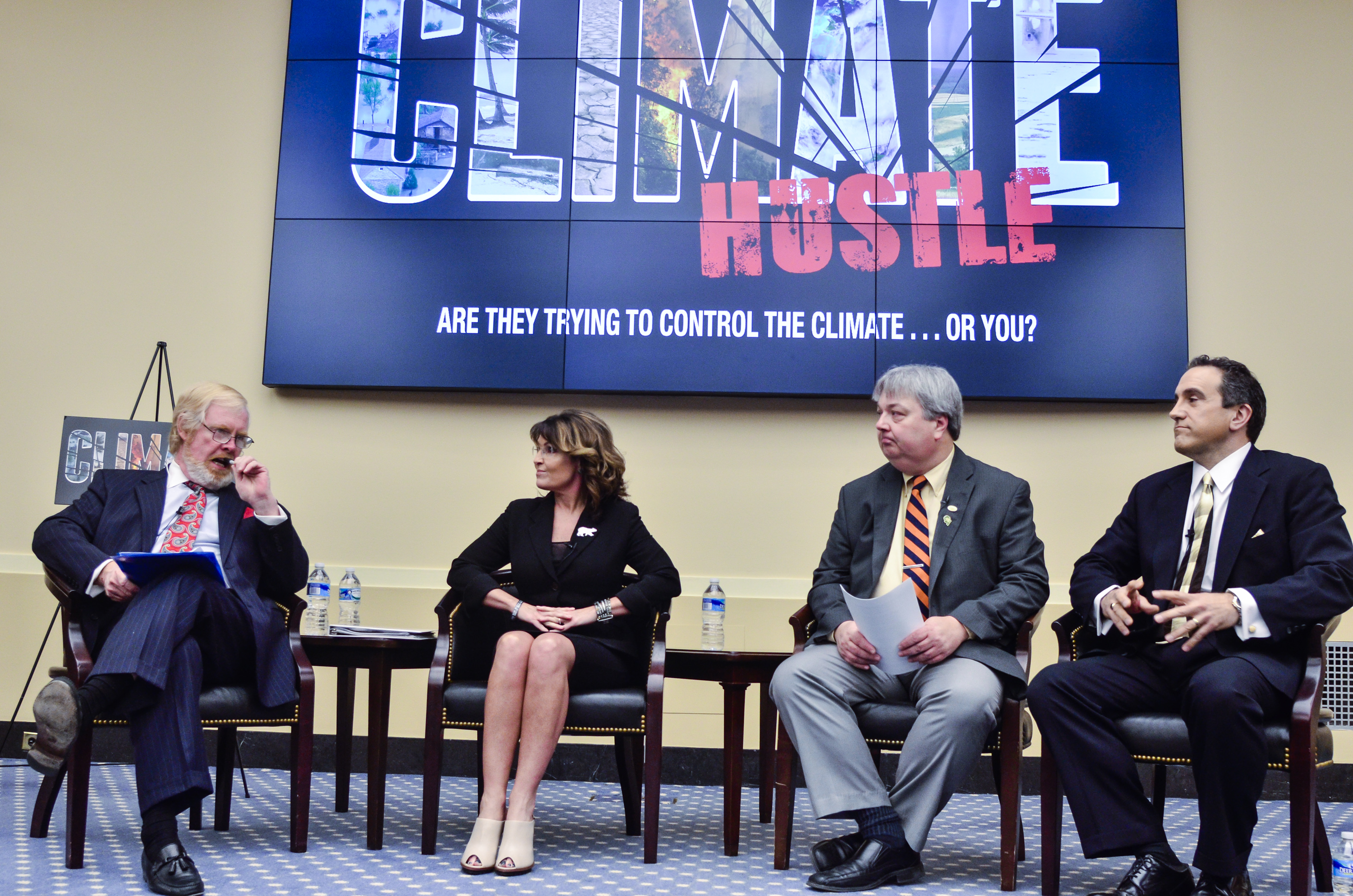 David Legates (second from right) appears at a 2016 event in Washington. | Kris Connor/AFP via Getty Images MORANO
Legates likely would be a key leader. He has worked with Office of Management and Budget Director Russ Vought on a series of proposals to tear down NOAA and to recruit industry and think tank researchers that oppose climate rules to write a government science report.
The two men authored a key chapter outlining their plans in the Project 2025 conservative policy playbook.
Legates, who was the former state climatologist for Delaware until he was asked to step down, served as a top NOAA official in Trump’s first term. He was also detailed to the Office of Science and Technology Policy, but was later removed from that position after attempting to publish a series of research memos that distorted climate science.
For years, Legates has turned a partisan lens to research, claiming that climate change will benefit humanity while climate policy will hurt people. He is affiliated with the Cornwall Alliance, a group of conservative Christian scholars “dedicated to educating the public and policymakers about Biblical earth stewardship.”
Legates declined to comment for this story.
Steve Kooni
Koonin, a New York University physicist and former top scientist at BP, has long pushed to conduct a “red team, blue team” review of climate science, which would pit two groups of scientists against each other to debate a scientific report, such as the National Climate Assessment.
One group would defend the report while the other would highlight its alleged scientific weaknesses. Koonin worked on putting together the effort during the first Trump administration, but the project was eventually scuttled by the White House because some officials were concerned about Trump’s reelection chances.
Koonin said he would prefer to take on the latest report from the Intergovernmental Panel on Climate Change to highlight areas of doubt.
“Anything that I can do to help make the science more transparent, you know, that’s been my goal, and remains my goal, for a long time,” he said.
Richard Lindzen
The retired Massachusetts Institute of Technology atmospheric scientist told POLITICO that he would “of course” help the Trump administration challenge the endangerment finding. Lindzen was dismayed that the red team, blue team exercise to publicly debate established climate science never took off during Trump’s first term.
A longtime critic of accepted climate science, Lindzen applauded Zeldin for calling “bullshit” on a “fake issue” of the severity of rising temperatures. But he acknowledged there may be little upside given how much the scientific community has supported the conclusion that human activity is driving climate change, even if he disagrees with it.
Lindzen argued the courts may offer the most direct route, where he said EPA should argue there “was never any evidence in the first place” to suggest greenhouse gases meet a legally defined standard of dangerous.
“I have no idea what they’re going to do,” he said. “But I think it’s pretty obvious when Trump is running on the issue of ‘Drill, baby drill,’ that he is not going to pay any attention to what is claimed to be the science.”
Ryan Maue
Maue has not had any communication with the Trump administration about serving in any science advisory or agency role, he wrote in a text message. But the libertarian meteorologist would be a natural fit: He served at NOAA and the Office of Science and Technology Policy in Trump’s first term.
Maue agrees that humans are warming the planet, but he has pushed back against stringent government policies to rein in greenhouse gases.
He has often used his large social media following on X to dispute the connections between climate change and specific extreme weather events. He has repeatedly cautioned that the world is not following the worst-case scenario climate trajectory, calling it “highly implausible” (https://x.com/RyanMaue/status/1633158370830983168) — a view that could align with Trump administration thinking to emphasize less dire forecasts.
Judith Curry
Curry said she would help the Trump administration reconsider the endangerment finding if she could work from home, but noted there’s been no outreach from Trump’s team.
The Georgia Tech professor emerita argued the original endangerment finding was “politically driven,” and that its reliance on worst-case climate scenarios compelled more drastic policy than necessary. Despite U.S. greenhouse gas reductions falling 17 percent below 2005 levels, the nation is still off-track of the U.S. share of reductions needed to stabilize global temperatures.
An additional 2 to 3 degrees Fahrenheit of warming by 2100 — which is aligned with current trajectories — “isn’t a big deal because it’s what we’ve seen over the last 100 years, and we’re doing just fine,” said Curry, who is now president of consulting firm Climate Forecast Applications Network.
Scientists have said such increases have brought and would bring massive biodiversity loss, more intense extreme weather events, deadlier heat waves and economic harm through natural disaster damage, lost labor productivity, food insecurity and deteriorating health.
While Curry said there are “plenty of reasons not to like fossil fuels” and that clean energy investment is needed, she claimed “policy isn’t going to help here.” An endangerment finding that reflected less severe consequences for failing to deal with climate change “takes away the urgency for doing all of this” through government policy, she said.
John Christy
Christy is a climate scientist at the University of Alabama in Huntsville and a former lead IPCC author. He has questioned whether humans are driving the observed warming trends in recent decades — something the world’s top science agencies have long confirmed.
He opposed the endangerment finding in 2009 and has questioned the climate models on which it was based in congressional testimony. He is also a longtime proponent of applying a red team, blue team exercise to climate science.
Christy said he believed he could identify weaknesses in the first endangerment finding and that he could use research from the last 15 years to further his argument if the Trump administration pursued a second endangerment finding.
“I would like to see a very clear demonstration that climate models are not capable of telling us about the future of climate to the level of the CO2 forcing that is occurring in the atmosphere,” he said.
In fact, climate scientists have tested the models on which they rely and have found a notable amount of accuracy (https://climate.mit.edu/posts/historical-climate-models-accurately-projected-global-warming), particularly the latest versions, which are far more sophisticated than the models of the past.
Will Happer
Happer was part of Trump’s National Security Council in the first term, who mostly worked on classified military projects. He is a professor emeritus of physics at Princeton University, though not a climate scientist.
Happer is one of the few scientists who have given Trump a briefing on climate research (https://www.science.org/content/article/why-high-profile-climate-science-opponent-quit-trump-s-white-house), though his views are not supported by the world’s leading science agencies. Happer has long cast doubt on the role humans play in driving global warming and has been a vociferous opponent of climate policy.
In Trump’s first term, Happer worked on the effort to conduct an adversarial review of climate science with Koonin. After that effort was torpedoed by White House officials, Trump told Happer that he wanted to bring him back for a red team, blue team effort in his second term. Trump even discussed a potential nationally televised science “debate,” Happer told POLITICO.
“If I see an opportunity to help, I will,” Happer said. “I think it’s long overdue.”
---
---
9 25 SEVERAL STORIES ON WATER IN FLIPBD I SCARD TO LOOK AT; fox jrnl fail on NC coast flood
Time and Tide Gauges wait for no Voortman
18 Sep 2025 by Gavin (https://www.realclimate.org/index.php/archives/author/gavin/) 31 Comments (https://www.realclimate.org/index.php/archives/2025/09/time-and-tide-gauges-wait-for-no-voortman/#comments)
Here we go again. An obscure, methodologically poor, paper published with little to no review makes a convenient point and gets elevated into supposedly ‘blockbusting’ science by the merchants of bullshit, sorry, doubt. Actual scientists drop everything to respond, but not before the (convenient) nonsense has spread widely. Rebuttals are written and submitted, but by the time they are published everyone has moved on.
If that sounds familiar, it’s because it happens a lot. In climate science, one classic example was Soon and Baliunas (2003) (https://en.wikipedia.org/wiki/Soon_and_Baliunas_controversy#Senate_hearing)which instantly made it’s way to the Senate floor (via Inhofe’s then aide Marc Morano). Other (https://www.realclimate.org/index.php/archives/2017/10/the-harde-they-fall/) examples (https://www.realclimate.org/index.php/archives/2022/03/issues-and-errors-in-a-new-scafetta-paper/) abound (https://www.realclimate.org/index.php/archives/2024/01/spencers-shenanigans/). So what is this week’s example?
As Dessler et al report (https://www.realclimate.org/index.php/archives/2025/09/climate-scientists-response-to-doe-report/) laid out convincingly last week, and in multiple (https://tamino.wordpress.com/2025/08/05/u-s-government-makes-old-lies-new-again/) posts (https://tamino.wordpress.com/2025/08/11/sea-level-rise-in-the-u-s-a/) by Tamino/Grant Foster, the sea level chapter in the DOE climate science ‘critique’ (https://www.realclimate.org/index.php/archives/2025/07/the-endangerment-of-the-endangerment-finding/) was notably poor. They highlighted 5 specific US tide gauge records, showed only four of them, declared that no acceleration was visible, and concluded that no acceleration was present anywhere. Curiously the 5th record (that wasn’t shown) has a very clear acceleration. They then bungled the referencing of the projections and invented a NOAA projection that did not correspond to anything real. Notably, they did no actual analysis. Actual analyses of the tide gauge record show that acceleration is sea level rise is not only widespread, but it is increasingly clear:
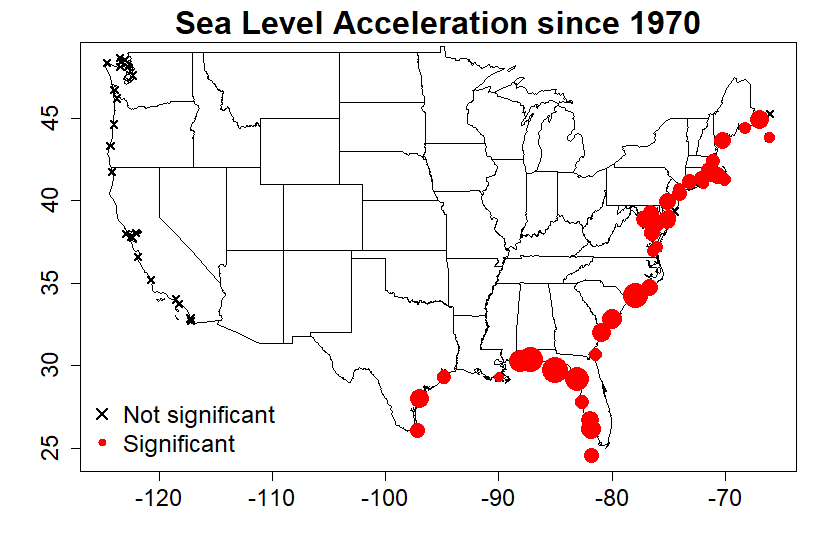 *Analysis of US tide gauge records showing statistically significant acceleration in sea level rise on the East Coast all the way from the Gulf to Maine (via Tamino (https://tamino.wordpress.com/2025/08/11/sea-level-rise-in-the-u-s-a/))
Conveniently, rather than defend the indefensible, one of the authors (Judith Curry) in response latched onto a new paper that apparently agreed with her prior vibes. The new paper is Voortman & de Vos (2025) (https://www.realclimate.org/index.php/archives/2025/09/time-and-tide-gauges-wait-for-no-voortman/#ITEM-26180-0) (VdV25) which was published on Aug 27, and hit the contrary-sphere a few days later heavily boosted by Michael Shellenberger (https://bsky.app/profile/bobkopp.net/post/3ly4aqsobh22o) and a few others. This paper claims that acceleration in 243 global tide gauge records is only significant in 4% of them. This, to be clear, is rubbish. But as always in such papers, it takes a little work to figure out what has gone wrong.
Fortunately, a group of scientists led by Bob Kopp, have quickly put together a rebuttal and request for a retraction (that has been submitted to the journal): Kopp et al. (2025) (https://www.realclimate.org/index.php/archives/2025/09/time-and-tide-gauges-wait-for-no-voortman/#ITEM-26180-1). In it, they point out that this analysis has in fact already been done properly (Wang et al, 2025 (https://www.realclimate.org/index.php/archives/2025/09/time-and-tide-gauges-wait-for-no-voortman/#ITEM-26180-2), published before VdV25 was submitted), and then go on to explain the basic errors.
Apart from the basic lack of context that happens when you ignore the satellite record, the main issues are that the statistical model they use is overly complicated and not properly described, the statistical tests for significance are not applied properly, and the correction for multiple hypothesis testing (which assumes there is no correlation across tide gauge records) is just wrong and all but guarantees their erroneous result.
Curiously, almost all of these errors were also made in an earlier Voortman paper, and were raised by the commenters on that paper at the time (Le Bars et al., 2023) (https://www.realclimate.org/index.php/archives/2025/09/time-and-tide-gauges-wait-for-no-voortman/#ITEM-26180-3)! Update:They were also noted in a [blog post (https://woodromances.blogspot.com/2025/09/evaluating-voortman-et-al-2025-on-sea.html)by Scott Simmons].
How will this all play out in the public discourse? The process of comments, replies, and retractions is relatively slow (multiple months to a year) and even with this preprint quickly available, none of the promoters of VdV25 will deal substantively with any of this (they have not done, and will not do, any analysis themselves). It may well be that VdV25 never gets raised again, having served its purpose as a momentary distraction from the critique of CWG report. (https://www.realclimate.org/index.php/archives/2025/09/climate-scientists-response-to-doe-report/) Whether or not it gets retracted is not really relevant to that.
We have seen this playbook many times before. Judith Curry and Michael Shellenberger are following in the (late) Pat Michaels’ footsteps who continually championed many new ‘blockbusting’ papers that were always on the verge of undermining the climate consensus, but that (somehow!) never quite did. Once folks lose the ability to check these things for themselves, and start basing claims on vibes, their estrangement from the scientific community hardens and the seriousness with which their opinions are taken decreases.
This little episode thus tells us very little about sea level rise acceleration, but quite a lot about the seriousness of the people involved.
:{:{References...}:
---
---
From Katrina to Helene: A timeline of Fox News’ hurricane misinformation, harmful narratives, and climate denial
August 29 marks the 20th anniversary of Hurricane Katrina’s landfall in Louisiana
Written by Allison Fisher (https://www.mediamatters.org/author/allison-fisher)
Published 08/28/25 mma
For two decades, Fox News has weaponized major disasters caused by supercharged storms to attack political opponents, push right-wing narratives, and deny climate change.
Major storms that hit populated areas generate wall-to-wall TV news coverage. At its best, this coverage exposes systemic issues that leave certain populations vulnerable to disasters, keeps a spotlight on both rescue and recovery processes to keep accountable those responsible for disaster response, and discusses the link between our warming planet and the intensification of storms, along with solutions for reducing climate pollution.
At its worst, coverage ignores these issues, downplaying or denying the role of climate change and using disasters to amplify false narratives and misinformation that serve a political agenda. In 20 years of hurricane reporting, Fox News’ coverage has predominately reflected the latter.
Below is an overview of some of the major storms that have made landfall in the U.S. over the past 20 years – and how Fox covered them.
2005 Hurricane Katrina: Fox pushed a false narrative of widespread violence and redirected federal failures to Democratic state and local officials
Hurricane Katrina remains the costliest extreme weather disaster in U.S. history (https://www.statista.com/statistics/744015/most-expensive-natural-disasters-usa/) and one of the deadliest, with many of the 1,392 deaths (https://www.nola.com/news/hurricane/how-many-people-died-in-katrina-toll-reduced-17-years-on/article_e3009e46-91ed-11ed-8f2a-a7b11e1e8d34.html) likely having come as a direct result of the federal government’s failed response (https://kpel965.com/katrina-20-years-later-failures-louisiana/). Over 1.5 million survivors were displaced, making it also “one of the largest forced migrations in U.S. history (https://storymaps.arcgis.com/stories/dd0b80e414b44331827429b19e1371af). … Families were separated, homes were lost, and entire communities were erased.”
The media latched on to unverified (https://web.archive.org/web/20060206145521/https://www.latimes.com/news/nationworld/nation/la-na-rumors27sep27,0,5492806,full.story?coll=la-home-headlines) stories of violence and societal breakdown (https://www.cjr.org/behind_the_news/setting_the_record_straight.php), demonizing those most impacted (https://nyujlpp.org/wp-content/uploads/2025/03/JLPP-27-2-Wen.pdf) by the storm and further delaying rescue and recovery efforts (https://dallasweekly.com/2025/07/hurricane-katrina-documentary-nat-geo/). Military forces were deployed to suppress the victims (https://www.cjr.org/the_media_today/hurricane-katrina-press-media-twenty-20-years-later-anniversary-looting-portrayal-race.php) rather than evacuate them. Fox pushed this narrative of violence — “robberies, rapes, carjackings, riots and murder. Violent gangs are roaming the streets at night, hidden by the cover of darkness” — and supported the Bush administration's (https://www.mediamatters.org/fox-news/foxs-garrett-falsely-claimed-house-report-katrina-verified-his-misleading-red-cross) reported strategy of blaming the faulty emergency response (https://www.mediamatters.org/fox-news/fox-touts-misleading-red-cross-account-blame-blanco) on Democratic state and local officials.
2012 Hurricane Sandy: Fox personalities and guests tried to brand the federal response to Hurricane Sandy as “Obama’s Katrina”
Superstorm Sandy hit the eastern United States in October 2012, causing at least 182 deaths (https://apnews.com/general-news-985fa861a86743d489f2c2979b72a851) and approximately $65 billion in damage. Fox criticized the Obama administration's Hurricane Sandy relief efforts (https://www.mediamatters.org/sean-hannity/fox-smears-fema-comparing-sandy-response-katrina) by comparing them to the Bush administration's response to Hurricane Katrina. In fact, there were few similarities between the responses, and the Obama administration's response to Sandy was widely praised by members of both parties.
Discussing Hurricane Sandy on the November 1, 2012, edition of his show, Fox host Sean Hannity asked: “So where's President Obama? Well, after his photo-op with Gov. Chris Christie, and the help of your tax dollars, he boards Air Force One and he begins his day with a stump speech.” Hannity later said, “And with the horrifying images of Sandy's devastation now contrasted with the president's constant campaigning, this is starting to look like, in my opinion, Obama's Katrina.”
2017 Hurricanes Harvey & Irma: Fox personalities downplayed the storms, claiming, “It’s called the weather,” and suggested that the number of hurricanes making landfall is “decreasing”
Hurricane Harvey was, at the time, “the most significant tropical cyclone rainfall event (https://www.nhc.noaa.gov/data/tcr/AL092017_Harvey.pdf) in United States history” and was particularly devastating to Black and Hispanic communities (https://gizmodo.com/survey-reveals-hurricane-harvey-hit-black-and-latinos-h-1821082159) in Texas. Discussing Hurricane Harvey on the August 25, 2017, edition of The Five (https://www.mediamatters.org/embed/clips/2017%3A09%3A07%3A55832%3Afnc-thefive-20170825-harveyclimate), Fox host Jesse Watters downplayed the impact of climate change on hurricanes, stating, “Hurricanes have been happening since the beginning of time. … These things just happen. It’s called the weather” — a nonsensical argument, as scientists are not claiming that climate change causes hurricanes, but that it makes them stronger and more intense (https://insideclimatenews.org/news/13082021/six-takeaways-about-tropical-cyclones-and-hurricanes-from-the-new-ipcc-report/).
Hurricane Irma, which hit Florida, was one of the strongest hurricanes ever recorded in the Atlantic. It claimed 129 lives (https://weather.com/news/news/2018-03-13-hurricane-irma-death-toll-nhc-final-report) in the U.S. and Caribbean and cost an estimated $52 billion in damages (https://www.gao.gov/products/gao-20-633r). Discussing Hurricane Irma on the September 11, 2017, edition of The Five (https://www.mediamatters.org/embed/clips/2017%3A09%3A13%3A55943%3Afnc-thefive-20170911-irmaclimate), co-host Greg Gutfeld also brought up the frequency of hurricanes while ignoring intensity, stating that “landfalling U.S. hurricanes, they’ve been decreasing over the last 140 years.”
2017 Hurricane Maria: Fox defended Trump’s response to Hurricane Maria and his lie that the death toll in Puerto Rico was inflated
Hurricane Maria killed an estimated 3,000 people (https://www.npr.org/2019/09/24/763958799/2-years-after-hurricane-maria-hit-puerto-rico-the-exact-death-toll-remains-unkno) in the U.S. territory and caused roughly $90 billion (https://www.nbcnews.com/news/latino/puerto-rico-four-years-hurricane-maria-far-recovery-rcna2073) worth of damage. President Donald Trump’s administration was widely criticized for its response and for blocking federal aid (https://www.rollingstone.com/politics/politics-news/trump-blocked-puerto-rico-hurricane-aid-1159976/) to Puerto Rico, which struggled for weeks to return power to its residents. The mayor of San Juan publicly criticized Trump’s response (https://www.nytimes.com/2017/09/30/us/politics/trump-puerto-rico-mayor.html), and Trump drew backlash (https://www.washingtonpost.com/politics/it-totally-belittled-the-moment-many-look-back-in-anger-at-trumps-tossing-of-paper-towels-in-puerto-rico/2018/09/13/8a3647d2-b77e-11e8-a2c5-3187f427e253_story.html) when he threw paper towels into the crowd (https://www.cnn.com/2017/10/03/politics/donald-trump-paper-towels-puerto-rico/index.html) at a relief center. Lying (https://www.mediamatters.org/erick-erickson/right-wing-media-figures-are-defending-trumps-lies-about-puerto-rican-death-toll) about death toll numbers, Trump claimed Democrats had inflated the number to make him look “as bad as possible.”
Fox personalities were among the right-wing media figures who leapt to Trump's defense (https://www.mediamatters.org/erick-erickson/right-wing-media-figures-are-defending-trumps-lies-about-puerto-rican-death-toll). Fox Business’ Lou Dobbs called the Hurricane Maria death toll a “farce” (https://www.mediamatters.org/lou-dobbs/lou-dobbs-hurricane-maria-death-toll-farce-and-amazing-tortured-inflation) and “an amazing tortured inflation.” Fox News’ John Roberts suggested that the dispute over Maria's death toll in Puerto Rico was part of Trump’s “feud with Puerto Rican officials (https://www.mediamatters.org/donald-trump/fox-reporter-calls-trumps-suggestion-marias-death-toll-puerto-rico-hoax-part-his-feud).”
On the October 19, 2017, edition of Tucker Carlson Tonight (https://www.mediamatters.org/video/2017/10/19/tucker-carlson-trump-cant-be-racist-against-puerto-ricans-because-they-self-identify-being-white/218275), the former host defended Trump from charges of racism against Puerto Ricans because “Puerto Rico is 75 percent white, according to the U.S. Census.” Carlson characterized as “unfounded” the charges that the Trump administration’s response to Hurricane Maria in Puerto Rico was racist and added that “the race angle” bothered him because “it makes people hate each other, and it’s just stupid.”
2018 Hurricane Florence: Fox guest and climate science denier Joe Bastardi claimed, “If there’s climate change going on, it's actually decreasing the amount of major hits”
Hurricane Florence caused catastrophic damage to the Carolinas, claiming at least 37 lives (https://www.cbsnews.com/live-news/hurricane-florence-aftermath-weather-flooding-power-outage-death-toll-fema-latest-forecast-live/). On Fox, climate denier Joe Bastardi (https://www.mediamatters.org/joe-bastardi) and Rush Limbaugh’s former “official climatologist” Roy Spencer (https://www.mediamatters.org/fox-news/trump-administrations-critical-review-climate-science-authored-some-fox-news-favorite) dismissed the link between climate change and intensifying hurricanes in favor of the denier argument that the frequency of hurricanes is decreasing. (Climate science (https://www.npr.org/2024/10/08/nx-s1-5143320/hurricanes-climate-change) does not argue that climate change is increasing the number of storms, but rather that it is making storms (https://www.npr.org/2024/10/08/nx-s1-5143320/hurricanes-climate-change) “more intense, with higher wind speeds, heavier rainfall, and more severe storm surge.”)
On the September 14, 2018, edition of Tucker Carlson Tonight (https://www.mediamatters.org/embed/clips/2018%3A09%3A21%3A61715%3Afox-tuckercarlson-09142018-spencer), Spencer talked about the declining frequency of “hits of the United States by major hurricanes,” claiming there’s too much “natural variability” to determine what influence human actions have had on hurricanes. On Hannity (https://www.mediamatters.org/media/3387736), Bastardi stated, “The amount of hurricanes in the last 50 years, from Florida to New England, is 37% of what it was the previous 50 years, so if there’s climate change going on, it's actually decreasing the amount of major hits.”
2019 Hurricane Dorian: Fox personalities dismissed the impact of climate on hurricanes and defended Trump’s “Sharpie-gate.” Hannity called the media who reported on Trump’s lie “psychotic jackasses.”
Affecting many states in the south, Hurricane Dorian was also the worst storm ever to hit the Bahamas and was responsible for at least 78 deaths (https://www.foxweather.com/learn/where-did-dorian-strike-how-bad-was-hurricane). But the lives that Dorian claimed were overshadowed by the spectacle of “Sharpie-gate” when the president altered a map of the storm’s predicted path (https://www.cnn.com/2019/09/06/politics/trump-sharpie-hurricane-dorian-alabama/) with a marker. After Trump lied about the path of Hurricane Dorian, using a Sharpie to manufacture a threat to Alabama, not only did prime-time host Sean Hannity defend (https://www.mediamatters.org/sean-hannity/defending-trumps-lie-about-alabama-and-dorian-peak-sean-hannity) him, but Fox’s Howard Kurtz attacked the media (https://www.mediamatters.org/howard-kurtz/fox-news-howard-kurtz-attacks-media-covering-trumps-repeated-lies-about-alabama-and) for covering Trump’s comments. Hannity called the media who reported on Trump’s lie “psychotic jackasses” and claimed that only “Trump derangement syndrome” could explain why reporters would point out that the president was wrong.
Roy Spencer appeared on the September 2, 2019, edition of The Story with Martha MacCallum (https://www.mediamatters.org/media/3827916) to downplay climate change’s impact on hurricanes. Spencer stated that there is “no long term trend in either their intensity or in the number of major hurricanes … that have hit Florida.” On the September 4, 2019, edition of Fox & Friends (https://www.mediamatters.org/media/3828201), co-host Ainsley Earhardt again brought up storm frequency in order to downplay the link between climate change and hurricanes, stating, “Hurricanes have been happening since the beginning of the atmosphere.” Later, on September 4, 2019, Jesse Watters appeared on The Story with Martha MacCallum (https://www.mediamatters.org/media/3828291) to claim falsely (https://eesm.science.energy.gov/research-highlights/anthropogenic-influence-hurricane-dorians-extreme-rainfall) that “there's no correlation between temperature and hurricanes, and there's no trend over the last hundred years about intensity or ferociousness or numbers.”
2021 Hurricane Ida: Fox host Sean Hannity claimed, “The left is blaming climate change for the heavy rainfall, severe weather, and using it as yet another pretext to push their Green New Deal socialist agenda”
Hurricane Ida caused extensive damage from the Southeast to the Northeast U.S., where it brokeprecipitation records (https://theconversation.com/hurricane-ida-2-reasons-for-its-record-shattering-rainfall-in-nyc-and-the-northeast-long-after-the-winds-weakened-167252) in New Jersey, New York, and Pennsylvania (https://www.inquirer.com/news/pennsylvania/hurricane-ida-damage-cost-pennsylvania-20210908.html) and caused major flash flooding, killing 95 people (https://interconnectedrisks.org/2022/disasters/hurricane-ida) and causing an estimated $85 billion in damages. (https://www.ncei.noaa.gov/access/billions/events/US/1980-2024/?disasters[]=tropical-cyclone) Fox News used the storm (https://www.mediamatters.org/fox-news/wake-hurricane-ida-fox-doubling-down-climate-denial-order-attack-bidens-infrastructure) to downplay the seriousness of climate change and attack then-President Joe Biden’s climate agenda, including the infrastructure bill that contained measures to make communities more resilient in the face of extreme weather.
While discussing Hurricane Ida on the September 7, 2021, edition of The Ingraham Angle (https://www.mediamatters.org/media/3967691), one of the network’s favorite climate contrarians, Michael Shellenberger (https://www.mediamatters.org/fox-news/right-wing-medias-favorite-climate-contrarians-go-fox-shows-bash-bidens-climate-plan), said that the frequency of hurricanes is decreasing and that there is “no significant increase” in intensity — a bald-faced lie. (https://www.npr.org/2024/10/08/nx-s1-5143320/hurricanes-climate-change) On the September 8, 2021, edition of Tucker Carlson Tonight (https://www.mediamatters.org/media/3967916), Joe Bastardi downplayed the intensity of the storm by arguing that other bad storms happened in the 1950s.
On the September 2, 2021, edition (https://www.mediamatters.org/media/3967581) of Fox News’ Hannity, Sean Hannity began a segment downplaying the impacts of climate on Ida by stating, “The left is blaming climate change for the heavy rainfall, severe weather, and using it as yet another pretext to push their Green New Deal socialist agenda.” On the September 5, 2021, edition (https://www.mediamatters.org/media/3967681) of Fox News’ The Next Revolution with Steve Hilton, host Steve Hilton ran a short segment on Democrats supposedly using Ida to implement the Green New Deal.
2022 Hurricane Ian: Former Fox host Tucker Carlson falsely stated “there’s no science” behind claims connecting climate change to more intense storms
Hurricane Ian brought a historic storm surge and catastrophic flooding (https://www.popsci.com/environment/hurricane-ian-florida-2/) to Florida and was responsible for at least 84 storm-related fatalities (https://www.axios.com/2022/09/30/hurricane-ian-florida-death-toll). As Hurricane Ian pummeled Florida and the Carolinas, Fox News dismissed (https://www.mediamatters.org/sean-hannity/hurricane-ian-hits-florida-fox-news-undermines-climate-change), mocked (https://www.mediamatters.org/fox-news/right-wing-media-manufacture-outrage-over-cnn-host-don-lemon-discussing-relationship), and outright denied (https://www.mediamatters.org/climate-deniers/climate-denial-abounds-fox-hurricane-ian-devastates-florida) climate change’s impact on hurricanes. On the September 29, 2022, edition of Tucker Carlson Tonight (https://www.mediamatters.org/media/3994556), former Fox host Tucker Carlson focused on hurricane frequency and downplayed the intensity argument, falsely claiming that “there’s no science behind these claims.” On the September 28, 2022, edition of Hannity (https://www.mediamatters.org/media/3994507), Sean Hannity stated, “During hurricane season, you usually have hurricanes, like we did a hundred years ago.” Later that night on The Ingraham Angle (https://www.mediamatters.org/media/3994438), Michael Shellenberger stated that hurricanes are “not intensifying right now, so any perception that hurricanes are more intense is just a perception fed by that relentless alarmist media.”
Meanwhile, Jesse Watters mocked Biden's disaster response (https://www.mediamatters.org/jesse-watters/fox-news-host-uses-hurricane-ian-mock-action-climate-change). Watters said, “Maybe the reason Joe [Biden] isn't talking with the leader of the state that's about to be devastated by this natural disaster is because he's already got the whole thing covered with the Inflation Reduction Act. Sen. Amy Klobuchar laid it out for us clearly. There's no need to worry, people, because the Inflation Reduction Act and voting for Democrats is going to stop hurricanes.”
2023 Hurricane Idalia: Fox guest and climate science denier Judith Curry said scientists have “seriously mischaracterized” the threat of climate change
Hurricane Idalia slammed into Florida's Gulf Coast, causing approximately $4 billion in damage (https://www.ncei.noaa.gov/access/billions/events/US/1980-2024/?disasters[]=tropical-cyclone) to one of the state's poorest and least populated areas (https://www.wlrn.org/business/2023-09-05/idalia-economy-recovery-florida). As climate-fueled Hurricane Idalia barreled toward Florida, Jesse Watters Primetime (https://www.mediamatters.org/jesse-watters/jesse-watters-hosts-oil-industry-funded-scientist-buttress-his-climate-denial-and) hosted Judith Curry, a climate contrarian who consulted (https://www.desmog.com/judith-curry/) for oil and gas companies during her time in academia, to argue that scientists have “seriously mischaracterized” the threat of climate change. She claimed that the “dominant factor” in climate change is “far and away” Earth’s “natural climate variability.”
On the August 30, 2023, edition of Fox News’ so-called straight news program Special Report with Bret Baier (https://www.mediamatters.org/media/4010880), anchor Bret Baier dismissed comments from Joe Biden connecting the storm to climate change.
2024 Hurricane Helene: Fox host Jesse Watters claimed that “the Biden-Harris administration spent a billion dollars of FEMA money on illegal aliens”
With 213 fatalities, Hurricane Helene became the second deadliest hurricane (https://www.accuweather.com/en/hurricane/helene-is-2nd-deadliest-u-s-hurricane-in-50-years-could-cost-250-billion/1698452) to hit the U.S. mainland in 50 years, with economic losses estimated at more than $200 billion. Fox used Hurricane Helene (https://www.mediamatters.org/fox-news/right-wing-media-lies-about-federal-response-hurricane-helene) to attack the Biden administration’s policies and disaster response while laundering harmful misinformation, even while politicians of both parties representing the impacted areas praised the response (https://www.cnn.com/2024/10/03/politics/fact-check-trump-biden-hurricane-response) and begged media and bad actors to stop spreading misinformation (https://www.nbcnews.com/tech/tech-news/hurricane-helene-disinformation-social-media-public-officials-response-rcna174305) that ultimately disrupted rescue (https://www.nytimes.com/2024/10/06/us/hurricane-helene-north-carolina-misinformation.html) and recovery efforts and put Federal Emergency Management Agency workers in danger (https://www.mediamatters.org/hurricanes/social-media-posts-calling-violence-against-fema-gained-traction-fear-about-armed-groups).
One of these false and harmful claims (https://www.mediamatters.org/hurricanes/how-lie-about-immigrants-and-fema-disaster-aid-spread-across-fox-news) contended that FEMA’s hurricane victim relief funds had been drained by aid to undocumented immigrants. In reality, the funding is separate and unrelated. Jesse Watters and Sean Hannity led the charge in repeating the false claim; Watters’ prime-time show repeated the lie in 5 consecutive broadcasts starting October 3, and Hannity managed 6.
Fox News also falsely claimed (https://www.mediamatters.org/donald-trump/right-wing-media-falsely-insist-there-no-federal-response-hurricane-helene-while) that Vice President Kamala Harris and the Biden administration were ignoring millions of Americans impacted by intense flooding while dishonestly claiming (https://www.mediamatters.org/fox-news/right-wing-media-falsely-and-dishonestly-claim-hurricane-helene-survivors-are-only) that victims were only entitled to $750 in aid, when in reality that is just the start of federal benefits. Fox’s misleading coverage of the $750 payments was “one of the more dishonest omissions ever seen on Fox News – which is saying something,” Mediaite senior editor Michael Luciano wrote (https://www.mediaite.com/opinion/fox-news-hosts-dishonestly-cut-off-kamala-harris-speech-to-claim-hurricane-victims-are-only-getting-750/) of the misleading attack by Fox hosts Hannity, Watters, and Laura Ingraham.
Fox personalities also complained (https://www.mediamatters.org/fox-news/right-wing-media-lies-about-federal-response-hurricane-helene) about the Biden administration’s pledge to give $157 million to Lebanon, incorrectly claiming that the humanitarian aid for Lebanon was being taken from funds that would otherwise be used for disaster relief assistance. Hannity misleadingly suggested (https://www.mediamatters.org/media/4024640) U.S. foreign aid was competing with disaster relief for funding. Watters, meanwhile, incredulously asked (https://www.mediamatters.org/media/4024643), “How is it that Biden and Harris can send money overseas faster than they can send it to our own citizens?”
2025 extreme weather season: Fox News is giving the Trump administration a pass on federal disaster response
In May, just weeks before the start of the Atlantic hurricane season and peak extreme weather, CNN obtained an internal memo (https://www.cnn.com/2025/05/15/politics/fema-review-concerns-hurricane-season) warning that FEMA was “not ready” for hurricane season. According to the internal assessment, preparations for hurricane season have been “derailed” and issues abound at the agency, “including a general uncertainty around its mission, lack of coordination with states and other federal agencies, low morale and new red tape that will likely slow responses.” Fox ignored (https://www.mediamatters.org/fox-news/fox-news-giving-trump-administration-pass-federal-disaster-response) reporting on the agency's lack of preparation for this year’s extreme weather season. The network was also quiet about multiple states that expressed frustration over delayed or denied disaster relief from the Trump administration.
On June 2, acting FEMA Administrator David Richardson made headlines, first in Reuters (https://www.reuters.com/world/us/fema-staff-confused-after-head-said-he-was-unaware-us-hurricane-season-sources-2025-06-02/), for telling staff in a daily briefing that he had been unaware the U.S. has a hurricane season. Legacy (https://www.nytimes.com/2025/06/02/us/politics/fema-david-richardson-hurricane-season.html)news (https://abcnews.go.com/Politics/femas-acting-director-unaware-hurricane-season-started-white/story?id=122455820)outlets (https://www.cbsnews.com/news/fema-head-wasnt-aware-hurricane-season/), including cable networks CNN and MSNBC, covered Richardson’s controversial remarks and the wider concerns about FEMA’s hurricane preparedness while Fox News seemingly ignored them (https://www.mediamatters.org/hurricanes/fox-news-ignores-acting-fema-administrators-controversial-remarks-left-staff-baffled).
After the deadly flooding in Central Texas in early July, Fox News personalities attacked the media and prominent Democrats (https://www.mediamatters.org/fox-news/fox-news-relentlessly-politicized-extreme-weather-events-during-biden-era-now-its-accusing) for linking the flooding to climate change and for raising concerns about Trump administration cuts to agencies and services that predict and respond to extreme weather events. When reporting showed that the Trump administration’s response had been delayed, Fox ran defense for Department of Homeland Security Secretary Kristi Noem (https://www.mediamatters.org/fox-news/fox-news-runs-defense-trump-administration-its-delayed-response-texas-flooding).
---
---
mma 7 24
stossel
On May 24, Stossel posted an interview with Judith Curry in which she said there is no “true scientific consensus” on climate change and called it a “manufactured consensus.” While Curry admitted that fossil fuels are warming the planet, she also falsely said that “we still don’t know” how “much of the recent warming is caused by fossil fuels” or if a warming planet is dangerous for humans. YouTube,\ (https://youtu.be/p5CoePvsnOE&t=2s); NASA, [February 2021 (https://earthobservatory.nasa.gov/images/152519/emissions-from-fossil-fuels-continue-to-rise)]
At least two of Stossel’s videos related to climate change, including his interview with Curry, had ads as of July 30.Media Matters found an election campaign ad featuring presumptive Democratic presidential nominee Kamala Harris running on Stossel’s video with Curry and an ad for SunValue, a solar project developer, running on his video titled “Juice: Why Wind and Solar Make Our Power Grid Less Reliable.” YouTube, \7/30/24 (https://www.mediamatters.org/media/4022197), [7/30/24 (https://www.mediamatters.org/media/4022195)]
On May 24, Stossel also posted an interview with pro-fossil fuel activist Alex Epstein, who suggested it’s not “all bad” or “catastrophic” that fossil fuels are driving global warming.“You have to admit it leads to a lot of greening, because CO2 is plant food,” Epstein said. “And you also have to admit that warming is generally desirable in the world.” He also complained that “people do not acknowledge that today we are masters of climate and that any negatives of rising CO2 have been totally overwhelmed by the benefits of fossil fuels.” YouTube,[ (https://youtu.be/yyFa74p4deY&t=5s)]
According to Social Blade, as of July 25, Stossel’s estimated monthly YouTube earnings are $395 to $6,300.Social Blade, accessed [7/25/24 (https://www.mediamatters.org/media/4022096)]
---
---
rww 1 24
Former Fox host Tucker Carlson is platforming disgraced climate denier Willie Soon (https://www.mediamatters.org/breitbart-news/right-wing-media-rush-defend-industry-funded-climate-denier-willie-soon), an aerospace engineer known for accepting over $1 million from fossil fuel companies for writing publications he referred to as “deliverables.”
Carlson invited Soon, a former researcher at the Harvard-Smithsonian Center for Astrophysics (https://www.cfa.harvard.edu/), on his exclusive program on X (formerly Twitter) for an interview on January 9 (https://x.com/TuckerCarlson/status/1744777758507504061?s=20). The two amplified long-debunked hypotheses about what is causing climate change, and clips from the interview have already been viewed over 1 million times on TikTok, likely by a young audience that might not be familiar with Soon’s controversies, which came to light back in 2015.
The spread of these videos highlights TikTok’s ongoing climate misinformation problem, even as it has begun implementing a new policy (https://newsroom.tiktok.com/en-us/earth-day-2023) banning content that “undermines well-established scientific consensus, such as denying the existence of climate change or the factors that contribute to it.”
Though experts dismissed Soon’s false claims, clips of his interview with Carlson have gained traction on TikTok, a social media platform popular with young users
Clips of Carlson’s interview with Soon have been viewed over 1 million times on TikTok. Media Matters identified six videos that have collectively accrued more than 1.1 million views. According to a January 2023 report from Morning Consult, over 60% of Gen Z adults use TikTok at least once daily. TikTok, \1/10/24 (https://www.tiktok.com/@ahintoftruth/video/7322208574615162142?r=1&t=8ivVagTO9iI), 1/10/24 (https://www.tiktok.com/@ahintoftruth/video/7322274969142988062?r=1&t=8ivVe07jDEB), 1/10/24 (https://www.tiktok.com/@ahintoftruth/video/7323387094812855583);1/10/24 (https://www.tiktok.com/t/ZT8qDrJqy/); 1/10/24 (https://www.tiktok.com/@uncensoredtucker/video/7322553064739704097?t=8ix0B2k5Rle&r=1), 1/10/24 (https://www.tiktok.com/t/ZT8qD6UXv/);Morning Consult, [1/2023 (https://go.morningconsult.com/rs/850-TAA-511/images/State_of_Media_and_Entertainment_H1_2023.pdf?mkt_tok=ODUwLVRBQS01MTEAAAGKOGLoAFLTgxRvHjsFKWfgVamQT5fleo50BP25cgdU0Vw4vvrfcduhKD7gJvVWXe7YmWmeP3zrapWcCjMeK4Fufnlb0gA4vyc0bOGZCcFjT5fd)]
Climate scientists continue to highlight and debunk Soon’s disinformation.“Soon's science is based on faulty assumptions & his conclusions are invalid & that's likely why FF \fossil fuel] companies pay him," wrote Gavin Schmidt, head of NASA's Goddard Institute for Space Studies. Twitter/X, \9/10/23 (https://x.com/ClimateOfGavin/status/1700948164038029804?s=20), [1/10/24 (https://x.com/david_ho/status/1745166209358967222?s=20),[1/10/24 (https://x.com/GlobalEcoGuy/status/1745154600468951041?s=20)]
The interview is part of a larger trend of major right-wing media outlets relying more on long-debunked climate deniers
Discredited climate deniers like Judith Curry, Patrick Moore, Anthony Watts, and Gregory Wrightstone, who have been vocal for decades, received renewed attention in 2023 from right-wing media figures. After years of relative obscurity, these figures found a reliable home on shows like Newsmax’s Rob Schmitt Tonight, and also appeared on Fox News programs such as Jesse Watters Primetime and The Ingraham Angle. On social media, they’ve increased engagement on X. Media Matters, \11/28/12 (https://www.mediamatters.org/rush-limbaugh/meet-climate-denial-machine#watts), 2/17/14 (https://www.mediamatters.org/fox-friends/who-patrick-moore-look-former-greenpeace-members-industry-ties-and-climate-denial), 12/22/23 (https://www.mediamatters.org/climate-deniers/three-concerning-trends-shaped-right-wing-media-climate-change-narratives-2023); DeSmog, 5/15/22 (https://www.desmog.com/2023/05/15/judith-curry-denier-montana-climate-trial/); StateImpact Pennsylvania, [3/27/19 (https://stateimpact.npr.org/pennsylvania/2019/03/27/house-panel-hosts-climate-change-doubter-whose-beliefs-draw-a-rebuke-from-scientists/)]
Willie Soon has been exposed for unethically promoting flawed science
In 2015, a joint investigation by Greenpeace and the Climate Investigations Center found that Soon had accepted over $1.2 million in funding from fossil fuel companies for his research. Soon’s work was funded “almost entirely” by the fossil fuels industry, including Exxon Mobil, Southern Company, the American Petroleum Institute, and the Charles G. Koch Foundation. The Guardian, [2/21/15 (https://www.theguardian.com/environment/2015/feb/21/climate-change-denier-willie-soon-funded-energy-industry)]
Soon described his papers as “deliverables” to his corporate funders. Emails revealed that one of the country’s largest utility holding companies, Southern Company, paid Soon to publish research examining the sun’s role in driving climate change. At the time, Southern relied heavily on coal. Scientists have long recognized that solar activity cannot be responsible for the rapid warming that the planet has experienced in recent decades. The New York Times, \2/21/15 (https://www.nytimes.com/2015/02/22/us/ties-to-corporate-cash-for-climate-change-researcher-Wei-Hock-Soon.html); Inside Climate News, 2/21/15 (https://insideclimatenews.org/news/21022015/documents-reveal-fossil-fuel-fingerprints-contrarian-climate-research-willie-soon-harvard-smithsonian-koch-exxon-southern-company/?utm_source=Inside+Climate+News&utm_campaign=def6ba6b21-Dave_Special_Story2_21_2015&utm_medium=email&utm_term=0_29c928ffb5-def6ba6b21-); NASA, accessed [1/11/24 (https://climate.nasa.gov/faq/14/is-the-sun-causing-global-warming/)]
The investigation also found that Soon failed to disclose his relationship with Southern Company in some of his research papers, violating ethical guidelines upheld by scientific journals. Despite accepting more than $400,000 from the company, Soon insisted he had no conflicts of interest, raising the alarm for academics and scientists. His papers, which have been published in top scientific journals, push a “range of climate-denial (https://insideclimatenews.org/topic/climate-denial) perspectives.” Inside Climate News, [2/21/15 (https://insideclimatenews.org/news/21022015/documents-reveal-fossil-fuel-fingerprints-contrarian-climate-research-willie-soon-harvard-smithsonian-koch-exxon-southern-company/?utm_source=Inside+Climate+News&utm_campaign=def6ba6b21-Dave_Special_Story2_21_2015&utm_medium=email&utm_term=0_29c928ffb5-def6ba6b21-)]
Soon has for years been a go-to source for media and lawmakers keen on protecting fossil fuel interests
Soon and his work have been used by the GOP in their efforts to block climate action.Climate denier and former Oklahoma Sen. James Inhofe has cited Soon in press releases and on the Senate floor. In 2013, Soon testified in support of an effort to repeal Kansas’ renewable energy standard in front of state legislators, claiming that climate change isn’t a problem. DeSmog, accessed \1/11/24 (https://www.desmog.com/willie-soon/); Energy and Policy Institute, 8/28/15 (https://energyandpolicy.org/charles-koch-distorts-the-facts-prevents-clean-energy-businesses-from-succeeding/); U.S. Senate Committee on Environment & Public Works, 5/14/08 (https://www.epw.senate.gov/public/index.cfm/2008/5/post-e8b76795-802a-23ad-4c8b-089a6b4c03fe), [7/29/03 (https://www.epw.senate.gov/public/index.cfm/2003/7/post-037e5dea-9c4e-4b92-a416-4a6bf6cfd7ef)]
Soon has worked with right-wing think tanks that influence climate policy. Soon has spoken at conferences hosted by the Heritage Foundation, the Texas Public Policy Institute, and the Heartland Institute. In 2014, he was awarded the “Courage in Defense of Science Award” by the climate denier organization now called CO2 Coalition. DeSmog, accessed \1/11/24 (https://www.desmog.com/willie-soon/), 1/12/24 (https://www.desmog.com/george-c-marshall-institute/); Heartland Institute, accessed [1/12/24 (https://climateconference.heartland.org/speakers/willie-soon/)]
Since Soon’s interview with Carlson, several well-known conspiracy theorists praised his ideas.Jimmy Corsetti, a YouTuber who has pushed the idea that a polar shift is responsible for climate change impact, and The Vigilant Fox, a figure known for spreading anti-vaccine misinformation, and many more, praised him on social media. Twitter/X, \1/9/24 (https://x.com/BrightInsight6/status/1744941069673128212?s=20), 1/9/24 (https://x.com/VigilantFox/status/1744799909281226817?s=20); Media Matters, 5/24/23 (https://www.mediamatters.org/tiktok/climate-change-conspiracy-theory-about-cataclysmic-changes-earths-magnetic-field-goes-viral); Forbes, [11/26/22 (https://www.forbes.com/sites/brucelee/2022/11/26/claims-that-rsv-surge-due-to-covid-19-vaccines-take-clinical-trial-data-out-of-context/?sh=2da772b48618)]
---
---
mma 12 23
:{:{In 2023, as climate-driven (https://www.worldweatherattribution.org/extreme-heat-in-north-america-europe-and-china-in-july-2023-made-much-more-likely-by-climate-change/) disasters (https://www.cnn.com/2023/09/16/world/global-rain-flooding-climate-crisis-intl-hnk/index.html) plagued countries around the world and the COP28 climate change conference saw the adoption of a historic (though reportedly “loophole”-ridden) agreement (https://www.washingtonpost.com/climate-environment/2023/12/13/cop28-fossil-fuels-climate-deal/) referencing a transition away from fossil fuels for the first time, right-wing media remained committed to hindering progress}:
. Three concerning trends emerged in their strategies, which included facilitating comebacks for long-discredited climate deniers, cheering on violence against climate activists, and attributing deadly climate-driven events to conspiracies or religious calamity.}:
Right-wing media facilitated comebacks for long-discredited climate deniers.
Discredited climate deniers like Judith Curry, Patrick Moore, Anthony Watts, and Gregory Wrightstone, who have been vocal for decades, received renewed attention in 2023 from right-wing media figures, who seemed to be turning to views that stray further and further from established science.
Judith Curry, former chair of the School of Earth and Atmospheric Sciences at Georgia Tech, consulted (https://www.desmog.com/judith-curry/) for oil and gas companies during her time in academia. She resigned from Georgia Tech in 2017 citing climate “craziness” and has been called out (https://climatefeedback.org/scientists-reactions-us-house-science-committee-hearing-climate-science/) by other climate scientists for taking public positions reliant on debunked (https://skepticalscience.com/Judith_Curry_arg.htm) climate change denial (https://www.desmog.com/2023/05/15/judith-curry-denier-montana-climate-trial/)arguments.
Patrick Moore (https://www.esquire.com/news-politics/a26796527/who-is-patrick-moore/) is a former nuclear energy consultant and climate change denier (https://www.mediamatters.org/fox-friends/who-patrick-moore-look-former-greenpeace-members-industry-ties-and-climate-denial) who falsely claims he is a co-founder of Greenpeace. Anthony Watts (https://www.mediamatters.org/rush-limbaugh/meet-climate-denial-machine#watts) runs a junk science climate denier (https://www.isdglobal.org/wp-content/uploads/2022/06/Summative-Report-COP26.pdf) blog (https://www.politifact.com/personalities/watts/) and is a senior fellow (https://heartland.org/about-us/who-we-are/anthony-watts/) at the fossil fuel-funded Heartland Institute. Gregory Wrightstone is a geologist who worked for the natural gas industry (https://stateimpact.npr.org/pennsylvania/2019/03/27/house-panel-hosts-climate-change-doubter-whose-beliefs-draw-a-rebuke-from-scientists/) for 20 years, started a consulting firm for energy companies, and is now the executive director (https://co2coalition.org/teammember/gregory-wrightstone-executive-director/) of a climate change denial non-profit.
Climate deniers found a reliable home on Newsmax’s Rob Schmitt Tonight.Media Matters found that Curry and Moore appeared as guests on Newsmax’s Rob Schmitt Tonight combined at least 7 times in 2023 alone.
In 2023, these climate deniers appeared on cable news for the first time in years. Wrightstone appeared on One America News, seemingly making his first cable news appearance since 2019. Moore and Curry both appeared on Fox News for the first time since 2019, and Watts appeared on Fox News for the first time, according to Media Matters’ records. Moore and Curry were guests on Jesse Watters Primetime and Watts was a guest on The Ingraham Angle. As predicted, Jesse Watters continued Tucker Carlson’s legacy of climate denial on Fox News. Media Matters, [7/17/23 (https://www.mediamatters.org/jesse-watters/jesse-watters-bringing-his-egregious-brand-climate-denial-8pm-hour)]
On X (formerly Twitter), bad actors found support and saw their audiences grow as climate scientists fled the platform. In the past year, Curry’s account grew by approximately 31,600 followers while Moore’s account grew by more than 32,500. Media Matters previously reported that climate deniers and contrarians have benefited from Elon Musk’s takeover of the platform. “Yes the number of my followers is increasing much more rapidly than over the past year or so,” Curry said in a November 2022 tweet. Moore also expressed contentment with his account growth in April 2022. Social Blade, accessed 12/15/23; Twitter/X, \11/11/22 (https://x.com/curryja/status/1591158990217838593?s=20), 4/6/22 (https://x.com/EcoSenseNow/status/1511699320411676674?s=20); Media Matters, 12/8/22 (https://www.mediamatters.org/twitter/climate-deniers-gain-traction-elon-musks-twitter); The Guardian, [8/15/23 (https://www.theguardian.com/environment/2023/aug/15/twitter-exodus-climate-green-voices-musk-takeover)]
Right-wing media attempted to justify violence against climate activists engaging in non-violent direct action.
In 2023, activist (https://www.bbc.com/news/uk-63543307) groups (https://slate.com/news-and-politics/2023/02/letzte-generation-last-generation-germany-climate-gluers.html) doubled down (https://www.houstonchronicle.com/business/article/climate-protests-defiance-extinction-rebellion-18434106.php) on demands (https://www.exxonknews.org/p/inside-the-viral-takedown-of-exxons) for a global transition away from fossil fuels. Their tactics included throwing paint or food on famous works of art and property, infiltrating cultural events, and obstructing busy roads, provoking outrage from right-wing media.
Right-wing media escalated a yearslong campaign to frame protesters as violent, aggressive, and mentally ill to justify state efforts to criminalize civil disobedience.Right-wing influencers described climate activists as “enemies of humanity” and compared nonviolent direct actions, such as blocking roads, to “firing a gun into the air at random targets” and committing violent crimes. This framing has also been reflected in charges filed in Georgia, where authorities repurposed a state anti-terrorism law to target environmental activists as part of a crackdown on what they claim to be violent extremism. Media Matters, \2/1/23 (https://www.mediamatters.org/climate-deniers/right-wing-medias-reactions-forest-defenders-death-reveal-increasing-hostility), 11/10/23 (https://www.mediamatters.org/matt-walsh/matt-walsh-blames-two-protesters-shot-panama-their-own-deaths); Drilled, 12/6/23 (https://drilled.media/news/drilled-trfst-CopCity); Grist; [1/27/23 (https://grist.org/protest/atlanta-cop-city-terrorism/)]
Right-wing pundits have called for disproportionately severe punishments for those who have engaged in controversial and disruptive — but peaceful — acts of protest.The Daily Wire’s Matt Walsh (https://www.mediamatters.org/media/3997002) and former Daily Caller writer Greg Price (https://twitter.com/greg_price11/status/1580949848106278913?s=20&t=THzwXa8usx67JeIXEBr7pQ) have suggested that activists who have thrown food and paint at famous works of art should be dismembered, “beaten with a bullwhip,” or forced into “labor camps where they spend all day drilling for oil.” Media Matters \8/7/23 (https://www.mediamatters.org/twitter/right-wing-media-cheers-violence-against-climate-activists); Media Matters, [2/1/23 (https://www.mediamatters.org/climate-deniers/right-wing-medias-reactions-forest-defenders-death-reveal-increasing-hostility)]
When motorists responded to protests with violence, right-wing media repeatedly excused and even condoned the behavior.In November, Matt Walsh and other right-wing influencers blamed two government protesters in Panama for their own deaths after a U.S. citizen allegedly killed them for blocking the road. In Europe and in the U.S., violent motorists were praised and celebrated for beating up protesters who obstruct traffic. Media Matters, \11/10/23 (https://www.mediamatters.org/matt-walsh/matt-walsh-blames-two-protesters-shot-panama-their-own-deaths), 8/7/23 (https://www.mediamatters.org/twitter/right-wing-media-cheers-violence-against-climate-activists); Media Matters, [2/1/23 (https://www.mediamatters.org/climate-deniers/right-wing-medias-reactions-forest-defenders-death-reveal-increasing-hostility)]
Conspiracy theorists and right-wing Christian media figures spread misinformation about extreme weather events, often suggesting they were planned or indicative of a religious event.
Conspiracy theorists spread misinformation about the causes of extreme weather events, often suggesting they are orchestrated occurrences. In parallel, conservative Christian media figures reject the scientific consensus on human-driven climate change, attributing such events to divine will and interpreting them as “demonic attacks,” manifestations of biblical prophecy, or signs of the End Times.
Conspiracy theorists and right-wing media fabricated evidence that the fires that devastated the historic town of Lahaina, Hawaii, in August were planned. Claims that the fires were started by a direct energy weapon as a ploy to raise property prices or accelerate the construction of a “smart city” circulated online, and accounts used doctored images to back up these claims. YouTube and Meta allowed these posts to be monetized. Media Matters, [8/23/23 (https://www.mediamatters.org/climate-deniers/conspiracy-theorists-and-right-wing-media-fabricate-evidence-lahaina-fire-was)]
TikTok was a hotbed for misinformation about climate-driven events. TikTok videos falsely claiming that catastrophic wildfires plaguing Canada over the summer were started deliberately via helicopter, drone, or “Directed Energy Weapons” proliferated across social media, garnering millions of views. The fires received little coverage in U.S. media until smoke reached the East Coast, blanketing major cities in smoke and resulting in unhealthy air quality. Media Matters, [6/14/23 (https://www.mediamatters.org/tiktok/tiktok-driving-conspiracy-theories-about-canadas-wildfires)]
Right-wing Christian media figures and TikTok influencers dismissed climate change and instead cited biblical prophecy, the End Times, or “demonic attack” as explanations for extreme weather events. As concern about climate change declined among young evangelicals, Christian programs and news outlets such as FlashPoint and Charisma News attributed this summer’s heatwaves and wildfires to “God’s anger” and a “decline of morality.” TikTok accounts with hundreds of thousands of followers claimed the events were signs of the return of Jesus Christ. Even more mainstream right-wing media figures like Fox News hosts Tucker Carlson and Pete Hegseth suggested that only God controls the weather. Media Matters, [12/11/23 (https://www.mediamatters.org/climate-deniers/conservative-commentators-and-right-wing-christian-media-deny-climate-change)]
Climate change drove extreme wildfires in 2023.An August study found that human-induced climate change made Quebec’s 2023 fire season at least twice as likely and roughly 20% more intense. In the U.S. this year, the National Oceanic and Atmospheric Administration tracked 25 weather or climate disasters with losses exceeding $1 billion each. World Weather Attribution, \8/22/23 (https://www.worldweatherattribution.org/climate-change-more-than-doubled-the-likelihood-of-extreme-fire-weather-conditions-in-eastern-canada/); NOAA, [12/8/23 (https://www.ncei.noaa.gov/access/billions/)]
2024 will be another crucial year for climate action, with the U.S.’s climate leadership and goals hinging on the election. While a recent CNN poll (https://www.cnn.com/2023/12/08/politics/cnn-poll-climate-change/index.html) found that two-thirds of U.S. adults are concerned about the impacts of climate change in their communities, we can expect to see right-wing media assist GOP efforts to delegitimize (https://www.mediamatters.org/fox-news/right-wing-media-tried-and-failed-make-electric-bus-company-proterra-bidens-solyndra) and derail (https://www.mediamatters.org/fox-news/right-wing-media-are-targeting-federal-loan-guarantee-embattled-solar-company-proxy-war) Biden’s landmark climate policy, the Inflation Reduction Act. In tandem, bad actors will also likely continue to shift the focus from these devastating impacts in order to vilify those speaking out about them, creating the potential for even more violence.
- ### Matt Walsh blames two protesters shot in Panama for their own deaths (https://www.mediamatters.org/matt-walsh/matt-walsh-blames-two-protesters-shot-panama-their-own-deaths)
11/10/23 4:28 PM EST
- ### TikTok is driving conspiracy theories about Canada's wildfires (https://www.mediamatters.org/tiktok/tiktok-driving-conspiracy-theories-about-canadas-wildfires)
06/14/23 12:45 PM EDT
- ### Right wing media cheers on violence against climate activists (https://www.mediamatters.org/twitter/right-wing-media-cheers-violence-against-climate-activists)
:{:{08/07/23}:
-=-=
---
mma 8 23
Citation From the August 29, 2023, edition of Fox News' Jesse Watters Primetime
In a desperate attempt to deny the impacts of climate change, Fox’s newest prime-time darling Jesse Watters hosted Judith Curry, a disgraced climate contrarian (https://www.eenews.net/articles/judith-curry-retires-citing-craziness-of-climate-science/) and the co-founder of a private consulting company funded in part by oil industry groups. According to reporting from DeSmog, Curry’s clients include petroleum companies, electric utilities, and natural gas energy traders that she charges $400 an hour for consultation on weather-related risks and forecast applications.
Based on Media Matters’ internal database, it’s been four years since Curry last appeared on Fox News. She was also recently featured in another Murdoch-owned media property: The New York Post. In an August 9 article (https://nypost.com/2023/08/09/climate-scientist-admits-the-overwhelming-consensus-is-manufactured/), Curry made the false claim that the consensus on climate change is manufactured and suggested that scientists are financially incentivized to push the idea that climate change is caused by human activity.
During the prime-time segment, Watters failed to mention Curry’s ties to the fossil fuel industry (https://www.desmog.com/2023/05/15/judith-curry-denier-montana-climate-trial/), as well as her history of testifying on behalf (https://www.npr.org/2013/08/22/213894792/uncertain-science-judith-currys-take-on-climate-change) of Republican congress members to deny the importance of climate action. Curry also frequently makes appearances with other climate (https://twitter.com/ClimateDepot/status/1695790307915202888?s=20) (https://youtu.be/9Q2YHGIlUDk)
curry echoed Watters’ egregious (https://www.mediamatters.org/jesse-watters/jesse-watters-bringing-his-egregious-brand-climate-denial-8pm-hour) brand of climate denial, arguing that scientists have “seriously mischaracterized” the threat of climate change and warning against “hasty decisions” to invest in wind and solar energy. She added that the “dominant factor” in climate change is “far and away” the “natural climate variability” of the earth.
Curry’s opinions are refuted by climate experts. In fact, climate impacts have been quantified (https://www.pbs.org/newshour/science/climate-change-influencing-july-heat-waves-in-europe-china-and-america-study-says#::text=A%20stagnant%20atmosphere%2C%20warmed%20by,%281%20degree%20Celsius%29%20toastier%2C) in extreme weather (such as the record-shattering global heatwave in July (https://www.nytimes.com/2023/07/25/climate/us-europe-heat-waves-climate-change.html) that impacted millions across North America, Europe, and Asia), and scientists have repeatedly warned (https://www.theguardian.com/environment/2023/mar/20/ipcc-climate-crisis-report-delivers-final-warning-on-15c) about the dire consequences (https://www.forbes.com/sites/roberthart/2021/08/09/code-red-for-humanity-humans-driving-unprecedented-climate-change-un-report-finds/?sh=598a0da95d93) of inaction.
Watters ended his interview with praise for Curry, an unsurprising gesture given his penchant for climate (https://www.mediamatters.org/fox-news/fox-news-jesse-watters-suggests-government-officials-caused-maui-wildfires-part-conspiracy) conspiracy theories (https://www.mediamatters.org/jesse-watters/jesse-watters-fails-disguise-oil-industry-funded-group-grassroots-ocean-advocate).
---
biznewstv
There are particular fields in which those that stray from the official narrative are instantly shunned as dissidents. Climate change is one of these. Dr Judith Curry, Professor Emeritus and former chair of the School of Earth and Atmospheric Sciences at the Georgia Institute of Technology, has become known as one of the outspoken scientists who doubt the “scientific consensus” on climate change. As a result, she was “academically, pretty much finished off” and “essentially unhirable”. However, this didn’t slow down the bold climatologist. BizNews spoke to Curry about her views on climate change and the impact that human beings have had on the planet. A delightfully fascinating discussion ensued in which Curry explained her objection to the “manufactured consensus of scientists at the request of policy makers” and how far reality really is from the grim picture painted by environmental activists. Curry made sense of recent extreme weather events and indicated that “Earth has survived far bigger insults than what human beings are doing”. An eye-opening interview.< https://www.youtube.com/watch?v=YBdmppcfixM
---
BS
realclear invest links to EID?!
no docs
https://eidclimate.org/failure-to-disclose-new-report-exposes-academics-with-financial-ties-to-law-firms/
no lnx see realclear invest
FAILURE TO DISCLOSE: NEW REPORT EXPOSES ACADEMICS WITH FINANCIAL TIES TO LAW FIRMS
MAY 24, 2021| WILLIAM ALLISON
Just a week after the bombshell admission that a Harvard academic is working under a retainer agreement with a top plaintiffs’ attorney firm without any previous disclosure,a new report puts the spotlight on this practice happening at universities across the country.
:{:{}:
}:
The report, “Private Funders, Public Institutions: ‘Climate’ Litigation and a Crisis of Integrity,” published by [NOT THE REAL] Government Accountability & Oversight, P.C. (GAO), uncovers the coordination taking place between public officials, activist organizations, wealthy donors, and university faculty to bring climate change-related cases against energy companies, with a specific focus on the lawsuit filed by Minnesota Attorney General Keith Ellison in June 2020.
Why the Naomi Oreskes-Sher Edling Retainer Presents Multiple Conflicts of Interest
The GAO report’s release couldn’t have come at a more apt time. Earlier this month, news broke that Harvard professor and longtime climate litigation activist Naomi Oreskes is on retainer with Sher Edling, LLP, the environmental plaintiffs’ law firm representing the majority of municipalities and states, including Minnesota, that have filed climate change lawsuits against the energy industry in recent years.
When Oreskes and fellow Harvard researcher Geoffrey Supran released a new study focused on climate change communications (that was just as flawed as their previous work), they did not seem prepared for the news that Oreskes is on retainer with Sher Edling to break. Notably, this wasn’t disclosed via a game of telephone, either, but Oreskes herself said so while under oath in a recent deposition.
It now appears that Oreskes sought to redefine her business relationship with Sher Edling after it hit the press, as she and Supran provided several different explanations to reporters when asked about her retainer disclosure. While Oreskes may be uncertain about the nature of her involvement with Sher Edling and its implications, others are not.
Academics took to Twitter to point out that this relationship should absolutely been disclosed:
A significant (an undisclosed) conflict of interesthttps://t.co/IPX2PgtsJ8
— Judith Curry(@curryja) May 14, 2021
Shot ‘n Chaser
LEFT – Authors of new paper about Exxon-Mobil complicity in downplaying climate states they have no relevant financial ties
RIGHT – Same author disclosing in a recent deposition (Mann vs CEI) that she is on retainer for a law firm suing Exxon-Mobil
This is fine pic.twitter.com/UGTxjAPizf
— Roger Pielke Jr.(@RogerPielkeJr) May 14, 2021
The Academic-Activist Behind the Curtain in Minnesota
The report shows that Oreskes is far from the only academic who is working directly with top attorneys involved in the climate litigation campaign.
In Minnesota, the report outlines the critical role that University of Minnesota law professor Alexandra Klassplayed in orchestratingAttorney General Ellison’s lawsuit. In April 2019, she signed a memo titled “Potential Lawsuit against Fossil Fuel Companies for Minnesota Climate Change Damages” to be shared with the newly sworn-in Ellison.
Newly released documents in the report show that Klass was approached by anoutside activist groupthat provided funding for her students to write the memo, reviewed by other attorneys supporting climate litigation, and backed by theRockefeller network that has manufactured entire national litigation campaign.
None of this involvement by Klass was ever disclosed to the public, whether when moderating a forum on campus with Ellison, providing quotes in local newspapers, or in podcasts discussing the lawsuit.
Highlighting emails obtained through public records requests, the report shows that in late 2018, Klass was approached by Michael Noble, executive director of local activist group Fresh Energy about enlisting her help with potential litigation in Minnesota. In conversations with Klass, Noble spoke of a “big idea” and sent along climate pleadings from previously filed cases, and that he was looking for Klass’s “reaction (and hopefully enthusiasm).”
Roughly one month later, in December 2018, Noble asked if Klass wanted “to do a phone call with the lawyers advising the Rockefeller family fund” (sic) and the climate case was off to the metaphorical races.
Image via GAO
By early 2019, Klass had a contract through Fresh Energy to hire several law students to assist her in drafting the legal memo focused on a potential Minnesota climate change lawsuit that was eventually sent to Ellison.
Image via GAO]
In October 2019, Klass helped to host a panel discussion at the University of Minnesota Law School on “the legal and scientific case for recovering climate change damages in Minnesota from fossil fuel companies” which featured both Minnesota Attorney General Keith Ellison and Sher Edling’s Vic Sher, whose law firm now represents Minnesota in its climate change deception case.
At the time, the event was framed as an academic discussion. But what the public didn’t know was that Klass had already written a memo to Ellison earlier that year laying out the proposed legal theories that could back a climate change-focused lawsuit targeting the energy industry. Furthermore, the event was coordinated by Sam Duggan – one of the students who helped write the memo.
Despite her direct involvement in the drafting of the lawsuit, Klass has continued to present herself as an impartial expert on Minnesota state law. When Ellison initially filed his climate case last summer, Klass was quoted in news stories, including coverage from the Minneapolis Star Tribune as a professor of environmental law and thus, a neutral third-party expert. To date, she has not publicly spoken about her lack of disclosure regarding her involvement in helping put the idea of climate litigation in front of Ellison.
Efforts to keep government actions hidden from the public has even extended to Ellison’s office.Earlier this year, Ellison wrote an op-ed in the Star Tribune touting his office’s transparency, but the hiring of two Bloomberg-funded Special Assistant Attorneys General from another university – the NYU Law School’s State Energy & Environmental Impact Center – raises serious questions. Ellison’s claim that these SAAGs “report to me and no one else,” and thus solely loyalty is to Minnesota taxpayers, is hard to believe when the job description for a similar position with the New York Attorney General explained:
“Fellows hosted by the OAG as special assistants will have responsibilities that include… preparing periodic reports of activities and progress for the State Impact Center.”
The Group in the Middle of It All? The Rockefellers
To the surprise of no one who has is even remotely familiar with the climate litigation campaign, the Rockefellers are one of the common threads between Oreskes and Klass.
The Rockefeller Family Fund supported all three of Oreskes’ major studies focused on the energy industry,and if there was any doubt that the wealthy foundation that supports climate litigation wouldn’t have any subjective effect on this research, then let Oreskes herself explain how the source of a researcher’s funding can lead to unconscious bias.
As Oreskes stated in published a letter she co-authored in 2015:
“But the issue is deeper than one of obeying rules; the important question is why those rules are necessary. The answer is that even if we think of ourselves as honest, objective, and independent, scientific evidence demonstrates that our research can be influenced by the sources of our funding… Many of us are reluctant to accept this funding because it seems to imply that our colleagues—including individuals we may know and respect—have been corrupted. Corruption exists, but the funding effect may more often be the result of unconscious bias.” (emphasis added)
In Minnesota, the Rockefeller Family Fund has been just as active. The group, and its director Lee Wasserman in particular, put the idea of a climate lawsuit in front of Michael Noble right after Ellison was elected in November 2018, as the report shows:
Image via GAO]
In turn, Noble then went to Klass where he explained the Rockefeller Family Fund’s role in supporting a climate lawsuit in Minnesota:
Images via GAO]
The “lawyers advising Rockefeller family fund” that Noble mentions is the Center for Climate Integrity, an activist group that’s supporting climate lawsuits across the country and which has received more than $3 million from the Rockefeller Family Fund. The group was also a sponsor of the 2019 panel that Ellison and Klass attended, and two senior officials from the group, Judith Enck andAlyssa Johl, provided feedback on Klass’s memo:
Images via GAO
With the memo prepared, Noble then went about bringing all the threads togethers by arranging a meeting of the key players, including Klass and officials with the Rockefeller Family Fund and the Center for Climate Integrity:
Finally, shortly after Ellison introduced the lawsuit, Noble couldn’t help but tout his own work when he admitted on a public webinar that he and the Rockefeller-funded Center for Center for Climate Integrity convinced the attorney general to file the case.
West Coast Edition
The coordination among academics and law firms is indeed happening from coast to coast, includingAnn Carlson, the UCLA Law professortaking a leave of absence to serve in the Biden Administration.
Previously, Carlson has worked as a consultant with Sher Edling, the same firm that has Naomi Oreskes on retainer. Carlson also appeared on a panel discussion on climate litigation alongside Vic Sher at the University of Hawai’i Richardson School of Law in May 2019, just ten months before the City & County of Honolulu filed its own climate lawsuit.
The report outlines Carlson’s work at theUCLA Law School and the financial support she received:
“Consider another relevant example, revealed in a recent public-record production obtained from UCLA Law School by Government Accountability & Oversight, P.C. That production of documents revealed certain details of how donors named Dan Emmett and Ralph and Shirley Shapiro gave a combined $1.5 million to a ‘Carlson discretionary fund’ which, according to the Shapiros’ instruction, is ‘to be used at the discretion of Professor Ann Carlson… in her sole discretion as she deems appropriate.’” (emphasis added)
Conclusion
As Energy In Depth as shown for years, the Rockefellers have manufactured the entire climate litigation campaign and their work hasn’t slowed down.
This new paper from Government Accountability & Oversight, P.C. uncovers the role that academics have played in supporting these lawsuits with Minnesota the latest example of the lack of disclosure between government officials, activist groups, and college professors.
Added on top of the bombshell news that Harvard professorNaomi Oreskes is on retainer with a top plaintiffs firm, this nationally coordinated campaign becomes more interconnected by the day.
---
---
cited ~ paris: HUH?!
This piece originally appeared in The Daily Signal (https://www.dailysignal.com/2019/11/05/staying-in-paris-agreement-would-have-cost-families-20k/)
---
ref
https://judithcurry.com/2018/11/24/is-rcp8-5-an-impossible-scenario/
blog?
is RCP8.5 an impossible scenario?
Posted on November 24, 2018 (https://judithcurry.com/2018/11/24/is-rcp8-5-an-impossible-scenario/) by curryja (https://judithcurry.com/author/curryja/) | 202 Comments (https://judithcurry.com/2018/11/24/is-rcp8-5-an-impossible-scenario/#comments)
by Judith Curry
In considering ‘worst case’ climate change impacts, we first need to assess the realistic worst case for global carbon emissions.
The recently published U.S. National Climate Assessment (https://nca2018.globalchange.gov/chapter/2/) shows that we are currently on track for RCP8.5.
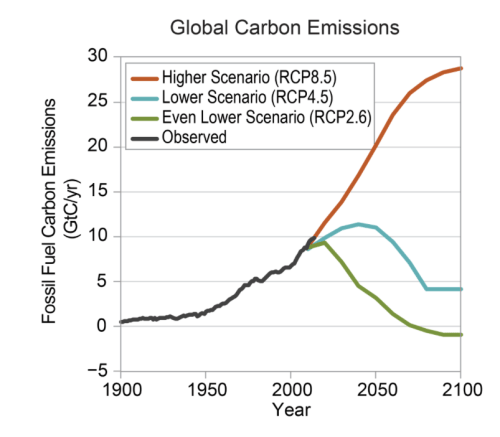 (https://i2.wp.com/judithcurry.com/wp-content/uploads/2018/11/screen-shot-2018-11-23-at-6-06-32-pm.png?ssl=1)
The assumptions that underlie the IPCC emissions scenarios are described in the 2000 IPCC Special Report on Emissions Scenarios [link (https://www.ipcc.ch/ipccreports/sres/emission/index.php?idp=0)].
RCP8.5 is sometimes referred to as a ‘business as usual’ scenario. It is not. Rather, it is an extreme scenario.
Larry Kummer wrote a 2015 guest post at Climate Etc. entitled A closer look at scenario RCP8.5 (https://judithcurry.com/2015/12/13/a-closer-look-at-scenario-rcp8-5/). LK describes RCP8.5 as a “useful worst case scenario.”
RCP8.5 figures prominently in the most alarming of future climate scenarios. I am wondering if RCP8.5 is too extreme, in the sense that is may be impossible, given constraints on recoverable fossil fuel supply.
In particular, there is a fairly large number of papers arguing that assumptions about coal are incorrect: (list of papers courtesy of LK).
- The first major study questioning the actual extent of coal reserves: “The Peak in U.S. Coal Production (http://www.copvcia.com/free/ww3/052504_coal_peak.html)“ by Gregson Vaux, 27 May 2004
- More evidence that reserves are overstated: “Coal Of The Future (Supply Prospects for Thermal Coal by 2030-2050) (https://ec.europa.eu/jrc/en/publication/eur-scientific-and-technical-research-reports/coal-future-supply-prospects-thermal-coal-2030-2050)“ by Energy Edge Limited, Prepared for the Institute for Energy of the European Commission’s Joint Research Centre, February 2007
- More evidence that reserves are overstated: “Coal: Resources and Future Production (https://www.energiestiftung.ch/files/energiestiftung/publikationen/downloads/energiethemen-fossileenergien-kohle/ewg_report_coal_10-07-2007ms.pdf)“ by Energy Watch Group, March 2007 (47 pages,)
- The major study showing that coal reserves are overstated: “Coal: Research and Development to Support National Energy Policy (https://www.nap.edu/catalog/11977/coal-research-and-development-to-support-national-energy-policy)“ by the National Academies, June 2007
- “Why do climate change scenarios return to coal? (https://www.sciencedirect.com/science/article/abs/pii/S0360544217314597)” by Justin Ritchie and Hadi Dowlatabadi in Energy, 1 December 2017.
For broader fossil fuel supply issues, see
Wang et al. (2017); The implications of fossil fuel constraints on climate change projections — A supply side analysis [link (https://www.researchgate.net/publication/303621100_The_implications_of_fossil_fuel_supply_constraints_on_climate_change_projetions-A_supply-side_analysis)]. From the Abstract:
Climate projections are based on emission scenarios. The emission scenarios used by the IPCC and by mainstream climate scientists are largely derived from the predicted demand for fossil fuels, and in our view take insufficient consideration of the constrained emissions that are likely due to the depletion of these fuels. This paper, by contrast, takes a supply- side view of CO2 emission, and generates two supply-driven emission scenarios based on a comprehensive investigation of likely long-term pathways of fossil fuel production drawn from peer-reviewed literature published since 2000.
The potential rapid increases in the supply of the non-conventional fossil fuels are also investigated. Climate projections calculated in this paper indicate that the future atmospheric CO2 concentration will not exceed 610 ppm in this century; and that the increase in global surface temperature will be lower than 2.6 C compared to pre-industrial level even if there is a significant increase in the production of non-conventional fossil fuels. Our results indicate therefore that the IPCC’s climate projections overestimate the upper-bound of climate change. Furthermore, this paper shows that different production pathways of fossil fuels use, and different climate models, are the two main reasons for the significant differences in current literature on the topic.
Ritchie and Dowlatabadi (2017) explain that RCP8.5 contains a return to coal hypothesis, requiring increased per-capita coal use based on systematic errors in coal production outlooks. Ritchie and Dowlatabadi conclude that RCP8.5 should not be used as a benchmark for future scientific research or policy studies.
It looks like substantial technological advances would be needed to tackle the less recoverable resources. Given the climate change and environmental quality issues, how realistic is it to expect these technological advances to be pursued — rather than pursuing greener energy technologies?
.
So my main questions are:
- Should RCP8.5 be used as a ‘worst case’ emissions scenario?
- Is RCP8.5 impossible based upon the knowledge we currently have?
RCP8.5 may be useful for climate research, for considering processes in a substantially altered environment.
However, many ‘catastrophic’ impacts of climate change don’t really kick at the lower CO2 concentrations, and RCP8.5 then becomes useful as a ‘scare’ tactic.
For policy making, I’m not sure that RCP8.5 is a useful scenario.
I would appreciate your thoughts on this.
---
REF 2 PRETTY MUCH RECYCLED above
https://www.heritage.org/energy-economics/commentary/democrats-want-rejoin-the-paris-accord-lets-recall-why-it-was-such-bad
---
Evangelical Environmental Network, led by Rev. Jim Ball.
:{:{}:
}:
Understanding conservative religious resistance to climate science
Posted on December 20, 2010 by curryja (https://judithcurry.com/author/curryja/) | 851 Comments (https://judithcurry.com/2010/12/20/understanding-conservative-religious-resistance-to-climate-science/#comments)
This post is a Q&A with Dr. David Gushee, who is Distinguished Professor of Christian Ethics at Mercer University, his personal web site is here (http://www.davidpgushee.com/Gushee/Home.html) and Wikipedia bio is here (http://en.wikipedia.org/wiki/David_P._Gushee).
Dr. Gushee is an internationally recognized Holocaust scholar and ethicist. His current research interests focus on issues emerging at the intersection between Christian faith, ethics and public policy. He has written or edited 12 books, including:
Religious Faith, Torture, and Our National Soul (http://www.amazon.com/Religious-Faith-Torture-National-Soul/dp/0881462039/ref=sr_1_12?s=books&ie=UTF8&qid=1292790858&sr=1-12)
The Future of Faith in American Politics (http://www.amazon.com/Future-Faith-American-Politics-Evangelical/dp/1602580715/ref=sr_1_2?s=books&ie=UTF8&qid=1292790823&sr=1-2)
Kingdom Ethics: Following Jesus in Contemporary Context (http://www.amazon.com/Kingdom-Ethics-Following-Contemporary-Context/dp/0830826688/ref=sr_1_1?s=books&ie=UTF8&qid=1292790786&sr=1-1).
Christians and Politics Beyond the Culture Wars (http://www.amazon.com/Christians-Politics-Beyond-Culture-Wars/dp/0801022312/ref=sr_1_13?s=books&ie=UTF8&qid=1292790942&sr=1-13)
Dr. Gushee has engaged as an activist and public intellectual on a number of controversial issues. Of particular relevance here, Dr. Gushee was the principal drafter of the 2006 Evangelical Climate Initiative and remains deeply involved in efforts to address climate change and other environmental issues.During the 2008 presidential campaign, he was contacted by candidate Barack Obama and he spoke at the 2008 Democratic Convention.
There is an interesting story behind how I met Dr. Gushee. In December 2006, the Center for Health and Global Environment at Harvard Medical School and the National Association of Evangelicals held a first-of-its-kind retreat to unite 30 faith leaders and scientists on issues of climate change and global warming. Among the scientists attending were E.O. Wilson, Jim Hansen, and Gus Spaeth. The retreat was held at an old plantation in Malvern, GA, and I was privileged to attend. Not knowing much about evangelicals, I had no idea what to expect of this meeting. One thing that I did not expect was to encounter such a deep and profound thinker as Dr. David Gushee. When Dr. Gushee moved to to Mercer University (in Atlanta), we reconnected and we have participated in events at each other’s institution.
One thing that I learned from this retreat was that many evangelicals view their religion as being consistent with evolution, and one of the participants, Reverend Ken Wilson (http://kenwilsononline.com/about-ken-wilson/), send me the book by Francis Collins (http://en.wikipedia.org/wiki/Francis_Collins) entitled The Language of God: A Scientist Presents Evidence for Belief (http://www.amazon.com/s/ref=nb_sb_noss?url=search-alias%3Dstripbooks&field-keywords=francis+collins&x=0&y=0).
Without further ado, lets hear from Dr. Gushee.
JC: Can you characterize evangelicalism, and give us some demographics (both in the U.S. and if relevant world wide)
DG: Evangelicalism is a term generally used to describe theologically conservative Protestant Christians. There are a variety of more technical definitions of the characteristics of evangelicalism. In my book, The Future of Faith in American Politics (http://tinyurl.com/29tm6gj) (http://tinyurl.com/29tm6gj%29), I name three possible approaches for defining evangelicals: one is by denominations (ex. Southern Baptists), one is by the specific content of religious beliefs (ex: high view of the authority of the Bible, belief that Christ died for the salvation of all), and one is by self-definition (ex: when asked what they believe, the person says that they are “evangelical”). Combining these measures and various surveys, it is estimated that some 25% of the US population is evangelical. Ninety percent of these evangelicals are white, but there are also a very large number of black and Hispanic evangelicals. Globally, it is estimated that there are 420,000,000 evangelicals, over half of them non-white. Evangelicalism, especially the highly emotive and Spirit-oriented version of evnagelicalism known as Pentecostalism, is the fastest growing form of Christianity in the world by far. Evangelicalism should not be confused with fundamentalism, which is a rigidly conservative version of religion that surfaces in every religious tradition, including Protestantism.
JC: Give us some history on the involvement of evangelicals in the climate change debate (and politics).
DG: Evangelicals are politically divided even if one can broadly describe a shared religious paradigm. In the popular mind, most associate American evangelicalism with conservative politics, and this has been largely the case since the emergence of the Christian Right in the 1970s. But even during the headiest days of the Christian Right, there were always alternative and dissenting voices. This is a reminder that evangelical theology doesn’t have to mean conservative politics; indeed, there is quite a ferocious debate within evangelicalism over what kind of politics is best read off of the witness of the Bible whose authority we all believe in.
In my book on faith and politics, I suggest that as of 2008 roughly half of white evangelicals remained politically conservative, perhaps 15% liberal, and 35% centrist. Recent conservative gains would probably shrink the center category in favor of the conservative. I think it is predictable that no matter who runs in the 2012 presidential election against Barack Obama, around 70% of white evangelicals will vote for the Republican. Latino evangelicals are more fluid in their voting patterns at this stage and black voters are more liberal in their voting even while theologically conservative.
So a strong majority of white evangelicals in the United States (every term there is significant–this is a white, US pattern) tend to vote Republican and to hold to a politically conservative ideology. Therefore it is not a surprise (sadly) that going back to the emergence of environmentalism in the 1960s-1970s, most white evangelicals were either disinterested or opposed to environmentalism. Sometimes this was due to (in my view, spurious) religious reasons, such as the fear that environmentalism as a whole was characterized by non-Christian or anti-Christian religious beliefs or presuppositions. Other times it was clearly related to a generalized anti-“left” politics, with environmentalism being treated as a cause of the left.
The climate change debate didn’t really surface in evangelicalism until the early part of the 21st century. Few American evangelicals knew much about the ongoing development of climate science and the growing consensus that the climate was changing primarily due to human activity. Few of us had even heard of the IPCC and a UN process to study the climate and to trigger policy responses as the science solidified.
The climate issue was brought to my attention through the work of the Evangelical Environmental Network, led by Rev. Jim Ball. This small evangelical group had been around since the early ’90s and was indeed paying attention to climate science. EEN played a convening role in 2004 in getting some leading evangelicals together to listen to the findings of climate scientists like the evangelical Briton Sir John Houghton, who played a key role in the IPCC. Many of us found Dr. Houghton and others quite convincing. We agreed together to try to mobilize the evangelical community from what was, at the time, mainly a stance of apathy and disinterest.
JC: Tell us about your own involvement in the climate change debate
DG: The 2004 creation care conference that I just mentioned was followed by an effort to draft a simple but significant statement on climate change. It came to be known as the Evangelical Climate Initiative, and I was the principal drafter of the statement. See http://christiansandclimate.org/. The statement, which was released in 2006, basically says: 1) human-induced climate change is real, 2) the consequences of climate change will be significant, and will hit the poor the hardest, 3) Christian moral convictions demand our response to the climate change problem, and 4) We need to act now–governments, businesses, churches, and individuals all have a role to play. It should be noted that the IPCC was treated as foundational for the claims of this document, though the statements of the various national scientific academies were also cited.
About six dozen key evangelical leaders signed the original statement, and it made a major media splash. But then the pushback came, and it was fierce. A newly organized group, eventually known as the Cornwall Alliance (http://www.cornwallalliance.org/) (http://www.cornwallalliance.org/%29), offered a counter-statement and now exists as a counter-voice to the Evangelical Environmental Network. This group questions mainstream climate science, questions the seriousness of the impact of climate change, expresses worry that the major policy responses under consideration will actually hurt the poor, and is especially negative about government regulation of business activity in the name of climate. I read them as being motivated by a strongly libertarian, laissez-faire economic ideology and a strongly Calvinist theology which leads them to doubt that God would permit human beings to have any serious impact on the climate.
It seems to me that the general turn toward climate skepticism in the US setting over the last couple of years has been influenced by the efforts of this group and others like it. The economic downturn has everyone concerned about doing anything that might negatively affect business and prosperity, and American evangelicalism has tended to revert toward its instinctive political conservatism. For now at least, the ECI looks to have been a high water mark of evangelical environmental activism as it relates to climate change.
JC: What are the ingredients of evangelical climate skepticism? How does creationism play into this?
DG: I have suggested in some public lectures that there are several ingredients of evangelical climate skepticism:
*1) Disdain for the environmental movement
2) Distrust of mainstream science in general (evolution vs. creationism is indeed a factor here for some)
3) Distrust of the mainstream media (nicely captured by Sarah Palin’s derisive term “lamestream media”)
4) Loyalty to the Republican Party
5) Libertarian economics as God’s will–God is opposed to government regulation or taxation
6)Misunderstandings of divine sovereignty–God won’t let us ruin creation
7) Unreconstructed Dominion theology–Genesis 1–God calls human beings to subdue and rule creation*
To summarize, then: God is sovereign over creation and therefore humans can do no permanent damage. God entrusted the earth to human dominion and we should not be afraid of economic development or other uses of human creativity. God established government for very limited purposes such as providing for the common defense–government should not intervene much in the workings of a free market economy. The Republican Party has taken a skeptical posture toward climate and we support that posture and that party. The media is overplaying climate change worries, at the behest of scientists who cannot be trusted anyway; it may all be a conspiracy to limit our personal and business freedoms and tax us even more. The environmental movement is secular/pagan and has always been a threat to American liberties and has always been anti-business and exaggerated environmental problems.
Nice worldview, huh? I disagree with just about every word of it.
JC: Tell us about Creation Care and the New Evangelical Partnership for the Common Good.
DG: My one-year-old activist organization, the New Evangelical Partnership for the Common Good (www.nepcg.org (http://www.nepcg.org/) ) includes commitment to care of God’s creation as one of its core planks. We never thought that climate change was the only environmental concern worth caring about but we do believe that climate remains at risk and that the broad patterns identified by the IPCC and others are indisputable. We are looking for creative ways to reach the hearts and minds of evangelicals in a time when many remain highly skeptical of the entire climate issue.
Can I say one thing for the scientists who read this? Laypeople like us (in terms of science) need good science from your side. We depend on the accuracy and credibility of your findings. To the extent, for example, that ECI’s claims were based on IPCC, and to the extent that IPCC got a little sloppy or a little carried away with advocacy, our own efforts to work within our community have been damaged.
*I am the son of an MIT-trained chemical engineer who did environmental policy analysis for the Congressional Research Service. I am among those evangelicals who can handle the push and pull, ebb and flow, and constantly unfinished nature of real scientific research. I trust this kind of science and need to be able to trust it to do good teaching and advocacy. So let’s agree on a division of labor in which climatologists and other scientists offer the unvarnished truth about where your research stands at any given moment, what is both known and unknown, and we can craft our advocacy claims realistically based on what you are finding. I fear that in the white-hot spotlight of climate science sometimes this care has been lost on all sides. It has to some extent set back progress toward the shared human task of environmental stewardship and responsibility. But I remain at least tentatively confident that human beings will get their act together on climate change before it is too late.
*
Moderation note: moderation on this thread will be strictly enforced for relevance and civility.
This entry was posted in Ethics (https://judithcurry.com/category/ethics/). Bookmark the permalink (https://judithcurry.com/2010/12/20/understanding-conservative-religious-resistance-to-climate-science/).
851 RESPONSES TO “UNDERSTANDING CONSERVATIVE RELIGIOUS RESISTANCE TO CLIMATE SCIENCE”
---
---
https://www.chronicle.com/article/to-court-a-secretive-donor-law-deans-at-george-mason-blasted-climate-scientists-and-their-own-accreditor/
no lnx
Chronicle.com
To Court a Secretive Donor, Law Deans at George Mason Blasted Climate Scientists and Their Own Accreditor
By Jack Stripling and Nell Gluckman
DECEMBER 18, 2019
Dean Henry N. Butler, left, and the artist Greg Wyatt unveil astatue of Antonin Scalia at George Mason U. law schoolin the fall of 2018. In the audience are Supreme Court Justice Clarence Thomas; Chief Justice John G. Roberts and his wife, Jane Sullivan Roberts; Justice Samuel Alito and his wife, Martha-Ann Bomgardner Alito; Justice Elena Kagan, and Justice Neil Gorsuch.
Leaders of George Mason University’s Antonin Scalia Law School, which has been criticized for its ties to conservative donors, have spent years courting a wealthy Chicago philanthropist who has steered money toward organizations that promote skepticism of climate change or finance conservative and libertarian journalism on college campuses.
Newly released documents show the extent to which Barre Seid, the philanthropist, sought to engage law-school deans on hot-button political topics. On several occasions he raised alarms about political activism by climate scientists at George Mason, prompting assurances from the dean that “some of our friends on the board” were “all over it (behind the scenes).”
The documents, which include more than 800 pages of emails and other communications, were obtained through a public-records request filed by UnKoch My Campus, a national group that seeks to expose the Charles Koch Foundation’s influence on higher education.
In 2016, George Mason announced that it had received a $10 million grant from the Koch Foundation, along with $20 million from an anonymous donor, who asked that the law school be named in honor of Scalia, the late Supreme Court justice and a conservative icon. In a news release on Thursday, Allison Pienta, a lawyer working with UnKoch My Campus, argued that the documents she had obtained “prove that Mr. Seid is the Scalia Law donor.”
Taxpayers, students, Virginia citizens, we have a right to know who is donating to a public law school and asking the law school in return to serve their interest.
Pienta, who had requested records that contained the anonymous donor’s name, suspected that Seid had been the benefactor in part because people associated with him are referred to in a number of exchanges. She concluded that he was the donor after cross-referencing those emails with others that mention Seid by name.
Anne Holton, George Mason’s interim president, said in a letter to Pienta that the university could not “confirm or deny your conclusion” that Seid is the anonymous donor, “as universities have an obligation to respect a donor’s right to anonymity.”
After reviewing the records, which contained numerous redactions to protect donor privacy, The Chronicle could not independently verify the identity of the donor.What the records do show, however, is a yearslong, politically tinged dialogue between Seid and two successive deans of George Mason’s law school.
People who are concerned about undue donor influence often envision clear-cut quid pro quos or prescriptive gift agreements that grant wealthy people too much control over the academic enterprise. These documents imply a subtler form of influence, one in which a donor elevates concerns about a professor or a regulatory body just by passing information along to university decision makers.
An Activist Donor
As told through the documents, the story of Seid’s relationships with Daniel D. Polsby, former dean of the law school, and his successor, Henry N. Butler, begins at least nine years ago. By that time, Seid had already been working to transform a tiny part of the higher-education landscape. Through the Barbara and Barre Seid Foundation, he gave $825,000 to Shimer College, an institution that enrolled about 100 students and followed the Great Books curriculum. After the donation, several people with financial ties to Seid joined the college’s Board of Trustees, and a fierce battle over governance of the college followed.
(In 2017, Shimer was absorbed by North Central College, which added the Shimer Great Books School as an academic program).
Between 2011 and 2016, Seid had or had scheduled at least seven meetings with one or both of George Mason’s law deans.
The deans found in Seid an inquisitive communicator, particularly when it came to conservative causes. In 2012, for example, he wrote to Polsby asking for “any insight” into a new program, housed at George Mason, that was established by the former Republican Congressman Bob Inglis. The question was notable given Seid’s apparent interest in the politics of climate science. Inglis had been voted out of office two years earlier during his primary, largely because he supported a tax on carbon. Now he was being embraced by George Mason.
Inglis’s program, the Energy and Enterprise Initiative, was meant to “promote conservative solutions to America’s energy and climate challenges.” Polsby responded to Seid right away, appearing to distance himself and the law school from the program.
“Inglis’s new center is in a different college from us,” Polsby said. “The law school has no role and wasn’t asked before the announcement was made.”
The conversations at times took on an antiregulatory flavor. In one exchange with Seid, in 2013, Polsby launched into a broadside against the law school’s accrediting agency. The American Bar Association, he wrote, “has added all kinds of dubious nonsense in its accreditation standards.”
“Poking them in the eye,” Polsby continued, “would be a genuine pleasure.”
Seid seemed particularly curious about the powers of higher-education regulators. Who was to say whether a person could operate a school, he wondered? Did you need the state’s permission, he asked Polsby? Did you need accreditation?
The impetus for that discussion was a Chronicle article that said the state of Virginia was shutting down an unaccredited university.
‘Outrageous Behavior’
In 2015, the year Butler became dean, a controversy in climate science captured Seid’s attention. Butler assured the philanthropist that he, too, was aghast.
A group of 20 professors, including some at George Mason, signed a letter urging the Obama administration to open a racketeering investigation into fossil-fuel companies and their allies. The companies had “knowingly deceived the American people about the risks of climate change,” the professors wrote, and could be investigated under the Racketeer Influenced and Corrupt Organizations Act, commonly known as RICO.
This wasn’t the professors’ idea. Several months earlier, U.S. Sen. Sheldon Whitehouse, Democrat of Rhode Island, had proposed the possibility of suing fossil-fuel companies under RICO, just as the Justice Department had done to Big Tobacco more than a decade earlier. Tobacco companies had engaged in a “massive 50-year scheme to defraud the public,” the department had argued. The same might be said of fossil-fuel companies, Senator Whitehouse wrote, which had sponsored climate-change research that contradicts peer-reviewed consensus.
Seid forwarded to Butler a blog post by Judith A. Curry, a high-profile skeptic of climate science and former chairwoman of the Georgia Institute of Technology’s School of Earth and Atmospheric Sciences. Curry wrote that “the consensus on human caused climate change is not as overwhelming as you seem to think.” She admonished the professors for engaging in “irresponsible advocacy,” accusing them of trying to “silence scientists that disagree with you.”
“Is it significant that 6 GMU guys,” Seid wrote to Butler, “were the originators” of the letter.
“This is really outrageous behavior,” Butler repliedon September 18, 2015. “I do not know the GMU folks who signed the letter, but they should be embarrassed. I wonder if they really understand anything about RICO, which was the source of much abuse by prosecutors (and the plaintiffs’ bar in follow on private suits) until the Feds went totally crazy and criminalized almost all behavior (which meant there was less need to use conspiracy theories).”
A few weeks later, Seid forwarded to Butler another blog post on the same subject from Powerline, an outlet for conservative commentary.
“Not your problem — but. … ” Seid wrote to the dean.
The post, titled “An Instance of Warmist Corruption,” took aim at Jagadish Shukla, a climate scientist at George Mason and the first signatory to the professors’ letter calling for a RICO investigation. The blog described Shukla as “remarkably well paid” and suggested some form of financial malfeasance on his part.
Shukla was one of the lead authors of the Intergovernmental Panel on Climate Change report, who shared the Nobel Peace Prize with former Vice President Al Gore Jr., in 2007.
Responding to the Powerline post, Butler assured Seid that powerful people at George Mason were involved with the matter.
“This is such absurd behavior,” Butler wrote to Seid on October 9, 2015. “Totally indefensible.
“Some of our friends on the board,” he continued, “are all over it (behind the scenes).”
That same month, George Mason began an internal audit of Shukla’s handling of grants, a university spokesman confirmed to The Chronicle.
By this time, Shukla had run smack into a political buzz saw. Lamar S. Smith, a Republican Congressman from Texas, had announced plans to investigate a nonprofit research group led by Shukla.
On November 5, 2015, Seid forwarded to Butler an email about Shukla from Joseph L. Bast, then the president of the Heartland Institute, a conservative think tank. Seid’s foundation has donated at least $1 million to the institute, which rejects as “propaganda” the idea of scientific consensus on the causes and consequences of climate change. George Mason’s own “multimillionaire government trough-feeder,” Bast wrote, was finally being exposed.
In response to Seid, Butler wrote, “The president is freaking out about this,” referring to Ángel Cabrera, George Mason’s president at the time.
For climate scientists like Shukla, criticism often comes with the job. But the newly released emails, Shukla told The Chronicle, suggest that those attackers had the ear of George Mason’s Board of Visitors.
“The ferocity of their attack was totally expected,” Shukla said in an email. “The fact that these guys had access to GMU board members, as the emails show, that is very unusual.”
Michael Sandler, a spokesman for George Mason, told The Chronicle that George Mason’s audit “concluded no wrongdoing on the part of Professor Shukla.”
The Chronicle requested a copy of the audit, but George Mason officials said it was a personnel record and not subject to public-disclosure laws.
As for congressional scrutiny, a politically connected board member says he came to Shukla’s defense. Thomas M. Davis III, the rector of George Mason’s board and a former Republican congressman from Virginia, said in an interview on Tuesday that he had quietly urged Representative Smith not to call a public hearing.
“I said ‘Look, lay off this guy,’” Davis said. “I made it clear we stood behind him and they ought to lay off him, and they did. I met with Shukla and told him we supported him.
“When one of our professors is under attack, either from the right or the left, we are behind them,” Davis continued.
Butler, the dean, declined an interview requestand did not answer specific questions from The Chronicle about his emails. In a statement, Butler said he had nothing to do with the university’s response to Shukla.
“I had no influence in this matter, nor did I attempt to exert any influence in this matter,” Butler’s statement reads. “I support academic freedom at George Mason University’s Scalia Law School and across the university. Academic freedom and an open marketplace of ideas, including room for robust debate, is the very foundation of higher learning.”
A spokeswoman for Tripp Lite, a manufacturing company where Seid served as president, did not respond to emails this week seeking comment from Seid, who did not respond to a phone message on Wednesday.
A University on the Defensive
For George Mason, the release of a new cache of documents related to donor influence marks a chapter in a continuing saga. For years the university has fought in courts of law and public opinion, defending its relationships with conservative philanthropists. Only recently, however, did the university acknowledge that it hasn’t always gotten it right.
Last year when Cabrera, then the university’s president, announced a review of George Mason’s gift-acceptance policies, he conceded that some of its grant agreements “fall short of the standards of academic independence.” The agreements gave donors opportunities to weigh in on faculty hiring and stated with some specificity what professors would study.
But donors can still keep their identities secret, making it difficult to discern their intent.
By channeling a gift through a third party, a donor can further obscure the source of the money. That appears to have happened at George Mason. Several of the newly released emails refer to Donors Trust, a nonprofit organization that, among other things, offers donors anonymity.
Donors Trust describes itself as a public charity that was created to work with donors who are “dedicated to the ideals of limited government, personal responsibility, and free enterprise.” Mother Jones described it as “the dark-money ATM of the right.” In her book Dark Money: The Hidden History of the Billionaires Behind the Rise of the Radical Right, Jane Mayer explained that donors could give to the fund, which in turn donated to conservative groups and, in effect, “erased the donors’ names from the money trail.”
That kind of opacity troubles some at George Mason, who say the public deserves more information about who may be exerting influence on a public university’s leadership and its faculty members. Pienta, the lawyer working with UnKoch My Campus, said “Mason has become basically ground zero for improper donor influence on a public institution.”
“Taxpayers, students, Virginia citizens, we have a right to know who is donating to a public law school and asking the law school in return to serve their interest,” said Pienta, a graduate of George Mason’s law school.
Virginia code, however, exempts from disclosure any records that could reveal the identity of a donor who has requested anonymity. (The state’s Supreme Court ruled last week that George Mason’s fund-raising arm is exempt from public-records laws).
It is still not clear what Seid’s involvement in renaming the law school may have been, if anything. But when the school unveiled a 4,300-pound “Bill of Rights Eagle” statue in front of its building, Butler wanted Seid to know about it.
“Yesterday was a really cool day at Scalia Law,” he wrote to Seid in May 2017, just over a year after the school was renamed. The sculptor had another project in the works, Butler explained: “a larger-than-life statue of Justice Scalia.”
Jack Stripling covers college leadership, particularly presidents and governing boards. Follow him on Twitter @jackstripling, or email him at jack.stripling@chronicle.com.
Nell Gluckman is a senior reporter who writes about research, ethics, funding issues, affirmative action, and other higher-education topics. You can follow her on Twitter @nellgluckman, or email her at nell.gluckman@chronicle.com.
Dan Bauman and Megan Zahneis contributed to this report.
A version of this article appeared in the January 10, 2020, issue.
---
---
http://www.ecowatch.com/lamar-smith-climate-science-2336435692.html
Climate Deniers' Big Day on Capitol Hill
No one thought that Lamar "my career has been funded by fossil fuels (https://www.opensecrets.org/politicians/summary.php?cid=N00001811&cycle=Career)" Smith was going to put on an unbiased hearing on climate science. After all, the minority Democrats on Smith's House Committee on Science, Space, & Technology published a report this month, Much Ado About Nothing (http://democrats.science.house.gov/committee-report/much-ado-about-nothing%E2%80%9D-minority-review-majority%E2%80%99s-climate-science-investigation), which details Smith's "crusade to attempt to undermine and invalidate" Tom Karl's pause-buster study.(Yet Smith still can't get NOAA's name right (http://democrats.science.house.gov/committee-report/much-ado-about-nothing%E2%80%9D-minority-review-majority%E2%80%99s-climate-science-investigation)!}:
Although little was said about Karl, Wednesday's House Science Committee hearing with Drs. Michael Mann (http://www.ecowatch.com/open-season-climate-scientists-2259332495.html), John Christy, Judith Curry and Roger Pielke Jr. was a quite a circus. Which is exactly why someone who's been through Smith's nonsense, Dr. David Titley, wrote for the Washington Post that scientists should boycott (https://www.washingtonpost.com/news/capital-weather-gang/wp/2017/03/28/credible-climate-scientists-need-to-boycott-biased-congressional-hearings/?asdasdasdasdasd&utm_term=.47001d3d5368) these biased hearings.
That would be nice, if that meant that Smith would stop holding them. But since he shows no sign of slowing his inquisition (http://www.motherjones.com/environment/2017/01/house-science-committee-lamar-smith-climate-change-exxon), someone needs to show up to set the record straight and push back on all the denial packed into the hearing like so many clowns in a tiny car.
And that's exactly what Dr. Mann did, successfully walking the tight-rope between correcting other witnesses and coming off as a jerk. Most notably and most clearly getting under Smith's skin, Mann cited a recent Science Magazine article (http://www.sciencemag.org/news/2017/03/lamar-smith-unbound-lays-out-political-strategy-climate-doubters-conference)describing Smith's comments at the Heartland conference (http://www.dailykos.com/story/2017/03/27/1647646/-Highlights-from-the-Lowlifes-at-Heartland-s-Climate-Conference). Mann read the killer quote about how Smith "acknowledged that the committee is now a tool to advance his political agenda rather than a forum to examine important issues facing the U.S. research community."
In response,Lamar Smith, the esteemed media critic who cited the Daily Mail's bogus Bates story (http://www.dailykos.com/story/2017/02/21/1636179/-Tricked-by-a-Rose-on-the-Page-Smith-Takes-Up-Tabloid-Conspiracy-Crusade), who has written for Breitbart (http://www.breitbart.com/author/rep-lamar-smith-r-tx/) and said that people should get their news directly from Trump (http://www.cnn.com/2017/01/25/politics/lamar-smith-donald-trump-news/), claimed that Science Magazine is "not known as an objective magazine." As Emily Atkin of the New Republic aptly put it (https://twitter.com/emorwee/status/847106310625804288), "The fact that the chairman of the House Science committee doesn't consider that source 'objective' is ACTUALLY MIND BLOWING."
Smith, with pie on his face, also demonstrated his media savvy by citing the never-correct (http://www.dailykos.com/story/2016/6/15/1538935/-WSJ-Ads-Call-Out-WSJ-s-Climate-Denial) editorial page of the Wall Street Journal on heat records (http://climatefeedback.org/wall-street-journal-articles-on-2016-heat-record-send-contradicting-messages/). This opinion is about as solid as cotton candy and has been contradicted by the paper's own reporting.
[img]
Speaking of dumb Wall Street Journal opinions, Mann also did a nice job of calling out Pielke's hypocrisy for whining in the Journal (http://www.dailykos.com/story/2016/12/06/1607848/-Pielke-Pouts-in-WSJ-Conveniently-Forgets-To-Mention-His-Own-Guilt) about being harassed, after sending threatening letters (http://www.huffingtonpost.com/2014/03/28/fivethirtyeight-climate-change-dispute_n_5049279.html) to Mann and Kevin Trenberth's bosses when they criticized his awful FiveThirtyEight piece that needed correction (https://fivethirtyeight.com/features/mit-climate-scientist-responds-on-disaster-costs-and-climate-change/).
Also needing correction was John Christy, who trotted out his error-laden graph (https://www.theguardian.com/environment/climate-consensus-97-per-cent/2016/feb/19/republicans-favorite-climate-chart-has-some-serious-problems) of models and observations. Again, Mann highlighted the foolishness of his fellow witnesses by pointing out how others have corrected Christy many times on the satellite record vs. the thermometer record. And more importantly, he cited the recent research (http://journals.ametsoc.org/doi/abs/10.1175/JCLI-D-16-0333.1) that totally debunks Christy's false contention (https://twitter.com/hausfath/status/847117098199375872) that models overestimate warming.
And then there's Judith Currywho, true to form, was there to talk about uncertainty (inappropriately (https://twitter.com/CColose/status/847120801790877696)). Again Mann was prepared, pointing out that uncertainty is actually a reason to take stronger action sooner (https://theconversation.com/why-climate-uncertainty-is-no-excuse-for-doing-nothing-32924). Uncertainty cuts both ways: while Curry and the GOP would have you believe maybe warming won't be so bad, it could actually be much worse than we fear.
Curry also bristled at being referred to as a "climate science denier (http://www.ecowatch.com/tag/climate-denier)" in Mann's written testimony. That's silly: She's teamed up with the Kochs (http://www.dailykos.com/story/2017/01/27/1625962/-Trump-Advances-Doomsday-Clock-and-The-Curious-Case-of-Curry-s-Curiae-with-Kochs), questioned the validity of the endangerment finding (http://www.dailykos.com/story/2016/11/15/1599667/-Curry-Denies-Clear-and-Present-Endangerment-Calls-UNFCCC-Hoaxsters) and said in her opening statement that it's time to "make the debate about climate change great again (https://twitter.com/blkahn/status/847093211587858432)." So it is safe to say that "Judith Curry is absolutely a climate denier (https://twitter.com/SarahEMyhre/status/847118948696915969)."
And she proved it in the hearing, denying the science and claiming we don't know how much is human versus natural. In 2014, NASA's Gavin Schmidt laid out the case for Curry (http://www.realclimate.org/index.php/archives/2014/08/ipcc-attribution-statements-redux-a-response-to-judith-curry/) that our best estimate is that humans are causing 110 percent of warming. (It's more than 100 percent because natural forces and particulate pollution cause cooling, which CO2 is overcoming to cause warming).
Curry also questioned ocean acidification (http://www.ecowatch.com/tag/ocean-acidification) science, in a way that Brian Kahn noted "is way out of step with most ocean scientists (https://twitter.com/blkahn/status/847121342583459841)" that he's talked with.
Other odds and ends that made an appearance include the 1998 documents (https://www.documentcloud.org/documents/784572-api-global-climate-science-communications-plan.html) showing Big Oil's plan (http://www.nytimes.com/1998/04/26/us/industrial-group-plans-to-battle-climate-treaty.html) to inject uncertainty into the climate debate, the long-debunked 70s cooling myth (http://journals.ametsoc.org/doi/abs/10.1175/2008BAMS2370.1) and Smith's tired denial of the consensus (http://iopscience.iop.org/article/10.1088/1748-9326/11/4/048002).
So like any good circus, there were plenty of clowns, people lion, tired grr-causing myths and bear-ly believable statements.
Oh my.
Here's the full hearing:
---
==
OMG CRUZ SCI COMM
Climate-denying arguments by Ted Cruz (http://www.ecowatch.com/11-reasons-why-everybody-hates-ted-cruz-1882128569.html) at a Senate committee hearing last year have been soundly debunked by a new study published in the Journal of Climate (http://journals.ametsoc.org/doi/abs/10.1175/JCLI-D-16-0333.1). Testimony at the hearing attacked climate change (http://www.ecowatch.com/climate-change/) by using cherry-picked satellite temperature data allegedly inconsistent with global warming. The paper found errors in this analysis that refutes the bogus claims.
In the midst of the Texas senator's stillborn run for nomination as the Republican presidential candidate, he used his position as chairman of the Subcommittee on Space, Science and Competitiveness to convene a hearing (http://www.commerce.senate.gov/public/index.cfm/hearings?ID=CA2ABC55-B1E8-4B7A-AF38-34821F6468F7) entitled, "Data or Dogma? Promoting Open Inquiry in the Debate over the Magnitude of Human Impact on Earth's Climate."Hand-picked witnesses included noted climate skeptics John Christy (http://www.nytimes.com/2014/07/16/us/skeptic-of-climate-change-john-christy-finds-himself-a-target-of-suspicion.html?r=0), Judith Curry (http://www.npr.org/2013/08/22/213894792/uncertain-science-judith-currys-take-on-climate-change), conservative author Mark Steyn (http://mediamatters.org/blog/2015/12/08/why-is-shock-jock-mark-steyn-testifying-at-a-se/207349) and Princeton University's William Harper. Harper was caught up in a sting operation (http://www.nytimes.com/2015/12/09/science/greenpeace-subterfuge-tests-climate-research.html?r=0) by Greenpeace last year when he agreed to write a paper that, he was told, would be paid for by an unnamed Middle Eastern oil and gas company that wanted the payments to remain undisclosed.
==
My Fox News op-ed on RICO
Posted on September 28, 2015 (https://judithcurry.com/2015/09/28/my-fox-news-op-ed-on-rico/) | 462 Comments (https://judithcurry.com/2015/09/28/my-fox-news-op-ed-on-rico/#comments)
by Judith Curry
A new low in science: criminalizing climate skeptics.
Fox News op-ed
Here is the link (http://www.foxnews.com/opinion/2015/09/28/new-low-in-science-criminalizing-climate-change-skeptics.html) to my op-ed:
Scientists have many important roles to play in preparations for the upcomingUN Conference on Climate Change in Paris (http://unfccc.int/meetings/paris_nov_2015/meeting/8926.php). Some are working hard to clarify uncertainties in the science, others on developing and evaluating alternative climate policies.
One group of climate scientists is trying a different approach. Dismayed by what they see as a lack of progress on the implementation of climate policies that they support, these 20 scientists sent aletter to the White House (http://www.iges.org/letter/LetterPresidentAG.pdf) calling for their political opponents to be investigated by the government.
In particular, they are voicing their support of a proposal by Senator Sheldon Whitehouse (D-RI) for a RICO investigation of fossil fuel corporations and their supporters, who the scientists allege have deceived the American people about the risks of climate change, with the consequence of forestalling America’s response to reducing carbon emissions.
RICO, short for Racketeer Influenced and Corrupt Organizations Act, is a federal law enacted in 1970 as a crime-fighting tool for use against the Mafia. It includes prison sentences of up to 20 years and seizure of financial assets for those found guilty of such “racketeering.”
Senator Whitehouse singled out one climate scientist, Willie Soon (http://www.nytimes.com/2015/02/22/us/ties-to-corporate-cash-for-climate-change-researcher-Wei-Hock-Soon.html?_r=2), a solar physicist at the Harvard-Smithsonian Research Center who argues that changes in solar radiation, rather than carbon emissions, are the major force behind global warming.
Seven other climate scientists were the targets of a recent McCarthyite ‘witch hunt’ by Rep. Raul Grijalva (https://judithcurry.com/2015/02/25/conflicts-of-interest-in-climate-science/) (D-AZ). I was one of the seven. Rep. Grijalva indicated that I was investigated because of my recent Congressional testimony summarizing peer-reviewed research indicating that the magnitude and impacts of expected warming could be less than generally believed.
None of the Grijalva 7 was found to have engaged in wrongdoing of any sort, yet there have been significant career consequences (http://dailycaller.com/2015/02/25/democrats-witch-hunt-global-warming/) for some.
The demand by Senator Whitehouse and the 20 climate scientists for legal persecution of people whose research on science and policy they disagree with represents a new low in the politicization of science.
The role of these 20 scientists is particularly troubling. The consequence of this persecution, intended or not, is to make pariahs of scientists who are doing exactly what we expect of researchers: to critically evaluate evidence and publish that work in the scientific literature.
Minority perspectives have an important and respected role to play in advancing science, as a mean for testing ideas and pushing the knowledge frontier forward. While President Obama bows to no one in attacking climate ‘deniers’ (https://www.barackobama.com/stand-with-science/#/), he recently made an important statement (http://www.vox.com/2015/9/14/9326965/obama-political-correctness)in a town hall meeting at the University in Iowa on the importance of challenging received knowledge in a university setting:
“Because there was this space where you could interact with people who didn’t agree with you and had different backgrounds from you … I started testing my own assumptions, and sometimes I changed my mind,” he said. “Sometimes I realized, maybe I’ve been too narrow-minded; maybe I didn’t take this into account; maybe I should see this person’s perspective. That’s what college, in part, is all about.”
That’s even more what real science is about. It is important for scientists to engage the public and to work with policy makers to assess the impacts and unintended consequences of policy options. However, it has become ‘fashionable’ for academic scientists to advocate for certain political outcomes, without having much understanding of the policy process, economics, or the ethics of such advocacy.
What these 20 scientists have done with their letter is the worst kind of irresponsible advocacy. Attempts by powerful people to silence other scientists, especially in this brutal fashion, is a recipe for stifling scientific progress and for making poor policies.
Climate policy has been limited by an overly narrow set of narratives and policy options. Expanding the frameworks for thinking about climate change and climate policy can lead to developing a wider choice of options in addressing the risks from it.
That is how democracy is supposed to work. We search for solutions that can garner a critical mass of support. We don’t try to criminalize our political opponents, and especially should not try to criminalize scientists who have a different view.
I would like to acknowledge comments from Peter Webster andRoger Pielke Jr. in preparation of this op-ed.
The RICO20 speak out
Several of RICO20 have made public statements:
In an interview (http://watchdog.org/239397/environmentalists-seek-rico-prosecutions/), Alan Betts (http://alanbetts.com/) made the following statements:
“Bring them to court and make them face up,” Betts said. “Somebody downstream is going to have to pay the staggering costs of all the delays in taking action on climate change. The fossil fuel companies are now deeply culpable because of their deliberate deceptive strategies.”
Asked if RICO could be used to investigate local intervenors or dissenting environmental groups like Energize Vermont, Betts said, “I don’t think so. Everyone has a right to discuss.” The scientist also dismissed concerns that RICO investigations might violate the right to free speech, saying, “I have no idea how it affects the First Amendment.”
Barry Klinger (http://mason.gmu.edu/bklinger/) of George Mason/IGES posted a statement (http://mason.gmu.edu/bklinger/rico.html) on his website, excerpts:
A RICO suit like the one we propose would be very narrowly focussed on whether companies were engaged in fraud in order to continue selling a product which threatens to do harm. I’m not a legal expert, but I think that anyone not selling a product or service can not be punished for fraud, so the vast majority of people opining on climate are not even theoretically threatened by such a case. Even for an oil company, the standard for finding fraud is quite high.
What do we want to do to climate contrarians? No one is trying to throw anyone in jail. Our model is the civil (not criminal) tobacco suit which previously used RICO. If I understand the case correctly, the final outcome of the judgement against tobacco companies was to order them to stop denying known harms of smoking and to publicize the falsity of their fraudulent statements. I expect that a case against fossil fuel companies, if it ever did prove fraud, would result in a similar judgement.
Should free speech apply to all sides of a debate? I sympathize with the fear that the legal system could be inappropriately applied to squelching the free speech of scientists. I would strongly oppose a widening of the scope to anyone unrelated to the efforts of a company selling a product (for which there is a lot of case law about commercial exceptions to free speech).
However, I don’t recall climate contrarians coming to the defense of Michael Mann when he was subject to ideologically-based legal harrassment from then-Virginia Attorney General Ken Cuccinelli as well as from Republicans in Congress.
Note: Steve McIntyre has a new post taking Klinger to task regarding the defense of Mann by climate ‘contrarians’ [link (http://climateaudit.org/2015/09/25/disinformation-from-barry-klinger-and-the-rico-20/)].
Tobacco RICO
Well, Klinger’s view of RICO and the tobacco model is quite naive. Via email, I received an email from tobacco researcher James Enstrom, excerpt:
I was illegally inserted into the 1999-2006 USDOJ RICO lawsuit against the tobacco industry because I published politically incorrect findings in the May 17, 2003 BMJ. This insertion severely damaged my distinguished scientific career at UCLA, but with great effort I have survived and fought back.
This letter motivated me to look into this. I spotted this 2007 LaTimes article Tobacco funding of research reviewed (http://articles.latimes.com/2007/mar/28/local/me-tobacco28). Excerpts:
For more than three decades, epidemiologist James Enstrom has labored quietly at UCLA, studying the effect of tobacco smoke on human health. In recent years, his work has challenged the conventional view that second-hand smoke poses a serious health risk.
He calls himself a lone wolf, a maverick and a rebel. His critics call him a turncoat.
Enstrom once worked closely with the American Cancer Society, but today his sponsor is the tobacco industry. Over the last 15 years, he has received $1.4 million plus undisclosed consulting fees from the industry while producing research that supports industry views. One study used the American Cancer Society’s database to contend that second-hand smoke was not a serious health hazard.
Now Enstrom has become a symbol of industry influence for activists who support a proposal to bar University of California researchers from receiving tobacco industry money. The regents will take up the issue in May. Mirroring divisions elsewhere in UC, some university regents back a ban, while others oppose it on grounds of academic freedom. The 63-year-old Enstrom maintains that he is simply a scholar in “pursuit of truth.”
“If I was so corrupt, how could I survive for 33 years at UCLA?” he asks. “The effort is to smear me and libel me.”
Seven months ago, his research and correspondence were cited by a federal judge in a racketeering case as evidence of the tobacco industry’s manipulation of the scientific process. In January, the ethics of his research were called into question at a public meeting of the UC Board of Regents.
Enstrom, tall, forceful and passionate, believes the proposed ban at UC is aimed personally at him and says he is being vilified by a powerful lobby that places “political correctness” above science. He denies that tobacco money influenced his results, says no one has found errors in his calculations and contends that other studies corroborate his findings.
“It’s unfortunate to end up in a racketeering lawsuit for writing an article in a British medical journal,” he said ruefully.
University officials have kept their distance from Enstrom but note that he has faced tremendous pressure from his critics.
“In some sense I will stand up for Dr. Enstrom,” said Roberto Peccei, UCLA vice chancellor for research. “He’s got all these people beating on him. I’m not here to defend him, but I do think he was hit by a Mack truck.”
Read the whole article, it is fascinating as well as very disturbing.
Why Do Academics Sign Climate Action Petitions?
Lucas Bergkamp has penned a provocative essay \link (https://www.linkedin.com/pulse/why-do-academics-sign-climate-change-petitions-bergkamp-ll-m-?trk=hp-feed-article-title-publish)], discussing the RICO20 and also the role of scientists in the [Dutch Urgenda case (https://judithcurry.com/2015/09/09/the-urgenda-ruling-in-the-netherlands/). Excerpts:
Why would an academic sign a petition to request that a government take some specific action or refrain from taking some action? Where an academic possess expertise that is relevant to a policy issue, he or she might decide to share that expertise with the government and suggest a specific course of action based on that expertise. The problem with this practice is that science does not dictate policies, so the arguments set out in such petitions need to invoke some value or make some subjective judgment to arrive at the policy recommendation. Nevertheless, where the values invoked are commonly accepted and already reflected in law and policy, this is uncontroversial.
In the area of climate change, academics have been filing petitions left and right. In the US, a group of academics requested the Obama administration to launch a criminal investigation into “climate deceptive” statements of corporations, because it would be “imperative that these misdeeds be stopped as soon as possible.” The evidence for their accusation are some books and reports by social and climate action advocates. Many of the signatories are not lawyers and had no formal legal training. The petition does not set forth any coherent argument. It purpose seems to be to deter rejection of a socially constructed and politically endorsed scientific consensus.
This is a puzzling practice. Why would academics put their reputation on the line by endorsing a poorly argued, activist petition entirely outside their area of expertise? If he or she did so as a citizen, without using academic titles, this would not be much of a concern; such citizen petitions are submitted all the time. But if academic titles and affiliations are used in connection with an issue that has no relation whatsoever with the substance of the petition, is their use appropriate? In general, the risk would that the academic’s independence, impartiality, and scientific credibility is adversely affected by such practices. Partisanship is incompatible with academic excellence, sound scientific research, and unbiased, reliable opinions.
In the area of climate change, this seems not to be a concern, however, as long as the opinions expressed are in line with the climate action orthodoxy. Academics that side with the climate action activists are in the good camp. Partisanship does not adversely affect their credibility and reputation, because these attributes do not derive from the strength of their arguments. Their authority is a function of their affiliation with the good camp. Likewise, the lack of authority of opponents or critics is a function of their affiliation with the “climate-destructive” industry, some self-interest, or their general lack of enlightened pro-climate thinking. Whether this way of assigning academic authority is consistent with science’s mission, is an issue that does not deserve attention, given the urgency of the climate action required.
These climate action petitions unduly distort the public debate and are unhelpful to policy-making, because they inappropriately invoke scientific authority and do not rely on sound argument. At best, they will be recognized as such and ignored. At worst, they will be viewed, mistakenly or willfully, as science-based advice from the academic community. The latter, of course, is what these academics hope for. They may well realize that they abuse their academic credentials, but it does not stop them. After all, as the Dismal Theorem holds, peoples’ willingness to pay to guard against possible future climate catastrophe is infinitely large. Why should anyone bother about inappropriate use of credentials if the continued existence of humanity and planet earth is on the line? In saving our planet, who could possibly challenge the proposition that the ends justify the means?
Funding issues
Other articles that I’ve spotted focus on the government funding going to IGES, particularly what is being paid to Shukla and members of his family:
Climate Scientists Asking Obama to Prosecute Skeptics Got Millions From US Taxpayers (http://dailycaller.com/2015/09/21/climate-scientists-asking-obama-to-prosecute-skeptics-gets-millions-from-u-s-taxpayers/)
Silence of the scientists: how the global warming RICO letter backfired (http://www.examiner.com/article/silence-of-the-scientists-how-the-global-warming-rico-letter-backfired)
The lead scientist behind the Obama RICO letter has some serious questions to answer (http://www.breitbart.com/big-government/2015/09/22/lead-climate-scientist-behind-obamarico-letter-serious-questions-answer/)
Warmists’ golden fleece (https://quadrant.org.au/opinion/qed/2015/09/warmists-golden-fleece/)
From the Examiner article:
What is not criminal is having an opposing scientific opinion. What is not criminal is pursuing the science and extending the debate on climate. To call such science as criminal without a crime having been committed is a political witch hunt without a broomstick to stand on.
This topic is receiving much discussion in academic circles – astonishment at the amount of government funding Shukla has been pulling in and the large double salary he is paying himself. Based on conflict of interest guidelines at Georgia Tech and University of Colorado, there is no way that I can see that this would have been legal/allowed. I know of several people investigating this issue informally; I assume someone will pick up this investigation in a more formal way.
All this makes Willie Soon’s $1.2 M over 10+ years from energy companies, all of which went to the Harvard Smithsonian, look virtuous (not to mention paltry).
BREAKING:Steve McIntyre has a thorough expose Shukla’s Gold (http://climateaudit.org/2015/09/28/shuklas-gold/). Must read.
JC reflections
I’m hoping that my op-ed will help stimulate outrage over the RICO20 letter, lessons learned for the scientists, and the development of better ethical guidelines for scientists interacting with the public and engaging in advocacy.
The RICO20 letter certainly seems to have backfired, as the main publicity it is receiving is investigation of GMU/IGES funding improprieties and conflict of interest.
I’ll conclude by reiterating this statement from my op-ed:
What these 20 scientists have done with their letter is the worst kind of irresponsible advocacy. Attempts by powerful people to silence other scientists, especially in this brutal fashion, is a recipe for stifling scientific progress and for making poor policies.
==
cruz 12/15 sci comm
"We know there will always be more to learn ... that's the beautiful thing about science," Peters said. "But knowing there's more to learn shouldn't stop us from acting on what we know now."
At one point, Democratic Sen. Ed Markey of Massachusetts sparred with witnesses including Judith Curry, chairwoman of the Georgia Institute of Technology's School of Earth and Atmospheric Sciences, who asked the senator whether he was aware of a survey of more than 1,800 members of the American Meteorological Society that showed 52 percent of those asked said climate change was occuring and humans were to blame.
"We need to sort this out rather than ignore it," Curry said.
One Republican witness, Mark Steyn, the Canadian National Review writer and author of "Climate Change: The Facts," accused Democrats of trying to threaten and hush scientists who question the theories behind climate change, while Curry said there's a "chilling effect" in the scientific community among those who disagree.
"The social contract currently between the Obama administration and climate science is that if you say alarming things, you'll get funding," Curry said.
But Democratic Sen. Bill Nelson of Florida cautioned Cruz and his witnesses about making such accusations.
Nelson said he found it "ironic" the subcommittee was talking about stifling those questioning climate science, when the opposite appears to be true. Nelson noted that he introduced an amendment in March to combat Gov. Rick Scott (R) allegedly directing state officials to stop using the words "climate change" or "global warming."
Nelson said his amendment, which secured a vote of confidence from two Republicans on the Senate panel -- would have prevented any similar "muzzling" of federal officials, but Republicans raised a point of order against the amendment as too prescriptive under budget rules(E&E Daily, March 27).
"We start talking about muzzling of scientists, I think we better watch out how we talk about which side is trying to do the muzzling," Nelson said.
---
http://www.alternet.org/environment/sen-sheldon-whitehouse-wsj-caters-fossil-fuel-interestsagain
In recent weeks the right-wing attack machine has been up in arms regarding a letter sent by a group of 20 climate scientists to President Barack Obama, Attorney General Loretta Lynch, and White House science adviser John Holdren requesting that the Department of Justice (DOJ) investigate fossil-fuel companies that appear to have lied about the effects of their products on our world's climate. This week, the Wall Street Journal joined the fray (http://www.wsj.com/articles/shut-upor-well-shut-you-down-1444429915), writing that "[a]dvocates of climate regulation are urging the Obama Administration to investigate people who don't share their views... they want the feds to use a law created to prosecute the mafia against lawful businesses and scientists."
As the Wall Street Journal and others have noted, and as the scientists' letter acknowledges, I myself raised the possibility of an investigation along these lines in a Washington Post op-ed (https://www.washingtonpost.com/opinions/the-fossil-fuel-industrys-campaign-to-mislead-the-american-people/2015/05/29/04a2c448-0574-11e5-8bda-c7b4e9a8f7ac_story.html)earlier this year. The connection prompted the Journal to quote Georgia Tech's Judith Curry - a prominent climate denier - attacking both me and the scientists. "The demand by Senator Whitehouse and the 20 climate scientists for legal persecution of people whose research on science and policy they disagree with represents a new low in the politicization of science," she said.
==
Judith Curry. “Pope Francis, climate change, and morality (http://www.webcitation.org/6YqC01K2L),” JudithCurry.com, April 29, 2015. Archived with Webite May 27, 2015.
Pope Francis, climate change, and morality
Posted on April 29, 2015 (http://www.webcitation.org/getfile.php?fileid=b2cd9c13659507de29ba63c99cd12b0a97a28355) | 202 Comments (http://www.webcitation.org/incrediblyunlikelyfliename.1.html#comments)
by Judith Curry
The Pontifical Academy of Science meeting on climate change is raising some interesting issues for Catholics and for humanity.
Pope Francis is emerging as one of the world’s foremost campaigners on global warming. The Economist writes in an article A green wearing white? (http://www.economist.com/blogs/erasmus/2015/04/pope-and-climate-change?fsrc=scn/tw/te/bl/ed/agreenwearingwhite):
The challenge for Pope Francis will be to strike a note that sounds authentic to his own followers, including conservative sceptics, while also striking a chord with the remainder of humanity.
Chris Mooney writes (http://www.washingtonpost.com/news/energy-environment/wp/2015/04/28/2015-may-be-the-last-effective-opportunity-to-safely-limit-warming-says-vatican-conference-statement/?postshare=7001430312964835):
Many in the environmental and scientific community think that if Pope Francis injects himself into international climate politics in an equally blunt fashion later this year, the ramifications on the climate debate could be dramatic.
Statistician and climate scientist Matt Briggs (a Catholic) writes in Crisis Magazine (http://www.crisismagazine.com/2015/vatican-burns-with-global-warming-enthusiasm):
Used to be in the West when the Catholic Church spoke, people listened. They considered. Sure, they sometimes rejected, perhaps even more often than they heeded.
Not so now. The press, politicians, and people no longer care what the clergy has to say on designer babies (i.e. eugenics), abortion, homosexual acts, same-sex “marriage”, you name it [JC comment: BIRTH CONTROL] . Not when a recalcitrant Church disallows female priests, divorce, and every other thing the secular salivate over.
Papal Summit on climate change
The rationale for the Summit is described in America: The National Catholic Review (http://americamagazine.org/content/all-things/pope-francis-vs-climate-change-vatican-convenes-one-day-summit):
The one-day summit on April 28 will also include participants from major world religions and aims to “elevate the debate on the moral dimensions of protecting the environment in advance of the papal encyclical,” as the papal document is known.
Another goal, says a statement on a Vatican website, is to highlight “the intrinsic connection between respect for the environment and respect for people — especially the poor, the excluded, victims of human trafficking and modern slavery, children, and future generations.”
Also addressing the conference will be Cardinal Peter Turkson of Ghana, a top Vatican official who is leading the drafting process of Francis’ encyclical on the environment, which is expected to come out in June or July.
The program for the Summit is \here (http://www.pas.va/content/accademia/en/events/2015/protectearth.html)]. Councillors of the Pontifical Academy of Sciences are found [[here (http://www.casinapioiv.va/content/accademia/en/about/council.html)]; the names include Paul Crutzen, V. Ramanathan, Martin Rees.
The Summit issued a Final Declaration (http://en.radiovaticana.va/news/2015/04/28/final_declaration_on_workshop_on_climate_change/1140356):
World leaders meeting at the Vatican for a conference on climate change have issued a final statement, declaring that “human-induced climate change is a scientific reality” and “its decisive mitigation is a moral and religious imperative for humanity.”
The statement says that humans have the technological and financial means, and the know-how, to combat human-induced climate change, while at the same time eliminating global poverty.
The statement is a political one; about half of the statement is devoted to the forthcoming UNFCCC COP meeting in Paris.
Climate change statement by the Pontifical Academy of Sciences
The following statement has been issued by the Pontifical Academy of Sciences: Climate Change and the Common Good: A Statement of the Problem and Demand for Transformative Solutions (http://s3.documentcloud.org/documents/2068632/climate-change-and-the-common-good.pdf). The list of authors includes Ramanathan, Crutzen, Rees, Peter Raven, Jeffrey Sachs, Mario Molina, Schellenhuber.
From the Declaration:
The Catholic Church, working with the leadership of other religions, can now take a decisive role by mobilizing public opinion and public funds to meet the energy needs of the poorest 3 billion people, thus allowing them to prepare for the challenges of unavoidable climate and eco-system changes.
The document contains the usual rhetoric, albeit with some surprising nods to uncertainty. The most compelling parts of the documents relate to Ramanathan’s plea for cook stoves:
In addition to the issue of inter-generational equity, climate change from fossil-fuel burning poses a major problem of intra-generational equity. During the 20th Century the overwhelming bulk of carbon emissions was made by today’s rich countries. But there are still three billion people today who do not have access to modern energy sources. They are obliged to cook and heat their homes by burning solid fuels, thus producing indoor smoke to a degree that is dangerous to their health.
Peter Raven’s perspective on ecology and species loss comes across loud and clear:
Unsustainable consumption coupled with the already record size of the human population and the uses of inappropriate technologies are causally linked with the destruction of the world’s sustainability and resilience and the loss of millions of species of the organisms on which we depend directly for life, as well as the widening inequalities of wealth and income in many societies.
The most controversial statements in the document effectively say “ditch capitalism (http://judithcurry.com/2015/04/29/pope-francis-climate-change-and-morality/the%20options%20we%20face%20are%20not%20%E2%80%98win-win.%E2%80%99%E2%80%9D):”
“Market forces alone, bereft of ethical values, cannot solve the intertwined crises of poverty, exclusion, and the environment,” the document adds. “The move to a sustainable world will not be cost-free for all: the options we face are not ‘win-win.’”
“We should be prepared to accept a reallocation of the benefits and burdens that accompany humanity’s activities both within nations and between nations,”
A summary of the Recommended Measures:
RECOMMENDED MEASURES: CLIMATE MITIGATION
● Reduce worldwide carbon dioxide emissions without delay, using all means possible to meet ambitious international targets for reducing global warming and ensuring the long-term stability of the climate system.
● Reduce the concentrations of short-lived climate warming air pollutants (dark soot, methane, lower atmosphere ozone, and hydrofluorocarbons) by as much as 50%, to slow down climate change during this century, and to prevent a hundred million premature deaths between now and 2050 as well as hundreds of millions of tons of crop loss during the same period.
● Prepare especially the most vulnerable 3 billion people to adapt to the climate changes, both chronic and abrupt, that society will be unable to mitigate.
● The Catholic church, working with the leadership of other religions, can take a decisive role by mobilizing public opinion and public funds to meet the energy needs of the poorest 3 billion to better prepare them to cope with impending climate changes and more generally to raise the incomes, education, healthcare and quality of life of the world’s poorest under the aegis of the SDGs.
● Over and above institutional reforms, policy changes and technological innovations for affordable access to renewable energy sources, there is a fundamental need to reorient our attitude toward nature and, thereby, toward ourselves.
RECOMMENDED MEASURES: BEYOND CLIMATE CHANGE
● We must find ways to protect and conserve as large as possible a fraction of the tens of millions of plants, animals, fungi and microorganisms that make up the living fabric of the world.
● In view of the persistence of poverty, the widening of economic and social inequalities, and the continued destruction of the environment, we support and endorse the call for the adoption by 2015 of new universal goals, to be called Sustainable Development Goals (SDGs), to guide planetary-scale actions after 2015.
● Only through the empowerment and education of women and children throughout the world will we be able to attain a world that is both just and sustainable.
Pushback
The Christian Science Monitor (http://www.csmonitor.com/USA/Society/2015/0428/Pope-Francis-and-climate-change-why-Catholic-skeptics-are-so-alarmed-video)writes:
It’s the kind of organized effort that sets many conservative skeptics’ teeth on edge. And even though previous popes issued similar teachings on the environment, Francis has sparked a particularly vocal response. For Catholic conservatives, both in the US and overseas, Francis’s progressive views, combined with his overwhelming popularity with the laity, represents a challenge that some critics see as moving from the theological realm to the political. But there is no question that his voice reaches farther – on this and other social issues – than his predecessor.
The Heartland Institute (https://www.heartland.org/Vatican-Environment-Workshop) organized a delegation to go to Rome to advise the Pope (I have no idea if they actually obtained an audience with the Pope). Breitbart has an article Vatican heavies silence climate heretics at UN Papal Summit (http://www.breitbart.com/big-government/2015/04/28/vatican-heavies-silence-climate-heretics-at-un-papal-summit/). Telegraph also has an article Pope attacked by climate change skeptics (http://www.telegraph.co.uk/news/worldnews/the-pope/11569839/Pope-attacked-by-climate-change-sceptics.html).
I personally don’t think the Heartland sponsored efforts will be effective in influencing the Pope’s forthcoming encyclical. Matt Briggs writes (http://wmbriggs.com/post/15819/):
But I don’t think these uninvited emissaries will have much effect. I’m far from an expert on the politics of the Vatican, but from what I’ve gleaned, the best way to get things “done” in that glorious and ancient institution is to work behind the scenes. (Making contact with some skeptical bishops would have been my goal. It still is.)
Arguably the most effective ‘pushback’ comes from Cal Beisner of the Cornwall Alliance, who coordinated An Open Letter to Pope Francis on Climate Change (http://www.cornwallalliance.org/anopenlettertopopefrancisonclimatechange/), excerpts:
As world leaders contemplate a climate agreement, many look to you for guidance. We commend you for your care for the earth and God’s children, especially the poor. With this letter we raise some matters of concern that we ask you to consider as you convey that guidance.
Much of the debate over environmental stewardship is rooted in a clash of worldviews, with conflicting doctrines of God, creation, humanity, sin, and salvation. Unfortunately, that clash often works its way into the very conclusions of environmental science. Rather than a careful reporting of the best evidence, we get highly speculative and theory-laden conclusions presented as the assured results of science. In the process, science itself is diminished, and many well-meaning moral and religious leaders risk offering solutions based on misleading science. The effect, tragically, is that the very people we seek to help could be harmed instead.
And finally, I copied this tweet (I don’t know who wrote it): It is now obvious that “Global Warming” is matter of religious belief and has nothing, absolutely nothing, to do with Science.
Climate change as a moral dilemma
Pope Francis is tapping into the growing movement for climate justice (http://en.wikipedia.org/wiki/Climate_justice).
David Roberts (now at Vox) has a relevant article (http://www.vox.com/2015/4/29/8512853/fossil-fuel-divestment), excerpt:
But as Heartland clearly recognizes, the Pope’s statement carries unique significance for the simple reason that he has unquestioned moral authority for millions of people. He threatens to situate the fight against climate change as a deeply moral issue, a matter of God’s work on earth. Once it is so situated, it will slowly and inexorably drag culture and politics along in its wake. The right, which is entirely comfortable deploying moral arguments, understands this better than the mainstream, center-left environmental establishment.
Can climate action become a moral imperative? On that question, there is no fact of the matter, no answer knowable in advance. Moral imperatives are not things societies discover, but things they create, by believing in them. If enough people believe that climate action is a moral imperative, then it is. Belief makes it so.
Pat Michaels has a relevant article: The Climate Courage of Pope Francis (http://www.cato.org/publications/commentary/climate-courage-pope-francis?utm_medium=twitter&utm_source=twitterfeed). . Excerpts:
The conference has a moral duty to the poor, namely to help them find ways to not be poor. There is no debate that depriving them of the technological means that are required to lift their societies is immoral.
Pope Francis has done the world a wonderful favor. It is now time to examine all the moral aspects of climate change, the way we power our society, and the need to protect and help the least among us. Anything less would be a waste of the pontiff’s calling.
Bjørn Lomborg (http://judithcurry.com/2015/04/29/pope-francis-climate-change-and-morality/Bj%C3%B8rn%20Lomborg%20has%20been%20making%20the%20case%20that%20getting%20energy%20and%20clean%20water%20to%20Africans%20is%20a%20higher%20moral%20priority%20than%20pursuing%20renewable%20energy.%20He%20still%20thinks%20climate%20change%20is%20a%20danger,%20but%20he%20thinks%20developing%20new%20energy%20technologies%20will%20get%20far%20better%20results%20than%20rolling%20out%20expensive%20and%20land-hungry%20renewables%20today.)has been making the case that getting energy and clean water to Africans is a higher moral priority than pursuing renewable energy. Matt Ridley has an excellent article Electricity for Africa (http://www.rationaloptimist.com/blog/electricity-for-africa.aspx). Excerpts:
Without abundant fuel and power, prosperity is impossible: workers cannot amplify their productivity, doctors cannot preserve vaccines, students cannot learn after dark, goods cannot get to market. Nearly 700 million Africans rely mainly on wood or dung to cook and heat with, and 600 million have no access to electric light.
Africa is awash with fossil fuels — but not the capital to build plants to turn them into electricity.Yet the greens want Africans to hold back on the cheapest form of power: fossil fuels. In 2013 Ed Davey, the energy secretary, announced that British taxpayers will no longer fund coal-fired power stations in developing countries, and that he would put pressure on development banks to ensure that their funding policies rule out coal.
Yvo de Boer, head of the Global Green Growth Institute, says: “You really have to be able to offer these countries an economically viable alternative, before you begin to rule out coal.” And Donald Kaberuka, president of the African Development Bank, says it is hypocritical for western governments, made rich by fossil fuels, “to say to African countries, ‘You cannot develop dams, you cannot develop coal, just rely on these very expensive renewables’.”
And finally, Climate Change Dispatch asks: Will Pope Francis Stop Using Fossil Fuels to Set an Example? (http://www.climatechangedispatch.com/will-pope-francis-stop-using-fossil-fuels-to-set-an-example.html)
JC reflections
The debate on climate change has centered on the science and economic cost/benefit analyses – both of which are dominated by deep uncertainties. The moral dimensions of the climate change problem have received short shrift. The main moral debate is the conflict between intergenerational equity (e.g. our grandchildren) versus intra-generational equity (the poorest of the poor, on the edge of survival). The certainty of the current desperation of the poorest of the poor, versus the huge uncertainty of what kind of climate change our great grandchildren might face (and whether we can influence that change in any event), to me points in the direction of working to support the poorest of the poor and support their needs for electric power and cook stoves.
I applaud Pope Francis for standing up and speaking for the world’s poor, and for highlighting creation care and care for the earth’s species. But the elephant in the room is this: POPULATION INCREASE. Anthropogenic climate change is largely a problem of global population increase, particularly as the extremely rapidly growing populations in the world’s poorest countries seek electric power and to develop economically.
Among the world’s religions (http://en.wikipedia.org/wiki/Religion_and_birth_control), the Roman Catholic Church stands out in disallowing artificial contraception. While practicing Roman Catholics in the West largely pay no attention to this edict, it does influence international family planning efforts [link (http://www.rand.org/pubs/research_briefs/RB5063/index1.html)]. Contraception helps lower birth rates. The other major factors are education of women and economic development. The Pontifical Academy climate change statement calls out the need for education of women, but the issue of population increase and need for economic development are not addressed.
I hope that the Pope’s forthcoming encyclical on climate change will truly be a moral statement/quest, rather than a political one. If Pope Francis truly cares about global climate change and the impact on the poorest of the poor and species, then he should address the population problem and join the rest of the world’s religions in dropping the edict against artificial contraception.
Update: interesting guest post (http://www.bishop-hill.net/blog/2015/4/28/on-encyclicals.html) on BishopHill about papal encyclicals
Share this:
Email (http://judithcurry.com/2015/04/29/pope-francis-climate-change-and-morality/?share=email)
Twitter (http://judithcurry.com/2015/04/29/pope-francis-climate-change-and-morality/?share=twitter)
Facebook (http://judithcurry.com/2015/04/29/pope-francis-climate-change-and-morality/?share=facebook)
Print (http://www.webcitation.org/incrediblyunlikelyfliename.1.html#print)
Reddit (http://judithcurry.com/2015/04/29/pope-francis-climate-change-and-morality/?share=reddit)
Tumblr (http://judithcurry.com/2015/04/29/pope-francis-climate-change-and-morality/?share=tumblr)
-
Like this:
Like Loading...
Related
This entry was posted inEthics (http://judithcurry.com/category/ethics/), Policy (http://judithcurry.com/category/policy/). Bookmark the permalink (http://www.webcitation.org/getfile.php?fileid=b2cd9c13659507de29ba63c99cd12b0a97a28355).
← Making (non)sense of climate denial (http://judithcurry.com/2015/04/28/making-nonsense-of-climate-denial/)
Ethics of climate expertise → (http://judithcurry.com/2015/04/30/ethics-of-climate-expertise/)
202 responses to “Pope Francis, climate change, and morality”
==
busted by grijalva, objected? but then:
Lord Lawson’s climate denial charity, the Global Warming Policy Foundation (GWPF), invited climate sceptic Judith Curry (http://www.desmogblog.com/judith-curry), a professor of School of Earth and Atmospheric Sciences at the Georgia Institute of Technology, to speak in the House of Lords on Monday.
The organisation, which DeSmog UK has revealed (http://www.desmog.uk/2014/09/02/exposed-lawson-s-climate-denial-donors-links-tobacco-and-oil-backed-think-tank) to be supported by several Conservative Party donors, invited Curry to talk about the “The state of the USclimate debate”.
Curry, who has been invited several times by Republicans to testify at climate change hearings regarding alleged uncertainties on manmade climate change, focused on how the climate debate has been politicised and that science has been “caught in the crossfire” leading to “oversimplification” of the problem of and solutions to climate change.
According to her presentation notes, her main message (http://judithcurry.com/2015/06/15/state-of-the-climate-debate-in-the-u-s/#comments) was to emphasise the uncertainty in the climate change science: one that she echoes on her blog Climate Etc. “The punch line is this,” she said in the House of Lords, “Any impact of human caused global warming is lost in the noise of climate variability.”
Describing her doubts about the science as “motherhood and apple pie statements,” she told those attending that “with time, I have become increasingly sceptical of the IPCC [Intergovernmental Panel on Climate Change] conclusions on climate change and critical of their entire approach – most particularly their overconfidence and intolerance of dissent.”
In addition to writing on her own blog, Curry is a regular commentator at Anthony Watts’s denier blog, as well as Climate Audit, set up by Steve McIntyre (http://www.desmog.uk/2014/11/11/mcintyre-s-missing-millions-and-how-climategate-blogger-missed-out-deal-lifetime) – one of the original critics of Michael Mann’s hockey stick graph.
Among the sources cited in Curry’s presentation is the CATO Institute (http://www.desmogblog.com/cato-institute), a Libertarian think tank founded by Charles Koch.
Ties to GWPF
Her last significant link (http://www.desmogblog.com/judith-curry) with the GWPF was when she decided to write the foreword for Lewis and Krok’s GWPF report, entitled “A Sensitive Matter: How the IPCC Buried Evidence Showing Good News About Global Warming”.
Commenting on her decision to support the GWPF’s report, she wrote on her blog (https://web.archive.org/web/20140521140615/http://judithcurry.com/2014/03/05/lewis-and-crok-climate-less-sensitive-to-co2-than-models-suggest/): “I did think twice about writing a foreword for a GWPF publication. I try to stay away from organizations with political perspectives on global warming.
“That said, GWPF has done some commendable things, notably pushing for inquiries into the Climategate affair. And there really are very few options for publishing a report like this. I think it is important to put forward alternative assessments of the key elements of the climate change debate.”
State of the Debate
During her talk on Monday night, Curry analysed President Obama’s methods and tactics to push the climate change agenda, given the number of climate deniers in congress and the senate.

(Slide from presentation)
In order to do this, she claimed that the president has done four things.
Firstly, Obama has emphasised the long-term social costs of carbon. She believes the cost-benefit analysis of the long-term impacts of carbon emissions are “highly uncertain and contested”.
Instead, she claimed that the known high costs of acting on climate change now will “damage the economy and development”.
This echoes a newly-popularised PR line, developed by coal giant Peabody Energy (http://www.desmogblog.com/2015/05/30/peabody-energy-s-energy-poverty-campaign-takes-major-hit), that fossil fuels are vital for alleviating poverty and economic growth in developing countries. The climate sceptic community has increasingly picked up this argument: most recently at last week’s climate denial conference (http://www.desmog.uk/2015/06/11/heartland-heavies-silence-climate-reporters-oil-supported-summit) hosted by the fossil fuel-funded Heartland Institute.
Secondly, Curry showed how Obama has often linked extreme events, in particular hurricanes, to climate change. She argued that this link is not supported by existing science. (The one scientist she cites in her presentation on this point, Chris Landsea, resigned from the IPCC in protest.)
Thirdly, Curry was critical of Obama’s attempts to underline the public health benefits associated with carbon reduction.
She said: “The fact of the matter is that carbon dioxide does not impact air quality and breathing. U.S. air quality (ozone and particulates) has improved substantially over the past 3 decades.” Her presentation notes did not cite a source for this claim.
And finally, she claimed that Obama’s identification of climate change as a threat to the US’s national security interests is exaggerated.
Influential Foe
Curry praised Texas Republican Lamar Smith, chair of the House Committee on Science, Space and Technology as “the most influential of President Obama’s foes in the House of Representatives on the climate change issue.”
Speaking at the Heartland Institute’s climate denial conference in Washington, DC last week, Smith declared war on climate science research (http://www.desmog.uk/2015/06/11/texas-congressman-lamar-smith-declares-war-nasa-and-epa-climate-science-research). His commitment to cutting NASA’s earth science budget by 40 percent was met with applause from the audience.
Curry then went on to list many of the Republican presidential candidates’ views on climate change. She claimed that the portrayal of their views by the “liberal media” was unfair and “cartoonish”, when in fact they were legitimate disagreements with the consensus on climate change.
Curry failed to mention the issue of the fossil fuel industry lobby, and its potential influence on US politics or any of the Republican candidates mentioned.
‘Consequential Uncertainties’
Curry did acknowledge that the majority of climate scientists support the IPCC perspective, citing recent surveys on scientists which suggested that 52–85 percent of climate scientists agree with the IPCC.
However, she was keen to emphasise doubt on this consensus and pushed her view that we should focus on climate variability over manmade climate change.
“None of the most consequential scientific uncertainties are going to be resolved any time soon; there is a great deal of work still to do to understand climate change. And there is a growing realization that unpredictable natural climate variability is important.”
“I regard climate change as a wicked mess. A wicked mess is a complex problem with multiple dimensions and interrelated issues, with suboptimal solutions that create additional problems.”
According to her blog, she was meant to meet with the BBC’s Andrew Neil while in the UK, but this event was later cancelled. She is now expected to talk next week at the ‘Circling the Square’ conference in Nottingham.
@benjameslucas
http://www.desmog.uk/2015/06/16/uk-climate-deniers-invite-american-sceptic-judith-curry-speak-house-lords
==
from etc nottingham
Some people regard any engagement of a scientist with the policy process as advocacy – I disagree. The way I look at it is that advocacy involves forceful persuasion, which is consistent with the legal definition of advocacy.
In the code of ethics for lawyers, where forceful persuasion is part of their job description, they are ethically bound only not to state something that they know to be false. Lawyers are under no compunction to introduce evidence that hurts their case – that’s the other side’s job.
Unlike lawyers, scientists are supposed to search for truth, and scientific norms encourage disclosure of sources and magnitude of uncertainty. Now if you are a scientist advocating for a specific issue, uncertainty will get in the way of your forceful persuasion.
In principle, scientists can ethically and effectively advocate for an issue, provided that their statements are honest and they disclose uncertainties. In practice, too many scientists, and worse yet professional societies, are conducting their advocacy for emissions reductions in a manner that is not responsible in context of the norms of science.
In their efforts to promote their ‘cause,’ the scientific establishment behind the global warming issue has been drawn into the trap of seriously understating the uncertainties associated with the climate problem. This behavior risks destroying science’s reputation for honesty. It is this objectivity and honesty which gives science a privileged seat at the table. Without this objectivity and honesty, scientists become regarded as another lobbyist group.
So I see two broad problems. The first problem is with scientists who advocate for an issue in an irresponsible manner. My biggest concern here is when academic and professional societies become advocates – especially when those professional societies publish journals and confer recognition on scientists.
My second concern is with scientists who completely avoid engaging with the policy process for fear of being labeled as an advocate and compromising their objectivity as scientists, or their perception of objectivity.
In effect, the most objective and disinterested scientists are effectively discouraged from engaging in the policy process, leaving an open field for the forceful persuaders. If we had a situation analogous to a courtroom, where both sides have an opportunity to present their case, then such advocacy would not necessarily introduce bias. But when one side has systematically worked to discredit and marginalize their opposition, then we have a problem.
==
true colors?
nicholas lewis bath up Date: 25 Sep 2014
The implications for climate sensitivity of AR5 forcing and heat uptake estimates
Nicholas Lewis (http://link.springer.com/search?facet-author=%22Nicholas+Lewis%22),
Judith A. Curry (http://link.springer.com/search?facet-author=%22Judith+A.+Curry%22)
Email: nhlewis@btinternet.com
---
huffpo mann
http://www.huffingtonpost.com/michael-e-mann/judith-curry-climate-change_b_6000636.html
Georgia Tech’s Judith Curry has authored an op-ed (http://online.wsj.com/articles/judith-curry-the-global-warming-statistical-meltdown-1412901060) in theWall Street Journalclaiming that “there is less urgency to phase out greenhouse gas emissions now” than in the past. This could not be further from the truth.
She ties her argument to a new study (http://link.springer.com/article/10.1007/s00382-014-2342-y#page-1) she has co-authored, as well as the global warming speed bump (http://www.huffingtonpost.com/michael-e-mann/global-warming-speed-bump_b_4756711.html) (or faux pause (http://thinkprogress.org/climate/2014/07/22/3462647/global-surface-temperatures/)). [subsequently we got better data buoys vs boats?]Neither offers a compelling reason to avoid reducing emissions. Her study looks at recent temperatures and uses them to try and determine how much the atmosphere will warm from our CO2 emissions.
The result is a figure low enough for contrarians to trumpet, but still not really that far from the official figures provided by the UN’s IPCC (http://ecowatch.com/2014/08/28/ipcc-leaked-climate-change-report/), the gold standard of climate science. This is why the new study (and the others very similar to it) have elicited only a collective yawn from serious academia.
So the piece repeats the same tired claims about lowered sensitivity, using the“pause” meme (http://www.skepticalscience.com/graphics/Escalator_2012_500.gif) and her own study as justification for delaying action. According to her (and of course the contrarians) a limited set of studies using a single incomplete methodology are reason enough to put off getting serious about climate change (http://ecowatch.com/climate-change-news/). One of us (Dr. Mann (http://ecowatch.com/author/mmann/)) addressed this misguided claim about climate sensitivity to CO2 earlier this year in a detailed piece (http://www.scientificamerican.com/article/earth-will-cross-the-climate-danger-threshold-by-2036/) in Scientific American.
To summarize the article, it turns out that even if one assumes these recent studies are correct, this buys us only a decade of extra time before crossing the internationally agreed-upon limit of 2°C of warming. This means that even if Curry’s correct, it may just be the difference between bad and terrible consequences of our inability to get emissions under control.
This understanding is shared by all the mainstream climate scientists who have examined the breadth of the scientific literature. For example, Oxford University professor and IPCC author Dr. Myles Allen told Carbon Brief (http://www.carbonbrief.org/blog/2014/09/your-questions-on-climate-sensitivity-answered/) that a reduction in climate sensitivity as presented by Curry and others “is hardly a game-changer” because it “would mean the changes we expect between now and 2050 might take until the early 2060s instead.”...
...
In the end, Curry's claims fly in the face of what we know. Quite literally, according to the largest scientific organization in the world and publisher of the journal Science. The American Association for the Advancement of Science (AAAS) released this year a report titled "What We Know (http://whatweknow.aaas.org/)" that shows that taking action now reduces both the cost and the risks associated with our warmed world.
Regardless of whether Curry is right about the climate being slightly less sensitive to CO2 (something that hundreds of thousands of years of paleoclimate records suggest is false) the fact remains that the sooner we reduce emissions, the less damage we will endure. And interestingly, Curry admits that the only substantial worry is from a high emissions scenario. But if we listen to her argument for inaction, that high emissions scenario is exactly what we'll get.
Ultimately, we all wish that Curry is right, and climate change won't be as costly as the mountain of evidence suggests. Unfortunately, the science so far shows that if anything, we've been underestimating the scale of the impacts. The Wall Street Journal does its audience a disservice by portraying a ten-year reprieve (at best) as though it was a full pardon.
Signed,
Professor John Abraham, University of St. Thomas
:{:{Dr. Peter Gleick, MacArthur Fellow}::{, hydro climatologist}:
Professor Scott Mandia, Suffolk County Community College
Professor Michael Mann, Pennsylvania State University
Professor Richard C.J. Somerville, University of California, San Diego}:
http://ecowatch.com/2014/10/20/wall-street-journal-curry-climate-change/
---
http://www.newswire.ca/en/story/1293641/co2-not-a-control-knob-that-can-fine-tune-climate-says-judith-curry-to-us-senate
---
BS
FORMER NASA SCIENTIST: GLOBAL WARMING IS NONSENSE
byNICK HALLETT26 Apr 2014,
http://www.breitbart.com/Breitbart-London/2014/04/26/Former-NASA-Scientist-Global-Warming-is-Nonsense
A former NASA scientist has described global warming as “nonsense”, dismissing the theory of man-made climate change as “an unsubstantiated hypothesis” and saying that it is “absolutely stupid” to blame the recent UK floods on human activity.
Professor Les Woodcock, who has had a long and distinguished academic career, also said there is “no reproducible evidence” that carbon dioxide levels have increased over the past century, and blamed the green movement for inflicting economic damage on ordinary people.
Professor Woodcock is Emeritus Professor of Chemical Thermodynamics at the University of Manchester and has authored over 70 academic papers for a wide range of scientific journals. He received his PhD from the University of London, and is a Fellow of the Royal Society of Chemistry, a recipient of a Max Planck Society Visiting Fellowship, and a founding editor the journal Molecular Simulation. (h/t Climate Depot)
Professor Woodcock told theYorkshire Evening Post:
“The term ‘climate change’ is meaningless. The Earth’s climate has been changing since time immemorial, that is since the Earth was formed 1,000 million years ago. The theory of ‘man-made climate change’ is an unsubstantiated hypothesis [about] our climate [which says it] has been adversely affected by the burning of fossil fuels in the last 100 years, causing the average temperature on the earth’s surface to increase very slightly but with disastrous environmental consequences.
“The theory is that the CO2 emitted by burning fossil fuel is the ‘greenhouse gas’ causes ‘global warming’ – in fact, water is a much more powerful greenhouse gas and there is 20 time more of it in our atmosphere (around one per cent of the atmosphere) whereas CO2 is only 0.04 per cent.
“There is no reproducible scientific evidence CO2 has significantly increased in the last 100 years.”
He also said:
“Even the term ‘global warming’ does not mean anything unless you give it a time scale. The temperature of the earth has been going up and down for millions of years, if there are extremes, it’s nothing to do with carbon dioxide in the atmosphere, it’s not permanent and it’s not caused by us. Global warming is nonsense.” Professor Woodcock dismissed evidence for global warming, such as the floods that deluged large parts of Britain this winter, as “anecdotal” and therefore meaningless in science.
“Events can happen with frequencies on all time scales in the physics of a chaotic system such as the weather. Any point on lowland can flood up to a certain level on all time scales from one month to millions of years and it’s completely unpredictable beyond around five days.” Also, the only reason we regularly hear that we have had the most extreme weather “since records began” is that records only began about 100 years ago.
“The reason records seem to be being frequently broken is simply because we only started keeping them about 100 years ago. There will always be some record broken somewhere when we have another natural fluctuation in weather. “It’s absolutely stupid to blame floods on climate change, as I read the Prime Minister did recently. I don’t blame the politicians in this case, however, I blame his so-called scientific advisors.”
When asked how can say this when most of the world’s scientists, political leaders and people in general are committed to the theory of global warming, Prof Woodcock answered bluntly: “This is not the way science works. If you tell me that you have a theory there is a teapot in orbit between the earth and the moon, it’s not up to me to prove it does not exist, it’s up to you to provide the reproducible scientific evidence for your theory.
“Such evidence for the man-made climate change theory has not been forthcoming.”
This lack of evidence has not stopped a whole green industry building up, however. At the behest of that industry, governments have been passing ever more regulations that make life more difficult and expensive.
“…the damage to our economy the climate change lobby is now costing us is infinitely more destructive to the livelihoods of our grand-children. Indeed, we grand-parents are finding it increasingly expensive just to keep warm as a consequence of the idiotic decisions our politicians have taken in recent years about the green production of electricity.”
Professor Woodcock is the latest scientist to come out against the theory of man-made global warming. James Lovelock, once described as a “green guru”, earlier this month said that climate scientists “just guess”, and that no one really knows what’s happening.
Judith Curry, chair of the School of Earth and Atmospheric Sciences at the Georgia Institute of Technology, also said that she was “duped into supporting the IPCC” and added “If the IPCC is dogma, then count me in as a heretic.”
==
[unflattering foto]
Judith Curry is not a skeptic but a hurricane alarmist who had an alleged epiphany (http://www.nature.com/news/2006/060313/full/news060313-12.html) after Climategate and now seeks to be some sort of arbiter of scientific integrity. Her history of trust building includes accusing world leading hurricane expert, Dr. William Gray of "brain fossilization (http://blog.chron.com/sciguy/2006/02/speaking-of-hurricanes-off-season-fireworks/)" and that, "Nobody except a few groupies wants to hear what he has to say (http://blog.chron.com/sciguy/2006/02/speaking-of-hurricanes-off-season-fireworks/)" for his objections to her alarmist position on hurricanes. Curry has derided skeptics as "deniers" in both a testimony to congress (http://curry.eas.gatech.edu/climate/pdf/testimony-curry.pdf) and in the peer-reviewed literature (http://journals.ametsoc.org/doi/pdf/10.1175/BAMS-87-8-1025), apparently in attempts at building "trust". Not even the most moderate of skeptics, Bjorn Lomborg was safe, "he fails to appreciate the risks that global warming bring to us all (http://www.washingtonpost.com/wp-dyn/content/article/2007/10/10/AR2007101002157.html)". Regarding the corruption exposed (http://www.weeklystandard.com/Content/Public/Articles/000/000/017/300ubchn.asp?nopager=1) by Climategate she incomprehensibly believes, "I don't think anybody’s come at this with bad motives (http://gtalumnimag.com/2010/10/handling-the-heat/)". She even defended Michael Mann by claiming that Steve McIntyre only found, "relatively minor errors (http://noconsensus.wordpress.com/2010/02/24/discussion-of-trust/#comment-21787)" in Mann's Hockey Stick papers. But when it comes to the alarmist English major Chris Mooney, author of such "amicable" titles as the "The Republican War on Science", she gave him a five star review on Amazon for "Storm World: Hurricanes, Politics, and the Battle Over Global Warming" calling it, "Science writing at its best (http://www.amazon.com/review/R2GHI0ME4YH2CQ)".
"The influence of global warming deniers, consisting of a small group of scientists plus others that are motivated to deny global warming..."- Judith Curry, 2006 (http://curry.eas.gatech.edu/climate/pdf/testimony-curry.pdf)
"Gore's statement in the movie is that we can expect more storms like Katrina in a greenhouse-warmed world. I would agree with this" - Judith Curry, 2006 (http://www.washingtontimes.com/news/2006/may/29/20060529-124851-7254r/)
"We're looking at a much worse \Hurricane] risk than people were thinking about a year ago ...some places are going to become uninsurable." - [Judith Curry, 2006 (http://www.nature.com/news/2006/060313/full/news060313-12.html)
References:
Speaking of hurricanes: off-season fireworks! (http://blog.chron.com/sciguy/2006/02/speaking-of-hurricanes-off-season-fireworks/) (Houston Chronicle, February 2, 2006)
Warming seas cause stronger hurricanes (http://www.nature.com/news/2006/060313/full/news060313-12.html) (Nature, March 16, 2006)
Gore's 'Truth' splits hurricane scientists (http://www.washingtontimes.com/news/2006/may/29/20060529-124851-7254r/) (The Washington Times, May 29, 2006)
Global Warming and Hurricanes (http://curry.eas.gatech.edu/climate/pdf/testimony-curry.pdf) (Judith Curry, Testimony to Congress, July 20, 2006)
Mixing Politics and Science in Testing the Hypothesis That Greenhouse Warming Is Causing a Global Increase in Hurricane Intensity (http://journals.ametsoc.org/doi/pdf/10.1175/BAMS-87-8-1025) (PDF) (J.A. Curry et al., BAMS, August 2006)
Cooler Heads and Climate Change (http://www.washingtonpost.com/wp-dyn/content/article/2007/10/10/AR2007101002157.html) (The Washington Post, October 10, 2007)
Scientists Behaving Badly (http://www.weeklystandard.com/Content/Public/Articles/000/000/017/300ubchn.asp?nopager=1) (The Weekly Standard, December 14, 2009)
Rebuilding Trust (http://noconsensus.wordpress.com/2010/02/24/discussion-of-trust/) (The Air Vent, February 12, 2010)
Climate Heretic: Judith Curry Turns on Her Colleagues (https://www.scientificamerican.com/article.cfm?id=climate-heretic) (Scientific American, October 25, 2010)
Handling the Heat (http://gtalumnimag.com/2010/10/handling-the-heat/) (Georgia Tech Alumni Magazine, October 27, 2010)
 Print
 PDF (http://www.printfriendly.com)
Posted by Andrew
Labels: Global Warming (http://www.populartechnology.net/search/label/Global%20Warming)
2 comments:
Harry Dale Huffman (http://www.blogger.com/profile/03210275295826050501) said...
Dr. Judith Curry, as an academic, has shown herself to be more of a climate consensus follower than an independent scientific mind, able to expertly judge the definitive evidence that can readily be found against the consensus. But you can say the same about virtually every academic scientist. And quotes from 2006, well before her blog started in 2009 and her climate position evolved to the fence-sitting position she seems to be stuck on, in that blog, will not do to define her. I had not even paid attention to claims of global warming myself before late 2009 (I don't know if I even heard of it before that), yet within a year I had disproved the "greenhouse effect" being foisted upon the people of the world as "settled science", and shown that climate scientists should have done the same 20 years ago, if any had been competent in their field. The truth about Judith Curry, as I see it, is that she has a strong attraction for political dialogue, and refuses to see that the public debate over climate is fundamentally at odds with good science, as is the IPCC-sponsored "consensus" of climate alarmism, or in her case, of climate political-worryism (she seems deeply attached to helping bring about "reasonable" and "responsible" climate policies--whereas my view is that any and all such climate policies, now, are necessarily based upon incompetent, false science, are entirely the wrong thing to try to impose upon the people of the world, and need to be summarily thrown out, before one can even begin to have a dispassionate, competent scientific dialogue--as opposed to the political debate now being served up--on the state of climate science.).
5/27/2012 12:54 PM (http://www.populartechnology.net/2012/05/truth-about-judith-curry.html?showComment=1338137679490#c2086054556857314453)
 (http://www.blogger.com/profile/05170143101028077396)
Andrew (http://www.blogger.com/profile/05170143101028077396) said...
Her recent past is directly relevant to her attempts at being an arbiter of scientific integrity and truth. Especially when this behavior continued,
Her comment on McIntyre only finding "relatively minor errors" in Mann's Hockey Stick papers was post-climategate (2009). So was her comment about Climategate scientists, "I don't think anybody’s come at this with bad motives". She also continued to use the word "denier",
http://wattsupwiththat.com/2010/02/24/on-the-credibility-of-climate-research-part-ii-towards-rebuilding-trust/
http://wattsupwiththat.com/2009/11/28/the-curry-letter-a-word-about-deniers/
5/27/2012 1:11 PM (http://www.populartechnology.net/2012/05/truth-about-judith-curry.html?showComment=1338138684789#c3005872688141739080)
---
Permanent Address: http://www.scientificamerican.com/article.cfm?id=climate-heretic
Climate Heretic: Judith Curry Turns on Her Colleagues (http://www.scientificamerican.com/article.cfm?id=climate-heretic&print=true)
Why can't we have a civil conversation about climate?
By Michael D. Lemonick (http://www.scientificamerican.com/author.cfm?id=1677) | Monday, October 25, 2010 | 264 (http://www.scientificamerican.com/article.cfm?id=climate-heretic&print=true#comments)
CRITIC:Judith Curry has traded harsh words with many of her colleagues in climate science. Image: Photograph by Gregory Miller (interesting to contrast to poptech]
In trying to understand the Judith Curry phenomenon, it is tempting to default to one of two comfortable and familiar story lines.
For most of her career, Curry, who heads the School of Earth and Atmospheric Sciences at the Georgia Institute of Technology, has been known for her work on hurricanes, Arctic ice dynamics and other climate-related topics. But over the past year or so she has become better known for something that annoys, even infuriates, many of her scientific colleagues. Curry has been engaging actively with the climate change skeptic community, largely by participating on outsider blogs such as Climate Audit, the Air Vent and the Blackboard. Along the way, she has come to question how climatologists react to those who question the science, no matter how well established it is. Although many of the skeptics recycle critiques that have long since been disproved, others, she believes, bring up valid points—and by lumping the good with the bad, climate researchers not only miss out on a chance to improve their science, they come across to the public as haughty. “Yes, there’s a lot of crankology out there,” Curry says. “But not all of it is. If only 1 percent of it or 10 percent of what the skeptics say is right, that is time well spent because we have just been too encumbered by groupthink.”
She reserves her harshest criticism for the Intergovernmental Panel on Climate Change (IPCC). For most climate scientists the major reports issued by the United Nations–sponsored body every five years or so constitute the consensus on climate science. Few scientists would claim the IPCC is perfect, but Curry thinks it needs thoroughgoing reform. She accuses it of “corruption.”“I’m not going to just spout off and endorse the IPCC,” she says, “because I think I don’t have confidence in the process.”
Whispered discreetly at conferences or in meeting rooms, these claims might be accepted as part of the frequently contentious process of a still evolving area of science. Stated publicly on some of the same Web sites that broke the so-called Climategate e-mails last fall, they are considered by many to be a betrayal, earning Curry epithets from her colleagues ranging from “naive” to “bizarre” to “nasty” to worse.
All of which sets up the two competing story lines, which are, on the surface at least, equally plausible. The first paints Curry as a peacemaker—someone who might be able to restore some civility to the debate and edge the public toward meaningful action. By frankly acknowledging mistakes and encouraging her colleagues to treat skeptics with respect, she hopes to bring about a meeting of the minds.
The alternative version paints her as a dupe—someone whose well-meaning efforts have only poured fuel on the fire. By this account, engaging with the skeptics is pointless because they cannot be won over. They have gone beyond the pale, taking their arguments to the public and distributing e-mails hacked from personal computer accounts rather than trying to work things out at conferences and in journal papers.
Which of these stories is more accurate would not matter much if the field of science in question was cosmology, say, or paleontology, or some other area without any actual impact on people’s lives.
Climate science obviously is not like that. The experts broadly agree that it will take massive changes in agriculture, energy production, and more to avert a potential disaster.
In this context, figuring out how to shape the public debate is a matter of survival. If people and governments are going to take serious action, it pretty much has to be now, because any delay will make efforts to stave off major climate change much more expensive and difficult to achieve. But the COP15 climate negotiations in Copenhagen last December ended in a watered-down policy document, with no legally binding commitments for countries to reduce greenhouse gas emissions. Following Copenhagen, the U.S. Senate was unable to pass even a modest “cap and trade” bill that would have mandated reductions. And in the wake of Climategate a year ago and widespread attacks on the IPCC and on climate science in general, the public may be more confused than ever about what to think. Is Curry making things worse or better?
Over to the Dark Side
Curry’s saga began with aSciencepaper she co-authored in 2005, which linked an increase in powerful tropical cyclones to global warming. It earned her scathing attacks on skeptical climate blogs. They claimed there were serious problems with the hurricane statistics the paper relied on, particularly from before the 1970s, and that she and her co-authors had failed to take natural variability sufficiently into account. “We were generally aware of these problems when we wrote the paper,” Curry says, “but the critics argued that these issues were much more significant than we had acknowledged.”
She did not necessarily agree with the criticisms, butrather than dismissing them, as many scientists might have done, she began to engage with the critics. “The lead author on the paper, Peter J. Webster, supports me in speaking with skeptics,” Curry says, “and we now have very cordial interactions withChris Landsea(whom we were at loggerheads with in 2005/2006), and we have had discussions with Pat Michaels on this subject.” In the course of engaging with the skeptics, Curry ventured onto a blog run by Roger Pielke, Jr., a professor of environmental studies at the University of Colorado who is often critical of the climate science establishment, and onto Climate Audit, run by statistician Steve McIntyre. The latter, Curry adds, “became my blog of choice, because I found the discussions very interesting and I thought, ‘Well, these are the people I want to reach rather than preaching to the converted over at [the mainstream climate science blog] RealClimate.’”
It was here that Curry began to develop respect for climate outsiders—or at least, some of them. And it made her reconsider her uncritical defense of the IPCC over the years. Curry says, “I realize I engaged in groupthink myself”—not on the hurricane paper per se but more broadly in her unquestioning acceptance of the idea that IPCC reports represent the best available thinking about climate change.
She says she always trusted the IPCC to gather and synthesize all the disparate threads in this complex and multifaceted area of science. “I had 90 to 95 percent confidence in the IPCC Working Group 1 report,” she states, referring to the basic-science section of the three-part report. But even then, she harbored some doubts. In areas where she had some expertise—clouds and sea ice, for example—she felt that the report’s authors were not appropriately careful. “I was actually a reviewer for the IPCC Third Assessment Report,” Curry says, “on the subject of atmospheric aerosols [that is, particles such as dust and soot that affect cloud formation]. I told them that their perspective was far too simplistic and that they didn’t even mention the issue of aerosol impacts on the nucleation of ice clouds. So it’s not so much as finding things that were wrong, but rather ignorance that was unrecognized and confidence that was overstated.” In retrospect, she laughs, “if people expert in other areas were in the same boat, then that makes me wonder.”
Apparently few others felt the same way; of the many hundreds of scientists involved in that report, which came out in 2001, only a handful have claimed their views were ignored—although the Third Assessment Report could not possibly reflect any one scientist’s perspective perfectly.
Still, once Curry ventured out onto the skeptic blogs, the questions she saw coming from the most technically savvy of the outsiders—including statisticians, mechanical engineers and computer modelers from industry—helped to solidify her own uneasiness. “Not to say that the IPCC science was wrong, but I no longer felt obligated in substituting the IPCC for my own personal judgment,” she said in a recent interview posted on the Collide-a-Scape climate blog.
Curry began to find other examples where she thought the IPCC was “torquing the science” in various ways. For example, she says, “a senior leader at one of the big climate-modeling institutions told me that climate modelers seem to be spending 80 percent of their time on the IPCC production runs and 20 percent of their time developing better climate models.” She also asserts that the IPCC has violated its own rules by accepting nonpeer-reviewed papers and assigning high-status positions to relatively untested scientists who happen to feed into the organization’s “narrative” of impending doom.
Climate skeptics have seized on Curry’s statements to cast doubt on the basic science of climate change. So it is important to emphasize that nothing she encountered led her to question the science; she still has no doubt that the planet is warming, that human-generated greenhouse gases, including carbon dioxide, are in large part to blame, or that the plausible worst-case scenario could be catastrophic. She does not believe that the Climategate e-mails are evidence of fraud or that the IPCC is some kind of grand international conspiracy. What she does believe is that the mainstream climate science community has moved beyond the ivory tower into a type of fortress mentality, in which insiders can do no wrong and outsiders are forbidden entry. [interesting that neo-cons are frustrated academics?]
Uncertainty and Science
Curry is not alone in criticizing the IPCC and individual climate scientists; in the wake of Climategate, an error about glacial melting in an IPCC report, and accusations of conflicts of interest involving IPCC chair Rajendra K. Pachauri, bodies ranging from the U.N. to the British government to individual universities on both sides of the Atlantic launched investigations. None found evidence of fraudulent science—including, most important, a probe by the InterAcademy Council (IAC)—a network of the U.S. National Academies of Science and its counterparts around the world. Although it found no major errors or distortions, it reported that the IPCC’s procedures have failed to change adequately with the times and that in some cases the body has not enforced its own standards rigorously.
Stripped of incendiary words, the central issue that concerns Curry also happens to be the key problem in translating climate science into climate policy. The public at large wants to know whether or not climate is warming, by how much and when, and they want to know how bad the effects are going to be. But the answers scientists give in papers and at conferences come couched in a seemingly vague language of confidence intervals and probabilities.The politically charged nature of the issue seems to have made some scientists reluctant to even mention anything to the public about “uncertainty” for fear that the likes of Oklahoma’s Senator James “greatest hoax ever perpetrated on the American people” Inhofe and other politically motivated skeptics will continue to use the word as a blunt instrument against the whole enterprise of climate science—that because the scientists do not know everything, they know nothing.
The uncertainty lies in both the data about past climate and the models that project future climate. Curry asserts that scientists haven’t adequately dealt with the uncertainty in their calculations and don’t even know with precision what’s arguably the most basic number in the field: the climate forcing from CO2—that is, the amount of warming a doubling of CO2 alone would cause without any amplifying or mitigating effects from melting ice, increased water vapor or any of a dozen other factors.
Things get worse, she argues, when you try to add in those feedbacks to project likely temperature increases over the next century, because the feedbacks are rife with uncertainty as well: “There’s a whole host of unknown unknowns that we don’t even know how to quantify but that should be factored into our confidence level.” One example she cites is the “hockey stick” chart showing that current temperatures are the warmest in hundreds of years. If you are going to say that this year or that decade is the hottest, you had better have a good idea of what temperatures have actually been over those hundreds of years—and Curry, along with many skeptics, does not think we have as good a handle on that as the scientific community believes.
Many climate scientists find these complaints unfair. They say the IPCC has been upfront about uncertainties all along—that the reports explicitly cite areas where knowledge is lacking. It would be scientifically irresponsible to give flat answers to questions such as “How much will it warm?” or “How much will sea level rise?” Instead the experts give ranges and confidence intervals and the like. More important, other scientists part ways with Curry over how significant those uncertainties are to the final calculation. Yes, the most basic number in climate science is not known with absolute precision, agreed Stanford University’s Stephen H. Schneider in a conversation shortly before he died in July. But it is only uncertain by a few percent, which simply is not enough to skew the projections significantly.Other effects, such as whether clouds will accelerate or retard warming, are much less certain—but here people like Schneider point out that the lack of precision is laid out by the IPCC. (Schneider was the one who persuaded the IPCC to systematize its discussion of uncertainty a decade ago.) For that reason, Curry’s charges are misleading, her critics say. “We’ve seen a lot of strawmen from Judy lately,” Schneider said. “It is frankly shocking to see such a good scientist take that kind of a turn to sloppy thinking. I have no explanation for it.”
The sloppiness is not one-sided, however. While the IAC panel came out of its investigation with respect for the IPCC overall, it had issues with how the organization deals with uncertainty. “We looked very carefully at the question of how they communicate the level of uncertainty to policy makers,” says Harold Shapiro, a former president of Princeton University and head of the IAC panel. “We found it was a mix. Sometimes they do it well, sometimes not so well. There were statements made where they expressed high confidence in a conclusion where there was very little evidence, and sometimes there were statements made that could not be falsified.” A statement that cannot be proven false is generally not considered to be scientific.
In at least one respect, however, Curry is in harmony with her colleagues. The public needs to understand that in science uncertainty is not the same thing as ignorance; rather it is a discipline for quantifying what is unknown. Curry has sought to begin a conversation on one of the most important and difficult issues in climate policy: the extent to which science can say something valid despite gaps in knowledge. “If we can’t talk the language of probability theory and probability distributions,” says Chris E. Forest, a statistician at Pennsylvania State University, “we have to resort to concepts like odds, rolls of the dice, roulette wheels.” And because climate is complex, he adds, the terms “likely” and “very likely” in the IPCC reports represent lots of wheels or lots of dice rolling at once, all interacting with one another. When scientists translate statistical jargon into comprehensible language, they necessarily oversimplify it, giving the impression of glossing over nuance. The public gets cartoon versions of climate theories, which are easily refuted.
A crucial lesson for the public is that uncertainty cuts both ways. When science is uncertain, it means that things could turn out to be much rosier than projections would indicate. It also means things could turn out to be much worse. Sea-level-rise projections are a case in point. Glaciologists can easily estimate how quickly the thick blankets of ice covering Greenland and Antarctica should melt as temperatures rise and how much that extra water should raise sea level. Warming, though, could also affect the rate at which glaciers flow from the ice sheets down to the sea to dump icebergs, which raises sea level independently. Predicting the latter effect is tougher. In fact, Curry says, “we don’t know how to quantify it, so we don’t even include it in our models. But it’s out there, and we know it probably has an impact.”
Rather than sweeping that uncertainty about ice sheets under the rug, as Curry’s overall critique might lead one to assume, the IPCC’s 2007 Fourth Assessment Report flags this uncertainty. Specifically, the report projects 0.18 to 0.59 meter of sea-level rise by the end of the century but explicitly excludes possible increases in ice flow. The reason, as the report explains, is that while such increases are likely, there was insufficient information at the time to estimate what they might be. Since the report came out, new research has given a better sense of what might happen with ice dynamics (although the authors caution that considerable uncertainty remains about the projections).It turns out that the original projections may have been too benign.
The same could be true for other aspects of climate. “The plausible worst-case scenario could be worse than anything we’re looking at right now,” Curry says. The rise in temperature from a doubling of CO2 “could be one degree. It could be 10 degrees. Let’s just put it out there and develop policy options for all the scenarios and do a cost-benefit analysis for all of them, and then you start to get the things that make sense.”
Doing Damage
There is no question Curry has caused a stir; she is frequently cited by some of the harshest skeptics around, includingMarc Morano, the former aide to Senator Inhofe and founder of the Climate Depot skeptic blog. It is not just the skeptics: Andrew C. Revkin, the New York Times’s longtime environment reporter has treated her with great respect on his Dot Earth blog more than once. So has Keith Kloor, who runs the militantly evenhanded Collide-a-Scape blog.
What scientists worry is that such exposure means Curry has the power to do damage to a consensus on climate change that has been building for the past 20 years. They see little point in trying to win over skeptics, even if they could be won over. Says Gavin A. Schmidt, a climate scientist at the NASA Goddard Institute for Space Studies in New York City and proprietor of the RealClimate blog: “Science is not a political campaign. We’re not trying to be everyone’s best friend, kiss everyone’s baby.”
To Curry, the damage comes not from the skeptics’ critiques themselves, most of which are questionable, but from the scientific community’s responses to them—much as deaths from virulent flu come not from the virus but from the immune system’s violent overreaction. Curry remarks that she has been a victim of this herself, spurned by her colleagues for her outreach efforts (although she adds that she has not been damaged professionally and continues to publish). “She’s been hugely criticized by the climate science community,” McIntyre says, “for not maintaining the fatwa [against talking to outsiders].”
Some disinterested commentators agree. One is S. Alexander Haslam, an expert in organizational psychology at the University of Exeter in England. The climate community, he says, is engaging in classic black sheep syndrome: members of a group may be annoyed by public criticism from outsiders, but they reserve their greatest anger for insiders who side with outsiders. By treating Curry as a pariah, Haslam says, scientists are only enhancing her reputation as some kind of renegade who speaks truth to power. Even if she is substantially wrong, it is not in the interests of climate scientists to treat Curry as merely an annoyance or a distraction. “I think her criticisms are damaging,” Haslam says. “But in a way, that’s a consequence of failing to acknowledge that all science has these political dynamics.”
In a sense, the two competing storylines about Judith Curry—peacemaker or dupe?—are both true. Climate scientists feel embattled by a politically motivated witch hunt, and in that charged environment, what Curry has tried to do naturally feels like treason—especially since the skeptics have latched onto her as proof they have been right all along. But Curry and the skeptics have their own cause for grievance. They feel they have all been lumped together as crackpots, no matter how worthy their arguments. The whole thing has become a political potboiler, and what might be the normal insider debates over the minutiae of data, methodology and conclusions have gotten shrill. It is perhaps unreasonable to expect everyone to stop sniping at one another, but given the high stakes, it is crucial to focus on the science itself and not the noise.
---
http://thinkprogress.org/climate/2010/10/26/206933/scientific-american-jumps-the-shark-online-polls-judith-curry/?mobile=nc critique of an online survey?
---
http://wattsupwiththat.com/2010/10/26/take-the-scientific-american-poll-on-judith-currry/
==
Lou Dobbs Breaks His Promise To "Debunk Climate Change"
Blog ››› August 4, 2011 5:56 PM EDT ››› JILL FITZSIMMONS & JOCELYN FONG
Promoting an interview with scientist and climate skepticRoy Spencer, Fox Business' Lou Dobbs claimed last week that Spencer's "new findings throw the entire global warming theory into question." Not to be misunderstood, Dobbs slowed down and repeated the claim: "I said new facts throw the entire global warming theory into question."
Dobbs teased the interview again at the end of his August 2 show, stating: "Debunking climate change -- new evidence from NASA. The whole thing. Well tune in, Al Gore, tomorrow."
But on August 3, Dobbs changed his tune. His interview with Spencer did not address whether global warming is happening or whether humans are contributing to it, but what the "effects" will be. In fact, at the end of the interview, Dobbs concluded: "[T]here's no question about climate change. What there is an issue about is the effect of it primarily, and really not much of a discussion about cause either."
That doesn't mean, however, that the claims made by Dobbs (and Spencer) during the show were actually supported by Spencer's study. Nor did Dobbs bother to mention that many climate scientists have criticized Spencer's methodology and disputed the study's conclusions.
Dobbs wasn't the only media figure quick to grossly exaggerate Spencer's findings. As we detailed, conservative media outlets ran sensational headlines this week, falsely claiming that Spencer's study refutes the notion that climate change is a problem. Today Rush Limbaughclaimed the paper showed that "the whole thing has been" a "hoax."
Even Spencer, who makes known his conservative political views, said media outlets "are overstating what the research found," according to the Associated Press. On his website, Spencer conceded that he "did not actually 'prove'" that "the models produce too much warming in the long term." However, Spencer himself overstated the findings during his television appearance.
Dobbs claimed Spencer's research shows "the future effects of warming could be far less than what most computer models to this point have predicted." And Spencer said that contrary to IPCC model projections of 3 degrees C of warming, "We're finding from the real satellite data of how the real climate system operates that it might be more like 1 degree C of warming, and maybe even less." But these statements are not supported by the study, which only looked at the past 10 years and cannot speak to long-term warming projections.
Asked about Spencer's performance on Fox Business, MIT atmospheric scientist Kerry Emanuel said:
I cannot see how Spencer's statements to Fox are supported by his data. I must say I am disconcerted to hear him spinning his own work.
Similarly,Judith Curry of the Georgia Institute of Technology, a frequent critic of the IPCC, wrote that Spencer and his co-author were "concluding too much from their analysis about feedback, sensitivity, and the performance of models," adding:
It needs to be understood that given the short period of their data set, Spencer and Braswell are looking only at fast feedback processes associated with clouds (not the longer feedbacks associated with oceans and ice sheets). How to translate all of this into a conclusion that climate models are producing incorrect sensitivity to greenhouse warming is not at all clear.
UPDATE:
Roy Spencer returned to Fox Business on the August 6 edition of The Tom Sullivan Show. And once again, the interview was not as advertised.Teasing the segment, host Tom Sullivan said he would reveal "important scientific data about global warming that will hopefully stop the argument about greenhouse gases." In a second tease, Sullivan stated, "Has a recent NASA study finally put an end to climate change hysteria? Global warming alarmists may have to accept a new inconvenient truth." Sullivan also aired the following graphic stating, "Global Warming a Hoax?"
Global Warming a Hoax?
In a third tease, the on-screen text stated, "No global warming?"
[images/segments deleted]
No Global Warming?
But during the interview, Spencer told Sullivan that his study "doesn't mean there is no such thing as manmade global warming. It might be just that it's been overblown." Spencer later added that it would not be accurate to say his study "refutes the arguments or the projections that have been made about global warming in our world," and acknowledged that the conclusions he drew from ten years of satellite data may not apply to long-term global warming.
---
desmog
http://desmogblog.com/judith-curry
Credentials
PhD, Geophysical Sciences,University of Chicago (1982).
B.S., Geography, Northern Illinois University (1974).
Source:[1 (http://desmogblog.com/judith-curry#s1)
Background
Judith A. Curry is the chairman of the School of Earth and Atmospheric Sciences at the Georgia Institute of Technology and has held this position since 2002. Judith Curry writes and speaks prolifically on the climate change issue, and runs the blog Climate Etc.
Judith Curry has been invited by Republicans to testify at climate change hearings regarding alleged uncertainties regarding man-made climate change. She has also participated in a variety of blogs in the skeptical community including Climate Audit, the Air Vent and the Black-board.
Curry has been criticized by climate scientists for her climate outreach in the blogosphere based on assertions not necessarily supported by the evidence: particularly that the “climate always changes.” [6 (http://desmogblog.com/judith-curry#6) Scientist Mark Serreze, director of the National Snow and Ice Data Center at the University of Colorado at Boulder, points out that “Climate doesn't change all by itself for no good reason. Something has to force it.” [6 (http://desmogblog.com/judith-curry#6)
When she was questioned about potential conflicts of interest, this was her response to the Scientific American: [2 (http://desmogblog.com/judith-curry#2)
“I do receive some funding from the fossil fuel industry. My company…does [short-term] hurricane forecasting…for an oil company, since 2007. During this period I have been both a strong advocate for the IPCC, and more recently a critic of theIPCC, there is no correlation of this funding with my public statements.”
Stance on Climate Change
Key Quotes
“The manufactured consensus of the IPCC has had the unintended consequences of distorting the science, elevating the voices of scientists that dispute the consensus, and motivating actions by the consensus scientists and their supporters that have diminished the public’s trust in the IPCC.” [3 (http://desmogblog.com/judith-curry#3)
“If all other things remain equal, it is clear that adding more carbon dioxide to the atmosphere will warm the planet. However the real difficulty is that nothing remains equal, and reliable prediction of the impact of carbon dioxide on the climate requires that we understand natural climate variability properly. Until we understand natural climate variability better, we cannot reliably infer sensitivity to greenhouse gas forcing or understand its role in influencing extreme weather events. \…] While 20th century climate change is most often explained in terms of external forcing, with natural internal variability providing high frequency ‘noise,’ the role of large multidecadal oscillations is receiving increasing attention.” [[4 (http://desmogblog.com/judith-curry#4)
Key Deeds
April 25, 2013
Judith Curry testified before the Senate Subcommittee on Environment in a hearing titled “Policy Relevant Climate Issues in Context.” According to her testimony, there is still uncertainty whether carbon dioxide impacts the climate until “we better understand natural climate variability.” [4 (http://desmogblog.com/judith-curry#4)
Prominent climate change skeptic Bjorn Lomborg (http://www.desmogblog.com/bjorn-lomborg) also testified at the hearing.
October, 2012
Judith Curry is the co-author of a paper titled “Climate change: no consensus on consensus (http://judithcurry.com/2012/10/28/climate-change-no-consensus-on-consensus/)” which provides an overview of critiques of the IPCC consensus process.
According to the paper's introduction, “It is difficult to avoid concluding that the IPCCconsensus is manufactured and that the existence of this consensus does not lend intellectual substance to their conclusions.” [3 (http://desmogblog.com/judith-curry#3)
Affiliations
Climate Forecast Applications Network (CFAN)— President and Co-Founder. [5 (http://desmogblog.com/judith-curry#5)
Publications
Judith Curry and Peter J. Webster, “Thermodynamics of Atmospheres and Oceans (http://curry.eas.gatech.edu/Courses/6140/),” International Geophysics Series: Volume 65, February 13, 1999. [7 (http://desmogblog.com/judith-curry#7)
Judith Curry, “FIRE Arctic Clouds Experiment (http://books.google.co.uk/books?id=j-A2QwAACAAJ&dq=inauthor:%22+Judith+A.+Curry%22&cd=7),” Journal of Geophysical Research Volume 106, Part 14, 2001. [8 (http://desmogblog.com/judith-curry#8)
Resources
- “JUDITH A. CURRY (http://curry.eas.gatech.edu/currycv.html),” CV at the School of Earth and Atmospheric Sciences, Georgia Institute of Technology. Accessed April 27, 2013.
- Michael D. Lemonick. “Climate Heretic: Judith Curry Turns on Her Colleagues (http://www.scientificamerican.com/article.cfm?id=climate-heretic),” Scientific American, October 25, 2010.
- Judith Curry. “Climate change: no consensus on consensus (http://judithcurry.com/2012/10/28/climate-change-no-consensus-on-consensus/),” Climate Etc., October 28, 2012.
- Judith A. Curry. “Hearing on'Policy Relevant Climate Issues in Context'” (PDF) (http://science.house.gov/sites/republicans.science.house.gov/files/documents/HHRG-113-SY18-WState-JCurry-20130425.pdf), Committe on Space, Science and Technology, April 25, 2013.
- “About (http://www.cfanclimate.com/team.php),” Climate Forecast Applications Network. Accessed April 27, 2013.
- Joe Romm, “Judith Curry Abandons Science (http://thinkprogress.org/climate/2010/11/11/207018/judith-curry-climate-science/),” Climate Progress, November 11, 2010.
- Judith Curry and Peter J. Webster, “Thermodynamics of Atmospheres and Oceans (http://curry.eas.gatech.edu/Courses/6140/),” International Geophysics Series: Volume 65, February 13, 1999.
- Judith Curry, “FIRE Arctic Clouds Experiment,” Journal of Geophysical Research Volume 106, Part 14, 2001.
- “Judith Curry (http://www.sourcewatch.org/index.php?title=Judith_Curry),” SourceWatch.
- “Judith Curry (http://en.wikipedia.org/wiki/Judith_Curry),” Wikipedia.
Tags:
Judith Curry (http://desmogblog.com/directory/vocabulary/5327)
global warming (http://desmogblog.com/directory/vocabulary/913)
climate change (http://desmogblog.com/directory/vocabulary/939)
climate change skeptic (http://desmogblog.com/directory/vocabulary/6886)
climate change denier (http://desmogblog.com/directory/vocabulary/3068)
climate denialism (http://desmogblog.com/directory/vocabulary/7705)
denial industry (http://desmogblog.com/directory/vocabulary/2654)
denial database (http://desmogblog.com/directory/vocabulary/7706)
global warming blog (http://desmogblog.com/directory/vocabulary/2560)
desmogblog (http://desmogblog.com/directory/vocabulary/2540)
global warming research (http://desmogblog.com/directory/vocabulary/4046)
climate misinformation (http://desmogblog.com/directory/vocabulary/4047)
smogger (http://desmogblog.com/directory/vocabulary/5721)
---
wiki
Judith A. Curry is an American climatologist (https://en.wikipedia.org/wiki/Climatologist) and former chair of the School of Earth and Atmospheric Sciences at the Georgia Institute of Technology (https://en.wikipedia.org/wiki/Georgia_Institute_of_Technology). Her research interests include hurricanes (https://en.wikipedia.org/wiki/Hurricanes), remote sensing (https://en.wikipedia.org/wiki/Remote_sensing), atmospheric modeling (https://en.wikipedia.org/wiki/Atmospheric_model), polar climates (https://en.wikipedia.org/wiki/Polar_climate), air-sea interactions (https://en.wikipedia.org/wiki/Physical_oceanography#Ocean.E2.80.93atmosphere_interface), and the use of unmanned aerial vehicles (https://en.wikipedia.org/wiki/Unmanned_aerial_vehicle) for atmospheric research. She is a member of the National Research Council's (https://en.wikipedia.org/wiki/United_States_National_Research_Council) Climate Research Committee.[1]
Curry is the co-author of Thermodynamics of Atmospheres and Oceans (1999), and co-editor of Encyclopedia of Atmospheric Sciences (2002), as well as over 140 scientific papers. Among her awards is the Henry G. Houghton Research Award from the American Meteorological Society (https://en.wikipedia.org/wiki/American_Meteorological_Society) in 1992.
Regarding climate change, she thinks that the IPCC (https://en.wikipedia.org/wiki/IPCC) reports typically neglect what she calls the "Uncertainty Monster"[2] in projecting future climate trends, which she calls a "wicked problem."[3] Curry also hosts a popular science blog in which she writes on topics related to climate science and the science-policy interface.[4]
Contents
[hide (https://en.wikipedia.org/wiki/Judith_Curry#)]
1 Education (https://en.wikipedia.org/wiki/Judith_Curry#Education)
2 Career (https://en.wikipedia.org/wiki/Judith_Curry#Career)
2.1 Climate change (https://en.wikipedia.org/wiki/Judith_Curry#Climate_change)
3 References (https://en.wikipedia.org/wiki/Judith_Curry#References)
4 External links (https://en.wikipedia.org/wiki/Judith_Curry#External_links)
Education
Curry graduated cum laude (https://en.wikipedia.org/wiki/Cum_laude) from Northern Illinois University (https://en.wikipedia.org/wiki/Northern_Illinois_University) in 1974 with a Bachelor of Science (https://en.wikipedia.org/wiki/Bachelor_of_Science) degree in Geography. She earned her PhD (https://en.wikipedia.org/wiki/Doctor_of_Philosophy) degree in Geophysical Sciences (https://en.wikipedia.org/wiki/Earth_science) from the University of Chicago (https://en.wikipedia.org/wiki/University_of_Chicago) in 1982.[5]
Career
Curry is a Professor and former Chair of the School of Earth and Atmospheric Sciences at the Georgia Institute of Technology (https://en.wikipedia.org/wiki/Georgia_Institute_of_Technology); she held the latter position from 2002 to 2013.\6] Curry serves on NASA (https://en.wikipedia.org/wiki/NASA) Advisory Council Earth Science Subcommittee whose mission is to provide advice and recommendations to NASA on issues of program priorities and policy. She is a recent member of the NOAA (https://en.wikipedia.org/wiki/NOAA) Climate Working Group[6][7]and a former member of the [National Academies (https://en.wikipedia.org/wiki/National_Academies) Space Studies Board and Climate Research Group.[6][8]
Curry is a former professor of Atmospheric and Oceanic Sciences at the University of Colorado-Boulder (https://en.wikipedia.org/wiki/University_of_Colorado-Boulder) and has held faculty positions at Penn State University (https://en.wikipedia.org/wiki/Penn_State_University), Purdue (https://en.wikipedia.org/wiki/Purdue), and the University of Wisconsin-Madison (https://en.wikipedia.org/wiki/University_of_Wisconsin-Madison).\6]\8]Curry has been active in researching possible connections between [hurricane (https://en.wikipedia.org/wiki/Hurricane) intensity and [global warming (https://en.wikipedia.org/wiki/Global_warming).[9][10] Her research group has also done research linking the size of hurricanes and resulting damage that showed that, among other things, the size of the hurricanes was an important factor in determining the number of tornadoes spawned by the system.[11]
Curry is the co-author of Thermodynamics of Atmospheres and Oceans (1999),[12] and co-editor of Encyclopedia of Atmospheric Sciences (2002).[13] Curry has published over 130 scientific peer reviewed papers.[14]Among her awards is the Henry G. Houghton Research Award from the American Meteorological Society (https://en.wikipedia.org/wiki/American_Meteorological_Society) in 1992.[14]
Climate change
While Judith Curry supports the scientific opinion (https://en.wikipedia.org/wiki/Scientific_opinion_on_climate_change) on climate change,\15] she has argued that [climatologists (https://en.wikipedia.org/wiki/Climatologists) should be more accommodating of those skeptical of the scientific consensus on climate change.[15] Curry has stated she is troubled by what she calls the "tribal nature" of parts of the climate-science community, and what she sees as stonewalling over the release of data and its analysis for independent review.[15]
In February 2010 Curry published an essay called "On the Credibility of Climate Change, Towards Rebuilding Trust" on Watts Up With That? (https://en.wikipedia.org/wiki/Watts_Up_With_That%3F) and other blogs.\16] Writing in The New York Times (https://en.wikipedia.org/wiki/The_New_York_Times), Andrew Revkin (https://en.wikipedia.org/wiki/Andrew_Revkin) calls the essay a message to young scientists who may have been disheartened by the November 2009 climate change controversy (https://en.wikipedia.org/wiki/Climate_change_controversy) known as "[Climategate (https://en.wikipedia.org/wiki/Climategate)".[15]
In September 2010, she created Climate Etc., a blog related to climate change and hosted by Curry. She wrote that "Climate Etc. provides a forum for climate researchers, academics and technical experts from other fields, citizen scientists, and the interested public to engage in a discussion on topics related to climate science and the science-policy interface."[6] She wrote: "I have a total of 12,000 citations of my publications (since my first publication in 1983). Climate Etc. gets on average about 12,000 ‘hits’ per day, and 300-400 comments." She gets " zero academic credit or incentives for my blogging and tweeting," but hopes that " social media and the associated skill set [will become] better recognized within the academic system."[17]
Curry testified before the US House Subcommittee on Environment in 2013,[18] remarking on the many large uncertainties in forecasting future climate.[19]
In October 2014, Curry wrote an op-ed for the Wall Street Journal ^[20] where she argued that human-caused warming near the end of the 21st century should be less than the 2-degrees-Celsius “danger” level for all but the IPCC’s most extreme emission scenario, which is far later than the IPCC prediction of a 2-degrees-Celsius warming before 2040.
In April 2015 Curry gave evidence to the House of Representatives Committee on Science,Space and Technology (https://en.wikipedia.org/wiki/United_States_House_Committee_on_Science,_Space_and_Technology) Hearing on the President’s UN Climate Pledge (https://en.wikipedia.org/wiki/Energy_policy_of_the_Obama_administration). She summed up her evidence -
The definition of ‘dangerous’ climate change is ambiguous, and hypothesized catastrophic tipping points are regarded as very or extremely unlikely in the 21st century. Efforts to link dangerous impacts of extreme weather events to human-caused warming are misleading and unsupported by evidence. Climate change is a ‘wicked problem’ and ill-suited to a ‘command and control’ solution. It has been estimated that the U.S. national commitments to the UN to reduce emissions by 28% will prevent three hundredths of a degree centigrade in warming by 2100... The articulation of a preferred policy option in the early 1990’s by the United Nations has marginalized research on broader issues surrounding climate variability and change and has stifled the development of a broader range of policy options. We need to push the reset button in our deliberations about how we should respond to climate change. We should expand the frameworks for thinking about climate policy and provide a wider choice of options in addressing the risks from climate change. As an example of alternative options, pragmatic solutions have been proposed based on efforts to accelerate energy innovation, build resilience to extreme weather, and pursue no regrets pollution reduction. Each of these measures has justifications independent of their benefits for climate mitigation and adaptation. Robust policy options that can be justified by associated policy reasons whether or not human caused climate change is dangerous avoids the hubris of pretending to know what will happen with the 21st century climate.[21]
References
- Jump up National Research Council. Review of the U.S. CLIVAR Project Office. Committee to Review the U.S. Climate Variability and Predictability (CLIVAR) Project Office, National Academies Press, 2004, p. 35.
- Jump up Curry, Judith A.; Webster, Peter J. (2011). "Climate Science and the Uncertainty Monster". Bureau of the American Meteorological Society 175: 1667–1682. doi (https://en.wikipedia.org/wiki/Digital_object_identifier):10.1175/2011BAMS3139.1 (https://dx.doi.org/10.1175%2F2011BAMS3139.1).http://journals.ametsoc.org/doi/pdf/10.1175/2011BAMS3139.1
- Jump up Curry, Judith A. (2010-11-17). "Statement to the Subcommittee on Energy and Environment of the United States House of Representatives" (http://gop.science.house.gov/Media/hearings/energy10/nov17/Curry.pdf) (PDF). Retrieved 2014-08-03.
- Jump up About Climate Etc. (http://judithcurry.com/about/)
- Jump up "Judith Curry CV" (http://curry.eas.gatech.edu/currycv.html).
- ^ ^Jump up to:a (https://en.wikipedia.org/wiki/Judith_Curry#cite_ref-Climate_Etc_6-0) ^b (https://en.wikipedia.org/wiki/Judith_Curry#cite_ref-Climate_Etc_6-1)^ ^c (https://en.wikipedia.org/wiki/Judith_Curry#cite_ref-Climate_Etc_6-2)^ ^d (https://en.wikipedia.org/wiki/Judith_Curry#cite_ref-Climate_Etc_6-3)^ ^e (https://en.wikipedia.org/wiki/Judith_Curry#cite_ref-Climate_Etc_6-4) Judith Curry. "About" (http://judithcurry.com/about/). Climate Etc. Retrieved 22 September 2010.
- Jump up NOAA National Science Advisory Board, ed. (September 2008). "A Review of the NOAA Climate Services Strategic Plan, Final Report to the National Oceanic and Atmospheric Administration" (http://www.sab.noaa.gov/Reports/2008/NOAA_SAB_CWG_NCS_Review_Sep08_FINALtoNOAA.pdf) (PDF). Retrieved22 September 2010.
- ^ ^Jump up to:a (https://en.wikipedia.org/wiki/Judith_Curry#cite_ref-Academies_8-0) ^b (https://en.wikipedia.org/wiki/Judith_Curry#cite_ref-Academies_8-1)^ ^"Hurricanes and Global Warming: The Science, Technologies, and Politics" (http://www.nasa.gov/centers/langley/news/researchernews/rn_aprilcolloquim.html). Researcher News (NASA). April 6, 2006. Retrieved 22 September 2010.
- Jump up See, for example:
Curry, J.A.; Webster, P.J.; Holland, G.J. (2006), "Mixing Politics and Science in Testing the Hypothesis That Greenhouse Warming Is Causing a Global Increase in Hurricane Intensity" (http://curry.eas.gatech.edu/currydoc/Curry_BAMS87.pdf) (PDF), Bulletin of the American Meteorological Society (https://en.wikipedia.org/wiki/Bulletin_of_the_American_Meteorological_Society) 87 (8): 1025–1037, doi (https://en.wikipedia.org/wiki/Digital_object_identifier):10.1175/BAMS-87-8-1025 (https://dx.doi.org/10.1175%2FBAMS-87-8-1025)
Webster PJ, Holland GJ, Curry JA, Chang HR (September 2005). "Changes in tropical cyclone number, duration, and intensity in a warming environment". Science (https://en.wikipedia.org/wiki/Science_%28journal%29) 309 (5742): 1844–6.doi (https://en.wikipedia.org/wiki/Digital_object_identifier):10.1126/science.1116448 (https://dx.doi.org/10.1126%2Fscience.1116448). PMID (https://en.wikipedia.org/wiki/PubMed_Identifier) 16166514 (https://www.ncbi.nlm.nih.gov/pubmed/16166514).
- Jump up "Refereed Papers" (http://curry.eas.gatech.edu/onlinepapers.html). www.curry.eas.gatech.edu. Retrieved 24 April 2010.
- Jump up "Hurricanes Spawning More U.S. Tornadoes" (http://www.livescience.com/environment/090916-more-tornadoes.html). www.livescience.com. Retrieved 22 September 2010.
- Jump up Curry, Judith A.; Webster, Peter J. (1999). Thermodynamics of Atmospheres and Oceans. San Diego, California: Academic Press, a division of Harcourt Brace & Company. ISBN (https://en.wikipedia.org/wiki/International_Standard_Book_Number) 0-12-199570-4 (https://en.wikipedia.org/wiki/Special:BookSources/0-12-199570-4).
- Jump up Holton, James R.; Curry, Judith A.; Pyle, John A., eds. (2002). Encyclopedia of Atmospheric Sciences. Academic Press, a division of Harcourt Brace & Company. ISBN (https://en.wikipedia.org/wiki/International_Standard_Book_Number) 978-0-12-227090-1 (https://en.wikipedia.org/wiki/Special:BookSources/978-0-12-227090-1).
- ^ ^Jump up to:a (https://en.wikipedia.org/wiki/Judith_Curry#cite_ref-NASA_14-0) ^b (https://en.wikipedia.org/wiki/Judith_Curry#cite_ref-NASA_14-1)^ ^"Hurricanes and Global Warming: The Science, Technologies, and Politics" (http://www.nasa.gov/centers/langley/news/researchernews/rn_aprilcolloquim.html). NASA Researcher News. Retrieved 20 January 2014.
- ^ ^Jump up to:a (https://en.wikipedia.org/wiki/Judith_Curry#cite_ref-Andrew_Revkin2_15-0) ^b (https://en.wikipedia.org/wiki/Judith_Curry#cite_ref-Andrew_Revkin2_15-1)^ ^c (https://en.wikipedia.org/wiki/Judith_Curry#cite_ref-Andrew_Revkin2_15-2)^ ^d (https://en.wikipedia.org/wiki/Judith_Curry#cite_ref-Andrew_Revkin2_15-3)^ Revkin, Andrew (November 27, 2009). "A Climate Scientist Who Engages Skeptics" (http://dotearth.blogs.nytimes.com/2009/11/27/a-climate-scientist-on-climate-skeptics/?pagemode=print). New York Times. Retrieved 24 April 2010.
- Jump up Turner, Amy. "Richard Dawkins' pro-am clash in the boffins’ blogosphere" (http://www.timesonline.co.uk/tol/news/science/article7043753.ece?print=yes&randnum=1151003209000%7Ctitle), The Times (https://en.wikipedia.org/wiki/The_Times), February 28, 2010.[dead ^link]
- Jump up Judith Curry on Social Media (http://judithcurry.com/2014/08/03/kardashian-index/), August 3, 2014
- Jump up Subcommittee on Environment Hearing - Policy Relevant Climate Issues in Context (http://science.house.gov/hearing/subcommittee-environment-hearing-policy-relevant-climate-issues-context)
- Jump up Congressional Hearing on Policy-Relevant Climate Issues in Context (http://judithcurry.com/2013/04/25/congressional-hearing-on-policy-relevant-climate-issues-in-context/)
- Jump up [1 (http://online.wsj.com/articles/judith-curry-the-global-warming-statistical-meltdown-1412901060), WSJ op-ed "Global warming statistical meltdown", October 9, 2014
- Jump up Judith A. Curry, Hearing: President’s UN climate pledge (http://judithcurry.com/2015/04/15/hearing-presidents-un-climate-pledge/) dated April 15, 2015 at judithcurry.com, accessed April 16, 2015
---
Judith Curry
Scott Doney’s testimony
Excerpts from Doney’s recent congressional testimony [link (http://www.epw.senate.gov/public/index.cfm?FuseAction=Files.View&FileStore_id=afb04836-4f2f-4715-9ffc-f89765126ca1)]
Rebuttal
Craig Idso has written comprehensive rebuttal to the NRDC film“Acid Test: The Global Challenge of Ocean Acidification (http://scienceandpublicpolicy.org/originals/acid_test.html?Itemid=0).” [link (http://scienceandpublicpolicy.org/images/stories/papers/originals/acid_test.pdf)]
So what’s the story here? Are coral reefs really in their last decades of existence? Will the shells of other calcifying marine life also dissolve away during our lifetimes? The NRDC film certainly makes it appear that such is the case; but a little scientific sleuthing reveals nothing of substance in this regard. In fact, even a cursory review of the peer-reviewed scientific literature reveals that an equally strong case – if not a more persuasive one – can be made for the proposition that the ongoing rise in atmospheric CO2 concentration will actually prove a boon to calcifying marine life. Sadly, however, the NRDC chose to present an extreme one-sided, propagandized view of ocean acidification; and in this critique we present the part of the story that they clearly don’t want you to know.
[25 pages of text, 13 pages of references]
From the Conclusions:
In conclusion, based on the many real-world observations and laboratory experiments described above, it is clear that recent theoretical claims of impending marine species extinctions, due to increases in the atmosphere’s CO2 concentration, have no basis in empirical reality. In fact, these unsupportable contentions are typically refuted by demonstrable facts. As such, the NRDC’s portrayal of CO2-induced ocean acidification as a megadisaster-in-the-making is seen, at best, to be a one-sided distortion of the truth or, at worst, a blatant attempt to deceive the public.
 (http://sppiblog.org/wp-content/uploads/2013/07/climate-heretic_1.jpg)
Dr. Judith Curry
Surely, the NRDC and the scientists portrayed in their film should have been aware of at least one of the numerous peer-reviewed scientific journal articles that do not support a catastrophic – or even a problematic – view of the effect of ocean acidification on calcifying marine organisms; and they should have shared that information with the public. If by some slim chance they were not aware, shame on them for not investing the time, energy, and resources needed to fully investigate an issue that has profound significance for the biosphere. And if they did know the results of the studies we have discussed, no one should ever believe a single word they may utter or write in the future.
Finally, if there is a lesson to be learned from the materials presented in this document, it is that far too many predictions of CO2-induced catastrophes are looked upon as sure-to-occur, when real-world observations show such doomsday scenarios to be highly unlikely or even virtual impossibilities. The phenomenon of CO2-induced ocean acidification is no different. Rising atmospheric CO2 concentrations are not the bane of the biosphere; they are an invaluable boon to the planet’s many life forms.
JC comment: So whose view of the ocean acidification is correct: Doney’s or Idso’s? In this instance, it is instructive for me to describe my own reasoning process, since I come to this topic with very little first hand knowledge, beyond understanding the basic chemistry of the problem.
When I saw Scott Doney listed as a witness for this hearing, I was very pleased, since he is a scientific heavy hitter on this subject. However, upon reading the first page of his testimony, the following statement raised my skeptical hackles, especially since their was no evidence or reference to support this:
Today the surface ocean is almost 30% more acidic than it was in pre-industrial times.
I found Doney’s testimony to be highly normative (http://judithcurry.com/2013/02/16/congressional-testimony-and-normative-science/), something that I am not a fan of in testimony by scientists. I did a word search, looking for ‘uncertain’, ‘disagreement’, ‘debate’, ‘unknown’. The only statements I found were:
Decisions should incorporate precautionary considerations to account for the fact that potential carbon dioxide thresholds are presently unknown for many aspects of ocean acidification.
The potential biological consequences due to acidification are slowly becoming clearer at the level of individual species, but substantial uncertainties remain particularly at the ecosystem level.
For these reasons, Doney’s testimony didn’t score too high on my credibility meter, in spite of my acknowledgement of his expertise and stature in the field.
I figured that there has to be another side to this story, so I did a quick google search and spotted Idso’s document. Idso’s document clearly states that there is another side to this story. Idso’s approach is more credible IMO, since he acknowledges that there are two sides to the story, that at this point may be equally plausible. I searched for the same 4 words; only spotted one use of ‘unknown’, so I am not sure how useful my little litmus test was.
The issue is this: failure of the ‘mainstream’ experts to adequately discuss uncertainty and alternative viewpoints leaves a void to be filled by the likes of Idso, with the inadvertent effect of elevating Idso’s essay more than it probably deserves.
That said, I cannot personally judge whether Doney’s or Idso’s arguments are better scientifically, without digging into the primary literature myself; and even then I am not sure how confident I would be in my own ability to assess this.
If we use the Italian Flag method (http://judithcurry.com/2010/11/28/waving-the-italian-flag-part-i-uncertainty-and-pedigree/)(Michael Tobis will go ballistic if he spots this), we have:
Evidence for (green): Doney’s arguments
Evidence against (red): Idso’s arguments
Uncertainty and ignorance (white): there must be plenty here, but I haven’t seen any document that articulates the known unknowns.
I suspect that red and white add up to more than 50%, that is as close as I can come to making an assessment on this.
I would appreciate any good references on this topic, and I look forward to your comments.
---
many spaces?
External links
Curry's home page (http://curry.eas.gatech.edu/), accessed May 21, 2010.
Climate Etc. (http://judithcurry.com/), Curry's blog.
Email interview of Judith Curry (http://www.collide-a-scape.com/2010/04/23/an-inconvenient-provocateur/) by Keith Kloor (https://en.wikipedia.org/wiki/Keith_Kloor), April 23, 2010. Curry also responds to questions in the comments thread (scroll down).
Profile of Curry (http://www.scientificamerican.com/article.cfm?id=climate-heretic) at Scientific American (https://en.wikipedia.org/wiki/Scientific_American), October 25, 2010
Curry responds (http://judithcurry.com/2010/10/25/heresy-and-the-creation-of-monsters/) to the SciAm profile
Interview of Judith Curry (http://oilprice.com/The-Environment/Global-Warming/The-IPCC-May-Have-Outlived-its-Usefulness-An-Interview-with-Judith-Curry.html) at Oilprice.com, Feb 27, 2012.
Study: Less Arctic ice means more U.S. snow (http://content.usatoday.com/communities/sciencefair/post/2012/02/arctic-sea-ice-winter-snow-usa-blizzard-climate-change/1?csp=34#.T1BVOt2dyAt), Feb 27, 2012. (doi (https://en.wikipedia.org/wiki/Digital_object_identifier):10.1073/pnas. (https://dx.doi.org/10.1073%2Fpnas.1003336107)1003336107)
General-interest articles by Curry
"State of the Climate Debate" (http://judithcurry.com/2014/09/16/jc-at-the-national-press-club/), Judith Curry presentation at the National Press Club, Sept. 2014, includes slideshow (pdf) and video
Opinion: Can scientists rebuild the public trust in climate science? (http://www.physicstoday.org/daily_edition/politics_and_policy/1.2531584) at Physics Today (https://en.wikipedia.org/wiki/Physics_Today), February 24, 2010
Curry's open letter to graduate students and young scientists in fields related to climate research (http://web.archive.org/web/20100202083045/http://climateprogress.org/2009/11/27/%C2%AD-climategate-judith-curry-open-letter-to-graduate-students-young-scientists-climate-research-hacked-cru-emails/) at Joseph Romm (https://en.wikipedia.org/wiki/Joseph_Romm)'s "Climate Progress", November 27, 2009.
Curry: On the credibility of climate research (http://climateaudit.org/2009/11/22/curry-on-the-credibility-of-climate-research/) at Climate Audit (https://en.wikipedia.org/wiki/Climate_Audit), Nov 22, 2009
Earlier climate policy articles by Curry (http://curry.eas.gatech.edu/climate/policy.htm), 2003–2008
Books by Curry
Thermodynamics of atmospheres and oceans (http://books.google.co.uk/books?id=mdFzlFfWbiYC&pg=PP1&dq=inauthor:%22+Judith+A.+Curry%22&cd=1#v=onepage&q=&f=false)., by Judith A. Curry & Peter J. Webster
FIRE Arctic clouds experiment (http://books.google.co.uk/books?id=j-A2QwAACAAJ&dq=inauthor:%22+Judith+A.+Curry%22&cd=7)., by Judith A. Curry
==