Squaring the circle
Squaring the circle is a problem in geometry first proposed in Greek mathematics. It is the challenge of constructing a square with the area of a given circle by using only a finite number of steps with a compass and straightedge. The difficulty of the problem raised the question of whether specified axioms of Euclidean geometry concerning the existence of lines and circles implied the existence of such a square.
In 1882, the task was proven to be impossible, as a consequence of the Lindemann–Weierstrass theorem, which proves that pi (π) is a transcendental number. That is, π is not the root of any polynomial with rational coefficients. It had been known for decades that the construction would be impossible if π were transcendental, but that fact was not proven until 1882. Approximate constructions with any given non-perfect accuracy exist, and many such constructions have been found.
Despite the proof that it is impossible, attempts to square the circle have been common in mathematical crankery. The expression "squaring the circle" is sometimes used as a metaphor for trying to do the impossible.[1] The term quadrature of the circle is sometimes used as a synonym for squaring the circle. It may also refer to approximate or numerical methods for finding the area of a circle. In general, quadrature or squaring may also be applied to other plane figures.
For other uses, see Squaring the circle (disambiguation), Square the Circle (disambiguation), and Squared circle (disambiguation).
Not to be confused with Square peg in a round hole.
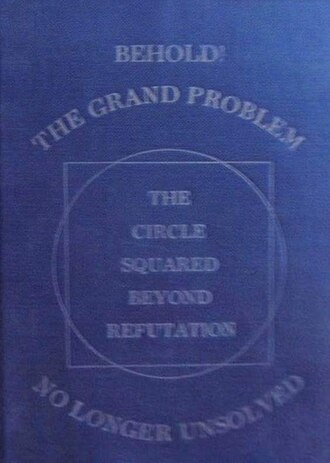
The mathematical crank Carl Theodore Heisel also claimed to have squared the circle in his 1934 book, "Behold! : the grand problem no longer unsolved: the circle squared beyond refutation."[44] Paul Halmos referred to the book as a "classic crank book."[45]
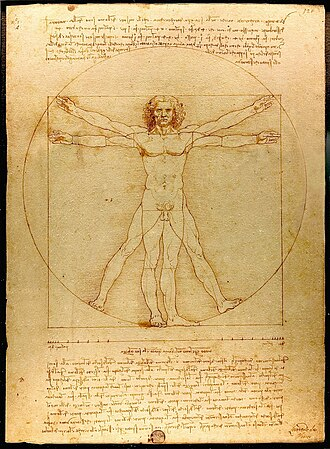
For Dante, squaring the circle represents a task beyond human comprehension, which he compares to his own inability to comprehend Paradise.[48] Dante's image also calls to mind a passage from Vitruvius, famously illustrated later in Leonardo da Vinci's Vitruvian Man, of a man simultaneously inscribed in a circle and a square.[49] Dante uses the circle as a symbol for God, and may have mentioned this combination of shapes in reference to the simultaneous divine and human nature of Jesus.[46][49] Earlier, in canto XIII, Dante calls out Greek circle-squarer Bryson as having sought knowledge instead of wisdom.[46]
SEE ALSO:
- Mrs. Miniver's problem – Problem on areas of intersecting circles
- Round square copula – Philosophical treatment of oxymorons
- Squircle – Shape between a square and a circle
- Tarski's circle-squaring problem – Problem of cutting and reassembling a disk into a square
DOWNLOADED FROM WIKIPEDIA
Monday, February 09, 2026 04:17PM