SENATE




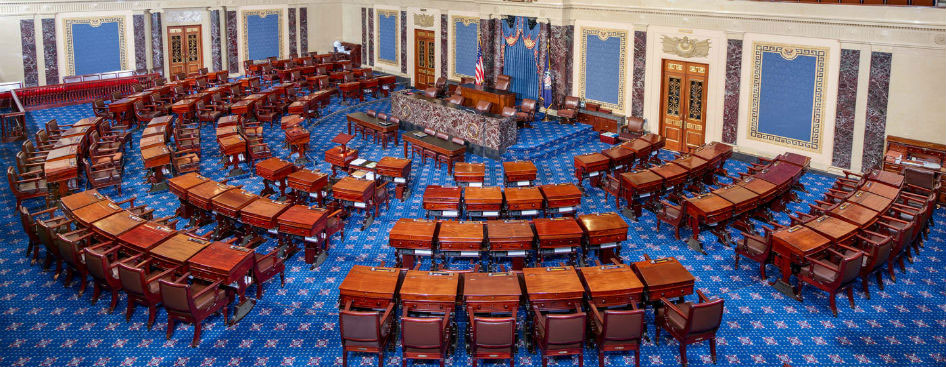
The United States Senate is a chamber of the bicameral United States Congress; it is the upper house, and the U.S. House of Representatives is the lower house. Together, the Senate and House have the authority under Article One of the Constitution to make and pass or defeat federal legislation.
The Senate has exclusive power to confirm U.S. presidential appointments, to approve or reject treaties, and to convict or exonerate impeachment cases brought by the House. The Senate and the House provide a check and balance on the powers of the executive and judicial branches of government. The composition and powers of the Senate are established by Article One of the U.S. Constitution, which has been in effect since March 4, 1789.[2] Each of the 50 states is represented by two senators who serve staggered six-year terms, for a total of 100 members.[3]
From its inception in 1789 until 1913, senators were appointed by the state legislatures of their respective states. Since 1913, however, following ratification of the Seventeenth Amendment, senators have been elected by statewide popular vote.[4] The Senate has several powers of advice and consent. These include the approval of treaties, the confirmation of Cabinet secretaries, federal judges (including justices of the Supreme Court), flag officers, regulatory officials, ambassadors, other federal executive officials, and federal uniformed officers. If no candidate receives a majority of electors for vice president, the duty falls to the Senate to elect one of the top two recipients of electors to that office. The Senate conducts trials of officials who have been impeached by the House. The Senate has been considered both a more deliberative[5] and prestigious[6][7][8] body than the House of Representatives due to its longer terms, smaller size, and statewide constituencies, which historically led to a more collegial and less partisan atmosphere.[9]
The Senate chamber is located in the north wing of the Capitol Building in Washington, D.C., the nation's capital. Despite not being a senator, the vice president of the United States serves as ex officio presiding officer and president of the Senate; the vice president may vote only if the Senate is equally divided. In the vice president's absence, the president pro tempore, who is traditionally the most senior member of the Senate majority party, presides over the Senate, and more often by rule allows a junior senator to take the chair, guided by the parliamentarian. In the early 1920s, the practice of majority and minority parties electing their floor leaders began. The Senate's legislative and executive business is managed and scheduled by the Senate majority leader, who, on occasion, negotiates some matters with the Senate minority leader. A characteristic practice in the Senate is the filibuster on some matters and its remedy, the vote on cloture.

The drafters of the Constitution debated more about how to award representation in the Senate than about any other part of the Constitution.[10] While bicameralism and the idea of a proportional[c] "people's house" were widely popular, discussions about Senate representation proved contentious. In the end, some small states—unwilling to give up their equal power with larger states under the Articles of Confederation—threatened to secede[11] in 1787, and won the day by a vote of 5–4 in what became known as the Connecticut Compromise. The Connecticut Compromise provided, among other things, that each state—regardless of population—would be represented by two senators.[12]
First convened in 1789, the Senate of the United States was formed on the example of the ancient Roman Senate.
The name is derived from the senatus, Latin for council of elders, derived from senex, meaning old man in Latin.[13]
Article Five of the Constitution stipulates that no constitutional amendment may be created to deprive a state of its equal suffrage in the Senate without that state's consent.
The United States has had 50 states since 1959,[14] thus the Senate has had 100 senators since 1959.[15]
rk note: Then why are "territories given the rights of states?:
Before the adoption of the Seventeenth Amendment in 1913, senators were elected by the individual state legislatures.[16] Problems with repeated vacant seats due to the inability of a legislature to elect senators, intrastate political struggles, bribery and intimidation gradually led to a growing movement to amend the Constitution to allow for the direct election of senators.[17]
In contrast to the House of Representatives, the Senate has historically had stronger norms of conduct for its members.[18]
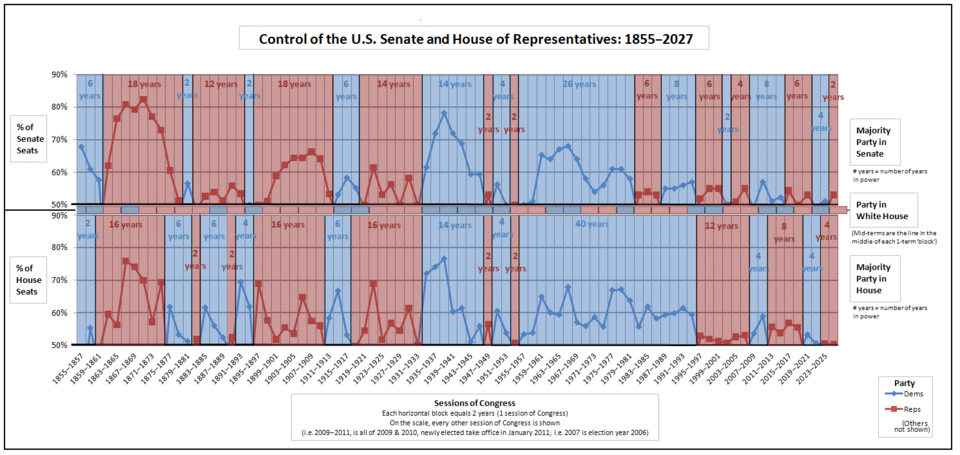
A graph of party control of the U.S. Senate, U.S. House of Representatives, and the Presidency since 1855
Senate approval is required to pass any federal legislation.
The Constitution provides several unique functions for the Senate that form its ability to "checks and balances" the powers of other elements of the federal government.
These include the requirement that
the Senate may advise and must consent to some of the president's government appointments;
also,
the Senate must consent to all treaties with foreign governments;
it tries all impeachments, and
it elects the vice president in the event
no person gets a majority of the electoral votes.